Cambridge IGCSE Business Studies 0450 — 2007 May/June Paper 1 · Variant 1
0450/11/M/J/07 · 100 marks · ≈113 min
The question paper and its mark scheme, free to read here and free to download. This is Cambridge’s own paper, exactly as it was sat.
Question paper33 pages




Mark scheme12 pages
Answers below. Sit the paper first if you are practising.
Paper as text
Question paper, page 1
Location Entry Codes From the June 2007 session, as part of CIE’s continual commitment to maintaining best practice in assessment, CIE has begun to use different variants of some question papers for our most popular assessments with extremely large and widespread candidature, The question papers are closely related and the relationships between them have been thoroughly established using our assessment expertise. All versions of the paper give assessment of equal standard. The content assessed by the examination papers and the type of questions are unchanged. This change means that for this component there are now two variant Question Papers, Mark Schemes and Principal Examiner’s Reports where previously there was only one. For any individual country, it is intended that only one variant is used. This document contains both variants which will give all Centres access to even more past examination material than is usually the case. The diagram shows the relationship between the Question Papers, Mark Schemes and Principal Examiner’s Reports. Question Paper Mark Scheme Principal Examiner’s Report Introduction Introduction Introduction First variant Question Paper First variant Mark Scheme First variant Principal Examiner’s Report Second variant Question Paper Second variant Mark Scheme Second variant Principal Examiner’s Report Who can I contact for further information on these changes? Please direct any questions about this to CIE’s Customer Services team at: international@cie.org.uk www.XtremePapers.com
Question paper, page 2
This document consists of 14 printed pages and 2 blank pages. SP (NH) T31508/3 © UCLES 2007 [Turn over UNIVERSITY OF CAMBRIDGE INTERNATIONAL EXAMINATIONS International General Certificate of Secondary Education READ THESE INSTRUCTIONS FIRST Write your Centre number, candidate number and name on all the work you hand in. Write in dark blue or black pen. Do not use staples, paper clips, highlighters, glue or correction fluid. DO NOT WRITE IN ANY BARCODES. Answer all questions. The businesses described in this question paper are entirely fictitious. At the end of the examination, fasten all your work securely together. The number of marks is given in brackets [ ] at the end of each question or part question. * 0 2 8 4 3 1 8 7 5 4 * BUSINESS STUDIES 0450/01 Paper 1 May/June 2007 1 hour 45 minutes Candidates answer on the Question Paper. No Additional Materials are required. For Examiner’s Use 1 2 3 4 5 Total P First variant Question Paper
Question paper, page 3
2 0450/01/M/J/07 For Examiner’s Use © UCLES 2007 1 Country X has a mixed economy. It also has businesses in the primary, secondary and tertiary sectors. (a) Give an example of a business in: (i) The primary sector … … (ii) The tertiary sector … …[2] (b) Explain what is meant by the term ‘mixed economy’. … … … … … … … …[4] (c) All public limited companies have to hold an Annual General Meeting. Explain two functions (purposes) of such a meeting. Function 1: … … … … Function 2: … … … …[4] First variant Question Paper
Question paper, page 4
3 0450/01/M/J/07 [Turn over For Examiner’s Use © UCLES 2007 (d) A number of public limited companies in country X have recently failed and stopped trading. (i) Why do some companies fail? … … … … … … … …[4] (ii) Do you think that the government of country X should provide financial help to failing companies? Explain your answer. … … … … … … … … … … … …[6] First variant Question Paper
Question paper, page 5
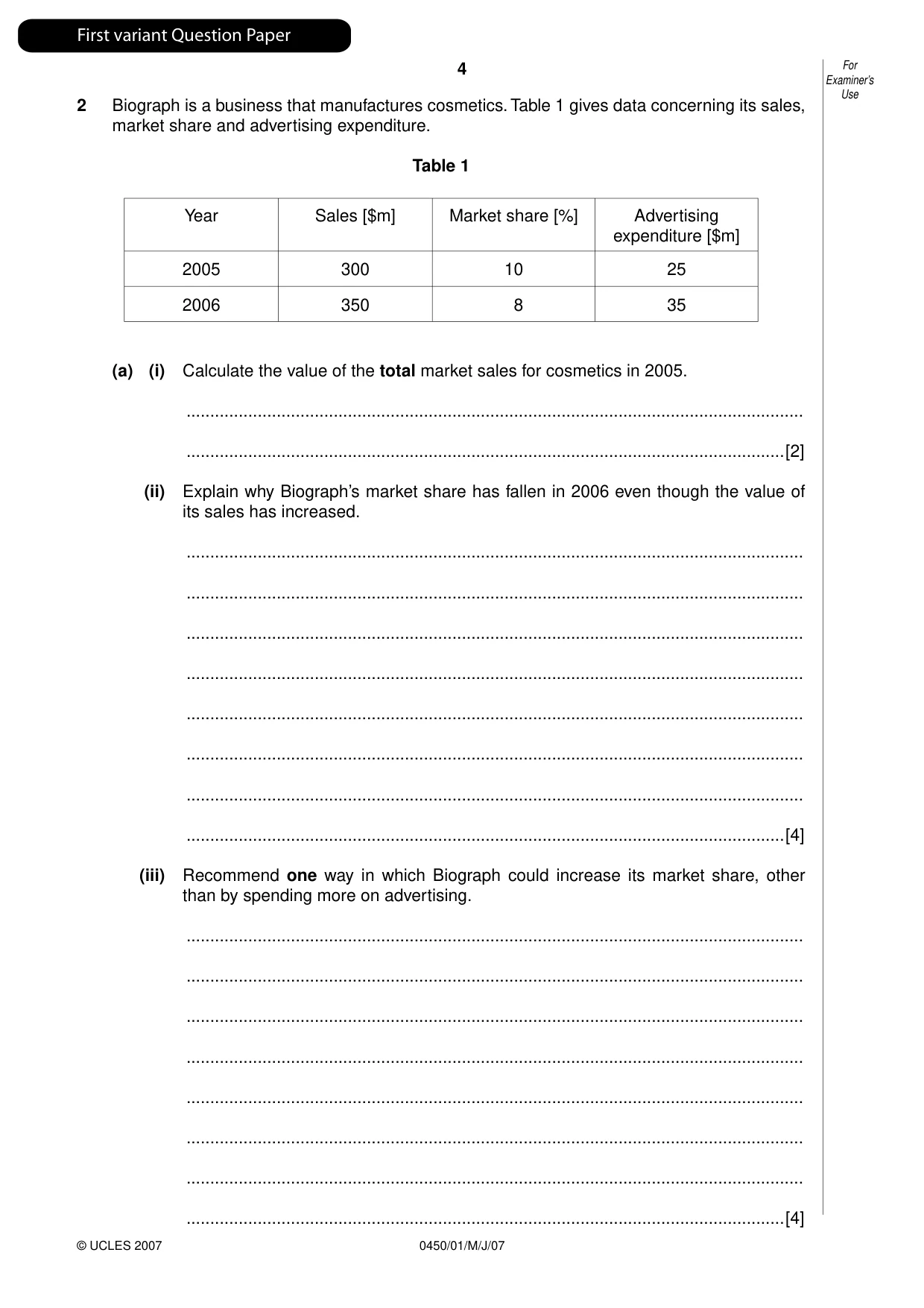
4 0450/01/M/J/07 For Examiner’s Use © UCLES 2007 2 Biograph is a business that manufactures cosmetics. Table 1 gives data concerning its sales, market share and advertising expenditure. Table 1 Year Sales [$m] Market share [%] Advertising expenditure [$m] 2005 300 10 25 2006 350 8 35 (a) (i) Calculate the value of the total market sales for cosmetics in 2005. … …[2] (ii) Explain why Biograph’s market share has fallen in 2006 even though the value of its sales has increased. … … … … … … … …[4] (iii) Recommend one way in which Biograph could increase its market share, other than by spending more on advertising. … … … … … … … …[4] First variant Question Paper
Question paper, page 6
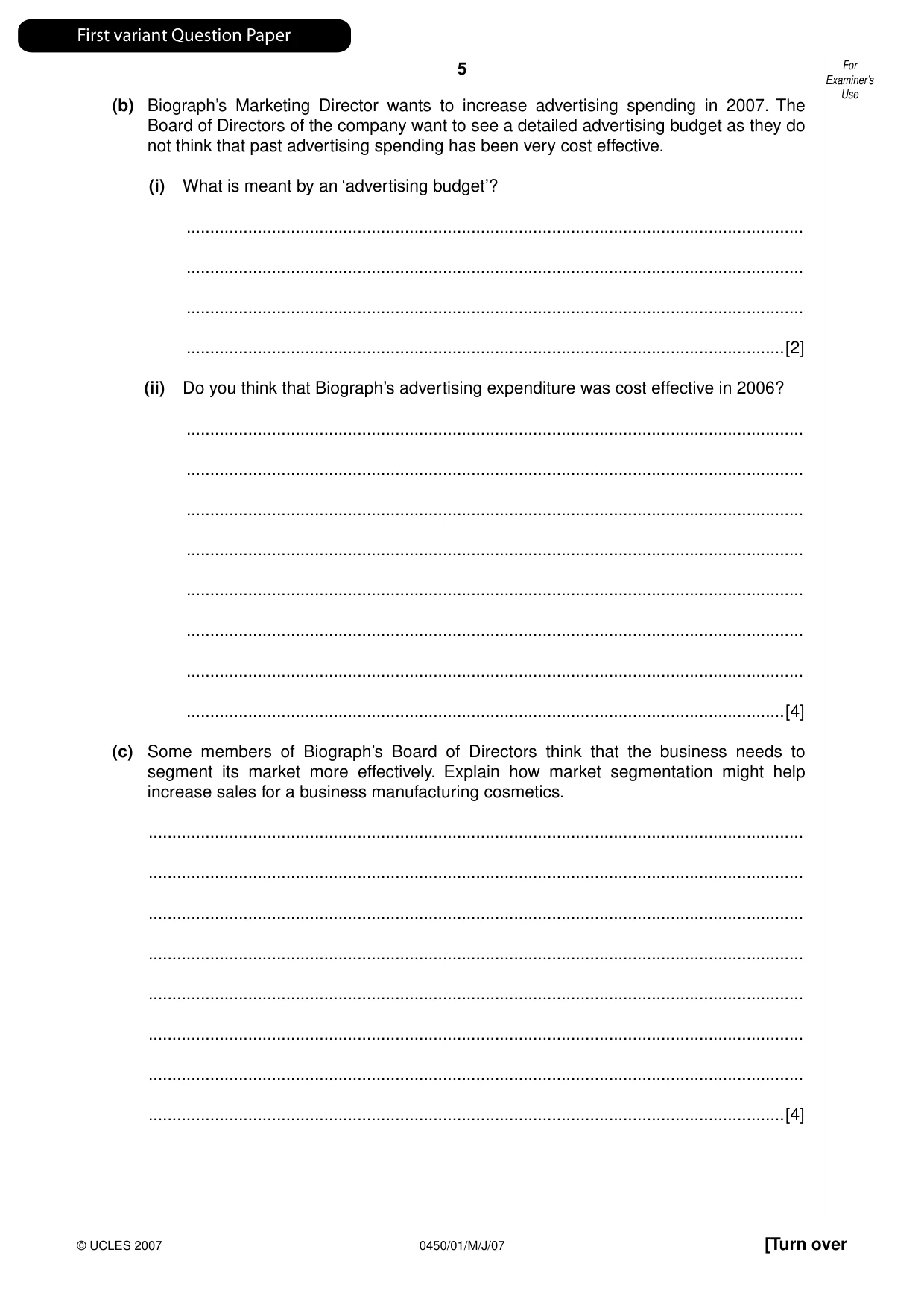
5 0450/01/M/J/07 [Turn over For Examiner’s Use © UCLES 2007 (b) Biograph’s Marketing Director wants to increase advertising spending in 2007. The Board of Directors of the company want to see a detailed advertising budget as they do not think that past advertising spending has been very cost effective. (i) What is meant by an ‘advertising budget’? … … … …[2] (ii) Do you think that Biograph’s advertising expenditure was cost effective in 2006? … … … … … … … …[4] (c) Some members of Biograph’s Board of Directors think that the business needs to segment its market more effectively. Explain how market segmentation might help increase sales for a business manufacturing cosmetics. … … … … … … … …[4] First variant Question Paper
Question paper, page 7
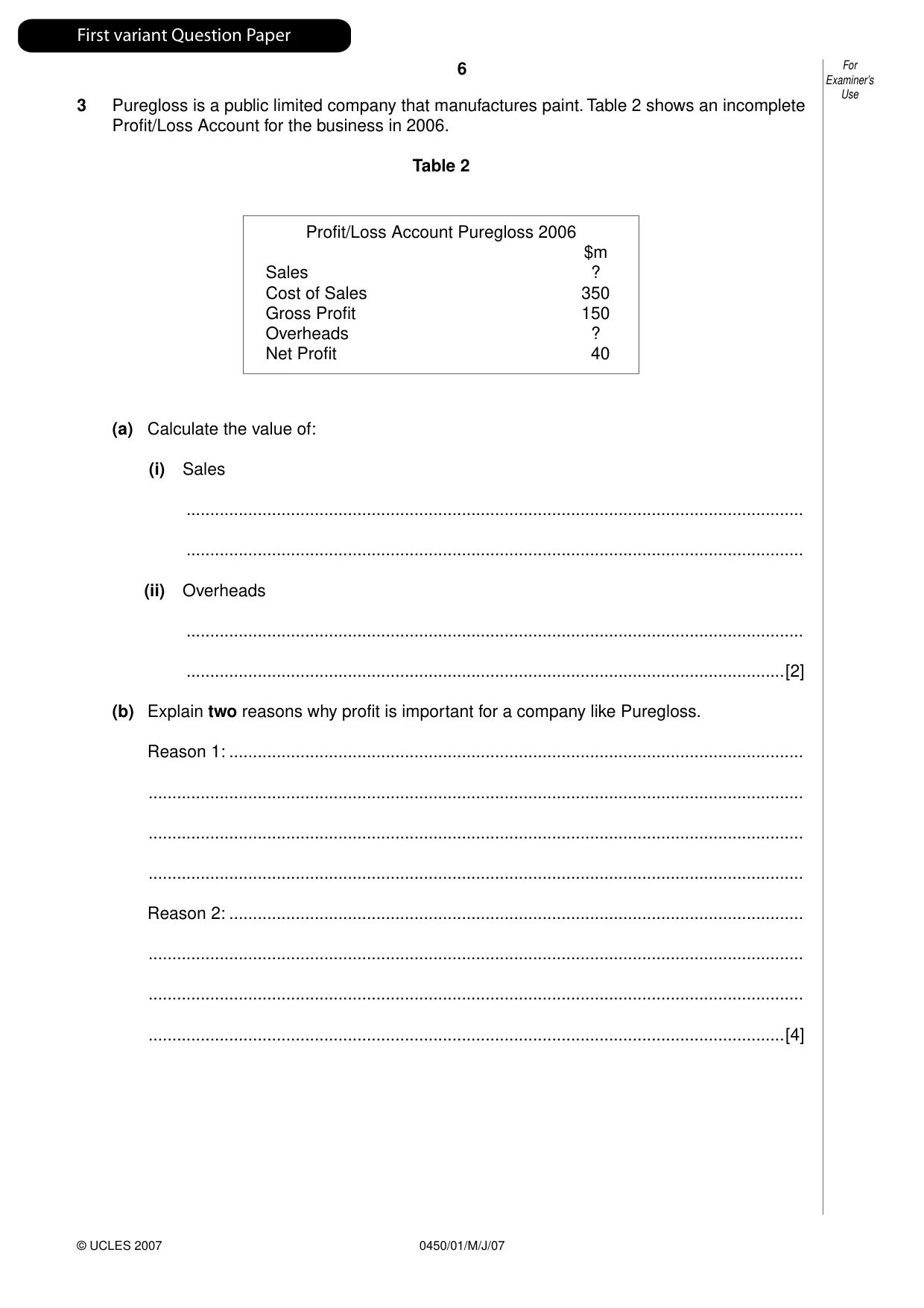
6 0450/01/M/J/07 For Examiner’s Use © UCLES 2007 3 Puregloss is a public limited company that manufactures paint. Table 2 shows an incomplete Profit/Loss Account for the business in 2006. Table 2 Profit/Loss Account Puregloss 2006 $m Sales ? Cost of Sales 350 Gross Profit 150 Overheads ? Net Profit 40 (a) Calculate the value of: (i) Sales … … (ii) Overheads … …[2] (b) Explain two reasons why profit is important for a company like Puregloss. Reason 1: … … … … Reason 2: … … … …[4] First variant Question Paper
Question paper, page 8
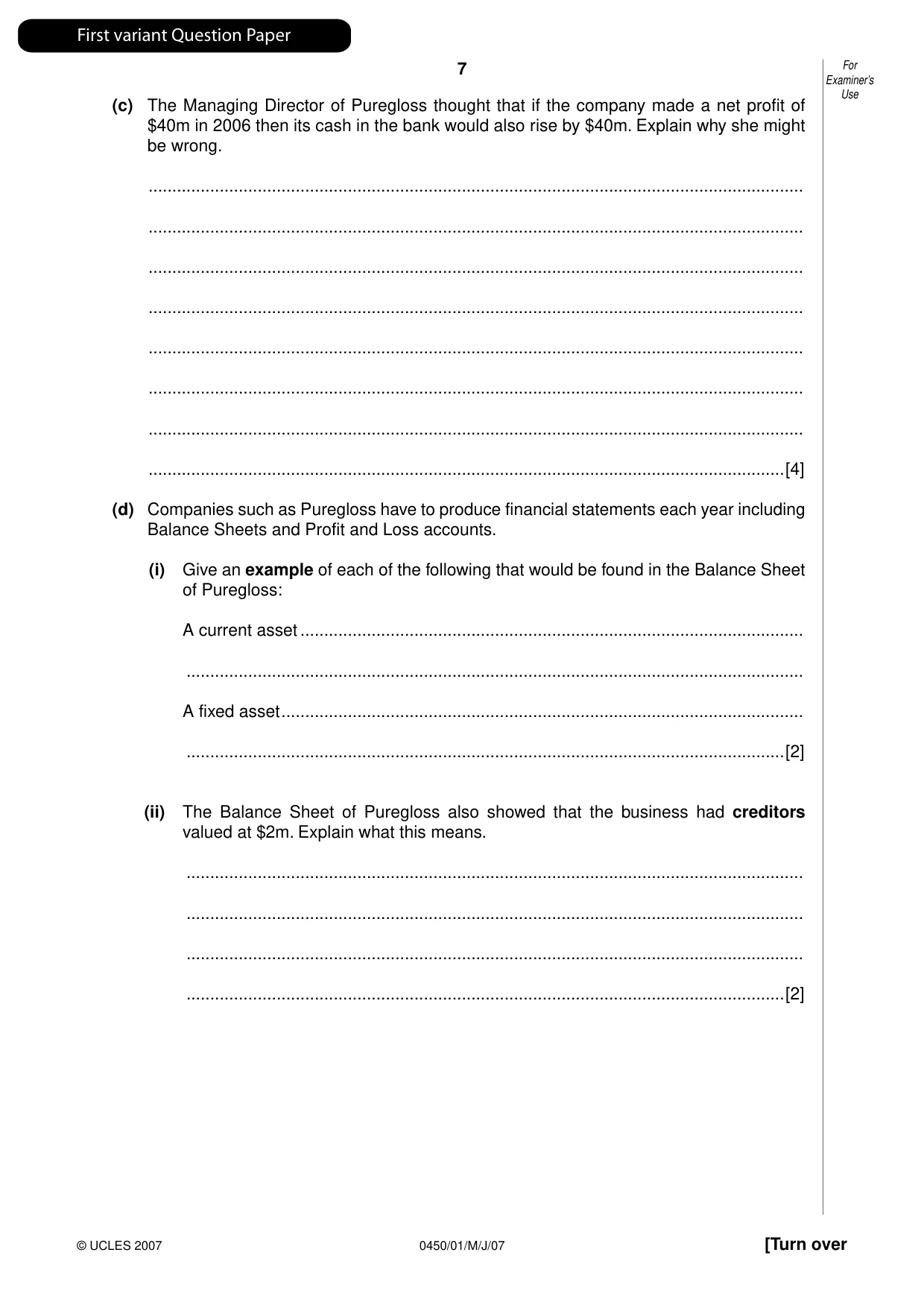
7 0450/01/M/J/07 [Turn over For Examiner’s Use © UCLES 2007 (c) The Managing Director of Puregloss thought that if the company made a net profit of $40m in 2006 then its cash in the bank would also rise by $40m. Explain why she might be wrong. … … … … … … … …[4] (d) Companies such as Puregloss have to produce financial statements each year including Balance Sheets and Profit and Loss accounts. (i) Give an example of each of the following that would be found in the Balance Sheet of Puregloss: A current asset … … A fixed asset … …[2] (ii) The Balance Sheet of Puregloss also showed that the business had creditors valued at $2m. Explain what this means. … … … …[2] First variant Question Paper
Question paper, page 9
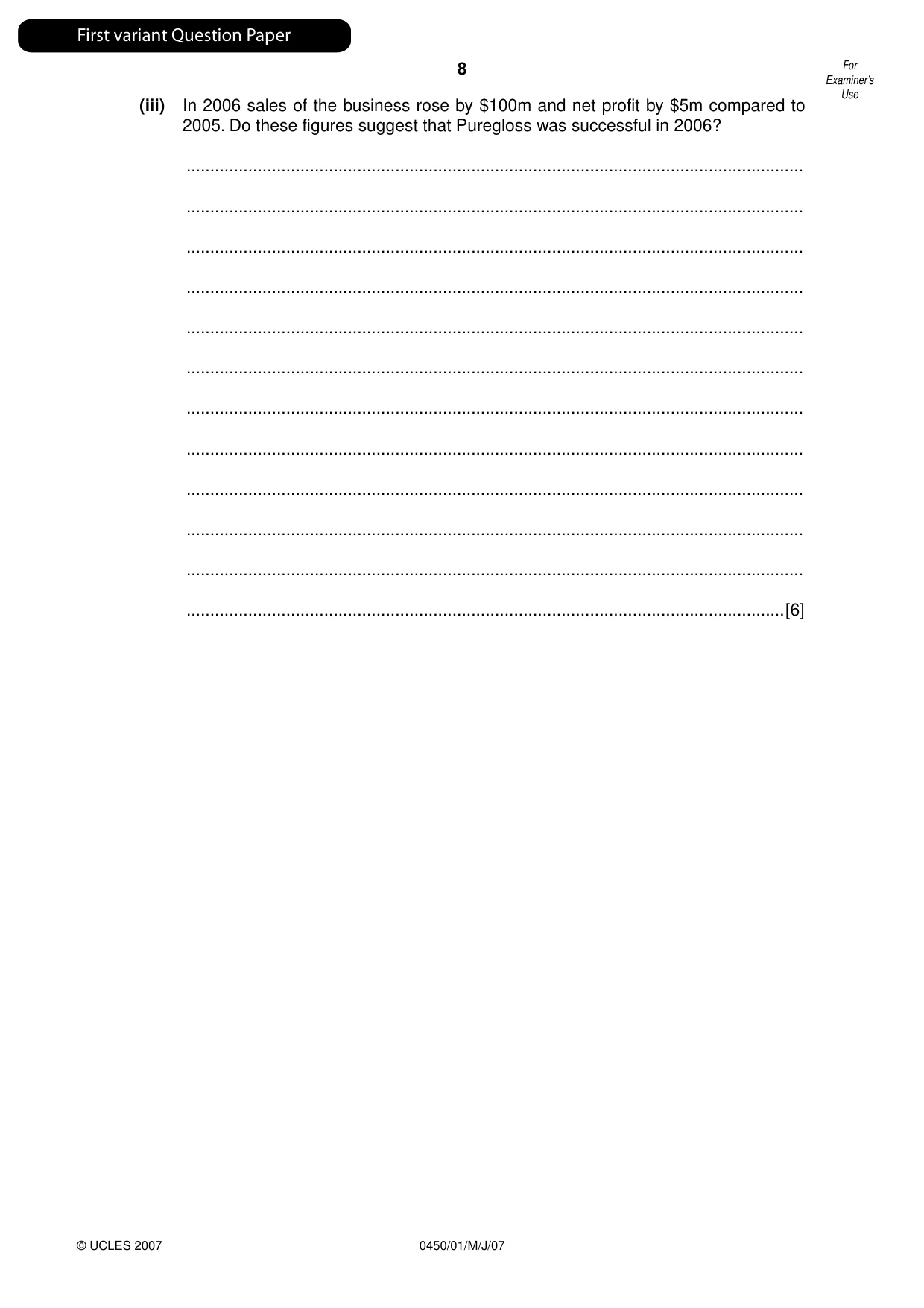
8 0450/01/M/J/07 For Examiner’s Use © UCLES 2007 (iii) In 2006 sales of the business rose by $100m and net profit by $5m compared to 2005. Do these figures suggest that Puregloss was successful in 2006? … … … … … … … … … … … …[6] First variant Question Paper
Question paper, page 10
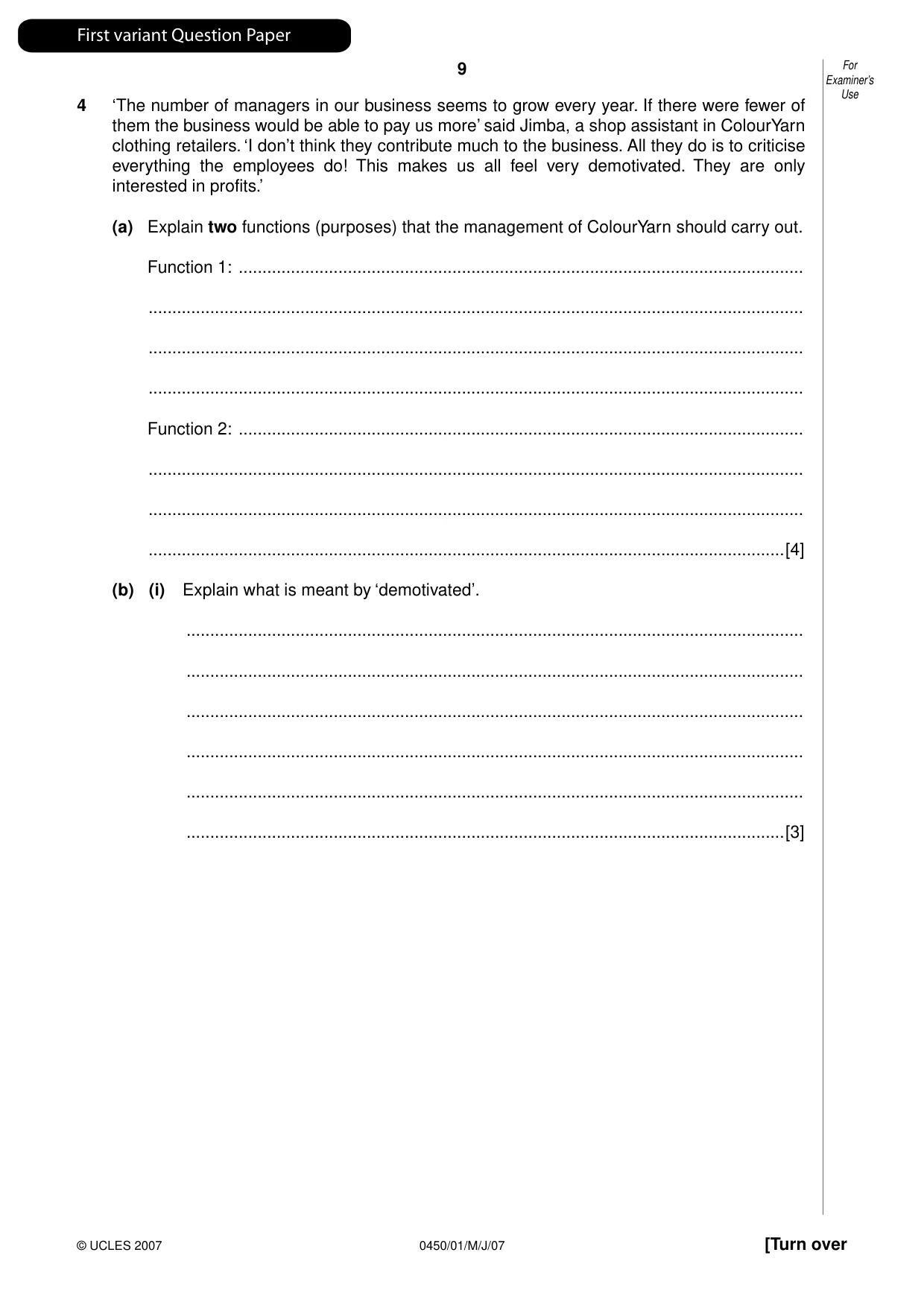
9 0450/01/M/J/07 [Turn over For Examiner’s Use © UCLES 2007 4 ‘The number of managers in our business seems to grow every year. If there were fewer of them the business would be able to pay us more’ said Jimba, a shop assistant in ColourYarn clothing retailers. ‘I don’t think they contribute much to the business. All they do is to criticise everything the employees do! This makes us all feel very demotivated. They are only interested in profits.’ (a) Explain two functions (purposes) that the management of ColourYarn should carry out. Function 1: … … … … Function 2: … … … …[4] (b) (i) Explain what is meant by ‘demotivated’. … … … … … …[3] First variant Question Paper
Question paper, page 11
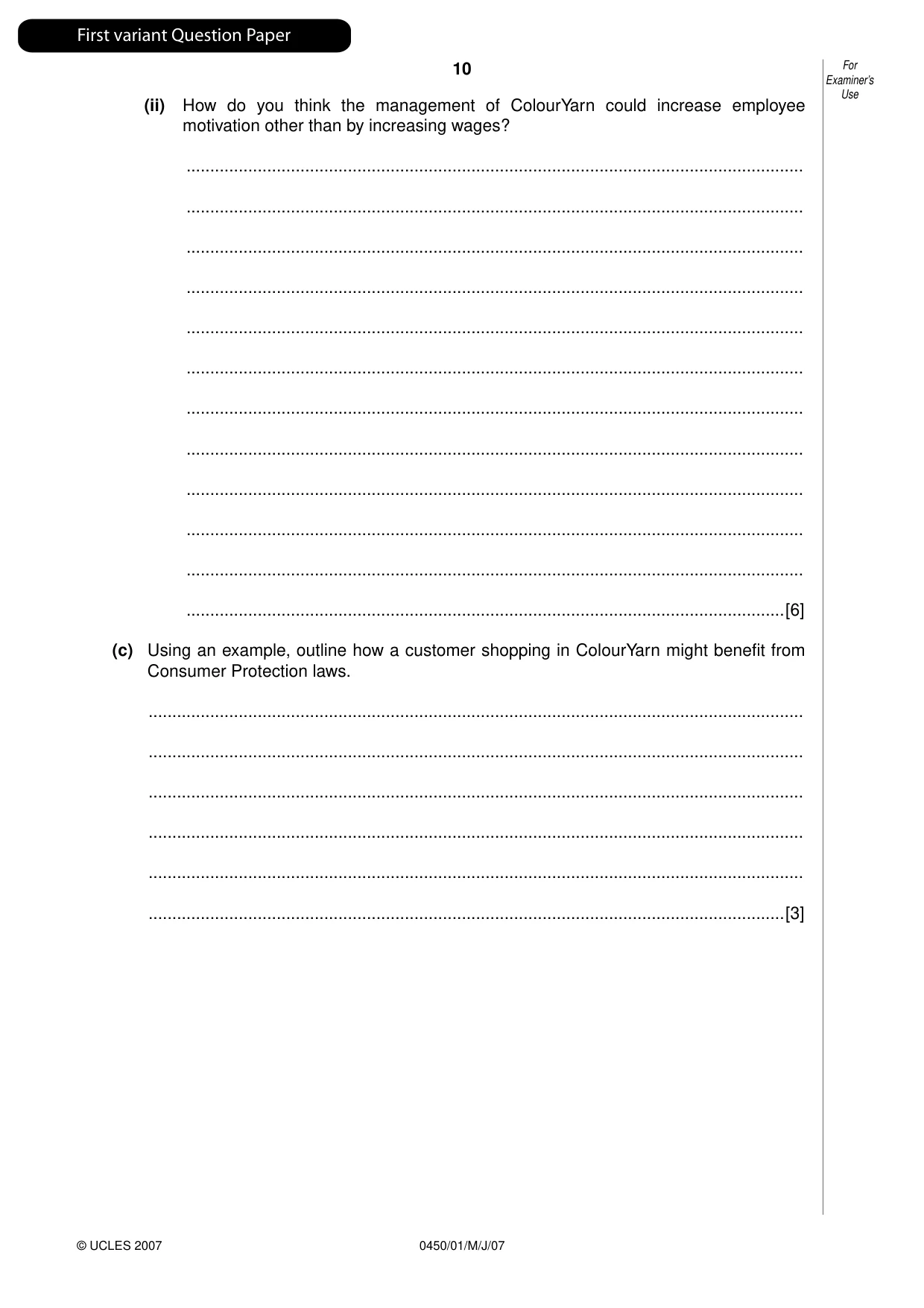
10 0450/01/M/J/07 For Examiner’s Use © UCLES 2007 (ii) How do you think the management of ColourYarn could increase employee motivation other than by increasing wages? … … … … … … … … … … … …[6] (c) Using an example, outline how a customer shopping in ColourYarn might benefit from Consumer Protection laws. … … … … … …[3] First variant Question Paper
Question paper, page 12
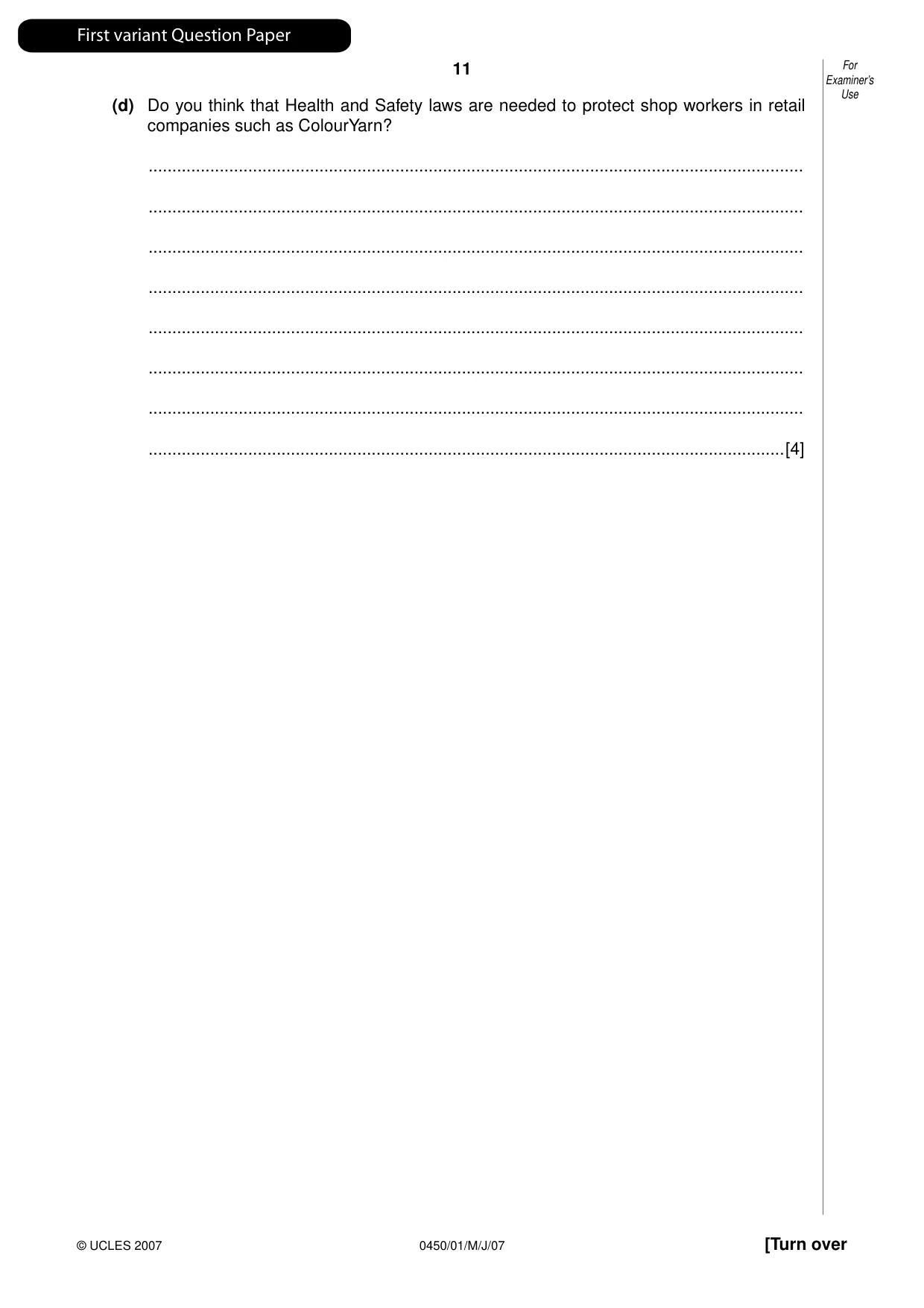
11 0450/01/M/J/07 [Turn over For Examiner’s Use © UCLES 2007 (d) Do you think that Health and Safety laws are needed to protect shop workers in retail companies such as ColourYarn? … … … … … … … …[4] First variant Question Paper
Question paper, page 13
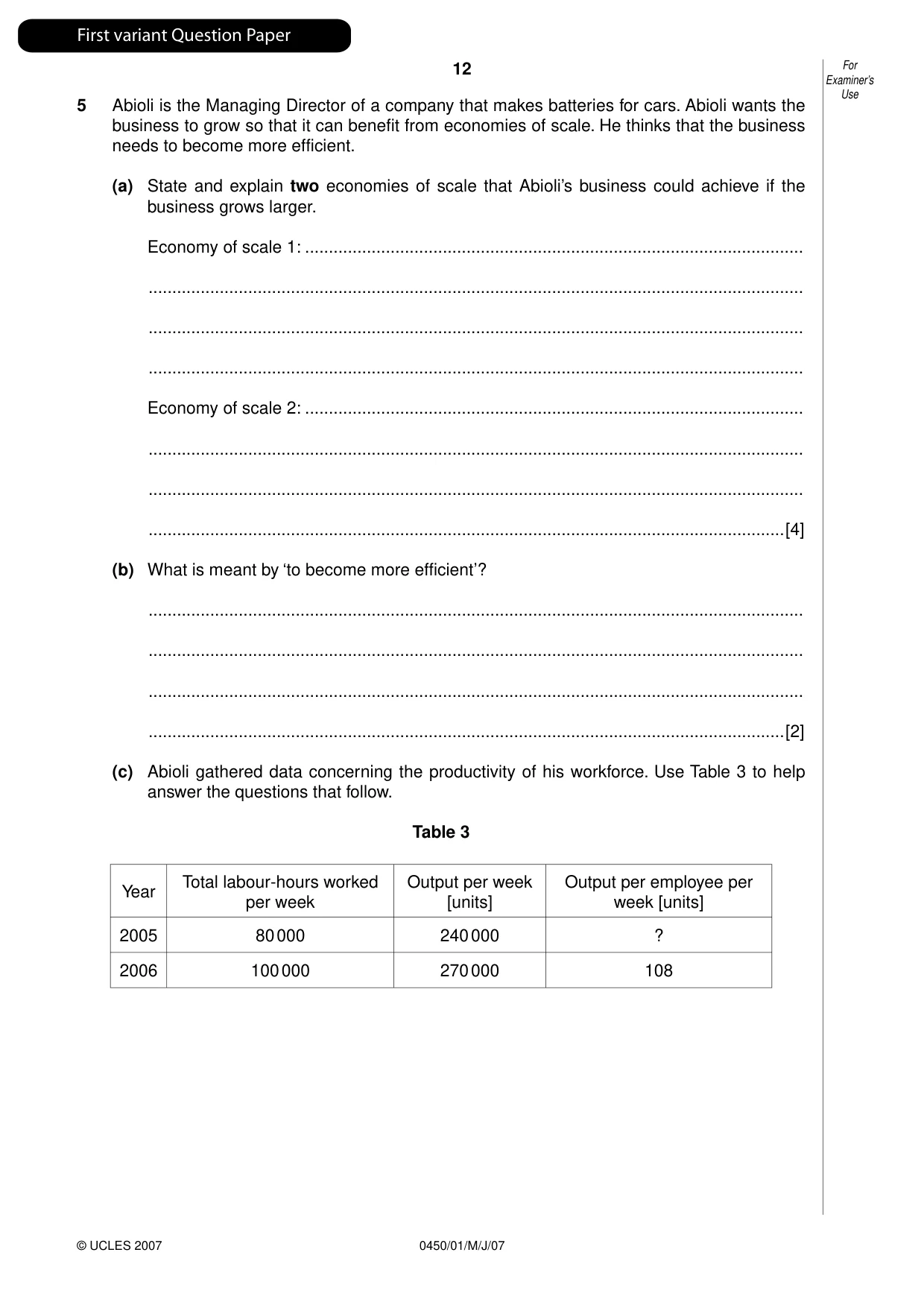
12 0450/01/M/J/07 For Examiner’s Use © UCLES 2007 5 Abioli is the Managing Director of a company that makes batteries for cars. Abioli wants the business to grow so that it can benefit from economies of scale. He thinks that the business needs to become more efficient. (a) State and explain two economies of scale that Abioli’s business could achieve if the business grows larger. Economy of scale 1: … … … … Economy of scale 2: … … … …[4] (b) What is meant by ‘to become more efficient’? … … … …[2] (c) Abioli gathered data concerning the productivity of his workforce. Use Table 3 to help answer the questions that follow. Table 3 Year Total labour-hours worked per week Output per week [units] Output per employee per week [units] 2005 80 000 240 000 ? 2006 100 000 270 000 108 First variant Question Paper
Question paper, page 14
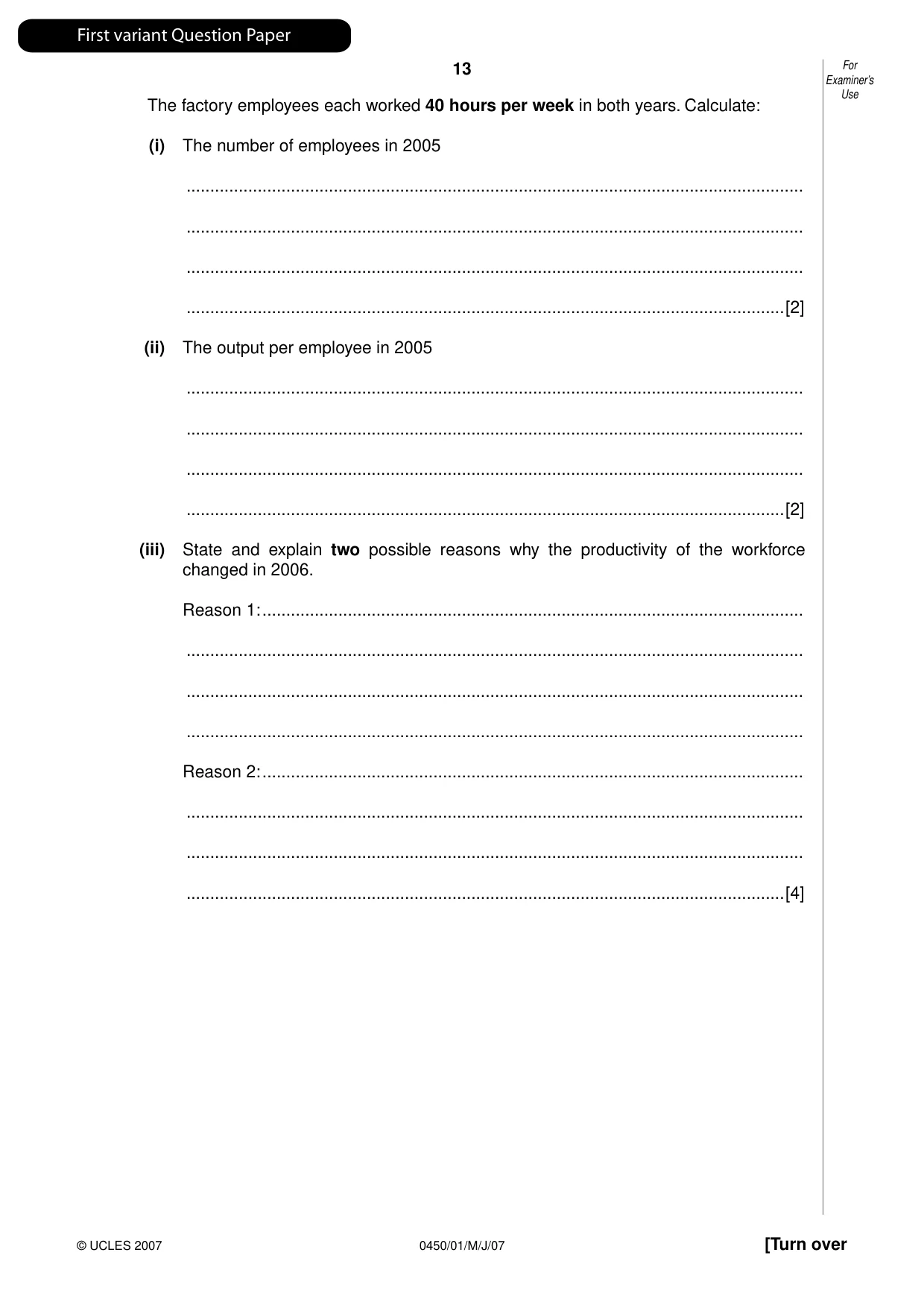
13 0450/01/M/J/07 [Turn over For Examiner’s Use © UCLES 2007 The factory employees each worked 40 hours per week in both years. Calculate: (i) The number of employees in 2005 … … … …[2] (ii) The output per employee in 2005 … … … …[2] (iii) State and explain two possible reasons why the productivity of the workforce changed in 2006. Reason 1: … … … … Reason 2: … … … …[4] First variant Question Paper
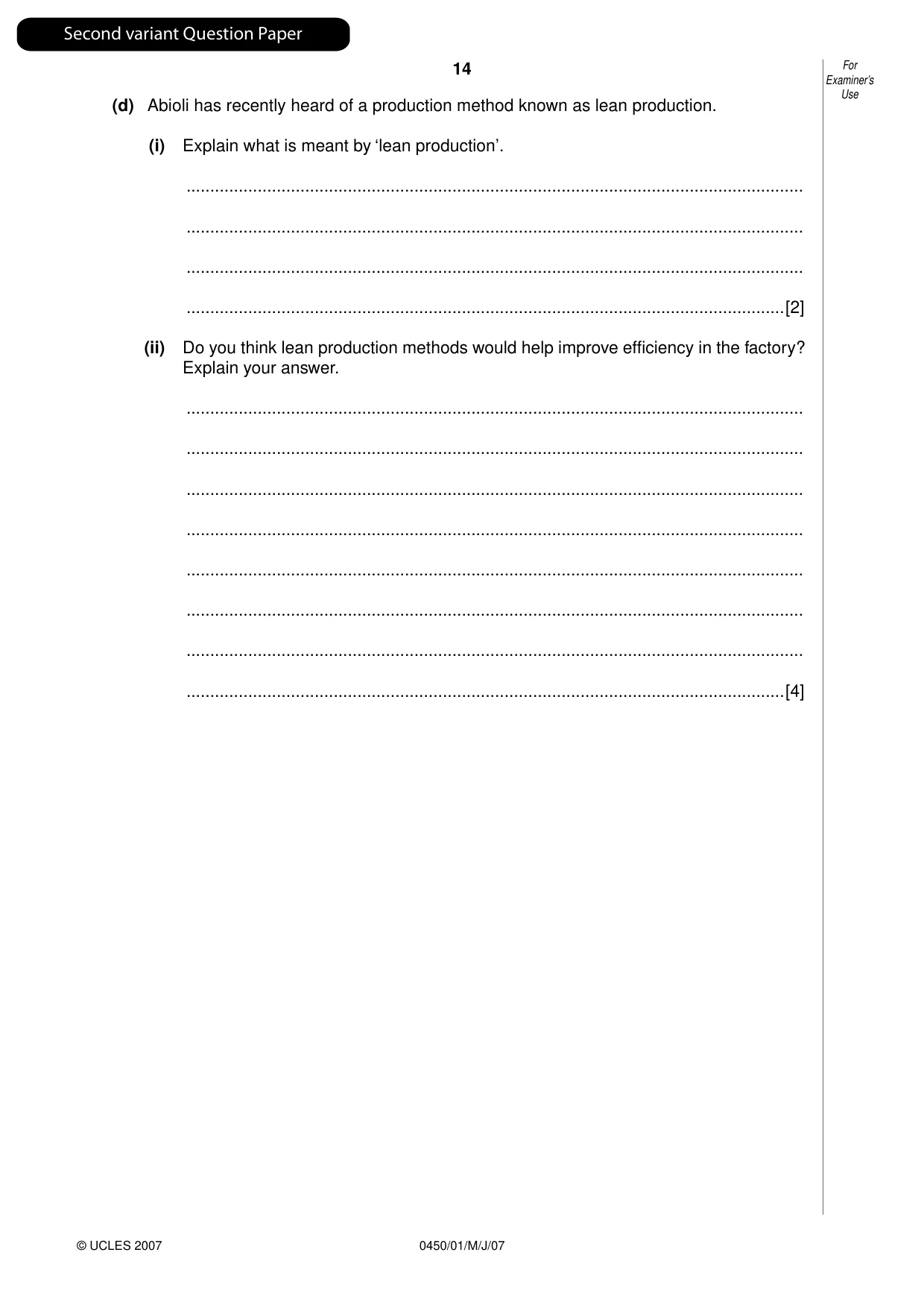
Question paper, page 15
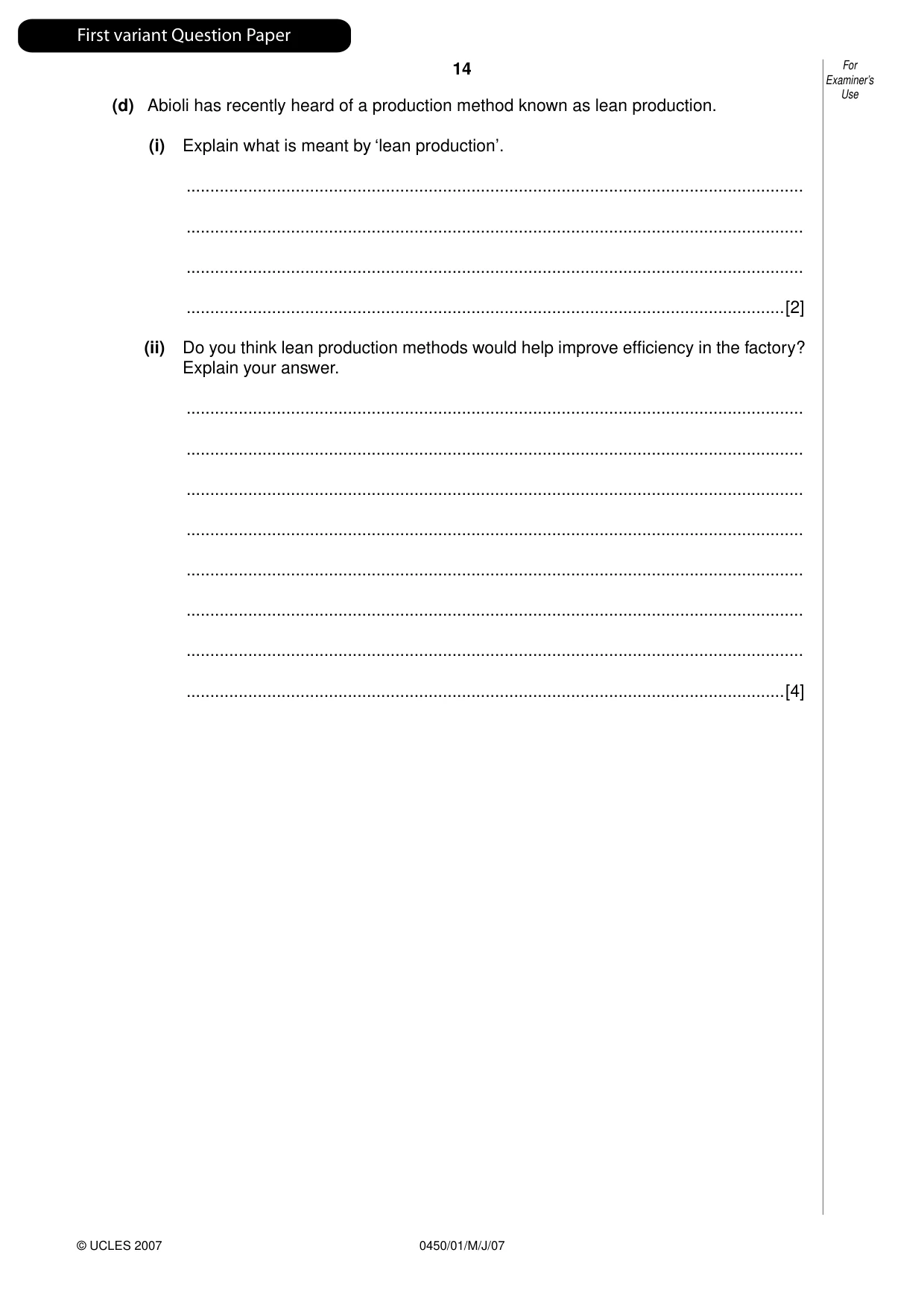
14 0450/01/M/J/07 For Examiner’s Use © UCLES 2007 (d) Abioli has recently heard of a production method known as lean production. (i) Explain what is meant by ‘lean production’. … … … …[2] (ii) Do you think lean production methods would help improve efficiency in the factory? Explain your answer. … … … … … … … …[4] First variant Question Paper
Question paper, page 16
15 0450/01/M/J/07 BLANK PAGE First variant Question Paper
Question paper, page 17
16 0450/01/M/J/07 BLANK PAGE Permission to reproduce items where third-party owned material protected by copyright is included has been sought and cleared where possible. Every reasonable effort has been made by the publisher (UCLES) to trace copyright holders, but if any items requiring clearance have unwittingly been included, the publisher will be pleased to make amends at the earliest possible opportunity. University of Cambridge International Examinations is part of the Cambridge Assessment Group. Cambridge Assessment is the brand name of University of Cambridge Local Examinations Syndicate (UCLES), which is itself a department of the University of Cambridge. First variant Question Paper
Question paper, page 18
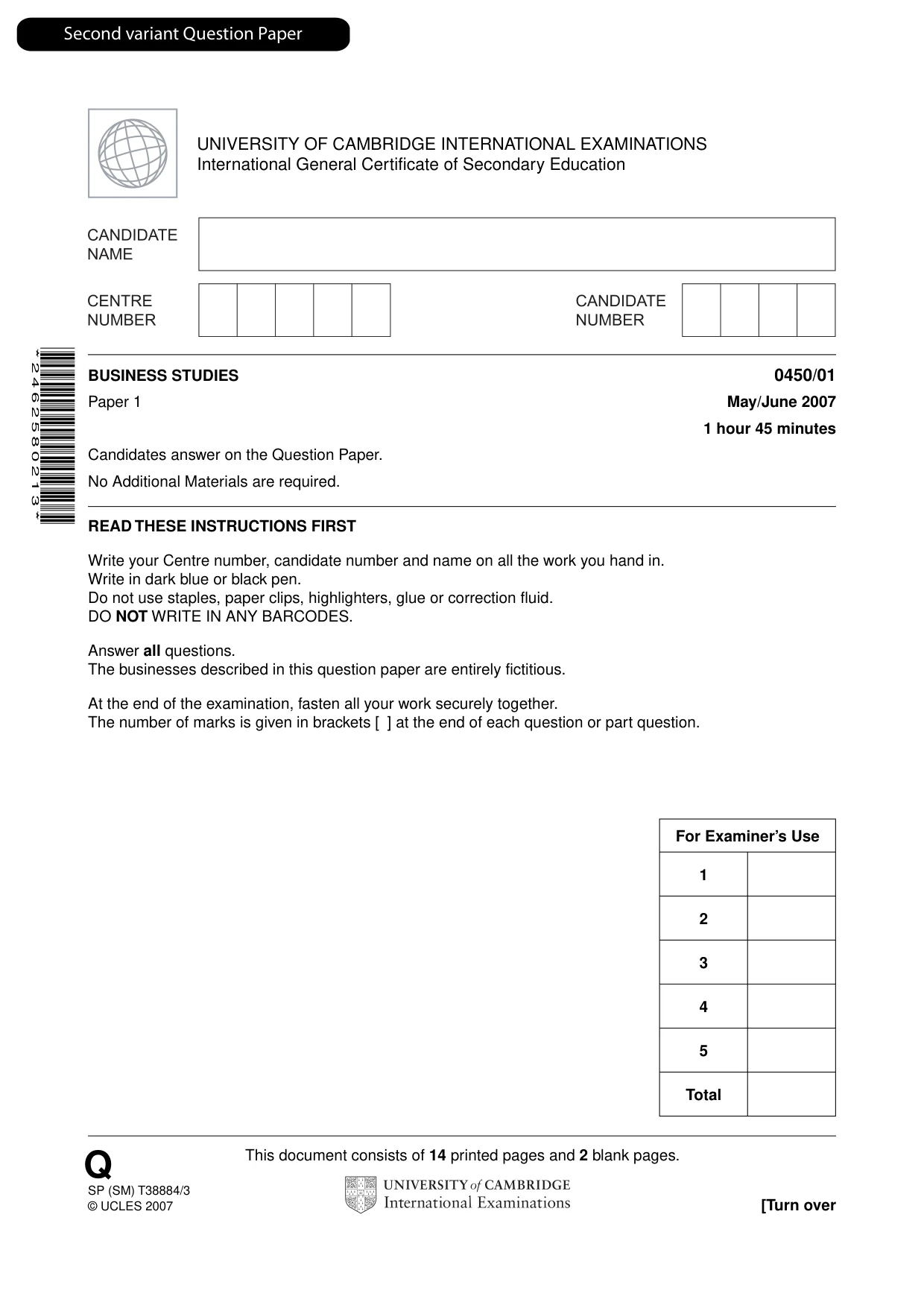
This document consists of 14 printed pages and 2 blank pages. SP (SM) T38884/3 © UCLES 2007 [Turn over UNIVERSITY OF CAMBRIDGE INTERNATIONAL EXAMINATIONS International General Certificate of Secondary Education READ THESE INSTRUCTIONS FIRST Write your Centre number, candidate number and name on all the work you hand in. Write in dark blue or black pen. Do not use staples, paper clips, highlighters, glue or correction fluid. DO NOT WRITE IN ANY BARCODES. Answer all questions. The businesses described in this question paper are entirely fictitious. At the end of the examination, fasten all your work securely together. The number of marks is given in brackets [ ] at the end of each question or part question. * 2 4 6 2 5 8 0 2 1 3 * BUSINESS STUDIES 0450/01 Paper 1 May/June 2007 1 hour 45 minutes Candidates answer on the Question Paper. No Additional Materials are required. For Examiner’s Use 1 2 3 4 5 Total Q Second variant Question Paper
Question paper, page 19
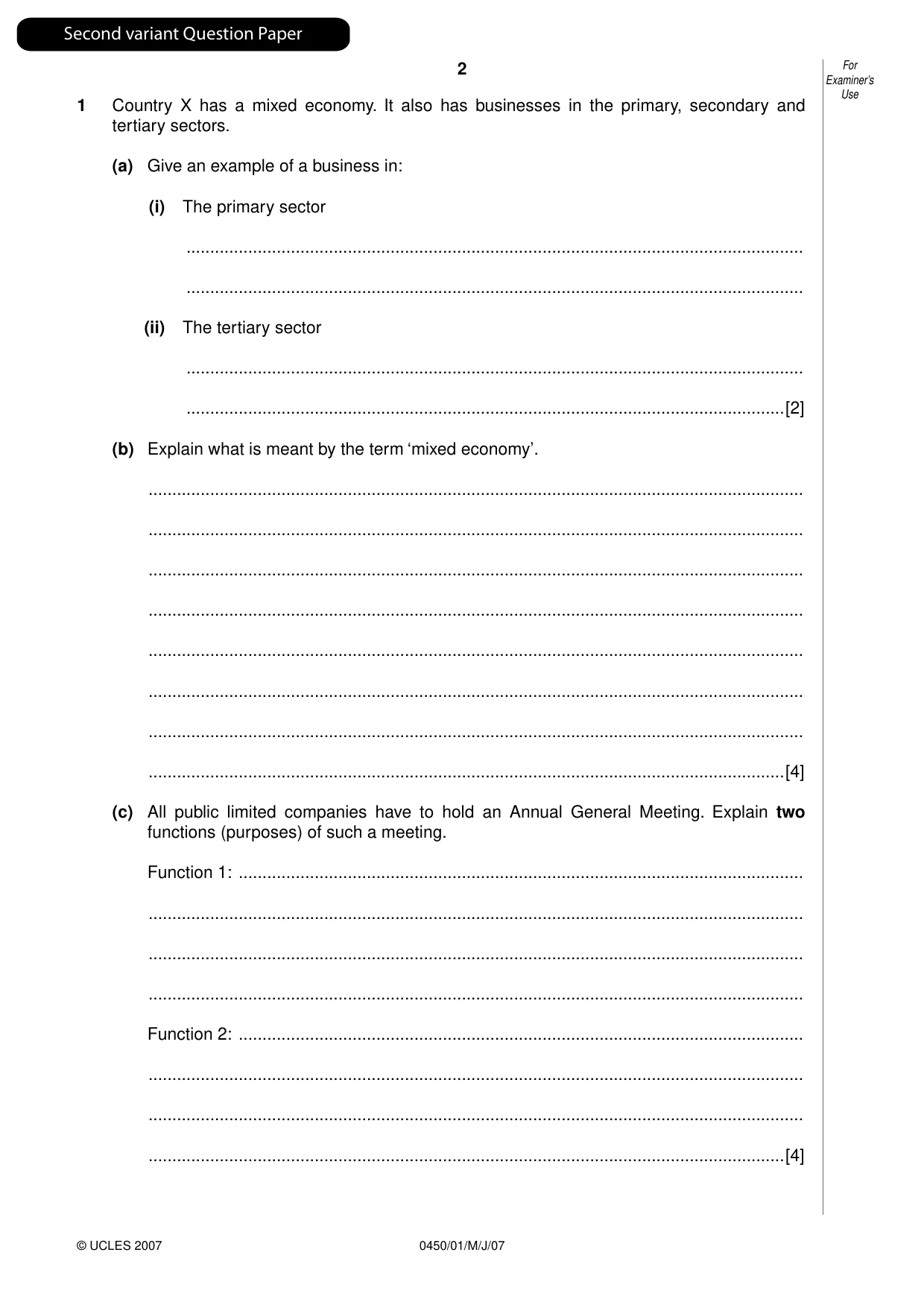
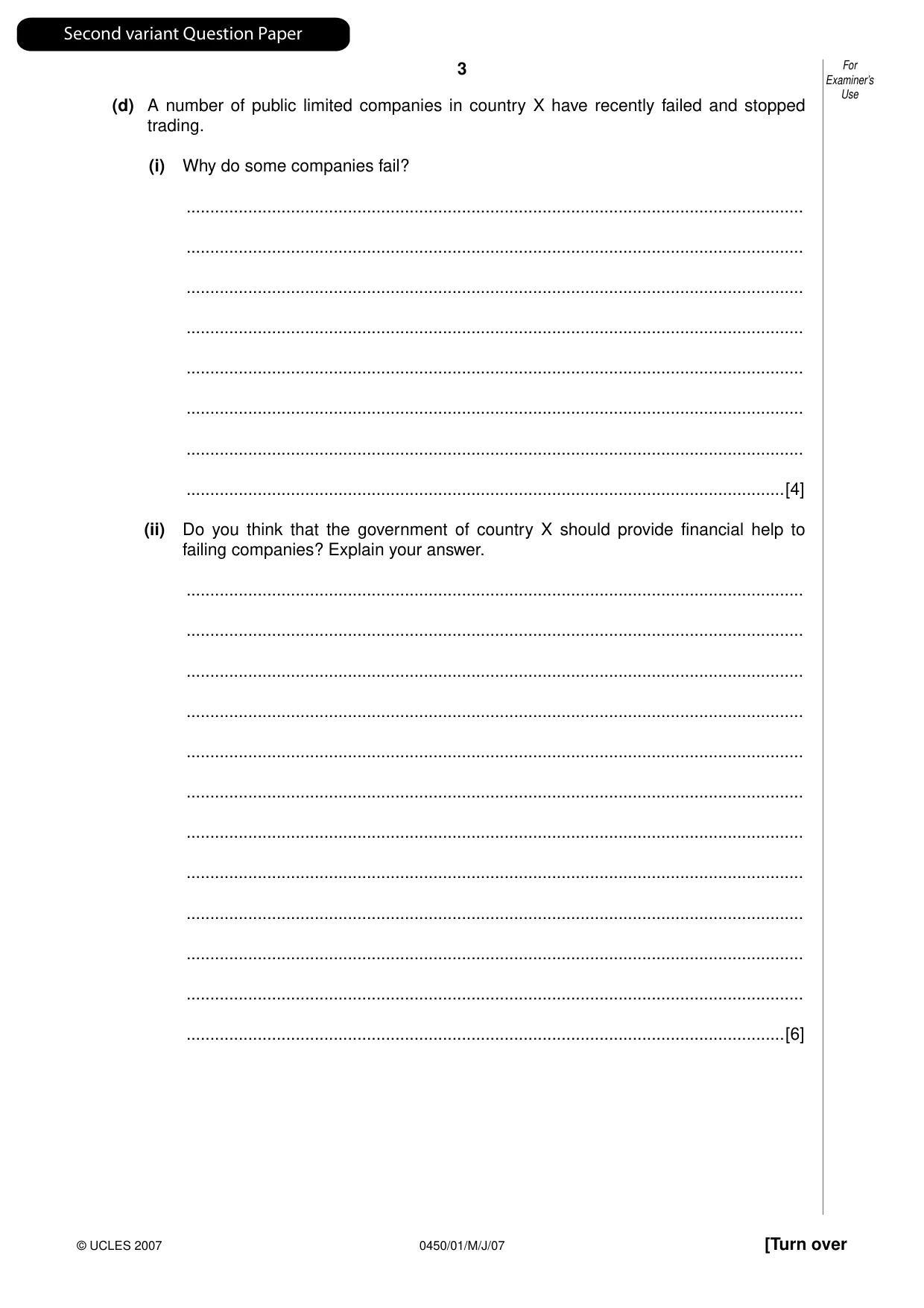
2 0450/01/M/J/07 For Examiner’s Use © UCLES 2007 1 Country X has a mixed economy. It also has businesses in the primary, secondary and tertiary sectors. (a) Give an example of a business in: (i) The primary sector … … (ii) The tertiary sector … …[2] (b) Explain what is meant by the term ‘mixed economy’. … … … … … … … …[4] (c) All public limited companies have to hold an Annual General Meeting. Explain two functions (purposes) of such a meeting. Function 1: … … … … Function 2: … … … …[4] Second variant Question Paper
Question paper, page 20
3 0450/01/M/J/07 [Turn over For Examiner’s Use © UCLES 2007 (d) A number of public limited companies in country X have recently failed and stopped trading. (i) Why do some companies fail? … … … … … … … …[4] (ii) Do you think that the government of country X should provide financial help to failing companies? Explain your answer. … … … … … … … … … … … …[6] Second variant Question Paper
Question paper, page 21
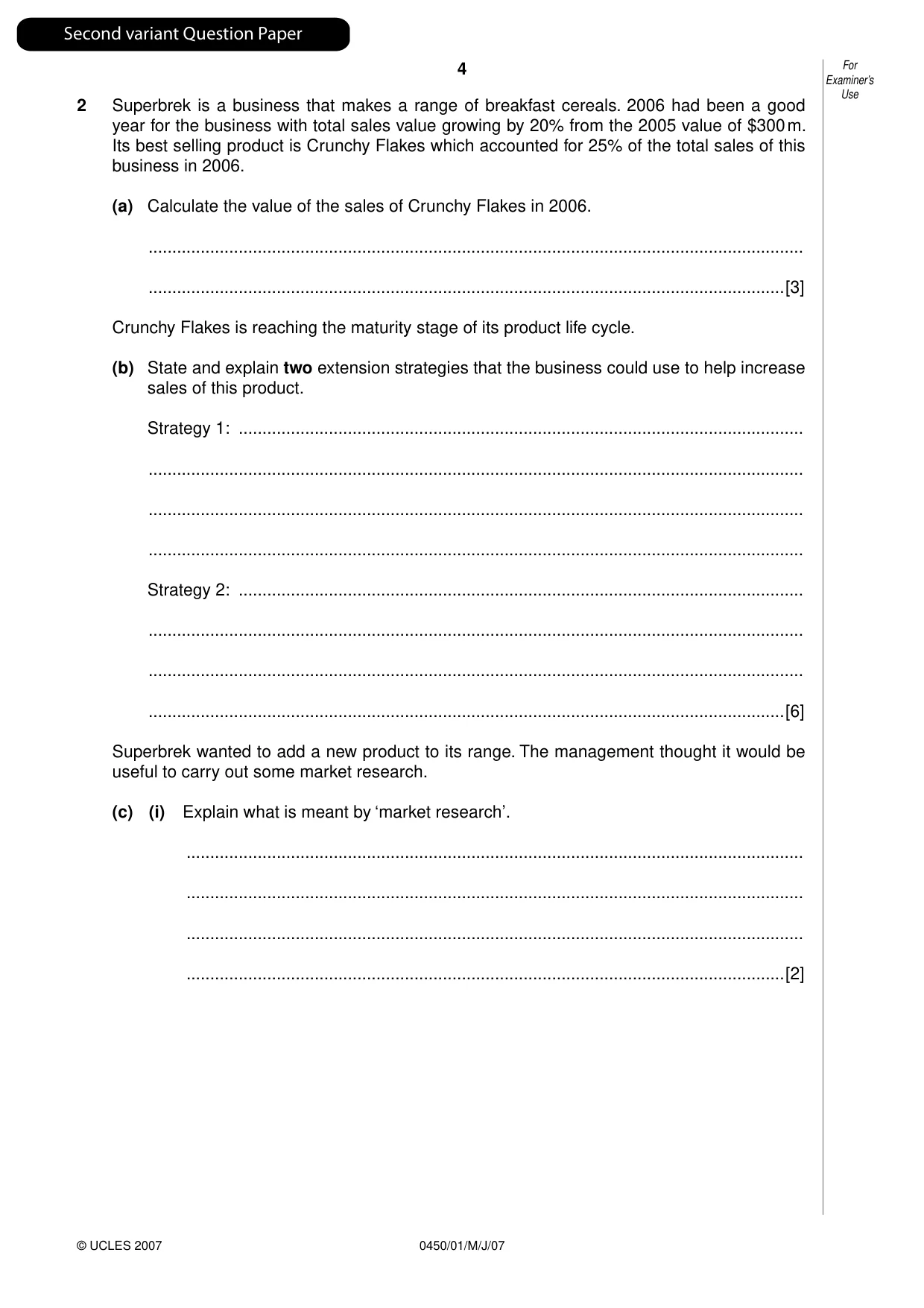
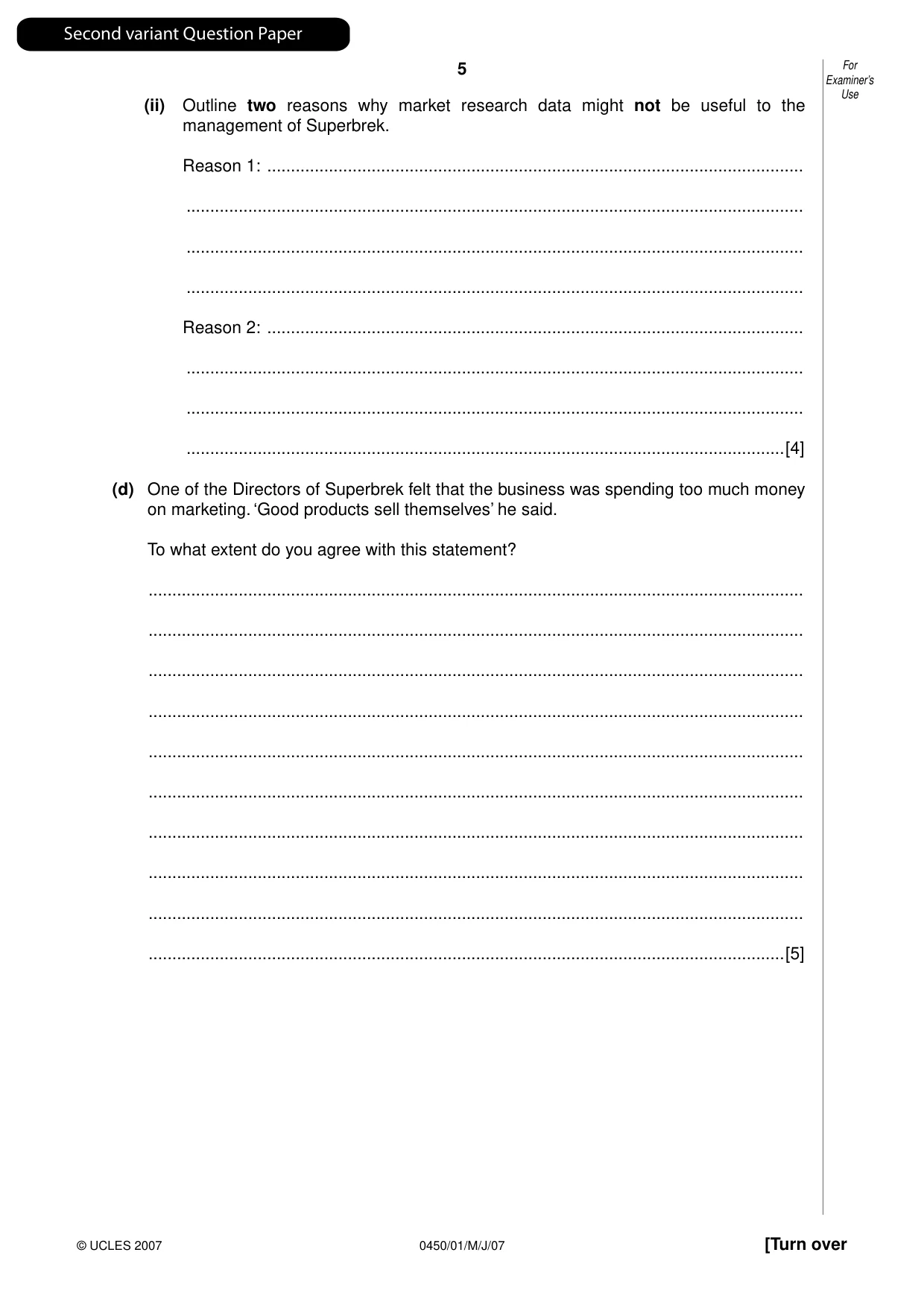
4 0450/01/M/J/07 For Examiner’s Use © UCLES 2007 2 Superbrek is a business that makes a range of breakfast cereals. 2006 had been a good year for the business with total sales value growing by 20% from the 2005 value of $300 m. Its best selling product is Crunchy Flakes which accounted for 25% of the total sales of this business in 2006. (a) Calculate the value of the sales of Crunchy Flakes in 2006. … …[3] Crunchy Flakes is reaching the maturity stage of its product life cycle. (b) State and explain two extension strategies that the business could use to help increase sales of this product. Strategy 1: … … … … Strategy 2: … … … …[6] Superbrek wanted to add a new product to its range. The management thought it would be useful to carry out some market research. (c) (i) Explain what is meant by ‘market research’. … … … …[2] Second variant Question Paper
Question paper, page 22
5 0450/01/M/J/07 [Turn over For Examiner’s Use © UCLES 2007 (ii) Outline two reasons why market research data might not be useful to the management of Superbrek. Reason 1: … … … … Reason 2: … … … …[4] (d) One of the Directors of Superbrek felt that the business was spending too much money on marketing. ‘Good products sell themselves’ he said. To what extent do you agree with this statement? … … … … … … … … … …[5] Second variant Question Paper
Question paper, page 23
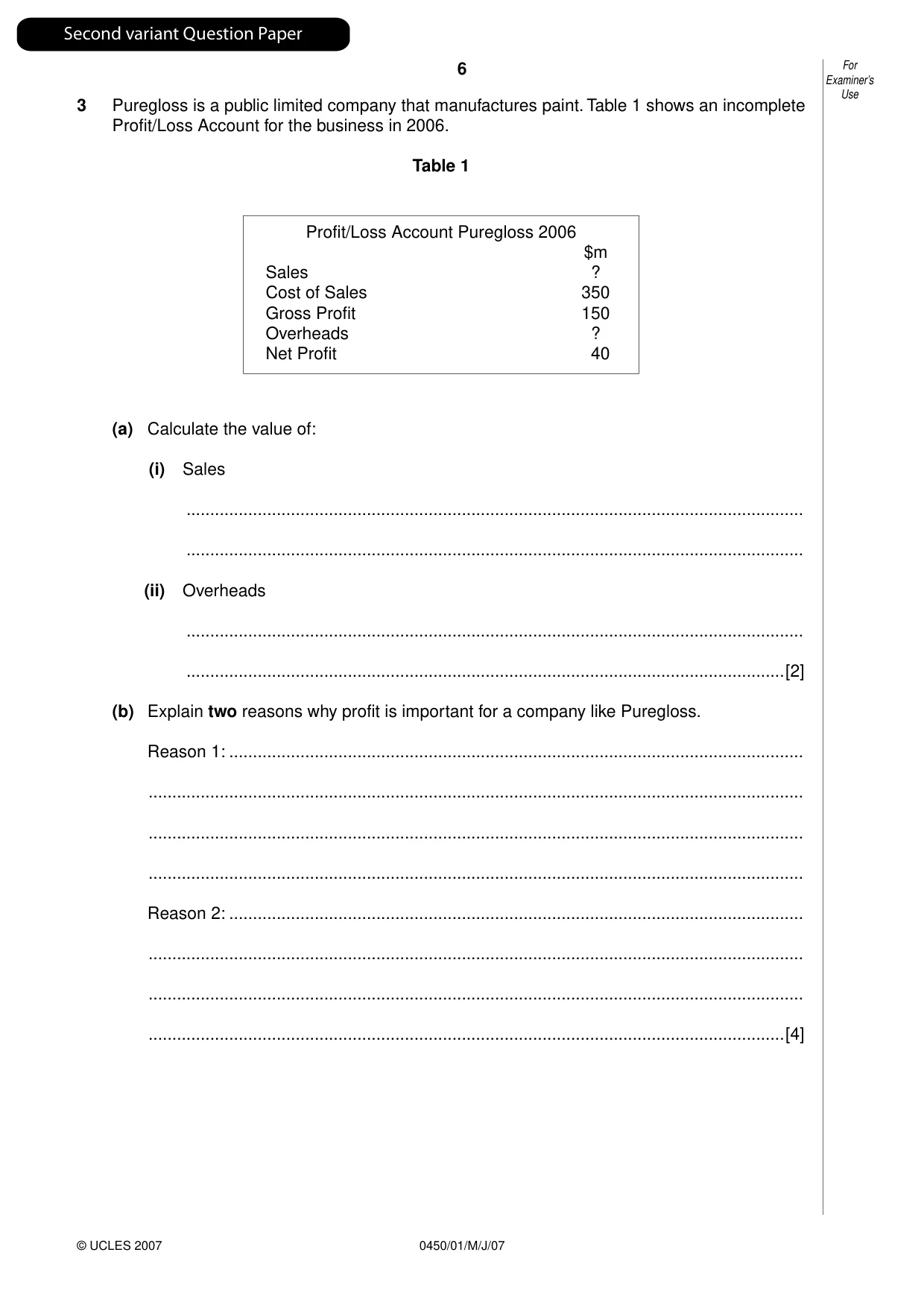
6 0450/01/M/J/07 For Examiner’s Use © UCLES 2007 3 Puregloss is a public limited company that manufactures paint. Table 1 shows an incomplete Profit/Loss Account for the business in 2006. Table 1 Profit/Loss Account Puregloss 2006 $m Sales ? Cost of Sales 350 Gross Profit 150 Overheads ? Net Profit 40 (a) Calculate the value of: (i) Sales … … (ii) Overheads … …[2] (b) Explain two reasons why profit is important for a company like Puregloss. Reason 1: … … … … Reason 2: … … … …[4] Second variant Question Paper
Question paper, page 24
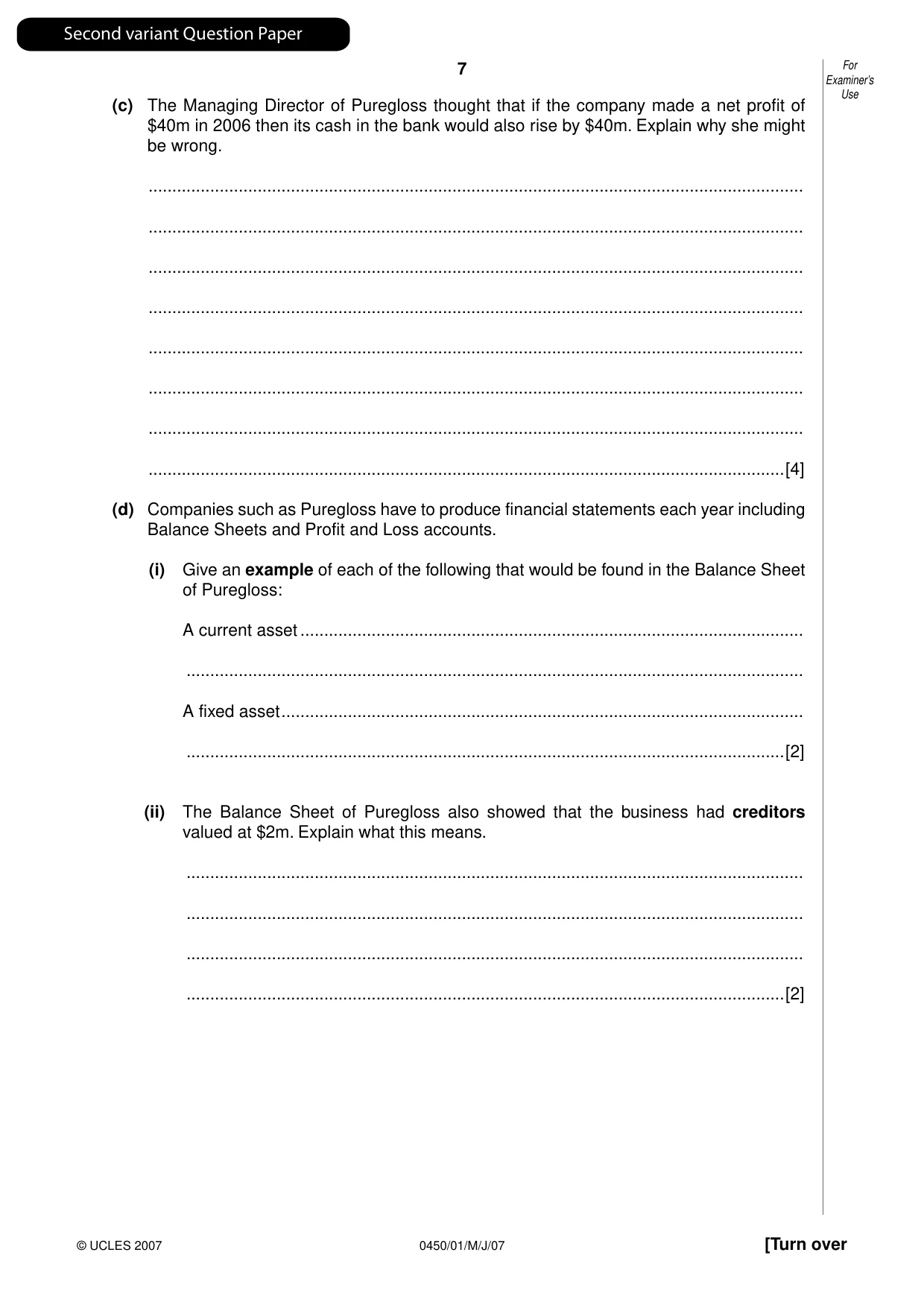
7 0450/01/M/J/07 [Turn over For Examiner’s Use © UCLES 2007 (c) The Managing Director of Puregloss thought that if the company made a net profit of $40m in 2006 then its cash in the bank would also rise by $40m. Explain why she might be wrong. … … … … … … … …[4] (d) Companies such as Puregloss have to produce financial statements each year including Balance Sheets and Profit and Loss accounts. (i) Give an example of each of the following that would be found in the Balance Sheet of Puregloss: A current asset … … A fixed asset … …[2] (ii) The Balance Sheet of Puregloss also showed that the business had creditors valued at $2m. Explain what this means. … … … …[2] Second variant Question Paper
Question paper, page 25
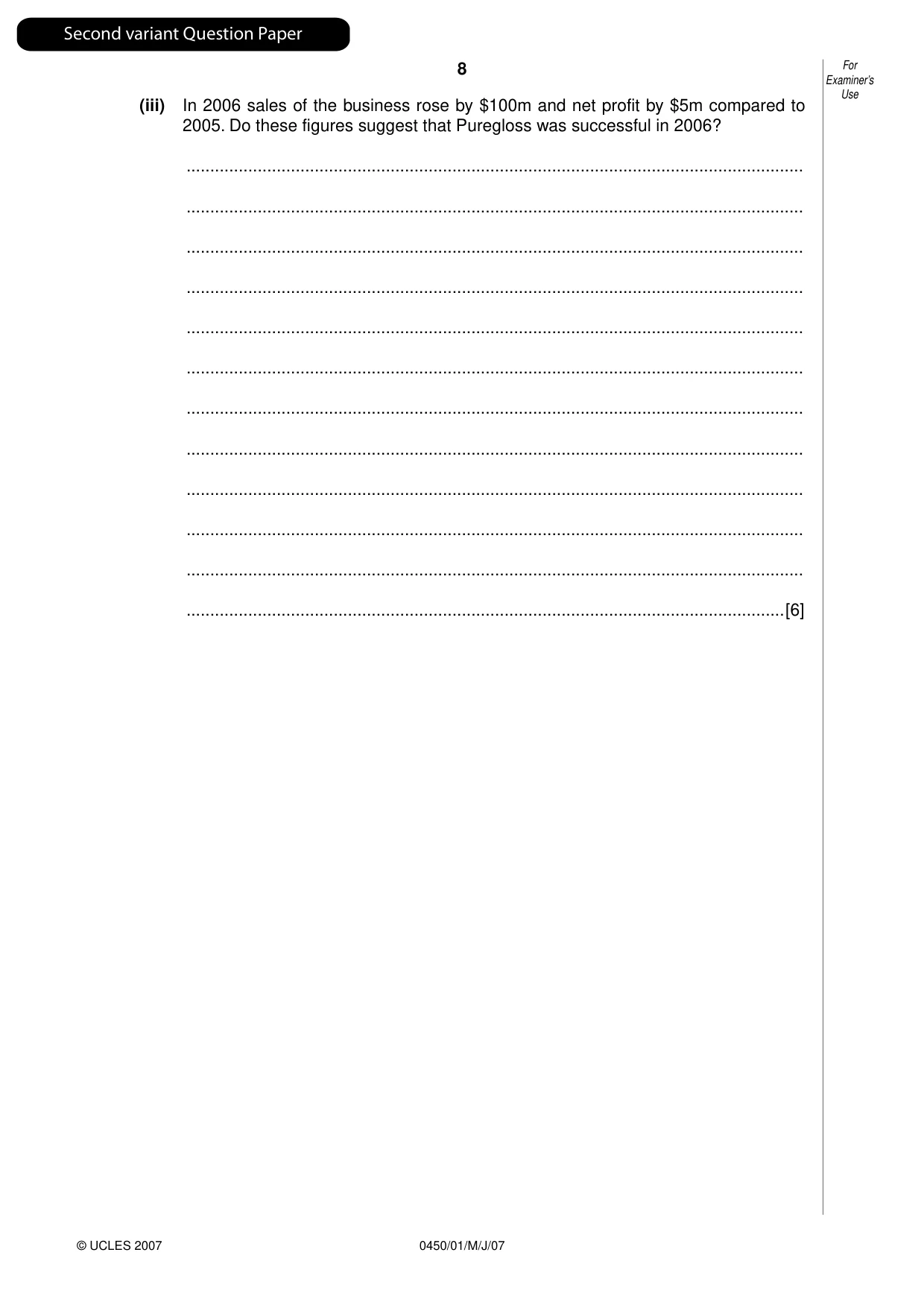
8 0450/01/M/J/07 For Examiner’s Use © UCLES 2007 (iii) In 2006 sales of the business rose by $100m and net profit by $5m compared to 2005. Do these figures suggest that Puregloss was successful in 2006? … … … … … … … … … … … …[6] Second variant Question Paper
Question paper, page 26
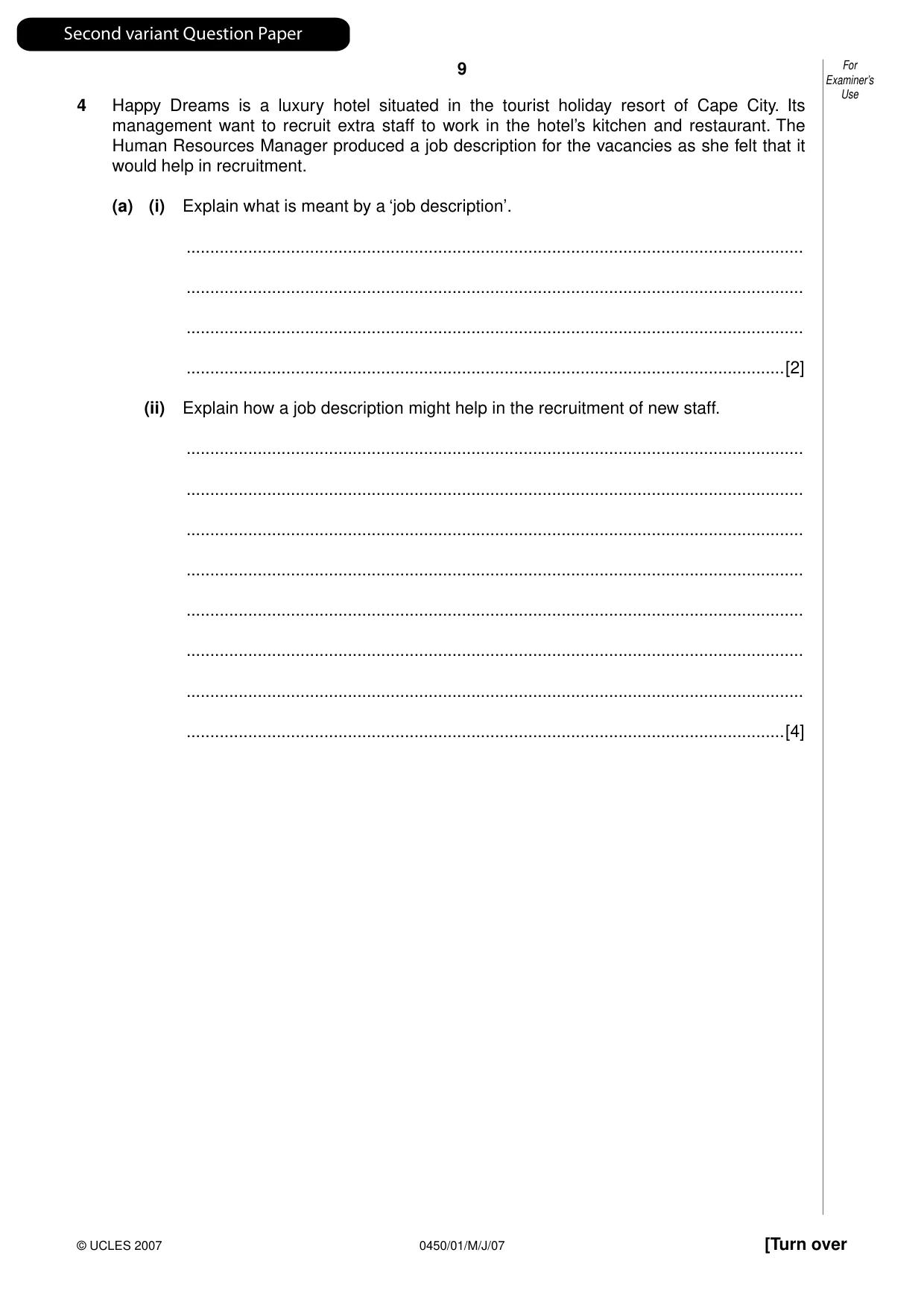
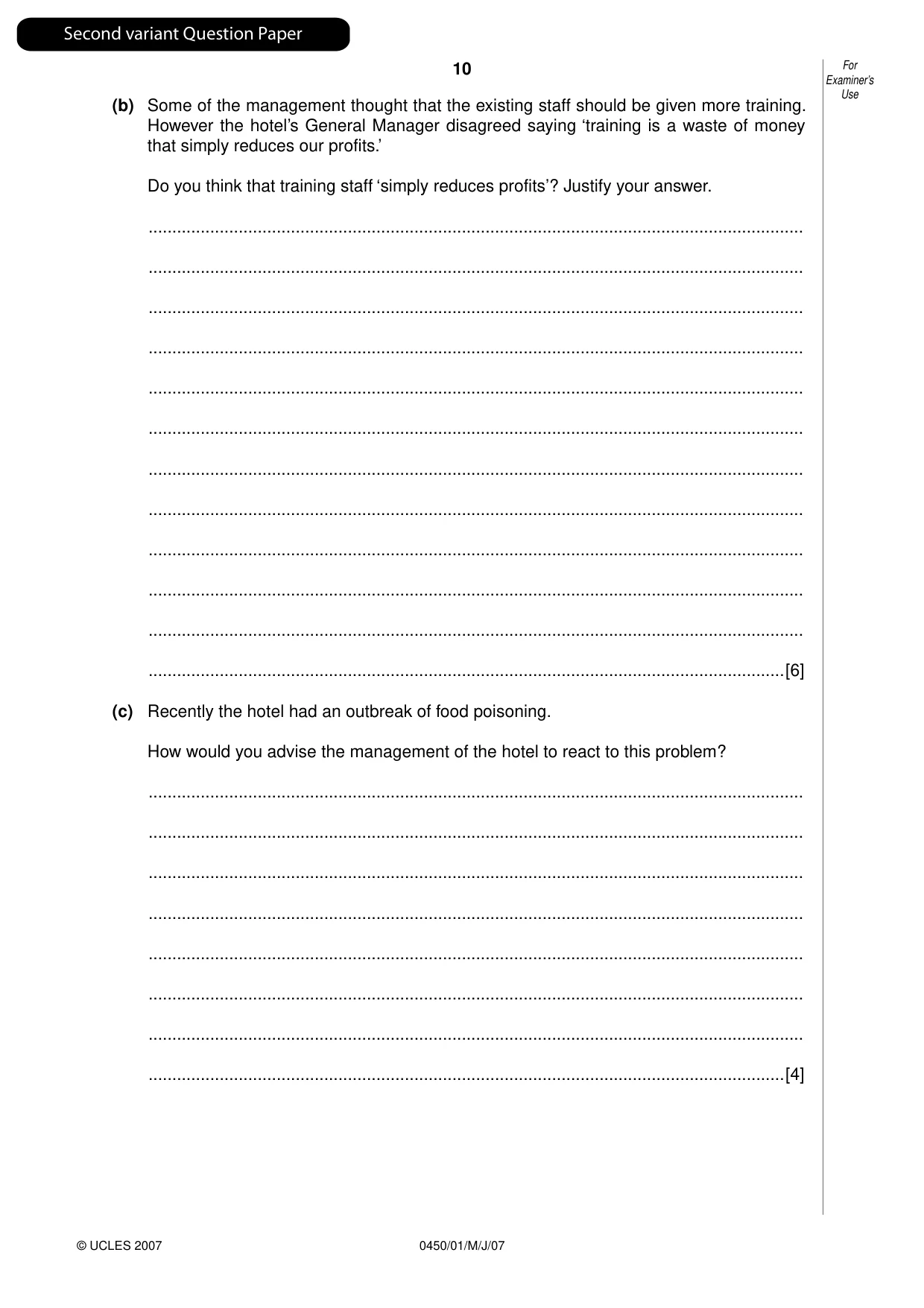
9 0450/01/M/J/07 [Turn over For Examiner’s Use © UCLES 2007 4 Happy Dreams is a luxury hotel situated in the tourist holiday resort of Cape City. Its management want to recruit extra staff to work in the hotel’s kitchen and restaurant. The Human Resources Manager produced a job description for the vacancies as she felt that it would help in recruitment. (a) (i) Explain what is meant by a ‘job description’. … … … …[2] (ii) Explain how a job description might help in the recruitment of new staff. … … … … … … … …[4] Second variant Question Paper
Question paper, page 27
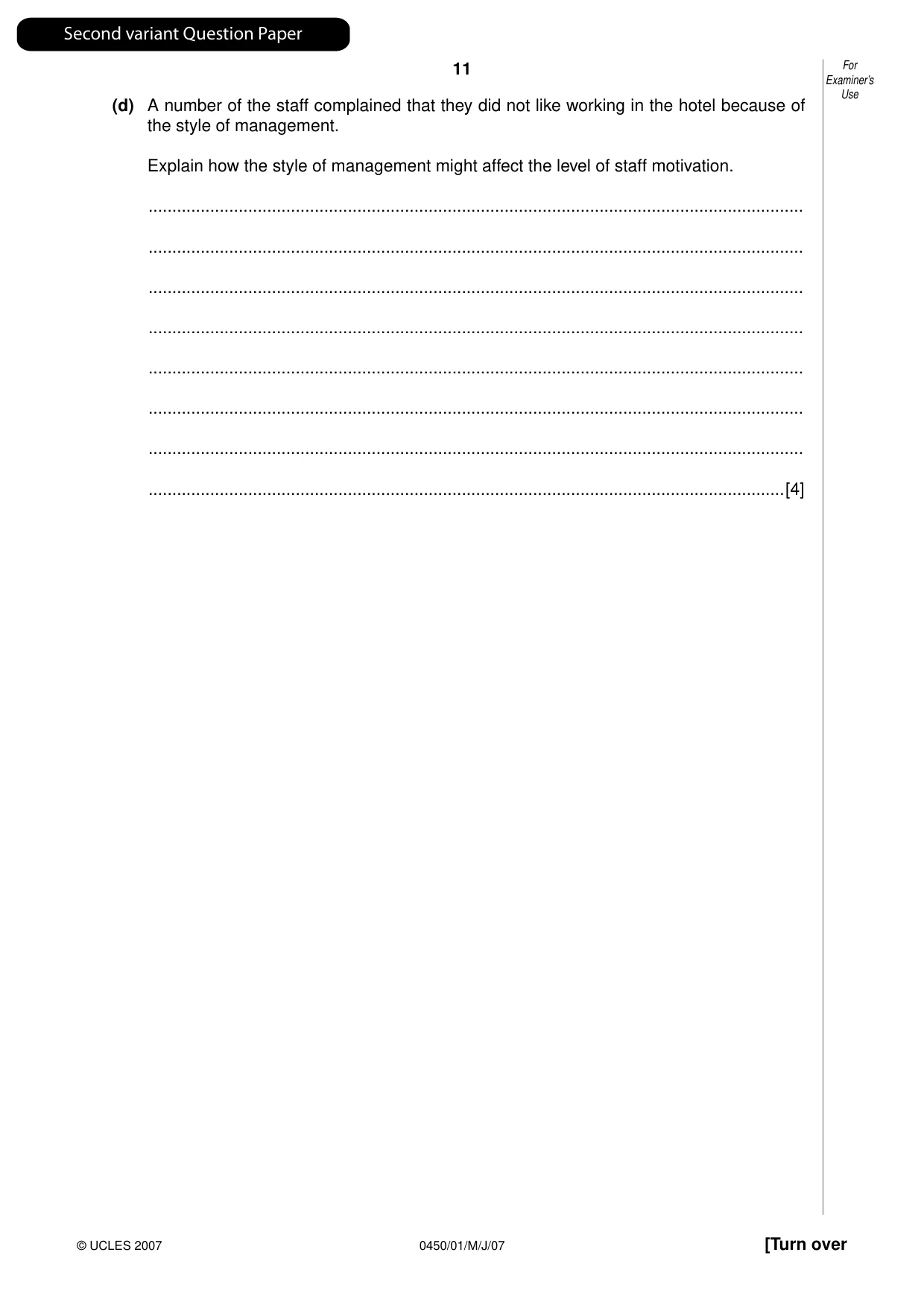
10 0450/01/M/J/07 For Examiner’s Use © UCLES 2007 (b) Some of the management thought that the existing staff should be given more training. However the hotel’s General Manager disagreed saying ‘training is a waste of money that simply reduces our profits.’ Do you think that training staff ‘simply reduces profits’? Justify your answer. … … … … … … … … … … … …[6] (c) Recently the hotel had an outbreak of food poisoning. How would you advise the management of the hotel to react to this problem? … … … … … … … …[4] Second variant Question Paper
Question paper, page 28
11 0450/01/M/J/07 [Turn over For Examiner’s Use © UCLES 2007 (d) A number of the staff complained that they did not like working in the hotel because of the style of management. Explain how the style of management might affect the level of staff motivation. … … … … … … … …[4] Second variant Question Paper
Question paper, page 29
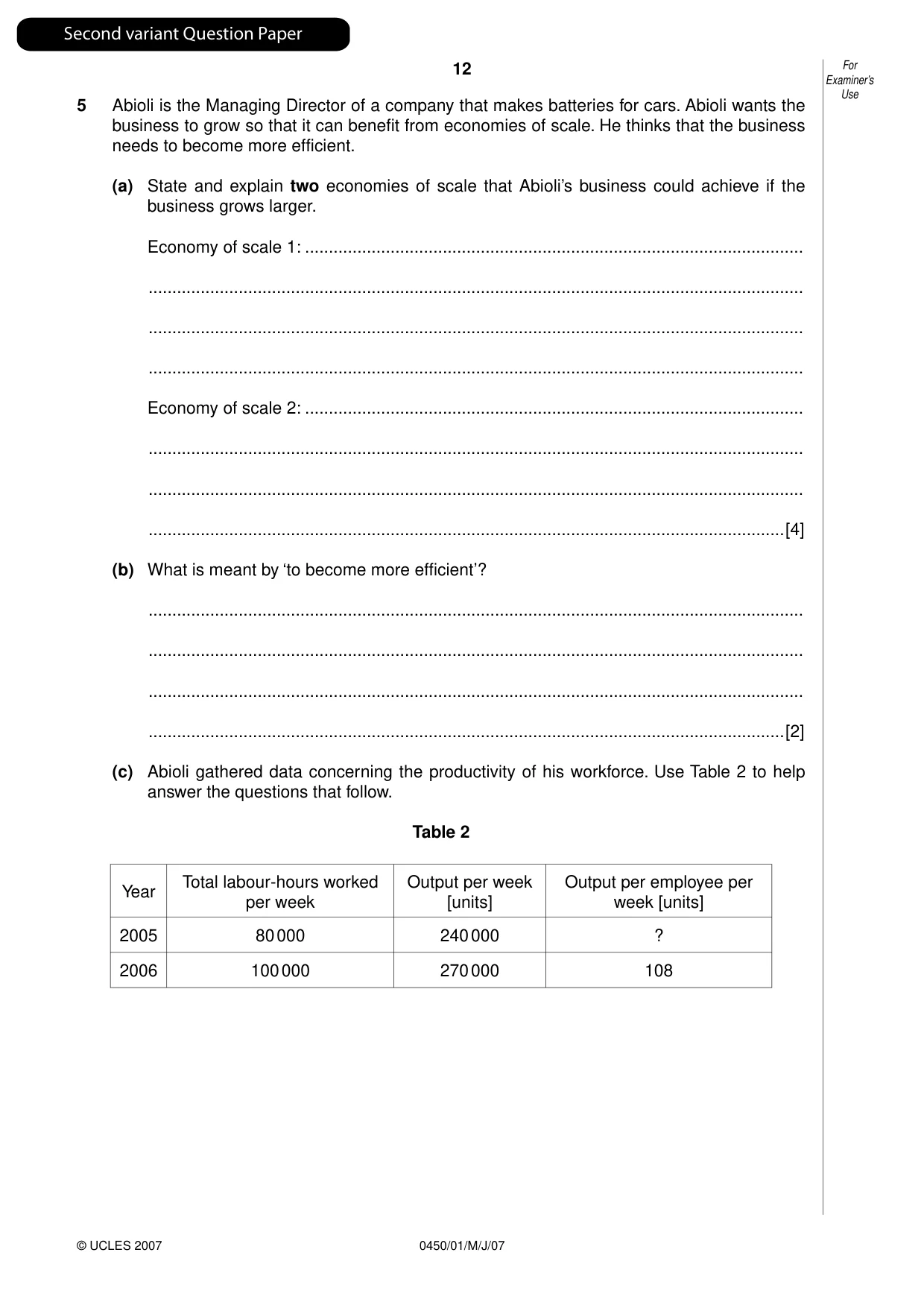
12 0450/01/M/J/07 For Examiner’s Use © UCLES 2007 5 Abioli is the Managing Director of a company that makes batteries for cars. Abioli wants the business to grow so that it can benefit from economies of scale. He thinks that the business needs to become more efficient. (a) State and explain two economies of scale that Abioli’s business could achieve if the business grows larger. Economy of scale 1: … … … … Economy of scale 2: … … … …[4] (b) What is meant by ‘to become more efficient’? … … … …[2] (c) Abioli gathered data concerning the productivity of his workforce. Use Table 2 to help answer the questions that follow. Table 2 Year Total labour-hours worked per week Output per week [units] Output per employee per week [units] 2005 80 000 240 000 ? 2006 100 000 270 000 108 Second variant Question Paper
Question paper, page 30
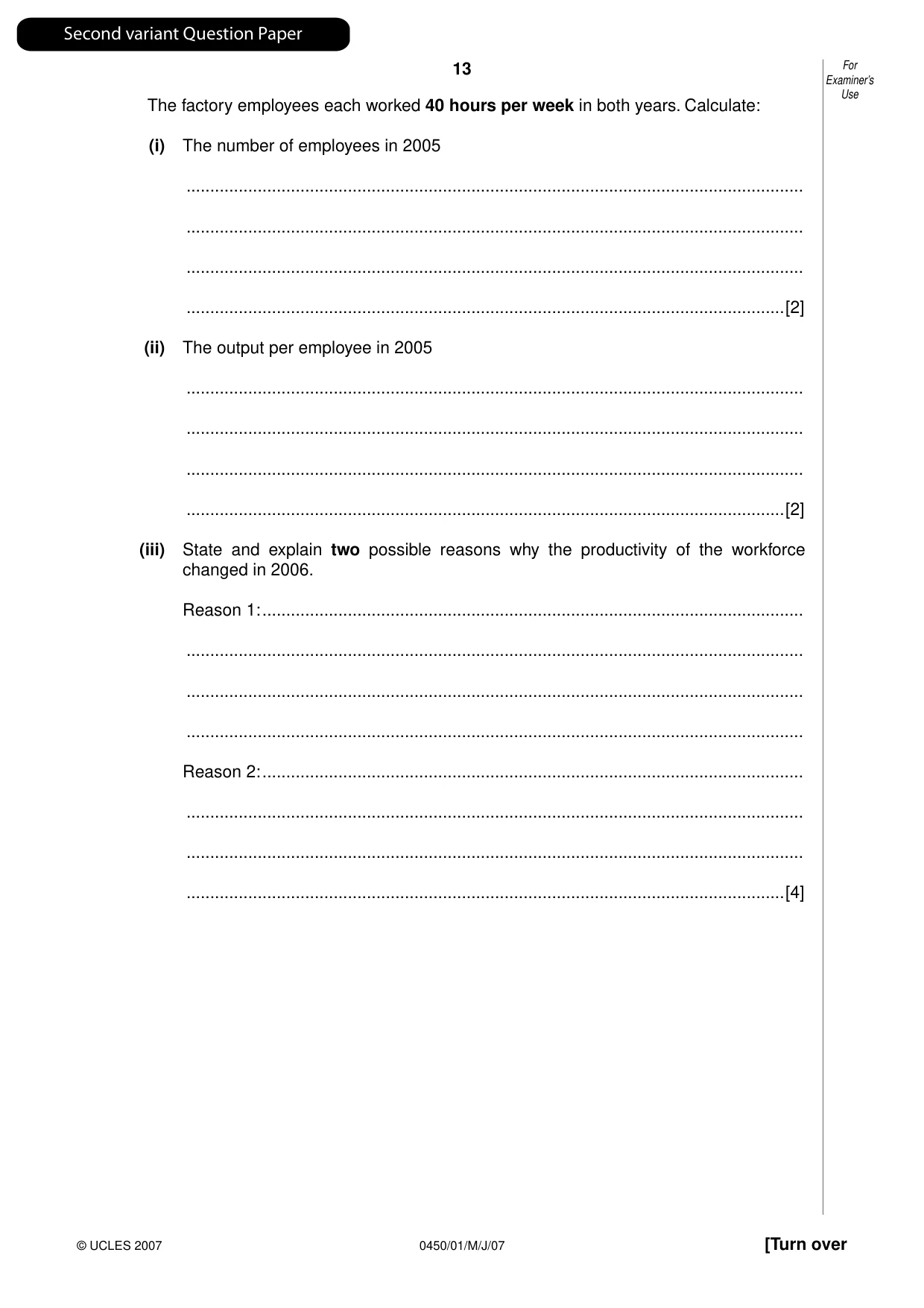
13 0450/01/M/J/07 [Turn over For Examiner’s Use © UCLES 2007 The factory employees each worked 40 hours per week in both years. Calculate: (i) The number of employees in 2005 … … … …[2] (ii) The output per employee in 2005 … … … …[2] (iii) State and explain two possible reasons why the productivity of the workforce changed in 2006. Reason 1: … … … … Reason 2: … … … …[4] Second variant Question Paper
Question paper, page 31
14 0450/01/M/J/07 For Examiner’s Use © UCLES 2007 (d) Abioli has recently heard of a production method known as lean production. (i) Explain what is meant by ‘lean production’. … … … …[2] (ii) Do you think lean production methods would help improve efficiency in the factory? Explain your answer. … … … … … … … …[4] Second variant Question Paper
Question paper, page 32
15 0450/01/M/J/07 BLANK PAGE Second variant Question Paper
Question paper, page 33
16 0450/01/M/J/07 BLANK PAGE Permission to reproduce items where third-party owned material protected by copyright is included has been sought and cleared where possible. Every reasonable effort has been made by the publisher (UCLES) to trace copyright holders, but if any items requiring clearance have unwittingly been included, the publisher will be pleased to make amends at the earliest possible opportunity. University of Cambridge International Examinations is part of the Cambridge Assessment Group. Cambridge Assessment is the brand name of University of Cambridge Local Examinations Syndicate (UCLES), which is itself a department of the University of Cambridge. Second variant Question Paper
Mark scheme, page 1
Location Entry Codes From the June 2007 session, as part of CIE’s continual commitment to maintaining best practice in assessment, CIE has begun to use different variants of some question papers for our most popular assessments with extremely large and widespread candidature, The question papers are closely related and the relationships between them have been thoroughly established using our assessment expertise. All versions of the paper give assessment of equal standard. The content assessed by the examination papers and the type of questions are unchanged. This change means that for this component there are now two variant Question Papers, Mark Schemes and Principal Examiner’s Reports where previously there was only one. For any individual country, it is intended that only one variant is used. This document contains both variants which will give all Centres access to even more past examination material than is usually the case. The diagram shows the relationship between the Question Papers, Mark Schemes and Principal Examiner’s Reports. Question Paper Mark Scheme Principal Examiner’s Report Introduction Introduction Introduction First variant Question Paper First variant Mark Scheme First variant Principal Examiner’s Report Second variant Question Paper Second variant Mark Scheme Second variant Principal Examiner’s Report Who can I contact for further information on these changes? Please direct any questions about this to CIE’s Customer Services team at: international@cie.org.uk www.XtremePapers.com
Mark scheme, page 2
UNIVERSITY OF CAMBRIDGE INTERNATIONAL EXAMINATIONS International General Certificate of Secondary Education MARK SCHEME for the May/June 2007 question paper 0450 BUSINESS STUDIES 0450/01 Paper 1 (Short Answer/Structured Response), maximum raw mark 100 This mark scheme is published as an aid to teachers and candidates, to indicate the requirements of the examination. It shows the basis on which Examiners were instructed to award marks. It does not indicate the details of the discussions that took place at an Examiners’ meeting before marking began. All Examiners are instructed that alternative correct answers and unexpected approaches in candidates’ scripts must be given marks that fairly reflect the relevant knowledge and skills demonstrated. Mark schemes must be read in conjunction with the question papers and the report on the examination. • CIE will not enter into discussions or correspondence in connection with these mark schemes. CIE is publishing the mark schemes for the May/June 2007 question papers for most IGCSE, GCE Advanced Level and Advanced Subsidiary Level syllabuses and some Ordinary Level syllabuses.
Mark scheme, page 3
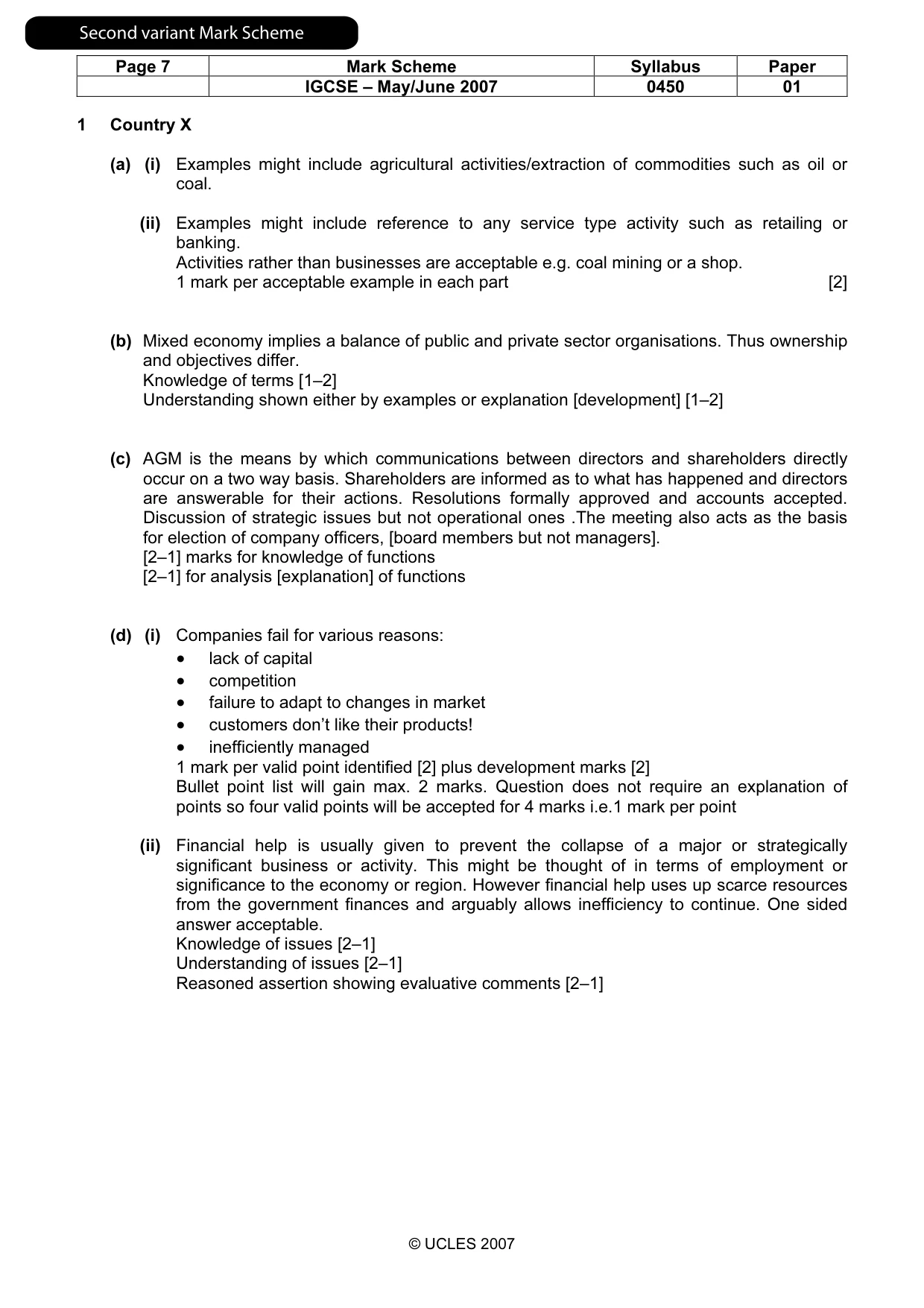
Page 2 Mark Scheme Syllabus Paper IGCSE – May/June 2007 0450 01 © UCLES 2007 1 Country X (a) (i) Examples might include agricultural activities/extraction of commodities such as oil or coal. (ii) Examples might include reference to any service type activity such as retailing or banking. Activities rather than businesses are acceptable e.g. coal mining or a shop. 1 mark per acceptable example in each part [2] (b) Mixed economy implies a balance of public and private sector organisations. Thus ownership and objectives differ. Knowledge of terms [1–2] Understanding shown either by examples or explanation [development] [1–2] (c) AGM is the means by which communications between directors and shareholders directly occur on a two way basis. Shareholders are informed as to what has happened and directors are answerable for their actions. Resolutions formally approved and accounts accepted. Discussion of strategic issues but not operational ones .The meeting also acts as the basis for election of company officers [board members but not managers]. [2–1] knowledge of functions [2–1] analysis [explanation] of functions (d) (i) Companies fail for various reasons: • lack of capital • competition • failure to adapt to changes in market • customers don’t like their products! • inefficiently managed 1 mark per valid point identified [2] plus development marks [2] Bullet point list will gain max. 2 marks. Question does not require an explanation of points so four valid points will be accepted for 4 marks i.e.1 mark per point (ii) Financial help is usually given to prevent the collapse of a major or strategically significant business or activity. This might be thought of in terms of employment or significance to the economy or region. However financial help uses up scarce resources from the government finances and arguably allows inefficiency to continue. One sided answer acceptable. Knowledge of issues [2–1] Understanding of issues [2–1] Reasoned assertion showing evaluative comments [2–1] First variant Mark Scheme
Mark scheme, page 4
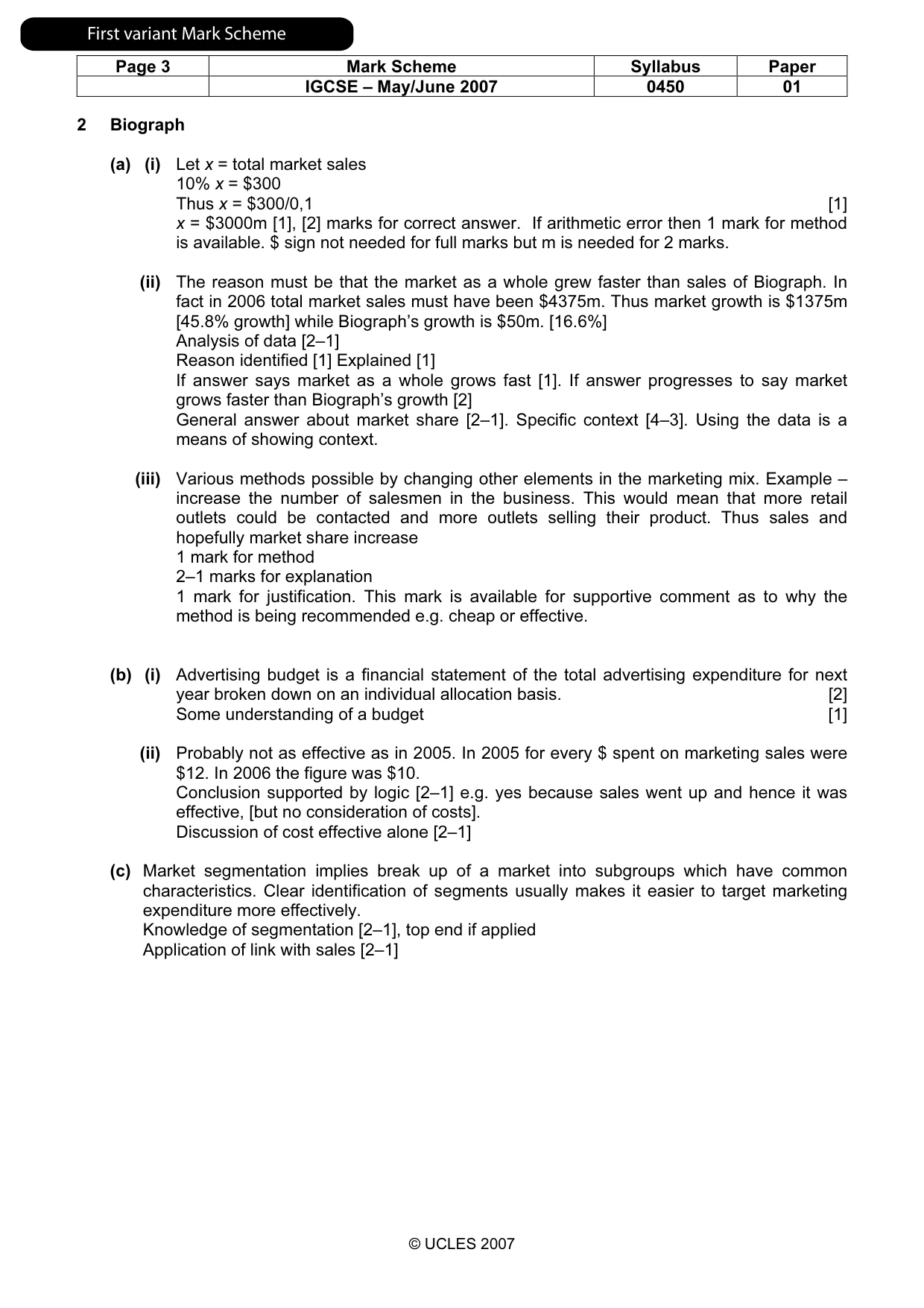
Page 3 Mark Scheme Syllabus Paper IGCSE – May/June 2007 0450 01 © UCLES 2007 2 Biograph (a) (i) Let x = total market sales 10% x = $300 Thus x = $300/0,1 [1] x = $3000m [1], [2] marks for correct answer. If arithmetic error then 1 mark for method is available. $ sign not needed for full marks but m is needed for 2 marks. (ii) The reason must be that the market as a whole grew faster than sales of Biograph. In fact in 2006 total market sales must have been $4375m. Thus market growth is $1375m [45.8% growth] while Biograph’s growth is $50m. [16.6%] Analysis of data [2–1] Reason identified [1] Explained [1] If answer says market as a whole grows fast [1]. If answer progresses to say market grows faster than Biograph’s growth [2] General answer about market share [2–1]. Specific context [4–3]. Using the data is a means of showing context. (iii) Various methods possible by changing other elements in the marketing mix. Example – increase the number of salesmen in the business. This would mean that more retail outlets could be contacted and more outlets selling their product. Thus sales and hopefully market share increase 1 mark for method 2–1 marks for explanation 1 mark for justification. This mark is available for supportive comment as to why the method is being recommended e.g. cheap or effective. (b) (i) Advertising budget is a financial statement of the total advertising expenditure for next year broken down on an individual allocation basis. [2] Some understanding of a budget [1] (ii) Probably not as effective as in 2005. In 2005 for every $ spent on marketing sales were $12. In 2006 the figure was $10. Conclusion supported by logic [2–1] e.g. yes because sales went up and hence it was effective, [but no consideration of costs]. Discussion of cost effective alone [2–1] (c) Market segmentation implies break up of a market into subgroups which have common characteristics. Clear identification of segments usually makes it easier to target marketing expenditure more effectively. Knowledge of segmentation [2–1], top end if applied Application of link with sales [2–1] First variant Mark Scheme
Mark scheme, page 5
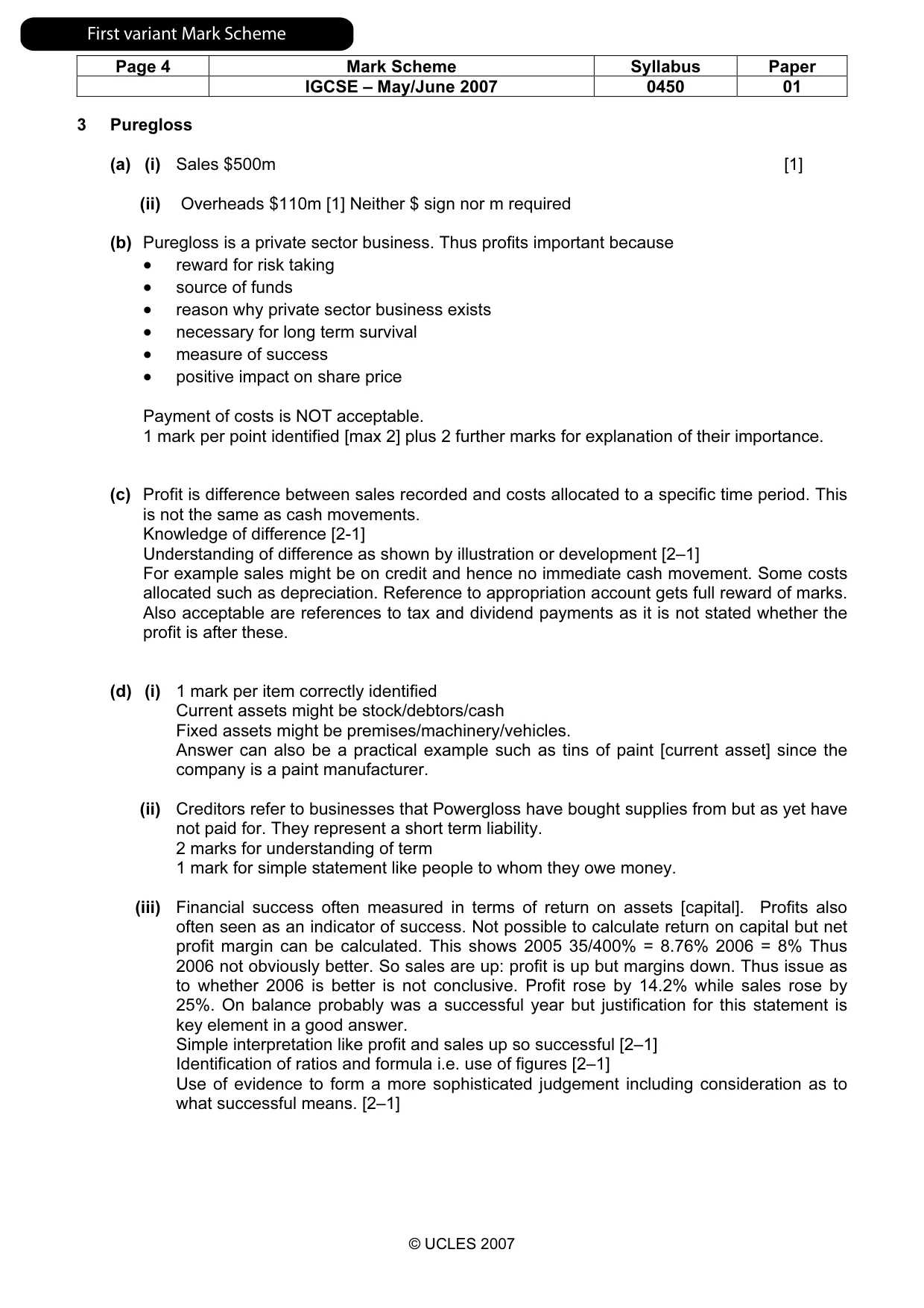
Page 4 Mark Scheme Syllabus Paper IGCSE – May/June 2007 0450 01 © UCLES 2007 3 Puregloss (a) (i) Sales $500m [1] (ii) Overheads $110m [1] Neither $ sign nor m required (b) Puregloss is a private sector business. Thus profits important because • reward for risk taking • source of funds • reason why private sector business exists • necessary for long term survival • measure of success • positive impact on share price Payment of costs is NOT acceptable. 1 mark per point identified [max 2] plus 2 further marks for explanation of their importance. (c) Profit is difference between sales recorded and costs allocated to a specific time period. This is not the same as cash movements. Knowledge of difference [2-1] Understanding of difference as shown by illustration or development [2–1] For example sales might be on credit and hence no immediate cash movement. Some costs allocated such as depreciation. Reference to appropriation account gets full reward of marks. Also acceptable are references to tax and dividend payments as it is not stated whether the profit is after these. (d) (i) 1 mark per item correctly identified Current assets might be stock/debtors/cash Fixed assets might be premises/machinery/vehicles. Answer can also be a practical example such as tins of paint [current asset] since the company is a paint manufacturer. (ii) Creditors refer to businesses that Powergloss have bought supplies from but as yet have not paid for. They represent a short term liability. 2 marks for understanding of term 1 mark for simple statement like people to whom they owe money. (iii) Financial success often measured in terms of return on assets [capital]. Profits also often seen as an indicator of success. Not possible to calculate return on capital but net profit margin can be calculated. This shows 2005 35/400% = 8.76% 2006 = 8% Thus 2006 not obviously better. So sales are up: profit is up but margins down. Thus issue as to whether 2006 is better is not conclusive. Profit rose by 14.2% while sales rose by 25%. On balance probably was a successful year but justification for this statement is key element in a good answer. Simple interpretation like profit and sales up so successful [2–1] Identification of ratios and formula i.e. use of figures [2–1] Use of evidence to form a more sophisticated judgement including consideration as to what successful means. [2–1] First variant Mark Scheme
Mark scheme, page 6
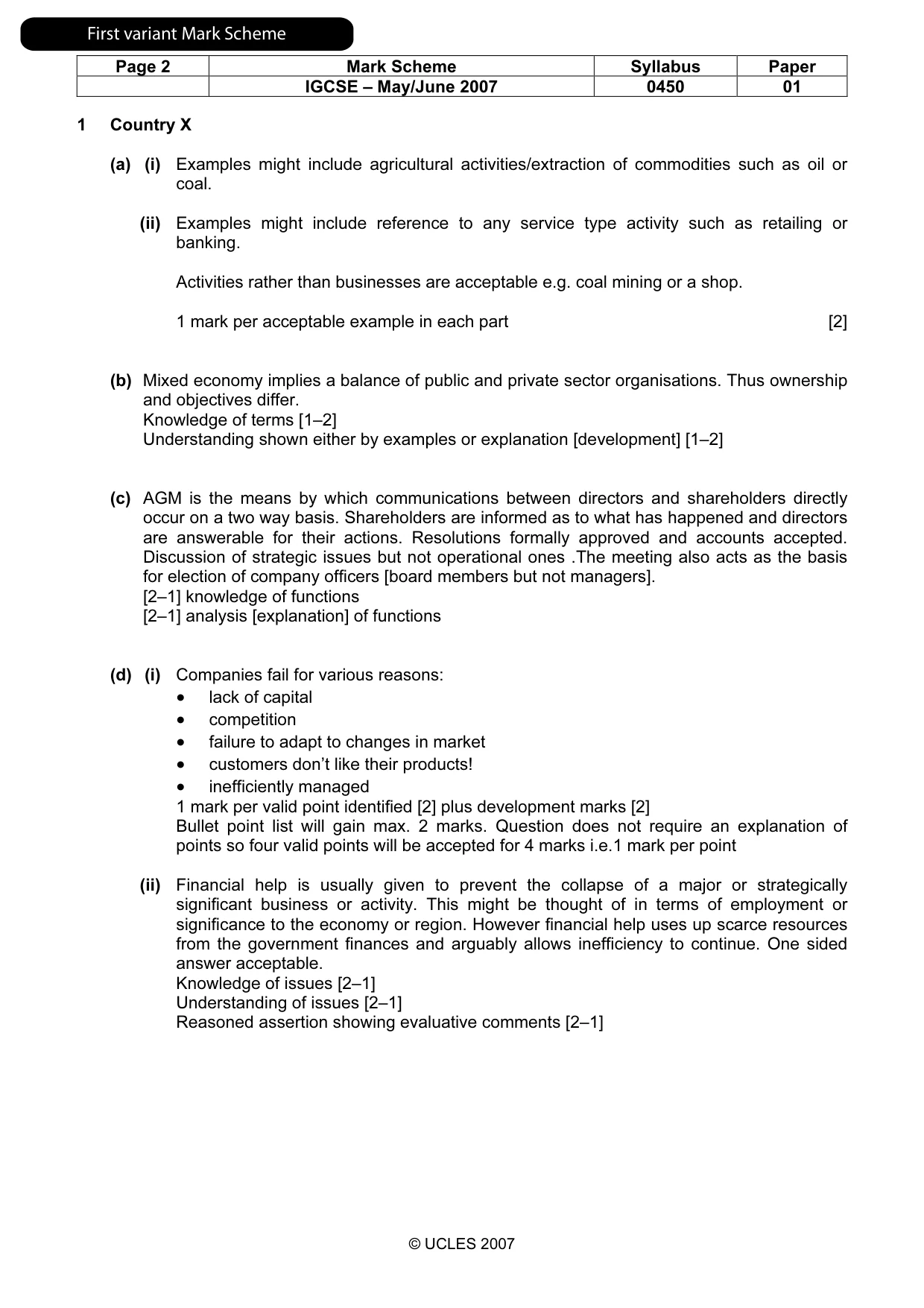
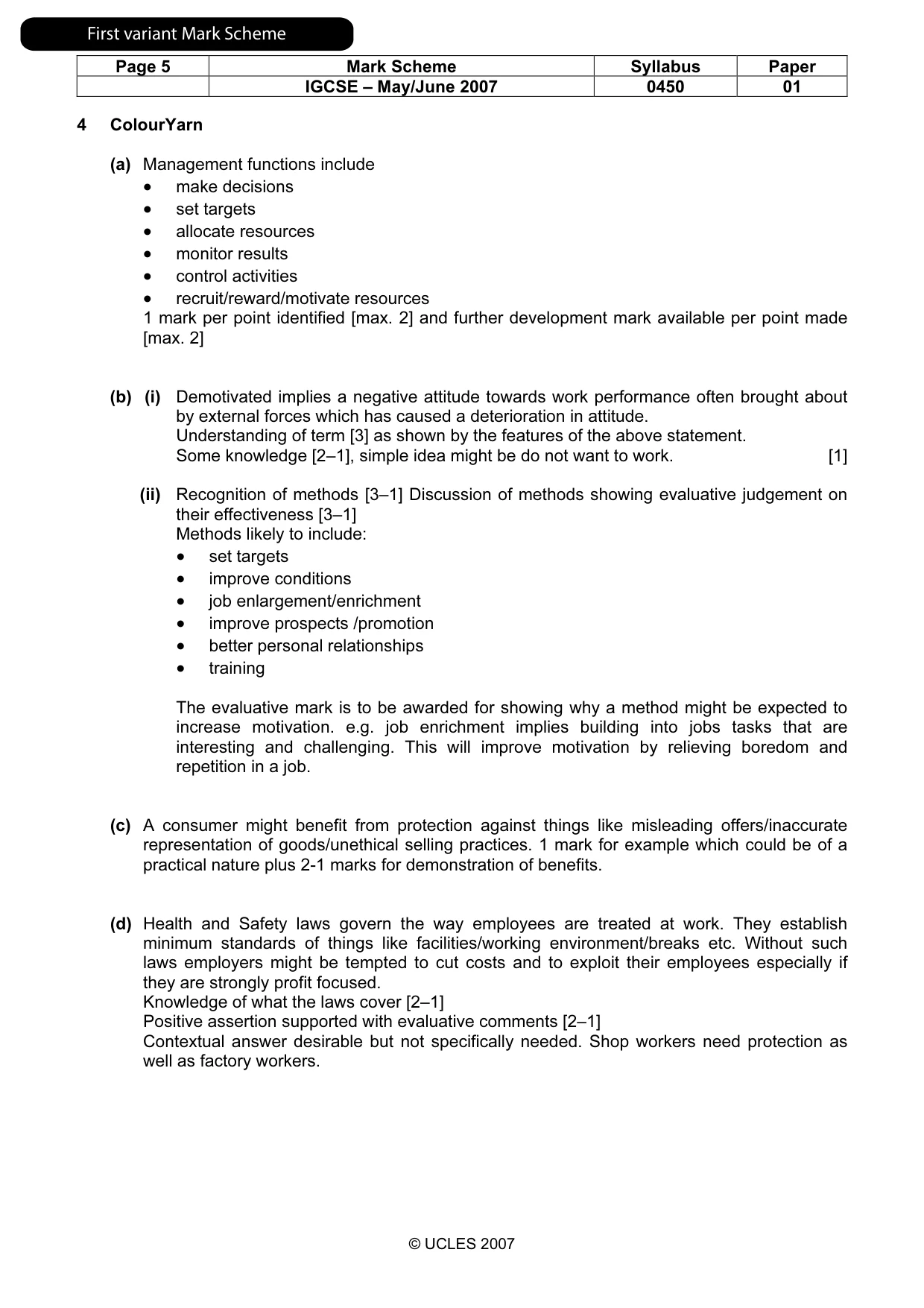
Page 5 Mark Scheme Syllabus Paper IGCSE – May/June 2007 0450 01 © UCLES 2007 4 ColourYarn (a) Management functions include • make decisions • set targets • allocate resources • monitor results • control activities • recruit/reward/motivate resources 1 mark per point identified [max. 2] and further development mark available per point made [max. 2] (b) (i) Demotivated implies a negative attitude towards work performance often brought about by external forces which has caused a deterioration in attitude. Understanding of term [3] as shown by the features of the above statement. Some knowledge [2–1], simple idea might be do not want to work. [1] (ii) Recognition of methods [3–1] Discussion of methods showing evaluative judgement on their effectiveness [3–1] Methods likely to include: • set targets • improve conditions • job enlargement/enrichment • improve prospects /promotion • better personal relationships • training The evaluative mark is to be awarded for showing why a method might be expected to increase motivation. e.g. job enrichment implies building into jobs tasks that are interesting and challenging. This will improve motivation by relieving boredom and repetition in a job. (c) A consumer might benefit from protection against things like misleading offers/inaccurate representation of goods/unethical selling practices. 1 mark for example which could be of a practical nature plus 2-1 marks for demonstration of benefits. (d) Health and Safety laws govern the way employees are treated at work. They establish minimum standards of things like facilities/working environment/breaks etc. Without such laws employers might be tempted to cut costs and to exploit their employees especially if they are strongly profit focused. Knowledge of what the laws cover [2–1] Positive assertion supported with evaluative comments [2–1] Contextual answer desirable but not specifically needed. Shop workers need protection as well as factory workers. First variant Mark Scheme
Mark scheme, page 7
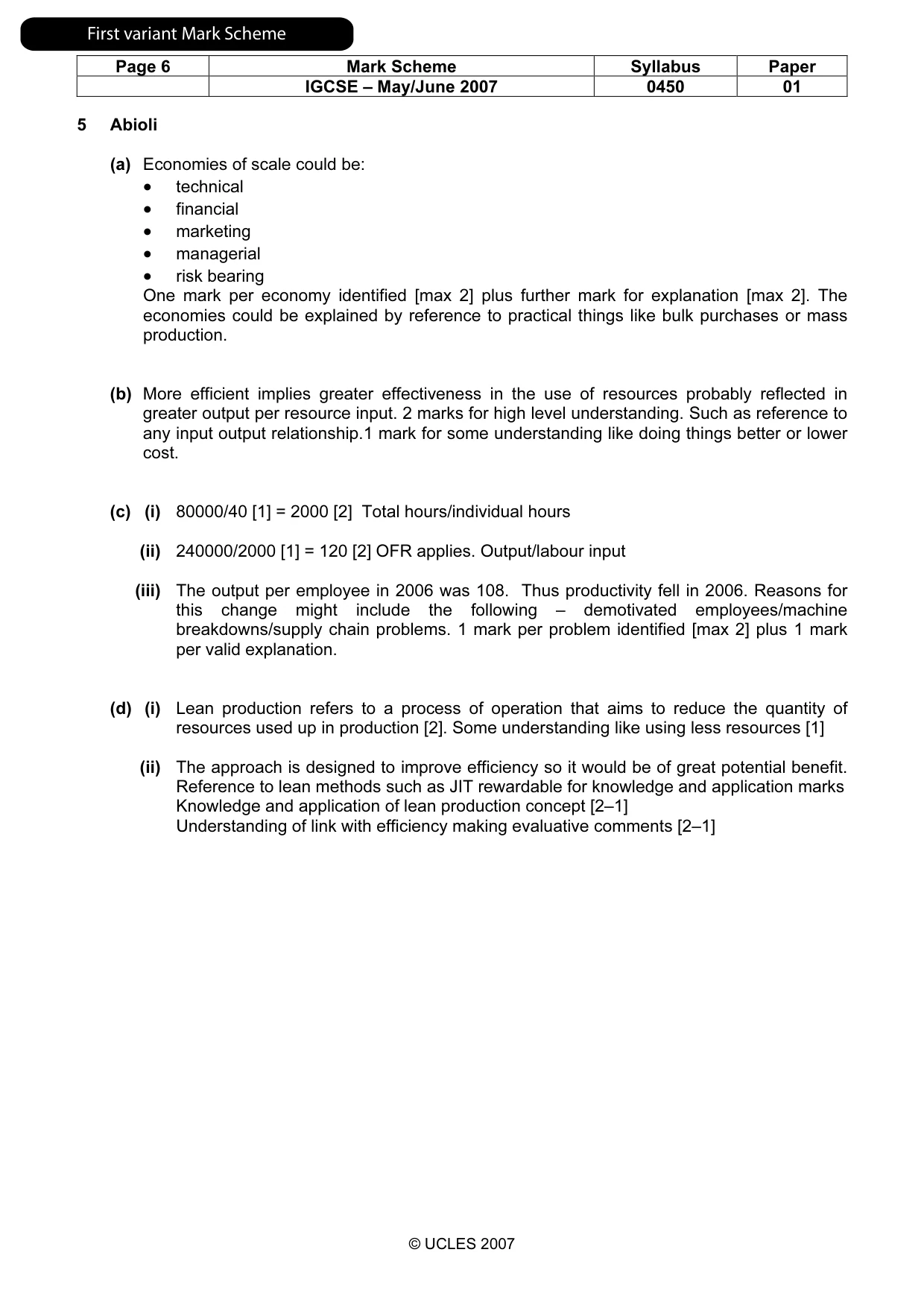
Page 6 Mark Scheme Syllabus Paper IGCSE – May/June 2007 0450 01 © UCLES 2007 5 Abioli (a) Economies of scale could be: • technical • financial • marketing • managerial • risk bearing One mark per economy identified [max 2] plus further mark for explanation [max 2]. The economies could be explained by reference to practical things like bulk purchases or mass production. (b) More efficient implies greater effectiveness in the use of resources probably reflected in greater output per resource input. 2 marks for high level understanding. Such as reference to any input output relationship.1 mark for some understanding like doing things better or lower cost. (c) (i) 80000/40 [1] = 2000 [2] Total hours/individual hours (ii) 240000/2000 [1] = 120 [2] OFR applies. Output/labour input (iii) The output per employee in 2006 was 108. Thus productivity fell in 2006. Reasons for this change might include the following – demotivated employees/machine breakdowns/supply chain problems. 1 mark per problem identified [max 2] plus 1 mark per valid explanation. (d) (i) Lean production refers to a process of operation that aims to reduce the quantity of resources used up in production [2]. Some understanding like using less resources [1] (ii) The approach is designed to improve efficiency so it would be of great potential benefit. Reference to lean methods such as JIT rewardable for knowledge and application marks Knowledge and application of lean production concept [2–1] Understanding of link with efficiency making evaluative comments [2–1] First variant Mark Scheme
Mark scheme, page 8
Page 7 Mark Scheme Syllabus Paper IGCSE – May/June 2007 0450 01 © UCLES 2007 1 Country X (a) (i) Examples might include agricultural activities/extraction of commodities such as oil or coal. (ii) Examples might include reference to any service type activity such as retailing or banking. Activities rather than businesses are acceptable e.g. coal mining or a shop. 1 mark per acceptable example in each part [2] (b) Mixed economy implies a balance of public and private sector organisations. Thus ownership and objectives differ. Knowledge of terms [1–2] Understanding shown either by examples or explanation [development] [1–2] (c) AGM is the means by which communications between directors and shareholders directly occur on a two way basis. Shareholders are informed as to what has happened and directors are answerable for their actions. Resolutions formally approved and accounts accepted. Discussion of strategic issues but not operational ones .The meeting also acts as the basis for election of company officers, [board members but not managers]. [2–1] marks for knowledge of functions [2–1] for analysis [explanation] of functions (d) (i) Companies fail for various reasons: • lack of capital • competition • failure to adapt to changes in market • customers don’t like their products! • inefficiently managed 1 mark per valid point identified [2] plus development marks [2] Bullet point list will gain max. 2 marks. Question does not require an explanation of points so four valid points will be accepted for 4 marks i.e.1 mark per point (ii) Financial help is usually given to prevent the collapse of a major or strategically significant business or activity. This might be thought of in terms of employment or significance to the economy or region. However financial help uses up scarce resources from the government finances and arguably allows inefficiency to continue. One sided answer acceptable. Knowledge of issues [2–1] Understanding of issues [2–1] Reasoned assertion showing evaluative comments [2–1] Second variant Mark Scheme
Mark scheme, page 9
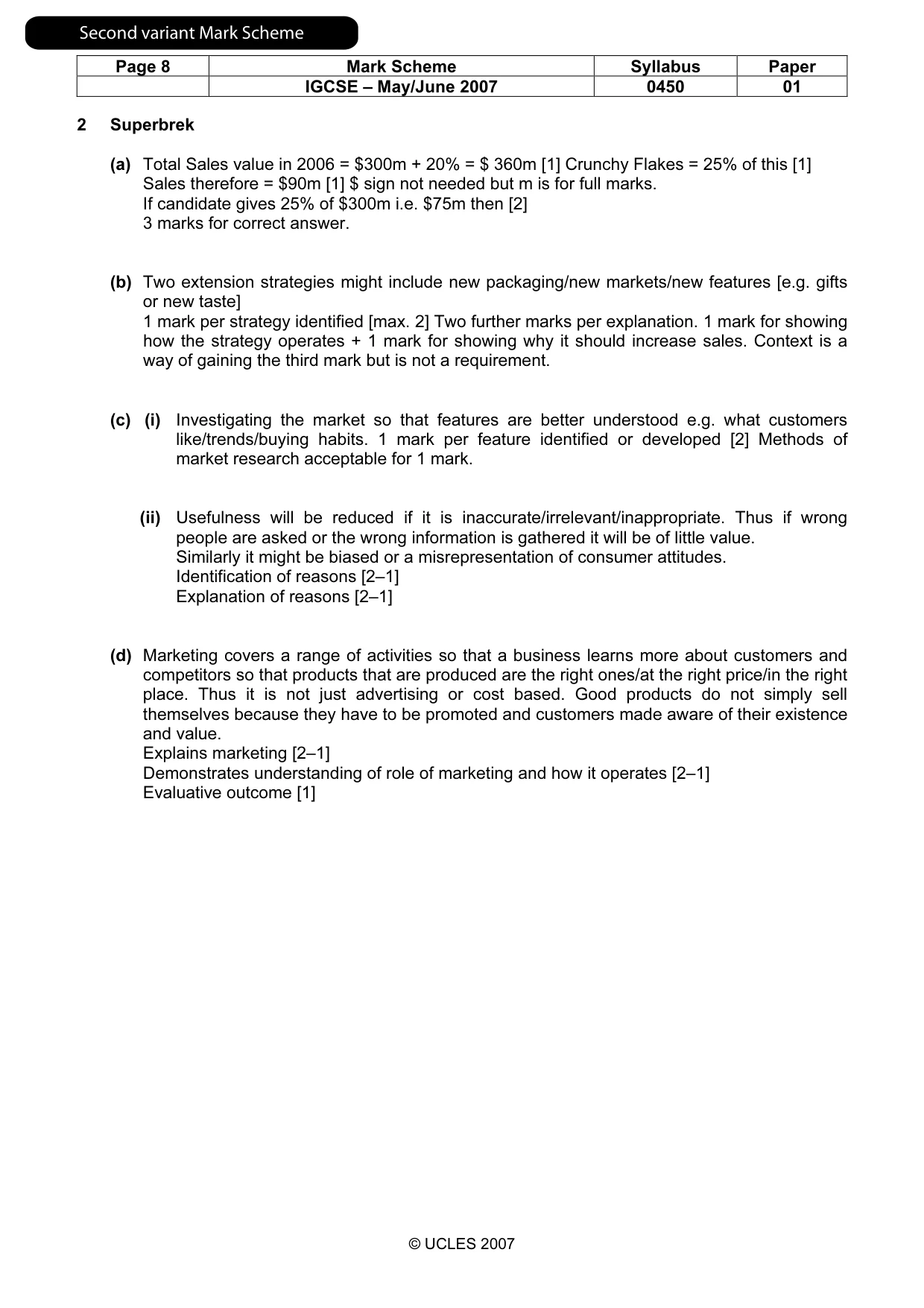
Page 8 Mark Scheme Syllabus Paper IGCSE – May/June 2007 0450 01 © UCLES 2007 2 Superbrek (a) Total Sales value in 2006 = $300m + 20% = $ 360m [1] Crunchy Flakes = 25% of this [1] Sales therefore = $90m [1] $ sign not needed but m is for full marks. If candidate gives 25% of $300m i.e. $75m then [2] 3 marks for correct answer. (b) Two extension strategies might include new packaging/new markets/new features [e.g. gifts or new taste] 1 mark per strategy identified [max. 2] Two further marks per explanation. 1 mark for showing how the strategy operates + 1 mark for showing why it should increase sales. Context is a way of gaining the third mark but is not a requirement. (c) (i) Investigating the market so that features are better understood e.g. what customers like/trends/buying habits. 1 mark per feature identified or developed [2] Methods of market research acceptable for 1 mark. (ii) Usefulness will be reduced if it is inaccurate/irrelevant/inappropriate. Thus if wrong people are asked or the wrong information is gathered it will be of little value. Similarly it might be biased or a misrepresentation of consumer attitudes. Identification of reasons [2–1] Explanation of reasons [2–1] (d) Marketing covers a range of activities so that a business learns more about customers and competitors so that products that are produced are the right ones/at the right price/in the right place. Thus it is not just advertising or cost based. Good products do not simply sell themselves because they have to be promoted and customers made aware of their existence and value. Explains marketing [2–1] Demonstrates understanding of role of marketing and how it operates [2–1] Evaluative outcome [1] Second variant Mark Scheme
Mark scheme, page 10
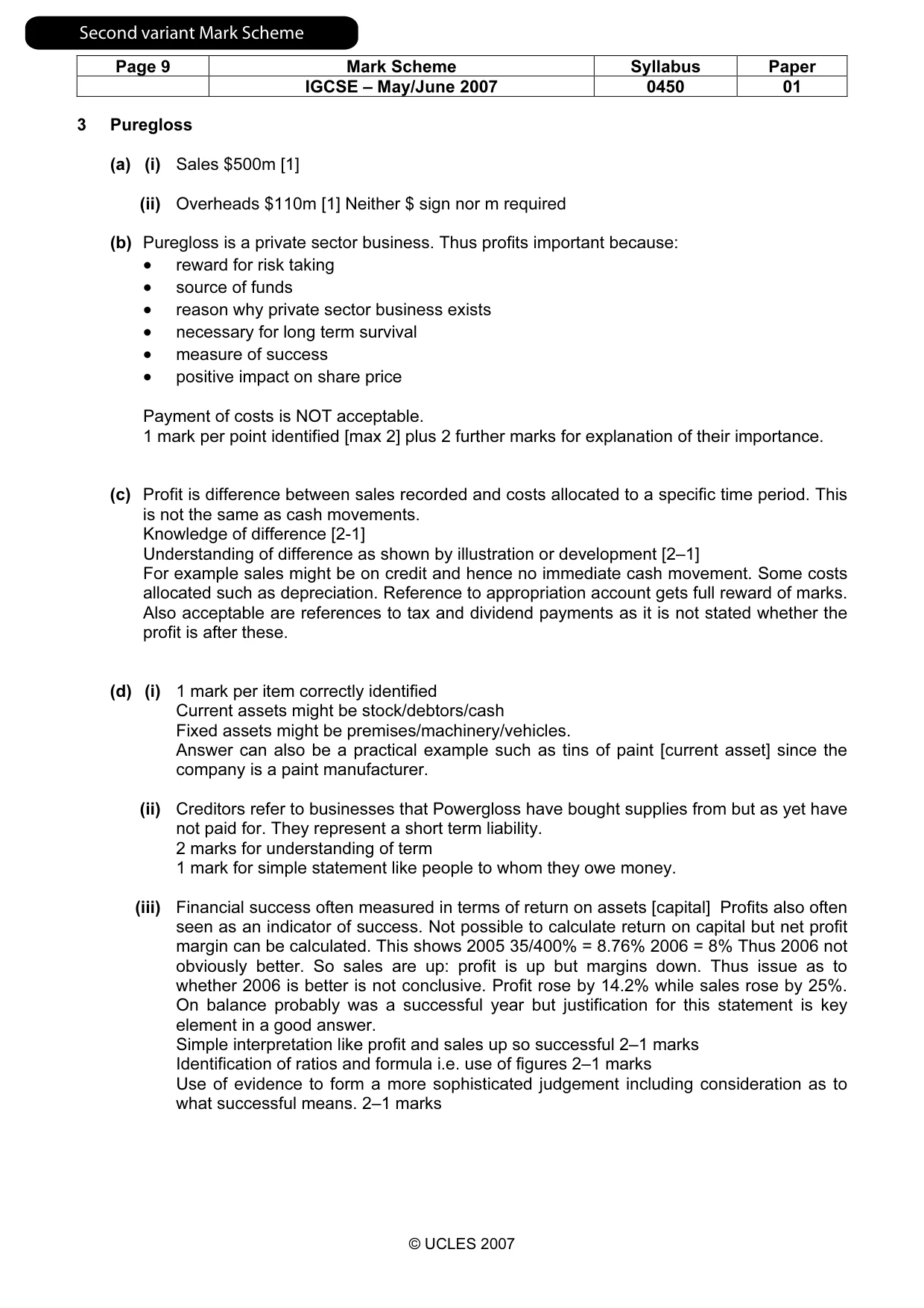
Page 9 Mark Scheme Syllabus Paper IGCSE – May/June 2007 0450 01 © UCLES 2007 3 Puregloss (a) (i) Sales $500m [1] (ii) Overheads $110m [1] Neither $ sign nor m required (b) Puregloss is a private sector business. Thus profits important because: • reward for risk taking • source of funds • reason why private sector business exists • necessary for long term survival • measure of success • positive impact on share price Payment of costs is NOT acceptable. 1 mark per point identified [max 2] plus 2 further marks for explanation of their importance. (c) Profit is difference between sales recorded and costs allocated to a specific time period. This is not the same as cash movements. Knowledge of difference [2-1] Understanding of difference as shown by illustration or development [2–1] For example sales might be on credit and hence no immediate cash movement. Some costs allocated such as depreciation. Reference to appropriation account gets full reward of marks. Also acceptable are references to tax and dividend payments as it is not stated whether the profit is after these. (d) (i) 1 mark per item correctly identified Current assets might be stock/debtors/cash Fixed assets might be premises/machinery/vehicles. Answer can also be a practical example such as tins of paint [current asset] since the company is a paint manufacturer. (ii) Creditors refer to businesses that Powergloss have bought supplies from but as yet have not paid for. They represent a short term liability. 2 marks for understanding of term 1 mark for simple statement like people to whom they owe money. (iii) Financial success often measured in terms of return on assets [capital] Profits also often seen as an indicator of success. Not possible to calculate return on capital but net profit margin can be calculated. This shows 2005 35/400% = 8.76% 2006 = 8% Thus 2006 not obviously better. So sales are up: profit is up but margins down. Thus issue as to whether 2006 is better is not conclusive. Profit rose by 14.2% while sales rose by 25%. On balance probably was a successful year but justification for this statement is key element in a good answer. Simple interpretation like profit and sales up so successful 2–1 marks Identification of ratios and formula i.e. use of figures 2–1 marks Use of evidence to form a more sophisticated judgement including consideration as to what successful means. 2–1 marks Second variant Mark Scheme
Mark scheme, page 11
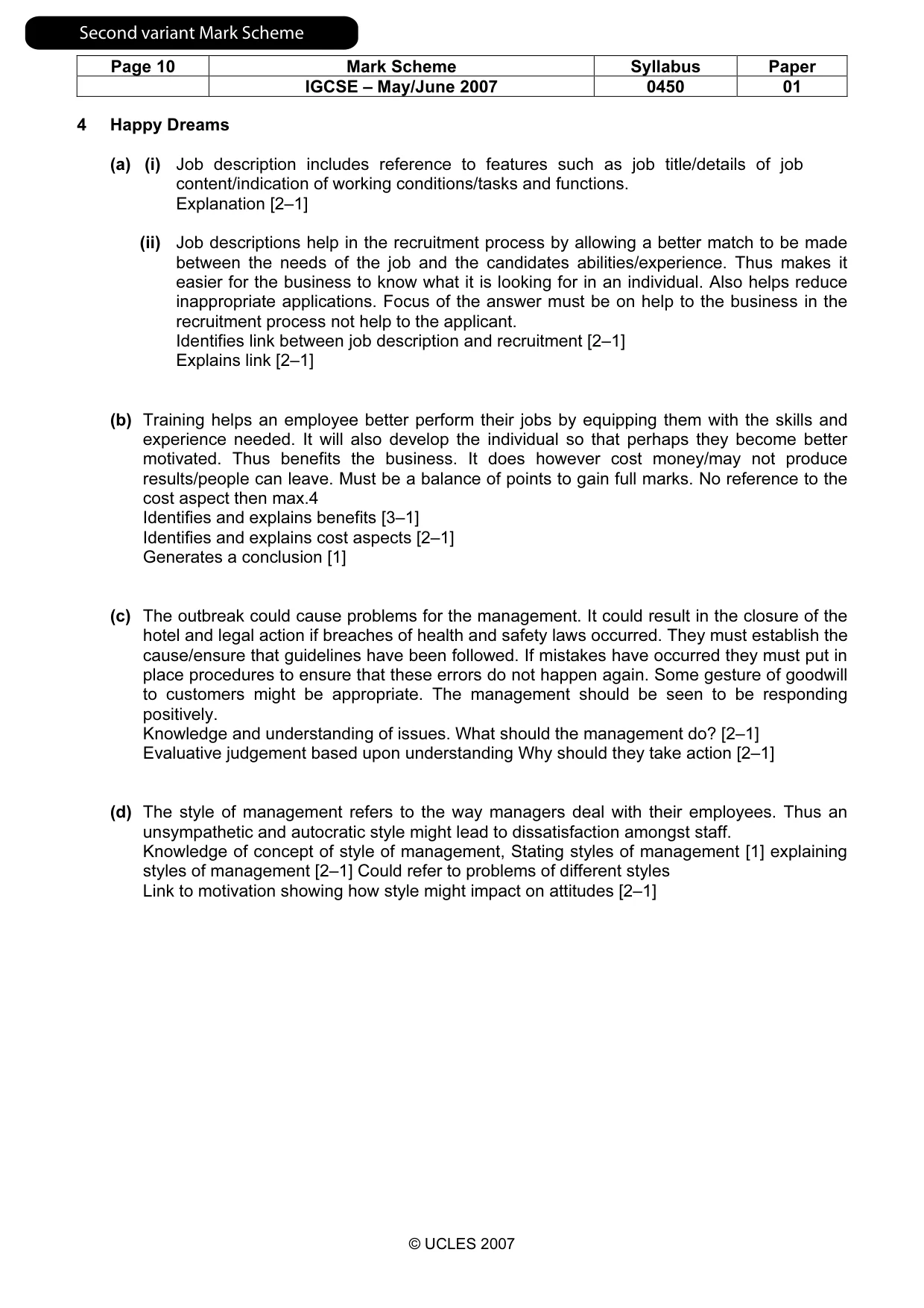
Page 10 Mark Scheme Syllabus Paper IGCSE – May/June 2007 0450 01 © UCLES 2007 4 Happy Dreams (a) (i) Job description includes reference to features such as job title/details of job content/indication of working conditions/tasks and functions. Explanation [2–1] (ii) Job descriptions help in the recruitment process by allowing a better match to be made between the needs of the job and the candidates abilities/experience. Thus makes it easier for the business to know what it is looking for in an individual. Also helps reduce inappropriate applications. Focus of the answer must be on help to the business in the recruitment process not help to the applicant. Identifies link between job description and recruitment [2–1] Explains link [2–1] (b) Training helps an employee better perform their jobs by equipping them with the skills and experience needed. It will also develop the individual so that perhaps they become better motivated. Thus benefits the business. It does however cost money/may not produce results/people can leave. Must be a balance of points to gain full marks. No reference to the cost aspect then max.4 Identifies and explains benefits [3–1] Identifies and explains cost aspects [2–1] Generates a conclusion [1] (c) The outbreak could cause problems for the management. It could result in the closure of the hotel and legal action if breaches of health and safety laws occurred. They must establish the cause/ensure that guidelines have been followed. If mistakes have occurred they must put in place procedures to ensure that these errors do not happen again. Some gesture of goodwill to customers might be appropriate. The management should be seen to be responding positively. Knowledge and understanding of issues. What should the management do? [2–1] Evaluative judgement based upon understanding Why should they take action [2–1] (d) The style of management refers to the way managers deal with their employees. Thus an unsympathetic and autocratic style might lead to dissatisfaction amongst staff. Knowledge of concept of style of management, Stating styles of management [1] explaining styles of management [2–1] Could refer to problems of different styles Link to motivation showing how style might impact on attitudes [2–1] Second variant Mark Scheme
Mark scheme, page 12
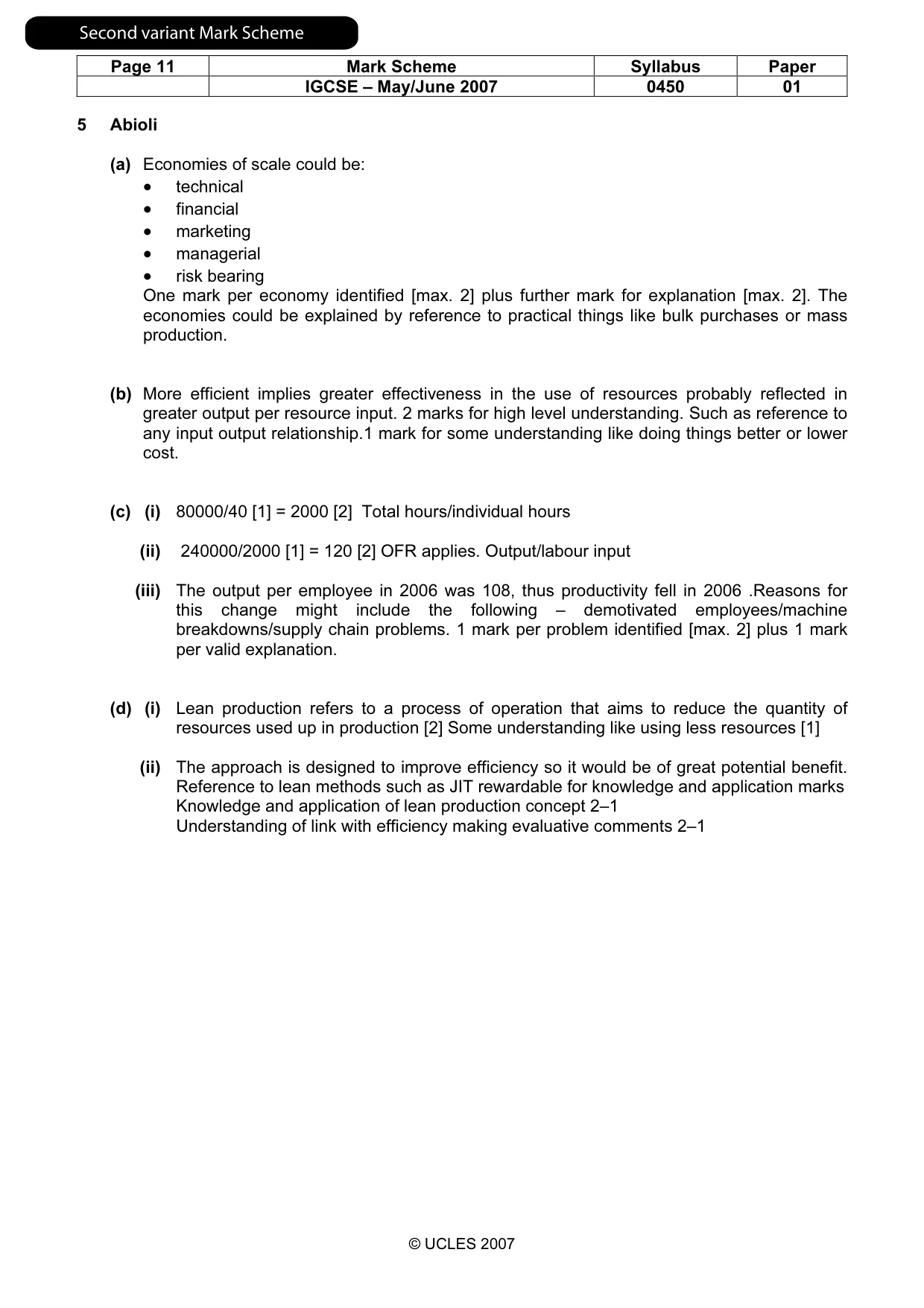
Page 11 Mark Scheme Syllabus Paper IGCSE – May/June 2007 0450 01 © UCLES 2007 5 Abioli (a) Economies of scale could be: • technical • financial • marketing • managerial • risk bearing One mark per economy identified [max. 2] plus further mark for explanation [max. 2]. The economies could be explained by reference to practical things like bulk purchases or mass production. (b) More efficient implies greater effectiveness in the use of resources probably reflected in greater output per resource input. 2 marks for high level understanding. Such as reference to any input output relationship.1 mark for some understanding like doing things better or lower cost. (c) (i) 80000/40 [1] = 2000 [2] Total hours/individual hours (ii) 240000/2000 [1] = 120 [2] OFR applies. Output/labour input (iii) The output per employee in 2006 was 108, thus productivity fell in 2006 .Reasons for this change might include the following – demotivated employees/machine breakdowns/supply chain problems. 1 mark per problem identified [max. 2] plus 1 mark per valid explanation. (d) (i) Lean production refers to a process of operation that aims to reduce the quantity of resources used up in production [2] Some understanding like using less resources [1] (ii) The approach is designed to improve efficiency so it would be of great potential benefit. Reference to lean methods such as JIT rewardable for knowledge and application marks Knowledge and application of lean production concept 2–1 Understanding of link with efficiency making evaluative comments 2–1 Second variant Mark Scheme
What you needed in this session
Cambridge’s own grade thresholds for 2007 May/June, Paper 1 · Variant 1. A higher threshold means an easier paper — the bar moves with how the cohort did.