Cambridge IGCSE Business Studies 0450 — 2006 Oct/Nov Paper 1 · Variant 1
0450/11/O/N/06 · 100 marks · ≈113 min
The question paper and its mark scheme, free to read here and free to download. This is Cambridge’s own paper, exactly as it was sat.
Question paper12 pages




Mark scheme5 pages
Answers below. Sit the paper first if you are practising.
Paper as text
Question paper, page 1
This document consists of 11 printed pages and 1 blank page. SP (NH) T17653/5 © UCLES 2006 [Turn over UNIVERSITY OF CAMBRIDGE INTERNATIONAL EXAMINATIONS International General Certificate of Secondary Education BUSINESS STUDIES Paper 1 0450/01 October/November 2006 1 hour 45 minutes Candidates answer on the Question Paper. No Additional Materials are required. READ THESE INSTRUCTIONS FIRST Write your Centre number, candidate number and name on all the work you hand in. Write in dark blue or black pen. Do not use staples, paper clips, highlighters, glue or correction fluid. Answer all questions. The businesses described in this question paper are entirely fictitious. At the end of the examination, fasten all your work securely together. The number of marks is given in brackets [ ] at the end of each question or part question. For Examiner’s Use 1 2 3 4 5 Total www.XtremePapers.com
Question paper, page 2
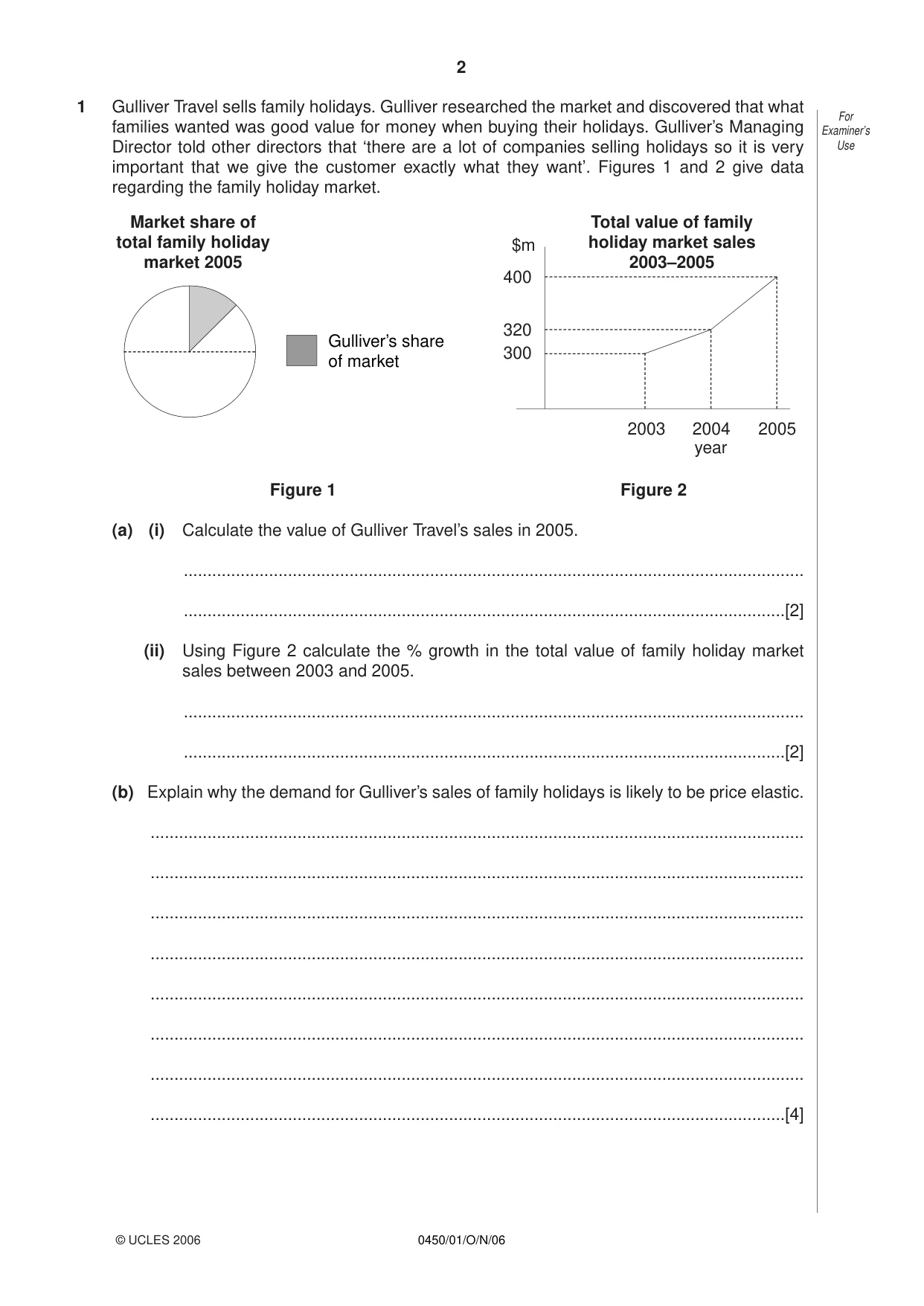
2 © UCLES 2006 0450/01/O/N/06 1 Gulliver Travel sells family holidays. Gulliver researched the market and discovered that what families wanted was good value for money when buying their holidays. Gulliver’s Managing Director told other directors that ‘there are a lot of companies selling holidays so it is very important that we give the customer exactly what they want’. Figures 1 and 2 give data regarding the family holiday market. Figure 1 Figure 2 (a) (i) Calculate the value of Gulliver Travel’s sales in 2005. … …[2] (ii) Using Figure 2 calculate the % growth in the total value of family holiday market sales between 2003 and 2005. … …[2] (b) Explain why the demand for Gulliver’s sales of family holidays is likely to be price elastic. … … … … … … … …[4] For Examiner’s Use Total value of family holiday market sales 2003–2005 Market share of total family holiday market 2005 400 320 300 $m year 2005 2004 2003 Gulliver’s share of market
Question paper, page 3
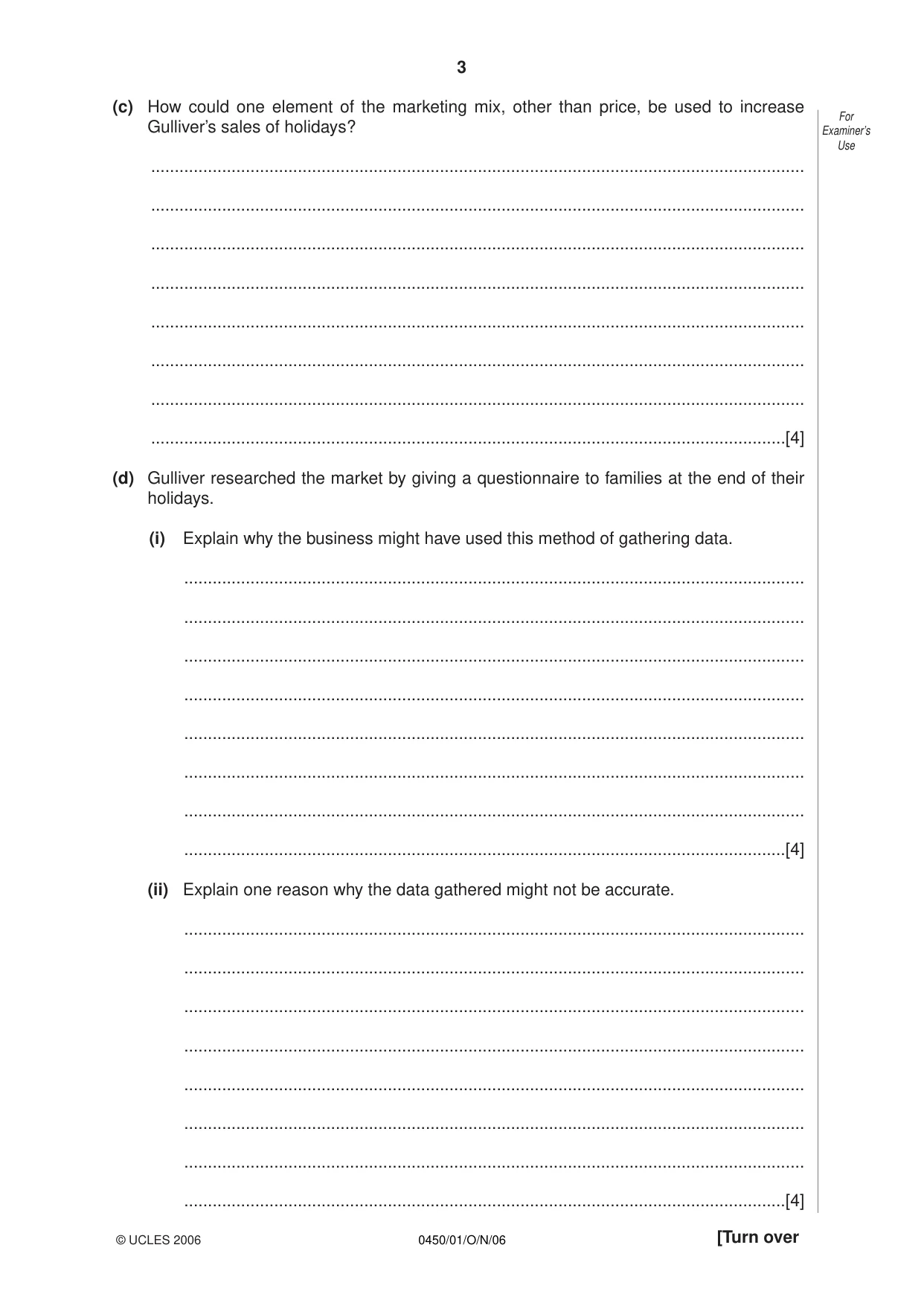
3 © UCLES 2006 0450/01/O/N/06 [Turn over (c) How could one element of the marketing mix, other than price, be used to increase Gulliver’s sales of holidays? … … … … … … … …[4] (d) Gulliver researched the market by giving a questionnaire to families at the end of their holidays. (i) Explain why the business might have used this method of gathering data. … … … … … … … …[4] (ii) Explain one reason why the data gathered might not be accurate. … … … … … … … …[4] For Examiner’s Use
Question paper, page 4
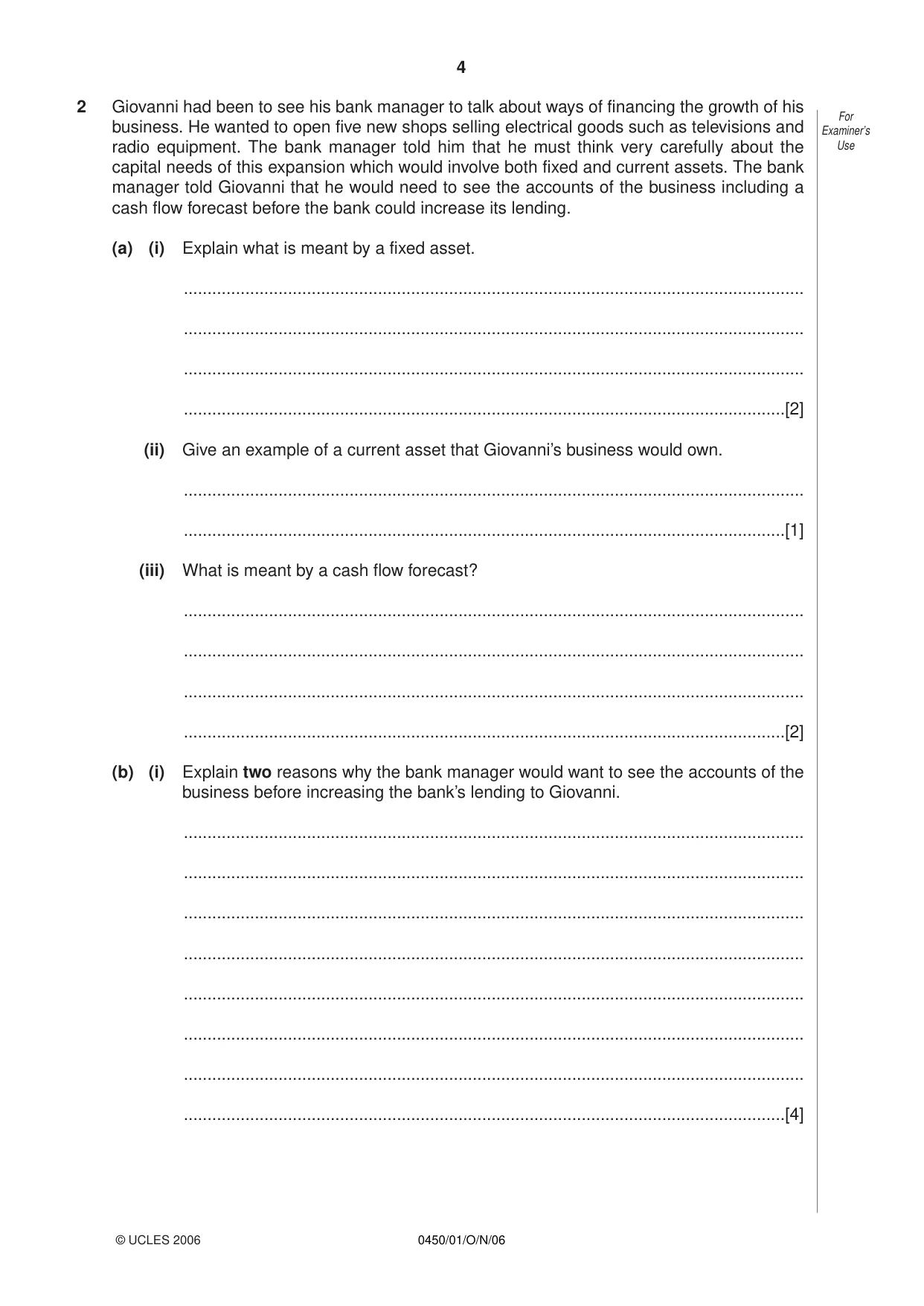
4 © UCLES 2006 0450/01/O/N/06 2 Giovanni had been to see his bank manager to talk about ways of financing the growth of his business. He wanted to open five new shops selling electrical goods such as televisions and radio equipment. The bank manager told him that he must think very carefully about the capital needs of this expansion which would involve both fixed and current assets. The bank manager told Giovanni that he would need to see the accounts of the business including a cash flow forecast before the bank could increase its lending. (a) (i) Explain what is meant by a fixed asset. … … … …[2] (ii) Give an example of a current asset that Giovanni’s business would own. … …[1] (iii) What is meant by a cash flow forecast? … … … …[2] (b) (i) Explain two reasons why the bank manager would want to see the accounts of the business before increasing the bank’s lending to Giovanni. … … … … … … … …[4] For Examiner’s Use
Question paper, page 5
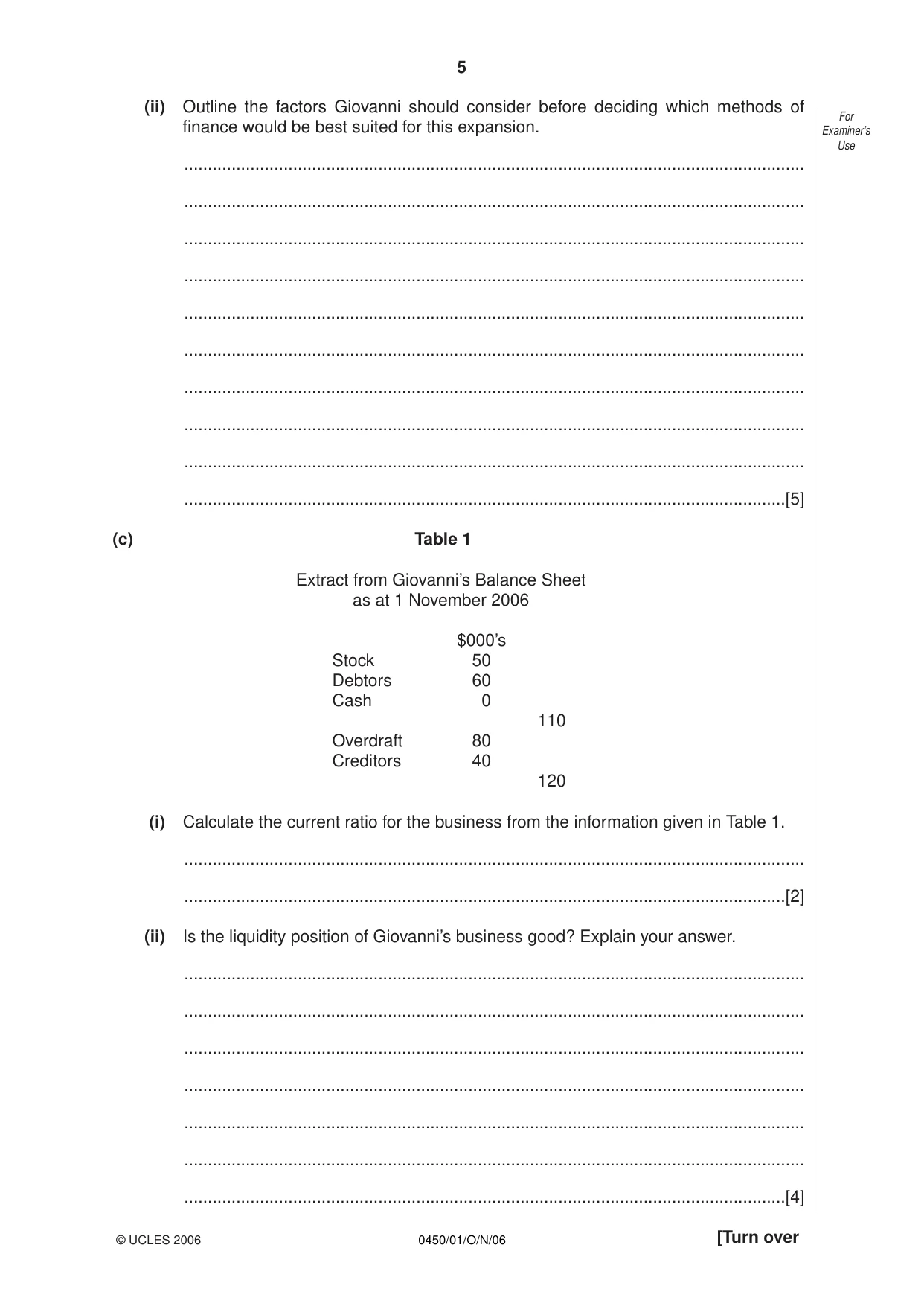
5 © UCLES 2006 0450/01/O/N/06 [Turn over (ii) Outline the factors Giovanni should consider before deciding which methods of finance would be best suited for this expansion. … … … … … … … … … …[5] (c) Table 1 Extract from Giovanni’s Balance Sheet as at 1 November 2006 $000’s Stock 50 Debtors 60 Cash 0 110 Overdraft 80 Creditors 40 120 (i) Calculate the current ratio for the business from the information given in Table 1. … …[2] (ii) Is the liquidity position of Giovanni’s business good? Explain your answer. … … … … … … …[4] For Examiner’s Use
Question paper, page 6
6 © UCLES 2006 0450/01/O/N/06 3 The directors of Philochem are thinking about building a chemical factory in country Z. (a) Identify and explain three factors the directors need to consider in making this location decision. … … … … … … … … … … … …[6] (b) Using examples show why a knowledge of health and safety laws in country Z would be important for the management of this business. … … … … … … … …[4] For Examiner’s Use
Question paper, page 7
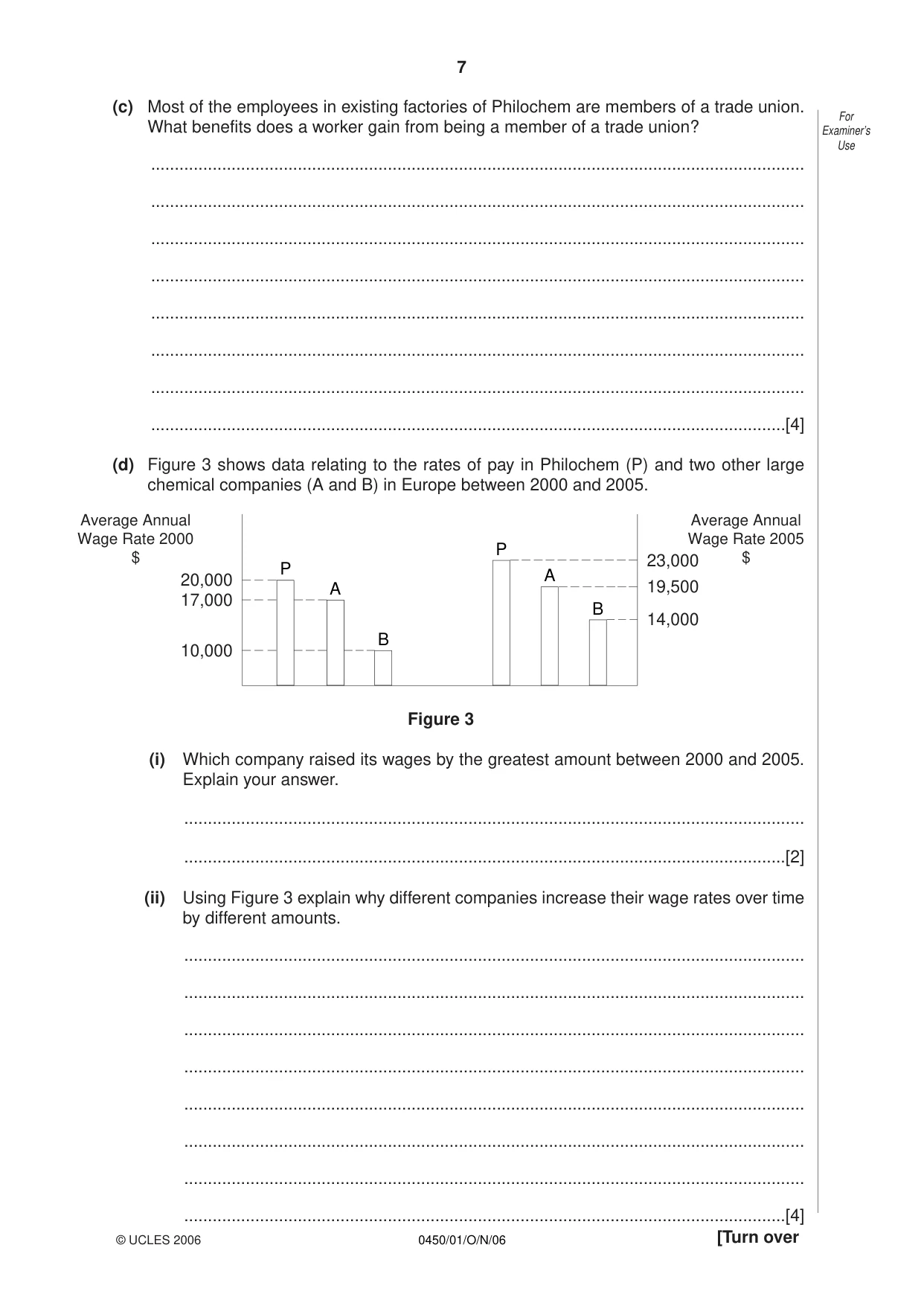
7 © UCLES 2006 0450/01/O/N/06 [Turn over (c) Most of the employees in existing factories of Philochem are members of a trade union. What benefits does a worker gain from being a member of a trade union? … … … … … … … …[4] (d) Figure 3 shows data relating to the rates of pay in Philochem (P) and two other large chemical companies (A and B) in Europe between 2000 and 2005. Figure 3 (i) Which company raised its wages by the greatest amount between 2000 and 2005. Explain your answer. … …[2] (ii) Using Figure 3 explain why different companies increase their wage rates over time by different amounts. … … … … … … … …[4] For Examiner’s Use Average Annual Wage Rate 2000 $ Average Annual Wage Rate 2005 $ 20,000 17,000 10,000 23,000 19,500 14,000 P P A A B B
Question paper, page 8
8 © UCLES 2006 0450/01/O/N/06 4 Gurinder Singh set up his successful business ten years ago. Gurinder makes all the decisions in his business. He tells staff what to do and he expects them to follow his orders. Gurinder doesn’t hold meetings as he feels that they are unnecessary and a waste of time. ‘Why consult and discuss when I know best,’ he said. ‘Everyone who is employed in my company is directly answerable to me. I pay high wages and I expect results. Everyone knows that if they don’t work hard I will dismiss them. Employees like my wages even if they don’t like me!’ (a) (i) Describe the management style used by Gurinder. … … … … … …[3] (ii) Do you think that this is a good way to manage a business? Justify your answer. … … … … … … … … … … … …[6] For Examiner’s Use
Question paper, page 9
9 © UCLES 2006 0450/01/O/N/06 [Turn over (b) It has been suggested to Gurinder that he might introduce delegation into his business. Explain what is meant by delegation. … … … … … …[3] (c) Recently Gurinder dismissed an employee for failing to carry out his orders. (i) Is this an example of an employee being made redundant? Explain your answer. … … … …[2] (ii) To what extent do you think high wages motivate staff in companies such as Gurinder’s? … … … … … … … … … … … …[6] For Examiner’s Use
Question paper, page 10
10 © UCLES 2006 0450/01/O/N/06 5 J.T. Enterprises is a large private sector business that owns a number of farms in country A. The business breeds a variety of animals such as cows and sheep as well as growing crops. They employ many workers and the business is successful and profitable. (a) Why is profit important to a business such as J.T. Enterprises? … … … … … …[3] (b) Using an example from J.T. Enterprises explain what is meant by added value. … … … … … …[3] (c) Many farmers such as J.T. Enterprises export their animals and crops. If the currency of Country A depreciates on the foreign exchange markets explain how this could affect the sales of J.T. Enterprises in export markets. … … … … … … … …[4] For Examiner’s Use
Question paper, page 11
11 © UCLES 2006 0450/01/O/N/06 (d) Business activity may result in social costs and social benefits. Describe the social benefits that you would expect J.T. Enterprises to produce. … … … … … … … …[4] (e) Identify and explain two important changes that have happened in your country in terms of employment and contribution to national wealth in recent times. … … … … … … … … … … … …[6] For Examiner’s Use
Question paper, page 12
0450/01/O/N/06 12 BLANK PAGE Permission to reproduce items where third-party owned material protected by copyright is included has been sought and cleared where possible. Every reasonable effort has been made by the publisher (UCLES) to trace copyright holders, but if any items requiring clearance have unwittingly been included, the publisher will be pleased to make amends at the earliest possible opportunity. University of Cambridge International Examinations is part of the University of Cambridge Local Examination Syndicate (UCLES) which is itself a department of the University of Cambridge.
Mark scheme, page 1
UNIVERSITY OF CAMBRIDGE INTERNATIONAL EXAMINATIONS International General Certificate of Secondary Education MARK SCHEME for the October/November 2006 question paper 0450 BUSINESS STUDIES 0450/01 Paper 1 (Short Answer/Structured Response), maximum raw mark 100 This mark scheme is published as an aid to teachers and students, to indicate the requirements of the examination. It shows the basis on which Examiners were instructed to award marks. It does not indicate the details of the discussions that took place at an Examiners’ meeting before marking began. All Examiners are instructed that alternative correct answers and unexpected approaches in candidates’ scripts must be given marks that fairly reflect the relevant knowledge and skills demonstrated. Mark schemes must be read in conjunction with the question papers and the report on the examination. The grade thresholds for various grades are published in the report on the examination for most IGCSE, GCE Advanced Level and Advanced Subsidiary Level syllabuses. • CIE will not enter into discussions or correspondence in connection with these mark schemes. CIE is publishing the mark schemes for the October/November 2006 question papers for most IGCSE, GCE Advanced Level and Advanced Subsidiary Level syllabuses and some Ordinary Level syllabuses. www.XtremePapers.com
Mark scheme, page 2
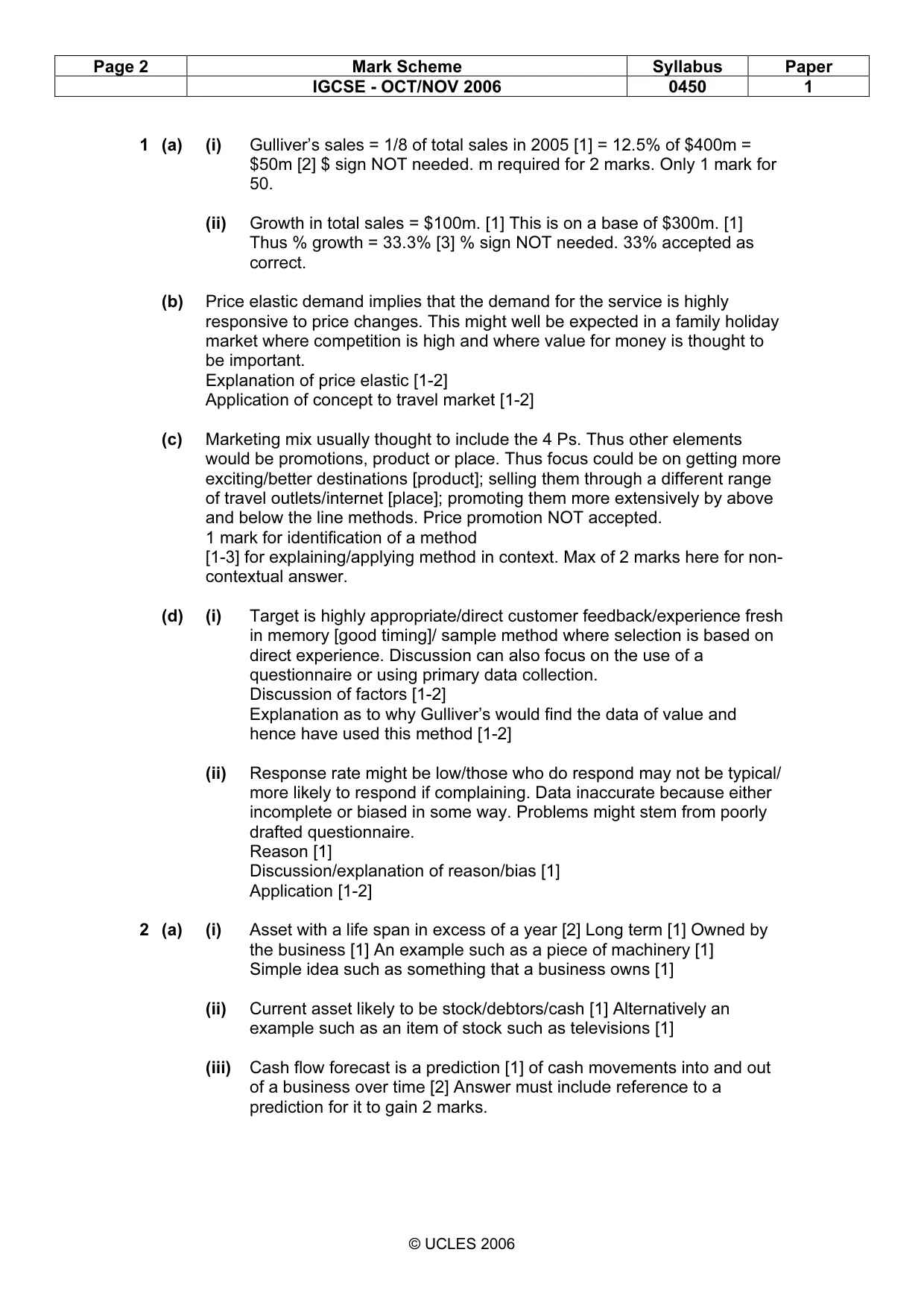
Page 2 Mark Scheme Syllabus Paper IGCSE - OCT/NOV 2006 0450 1 © UCLES 2006 1 (a) (i) Gulliver’s sales = 1/8 of total sales in 2005 [1] = 12.5% of $400m = $50m [2] $ sign NOT needed. m required for 2 marks. Only 1 mark for 50. (ii) Growth in total sales = $100m. [1] This is on a base of $300m. [1] Thus % growth = 33.3% [3] % sign NOT needed. 33% accepted as correct. (b) Price elastic demand implies that the demand for the service is highly responsive to price changes. This might well be expected in a family holiday market where competition is high and where value for money is thought to be important. Explanation of price elastic [1-2] Application of concept to travel market [1-2] (c) Marketing mix usually thought to include the 4 Ps. Thus other elements would be promotions, product or place. Thus focus could be on getting more exciting/better destinations [product]; selling them through a different range of travel outlets/internet [place]; promoting them more extensively by above and below the line methods. Price promotion NOT accepted. 1 mark for identification of a method [1-3] for explaining/applying method in context. Max of 2 marks here for non- contextual answer. (d) (i) Target is highly appropriate/direct customer feedback/experience fresh in memory [good timing]/ sample method where selection is based on direct experience. Discussion can also focus on the use of a questionnaire or using primary data collection. Discussion of factors [1-2] Explanation as to why Gulliver’s would find the data of value and hence have used this method [1-2] (ii) Response rate might be low/those who do respond may not be typical/ more likely to respond if complaining. Data inaccurate because either incomplete or biased in some way. Problems might stem from poorly drafted questionnaire. Reason [1] Discussion/explanation of reason/bias [1] Application [1-2] 2 (a) (i) Asset with a life span in excess of a year [2] Long term [1] Owned by the business [1] An example such as a piece of machinery [1] Simple idea such as something that a business owns [1] (ii) Current asset likely to be stock/debtors/cash [1] Alternatively an example such as an item of stock such as televisions [1] (iii) Cash flow forecast is a prediction [1] of cash movements into and out of a business over time [2] Answer must include reference to a prediction for it to gain 2 marks.
Mark scheme, page 3
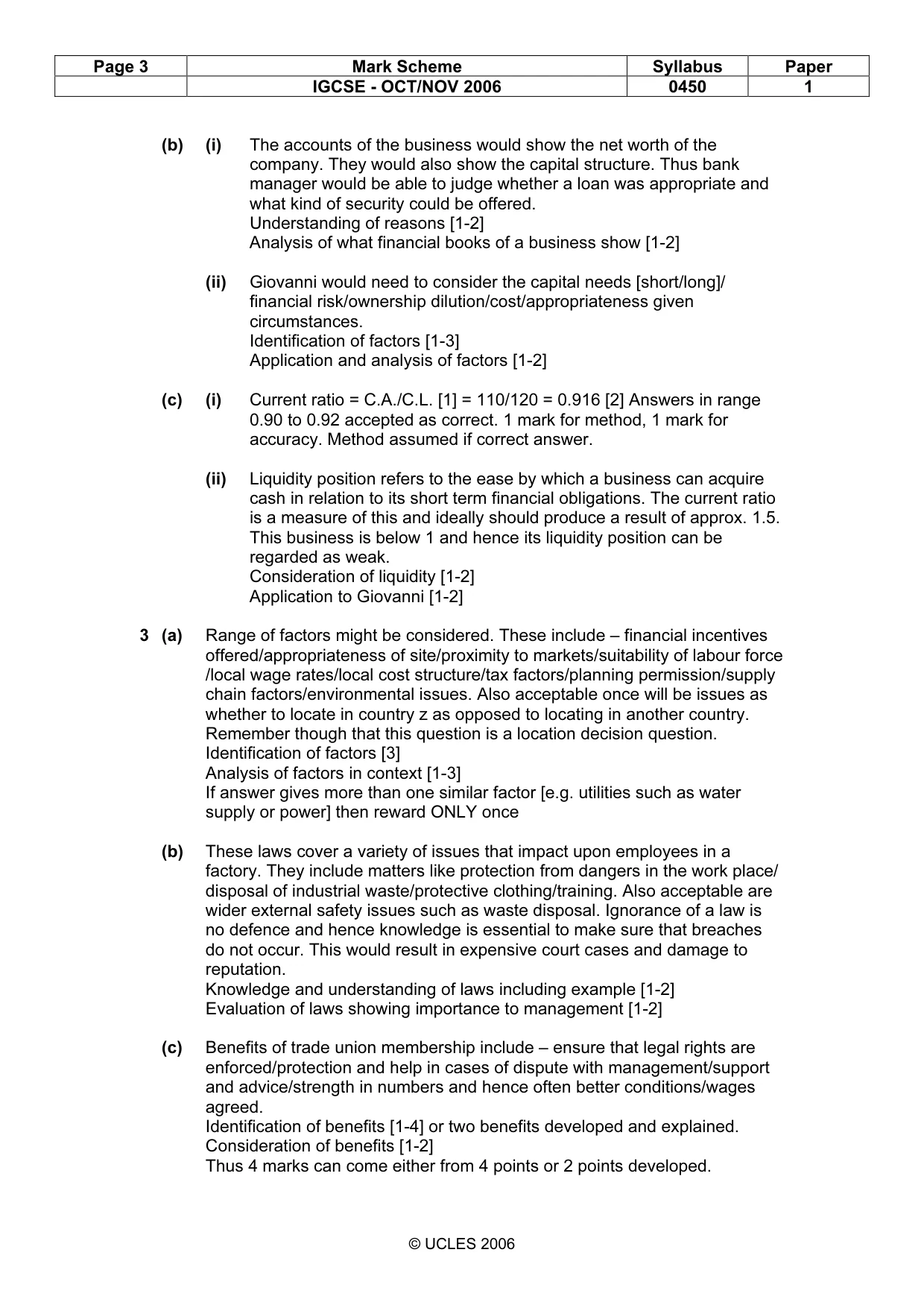
Page 3 Mark Scheme Syllabus Paper IGCSE - OCT/NOV 2006 0450 1 © UCLES 2006 (b) (i) The accounts of the business would show the net worth of the company. They would also show the capital structure. Thus bank manager would be able to judge whether a loan was appropriate and what kind of security could be offered. Understanding of reasons [1-2] Analysis of what financial books of a business show [1-2] (ii) Giovanni would need to consider the capital needs [short/long]/ financial risk/ownership dilution/cost/appropriateness given circumstances. Identification of factors [1-3] Application and analysis of factors [1-2] (c) (i) Current ratio = C.A./C.L. [1] = 110/120 = 0.916 [2] Answers in range 0.90 to 0.92 accepted as correct. 1 mark for method, 1 mark for accuracy. Method assumed if correct answer. (ii) Liquidity position refers to the ease by which a business can acquire cash in relation to its short term financial obligations. The current ratio is a measure of this and ideally should produce a result of approx. 1.5. This business is below 1 and hence its liquidity position can be regarded as weak. Consideration of liquidity [1-2] Application to Giovanni [1-2] 3 (a) Range of factors might be considered. These include – financial incentives offered/appropriateness of site/proximity to markets/suitability of labour force /local wage rates/local cost structure/tax factors/planning permission/supply chain factors/environmental issues. Also acceptable once will be issues as whether to locate in country z as opposed to locating in another country. Remember though that this question is a location decision question. Identification of factors [3] Analysis of factors in context [1-3] If answer gives more than one similar factor [e.g. utilities such as water supply or power] then reward ONLY once (b) These laws cover a variety of issues that impact upon employees in a factory. They include matters like protection from dangers in the work place/ disposal of industrial waste/protective clothing/training. Also acceptable are wider external safety issues such as waste disposal. Ignorance of a law is no defence and hence knowledge is essential to make sure that breaches do not occur. This would result in expensive court cases and damage to reputation. Knowledge and understanding of laws including example [1-2] Evaluation of laws showing importance to management [1-2] (c) Benefits of trade union membership include – ensure that legal rights are enforced/protection and help in cases of dispute with management/support and advice/strength in numbers and hence often better conditions/wages agreed. Identification of benefits [1-4] or two benefits developed and explained. Consideration of benefits [1-2] Thus 4 marks can come either from 4 points or 2 points developed.
Mark scheme, page 4
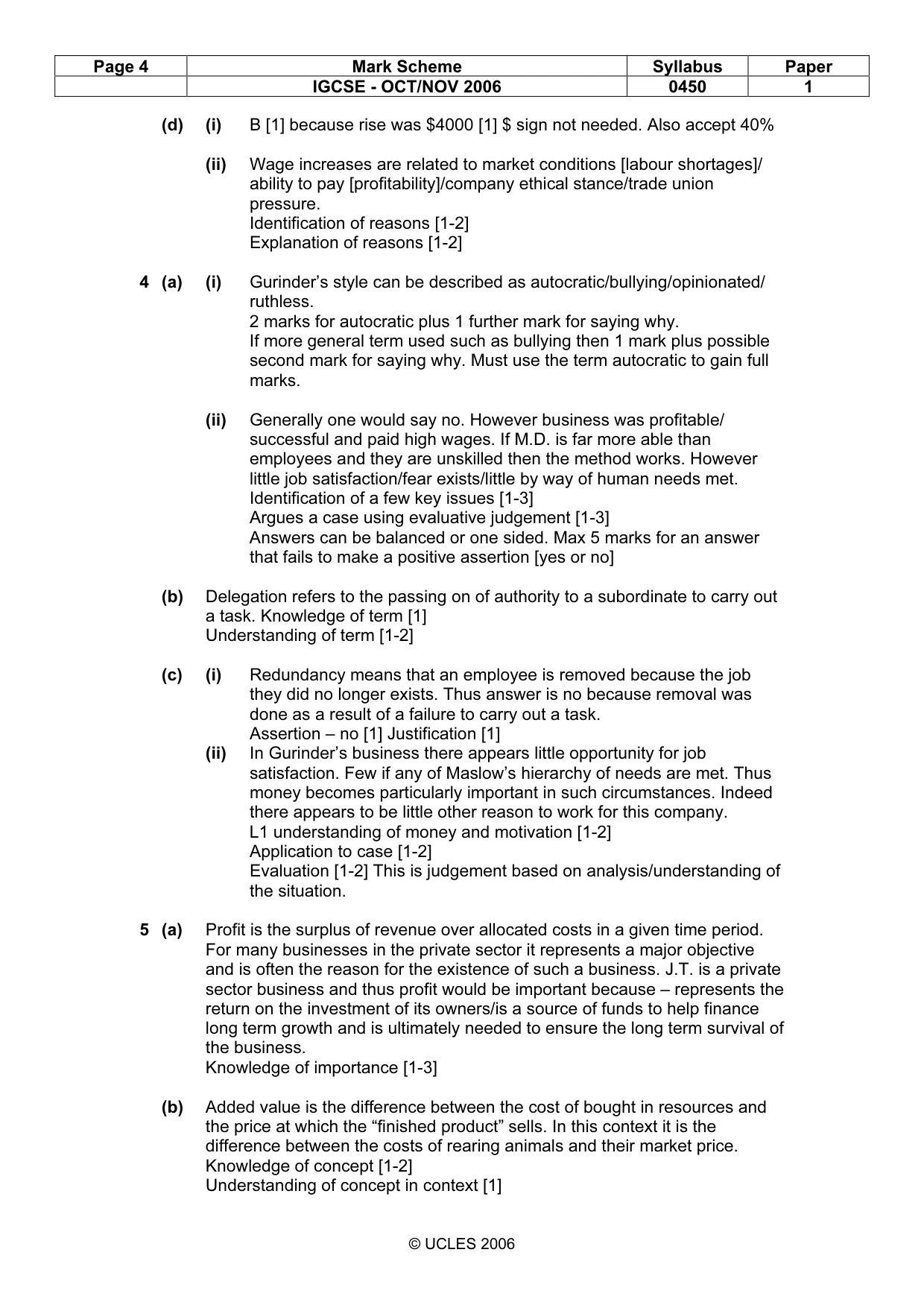
Page 4 Mark Scheme Syllabus Paper IGCSE - OCT/NOV 2006 0450 1 © UCLES 2006 (d) (i) B [1] because rise was $4000 [1] $ sign not needed. Also accept 40% (ii) Wage increases are related to market conditions [labour shortages]/ ability to pay [profitability]/company ethical stance/trade union pressure. Identification of reasons [1-2] Explanation of reasons [1-2] 4 (a) (i) Gurinder’s style can be described as autocratic/bullying/opinionated/ ruthless. 2 marks for autocratic plus 1 further mark for saying why. If more general term used such as bullying then 1 mark plus possible second mark for saying why. Must use the term autocratic to gain full marks. (ii) Generally one would say no. However business was profitable/ successful and paid high wages. If M.D. is far more able than employees and they are unskilled then the method works. However little job satisfaction/fear exists/little by way of human needs met. Identification of a few key issues [1-3] Argues a case using evaluative judgement [1-3] Answers can be balanced or one sided. Max 5 marks for an answer that fails to make a positive assertion [yes or no] (b) Delegation refers to the passing on of authority to a subordinate to carry out a task. Knowledge of term [1] Understanding of term [1-2] (c) (i) Redundancy means that an employee is removed because the job they did no longer exists. Thus answer is no because removal was done as a result of a failure to carry out a task. Assertion – no [1] Justification [1] (ii) In Gurinder’s business there appears little opportunity for job satisfaction. Few if any of Maslow’s hierarchy of needs are met. Thus money becomes particularly important in such circumstances. Indeed there appears to be little other reason to work for this company. L1 understanding of money and motivation [1-2] Application to case [1-2] Evaluation [1-2] This is judgement based on analysis/understanding of the situation. 5 (a) Profit is the surplus of revenue over allocated costs in a given time period. For many businesses in the private sector it represents a major objective and is often the reason for the existence of such a business. J.T. is a private sector business and thus profit would be important because – represents the return on the investment of its owners/is a source of funds to help finance long term growth and is ultimately needed to ensure the long term survival of the business. Knowledge of importance [1-3] (b) Added value is the difference between the cost of bought in resources and the price at which the “finished product” sells. In this context it is the difference between the costs of rearing animals and their market price. Knowledge of concept [1-2] Understanding of concept in context [1]
Mark scheme, page 5
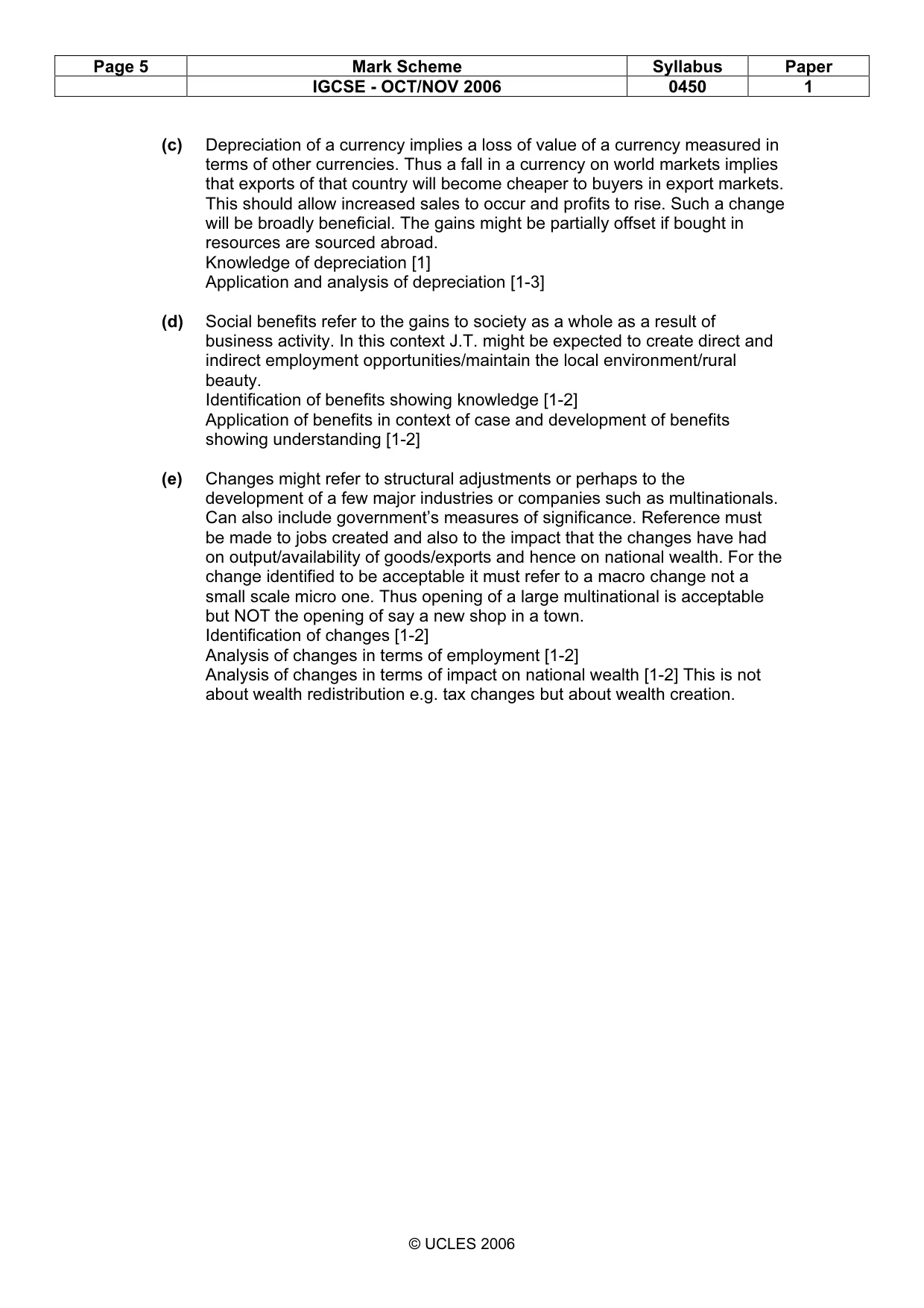
Page 5 Mark Scheme Syllabus Paper IGCSE - OCT/NOV 2006 0450 1 © UCLES 2006 (c) Depreciation of a currency implies a loss of value of a currency measured in terms of other currencies. Thus a fall in a currency on world markets implies that exports of that country will become cheaper to buyers in export markets. This should allow increased sales to occur and profits to rise. Such a change will be broadly beneficial. The gains might be partially offset if bought in resources are sourced abroad. Knowledge of depreciation [1] Application and analysis of depreciation [1-3] (d) Social benefits refer to the gains to society as a whole as a result of business activity. In this context J.T. might be expected to create direct and indirect employment opportunities/maintain the local environment/rural beauty. Identification of benefits showing knowledge [1-2] Application of benefits in context of case and development of benefits showing understanding [1-2] (e) Changes might refer to structural adjustments or perhaps to the development of a few major industries or companies such as multinationals. Can also include government’s measures of significance. Reference must be made to jobs created and also to the impact that the changes have had on output/availability of goods/exports and hence on national wealth. For the change identified to be acceptable it must refer to a macro change not a small scale micro one. Thus opening of a large multinational is acceptable but NOT the opening of say a new shop in a town. Identification of changes [1-2] Analysis of changes in terms of employment [1-2] Analysis of changes in terms of impact on national wealth [1-2] This is not about wealth redistribution e.g. tax changes but about wealth creation.
What you needed in this session
Cambridge’s own grade thresholds for 2006 Oct/Nov, Paper 1 · Variant 1. A higher threshold means an easier paper — the bar moves with how the cohort did.