Cambridge IGCSE Business Studies 0450 — 2006 May/June Paper 1 · Variant 1
0450/11/M/J/06 · 100 marks · ≈113 min
The question paper and its mark scheme, free to read here and free to download. This is Cambridge’s own paper, exactly as it was sat.
Question paper16 pages



Mark scheme4 pages
Answers below. Sit the paper first if you are practising.
Paper as text
Question paper, page 1
This document consists of 15 printed pages and 1 blank page. SP (SLM/KS) T15439/4 © UCLES 2006 [Turn over UNIVERSITY OF CAMBRIDGE INTERNATIONAL EXAMINATIONS International General Certificate of Secondary Education BUSINESS STUDIES Paper 1 0450/01 May/June 2006 1 hour 45 minutes Candidates answer on the Question Paper. No Additional Materials are required READ THESE INSTRUCTIONS FIRST Write your Centre number, candidate number and name on all the work you hand in. Write in dark blue or black pen. Do not use staples, paper clips, highlighters, glue or correction fluid. Answer all questions. The businesses described in this question paper are entirely fictitious. At the end of the examination, fasten all your work securely together. The number of marks is given in brackets [ ] at the end of each question or part question. For Examiner’s Use 1 2 3 4 5 Total www.XtremePapers.com
Question paper, page 2
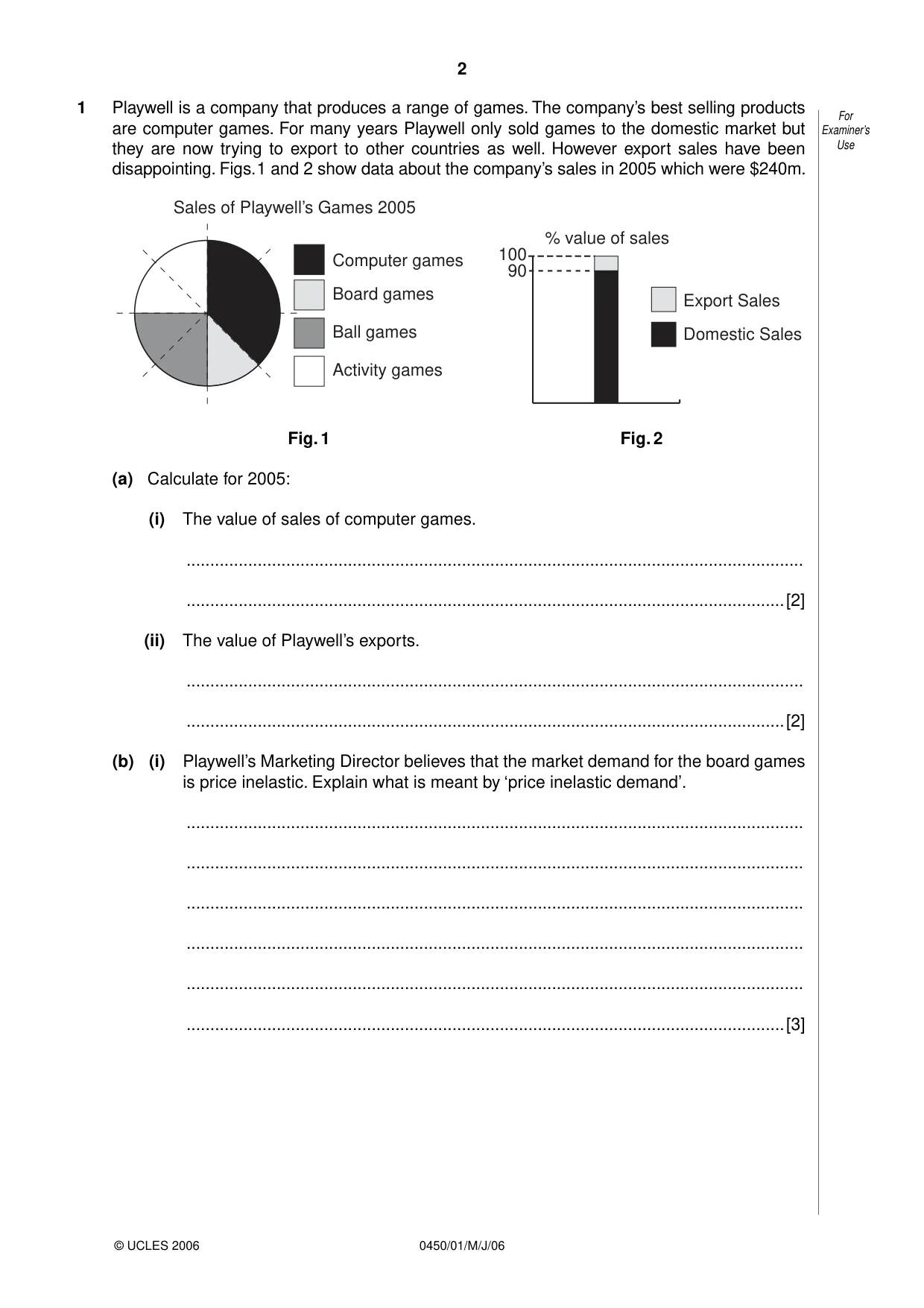
2 0450/01/M/J/06 For Examiner’s Use © UCLES 2006 1 Playwell is a company that produces a range of games. The company’s best selling products are computer games. For many years Playwell only sold games to the domestic market but they are now trying to export to other countries as well. However export sales have been disappointing. Figs. 1 and 2 show data about the company’s sales in 2005 which were $240m. Sales of Playwell’s Games 2005 Computer games Board games Ball games Activity games 90 100 Domestic Sales Export Sales % value of sales Fig.1 Fig.2 (a) Calculate for 2005: (i) The value of sales of computer games. … …[2] (ii) The value of Playwell’s exports. … …[2] (b) (i) Playwell’s Marketing Director believes that the market demand for the board games is price inelastic. Explain what is meant by ‘price inelastic demand’. … … … … … …[3]
Question paper, page 3
3 0450/01/M/J/06 [Turn over For Examiner’s Use © UCLES 2006 (ii) Explain how Playwell’s pricing policy for board games might be influenced by the demand being price inelastic. … … … … … …[3] (c) Playwell’s Board of Directors feel that good distribution channels are very important for increasing company sales. How important do you think channels of distribution are for increasing sales of Playwell’s products? … … … … … … … … … … … …[6]
Question paper, page 4
4 0450/01/M/J/06 For Examiner’s Use © UCLES 2006 (d) Why might Playwell find it difficult to sell their games in other countries? … … … … … … … …[4]
Question paper, page 5
5 0450/01/M/J/06 [Turn over For Examiner’s Use © UCLES 2006 2 Mirex is a large company that sells a range of insurance policies to businesses and the general public. The market for insurance is very competitive and Mirex are always looking for ways to cut their costs. Recently they have invested heavily in new technology. (a) (i) Mirex has been described as a large company. State three ways of measuring the size of a business. … … … … … …[3] (ii) What sector of business activity does Mirex operate in? Explain your answer. … … … …[2] (iii) What is meant by a competitive market? … … … …[2]
Question paper, page 6
6 0450/01/M/J/06 For Examiner’s Use © UCLES 2006 (b) Explain how new technology such as office computers might cut the costs of companies such as Mirex. … … … … … … … … … …[5] (c) The management of Mirex could consider the needs of all stakeholders when making decisions. (i) Explain what is meant by a stakeholder. … … … …[2]
Question paper, page 7
7 0450/01/M/J/06 [Turn over For Examiner’s Use © UCLES 2006 (ii) Identify and explain the objectives of two stakeholder groups who might be affected by Mirex’s decisions. … … … … … … … … … … … …[6]
Question paper, page 8
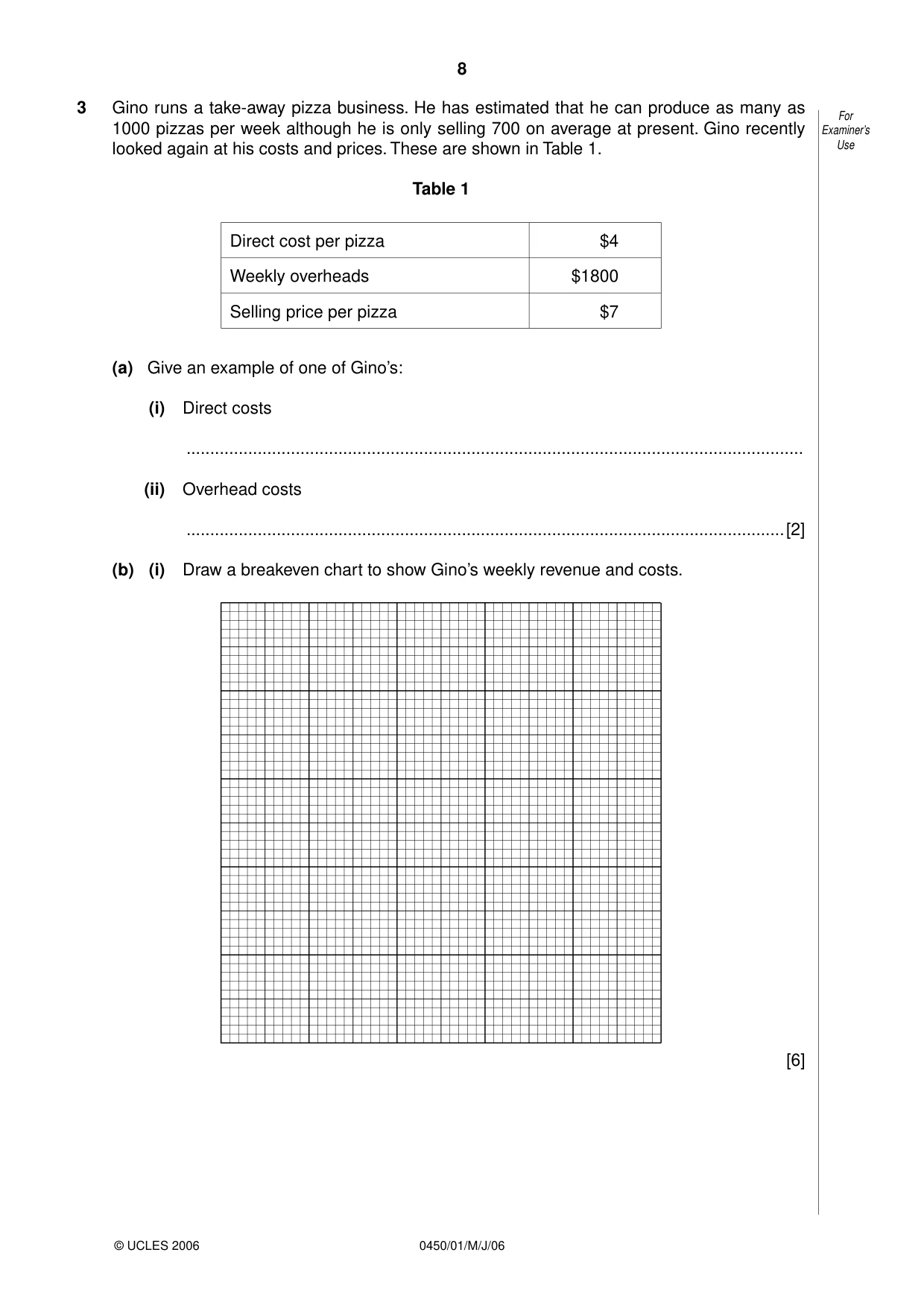
8 0450/01/M/J/06 For Examiner’s Use © UCLES 2006 3 Gino runs a take-away pizza business. He has estimated that he can produce as many as 1000 pizzas per week although he is only selling 700 on average at present. Gino recently looked again at his costs and prices. These are shown in Table 1. Table 1 Direct cost per pizza $4 Weekly overheads $1800 Selling price per pizza $7 (a) Give an example of one of Gino’s: (i) Direct costs … (ii) Overhead costs …[2] (b) (i) Draw a breakeven chart to show Gino’s weekly revenue and costs. [6]
Question paper, page 9
9 0450/01/M/J/06 [Turn over For Examiner’s Use © UCLES 2006 Calculate: (ii) How many pizzas Gino has to sell to break even. … …[1] (iii) Gino’s annual profit when he sells 700 pizzas per week. … … … … … …[3] (c) Gino invested $100000 in his business when he set it up. Using your profit figure from (b)(iii) calculate the return on capital employed. … … … …[2]
Question paper, page 10
10 0450/01/M/J/06 For Examiner’s Use © UCLES 2006 (d) Gino’s business is currently profitable. He thought that this meant it would be profitable for the next few years as well. What do you think? … … … … … … … … … … … …[6]
Question paper, page 11
11 0450/01/M/J/06 [Turn over For Examiner’s Use © UCLES 2006 4 B.M.F. is a major electronics manufacturer. It has recently built a new factory in country Y. The factory employs a large number of workers and uses flow production methods to assemble the products. All the workers were recruited locally. The management believe that it is very important for the workers to be motivated and for productivity to be high. (a) Why do you think that B.M.F. uses ‘flow production methods’? … … … … … … … …[4] (b) Explain two methods that the management of B.M.F. could use to motivate their employees. … … … … … … … … … … … …[6]
Question paper, page 12
12 0450/01/M/J/06 For Examiner’s Use © UCLES 2006 (c) Why is high productivity important to the management of B.M.F.? … … … … … … … …[4] (d) The government of country Y gave B.M.F. financial help to set up in their country. Not everyone in the country was pleased to see the factory built. Some pointed out that there would be social costs produced by the factory. Explain what these social costs might be. … … … … … … … … … … … …[6]
Question paper, page 13
13 0450/01/M/J/06 [Turn over For Examiner’s Use © UCLES 2006 5 Easy Chairs is a private limited company that manufactures furniture. The business has recently had financial problems. The management thought that these had been caused largely by an economic recession. Important decisions needed to be made to solve these problems. The management are thinking about making employees redundant. The Human Resources Director has had talks with trade union leaders and three options were discussed: • 100 workers to be made redundant • Wages of all workers to be cut by $50 per week but no redundancies • Working just 3 days a week, so earnings are less, but no redundancies. (a) (i) Explain what is meant by an economic recession. … … … …[2] (ii) Why might an economic recession have caused financial problems for Easy Chairs? … … … … … … … …[4]
Question paper, page 14
14 0450/01/M/J/06 For Examiner’s Use © UCLES 2006 (b) Assume you are a trade union leader at Easy Chairs. Explain to your members which option you would recommend they accept. Support your recommendation with reasons. … … … … … … … … … … … …[6] (c) Identify and explain one possible solution to the financial problem at Easy Chairs other than reducing labour costs. … … … … … … … …[4]
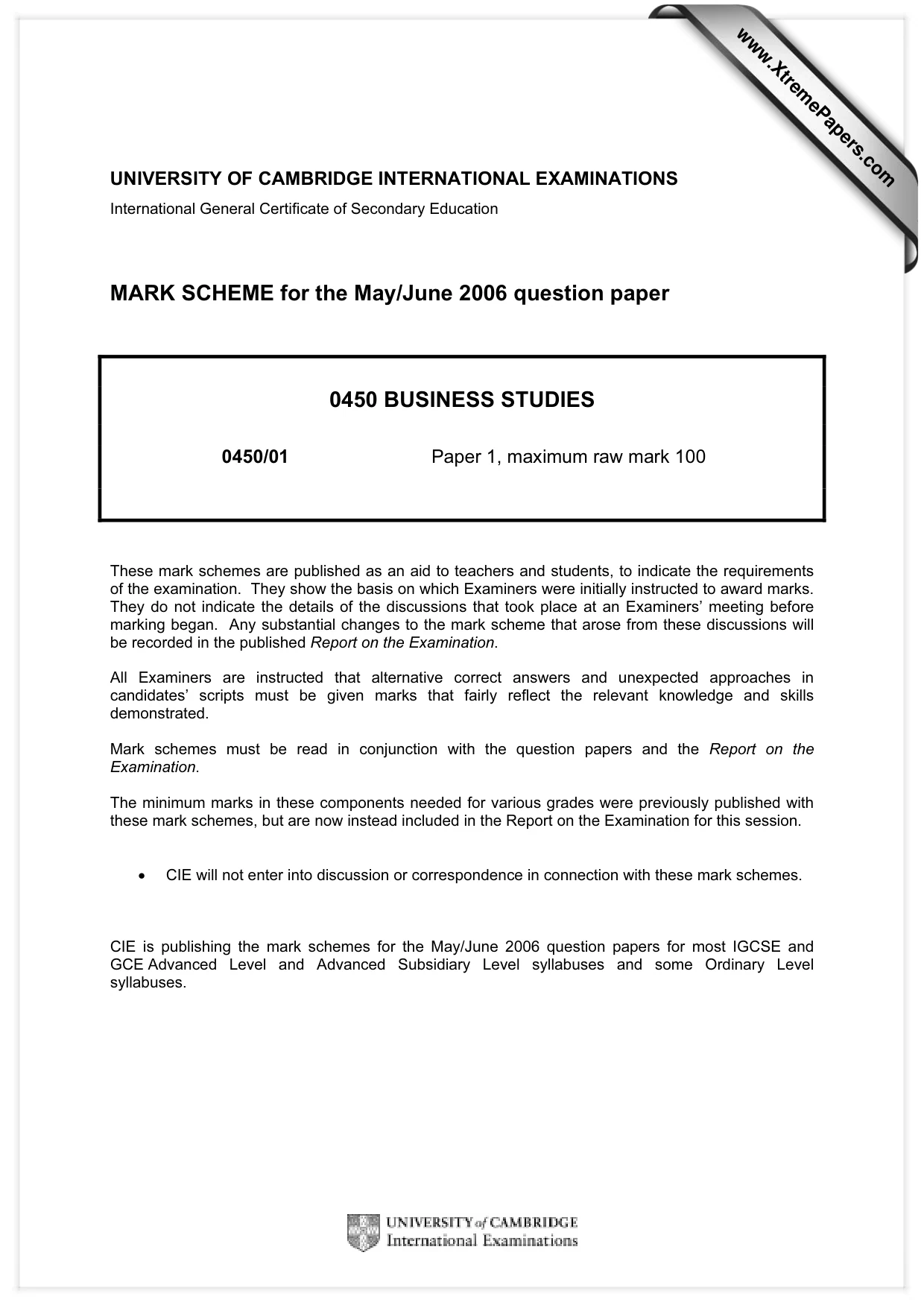
Question paper, page 15
15 0450/01/M/J/06 For Examiner’s Use © UCLES 2006 (d) Recently Easy Chairs received a complaint from a customer that one of their chairs did not meet the minimum standards required by consumer protection laws. The management ignored the complaint and said that the customer must be mistaken. Do you think that this is the way the management should have reacted? Justify your answer. … … … … … … … …[4]
Question paper, page 16
16 0450/01/M/J/06 BLANK PAGE Permission to reproduce items where third-party owned material protected by copyright is included has been sought and cleared where possible. Every reasonable effort has been made by the publisher (UCLES) to trace copyright holders, but if any items requiring clearance have unwittingly been included, the publisher will be pleased to make amends at the earliest possible opportunity. University of Cambridge International Examinations is part of the University of Cambridge Local Examination Syndicate (UCLES) which is itself a department of the University of Cambridge.
Mark scheme, page 1
UNIVERSITY OF CAMBRIDGE INTERNATIONAL EXAMINATIONS International General Certificate of Secondary Education MARK SCHEME for the May/June 2006 question paper 0450 BUSINESS STUDIES 0450/01 Paper 1, maximum raw mark 100 These mark schemes are published as an aid to teachers and students, to indicate the requirements of the examination. They show the basis on which Examiners were initially instructed to award marks. They do not indicate the details of the discussions that took place at an Examiners’ meeting before marking began. Any substantial changes to the mark scheme that arose from these discussions will be recorded in the published Report on the Examination. All Examiners are instructed that alternative correct answers and unexpected approaches in candidates’ scripts must be given marks that fairly reflect the relevant knowledge and skills demonstrated. Mark schemes must be read in conjunction with the question papers and the Report on the Examination. The minimum marks in these components needed for various grades were previously published with these mark schemes, but are now instead included in the Report on the Examination for this session. • CIE will not enter into discussion or correspondence in connection with these mark schemes. CIE is publishing the mark schemes for the May/June 2006 question papers for most IGCSE and GCE Advanced Level and Advanced Subsidiary Level syllabuses and some Ordinary Level syllabuses. www.XtremePapers.com
Mark scheme, page 2
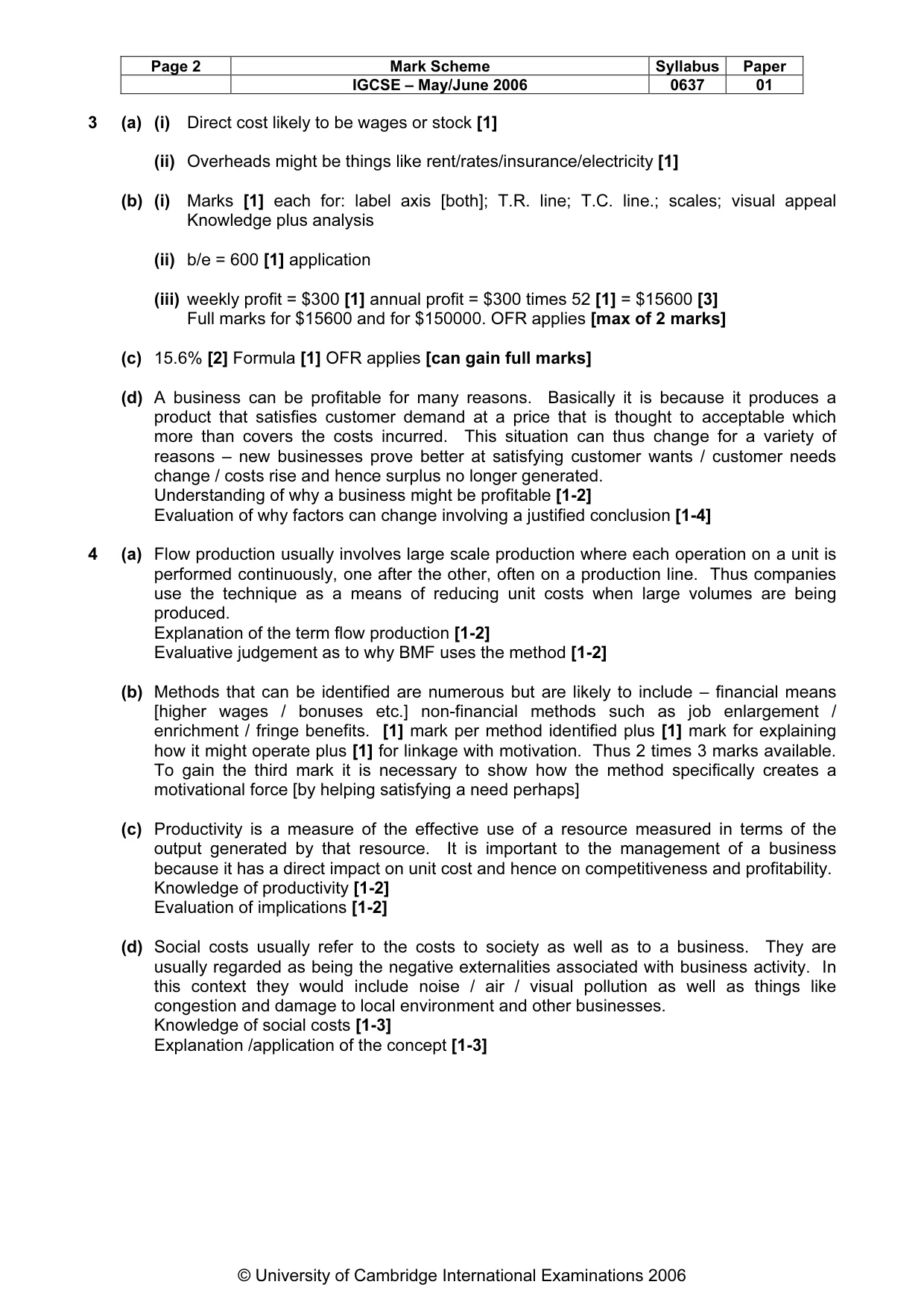
Page 1 Mark Scheme Syllabus Paper IGCSE – May/June 2006 0637 01 © University of Cambridge International Examinations 2006 1 (a) (i) Value of computer sales = 3/8 of $240 [1] Answer =$90m [2] (ii) Value of exports = 10% of total value [1] Answer = $24m [2] In both cases correct answer alone gets full marks. (b) (i) L1 Demand not much affected by price [1] L2 Change in demand less than change in price [2] L3 % change in Q.D / % change in P less than 1 OR concept explained [3] (ii) If demand is price inelastic then prices will probably rise because such a change would increase turnover [sales revenue]. However other business objectives might be being pursued e.g. market share. If so then price may be kept low. Knowledge of link [1] Understanding / application of link /awareness of other objectives [2-3] (c) A channel of distribution is the route taken by a product as it passes from the producer to the customer. Distribution is one element of the marketing mix. Thus it is important as part of an overall strategy of generating sales. Knowledge of channels of distribution [1-2] Application of concept to Playwell’s computer products [1-2] Evaluative judgement of importance [1-2] (d) It is difficult for a company to sell products in new markets overseas for various reasons. These might include reference to – tastes may differ in different countries hence customers might not like the games / existing brands may be hard to dislodge / distribution network not well established / lack of awareness of potential customers / import taxes and other barriers to entry / adverse changes in exchange rates. Awareness of possible reasons [1-2] Explanation of reasons [1-2] 2 (a) (i) Measurement of size usually done by – number of employees / value of sales / capital employed / value of assets. [net worth]. Knowledge [1] per point identified. [1-3] (ii) Tertiary [1] service based activity [1] (iii) Simple explanation such as a market where there is competition [1] Development of explanation by making reference to number of similar businesses selling products aimed at similar customer base [2]. Thus showing higher level of understanding. (b) New technology such as office computers might be expected to cut office costs in a number of ways. They might reduce the number of employees needed because of their labour saving potential. They might speed up activities and hence allow more work to be completed in a given time period. Thus overheads spread over more work. Identification of ways costs might be cut [1-2] Explanation of ways showing how gains might be achieved [1-3] (c) (i) Stakeholders refer to any group which has an interest in business activity. [2] Simple answer such as people who are involved in a business [1]. Simple answer plus appropriate examples will get two marks. (ii) Clearly different stakeholders can be identified. Shareholders would have an objective to get a satisfactory return on their investment. This means that they buy shares usually in anticipation of a financial gain achieved either through dividend income or appreciation in capital value. Employees have objectives like high wages or job security. People work primarily for money and hence wage rates very important or job security helps satisfy basic needs which provides stability that people enjoy. Similar ideas for groups such as consumers / suppliers / society. The objectives must be of TWO different groups of stakeholders. Identification of objectives of two groups [2] Explanation of objectives [1-4]
Mark scheme, page 3
Page 2 Mark Scheme Syllabus Paper IGCSE – May/June 2006 0637 01 © University of Cambridge International Examinations 2006 3 (a) (i) Direct cost likely to be wages or stock [1] (ii) Overheads might be things like rent/rates/insurance/electricity [1] (b) (i) Marks [1] each for: label axis [both]; T.R. line; T.C. line.; scales; visual appeal Knowledge plus analysis (ii) b/e = 600 [1] application (iii) weekly profit = $300 [1] annual profit = $300 times 52 [1] = $15600 [3] Full marks for $15600 and for $150000. OFR applies [max of 2 marks] (c) 15.6% [2] Formula [1] OFR applies [can gain full marks] (d) A business can be profitable for many reasons. Basically it is because it produces a product that satisfies customer demand at a price that is thought to acceptable which more than covers the costs incurred. This situation can thus change for a variety of reasons – new businesses prove better at satisfying customer wants / customer needs change / costs rise and hence surplus no longer generated. Understanding of why a business might be profitable [1-2] Evaluation of why factors can change involving a justified conclusion [1-4] 4 (a) Flow production usually involves large scale production where each operation on a unit is performed continuously, one after the other, often on a production line. Thus companies use the technique as a means of reducing unit costs when large volumes are being produced. Explanation of the term flow production [1-2] Evaluative judgement as to why BMF uses the method [1-2] (b) Methods that can be identified are numerous but are likely to include – financial means [higher wages / bonuses etc.] non-financial methods such as job enlargement / enrichment / fringe benefits. [1] mark per method identified plus [1] mark for explaining how it might operate plus [1] for linkage with motivation. Thus 2 times 3 marks available. To gain the third mark it is necessary to show how the method specifically creates a motivational force [by helping satisfying a need perhaps] (c) Productivity is a measure of the effective use of a resource measured in terms of the output generated by that resource. It is important to the management of a business because it has a direct impact on unit cost and hence on competitiveness and profitability. Knowledge of productivity [1-2] Evaluation of implications [1-2] (d) Social costs usually refer to the costs to society as well as to a business. They are usually regarded as being the negative externalities associated with business activity. In this context they would include noise / air / visual pollution as well as things like congestion and damage to local environment and other businesses. Knowledge of social costs [1-3] Explanation /application of the concept [1-3]
Mark scheme, page 4
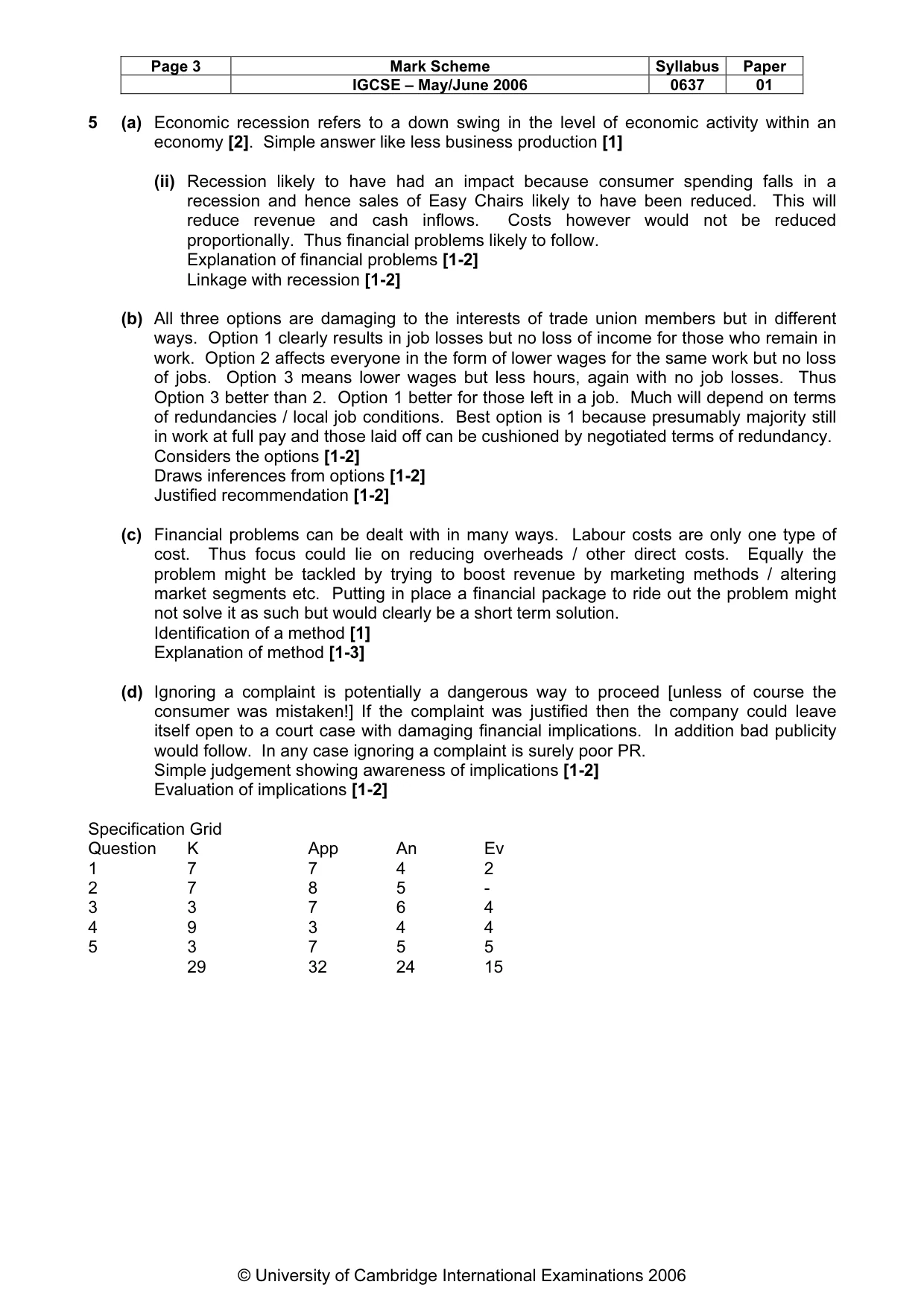
Page 3 Mark Scheme Syllabus Paper IGCSE – May/June 2006 0637 01 © University of Cambridge International Examinations 2006 5 (a) Economic recession refers to a down swing in the level of economic activity within an economy [2]. Simple answer like less business production [1] (ii) Recession likely to have had an impact because consumer spending falls in a recession and hence sales of Easy Chairs likely to have been reduced. This will reduce revenue and cash inflows. Costs however would not be reduced proportionally. Thus financial problems likely to follow. Explanation of financial problems [1-2] Linkage with recession [1-2] (b) All three options are damaging to the interests of trade union members but in different ways. Option 1 clearly results in job losses but no loss of income for those who remain in work. Option 2 affects everyone in the form of lower wages for the same work but no loss of jobs. Option 3 means lower wages but less hours, again with no job losses. Thus Option 3 better than 2. Option 1 better for those left in a job. Much will depend on terms of redundancies / local job conditions. Best option is 1 because presumably majority still in work at full pay and those laid off can be cushioned by negotiated terms of redundancy. Considers the options [1-2] Draws inferences from options [1-2] Justified recommendation [1-2] (c) Financial problems can be dealt with in many ways. Labour costs are only one type of cost. Thus focus could lie on reducing overheads / other direct costs. Equally the problem might be tackled by trying to boost revenue by marketing methods / altering market segments etc. Putting in place a financial package to ride out the problem might not solve it as such but would clearly be a short term solution. Identification of a method [1] Explanation of method [1-3] (d) Ignoring a complaint is potentially a dangerous way to proceed [unless of course the consumer was mistaken!] If the complaint was justified then the company could leave itself open to a court case with damaging financial implications. In addition bad publicity would follow. In any case ignoring a complaint is surely poor PR. Simple judgement showing awareness of implications [1-2] Evaluation of implications [1-2] Specification Grid Question K App An Ev 1 7 7 4 2 2 7 8 5 - 3 3 7 6 4 4 9 3 4 4 5 3 7 5 5 29 32 24 15
What you needed in this session
Cambridge’s own grade thresholds for 2006 May/June, Paper 1 · Variant 1. A higher threshold means an easier paper — the bar moves with how the cohort did.