Cambridge IGCSE Business Studies 0450 — 2005 Oct/Nov Paper 1 · Variant 1
0450/11/O/N/05
The question paper and its mark scheme, free to read here and free to download. This is Cambridge’s own paper, exactly as it was sat.
Question paper16 pages

Mark scheme5 pages
Answers below. Sit the paper first if you are practising.
Paper as text
Question paper, page 1
This document consists of 15 printed pages and 1 blank page. SP (NH) T02626/3 © UCLES 2005 [Turn over UNIVERSITY OF CAMBRIDGE INTERNATIONAL EXAMINATIONS International General Certificate of Secondary Education BUSINESS STUDIES Paper 1 0450/01 October/November 2005 1 hour 45 minutes Candidates answer on the Question Paper. No Additional Materials are required. READ THESE INSTRUCTIONS FIRST Write your Centre number, candidate number and name on all the work you hand in. Write in dark blue or black pen in the spaces provided on the Question Paper. Do not use staples, paper clips, highlighters, glue or correction fluid. Answer all questions. At the end of the examination, fasten all your work securely together. The number of marks is given in brackets [ ] at the end of each question or part question. The businesses described in this question paper are entirely fictitious. DO NOT WRITE IN THE BARCODE. DO NOT WRITE IN THE GREY AREAS BETWEEN THE PAGES. If you have been given a label, look at the details. If any details are incorrect or missing, please fill in your correct details in the space given at the top of this page. Stick your personal label here, if provided. For Examiner’s Use 1 2 3 4 5 Total www.XtremePapers.com
Question paper, page 2
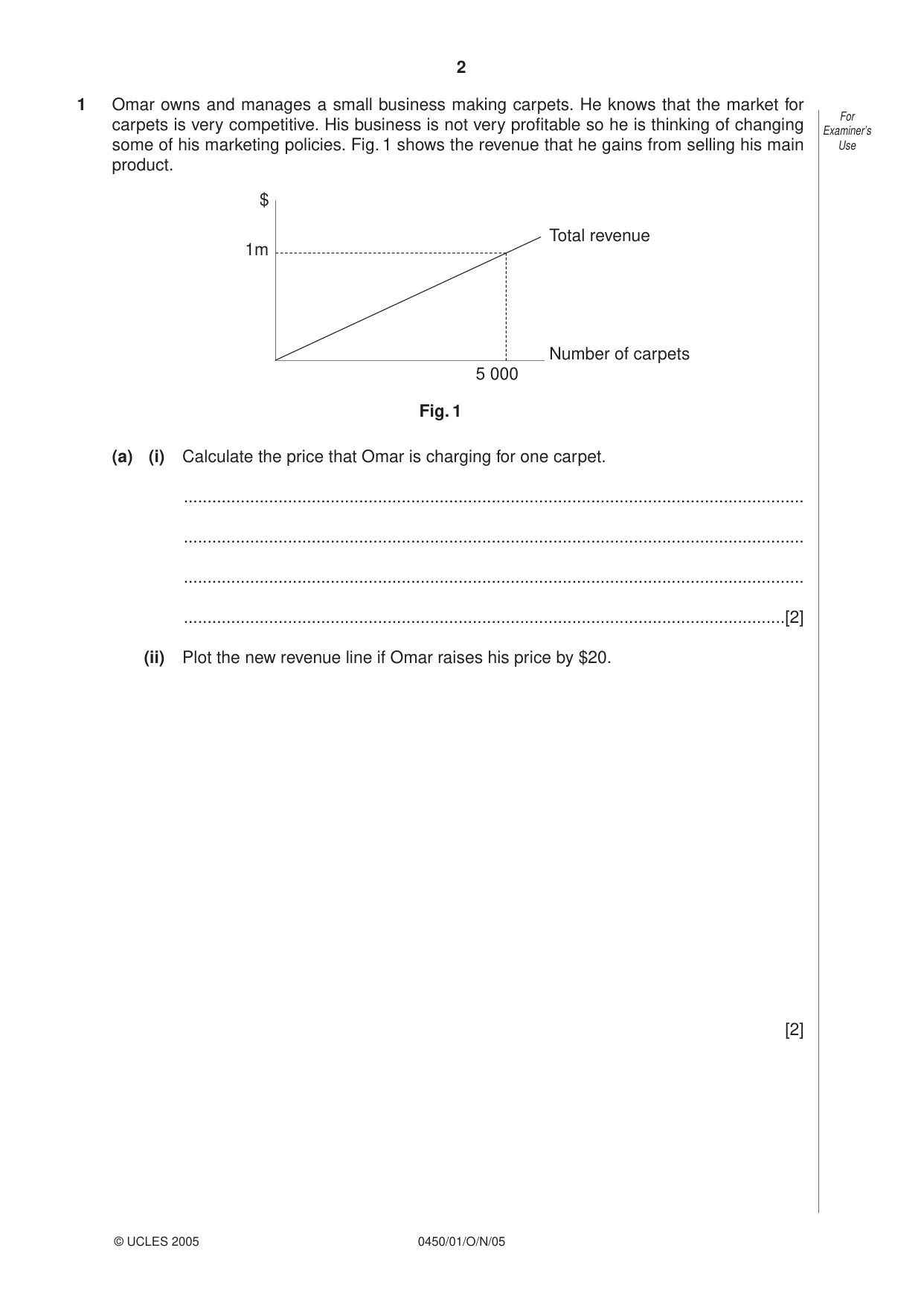
2 0450/01/O/N/05 © UCLES 2005 1 Omar owns and manages a small business making carpets. He knows that the market for carpets is very competitive. His business is not very profitable so he is thinking of changing some of his marketing policies. Fig. 1 shows the revenue that he gains from selling his main product. Fig. 1 (a) (i) Calculate the price that Omar is charging for one carpet. … … … …[2] (ii) Plot the new revenue line if Omar raises his price by $20. [2] For Examiner’s Use 1m $ 5 000 Total revenue Number of carpets
Question paper, page 3
3 0450/01/O/N/05 © UCLES 2005 (iii) Would you advise Omar to increase his prices? Explain your reasons. … … … … … … … … … …[5] Omar has also been thinking of advertising his products more widely. He thinks that this will increase his sales. (b) (i) Explain why more money spent on advertising might increase his sales. … … … … … …[3] (ii) Explain why a decision to increase advertising might reduce profits. … … … … … … … …[4] For Examiner’s Use [Turn over
Question paper, page 4
4 0450/01/O/N/05 © UCLES 2005 (c) The government has recently introduced laws to protect consumers. Explain how such laws might affect Omar’s advertisements. … … … … … … … …[4] For Examiner’s Use
Question paper, page 5
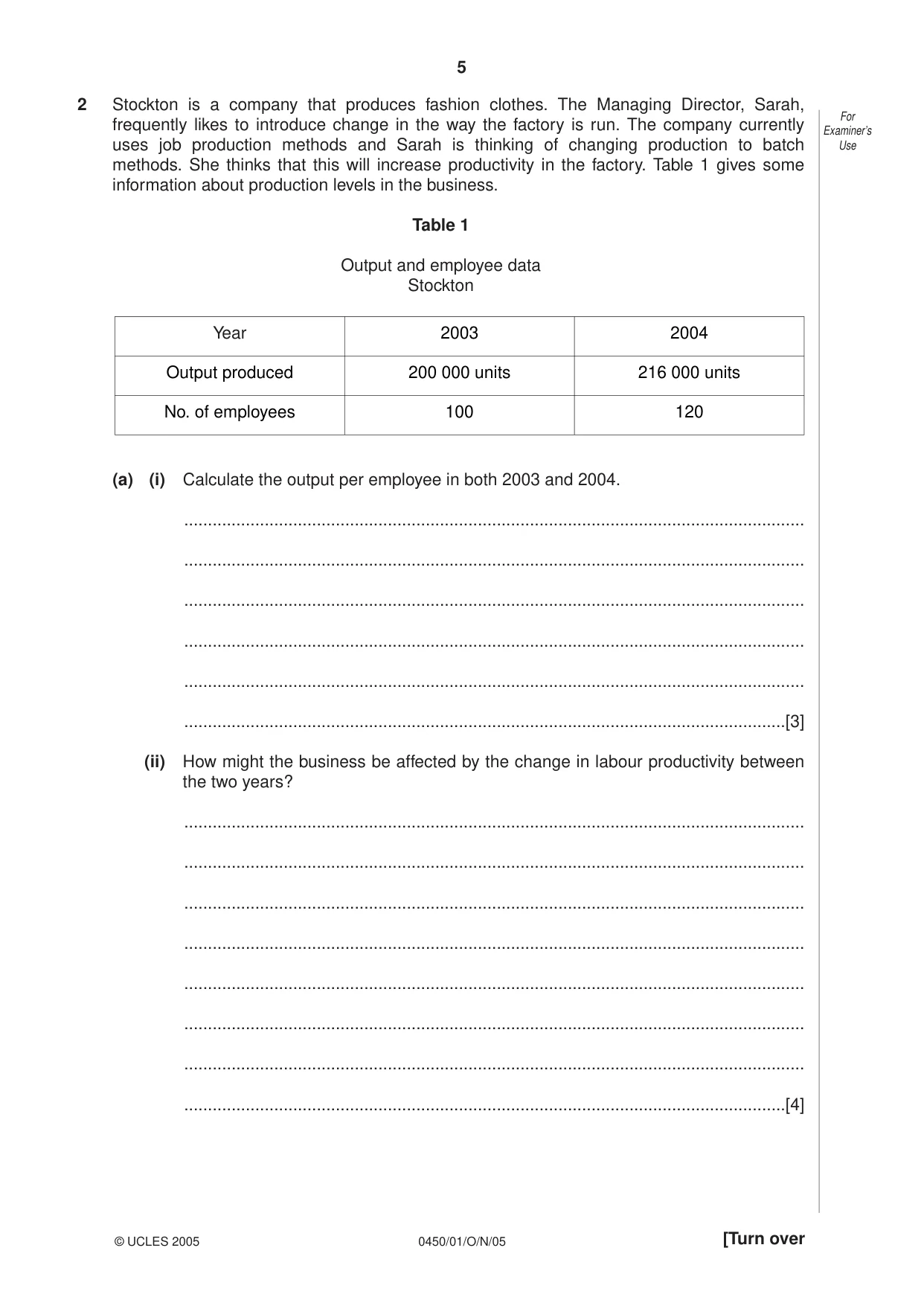
5 0450/01/O/N/05 © UCLES 2005 2 Stockton is a company that produces fashion clothes. The Managing Director, Sarah, frequently likes to introduce change in the way the factory is run. The company currently uses job production methods and Sarah is thinking of changing production to batch methods. She thinks that this will increase productivity in the factory. Table 1 gives some information about production levels in the business. Table 1 Output and employee data Stockton (a) (i) Calculate the output per employee in both 2003 and 2004. … … … … … …[3] (ii) How might the business be affected by the change in labour productivity between the two years? … … … … … … … …[4] For Examiner’s Use [Turn over Year 2003 2004 Output produced 200 000 units 216 000 units No. of employees 100 120
Question paper, page 6
6 0450/01/O/N/05 © UCLES 2005 (b) Explain the main features of job production. … … … … … … … …[4] (c) How should Sarah communicate the change in production methods to the employees? Give reasons for your suggestions. … … … … … … … …[4] For Examiner’s Use
Question paper, page 7
7 0450/01/O/N/05 © UCLES 2005 Sarah plans to change the way employees are paid. At present they are paid on a time rate but she wants to alter this to a piece rate. (d) Do you think that the employees will like this change? Explain your answer. … … … … … … … … … …[5] For Examiner’s Use [Turn over
Question paper, page 8
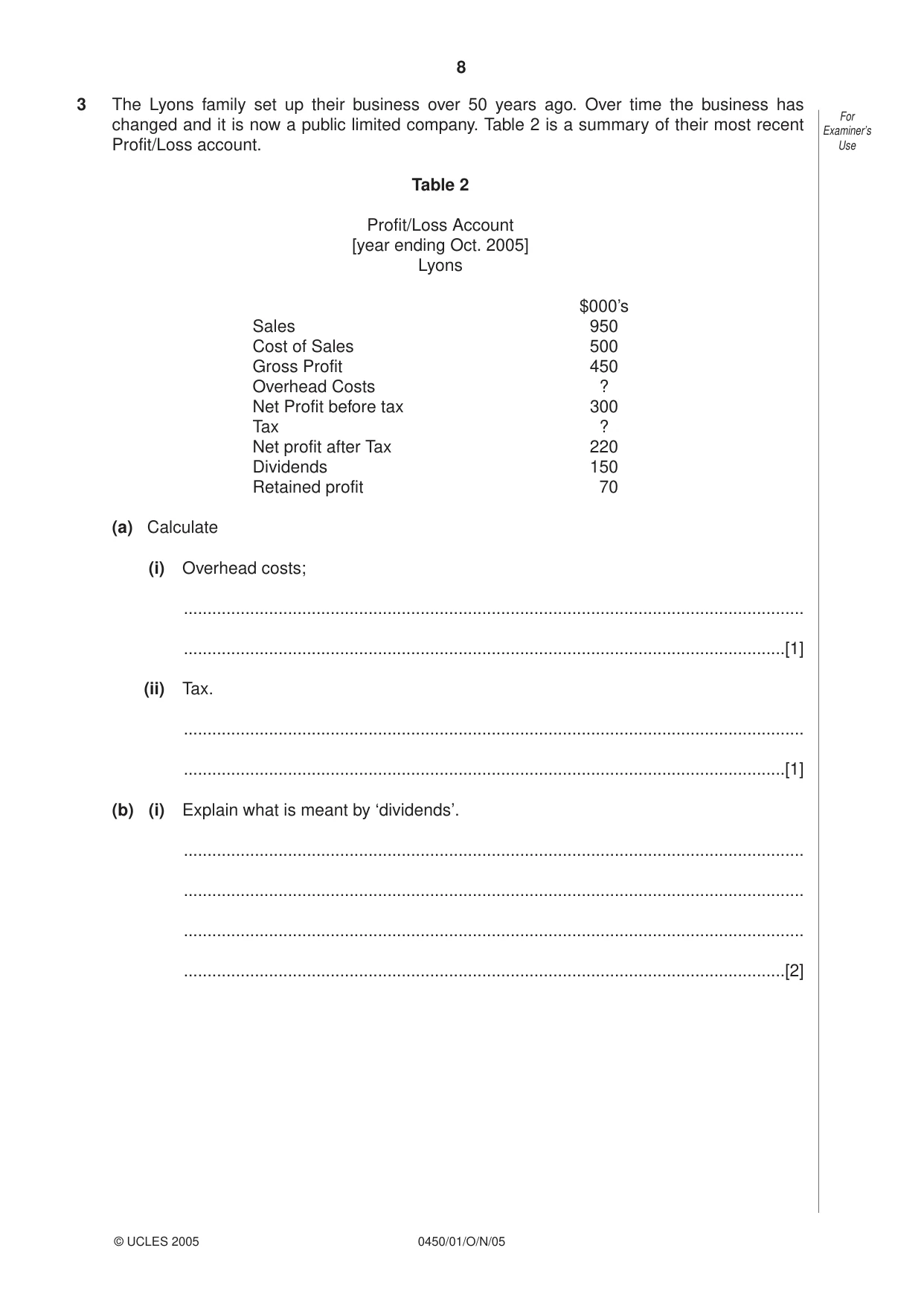
8 0450/01/O/N/05 © UCLES 2005 3 The Lyons family set up their business over 50 years ago. Over time the business has changed and it is now a public limited company. Table 2 is a summary of their most recent Profit/Loss account. Table 2 Profit/Loss Account [year ending Oct. 2005] Lyons $000’s Sales 950 Cost of Sales 500 Gross Profit 450 Overhead Costs ? Net Profit before tax 300 Tax ? Net profit after Tax 220 Dividends 150 Retained profit 70 (a) Calculate (i) Overhead costs; … …[1] (ii) Tax. … …[1] (b) (i) Explain what is meant by ‘dividends’. … … … …[2] For Examiner’s Use
Question paper, page 9
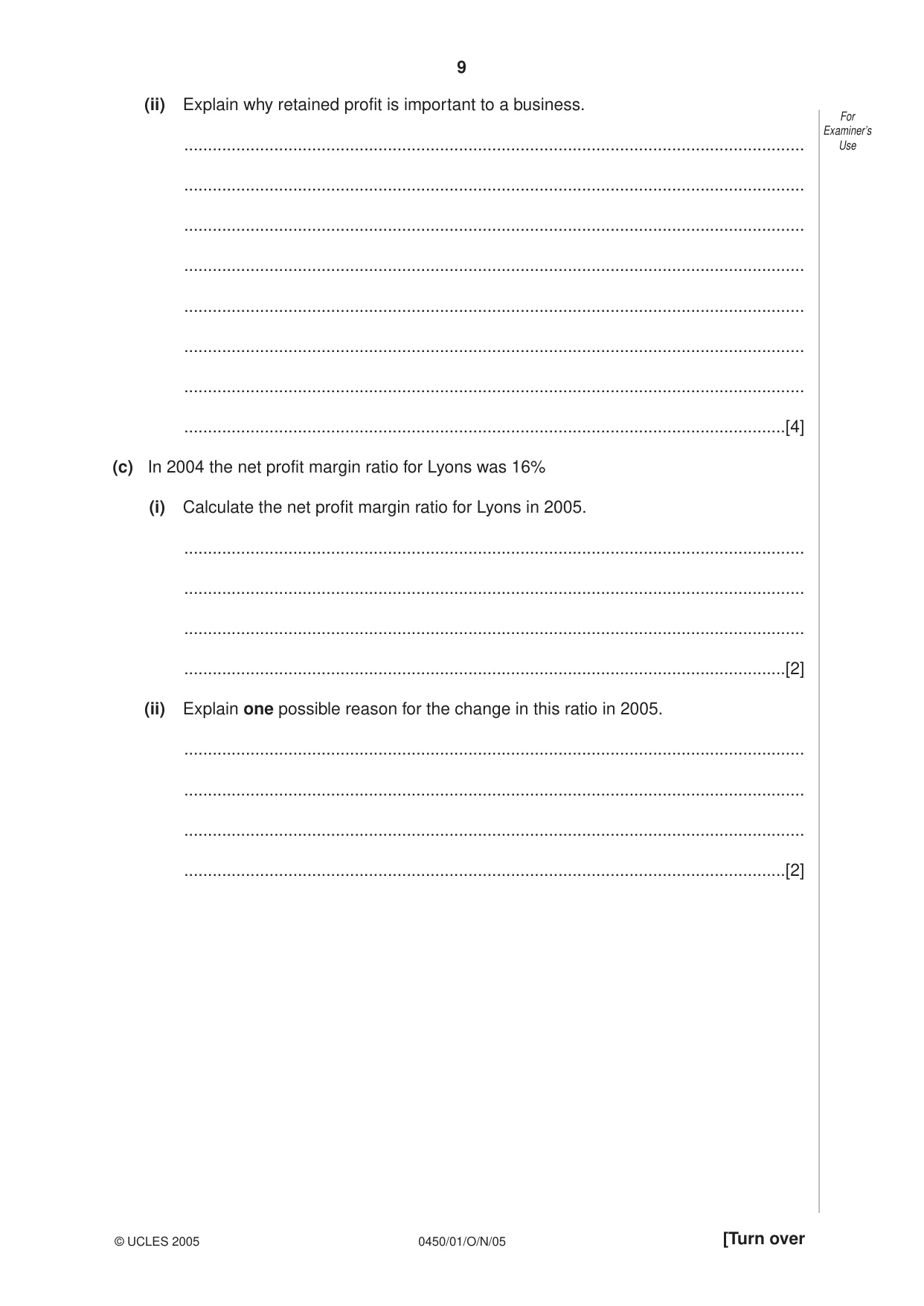
9 0450/01/O/N/05 © UCLES 2005 (ii) Explain why retained profit is important to a business. … … … … … … … …[4] (c) In 2004 the net profit margin ratio for Lyons was 16% (i) Calculate the net profit margin ratio for Lyons in 2005. … … … …[2] (ii) Explain one possible reason for the change in this ratio in 2005. … … … …[2] For Examiner’s Use [Turn over
Question paper, page 10
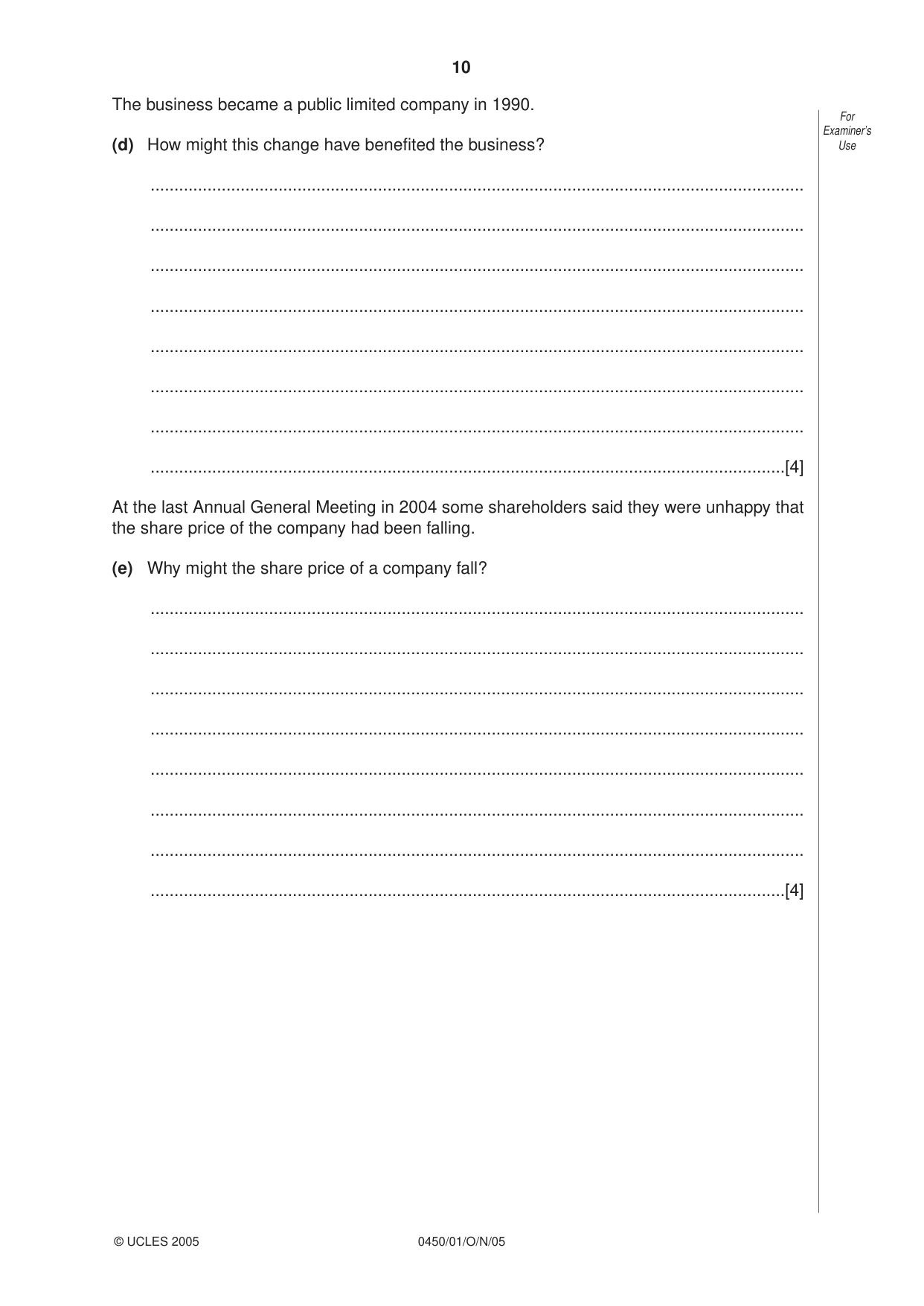
10 0450/01/O/N/05 © UCLES 2005 The business became a public limited company in 1990. (d) How might this change have benefited the business? … … … … … … … …[4] At the last Annual General Meeting in 2004 some shareholders said they were unhappy that the share price of the company had been falling. (e) Why might the share price of a company fall? … … … … … … … …[4] For Examiner’s Use
Question paper, page 11
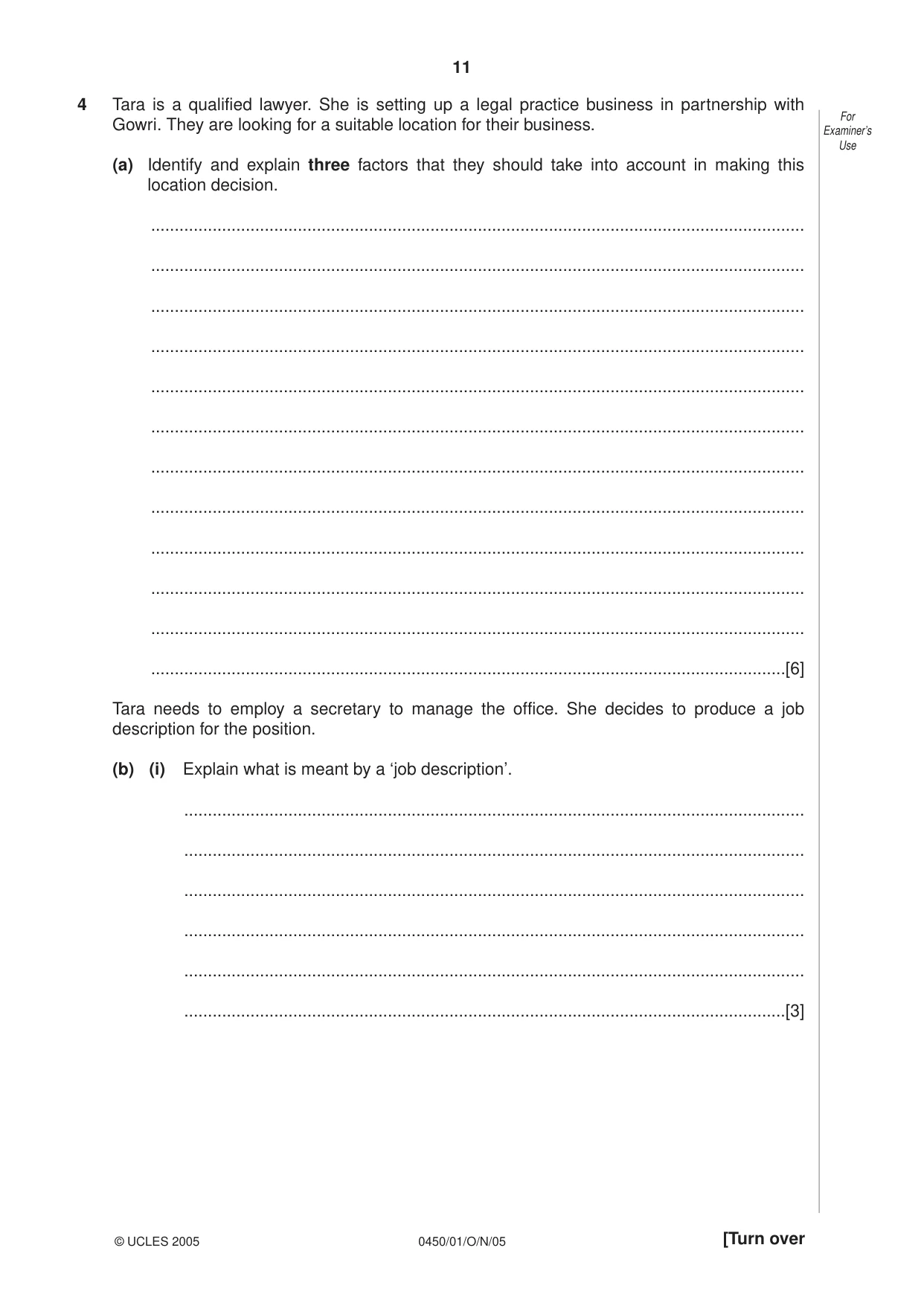
11 0450/01/O/N/05 © UCLES 2005 4 Tara is a qualified lawyer. She is setting up a legal practice business in partnership with Gowri. They are looking for a suitable location for their business. (a) Identify and explain three factors that they should take into account in making this location decision. … … … … … … … … … … … …[6] Tara needs to employ a secretary to manage the office. She decides to produce a job description for the position. (b) (i) Explain what is meant by a ‘job description’. … … … … … …[3] For Examiner’s Use [Turn over
Question paper, page 12
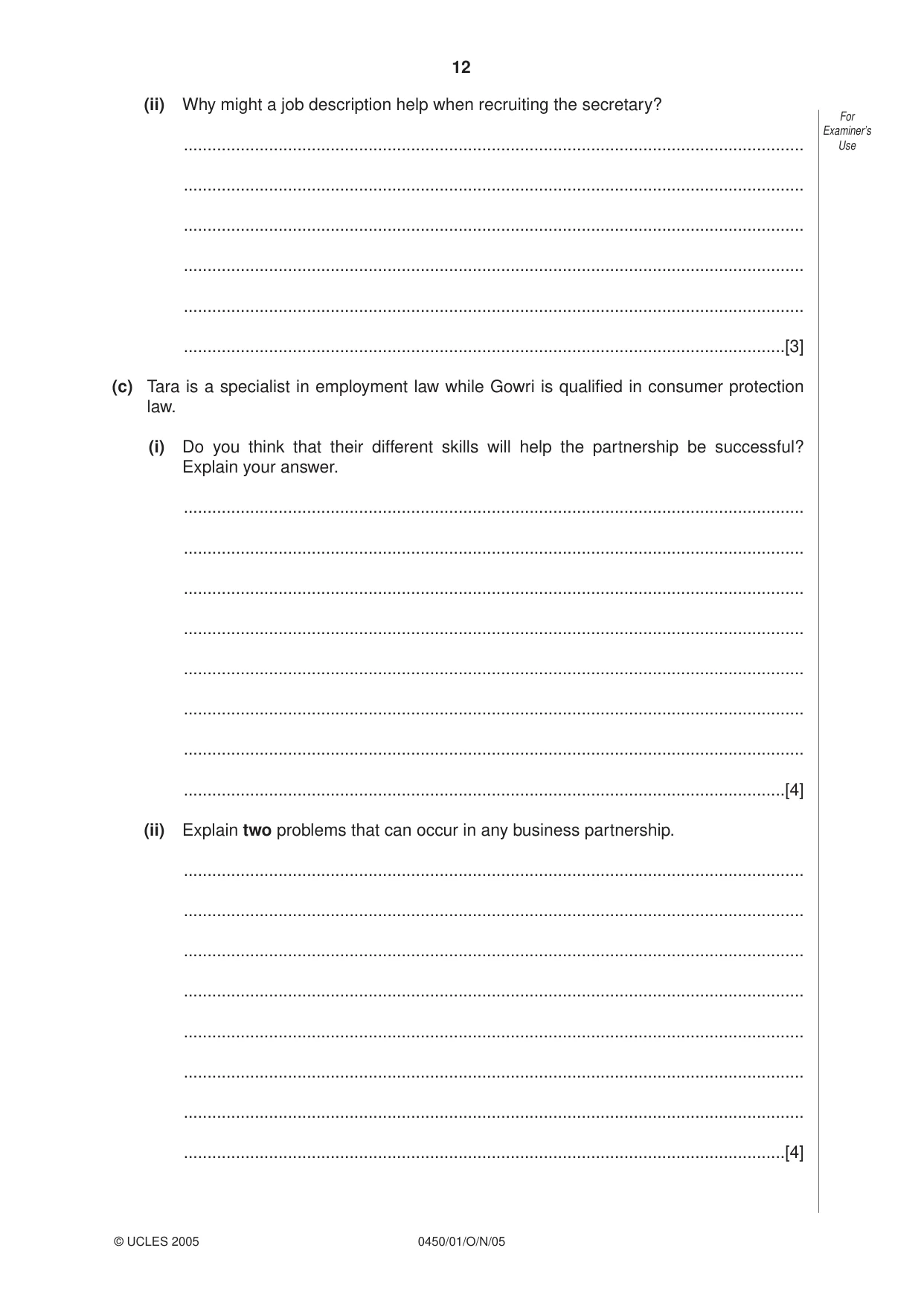
12 0450/01/O/N/05 © UCLES 2005 (ii) Why might a job description help when recruiting the secretary? … … … … … …[3] (c) Tara is a specialist in employment law while Gowri is qualified in consumer protection law. (i) Do you think that their different skills will help the partnership be successful? Explain your answer. … … … … … … … …[4] (ii) Explain two problems that can occur in any business partnership. … … … … … … … …[4] For Examiner’s Use
Question paper, page 13
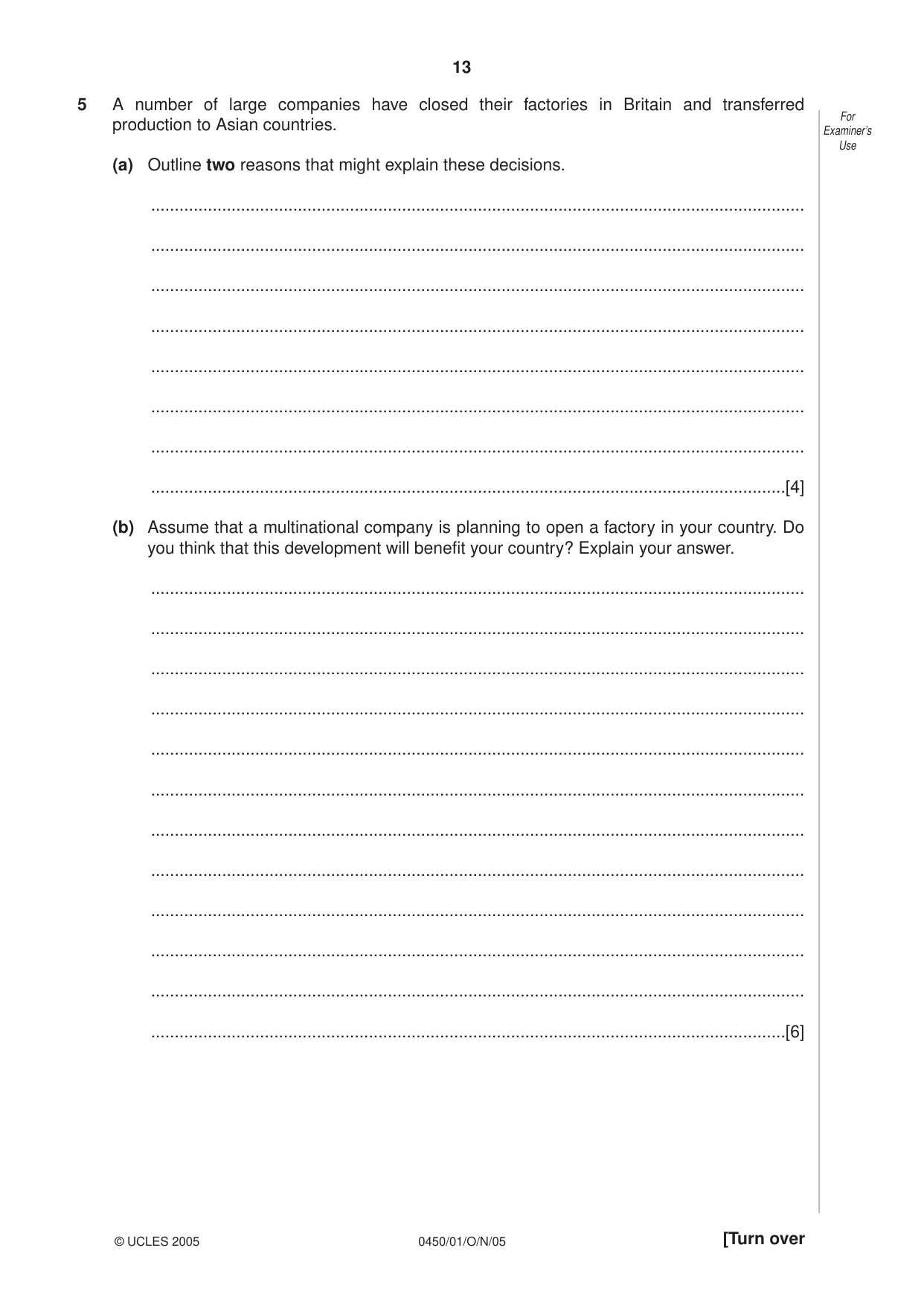
13 0450/01/O/N/05 © UCLES 2005 5 A number of large companies have closed their factories in Britain and transferred production to Asian countries. (a) Outline two reasons that might explain these decisions. … … … … … … … …[4] (b) Assume that a multinational company is planning to open a factory in your country. Do you think that this development will benefit your country? Explain your answer. … … … … … … … … … … … …[6] For Examiner’s Use [Turn over
Question paper, page 14
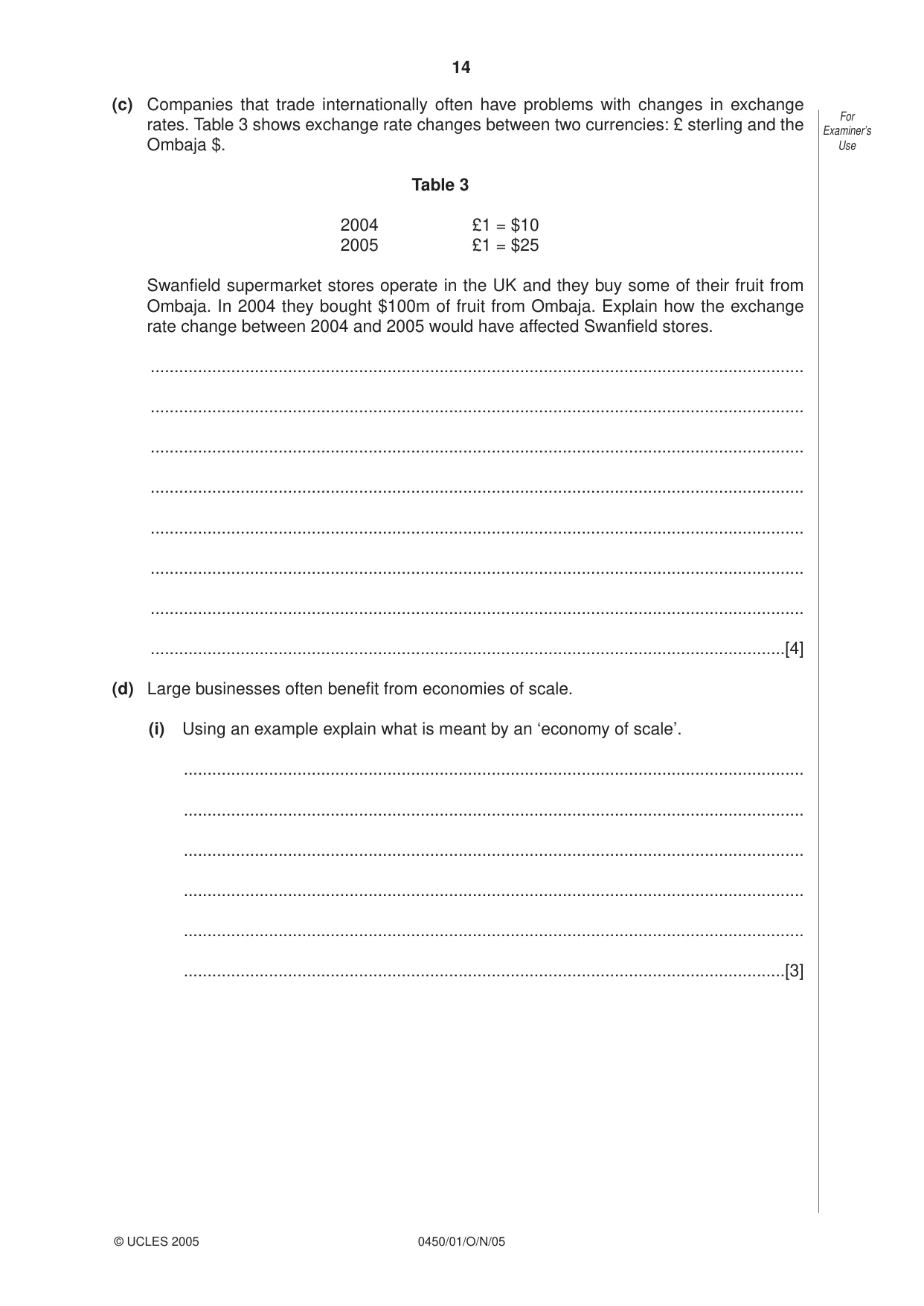
14 0450/01/O/N/05 © UCLES 2005 (c) Companies that trade internationally often have problems with changes in exchange rates. Table 3 shows exchange rate changes between two currencies: £ sterling and the Ombaja $. Table 3 2004 £1 = $10 2005 £1 = $25 Swanfield supermarket stores operate in the UK and they buy some of their fruit from Ombaja. In 2004 they bought $100m of fruit from Ombaja. Explain how the exchange rate change between 2004 and 2005 would have affected Swanfield stores. … … … … … … … …[4] (d) Large businesses often benefit from economies of scale. (i) Using an example explain what is meant by an ‘economy of scale’. … … … … … …[3] For Examiner’s Use
Question paper, page 15
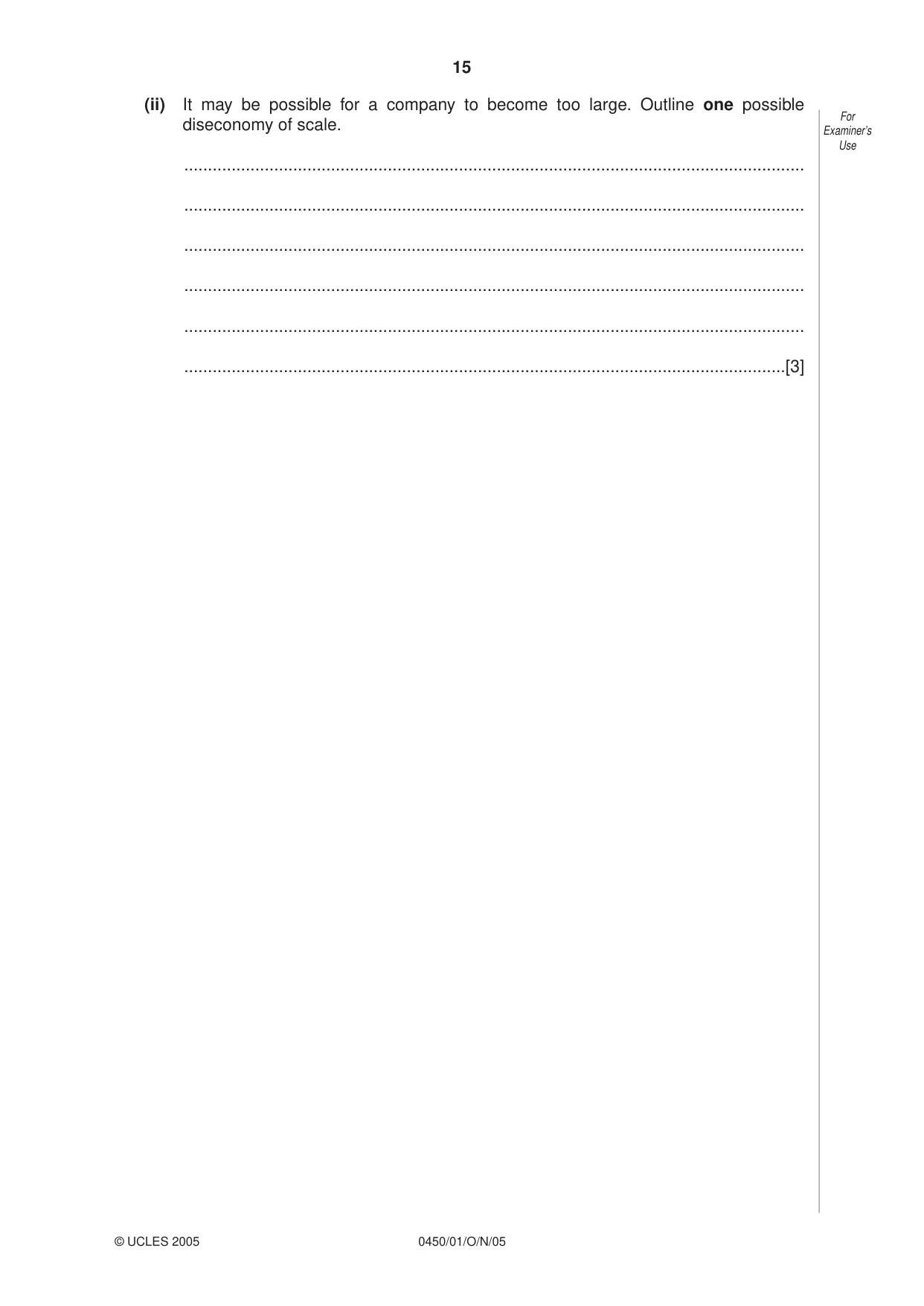
15 0450/01/O/N/05 © UCLES 2005 (ii) It may be possible for a company to become too large. Outline one possible diseconomy of scale. … … … … … …[3] For Examiner’s Use
Question paper, page 16
16 0450/01/O/N/05 BLANK PAGE Permission to reproduce items where third-party owned material protected by copyright is included has been sought and cleared where possible. Every reasonable effort has been made by the publisher (UCLES) to trace copyright holders, but if any items requiring clearance have unwittingly been included, the publisher will be pleased to make amends at the earliest possible opportunity. University of Cambridge International Examinations is part of the University of Cambridge Local Examinations Syndicate (UCLES), which is itself a department of the University of Cambridge.
Mark scheme, page 1
UNIVERSITY OF CAMBRIDGE INTERNATIONAL EXAMINATIONS International General Certificate of Secondary Education MARK SCHEME for the November 2005 question paper 0450 BUSINESS STUDIES 0450/01 Paper 1, maximum raw mark 100 This mark scheme is published as an aid to teachers and students, to indicate the requirements of the examination. It shows the basis on which Examiners were initially instructed to award marks. It does not indicate the details of the discussions that took place at an Examiners’ meeting before marking began. Any substantial changes to the mark scheme that arose from these discussions will be recorded in the published Report on the Examination. All Examiners are instructed that alternative correct answers and unexpected approaches in candidates’ scripts must be given marks that fairly reflect the relevant knowledge and skills demonstrated. Mark schemes must be read in conjunction with the question papers and the Report on the Examination. The minimum marks in these components needed for various grades were previously published with these mark schemes, but are now instead included in the Report on the Examination for this session. • CIE will not enter into discussion or correspondence in connection with these mark schemes. CIE is publishing the mark schemes for the November 2005 question papers for most IGCSE and GCE Advanced Level and Advanced Subsidiary Level syllabuses and some Ordinary Level syllabuses’. www.XtremePapers.com
Mark scheme, page 2
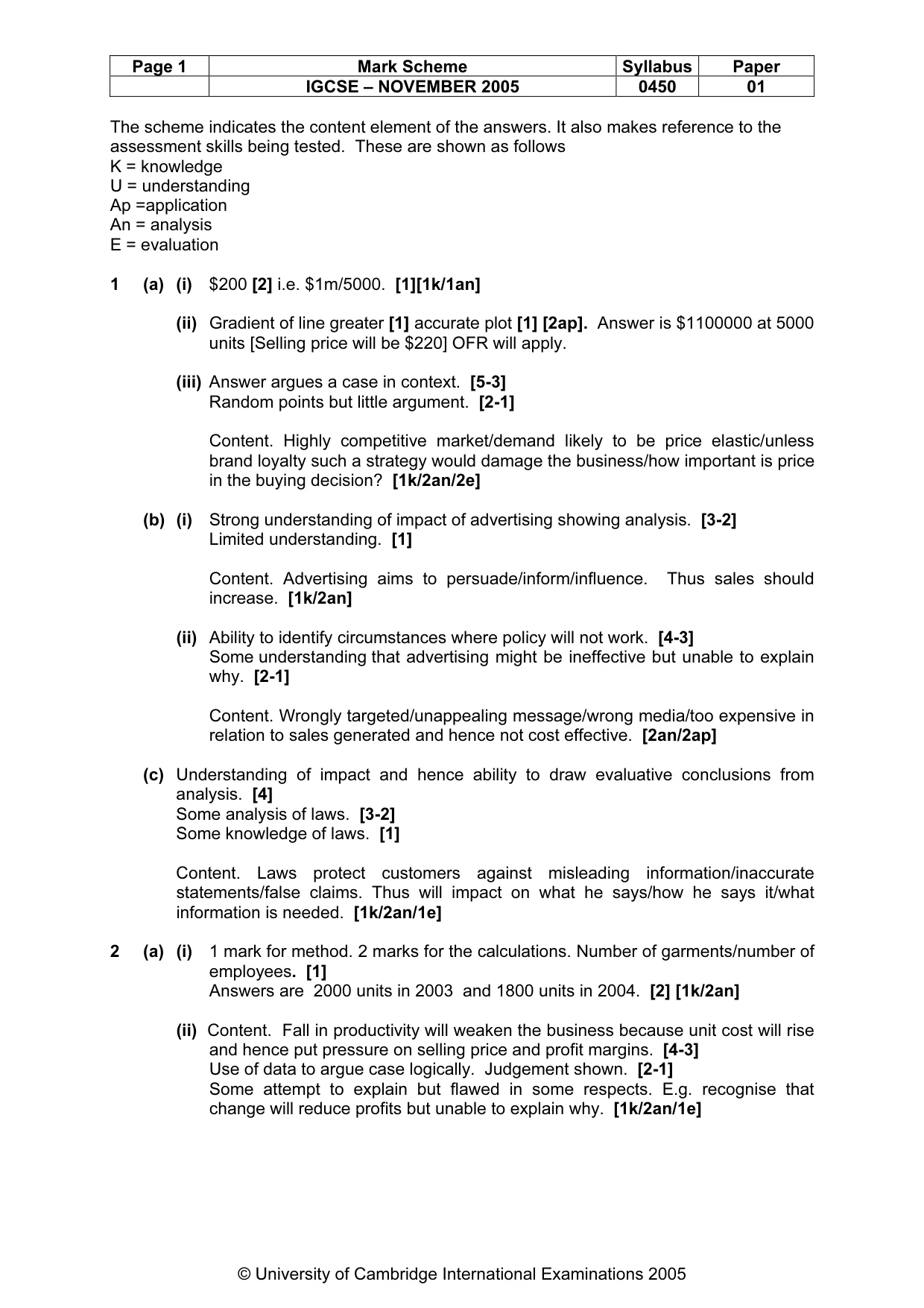
Page 1 Mark Scheme Syllabus Paper IGCSE – NOVEMBER 2005 0450 01 © University of Cambridge International Examinations 2005 The scheme indicates the content element of the answers. It also makes reference to the assessment skills being tested. These are shown as follows K = knowledge U = understanding Ap =application An = analysis E = evaluation 1 (a) (i) $200 [2] i.e. $1m/5000. [1][1k/1an] (ii) Gradient of line greater [1] accurate plot [1] [2ap]. Answer is $1100000 at 5000 units [Selling price will be $220] OFR will apply. (iii) Answer argues a case in context. [5-3] Random points but little argument. [2-1] Content. Highly competitive market/demand likely to be price elastic/unless brand loyalty such a strategy would damage the business/how important is price in the buying decision? [1k/2an/2e] (b) (i) Strong understanding of impact of advertising showing analysis. [3-2] Limited understanding. [1] Content. Advertising aims to persuade/inform/influence. Thus sales should increase. [1k/2an] (ii) Ability to identify circumstances where policy will not work. [4-3] Some understanding that advertising might be ineffective but unable to explain why. [2-1] Content. Wrongly targeted/unappealing message/wrong media/too expensive in relation to sales generated and hence not cost effective. [2an/2ap] (c) Understanding of impact and hence ability to draw evaluative conclusions from analysis. [4] Some analysis of laws. [3-2] Some knowledge of laws. [1] Content. Laws protect customers against misleading information/inaccurate statements/false claims. Thus will impact on what he says/how he says it/what information is needed. [1k/2an/1e] 2 (a) (i) 1 mark for method. 2 marks for the calculations. Number of garments/number of employees. [1] Answers are 2000 units in 2003 and 1800 units in 2004. [2] [1k/2an] (ii) Content. Fall in productivity will weaken the business because unit cost will rise and hence put pressure on selling price and profit margins. [4-3] Use of data to argue case logically. Judgement shown. [2-1] Some attempt to explain but flawed in some respects. E.g. recognise that change will reduce profits but unable to explain why. [1k/2an/1e]
Mark scheme, page 3
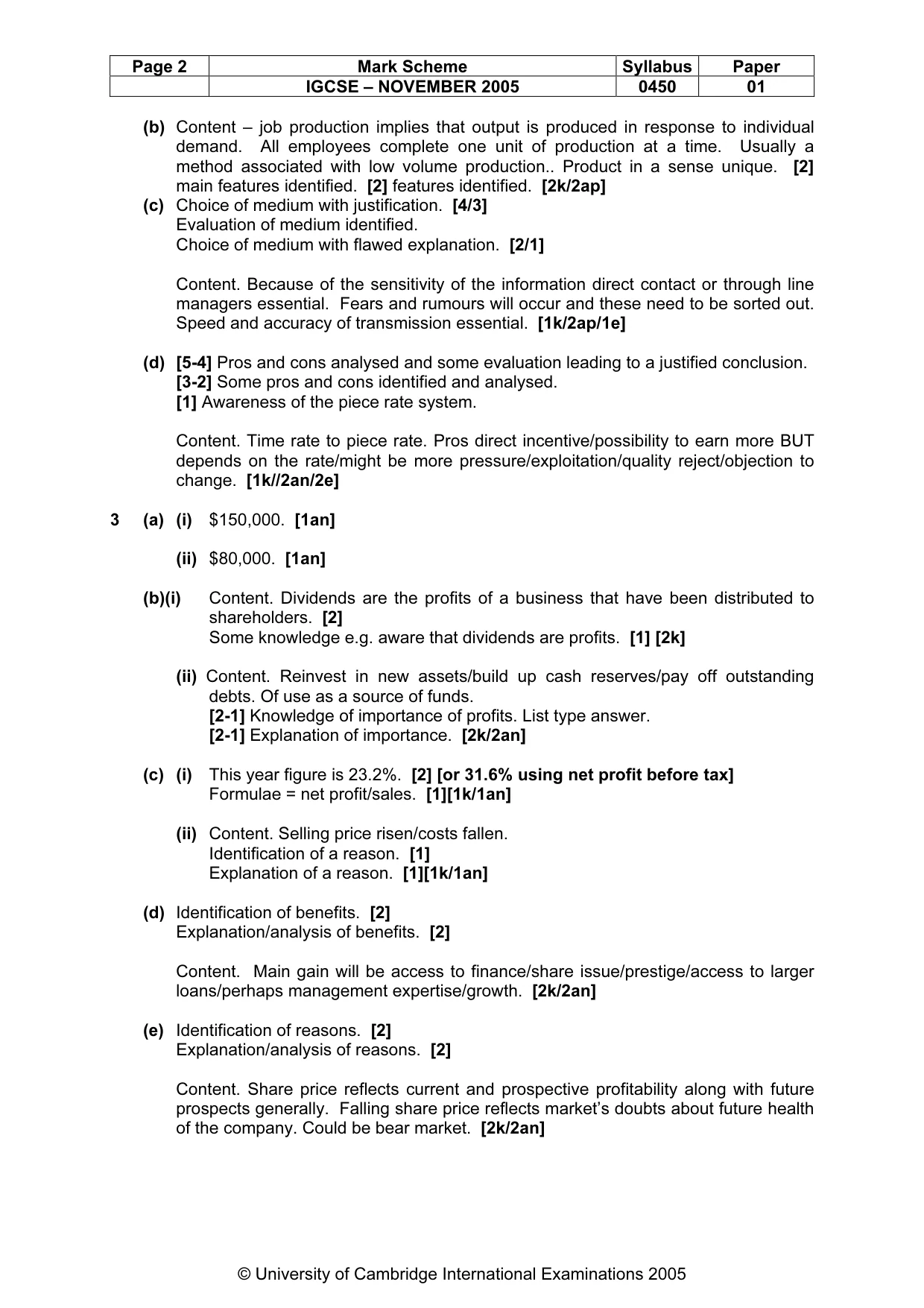
Page 2 Mark Scheme Syllabus Paper IGCSE – NOVEMBER 2005 0450 01 © University of Cambridge International Examinations 2005 (b) Content – job production implies that output is produced in response to individual demand. All employees complete one unit of production at a time. Usually a method associated with low volume production.. Product in a sense unique. [2] main features identified. [2] features identified. [2k/2ap] (c) Choice of medium with justification. [4/3] Evaluation of medium identified. Choice of medium with flawed explanation. [2/1] Content. Because of the sensitivity of the information direct contact or through line managers essential. Fears and rumours will occur and these need to be sorted out. Speed and accuracy of transmission essential. [1k/2ap/1e] (d) [5-4] Pros and cons analysed and some evaluation leading to a justified conclusion. [3-2] Some pros and cons identified and analysed. [1] Awareness of the piece rate system. Content. Time rate to piece rate. Pros direct incentive/possibility to earn more BUT depends on the rate/might be more pressure/exploitation/quality reject/objection to change. [1k//2an/2e] 3 (a) (i) $150,000. [1an] (ii) $80,000. [1an] (b)(i) Content. Dividends are the profits of a business that have been distributed to shareholders. [2] Some knowledge e.g. aware that dividends are profits. [1] [2k] (ii) Content. Reinvest in new assets/build up cash reserves/pay off outstanding debts. Of use as a source of funds. [2-1] Knowledge of importance of profits. List type answer. [2-1] Explanation of importance. [2k/2an] (c) (i) This year figure is 23.2%. [2] [or 31.6% using net profit before tax] Formulae = net profit/sales. [1][1k/1an] (ii) Content. Selling price risen/costs fallen. Identification of a reason. [1] Explanation of a reason. [1][1k/1an] (d) Identification of benefits. [2] Explanation/analysis of benefits. [2] Content. Main gain will be access to finance/share issue/prestige/access to larger loans/perhaps management expertise/growth. [2k/2an] (e) Identification of reasons. [2] Explanation/analysis of reasons. [2] Content. Share price reflects current and prospective profitability along with future prospects generally. Falling share price reflects market’s doubts about future health of the company. Could be bear market. [2k/2an]
Mark scheme, page 4
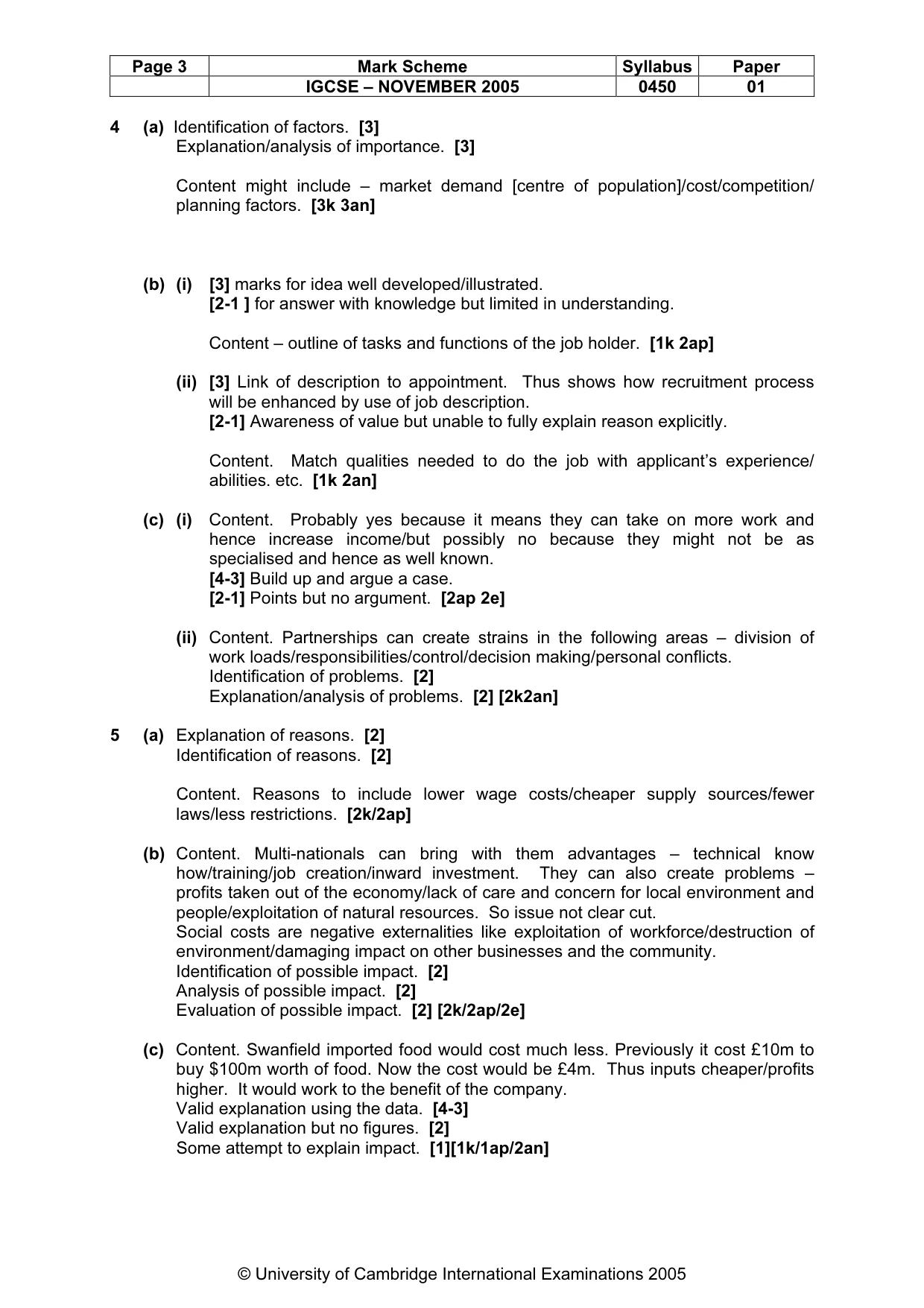
Page 3 Mark Scheme Syllabus Paper IGCSE – NOVEMBER 2005 0450 01 © University of Cambridge International Examinations 2005 4 (a) Identification of factors. [3] Explanation/analysis of importance. [3] Content might include – market demand [centre of population]/cost/competition/ planning factors. [3k 3an] (b) (i) [3] marks for idea well developed/illustrated. [2-1 ] for answer with knowledge but limited in understanding. Content – outline of tasks and functions of the job holder. [1k 2ap] (ii) [3] Link of description to appointment. Thus shows how recruitment process will be enhanced by use of job description. [2-1] Awareness of value but unable to fully explain reason explicitly. Content. Match qualities needed to do the job with applicant’s experience/ abilities. etc. [1k 2an] (c) (i) Content. Probably yes because it means they can take on more work and hence increase income/but possibly no because they might not be as specialised and hence as well known. [4-3] Build up and argue a case. [2-1] Points but no argument. [2ap 2e] (ii) Content. Partnerships can create strains in the following areas – division of work loads/responsibilities/control/decision making/personal conflicts. Identification of problems. [2] Explanation/analysis of problems. [2] [2k2an] 5 (a) Explanation of reasons. [2] Identification of reasons. [2] Content. Reasons to include lower wage costs/cheaper supply sources/fewer laws/less restrictions. [2k/2ap] (b) Content. Multi-nationals can bring with them advantages – technical know how/training/job creation/inward investment. They can also create problems – profits taken out of the economy/lack of care and concern for local environment and people/exploitation of natural resources. So issue not clear cut. Social costs are negative externalities like exploitation of workforce/destruction of environment/damaging impact on other businesses and the community. Identification of possible impact. [2] Analysis of possible impact. [2] Evaluation of possible impact. [2] [2k/2ap/2e] (c) Content. Swanfield imported food would cost much less. Previously it cost £10m to buy $100m worth of food. Now the cost would be £4m. Thus inputs cheaper/profits higher. It would work to the benefit of the company. Valid explanation using the data. [4-3] Valid explanation but no figures. [2] Some attempt to explain impact. [1][1k/1ap/2an]
Mark scheme, page 5
Page 4 Mark Scheme Syllabus Paper IGCSE – NOVEMBER 2005 0450 01 © University of Cambridge International Examinations 2005 (d) (i) Content. Economy of scale is a financial advantage associated with size that reduces unit cost. [2] Knowledge but lack of accuracy. [1] Example. [1] [2k/1ap] (ii) Content. Diseconomies of scale might occur because: difficult to control/ manage/decision making slow/lack of corporate identity/low morale. Knowledge of a reason. [1] Explanation/analysis of reason. [2] [1k/2a]