Cambridge IGCSE Business Studies 0450 — 2005 May/June Paper 1 · Variant 1
0450/11/M/J/05
The question paper and its mark scheme, free to read here and free to download. This is Cambridge’s own paper, exactly as it was sat.
Question paper16 pages

Mark scheme6 pages
Answers below. Sit the paper first if you are practising.
Paper as text
Question paper, page 1
This document consists of 15 printed pages and 1 blank page. SP (KS) S92053/3.1 © UCLES 2005 [Turn over UNIVERSITY OF CAMBRIDGE INTERNATIONAL EXAMINATIONS International General Certificate of Secondary Education BUSINESS STUDIES Paper 1 0450/01 May/June 2005 1 hour 45 minutes Candidates answer on the Question Paper. No Additional Materials are required. READ THESE INSTRUCTIONS FIRST Write your Centre number, candidate number and name on all the work you hand in. Write in dark blue or black pen in the spaces provided on the Question Paper. Do not use staples, paper clips, highlighters, glue or correction fluid. Answer all questions. At the end of the examination, fasten all your work securely together. The number of marks is given in brackets [ ] at the end of each question or part question. The businesses described in this question paper are entirely fictitious. DO NOT WRITE IN THE BARCODE. DO NOT WRITE IN THE GREY AREAS BETWEEN THE PAGES. For Examiner’s Use 1 2 3 4 5 Total Candidate Name Centre Number Candidate Number www.XtremePapers.com
Question paper, page 2
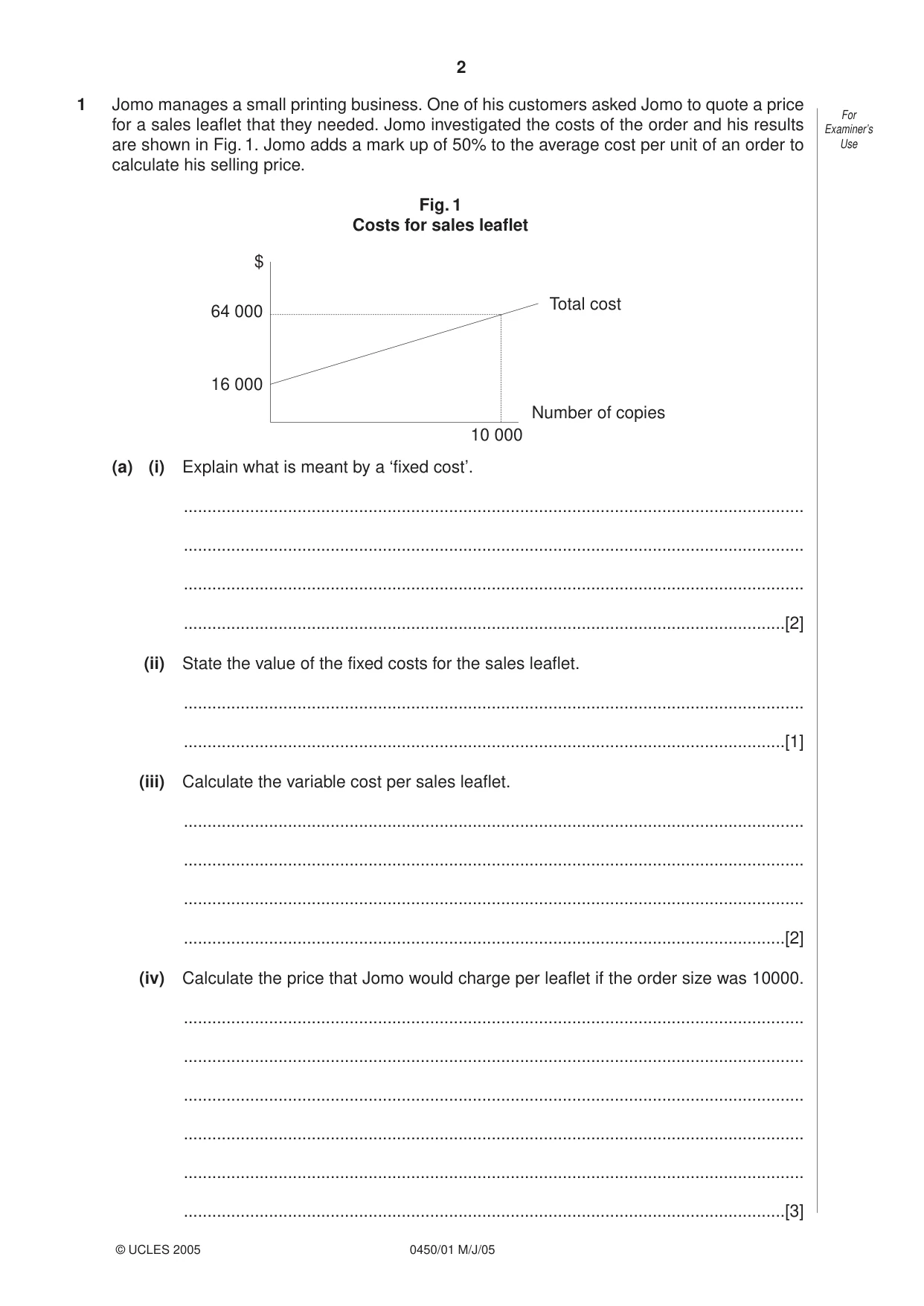
2 © UCLES 2005 0450/01 M/J/05 1 Jomo manages a small printing business. One of his customers asked Jomo to quote a price for a sales leaflet that they needed. Jomo investigated the costs of the order and his results are shown in Fig. 1. Jomo adds a mark up of 50% to the average cost per unit of an order to calculate his selling price. Fig. 1 Costs for sales leaflet (a) (i) Explain what is meant by a ‘fixed cost’. … … … …[2] (ii) State the value of the fixed costs for the sales leaflet. … …[1] (iii) Calculate the variable cost per sales leaflet. … … … …[2] (iv) Calculate the price that Jomo would charge per leaflet if the order size was 10000. … … … … … …[3] For Examiner’s Use 64 000 $ 16 000 10 000 Total cost Number of copies
Question paper, page 3
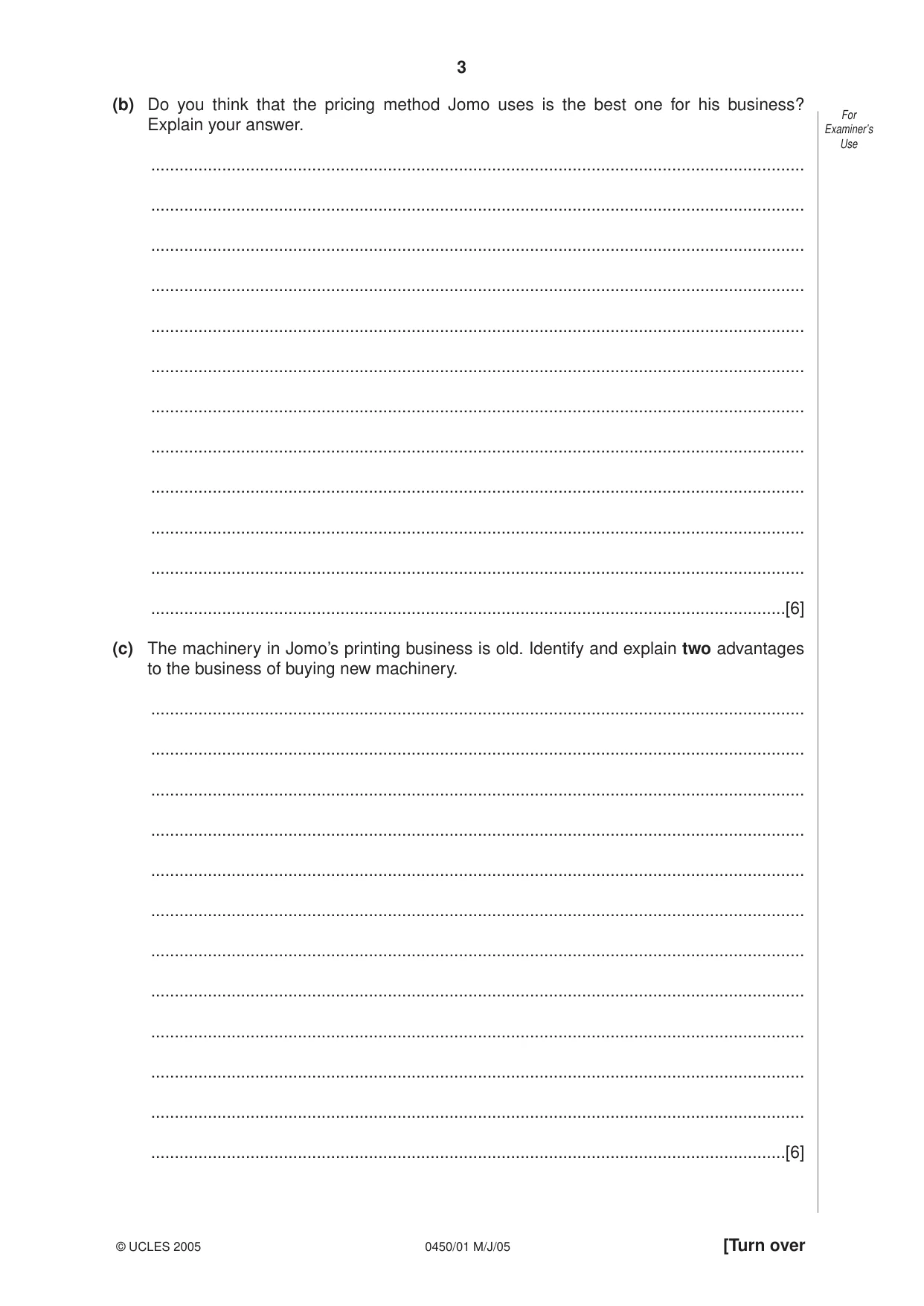
3 © UCLES 2005 0450/01 M/J/05 [Turn over (b) Do you think that the pricing method Jomo uses is the best one for his business? Explain your answer. … … … … … … … … … … … …[6] (c) The machinery in Jomo’s printing business is old. Identify and explain two advantages to the business of buying new machinery. … … … … … … … … … … … …[6] For Examiner’s Use
Question paper, page 4
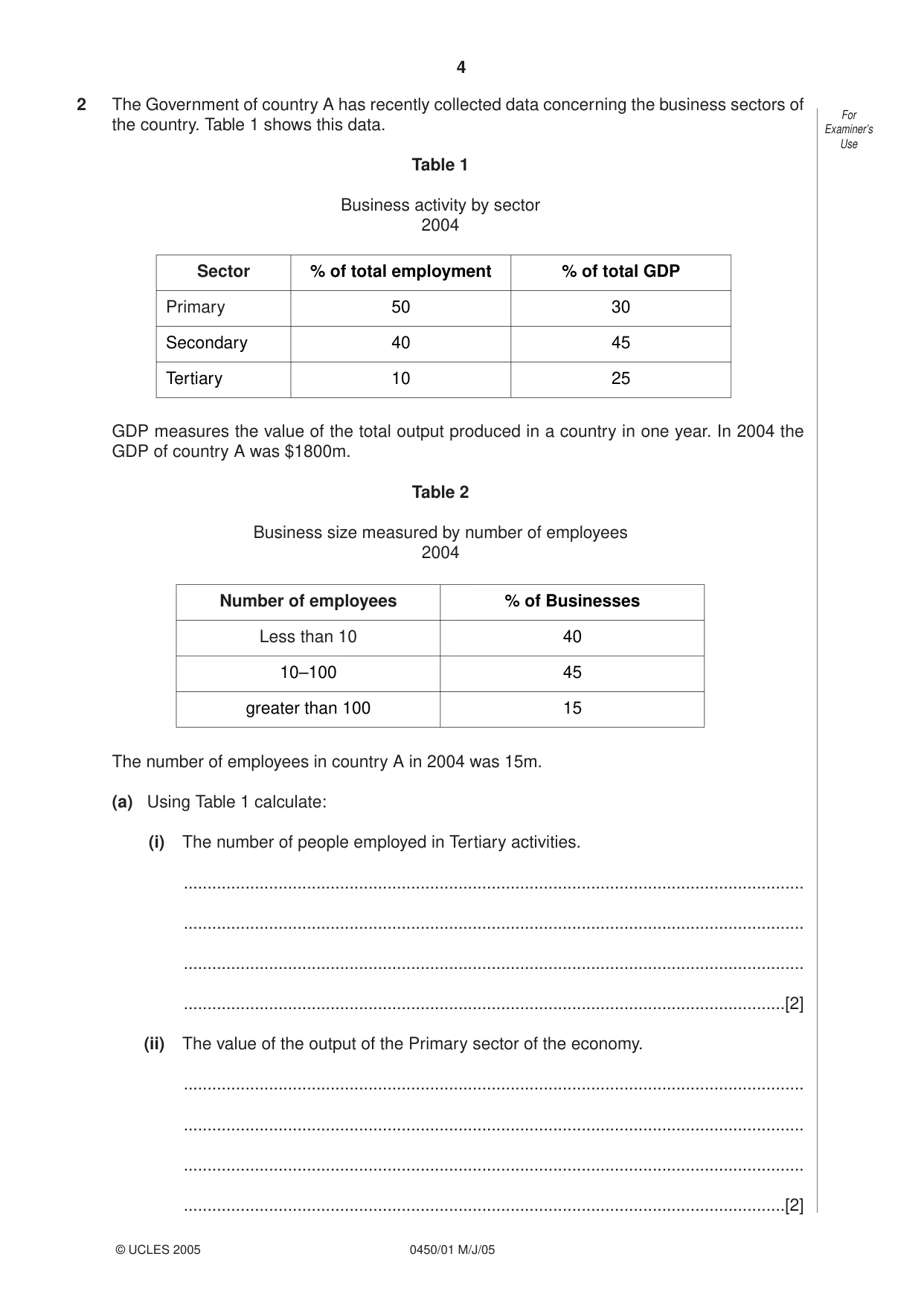
4 © UCLES 2005 0450/01 M/J/05 2 The Government of country A has recently collected data concerning the business sectors of the country. Table 1 shows this data. Table 1 Business activity by sector 2004 GDP measures the value of the total output produced in a country in one year. In 2004 the GDP of country A was $1800m. Table 2 Business size measured by number of employees 2004 The number of employees in country A in 2004 was 15m. (a) Using Table 1 calculate: (i) The number of people employed in Tertiary activities. … … … …[2] (ii) The value of the output of the Primary sector of the economy. … … … …[2] For Examiner’s Use Sector % of total employment % of total GDP Primary 50 30 Secondary 40 45 Tertiary 10 25 Number of employees % of Businesses Less than 10 40 10–100 45 greater than 100 15
Question paper, page 5
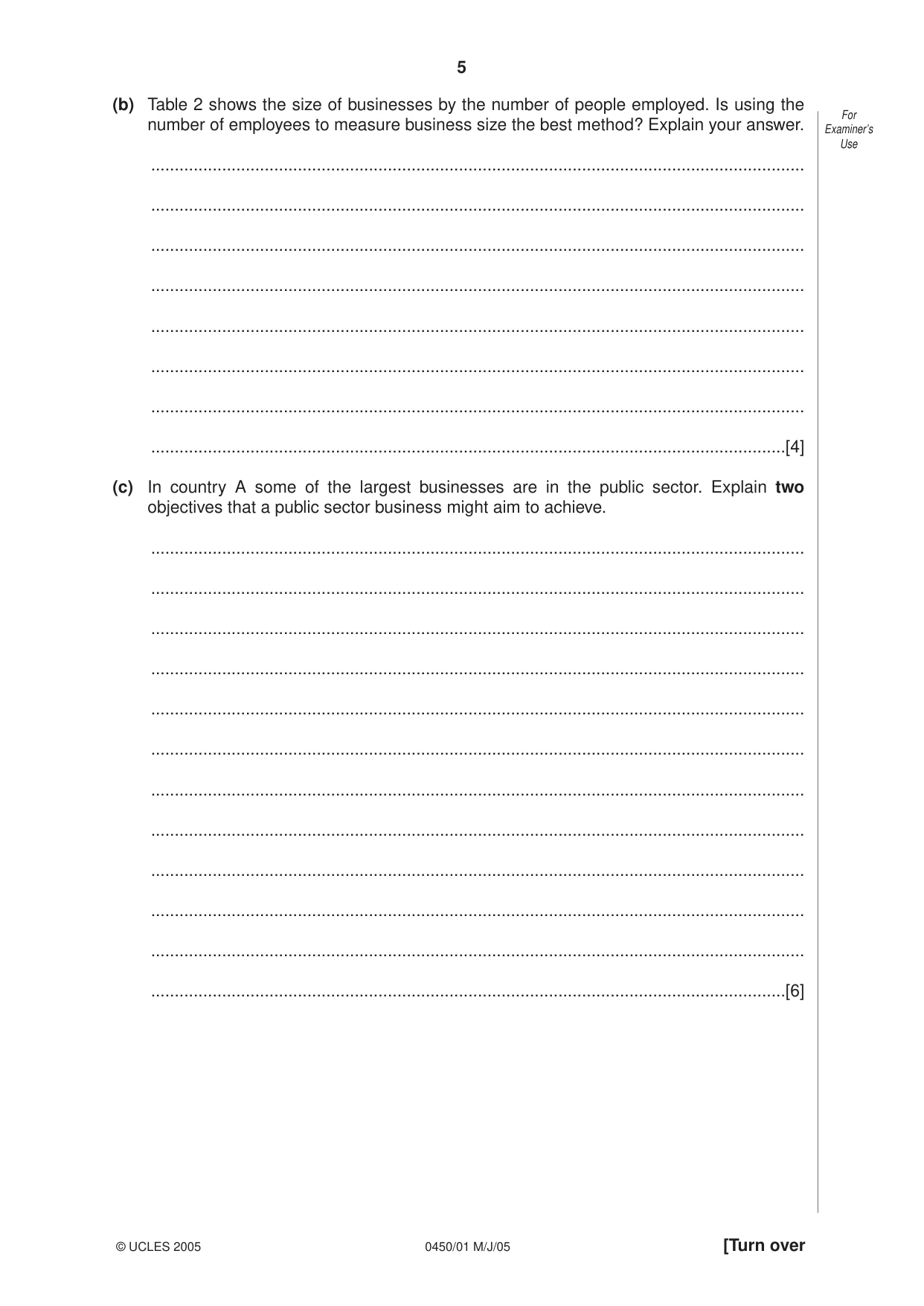
5 © UCLES 2005 0450/01 M/J/05 [Turn over (b) Table 2 shows the size of businesses by the number of people employed. Is using the number of employees to measure business size the best method? Explain your answer. … … … … … … … …[4] (c) In country A some of the largest businesses are in the public sector. Explain two objectives that a public sector business might aim to achieve. … … … … … … … … … … … …[6] For Examiner’s Use
Question paper, page 6
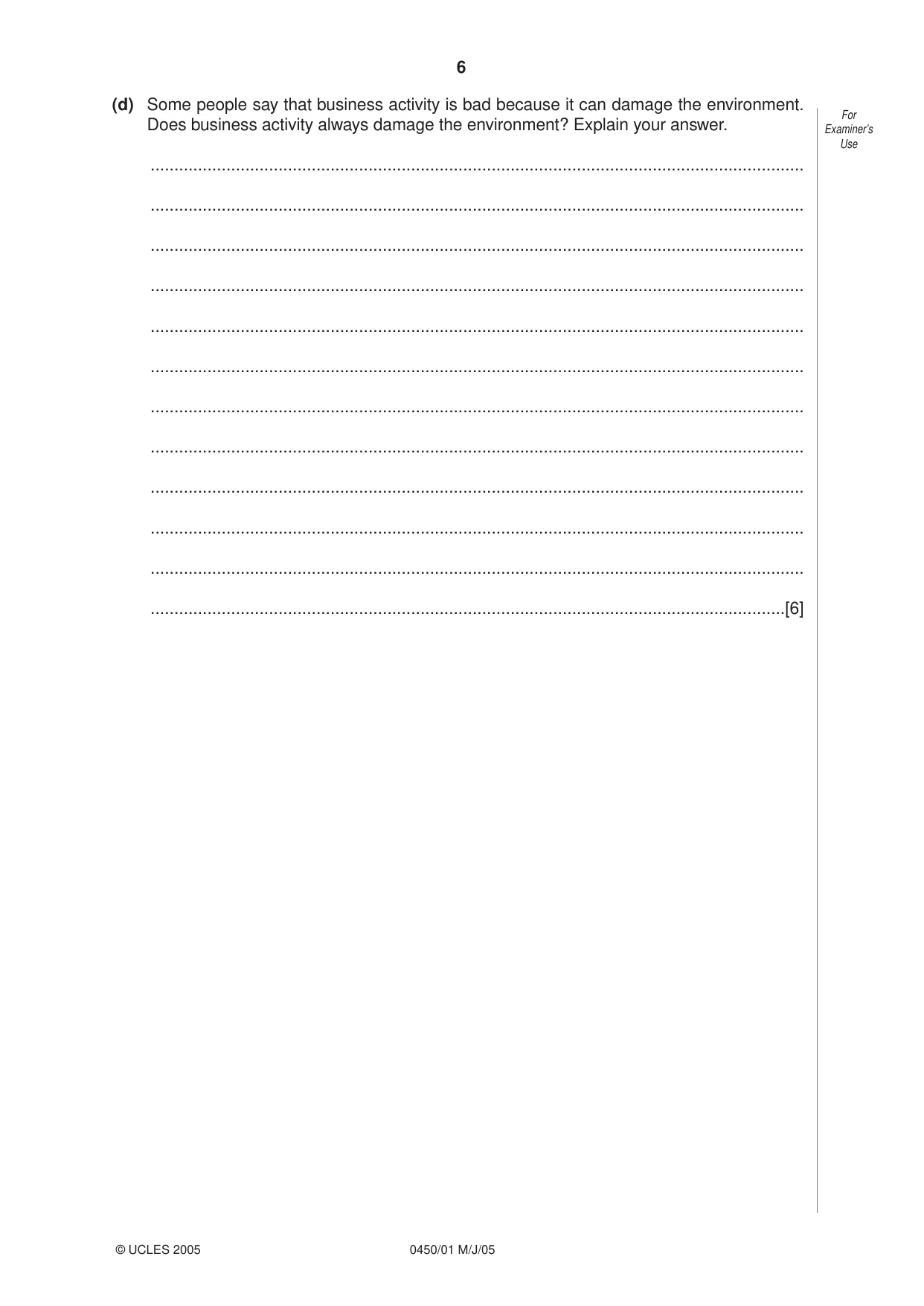
6 © UCLES 2005 0450/01 M/J/05 (d) Some people say that business activity is bad because it can damage the environment. Does business activity always damage the environment? Explain your answer. … … … … … … … … … … … …[6] For Examiner’s Use
Question paper, page 7
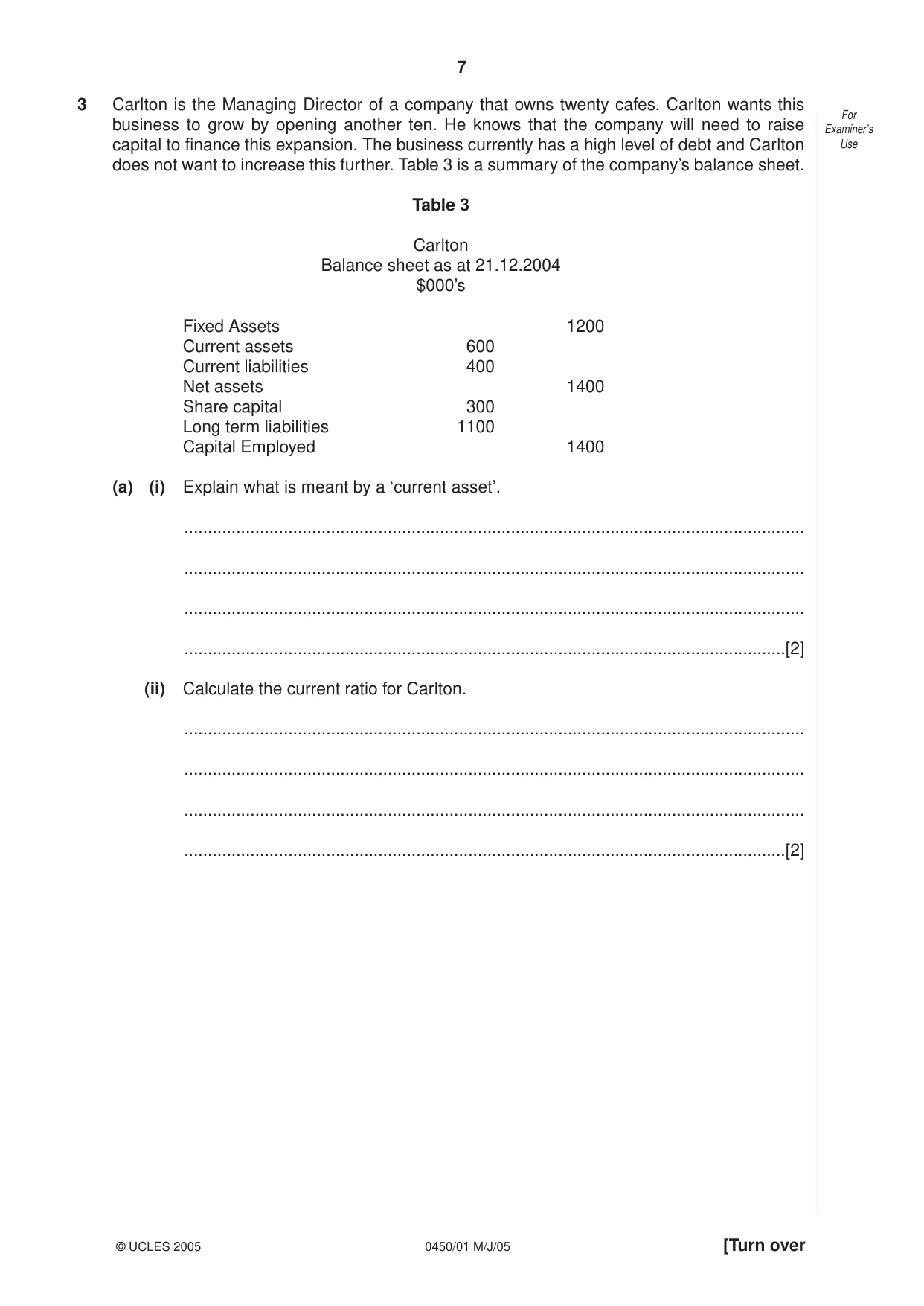
7 © UCLES 2005 0450/01 M/J/05 [Turn over 3 Carlton is the Managing Director of a company that owns twenty cafes. Carlton wants this business to grow by opening another ten. He knows that the company will need to raise capital to finance this expansion. The business currently has a high level of debt and Carlton does not want to increase this further. Table 3 is a summary of the company’s balance sheet. Table 3 Carlton Balance sheet as at 21.12.2004 $000’s Fixed Assets 1200 Current assets 600 Current liabilities 400 Net assets 1400 Share capital 300 Long term liabilities 1100 Capital Employed 1400 (a) (i) Explain what is meant by a ‘current asset’. … … … …[2] (ii) Calculate the current ratio for Carlton. … … … …[2] For Examiner’s Use
Question paper, page 8
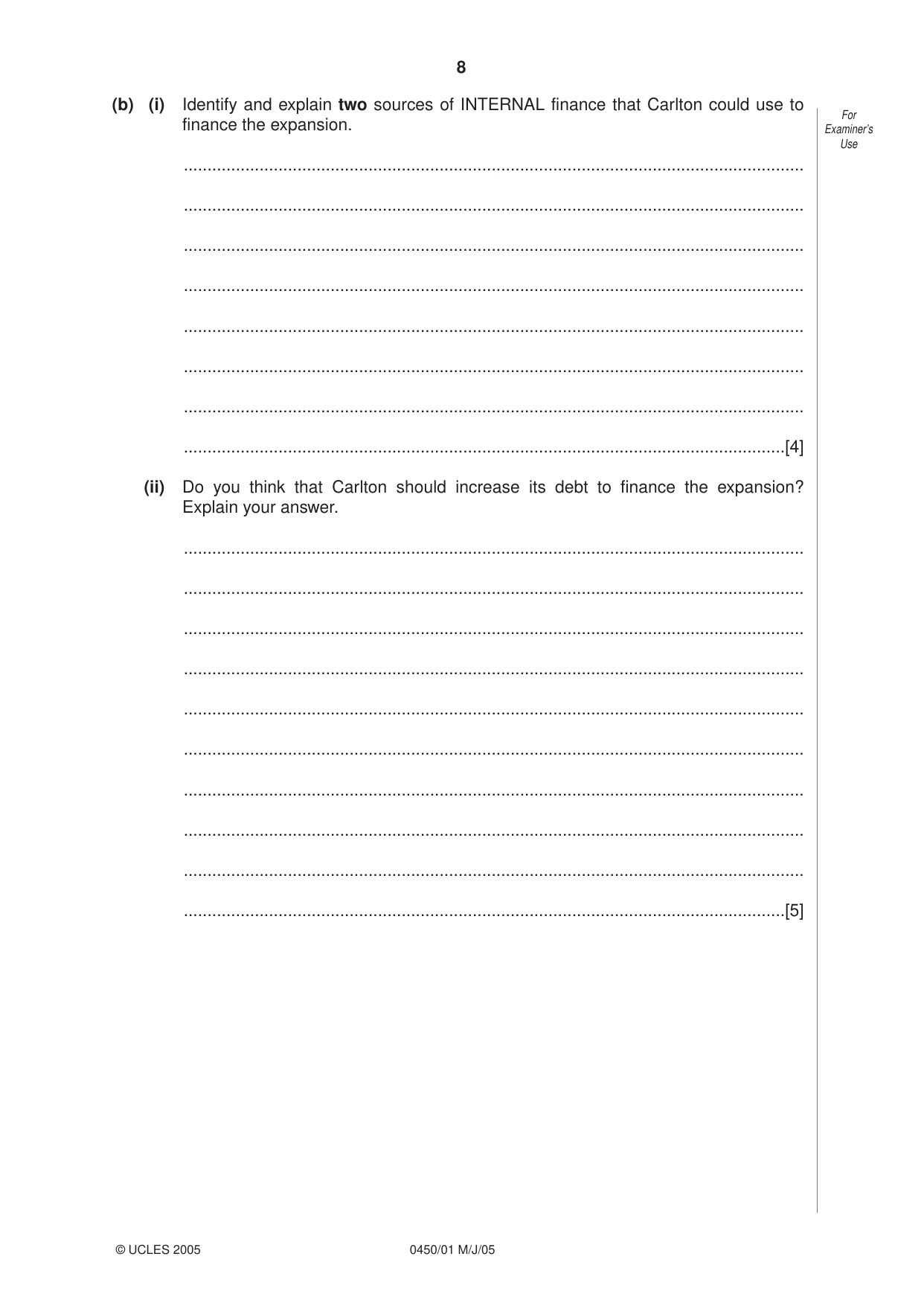
8 © UCLES 2005 0450/01 M/J/05 (b) (i) Identify and explain two sources of INTERNAL finance that Carlton could use to finance the expansion. … … … … … … … …[4] (ii) Do you think that Carlton should increase its debt to finance the expansion? Explain your answer. … … … … … … … … … …[5] For Examiner’s Use
Question paper, page 9
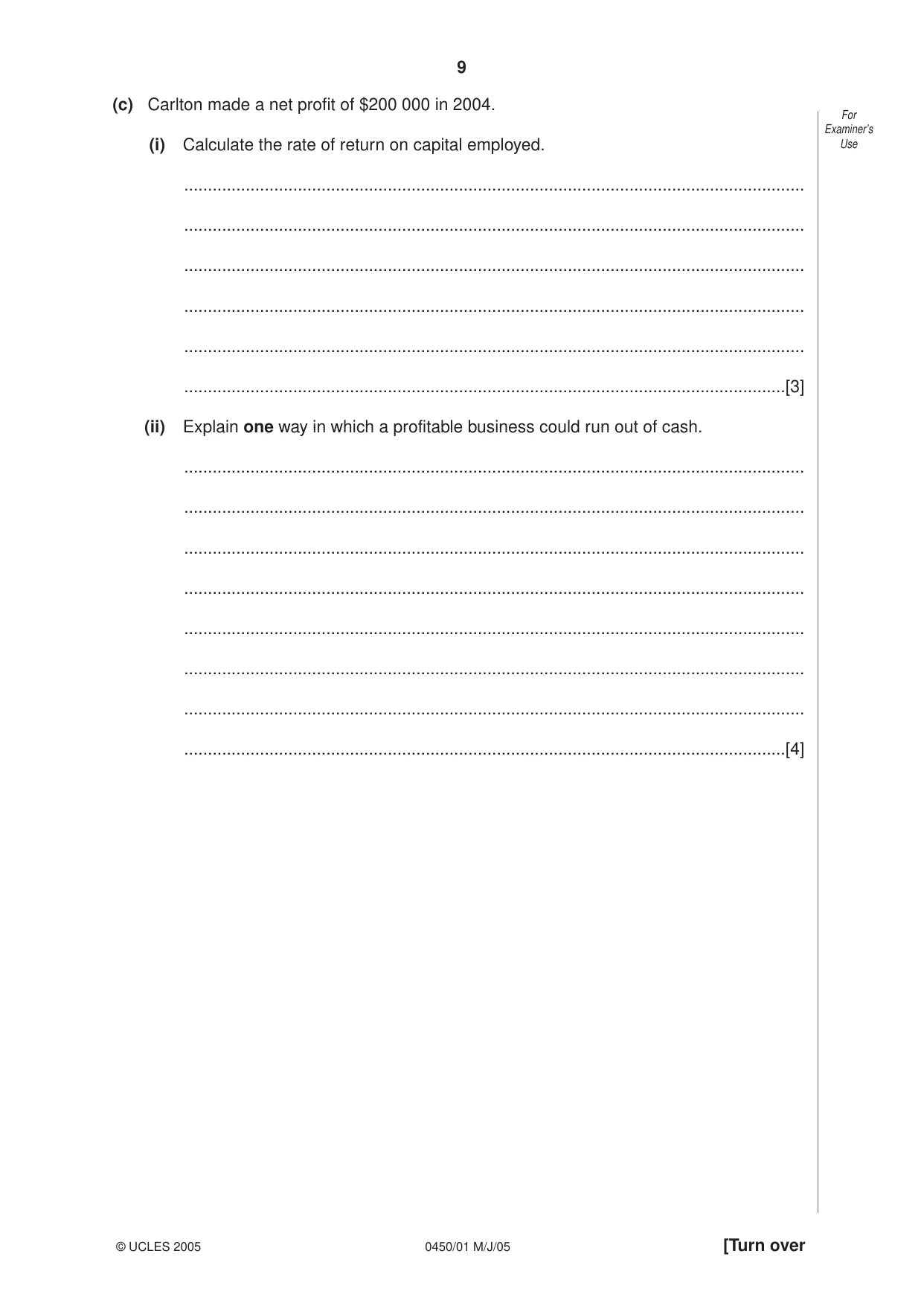
9 © UCLES 2005 0450/01 M/J/05 [Turn over (c) Carlton made a net profit of $200 000 in 2004. (i) Calculate the rate of return on capital employed. … … … … … …[3] (ii) Explain one way in which a profitable business could run out of cash. … … … … … … … …[4] For Examiner’s Use
Question paper, page 10
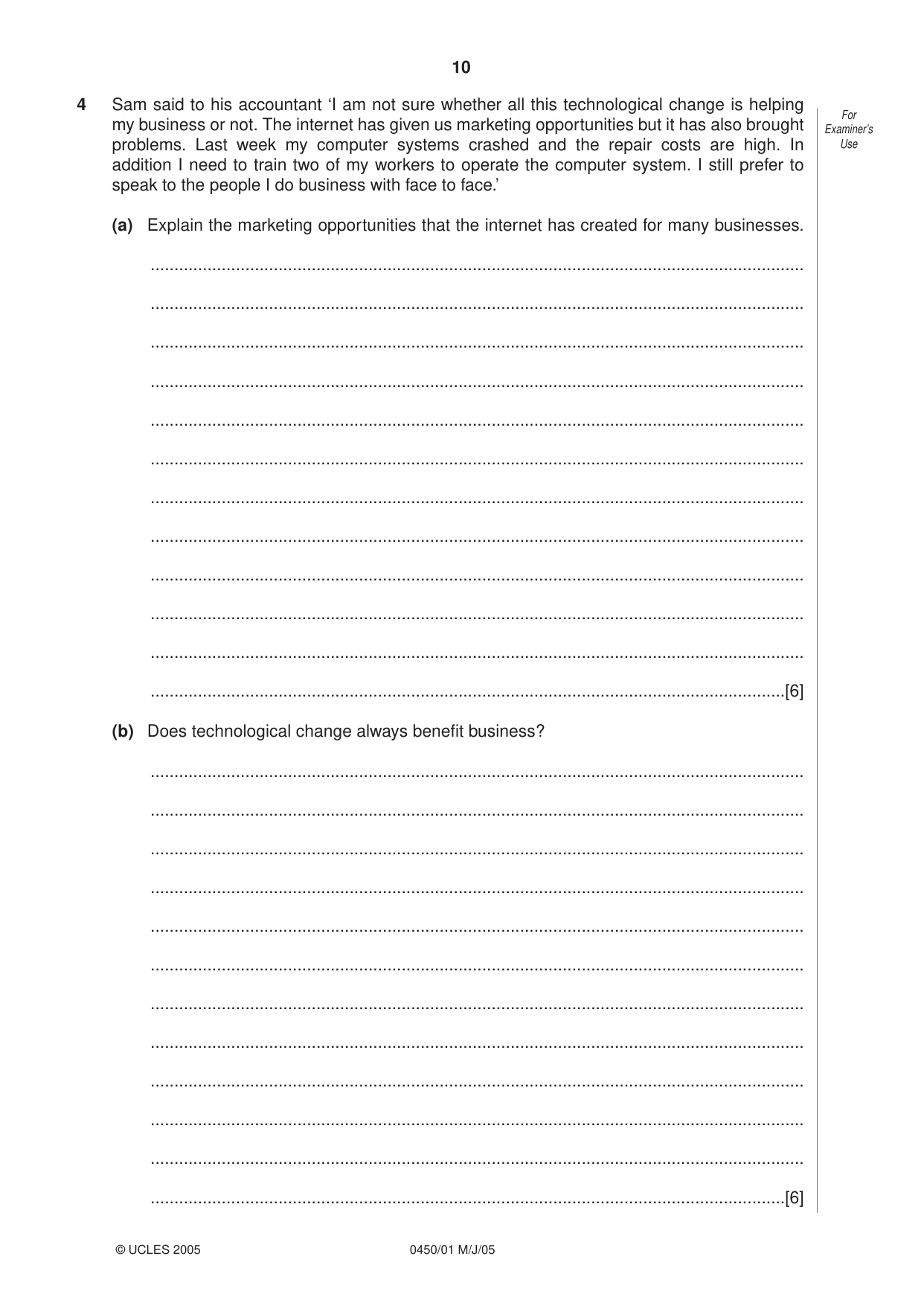
10 © UCLES 2005 0450/01 M/J/05 4 Sam said to his accountant ‘I am not sure whether all this technological change is helping my business or not. The internet has given us marketing opportunities but it has also brought problems. Last week my computer systems crashed and the repair costs are high. In addition I need to train two of my workers to operate the computer system. I still prefer to speak to the people I do business with face to face.’ (a) Explain the marketing opportunities that the internet has created for many businesses. … … … … … … … … … … … …[6] (b) Does technological change always benefit business? … … … … … … … … … … … …[6] For Examiner’s Use
Question paper, page 11
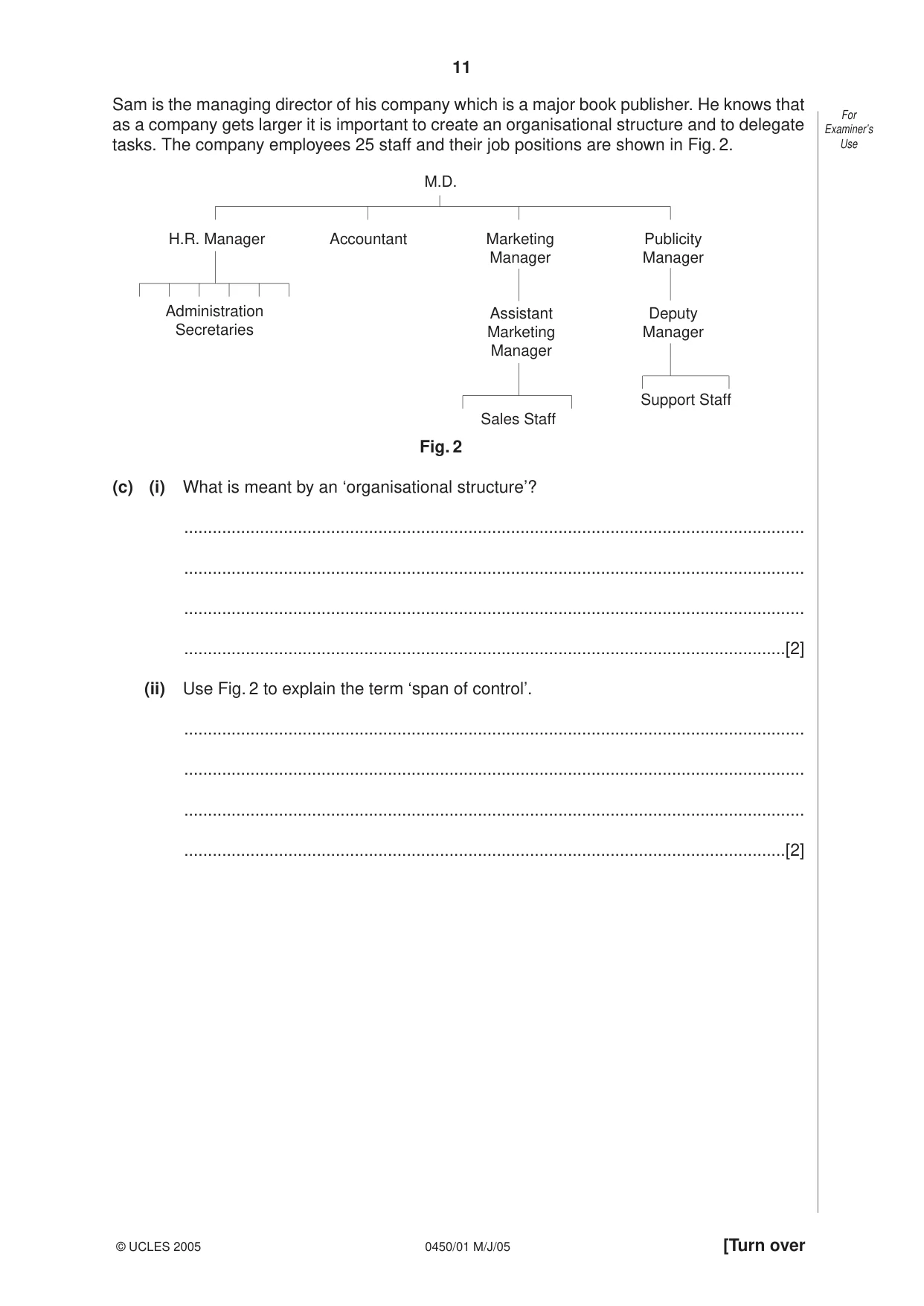
11 © UCLES 2005 0450/01 M/J/05 [Turn over Sam is the managing director of his company which is a major book publisher. He knows that as a company gets larger it is important to create an organisational structure and to delegate tasks. The company employees 25 staff and their job positions are shown in Fig. 2. Fig. 2 (c) (i) What is meant by an ‘organisational structure’? … … … …[2] (ii) Use Fig. 2 to explain the term ‘span of control’. … … … …[2] For Examiner’s Use M.D. Publicity Manager Deputy Manager Support Staff Sales Staff Marketing Manager Accountant H.R. Manager Administration Secretaries Assistant Marketing Manager
Question paper, page 12
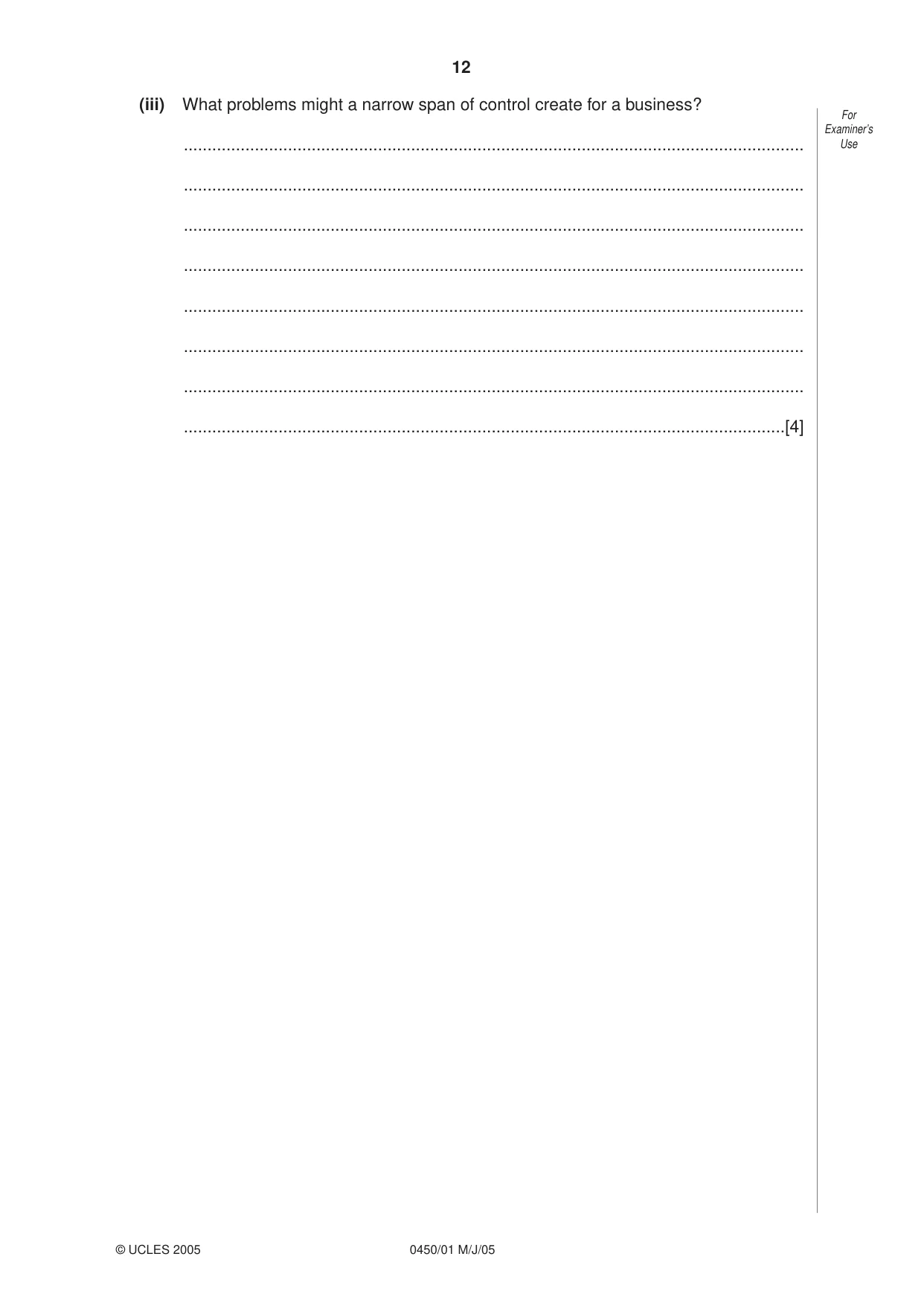
12 © UCLES 2005 0450/01 M/J/05 (iii) What problems might a narrow span of control create for a business? … … … … … … … …[4] For Examiner’s Use
Question paper, page 13
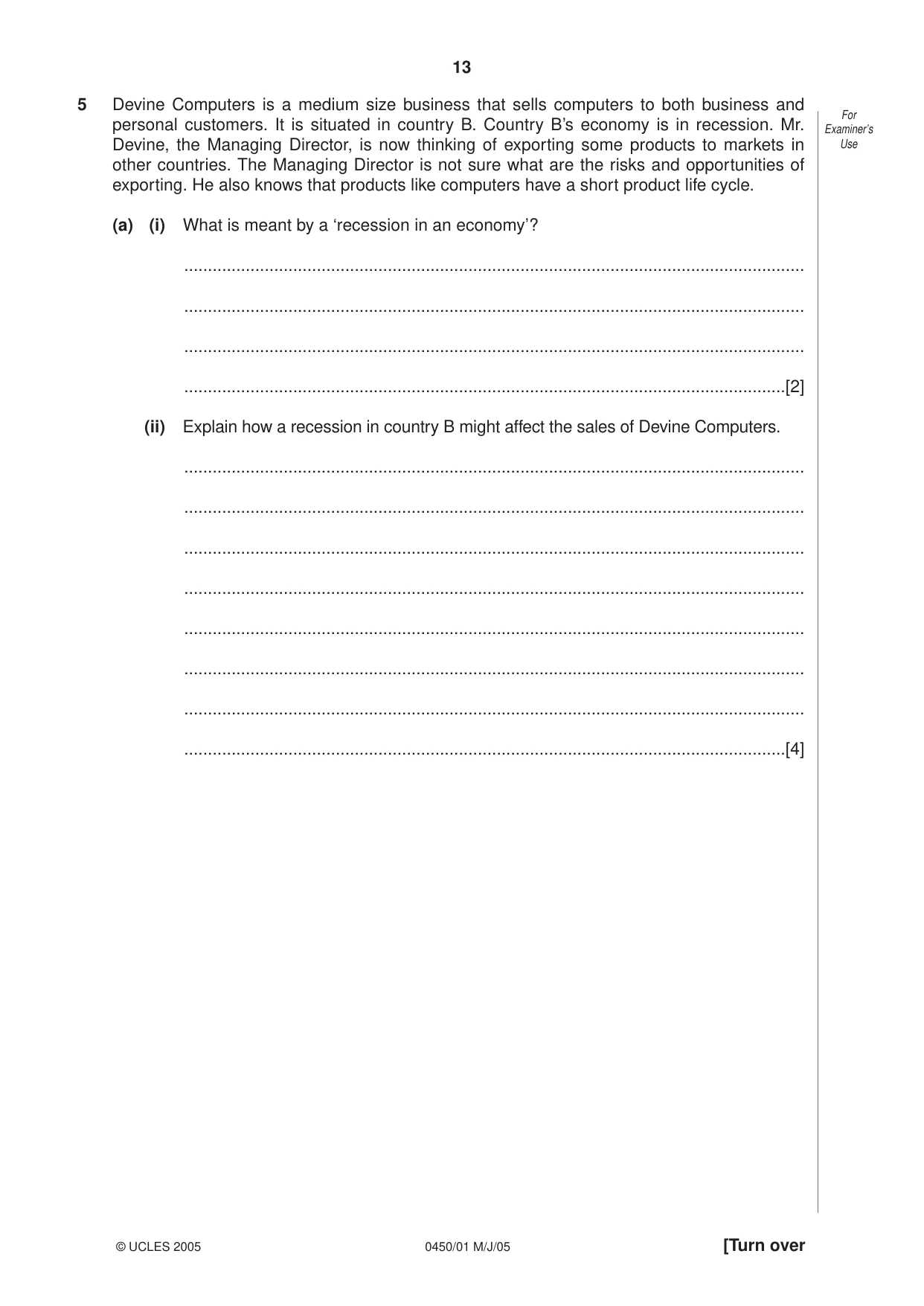
13 © UCLES 2005 0450/01 M/J/05 [Turn over 5 Devine Computers is a medium size business that sells computers to both business and personal customers. It is situated in country B. Country B’s economy is in recession. Mr. Devine, the Managing Director, is now thinking of exporting some products to markets in other countries. The Managing Director is not sure what are the risks and opportunities of exporting. He also knows that products like computers have a short product life cycle. (a) (i) What is meant by a ‘recession in an economy’? … … … …[2] (ii) Explain how a recession in country B might affect the sales of Devine Computers. … … … … … … … …[4] For Examiner’s Use
Question paper, page 14
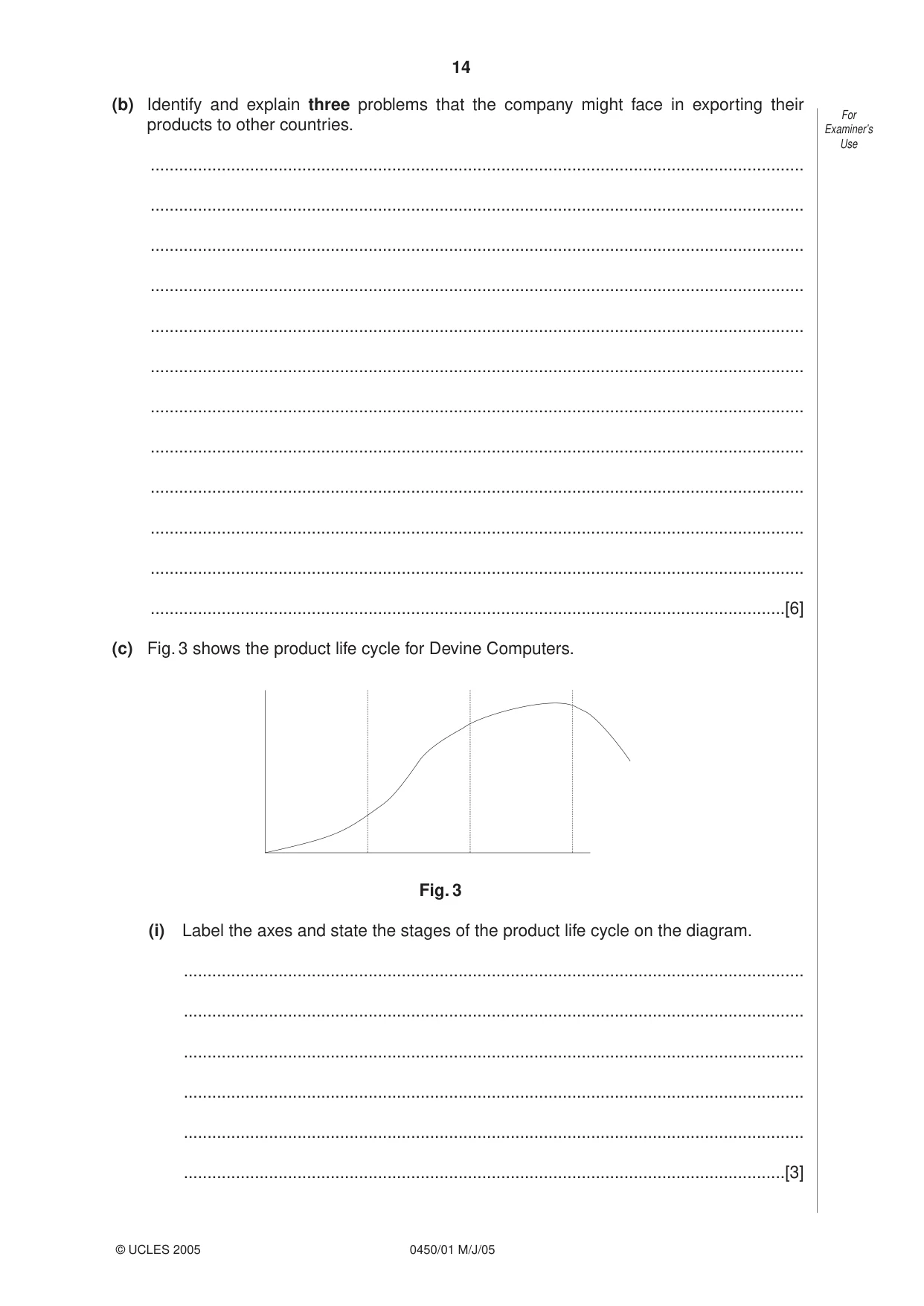
14 © UCLES 2005 0450/01 M/J/05 (b) Identify and explain three problems that the company might face in exporting their products to other countries. … … … … … … … … … … … …[6] (c) Fig. 3 shows the product life cycle for Devine Computers. Fig. 3 (i) Label the axes and state the stages of the product life cycle on the diagram. … … … … … …[3] For Examiner’s Use
Question paper, page 15
15 © UCLES 2005 0450/01 M/J/05 (ii) Explain the disadvantages of a short product life cycle for Devine Computers. … … … … … … … … … …[5] For Examiner’s Use
Question paper, page 16
16 0450/01 M/J/05 BLANK PAGE Permission to reproduce items where third-party owned material protected by copyright is included has been sought and cleared where possible. Every reasonable effort has been made by the publisher (UCLES) to trace copyright holders, but if any items requiring clearance have unwittingly been included, the publisher will be pleased to make amends at the earliest possible opportunity. University of Cambridge International Examinations is part of the University of Cambridge Local Examinations Syndicate (UCLES), which is itself a department of the University of Cambridge.
Mark scheme, page 1
UNIVERSITY OF CAMBRIDGE INTERNATIONAL EXAMINATIONS International General Certificate of Secondary Education MARK SCHEME for the June 2005 question paper 0450 BUSINESS STUDIES 0450/01 Paper 1, maximum raw mark 100 This mark scheme is published as an aid to teachers and students, to indicate the requirements of the examination. It shows the basis on which Examiners were initially instructed to award marks. It does not indicate the details of the discussions that took place at an Examiners’ meeting before marking began. Any substantial changes to the mark scheme that arose from these discussions will be recorded in the published Report on the Examination. All Examiners are instructed that alternative correct answers and unexpected approaches in candidates’ scripts must be given marks that fairly reflect the relevant knowledge and skills demonstrated. Mark schemes must be read in conjunction with the question papers and the Report on the Examination. • CIE will not enter into discussion or correspondence in connection with these mark schemes. CIE is publishing the mark schemes for the June 2005 question papers for most IGCSE and GCE Advanced Level and Advanced Subsidiary Level syllabuses and some Ordinary Level syllabuses’. www.XtremePapers.com
Mark scheme, page 2
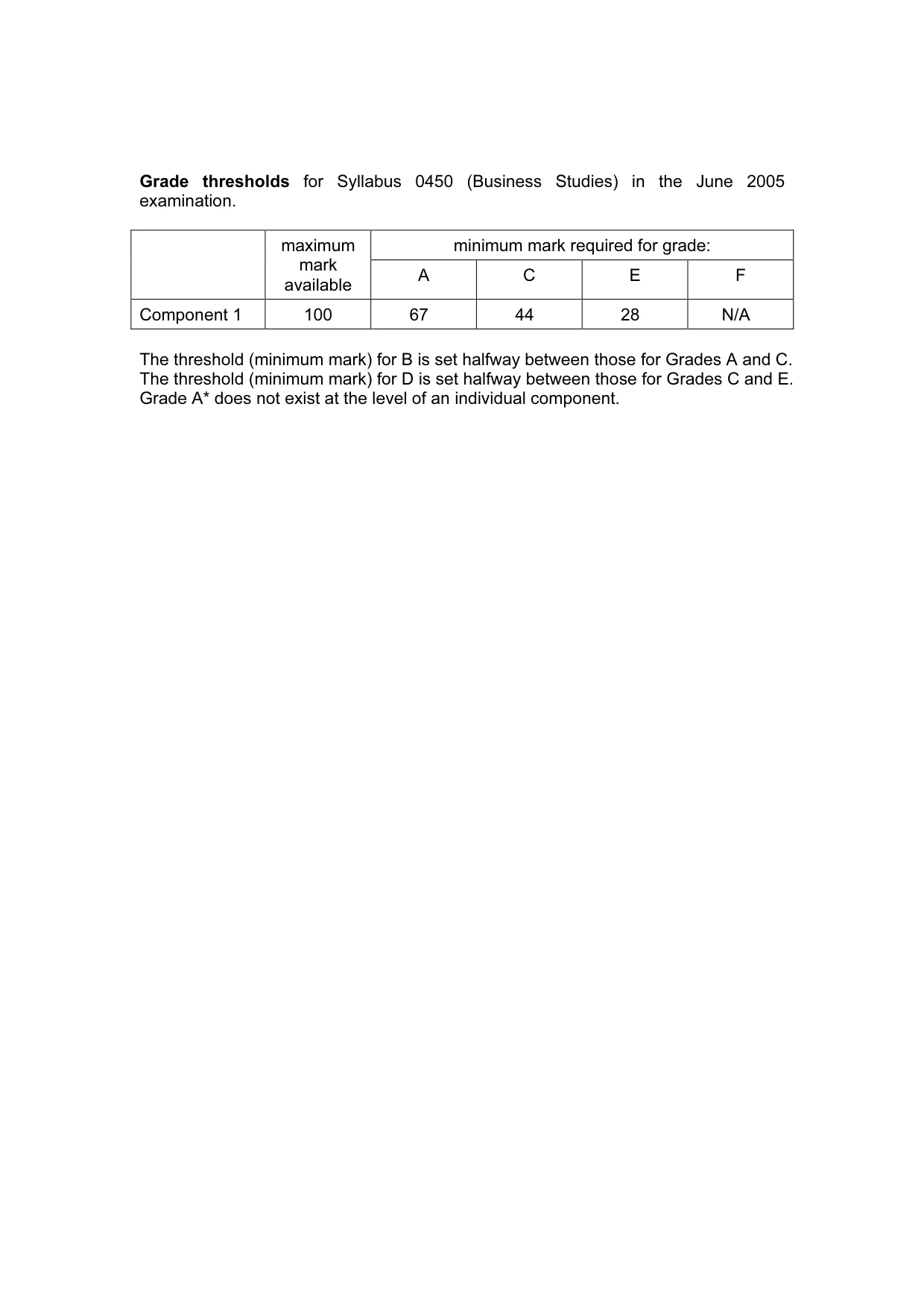
Grade thresholds for Syllabus 0450 (Business Studies) in the June 2005 examination. minimum mark required for grade: maximum mark available A C E F Component 1 100 67 44 28 N/A The threshold (minimum mark) for B is set halfway between those for Grades A and C. The threshold (minimum mark) for D is set halfway between those for Grades C and E. Grade A* does not exist at the level of an individual component.
Mark scheme, page 3
JUNE 2005 IGCSE MARK SCHEME MAXIMUM MARK: 100 SYLLABUS/COMPONENT: 0450/01 BUSINESS STUDIES Paper 1
Mark scheme, page 4
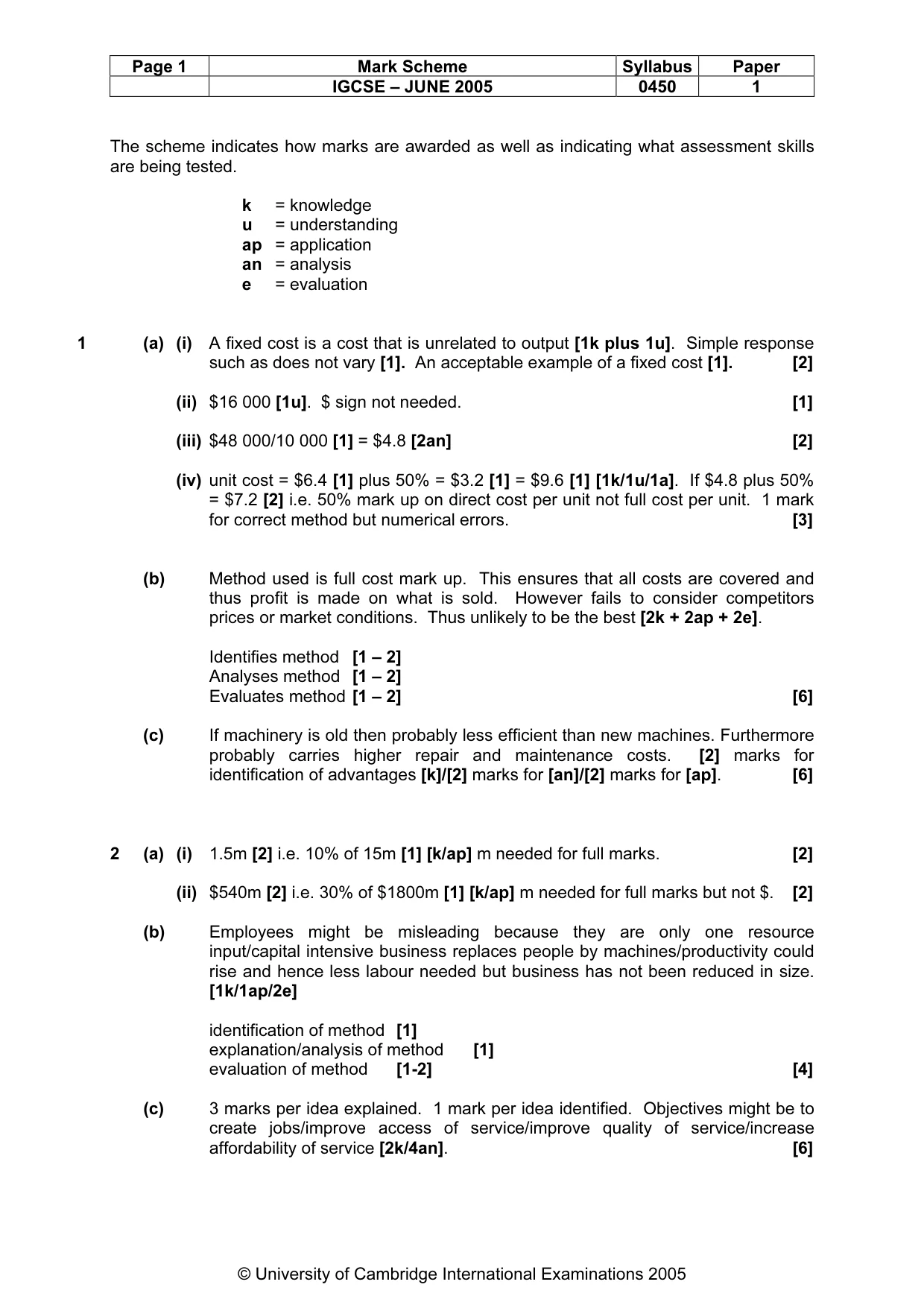
Page 1 Mark Scheme Syllabus Paper IGCSE – JUNE 2005 0450 1 © University of Cambridge International Examinations 2005 The scheme indicates how marks are awarded as well as indicating what assessment skills are being tested. k = knowledge u = understanding ap = application an = analysis e = evaluation 1 (a) (i) A fixed cost is a cost that is unrelated to output [1k plus 1u]. Simple response such as does not vary [1]. An acceptable example of a fixed cost [1]. [2] (ii) $16 000 [1u]. $ sign not needed. [1] (iii) $48 000/10 000 [1] = $4.8 [2an] [2] (iv) unit cost = $6.4 [1] plus 50% = $3.2 [1] = $9.6 [1] [1k/1u/1a]. If $4.8 plus 50% = $7.2 [2] i.e. 50% mark up on direct cost per unit not full cost per unit. 1 mark for correct method but numerical errors. [3] (b) Method used is full cost mark up. This ensures that all costs are covered and thus profit is made on what is sold. However fails to consider competitors prices or market conditions. Thus unlikely to be the best [2k + 2ap + 2e]. Identifies method [1 – 2] Analyses method [1 – 2] Evaluates method [1 – 2] [6] (c) If machinery is old then probably less efficient than new machines. Furthermore probably carries higher repair and maintenance costs. [2] marks for identification of advantages [k]/[2] marks for [an]/[2] marks for [ap]. [6] 2 (a) (i) 1.5m [2] i.e. 10% of 15m [1] [k/ap] m needed for full marks. [2] (ii) $540m [2] i.e. 30% of $1800m [1] [k/ap] m needed for full marks but not $. [2] (b) Employees might be misleading because they are only one resource input/capital intensive business replaces people by machines/productivity could rise and hence less labour needed but business has not been reduced in size. [1k/1ap/2e] identification of method [1] explanation/analysis of method [1] evaluation of method [1-2] [4] (c) 3 marks per idea explained. 1 mark per idea identified. Objectives might be to create jobs/improve access of service/improve quality of service/increase affordability of service [2k/4an]. [6]
Mark scheme, page 5
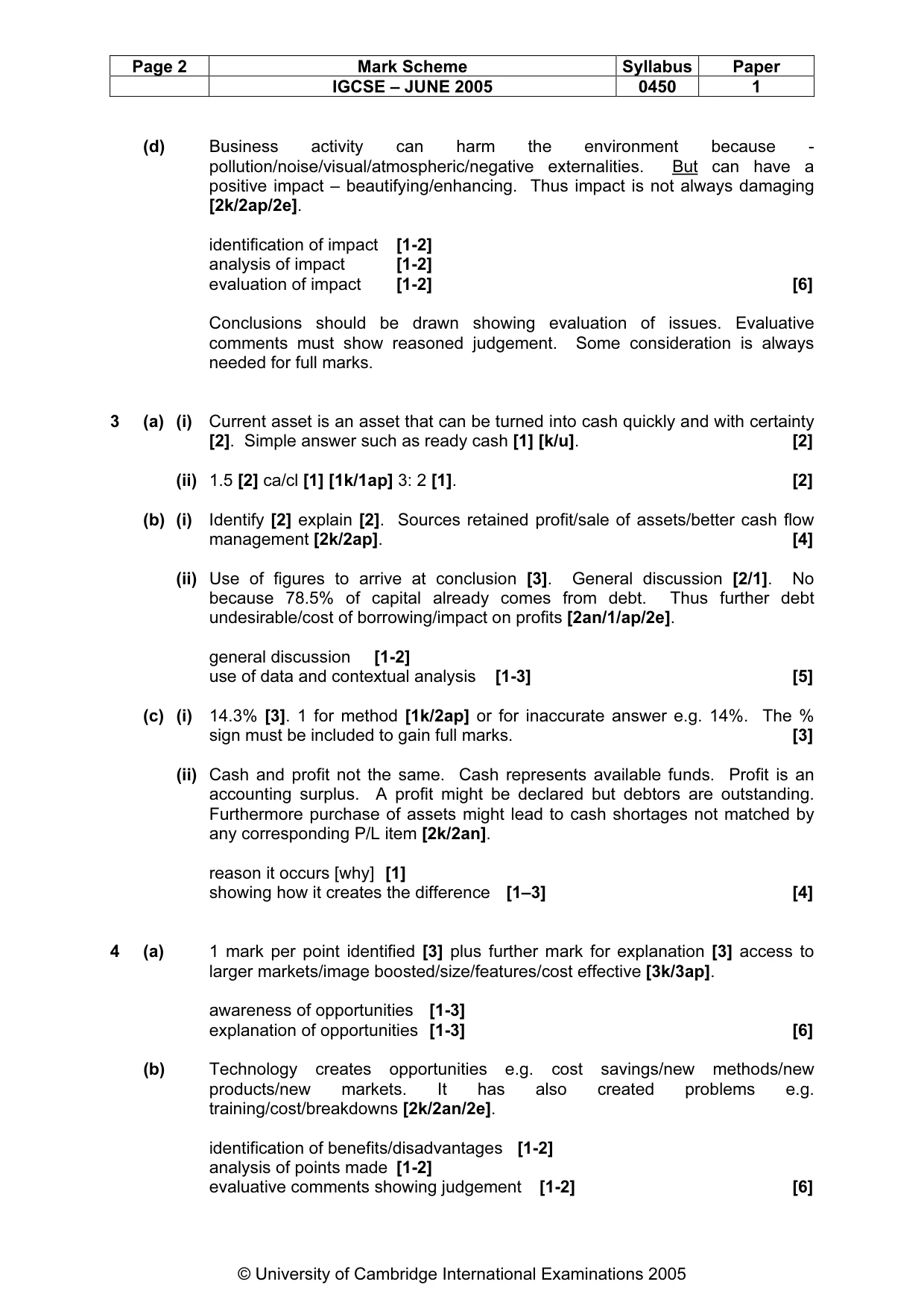
Page 2 Mark Scheme Syllabus Paper IGCSE – JUNE 2005 0450 1 © University of Cambridge International Examinations 2005 (d) Business activity can harm the environment because - pollution/noise/visual/atmospheric/negative externalities. But can have a positive impact – beautifying/enhancing. Thus impact is not always damaging [2k/2ap/2e]. identification of impact [1-2] analysis of impact [1-2] evaluation of impact [1-2] [6] Conclusions should be drawn showing evaluation of issues. Evaluative comments must show reasoned judgement. Some consideration is always needed for full marks. 3 (a) (i) Current asset is an asset that can be turned into cash quickly and with certainty [2]. Simple answer such as ready cash [1] [k/u]. [2] (ii) 1.5 [2] ca/cl [1] [1k/1ap] 3: 2 [1]. [2] (b) (i) Identify [2] explain [2]. Sources retained profit/sale of assets/better cash flow management [2k/2ap]. [4] (ii) Use of figures to arrive at conclusion [3]. General discussion [2/1]. No because 78.5% of capital already comes from debt. Thus further debt undesirable/cost of borrowing/impact on profits [2an/1/ap/2e]. general discussion [1-2] use of data and contextual analysis [1-3] [5] (c) (i) 14.3% [3]. 1 for method [1k/2ap] or for inaccurate answer e.g. 14%. The % sign must be included to gain full marks. [3] (ii) Cash and profit not the same. Cash represents available funds. Profit is an accounting surplus. A profit might be declared but debtors are outstanding. Furthermore purchase of assets might lead to cash shortages not matched by any corresponding P/L item [2k/2an]. reason it occurs [why] [1] showing how it creates the difference [1–3] [4] 4 (a) 1 mark per point identified [3] plus further mark for explanation [3] access to larger markets/image boosted/size/features/cost effective [3k/3ap]. awareness of opportunities [1-3] explanation of opportunities [1-3] [6] (b) Technology creates opportunities e.g. cost savings/new methods/new products/new markets. It has also created problems e.g. training/cost/breakdowns [2k/2an/2e]. identification of benefits/disadvantages [1-2] analysis of points made [1-2] evaluative comments showing judgement [1-2] [6]
Mark scheme, page 6
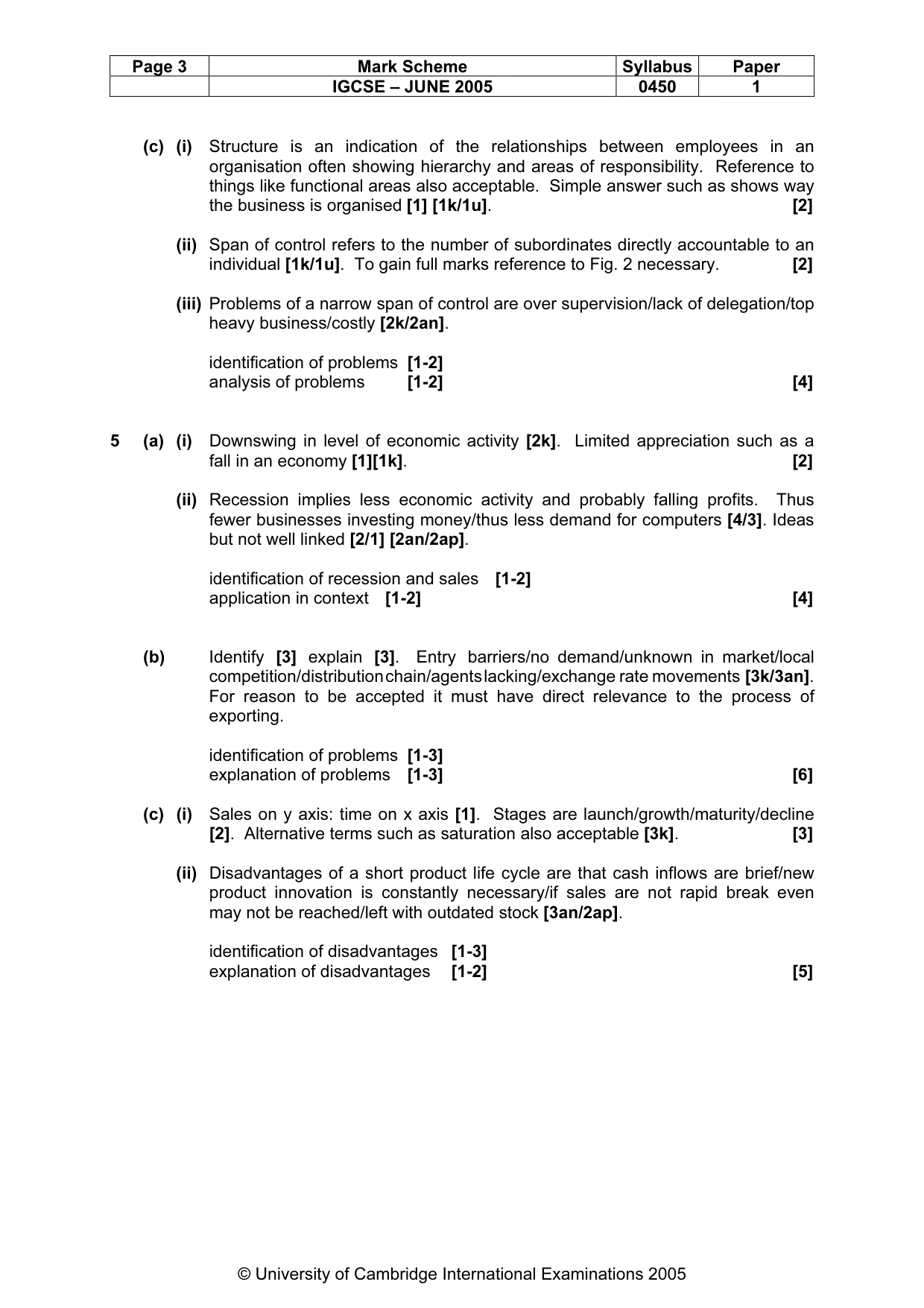
Page 3 Mark Scheme Syllabus Paper IGCSE – JUNE 2005 0450 1 © University of Cambridge International Examinations 2005 (c) (i) Structure is an indication of the relationships between employees in an organisation often showing hierarchy and areas of responsibility. Reference to things like functional areas also acceptable. Simple answer such as shows way the business is organised [1] [1k/1u]. [2] (ii) Span of control refers to the number of subordinates directly accountable to an individual [1k/1u]. To gain full marks reference to Fig. 2 necessary. [2] (iii) Problems of a narrow span of control are over supervision/lack of delegation/top heavy business/costly [2k/2an]. identification of problems [1-2] analysis of problems [1-2] [4] 5 (a) (i) Downswing in level of economic activity [2k]. Limited appreciation such as a fall in an economy [1][1k]. [2] (ii) Recession implies less economic activity and probably falling profits. Thus fewer businesses investing money/thus less demand for computers [4/3]. Ideas but not well linked [2/1] [2an/2ap]. identification of recession and sales [1-2] application in context [1-2] [4] (b) Identify [3] explain [3]. Entry barriers/no demand/unknown in market/local competition/distribution chain/agents lacking/exchange rate movements [3k/3an]. For reason to be accepted it must have direct relevance to the process of exporting. identification of problems [1-3] explanation of problems [1-3] [6] (c) (i) Sales on y axis: time on x axis [1]. Stages are launch/growth/maturity/decline [2]. Alternative terms such as saturation also acceptable [3k]. [3] (ii) Disadvantages of a short product life cycle are that cash inflows are brief/new product innovation is constantly necessary/if sales are not rapid break even may not be reached/left with outdated stock [3an/2ap]. identification of disadvantages [1-3] explanation of disadvantages [1-2] [5]