Cambridge IGCSE Business Studies 0450 — 2004 Oct/Nov Paper 1 · Variant 1
0450/11/O/N/04
The question paper and its mark scheme, free to read here and free to download. This is Cambridge’s own paper, exactly as it was sat.
Question paper12 pages
Mark scheme8 pages
Answers below. Sit the paper first if you are practising.
Paper as text
Question paper, page 1
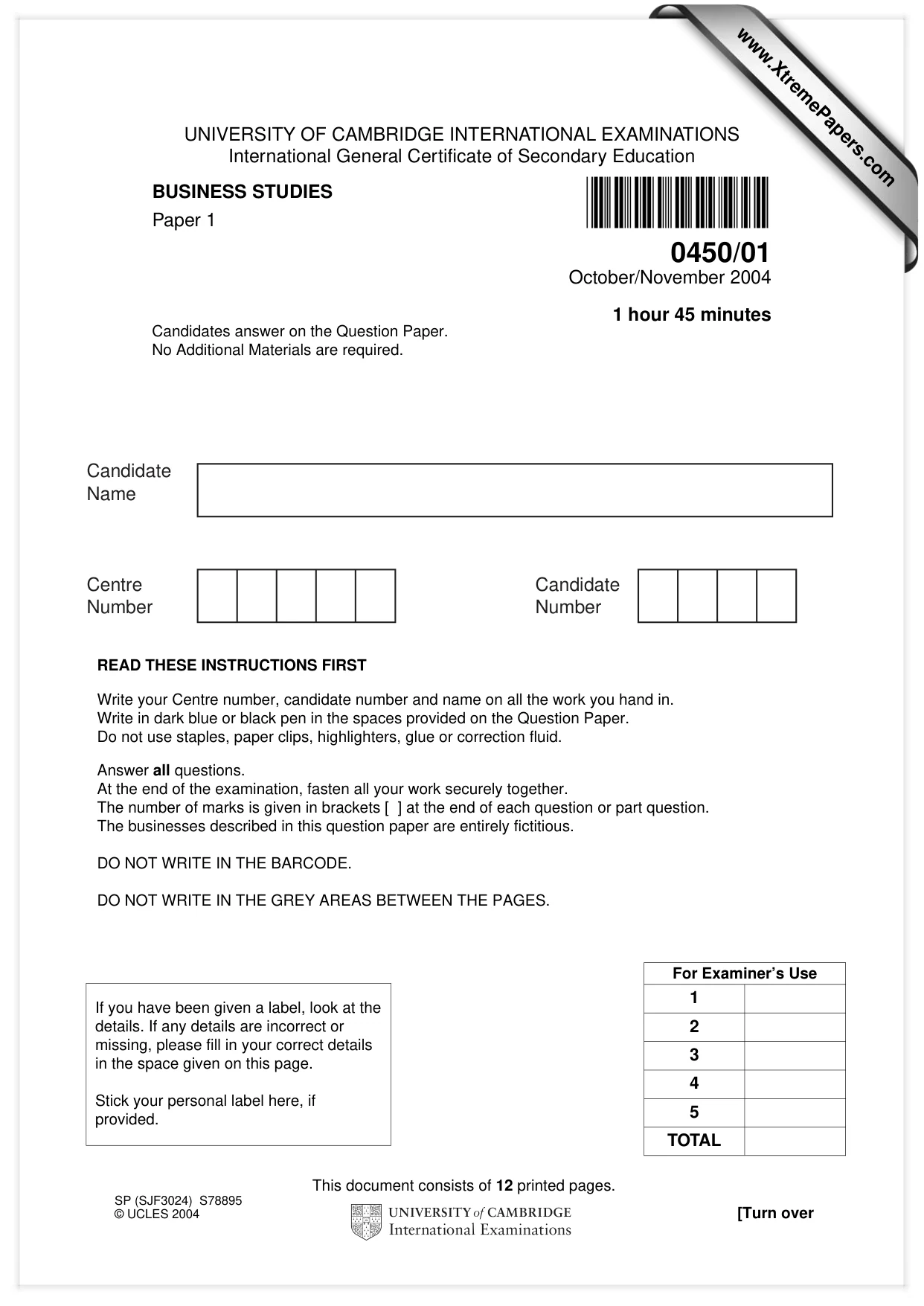
This document consists of 12 printed pages. SP (SJF3024) S78895 © UCLES 2004 [Turn over UNIVERSITY OF CAMBRIDGE INTERNATIONAL EXAMINATIONS International General Certificate of Secondary Education BUSINESS STUDIES Paper 1 0450/01 October/November 2004 1 hour 45 minutes Candidates answer on the Question Paper. No Additional Materials are required. READ THESE INSTRUCTIONS FIRST Write your Centre number, candidate number and name on all the work you hand in. Write in dark blue or black pen in the spaces provided on the Question Paper. Do not use staples, paper clips, highlighters, glue or correction fluid. Answer all questions. At the end of the examination, fasten all your work securely together. The number of marks is given in brackets [ ] at the end of each question or part question. The businesses described in this question paper are entirely fictitious. DO NOT WRITE IN THE BARCODE. DO NOT WRITE IN THE GREY AREAS BETWEEN THE PAGES. For Examiner’s Use 1 2 3 4 5 TOTAL Candidate Name Centre Number Candidate Number If you have been given a label, look at the details. If any details are incorrect or missing, please fill in your correct details in the space given on this page. Stick your personal label here, if provided. www.XtremePapers.com
Question paper, page 2
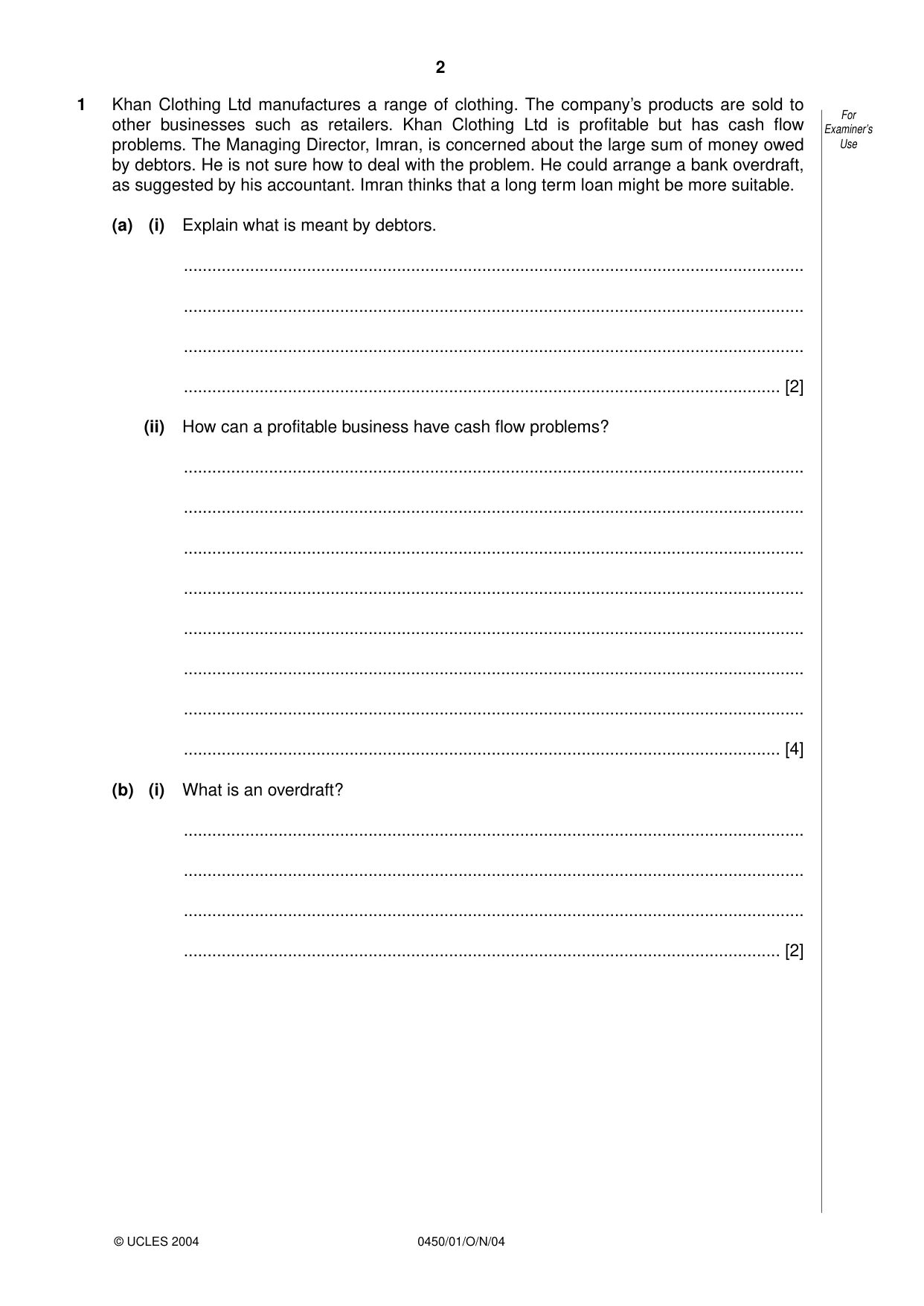
2 0450/01/O/N/04 1 Khan Clothing Ltd manufactures a range of clothing. The company’s products are sold to other businesses such as retailers. Khan Clothing Ltd is profitable but has cash flow problems. The Managing Director, Imran, is concerned about the large sum of money owed by debtors. He is not sure how to deal with the problem. He could arrange a bank overdraft, as suggested by his accountant. Imran thinks that a long term loan might be more suitable. (a) (i) Explain what is meant by debtors. … … … … [2] (ii) How can a profitable business have cash flow problems? … … … … … … … … [4] (b) (i) What is an overdraft? … … … … [2] For Examiner’s Use © UCLES 2004
Question paper, page 3
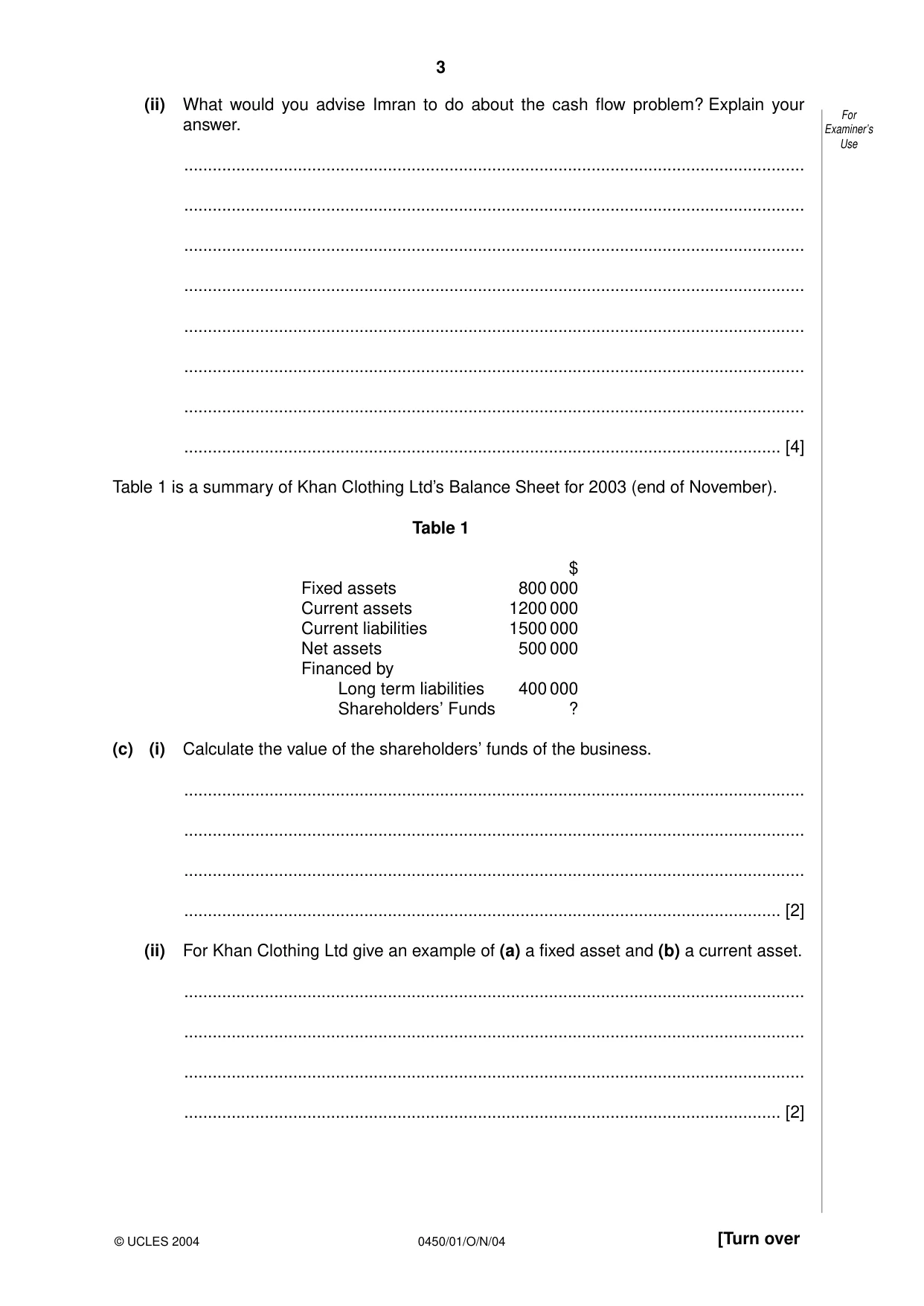
3 0450/01/O/N/04 [Turn over (ii) What would you advise Imran to do about the cash flow problem? Explain your answer. … … … … … … … … [4] Table 1 is a summary of Khan Clothing Ltd’s Balance Sheet for 2003 (end of November). Table 1 $ Fixed assets 800 000 Current assets 1200 000 Current liabilities 1500 000 Net assets 500 000 Financed by Long term liabilities 400 000 Shareholders’ Funds ? (c) (i) Calculate the value of the shareholders’ funds of the business. … … … … [2] (ii) For Khan Clothing Ltd give an example of (a) a fixed asset and (b) a current asset. … … … … [2] For Examiner’s Use © UCLES 2004
Question paper, page 4
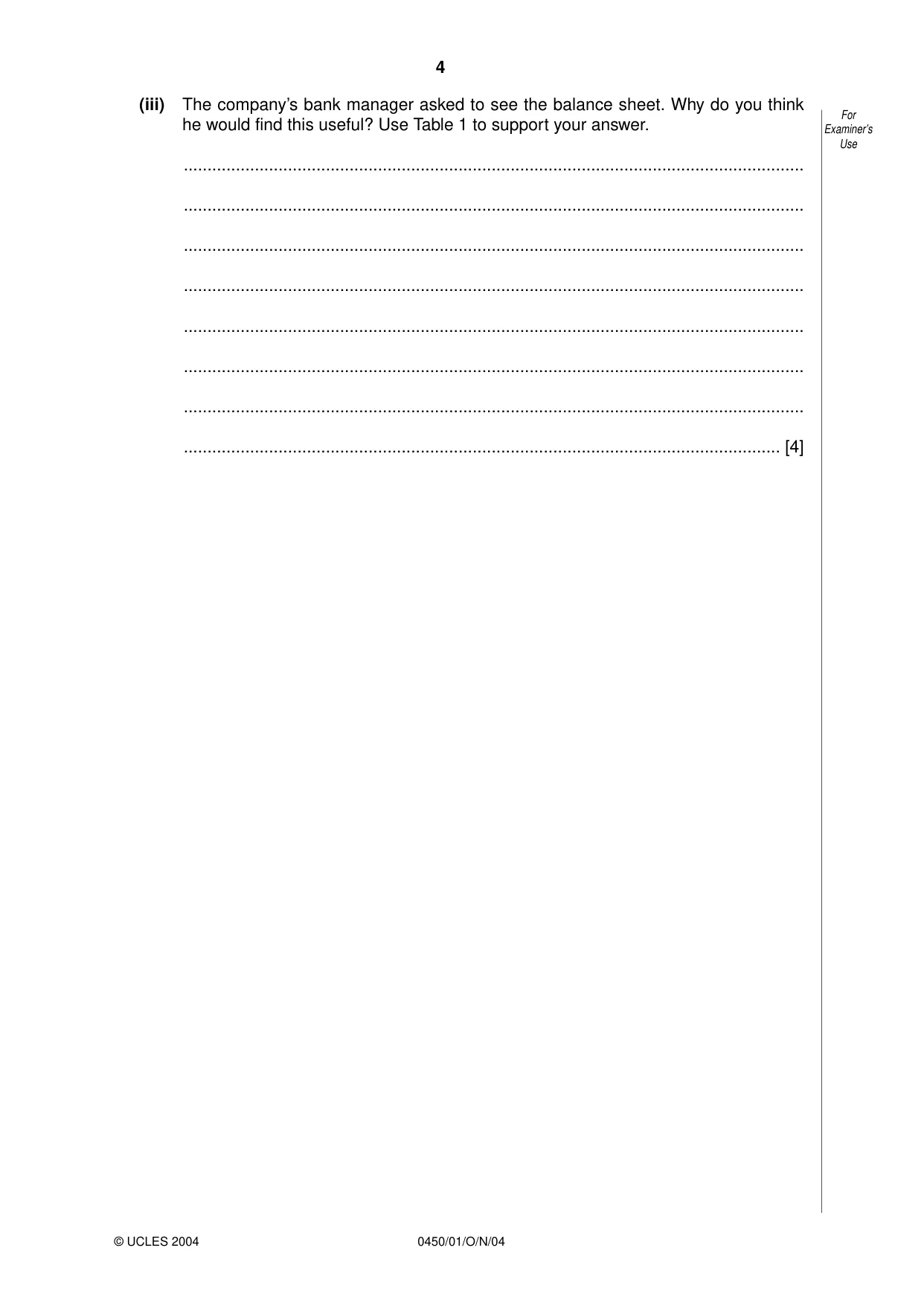
4 0450/01/O/N/04 (iii) The company’s bank manager asked to see the balance sheet. Why do you think he would find this useful? Use Table 1 to support your answer. … … … … … … … … [4] For Examiner’s Use © UCLES 2004
Question paper, page 5
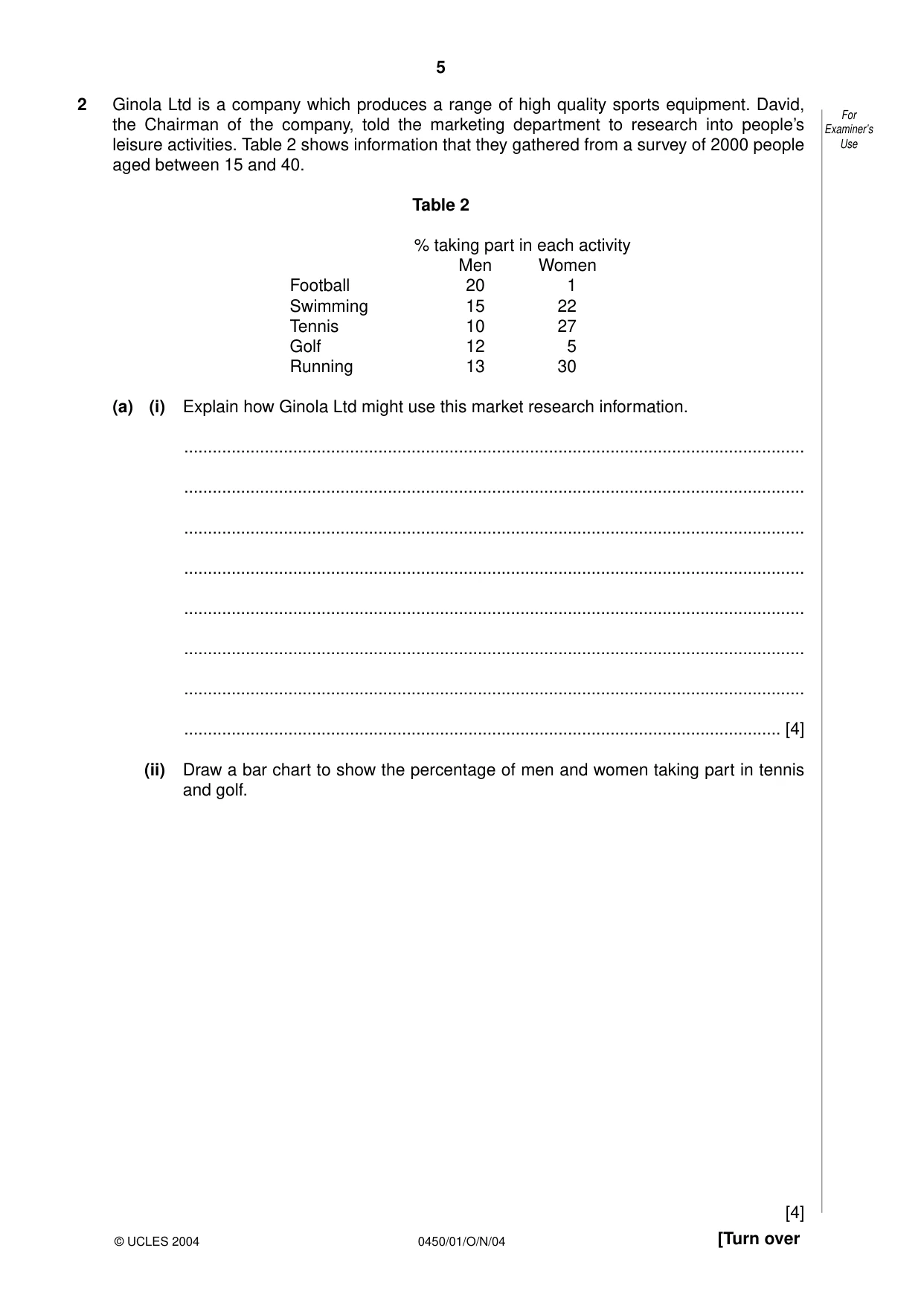
5 0450/01/O/N/04 [Turn over 2 Ginola Ltd is a company which produces a range of high quality sports equipment. David, the Chairman of the company, told the marketing department to research into people’s leisure activities. Table 2 shows information that they gathered from a survey of 2000 people aged between 15 and 40. Table 2 % taking part in each activity Men Women Football 20 1 Swimming 15 22 Tennis 10 27 Golf 12 5 Running 13 30 (a) (i) Explain how Ginola Ltd might use this market research information. … … … … … … … … [4] (ii) Draw a bar chart to show the percentage of men and women taking part in tennis and golf. [4] For Examiner’s Use © UCLES 2004
Question paper, page 6
6 0450/01/O/N/04 (b) David thinks that it would be a good idea to charge a price lower than his competitors. Explain why this policy might not be a good idea. … … … … … … … … [4] (c) (i) Give two examples of promotional methods that David could use for sports equipment. … … … … [2] (ii) Why is promotion an important part of the marketing mix for a product? … … … … … … … … … … … … [6] For Examiner’s Use © UCLES 2004
Question paper, page 7
7 0450/01/O/N/04 [Turn over 3 The Snack Factory produces a variety of sweets and chocolate products. They use flow production methods making use of the latest technology. The management believe that such methods help reduce costs. Anesh Batal is a trainee manager. He is finding out about the costs of the business. (a) Explain what is meant by: (i) variable cost, … … … … … … [3] (ii) unit cost. … … … … … … [3] (b) Why might the business’ production methods lead to low costs? … … … … … … … … [4] For Examiner’s Use © UCLES 2004
Question paper, page 8
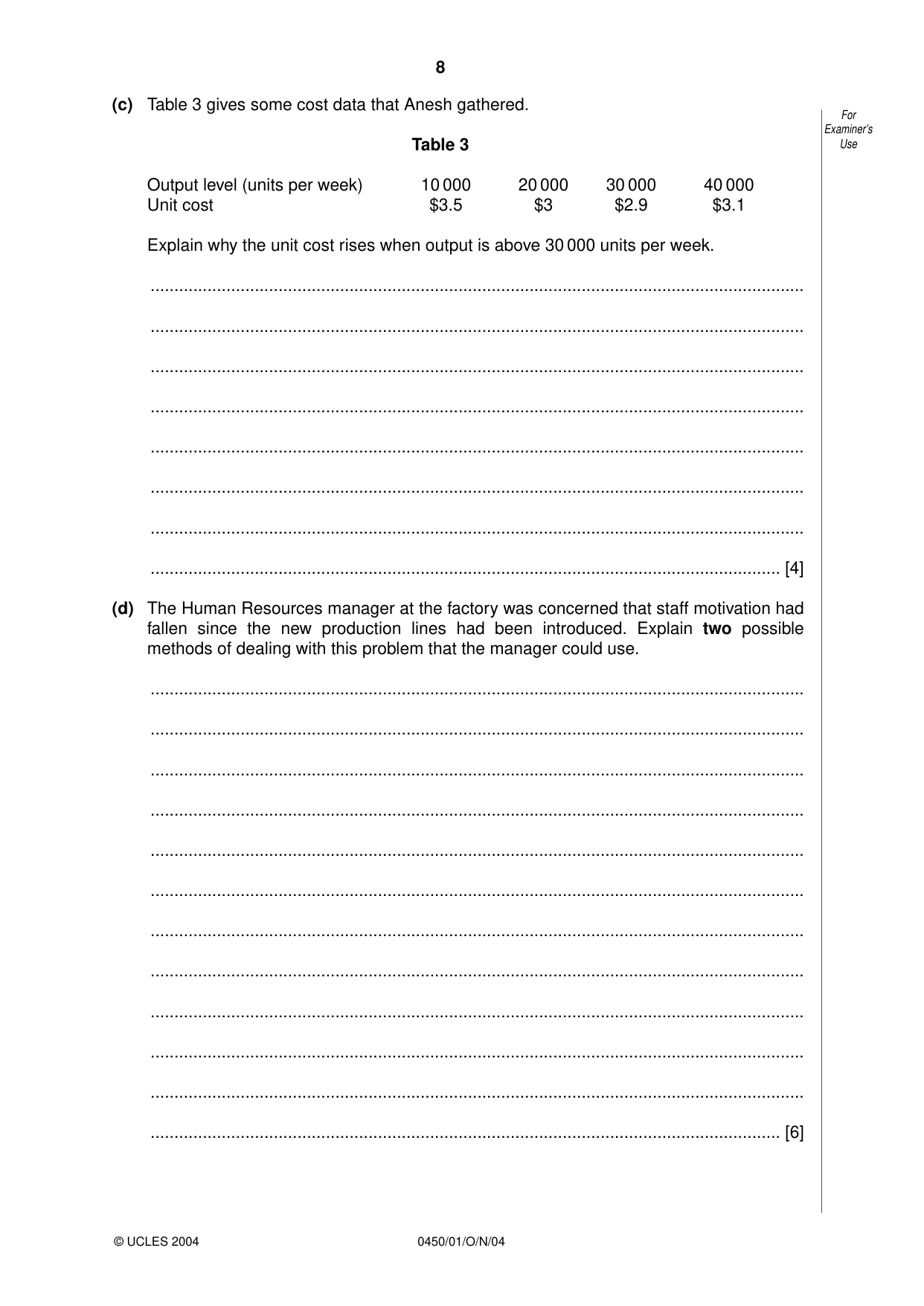
8 0450/01/O/N/04 (c) Table 3 gives some cost data that Anesh gathered. Table 3 Output level (units per week) 10 000 20 000 30 000 40 000 Unit cost $3.5 $3 $2.9 $3.1 Explain why the unit cost rises when output is above 30 000 units per week. … … … … … … … … [4] (d) The Human Resources manager at the factory was concerned that staff motivation had fallen since the new production lines had been introduced. Explain two possible methods of dealing with this problem that the manager could use. … … … … … … … … … … … … [6] For Examiner’s Use © UCLES 2004
Question paper, page 9
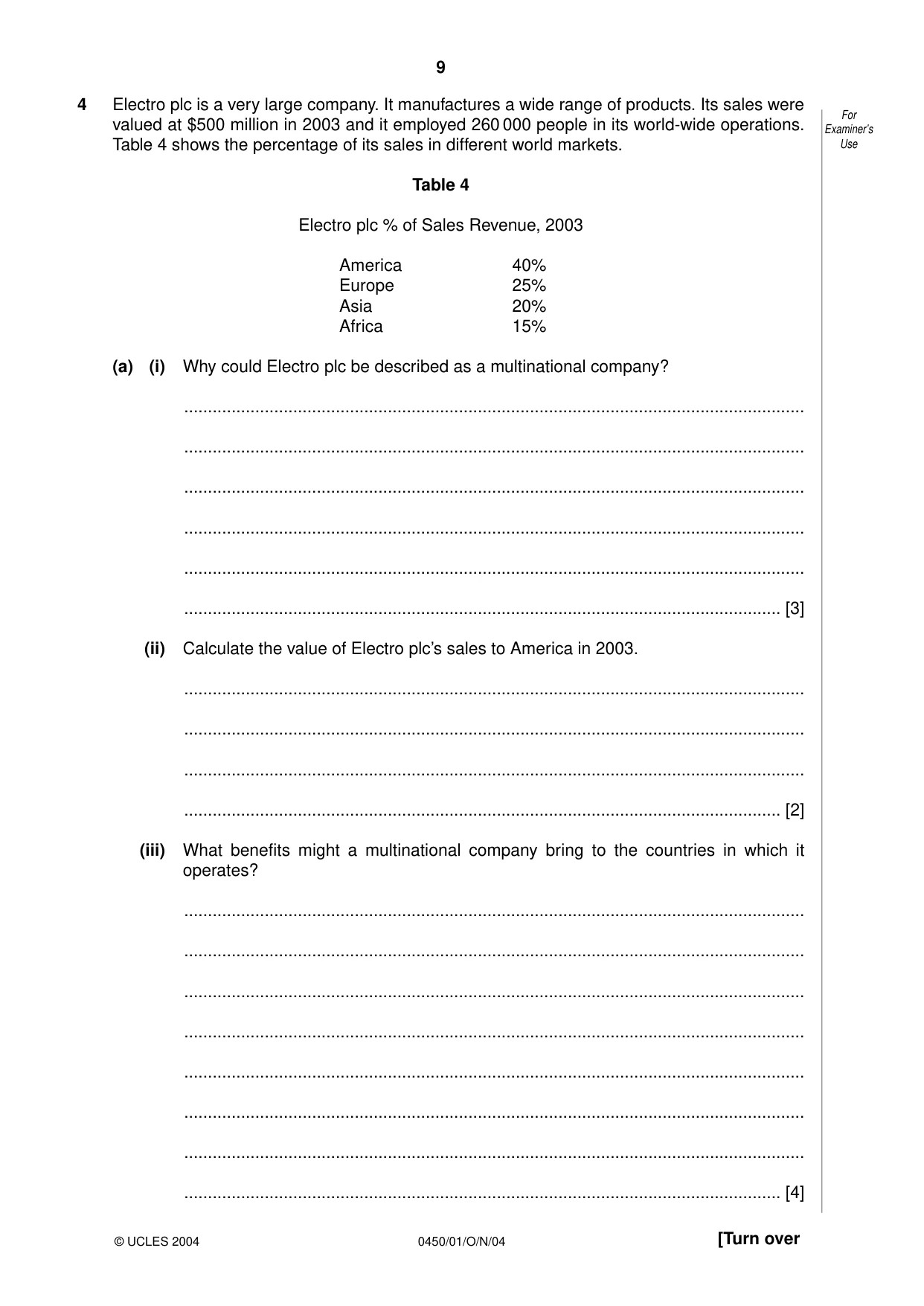
9 0450/01/O/N/04 [Turn over 4 Electro plc is a very large company. It manufactures a wide range of products. Its sales were valued at $500 million in 2003 and it employed 260 000 people in its world-wide operations. Table 4 shows the percentage of its sales in different world markets. Table 4 Electro plc % of Sales Revenue, 2003 America 40% Europe 25% Asia 20% Africa 15% (a) (i) Why could Electro plc be described as a multinational company? … … … … … … [3] (ii) Calculate the value of Electro plc’s sales to America in 2003. … … … … [2] (iii) What benefits might a multinational company bring to the countries in which it operates? … … … … … … … … [4] For Examiner’s Use © UCLES 2004
Question paper, page 10
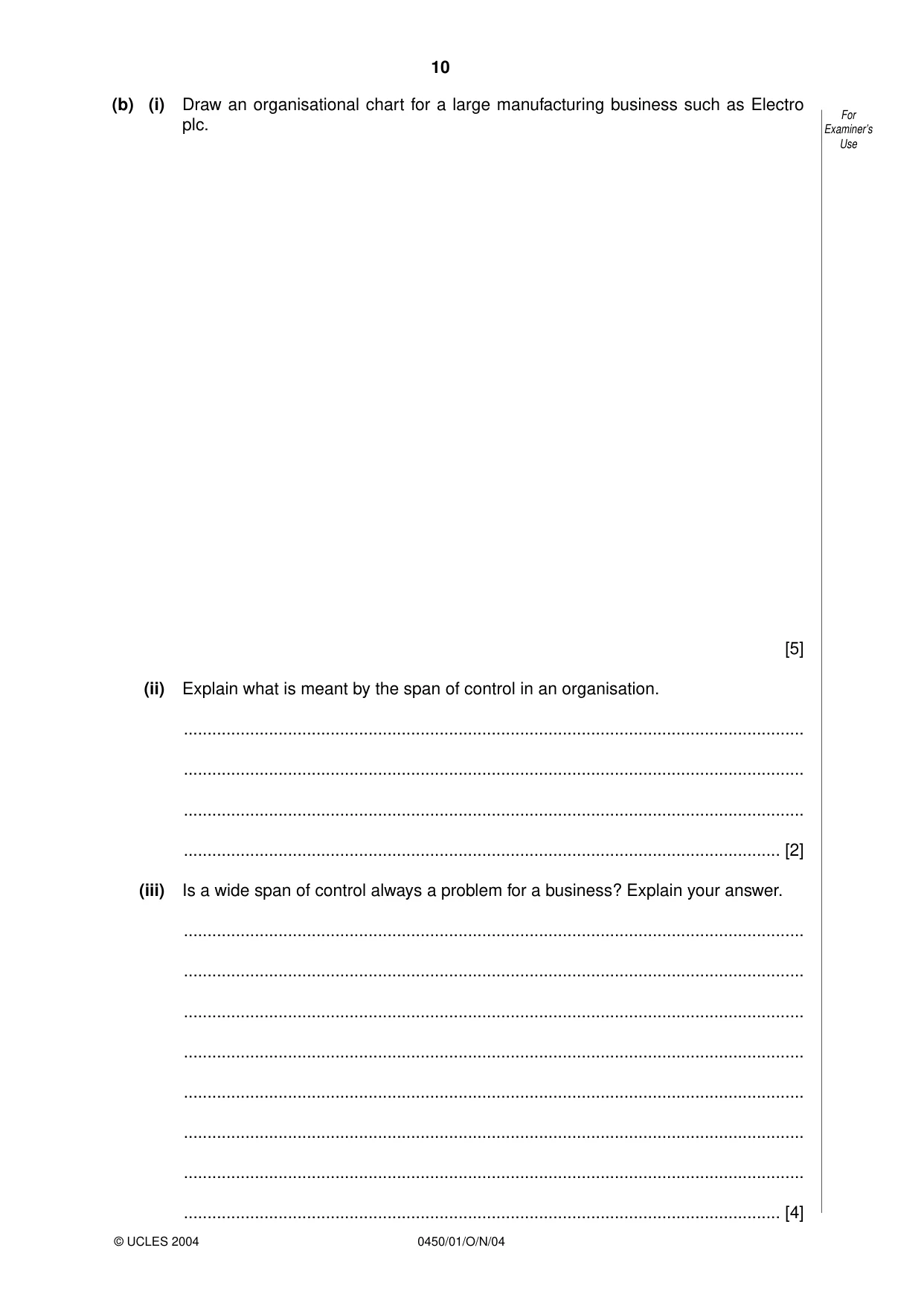
10 0450/01/O/N/04 (b) (i) Draw an organisational chart for a large manufacturing business such as Electro plc. [5] (ii) Explain what is meant by the span of control in an organisation. … … … … [2] (iii) Is a wide span of control always a problem for a business? Explain your answer. … … … … … … … … [4] For Examiner’s Use © UCLES 2004
Question paper, page 11
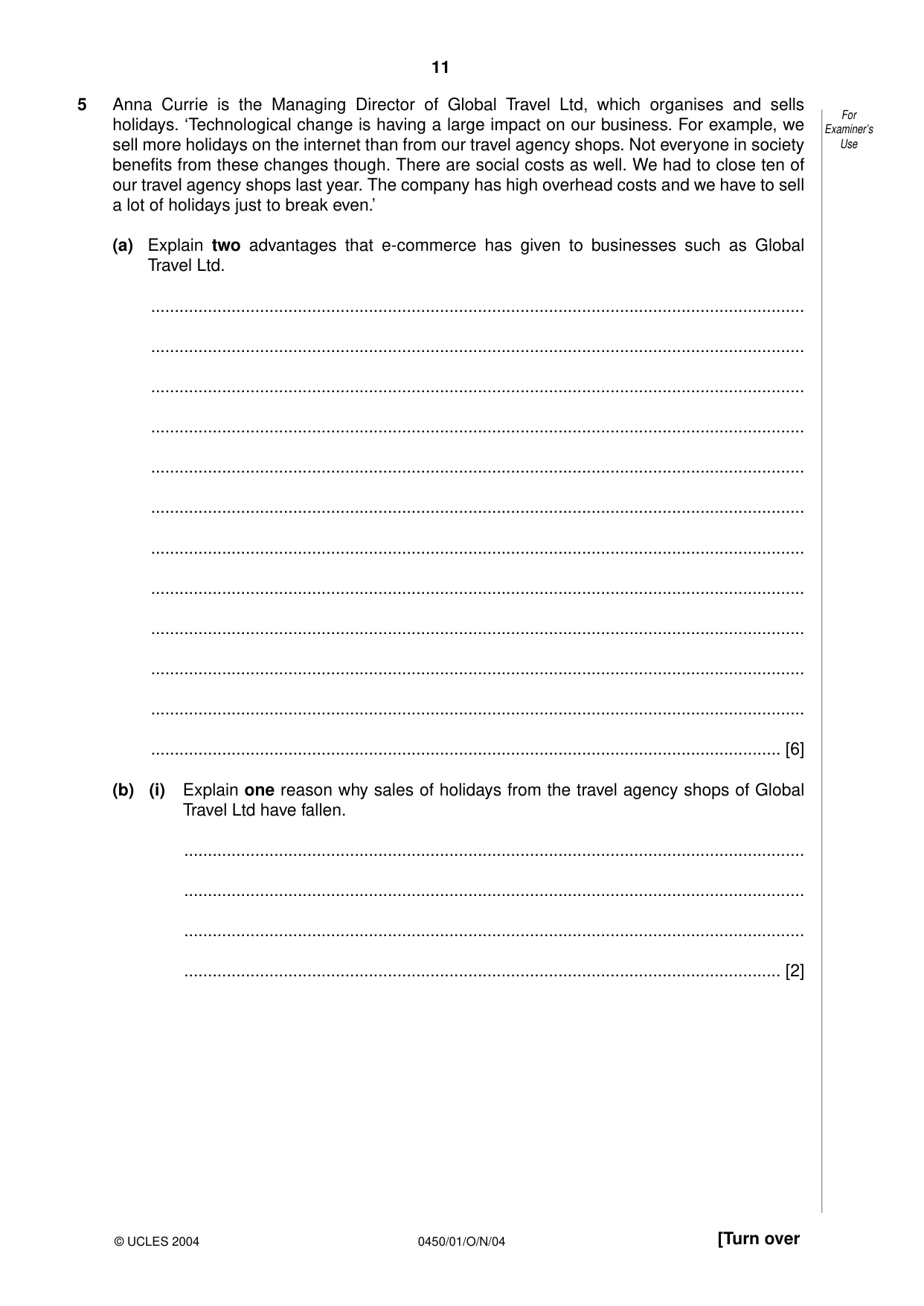
11 0450/01/O/N/04 [Turn over 5 Anna Currie is the Managing Director of Global Travel Ltd, which organises and sells holidays. ‘Technological change is having a large impact on our business. For example, we sell more holidays on the internet than from our travel agency shops. Not everyone in society benefits from these changes though. There are social costs as well. We had to close ten of our travel agency shops last year. The company has high overhead costs and we have to sell a lot of holidays just to break even.’ (a) Explain two advantages that e-commerce has given to businesses such as Global Travel Ltd. … … … … … … … … … … … … [6] (b) (i) Explain one reason why sales of holidays from the travel agency shops of Global Travel Ltd have fallen. … … … … [2] For Examiner’s Use © UCLES 2004
Question paper, page 12
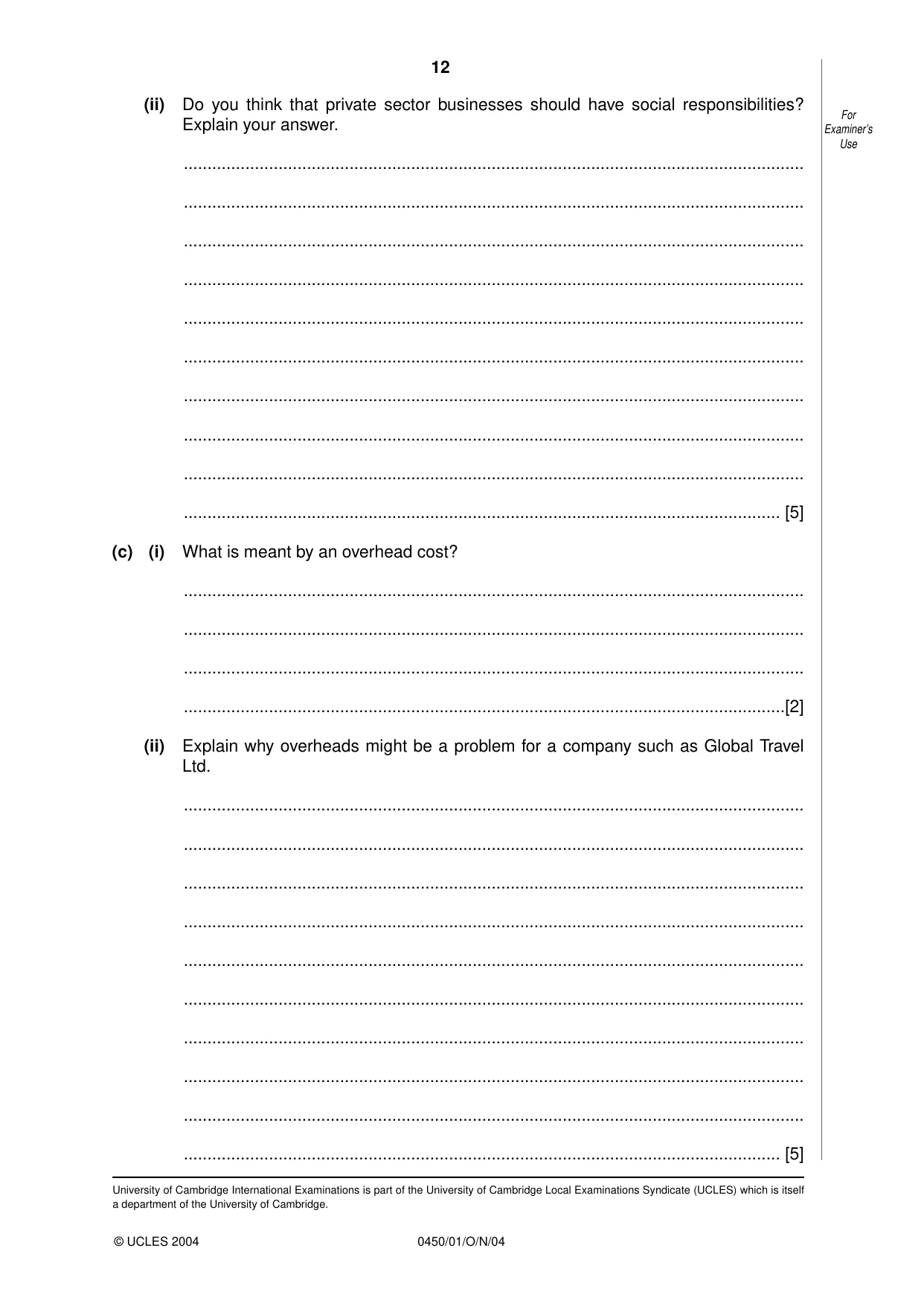
12 0450/01/O/N/04 (ii) Do you think that private sector businesses should have social responsibilities? Explain your answer. … … … … … … … … … … [5] (c) (i) What is meant by an overhead cost? … … … …[2] (ii) Explain why overheads might be a problem for a company such as Global Travel Ltd. … … … … … … … … … … [5] For Examiner’s Use © UCLES 2004 University of Cambridge International Examinations is part of the University of Cambridge Local Examinations Syndicate (UCLES) which is itself a department of the University of Cambridge.
Mark scheme, page 1
UNIVERSITY OF CAMBRIDGE INTERNATIONAL EXAMINATIONS International General Certificate of Secondary Education MARK SCHEME for the November 2004 question paper 0450 BUSINESS STUDIES 0450/01 Paper 1, maximum raw mark 100 This mark scheme is published as an aid to teachers and students, to indicate the requirements of the examination. It shows the basis on which Examiners were initially instructed to award marks. It does not indicate the details of the discussions that took place at an Examiners’ meeting before marking began. Any substantial changes to the mark scheme that arose from these discussions will be recorded in the published Report on the Examination. All Examiners are instructed that alternative correct answers and unexpected approaches in candidates’ scripts must be given marks that fairly reflect the relevant knowledge and skills demonstrated. Mark schemes must be read in conjunction with the question papers and the Report on the Examination. • CIE will not enter into discussion or correspondence in connection with these mark schemes. CIE is publishing the mark schemes for the November 2004 question papers for most IGCSE and GCE Advanced Level syllabuses. www.XtremePapers.com
Mark scheme, page 2
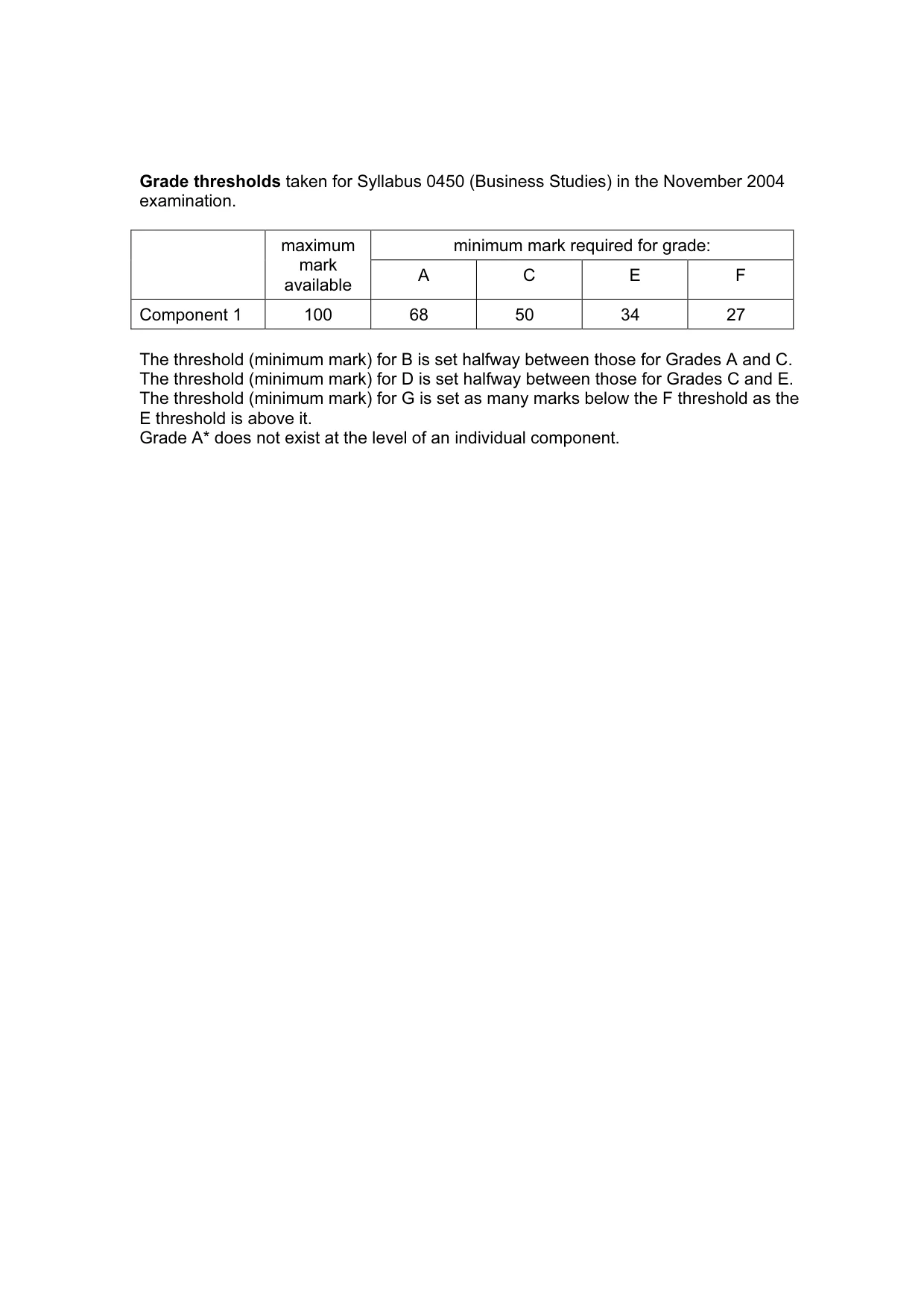
Grade thresholds taken for Syllabus 0450 (Business Studies) in the November 2004 examination. minimum mark required for grade: maximum mark available A C E F Component 1 100 68 50 34 27 The threshold (minimum mark) for B is set halfway between those for Grades A and C. The threshold (minimum mark) for D is set halfway between those for Grades C and E. The threshold (minimum mark) for G is set as many marks below the F threshold as the E threshold is above it. Grade A* does not exist at the level of an individual component.
Mark scheme, page 3
November 2004 INTERNATIONAL GCSE MARK SCHEME MAXIMUM MARK: 100 SYLLABUS/COMPONENT: 0450/01 BUSINESS STUDIES Paper 1
Mark scheme, page 4
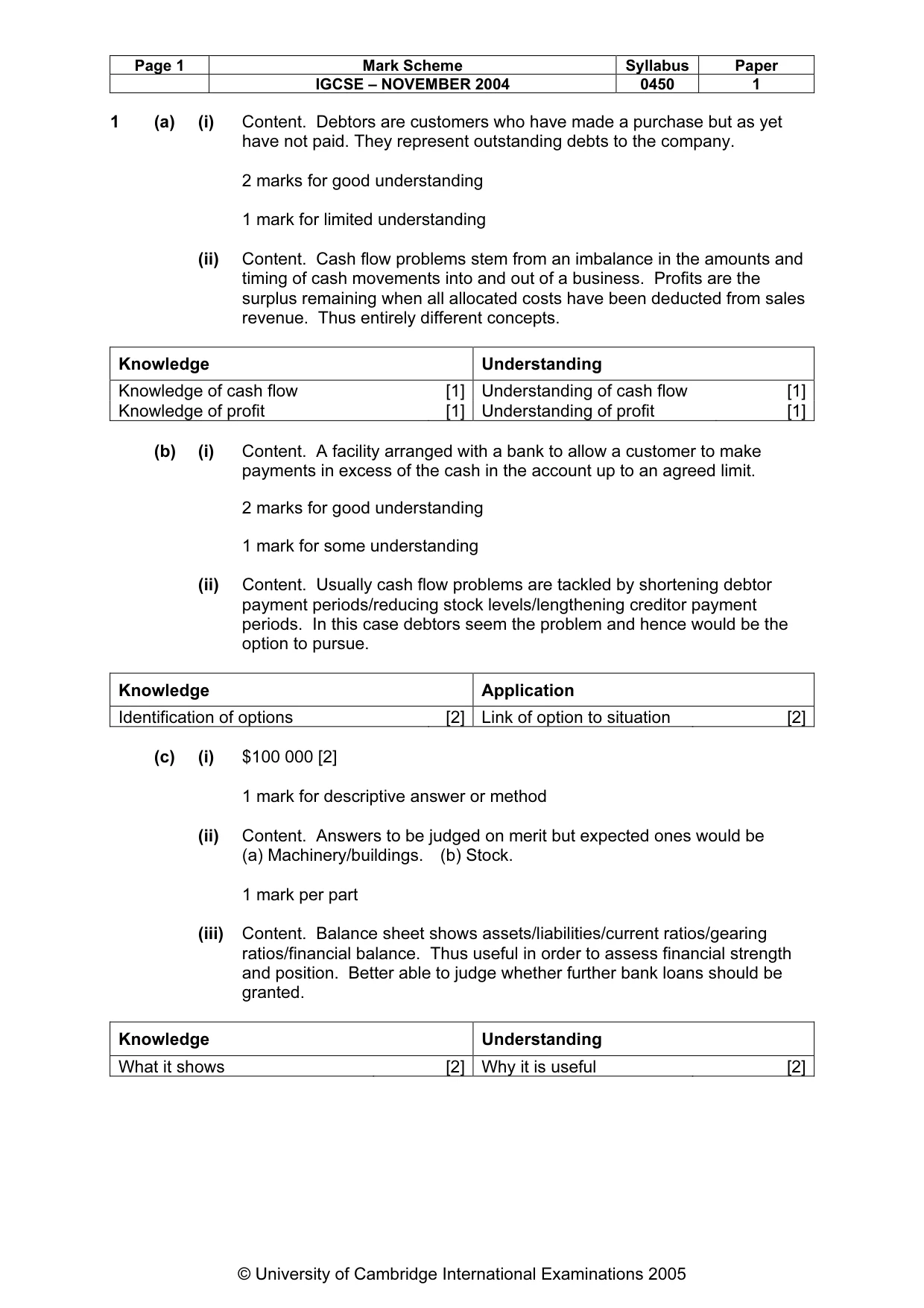
Page 1 Mark Scheme Syllabus Paper IGCSE – NOVEMBER 2004 0450 1 © University of Cambridge International Examinations 2005 1 (a) (i) Content. Debtors are customers who have made a purchase but as yet have not paid. They represent outstanding debts to the company. 2 marks for good understanding 1 mark for limited understanding (ii) Content. Cash flow problems stem from an imbalance in the amounts and timing of cash movements into and out of a business. Profits are the surplus remaining when all allocated costs have been deducted from sales revenue. Thus entirely different concepts. Knowledge Understanding Knowledge of cash flow [1] Understanding of cash flow [1] Knowledge of profit [1] Understanding of profit [1] (b) (i) Content. A facility arranged with a bank to allow a customer to make payments in excess of the cash in the account up to an agreed limit. 2 marks for good understanding 1 mark for some understanding (ii) Content. Usually cash flow problems are tackled by shortening debtor payment periods/reducing stock levels/lengthening creditor payment periods. In this case debtors seem the problem and hence would be the option to pursue. Knowledge Application Identification of options [2] Link of option to situation [2] (c) (i) $100 000 [2] 1 mark for descriptive answer or method (ii) Content. Answers to be judged on merit but expected ones would be (a) Machinery/buildings. (b) Stock. 1 mark per part (iii) Content. Balance sheet shows assets/liabilities/current ratios/gearing ratios/financial balance. Thus useful in order to assess financial strength and position. Better able to judge whether further bank loans should be granted. Knowledge Understanding What it shows [2] Why it is useful [2]
Mark scheme, page 5
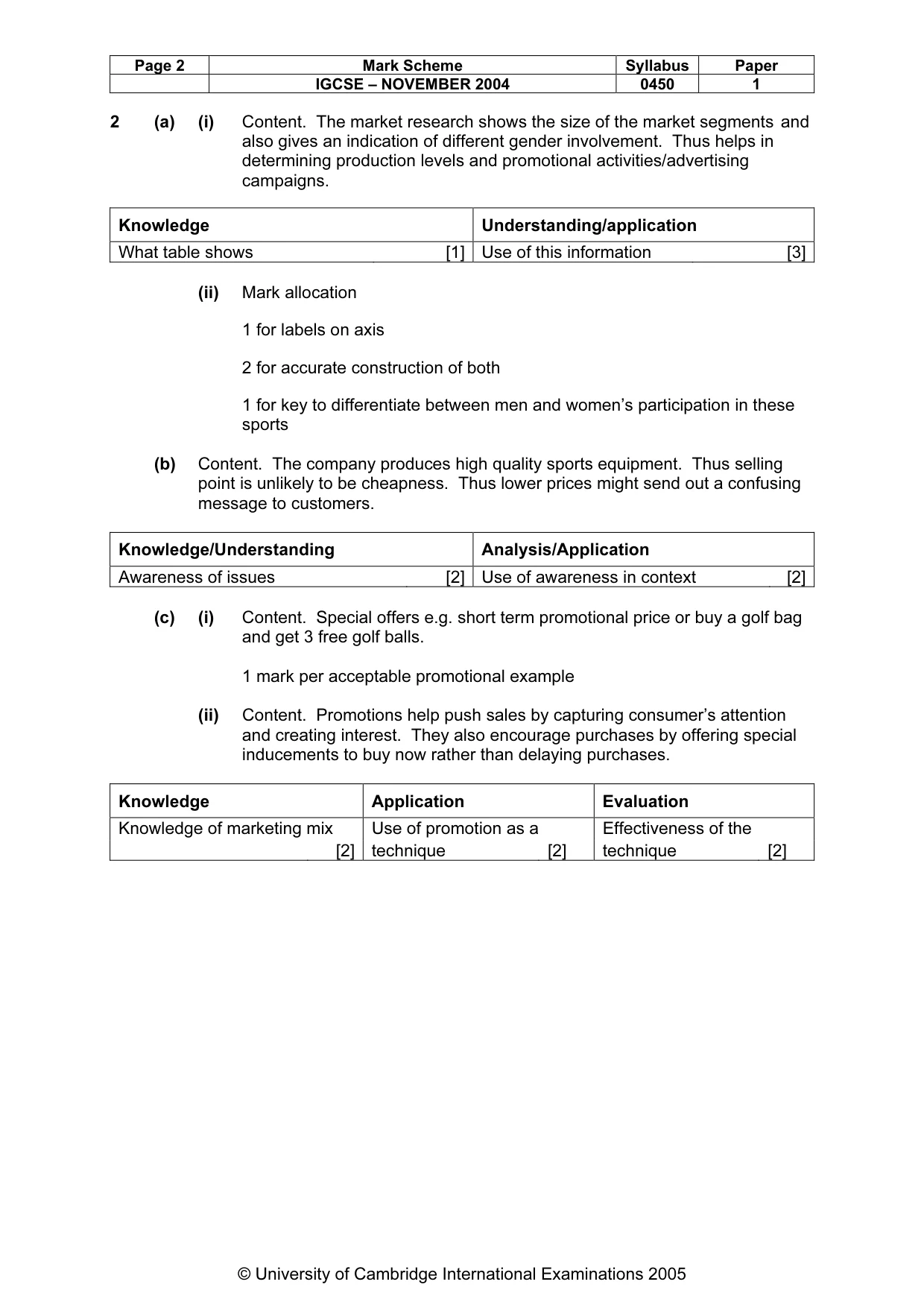
Page 2 Mark Scheme Syllabus Paper IGCSE – NOVEMBER 2004 0450 1 © University of Cambridge International Examinations 2005 2 (a) (i) Content. The market research shows the size of the market segments and also gives an indication of different gender involvement. Thus helps in determining production levels and promotional activities/advertising campaigns. Knowledge Understanding/application What table shows [1] Use of this information [3] (ii) Mark allocation 1 for labels on axis 2 for accurate construction of both 1 for key to differentiate between men and women’s participation in these sports (b) Content. The company produces high quality sports equipment. Thus selling point is unlikely to be cheapness. Thus lower prices might send out a confusing message to customers. Knowledge/Understanding Analysis/Application Awareness of issues [2] Use of awareness in context [2] (c) (i) Content. Special offers e.g. short term promotional price or buy a golf bag and get 3 free golf balls. 1 mark per acceptable promotional example (ii) Content. Promotions help push sales by capturing consumer’s attention and creating interest. They also encourage purchases by offering special inducements to buy now rather than delaying purchases. Knowledge Application Evaluation Knowledge of marketing mix Use of promotion as a Effectiveness of the [2] technique [2] technique [2]
Mark scheme, page 6
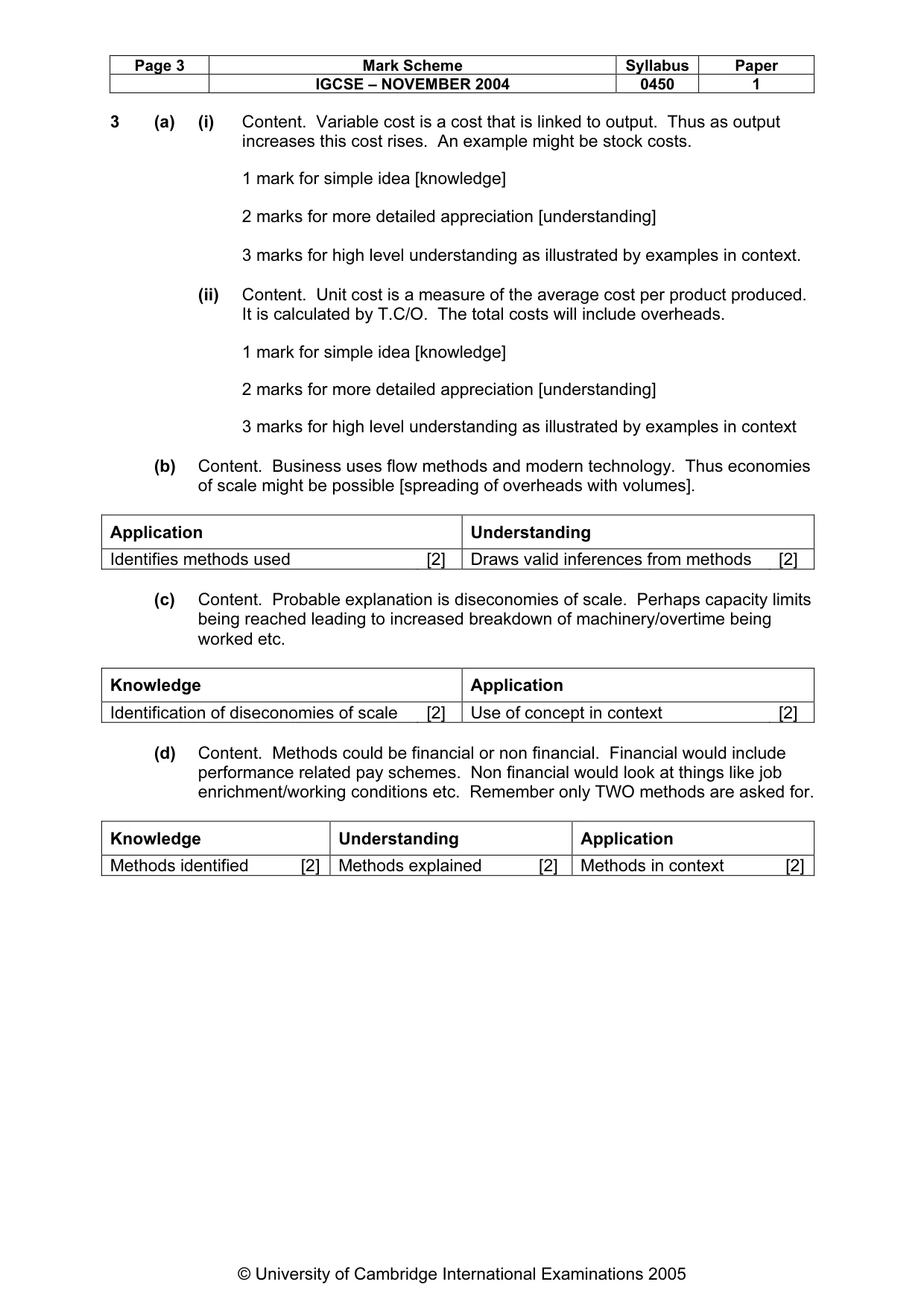
Page 3 Mark Scheme Syllabus Paper IGCSE – NOVEMBER 2004 0450 1 © University of Cambridge International Examinations 2005 3 (a) (i) Content. Variable cost is a cost that is linked to output. Thus as output increases this cost rises. An example might be stock costs. 1 mark for simple idea [knowledge] 2 marks for more detailed appreciation [understanding] 3 marks for high level understanding as illustrated by examples in context. (ii) Content. Unit cost is a measure of the average cost per product produced. It is calculated by T.C/O. The total costs will include overheads. 1 mark for simple idea [knowledge] 2 marks for more detailed appreciation [understanding] 3 marks for high level understanding as illustrated by examples in context (b) Content. Business uses flow methods and modern technology. Thus economies of scale might be possible [spreading of overheads with volumes]. Application Understanding Identifies methods used [2] Draws valid inferences from methods [2] (c) Content. Probable explanation is diseconomies of scale. Perhaps capacity limits being reached leading to increased breakdown of machinery/overtime being worked etc. Knowledge Application Identification of diseconomies of scale [2] Use of concept in context [2] (d) Content. Methods could be financial or non financial. Financial would include performance related pay schemes. Non financial would look at things like job enrichment/working conditions etc. Remember only TWO methods are asked for. Knowledge Understanding Application Methods identified [2] Methods explained [2] Methods in context [2]
Mark scheme, page 7
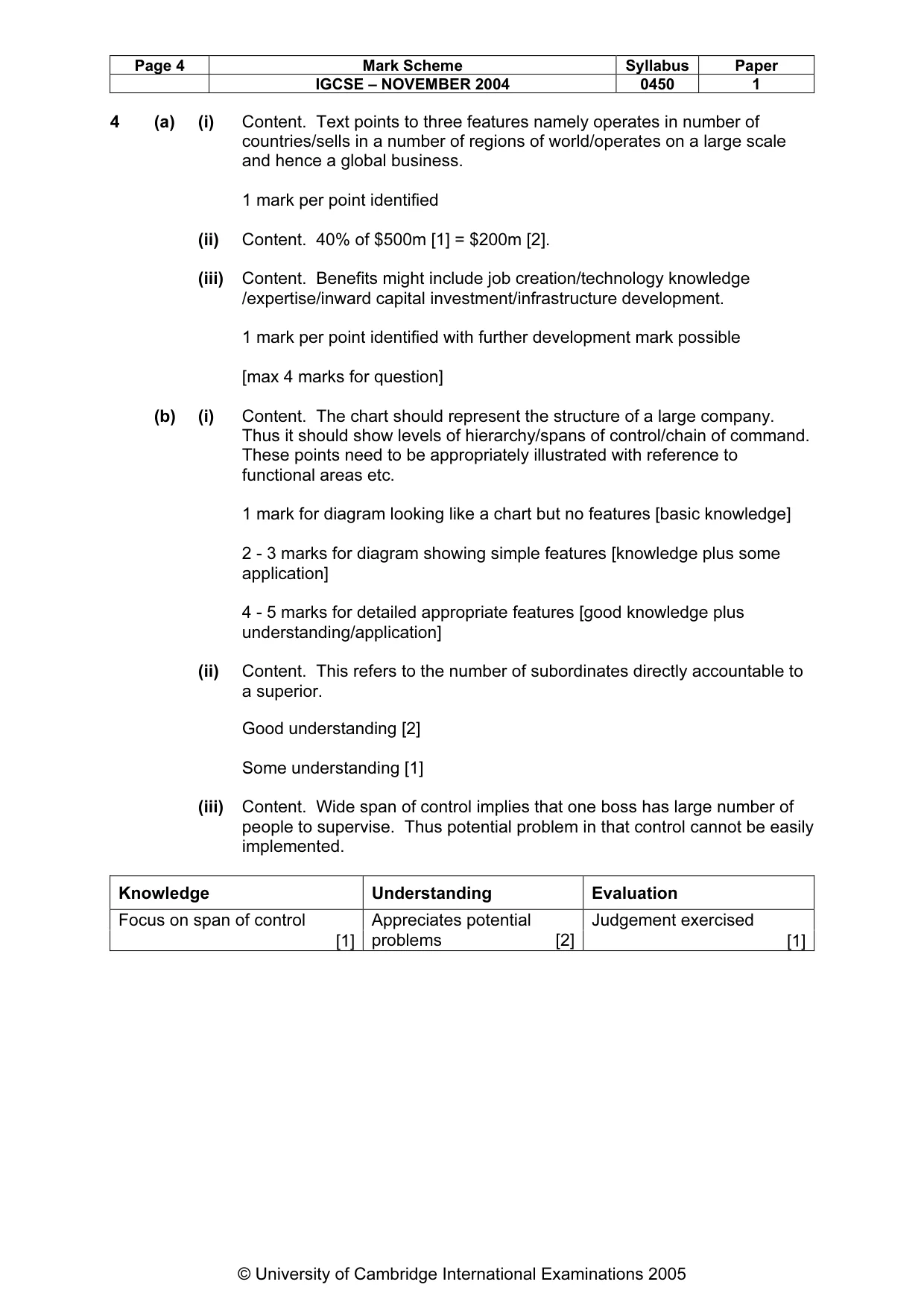
Page 4 Mark Scheme Syllabus Paper IGCSE – NOVEMBER 2004 0450 1 © University of Cambridge International Examinations 2005 4 (a) (i) Content. Text points to three features namely operates in number of countries/sells in a number of regions of world/operates on a large scale and hence a global business. 1 mark per point identified (ii) Content. 40% of $500m [1] = $200m [2]. (iii) Content. Benefits might include job creation/technology knowledge /expertise/inward capital investment/infrastructure development. 1 mark per point identified with further development mark possible [max 4 marks for question] (b) (i) Content. The chart should represent the structure of a large company. Thus it should show levels of hierarchy/spans of control/chain of command. These points need to be appropriately illustrated with reference to functional areas etc. 1 mark for diagram looking like a chart but no features [basic knowledge] 2 - 3 marks for diagram showing simple features [knowledge plus some application] 4 - 5 marks for detailed appropriate features [good knowledge plus understanding/application] (ii) Content. This refers to the number of subordinates directly accountable to a superior. Good understanding [2] Some understanding [1] (iii) Content. Wide span of control implies that one boss has large number of people to supervise. Thus potential problem in that control cannot be easily implemented. Knowledge Understanding Evaluation Focus on span of control Judgement exercised [1] Appreciates potential problems [2] [1]
Mark scheme, page 8
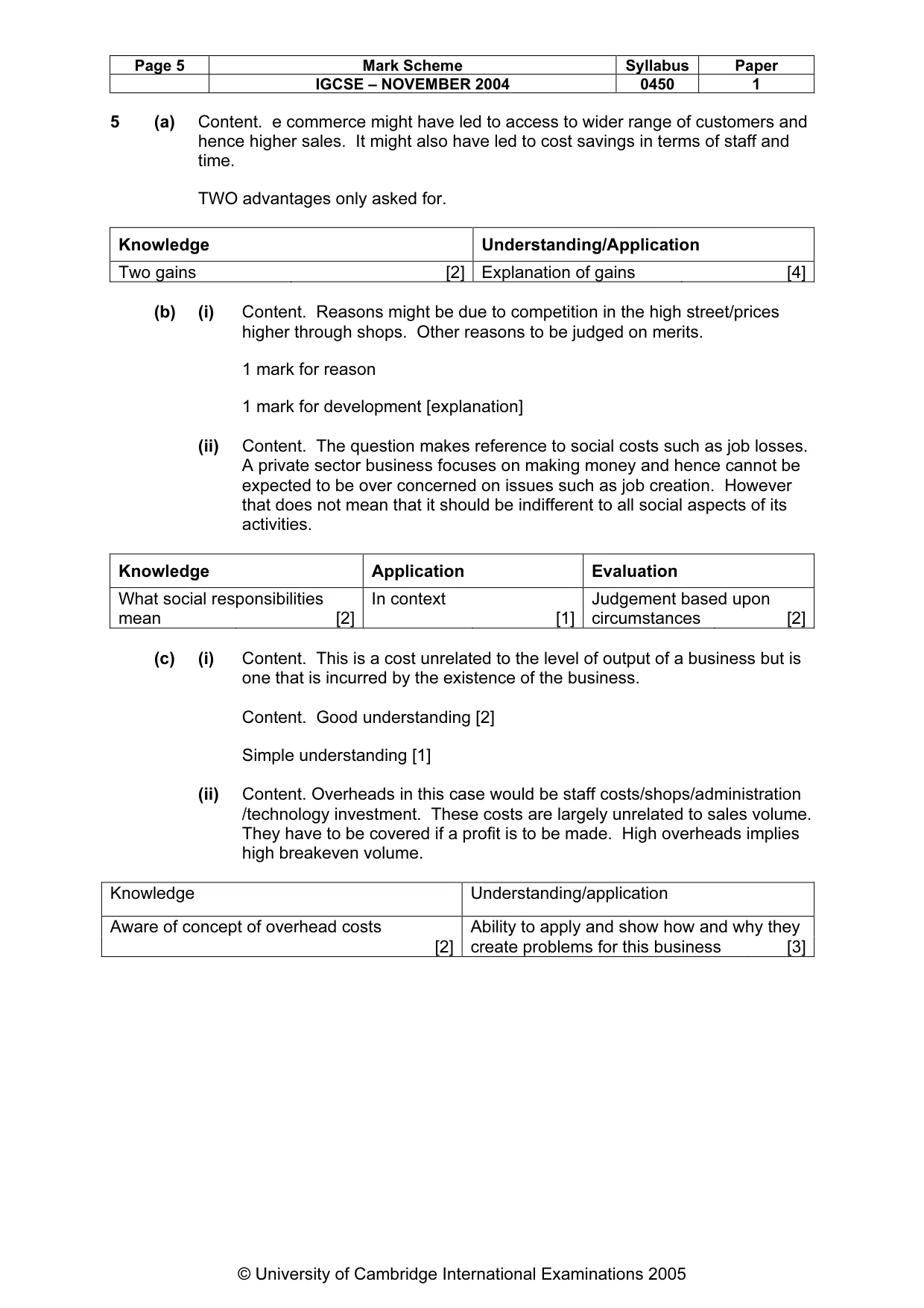
Page 5 Mark Scheme Syllabus Paper IGCSE – NOVEMBER 2004 0450 1 © University of Cambridge International Examinations 2005 5 (a) Content. e commerce might have led to access to wider range of customers and hence higher sales. It might also have led to cost savings in terms of staff and time. TWO advantages only asked for. Knowledge Understanding/Application Two gains [2] Explanation of gains [4] (b) (i) Content. Reasons might be due to competition in the high street/prices higher through shops. Other reasons to be judged on merits. 1 mark for reason 1 mark for development [explanation] (ii) Content. The question makes reference to social costs such as job losses. A private sector business focuses on making money and hence cannot be expected to be over concerned on issues such as job creation. However that does not mean that it should be indifferent to all social aspects of its activities. Knowledge Application Evaluation What social responsibilities In context Judgement based upon mean [2] [1] circumstances [2] (c) (i) Content. This is a cost unrelated to the level of output of a business but is one that is incurred by the existence of the business. Content. Good understanding [2] Simple understanding [1] (ii) Content. Overheads in this case would be staff costs/shops/administration /technology investment. These costs are largely unrelated to sales volume. They have to be covered if a profit is to be made. High overheads implies high breakeven volume. Knowledge Understanding/application Aware of concept of overhead costs Ability to apply and show how and why they [2] create problems for this business [3]