Cambridge IGCSE Business Studies 0450 — 2002 Oct/Nov Paper 1 · Variant 1
0450/11/O/N/02
The question paper and its mark scheme, free to read here and free to download. This is Cambridge’s own paper, exactly as it was sat.
Question paper12 pages


Mark scheme5 pages
Answers below. Sit the paper first if you are practising.
Paper as text
Question paper, page 1
This question paper consists of 11 printed pages and 1 blank page. SP (NF) S10531/2 © CIE 2002 [Turn over International General Certificate of Secondary Education CAMBRIDGE INTERNATIONAL EXAMINATIONS BUSINESS STUDIES 0450/1 PAPER 1 OCTOBER/NOVEMBER SESSION 2002 1 hour 45 minutes Candidates answer on the question paper. No additional materials are required. TIME 1 hour 45 minutes INSTRUCTIONS TO CANDIDATES Write your name, Centre number and candidate number in the spaces at the top of this page. Answer all questions. Write your answers in the spaces provided on the question paper. INFORMATION FOR CANDIDATES The number of marks is given in brackets [ ] at the end of each question or part question. The businesses mentioned in the questions are entirely fictitious. Candidate Centre Number Number Candidate Name FOR EXAMINER’S USE 1 2 3 4 5 TOTAL www.XtremePapers.com
Question paper, page 2
2 0450/1/O/N/02 1 (a) Give an example of a business activity that would be classified as: (i) a primary activity, …[1] (ii) a secondary activity. …[1] (b) Identify and explain two advantages of a partnership form of business organisation compared to a sole trader. … … … … … … … …[4] (c) What is meant by the term limited liability? … … … …[2] (d) (i) Explain the purpose of the Annual General Meetings held by Public Limited Companies (plc). … … … … … …[3] For Examiner’s Use
Question paper, page 3
3 0450/1/O/N/02 [Turn over (ii) Public Limited Companies have to publish their annual financial accounts. What can be learned from the analysis of such accounts? … … … … … … … … … …[5] (e) Explain why profits are important to businesses in the private sector. … … … … … … … …[4] For Examiner’s Use
Question paper, page 4
4 0450/1/O/N/02 2 (a) How could a sports shoe manufacturer segment its market? … … … … … … … …[4] (b) (i) Define the term advertising. … … … …[2] (ii) Explain why some advertising might not be cost effective. … … … … … …[3] For Examiner’s Use
Question paper, page 5
5 0450/1/O/N/02 [Turn over (c) The management of a hotel aims to increase the number of business guests using the hotel. Giving your reasons, suggest where you think they should advertise their hotel. … … … … … … … …[4] (d) “The only way to compete with rival businesses is to charge lower prices.” Do you agree with this statement? … … … … … … … …[4] (e) State three functions that packaging performs. … … … … … …[3] For Examiner’s Use
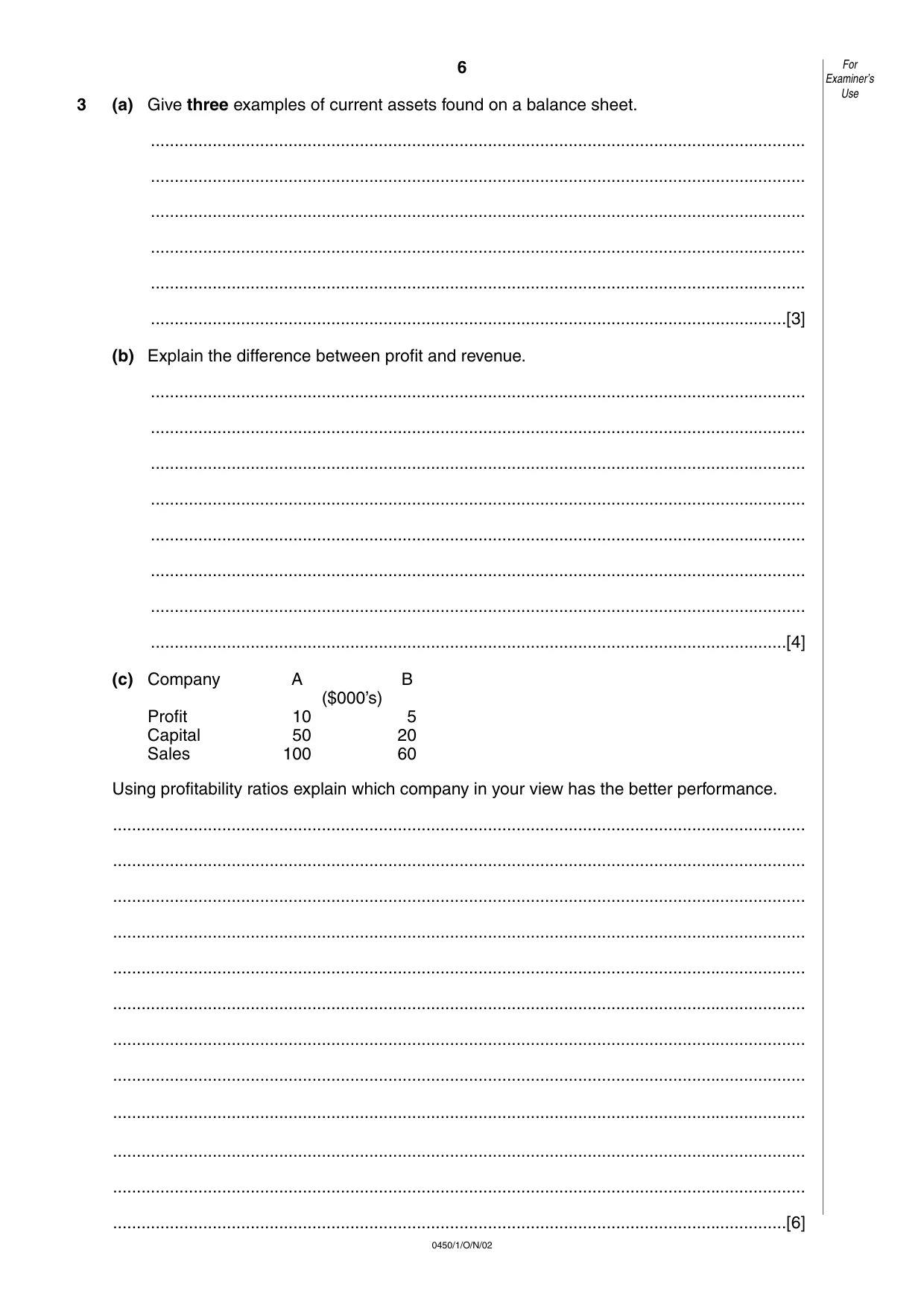
Question paper, page 6
6 0450/1/O/N/02 3 (a) Give three examples of current assets found on a balance sheet. … … … … … …[3] (b) Explain the difference between profit and revenue. … … … … … … … …[4] (c) Company A B ($000’s) Profit 10 5 Capital 50 20 Sales 100 60 Using profitability ratios explain which company in your view has the better performance. … … … … … … … … … … … …[6] For Examiner’s Use
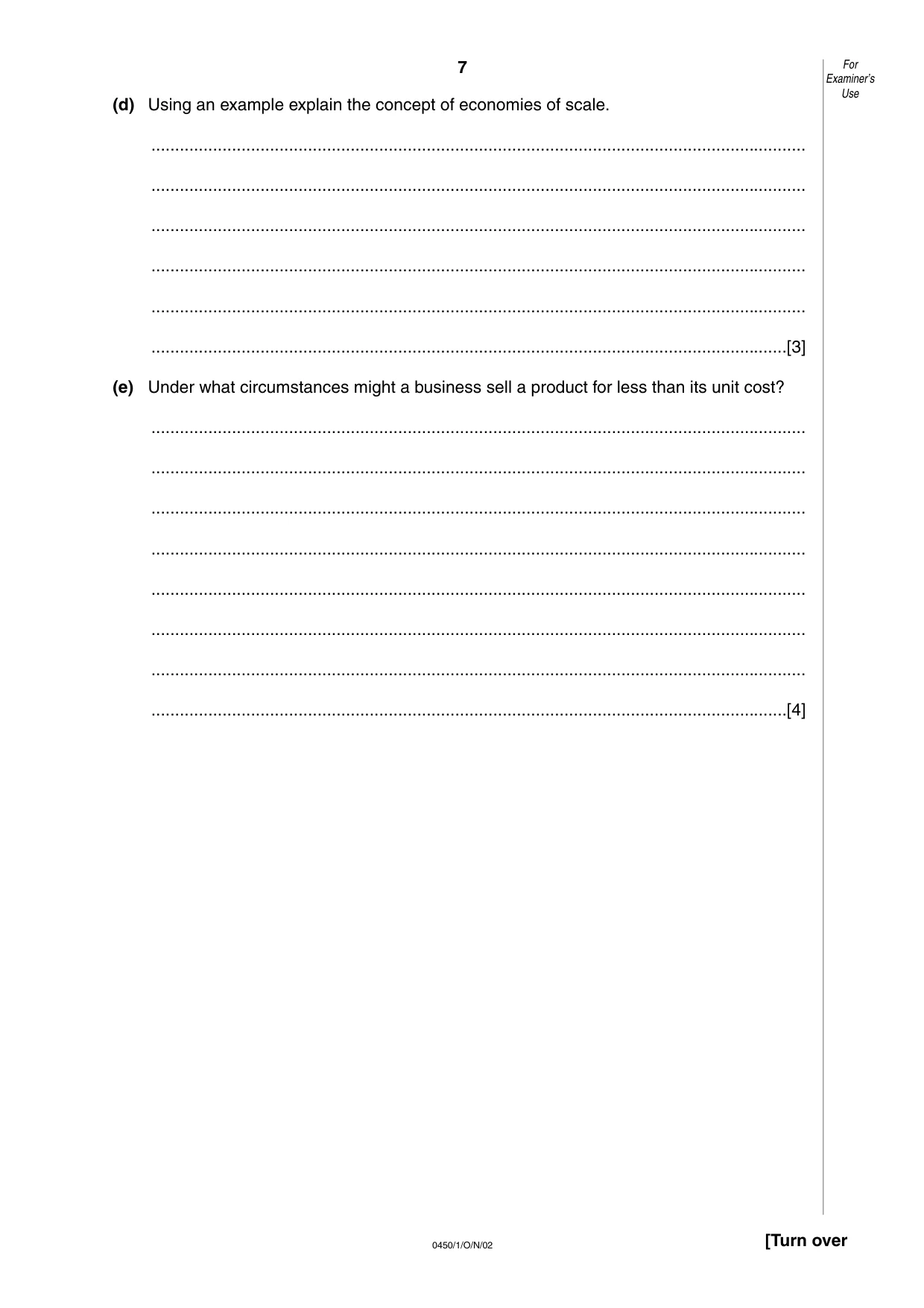
Question paper, page 7
7 0450/1/O/N/02 [Turn over (d) Using an example explain the concept of economies of scale. … … … … … …[3] (e) Under what circumstances might a business sell a product for less than its unit cost? … … … … … … … …[4] For Examiner’s Use
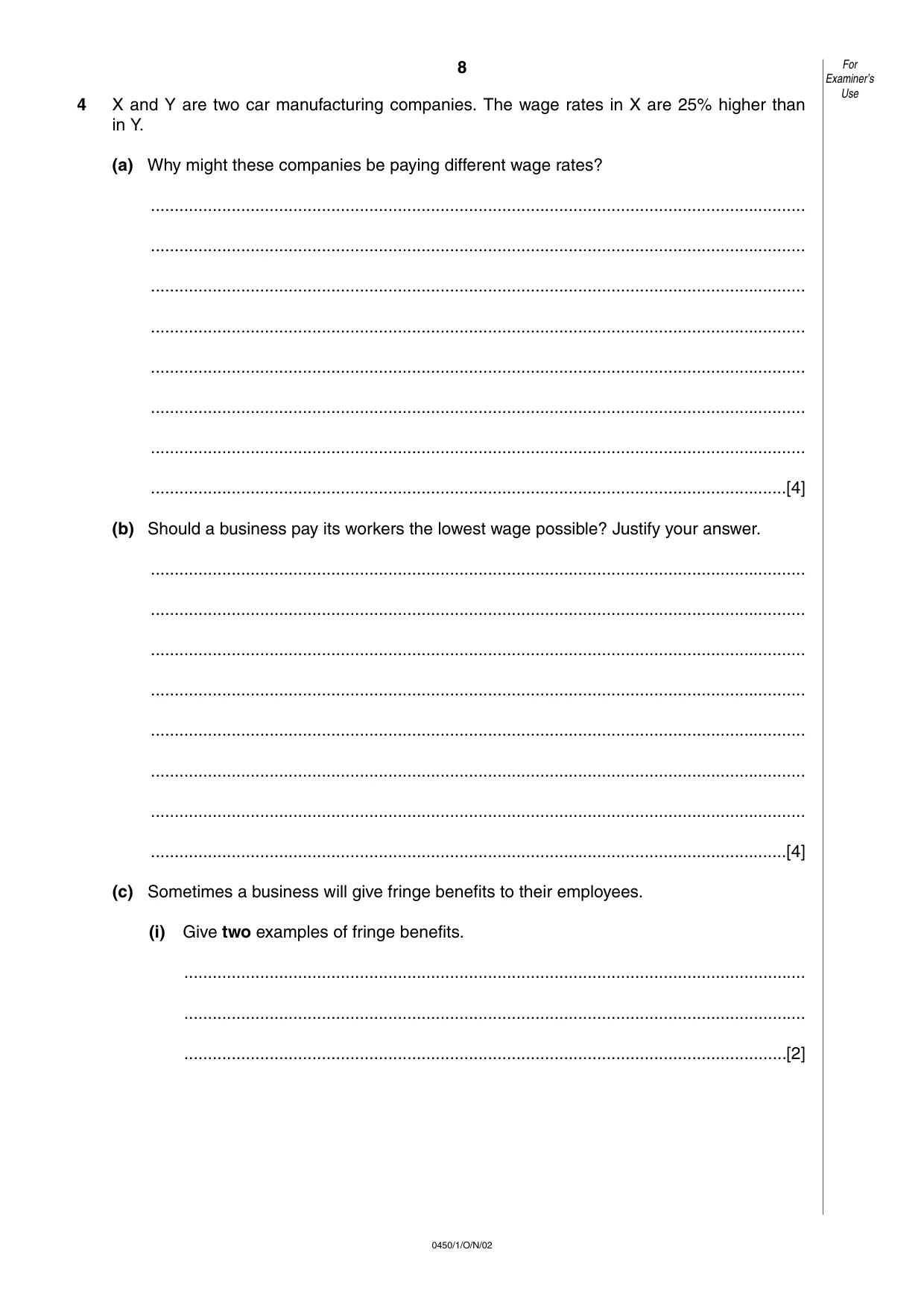
Question paper, page 8
8 0450/1/O/N/02 4 X and Y are two car manufacturing companies. The wage rates in X are 25% higher than in Y. (a) Why might these companies be paying different wage rates? … … … … … … … …[4] (b) Should a business pay its workers the lowest wage possible? Justify your answer. … … … … … … … …[4] (c) Sometimes a business will give fringe benefits to their employees. (i) Give two examples of fringe benefits. … … …[2] For Examiner’s Use
Question paper, page 9
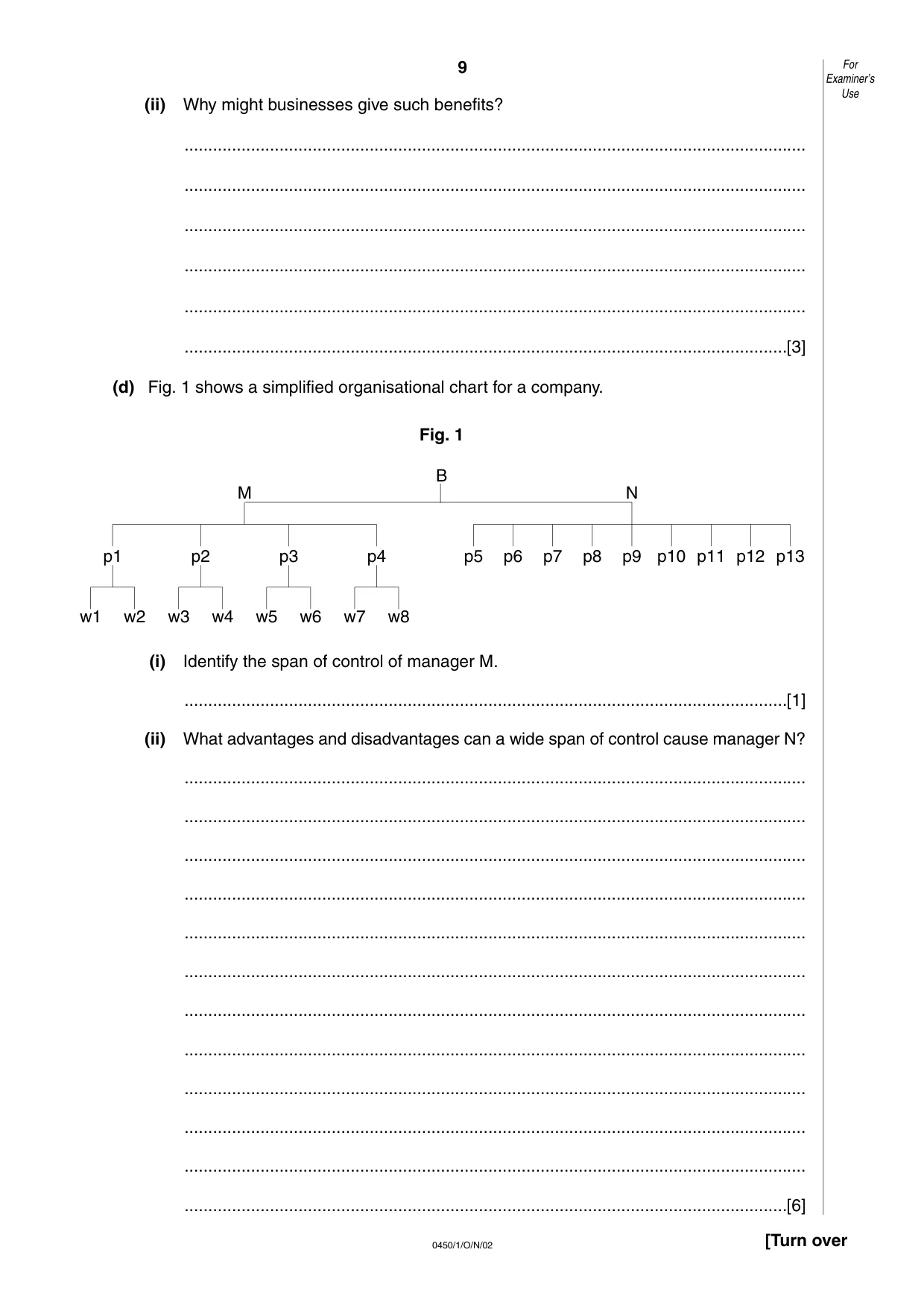
9 0450/1/O/N/02 [Turn over (ii) Why might businesses give such benefits? … … … … … …[3] (d) Fig. 1 shows a simplified organisational chart for a company. Fig. 1 B M N p1 p2 p3 p4 p5 p6 p7 p8 p9 p10 p11 p12 p13 w1 w2 w3 w4 w5 w6 w7 w8 (i) Identify the span of control of manager M. …[1] (ii) What advantages and disadvantages can a wide span of control cause manager N? … … … … … … … … … … … …[6] For Examiner’s Use
Question paper, page 10
10 0450/1/O/N/02 5 (a) The planning authorities in country Y are considering a proposal for a major new road development. Some people have objected to the scheme. The building contractors are a multinational company. (i) Outline the likely social benefits and costs that such a development could be expected to cause. … … … … … … … … … … … … … … … …[8] (ii) Explain what is meant by a multinational company. … …[2] For Examiner’s Use
Question paper, page 11
11 0450/1/O/N/02 (iii) What disadvantages might country Y experience in using a multinational company to build the road? … … … … … … … …[4] (b) A computer manufacturer based in Singapore wants to export its products to new markets in South Africa. Identify and explain two problems that they might face in entering a new export market. … … … … … … … … … … … …[6] For Examiner’s Use
Mark scheme, page 1
& CAMBRIDGE INTERNATIONAL EXAMINATIONS , International General Certificate of Secondary Education MARK SCHEME FOR the November 2002 question papers 0450 BUSINESS STUDIES 0450/01 Paper 1, maximum raw mark 100 0450/02 Paper 2, maximum raw mark 80 0450/04 Paper 4, maximum raw mark 100 These mark schemes are published as an aid to teachers and students, to indicate the requirements of the examination. They show the basis on which Examiners were initially instructed to award marks. They do not indicate the details of the discussions that took place at an Examiners’ meeting before marking began. Any substantial changes to the mark scheme that arose from these discussions will be recorded in the published Report on the Examination. All Examiners are instructed that alternative correct answers and unexpected approaches in candidates’ scripts must be given marks that fairly reflect the relevant knowledge and skills demonstrated. Mark schemes must be read in conjunction with the question papers and the Report on the Examination. . CIE will not enter into discussions or correspondence in connection with these mark schemes. CIE is publishing the mark schemes for the October/November 2002 question papers for most IGCSE, GCE Advanced Subsidiary (AS) and GCE Advanced (A) Level syllabuses. UNIVERSITY of CAMBRIDGE Local Examinations Syndicate
Mark scheme, page 2
CAMBRIDGE INTERNATIONAL EXAMINATIONS November 2002 INTERNATIONAL GCSE UNIVERSITY of CAMBRIDGE Local Examinations Syndicate
Mark scheme, page 3
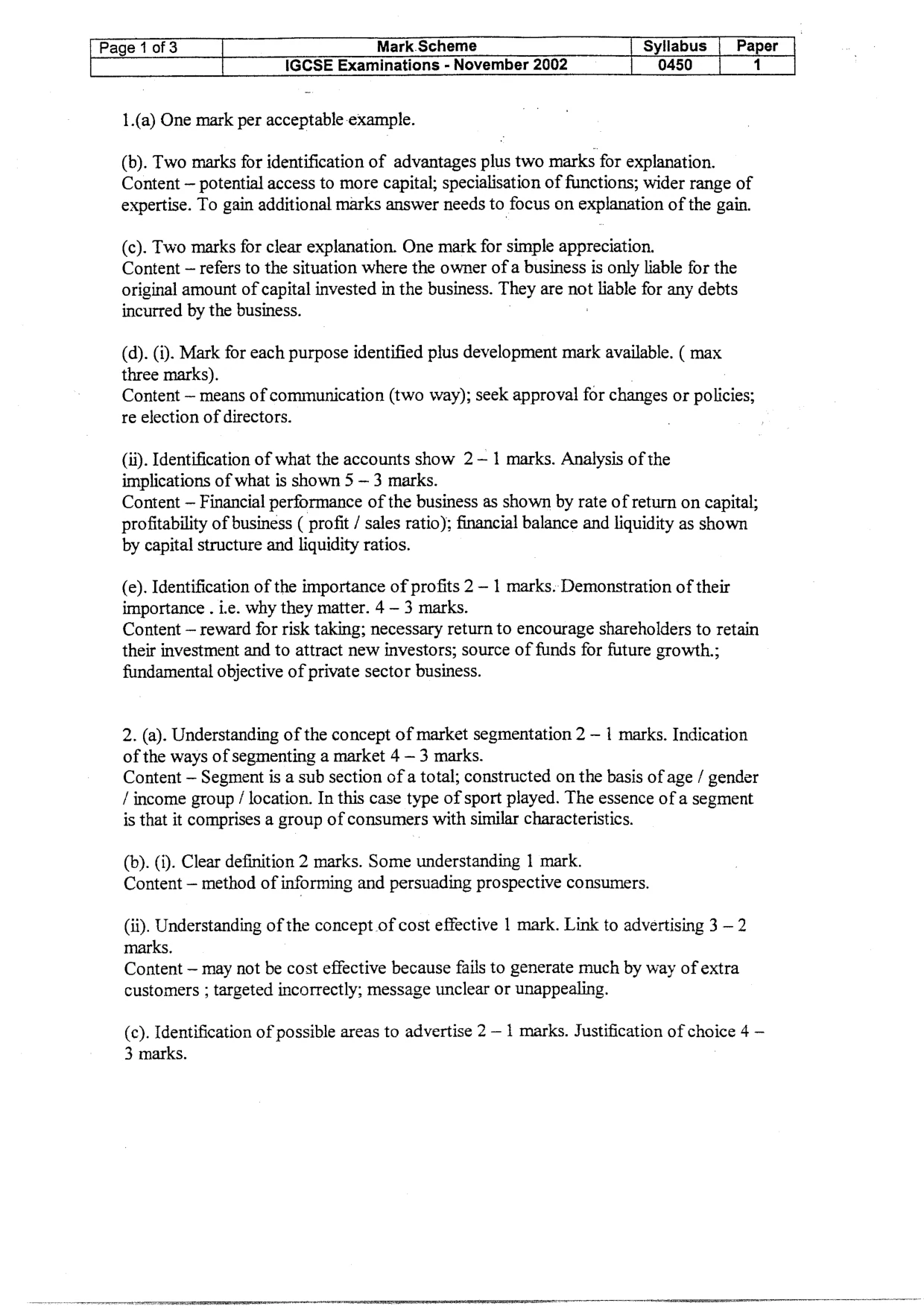
Page 1 of 3 Mark.Scheme Syllabus | Paper IGCSE Examinations - November 2002 0450 1 1.(a) One mark per acceptable example. (b). Two marks for identification of advantages plus two marks for explanation. Content — potential access to more capital; specialisation of functions; wider range of expertise. To gain additional marks answer needs to focus on explanation of the gain. (c). Two marks for clear explanation. One mark for simple appreciation. Content — refers to the situation where the owner of a business is only liable for the original amount of capital invested in the business. They are not liable for any debts incurred by the business. (d). (). Mark for each purpose identified plus development mark available. ( max three marks). Content — means of communication (two way); seek approval for changes or policies; re election of directors. (ii). Identification of what the accounts show 2-1 marks. Analysis of the implications of what is shown 5 — 3 marks. Content — Financial performance of the business as shown by rate of return on capital; profitability of business ( profit / sales ratio); financial balance and liquidity as shown by capital structure and liquidity ratios. (e). Identification of the importance of profits 2 — 1 marks. Demonstration of their importance . ie. why they matter. 4 - 3 marks. Content — reward for risk taking; necessary return to encourage shareholders to retain their investment and to attract new investors; source of funds for future growth.; fundamental objective of private sector business. 2. (a). Understanding of the concept of market segmentation 2 ~ 1 marks. Indication of the ways of segmenting a market 4 — 3 marks. Content — Segment is a sub section of a total; constructed on the basis of age / gender / income group / location. In this case type of sport played. The essence of a segment is that it comprises a group of consumers with similar characteristics. (b). (i). Clear definition 2 marks. Some understanding 1 mark. Content — method of informing and persuading prospective consumers. (ii). Understanding of the concept of cost effective 1 mark. Link to advertising 3 - 2 marks. Content — may not be cost effective because fails to generate much by way of extra customers ; targeted incorrectly; message unclear or unappealing. (c). Identification of possible areas to advertise 2 — 1 marks. Justification of choice 4 — 3 marks.
Mark scheme, page 4
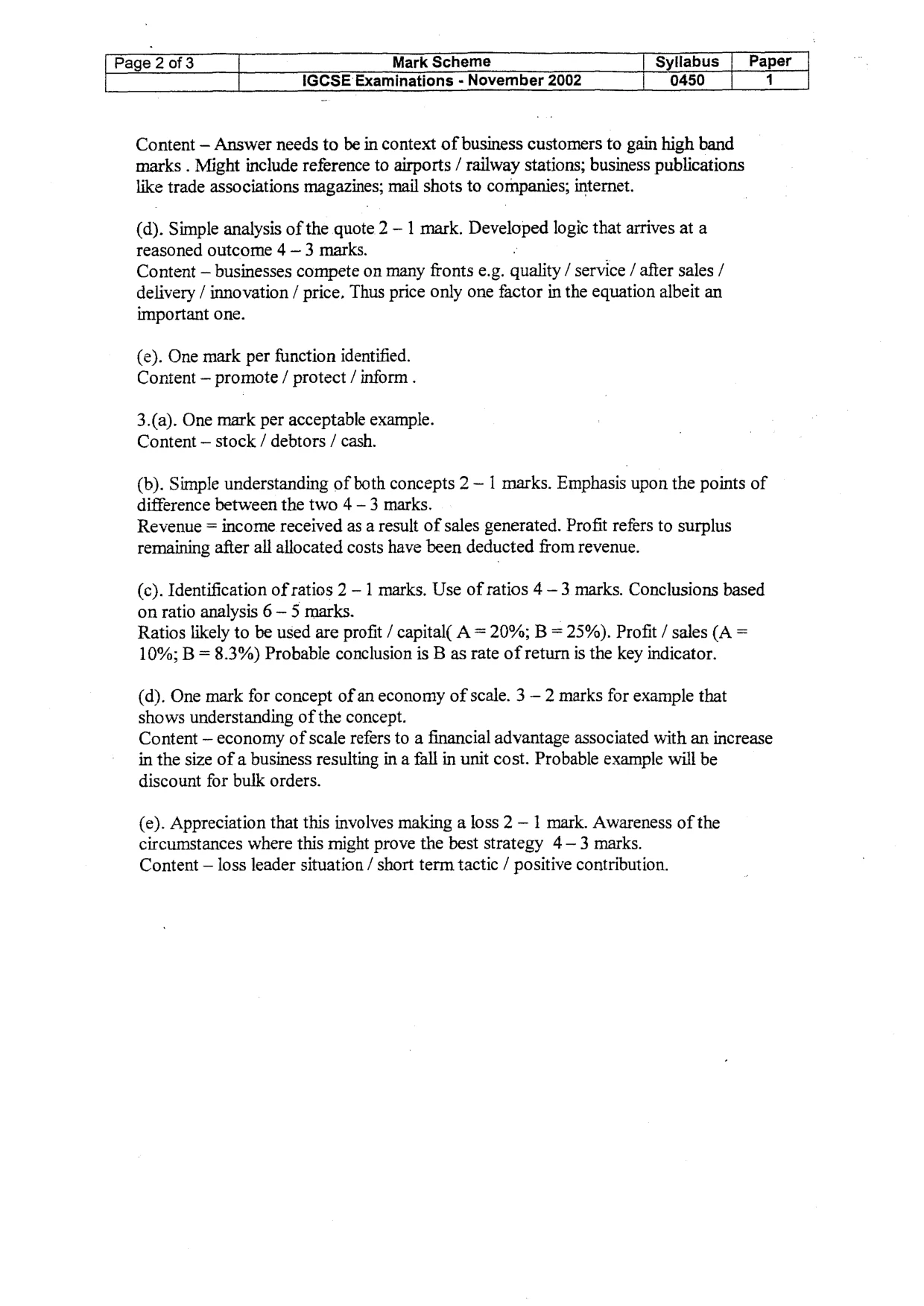
Page 2 of 3 Mark Scheme Syllabus Paper IGCSE Examinations - November 2002 0450 41 Content — Answer needs to be in context of business customers to gain high band marks . Might include reference to airports / railway stations; business publications like trade associations magazines; mail shots to companies; internet. (d). Simple analysis of the quote 2 —- 1 mark. Developed logic that arrives at a reasoned outcome 4 — 3 marks. ’ Content — businesses compete on many fronts e.g. quality / service / after sales / delivery / innovation / price. Thus price only one factor in the equation albeit an important one. (e). One mark per function identified. Content — promote / protect / inform . 3.(a). One mark per acceptable example. Content — stock / debtors / cash. (b). Simple understanding of both concepts 2 ~ 1 marks. Emphasis upon the points of difference between the two 4 - 3 marks. Revenue = income received as a result of sales generated. Profit refers to surplus remaining after all allocated costs have been deducted from revenue. (c). Identification of ratios 2 - 1 marks. Use of ratios 4-3 marks. Conclusions based on ratio analysis 6 — 5 marks. Ratios likely to be used are profit / capital( A = 20%; B = 25%). Profit / sales (A = 10%; B = 8.3%) Probable conclusion is B as rate of return is the key indicator. (d). One mark for concept of an economy of scale. 3 — 2 marks for example that shows understanding of the concept. Content — economy of scale refers to a financial advantage associated with an increase in the size of a business resulting in a fall in unit cost. Probable example will be discount for bulk orders. (e). Appreciation that this involves making a loss 2 — 1 mark. Awareness of the circumstances where this might prove the best strategy 4—3 marks. Content — loss leader situation / short term tactic / positive contribution.
Mark scheme, page 5
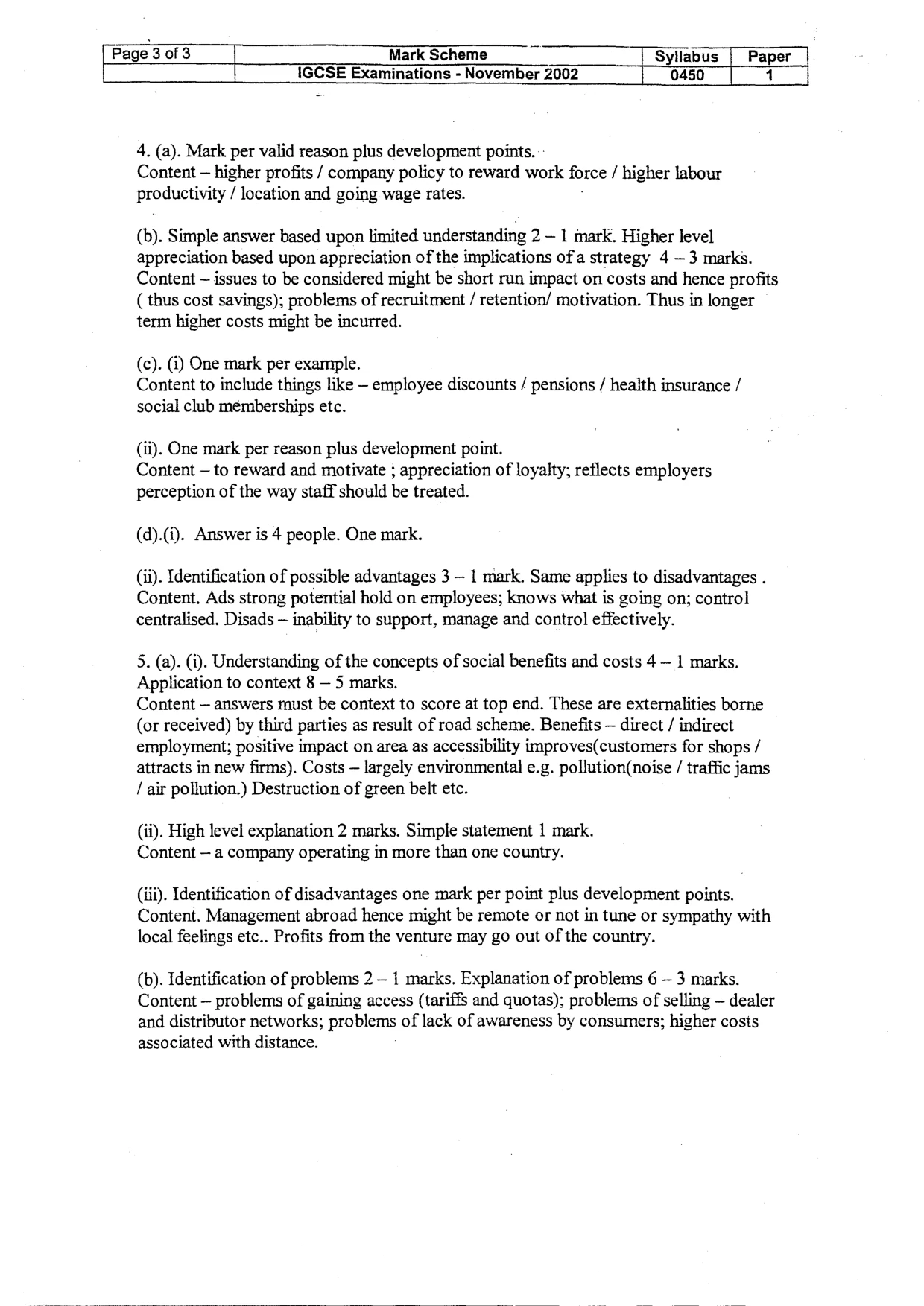
Page 3 of 3 : Mark Scheme ~ Syllabus | Paper IGCSE Examinations - November 2002 0450 1 4. (a). Mark per valid reason plus development points. Content — higher profits / company policy to reward work force / higher labour productivity / location and going wage rates. (b). Simple answer based upon limited understanding 2 — 1 mark. Higher level appreciation based upon appreciation of the implications of a strategy 4 —3 marks. Content — issues to be considered might be short run impact on costs and hence profits (thus cost savings); problems of recruitment / retention/ motivation. Thus in longer term higher costs might be incurred. (c). (i) One mark per example. Content to include things like - employee discounts / pensions / health insurance / social club memberships etc. (ii). One mark per reason plus development point. Content — to reward and motivate ; appreciation of loyalty; reflects employers perception of the way staff should be treated. (d).(i).. Answer is 4 people. One mark. (ii). Identification of possible advantages 3 — 1 mark. Same applies to disadvantages . Content. Ads strong potential hold on employees; knows what is going on; control centralised. Disads ~ inability to support, manage and control effectively. 5. (a). (i). Understanding of the concepts of social benefits and costs 4 — 1 marks. Application to context 8 — 5 marks. Content — answers must be context to score at top end. These are externalities borne (or received) by third parties as result of road scheme. Benefits — direct / indirect employment; positive impact on area as accessibility improves(customers for shops / attracts in new firms). Costs — largely environmental e.g. pollution(noise / traffic jams / air pollution.) Destruction of green belt etc. (ii). High level explanation 2 marks. Simple statement 1 mark. Content — a company operating in more than one country. (iii). Identification of disadvantages one mark per point plus development points. Content. Management abroad hence might be remote or not in tune or sympathy with local feelings etc.. Profits from the venture may go out of the country. (b). Identification of problems 2 — 1 marks. Explanation of problems 6 — 3 marks. Content — problems of gaining access (tariffs and quotas); problems of selling — dealer and distributor networks; problems of lack of awareness by consumers; higher costs associated with distance.