Cambridge IGCSE Biology (BES) 0438 — 2013 Oct/Nov Paper 5 · Variant 1
0438/51/O/N/13
The question paper and its mark scheme, free to read here and free to download. This is Cambridge’s own paper, exactly as it was sat.
Question paper12 pages
Mark scheme7 pages
Answers below. Sit the paper first if you are practising.
Paper as text
Question paper, page 1
This document consists of 10 printed pages and 2 blank pages. IB13 11_0438_51/RP © UCLES 2013 [Turn over *8566174631* UNIVERSITY OF CAMBRIDGE INTERNATIONAL EXAMINATIONS International General Certificate of Secondary Education BIOLOGY (US) 0438/51 Paper 5 Practical Test October/November 2013 1 hour 15 minutes Candidates answer on the Question Paper Additional Materials: As listed in the Confidential Instructions. READ THESE INSTRUCTIONS FIRST Write your Center number, candidate number and name on all the work you hand in. Write in dark blue or black pen. You may use a pencil for any diagrams or graphs. Do not use staples, paper clips, highlighters, glue or correction fluid. DO NOT WRITE IN ANY BARCODES. Answer all questions. Electronic calculators may be used. You may lose marks if you do not show your working or if you do not use appropriate units. At the end of the examination, fasten all your work securely together. The number of marks is given in brackets [ ] at the end of each question or part question. For Examiner's Use 1 2 Total
Question paper, page 2
2 © UCLES 2013 0438/51/O/N/13 For Examiner's Use Read through all the questions on this paper carefully before starting work 1 Seeds from the plant family Papilionaceae form an important part of the human diet. You are provided with three different types of soaked seed: lentil (Lens culinaris), chickpea (Cicer arietinum) and soya bean (Glycine max). Carefully observe these seeds with the hand lens. (a) Describe the differences in shape and appearance of the seed coat (testa) between the three types of seed. Write your answers in Table 1.1. Table 1.1 feature lentil chickpea soya bean shape of seed appearance of seed coat [3] (b) Describe the food tests you could carry out to show that these seeds contain: (i) protein; [2]
Question paper, page 3
3 © UCLES 2013 0438/51/O/N/13 [Turn over For Examiner's Use (ii) fat. [3] (c) • Carefully remove the seed coat (testa) from one seed of each type. • Separate the two parts of each seed (cotyledons) and place on a clean white tile. • Add iodine solution to the cotyledons of each seed. • Leave the seeds for at least five minutes. While you are waiting continue with the rest of Question 1. Record your observations and conclusions in Table 1.2. Table 1.2 type of seed lentil chickpea soya bean observation conclusion [2]
Question paper, page 4
4 © UCLES 2013 0438/51/O/N/13 For Examiner's Use (d) The percentage of protein and fat in five types of seed are shown in Table 1.3. Table 1.3 type of seed percentage of protein / % percentage of fat / % chickpea 8.0 2.5 lentil 9.0 0.6 lima bean 6.0 0.4 mung bean 7.0 0.4 soya bean 16.0 8.0 (i) Construct a bar chart to show the percentages of protein and fat in the five types of seed. Use the same axes for the two sets of data. [5] (ii) Meat is a good source of protein. Name the type of seed in Table 1.3 that would be a good alternative to meat in the human diet. [1]
Question paper, page 5
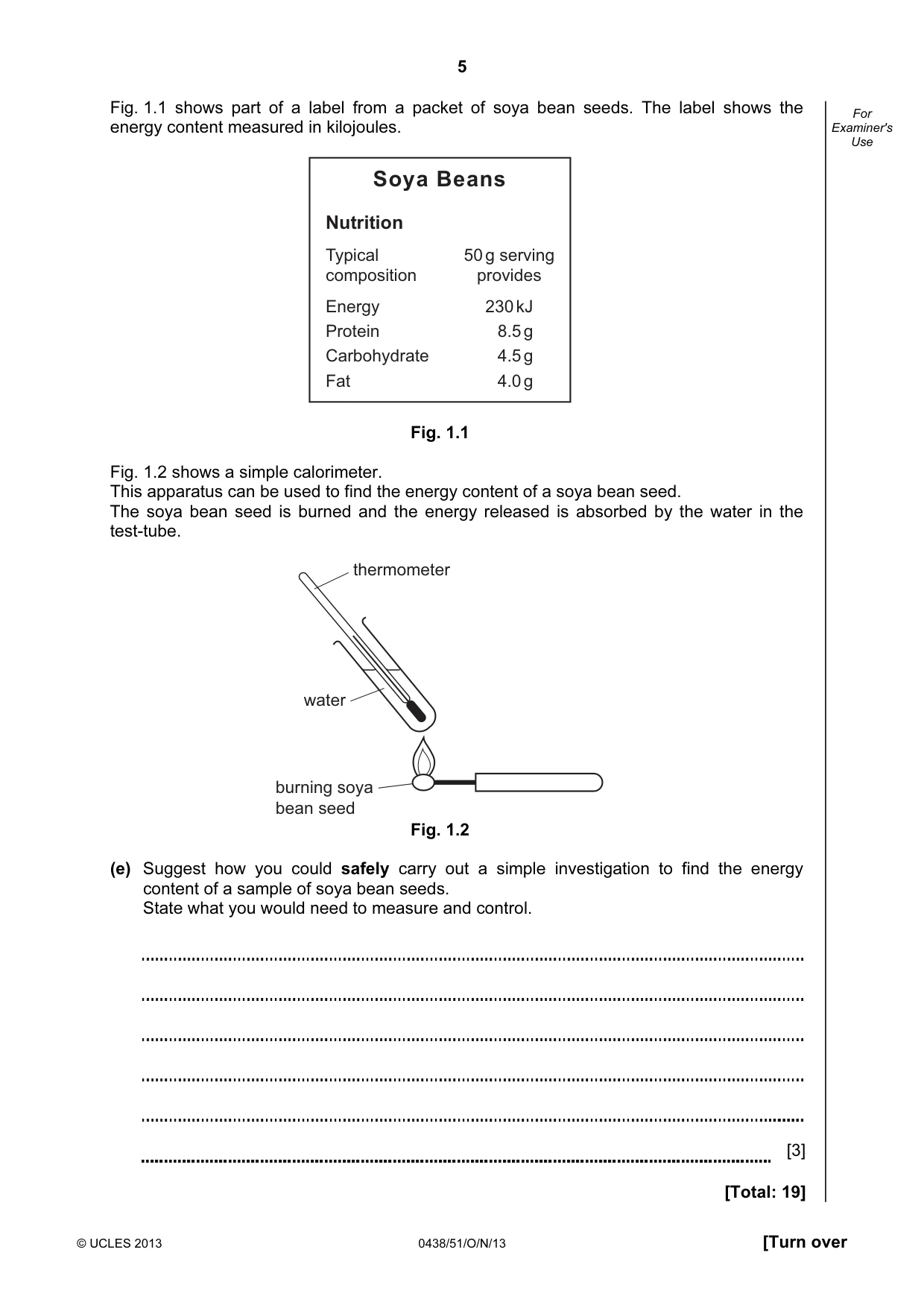
5 © UCLES 2013 0438/51/O/N/13 [Turn over For Examiner's Use Fig. 1.1 shows part of a label from a packet of soya bean seeds. The label shows the energy content measured in kilojoules. Soya Beans Nutrition Typical composition 50 g serving provides Energy Protein Carbohydrate Fat 230 kJ 8.5 g 4.5 g 4.0 g Fig. 1.1 Fig. 1.2 shows a simple calorimeter. This apparatus can be used to find the energy content of a soya bean seed. The soya bean seed is burned and the energy released is absorbed by the water in the test-tube. thermometer water burning soya bean seed Fig. 1.2 (e) Suggest how you could safely carry out a simple investigation to find the energy content of a sample of soya bean seeds. State what you would need to measure and control. [3] [Total: 19]
Question paper, page 6
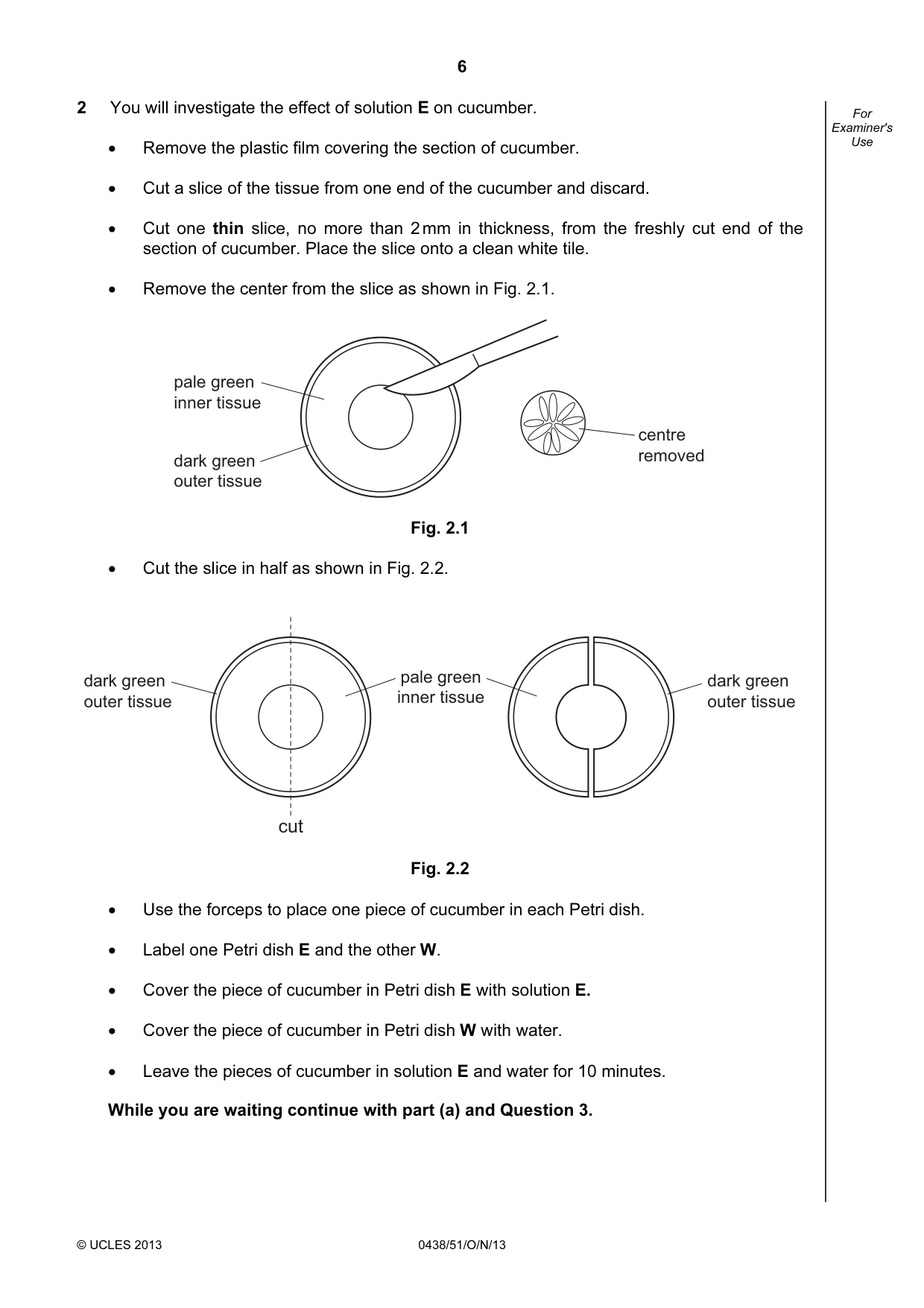
6 © UCLES 2013 0438/51/O/N/13 For Examiner's Use 2 You will investigate the effect of solution E on cucumber. • Remove the plastic film covering the section of cucumber. • Cut a slice of the tissue from one end of the cucumber and discard. • Cut one thin slice, no more than 2 mm in thickness, from the freshly cut end of the section of cucumber. Place the slice onto a clean white tile. • Remove the center from the slice as shown in Fig. 2.1. dark green outer tissue pale green inner tissue centre removed Fig. 2.1 • Cut the slice in half as shown in Fig. 2.2. dark green outer tissue dark green outer tissue pale green inner tissue cut Fig. 2.2 • Use the forceps to place one piece of cucumber in each Petri dish. • Label one Petri dish E and the other W. • Cover the piece of cucumber in Petri dish E with solution E. • Cover the piece of cucumber in Petri dish W with water. • Leave the pieces of cucumber in solution E and water for 10 minutes. While you are waiting continue with part (a) and Question 3.
Question paper, page 7
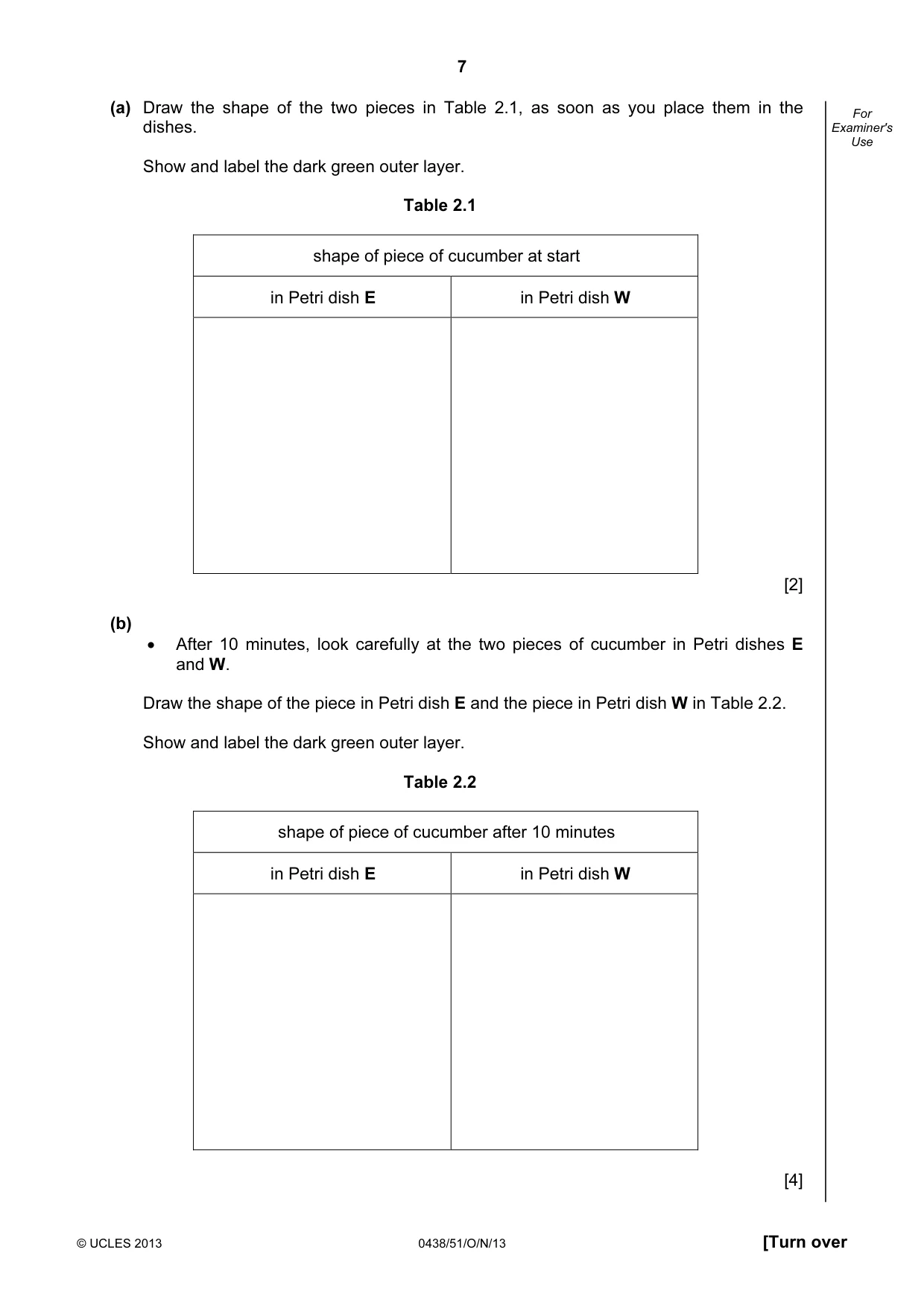
7 © UCLES 2013 0438/51/O/N/13 [Turn over For Examiner's Use (a) Draw the shape of the two pieces in Table 2.1, as soon as you place them in the dishes. Show and label the dark green outer layer. Table 2.1 shape of piece of cucumber at start in Petri dish E in Petri dish W [2] (b) • After 10 minutes, look carefully at the two pieces of cucumber in Petri dishes E and W. Draw the shape of the piece in Petri dish E and the piece in Petri dish W in Table 2.2. Show and label the dark green outer layer. Table 2.2 shape of piece of cucumber after 10 minutes in Petri dish E in Petri dish W [4]
Question paper, page 8
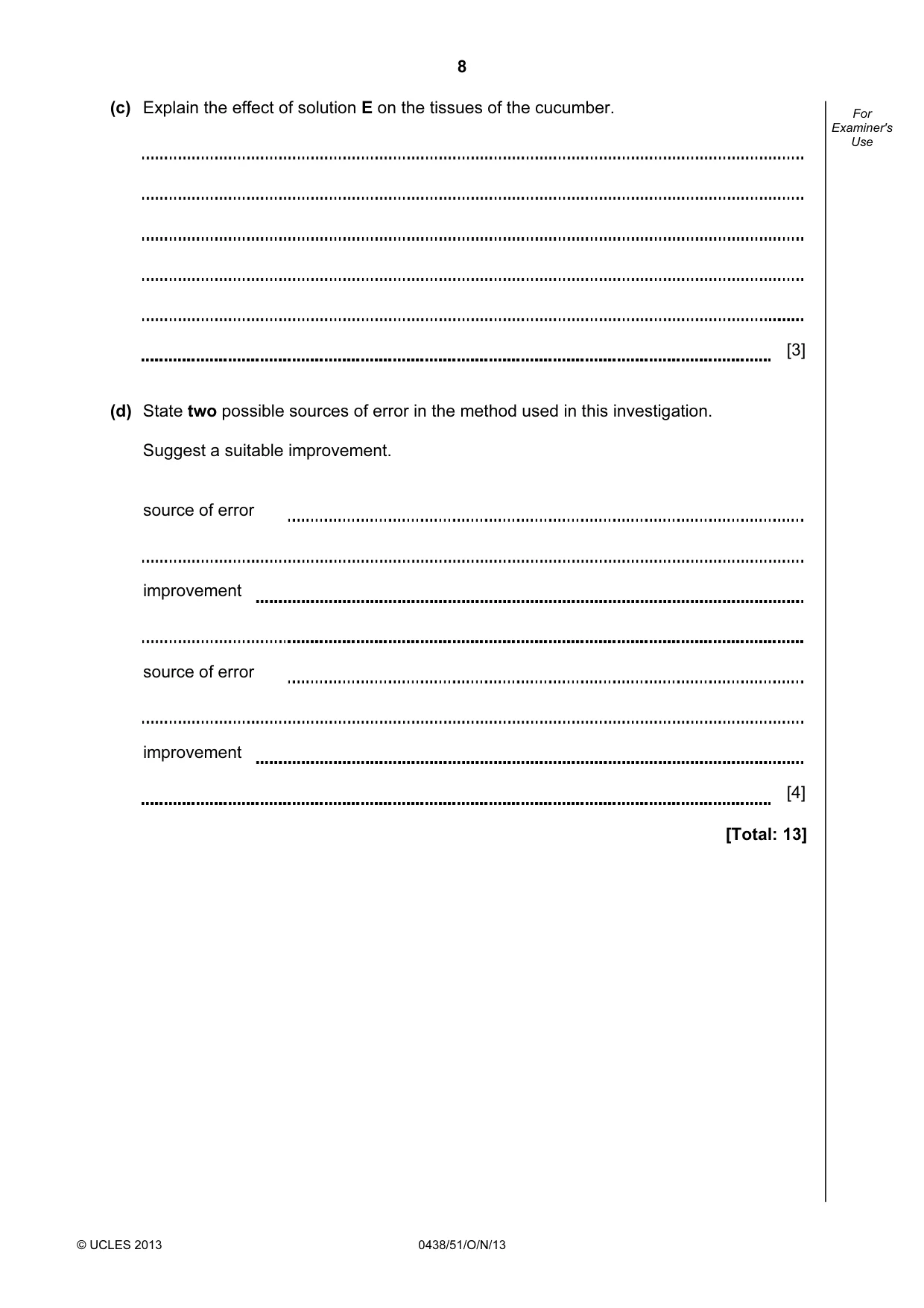
8 © UCLES 2013 0438/51/O/N/13 For Examiner's Use (c) Explain the effect of solution E on the tissues of the cucumber. [3] (d) State two possible sources of error in the method used in this investigation. Suggest a suitable improvement. source of error improvement source of error improvement [4] [Total: 13]
Question paper, page 9
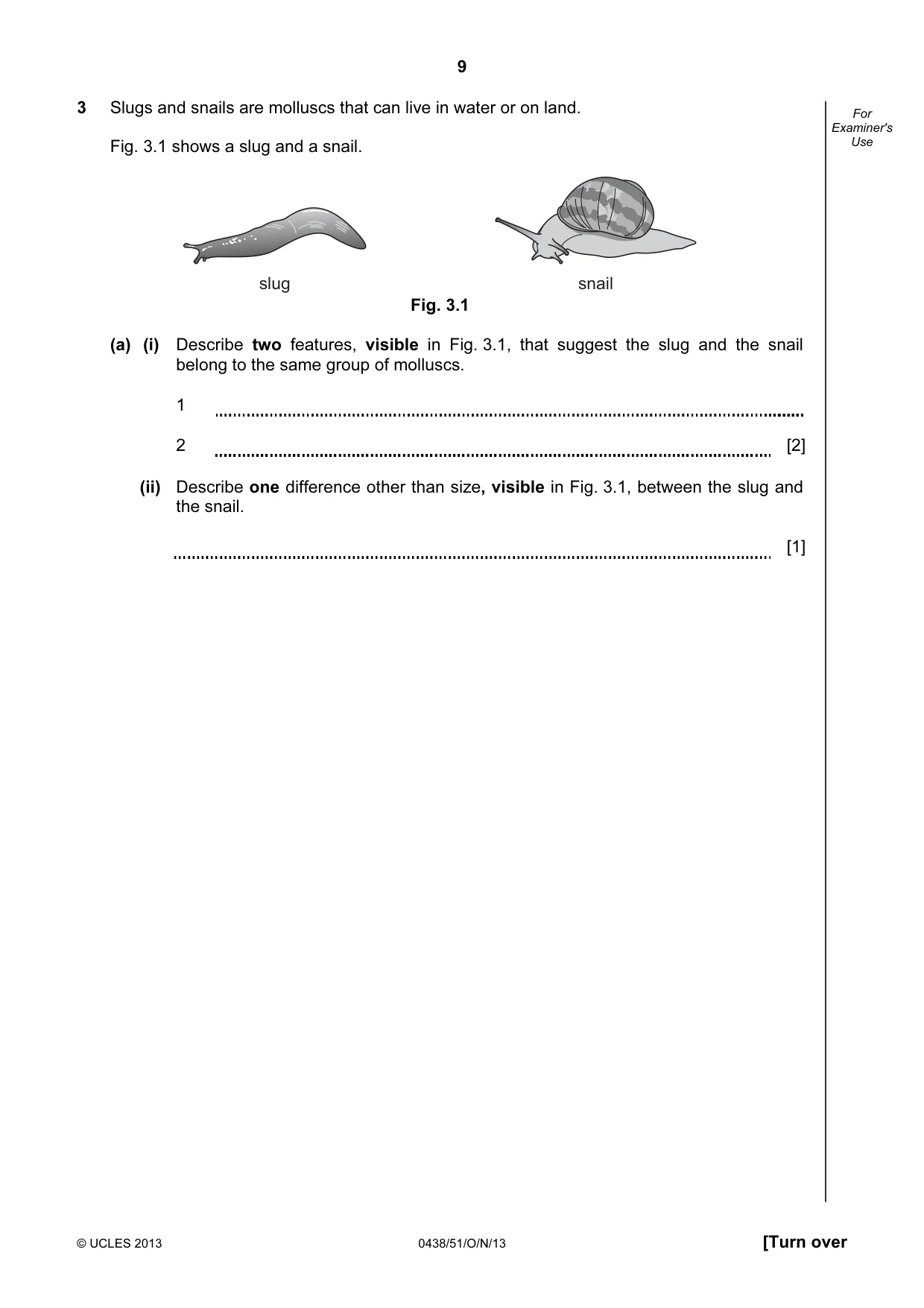
9 © UCLES 2013 0438/51/O/N/13 [Turn over For Examiner's Use 3 Slugs and snails are molluscs that can live in water or on land. Fig. 3.1 shows a slug and a snail. slug snail Fig. 3.1 (a) (i) Describe two features, visible in Fig. 3.1, that suggest the slug and the snail belong to the same group of molluscs. 1 2 [2] (ii) Describe one difference other than size, visible in Fig. 3.1, between the slug and the snail. [1]
Question paper, page 10
10 © UCLES 2013 0438/51/O/N/13 For Examiner's Use You are provided with a shell of a mollusc. (b) (i) Make a large, labeled drawing of this shell. [4] (ii) Suggest the importance of the shell to molluscs belonging to this group. [1] [Total: 8]
Question paper, page 11
11 © UCLES 2013 0438/51/O/N/13 BLANK PAGE
Question paper, page 12
12 Permission to reproduce items where third-party owned material protected by copyright is included has been sought and cleared where possible. Every reasonable effort has been made by the publisher (UCLES) to trace copyright holders, but if any items requiring clearance have unwittingly been included, the publisher will be pleased to make amends at the earliest possible opportunity. University of Cambridge International Examinations is part of the Cambridge Assessment Group. Cambridge Assessment is the brand name of University of Cambridge Local Examinations Syndicate (UCLES), which is itself a department of the University of Cambridge. © UCLES 2013 0438/51/O/N/13 BLANK PAGE
Mark scheme, page 1
CAMBRIDGE INTERNATIONAL EXAMINATIONS International General Certificate of Secondary Education MARK SCHEME for the October/November 2013 series 0438 BIOLOGY (US) 0438/51 Paper 5 (Practical Test), maximum raw mark 40 This mark scheme is published as an aid to teachers and candidates, to indicate the requirements of the examination. It shows the basis on which Examiners were instructed to award marks. It does not indicate the details of the discussions that took place at an Examiners’ meeting before marking began, which would have considered the acceptability of alternative answers. Mark schemes should be read in conjunction with the question paper and the Principal Examiner Report for Teachers. Cambridge will not enter into discussions about these mark schemes. Cambridge is publishing the mark schemes for the October/November 2013 series for most IGCSE, GCE Advanced Level and Advanced Subsidiary Level components and some Ordinary Level components.
Mark scheme, page 2
Page 2 Mark Scheme Syllabus Paper IGCSE – October/November 2013 0438 51 © Cambridge International Examinations 2013 Mark schemes will use these abbreviations • ; separates marking points • / alternatives • R reject • A accept (for answers correctly cued by the question) • I ignore as irrelevant • ecf error carried forward • AW alternative wording (where responses vary more than usual) • AVP alternative valid point • Underline actual word given must be used by candidate (grammatical variants excepted) • ( ) the word / phrase in brackets is not required but sets the context • D, L, T, Q quality of: drawing / labelling / table / detail as indicated • max indicates the maximum number of marks.
Mark scheme, page 3
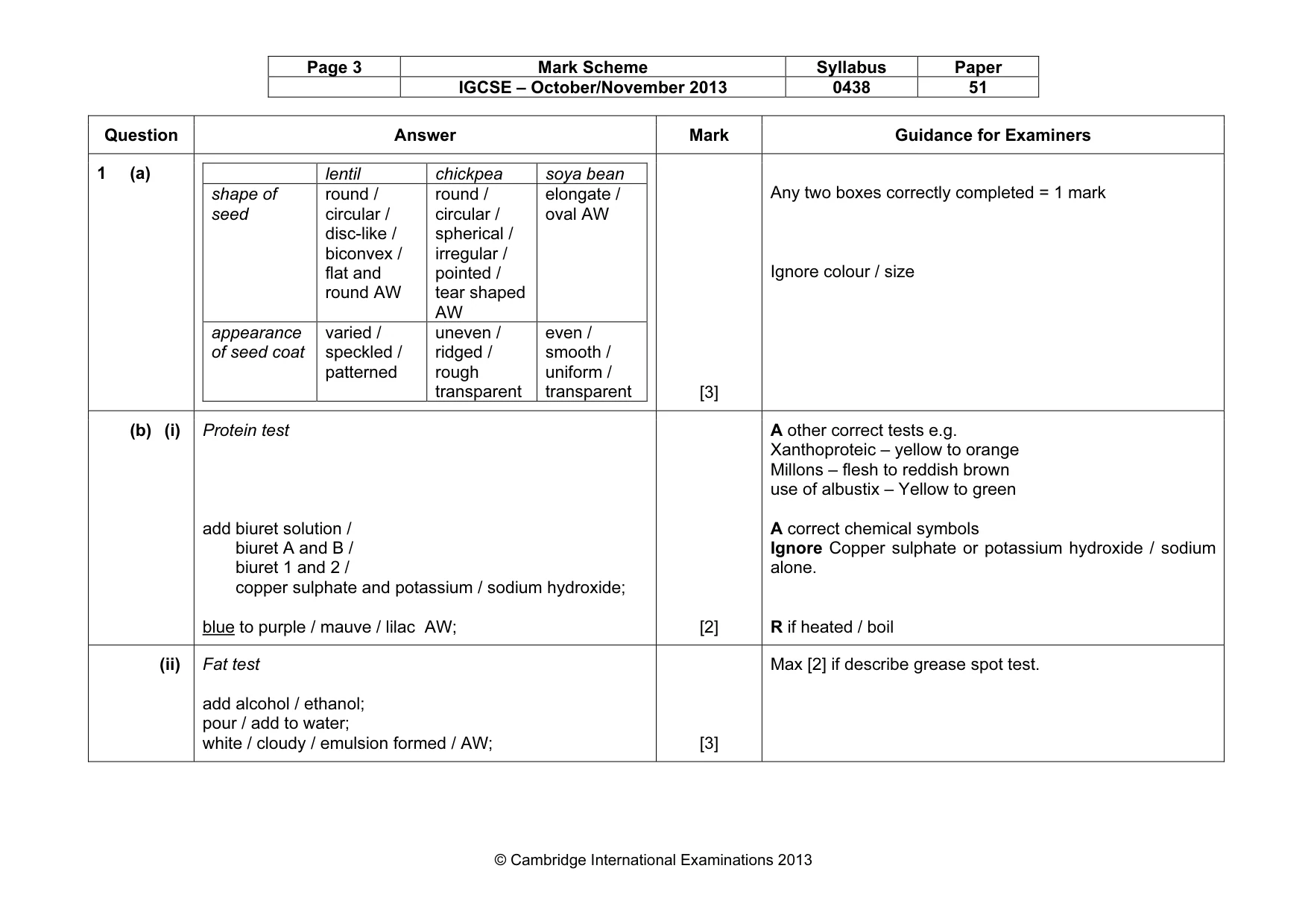
Page 3 Mark Scheme Syllabus Paper IGCSE – October/November 2013 0438 51 © Cambridge International Examinations 2013 Question Answer Mark Guidance for Examiners 1 (a) lentil chickpea soya bean shape of seed round / circular / disc-like / biconvex / flat and round AW round / circular / spherical / irregular / pointed / tear shaped AW elongate / oval AW appearance of seed coat varied / speckled / patterned uneven / ridged / rough transparent even / smooth / uniform / transparent [3] Any two boxes correctly completed = 1 mark Ignore colour / size (b) (i) Protein test add biuret solution / biuret A and B / biuret 1 and 2 / copper sulphate and potassium / sodium hydroxide; blue to purple / mauve / lilac AW; [2] A other correct tests e.g. Xanthoproteic – yellow to orange Millons – flesh to reddish brown use of albustix – Yellow to green A correct chemical symbols Ignore Copper sulphate or potassium hydroxide / sodium alone. R if heated / boil (ii) Fat test add alcohol / ethanol; pour / add to water; white / cloudy / emulsion formed / AW; [3] Max [2] if describe grease spot test.
Mark scheme, page 4
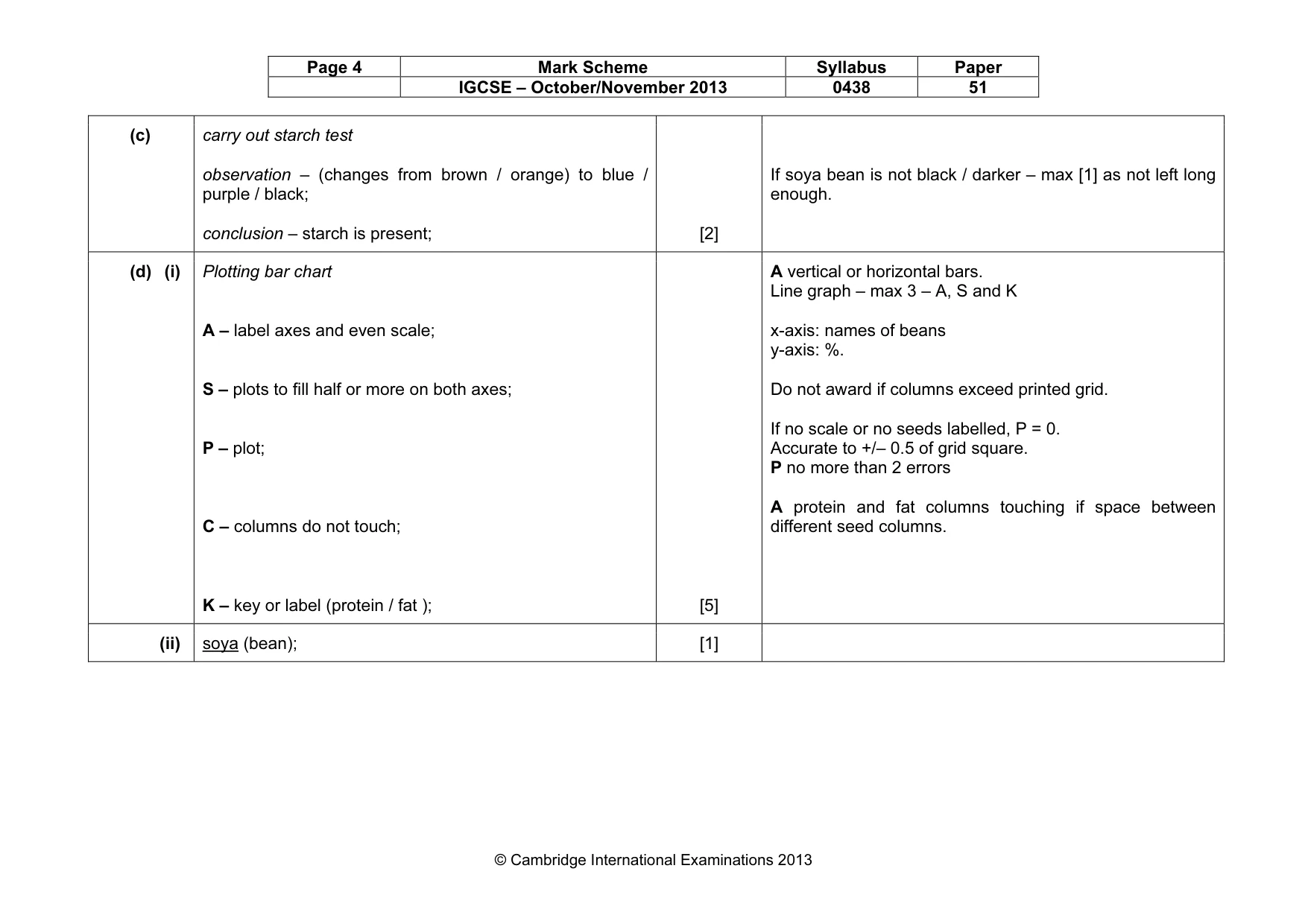
Page 4 Mark Scheme Syllabus Paper IGCSE – October/November 2013 0438 51 © Cambridge International Examinations 2013 (c) carry out starch test observation – (changes from brown / orange) to blue / purple / black; conclusion – starch is present; [2] If soya bean is not black / darker – max [1] as not left long enough. (d) (i) Plotting bar chart A – label axes and even scale; S – plots to fill half or more on both axes; P – plot; C – columns do not touch; K – key or label (protein / fat ); [5] A vertical or horizontal bars. Line graph – max 3 – A, S and K x-axis: names of beans y-axis: %. Do not award if columns exceed printed grid. If no scale or no seeds labelled, P = 0. Accurate to +/– 0.5 of grid square. P no more than 2 errors A protein and fat columns touching if space between different seed columns. (ii) soya (bean); [1]
Mark scheme, page 5
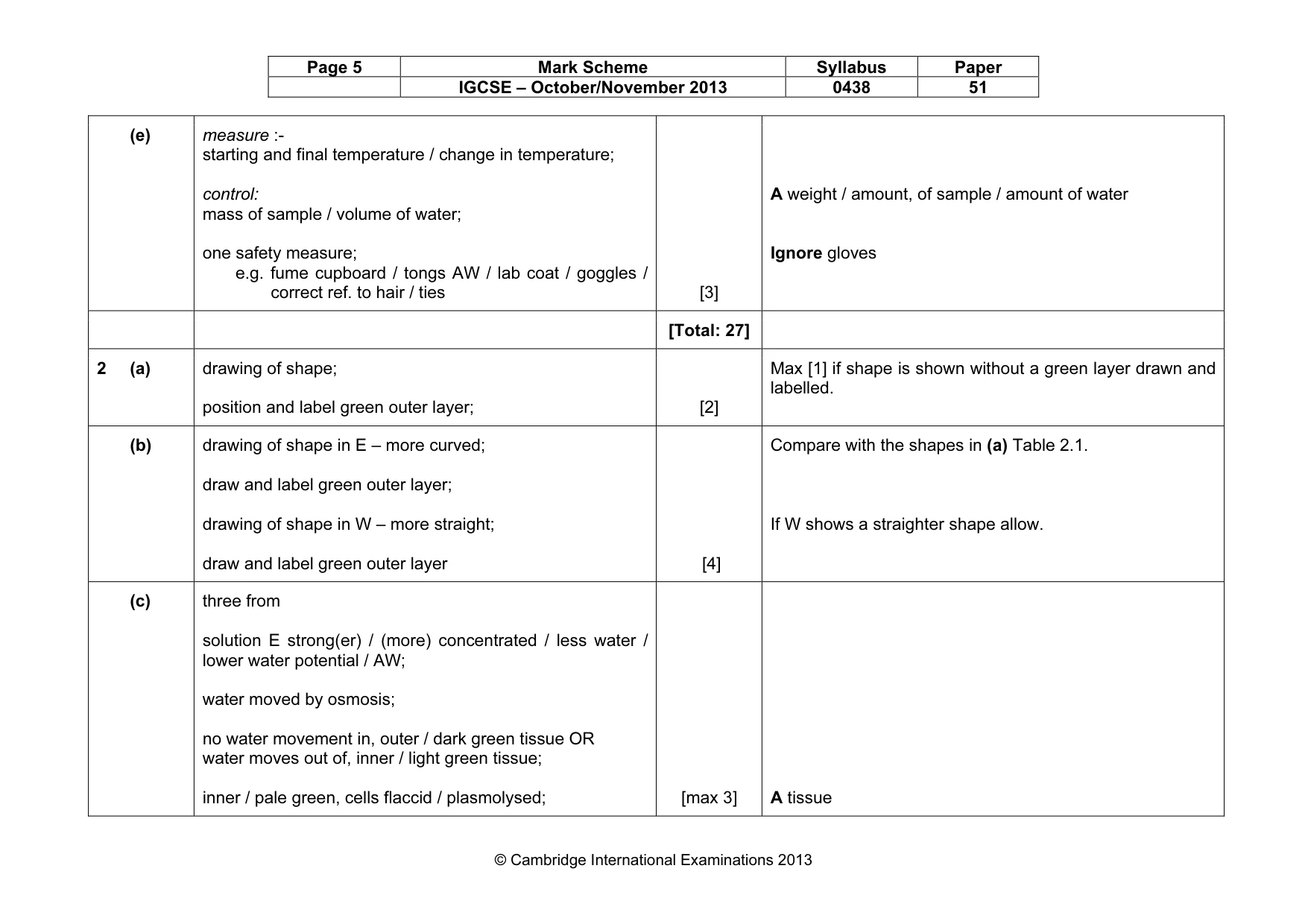
Page 5 Mark Scheme Syllabus Paper IGCSE – October/November 2013 0438 51 © Cambridge International Examinations 2013 (e) measure :- starting and final temperature / change in temperature; control: mass of sample / volume of water; one safety measure; e.g. fume cupboard / tongs AW / lab coat / goggles / correct ref. to hair / ties [3] A weight / amount, of sample / amount of water Ignore gloves [Total: 27] 2 (a) drawing of shape; position and label green outer layer; [2] Max [1] if shape is shown without a green layer drawn and labelled. (b) drawing of shape in E – more curved; draw and label green outer layer; drawing of shape in W – more straight; draw and label green outer layer [4] Compare with the shapes in (a) Table 2.1. If W shows a straighter shape allow. (c) three from solution E strong(er) / (more) concentrated / less water / lower water potential / AW; water moved by osmosis; no water movement in, outer / dark green tissue OR water moves out of, inner / light green tissue; inner / pale green, cells flaccid / plasmolysed; [max 3] A tissue
Mark scheme, page 6
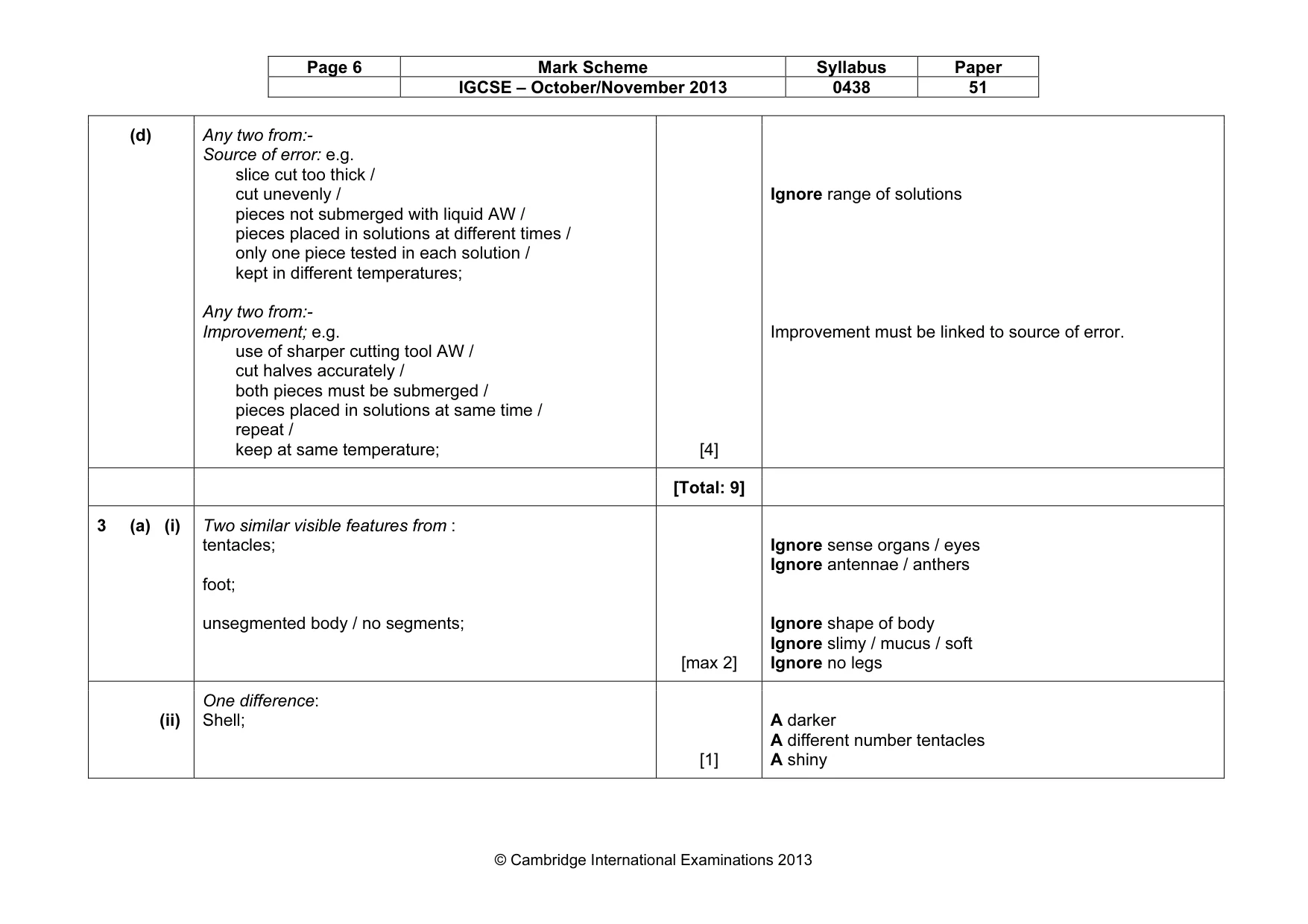
Page 6 Mark Scheme Syllabus Paper IGCSE – October/November 2013 0438 51 © Cambridge International Examinations 2013 (d) Any two from:- Source of error: e.g. slice cut too thick / cut unevenly / pieces not submerged with liquid AW / pieces placed in solutions at different times / only one piece tested in each solution / kept in different temperatures; Any two from:- Improvement; e.g. use of sharper cutting tool AW / cut halves accurately / both pieces must be submerged / pieces placed in solutions at same time / repeat / keep at same temperature; [4] Ignore range of solutions Improvement must be linked to source of error. [Total: 9] 3 (a) (i) Two similar visible features from : tentacles; foot; unsegmented body / no segments; [max 2] Ignore sense organs / eyes Ignore antennae / anthers Ignore shape of body Ignore slimy / mucus / soft Ignore no legs (ii) One difference: Shell; [1] A darker A different number tentacles A shiny
Mark scheme, page 7
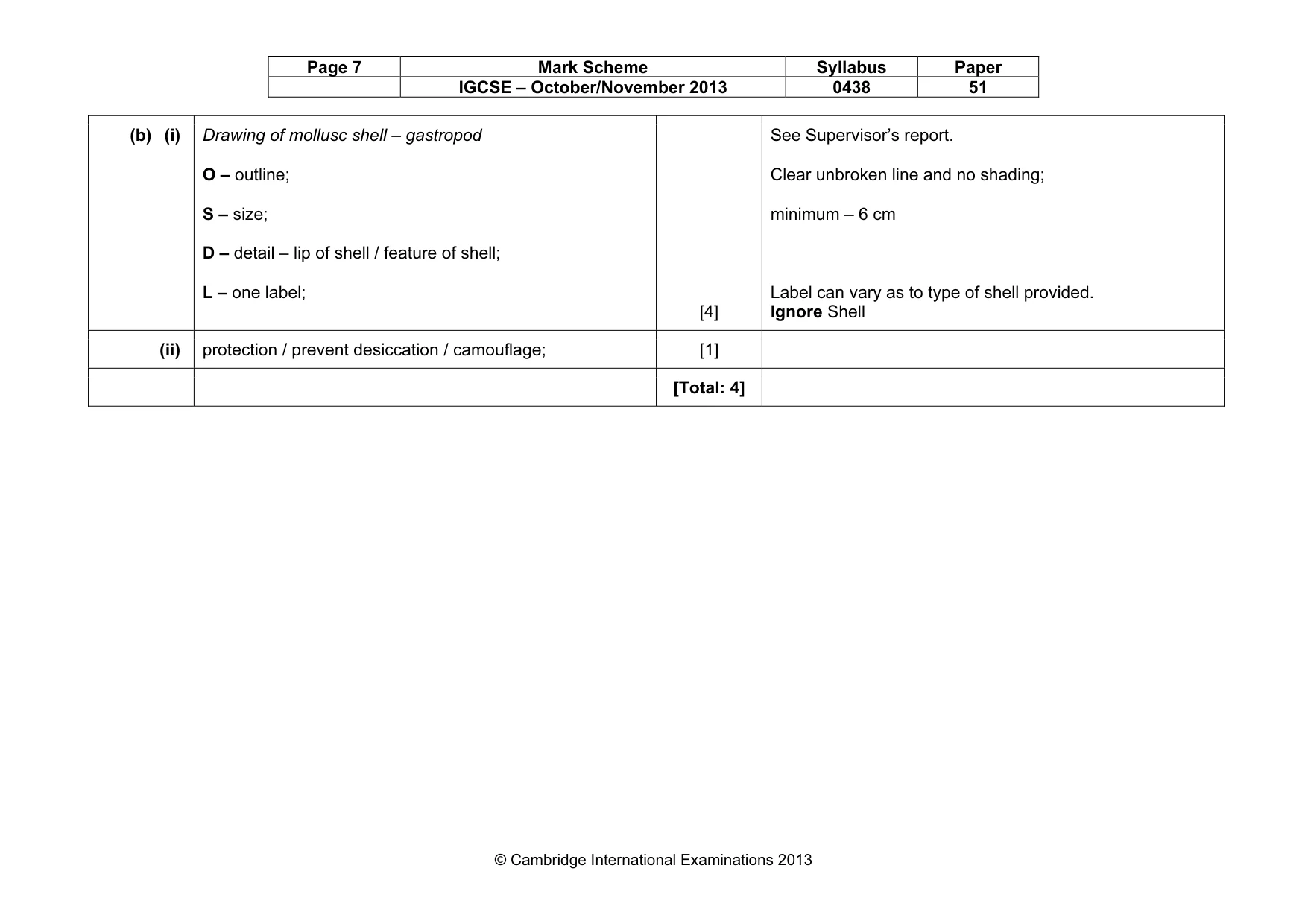
Page 7 Mark Scheme Syllabus Paper IGCSE – October/November 2013 0438 51 © Cambridge International Examinations 2013 (b) (i) Drawing of mollusc shell – gastropod O – outline; S – size; D – detail – lip of shell / feature of shell; L – one label; [4] See Supervisor’s report. Clear unbroken line and no shading; minimum – 6 cm Label can vary as to type of shell provided. Ignore Shell (ii) protection / prevent desiccation / camouflage; [1] [Total: 4]