Cambridge IGCSE Biology (BES) 0438 — 2012 May/June Paper 5 · Variant 3
0438/53/M/J/12 · 40 marks · ≈45 min
The question paper and its mark scheme, free to read here and free to download. This is Cambridge’s own paper, exactly as it was sat.
Question paper12 pages
Mark scheme5 pages
Answers below. Sit the paper first if you are practising.
Paper as text
Question paper, page 1
This document consists of 10 printed pages and 2 blank pages. IB12 06_0438_53/RP © UCLES 2012 [Turn over *5824444963* For Examiner's Use 1 2 3 Total UNIVERSITY OF CAMBRIDGE INTERNATIONAL EXAMINATIONS International General Certificate of Secondary Education Biology (US) 0438/53 Paper 5 Practical Test May/June 2012 1 hour 15 minutes Candidates answer on the Question Paper Additional Materials: As listed in Confidential Instructions READ THESE INSTRUCTIONS FIRST Write your Center number, candidate number and name on all the work you hand in. Write in dark blue or black pen. You may use a pencil for any diagrams or graphs. Do not use staples, paper clips, highlighters, glue or correction fluid. DO NOT WRITE IN ANY BARCODES. Answer all the questions. At the end of the examination, fasten all your work securely together. The number of marks is given in brackets [ ] at the end of each question or part question.
Question paper, page 2
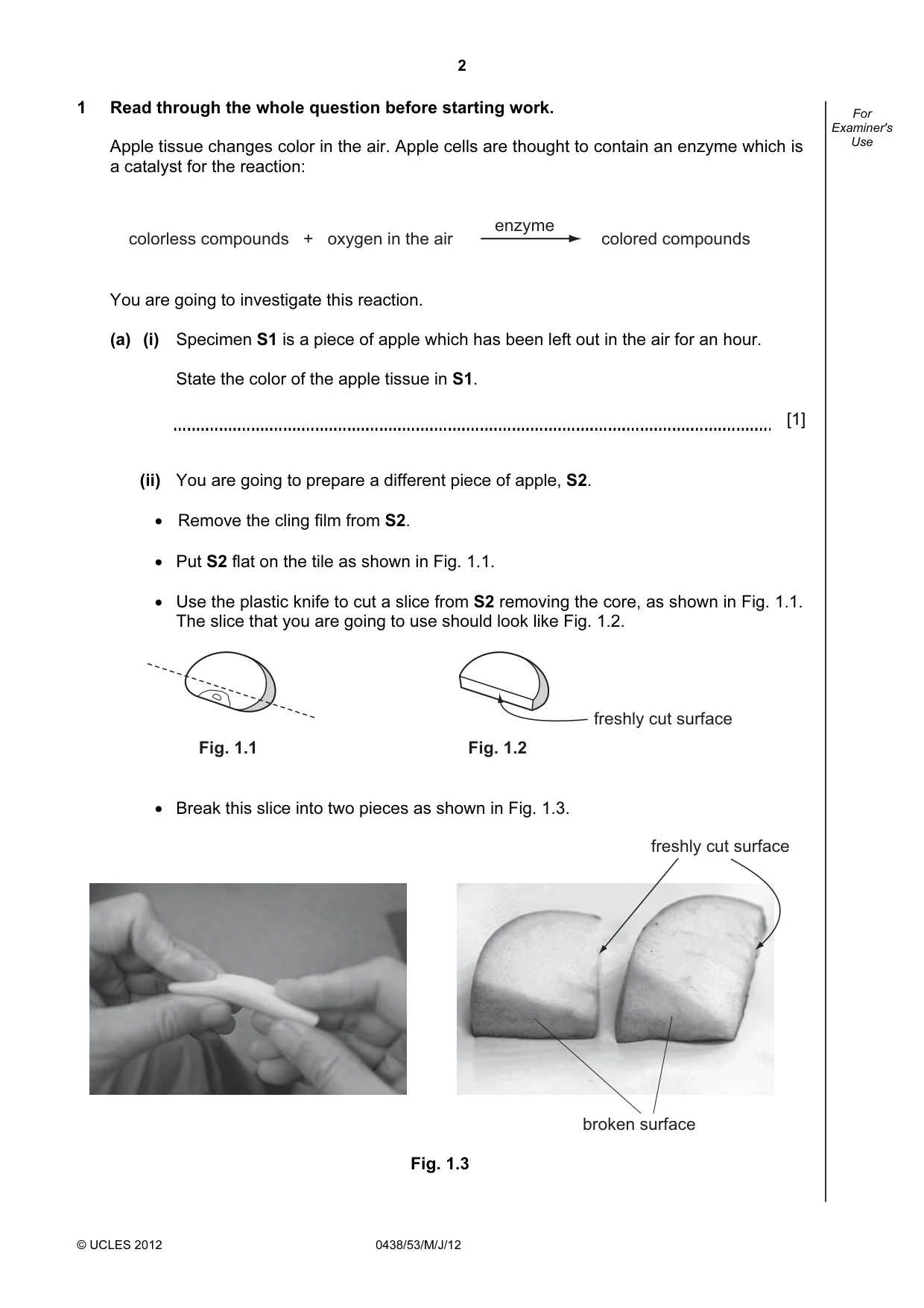
2 © UCLES 2012 0438/53/M/J/12 For Examiner's Use 1 Read through the whole question before starting work. Apple tissue changes color in the air. Apple cells are thought to contain an enzyme which is a catalyst for the reaction: colorless compounds + oxygen in the air colored compounds enzyme You are going to investigate this reaction. (a) (i) Specimen S1 is a piece of apple which has been left out in the air for an hour. State the color of the apple tissue in S1. [1] (ii) You are going to prepare a different piece of apple, S2. • Remove the cling film from S2. • Put S2 flat on the tile as shown in Fig. 1.1. • Use the plastic knife to cut a slice from S2 removing the core, as shown in Fig. 1.1. The slice that you are going to use should look like Fig. 1.2. Fig. 1.1 Fig. 1.2 freshly cut surface • Break this slice into two pieces as shown in Fig. 1.3. freshly cut surface broken surface Fig. 1.3
Question paper, page 3
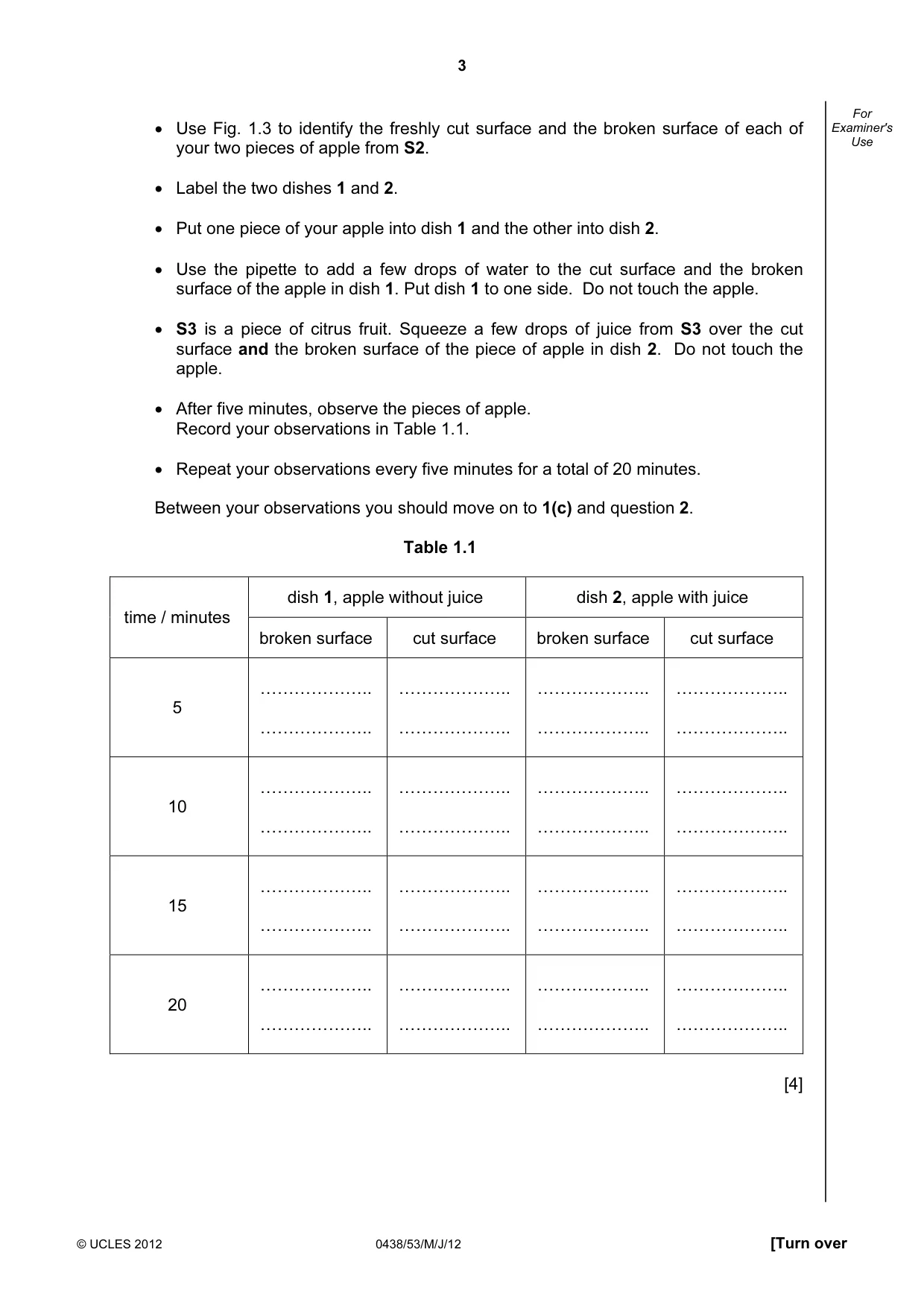
3 © UCLES 2012 0438/53/M/J/12 [Turn over For Examiner's Use • Use Fig. 1.3 to identify the freshly cut surface and the broken surface of each of your two pieces of apple from S2. • Label the two dishes 1 and 2. • Put one piece of your apple into dish 1 and the other into dish 2. • Use the pipette to add a few drops of water to the cut surface and the broken surface of the apple in dish 1. Put dish 1 to one side. Do not touch the apple. • S3 is a piece of citrus fruit. Squeeze a few drops of juice from S3 over the cut surface and the broken surface of the piece of apple in dish 2. Do not touch the apple. • After five minutes, observe the pieces of apple. Record your observations in Table 1.1. • Repeat your observations every five minutes for a total of 20 minutes. Between your observations you should move on to 1(c) and question 2. Table 1.1 dish 1, apple without juice dish 2, apple with juice time / minutes broken surface cut surface broken surface cut surface 5 ……………….. ……………….. ……………….. ……………….. ……………….. ……………….. ……………….. ……………….. 10 ……………….. ……………….. ……………….. ……………….. ……………….. ……………….. ……………….. ……………….. 15 ……………….. ……………….. ……………….. ……………….. ……………….. ……………….. ……………….. ……………….. 20 ……………….. ……………….. ……………….. ……………….. ……………….. ……………….. ……………….. ……………….. [4]
Question paper, page 4
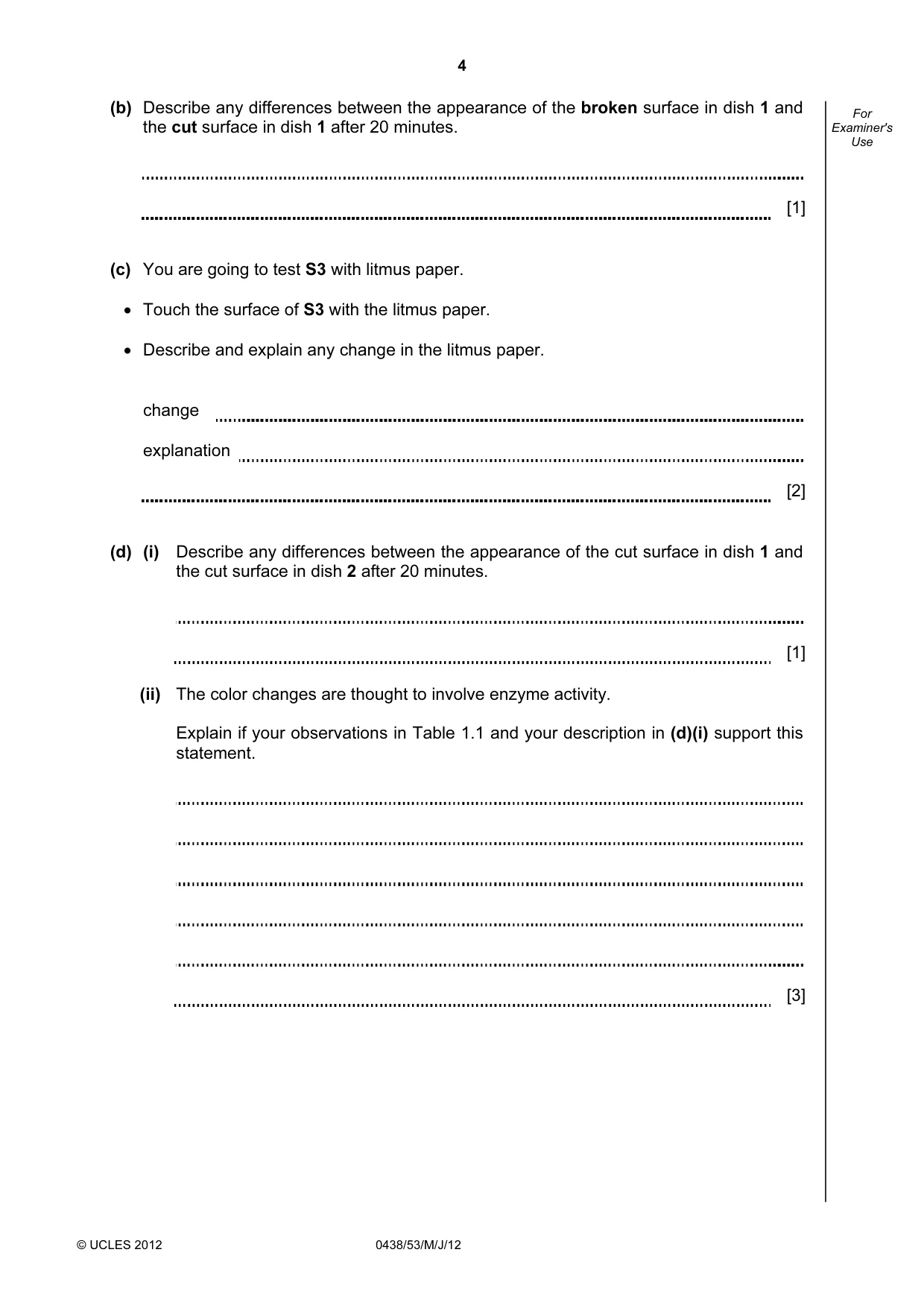
4 © UCLES 2012 0438/53/M/J/12 For Examiner's Use (b) Describe any differences between the appearance of the broken surface in dish 1 and the cut surface in dish 1 after 20 minutes. [1] (c) You are going to test S3 with litmus paper. • Touch the surface of S3 with the litmus paper. • Describe and explain any change in the litmus paper. change explanation [2] (d) (i) Describe any differences between the appearance of the cut surface in dish 1 and the cut surface in dish 2 after 20 minutes. [1] (ii) The color changes are thought to involve enzyme activity. Explain if your observations in Table 1.1 and your description in (d)(i) support this statement. [3]
Question paper, page 5
5 © UCLES 2012 0438/53/M/J/12 [Turn over For Examiner's Use (e) Cutting the apple with a knife damages cells, releasing the contents. Suggest, from your observations in Table 1.1 and your description in (b), how breaking the apple may affect the cells. [1] (f) In another experiment, apple pieces were boiled in water for two minutes. Explain why there was no color change five minutes after they were taken out and left in the air. [2] [Total: 15]
Question paper, page 6
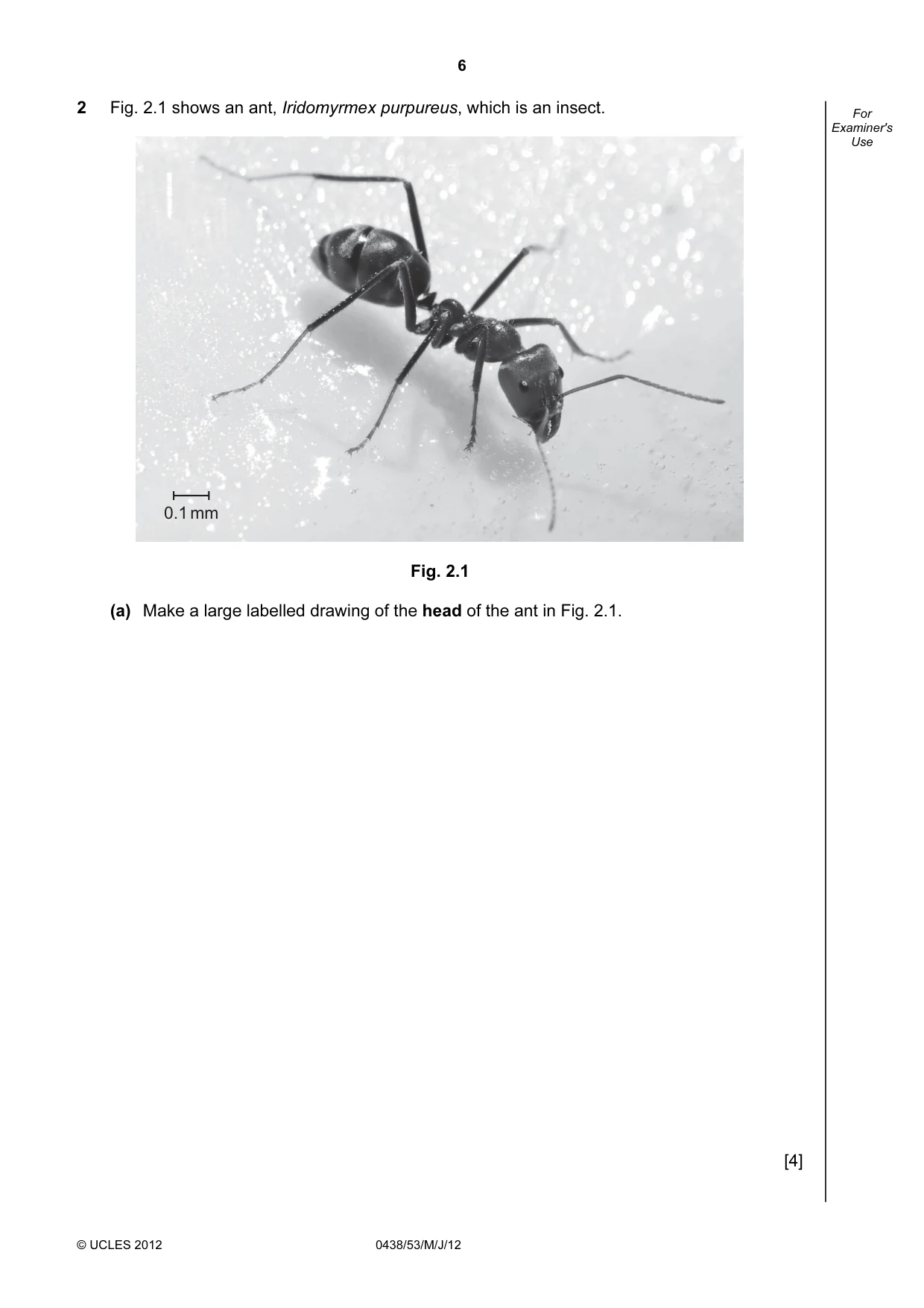
6 © UCLES 2012 0438/53/M/J/12 For Examiner's Use 2 Fig. 2.1 shows an ant, Iridomyrmex purpureus, which is an insect. 0.1 mm Fig. 2.1 (a) Make a large labelled drawing of the head of the ant in Fig. 2.1. [4]
Question paper, page 7
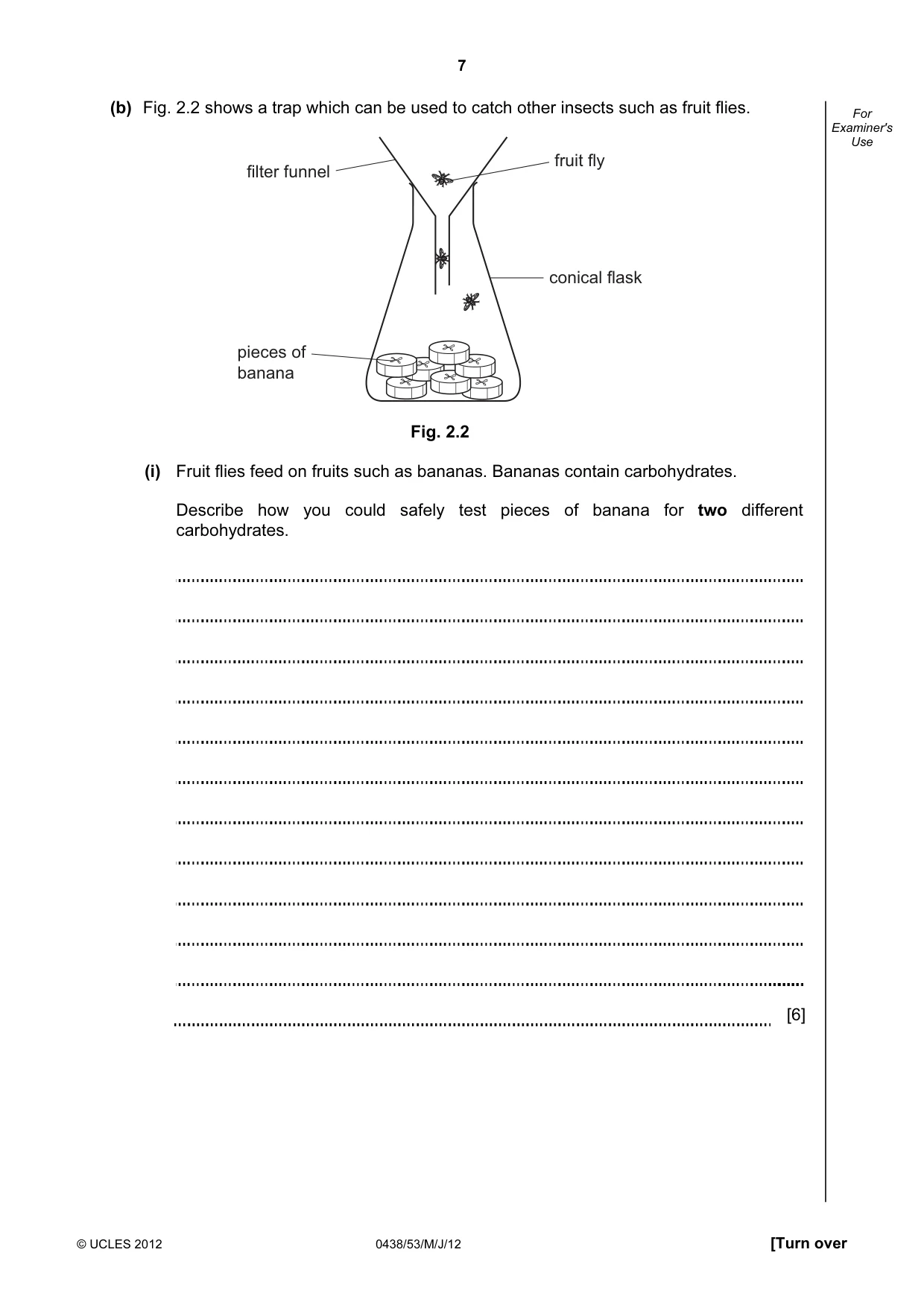
7 © UCLES 2012 0438/53/M/J/12 [Turn over For Examiner's Use (b) Fig. 2.2 shows a trap which can be used to catch other insects such as fruit flies. pieces of banana conical flask filter funnel fruit fly Fig. 2.2 (i) Fruit flies feed on fruits such as bananas. Bananas contain carbohydrates. Describe how you could safely test pieces of banana for two different carbohydrates. [6]
Question paper, page 8
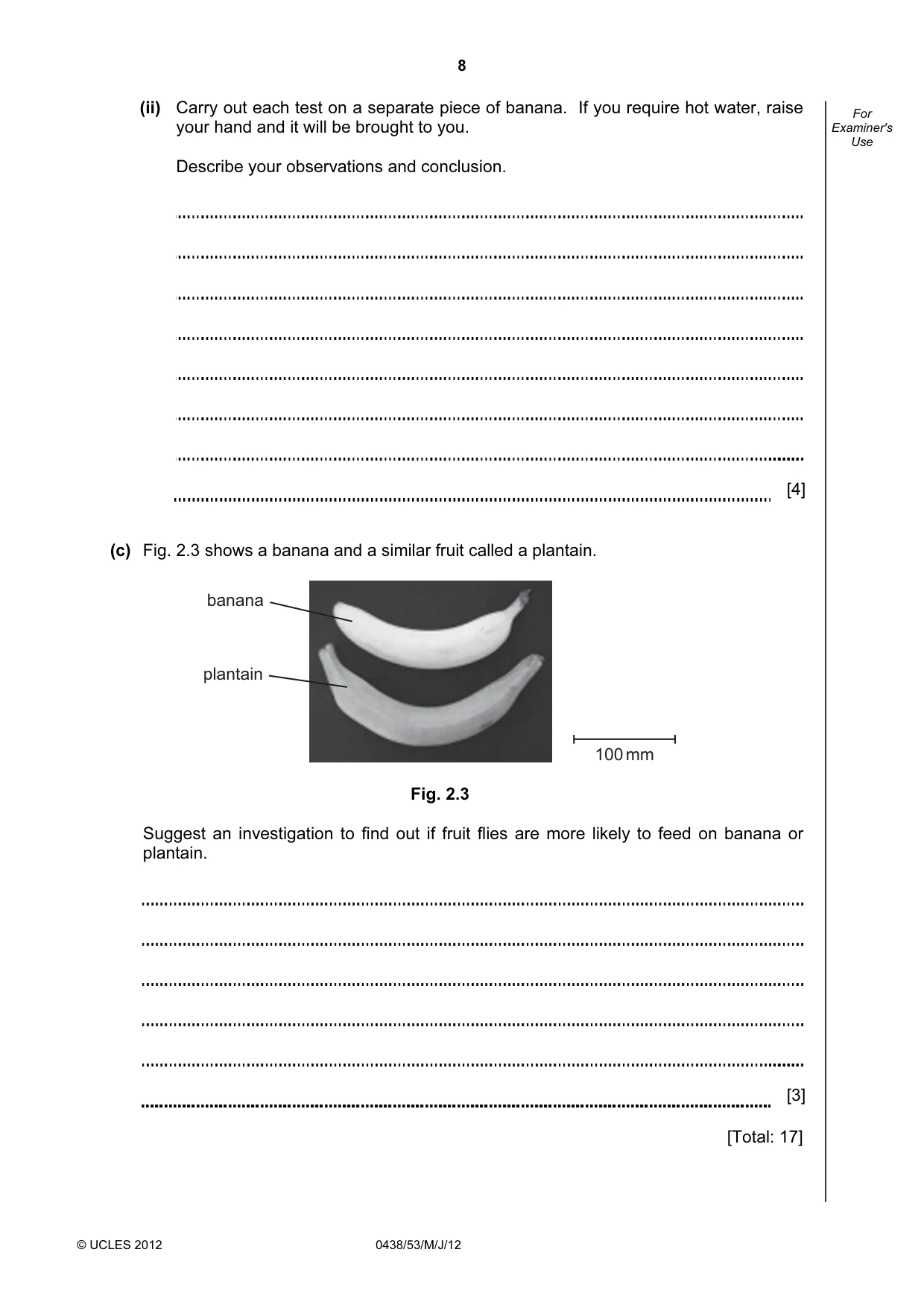
8 © UCLES 2012 0438/53/M/J/12 For Examiner's Use (ii) Carry out each test on a separate piece of banana. If you require hot water, raise your hand and it will be brought to you. Describe your observations and conclusion. [4] (c) Fig. 2.3 shows a banana and a similar fruit called a plantain. 100 mm banana plantain Fig. 2.3 Suggest an investigation to find out if fruit flies are more likely to feed on banana or plantain. [3] [Total: 17]
Question paper, page 9
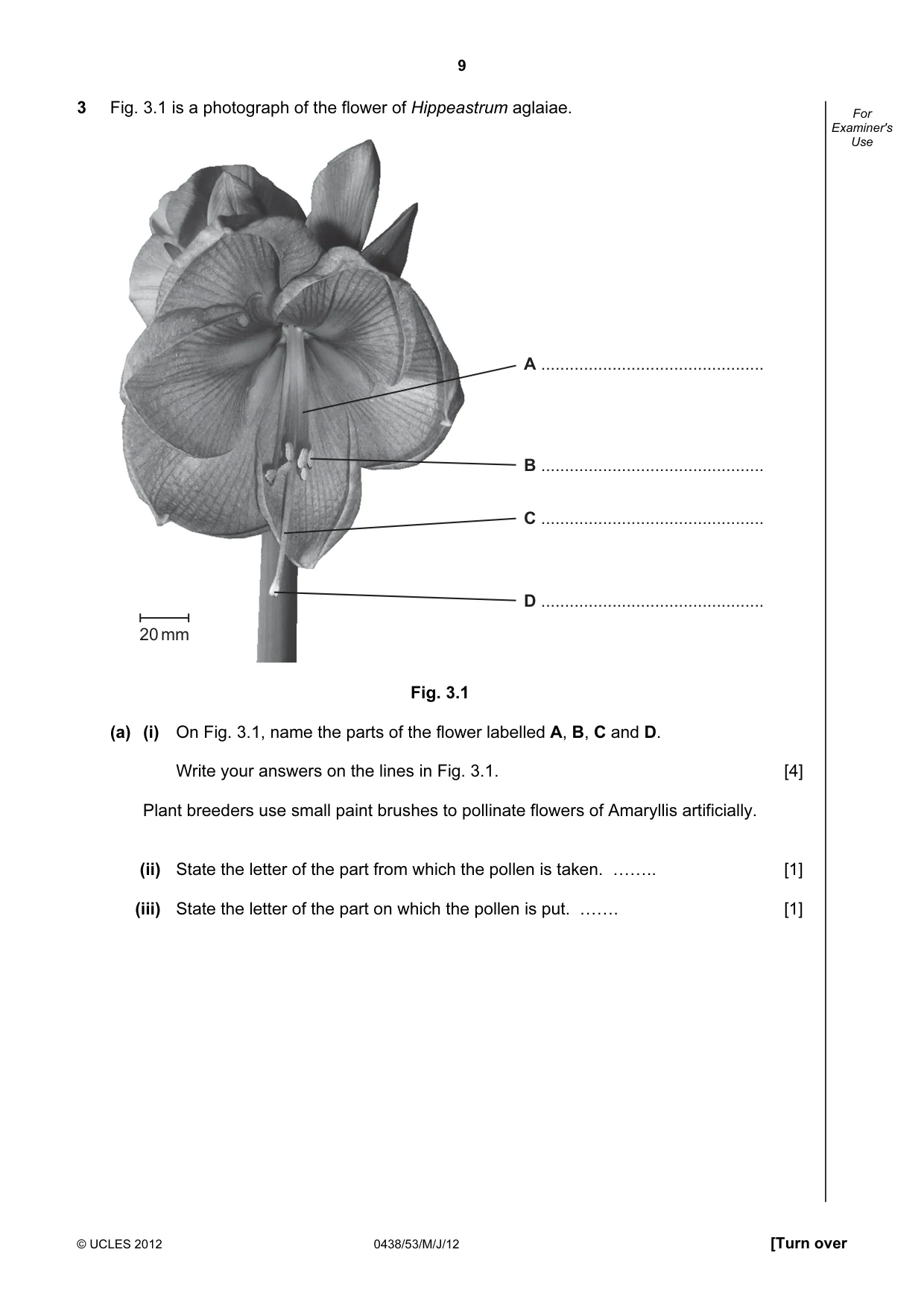
9 © UCLES 2012 0438/53/M/J/12 [Turn over For Examiner's Use 3 Fig. 3.1 is a photograph of the flower of Hippeastrum aglaiae. A … B … C … D … 20 mm Fig. 3.1 (a) (i) On Fig. 3.1, name the parts of the flower labelled A, B, C and D. Write your answers on the lines in Fig. 3.1. [4] Plant breeders use small paint brushes to pollinate flowers of Amaryllis artificially. (ii) State the letter of the part from which the pollen is taken. …….. [1] (iii) State the letter of the part on which the pollen is put. ……. [1]
Question paper, page 10
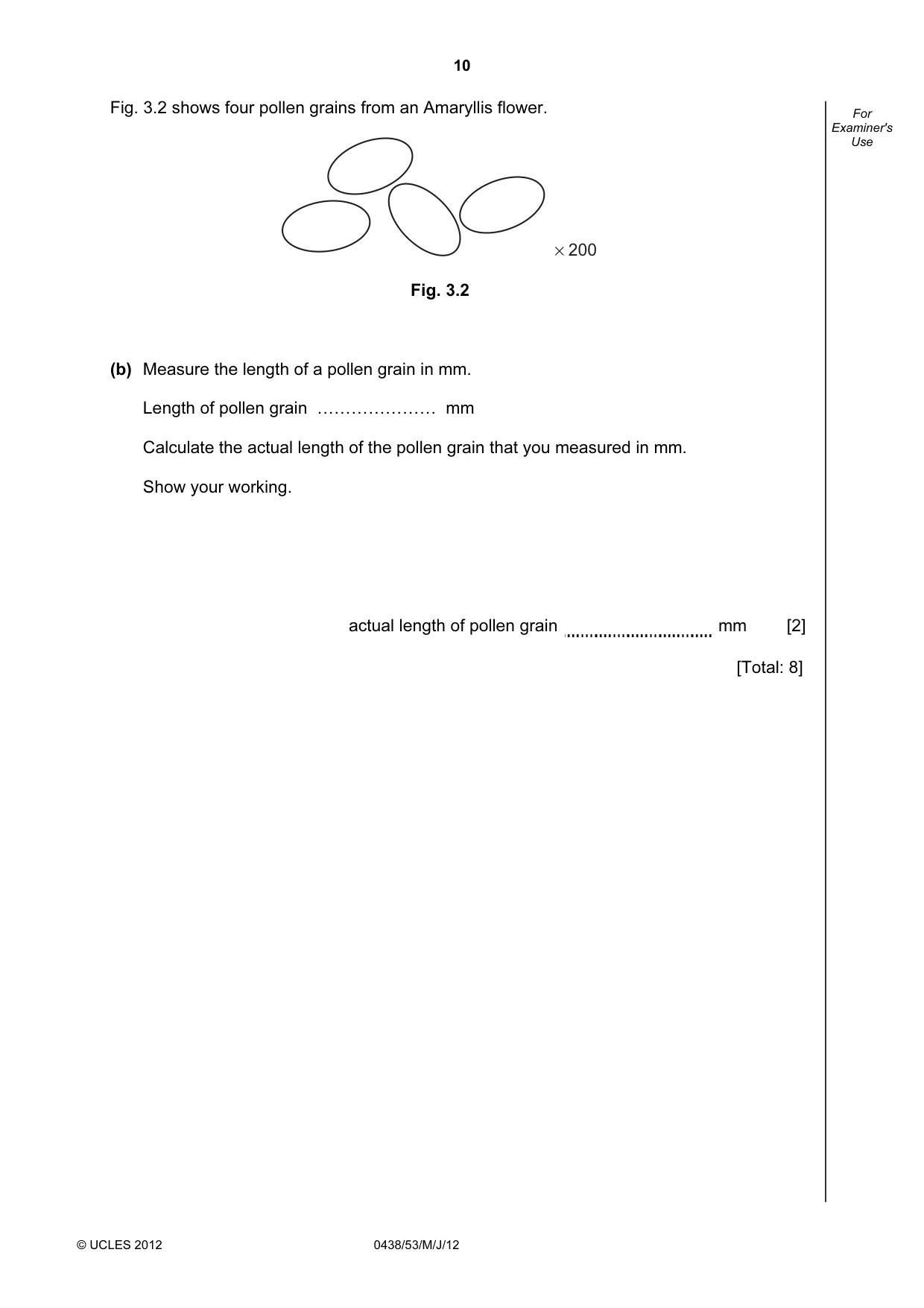
10 © UCLES 2012 0438/53/M/J/12 For Examiner's Use Fig. 3.2 shows four pollen grains from an Amaryllis flower. × 200 Fig. 3.2 (b) Measure the length of a pollen grain in mm. Length of pollen grain ………………… mm Calculate the actual length of the pollen grain that you measured in mm. Show your working. actual length of pollen grain mm [2] [Total: 8]
Question paper, page 11
11 © UCLES 2012 0438/53/M/J/12 BLANK PAGE
Question paper, page 12
12 Copyright Acknowledgements: Question 2a Figure 2.1 Photograph Question 2c Figure 2.3 Photograph Question 3a Figure 3.1 Photograph © Iridomyrex purpureus; http://en.wikipedia.org/wiki/Meat_ant. © Banana and a plantain; http://www.grabemsnacks.com/what-is-a-plantain.html. Olive Ford © UCLES> Permission to reproduce items where third-party owned material protected by copyright is included has been sought and cleared where possible. Every reasonable effort has been made by the publisher (UCLES) to trace copyright holders, but if any items requiring clearance have unwittingly been included, the publisher will be pleased to make amends at the earliest possible opportunity. University of Cambridge International Examinations is part of the Cambridge Assessment Group. Cambridge Assessment is the brand name of University of Cambridge Local Examinations Syndicate (UCLES), which is itself a department of the University of Cambridge. © UCLES 2012 0438/53/M/J/12 BLANK PAGE
Mark scheme, page 1
UNIVERSITY OF CAMBRIDGE INTERNATIONAL EXAMINATIONS International General Certificate of Secondary Education MARK SCHEME for the May/June 2012 question paper for the guidance of teachers 0438 BIOLOGY 0438/53 Paper 5 (Practical Test), maximum raw mark 40 This mark scheme is published as an aid to teachers and candidates, to indicate the requirements of the examination. It shows the basis on which Examiners were instructed to award marks. It does not indicate the details of the discussions that took place at an Examiners’ meeting before marking began, which would have considered the acceptability of alternative answers. Mark schemes must be read in conjunction with the question papers and the report on the examination. • Cambridge will not enter into discussions or correspondence in connection with these mark schemes. Cambridge is publishing the mark schemes for the May/June 2012 question papers for most IGCSE, GCE Advanced Level and Advanced Subsidiary Level syllabuses and some Ordinary Level syllabuses.
Mark scheme, page 2
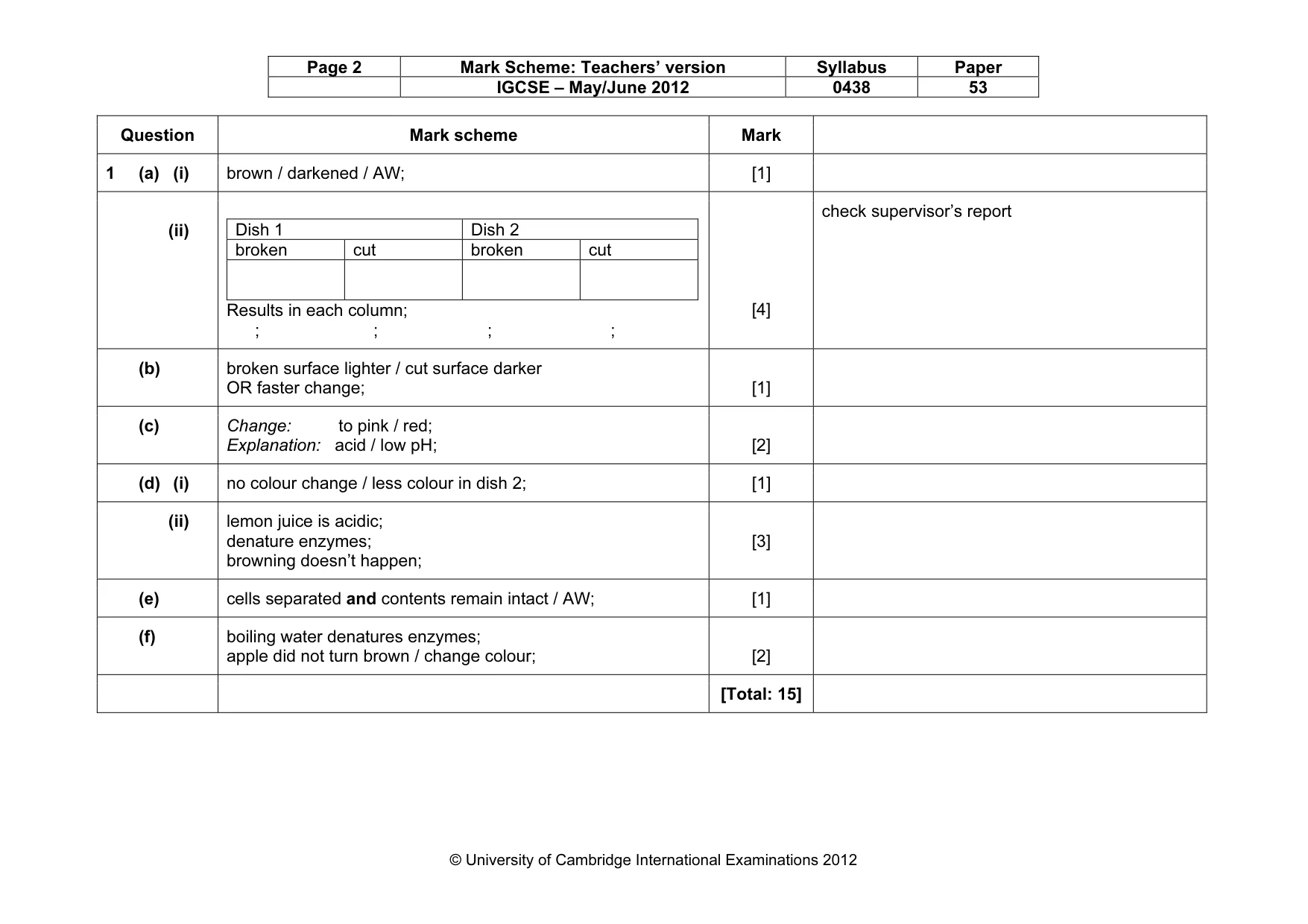
Page 2 Mark Scheme: Teachers’ version Syllabus Paper IGCSE – May/June 2012 0438 53 © University of Cambridge International Examinations 2012 Question Mark scheme Mark 1 (a) (i) brown / darkened / AW; [1] (ii) Dish 1 Dish 2 broken cut broken cut Results in each column; ; ; ; ; [4] check supervisor’s report (b) broken surface lighter / cut surface darker OR faster change; [1] (c) Change: to pink / red; Explanation: acid / low pH; [2] (d) (i) no colour change / less colour in dish 2; [1] (ii) lemon juice is acidic; denature enzymes; browning doesn’t happen; [3] (e) cells separated and contents remain intact / AW; [1] (f) boiling water denatures enzymes; apple did not turn brown / change colour; [2] [Total: 15]
Mark scheme, page 3
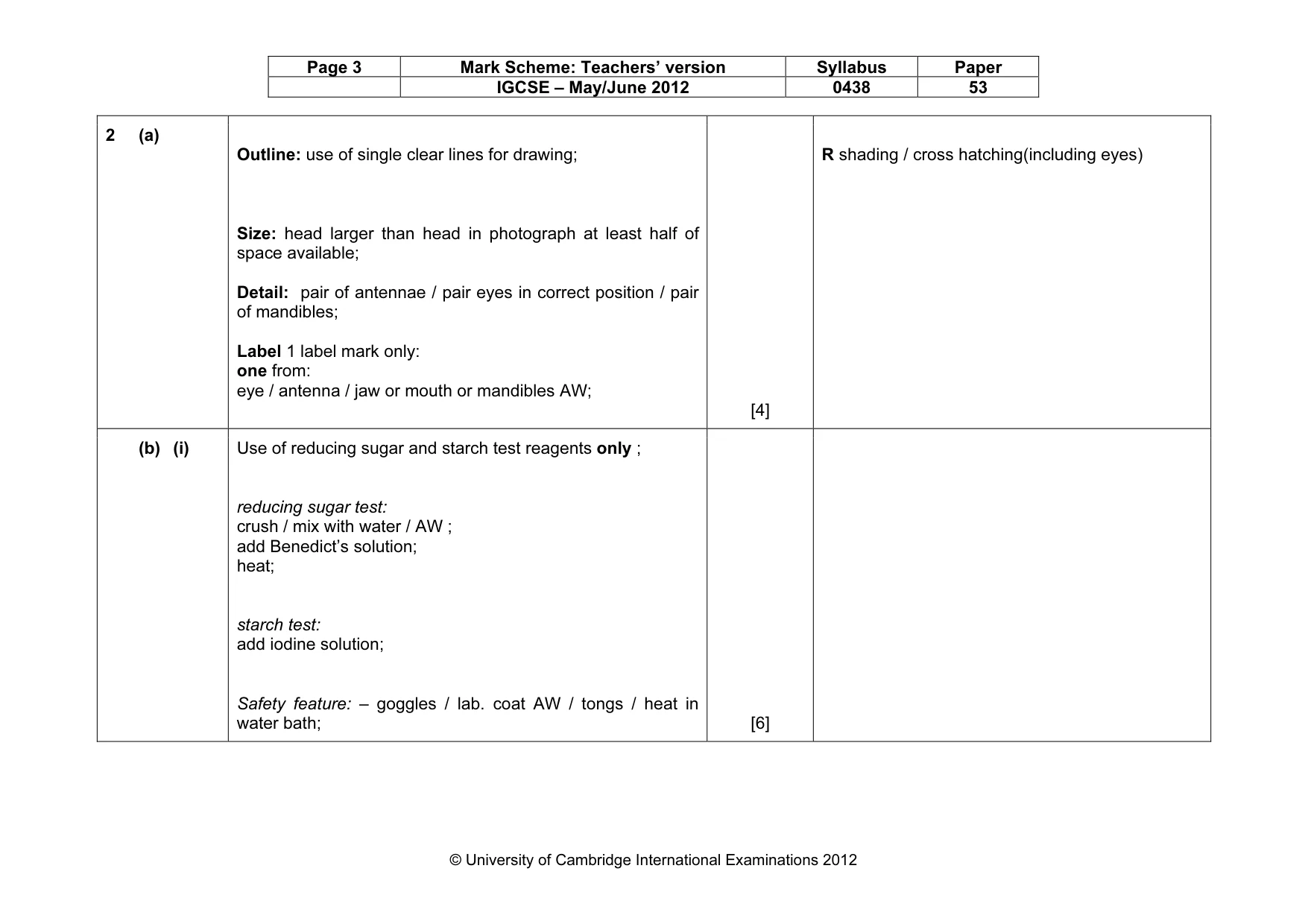
Page 3 Mark Scheme: Teachers’ version Syllabus Paper IGCSE – May/June 2012 0438 53 © University of Cambridge International Examinations 2012 2 (a) Outline: use of single clear lines for drawing; Size: head larger than head in photograph at least half of space available; Detail: pair of antennae / pair eyes in correct position / pair of mandibles; Label 1 label mark only: one from: eye / antenna / jaw or mouth or mandibles AW; [4] R shading / cross hatching(including eyes) (b) (i) Use of reducing sugar and starch test reagents only ; reducing sugar test: crush / mix with water / AW ; add Benedict’s solution; heat; starch test: add iodine solution; Safety feature: – goggles / lab. coat AW / tongs / heat in water bath; [6]
Mark scheme, page 4
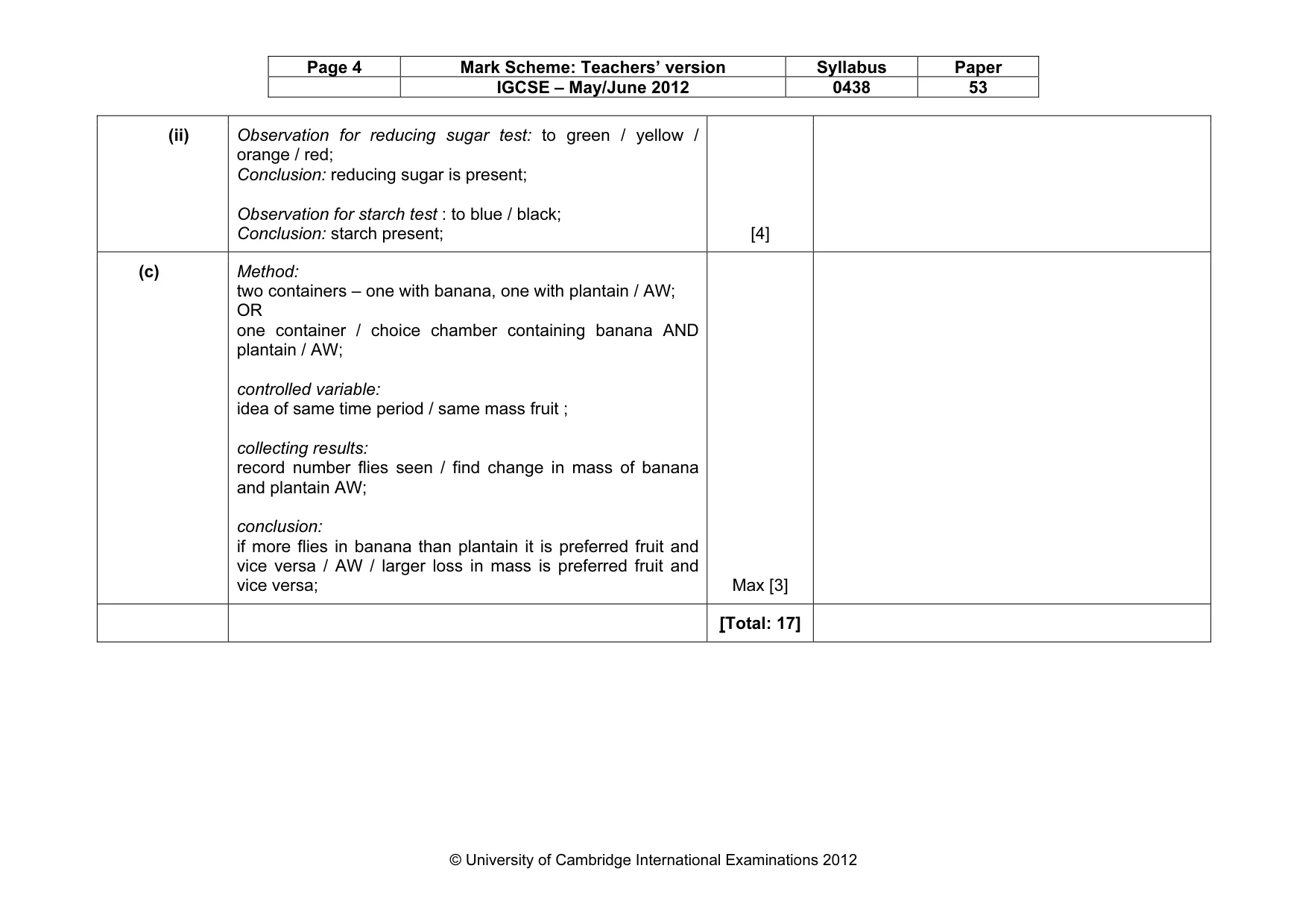
Page 4 Mark Scheme: Teachers’ version Syllabus Paper IGCSE – May/June 2012 0438 53 © University of Cambridge International Examinations 2012 (ii) Observation for reducing sugar test: to green / yellow / orange / red; Conclusion: reducing sugar is present; Observation for starch test : to blue / black; Conclusion: starch present; [4] (c) Method: two containers – one with banana, one with plantain / AW; OR one container / choice chamber containing banana AND plantain / AW; controlled variable: idea of same time period / same mass fruit ; collecting results: record number flies seen / find change in mass of banana and plantain AW; conclusion: if more flies in banana than plantain it is preferred fruit and vice versa / AW / larger loss in mass is preferred fruit and vice versa; Max [3] [Total: 17]
Mark scheme, page 5
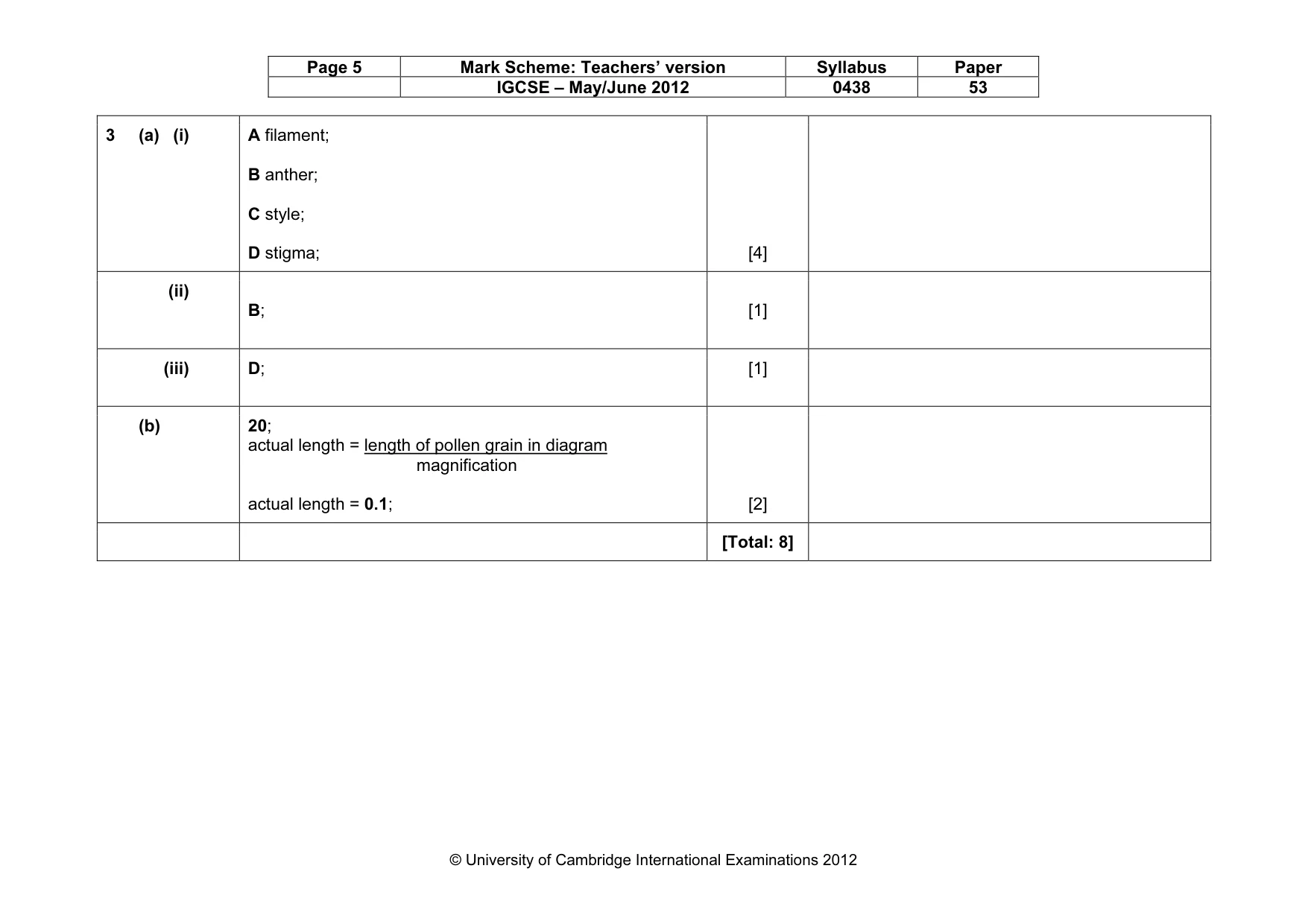
Page 5 Mark Scheme: Teachers’ version Syllabus Paper IGCSE – May/June 2012 0438 53 © University of Cambridge International Examinations 2012 3 (a) (i) A filament; B anther; C style; D stigma; [4] (ii) B; [1] (iii) D; [1] (b) 20; actual length = length of pollen grain in diagram magnification actual length = 0.1; [2] [Total: 8]
What you needed in this session
Cambridge’s own grade thresholds for 2012 May/June, Paper 5 · Variant 3. A higher threshold means an easier paper — the bar moves with how the cohort did.