Cambridge IGCSE Bahasa Indonesia 0538 — 2017 May/June Paper 2 · Variant 1
0538/21/M/J/17 · 40 marks · ≈45 min
The question paper and its mark scheme, free to read here and free to download. This is Cambridge’s own paper, exactly as it was sat.
Question paper8 pages
Mark scheme8 pages
Answers below. Sit the paper first if you are practising.
Paper as text
Question paper, page 1
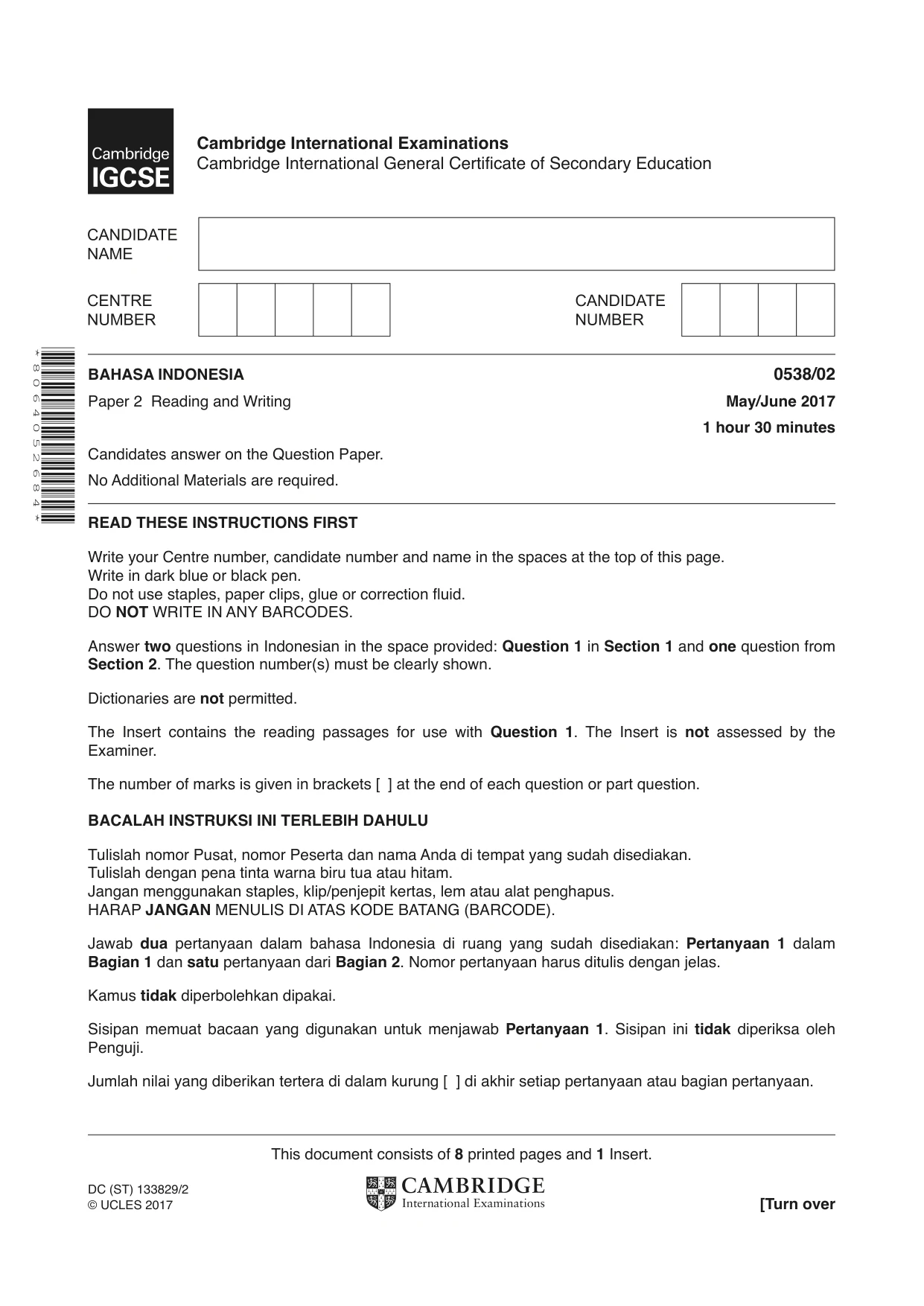
This document consists of 8 printed pages and 1 Insert. DC (ST) 133829/2 © UCLES 2017 [Turn over Cambridge International Examinations Cambridge International General Certificate of Secondary Education * 8 0 6 4 0 5 2 6 8 4 * BAHASA INDONESIA 0538/02 Paper 2 Reading and Writing May/June 2017 1 hour 30 minutes Candidates answer on the Question Paper. No Additional Materials are required. READ THESE INSTRUCTIONS FIRST Write your Centre number, candidate number and name in the spaces at the top of this page. Write in dark blue or black pen. Do not use staples, paper clips, glue or correction fluid. DO NOT WRITE IN ANY BARCODES. Answer two questions in Indonesian in the space provided: Question 1 in Section 1 and one question from Section 2. The question number(s) must be clearly shown. Dictionaries are not permitted. The Insert contains the reading passages for use with Question 1. The Insert is not assessed by the Examiner. The number of marks is given in brackets [ ] at the end of each question or part question. BACALAH INSTRUKSI INI TERLEBIH DAHULU Tulislah nomor Pusat, nomor Peserta dan nama Anda di tempat yang sudah disediakan. Tulislah dengan pena tinta warna biru tua atau hitam. Jangan menggunakan staples, klip/penjepit kertas, lem atau alat penghapus. HARAP JANGAN MENULIS DI ATAS KODE BATANG (BARCODE). Jawab dua pertanyaan dalam bahasa Indonesia di ruang yang sudah disediakan: Pertanyaan 1 dalam Bagian 1 dan satu pertanyaan dari Bagian 2. Nomor pertanyaan harus ditulis dengan jelas. Kamus tidak diperbolehkan dipakai. Sisipan memuat bacaan yang digunakan untuk menjawab Pertanyaan 1. Sisipan ini tidak diperiksa oleh Penguji. Jumlah nilai yang diberikan tertera di dalam kurung [ ] di akhir setiap pertanyaan atau bagian pertanyaan.
Question paper, page 2
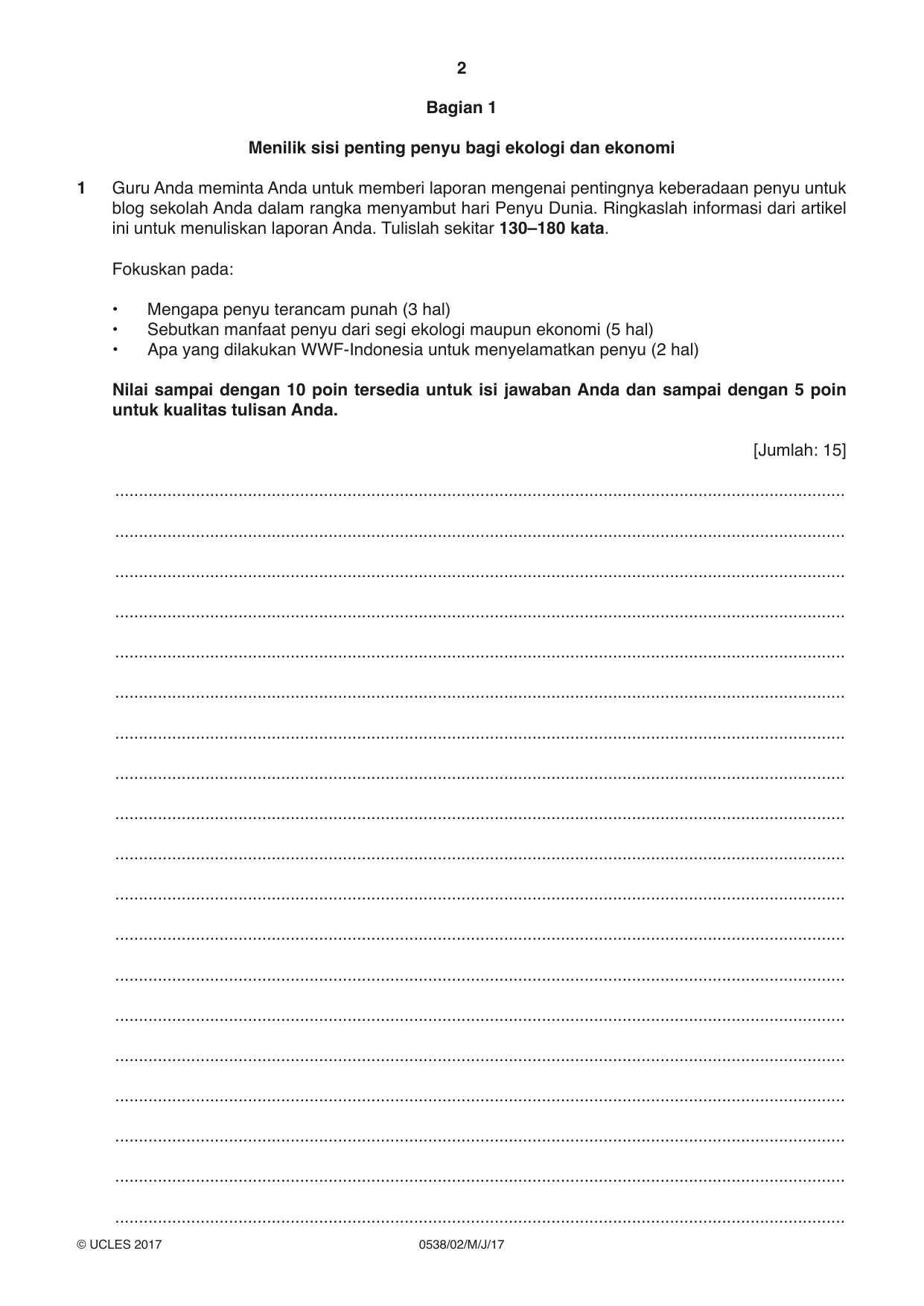
2 0538/02/M/J/17 © UCLES 2017 Bagian 1 Menilik sisi penting penyu bagi ekologi dan ekonomi 1 Guru Anda meminta Anda untuk memberi laporan mengenai pentingnya keberadaan penyu untuk blog sekolah Anda dalam rangka menyambut hari Penyu Dunia. Ringkaslah informasi dari artikel ini untuk menuliskan laporan Anda. Tulislah sekitar 130–180 kata. Fokuskan pada: • Mengapa penyu terancam punah (3 hal) • Sebutkan manfaat penyu dari segi ekologi maupun ekonomi (5 hal) • Apa yang dilakukan WWF-Indonesia untuk menyelamatkan penyu (2 hal) Nilai sampai dengan 10 poin tersedia untuk isi jawaban Anda dan sampai dengan 5 poin untuk kualitas tulisan Anda. [Jumlah: 15] … … … … … … … … … … … … … … … … … … …
Question paper, page 3
3 0538/02/M/J/17 © UCLES 2017 [Turn over … … … … … … … … … … … … … … … … … … …
Question paper, page 4
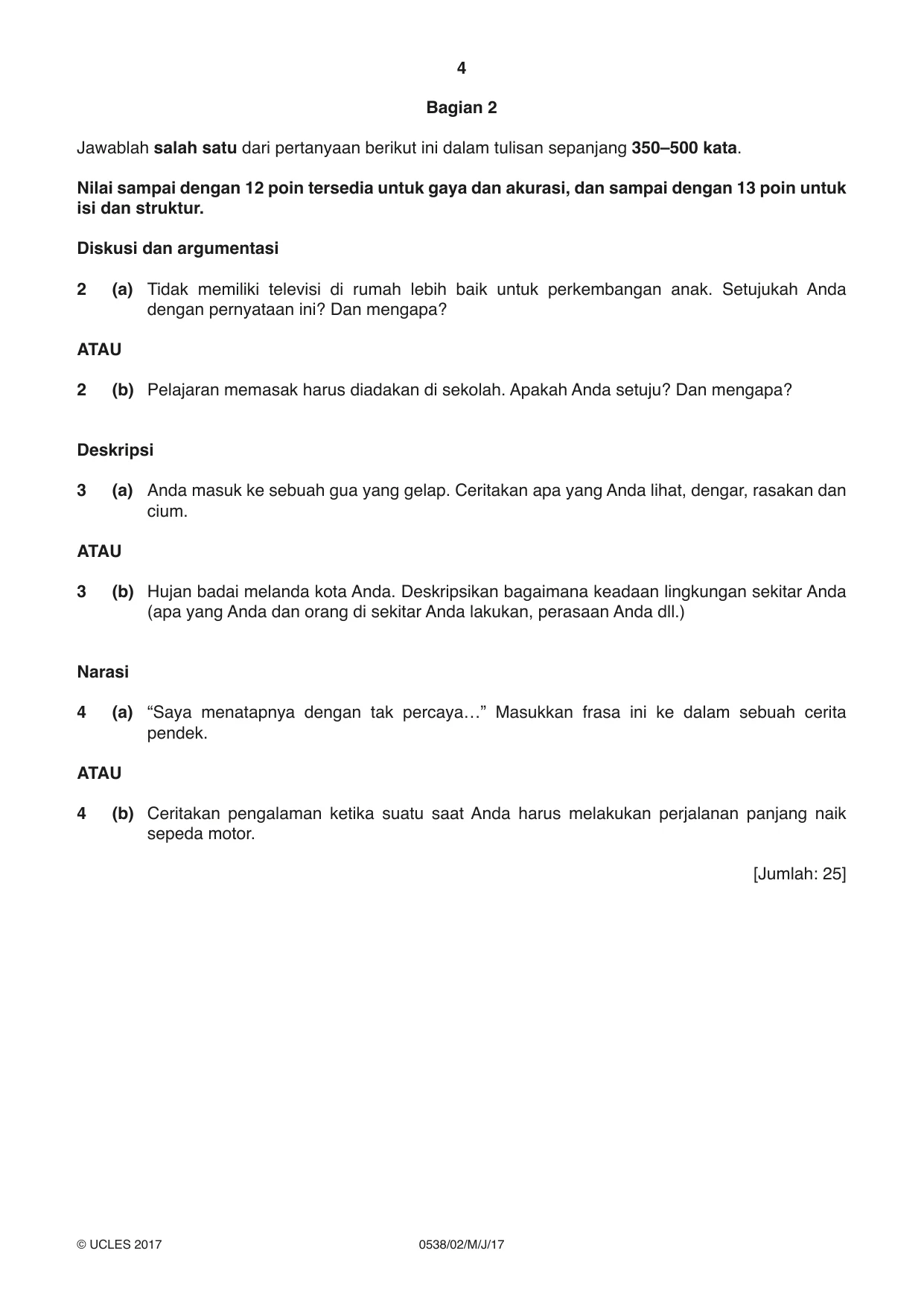
4 0538/02/M/J/17 © UCLES 2017 Bagian 2 Jawablah salah satu dari pertanyaan berikut ini dalam tulisan sepanjang 350–500 kata. Nilai sampai dengan 12 poin tersedia untuk gaya dan akurasi, dan sampai dengan 13 poin untuk isi dan struktur. Diskusi dan argumentasi 2 (a) Tidak memiliki televisi di rumah lebih baik untuk perkembangan anak. Setujukah Anda dengan pernyataan ini? Dan mengapa? ATAU 2 (b) Pelajaran memasak harus diadakan di sekolah. Apakah Anda setuju? Dan mengapa? Deskripsi 3 (a) Anda masuk ke sebuah gua yang gelap. Ceritakan apa yang Anda lihat, dengar, rasakan dan cium. ATAU 3 (b) Hujan badai melanda kota Anda. Deskripsikan bagaimana keadaan lingkungan sekitar Anda (apa yang Anda dan orang di sekitar Anda lakukan, perasaan Anda dll.) Narasi 4 (a) “Saya menatapnya dengan tak percaya…” Masukkan frasa ini ke dalam sebuah cerita pendek. ATAU 4 (b) Ceritakan pengalaman ketika suatu saat Anda harus melakukan perjalanan panjang naik sepeda motor. [Jumlah: 25]
Question paper, page 5
5 0538/02/M/J/17 © UCLES 2017 [Turn over Berilah tanda silang di kotak yang tersedia untuk menunjukkan pertanyaan mana yang Anda jawab. 2(a) 2(b) 3(a) 3(b) 4(a) 4(b) … … … … … … … … … … … … … … … … … … … … … … … … …
Question paper, page 6
6 0538/02/M/J/17 © UCLES 2017 … … … … … … … … … … … … … … … … … … … … … … … … … … … …
Question paper, page 7
7 0538/02/M/J/17 © UCLES 2017 [Turn over … … … … … … … … … … … … … … … … … … … … … … … … … … … …
Question paper, page 8
8 0538/02/M/J/17 © UCLES 2017 … … … … … … … … … … … … … … … … … … … … … … … … Permission to reproduce items where third-party owned material protected by copyright is included has been sought and cleared where possible. Every reasonable effort has been made by the publisher (UCLES) to trace copyright holders, but if any items requiring clearance have unwittingly been included, the publisher will be pleased to make amends at the earliest possible opportunity. To avoid the issue of disclosure of answer-related information to candidates, all copyright acknowledgements are reproduced online in the Cambridge International Examinations Copyright Acknowledgements Booklet. This is produced for each series of examinations and is freely available to download at www.cie.org.uk after the live examination series. Cambridge International Examinations is part of the Cambridge Assessment Group. Cambridge Assessment is the brand name of University of Cambridge Local Examinations Syndicate (UCLES), which is itself a department of the University of Cambridge.
Mark scheme, page 1
® IGCSE is a registered trademark. This document consists of 8 printed pages. © UCLES 2017 [Turn over Cambridge International Examinations Cambridge International General Certificate of Secondary Education BAHASA INDONESIA 0538/02 Paper 2 Reading and Writing May/June 2017 MARK SCHEME Maximum Mark: 40 Published This mark scheme is published as an aid to teachers and candidates, to indicate the requirements of the examination. It shows the basis on which Examiners were instructed to award marks. It does not indicate the details of the discussions that took place at an Examiners’ meeting before marking began, which would have considered the acceptability of alternative answers. Mark schemes should be read in conjunction with the question paper and the Principal Examiner Report for Teachers. Cambridge will not enter into discussions about these mark schemes. Cambridge is publishing the mark schemes for the May/June 2017 series for most Cambridge IGCSE®, Cambridge International A and AS Level and Cambridge Pre-U components, and some Cambridge O Level components.
Mark scheme, page 2
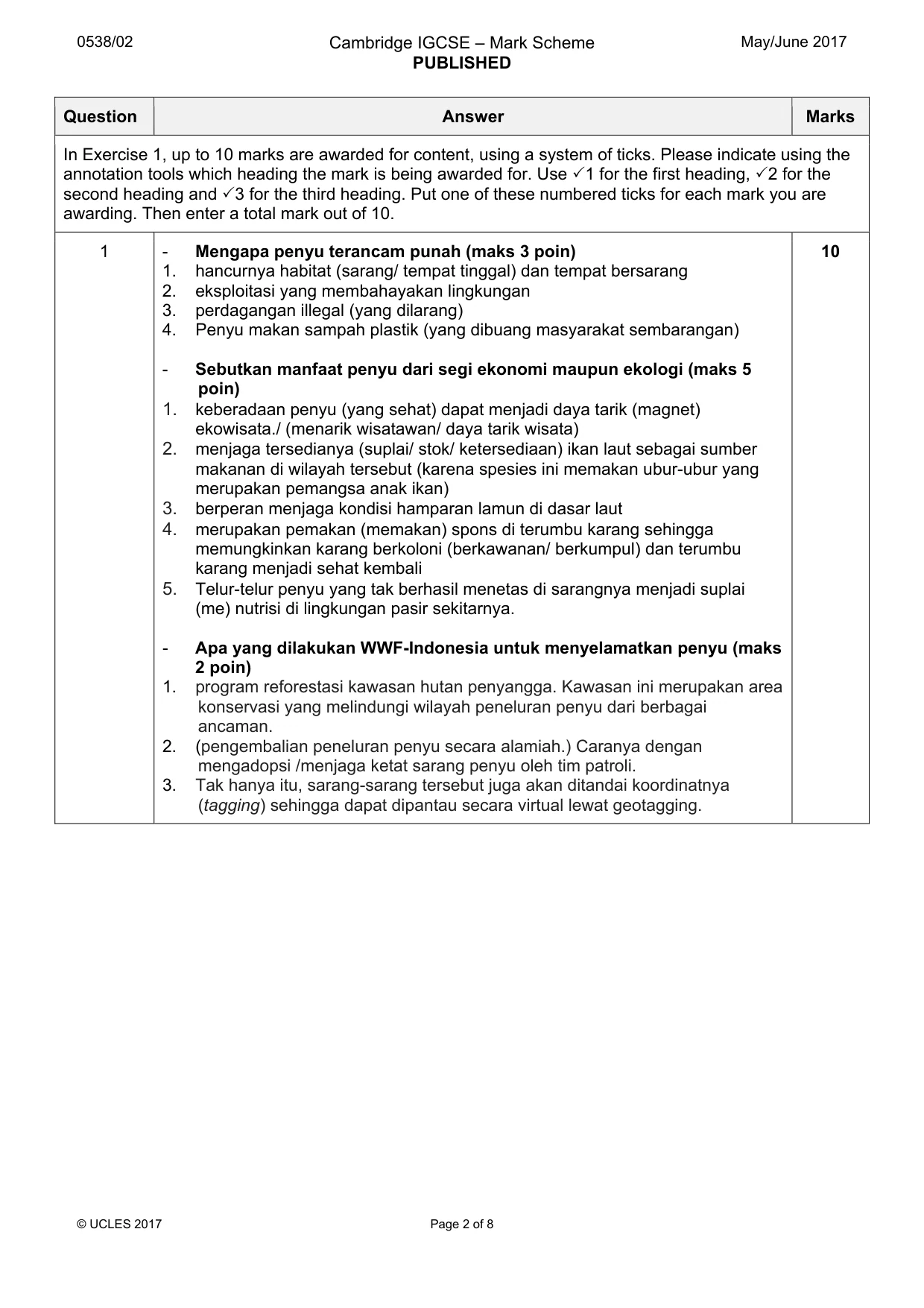
0538/02 Cambridge IGCSE – Mark Scheme PUBLISHED May/June 2017 © UCLES 2017 Page 2 of 8 Question Answer Marks In Exercise 1, up to 10 marks are awarded for content, using a system of ticks. Please indicate using the annotation tools which heading the mark is being awarded for. Use 31 for the first heading, 32 for the second heading and 33 for the third heading. Put one of these numbered ticks for each mark you are awarding. Then enter a total mark out of 10. 1 - Mengapa penyu terancam punah (maks 3 poin) 1. hancurnya habitat (sarang/ tempat tinggal) dan tempat bersarang 2. eksploitasi yang membahayakan lingkungan 3. perdagangan illegal (yang dilarang) 4. Penyu makan sampah plastik (yang dibuang masyarakat sembarangan) - Sebutkan manfaat penyu dari segi ekonomi maupun ekologi (maks 5 poin) 1. keberadaan penyu (yang sehat) dapat menjadi daya tarik (magnet) ekowisata./ (menarik wisatawan/ daya tarik wisata) 2. menjaga tersedianya (suplai/ stok/ ketersediaan) ikan laut sebagai sumber makanan di wilayah tersebut (karena spesies ini memakan ubur-ubur yang merupakan pemangsa anak ikan) 3. berperan menjaga kondisi hamparan lamun di dasar laut 4. merupakan pemakan (memakan) spons di terumbu karang sehingga memungkinkan karang berkoloni (berkawanan/ berkumpul) dan terumbu karang menjadi sehat kembali 5. Telur-telur penyu yang tak berhasil menetas di sarangnya menjadi suplai (me) nutrisi di lingkungan pasir sekitarnya. - Apa yang dilakukan WWF-Indonesia untuk menyelamatkan penyu (maks 2 poin) 1. program reforestasi kawasan hutan penyangga. Kawasan ini merupakan area konservasi yang melindungi wilayah peneluran penyu dari berbagai ancaman. 2. (pengembalian peneluran penyu secara alamiah.) Caranya dengan mengadopsi /menjaga ketat sarang penyu oleh tim patroli. 3. Tak hanya itu, sarang-sarang tersebut juga akan ditandai koordinatnya (tagging) sehingga dapat dipantau secara virtual lewat geotagging. 10
Mark scheme, page 3
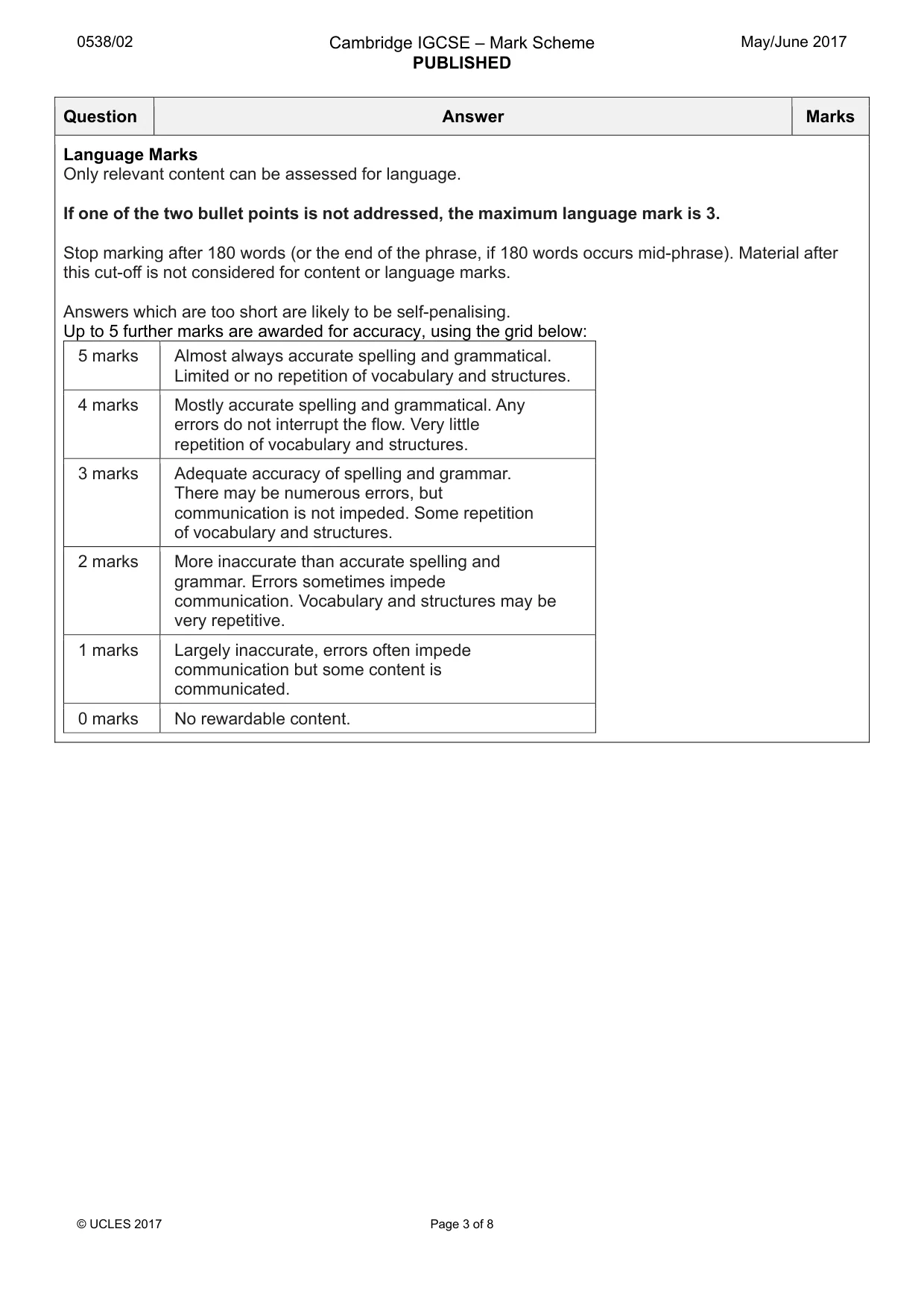
0538/02 Cambridge IGCSE – Mark Scheme PUBLISHED May/June 2017 © UCLES 2017 Page 3 of 8 Question Answer Marks Language Marks Only relevant content can be assessed for language. If one of the two bullet points is not addressed, the maximum language mark is 3. Stop marking after 180 words (or the end of the phrase, if 180 words occurs mid-phrase). Material after this cut-off is not considered for content or language marks. Answers which are too short are likely to be self-penalising. Up to 5 further marks are awarded for accuracy, using the grid below: 5 marks Almost always accurate spelling and grammatical. Limited or no repetition of vocabulary and structures. 4 marks Mostly accurate spelling and grammatical. Any errors do not interrupt the flow. Very little repetition of vocabulary and structures. 3 marks Adequate accuracy of spelling and grammar. There may be numerous errors, but communication is not impeded. Some repetition of vocabulary and structures. 2 marks More inaccurate than accurate spelling and grammar. Errors sometimes impede communication. Vocabulary and structures may be very repetitive. 1 marks Largely inaccurate, errors often impede communication but some content is communicated. 0 marks No rewardable content.
Mark scheme, page 4
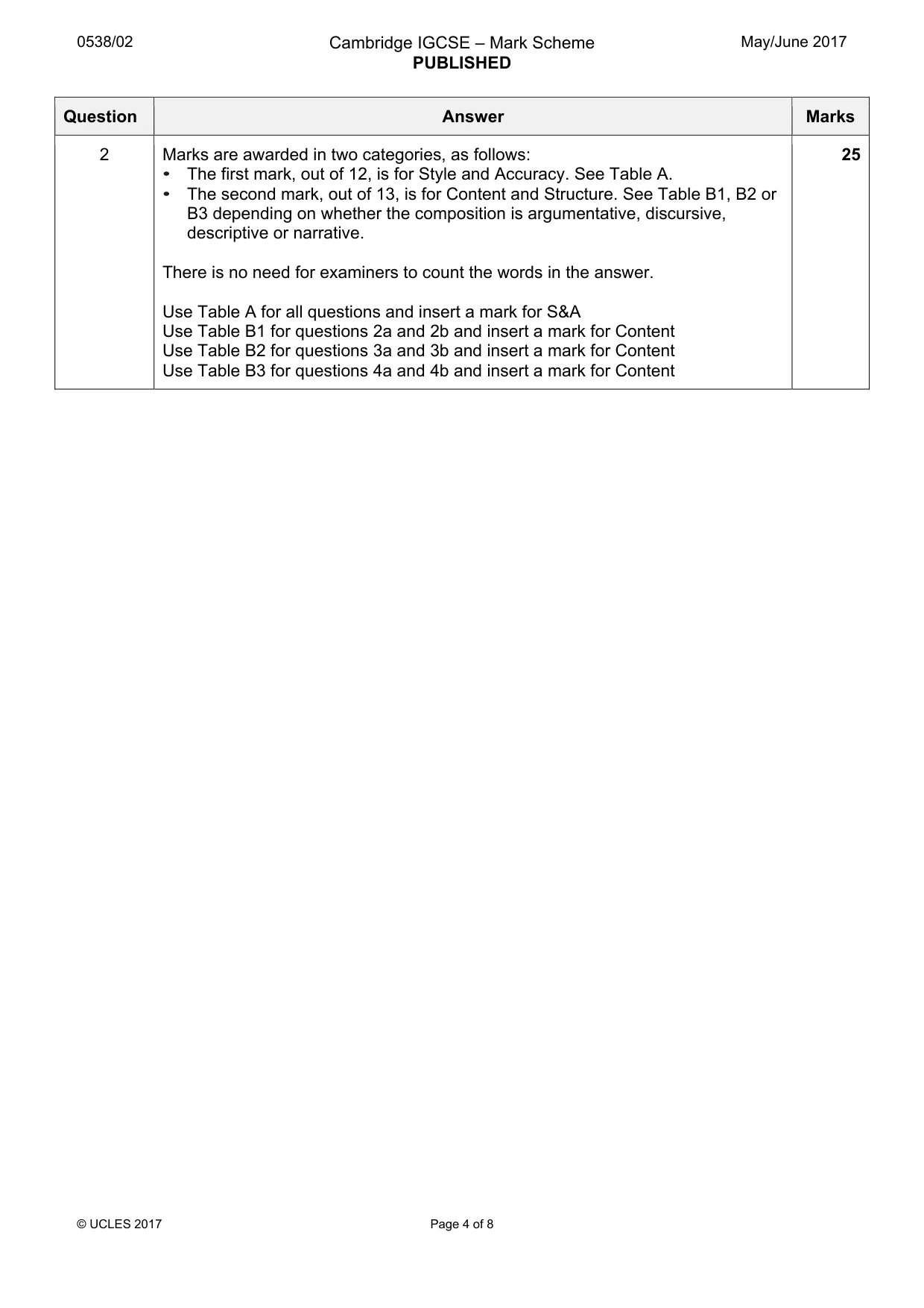
0538/02 Cambridge IGCSE – Mark Scheme PUBLISHED May/June 2017 © UCLES 2017 Page 4 of 8 Question Answer Marks 2 Marks are awarded in two categories, as follows: • The first mark, out of 12, is for Style and Accuracy. See Table A. • The second mark, out of 13, is for Content and Structure. See Table B1, B2 or B3 depending on whether the composition is argumentative, discursive, descriptive or narrative. There is no need for examiners to count the words in the answer. Use Table A for all questions and insert a mark for S&A Use Table B1 for questions 2a and 2b and insert a mark for Content Use Table B2 for questions 3a and 3b and insert a mark for Content Use Table B3 for questions 4a and 4b and insert a mark for Content 25
Mark scheme, page 5
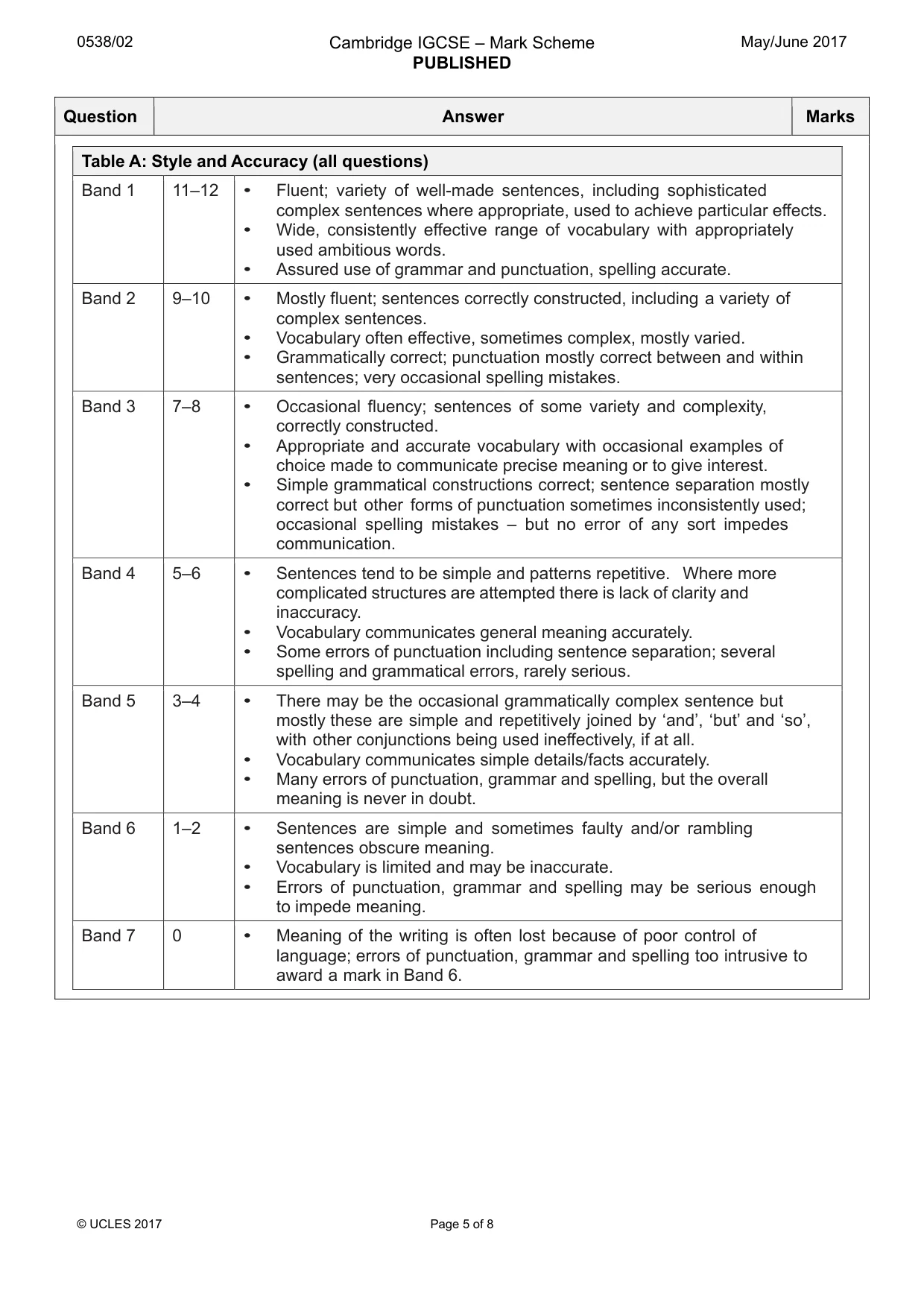
0538/02 Cambridge IGCSE – Mark Scheme PUBLISHED May/June 2017 © UCLES 2017 Page 5 of 8 Question Answer Marks Table A: Style and Accuracy (all questions) Band 1 11–12 • Fluent; variety of well-made sentences, including sophisticated complex sentences where appropriate, used to achieve particular effects. • Wide, consistently effective range of vocabulary with appropriately used ambitious words. • Assured use of grammar and punctuation, spelling accurate. Band 2 9–10 • Mostly fluent; sentences correctly constructed, including a variety of complex sentences. • Vocabulary often effective, sometimes complex, mostly varied. • Grammatically correct; punctuation mostly correct between and within sentences; very occasional spelling mistakes. Band 3 7–8 • Occasional fluency; sentences of some variety and complexity, correctly constructed. • Appropriate and accurate vocabulary with occasional examples of choice made to communicate precise meaning or to give interest. • Simple grammatical constructions correct; sentence separation mostly correct but other forms of punctuation sometimes inconsistently used; occasional spelling mistakes – but no error of any sort impedes communication. Band 4 5–6 • Sentences tend to be simple and patterns repetitive. Where more complicated structures are attempted there is lack of clarity and inaccuracy. • Vocabulary communicates general meaning accurately. • Some errors of punctuation including sentence separation; several spelling and grammatical errors, rarely serious. Band 5 3–4 • There may be the occasional grammatically complex sentence but mostly these are simple and repetitively joined by ‘and’, ‘but’ and ‘so’, with other conjunctions being used ineffectively, if at all. • Vocabulary communicates simple details/facts accurately. • Many errors of punctuation, grammar and spelling, but the overall meaning is never in doubt. Band 6 1–2 • Sentences are simple and sometimes faulty and/or rambling sentences obscure meaning. • Vocabulary is limited and may be inaccurate. • Errors of punctuation, grammar and spelling may be serious enough to impede meaning. Band 7 0 • Meaning of the writing is often lost because of poor control of language; errors of punctuation, grammar and spelling too intrusive to award a mark in Band 6.
Mark scheme, page 6
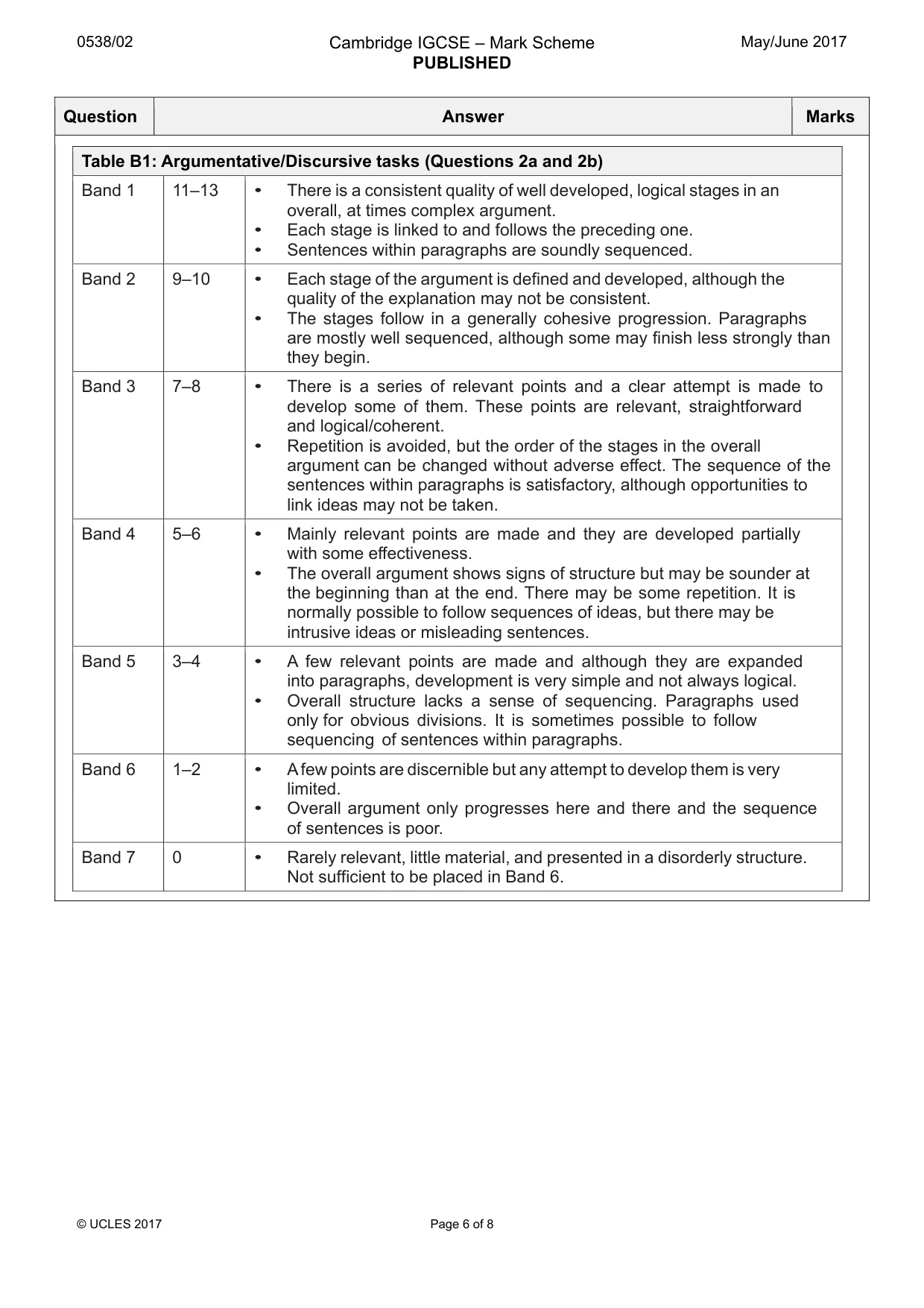
0538/02 Cambridge IGCSE – Mark Scheme PUBLISHED May/June 2017 © UCLES 2017 Page 6 of 8 Question Answer Marks Table B1: Argumentative/Discursive tasks (Questions 2a and 2b) Band 1 11–13 • There is a consistent quality of well developed, logical stages in an overall, at times complex argument. • Each stage is linked to and follows the preceding one. • Sentences within paragraphs are soundly sequenced. Band 2 9–10 • Each stage of the argument is defined and developed, although the quality of the explanation may not be consistent. • The stages follow in a generally cohesive progression. Paragraphs are mostly well sequenced, although some may finish less strongly than they begin. Band 3 7–8 • There is a series of relevant points and a clear attempt is made to develop some of them. These points are relevant, straightforward and logical/coherent. • Repetition is avoided, but the order of the stages in the overall argument can be changed without adverse effect. The sequence of the sentences within paragraphs is satisfactory, although opportunities to link ideas may not be taken. Band 4 5–6 • Mainly relevant points are made and they are developed partially with some effectiveness. • The overall argument shows signs of structure but may be sounder at the beginning than at the end. There may be some repetition. It is normally possible to follow sequences of ideas, but there may be intrusive ideas or misleading sentences. Band 5 3–4 • A few relevant points are made and although they are expanded into paragraphs, development is very simple and not always logical. • Overall structure lacks a sense of sequencing. Paragraphs used only for obvious divisions. It is sometimes possible to follow sequencing of sentences within paragraphs. Band 6 1–2 • A few points are discernible but any attempt to develop them is very limited. • Overall argument only progresses here and there and the sequence of sentences is poor. Band 7 0 • Rarely relevant, little material, and presented in a disorderly structure. Not sufficient to be placed in Band 6.
Mark scheme, page 7
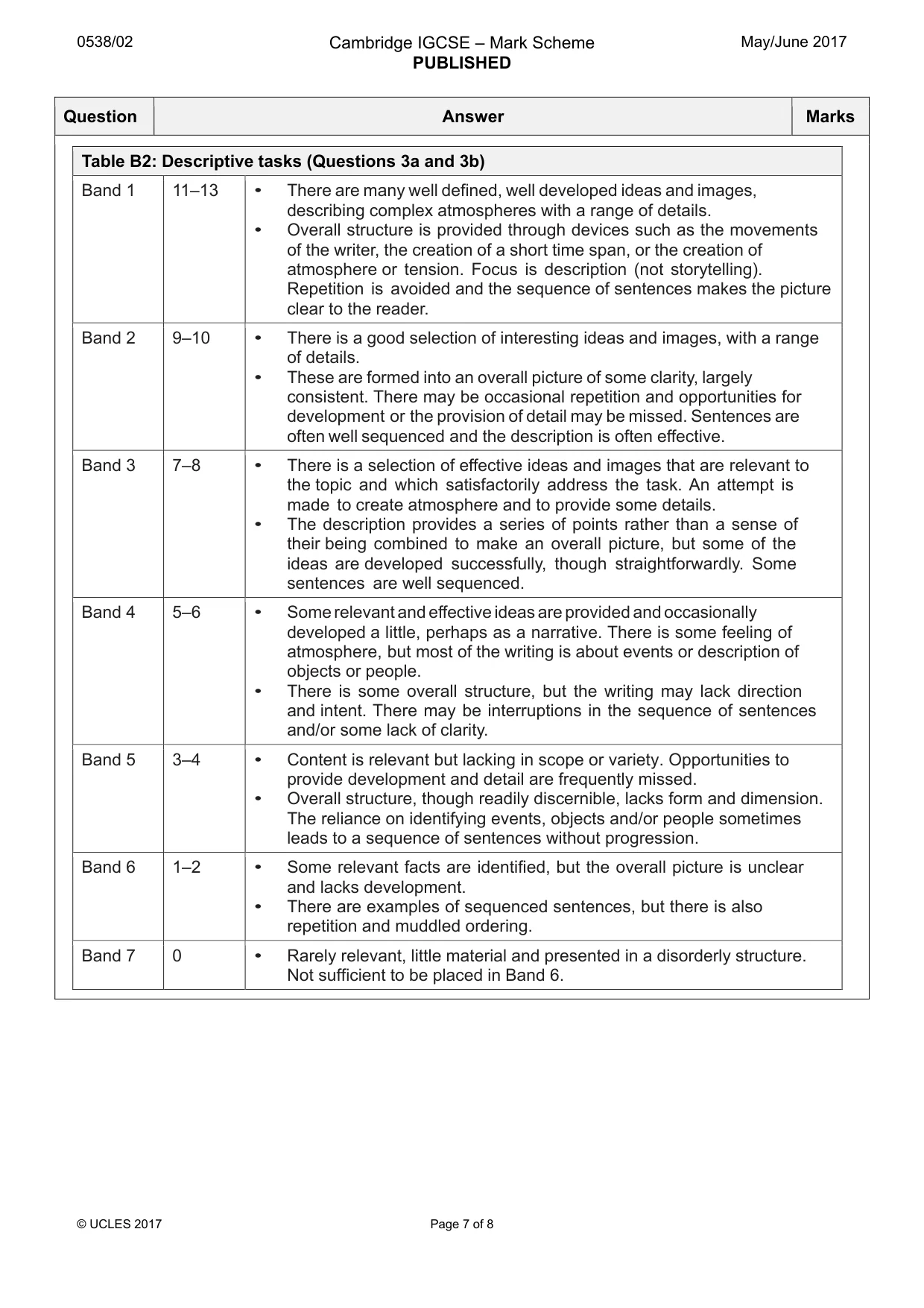
0538/02 Cambridge IGCSE – Mark Scheme PUBLISHED May/June 2017 © UCLES 2017 Page 7 of 8 Question Answer Marks Table B2: Descriptive tasks (Questions 3a and 3b) Band 1 11–13 • There are many well defined, well developed ideas and images, describing complex atmospheres with a range of details. • Overall structure is provided through devices such as the movements of the writer, the creation of a short time span, or the creation of atmosphere or tension. Focus is description (not storytelling). Repetition is avoided and the sequence of sentences makes the picture clear to the reader. Band 2 9–10 • There is a good selection of interesting ideas and images, with a range of details. • These are formed into an overall picture of some clarity, largely consistent. There may be occasional repetition and opportunities for development or the provision of detail may be missed. Sentences are often well sequenced and the description is often effective. Band 3 7–8 • There is a selection of effective ideas and images that are relevant to the topic and which satisfactorily address the task. An attempt is made to create atmosphere and to provide some details. • The description provides a series of points rather than a sense of their being combined to make an overall picture, but some of the ideas are developed successfully, though straightforwardly. Some sentences are well sequenced. Band 4 5–6 • Some relevant and effective ideas are provided and occasionally developed a little, perhaps as a narrative. There is some feeling of atmosphere, but most of the writing is about events or description of objects or people. • There is some overall structure, but the writing may lack direction and intent. There may be interruptions in the sequence of sentences and/or some lack of clarity. Band 5 3–4 • Content is relevant but lacking in scope or variety. Opportunities to provide development and detail are frequently missed. • Overall structure, though readily discernible, lacks form and dimension. The reliance on identifying events, objects and/or people sometimes leads to a sequence of sentences without progression. Band 6 1–2 • Some relevant facts are identified, but the overall picture is unclear and lacks development. • There are examples of sequenced sentences, but there is also repetition and muddled ordering. Band 7 0 • Rarely relevant, little material and presented in a disorderly structure. Not sufficient to be placed in Band 6.
Mark scheme, page 8
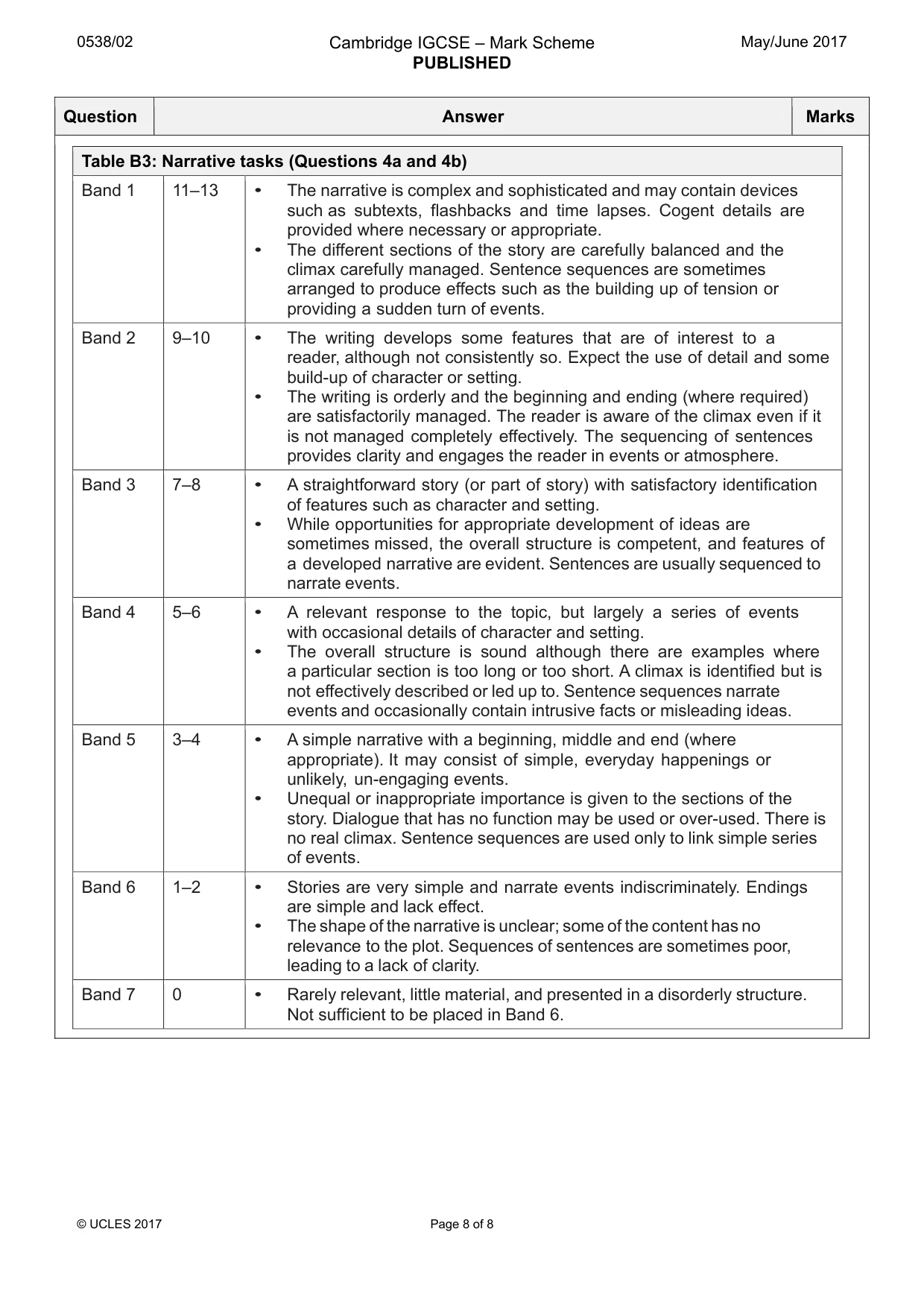
0538/02 Cambridge IGCSE – Mark Scheme PUBLISHED May/June 2017 © UCLES 2017 Page 8 of 8 Question Answer Marks Table B3: Narrative tasks (Questions 4a and 4b) Band 1 11–13 • The narrative is complex and sophisticated and may contain devices such as subtexts, flashbacks and time lapses. Cogent details are provided where necessary or appropriate. • The different sections of the story are carefully balanced and the climax carefully managed. Sentence sequences are sometimes arranged to produce effects such as the building up of tension or providing a sudden turn of events. Band 2 9–10 • The writing develops some features that are of interest to a reader, although not consistently so. Expect the use of detail and some build-up of character or setting. • The writing is orderly and the beginning and ending (where required) are satisfactorily managed. The reader is aware of the climax even if it is not managed completely effectively. The sequencing of sentences provides clarity and engages the reader in events or atmosphere. Band 3 7–8 • A straightforward story (or part of story) with satisfactory identification of features such as character and setting. • While opportunities for appropriate development of ideas are sometimes missed, the overall structure is competent, and features of a developed narrative are evident. Sentences are usually sequenced to narrate events. Band 4 5–6 • A relevant response to the topic, but largely a series of events with occasional details of character and setting. • The overall structure is sound although there are examples where a particular section is too long or too short. A climax is identified but is not effectively described or led up to. Sentence sequences narrate events and occasionally contain intrusive facts or misleading ideas. Band 5 3–4 • A simple narrative with a beginning, middle and end (where appropriate). It may consist of simple, everyday happenings or unlikely, un-engaging events. • Unequal or inappropriate importance is given to the sections of the story. Dialogue that has no function may be used or over-used. There is no real climax. Sentence sequences are used only to link simple series of events. Band 6 1–2 • Stories are very simple and narrate events indiscriminately. Endings are simple and lack effect. • The shape of the narrative is unclear; some of the content has no relevance to the plot. Sequences of sentences are sometimes poor, leading to a lack of clarity. Band 7 0 • Rarely relevant, little material, and presented in a disorderly structure. Not sufficient to be placed in Band 6.
What you needed in this session
Cambridge’s own grade thresholds for 2017 May/June, Paper 2 · Variant 1. A higher threshold means an easier paper — the bar moves with how the cohort did.