Cambridge IGCSE Art and Design 0400 — 2026 Feb/March Paper 2 · Variant 0
0400/20/F/M/26
The question paper and its mark scheme, free to read here and free to download. This is Cambridge’s own paper, exactly as it was sat.
Question paper4 pages
Mark scheme
No mark scheme is in the library for this paper.
Paper as text
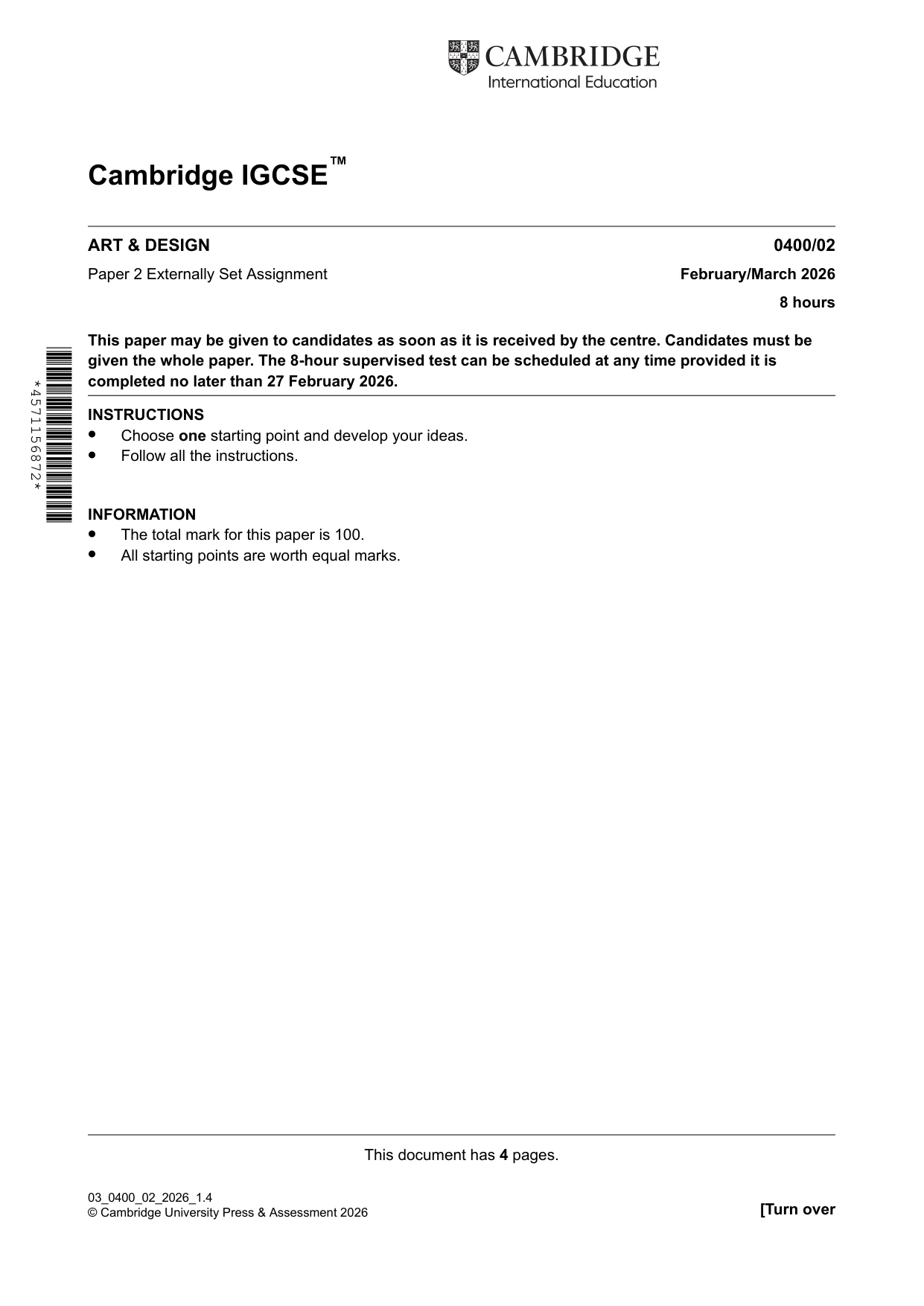
Question paper, page 1
Cambridge IGCSE™ 0400/02 ART & DESIGN February/March 2026 Paper 2 Externally Set Assignment 8 hours This paper may be given to candidates as soon as it is received by the centre. Candidates must be given the whole paper. The 8-hour supervised test can be scheduled at any time provided it is completed no later than 27 February 2026. INSTRUCTIONS • Choose one starting point and develop your ideas. • Follow all the instructions. INFORMATION • The total mark for this paper is 100. • All starting points are worth equal marks. This document has 4 pages. [Turn over 03_0400_02_2026_1.4 © Cambridge University Press & Assessment 2026 *4571156872*
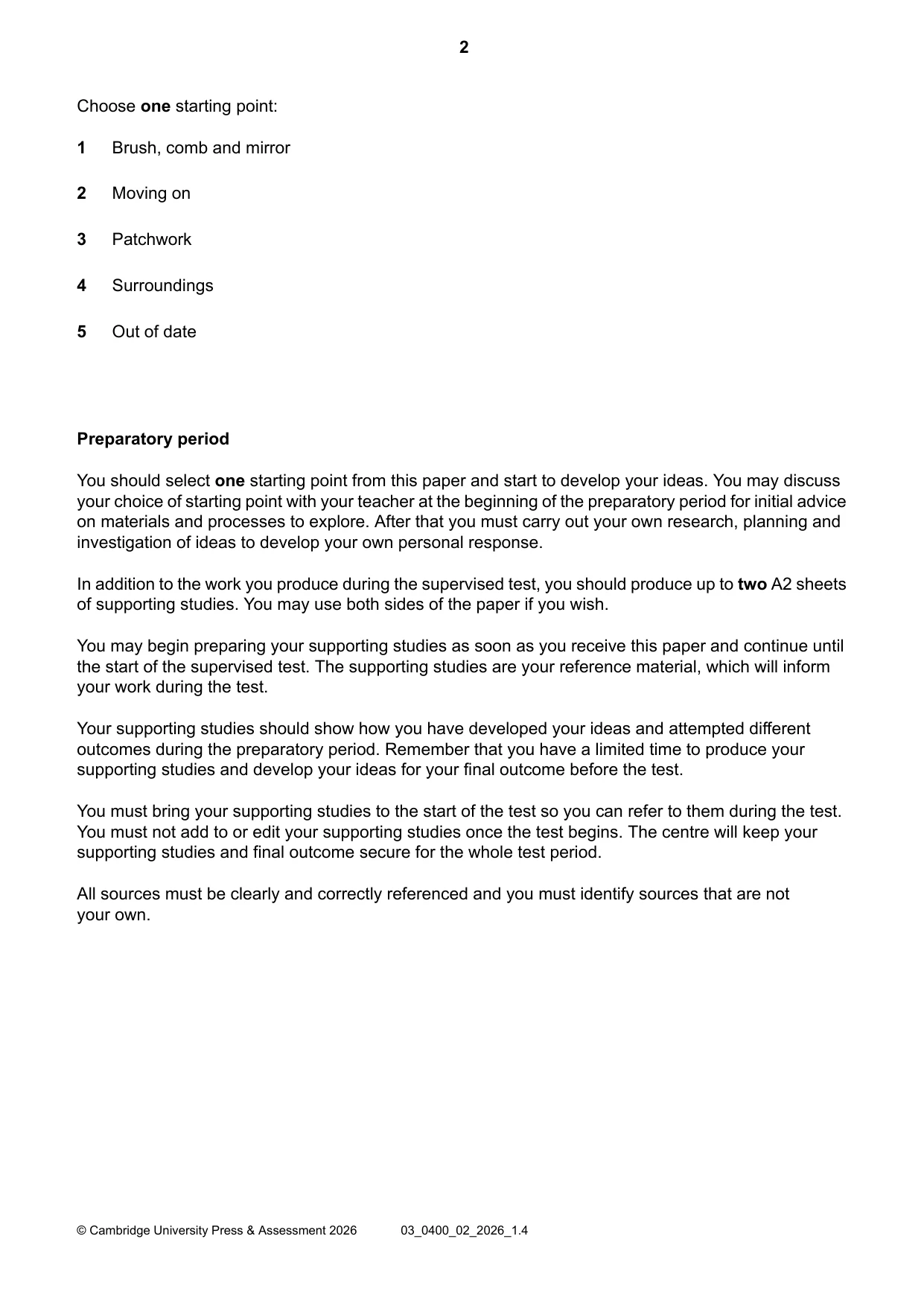
Question paper, page 2
Choose one starting point: Brush, comb and mirror 1 Moving on 2 Patchwork 3 Surroundings 4 Out of date 5 Preparatory period You should select one starting point from this paper and start to develop your ideas. You may discuss your choice of starting point with your teacher at the beginning of the preparatory period for initial advice on materials and processes to explore. After that you must carry out your own research, planning and investigation of ideas to develop your own personal response. In addition to the work you produce during the supervised test, you should produce up to two A2 sheets of supporting studies. You may use both sides of the paper if you wish. You may begin preparing your supporting studies as soon as you receive this paper and continue until the start of the supervised test. The supporting studies are your reference material, which will inform your work during the test. Your supporting studies should show how you have developed your ideas and attempted different outcomes during the preparatory period. Remember that you have a limited time to produce your supporting studies and develop your ideas for your final outcome before the test. You must bring your supporting studies to the start of the test so you can refer to them during the test. You must not add to or edit your supporting studies once the test begins. The centre will keep your supporting studies and final outcome secure for the whole test period. All sources must be clearly and correctly referenced and you must identify sources that are not your own. 03_0400_02_2026_1.4 © Cambridge University Press & Assessment 2026 2
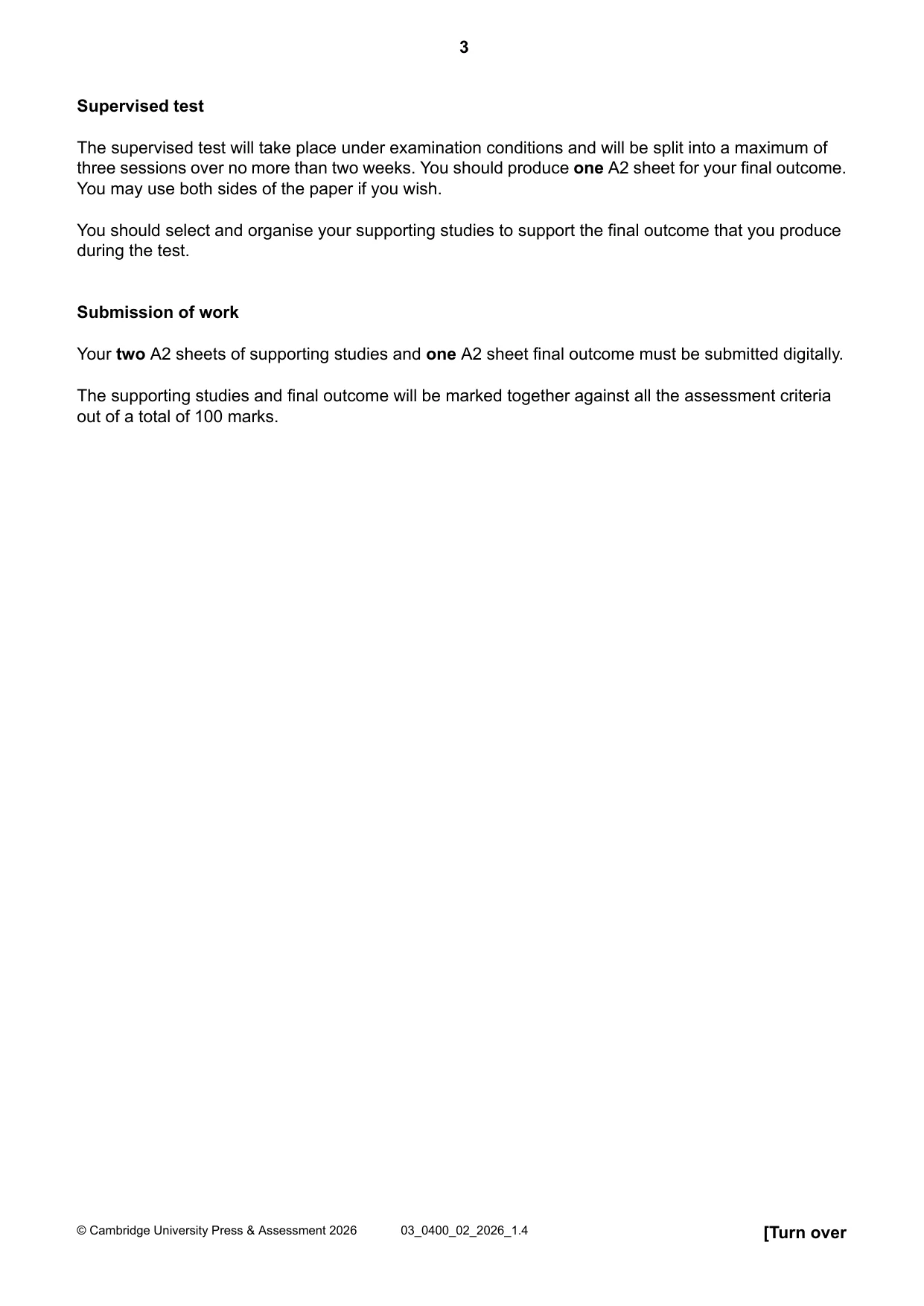
Question paper, page 3
Supervised test The supervised test will take place under examination conditions and will be split into a maximum of three sessions over no more than two weeks. You should produce one A2 sheet for your final outcome. You may use both sides of the paper if you wish. You should select and organise your supporting studies to support the final outcome that you produce during the test. Submission of work Your two A2 sheets of supporting studies and one A2 sheet final outcome must be submitted digitally. The supporting studies and final outcome will be marked together against all the assessment criteria out of a total of 100 marks. [Turn over 03_0400_02_2026_1.4 © Cambridge University Press & Assessment 2026 3
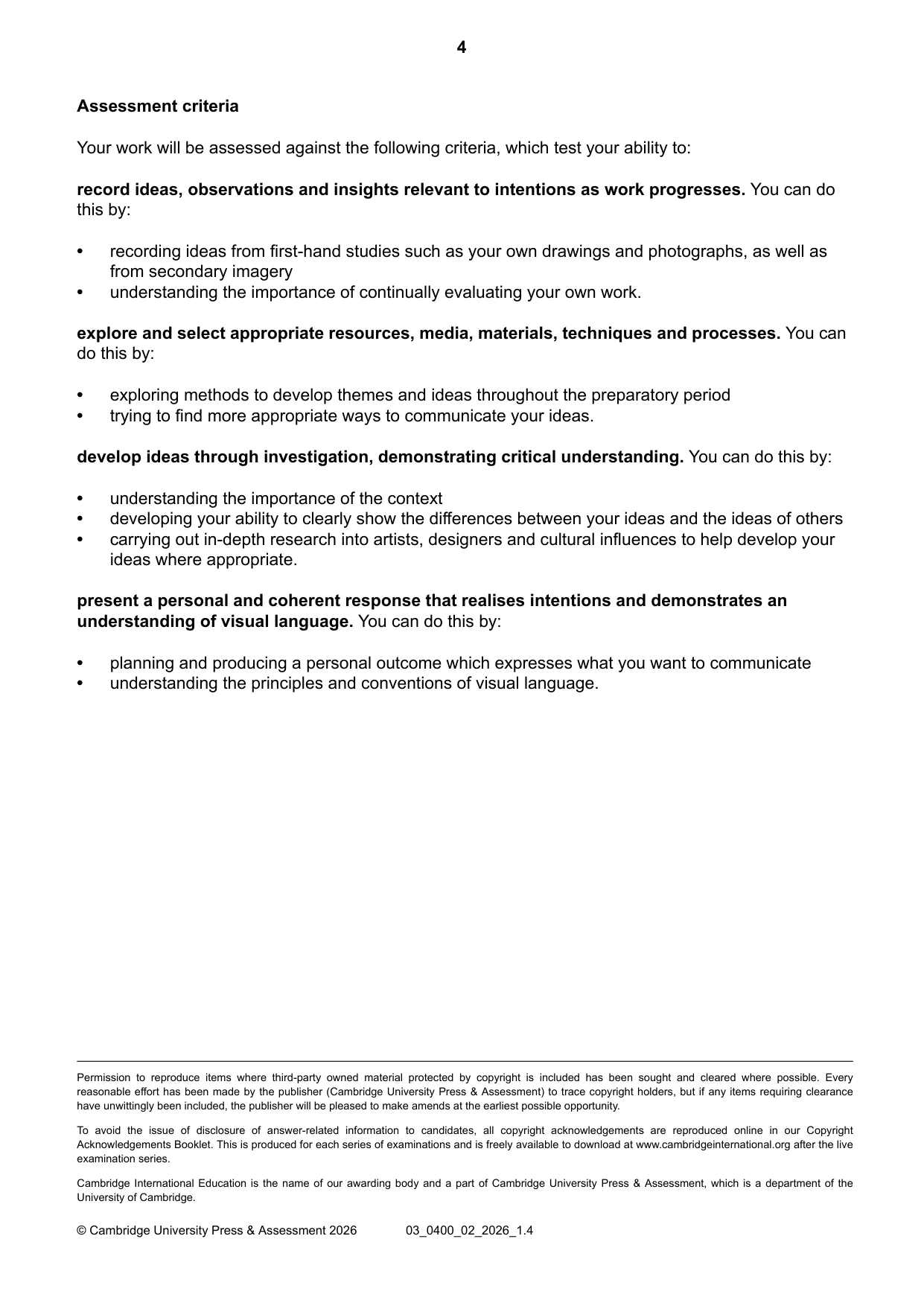
Question paper, page 4
Assessment criteria Your work will be assessed against the following criteria, which test your ability to: record ideas, observations and insights relevant to intentions as work progresses. You can do this by: • recording ideas from first-hand studies such as your own drawings and photographs, as well as from secondary imagery • understanding the importance of continually evaluating your own work. explore and select appropriate resources, media, materials, techniques and processes. You can do this by: • exploring methods to develop themes and ideas throughout the preparatory period • trying to find more appropriate ways to communicate your ideas. develop ideas through investigation, demonstrating critical understanding. You can do this by: • understanding the importance of the context • developing your ability to clearly show the differences between your ideas and the ideas of others • carrying out in-depth research into artists, designers and cultural influences to help develop your ideas where appropriate. present a personal and coherent response that realises intentions and demonstrates an understanding of visual language. You can do this by: • planning and producing a personal outcome which expresses what you want to communicate • understanding the principles and conventions of visual language. Permission to reproduce items where third-party owned material protected by copyright is included has been sought and cleared where possible. Every reasonable effort has been made by the publisher (Cambridge University Press & Assessment) to trace copyright holders, but if any items requiring clearance have unwittingly been included, the publisher will be pleased to make amends at the earliest possible opportunity. To avoid the issue of disclosure of answer-related information to candidates, all copyright acknowledgements are reproduced online in our Copyright Acknowledgements Booklet. This is produced for each series of examinations and is freely available to download at www.cambridgeinternational.org after the live examination series. Cambridge International Education is the name of our awarding body and a part of Cambridge University Press & Assessment, which is a department of the University of Cambridge. 03_0400_02_2026_1.4 © Cambridge University Press & Assessment 2026 4