Cambridge IGCSE Art and Design 0400 — 2014 May/June Paper 1 · Variant 1
0400/11/M/J/14 · 100 marks · ≈113 min
The question paper and its mark scheme, free to read here and free to download. This is Cambridge’s own paper, exactly as it was sat.
Question paper2 pages
Mark scheme4 pages
Answers below. Sit the paper first if you are practising.
Paper as text
Question paper, page 1
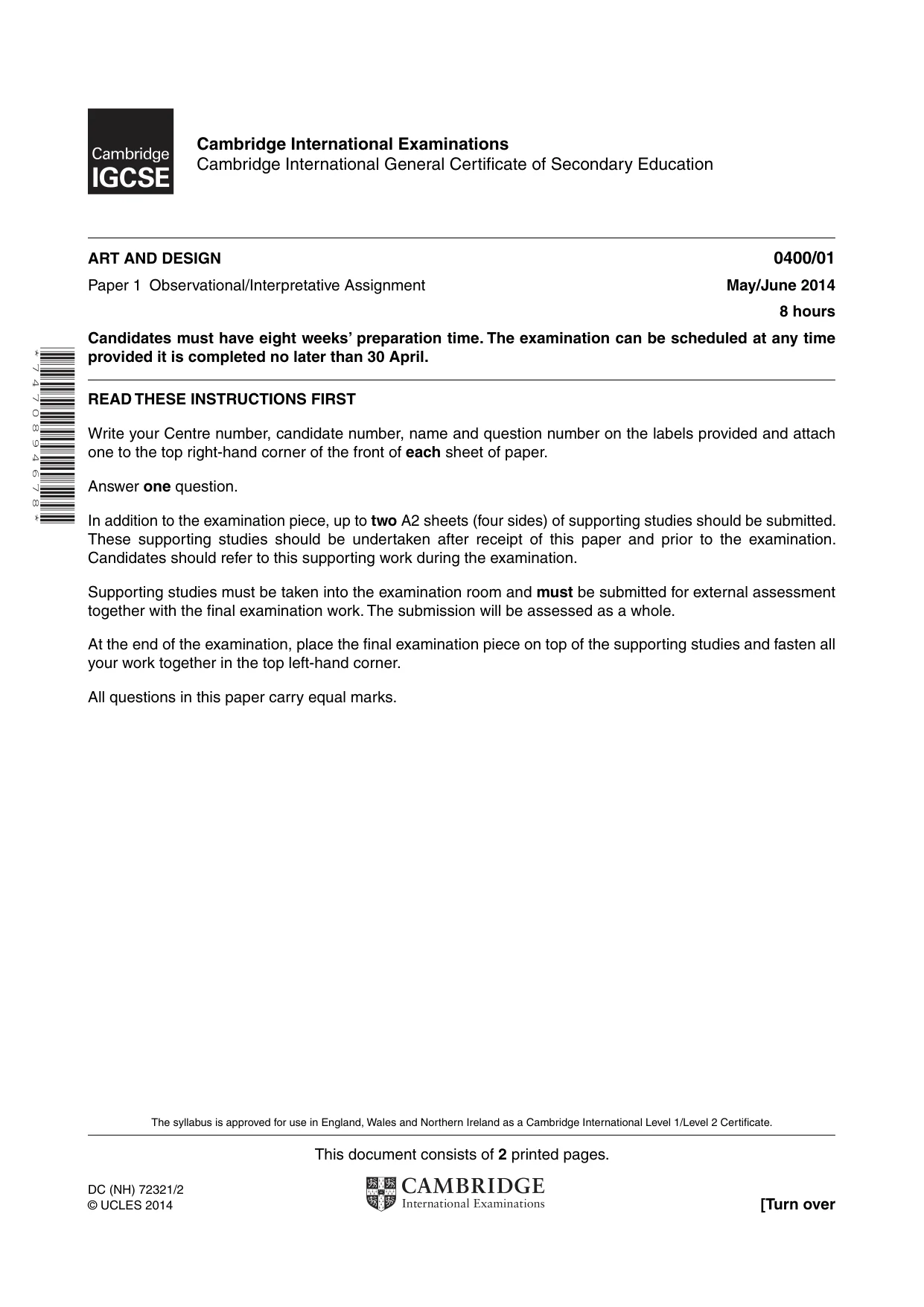
This document consists of 2 printed pages. DC (NH) 72321/2 © UCLES 2014 [Turn over * 7 4 7 0 8 9 4 6 7 8 * ART AND DESIGN 0400/01 Paper 1 Observational/Interpretative Assignment May/June 2014 8 hours Candidates must have eight weeks’ preparation time. The examination can be scheduled at any time provided it is completed no later than 30 April. READ THESE INSTRUCTIONS FIRST Write your Centre number, candidate number, name and question number on the labels provided and attach one to the top right-hand corner of the front of each sheet of paper. Answer one question. In addition to the examination piece, up to two A2 sheets (four sides) of supporting studies should be submitted. These supporting studies should be undertaken after receipt of this paper and prior to the examination. Candidates should refer to this supporting work during the examination. Supporting studies must be taken into the examination room and must be submitted for external assessment together with the final examination work. The submission will be assessed as a whole. At the end of the examination, place the final examination piece on top of the supporting studies and fasten all your work together in the top left-hand corner. All questions in this paper carry equal marks. Cambridge International Examinations Cambridge International General Certificate of Secondary Education The syllabus is approved for use in England, Wales and Northern Ireland as a Cambridge International Level 1/Level 2 Certificate.
Question paper, page 2
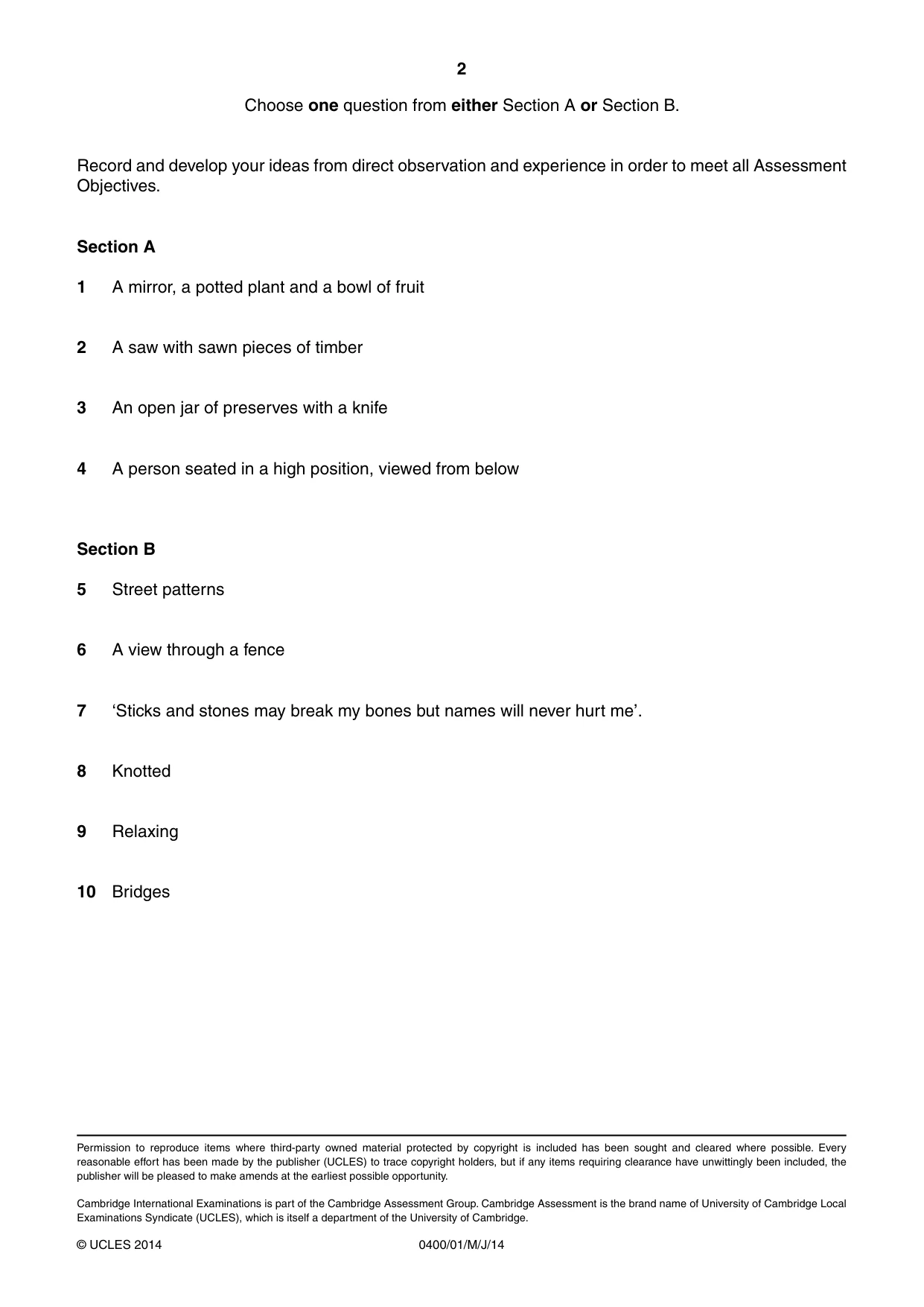
2 0400/01/M/J/14 © UCLES 2014 Permission to reproduce items where third-party owned material protected by copyright is included has been sought and cleared where possible. Every reasonable effort has been made by the publisher (UCLES) to trace copyright holders, but if any items requiring clearance have unwittingly been included, the publisher will be pleased to make amends at the earliest possible opportunity. Cambridge International Examinations is part of the Cambridge Assessment Group. Cambridge Assessment is the brand name of University of Cambridge Local Examinations Syndicate (UCLES), which is itself a department of the University of Cambridge. Choose one question from either Section A or Section B. Record and develop your ideas from direct observation and experience in order to meet all Assessment Objectives. Section A 1 A mirror, a potted plant and a bowl of fruit 2 A saw with sawn pieces of timber 3 An open jar of preserves with a knife 4 A person seated in a high position, viewed from below Section B 5 Street patterns 6 A view through a fence 7 ‘Sticks and stones may break my bones but names will never hurt me’. 8 Knotted 9 Relaxing 10 Bridges
Mark scheme, page 1
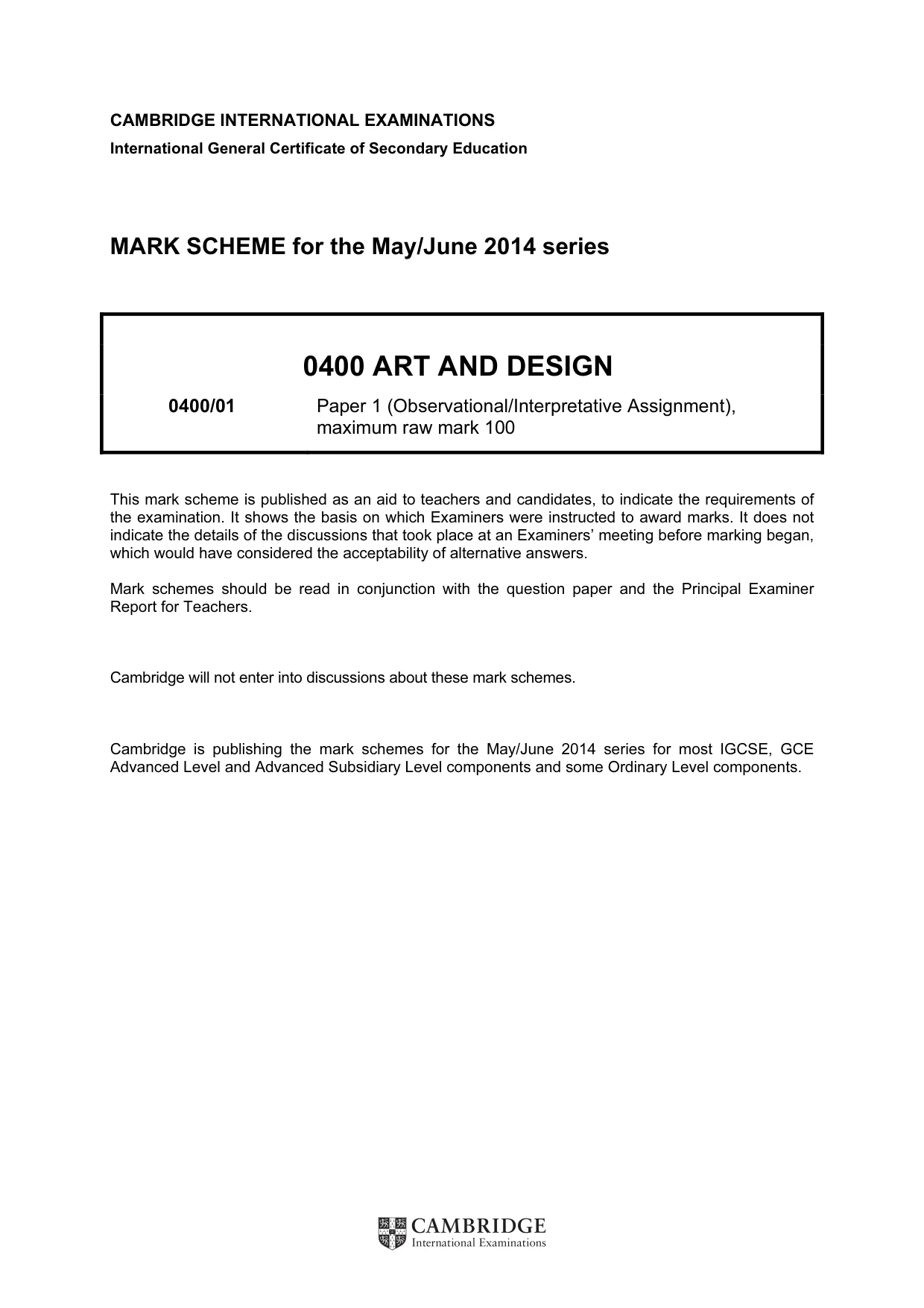
CAMBRIDGE INTERNATIONAL EXAMINATIONS International General Certificate of Secondary Education MARK SCHEME for the May/June 2014 series 0400 ART AND DESIGN 0400/01 Paper 1 (Observational/Interpretative Assignment), maximum raw mark 100 This mark scheme is published as an aid to teachers and candidates, to indicate the requirements of the examination. It shows the basis on which Examiners were instructed to award marks. It does not indicate the details of the discussions that took place at an Examiners’ meeting before marking began, which would have considered the acceptability of alternative answers. Mark schemes should be read in conjunction with the question paper and the Principal Examiner Report for Teachers. Cambridge will not enter into discussions about these mark schemes. Cambridge is publishing the mark schemes for the May/June 2014 series for most IGCSE, GCE Advanced Level and Advanced Subsidiary Level components and some Ordinary Level components.
Mark scheme, page 2
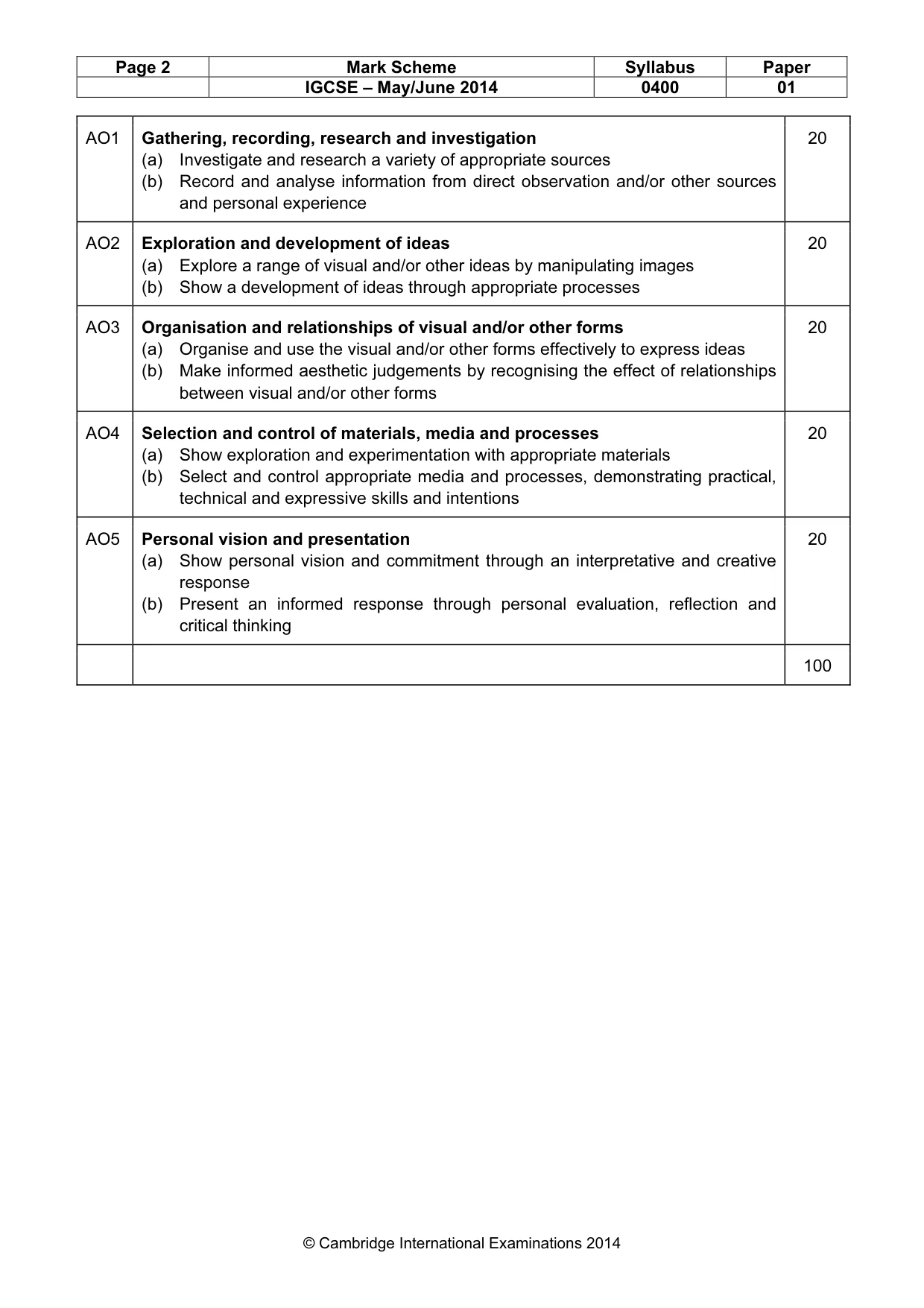
Page 2 Mark Scheme Syllabus Paper IGCSE – May/June 2014 0400 01 © Cambridge International Examinations 2014 AO1 Gathering, recording, research and investigation (a) Investigate and research a variety of appropriate sources (b) Record and analyse information from direct observation and/or other sources and personal experience 20 AO2 Exploration and development of ideas (a) Explore a range of visual and/or other ideas by manipulating images (b) Show a development of ideas through appropriate processes 20 AO3 Organisation and relationships of visual and/or other forms (a) Organise and use the visual and/or other forms effectively to express ideas (b) Make informed aesthetic judgements by recognising the effect of relationships between visual and/or other forms 20 AO4 Selection and control of materials, media and processes (a) Show exploration and experimentation with appropriate materials (b) Select and control appropriate media and processes, demonstrating practical, technical and expressive skills and intentions 20 AO5 Personal vision and presentation (a) Show personal vision and commitment through an interpretative and creative response (b) Present an informed response through personal evaluation, reflection and critical thinking 20 100
Mark scheme, page 3
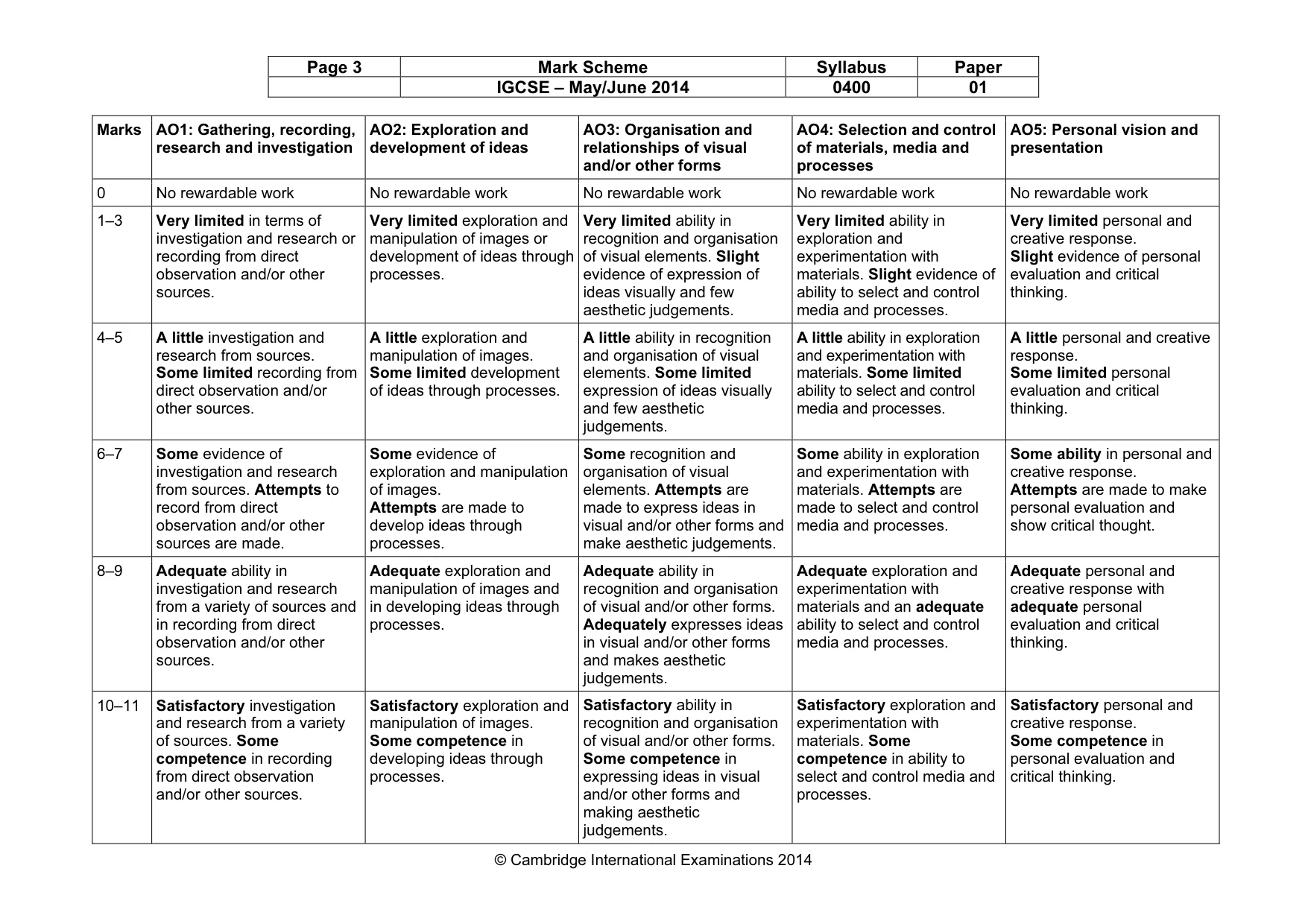
Page 3 Mark Scheme Syllabus Paper IGCSE – May/June 2014 0400 01 © Cambridge International Examinations 2014 Marks AO1: Gathering, recording, research and investigation AO2: Exploration and development of ideas AO3: Organisation and relationships of visual and/or other forms AO4: Selection and control of materials, media and processes AO5: Personal vision and presentation 0 No rewardable work No rewardable work No rewardable work No rewardable work No rewardable work 1–3 Very limited in terms of investigation and research or recording from direct observation and/or other sources. Very limited exploration and manipulation of images or development of ideas through processes. Very limited ability in recognition and organisation of visual elements. Slight evidence of expression of ideas visually and few aesthetic judgements. Very limited ability in exploration and experimentation with materials. Slight evidence of ability to select and control media and processes. Very limited personal and creative response. Slight evidence of personal evaluation and critical thinking. 4–5 A little investigation and research from sources. Some limited recording from direct observation and/or other sources. A little exploration and manipulation of images. Some limited development of ideas through processes. A little ability in recognition and organisation of visual elements. Some limited expression of ideas visually and few aesthetic judgements. A little ability in exploration and experimentation with materials. Some limited ability to select and control media and processes. A little personal and creative response. Some limited personal evaluation and critical thinking. 6–7 Some evidence of investigation and research from sources. Attempts to record from direct observation and/or other sources are made. Some evidence of exploration and manipulation of images. Attempts are made to develop ideas through processes. Some recognition and organisation of visual elements. Attempts are made to express ideas in visual and/or other forms and make aesthetic judgements. Some ability in exploration and experimentation with materials. Attempts are made to select and control media and processes. Some ability in personal and creative response. Attempts are made to make personal evaluation and show critical thought. 8–9 Adequate ability in investigation and research from a variety of sources and in recording from direct observation and/or other sources. Adequate exploration and manipulation of images and in developing ideas through processes. Adequate ability in recognition and organisation of visual and/or other forms. Adequately expresses ideas in visual and/or other forms and makes aesthetic judgements. Adequate exploration and experimentation with materials and an adequate ability to select and control media and processes. Adequate personal and creative response with adequate personal evaluation and critical thinking. 10–11 Satisfactory investigation and research from a variety of sources. Some competence in recording from direct observation and/or other sources. Satisfactory exploration and manipulation of images. Some competence in developing ideas through processes. Satisfactory ability in recognition and organisation of visual and/or other forms. Some competence in expressing ideas in visual and/or other forms and making aesthetic judgements. Satisfactory exploration and experimentation with materials. Some competence in ability to select and control media and processes. Satisfactory personal and creative response. Some competence in personal evaluation and critical thinking.
Mark scheme, page 4
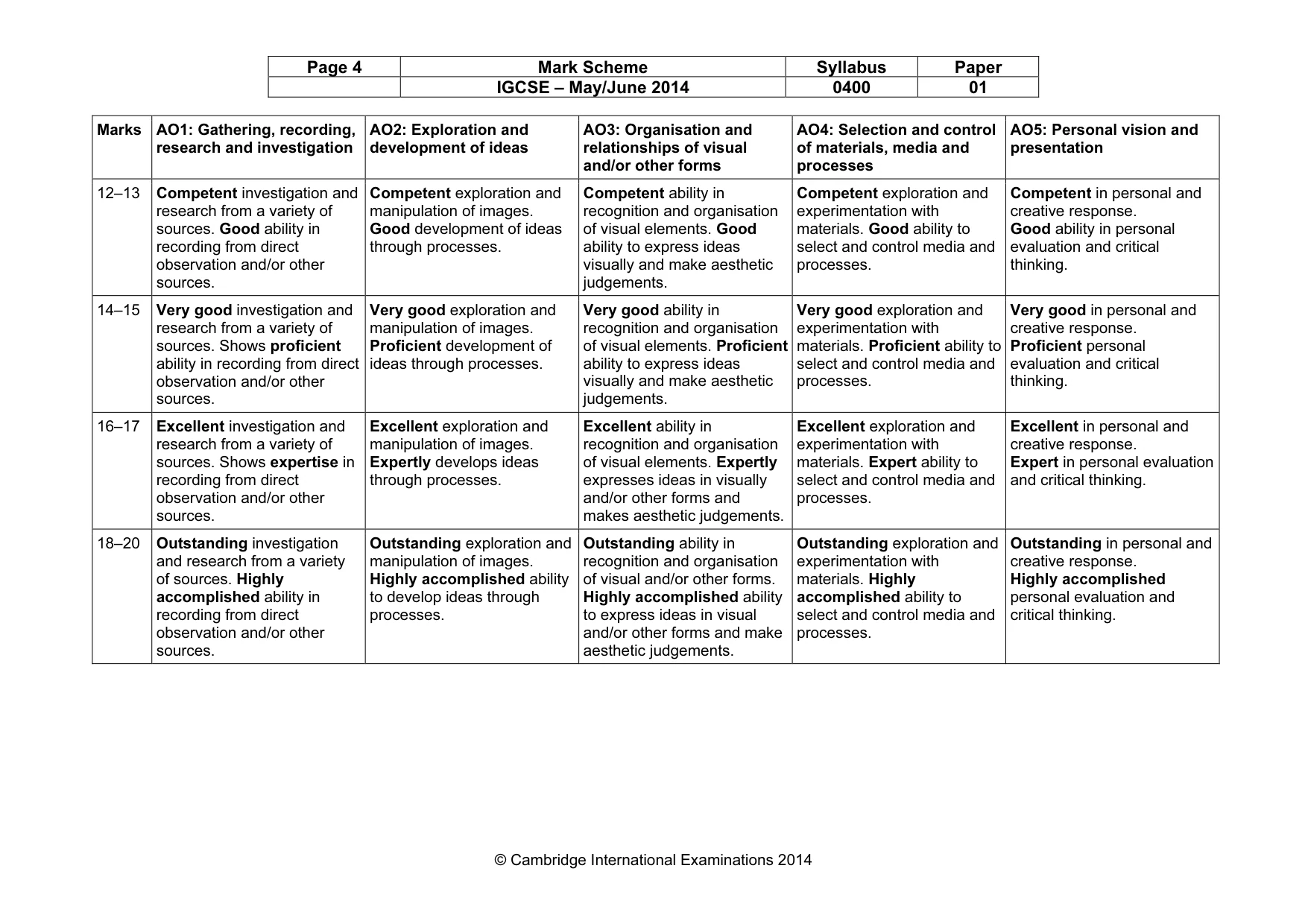
Page 4 Mark Scheme Syllabus Paper IGCSE – May/June 2014 0400 01 © Cambridge International Examinations 2014 Marks AO1: Gathering, recording, research and investigation AO2: Exploration and development of ideas AO3: Organisation and relationships of visual and/or other forms AO4: Selection and control of materials, media and processes AO5: Personal vision and presentation 12–13 Competent investigation and research from a variety of sources. Good ability in recording from direct observation and/or other sources. Competent exploration and manipulation of images. Good development of ideas through processes. Competent ability in recognition and organisation of visual elements. Good ability to express ideas visually and make aesthetic judgements. Competent exploration and experimentation with materials. Good ability to select and control media and processes. Competent in personal and creative response. Good ability in personal evaluation and critical thinking. 14–15 Very good investigation and research from a variety of sources. Shows proficient ability in recording from direct observation and/or other sources. Very good exploration and manipulation of images. Proficient development of ideas through processes. Very good ability in recognition and organisation of visual elements. Proficient ability to express ideas visually and make aesthetic judgements. Very good exploration and experimentation with materials. Proficient ability to select and control media and processes. Very good in personal and creative response. Proficient personal evaluation and critical thinking. 16–17 Excellent investigation and research from a variety of sources. Shows expertise in recording from direct observation and/or other sources. Excellent exploration and manipulation of images. Expertly develops ideas through processes. Excellent ability in recognition and organisation of visual elements. Expertly expresses ideas in visually and/or other forms and makes aesthetic judgements. Excellent exploration and experimentation with materials. Expert ability to select and control media and processes. Excellent in personal and creative response. Expert in personal evaluation and critical thinking. 18–20 Outstanding investigation and research from a variety of sources. Highly accomplished ability in recording from direct observation and/or other sources. Outstanding exploration and manipulation of images. Highly accomplished ability to develop ideas through processes. Outstanding ability in recognition and organisation of visual and/or other forms. Highly accomplished ability to express ideas in visual and/or other forms and make aesthetic judgements. Outstanding exploration and experimentation with materials. Highly accomplished ability to select and control media and processes. Outstanding in personal and creative response. Highly accomplished personal evaluation and critical thinking.
What you needed in this session
Cambridge’s own grade thresholds for 2014 May/June, Paper 1 · Variant 1. A higher threshold means an easier paper — the bar moves with how the cohort did.