Cambridge IGCSE Art and Design 0400 — 2009 Oct/Nov Paper 1 · Variant 1
0400/11/O/N/09 · 100 marks · ≈113 min
The question paper and its mark scheme, free to read here and free to download. This is Cambridge’s own paper, exactly as it was sat.
Question paper2 pages
Mark scheme2 pages
Answers below. Sit the paper first if you are practising.
Paper as text
Question paper, page 1
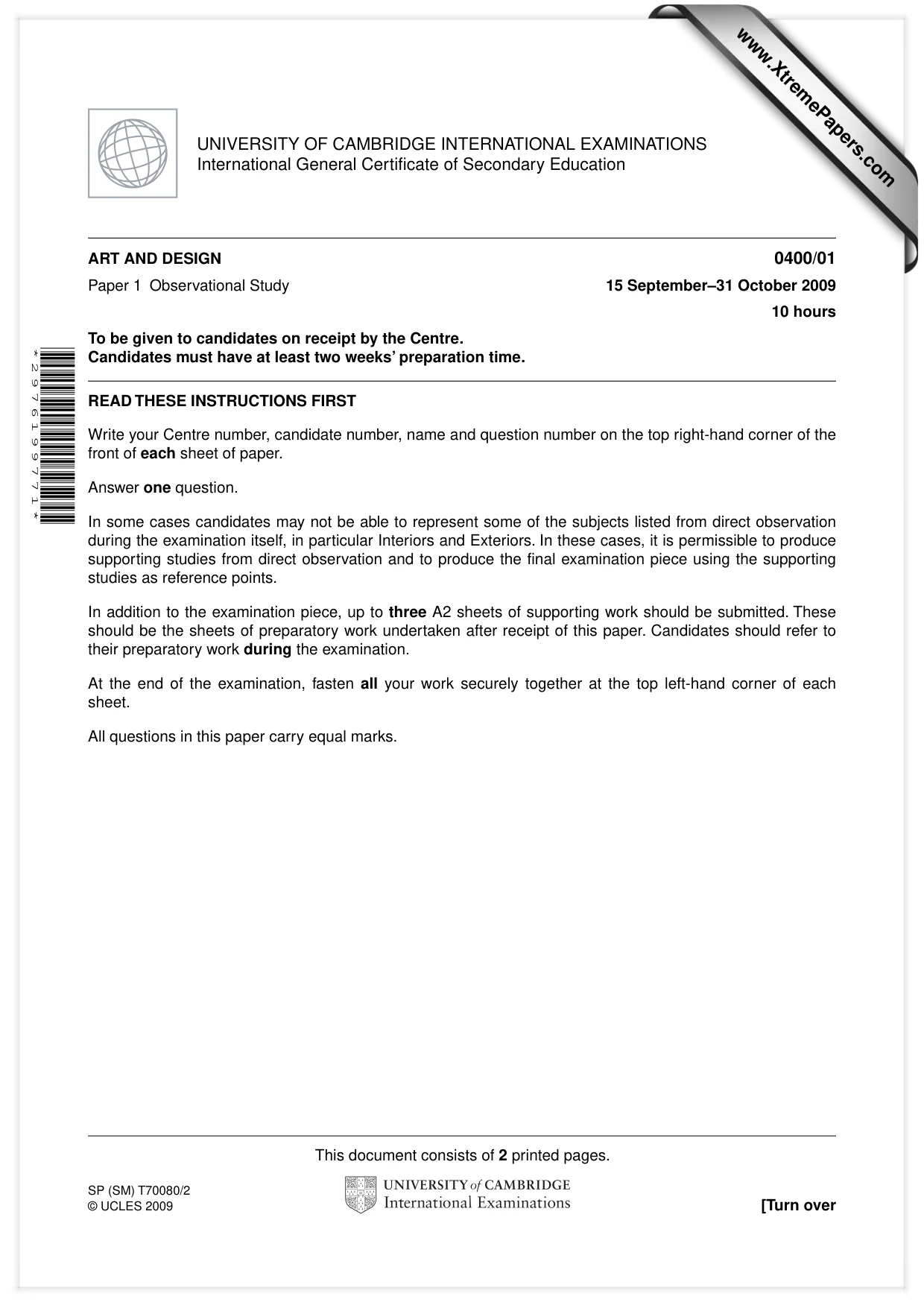
This document consists of 2 printed pages. SP (SM) T70080/2 © UCLES 2009 [Turn over UNIVERSITY OF CAMBRIDGE INTERNATIONAL EXAMINATIONS International General Certificate of Secondary Education READ THESE INSTRUCTIONS FIRST Write your Centre number, candidate number, name and question number on the top right-hand corner of the front of each sheet of paper. Answer one question. In some cases candidates may not be able to represent some of the subjects listed from direct observation during the examination itself, in particular Interiors and Exteriors. In these cases, it is permissible to produce supporting studies from direct observation and to produce the final examination piece using the supporting studies as reference points. In addition to the examination piece, up to three A2 sheets of supporting work should be submitted. These should be the sheets of preparatory work undertaken after receipt of this paper. Candidates should refer to their preparatory work during the examination. At the end of the examination, fasten all your work securely together at the top left-hand corner of each sheet. All questions in this paper carry equal marks. * 2 9 7 6 1 9 9 7 7 1 * ART AND DESIGN 0400/01 Paper 1 Observational Study 15 September–31 October 2009 10 hours To be given to candidates on receipt by the Centre. Candidates must have at least two weeks’ preparation time. www.XtremePapers.com
Question paper, page 2
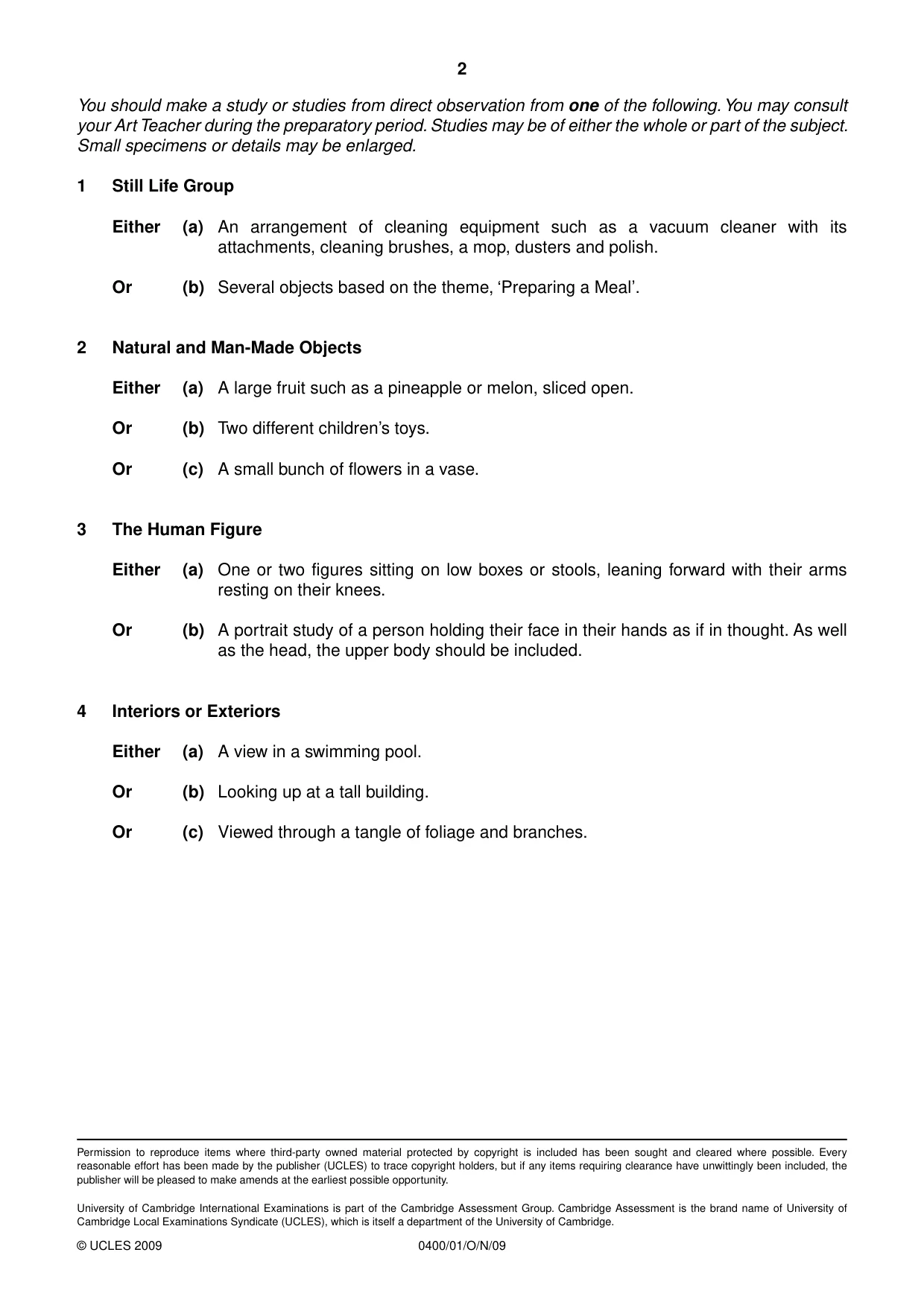
2 0400/01/O/N/09 © UCLES 2009 You should make a study or studies from direct observation from one of the following. You may consult your Art Teacher during the preparatory period. Studies may be of either the whole or part of the subject. Small specimens or details may be enlarged. 1 Still Life Group Either (a) An arrangement of cleaning equipment such as a vacuum cleaner with its attachments, cleaning brushes, a mop, dusters and polish. Or (b) Several objects based on the theme, ‘Preparing a Meal’. 2 Natural and Man-Made Objects Either (a) A large fruit such as a pineapple or melon, sliced open. Or (b) Two different children’s toys. Or (c) A small bunch of flowers in a vase. 3 The Human Figure Either (a) One or two figures sitting on low boxes or stools, leaning forward with their arms resting on their knees. Or (b) A portrait study of a person holding their face in their hands as if in thought. As well as the head, the upper body should be included. 4 Interiors or Exteriors Either (a) A view in a swimming pool. Or (b) Looking up at a tall building. Or (c) Viewed through a tangle of foliage and branches. Permission to reproduce items where third-party owned material protected by copyright is included has been sought and cleared where possible. Every reasonable effort has been made by the publisher (UCLES) to trace copyright holders, but if any items requiring clearance have unwittingly been included, the publisher will be pleased to make amends at the earliest possible opportunity. University of Cambridge International Examinations is part of the Cambridge Assessment Group. Cambridge Assessment is the brand name of University of Cambridge Local Examinations Syndicate (UCLES), which is itself a department of the University of Cambridge.
Mark scheme, page 1
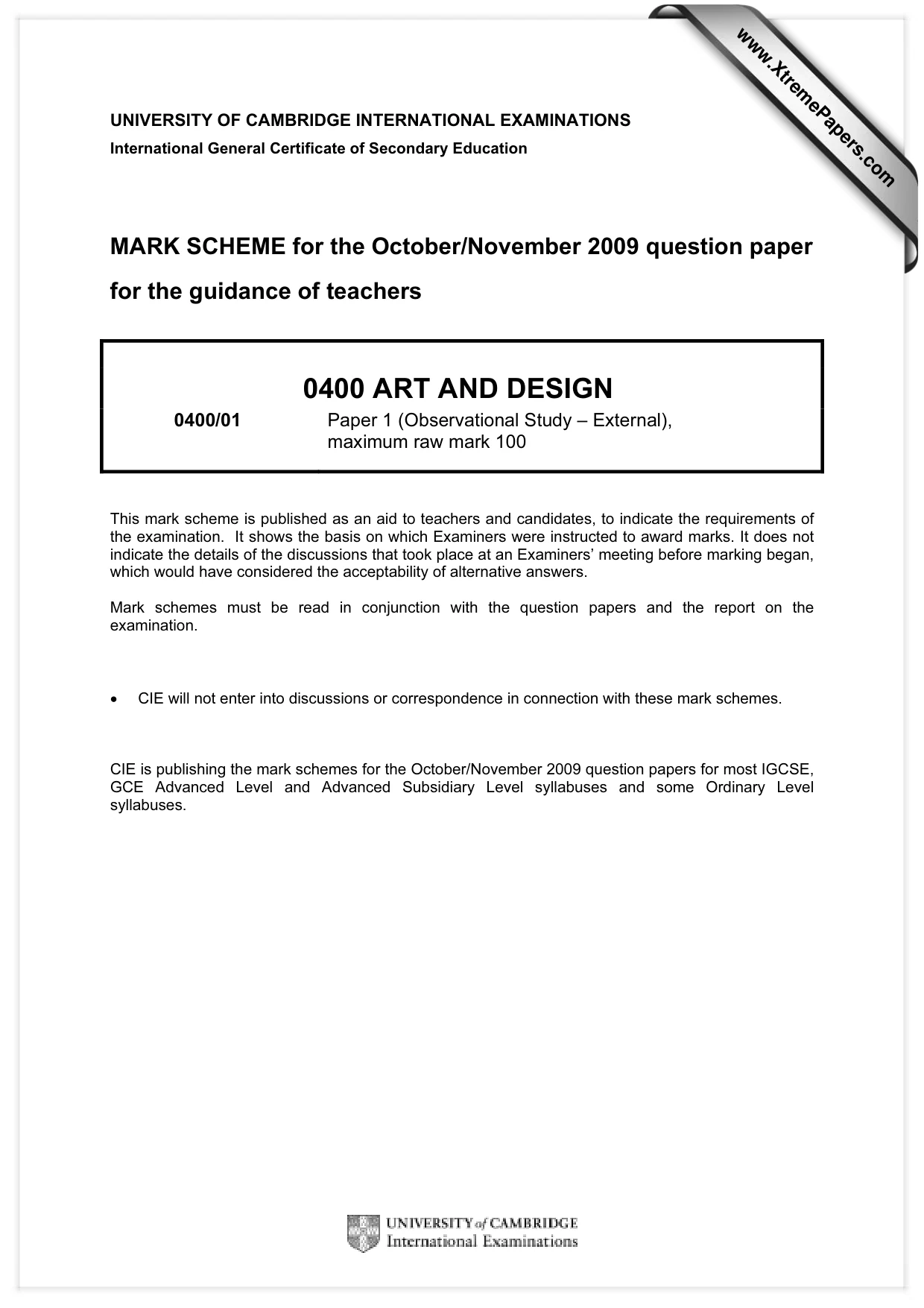
UNIVERSITY OF CAMBRIDGE INTERNATIONAL EXAMINATIONS International General Certificate of Secondary Education MARK SCHEME for the October/November 2009 question paper for the guidance of teachers 0400 ART AND DESIGN 0400/01 Paper 1 (Observational Study – External), maximum raw mark 100 This mark scheme is published as an aid to teachers and candidates, to indicate the requirements of the examination. It shows the basis on which Examiners were instructed to award marks. It does not indicate the details of the discussions that took place at an Examiners’ meeting before marking began, which would have considered the acceptability of alternative answers. Mark schemes must be read in conjunction with the question papers and the report on the examination. • CIE will not enter into discussions or correspondence in connection with these mark schemes. CIE is publishing the mark schemes for the October/November 2009 question papers for most IGCSE, GCE Advanced Level and Advanced Subsidiary Level syllabuses and some Ordinary Level syllabuses. www.XtremePapers.com
Mark scheme, page 2
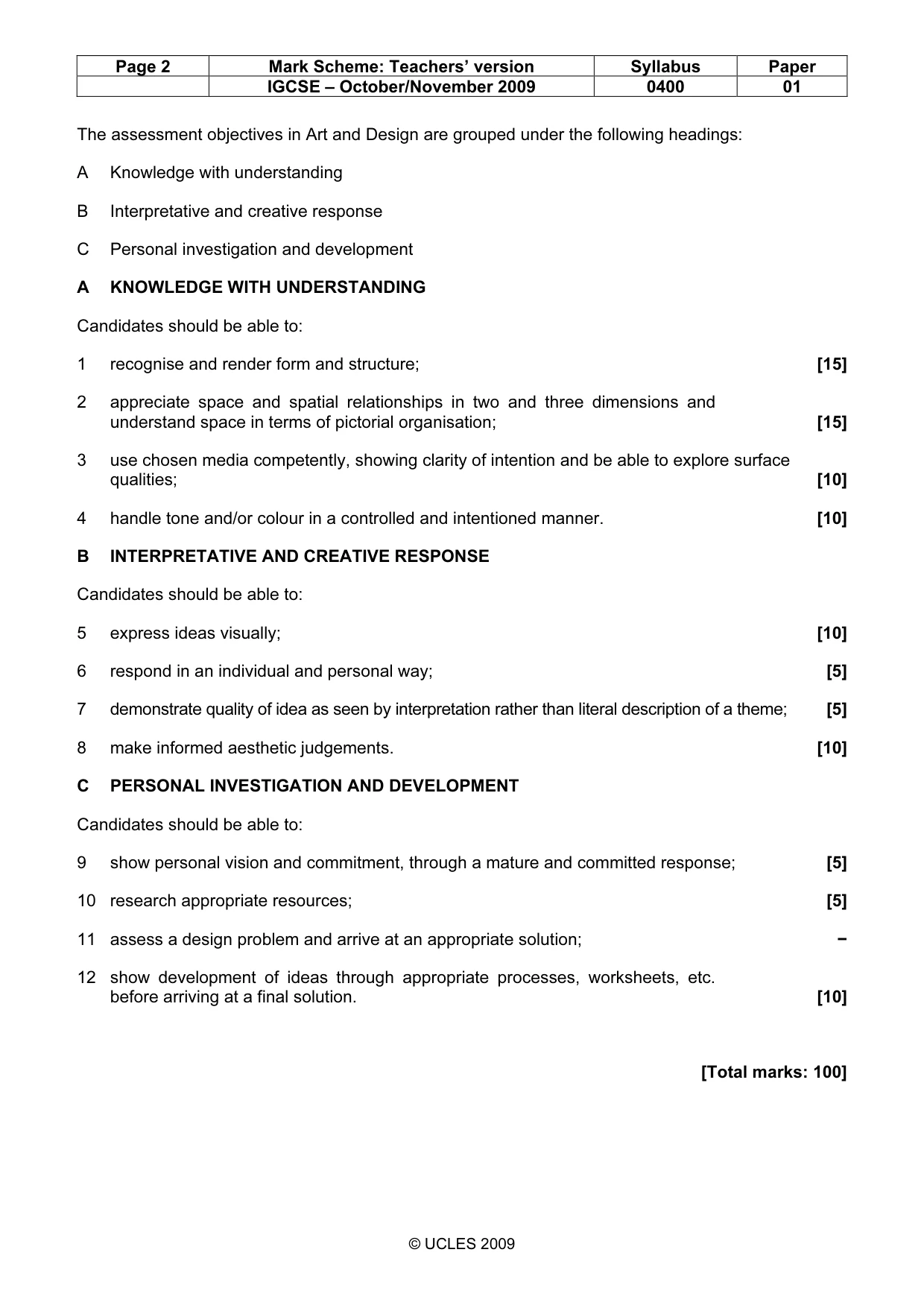
Page 2 Mark Scheme: Teachers’ version Syllabus Paper IGCSE – October/November 2009 0400 01 © UCLES 2009 The assessment objectives in Art and Design are grouped under the following headings: A Knowledge with understanding B Interpretative and creative response C Personal investigation and development A KNOWLEDGE WITH UNDERSTANDING Candidates should be able to: 1 recognise and render form and structure; [15] 2 appreciate space and spatial relationships in two and three dimensions and understand space in terms of pictorial organisation; [15] 3 use chosen media competently, showing clarity of intention and be able to explore surface qualities; [10] 4 handle tone and/or colour in a controlled and intentioned manner. [10] B INTERPRETATIVE AND CREATIVE RESPONSE Candidates should be able to: 5 express ideas visually; [10] 6 respond in an individual and personal way; [5] 7 demonstrate quality of idea as seen by interpretation rather than literal description of a theme; [5] 8 make informed aesthetic judgements. [10] C PERSONAL INVESTIGATION AND DEVELOPMENT Candidates should be able to: 9 show personal vision and commitment, through a mature and committed response; [5] 10 research appropriate resources; [5] 11 assess a design problem and arrive at an appropriate solution; − 12 show development of ideas through appropriate processes, worksheets, etc. before arriving at a final solution. [10] [Total marks: 100]
What you needed in this session
Cambridge’s own grade thresholds for 2009 Oct/Nov, Paper 1 · Variant 1. A higher threshold means an easier paper — the bar moves with how the cohort did.