Cambridge IGCSE Agriculture 0600 — 2017 Oct/Nov Paper 1 · Variant 3
0600/13/O/N/17 · 100 marks · ≈113 min
The question paper and its mark scheme, free to read here and free to download. This is Cambridge’s own paper, exactly as it was sat.
Question paper16 pages


Mark scheme22 pages
Answers below. Sit the paper first if you are practising.
Paper as text
Question paper, page 1
This document consists of 14 printed pages and 2 blank pages. DC (JP) 154715 © UCLES 2017 [Turn over * 8 3 1 6 4 8 9 0 5 9 * Cambridge International Examinations Cambridge International General Certificate of Secondary Education AGRICULTURE 0600/13 Paper 1 October/November 2017 1 hour 45 minutes Additional Materials: Answer Booklet/Paper READ THESE INSTRUCTIONS FIRST Write your Centre number, candidate number and name on all the work you hand in. Write in dark blue or black pen. You may use an HB pencil for any diagrams or graphs. Do not use staples, paper clips, glue or correction fluid. DO NOT WRITE IN ANY BARCODES. Section A Answer all questions. Electronic calculators may be used. Write your answers in the spaces provided on the Question Paper. You are advised to spend no longer than 1 hour on Section A. Section B Answer any two questions. Write your answers on the Answer Booklet/Paper provided. Enter the numbers of the Section B questions you have answered in the grid. At the end of the examination, fasten all your work securely together. The number of marks is given in brackets [ ] at the end of each question or part question. For Examiner’s Use Section A 1 2 3 4 5 6 7 8 9 Section B Total
Question paper, page 2
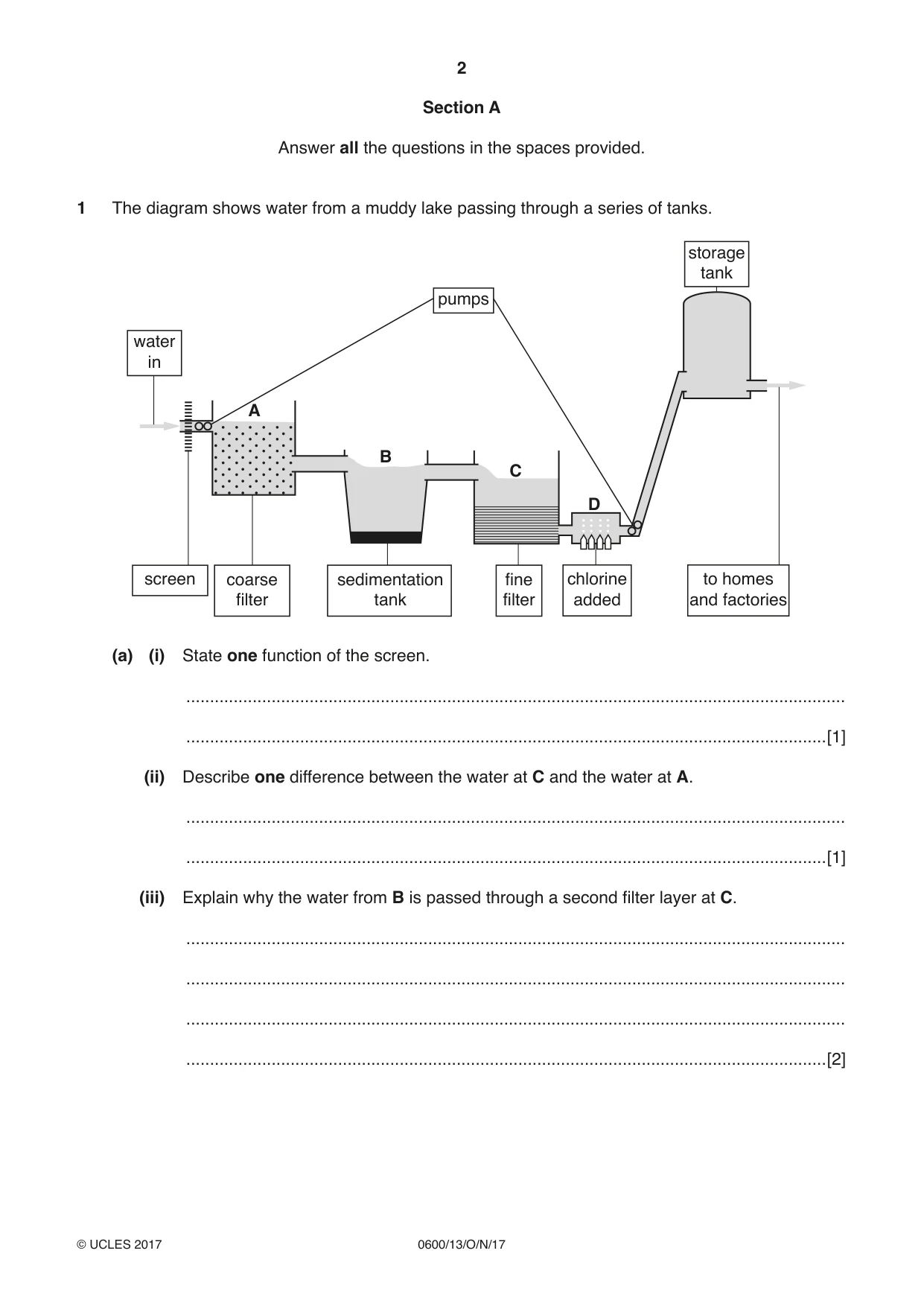
2 0600/13/O/N/17 © UCLES 2017 Section A Answer all the questions in the spaces provided. 1 The diagram shows water from a muddy lake passing through a series of tanks. water in screen coarse filter fine filter chlorine added to homes and factories sedimentation tank storage tank pumps A B C D (a) (i) State one function of the screen. … …[1] (ii) Describe one difference between the water at C and the water at A. … …[1] (iii) Explain why the water from B is passed through a second filter layer at C. … … … …[2]
Question paper, page 3
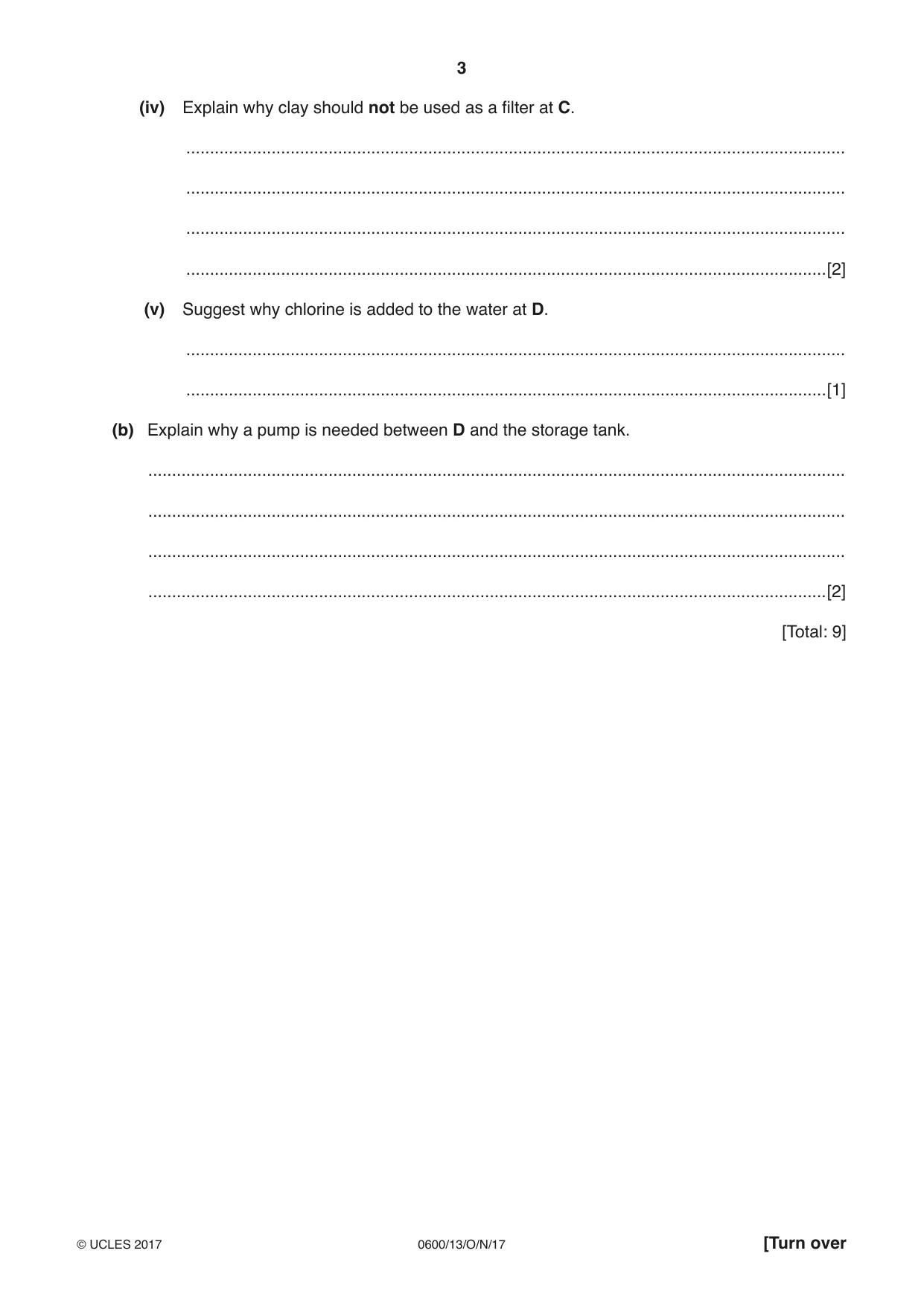
3 0600/13/O/N/17 © UCLES 2017 [Turn over (iv) Explain why clay should not be used as a filter at C. … … … …[2] (v) Suggest why chlorine is added to the water at D. … …[1] (b) Explain why a pump is needed between D and the storage tank. … … … …[2] [Total: 9]
Question paper, page 4
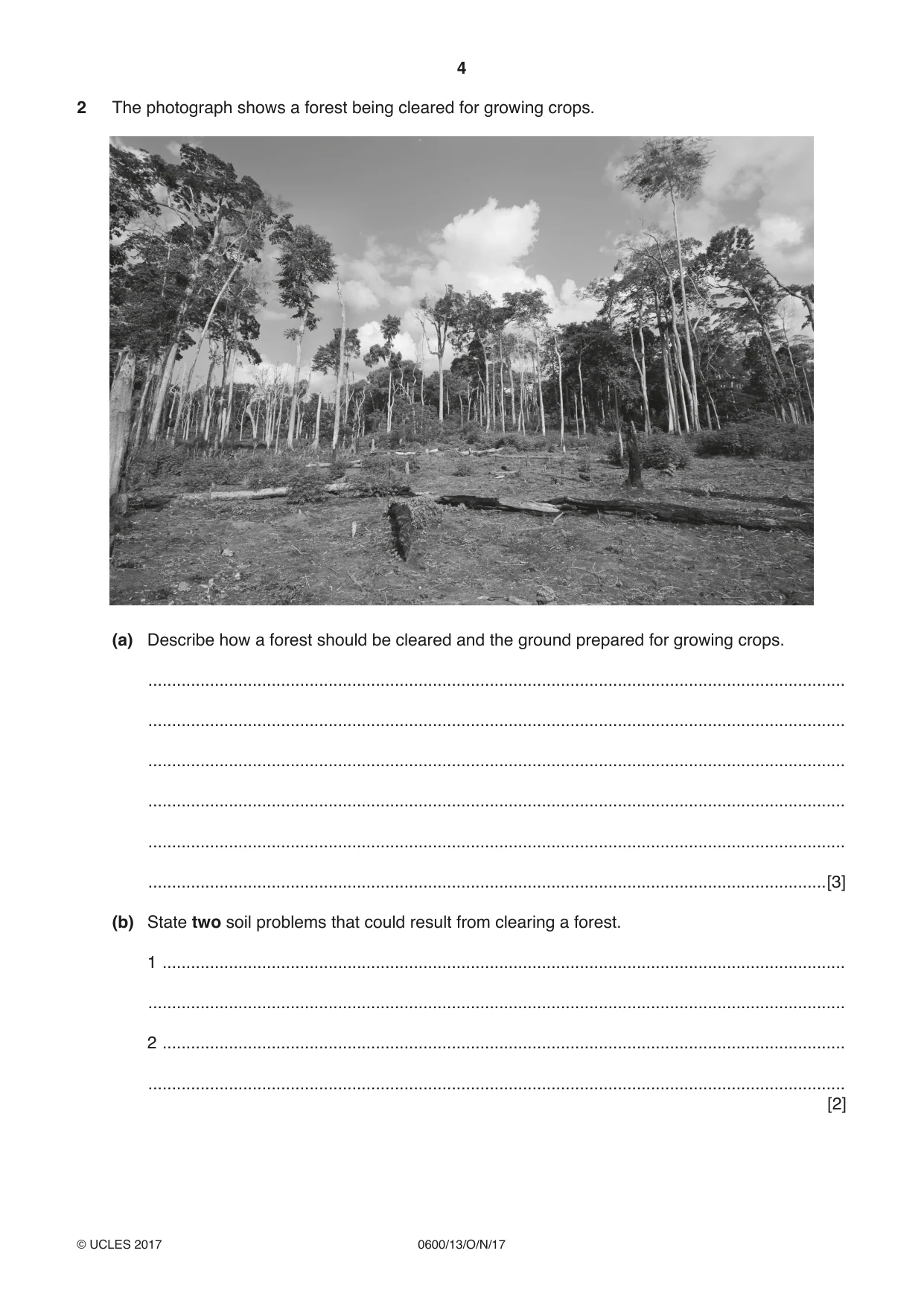
4 0600/13/O/N/17 © UCLES 2017 2 The photograph shows a forest being cleared for growing crops. (a) Describe how a forest should be cleared and the ground prepared for growing crops. … … … … … …[3] (b) State two soil problems that could result from clearing a forest. 1 … … 2 … … [2]
Question paper, page 5
5 0600/13/O/N/17 © UCLES 2017 [Turn over (c) Explain how the effect of the problems in (b) could be reduced. … … … … … …[2] [Total: 7]
Question paper, page 6
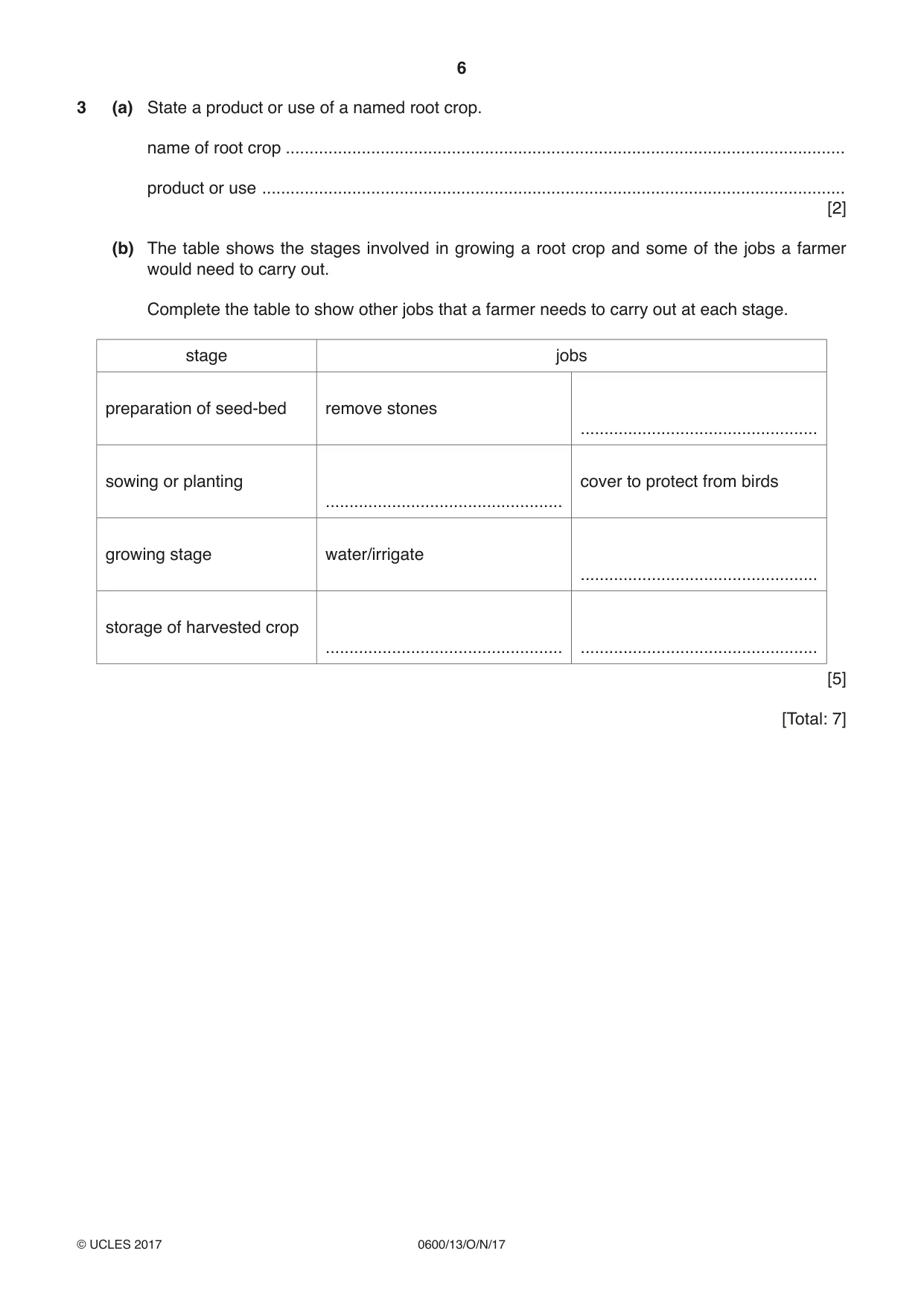
6 0600/13/O/N/17 © UCLES 2017 3 (a) State a product or use of a named root crop. name of root crop … product or use … [2] (b) The table shows the stages involved in growing a root crop and some of the jobs a farmer would need to carry out. Complete the table to show other jobs that a farmer needs to carry out at each stage. stage jobs preparation of seed-bed remove stones … sowing or planting … cover to protect from birds growing stage water/irrigate … storage of harvested crop … … [5] [Total: 7]
Question paper, page 7
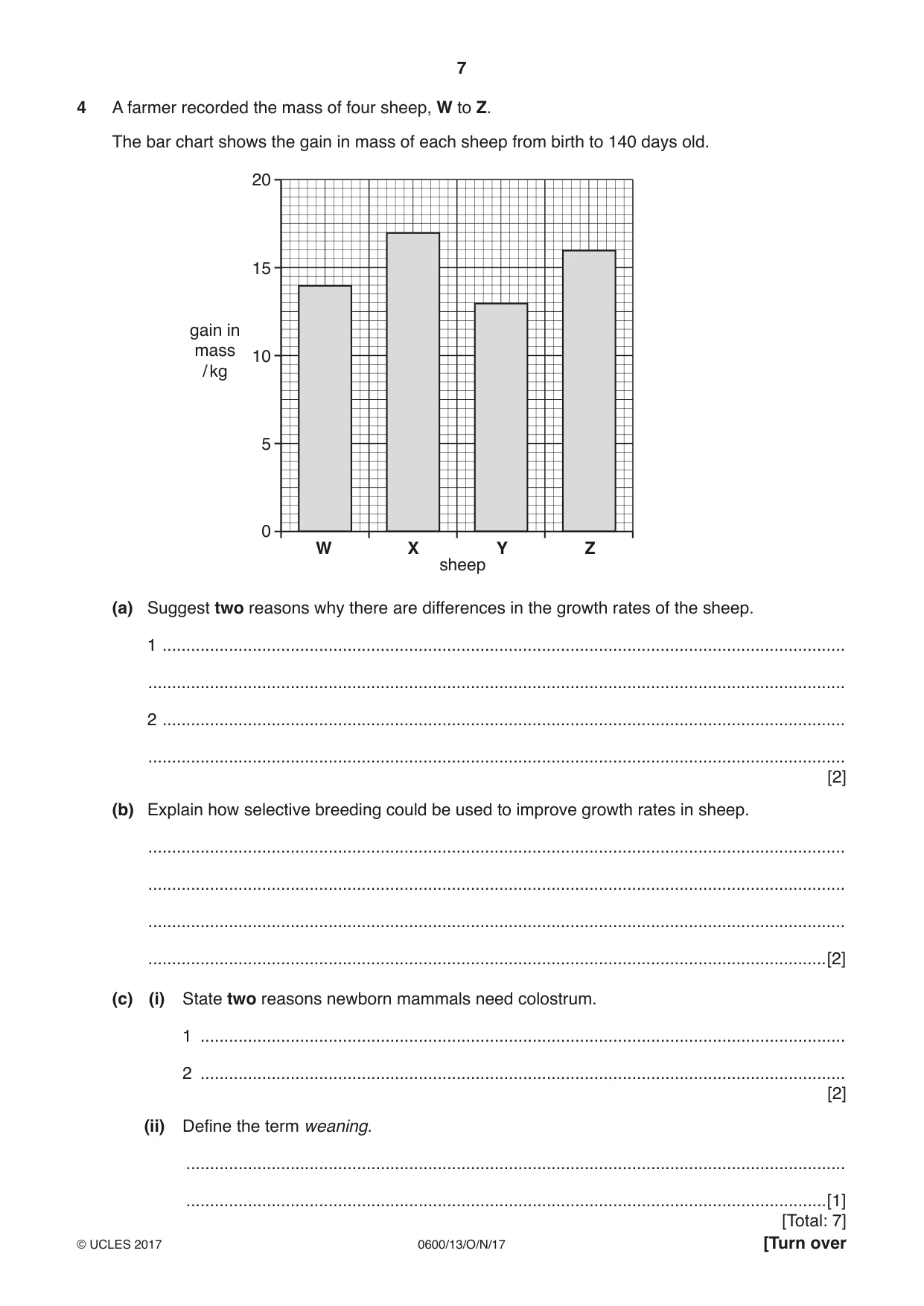
7 0600/13/O/N/17 © UCLES 2017 [Turn over 4 A farmer recorded the mass of four sheep, W to Z. The bar chart shows the gain in mass of each sheep from birth to 140 days old. 5 sheep 0 10 15 gain in mass / kg 20 W X Y Z (a) Suggest two reasons why there are differences in the growth rates of the sheep. 1 … … 2 … … [2] (b) Explain how selective breeding could be used to improve growth rates in sheep. … … … …[2] (c) (i) State two reasons newborn mammals need colostrum. 1 … 2 … [2] (ii) Define the term weaning. … …[1] [Total: 7]
Question paper, page 8
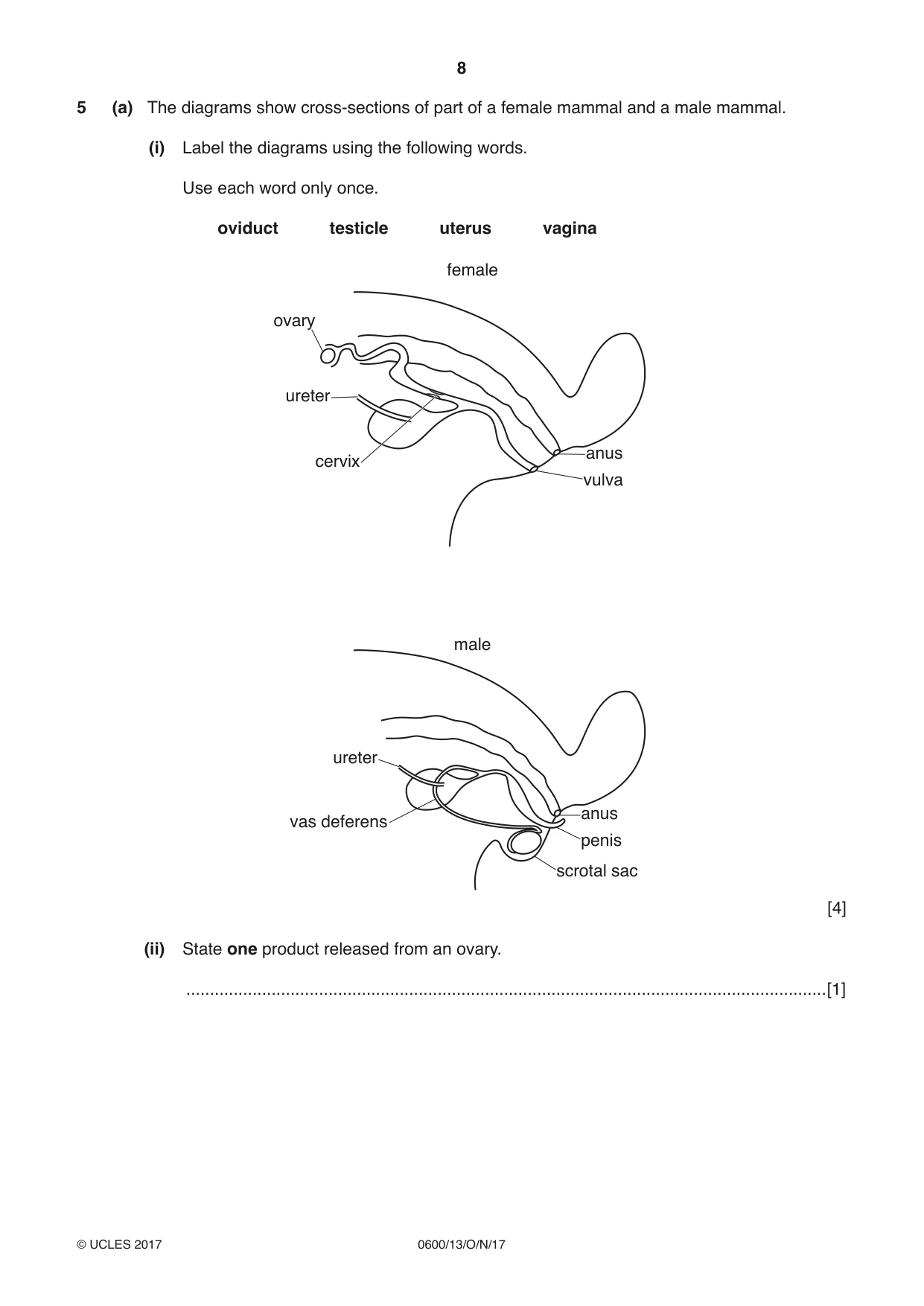
8 0600/13/O/N/17 © UCLES 2017 5 (a) The diagrams show cross-sections of part of a female mammal and a male mammal. (i) Label the diagrams using the following words. Use each word only once. oviduct testicle uterus vagina female vas deferens male ureter anus penis scrotal sac ovary ureter anus vulva cervix [4] (ii) State one product released from an ovary. …[1]
Question paper, page 9
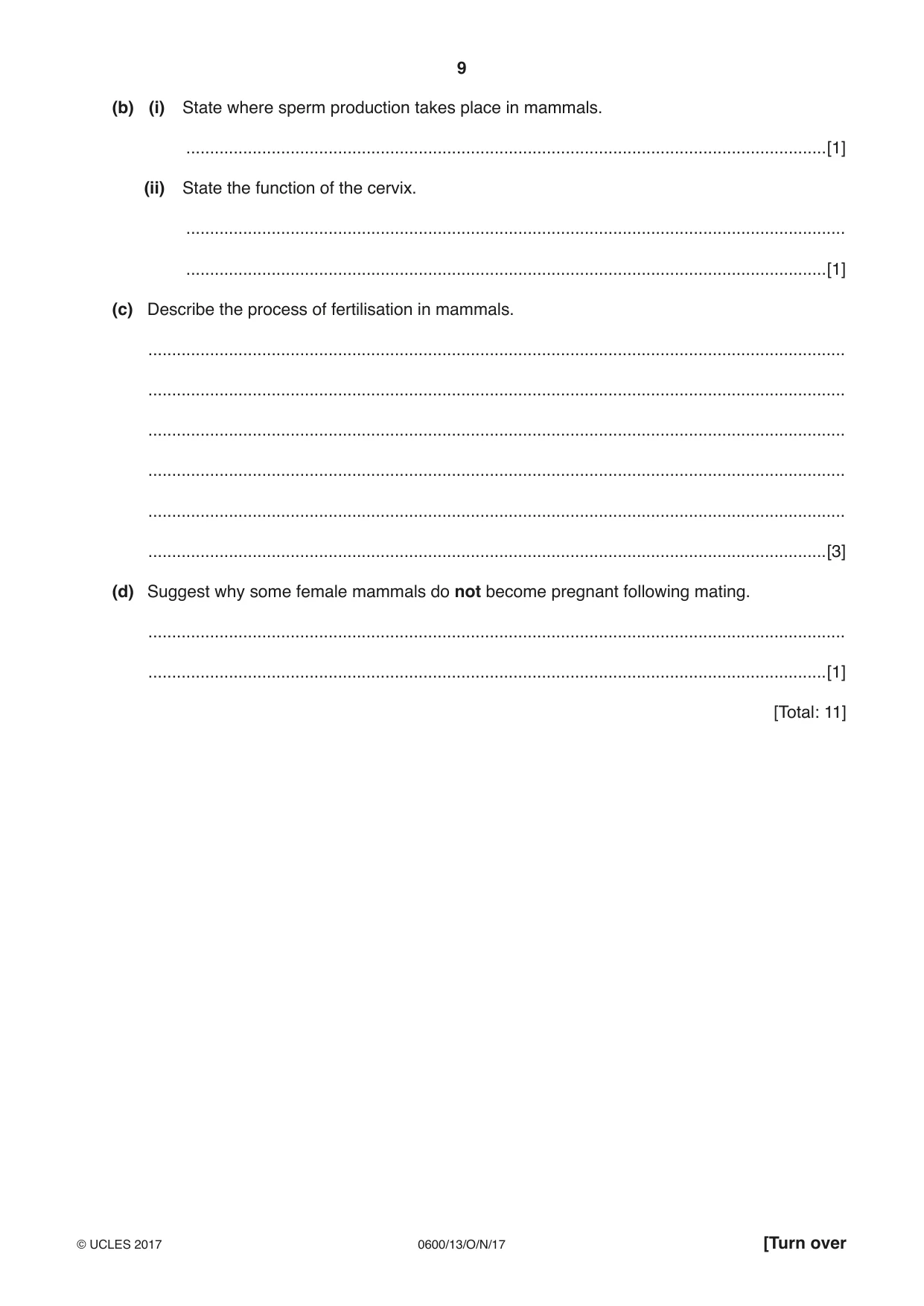
9 0600/13/O/N/17 © UCLES 2017 [Turn over (b) (i) State where sperm production takes place in mammals. …[1] (ii) State the function of the cervix. … …[1] (c) Describe the process of fertilisation in mammals. … … … … … …[3] (d) Suggest why some female mammals do not become pregnant following mating. … …[1] [Total: 11]
Question paper, page 10
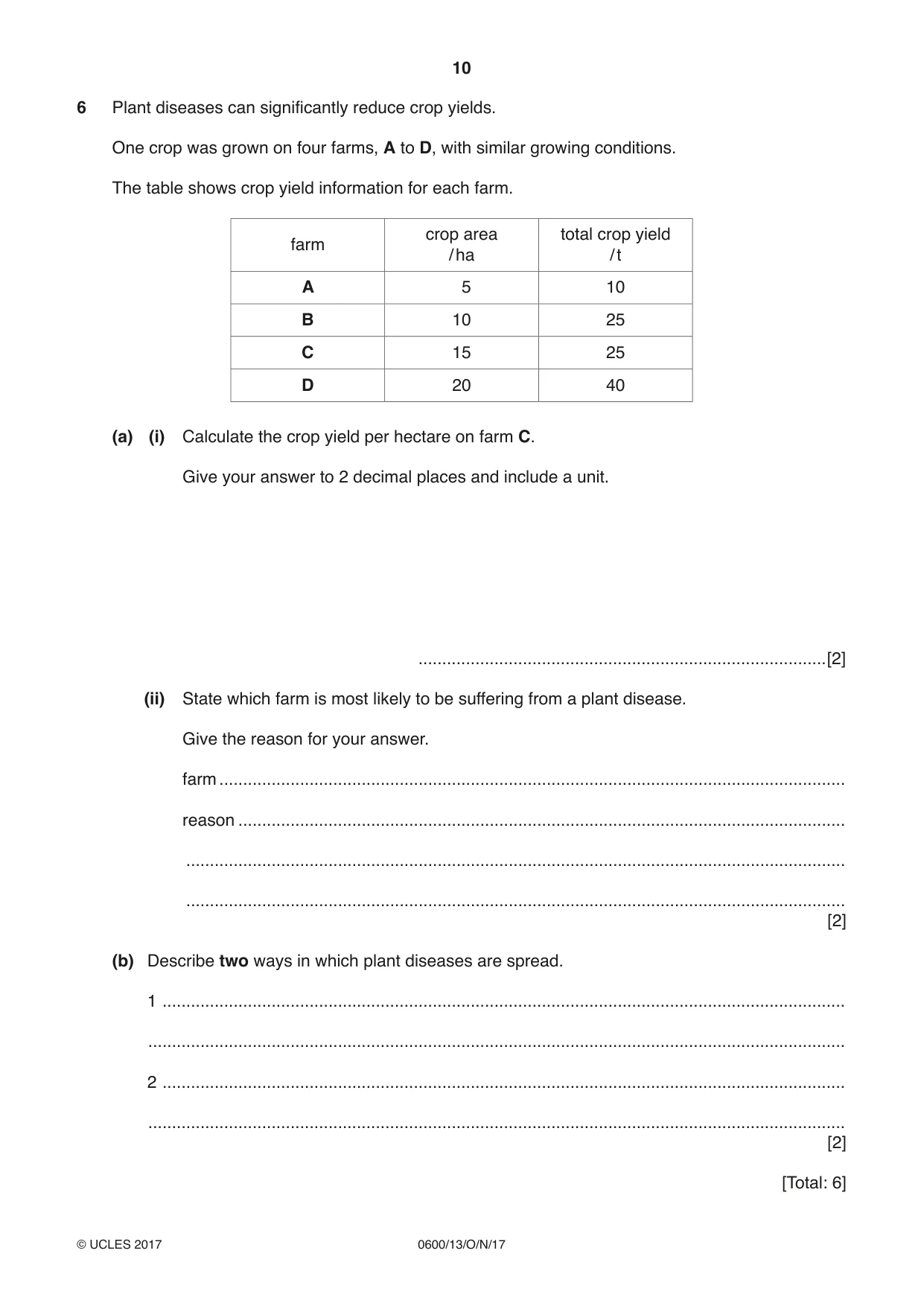
10 0600/13/O/N/17 © UCLES 2017 6 Plant diseases can significantly reduce crop yields. One crop was grown on four farms, A to D, with similar growing conditions. The table shows crop yield information for each farm. farm crop area / ha total crop yield / t A 5 10 B 10 25 C 15 25 D 20 40 (a) (i) Calculate the crop yield per hectare on farm C. Give your answer to 2 decimal places and include a unit. …[2] (ii) State which farm is most likely to be suffering from a plant disease. Give the reason for your answer. farm … reason … … … [2] (b) Describe two ways in which plant diseases are spread. 1 … … 2 … … [2] [Total: 6]
Question paper, page 11
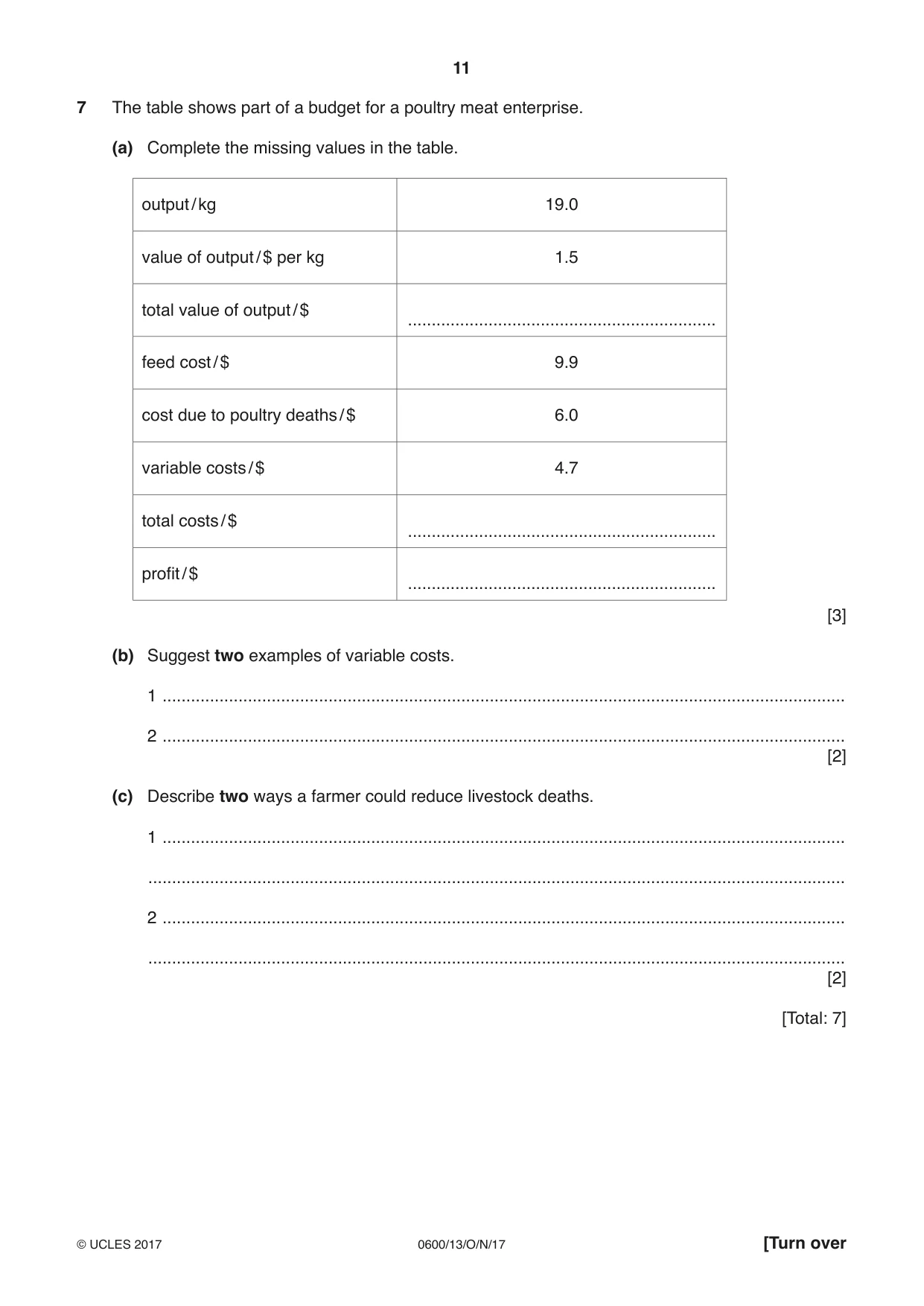
11 0600/13/O/N/17 © UCLES 2017 [Turn over 7 The table shows part of a budget for a poultry meat enterprise. (a) Complete the missing values in the table. output / kg 19.0 value of output / $ per kg 1.5 total value of output / $ … feed cost / $ 9.9 cost due to poultry deaths / $ 6.0 variable costs / $ 4.7 total costs / $ … profit / $ … [3] (b) Suggest two examples of variable costs. 1 … 2 … [2] (c) Describe two ways a farmer could reduce livestock deaths. 1 … … 2 … … [2] [Total: 7]
Question paper, page 12
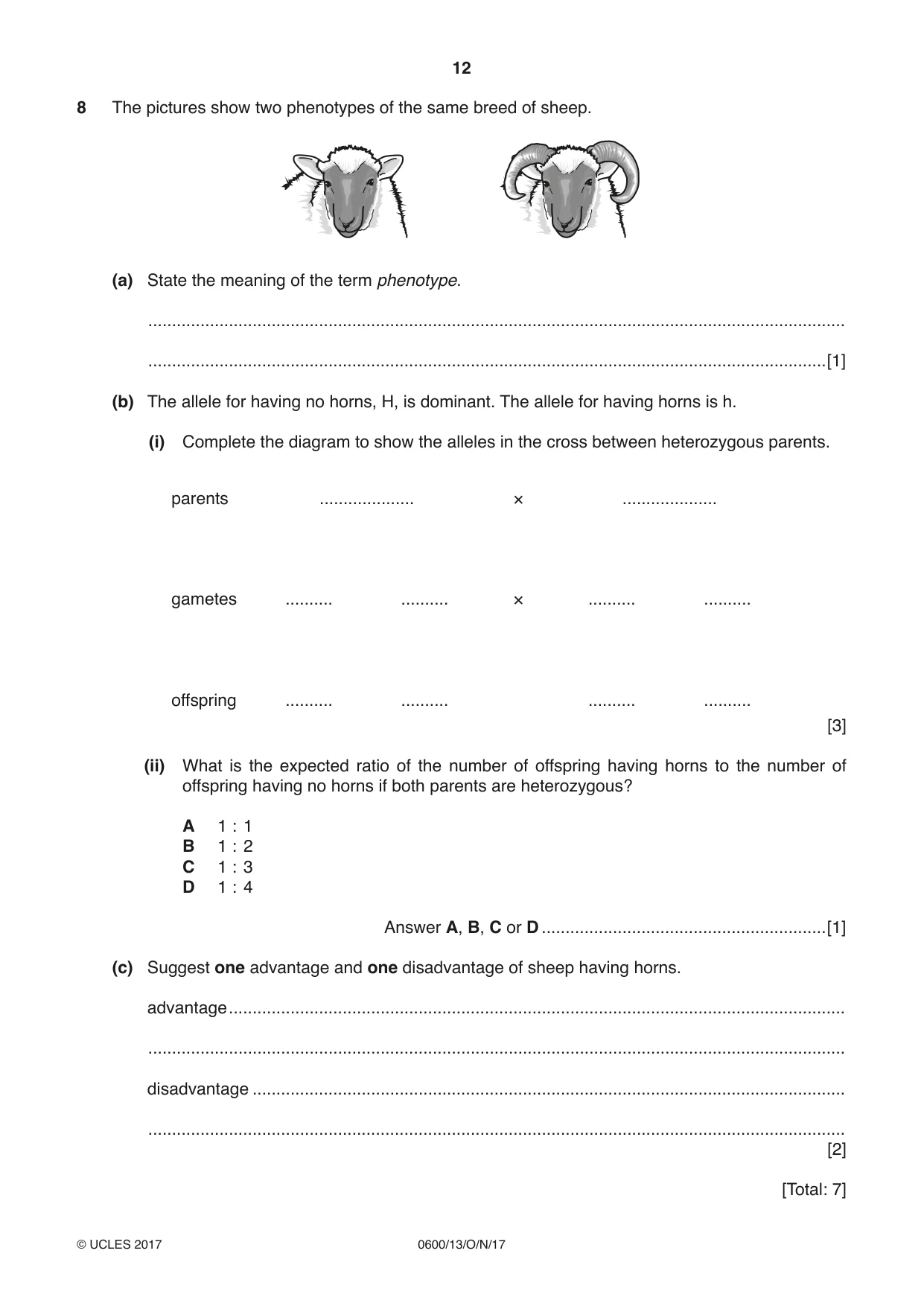
12 0600/13/O/N/17 © UCLES 2017 8 The pictures show two phenotypes of the same breed of sheep. (a) State the meaning of the term phenotype. … …[1] (b) The allele for having no horns, H, is dominant. The allele for having horns is h. (i) Complete the diagram to show the alleles in the cross between heterozygous parents. parents gametes offspring … … … … … … … … … … × × [3] (ii) What is the expected ratio of the number of offspring having horns to the number of offspring having no horns if both parents are heterozygous? A 1 : 1 B 1 : 2 C 1 : 3 D 1 : 4 Answer A, B, C or D …[1] (c) Suggest one advantage and one disadvantage of sheep having horns. advantage … … disadvantage … … [2] [Total: 7]
Question paper, page 13
13 0600/13/O/N/17 © UCLES 2017 [Turn over 9 (a) The table shows some management records from four farms, P to S. farm grazing area / ha number of grazing animals P 10 10 Q 15 30 R 20 30 S 25 30 (i) State which farm is most likely to use an extensive grazing system. Explain your answer. farm … explanation … … [2] (ii) Describe how the carrying capacity of the farms could be increased. … … … …[2] (b) Explain what is meant by the term zero grazing. … … … …[2] (c) Suggest three possible problems of overstocking in a grazing system. 1 … … 2 … … 3 … … [3] [Total: 9]
Question paper, page 14
14 0600/13/O/N/17 © UCLES 2017 Section B Answer any two questions. Write your answers on the separate paper provided. 10 (a) State what is meant by the term maintenance ration. [2] (b) Describe how the structure of the ruminant digestive system differs from the digestive system of a non-ruminant. [5] (c) Explain the roles of the different parts of the digestive system of a named non-ruminant. [8] 11 (a) Describe the nitrogen cycle. [5] (b) Describe how a compound fertiliser can affect soil fertility. [4] (c) Explain how legumes and organic fertilisers affect soil structure and fertility. [6] 12 (a) Name a biting and chewing crop pest and describe its effect on a crop. [4] (b) Describe how the pest in (a) could be controlled without using chemicals. [5] (c) Explain how growing genetically modified (GM) crops could improve farm profits. [6] 13 (a) Describe how livestock housing can increase the number of livestock that can be kept on a farm. [6] (b) A system of pumps and a tank supplies water to livestock housing. Describe how water can be supplied from the tank to the livestock. [3] (c) Explain the disadvantages of permanently housing livestock indoors. [6] 14 (a) State the differences between contact and systemic pesticides. [4] (b) Describe how to safely store and use farm chemicals. [5] (c) Explain the advantages and disadvantages of biological methods of controlling pests compared with chemical methods. [6]
Question paper, page 15
15 0600/13/O/N/17 © UCLES 2017 BLANK PAGE
Question paper, page 16
16 0600/13/O/N/17 © UCLES 2017 Permission to reproduce items where third-party owned material protected by copyright is included has been sought and cleared where possible. Every reasonable effort has been made by the publisher (UCLES) to trace copyright holders, but if any items requiring clearance have unwittingly been included, the publisher will be pleased to make amends at the earliest possible opportunity. To avoid the issue of disclosure of answer-related information to candidates, all copyright acknowledgements are reproduced online in the Cambridge International Examinations Copyright Acknowledgements Booklet. This is produced for each series of examinations and is freely available to download at www.cie.org.uk after the live examination series. Cambridge International Examinations is part of the Cambridge Assessment Group. Cambridge Assessment is the brand name of University of Cambridge Local Examinations Syndicate (UCLES), which is itself a department of the University of Cambridge. BLANK PAGE
Mark scheme, page 1
® IGCSE is a registered trademark. This document consists of 22 printed pages. © UCLES 2017 [Turn over Cambridge Assessment International Education Cambridge International General Certificate of Secondary Education AGRICULTURE 0600/13 Paper 1 October/November 2017 MARK SCHEME Maximum Mark: 100 Published This mark scheme is published as an aid to teachers and candidates, to indicate the requirements of the examination. It shows the basis on which Examiners were instructed to award marks. It does not indicate the details of the discussions that took place at an Examiners’ meeting before marking began, which would have considered the acceptability of alternative answers. Mark schemes should be read in conjunction with the question paper and the Principal Examiner Report for Teachers. Cambridge International will not enter into discussions about these mark schemes. Cambridge International is publishing the mark schemes for the October/November 2017 series for most Cambridge IGCSE®, Cambridge International A and AS Level components and some Cambridge O Level components.
Mark scheme, page 2
0600/13 Cambridge IGCSE – Mark Scheme PUBLISHED October/November 2017 © UCLES 2017 Page 2 of 22 Question Answer Marks 1(a)(i) screen protects the pump / removes or filters out large objects, e.g. debris / sticks / stones / leaves / dead birds / fish / branches; 1 1(a)(ii) water at C is / has: lighter in colour / clearer; smaller particles; less suspended materiel, e.g. soil / mud in water; water no longer smells; ORA for water at A. 1 1(a)(iii) to remove smaller objects / less dense (soil) particles at C that remain in suspension; which cannot pass through / are removed by the filter at C; to remove clay particles; 2 1(a)(iv) particles too close together / impermeable; water could not pass through / clay is waterproof; clay particles are small; would make the water cloudy; 2 1(a)(v) to kill bacteria / pathogens / microbes; 1 1(b) to raise water to the storage tank; higher than tank D / because the storage tank is higher than the other tanks; the pump increases the force / provides pressure / does work to lift the water; against gravity; 2
Mark scheme, page 3
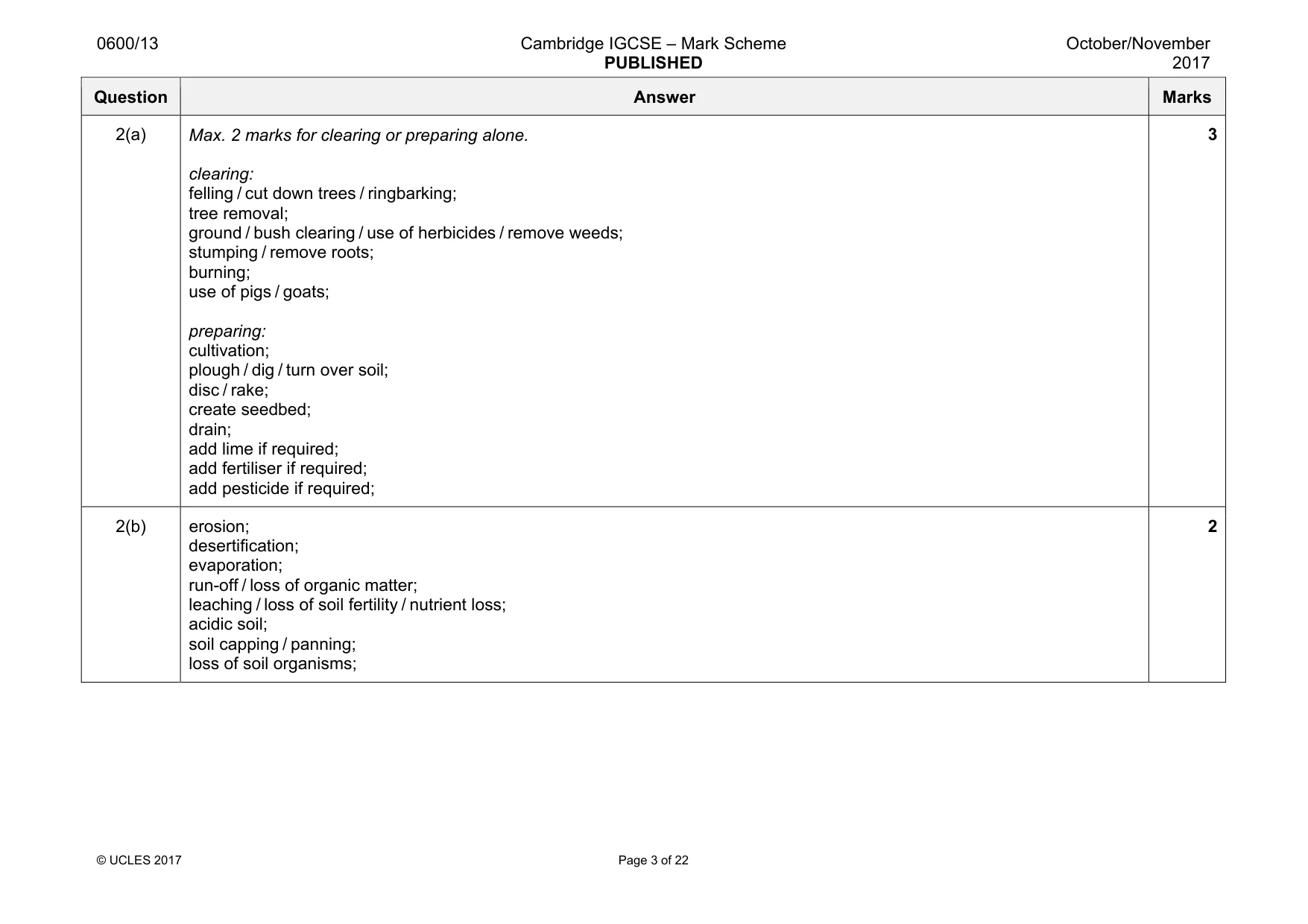
0600/13 Cambridge IGCSE – Mark Scheme PUBLISHED October/November 2017 © UCLES 2017 Page 3 of 22 Question Answer Marks 2(a) Max. 2 marks for clearing or preparing alone. clearing: felling / cut down trees / ringbarking; tree removal; ground / bush clearing / use of herbicides / remove weeds; stumping / remove roots; burning; use of pigs / goats; preparing: cultivation; plough / dig / turn over soil; disc / rake; create seedbed; drain; add lime if required; add fertiliser if required; add pesticide if required; 3 2(b) erosion; desertification; evaporation; run-off / loss of organic matter; leaching / loss of soil fertility / nutrient loss; acidic soil; soil capping / panning; loss of soil organisms; 2
Mark scheme, page 4
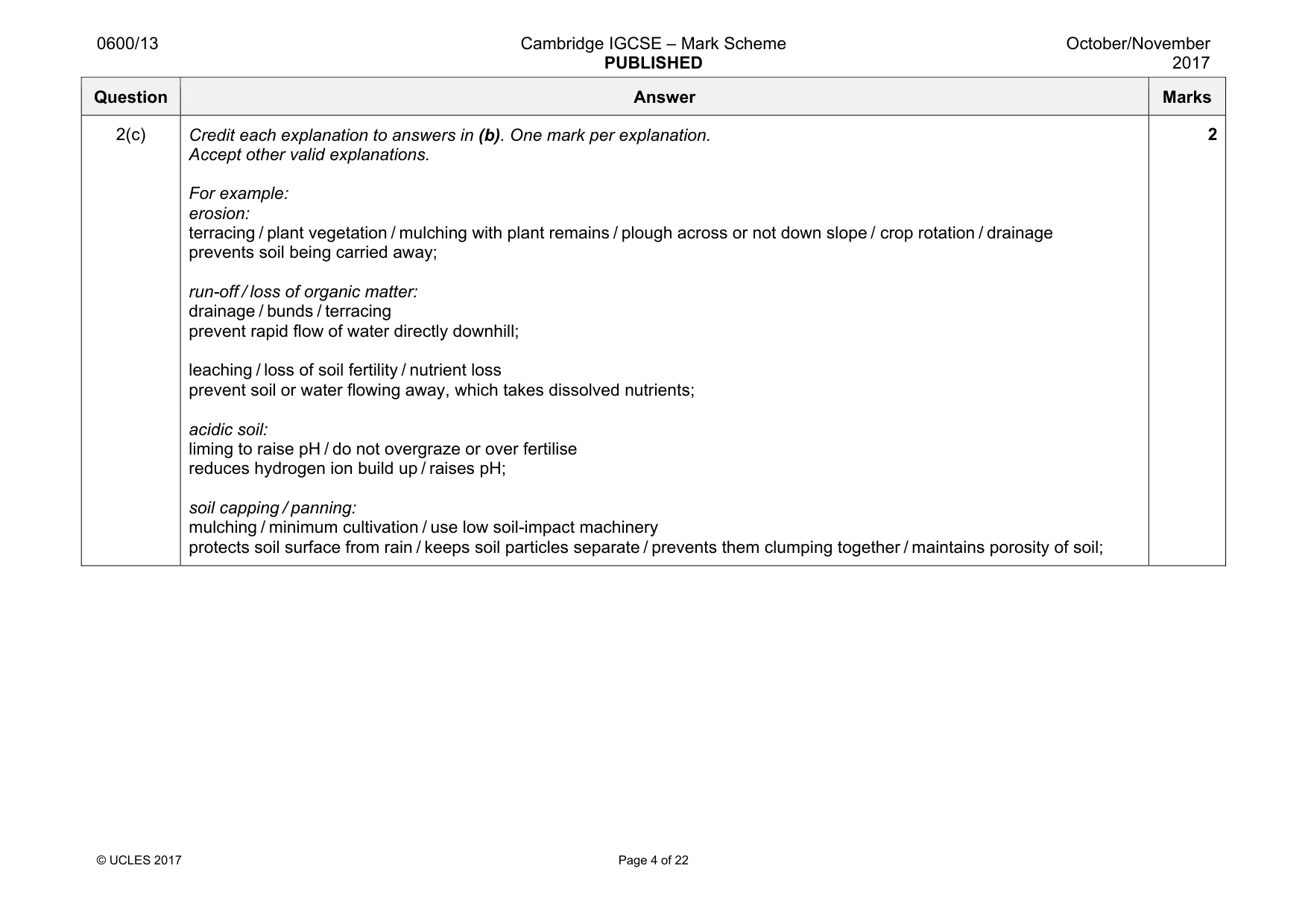
0600/13 Cambridge IGCSE – Mark Scheme PUBLISHED October/November 2017 © UCLES 2017 Page 4 of 22 Question Answer Marks 2(c) Credit each explanation to answers in (b). One mark per explanation. Accept other valid explanations. For example: erosion: terracing / plant vegetation / mulching with plant remains / plough across or not down slope / crop rotation / drainage prevents soil being carried away; run-off / loss of organic matter: drainage / bunds / terracing prevent rapid flow of water directly downhill; leaching / loss of soil fertility / nutrient loss prevent soil or water flowing away, which takes dissolved nutrients; acidic soil: liming to raise pH / do not overgraze or over fertilise reduces hydrogen ion build up / raises pH; soil capping / panning: mulching / minimum cultivation / use low soil-impact machinery protects soil surface from rain / keeps soil particles separate / prevents them clumping together / maintains porosity of soil; 2
Mark scheme, page 5
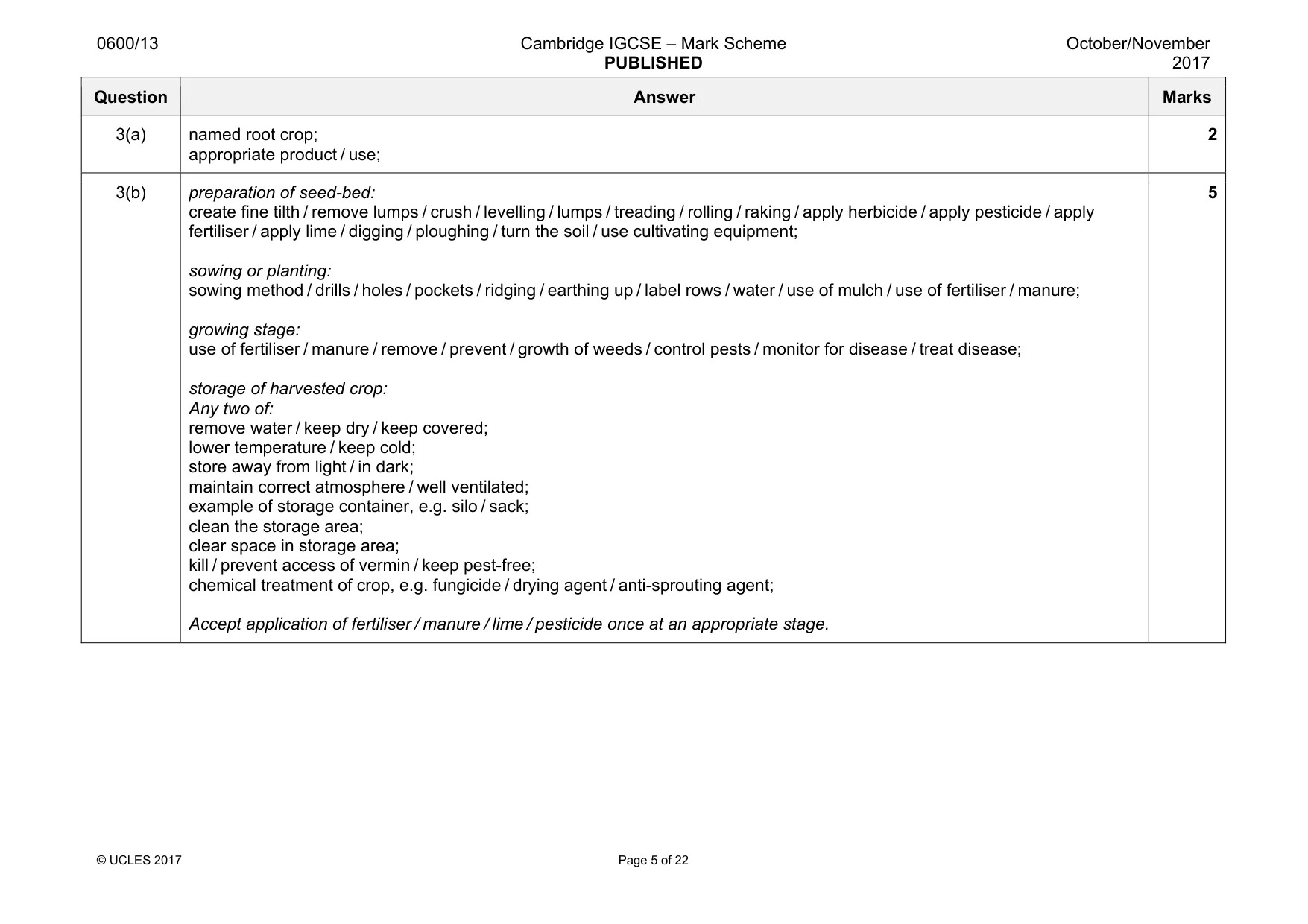
0600/13 Cambridge IGCSE – Mark Scheme PUBLISHED October/November 2017 © UCLES 2017 Page 5 of 22 Question Answer Marks 3(a) named root crop; appropriate product / use; 2 3(b) preparation of seed-bed: create fine tilth / remove lumps / crush / levelling / lumps / treading / rolling / raking / apply herbicide / apply pesticide / apply fertiliser / apply lime / digging / ploughing / turn the soil / use cultivating equipment; sowing or planting: sowing method / drills / holes / pockets / ridging / earthing up / label rows / water / use of mulch / use of fertiliser / manure; growing stage: use of fertiliser / manure / remove / prevent / growth of weeds / control pests / monitor for disease / treat disease; storage of harvested crop: Any two of: remove water / keep dry / keep covered; lower temperature / keep cold; store away from light / in dark; maintain correct atmosphere / well ventilated; example of storage container, e.g. silo / sack; clean the storage area; clear space in storage area; kill / prevent access of vermin / keep pest-free; chemical treatment of crop, e.g. fungicide / drying agent / anti-sprouting agent; Accept application of fertiliser / manure / lime / pesticide once at an appropriate stage. 5
Mark scheme, page 6
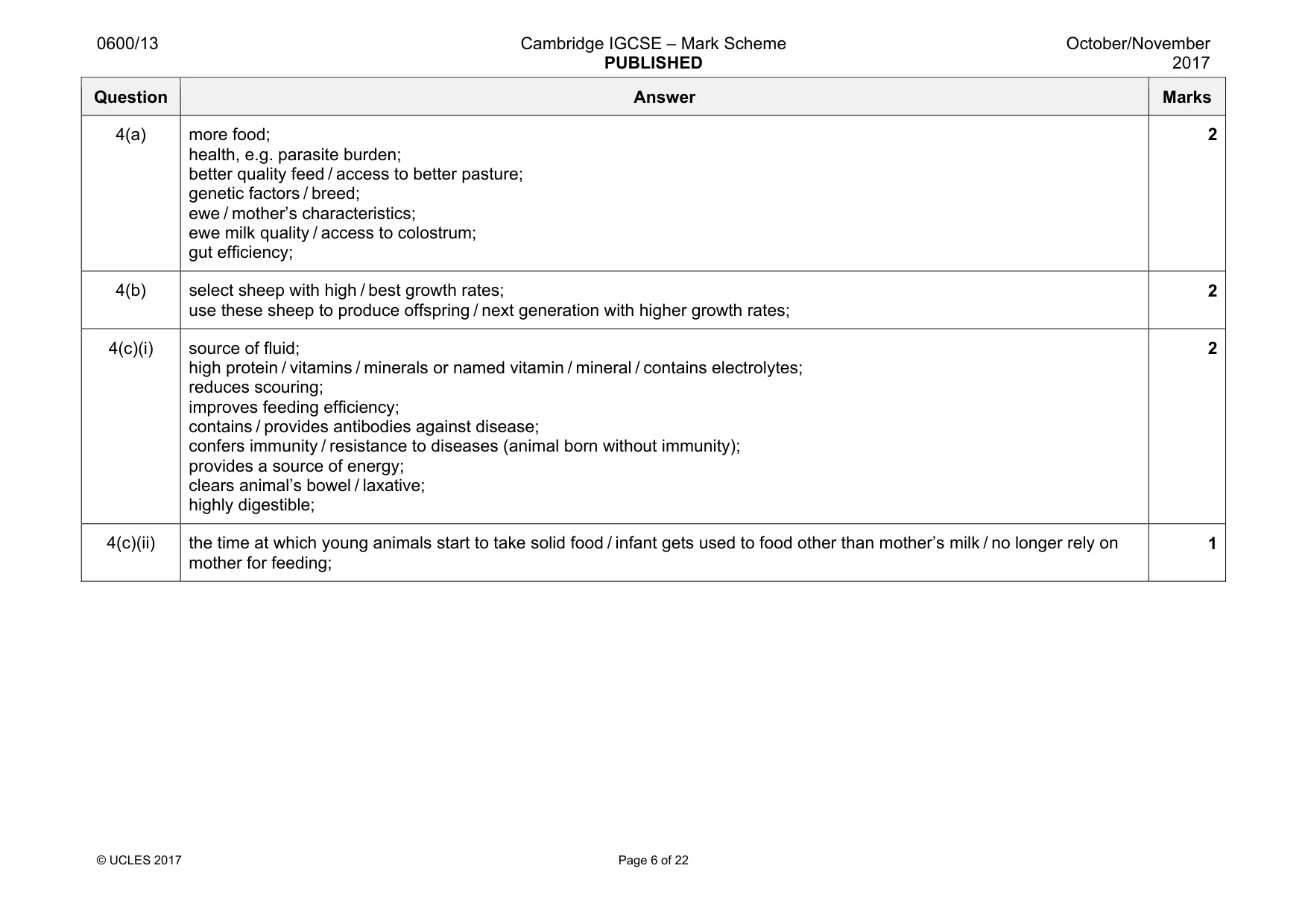
0600/13 Cambridge IGCSE – Mark Scheme PUBLISHED October/November 2017 © UCLES 2017 Page 6 of 22 Question Answer Marks 4(a) more food; health, e.g. parasite burden; better quality feed / access to better pasture; genetic factors / breed; ewe / mother’s characteristics; ewe milk quality / access to colostrum; gut efficiency; 2 4(b) select sheep with high / best growth rates; use these sheep to produce offspring / next generation with higher growth rates; 2 4(c)(i) source of fluid; high protein / vitamins / minerals or named vitamin / mineral / contains electrolytes; reduces scouring; improves feeding efficiency; contains / provides antibodies against disease; confers immunity / resistance to diseases (animal born without immunity); provides a source of energy; clears animal’s bowel / laxative; highly digestible; 2 4(c)(ii) the time at which young animals start to take solid food / infant gets used to food other than mother’s milk / no longer rely on mother for feeding; 1
Mark scheme, page 7
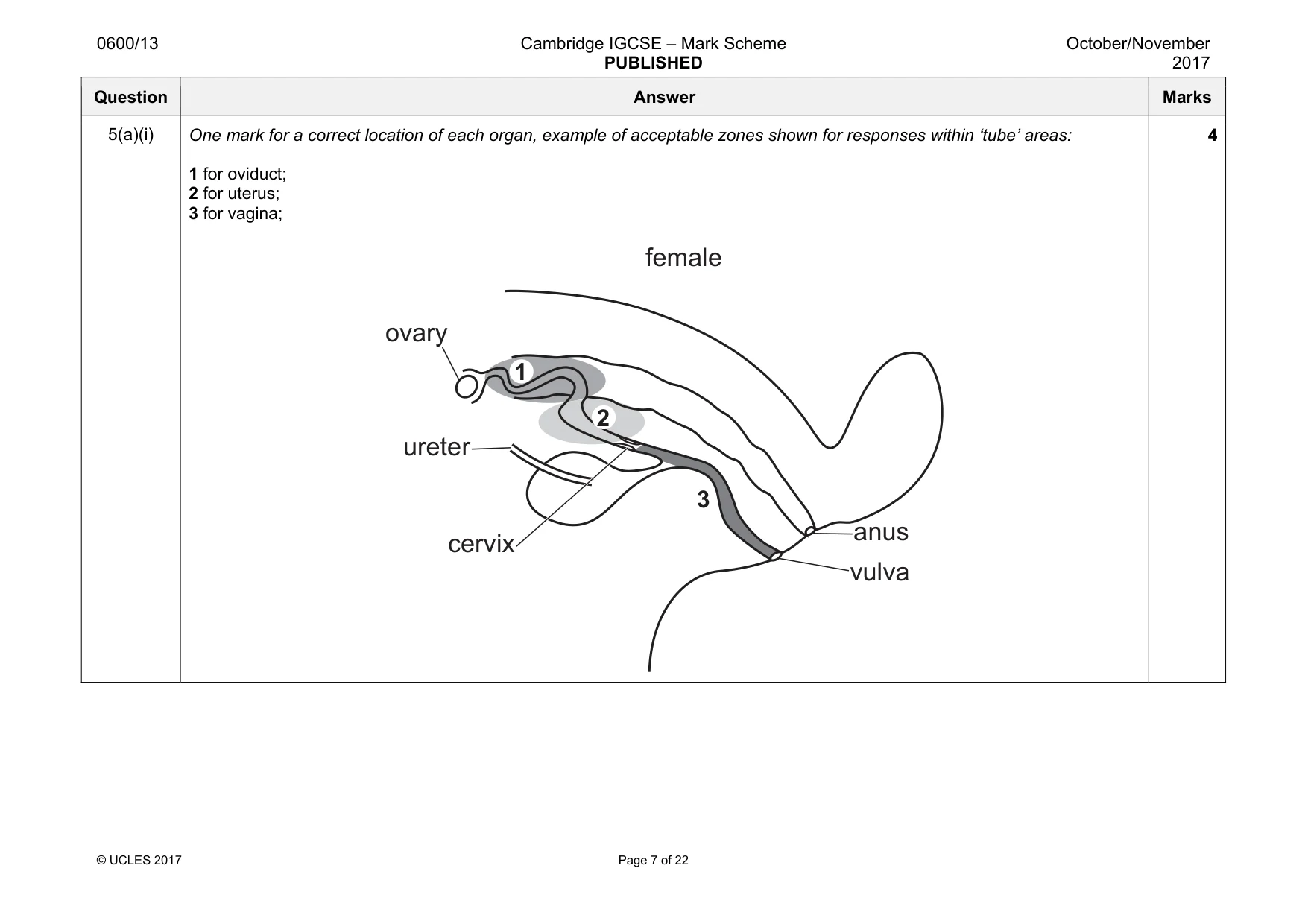
0600/13 Cambridge IGCSE – Mark Scheme PUBLISHED October/November 2017 © UCLES 2017 Page 7 of 22 Question Answer Marks 5(a)(i) One mark for a correct location of each organ, example of acceptable zones shown for responses within ‘tube’ areas: 1 for oviduct; 2 for uterus; 3 for vagina; 4 female ovary ureter anus vulva cervix 1 2 3
Mark scheme, page 8
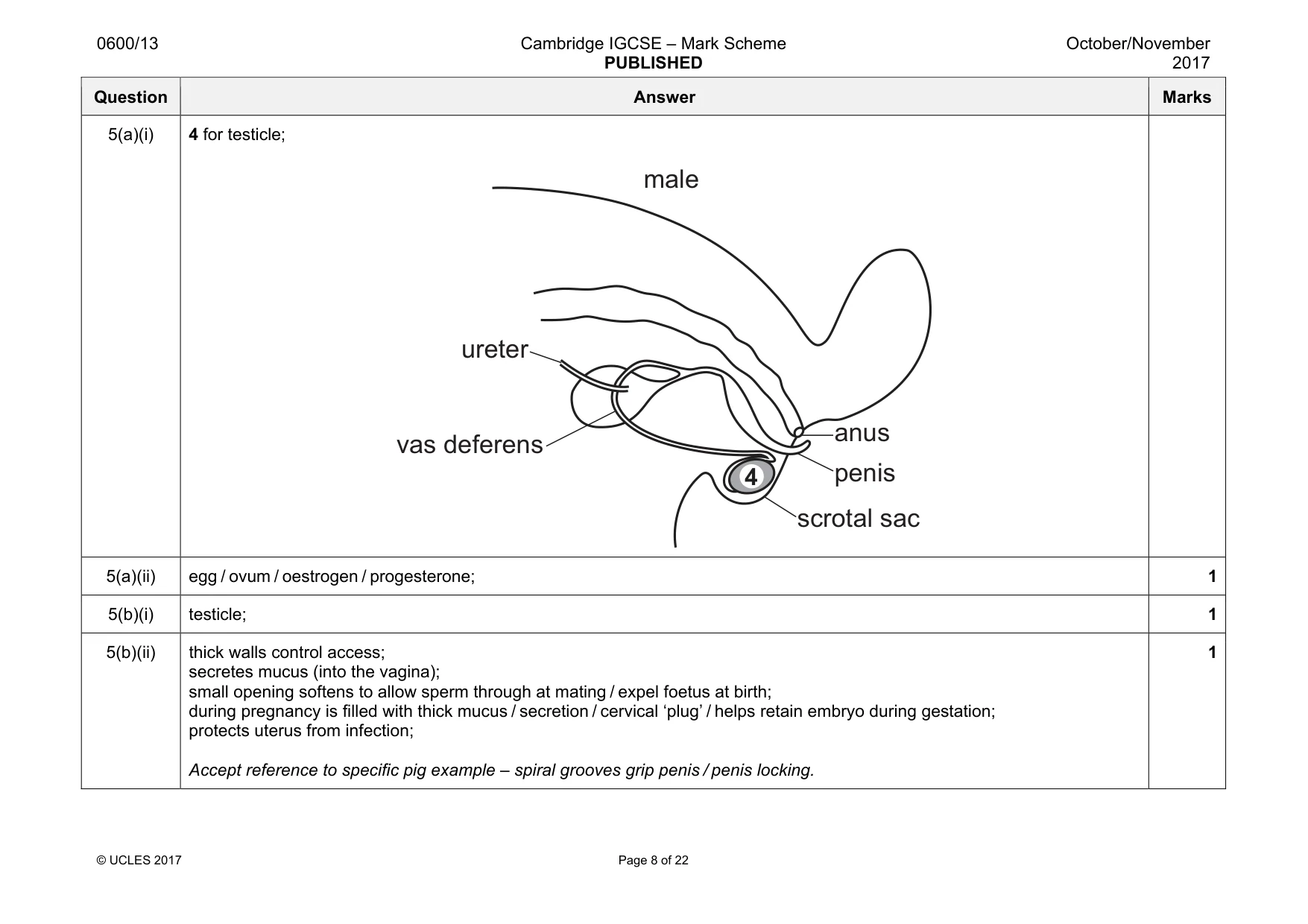
0600/13 Cambridge IGCSE – Mark Scheme PUBLISHED October/November 2017 © UCLES 2017 Page 8 of 22 Question Answer Marks 5(a)(i) 4 for testicle; 5(a)(ii) egg / ovum / oestrogen / progesterone; 1 5(b)(i) testicle; 1 5(b)(ii) thick walls control access; secretes mucus (into the vagina); small opening softens to allow sperm through at mating / expel foetus at birth; during pregnancy is filled with thick mucus / secretion / cervical ‘plug’ / helps retain embryo during gestation; protects uterus from infection; Accept reference to specific pig example – spiral grooves grip penis / penis locking. 1 vas deferens male ureter anus penis scrotal sac 4
Mark scheme, page 9
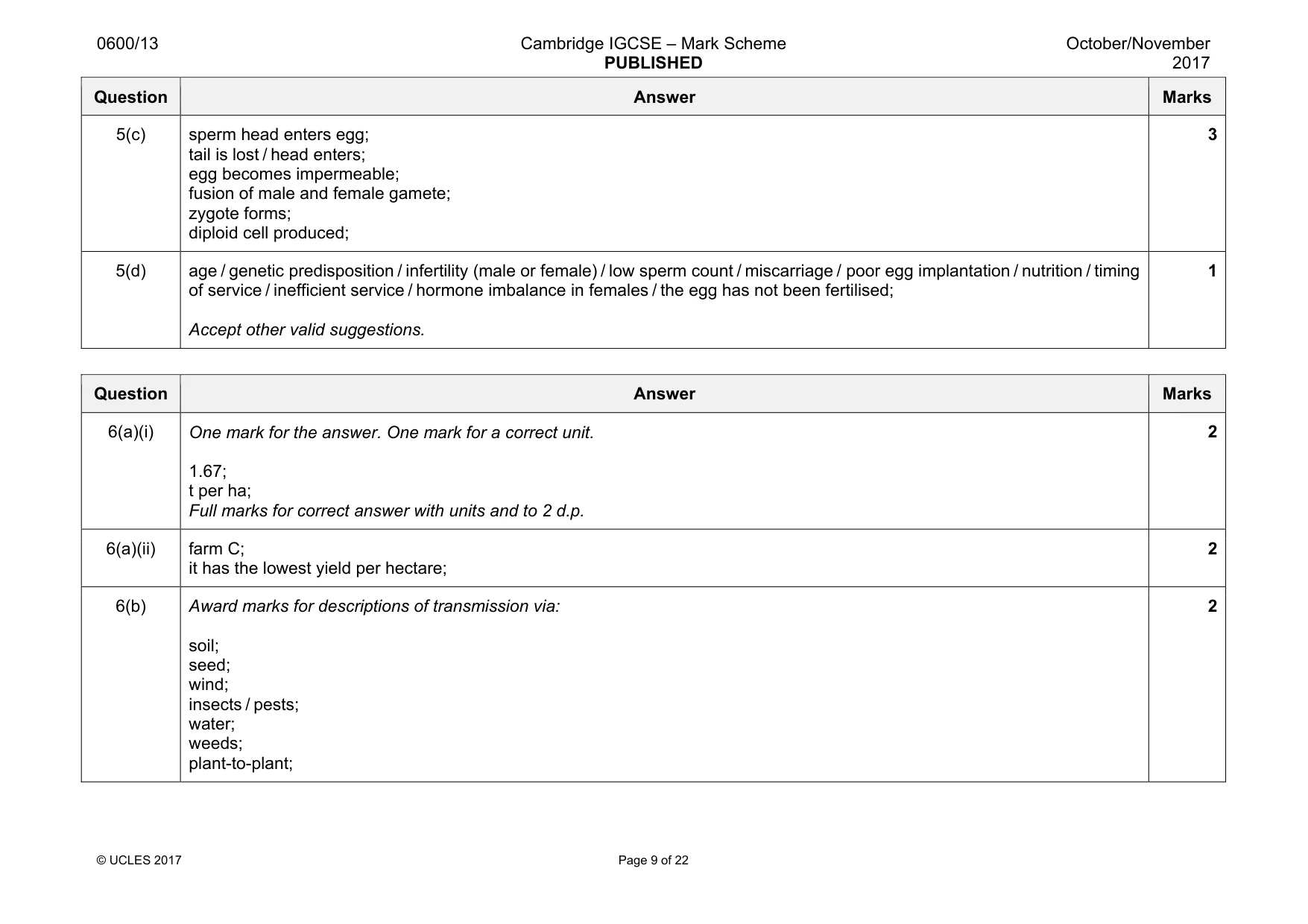
0600/13 Cambridge IGCSE – Mark Scheme PUBLISHED October/November 2017 © UCLES 2017 Page 9 of 22 Question Answer Marks 5(c) sperm head enters egg; tail is lost / head enters; egg becomes impermeable; fusion of male and female gamete; zygote forms; diploid cell produced; 3 5(d) age / genetic predisposition / infertility (male or female) / low sperm count / miscarriage / poor egg implantation / nutrition / timing of service / inefficient service / hormone imbalance in females / the egg has not been fertilised; Accept other valid suggestions. 1 Question Answer Marks 6(a)(i) One mark for the answer. One mark for a correct unit. 1.67; t per ha; Full marks for correct answer with units and to 2 d.p. 2 6(a)(ii) farm C; it has the lowest yield per hectare; 2 6(b) Award marks for descriptions of transmission via: soil; seed; wind; insects / pests; water; weeds; plant-to-plant; 2
Mark scheme, page 10
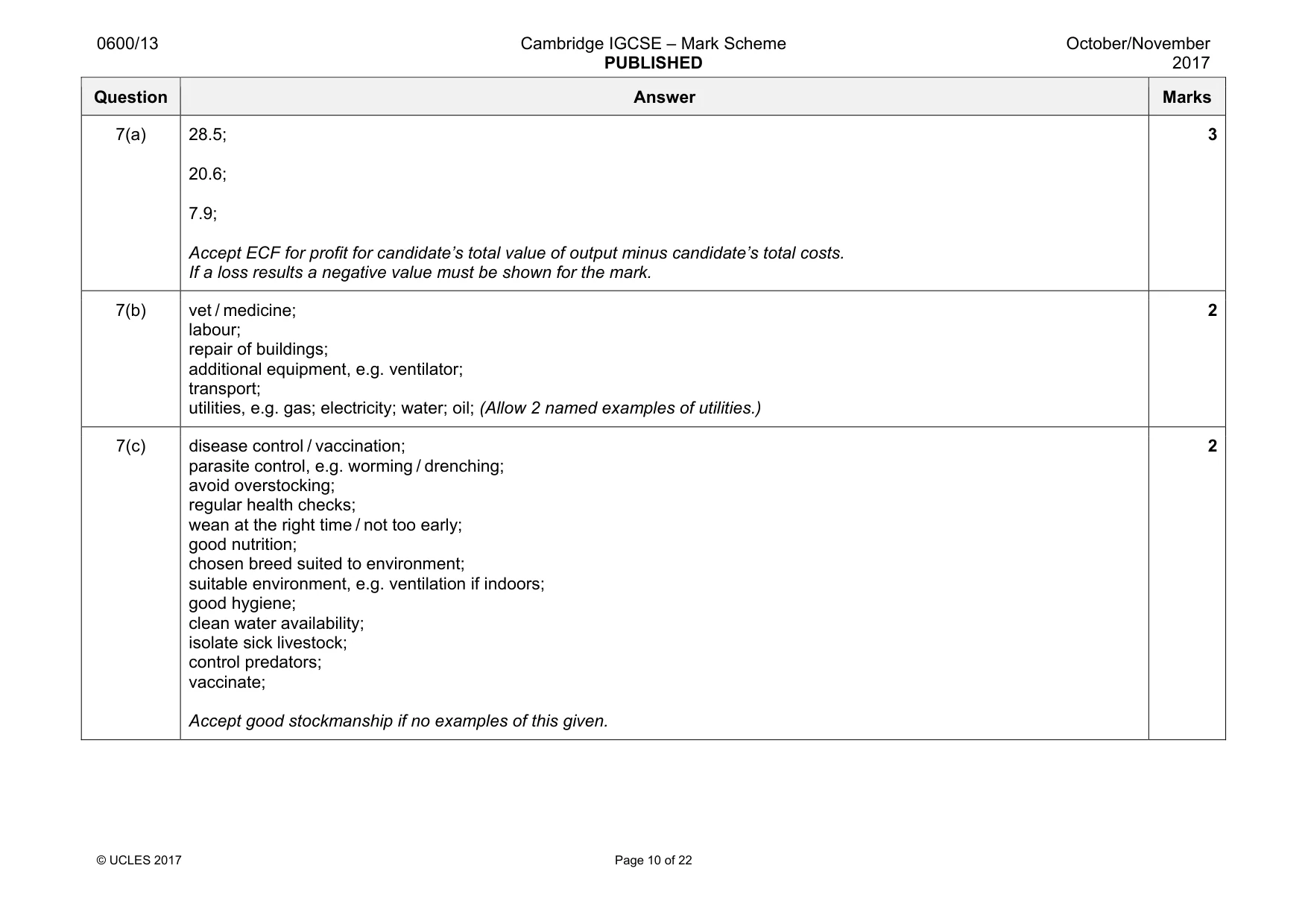
0600/13 Cambridge IGCSE – Mark Scheme PUBLISHED October/November 2017 © UCLES 2017 Page 10 of 22 Question Answer Marks 7(a) 28.5; 20.6; 7.9; Accept ECF for profit for candidate’s total value of output minus candidate’s total costs. If a loss results a negative value must be shown for the mark. 3 7(b) vet / medicine; labour; repair of buildings; additional equipment, e.g. ventilator; transport; utilities, e.g. gas; electricity; water; oil; (Allow 2 named examples of utilities.) 2 7(c) disease control / vaccination; parasite control, e.g. worming / drenching; avoid overstocking; regular health checks; wean at the right time / not too early; good nutrition; chosen breed suited to environment; suitable environment, e.g. ventilation if indoors; good hygiene; clean water availability; isolate sick livestock; control predators; vaccinate; Accept good stockmanship if no examples of this given. 2
Mark scheme, page 11
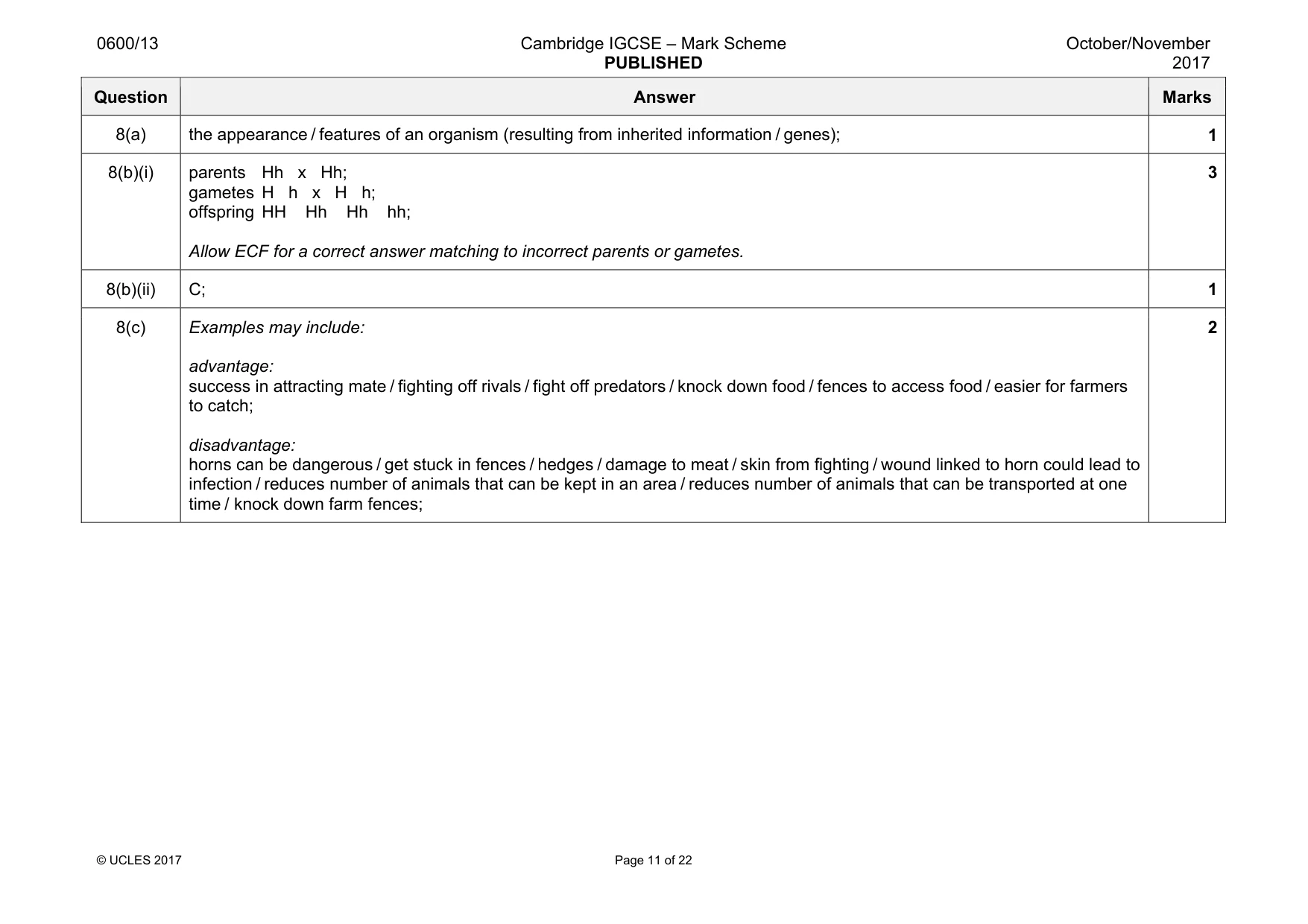
0600/13 Cambridge IGCSE – Mark Scheme PUBLISHED October/November 2017 © UCLES 2017 Page 11 of 22 Question Answer Marks 8(a) the appearance / features of an organism (resulting from inherited information / genes); 1 8(b)(i) parents Hh x Hh; gametes H h x H h; offspring HH Hh Hh hh; Allow ECF for a correct answer matching to incorrect parents or gametes. 3 8(b)(ii) C; 1 8(c) Examples may include: advantage: success in attracting mate / fighting off rivals / fight off predators / knock down food / fences to access food / easier for farmers to catch; disadvantage: horns can be dangerous / get stuck in fences / hedges / damage to meat / skin from fighting / wound linked to horn could lead to infection / reduces number of animals that can be kept in an area / reduces number of animals that can be transported at one time / knock down farm fences; 2
Mark scheme, page 12
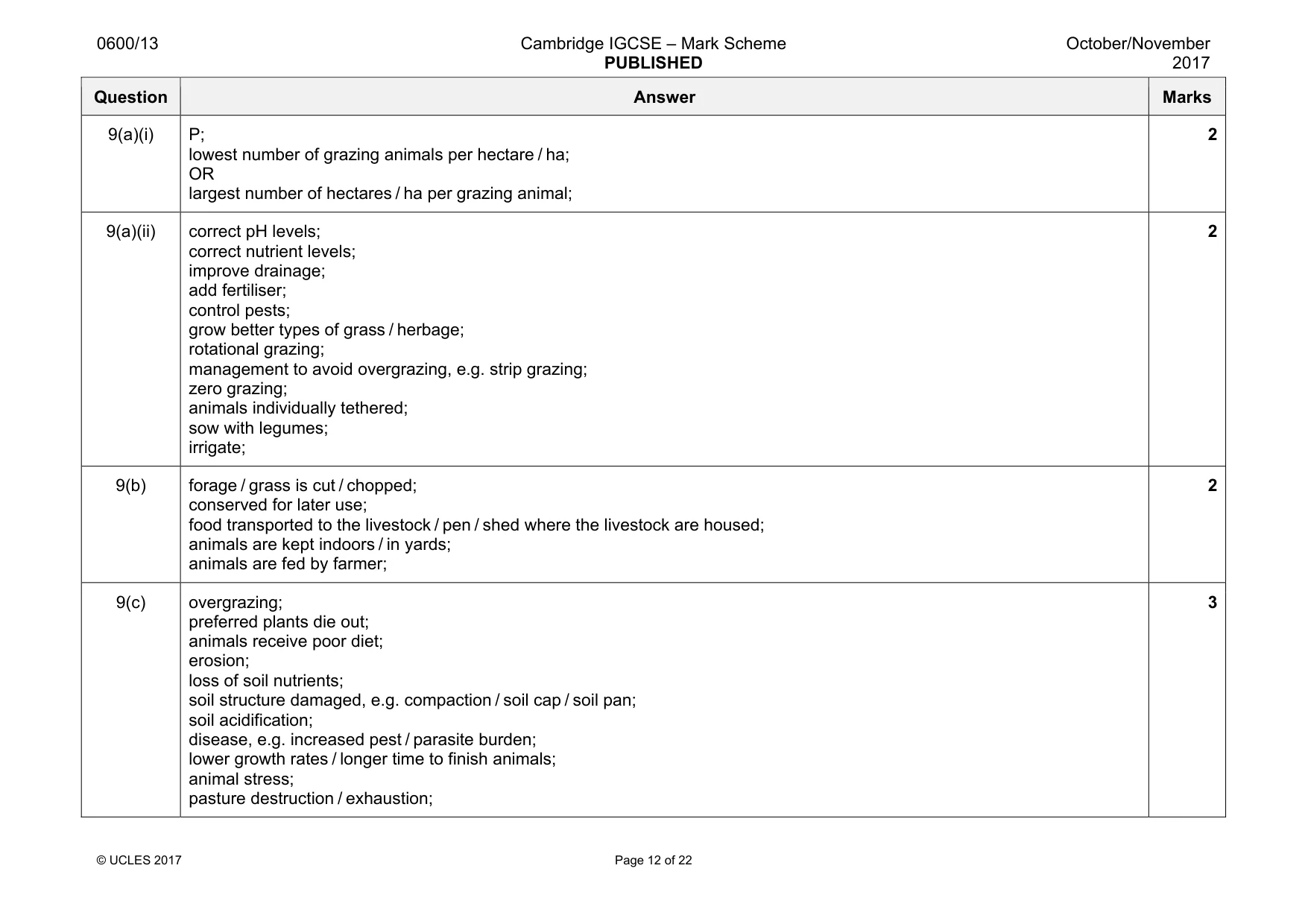
0600/13 Cambridge IGCSE – Mark Scheme PUBLISHED October/November 2017 © UCLES 2017 Page 12 of 22 Question Answer Marks 9(a)(i) P; lowest number of grazing animals per hectare / ha; OR largest number of hectares / ha per grazing animal; 2 9(a)(ii) correct pH levels; correct nutrient levels; improve drainage; add fertiliser; control pests; grow better types of grass / herbage; rotational grazing; management to avoid overgrazing, e.g. strip grazing; zero grazing; animals individually tethered; sow with legumes; irrigate; 2 9(b) forage / grass is cut / chopped; conserved for later use; food transported to the livestock / pen / shed where the livestock are housed; animals are kept indoors / in yards; animals are fed by farmer; 2 9(c) overgrazing; preferred plants die out; animals receive poor diet; erosion; loss of soil nutrients; soil structure damaged, e.g. compaction / soil cap / soil pan; soil acidification; disease, e.g. increased pest / parasite burden; lower growth rates / longer time to finish animals; animal stress; pasture destruction / exhaustion; 3
Mark scheme, page 13
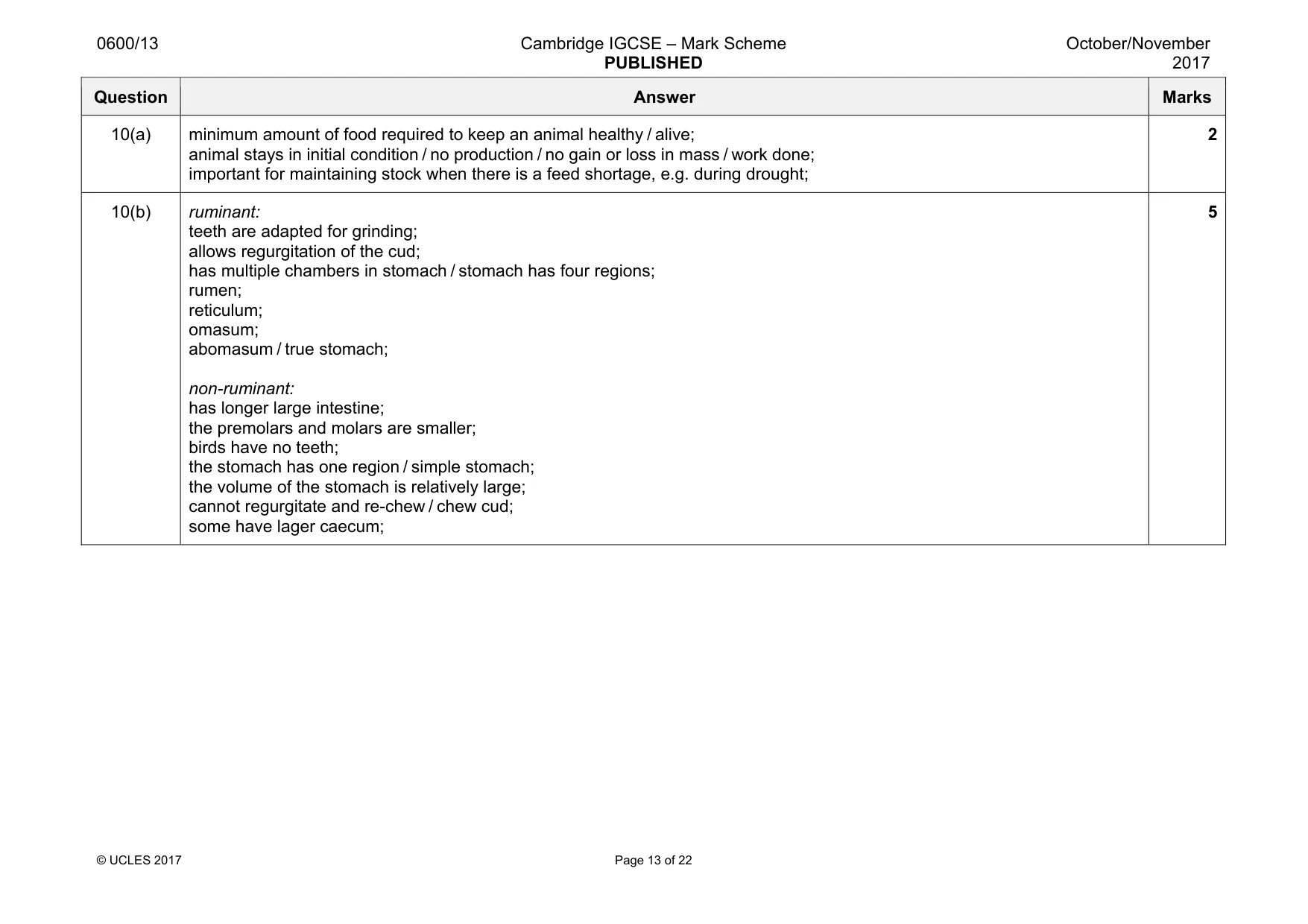
0600/13 Cambridge IGCSE – Mark Scheme PUBLISHED October/November 2017 © UCLES 2017 Page 13 of 22 Question Answer Marks 10(a) minimum amount of food required to keep an animal healthy / alive; animal stays in initial condition / no production / no gain or loss in mass / work done; important for maintaining stock when there is a feed shortage, e.g. during drought; 2 10(b) ruminant: teeth are adapted for grinding; allows regurgitation of the cud; has multiple chambers in stomach / stomach has four regions; rumen; reticulum; omasum; abomasum / true stomach; non-ruminant: has longer large intestine; the premolars and molars are smaller; birds have no teeth; the stomach has one region / simple stomach; the volume of the stomach is relatively large; cannot regurgitate and re-chew / chew cud; some have lager caecum; 5
Mark scheme, page 14
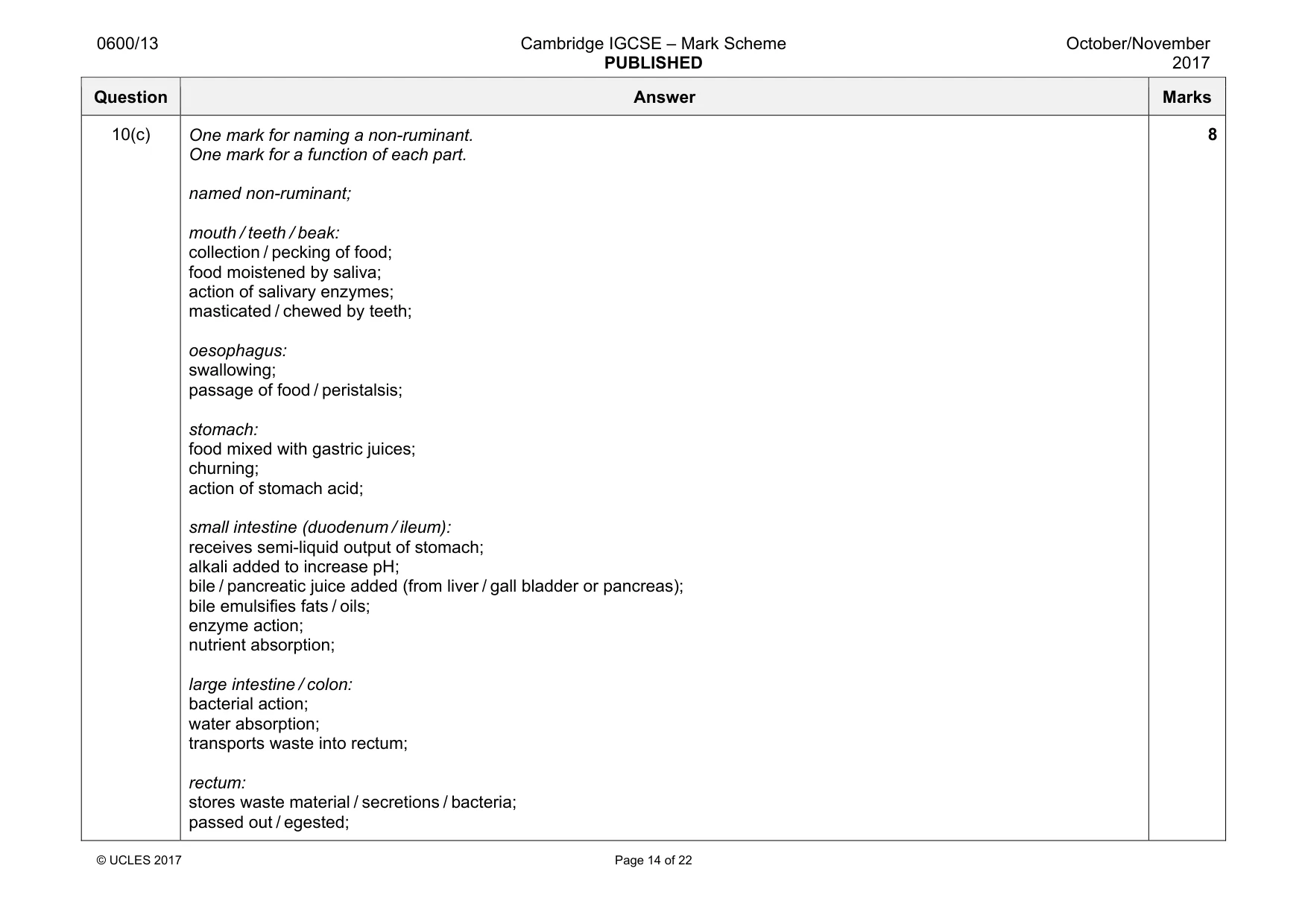
0600/13 Cambridge IGCSE – Mark Scheme PUBLISHED October/November 2017 © UCLES 2017 Page 14 of 22 Question Answer Marks 10(c) One mark for naming a non-ruminant. One mark for a function of each part. named non-ruminant; mouth / teeth / beak: collection / pecking of food; food moistened by saliva; action of salivary enzymes; masticated / chewed by teeth; oesophagus: swallowing; passage of food / peristalsis; stomach: food mixed with gastric juices; churning; action of stomach acid; small intestine (duodenum / ileum): receives semi-liquid output of stomach; alkali added to increase pH; bile / pancreatic juice added (from liver / gall bladder or pancreas); bile emulsifies fats / oils; enzyme action; nutrient absorption; large intestine / colon: bacterial action; water absorption; transports waste into rectum; rectum: stores waste material / secretions / bacteria; passed out / egested; 8
Mark scheme, page 15
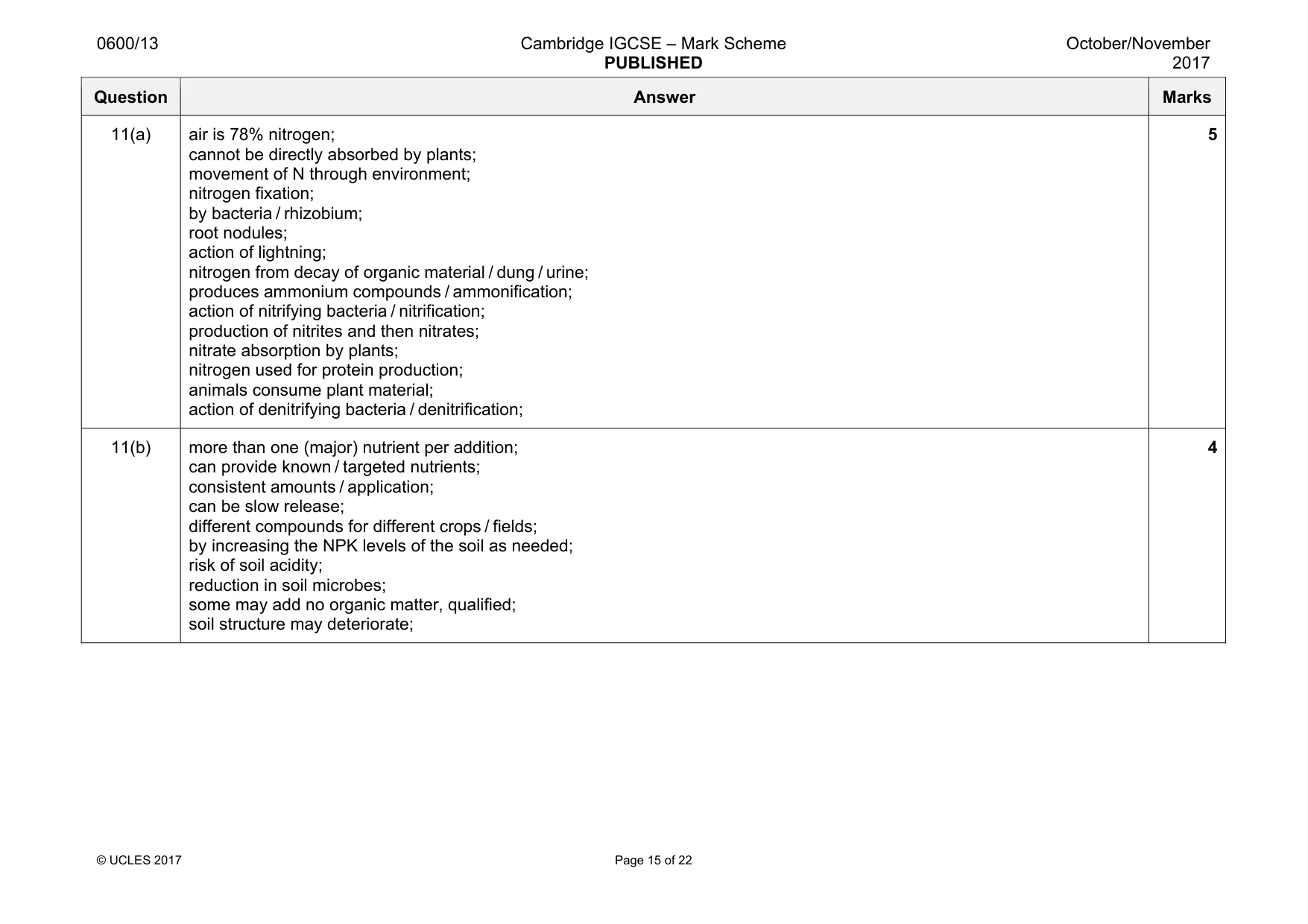
0600/13 Cambridge IGCSE – Mark Scheme PUBLISHED October/November 2017 © UCLES 2017 Page 15 of 22 Question Answer Marks 11(a) air is 78% nitrogen; cannot be directly absorbed by plants; movement of N through environment; nitrogen fixation; by bacteria / rhizobium; root nodules; action of lightning; nitrogen from decay of organic material / dung / urine; produces ammonium compounds / ammonification; action of nitrifying bacteria / nitrification; production of nitrites and then nitrates; nitrate absorption by plants; nitrogen used for protein production; animals consume plant material; action of denitrifying bacteria / denitrification; 5 11(b) more than one (major) nutrient per addition; can provide known / targeted nutrients; consistent amounts / application; can be slow release; different compounds for different crops / fields; by increasing the NPK levels of the soil as needed; risk of soil acidity; reduction in soil microbes; some may add no organic matter, qualified; soil structure may deteriorate; 4
Mark scheme, page 16
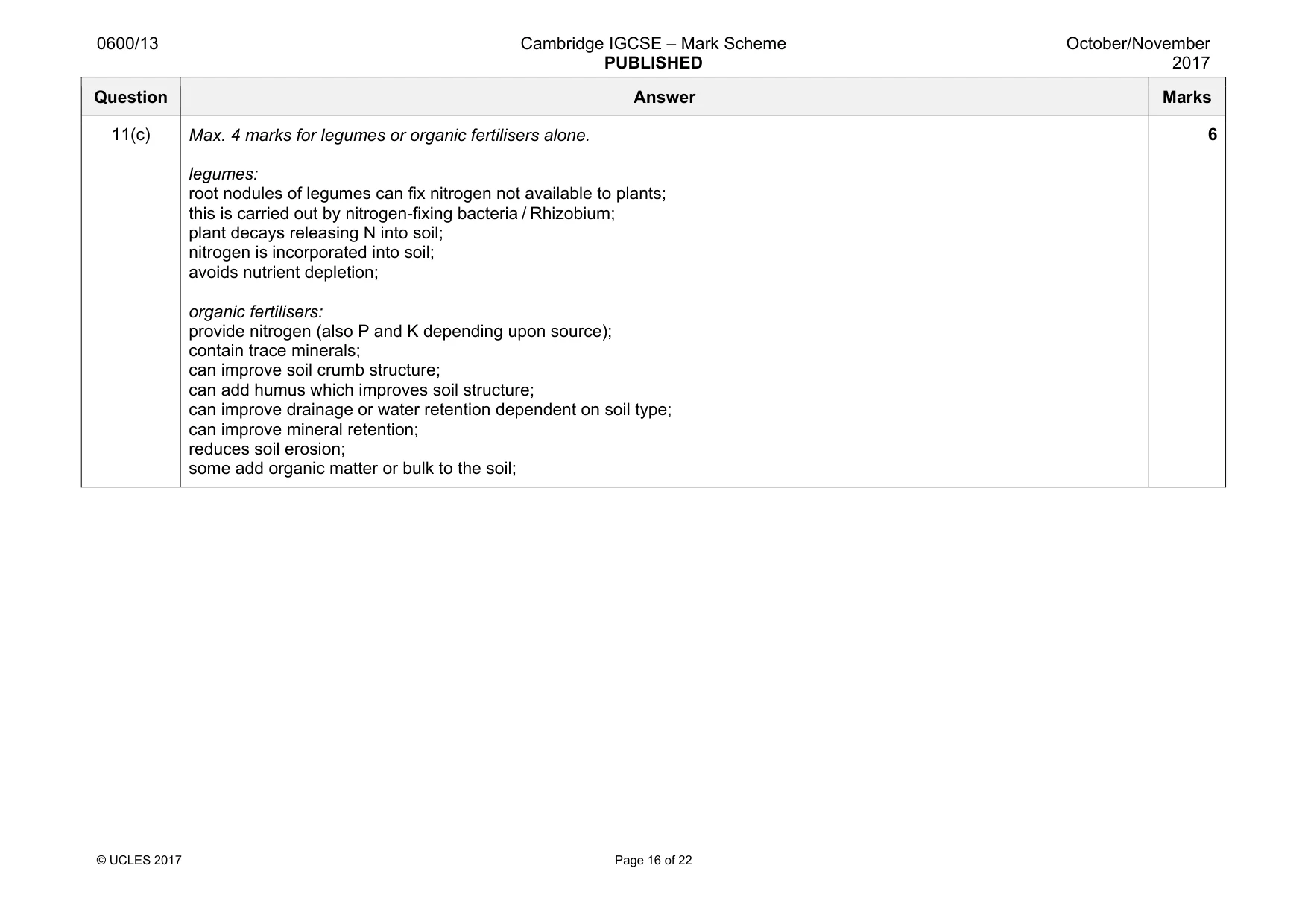
0600/13 Cambridge IGCSE – Mark Scheme PUBLISHED October/November 2017 © UCLES 2017 Page 16 of 22 Question Answer Marks 11(c) Max. 4 marks for legumes or organic fertilisers alone. legumes: root nodules of legumes can fix nitrogen not available to plants; this is carried out by nitrogen-fixing bacteria / Rhizobium; plant decays releasing N into soil; nitrogen is incorporated into soil; avoids nutrient depletion; organic fertilisers: provide nitrogen (also P and K depending upon source); contain trace minerals; can improve soil crumb structure; can add humus which improves soil structure; can improve drainage or water retention dependent on soil type; can improve mineral retention; reduces soil erosion; some add organic matter or bulk to the soil; 6
Mark scheme, page 17
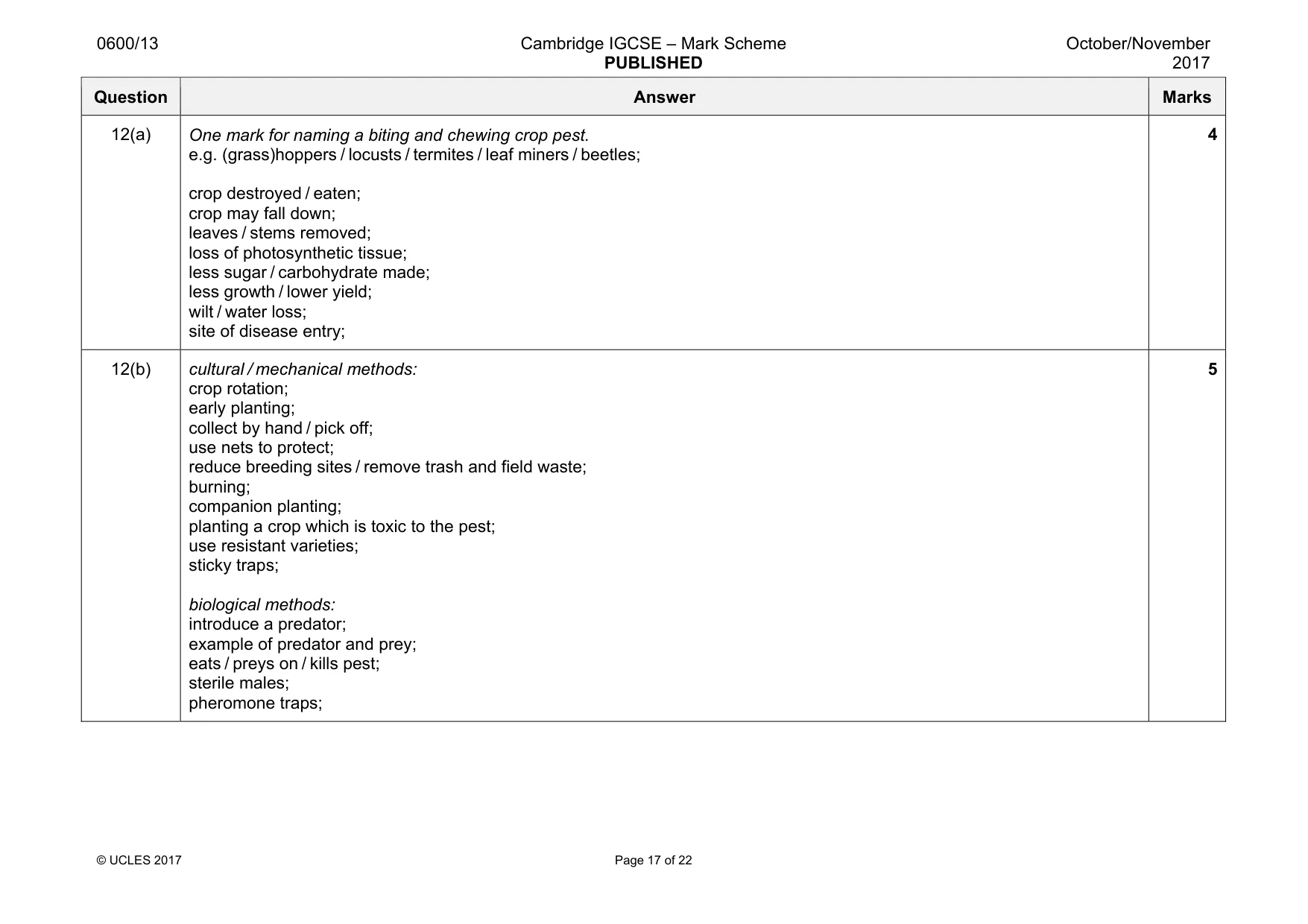
0600/13 Cambridge IGCSE – Mark Scheme PUBLISHED October/November 2017 © UCLES 2017 Page 17 of 22 Question Answer Marks 12(a) One mark for naming a biting and chewing crop pest. e.g. (grass)hoppers / locusts / termites / leaf miners / beetles; crop destroyed / eaten; crop may fall down; leaves / stems removed; loss of photosynthetic tissue; less sugar / carbohydrate made; less growth / lower yield; wilt / water loss; site of disease entry; 4 12(b) cultural / mechanical methods: crop rotation; early planting; collect by hand / pick off; use nets to protect; reduce breeding sites / remove trash and field waste; burning; companion planting; planting a crop which is toxic to the pest; use resistant varieties; sticky traps; biological methods: introduce a predator; example of predator and prey; eats / preys on / kills pest; sterile males; pheromone traps; 5
Mark scheme, page 18
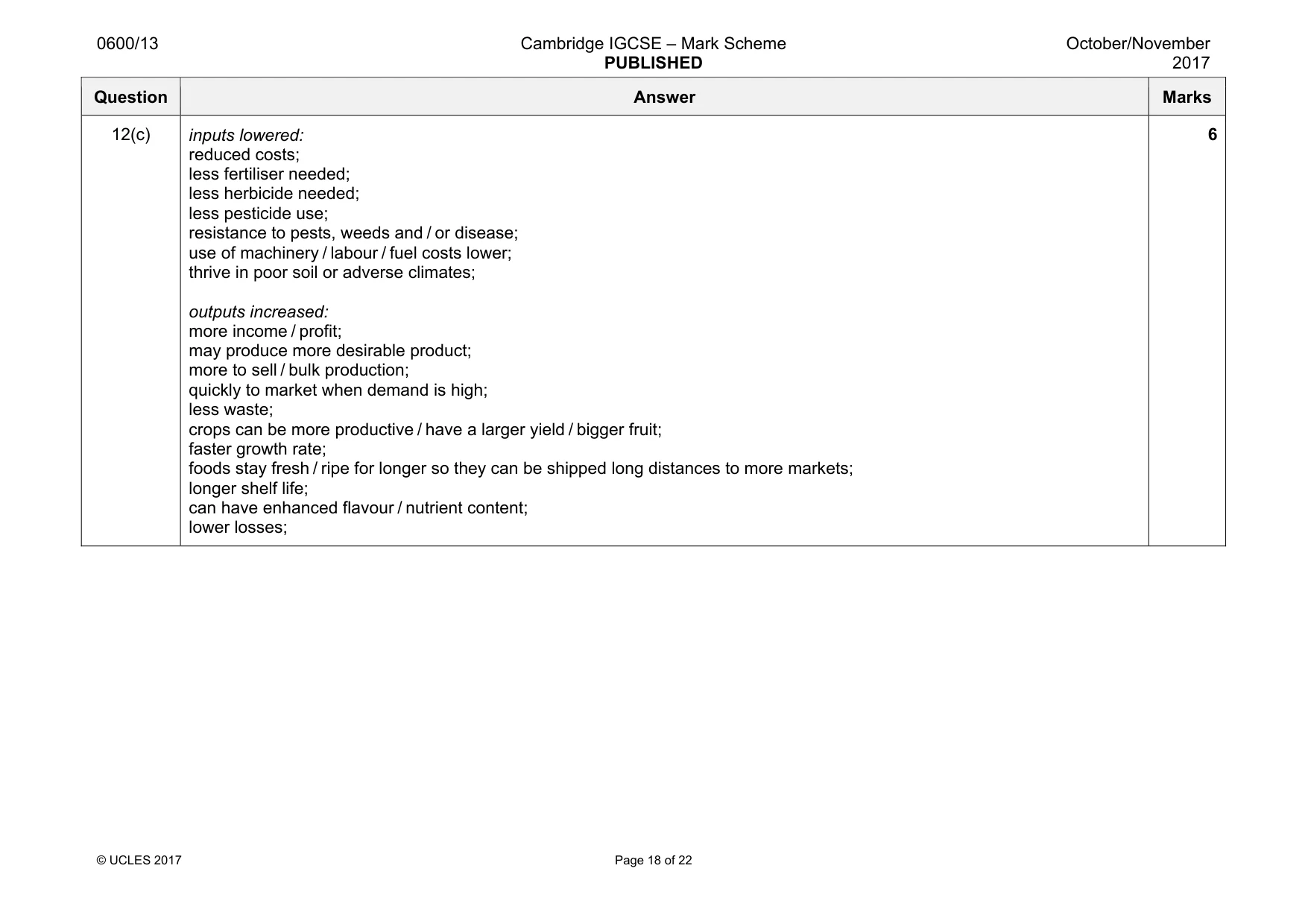
0600/13 Cambridge IGCSE – Mark Scheme PUBLISHED October/November 2017 © UCLES 2017 Page 18 of 22 Question Answer Marks 12(c) inputs lowered: reduced costs; less fertiliser needed; less herbicide needed; less pesticide use; resistance to pests, weeds and / or disease; use of machinery / labour / fuel costs lower; thrive in poor soil or adverse climates; outputs increased: more income / profit; may produce more desirable product; more to sell / bulk production; quickly to market when demand is high; less waste; crops can be more productive / have a larger yield / bigger fruit; faster growth rate; foods stay fresh / ripe for longer so they can be shipped long distances to more markets; longer shelf life; can have enhanced flavour / nutrient content; lower losses; 6
Mark scheme, page 19
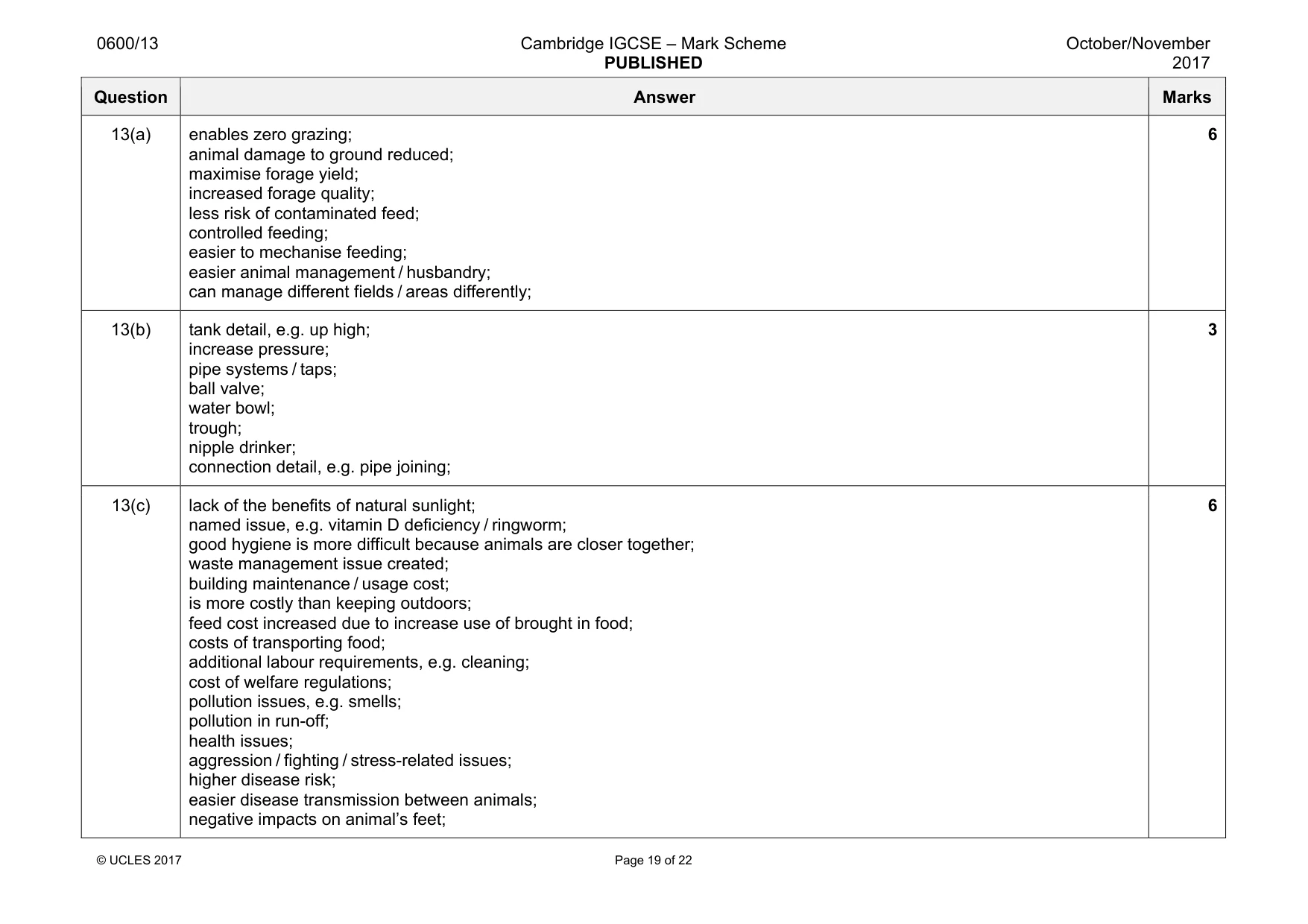
0600/13 Cambridge IGCSE – Mark Scheme PUBLISHED October/November 2017 © UCLES 2017 Page 19 of 22 Question Answer Marks 13(a) enables zero grazing; animal damage to ground reduced; maximise forage yield; increased forage quality; less risk of contaminated feed; controlled feeding; easier to mechanise feeding; easier animal management / husbandry; can manage different fields / areas differently; 6 13(b) tank detail, e.g. up high; increase pressure; pipe systems / taps; ball valve; water bowl; trough; nipple drinker; connection detail, e.g. pipe joining; 3 13(c) lack of the benefits of natural sunlight; named issue, e.g. vitamin D deficiency / ringworm; good hygiene is more difficult because animals are closer together; waste management issue created; building maintenance / usage cost; is more costly than keeping outdoors; feed cost increased due to increase use of brought in food; costs of transporting food; additional labour requirements, e.g. cleaning; cost of welfare regulations; pollution issues, e.g. smells; pollution in run-off; health issues; aggression / fighting / stress-related issues; higher disease risk; easier disease transmission between animals; negative impacts on animal’s feet; 6
Mark scheme, page 20
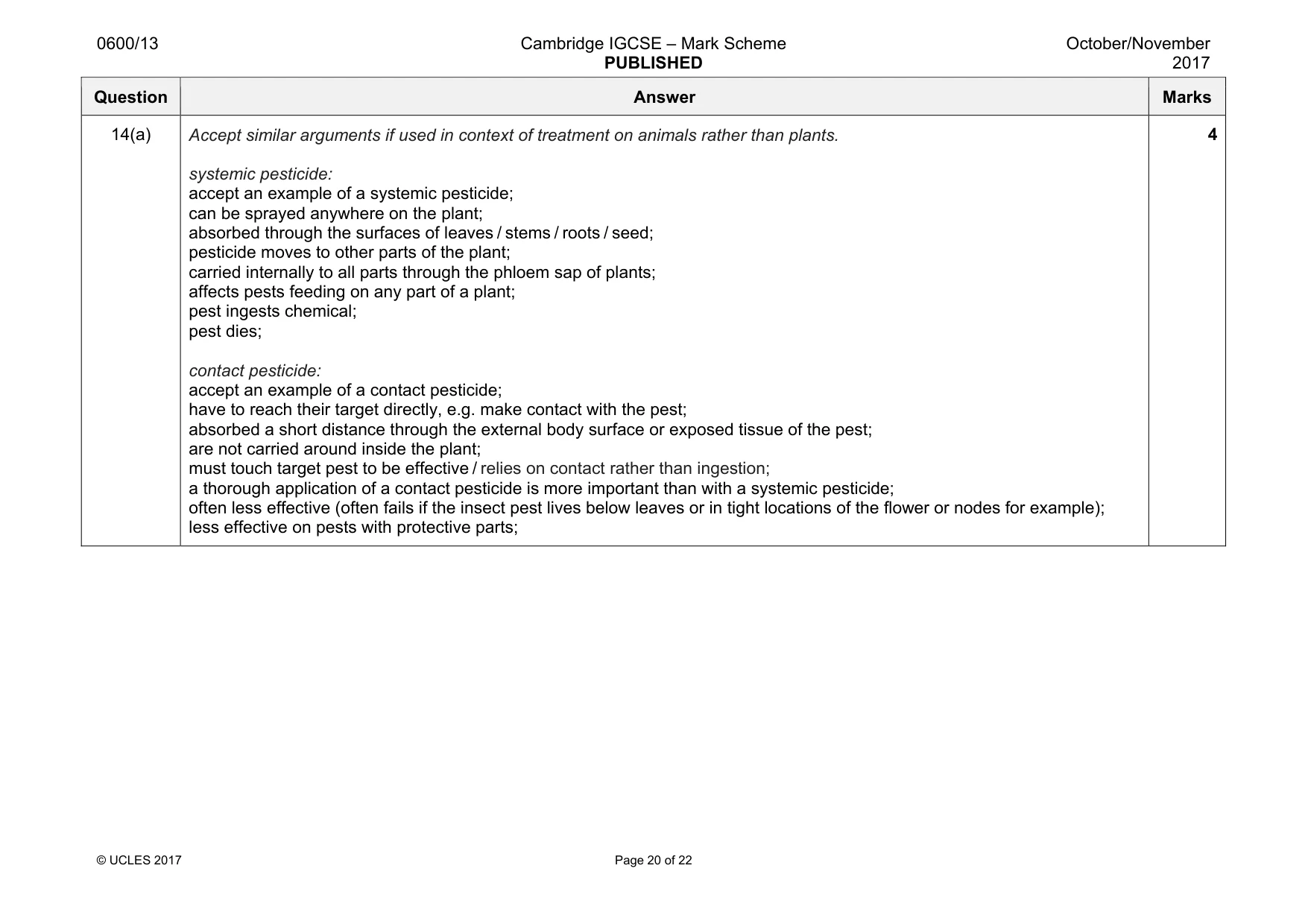
0600/13 Cambridge IGCSE – Mark Scheme PUBLISHED October/November 2017 © UCLES 2017 Page 20 of 22 Question Answer Marks 14(a) Accept similar arguments if used in context of treatment on animals rather than plants. systemic pesticide: accept an example of a systemic pesticide; can be sprayed anywhere on the plant; absorbed through the surfaces of leaves / stems / roots / seed; pesticide moves to other parts of the plant; carried internally to all parts through the phloem sap of plants; affects pests feeding on any part of a plant; pest ingests chemical; pest dies; contact pesticide: accept an example of a contact pesticide; have to reach their target directly, e.g. make contact with the pest; absorbed a short distance through the external body surface or exposed tissue of the pest; are not carried around inside the plant; must touch target pest to be effective / relies on contact rather than ingestion; a thorough application of a contact pesticide is more important than with a systemic pesticide; often less effective (often fails if the insect pest lives below leaves or in tight locations of the flower or nodes for example); less effective on pests with protective parts; 4
Mark scheme, page 21
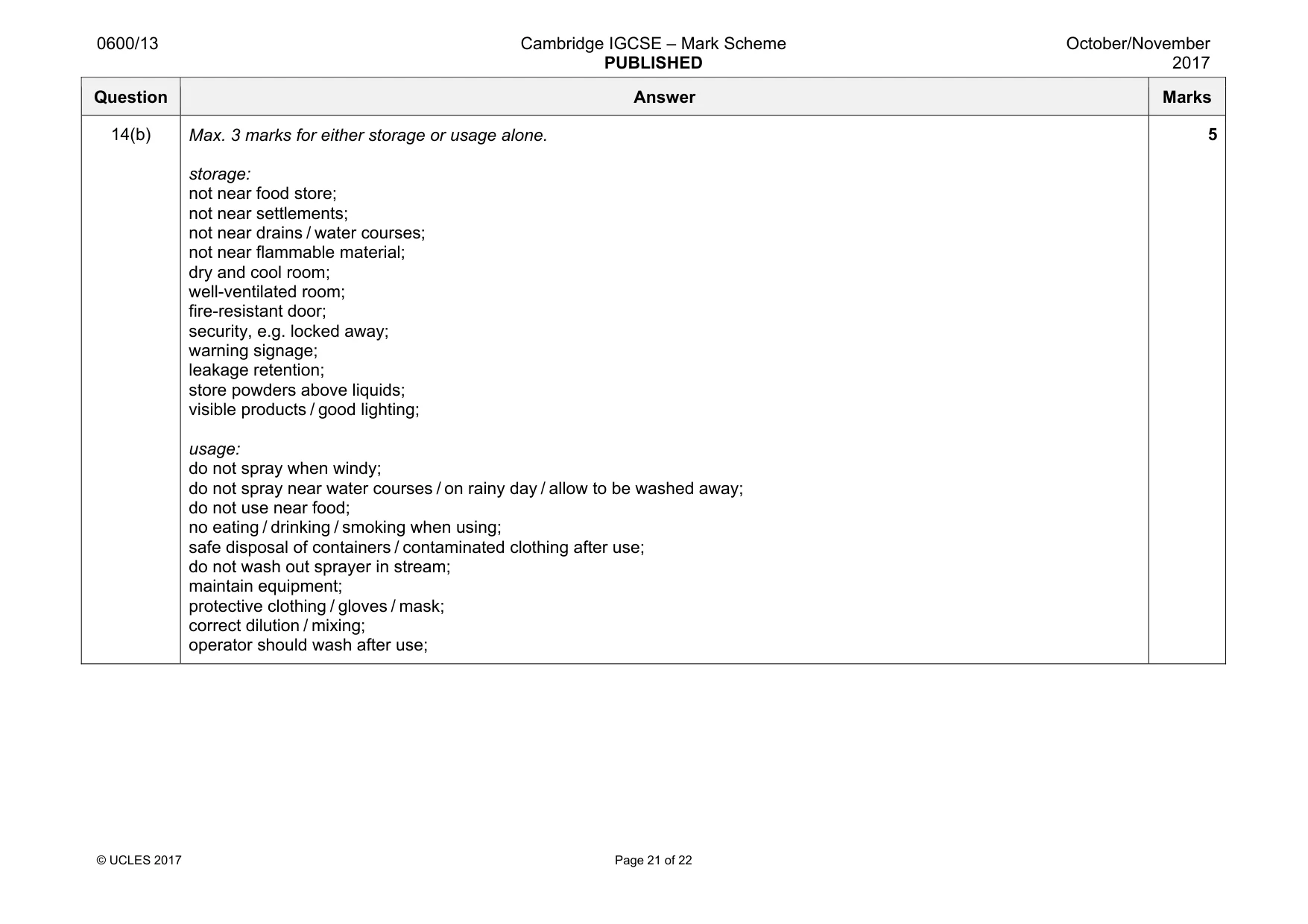
0600/13 Cambridge IGCSE – Mark Scheme PUBLISHED October/November 2017 © UCLES 2017 Page 21 of 22 Question Answer Marks 14(b) Max. 3 marks for either storage or usage alone. storage: not near food store; not near settlements; not near drains / water courses; not near flammable material; dry and cool room; well-ventilated room; fire-resistant door; security, e.g. locked away; warning signage; leakage retention; store powders above liquids; visible products / good lighting; usage: do not spray when windy; do not spray near water courses / on rainy day / allow to be washed away; do not use near food; no eating / drinking / smoking when using; safe disposal of containers / contaminated clothing after use; do not wash out sprayer in stream; maintain equipment; protective clothing / gloves / mask; correct dilution / mixing; operator should wash after use; 5
Mark scheme, page 22
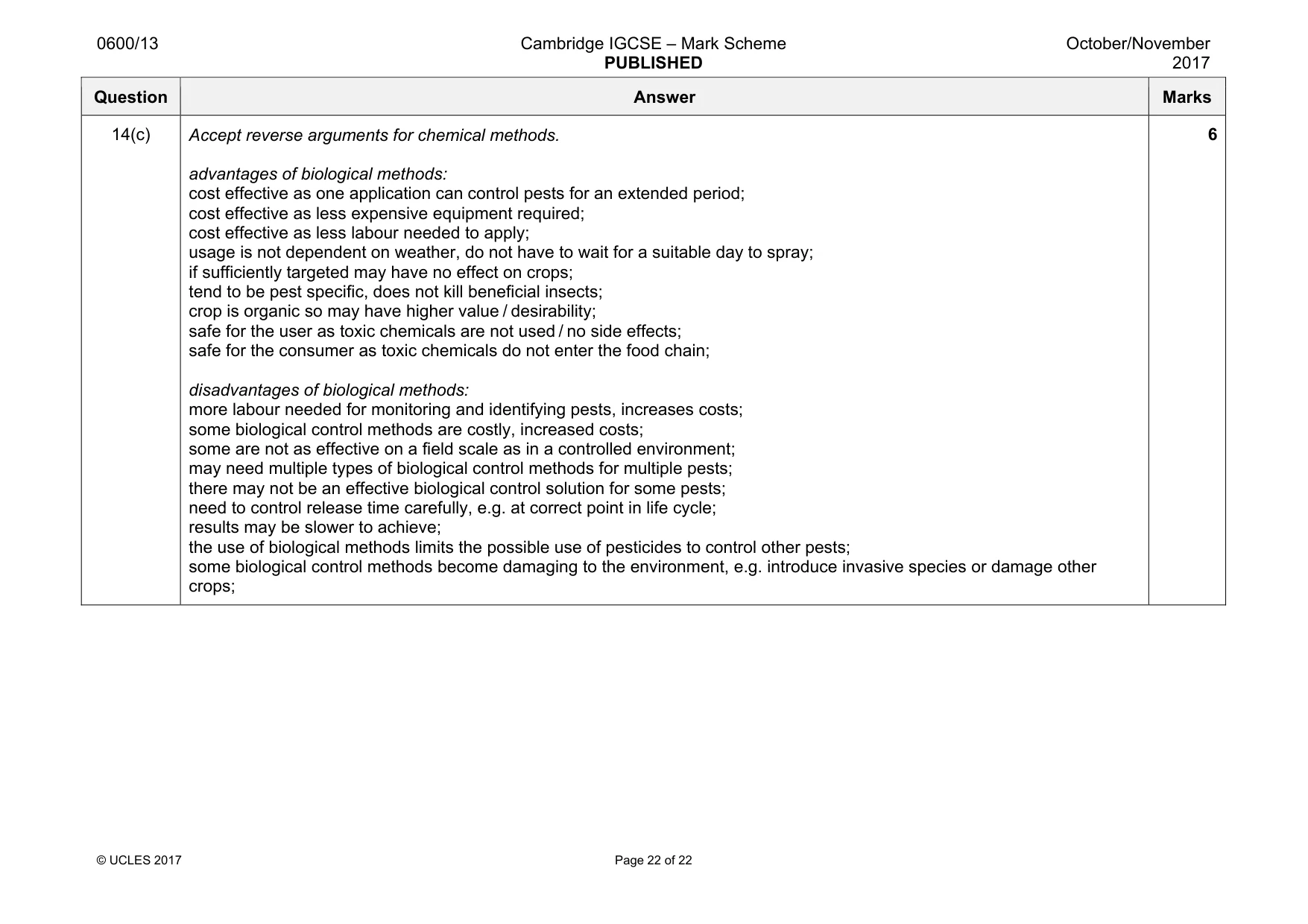
0600/13 Cambridge IGCSE – Mark Scheme PUBLISHED October/November 2017 © UCLES 2017 Page 22 of 22 Question Answer Marks 14(c) Accept reverse arguments for chemical methods. advantages of biological methods: cost effective as one application can control pests for an extended period; cost effective as less expensive equipment required; cost effective as less labour needed to apply; usage is not dependent on weather, do not have to wait for a suitable day to spray; if sufficiently targeted may have no effect on crops; tend to be pest specific, does not kill beneficial insects; crop is organic so may have higher value / desirability; safe for the user as toxic chemicals are not used / no side effects; safe for the consumer as toxic chemicals do not enter the food chain; disadvantages of biological methods: more labour needed for monitoring and identifying pests, increases costs; some biological control methods are costly, increased costs; some are not as effective on a field scale as in a controlled environment; may need multiple types of biological control methods for multiple pests; there may not be an effective biological control solution for some pests; need to control release time carefully, e.g. at correct point in life cycle; results may be slower to achieve; the use of biological methods limits the possible use of pesticides to control other pests; some biological control methods become damaging to the environment, e.g. introduce invasive species or damage other crops; 6
What you needed in this session
Cambridge’s own grade thresholds for 2017 Oct/Nov, Paper 1 · Variant 3. A higher threshold means an easier paper — the bar moves with how the cohort did.