Cambridge A Level Urdu - Pakistan only (A Level only) 9686 — 2010 May/June Paper 2 · Variant 1
9686/21/M/J/10 · 70 marks · ≈79 min
The question paper and its mark scheme, free to read here and free to download. This is Cambridge’s own paper, exactly as it was sat.
Question paper8 pages
Mark scheme7 pages
Answers below. Sit the paper first if you are practising.
Paper as text
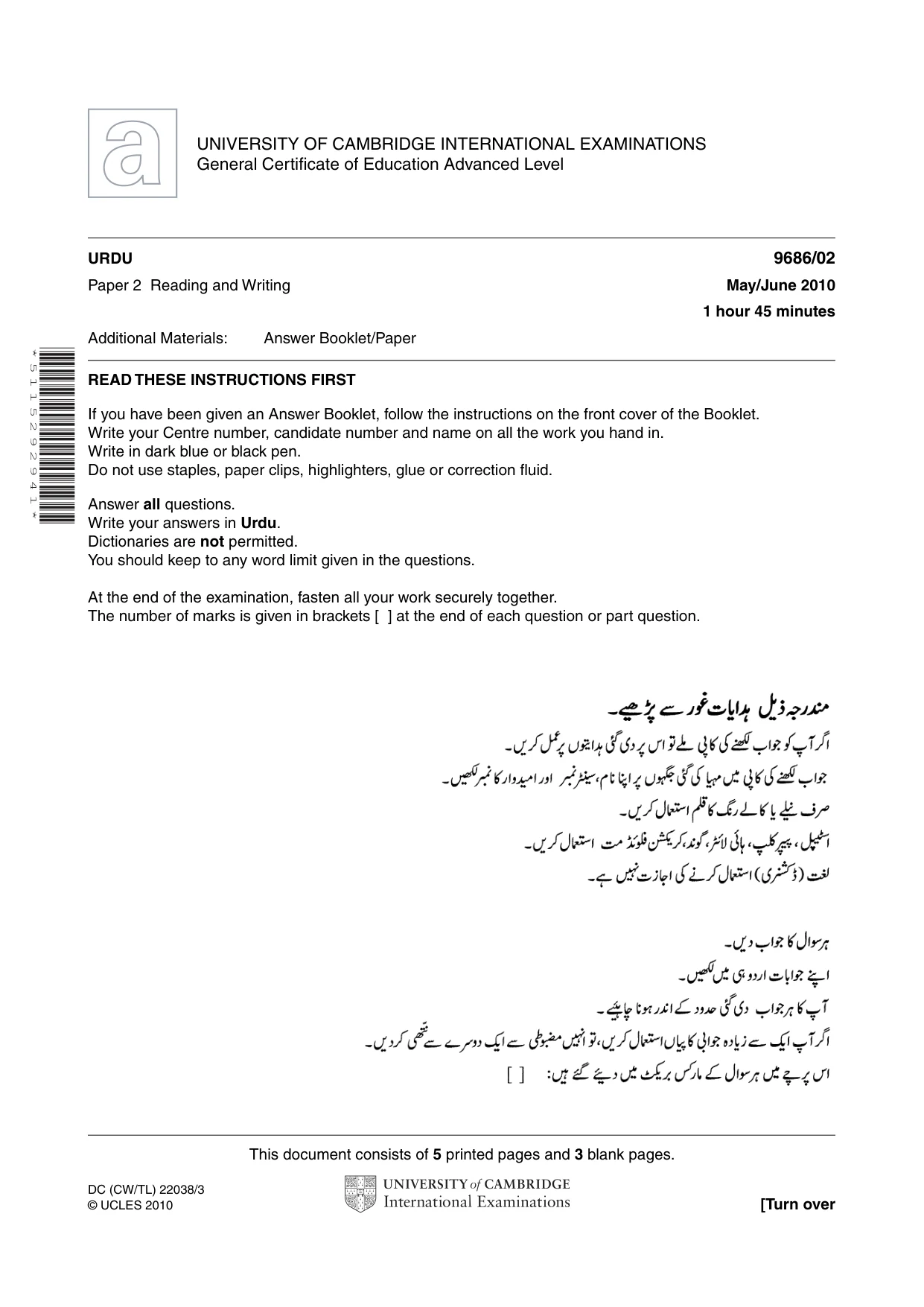
Question paper, page 1
This document consists of 5 printed pages and 3 blank pages. DC (CW/TL) 22038/3 © UCLES 2010 [Turn over UNIVERSITY OF CAMBRIDGE INTERNATIONAL EXAMINATIONS General Certificate of Education Advanced Level READ THESE INSTRUCTIONS FIRST If you have been given an Answer Booklet, follow the instructions on the front cover of the Booklet. Write your Centre number, candidate number and name on all the work you hand in. Write in dark blue or black pen. Do not use staples, paper clips, highlighters, glue or correction fluid. Answer all questions. Write your answers in Urdu. Dictionaries are not permitted. You should keep to any word limit given in the questions. At the end of the examination, fasten all your work securely together. The number of marks is given in brackets [ ] at the end of each question or part question. * 5 1 1 5 2 9 2 9 4 1 * URDU 9686/02 Paper 2 Reading and Writing May/June 2010 1 hour 45 minutes Additional Materials: Answer Booklet/Paper
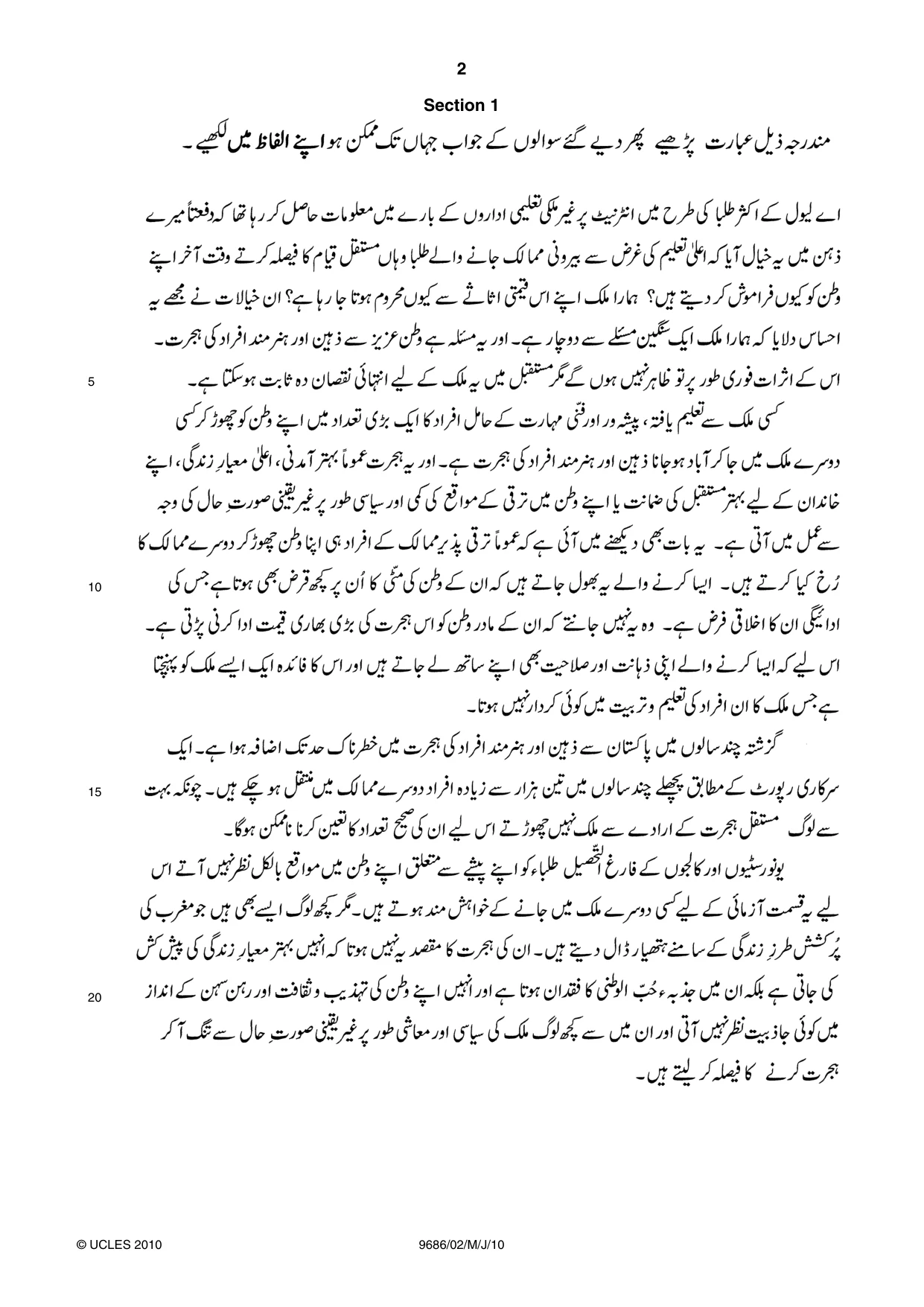
Question paper, page 2
2 9686/02/M/J/10 © UCLES 2010 5 10 15 20 Section 1
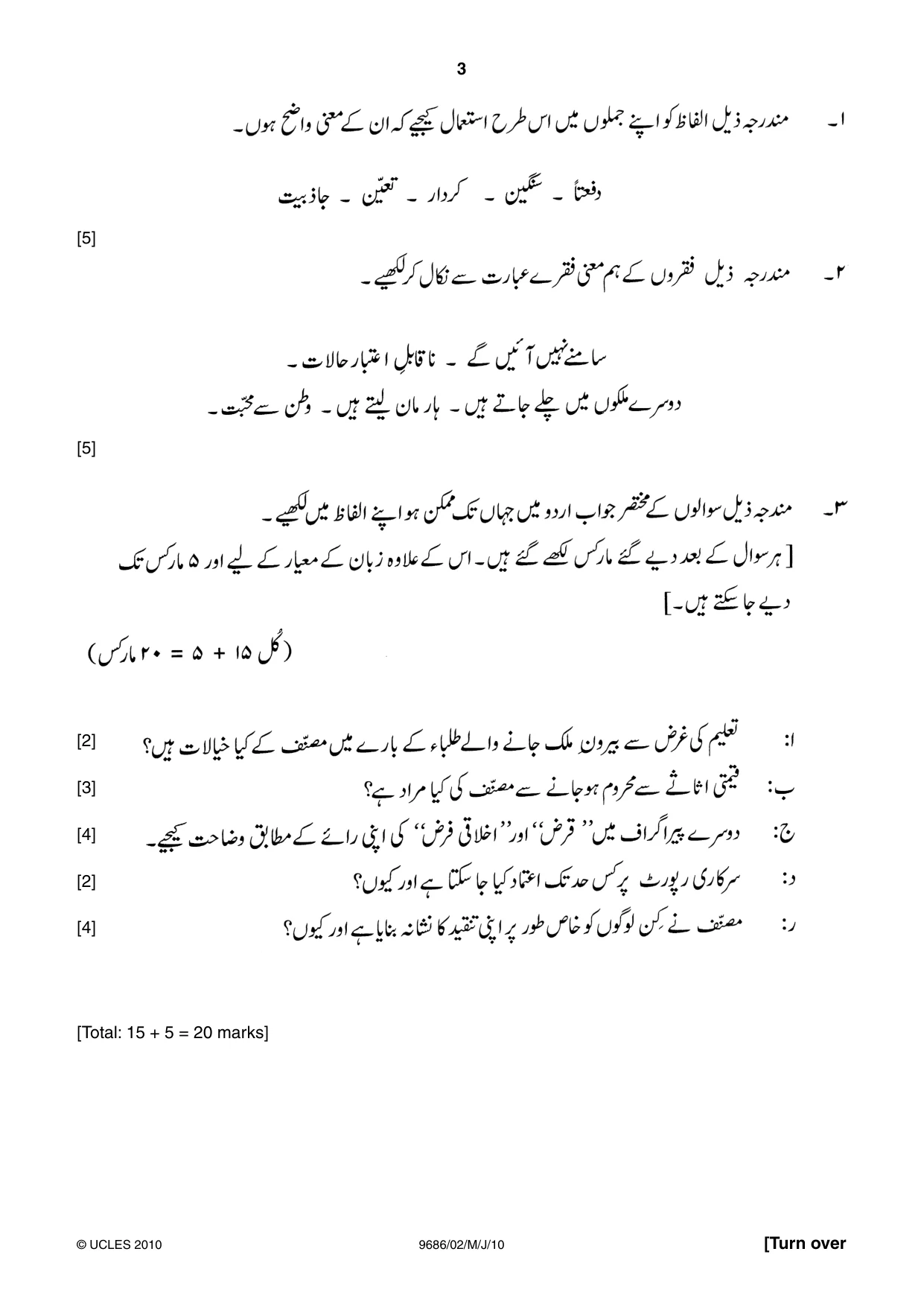
Question paper, page 3
3 9686/02/M/J/10 © UCLES 2010 [Turn over [5] [5] [Total: 15 + 5 = 20 marks] [2] [3] [4] [2] [4]
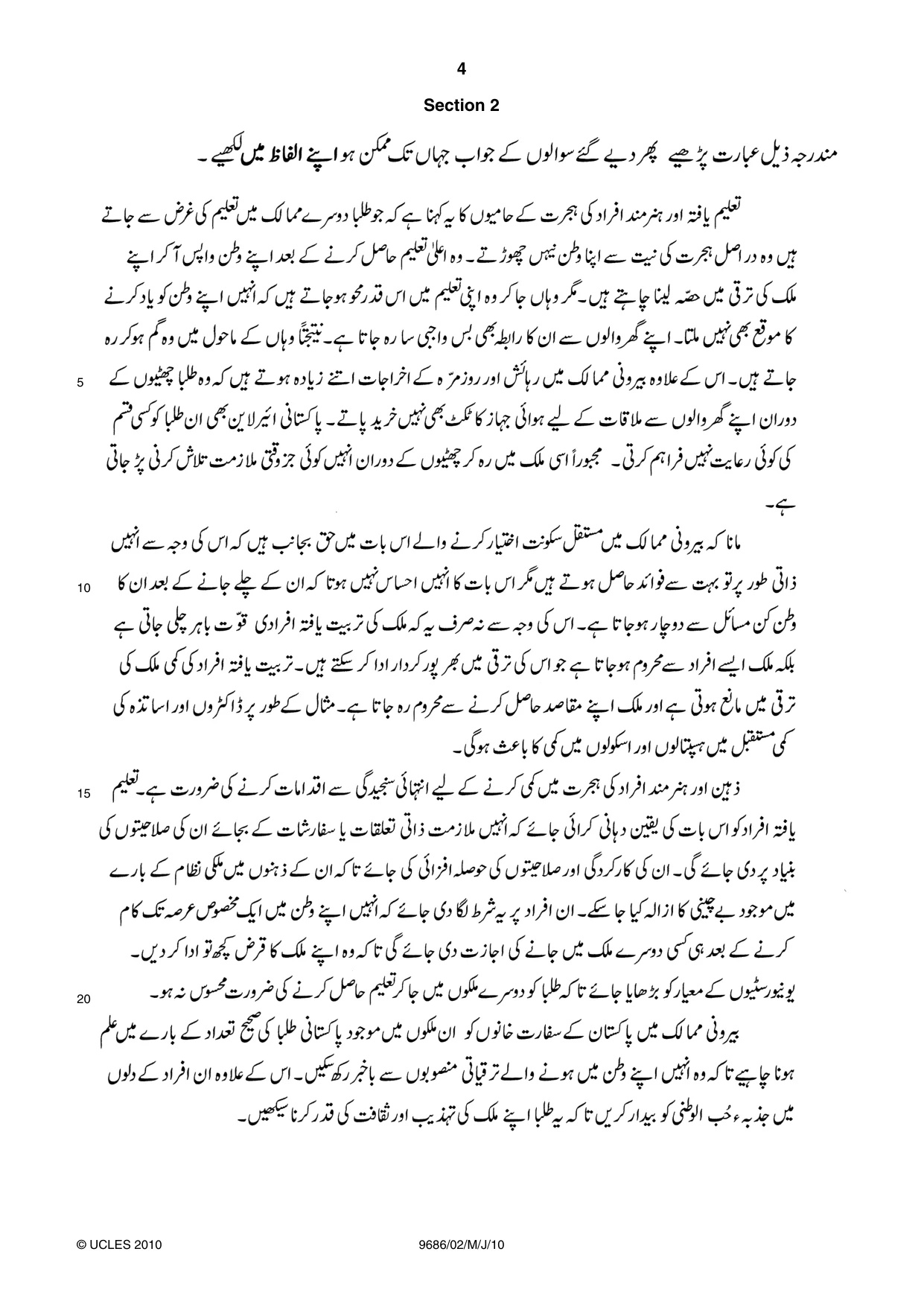
Question paper, page 4
4 9686/02/M/J/10 © UCLES 2010 5 10 15 20 Section 2
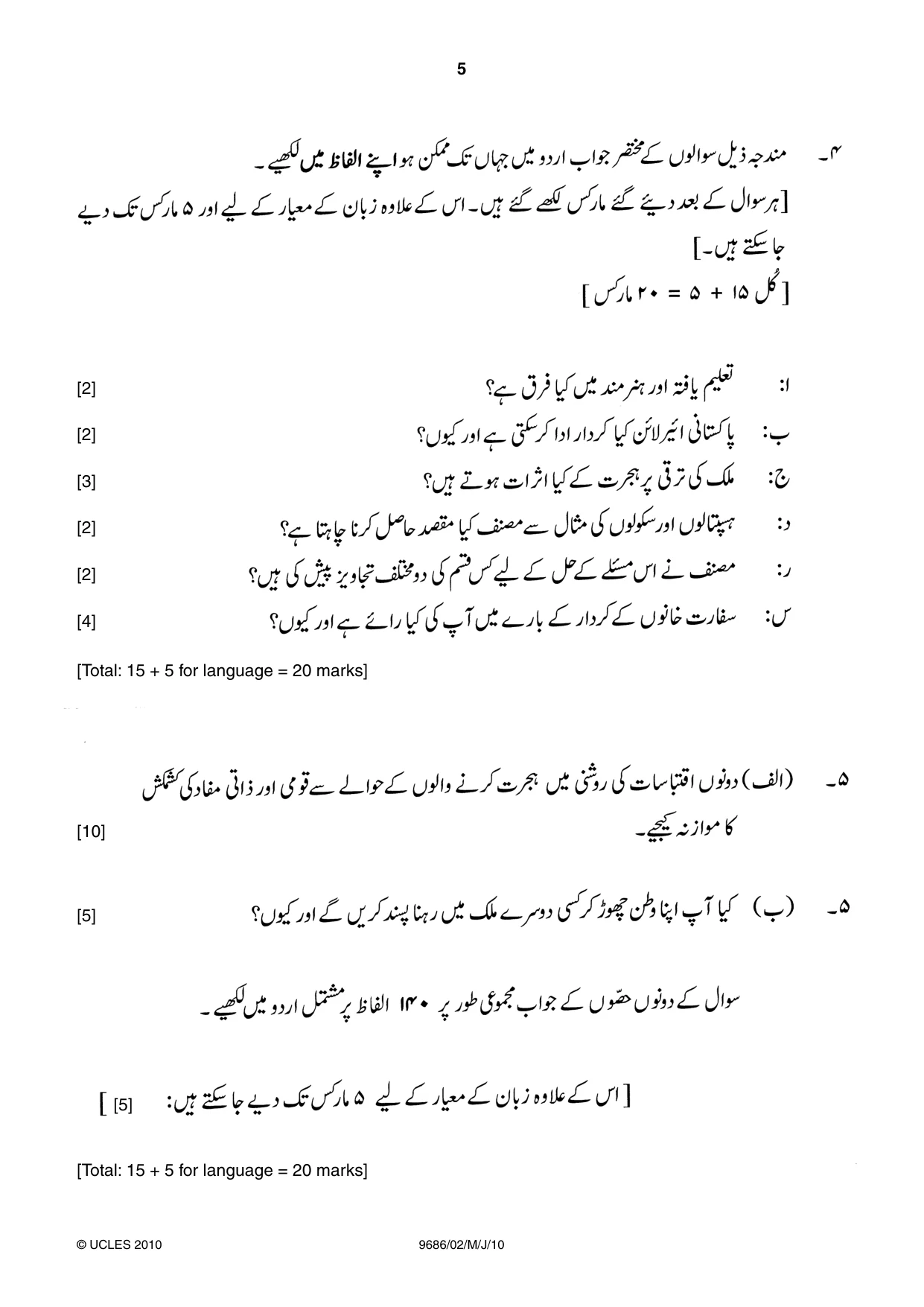
Question paper, page 5
5 9686/02/M/J/10 © UCLES 2010 [Total: 15 + 5 for language = 20 marks] [2] [2] [3] [2] [2] [4] [Total: 15 + 5 for language = 20 marks] [10] [5] [5]
Question paper, page 6
6 9686/02/M/J/10 © UCLES 2010 BLANK PAGE
Question paper, page 7
7 9686/02/M/J/10 © UCLES 2010 BLANK PAGE
Question paper, page 8
8 9686/02/M/J/10 © UCLES 2010 BLANK PAGE Copyright Acknowledgements: Passages 1 & 2: © Falaq A.S Hamirani; www.chitraltimes.com; 29 July 2008. Permission to reproduce items where third-party owned material protected by copyright is included has been sought and cleared where possible. Every reasonable effort has been made by the publisher (UCLES) to trace copyright holders, but if any items requiring clearance have unwittingly been included, the publisher will be pleased to make amends at the earliest possible opportunity. University of Cambridge International Examinations is part of the Cambridge Assessment Group. Cambridge Assessment is the brand name of University of Cambridge Local Examinations Syndicate (UCLES), which is itself a department of the University of Cambridge.
Mark scheme, page 1
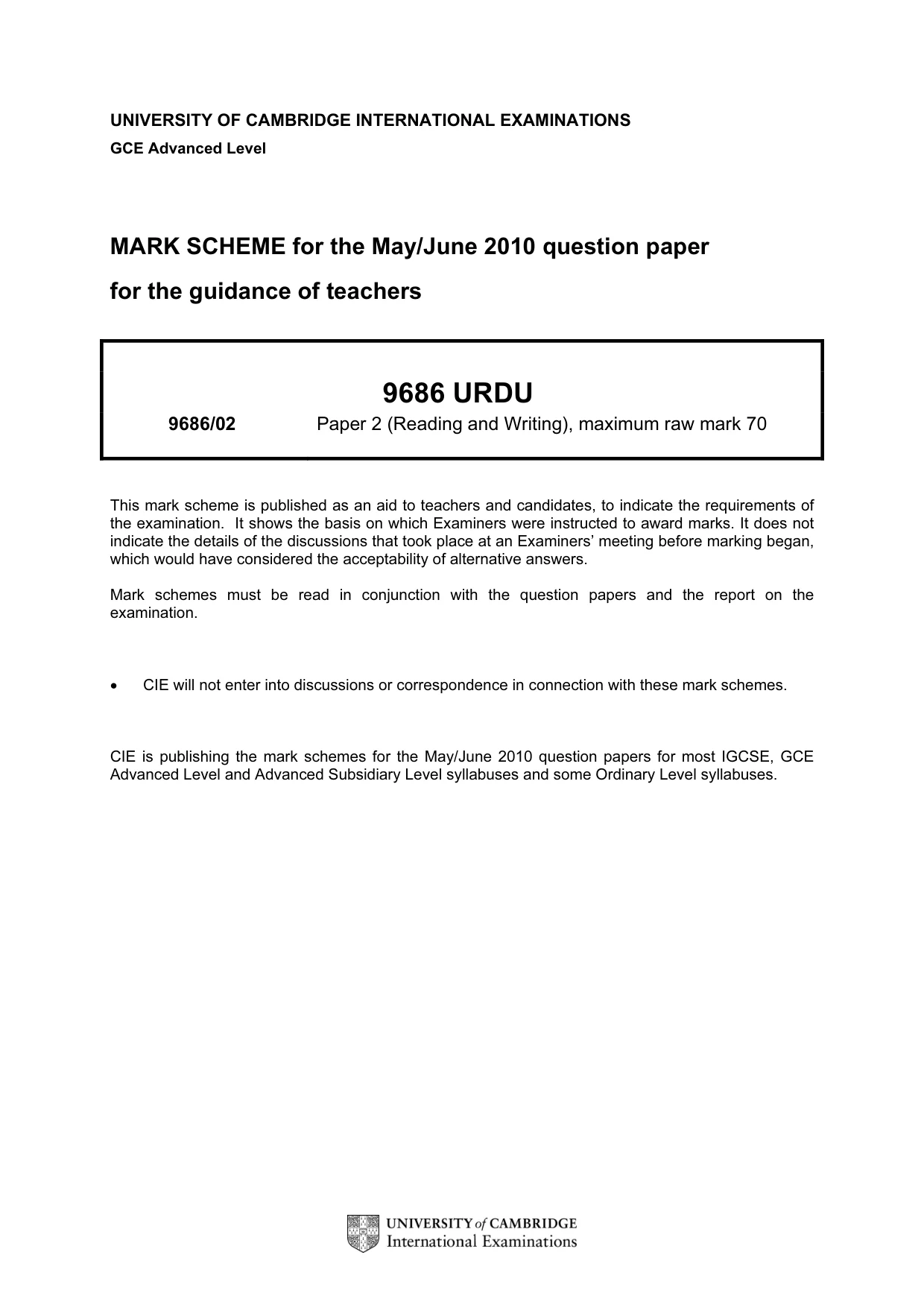
UNIVERSITY OF CAMBRIDGE INTERNATIONAL EXAMINATIONS GCE Advanced Level MARK SCHEME for the May/June 2010 question paper for the guidance of teachers 9686 URDU 9686/02 Paper 2 (Reading and Writing), maximum raw mark 70 This mark scheme is published as an aid to teachers and candidates, to indicate the requirements of the examination. It shows the basis on which Examiners were instructed to award marks. It does not indicate the details of the discussions that took place at an Examiners’ meeting before marking began, which would have considered the acceptability of alternative answers. Mark schemes must be read in conjunction with the question papers and the report on the examination. • CIE will not enter into discussions or correspondence in connection with these mark schemes. CIE is publishing the mark schemes for the May/June 2010 question papers for most IGCSE, GCE Advanced Level and Advanced Subsidiary Level syllabuses and some Ordinary Level syllabuses.
Mark scheme, page 2
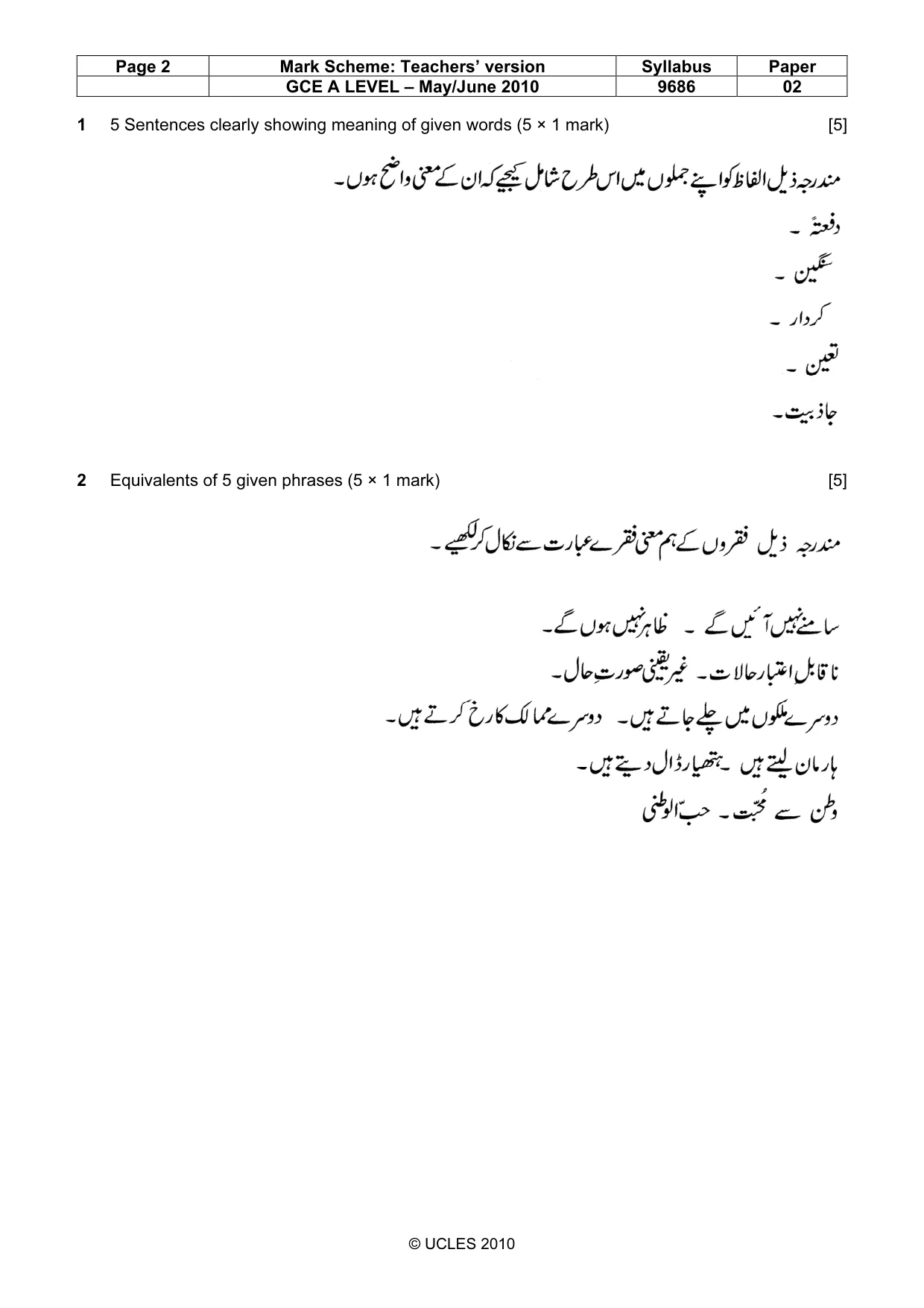
Page 2 Mark Scheme: Teachers’ version Syllabus Paper GCE A LEVEL – May/June 2010 9686 02 © UCLES 2010 1 5 Sentences clearly showing meaning of given words (5 × 1 mark) [5] 2 Equivalents of 5 given phrases (5 × 1 mark) [5]
Mark scheme, page 3
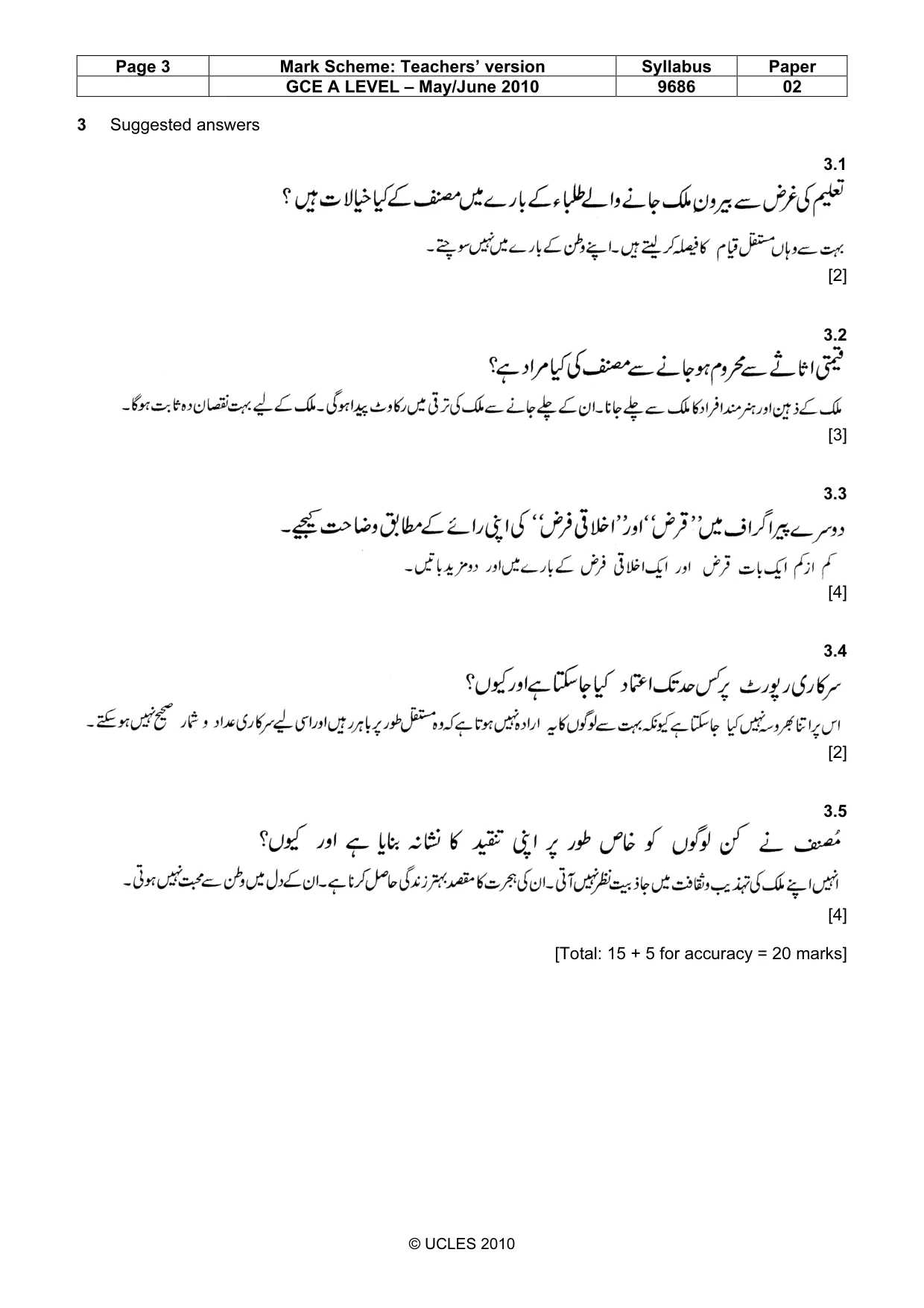
Page 3 Mark Scheme: Teachers’ version Syllabus Paper GCE A LEVEL – May/June 2010 9686 02 © UCLES 2010 3 Suggested answers 3.1 [2] 3.2 [3] 3.3 [4] 3.4 [2] 3.5 [4] [Total: 15 + 5 for accuracy = 20 marks]
Mark scheme, page 4
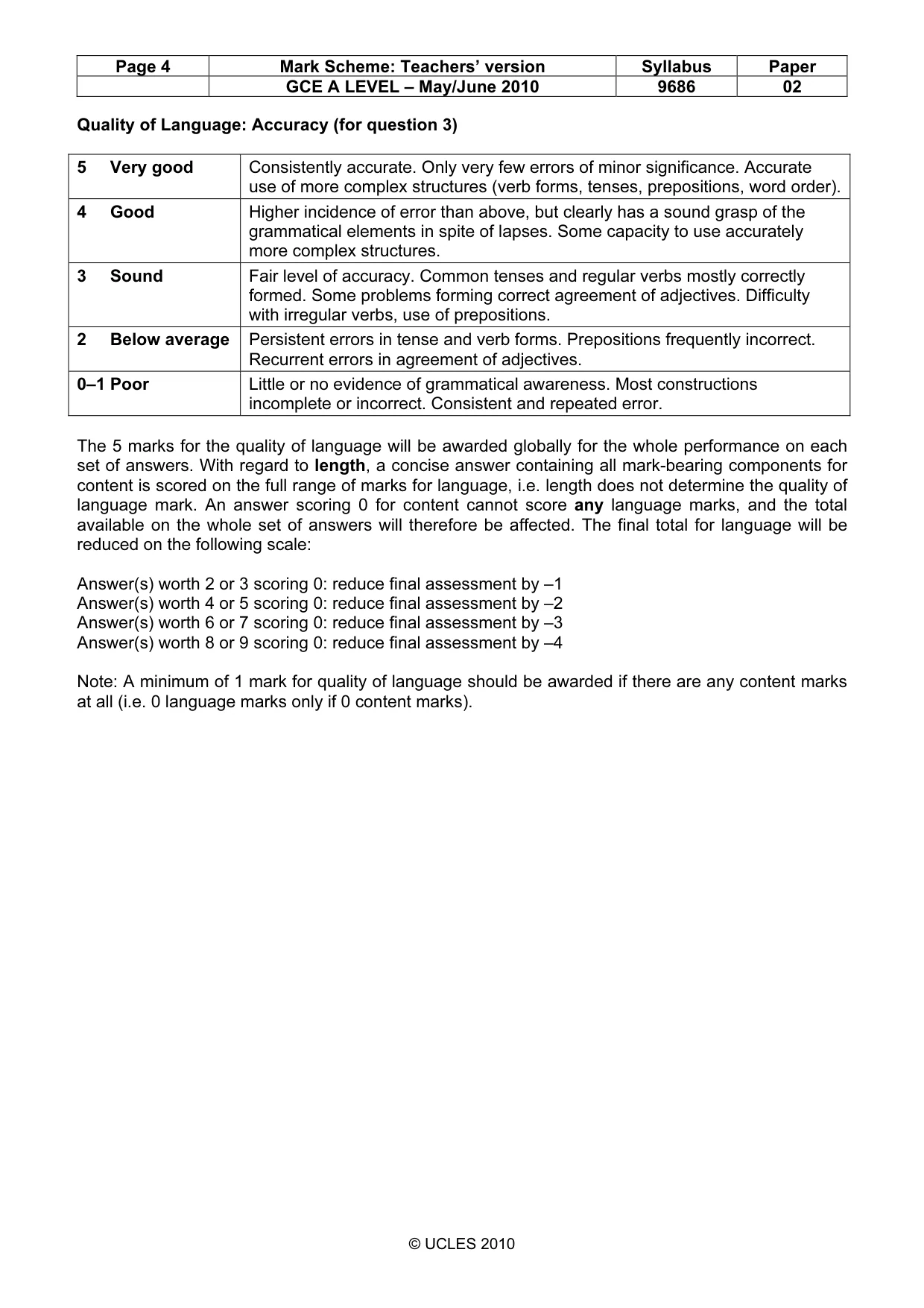
Page 4 Mark Scheme: Teachers’ version Syllabus Paper GCE A LEVEL – May/June 2010 9686 02 © UCLES 2010 Quality of Language: Accuracy (for question 3) 5 Very good Consistently accurate. Only very few errors of minor significance. Accurate use of more complex structures (verb forms, tenses, prepositions, word order). 4 Good Higher incidence of error than above, but clearly has a sound grasp of the grammatical elements in spite of lapses. Some capacity to use accurately more complex structures. 3 Sound Fair level of accuracy. Common tenses and regular verbs mostly correctly formed. Some problems forming correct agreement of adjectives. Difficulty with irregular verbs, use of prepositions. 2 Below average Persistent errors in tense and verb forms. Prepositions frequently incorrect. Recurrent errors in agreement of adjectives. 0–1 Poor Little or no evidence of grammatical awareness. Most constructions incomplete or incorrect. Consistent and repeated error. The 5 marks for the quality of language will be awarded globally for the whole performance on each set of answers. With regard to length, a concise answer containing all mark-bearing components for content is scored on the full range of marks for language, i.e. length does not determine the quality of language mark. An answer scoring 0 for content cannot score any language marks, and the total available on the whole set of answers will therefore be affected. The final total for language will be reduced on the following scale: Answer(s) worth 2 or 3 scoring 0: reduce final assessment by –1 Answer(s) worth 4 or 5 scoring 0: reduce final assessment by –2 Answer(s) worth 6 or 7 scoring 0: reduce final assessment by –3 Answer(s) worth 8 or 9 scoring 0: reduce final assessment by –4 Note: A minimum of 1 mark for quality of language should be awarded if there are any content marks at all (i.e. 0 language marks only if 0 content marks).
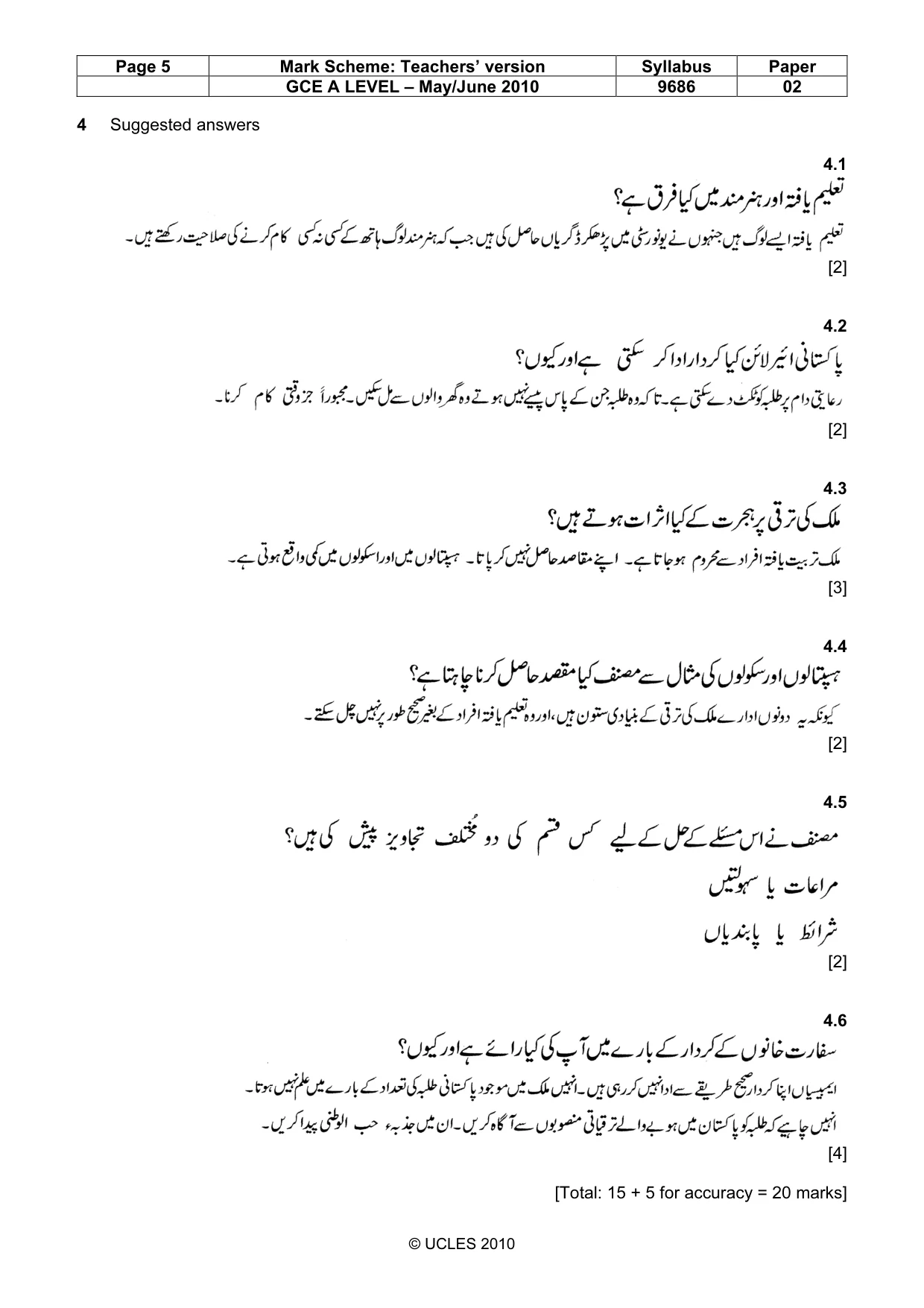
Mark scheme, page 5
Page 5 Mark Scheme: Teachers’ version Syllabus Paper GCE A LEVEL – May/June 2010 9686 02 © UCLES 2010 4 Suggested answers 4.1 [2] 4.2 [2] 4.3 [3] 4.4 [2] 4.5 [2] 4.6 [4] [Total: 15 + 5 for accuracy = 20 marks]
Mark scheme, page 6
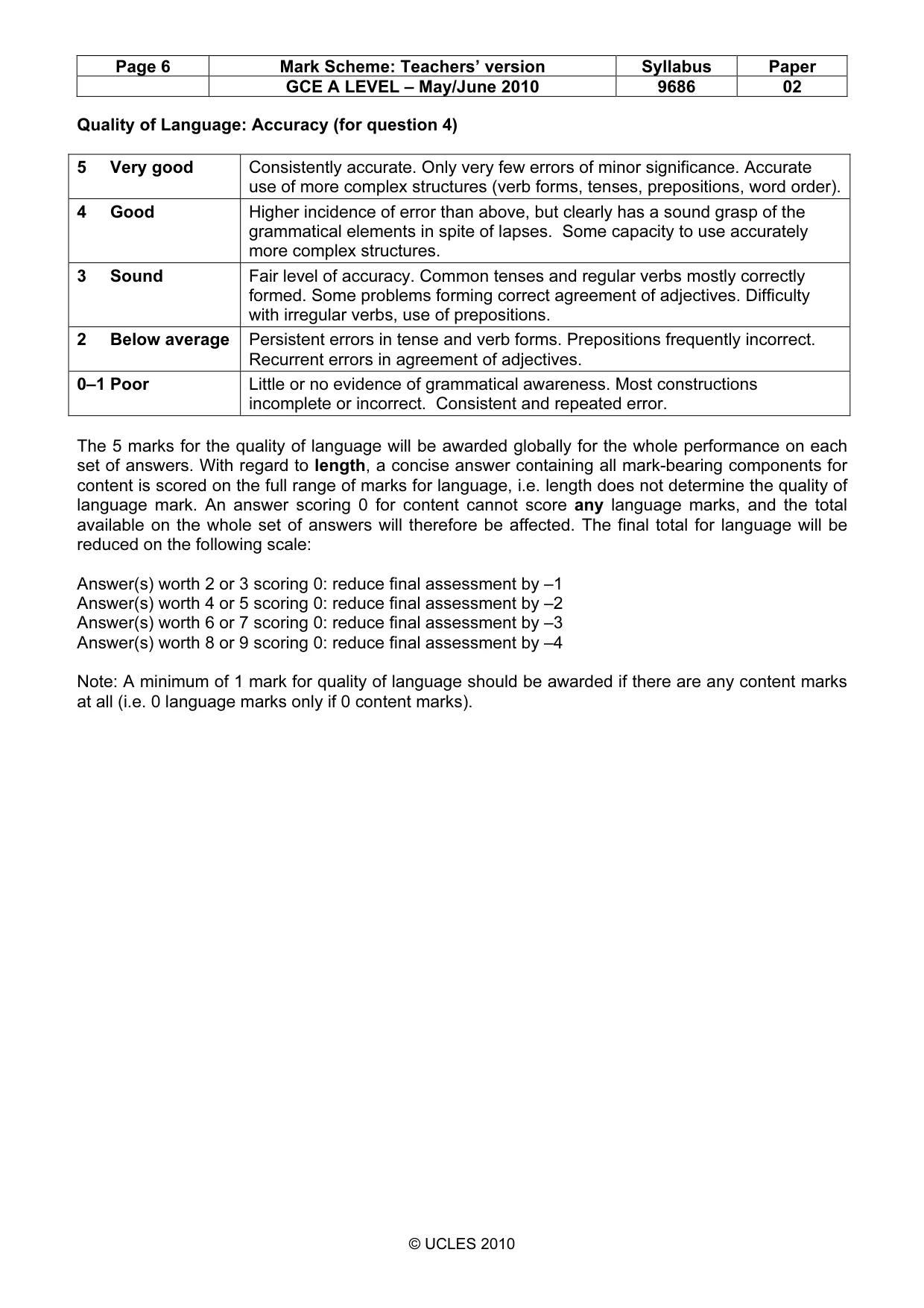
Page 6 Mark Scheme: Teachers’ version Syllabus Paper GCE A LEVEL – May/June 2010 9686 02 © UCLES 2010 Quality of Language: Accuracy (for question 4) 5 Very good Consistently accurate. Only very few errors of minor significance. Accurate use of more complex structures (verb forms, tenses, prepositions, word order). 4 Good Higher incidence of error than above, but clearly has a sound grasp of the grammatical elements in spite of lapses. Some capacity to use accurately more complex structures. 3 Sound Fair level of accuracy. Common tenses and regular verbs mostly correctly formed. Some problems forming correct agreement of adjectives. Difficulty with irregular verbs, use of prepositions. 2 Below average Persistent errors in tense and verb forms. Prepositions frequently incorrect. Recurrent errors in agreement of adjectives. 0–1 Poor Little or no evidence of grammatical awareness. Most constructions incomplete or incorrect. Consistent and repeated error. The 5 marks for the quality of language will be awarded globally for the whole performance on each set of answers. With regard to length, a concise answer containing all mark-bearing components for content is scored on the full range of marks for language, i.e. length does not determine the quality of language mark. An answer scoring 0 for content cannot score any language marks, and the total available on the whole set of answers will therefore be affected. The final total for language will be reduced on the following scale: Answer(s) worth 2 or 3 scoring 0: reduce final assessment by –1 Answer(s) worth 4 or 5 scoring 0: reduce final assessment by –2 Answer(s) worth 6 or 7 scoring 0: reduce final assessment by –3 Answer(s) worth 8 or 9 scoring 0: reduce final assessment by –4 Note: A minimum of 1 mark for quality of language should be awarded if there are any content marks at all (i.e. 0 language marks only if 0 content marks).
Mark scheme, page 7
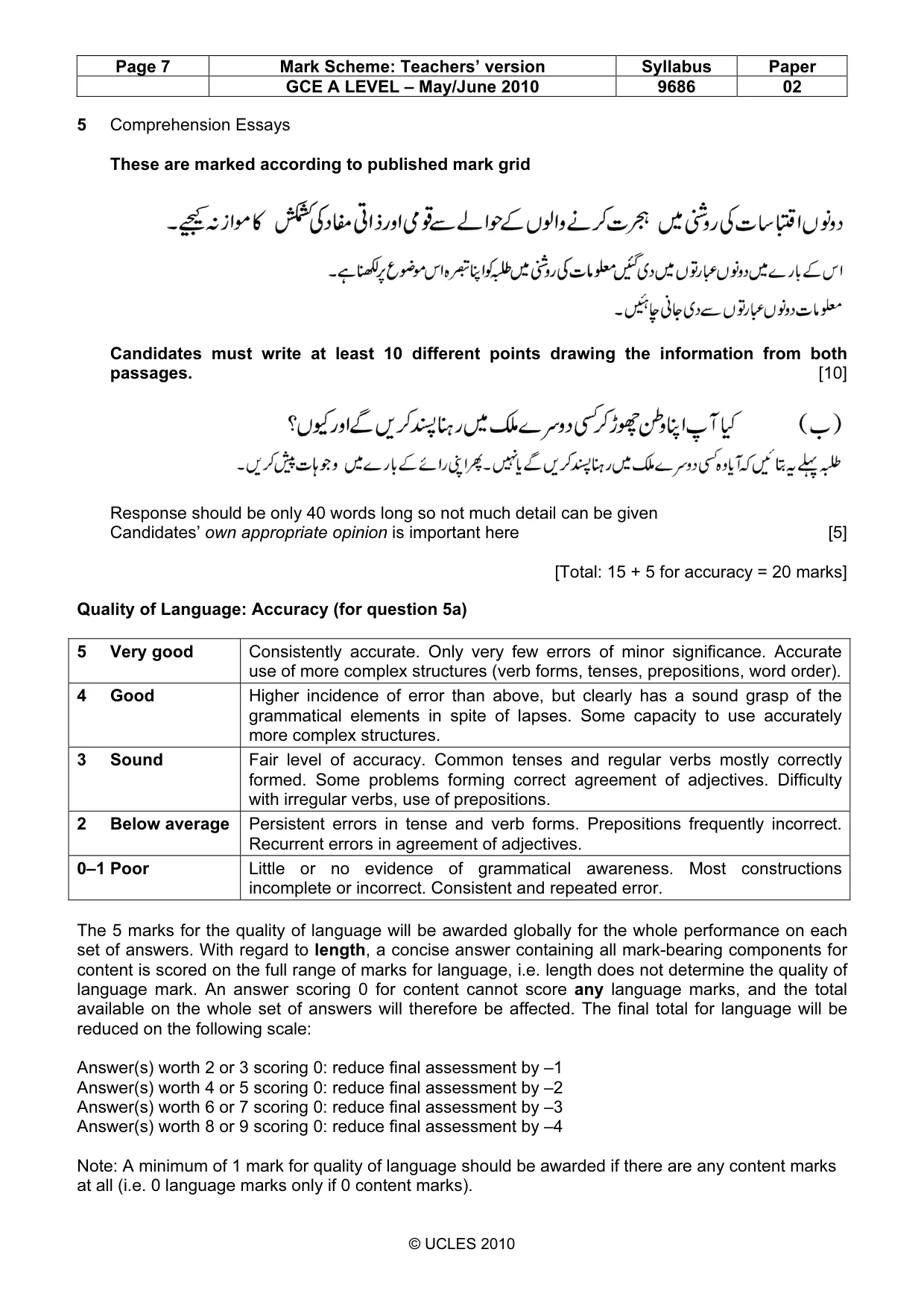
Page 7 Mark Scheme: Teachers’ version Syllabus Paper GCE A LEVEL – May/June 2010 9686 02 © UCLES 2010 5 Comprehension Essays These are marked according to published mark grid Candidates must write at least 10 different points drawing the information from both passages. [10] Response should be only 40 words long so not much detail can be given Candidates’ own appropriate opinion is important here [5] [Total: 15 + 5 for accuracy = 20 marks] Quality of Language: Accuracy (for question 5a) 5 Very good Consistently accurate. Only very few errors of minor significance. Accurate use of more complex structures (verb forms, tenses, prepositions, word order). 4 Good Higher incidence of error than above, but clearly has a sound grasp of the grammatical elements in spite of lapses. Some capacity to use accurately more complex structures. 3 Sound Fair level of accuracy. Common tenses and regular verbs mostly correctly formed. Some problems forming correct agreement of adjectives. Difficulty with irregular verbs, use of prepositions. 2 Below average Persistent errors in tense and verb forms. Prepositions frequently incorrect. Recurrent errors in agreement of adjectives. 0–1 Poor Little or no evidence of grammatical awareness. Most constructions incomplete or incorrect. Consistent and repeated error. The 5 marks for the quality of language will be awarded globally for the whole performance on each set of answers. With regard to length, a concise answer containing all mark-bearing components for content is scored on the full range of marks for language, i.e. length does not determine the quality of language mark. An answer scoring 0 for content cannot score any language marks, and the total available on the whole set of answers will therefore be affected. The final total for language will be reduced on the following scale: Answer(s) worth 2 or 3 scoring 0: reduce final assessment by –1 Answer(s) worth 4 or 5 scoring 0: reduce final assessment by –2 Answer(s) worth 6 or 7 scoring 0: reduce final assessment by –3 Answer(s) worth 8 or 9 scoring 0: reduce final assessment by –4 Note: A minimum of 1 mark for quality of language should be awarded if there are any content marks at all (i.e. 0 language marks only if 0 content marks).
What you needed in this session
Cambridge’s own grade thresholds for 2010 May/June, Paper 2 · Variant 1. A higher threshold means an easier paper — the bar moves with how the cohort did.