Cambridge A Level Urdu (A Level only) 9676 — 2019 Oct/Nov Paper 5 · Variant 1
9676/51/O/N/19 · 40 marks · ≈45 min
The question paper and its mark scheme, free to read here and free to download. This is Cambridge’s own paper, exactly as it was sat.
Question paper4 pages


Mark scheme7 pages
Answers below. Sit the paper first if you are practising.
Paper as text
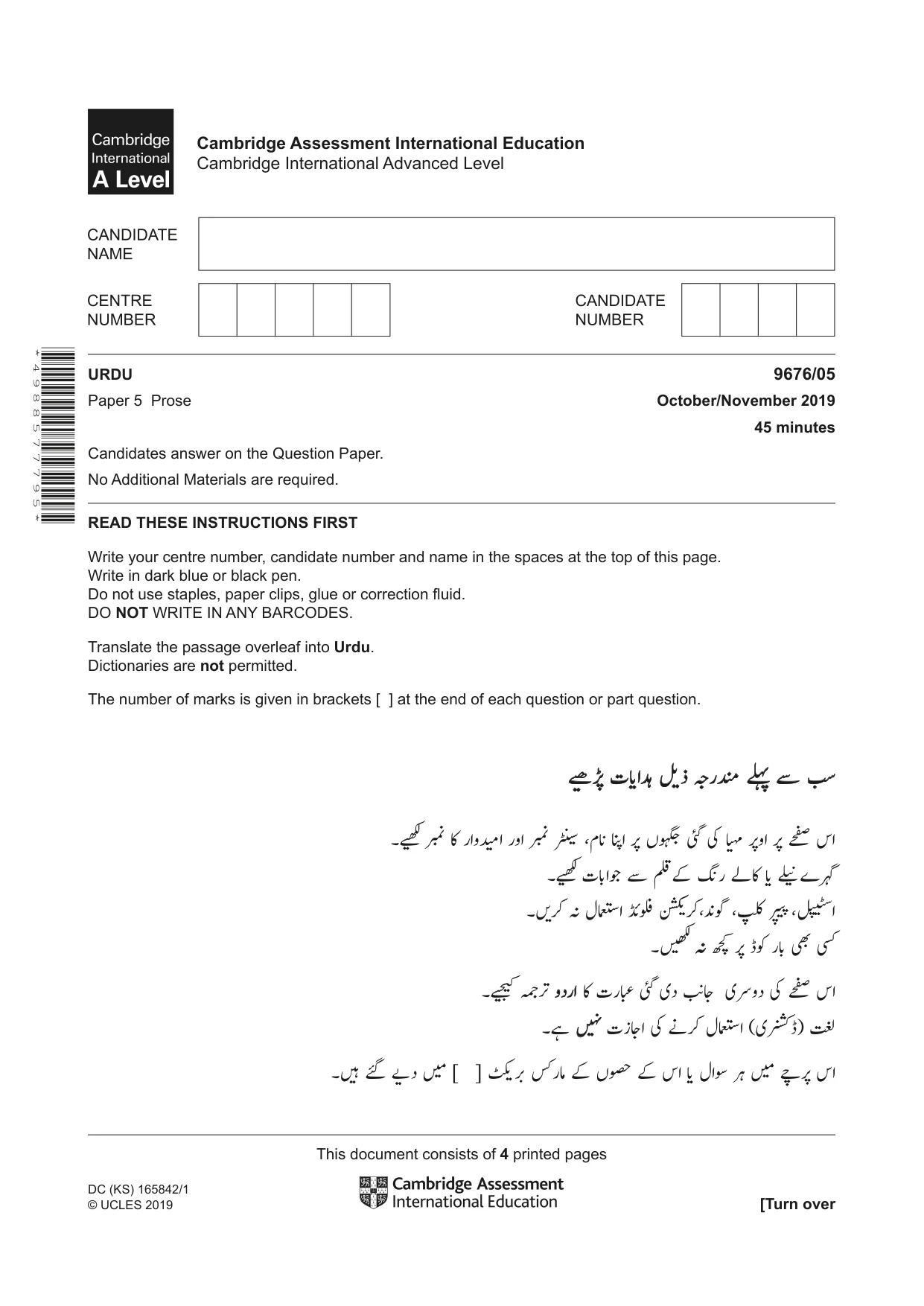
Question paper, page 1
This document consists of 4 printed pages DC (KS) 165842/1 © UCLES 2019 [Turn over * 4 9 8 8 5 7 7 7 9 5 * Cambridge Assessment International Education Cambridge International Advanced Level سب ےس ےلہپ دنمرہج ذ Ӊی دہا˄یات ڑپھی اس ےحفص رپ اورپ ہمیا یک یئگ وہگجں رپ اانپ ˄نام، سی ن ٹ ر ربمن اور امی دوار اک ربمن لکھƸیے۔ رہگے Ʊنƶیلے ˄یا اکےل ر˟ن ےکملق ےس وجا˄بات لکھƸیے۔ ی ش ن ولفՙئ ٹد اامعتسل ہن رکةی ۔ اسƶٹƹیƶپل، Ѫپ ی پر پلک، وگدن،رکΛ یسک یھب ˄بار وکڈ رپ ھچک ہن لکھƹیں۔ رہمج کƷیŧجƸیے۔ ت اس ےحفص یک دورسی اجҍن ب دی یئگ ابعرت اک اردو ɟ ی ےہ۔ ن تغل (ڈرنشکی) اامعتسل رکےن یک ااجزت ɼ ی ٹ [ ] می دԈی ےئگ ֽہ ی ۔ اس رپےچ می ɝہ ر وسال ˄یا اس ےک وصحں ےک امرسک ɟب رσ URDU 9676/05 Paper 5 Prose October/November 2019 45 minutes Candidates answer on the Question Paper. No Additional Materials are required. READ THESE INSTRUCTIONS FIRST Write your centre number, candidate number and name in the spaces at the top of this page. Write in dark blue or black pen. Do not use staples, paper clips, glue or correction fluid. DO NOT WRITE IN ANY BARCODES. Translate the passage overleaf into Urdu. Dictionaries are not permitted. The number of marks is given in brackets [ ] at the end of each question or part question.
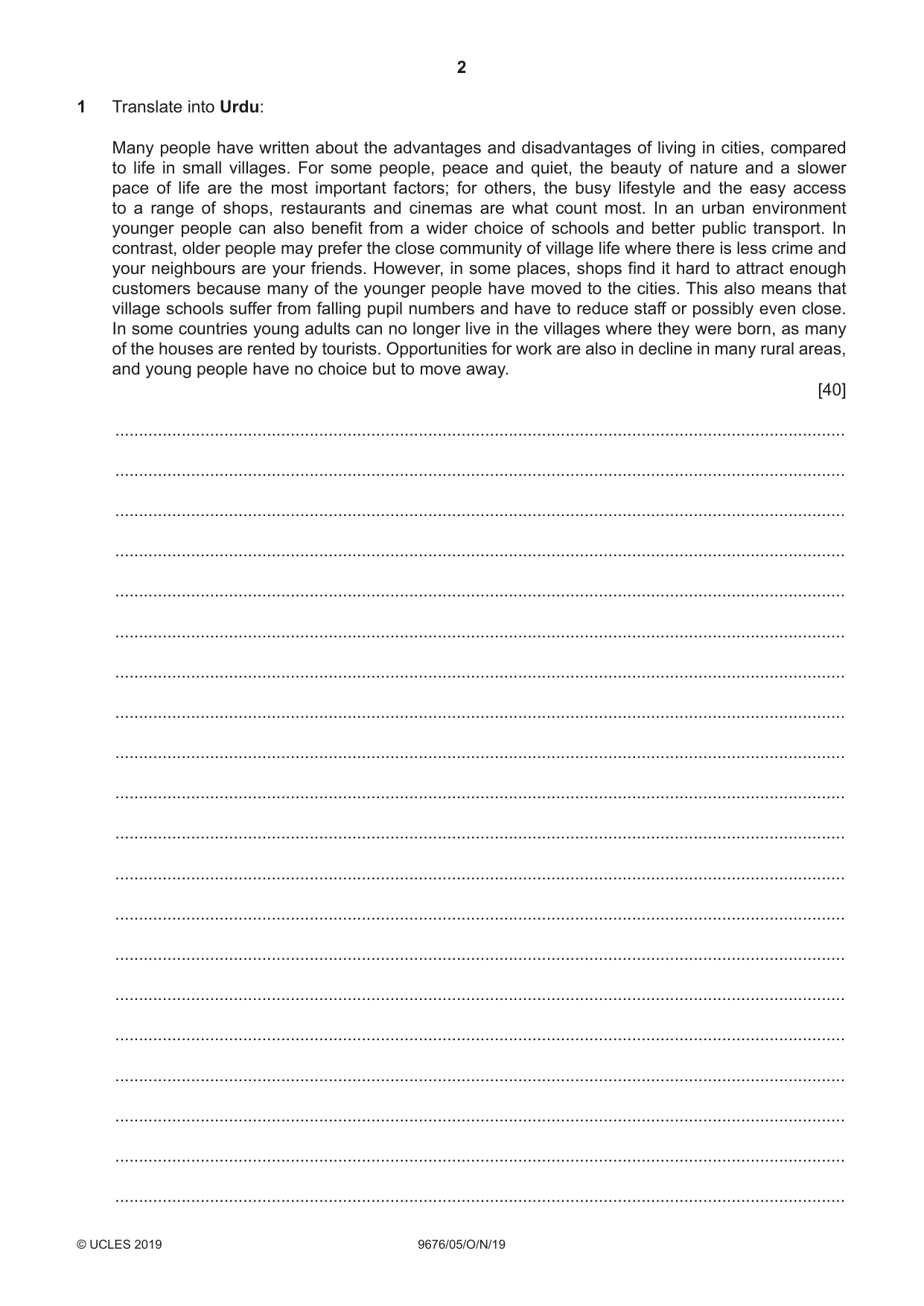
Question paper, page 2
2 9676/05/O/N/19 © UCLES 2019 1 Translate into Urdu: Many people have written about the advantages and disadvantages of living in cities, compared to life in small villages. For some people, peace and quiet, the beauty of nature and a slower pace of life are the most important factors; for others, the busy lifestyle and the easy access to a range of shops, restaurants and cinemas are what count most. In an urban environment younger people can also benefit from a wider choice of schools and better public transport. In contrast, older people may prefer the close community of village life where there is less crime and your neighbours are your friends. However, in some places, shops find it hard to attract enough customers because many of the younger people have moved to the cities. This also means that village schools suffer from falling pupil numbers and have to reduce staff or possibly even close. In some countries young adults can no longer live in the villages where they were born, as many of the houses are rented by tourists. Opportunities for work are also in decline in many rural areas, and young people have no choice but to move away. [40] … … … … … … … … … … … … … … … … … … … …
Question paper, page 3
3 9676/05/O/N/19 © UCLES 2019 [Turn over … … … … … … … … … … … … … … … … … … … … … … … … … … … …
Question paper, page 4
4 9676/05/O/N/19 © UCLES 2019 Permission to reproduce items where third-party owned material protected by copyright is included has been sought and cleared where possible. Every reasonable effort has been made by the publisher (UCLES) to trace copyright holders, but if any items requiring clearance have unwittingly been included, the publisher will be pleased to make amends at the earliest possible opportunity. To avoid the issue of disclosure of answer-related information to candidates, all copyright acknowledgements are reproduced online in the Cambridge Assessment International Education Copyright Acknowledgements Booklet. This is produced for each series of examinations and is freely available to download at www.cambridgeinternational.org after the live examination series. Cambridge Assessment International Education is part of the Cambridge Assessment Group. Cambridge Assessment is the brand name of the University of Cambridge Local Examinations Syndicate (UCLES), which itself is a department of the University of Cambridge. … … … … … … … … … … … … … … … … … … … … … … … …
Mark scheme, page 1
This document consists of 7 printed pages. © UCLES 2019 [Turn over Cambridge Assessment International Education Cambridge International Advanced Level URDU 9676/05 Paper 5 Prose October/November 2019 MARK SCHEME Maximum Mark: 40 Published This mark scheme is published as an aid to teachers and candidates, to indicate the requirements of the examination. It shows the basis on which Examiners were instructed to award marks. It does not indicate the details of the discussions that took place at an Examiners’ meeting before marking began, which would have considered the acceptability of alternative answers. Mark schemes should be read in conjunction with the question paper and the Principal Examiner Report for Teachers. Cambridge International will not enter into discussions about these mark schemes. Cambridge International is publishing the mark schemes for the October/November 2019 series for most Cambridge IGCSE™, Cambridge International A and AS Level components and some Cambridge O Level components.
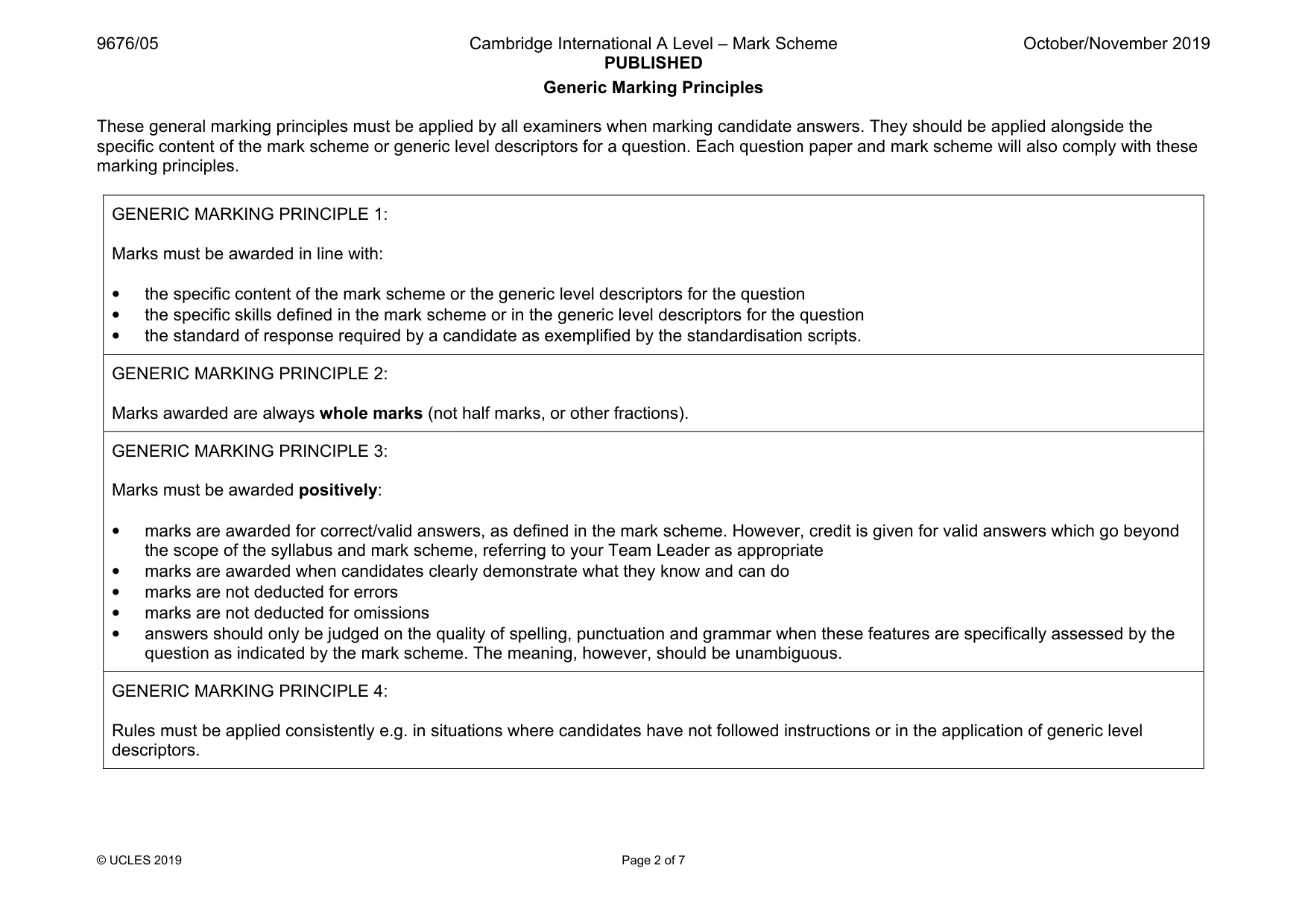
Mark scheme, page 2
9676/05 Cambridge International A Level – Mark Scheme PUBLISHED October/November 2019 © UCLES 2019 Page 2 of 7 Generic Marking Principles These general marking principles must be applied by all examiners when marking candidate answers. They should be applied alongside the specific content of the mark scheme or generic level descriptors for a question. Each question paper and mark scheme will also comply with these marking principles. GENERIC MARKING PRINCIPLE 1: Marks must be awarded in line with: • the specific content of the mark scheme or the generic level descriptors for the question • the specific skills defined in the mark scheme or in the generic level descriptors for the question • the standard of response required by a candidate as exemplified by the standardisation scripts. GENERIC MARKING PRINCIPLE 2: Marks awarded are always whole marks (not half marks, or other fractions). GENERIC MARKING PRINCIPLE 3: Marks must be awarded positively: • marks are awarded for correct/valid answers, as defined in the mark scheme. However, credit is given for valid answers which go beyond the scope of the syllabus and mark scheme, referring to your Team Leader as appropriate • marks are awarded when candidates clearly demonstrate what they know and can do • marks are not deducted for errors • marks are not deducted for omissions • answers should only be judged on the quality of spelling, punctuation and grammar when these features are specifically assessed by the question as indicated by the mark scheme. The meaning, however, should be unambiguous. GENERIC MARKING PRINCIPLE 4: Rules must be applied consistently e.g. in situations where candidates have not followed instructions or in the application of generic level descriptors.
Mark scheme, page 3
9676/05 Cambridge International A Level – Mark Scheme PUBLISHED October/November 2019 © UCLES 2019 Page 3 of 7 GENERIC MARKING PRINCIPLE 5: Marks should be awarded using the full range of marks defined in the mark scheme for the question (however; the use of the full mark range may be limited according to the quality of the candidate responses seen). GENERIC MARKING PRINCIPLE 6: Marks awarded are based solely on the requirements as defined in the mark scheme. Marks should not be awarded with grade thresholds or grade descriptors in mind.
Mark scheme, page 4
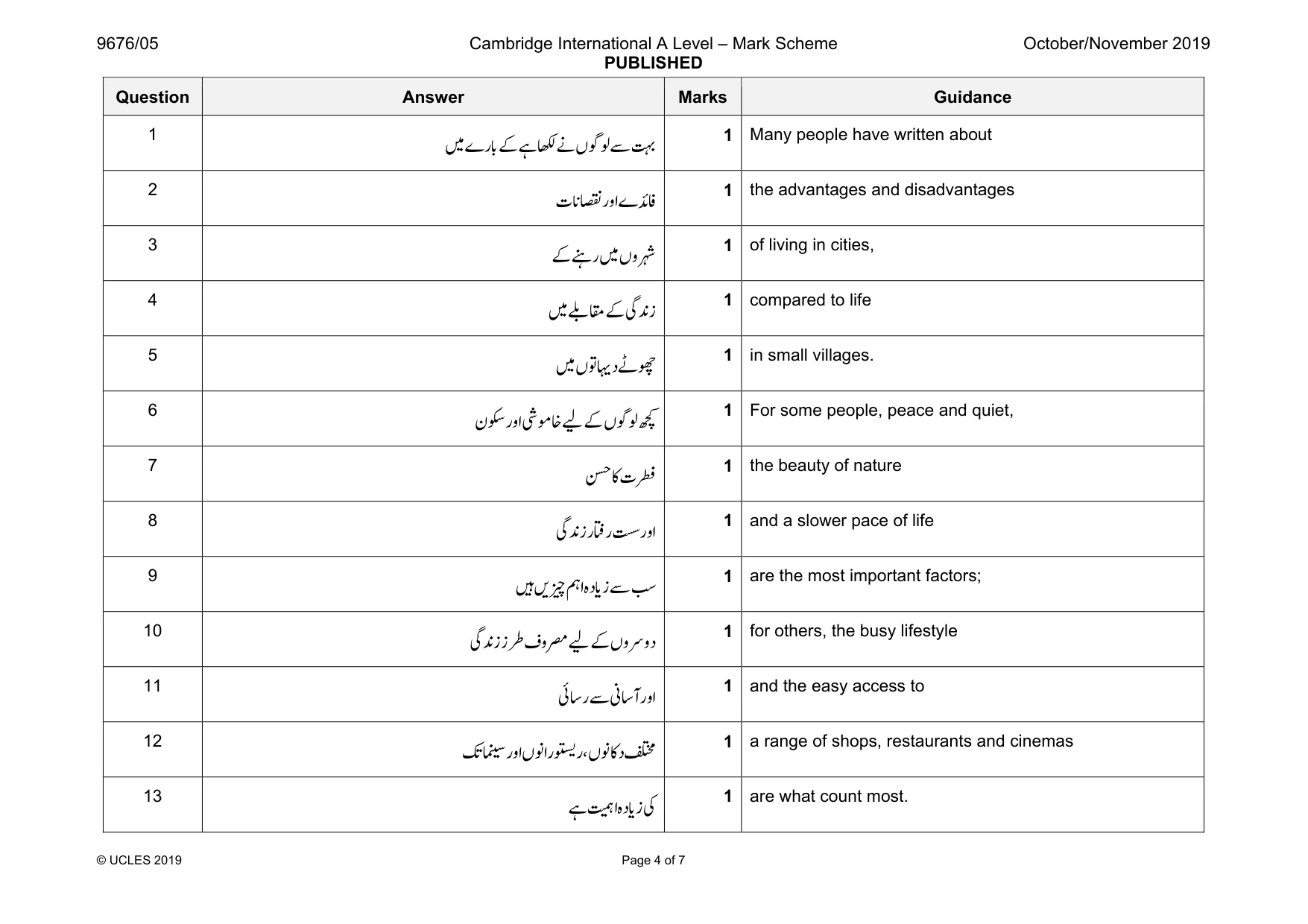
9676/05 Cambridge International A Level – Mark Scheme PUBLISHED October/November 2019 © UCLES 2019 Page 4 of 7 Question Answer Marks Guidance 1 Ĩ㈉Ĩ䞈Ĩ㞹Ĩ䗂Ĩė㍉㥀Ĩ╌Ĩਏ 䆀Ĩěînj˄ 1 Many people have written about 2 çǔ˄䏩ĨîþäĨě䯏⪕ 1 the advantages and disadvantages 3 ㈉Ĩ䜪îĨ䆀Ĩėþ⚘ 1 of living in cities, 4 䆀Ĩধ㹬Ĩ㈉Ĩ㐗䯀ï 1 compared to life 5 䆀ĨėᏠ䮫ìĨ᛭ᵘ 1 in small villages. 6 Ĩ⚨䁡ὟĨ㩓Ĩ㈉Ĩė㍉㥀Ĩ⸁ ü≸Ĩîþä 1 For some people, peace and quiet, 7 ṨĨⵇĨç⬓ 1 the beauty of nature 8 㐗䯀ïĨî⪙îĨ⇫Ĩîþä 1 and a slower pace of life 9 䞀Ĩ䮨ᷚĨ䚽äĨęìǎ˄ïĨ╌Ĩ njח 1 are the most important factors; 10 øþ㵱Ĩ㩓Ĩ㈉Ĩėþ⇤þì Ĩ ï⠪ Ĩ 㐗䯀ï 1 for others, the busy lifestyle 11 䤈îĨ╌Ĩ䕉ßĨîþä 1 and the easy access to 12 ǖĨ┻ĨîþäĨė䔘äî䧾îĨÛė䔘ⵇìĨ㰛 1 a range of shops, restaurants and cinemas 13 䞈Ĩ䛲äĨęìǎ˄ïĨㅎ 1 are what count most.
Mark scheme, page 5
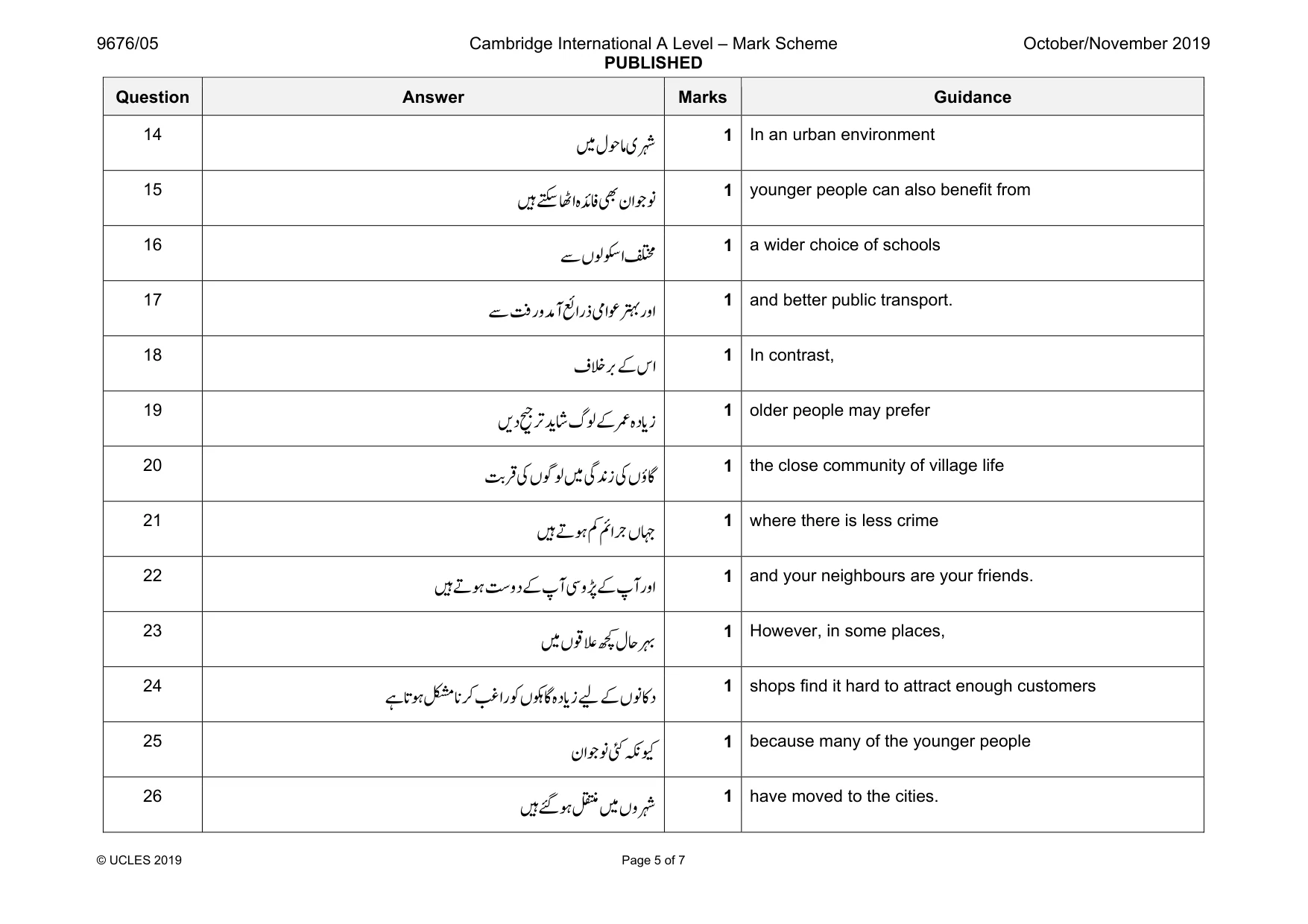
9676/05 Cambridge International A Level – Mark Scheme PUBLISHED October/November 2019 © UCLES 2019 Page 5 of 7 Question Answer Marks Guidance 14 䆀Ĩúἶ㩕ĨĚ⚘ 1 In an urban environment 15 Ĩę䯏⪕ĨĨüäᣅ䔘 䞀Ĩ ǖʆĨᗂä 1 younger people can also benefit from 16 ╌Ĩė㥀≸äĨ㰛 1 a wider choice of schools 17 ╌Ĩ⪘îĨþ㱄ßĨ䢵äîíĨ䂬ä⧋ĨĨîþä 1 and better public transport. 18 øῳĨ njɟĨ㈉Ĩðä 1 In contrast, 19 䮨ìĨ᧱ ǖ ɟĨ ǎՙ ǕӀĨĖ㥀Ĩ㈉Ĩ⦞Ĩęìǎ˄ï 1 older people may prefer 20 ǖ njҍ ǖ ӒĨㅎĨė㍉㥀Ĩ䆀Ĩ㐗䯀ïĨㅎĨėá㈊ 1 the close community of village life 21 䞀Ĩᓧ䜫Ĩ⽃Ĩ䣘ä njؼĨėᣇ 1 where there is less crime 22 䞀Ĩᓧ䜫Ĩ ǖחþìĨ㈉ĨĐßĨ⑬þ䯈Ĩ㈉ĨĐßĨîþä 1 and your neighbours are your friends. 23 䆀Ĩėⴑ⥲Ĩ⸁ĨúḝĨਛ 1 However, in some places, 24 䞈Ĩǖ˄䜫Ĩ㵐Ĩǔ˄⸗Ĩ⧳äîĨ〨Ĩė䙮㈊Ĩęìǎ˄ïĨ㩓Ĩ㈉Ĩė䔘ⵇì 1 shops find it hard to attract enough customers 25 Ĩüäᣅ䔘ĨㅋĨ䐲㈀ 1 because many of the younger people 26 䞀Ĩ㐖Ĩ䜫Ĩ㾅Ĩ䆀Ĩėþ⚘ 1 have moved to the cities.
Mark scheme, page 6
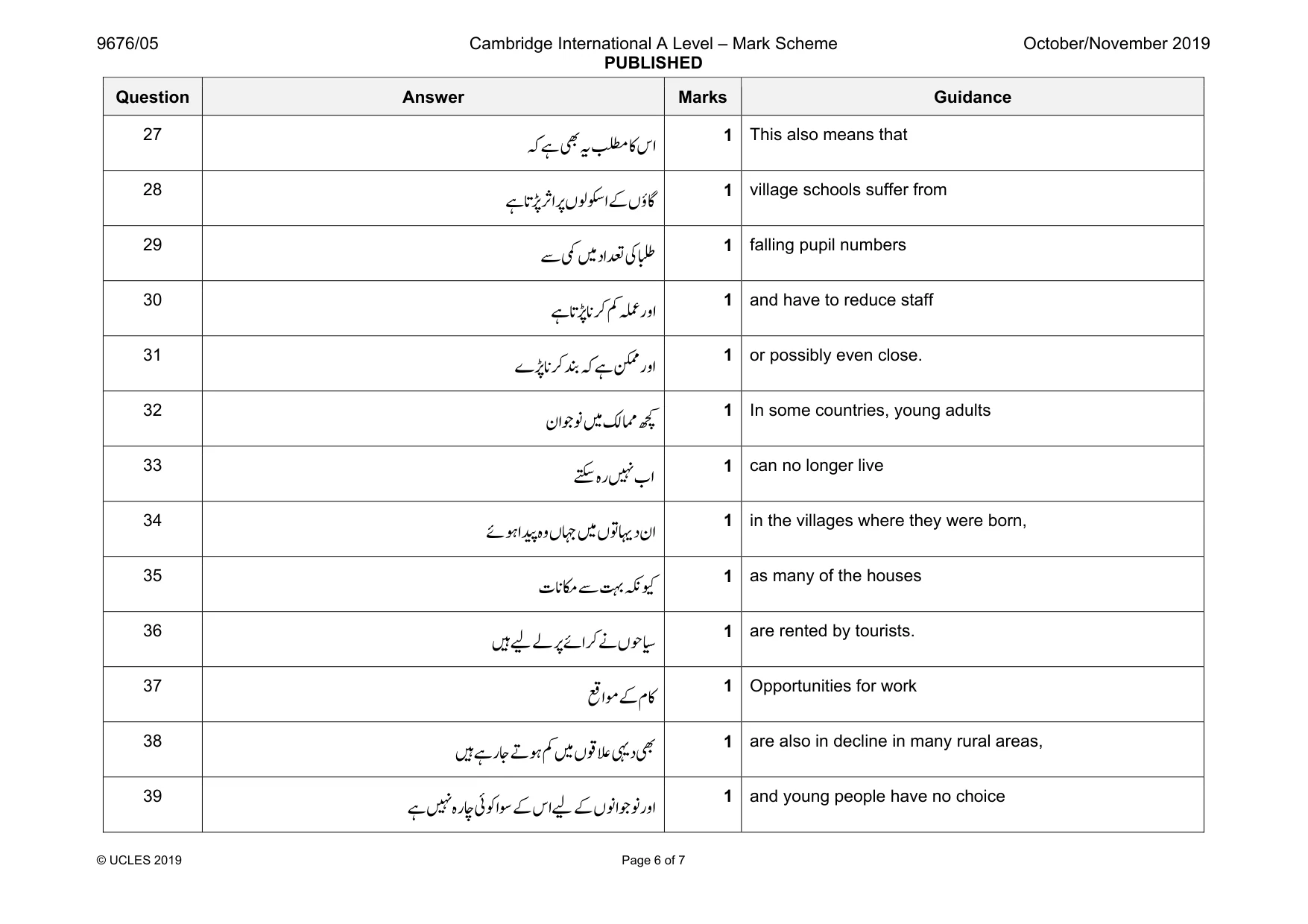
9676/05 Cambridge International A Level – Mark Scheme PUBLISHED October/November 2019 © UCLES 2019 Page 6 of 7 Question Answer Marks Guidance 27 ðä Ĩ 〪Ĩ䞈ĨĨ䮪Ĩ㶱Ĩⵇ 1 This also means that 28 䞈Ĩǖ˄䯈Ĩ Ǖ ɟäĨ䯎Ĩė㥀≸äĨ㈉Ĩėá㈊ 1 village schools suffer from 29 ╌Ĩ⾒Ĩ䆀ĨìäሧĨㅎĨ⡍ 1 falling pupil numbers 30 䞈Ĩǖ˄䯈Ĩǔ˄⸗Ĩ⽃Ĩ⦥Ĩîþä 1 and have to reduce staff 31 ě䯈Ĩǔ˄⸗ĨৠĨ〪Ĩ䞈Ĩ㽟Ĩîþä 1 or possibly even close. 32 üäᣅ䔘Ĩ䆀Ĩ㝼㽐Ĩ⸁ 1 In some countries, young adults 33 Ĩ Ĩåä Ĩ ǖʆĨęîĨ䔽 1 can no longer live 34 䥞䜫ĨäမĨęþĨėᣇĨ䆀ĨėᏠ䮫ìĨüä 1 in the villages where they were born, 35 Ĩ䐲㈀ çǔ˄㺕Ĩ╌Ĩਏ 1 as many of the houses 36 䞀Ĩ㩓Ĩ㩔Ĩ䯎Ĩ䥞ä⸗Ĩ䗂ĨėἶĨ⑭ 1 are rented by tourists. 37 Ⲛä䁡Ĩ㈉Ĩûⵇ 1 Opportunities for work 38 䞀Ĩ䞈îĨᜯĨᓧ䜫Ĩ⽃Ĩ䆀Ĩėⴑ⥲Ĩ䮱ìĨ 1 are also in decline in many rural areas, 39 ㈉ĨðäĨ㩓Ĩ㈉Ĩė䔘äᣅ䔘Ĩîþä Ĩ 䞈Ĩ䔽ĨęîᨴĨ䤈〨Ĩä 1 and young people have no choice
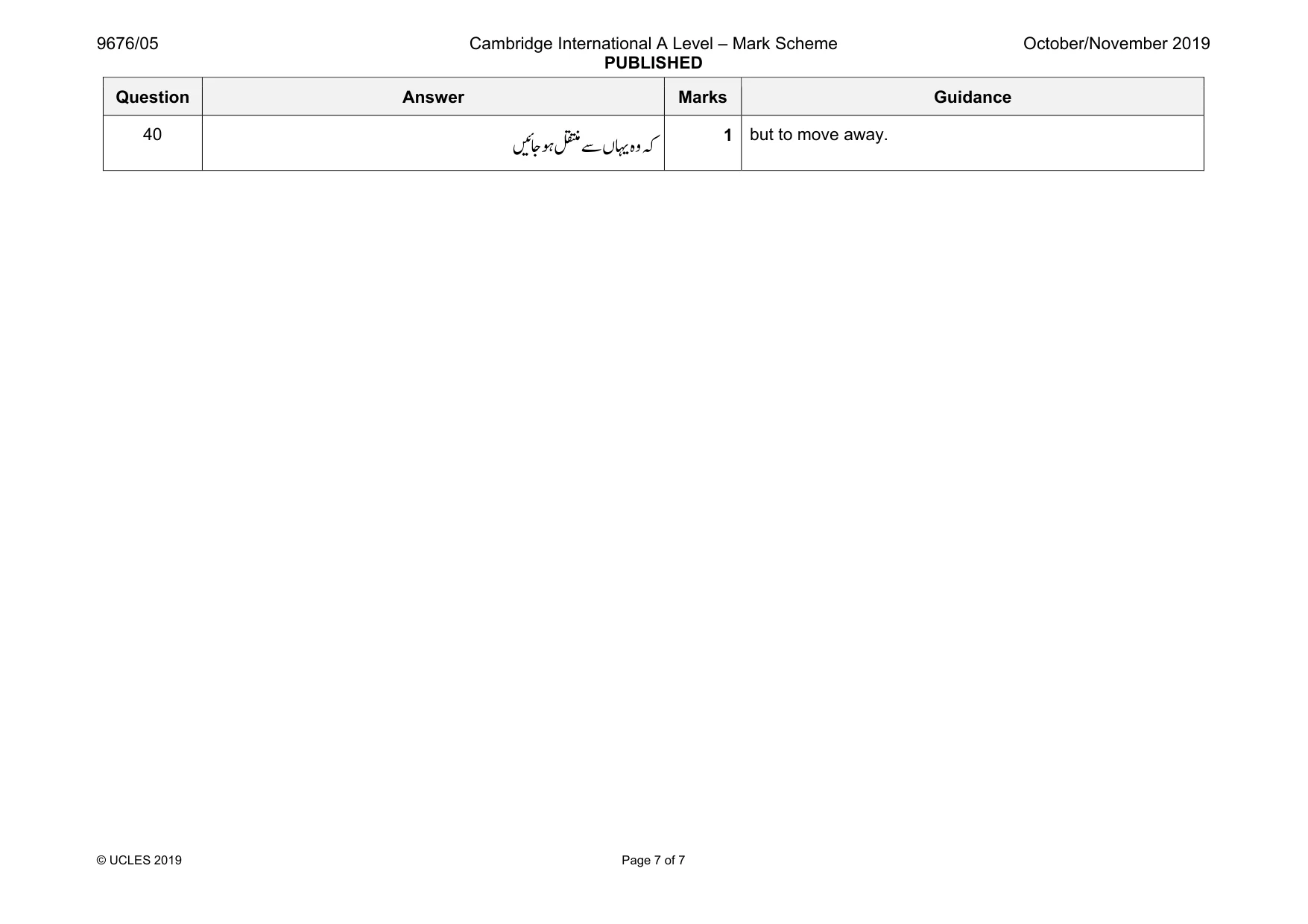
Mark scheme, page 7
9676/05 Cambridge International A Level – Mark Scheme PUBLISHED October/November 2019 © UCLES 2019 Page 7 of 7 Question Answer Marks Guidance 40 䥚ᜯĨ䜫Ĩ㾅Ĩ╌Ĩė䮫ĨęþĨ〪 1 but to move away.
What you needed in this session
Cambridge’s own grade thresholds for 2019 Oct/Nov, Paper 5 · Variant 1. A higher threshold means an easier paper — the bar moves with how the cohort did.