Cambridge A Level Travel and Tourism 9395 — 2022 Oct/Nov Paper 1 · Variant 3
9395/13/O/N/22 · 100 marks · ≈113 min
The question paper and its mark scheme, free to read here and free to download. This is Cambridge’s own paper, exactly as it was sat.
Question paper16 pages


Mark scheme15 pages
Answers below. Sit the paper first if you are practising.
Paper as text
Question paper, page 1
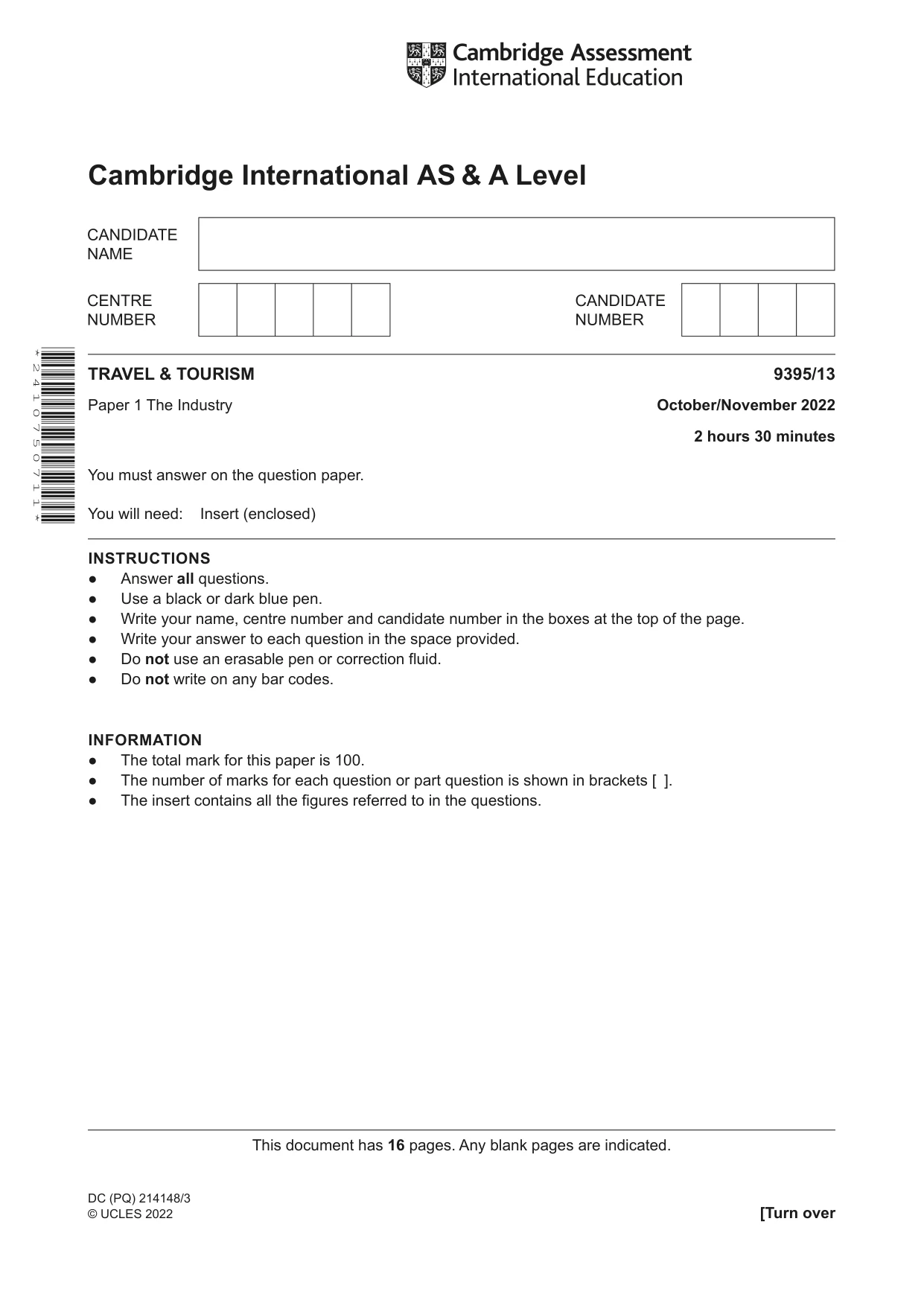
This document has 16 pages. Any blank pages are indicated. [Turn over Cambridge International AS & A Level DC (PQ) 214148/3 © UCLES 2022 * 2 4 1 0 7 5 0 7 1 1 * TRAVEL & TOURISM 9395/13 Paper 1 The Industry October/November 2022 2 hours 30 minutes You must answer on the question paper. You will need: Insert (enclosed) INSTRUCTIONS ● Answer all questions. ● Use a black or dark blue pen. ● Write your name, centre number and candidate number in the boxes at the top of the page. ● Write your answer to each question in the space provided. ● Do not use an erasable pen or correction fluid. ● Do not write on any bar codes. INFORMATION ● The total mark for this paper is 100. ● The number of marks for each question or part question is shown in brackets [ ]. ● The insert contains all the figures referred to in the questions.
Question paper, page 2
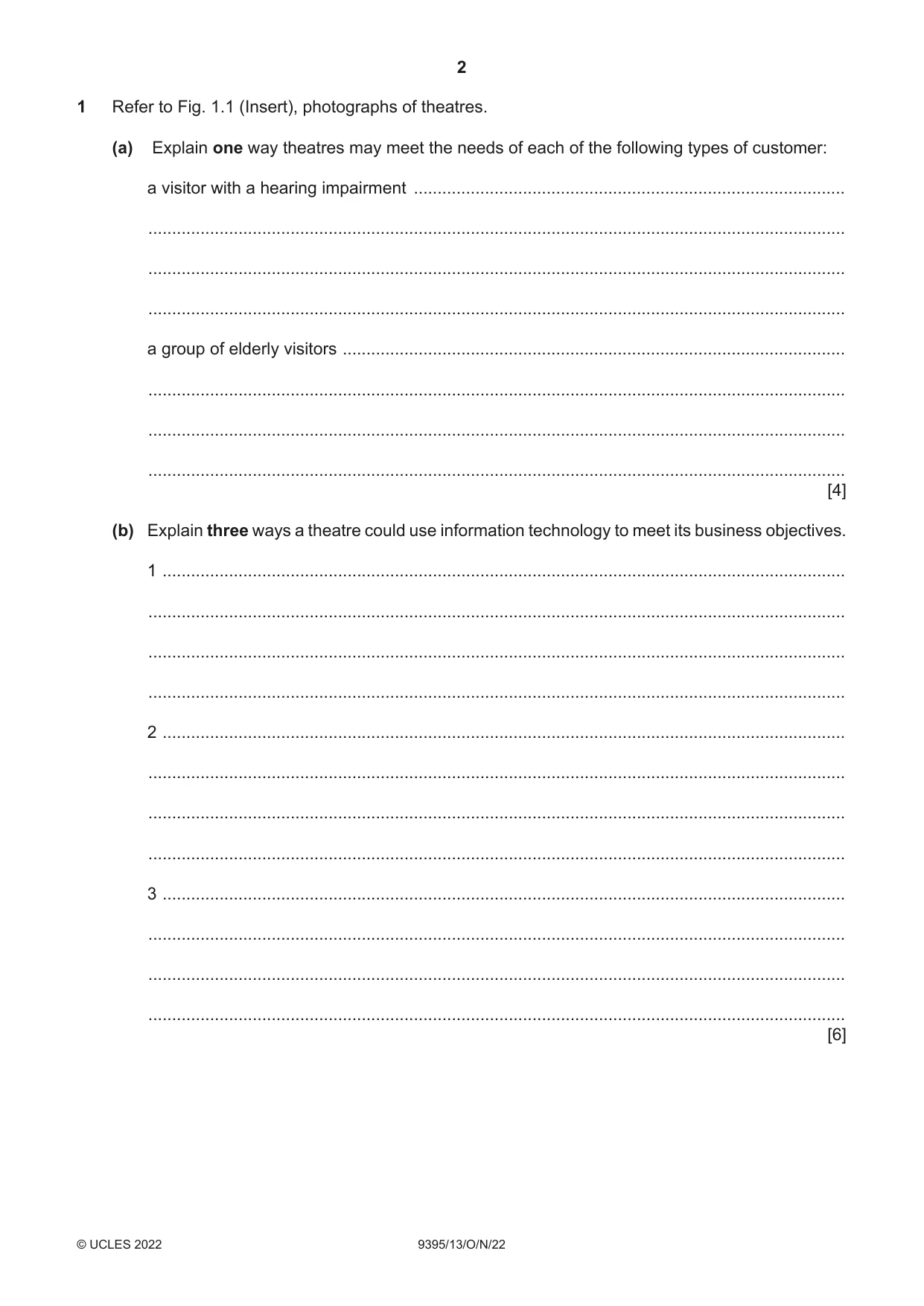
2 9395/13/O/N/22 © UCLES 2022 1 Refer to Fig. 1.1 (Insert), photographs of theatres. (a) Explain one way theatres may meet the needs of each of the following types of customer: a visitor with a hearing impairment … … … … a group of elderly visitors … … … … [4] (b) Explain three ways a theatre could use information technology to meet its business objectives. 1 … … … … 2 … … … … 3 … … … … [6]
Question paper, page 3
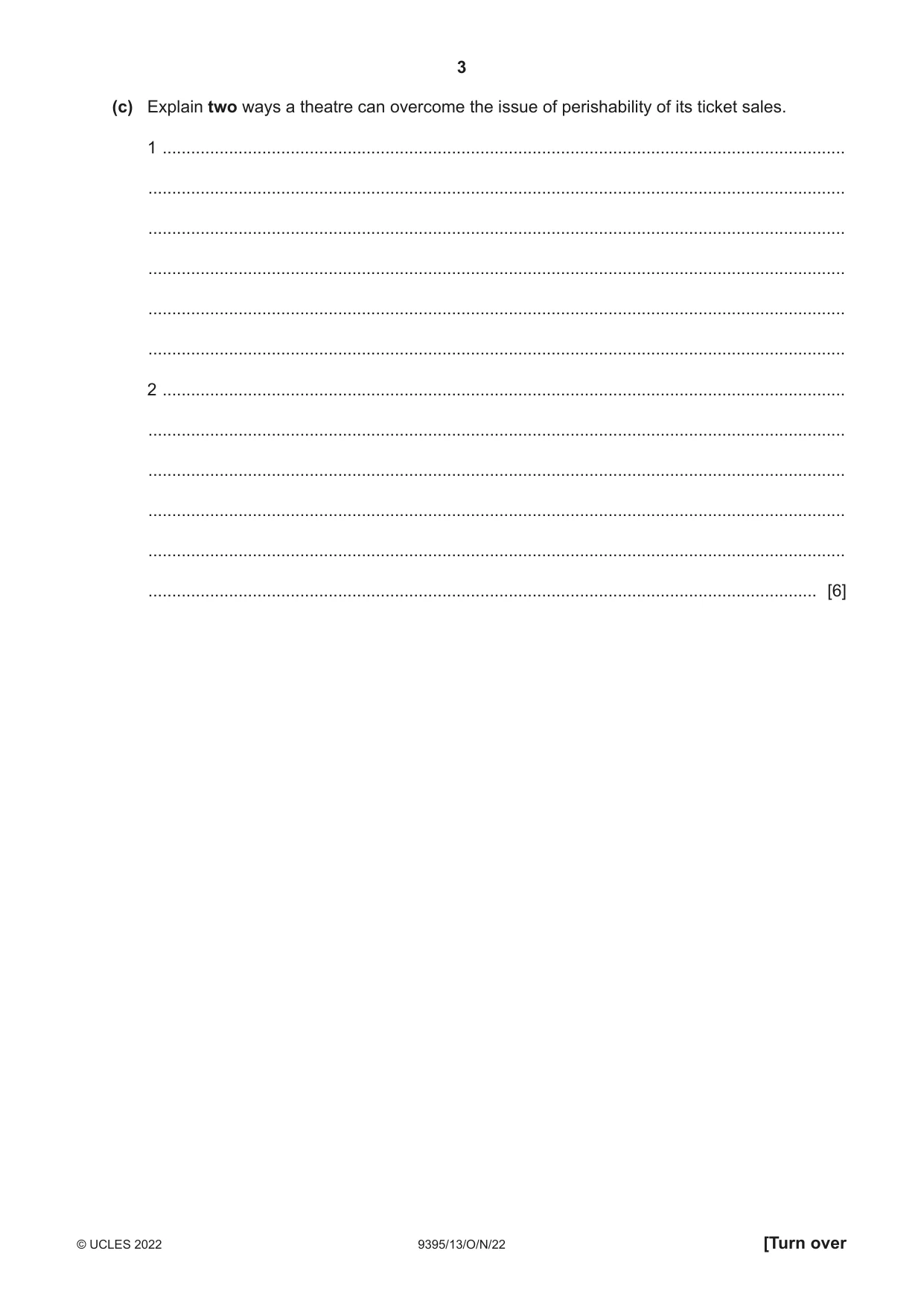
3 9395/13/O/N/22 © UCLES 2022 [Turn over (c) Explain two ways a theatre can overcome the issue of perishability of its ticket sales. 1 … … … … … … 2 … … … … … … [6]
Question paper, page 4
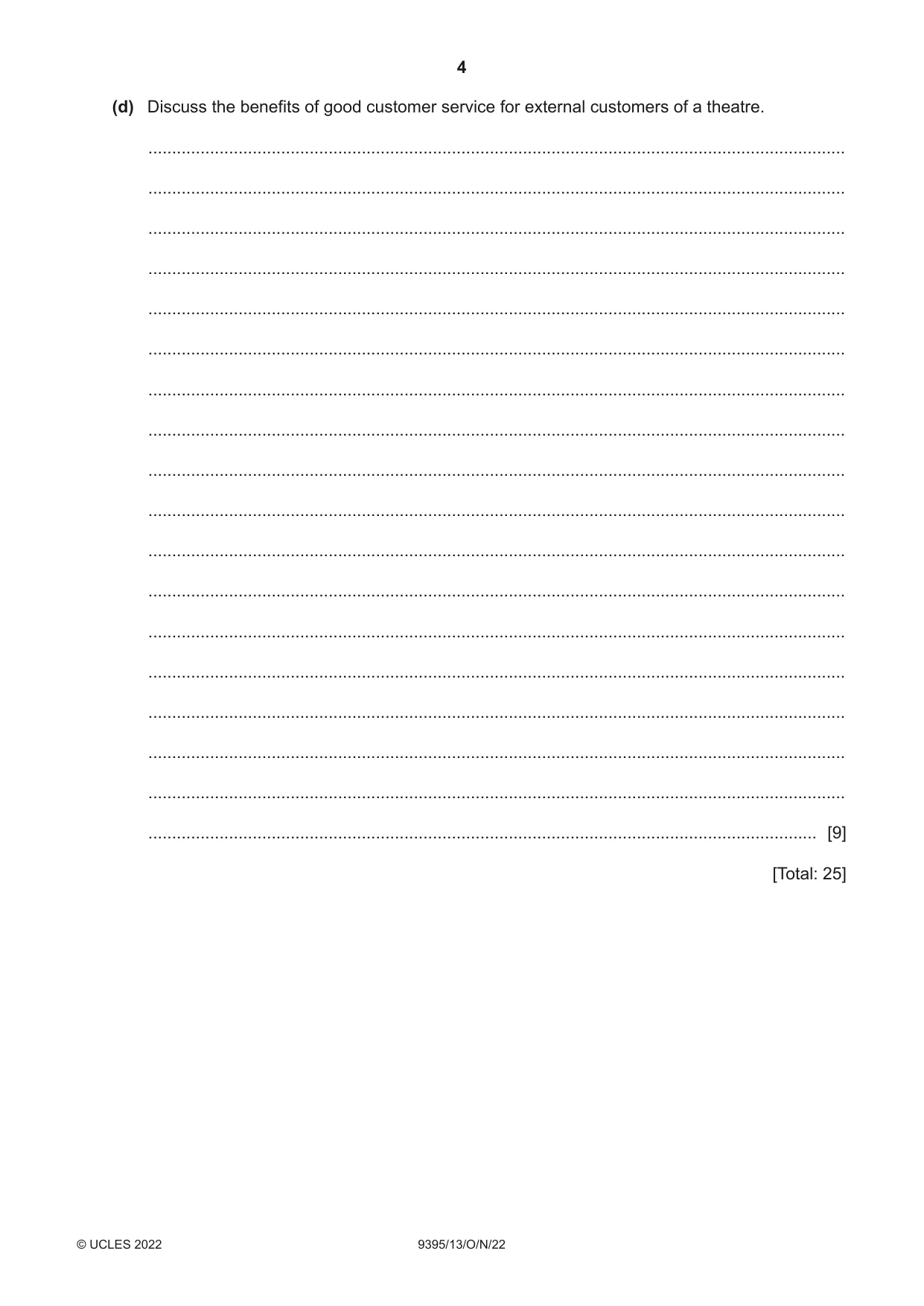
4 9395/13/O/N/22 © UCLES 2022 (d) Discuss the benefits of good customer service for external customers of a theatre. … … … … … … … … … … … … … … … … … … [9] [Total: 25]
Question paper, page 5
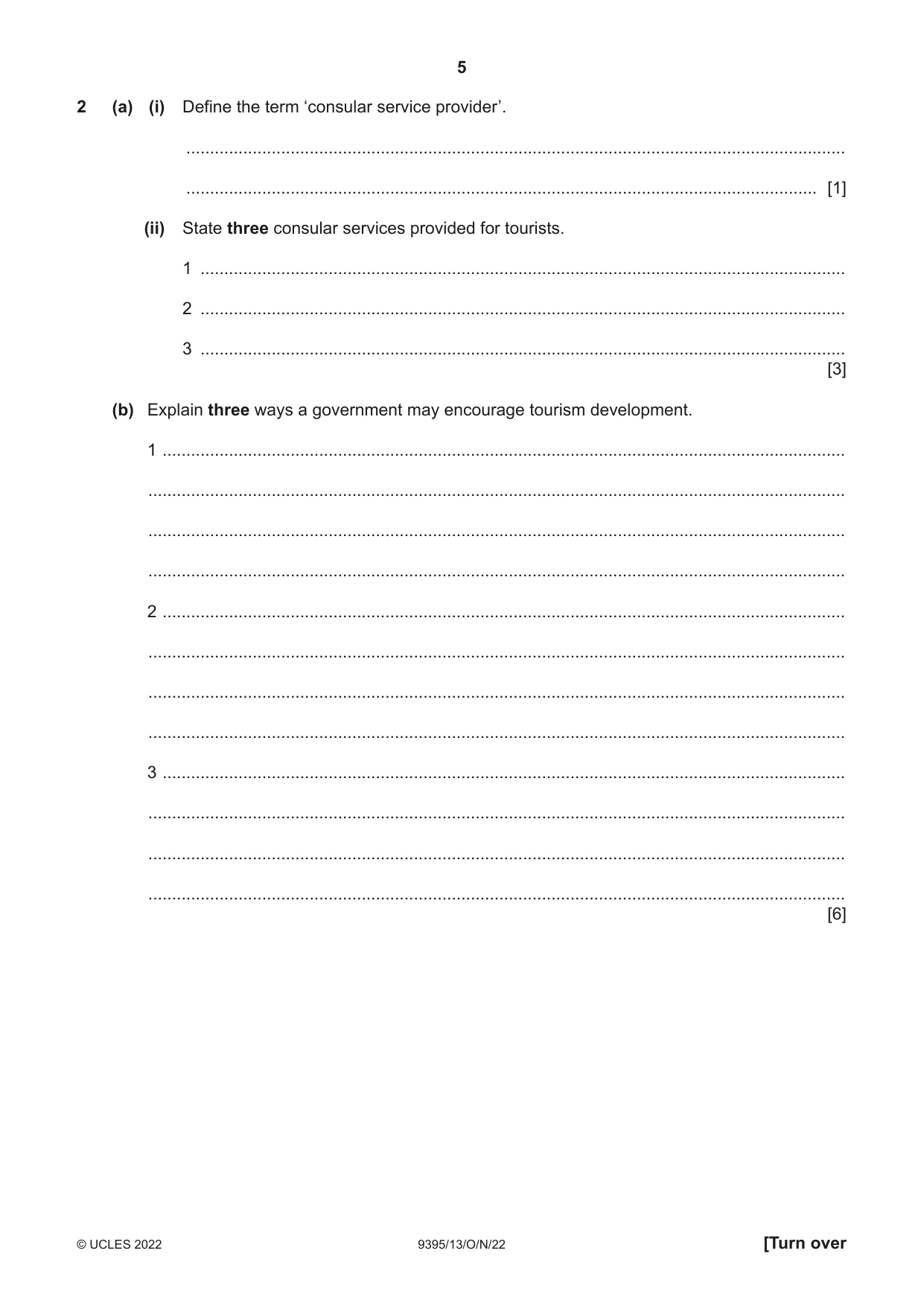
5 9395/13/O/N/22 © UCLES 2022 [Turn over 2 (a) (i) Define the term ‘consular service provider’. … … [1] (ii) State three consular services provided for tourists. 1 … 2 … 3 … [3] (b) Explain three ways a government may encourage tourism development. 1 … … … … 2 … … … … 3 … … … … [6]
Question paper, page 6
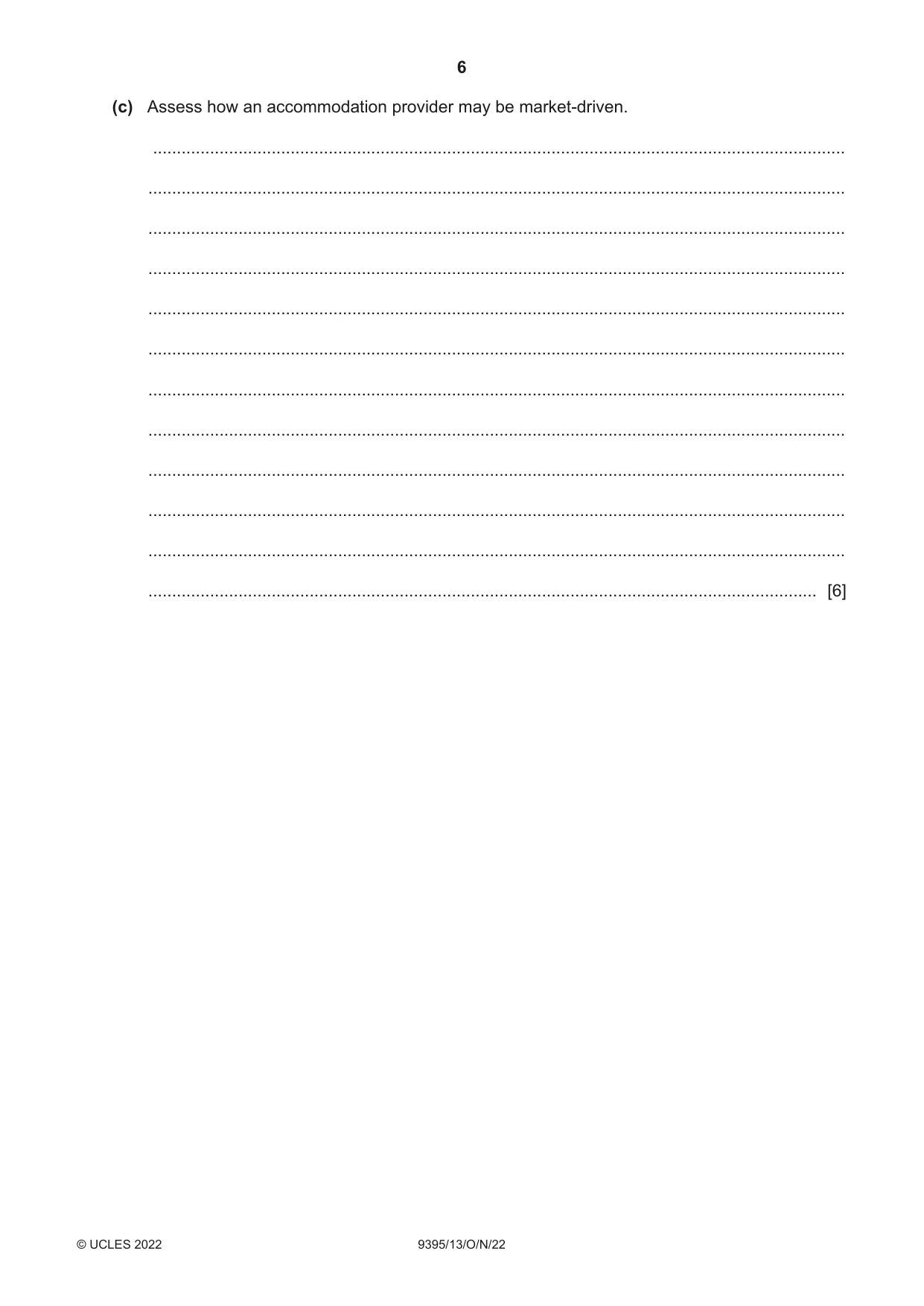
6 9395/13/O/N/22 © UCLES 2022 (c) Assess how an accommodation provider may be market-driven. … … … … … … … … … … … … [6]
Question paper, page 7
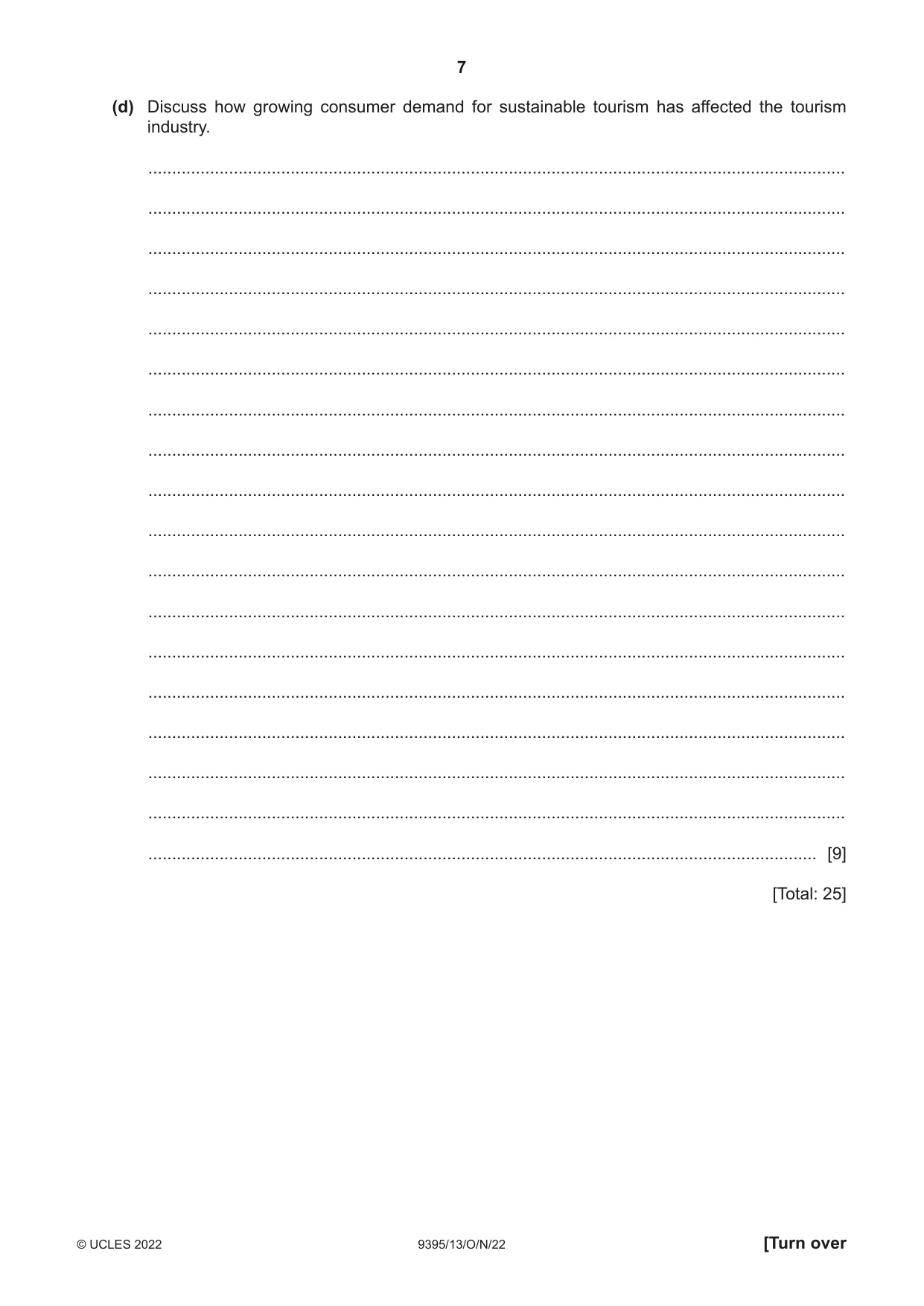
7 9395/13/O/N/22 © UCLES 2022 [Turn over (d) Discuss how growing consumer demand for sustainable tourism has affected the tourism industry. … … … … … … … … … … … … … … … … … … [9] [Total: 25]
Question paper, page 8
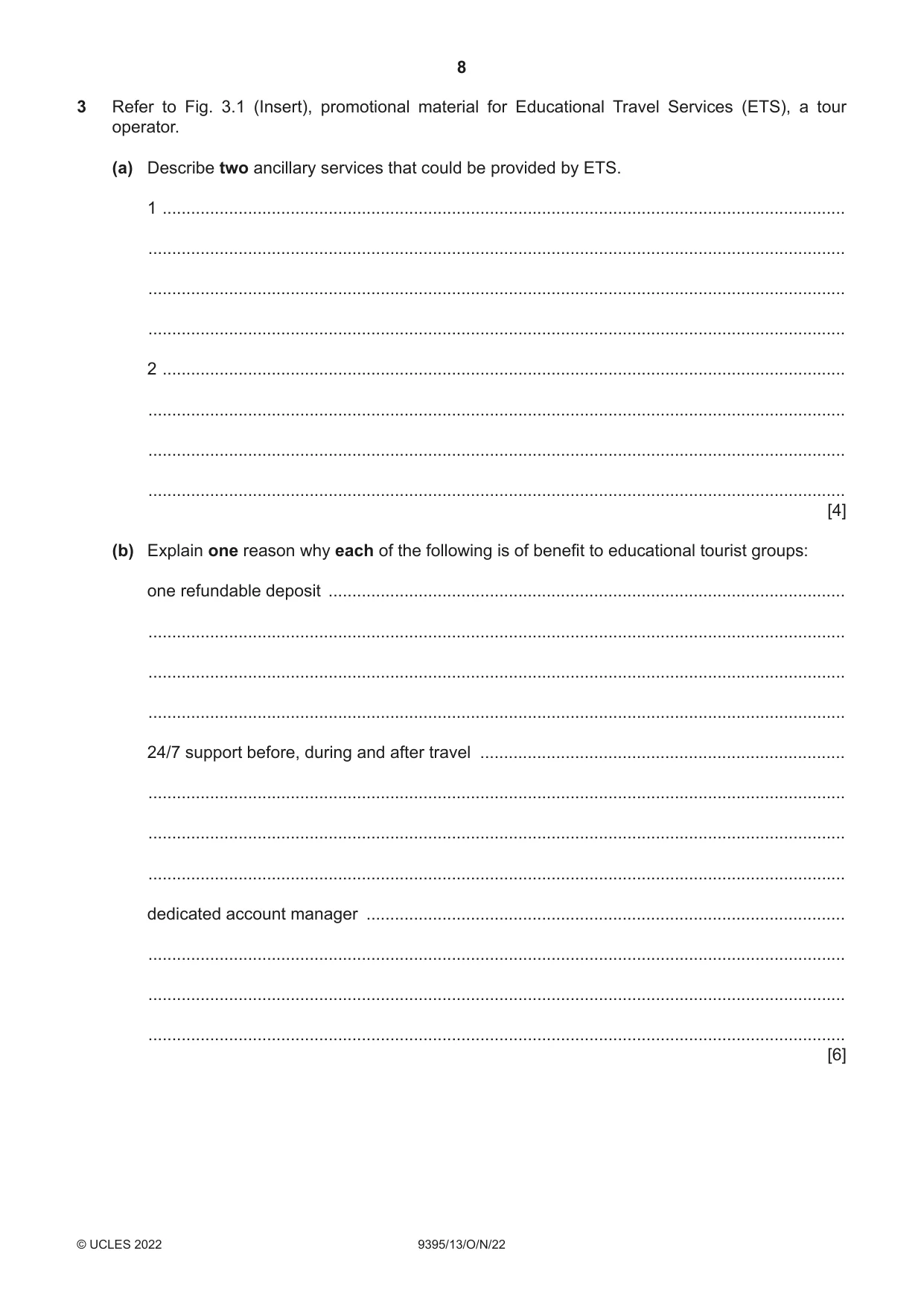
8 9395/13/O/N/22 © UCLES 2022 3 Refer to Fig. 3.1 (Insert), promotional material for Educational Travel Services (ETS), a tour operator. (a) Describe two ancillary services that could be provided by ETS. 1 … … … … 2 … … … … [4] (b) Explain one reason why each of the following is of benefit to educational tourist groups: one refundable deposit … … … … 24/7 support before, during and after travel … … … … dedicated account manager … … … … [6]
Question paper, page 9
9 9395/13/O/N/22 © UCLES 2022 [Turn over (c) Explain how business objectives of a commercial organisation such as ETS may differ from those of a non-commercial organisation. … … … … … … … … … … … … [6]
Question paper, page 10
10 9395/13/O/N/22 © UCLES 2022 (d) Discuss how changing the cost/quality ratio can benefit tour operators and their customers. … … … … … … … … … … … … … … … … … … [9] [Total: 25]
Question paper, page 11
11 9395/13/O/N/22 © UCLES 2022 [Turn over 4 Refer to Fig. 4.1 (Insert), information about the cruise industry. (a) Suggest four ways a cruise operator can meet changing consumer needs and expectations. 1 … … 2 … … 3 … … 4 … … [4] (b) Explain three ways cruise ship operators can provide job satisfaction for their internal customers. 1 … … … … 2 … … … … 3 … … … … [6]
Question paper, page 12
12 9395/13/O/N/22 © UCLES 2022 (c) Assess the economic impacts that cruises may have on destinations. … … … … … … … … … … … … [6]
Question paper, page 13
13 9395/13/O/N/22 © UCLES 2022 (d) Discuss how changing social factors affect the cruise industry. … … … … … … … … … … … … … … … … … … [9] [Total: 25]
Question paper, page 14
14 9395/13/O/N/22 © UCLES 2022 BLANK PAGE
Question paper, page 15
15 9395/13/O/N/22 © UCLES 2022 BLANK PAGE
Question paper, page 16
16 9395/13/O/N/22 © UCLES 2022 The boundaries and names shown, the designations used and the presentation of material on any maps contained in this question paper/insert do not imply official endorsement or acceptance by Cambridge Assessment International Education concerning the legal status of any country, territory, or area or any of its authorities, or of the delimitation of its frontiers or boundaries. Permission to reproduce items where third-party owned material protected by copyright is included has been sought and cleared where possible. Every reasonable effort has been made by the publisher (UCLES) to trace copyright holders, but if any items requiring clearance have unwittingly been included, the publisher will be pleased to make amends at the earliest possible opportunity. To avoid the issue of disclosure of answer-related information to candidates, all copyright acknowledgements are reproduced online in the Cambridge Assessment International Education Copyright Acknowledgements Booklet. This is produced for each series of examinations and is freely available to download at www.cambridgeinternational.org after the live examination series. Cambridge Assessment International Education is part of Cambridge Assessment. Cambridge Assessment is the brand name of the University of Cambridge Local Examinations Syndicate (UCLES), which is a department of the University of Cambridge. BLANK PAGE
Mark scheme, page 1
This document consists of 15 printed pages. © UCLES 2022 [Turn over Cambridge International AS & A Level TRAVEL & TOURISM 9395/13 Paper 1 The Industry October/November 2022 MARK SCHEME Maximum Mark: 100 Published This mark scheme is published as an aid to teachers and candidates, to indicate the requirements of the examination. It shows the basis on which Examiners were instructed to award marks. It does not indicate the details of the discussions that took place at an Examiners’ meeting before marking began, which would have considered the acceptability of alternative answers. Mark schemes should be read in conjunction with the question paper and the Principal Examiner Report for Teachers. Cambridge International will not enter into discussions about these mark schemes. Cambridge International is publishing the mark schemes for the October/November 2022 series for most Cambridge IGCSE™, Cambridge International A and AS Level components and some Cambridge O Level components.
Mark scheme, page 2
9395/13 Cambridge International AS & A Level – Mark Scheme PUBLISHED October/November 2022 © UCLES 2022 Page 2 of 15 Generic Marking Principles These general marking principles must be applied by all examiners when marking candidate answers. They should be applied alongside the specific content of the mark scheme or generic level descriptors for a question. Each question paper and mark scheme will also comply with these marking principles. GENERIC MARKING PRINCIPLE 1: Marks must be awarded in line with: • the specific content of the mark scheme or the generic level descriptors for the question • the specific skills defined in the mark scheme or in the generic level descriptors for the question • the standard of response required by a candidate as exemplified by the standardisation scripts. GENERIC MARKING PRINCIPLE 2: Marks awarded are always whole marks (not half marks, or other fractions). GENERIC MARKING PRINCIPLE 3: Marks must be awarded positively: • marks are awarded for correct/valid answers, as defined in the mark scheme. However, credit is given for valid answers which go beyond the scope of the syllabus and mark scheme, referring to your Team Leader as appropriate • marks are awarded when candidates clearly demonstrate what they know and can do • marks are not deducted for errors • marks are not deducted for omissions • answers should only be judged on the quality of spelling, punctuation and grammar when these features are specifically assessed by the question as indicated by the mark scheme. The meaning, however, should be unambiguous. GENERIC MARKING PRINCIPLE 4: Rules must be applied consistently, e.g. in situations where candidates have not followed instructions or in the application of generic level descriptors. GENERIC MARKING PRINCIPLE 5: Marks should be awarded using the full range of marks defined in the mark scheme for the question (however; the use of the full mark range may be limited according to the quality of the candidate responses seen). GENERIC MARKING PRINCIPLE 6: Marks awarded are based solely on the requirements as defined in the mark scheme. Marks should not be awarded with grade thresholds or grade descriptors in mind.
Mark scheme, page 3
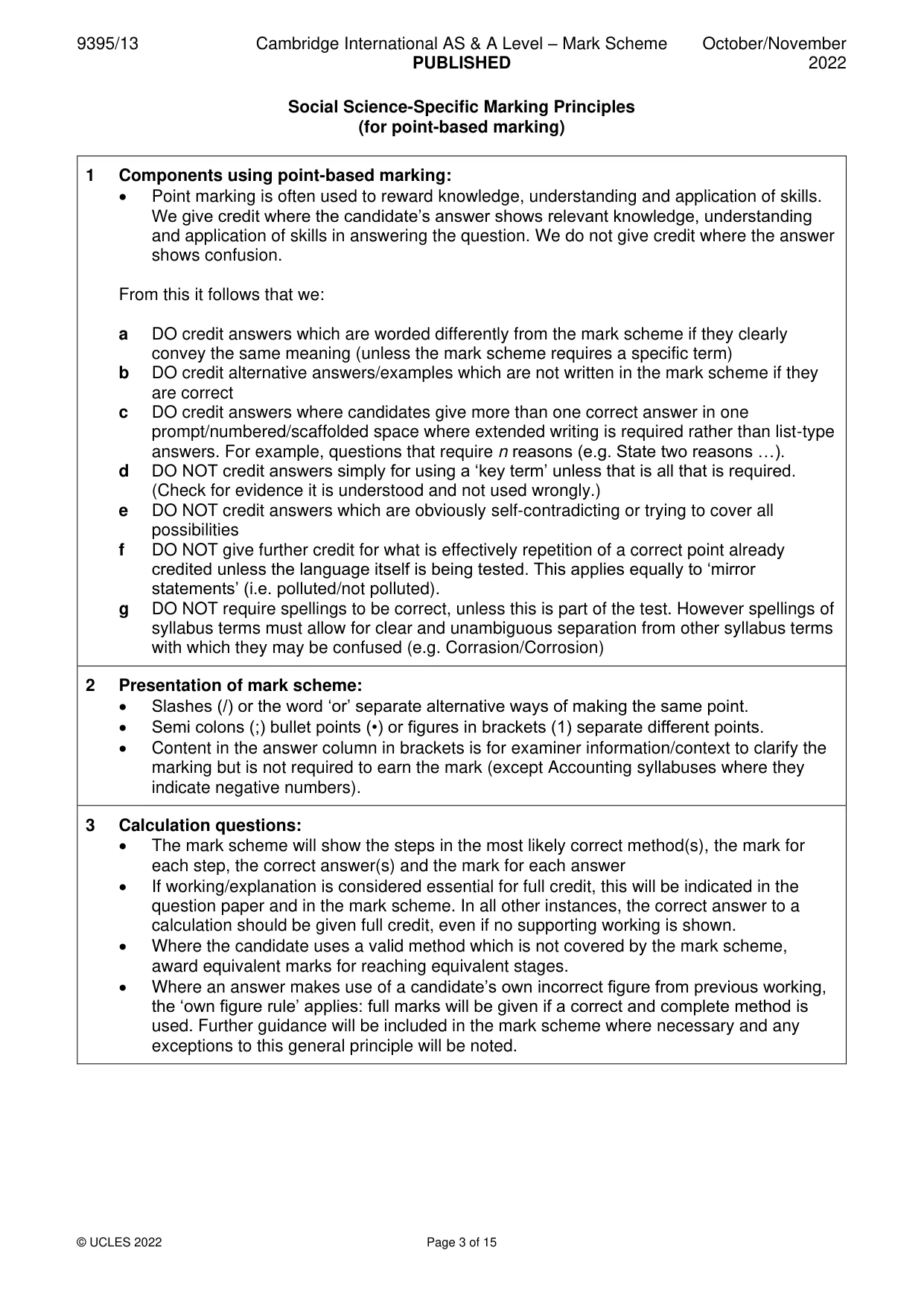
9395/13 Cambridge International AS & A Level – Mark Scheme PUBLISHED October/November 2022 © UCLES 2022 Page 3 of 15 Social Science-Specific Marking Principles (for point-based marking) 1 Components using point-based marking: • Point marking is often used to reward knowledge, understanding and application of skills. We give credit where the candidate’s answer shows relevant knowledge, understanding and application of skills in answering the question. We do not give credit where the answer shows confusion. From this it follows that we: a DO credit answers which are worded differently from the mark scheme if they clearly convey the same meaning (unless the mark scheme requires a specific term) b DO credit alternative answers/examples which are not written in the mark scheme if they are correct c DO credit answers where candidates give more than one correct answer in one prompt/numbered/scaffolded space where extended writing is required rather than list-type answers. For example, questions that require n reasons (e.g. State two reasons …). d DO NOT credit answers simply for using a ‘key term’ unless that is all that is required. (Check for evidence it is understood and not used wrongly.) e DO NOT credit answers which are obviously self-contradicting or trying to cover all possibilities f DO NOT give further credit for what is effectively repetition of a correct point already credited unless the language itself is being tested. This applies equally to ‘mirror statements’ (i.e. polluted/not polluted). g DO NOT require spellings to be correct, unless this is part of the test. However spellings of syllabus terms must allow for clear and unambiguous separation from other syllabus terms with which they may be confused (e.g. Corrasion/Corrosion) 2 Presentation of mark scheme: • Slashes (/) or the word ‘or’ separate alternative ways of making the same point. • Semi colons (;) bullet points (•) or figures in brackets (1) separate different points. • Content in the answer column in brackets is for examiner information/context to clarify the marking but is not required to earn the mark (except Accounting syllabuses where they indicate negative numbers). 3 Calculation questions: • The mark scheme will show the steps in the most likely correct method(s), the mark for each step, the correct answer(s) and the mark for each answer • If working/explanation is considered essential for full credit, this will be indicated in the question paper and in the mark scheme. In all other instances, the correct answer to a calculation should be given full credit, even if no supporting working is shown. • Where the candidate uses a valid method which is not covered by the mark scheme, award equivalent marks for reaching equivalent stages. • Where an answer makes use of a candidate’s own incorrect figure from previous working, the ‘own figure rule’ applies: full marks will be given if a correct and complete method is used. Further guidance will be included in the mark scheme where necessary and any exceptions to this general principle will be noted.
Mark scheme, page 4
9395/13 Cambridge International AS & A Level – Mark Scheme PUBLISHED October/November 2022 © UCLES 2022 Page 4 of 15 4 Annotation: • For point marking, ticks can be used to indicate correct answers and crosses can be used to indicate wrong answers. There is no direct relationship between ticks and marks. Ticks have no defined meaning for levels of response marking. • For levels of response marking, the level awarded should be annotated on the script. • Other annotations will be used by examiners as agreed during standardisation, and the meaning will be understood by all examiners who marked that paper.
Mark scheme, page 5
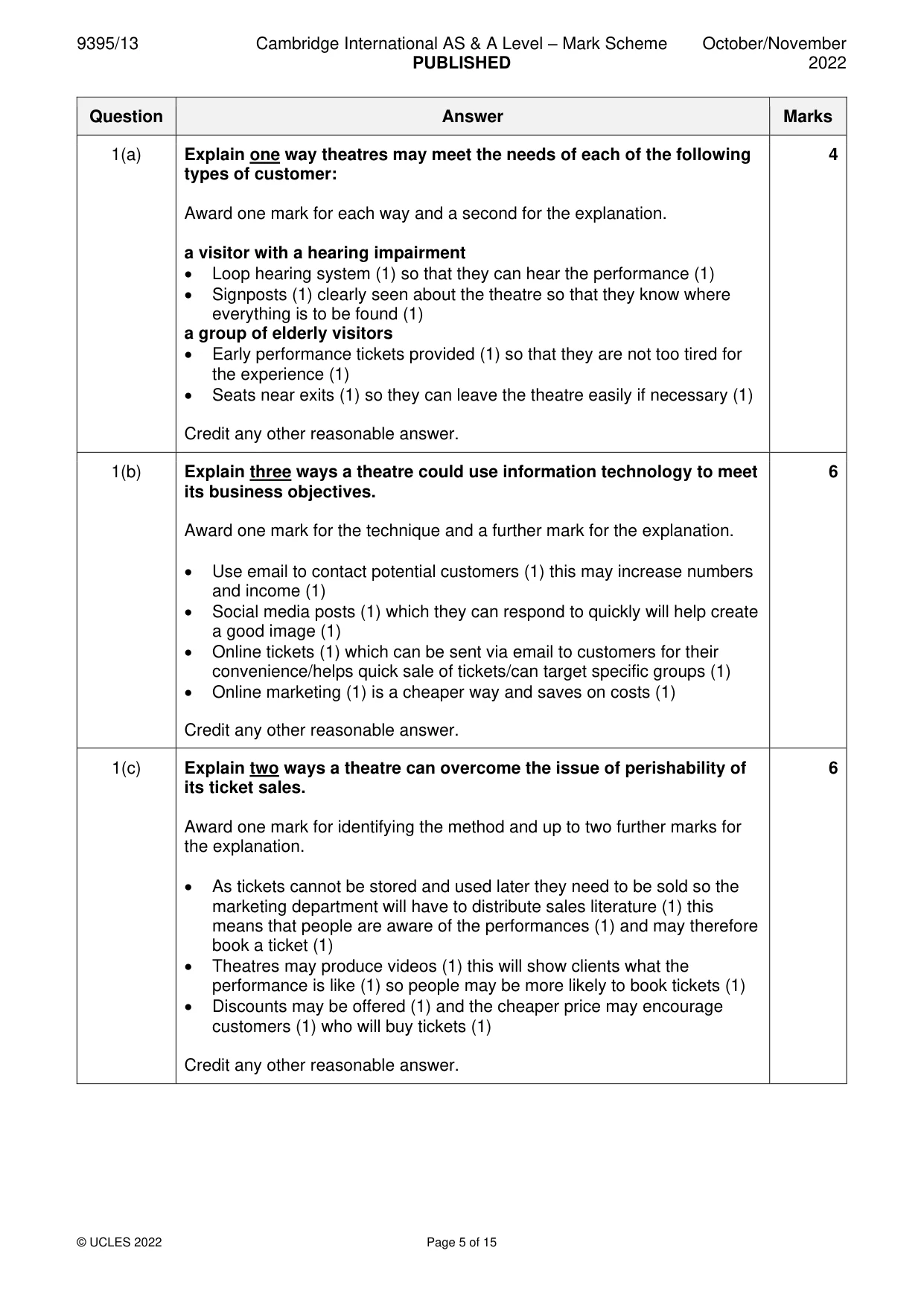
9395/13 Cambridge International AS & A Level – Mark Scheme PUBLISHED October/November 2022 © UCLES 2022 Page 5 of 15 Question Answer Marks 1(a) Explain one way theatres may meet the needs of each of the following types of customer: Award one mark for each way and a second for the explanation. a visitor with a hearing impairment • Loop hearing system (1) so that they can hear the performance (1) • Signposts (1) clearly seen about the theatre so that they know where everything is to be found (1) a group of elderly visitors • Early performance tickets provided (1) so that they are not too tired for the experience (1) • Seats near exits (1) so they can leave the theatre easily if necessary (1) Credit any other reasonable answer. 4 1(b) Explain three ways a theatre could use information technology to meet its business objectives. Award one mark for the technique and a further mark for the explanation. • Use email to contact potential customers (1) this may increase numbers and income (1) • Social media posts (1) which they can respond to quickly will help create a good image (1) • Online tickets (1) which can be sent via email to customers for their convenience/helps quick sale of tickets/can target specific groups (1) • Online marketing (1) is a cheaper way and saves on costs (1) Credit any other reasonable answer. 6 1(c) Explain two ways a theatre can overcome the issue of perishability of its ticket sales. Award one mark for identifying the method and up to two further marks for the explanation. • As tickets cannot be stored and used later they need to be sold so the marketing department will have to distribute sales literature (1) this means that people are aware of the performances (1) and may therefore book a ticket (1) • Theatres may produce videos (1) this will show clients what the performance is like (1) so people may be more likely to book tickets (1) • Discounts may be offered (1) and the cheaper price may encourage customers (1) who will buy tickets (1) Credit any other reasonable answer. 6
Mark scheme, page 6
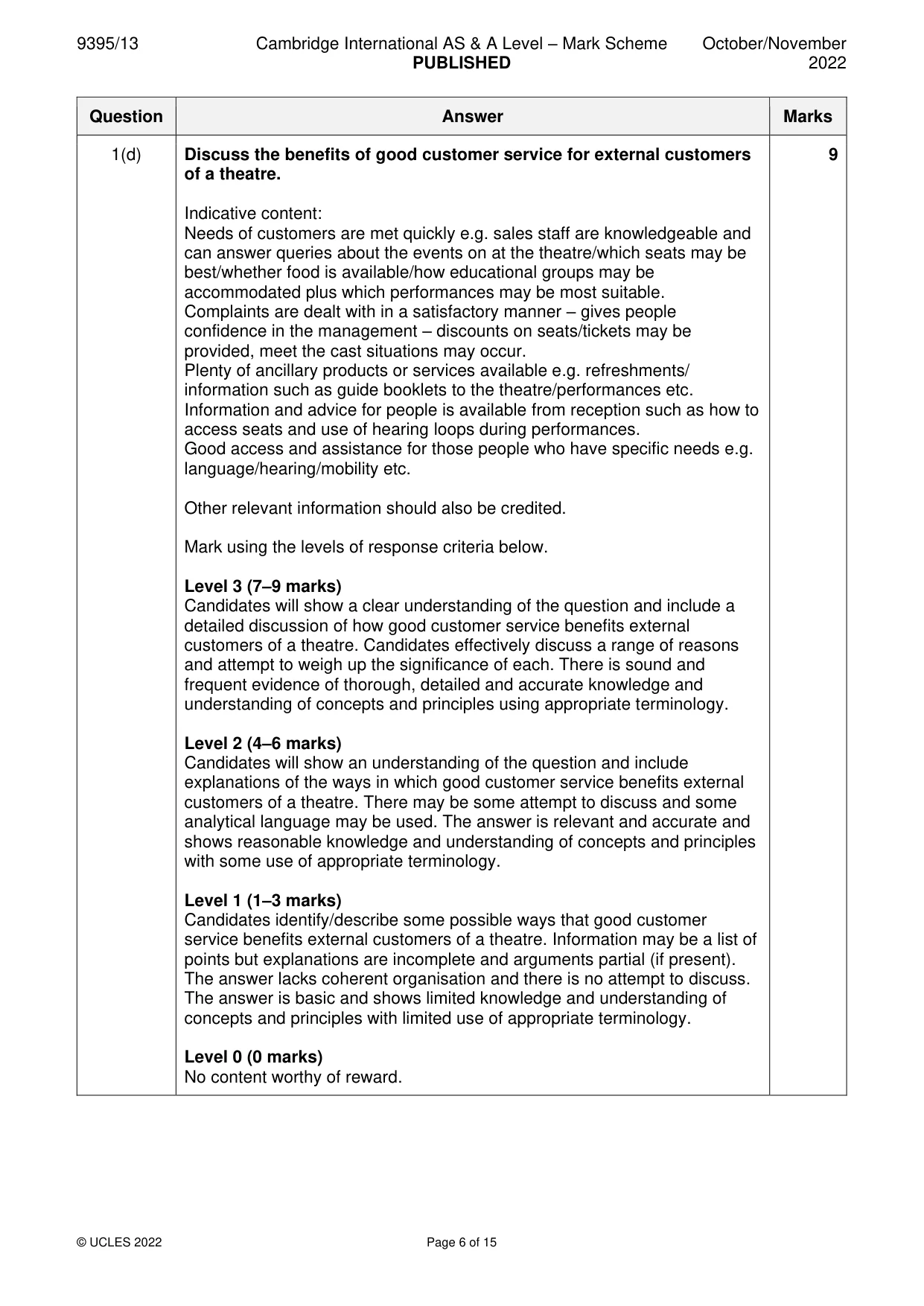
9395/13 Cambridge International AS & A Level – Mark Scheme PUBLISHED October/November 2022 © UCLES 2022 Page 6 of 15 Question Answer Marks 1(d) Discuss the benefits of good customer service for external customers of a theatre. Indicative content: Needs of customers are met quickly e.g. sales staff are knowledgeable and can answer queries about the events on at the theatre/which seats may be best/whether food is available/how educational groups may be accommodated plus which performances may be most suitable. Complaints are dealt with in a satisfactory manner – gives people confidence in the management – discounts on seats/tickets may be provided, meet the cast situations may occur. Plenty of ancillary products or services available e.g. refreshments/ information such as guide booklets to the theatre/performances etc. Information and advice for people is available from reception such as how to access seats and use of hearing loops during performances. Good access and assistance for those people who have specific needs e.g. language/hearing/mobility etc. Other relevant information should also be credited. Mark using the levels of response criteria below. Level 3 (7–9 marks) Candidates will show a clear understanding of the question and include a detailed discussion of how good customer service benefits external customers of a theatre. Candidates effectively discuss a range of reasons and attempt to weigh up the significance of each. There is sound and frequent evidence of thorough, detailed and accurate knowledge and understanding of concepts and principles using appropriate terminology. Level 2 (4–6 marks) Candidates will show an understanding of the question and include explanations of the ways in which good customer service benefits external customers of a theatre. There may be some attempt to discuss and some analytical language may be used. The answer is relevant and accurate and shows reasonable knowledge and understanding of concepts and principles with some use of appropriate terminology. Level 1 (1–3 marks) Candidates identify/describe some possible ways that good customer service benefits external customers of a theatre. Information may be a list of points but explanations are incomplete and arguments partial (if present). The answer lacks coherent organisation and there is no attempt to discuss. The answer is basic and shows limited knowledge and understanding of concepts and principles with limited use of appropriate terminology. Level 0 (0 marks) No content worthy of reward. 9
Mark scheme, page 7
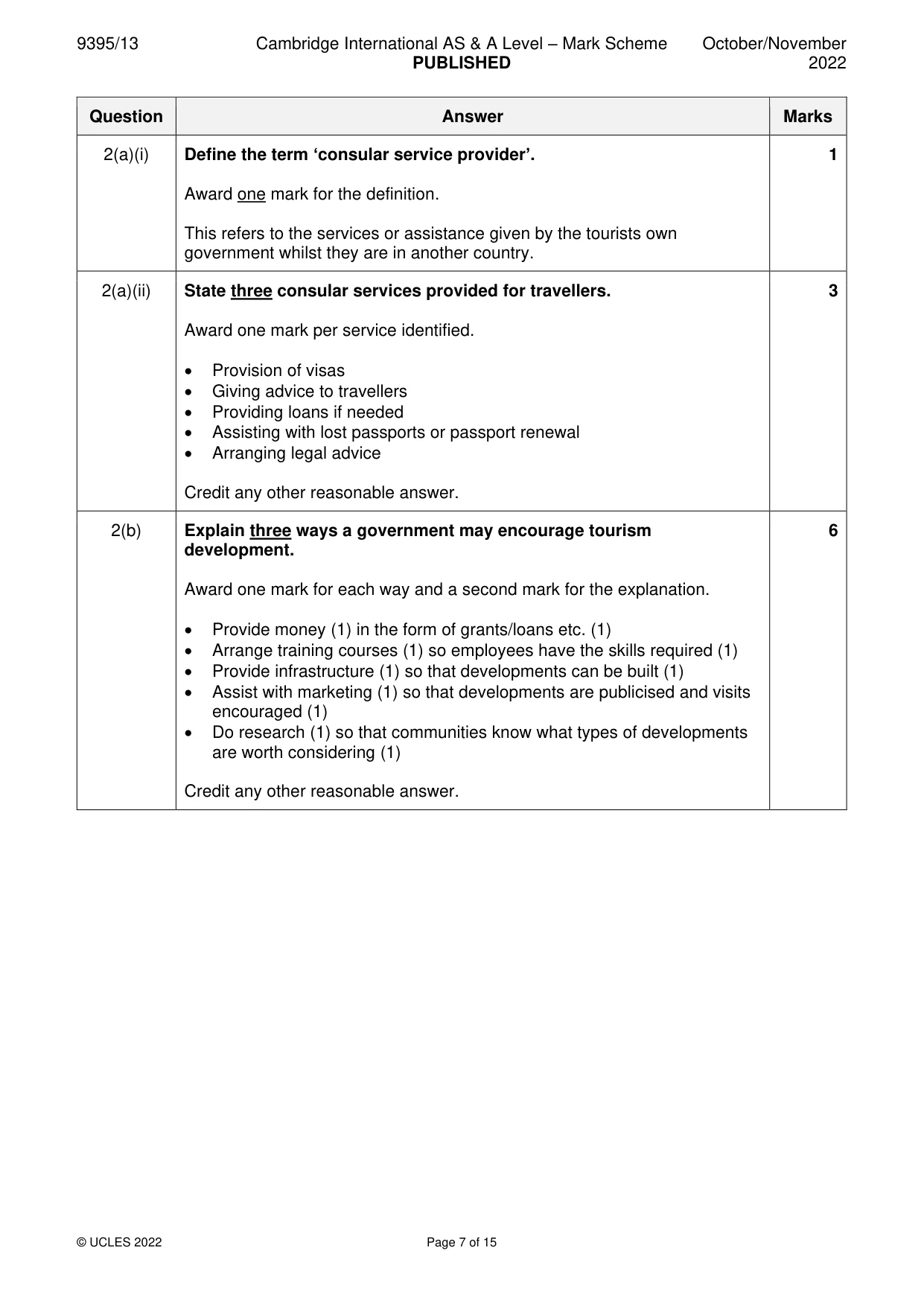
9395/13 Cambridge International AS & A Level – Mark Scheme PUBLISHED October/November 2022 © UCLES 2022 Page 7 of 15 Question Answer Marks 2(a)(i) Define the term ‘consular service provider’. Award one mark for the definition. This refers to the services or assistance given by the tourists own government whilst they are in another country. 1 2(a)(ii) State three consular services provided for travellers. Award one mark per service identified. • Provision of visas • Giving advice to travellers • Providing loans if needed • Assisting with lost passports or passport renewal • Arranging legal advice Credit any other reasonable answer. 3 2(b) Explain three ways a government may encourage tourism development. Award one mark for each way and a second mark for the explanation. • Provide money (1) in the form of grants/loans etc. (1) • Arrange training courses (1) so employees have the skills required (1) • Provide infrastructure (1) so that developments can be built (1) • Assist with marketing (1) so that developments are publicised and visits encouraged (1) • Do research (1) so that communities know what types of developments are worth considering (1) Credit any other reasonable answer. 6
Mark scheme, page 8
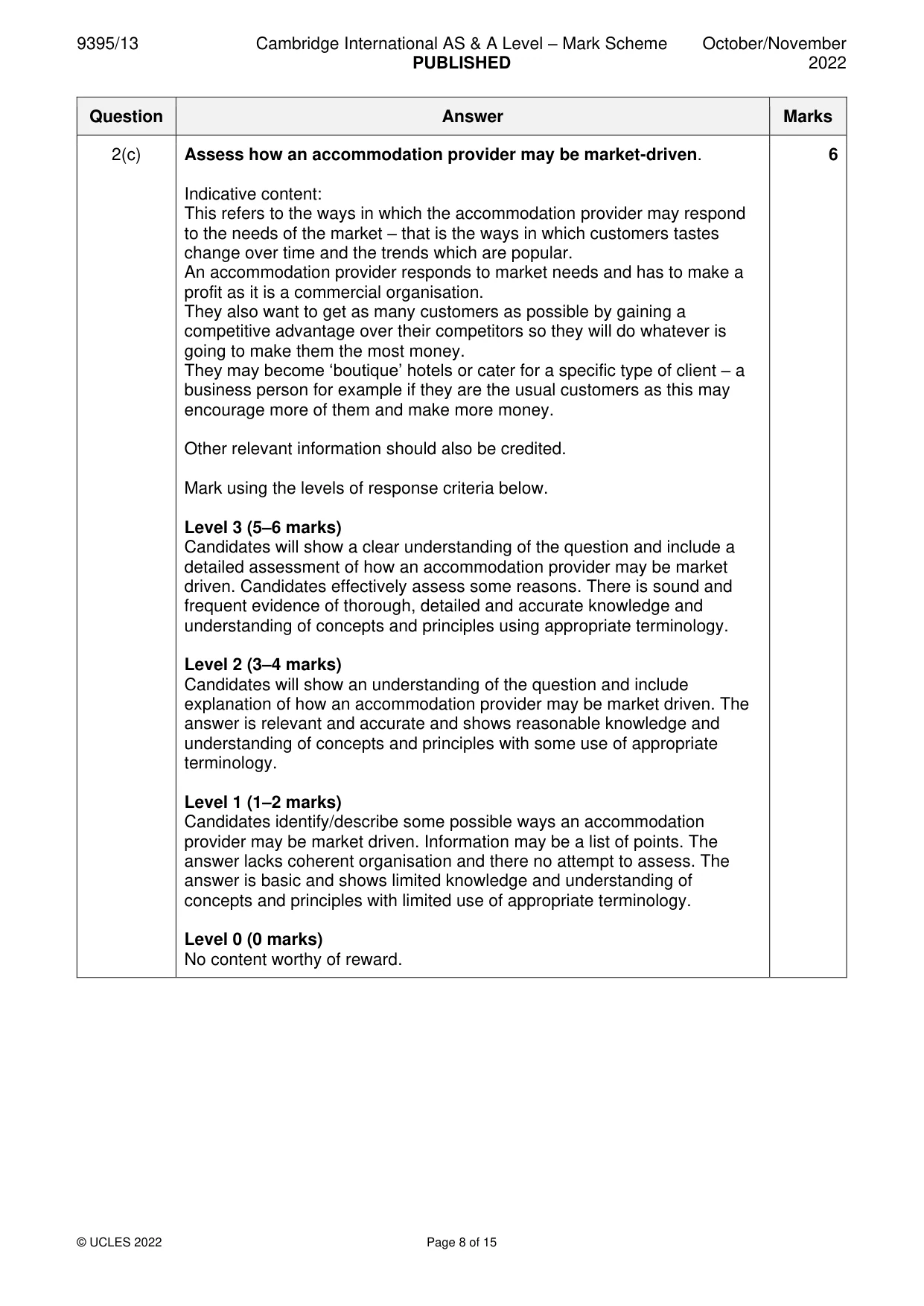
9395/13 Cambridge International AS & A Level – Mark Scheme PUBLISHED October/November 2022 © UCLES 2022 Page 8 of 15 Question Answer Marks 2(c) Assess how an accommodation provider may be market-driven. Indicative content: This refers to the ways in which the accommodation provider may respond to the needs of the market – that is the ways in which customers tastes change over time and the trends which are popular. An accommodation provider responds to market needs and has to make a profit as it is a commercial organisation. They also want to get as many customers as possible by gaining a competitive advantage over their competitors so they will do whatever is going to make them the most money. They may become ‘boutique’ hotels or cater for a specific type of client – a business person for example if they are the usual customers as this may encourage more of them and make more money. Other relevant information should also be credited. Mark using the levels of response criteria below. Level 3 (5–6 marks) Candidates will show a clear understanding of the question and include a detailed assessment of how an accommodation provider may be market driven. Candidates effectively assess some reasons. There is sound and frequent evidence of thorough, detailed and accurate knowledge and understanding of concepts and principles using appropriate terminology. Level 2 (3–4 marks) Candidates will show an understanding of the question and include explanation of how an accommodation provider may be market driven. The answer is relevant and accurate and shows reasonable knowledge and understanding of concepts and principles with some use of appropriate terminology. Level 1 (1–2 marks) Candidates identify/describe some possible ways an accommodation provider may be market driven. Information may be a list of points. The answer lacks coherent organisation and there no attempt to assess. The answer is basic and shows limited knowledge and understanding of concepts and principles with limited use of appropriate terminology. Level 0 (0 marks) No content worthy of reward. 6
Mark scheme, page 9
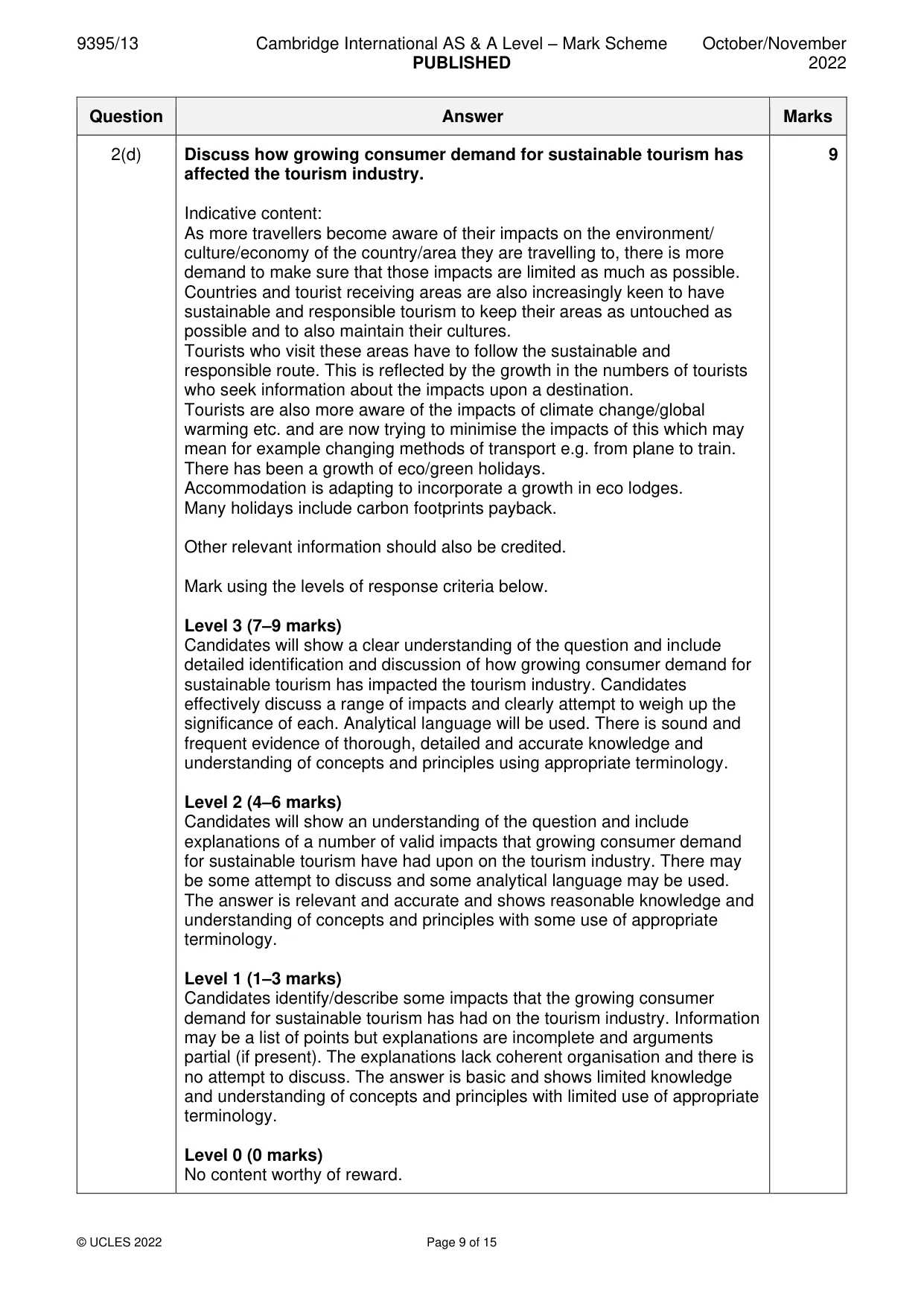
9395/13 Cambridge International AS & A Level – Mark Scheme PUBLISHED October/November 2022 © UCLES 2022 Page 9 of 15 Question Answer Marks 2(d) Discuss how growing consumer demand for sustainable tourism has affected the tourism industry. Indicative content: As more travellers become aware of their impacts on the environment/ culture/economy of the country/area they are travelling to, there is more demand to make sure that those impacts are limited as much as possible. Countries and tourist receiving areas are also increasingly keen to have sustainable and responsible tourism to keep their areas as untouched as possible and to also maintain their cultures. Tourists who visit these areas have to follow the sustainable and responsible route. This is reflected by the growth in the numbers of tourists who seek information about the impacts upon a destination. Tourists are also more aware of the impacts of climate change/global warming etc. and are now trying to minimise the impacts of this which may mean for example changing methods of transport e.g. from plane to train. There has been a growth of eco/green holidays. Accommodation is adapting to incorporate a growth in eco lodges. Many holidays include carbon footprints payback. Other relevant information should also be credited. Mark using the levels of response criteria below. Level 3 (7–9 marks) Candidates will show a clear understanding of the question and include detailed identification and discussion of how growing consumer demand for sustainable tourism has impacted the tourism industry. Candidates effectively discuss a range of impacts and clearly attempt to weigh up the significance of each. Analytical language will be used. There is sound and frequent evidence of thorough, detailed and accurate knowledge and understanding of concepts and principles using appropriate terminology. Level 2 (4–6 marks) Candidates will show an understanding of the question and include explanations of a number of valid impacts that growing consumer demand for sustainable tourism have had upon on the tourism industry. There may be some attempt to discuss and some analytical language may be used. The answer is relevant and accurate and shows reasonable knowledge and understanding of concepts and principles with some use of appropriate terminology. Level 1 (1–3 marks) Candidates identify/describe some impacts that the growing consumer demand for sustainable tourism has had on the tourism industry. Information may be a list of points but explanations are incomplete and arguments partial (if present). The explanations lack coherent organisation and there is no attempt to discuss. The answer is basic and shows limited knowledge and understanding of concepts and principles with limited use of appropriate terminology. Level 0 (0 marks) No content worthy of reward. 9
Mark scheme, page 10
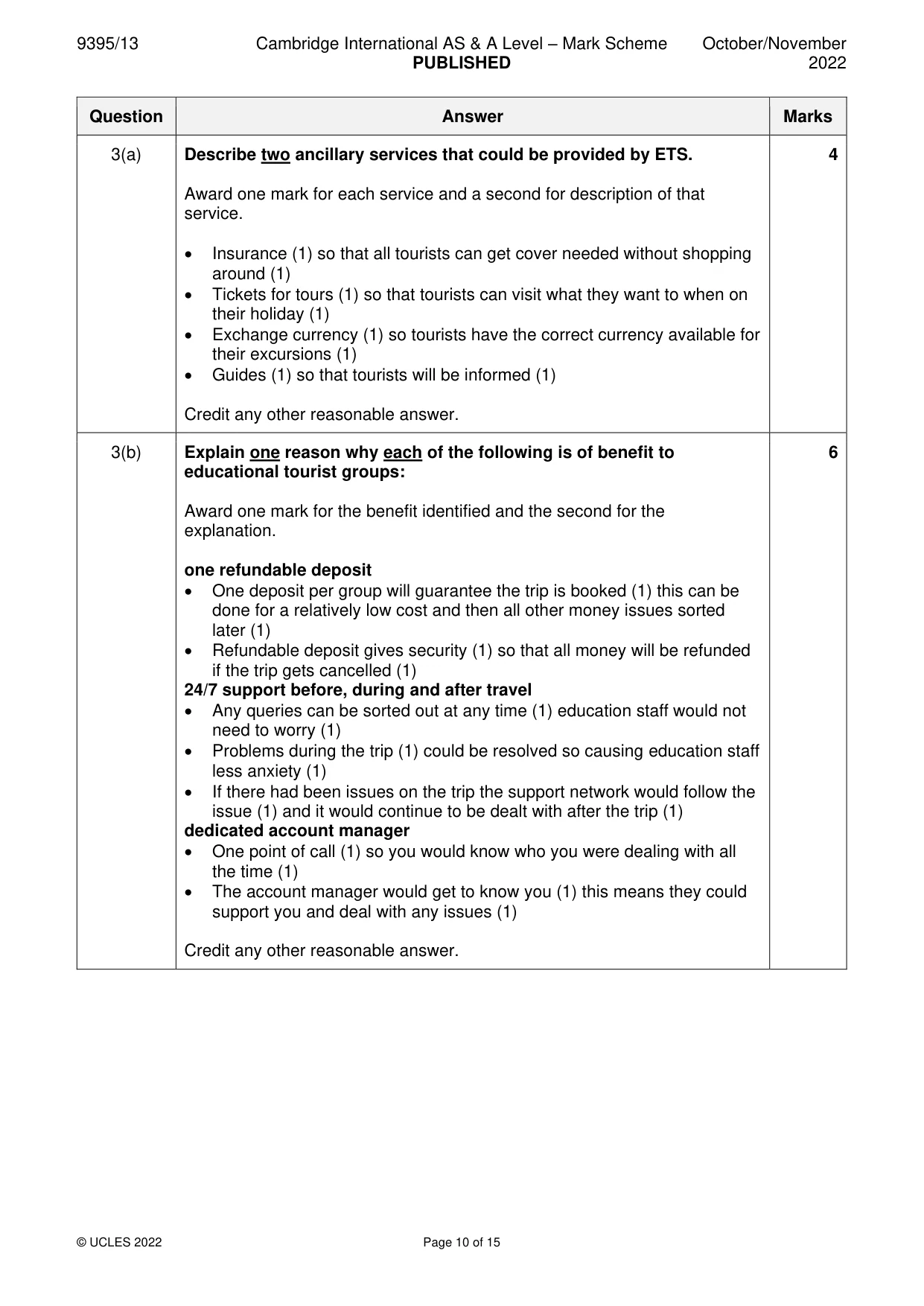
9395/13 Cambridge International AS & A Level – Mark Scheme PUBLISHED October/November 2022 © UCLES 2022 Page 10 of 15 Question Answer Marks 3(a) Describe two ancillary services that could be provided by ETS. Award one mark for each service and a second for description of that service. • Insurance (1) so that all tourists can get cover needed without shopping around (1) • Tickets for tours (1) so that tourists can visit what they want to when on their holiday (1) • Exchange currency (1) so tourists have the correct currency available for their excursions (1) • Guides (1) so that tourists will be informed (1) Credit any other reasonable answer. 4 3(b) Explain one reason why each of the following is of benefit to educational tourist groups: Award one mark for the benefit identified and the second for the explanation. one refundable deposit • One deposit per group will guarantee the trip is booked (1) this can be done for a relatively low cost and then all other money issues sorted later (1) • Refundable deposit gives security (1) so that all money will be refunded if the trip gets cancelled (1) 24/7 support before, during and after travel • Any queries can be sorted out at any time (1) education staff would not need to worry (1) • Problems during the trip (1) could be resolved so causing education staff less anxiety (1) • If there had been issues on the trip the support network would follow the issue (1) and it would continue to be dealt with after the trip (1) dedicated account manager • One point of call (1) so you would know who you were dealing with all the time (1) • The account manager would get to know you (1) this means they could support you and deal with any issues (1) Credit any other reasonable answer. 6
Mark scheme, page 11
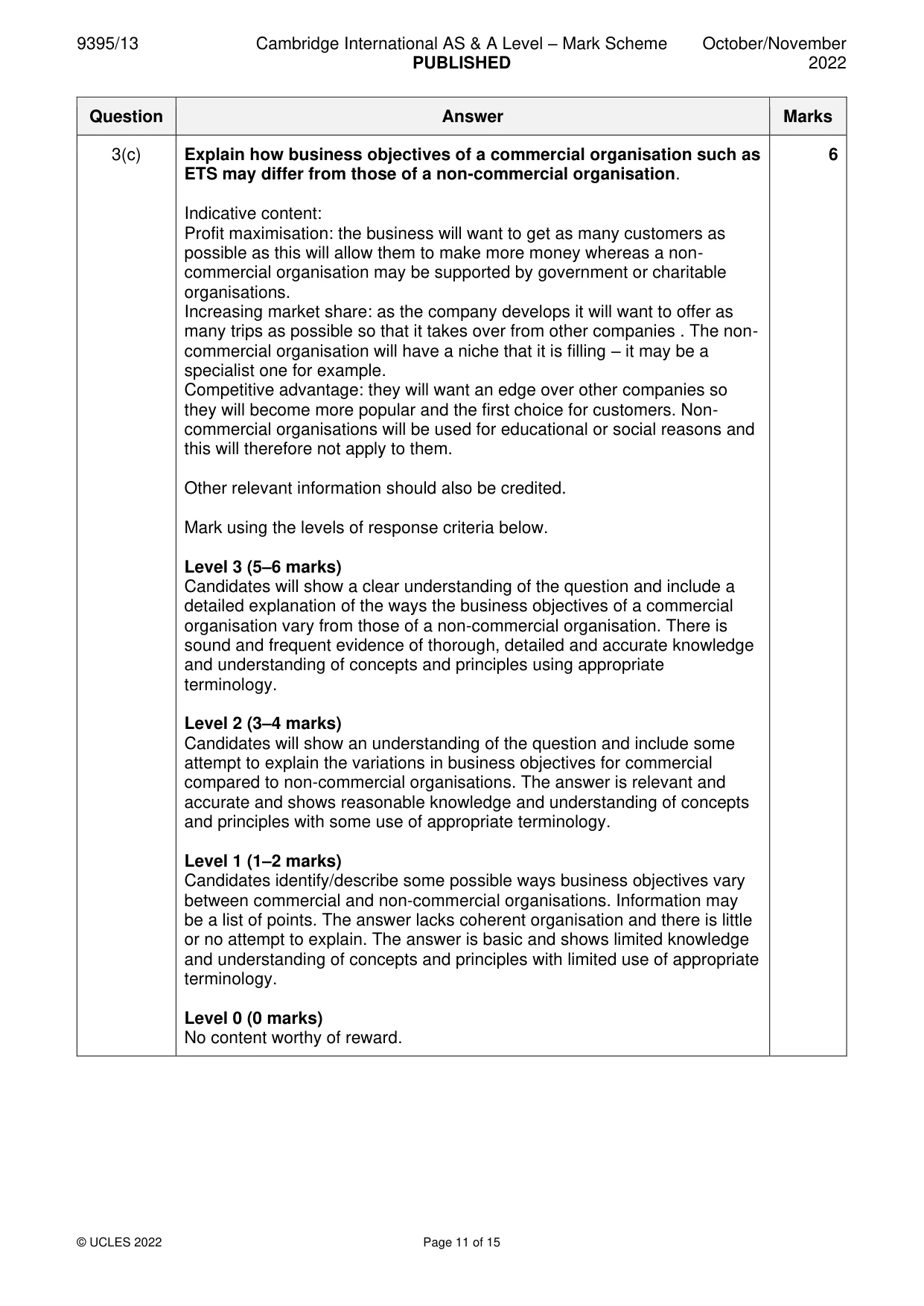
9395/13 Cambridge International AS & A Level – Mark Scheme PUBLISHED October/November 2022 © UCLES 2022 Page 11 of 15 Question Answer Marks 3(c) Explain how business objectives of a commercial organisation such as ETS may differ from those of a non-commercial organisation. Indicative content: Profit maximisation: the business will want to get as many customers as possible as this will allow them to make more money whereas a non- commercial organisation may be supported by government or charitable organisations. Increasing market share: as the company develops it will want to offer as many trips as possible so that it takes over from other companies . The non- commercial organisation will have a niche that it is filling – it may be a specialist one for example. Competitive advantage: they will want an edge over other companies so they will become more popular and the first choice for customers. Non- commercial organisations will be used for educational or social reasons and this will therefore not apply to them. Other relevant information should also be credited. Mark using the levels of response criteria below. Level 3 (5–6 marks) Candidates will show a clear understanding of the question and include a detailed explanation of the ways the business objectives of a commercial organisation vary from those of a non-commercial organisation. There is sound and frequent evidence of thorough, detailed and accurate knowledge and understanding of concepts and principles using appropriate terminology. Level 2 (3–4 marks) Candidates will show an understanding of the question and include some attempt to explain the variations in business objectives for commercial compared to non-commercial organisations. The answer is relevant and accurate and shows reasonable knowledge and understanding of concepts and principles with some use of appropriate terminology. Level 1 (1–2 marks) Candidates identify/describe some possible ways business objectives vary between commercial and non-commercial organisations. Information may be a list of points. The answer lacks coherent organisation and there is little or no attempt to explain. The answer is basic and shows limited knowledge and understanding of concepts and principles with limited use of appropriate terminology. Level 0 (0 marks) No content worthy of reward. 6
Mark scheme, page 12
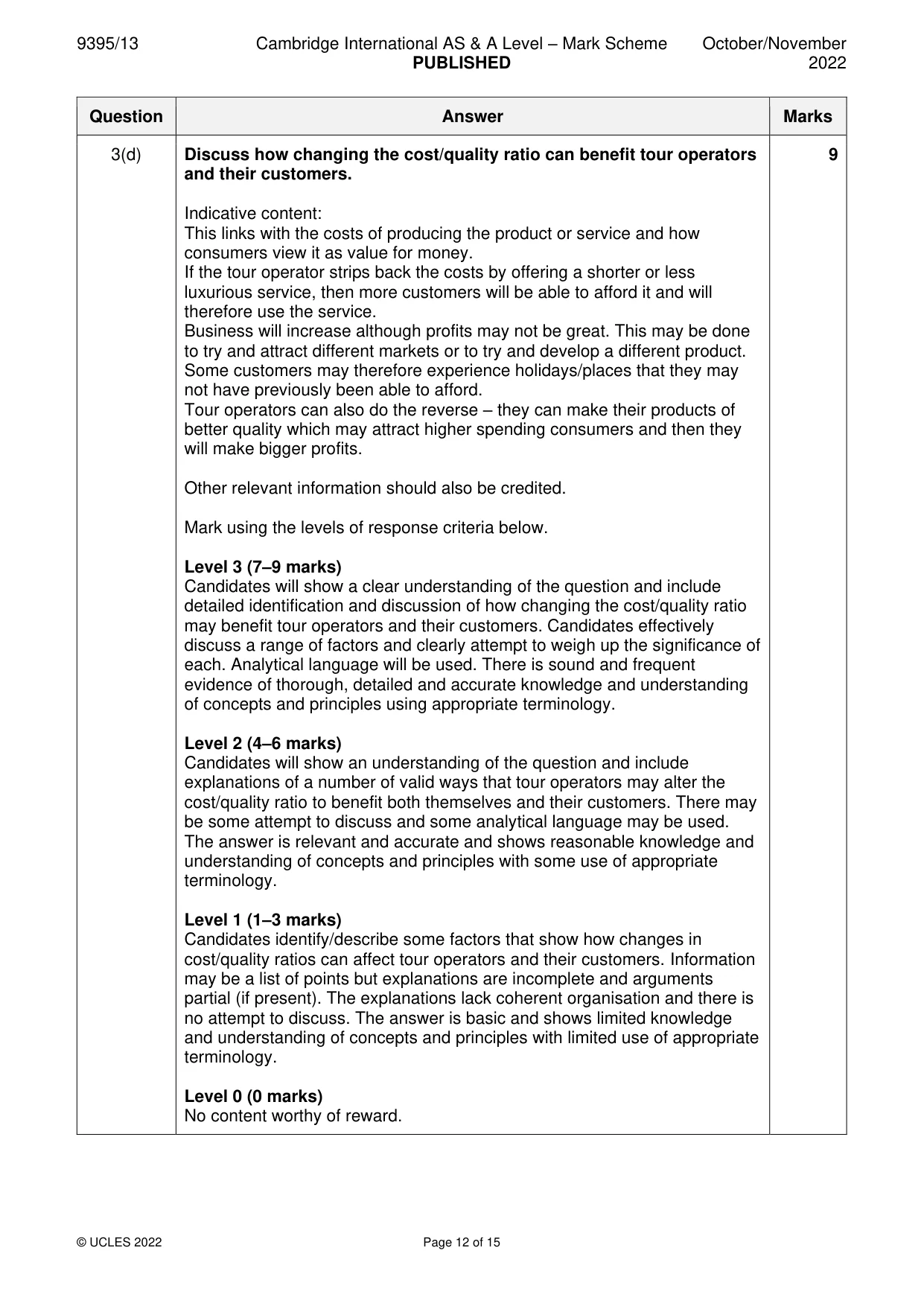
9395/13 Cambridge International AS & A Level – Mark Scheme PUBLISHED October/November 2022 © UCLES 2022 Page 12 of 15 Question Answer Marks 3(d) Discuss how changing the cost/quality ratio can benefit tour operators and their customers. Indicative content: This links with the costs of producing the product or service and how consumers view it as value for money. If the tour operator strips back the costs by offering a shorter or less luxurious service, then more customers will be able to afford it and will therefore use the service. Business will increase although profits may not be great. This may be done to try and attract different markets or to try and develop a different product. Some customers may therefore experience holidays/places that they may not have previously been able to afford. Tour operators can also do the reverse – they can make their products of better quality which may attract higher spending consumers and then they will make bigger profits. Other relevant information should also be credited. Mark using the levels of response criteria below. Level 3 (7–9 marks) Candidates will show a clear understanding of the question and include detailed identification and discussion of how changing the cost/quality ratio may benefit tour operators and their customers. Candidates effectively discuss a range of factors and clearly attempt to weigh up the significance of each. Analytical language will be used. There is sound and frequent evidence of thorough, detailed and accurate knowledge and understanding of concepts and principles using appropriate terminology. Level 2 (4–6 marks) Candidates will show an understanding of the question and include explanations of a number of valid ways that tour operators may alter the cost/quality ratio to benefit both themselves and their customers. There may be some attempt to discuss and some analytical language may be used. The answer is relevant and accurate and shows reasonable knowledge and understanding of concepts and principles with some use of appropriate terminology. Level 1 (1–3 marks) Candidates identify/describe some factors that show how changes in cost/quality ratios can affect tour operators and their customers. Information may be a list of points but explanations are incomplete and arguments partial (if present). The explanations lack coherent organisation and there is no attempt to discuss. The answer is basic and shows limited knowledge and understanding of concepts and principles with limited use of appropriate terminology. Level 0 (0 marks) No content worthy of reward. 9
Mark scheme, page 13
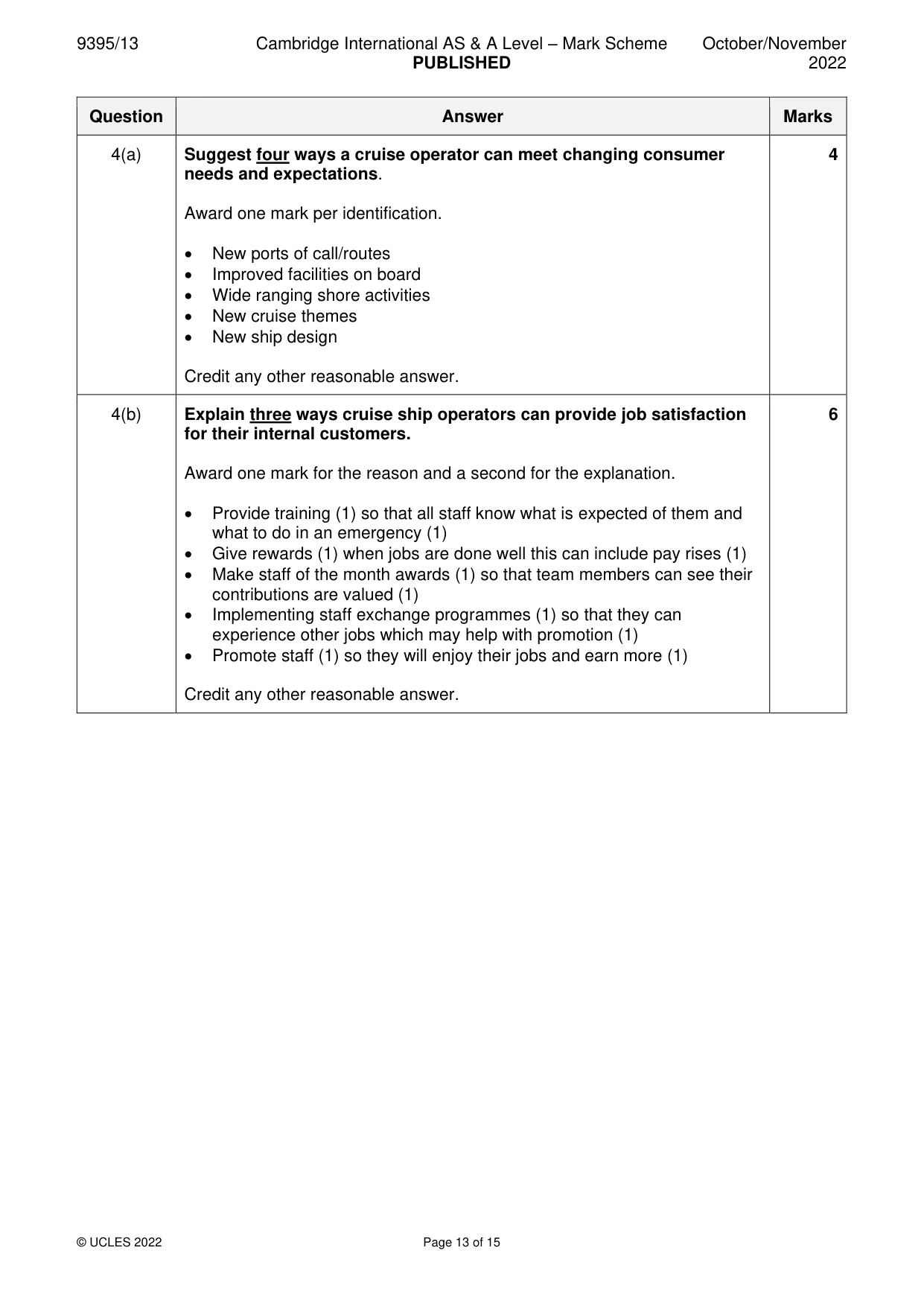
9395/13 Cambridge International AS & A Level – Mark Scheme PUBLISHED October/November 2022 © UCLES 2022 Page 13 of 15 Question Answer Marks 4(a) Suggest four ways a cruise operator can meet changing consumer needs and expectations. Award one mark per identification. • New ports of call/routes • Improved facilities on board • Wide ranging shore activities • New cruise themes • New ship design Credit any other reasonable answer. 4 4(b) Explain three ways cruise ship operators can provide job satisfaction for their internal customers. Award one mark for the reason and a second for the explanation. • Provide training (1) so that all staff know what is expected of them and what to do in an emergency (1) • Give rewards (1) when jobs are done well this can include pay rises (1) • Make staff of the month awards (1) so that team members can see their contributions are valued (1) • Implementing staff exchange programmes (1) so that they can experience other jobs which may help with promotion (1) • Promote staff (1) so they will enjoy their jobs and earn more (1) Credit any other reasonable answer. 6
Mark scheme, page 14
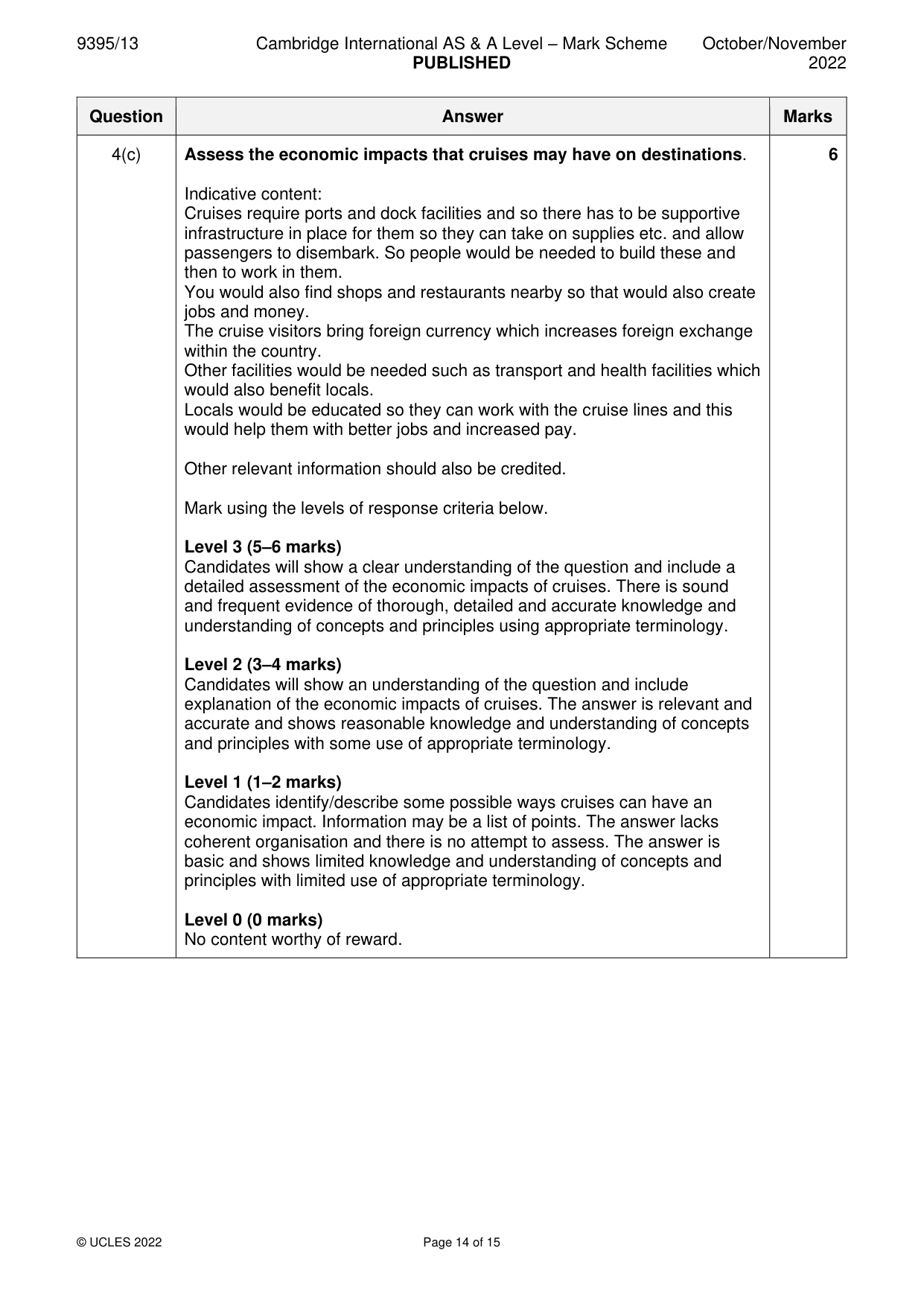
9395/13 Cambridge International AS & A Level – Mark Scheme PUBLISHED October/November 2022 © UCLES 2022 Page 14 of 15 Question Answer Marks 4(c) Assess the economic impacts that cruises may have on destinations. Indicative content: Cruises require ports and dock facilities and so there has to be supportive infrastructure in place for them so they can take on supplies etc. and allow passengers to disembark. So people would be needed to build these and then to work in them. You would also find shops and restaurants nearby so that would also create jobs and money. The cruise visitors bring foreign currency which increases foreign exchange within the country. Other facilities would be needed such as transport and health facilities which would also benefit locals. Locals would be educated so they can work with the cruise lines and this would help them with better jobs and increased pay. Other relevant information should also be credited. Mark using the levels of response criteria below. Level 3 (5–6 marks) Candidates will show a clear understanding of the question and include a detailed assessment of the economic impacts of cruises. There is sound and frequent evidence of thorough, detailed and accurate knowledge and understanding of concepts and principles using appropriate terminology. Level 2 (3–4 marks) Candidates will show an understanding of the question and include explanation of the economic impacts of cruises. The answer is relevant and accurate and shows reasonable knowledge and understanding of concepts and principles with some use of appropriate terminology. Level 1 (1–2 marks) Candidates identify/describe some possible ways cruises can have an economic impact. Information may be a list of points. The answer lacks coherent organisation and there is no attempt to assess. The answer is basic and shows limited knowledge and understanding of concepts and principles with limited use of appropriate terminology. Level 0 (0 marks) No content worthy of reward. 6
Mark scheme, page 15
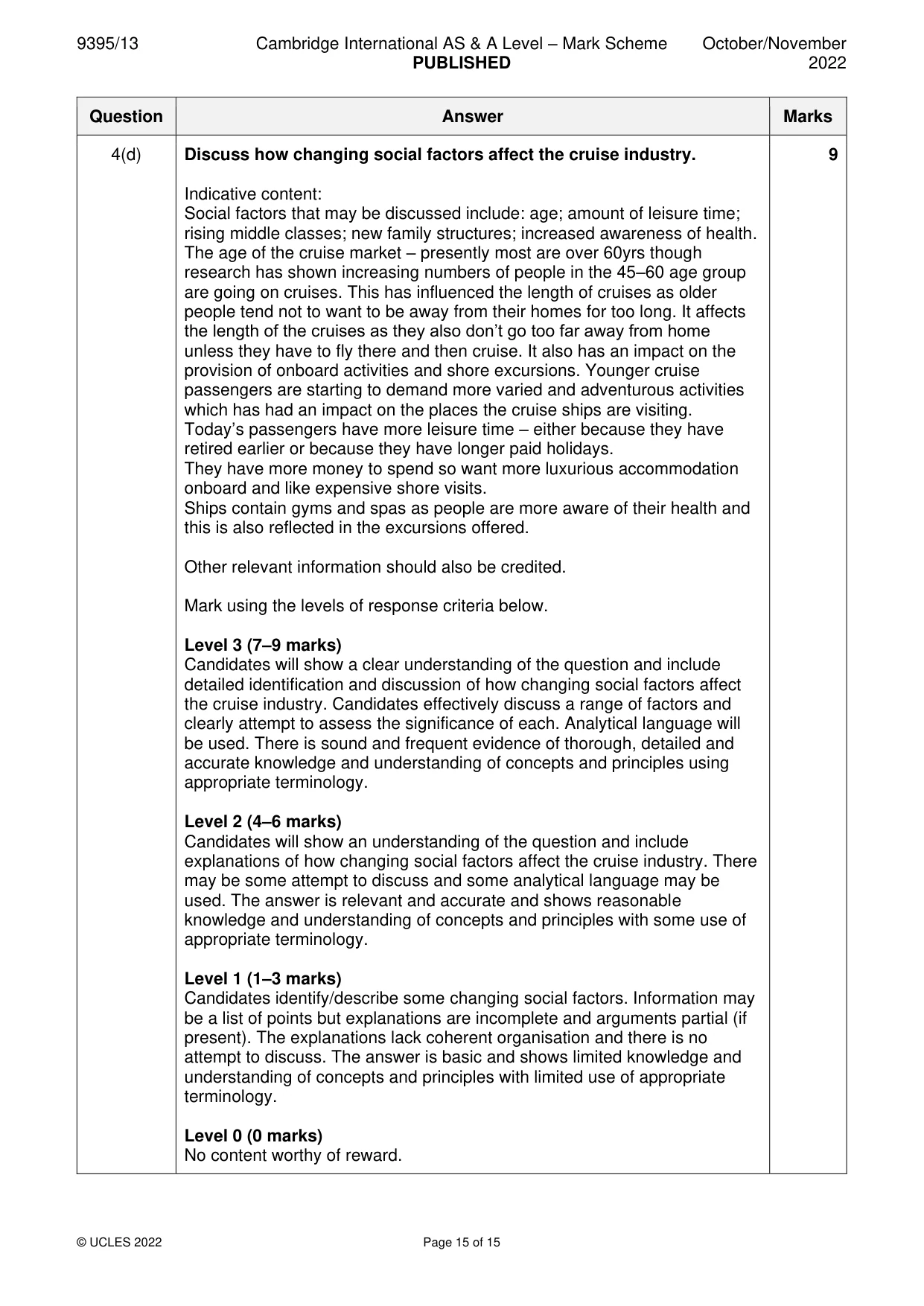
9395/13 Cambridge International AS & A Level – Mark Scheme PUBLISHED October/November 2022 © UCLES 2022 Page 15 of 15 Question Answer Marks 4(d) Discuss how changing social factors affect the cruise industry. Indicative content: Social factors that may be discussed include: age; amount of leisure time; rising middle classes; new family structures; increased awareness of health. The age of the cruise market – presently most are over 60yrs though research has shown increasing numbers of people in the 45–60 age group are going on cruises. This has influenced the length of cruises as older people tend not to want to be away from their homes for too long. It affects the length of the cruises as they also don’t go too far away from home unless they have to fly there and then cruise. It also has an impact on the provision of onboard activities and shore excursions. Younger cruise passengers are starting to demand more varied and adventurous activities which has had an impact on the places the cruise ships are visiting. Today’s passengers have more leisure time – either because they have retired earlier or because they have longer paid holidays. They have more money to spend so want more luxurious accommodation onboard and like expensive shore visits. Ships contain gyms and spas as people are more aware of their health and this is also reflected in the excursions offered. Other relevant information should also be credited. Mark using the levels of response criteria below. Level 3 (7–9 marks) Candidates will show a clear understanding of the question and include detailed identification and discussion of how changing social factors affect the cruise industry. Candidates effectively discuss a range of factors and clearly attempt to assess the significance of each. Analytical language will be used. There is sound and frequent evidence of thorough, detailed and accurate knowledge and understanding of concepts and principles using appropriate terminology. Level 2 (4–6 marks) Candidates will show an understanding of the question and include explanations of how changing social factors affect the cruise industry. There may be some attempt to discuss and some analytical language may be used. The answer is relevant and accurate and shows reasonable knowledge and understanding of concepts and principles with some use of appropriate terminology. Level 1 (1–3 marks) Candidates identify/describe some changing social factors. Information may be a list of points but explanations are incomplete and arguments partial (if present). The explanations lack coherent organisation and there is no attempt to discuss. The answer is basic and shows limited knowledge and understanding of concepts and principles with limited use of appropriate terminology. Level 0 (0 marks) No content worthy of reward. 9
What you needed in this session
Cambridge’s own grade thresholds for 2022 Oct/Nov, Paper 1 · Variant 3. A higher threshold means an easier paper — the bar moves with how the cohort did.