Cambridge A Level Travel and Tourism 9395 — 2022 May/June Paper 4 · Variant 3
9395/43/M/J/22 · 50 marks · ≈56 min
The question paper and its mark scheme, free to read here and free to download. This is Cambridge’s own paper, exactly as it was sat.
Question paper12 pages






Mark scheme10 pages
Answers below. Sit the paper first if you are practising.
Paper as text
Question paper, page 1
This document has 12 pages. Any blank pages are indicated. [Turn over Cambridge International AS & A Level DC (KN) 305428 © UCLES 2022 * 9 8 1 9 8 8 6 6 1 8 * TRAVEL & TOURISM 9395/43 Paper 4 Destination Management May/June 2022 1 hour 30 minutes You must answer on the question paper. You will need: Insert (enclosed) INSTRUCTIONS ● Answer all questions. ● Use a black or dark blue pen. ● Write your name, centre number and candidate number in the boxes at the top of the page. ● Write your answer to each question in the space provided. ● Do not use an erasable pen or correction fluid. ● Do not write on any bar codes. INFORMATION ● The total mark for this paper is 50. ● The number of marks for each question or part question is shown in brackets [ ]. ● The insert contains all the figures referred to in the questions.
Question paper, page 2
2 9395/43/M/J/22 © UCLES 2022 1 Refer to Fig. 1.1 (Insert), information about South Africa. (a) Explain two ways South African Tourism could minimise economic leakage. 1 … … … … 2 … … … … [4] (b) Assess the benefits for South African Tourism of working in partnership with NGOs and commercial organisations. … … … … … … … … … … … … … … … …
Question paper, page 3
3 9395/43/M/J/22 © UCLES 2022 [Turn over … … … … … … … … … … … … … … … … … … … … … … … … … … … … [9]
Question paper, page 4
4 9395/43/M/J/22 © UCLES 2022 (c) Discuss the reasons why mass tourism may cause conflicts with conservation efforts. … … … … … … … … … … … … … … … … … … … … … … … … … … …
Question paper, page 5
5 9395/43/M/J/22 © UCLES 2022 [Turn over … … … … … … … … … … … … … … … … … … … … … … … … … … … [12] [Total: 25]
Question paper, page 6
6 9395/43/M/J/22 © UCLES 2022 2 Refer to Fig. 2.1 (Insert), information about Aruba, an island in the Caribbean Sea. (a) Explain two political objectives of tourism development in Aruba. 1 … … … … 2 … … … … [4] (b) Assess the possible risks to Aruba of being over-dependent on tourism. … … … … … … … … … … … … … … … … …
Question paper, page 7
7 9395/43/M/J/22 © UCLES 2022 [Turn over … … … … … … … … … … … … … … … … … … … … … … … … … … … … [9]
Question paper, page 8
8 9395/43/M/J/22 © UCLES 2022 (c) Evaluate the likely sociocultural benefits of tourism development in island destinations such as Aruba. … … … … … … … … … … … … … … … … … … … … … … … … … … …
Question paper, page 9
9 9395/43/M/J/22 © UCLES 2022 … … … … … … … … … … … … … … … … … … … … … … … … … … … [12] [Total: 25]
Question paper, page 10
10 9395/43/M/J/22 © UCLES 2022 BLANK PAGE
Question paper, page 11
11 9395/43/M/J/22 © UCLES 2022 BLANK PAGE
Question paper, page 12
12 9395/43/M/J/22 © UCLES 2022 The boundaries and names shown, the designations used and the presentation of material on any maps contained in this question paper/insert do not imply official endorsement or acceptance by Cambridge Assessment International Education concerning the legal status of any country, territory, or area or any of its authorities, or of the delimitation of its frontiers or boundaries. Permission to reproduce items where third-party owned material protected by copyright is included has been sought and cleared where possible. Every reasonable effort has been made by the publisher (UCLES) to trace copyright holders, but if any items requiring clearance have unwittingly been included, the publisher will be pleased to make amends at the earliest possible opportunity. To avoid the issue of disclosure of answer-related information to candidates, all copyright acknowledgements are reproduced online in the Cambridge Assessment International Education Copyright Acknowledgements Booklet. This is produced for each series of examinations and is freely available to download at www.cambridgeinternational.org after the live examination series. Cambridge Assessment International Education is part of Cambridge Assessment. Cambridge Assessment is the brand name of the University of Cambridge Local Examinations Syndicate (UCLES), which is a department of the University of Cambridge. BLANK PAGE
Mark scheme, page 1
This document consists of 10 printed pages. © UCLES 2022 [Turn over Cambridge International A Level TRAVEL AND TOURISM 9395/43 Paper 4 Destination Management May/June 2022 MARK SCHEME Maximum Mark: 50 Published This mark scheme is published as an aid to teachers and candidates, to indicate the requirements of the examination. It shows the basis on which Examiners were instructed to award marks. It does not indicate the details of the discussions that took place at an Examiners’ meeting before marking began, which would have considered the acceptability of alternative answers. Mark schemes should be read in conjunction with the question paper and the Principal Examiner Report for Teachers. Cambridge International will not enter into discussions about these mark schemes. Cambridge International is publishing the mark schemes for the May/June 2022 series for most Cambridge IGCSE, Cambridge International A and AS Level and Cambridge Pre-U components, and some Cambridge O Level components.
Mark scheme, page 2
9395/43 Cambridge International A Level – Mark Scheme PUBLISHED May/June 2022 © UCLES 2022 Page 2 of 10 Generic Marking Principles These general marking principles must be applied by all examiners when marking candidate answers. They should be applied alongside the specific content of the mark scheme or generic level descriptors for a question. Each question paper and mark scheme will also comply with these marking principles. GENERIC MARKING PRINCIPLE 1: Marks must be awarded in line with: the specific content of the mark scheme or the generic level descriptors for the question the specific skills defined in the mark scheme or in the generic level descriptors for the question the standard of response required by a candidate as exemplified by the standardisation scripts. GENERIC MARKING PRINCIPLE 2: Marks awarded are always whole marks (not half marks, or other fractions). GENERIC MARKING PRINCIPLE 3: Marks must be awarded positively: marks are awarded for correct/valid answers, as defined in the mark scheme. However, credit is given for valid answers which go beyond the scope of the syllabus and mark scheme, referring to your Team Leader as appropriate marks are awarded when candidates clearly demonstrate what they know and can do marks are not deducted for errors marks are not deducted for omissions answers should only be judged on the quality of spelling, punctuation and grammar when these features are specifically assessed by the question as indicated by the mark scheme. The meaning, however, should be unambiguous. GENERIC MARKING PRINCIPLE 4: Rules must be applied consistently, e.g. in situations where candidates have not followed instructions or in the application of generic level descriptors. GENERIC MARKING PRINCIPLE 5: Marks should be awarded using the full range of marks defined in the mark scheme for the question (however; the use of the full mark range may be limited according to the quality of the candidate responses seen). GENERIC MARKING PRINCIPLE 6: Marks awarded are based solely on the requirements as defined in the mark scheme. Marks should not be awarded with grade thresholds or grade descriptors in mind.
Mark scheme, page 3
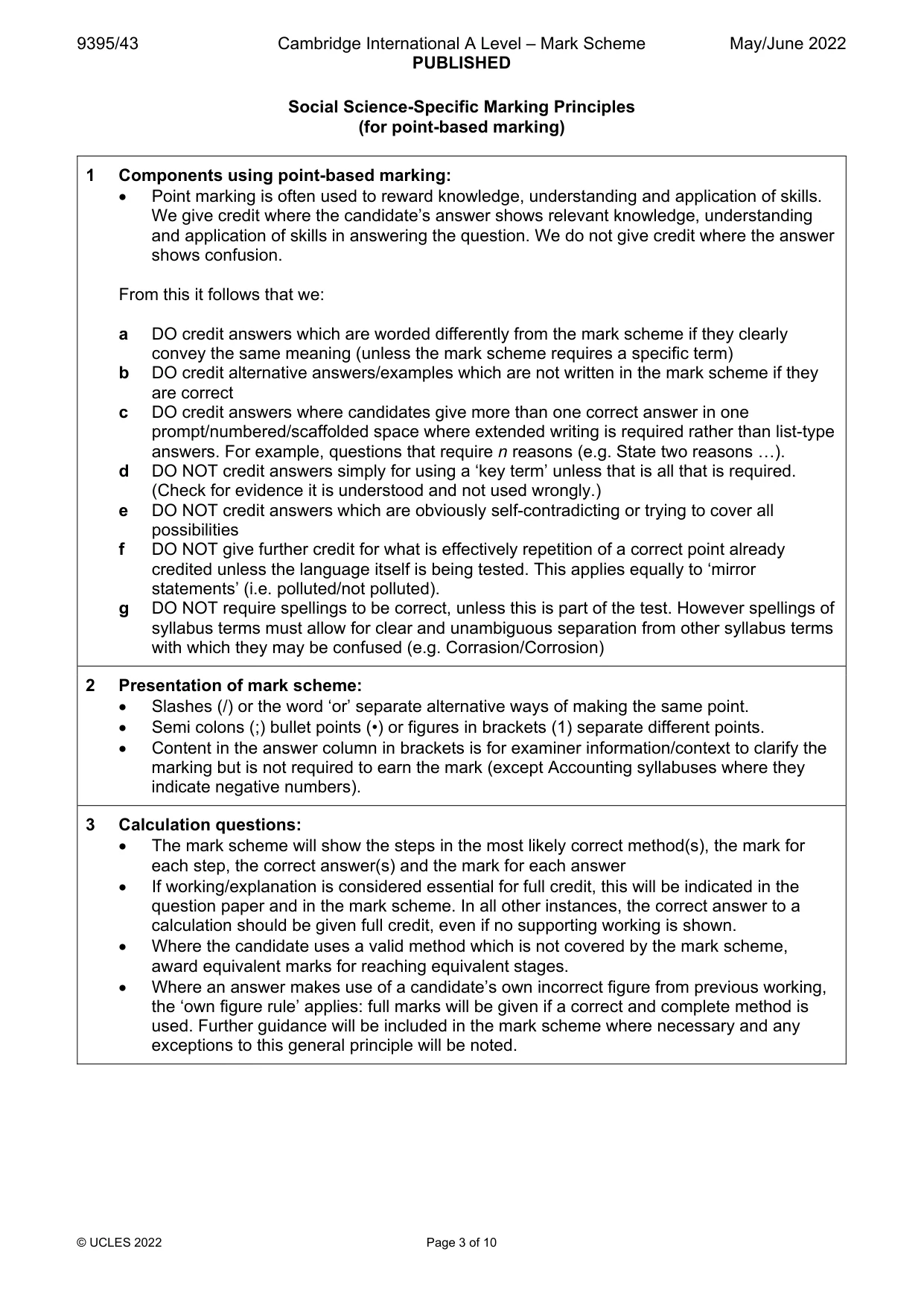
9395/43 Cambridge International A Level – Mark Scheme PUBLISHED May/June 2022 © UCLES 2022 Page 3 of 10 Social Science-Specific Marking Principles (for point-based marking) 1 Components using point-based marking: Point marking is often used to reward knowledge, understanding and application of skills. We give credit where the candidate’s answer shows relevant knowledge, understanding and application of skills in answering the question. We do not give credit where the answer shows confusion. From this it follows that we: a DO credit answers which are worded differently from the mark scheme if they clearly convey the same meaning (unless the mark scheme requires a specific term) b DO credit alternative answers/examples which are not written in the mark scheme if they are correct c DO credit answers where candidates give more than one correct answer in one prompt/numbered/scaffolded space where extended writing is required rather than list-type answers. For example, questions that require n reasons (e.g. State two reasons …). d DO NOT credit answers simply for using a ‘key term’ unless that is all that is required. (Check for evidence it is understood and not used wrongly.) e DO NOT credit answers which are obviously self-contradicting or trying to cover all possibilities f DO NOT give further credit for what is effectively repetition of a correct point already credited unless the language itself is being tested. This applies equally to ‘mirror statements’ (i.e. polluted/not polluted). g DO NOT require spellings to be correct, unless this is part of the test. However spellings of syllabus terms must allow for clear and unambiguous separation from other syllabus terms with which they may be confused (e.g. Corrasion/Corrosion) 2 Presentation of mark scheme: Slashes (/) or the word ‘or’ separate alternative ways of making the same point. Semi colons (;) bullet points (•) or figures in brackets (1) separate different points. Content in the answer column in brackets is for examiner information/context to clarify the marking but is not required to earn the mark (except Accounting syllabuses where they indicate negative numbers). 3 Calculation questions: The mark scheme will show the steps in the most likely correct method(s), the mark for each step, the correct answer(s) and the mark for each answer If working/explanation is considered essential for full credit, this will be indicated in the question paper and in the mark scheme. In all other instances, the correct answer to a calculation should be given full credit, even if no supporting working is shown. Where the candidate uses a valid method which is not covered by the mark scheme, award equivalent marks for reaching equivalent stages. Where an answer makes use of a candidate’s own incorrect figure from previous working, the ‘own figure rule’ applies: full marks will be given if a correct and complete method is used. Further guidance will be included in the mark scheme where necessary and any exceptions to this general principle will be noted.
Mark scheme, page 4
9395/43 Cambridge International A Level – Mark Scheme PUBLISHED May/June 2022 © UCLES 2022 Page 4 of 10 4 Annotation: For point marking, ticks can be used to indicate correct answers and crosses can be used to indicate wrong answers. There is no direct relationship between ticks and marks. Ticks have no defined meaning for levels of response marking. For levels of response marking, the level awarded should be annotated on the script. Other annotations will be used by examiners as agreed during standardisation, and the meaning will be understood by all examiners who marked that paper.
Mark scheme, page 5
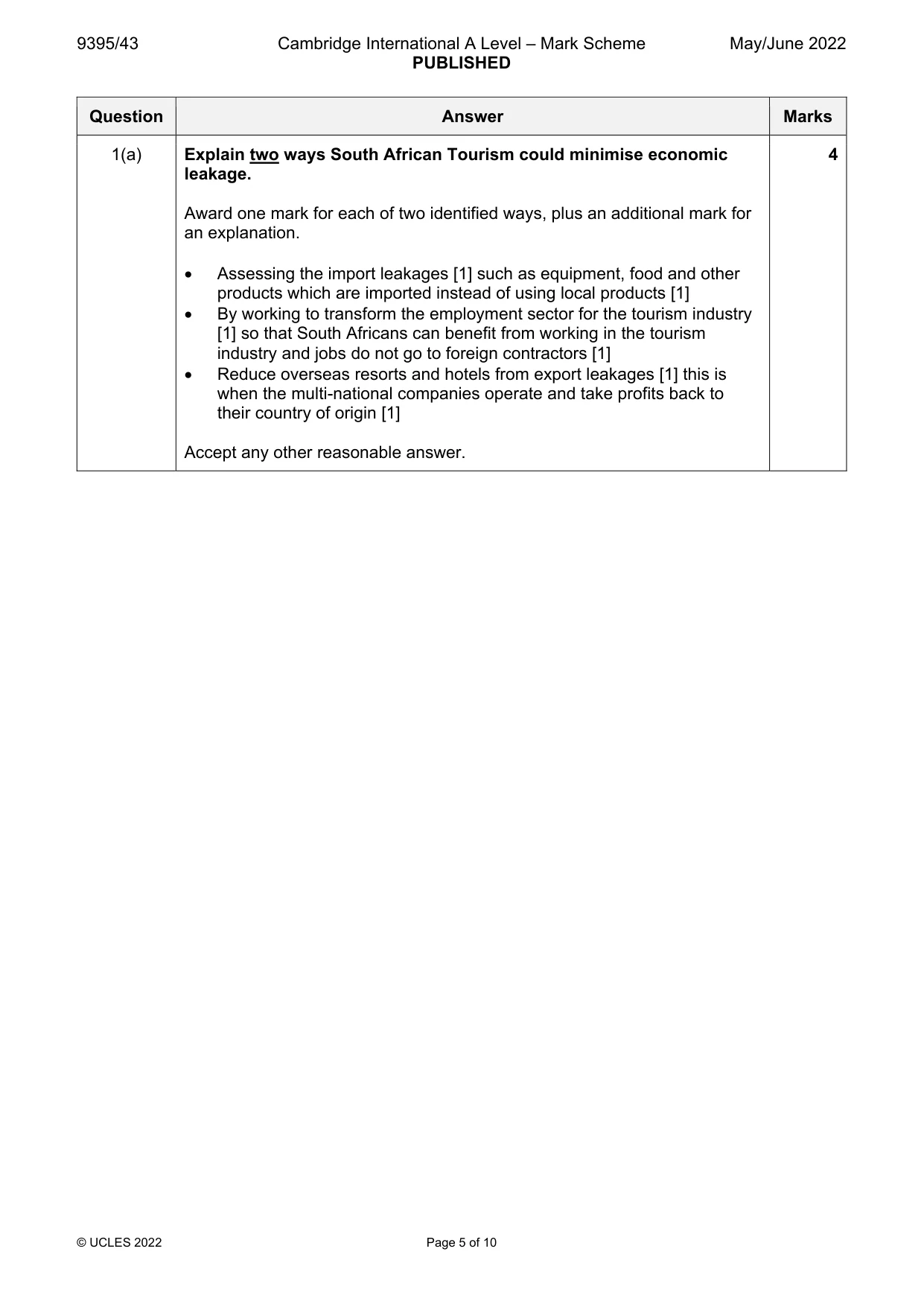
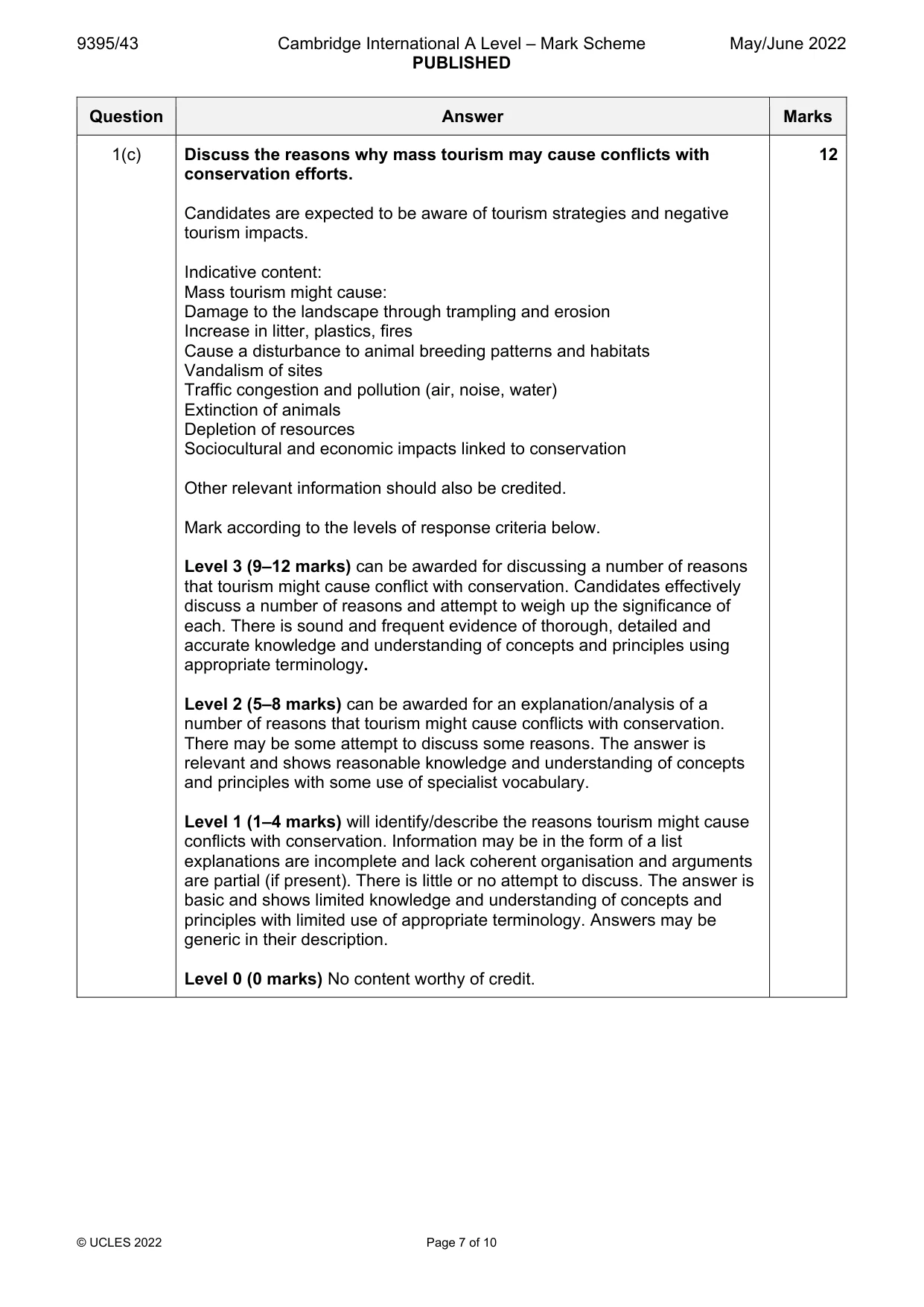
9395/43 Cambridge International A Level – Mark Scheme PUBLISHED May/June 2022 © UCLES 2022 Page 5 of 10 Question Answer Marks 1(a) Explain two ways South African Tourism could minimise economic leakage. Award one mark for each of two identified ways, plus an additional mark for an explanation. Assessing the import leakages [1] such as equipment, food and other products which are imported instead of using local products [1] By working to transform the employment sector for the tourism industry [1] so that South Africans can benefit from working in the tourism industry and jobs do not go to foreign contractors [1] Reduce overseas resorts and hotels from export leakages [1] this is when the multi-national companies operate and take profits back to their country of origin [1] Accept any other reasonable answer. 4
Mark scheme, page 6
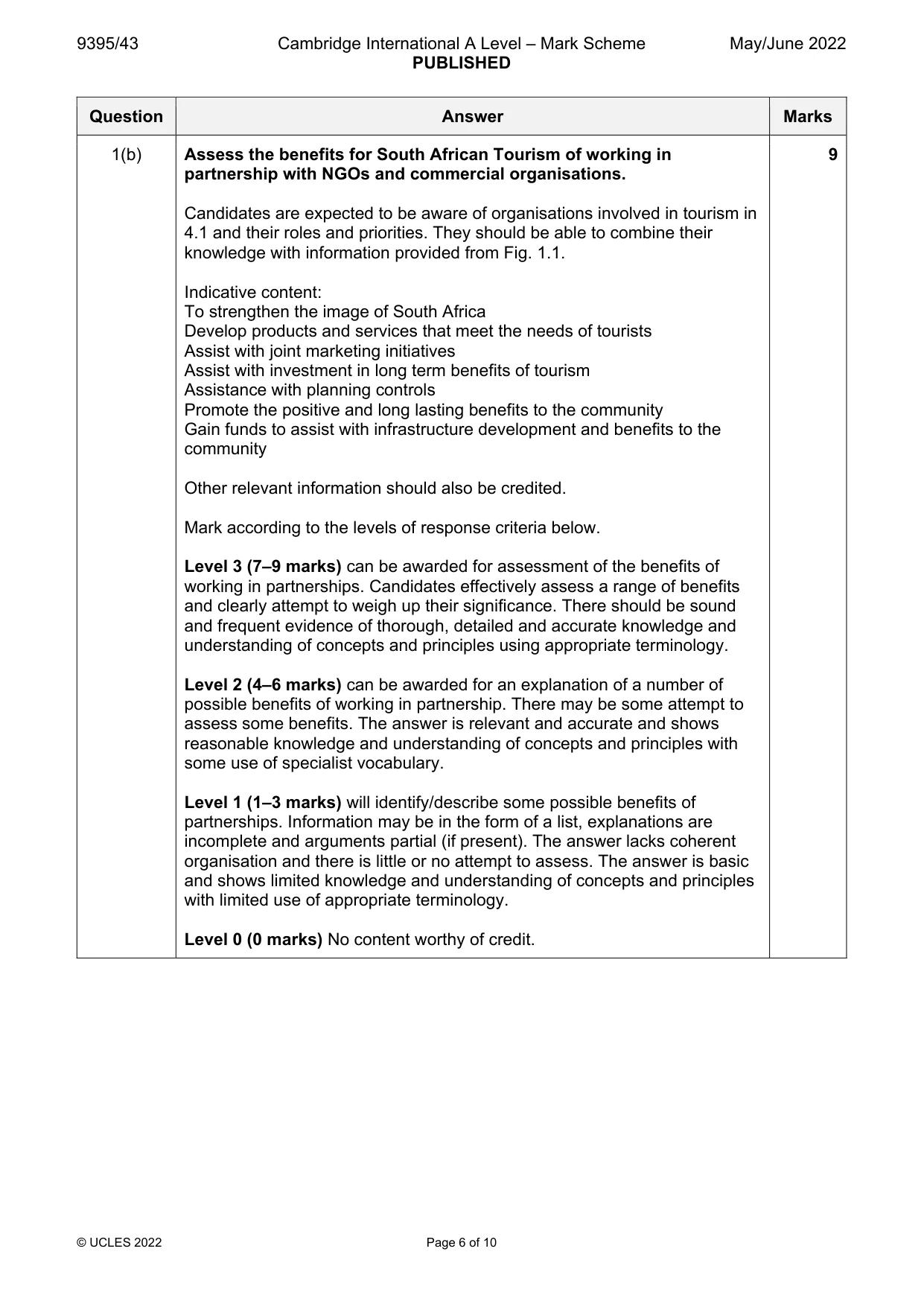
9395/43 Cambridge International A Level – Mark Scheme PUBLISHED May/June 2022 © UCLES 2022 Page 6 of 10 Question Answer Marks 1(b) Assess the benefits for South African Tourism of working in partnership with NGOs and commercial organisations. Candidates are expected to be aware of organisations involved in tourism in 4.1 and their roles and priorities. They should be able to combine their knowledge with information provided from Fig. 1.1. Indicative content: To strengthen the image of South Africa Develop products and services that meet the needs of tourists Assist with joint marketing initiatives Assist with investment in long term benefits of tourism Assistance with planning controls Promote the positive and long lasting benefits to the community Gain funds to assist with infrastructure development and benefits to the community Other relevant information should also be credited. Mark according to the levels of response criteria below. Level 3 (7–9 marks) can be awarded for assessment of the benefits of working in partnerships. Candidates effectively assess a range of benefits and clearly attempt to weigh up their significance. There should be sound and frequent evidence of thorough, detailed and accurate knowledge and understanding of concepts and principles using appropriate terminology. Level 2 (4–6 marks) can be awarded for an explanation of a number of possible benefits of working in partnership. There may be some attempt to assess some benefits. The answer is relevant and accurate and shows reasonable knowledge and understanding of concepts and principles with some use of specialist vocabulary. Level 1 (1–3 marks) will identify/describe some possible benefits of partnerships. Information may be in the form of a list, explanations are incomplete and arguments partial (if present). The answer lacks coherent organisation and there is little or no attempt to assess. The answer is basic and shows limited knowledge and understanding of concepts and principles with limited use of appropriate terminology. Level 0 (0 marks) No content worthy of credit. 9
Mark scheme, page 7
9395/43 Cambridge International A Level – Mark Scheme PUBLISHED May/June 2022 © UCLES 2022 Page 7 of 10 Question Answer Marks 1(c) Discuss the reasons why mass tourism may cause conflicts with conservation efforts. Candidates are expected to be aware of tourism strategies and negative tourism impacts. Indicative content: Mass tourism might cause: Damage to the landscape through trampling and erosion Increase in litter, plastics, fires Cause a disturbance to animal breeding patterns and habitats Vandalism of sites Traffic congestion and pollution (air, noise, water) Extinction of animals Depletion of resources Sociocultural and economic impacts linked to conservation Other relevant information should also be credited. Mark according to the levels of response criteria below. Level 3 (9–12 marks) can be awarded for discussing a number of reasons that tourism might cause conflict with conservation. Candidates effectively discuss a number of reasons and attempt to weigh up the significance of each. There is sound and frequent evidence of thorough, detailed and accurate knowledge and understanding of concepts and principles using appropriate terminology. Level 2 (5–8 marks) can be awarded for an explanation/analysis of a number of reasons that tourism might cause conflicts with conservation. There may be some attempt to discuss some reasons. The answer is relevant and shows reasonable knowledge and understanding of concepts and principles with some use of specialist vocabulary. Level 1 (1–4 marks) will identify/describe the reasons tourism might cause conflicts with conservation. Information may be in the form of a list explanations are incomplete and lack coherent organisation and arguments are partial (if present). There is little or no attempt to discuss. The answer is basic and shows limited knowledge and understanding of concepts and principles with limited use of appropriate terminology. Answers may be generic in their description. Level 0 (0 marks) No content worthy of credit. 12
Mark scheme, page 8
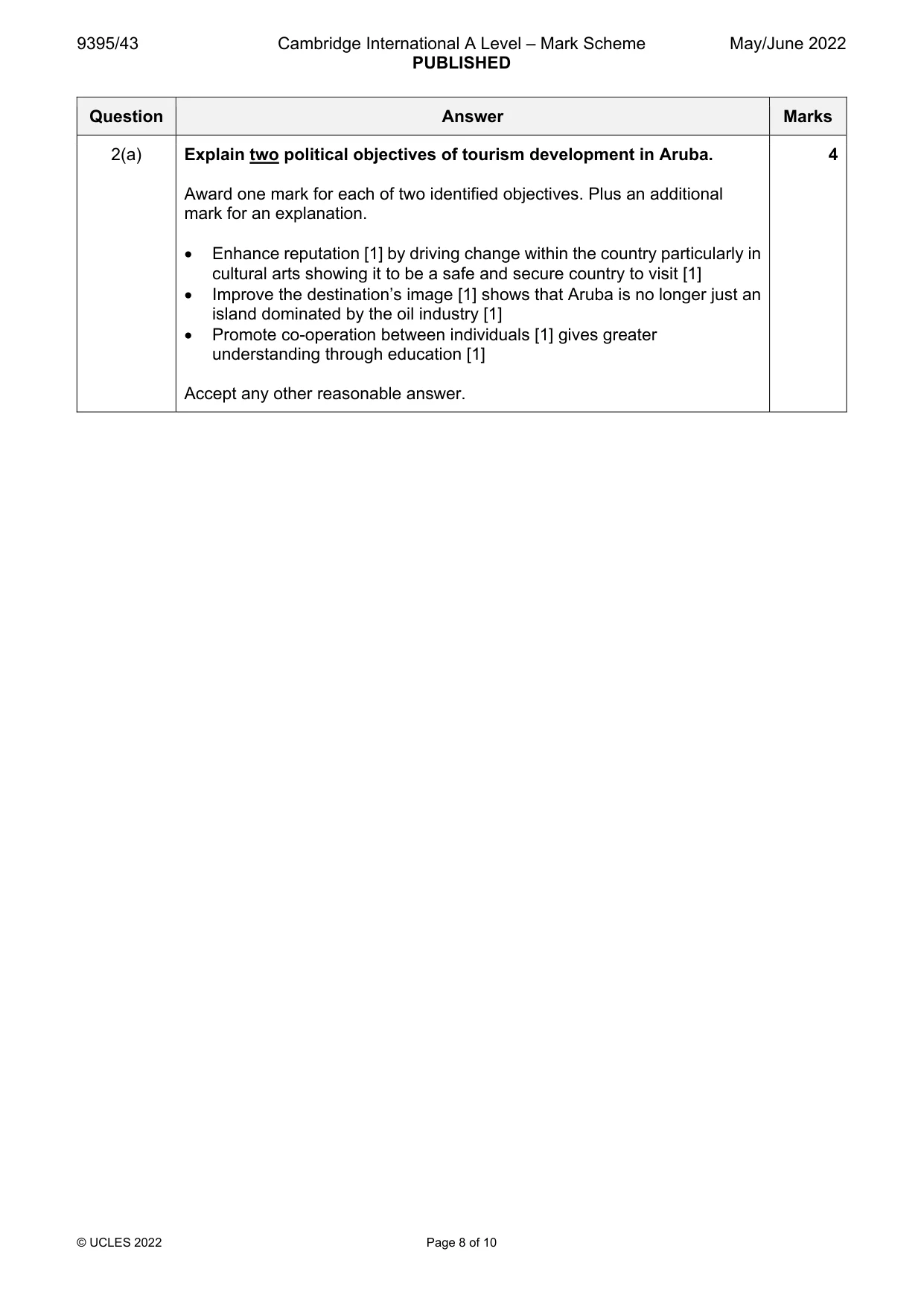
9395/43 Cambridge International A Level – Mark Scheme PUBLISHED May/June 2022 © UCLES 2022 Page 8 of 10 Question Answer Marks 2(a) Explain two political objectives of tourism development in Aruba. Award one mark for each of two identified objectives. Plus an additional mark for an explanation. Enhance reputation [1] by driving change within the country particularly in cultural arts showing it to be a safe and secure country to visit [1] Improve the destination’s image [1] shows that Aruba is no longer just an island dominated by the oil industry [1] Promote co-operation between individuals [1] gives greater understanding through education [1] Accept any other reasonable answer. 4
Mark scheme, page 9
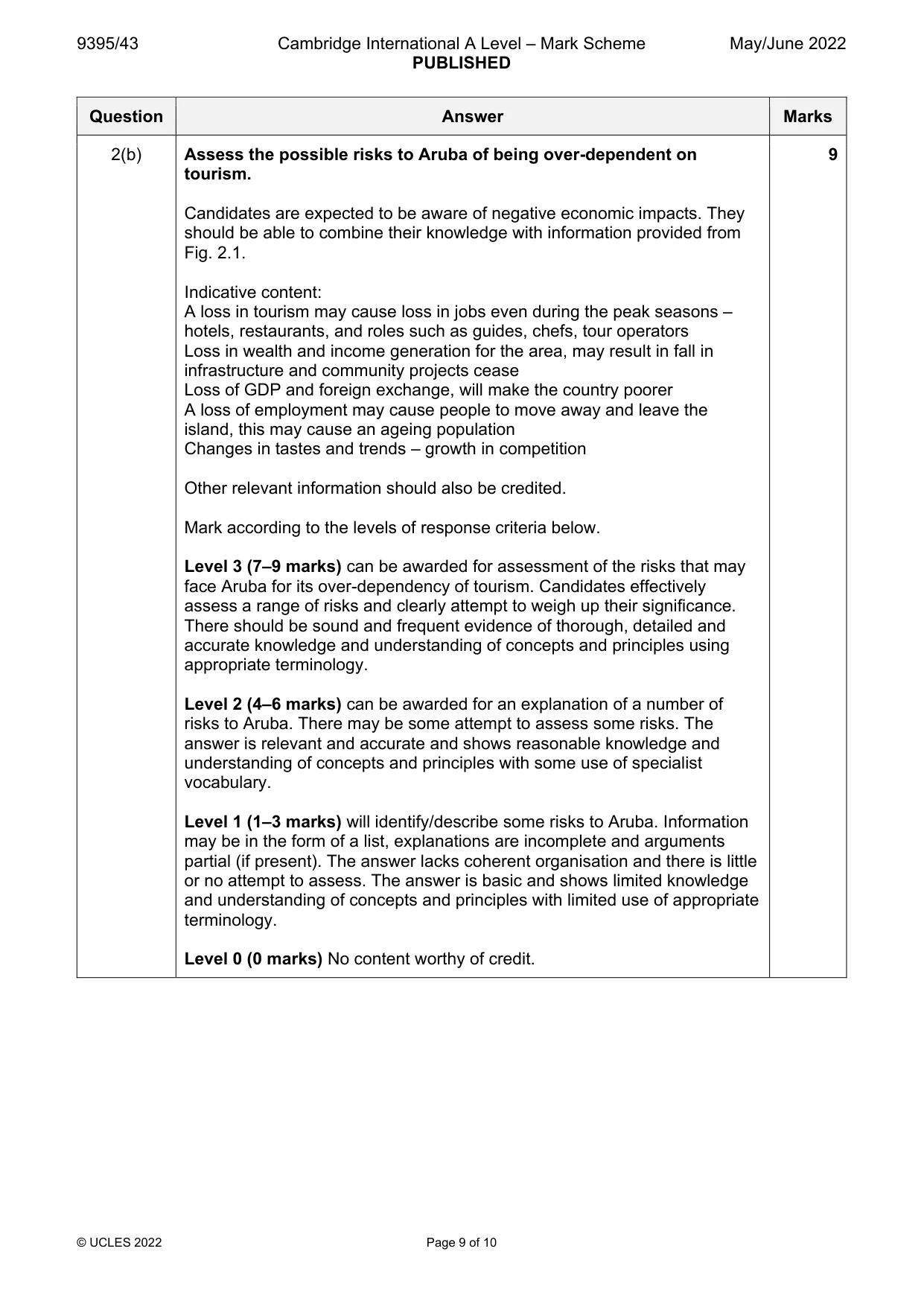
9395/43 Cambridge International A Level – Mark Scheme PUBLISHED May/June 2022 © UCLES 2022 Page 9 of 10 Question Answer Marks 2(b) Assess the possible risks to Aruba of being over-dependent on tourism. Candidates are expected to be aware of negative economic impacts. They should be able to combine their knowledge with information provided from Fig. 2.1. Indicative content: A loss in tourism may cause loss in jobs even during the peak seasons – hotels, restaurants, and roles such as guides, chefs, tour operators Loss in wealth and income generation for the area, may result in fall in infrastructure and community projects cease Loss of GDP and foreign exchange, will make the country poorer A loss of employment may cause people to move away and leave the island, this may cause an ageing population Changes in tastes and trends – growth in competition Other relevant information should also be credited. Mark according to the levels of response criteria below. Level 3 (7–9 marks) can be awarded for assessment of the risks that may face Aruba for its over-dependency of tourism. Candidates effectively assess a range of risks and clearly attempt to weigh up their significance. There should be sound and frequent evidence of thorough, detailed and accurate knowledge and understanding of concepts and principles using appropriate terminology. Level 2 (4–6 marks) can be awarded for an explanation of a number of risks to Aruba. There may be some attempt to assess some risks. The answer is relevant and accurate and shows reasonable knowledge and understanding of concepts and principles with some use of specialist vocabulary. Level 1 (1–3 marks) will identify/describe some risks to Aruba. Information may be in the form of a list, explanations are incomplete and arguments partial (if present). The answer lacks coherent organisation and there is little or no attempt to assess. The answer is basic and shows limited knowledge and understanding of concepts and principles with limited use of appropriate terminology. Level 0 (0 marks) No content worthy of credit. 9
Mark scheme, page 10
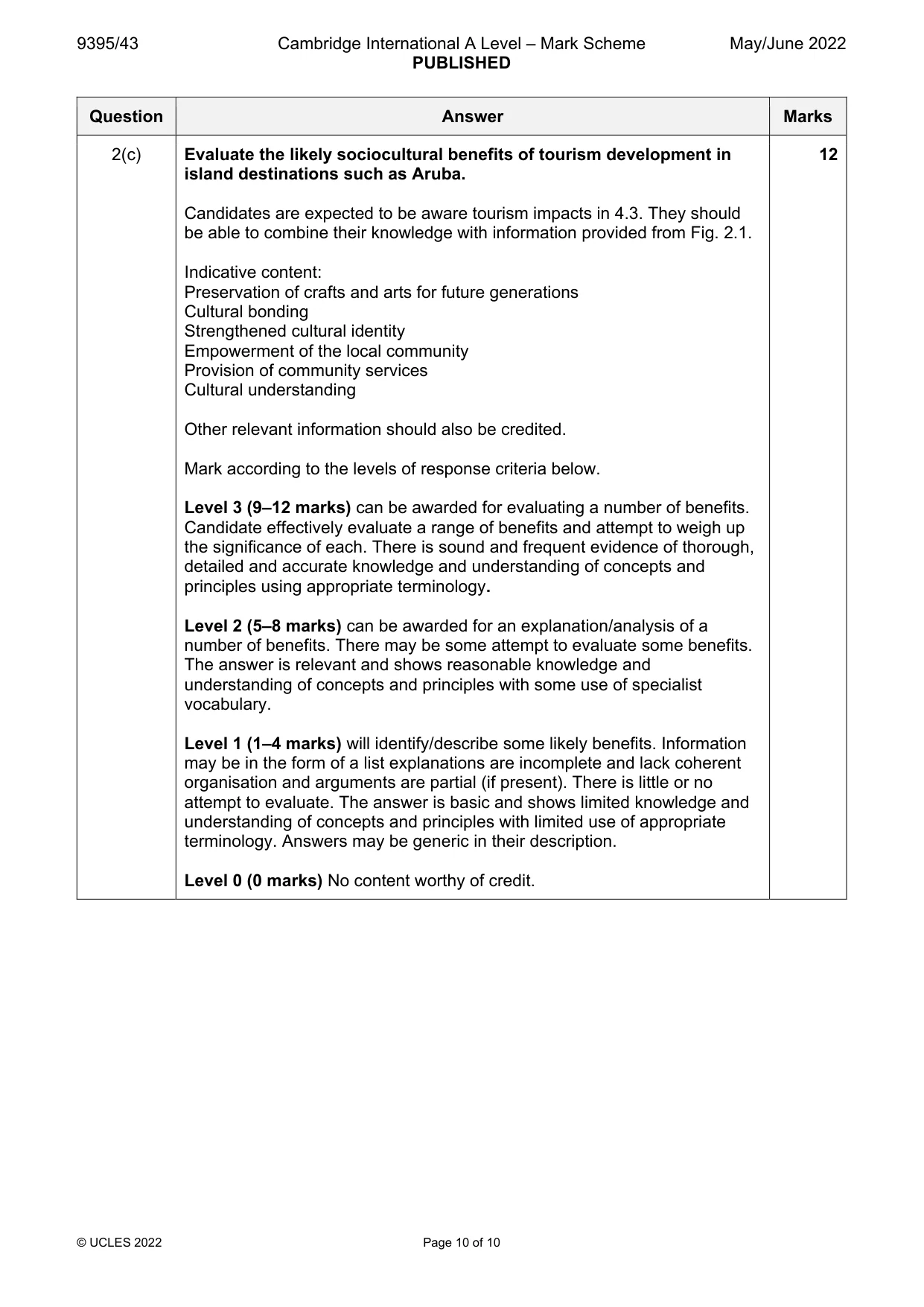
9395/43 Cambridge International A Level – Mark Scheme PUBLISHED May/June 2022 © UCLES 2022 Page 10 of 10 Question Answer Marks 2(c) Evaluate the likely sociocultural benefits of tourism development in island destinations such as Aruba. Candidates are expected to be aware tourism impacts in 4.3. They should be able to combine their knowledge with information provided from Fig. 2.1. Indicative content: Preservation of crafts and arts for future generations Cultural bonding Strengthened cultural identity Empowerment of the local community Provision of community services Cultural understanding Other relevant information should also be credited. Mark according to the levels of response criteria below. Level 3 (9–12 marks) can be awarded for evaluating a number of benefits. Candidate effectively evaluate a range of benefits and attempt to weigh up the significance of each. There is sound and frequent evidence of thorough, detailed and accurate knowledge and understanding of concepts and principles using appropriate terminology. Level 2 (5–8 marks) can be awarded for an explanation/analysis of a number of benefits. There may be some attempt to evaluate some benefits. The answer is relevant and shows reasonable knowledge and understanding of concepts and principles with some use of specialist vocabulary. Level 1 (1–4 marks) will identify/describe some likely benefits. Information may be in the form of a list explanations are incomplete and lack coherent organisation and arguments are partial (if present). There is little or no attempt to evaluate. The answer is basic and shows limited knowledge and understanding of concepts and principles with limited use of appropriate terminology. Answers may be generic in their description. Level 0 (0 marks) No content worthy of credit. 12
What you needed in this session
Cambridge’s own grade thresholds for 2022 May/June, Paper 4 · Variant 3. A higher threshold means an easier paper — the bar moves with how the cohort did.