Cambridge A Level Travel and Tourism 9395 — 2020 Oct/Nov Paper 1 · Variant 3
9395/13/O/N/20 · 100 marks · ≈113 min
The question paper and its mark scheme, free to read here and free to download. This is Cambridge’s own paper, exactly as it was sat.
Question paper16 pages



Mark scheme11 pages
Answers below. Sit the paper first if you are practising.
Paper as text
Question paper, page 1
Cambridge International AS & A Level * 5 1 2 4 1 6 8 7 2 0 * This document has 16 pages. Blank pages are indicated. DC (PQ) 179672/1 © UCLES 2020 [Turn over TRAVEL & TOURISM 9395/13 Paper 1 The Industry October/November 2020 2 hours 30 minutes You must answer on the question paper. You will need: Insert (enclosed) INSTRUCTIONS ● Answer all questions. ● Use a black or dark blue pen. ● Write your name, centre number and candidate number in the boxes at the top of the page. ● Write your answer to each question in the space provided. ● Do not use an erasable pen or correction fluid. ● Do not write on any bar codes. INFORMATION ● The total mark for this paper is 100. ● The number of marks for each question or part question is shown in brackets [ ]. ● The insert contains all the figures referred to in the questions.
Question paper, page 2
2 9395/13/O/N/20 © UCLES 2020 Question 1 Refer to Fig. 1.1 (Insert), photographs taken in the Seychelles, an island destination in the Indian Ocean. (a) Define, using an example, the following terms: climate change … … … … natural disaster … … … … [4] (b) Explain three ways climate change may impact on the Seychelles. 1 … … … … 2 … … … … 3 … … … … [6]
Question paper, page 3
3 9395/13/O/N/20 © UCLES 2020 [Turn over (c) Explain three ways the Seychelles may appeal to leisure tourists. 1 … … … … 2 … … … … 3 … … … … [6]
Question paper, page 4
4 9395/13/O/N/20 © UCLES 2020 (d) Discuss how the tourism industry in the Seychelles can be managed responsibly. … … … … … … … … … … … … … … … … … … [9] [Total: 25]
Question paper, page 5
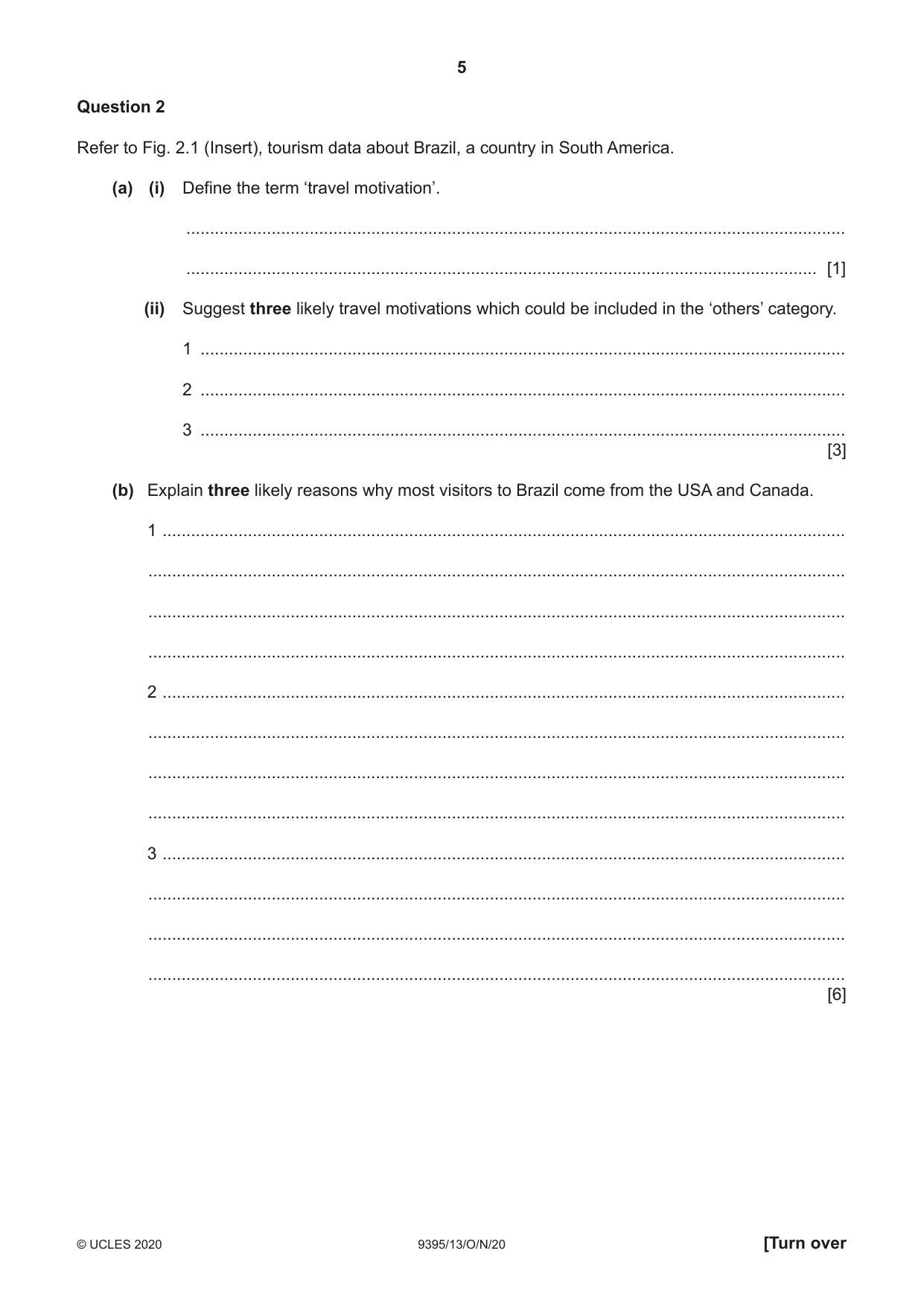
5 9395/13/O/N/20 © UCLES 2020 [Turn over Question 2 Refer to Fig. 2.1 (Insert), tourism data about Brazil, a country in South America. (a) (i) Define the term ‘travel motivation’. … … [1] (ii) Suggest three likely travel motivations which could be included in the ‘others’ category. 1 … 2 … 3 … [3] (b) Explain three likely reasons why most visitors to Brazil come from the USA and Canada. 1 … … … … 2 … … … … 3 … … … … [6]
Question paper, page 6
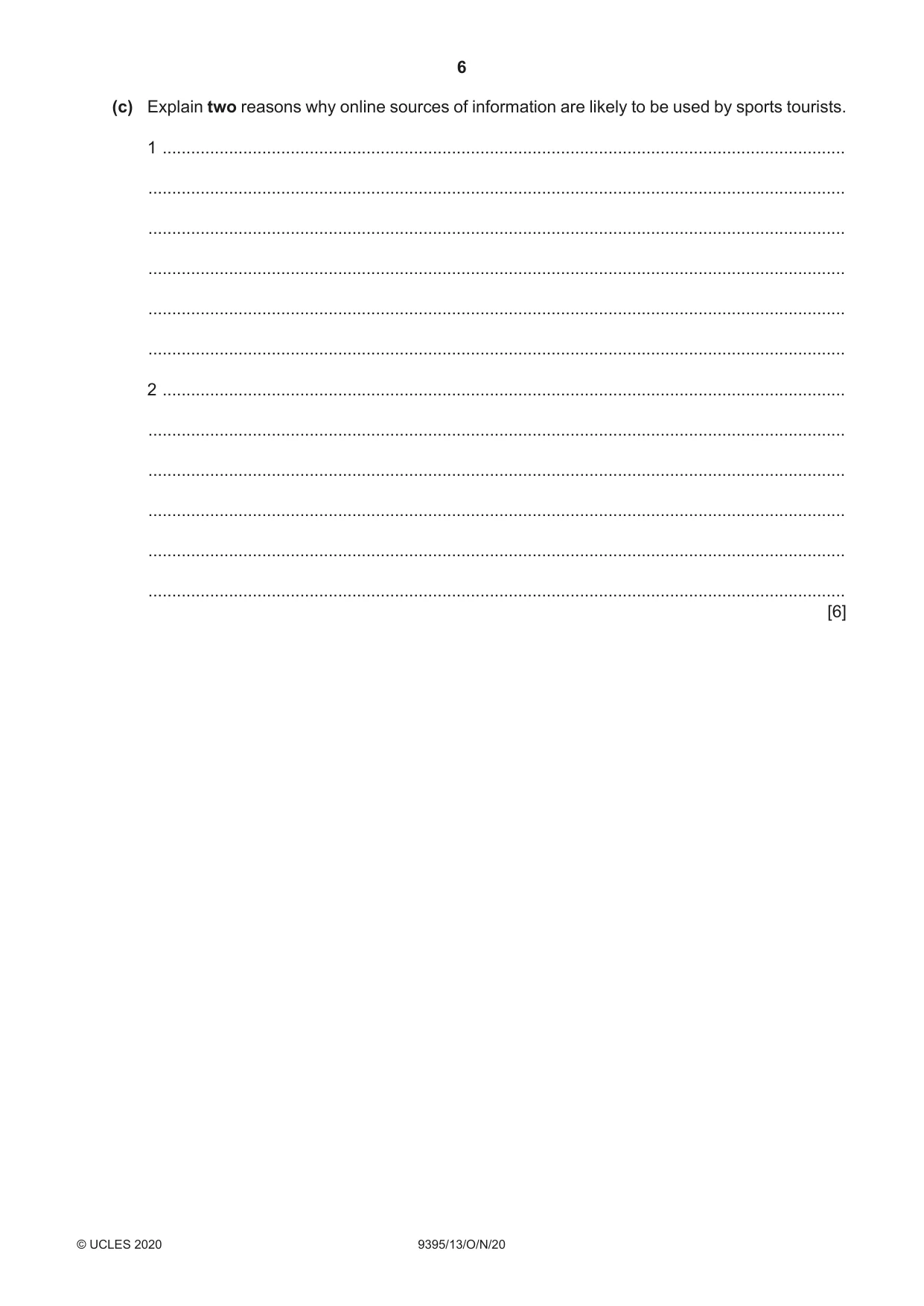
6 9395/13/O/N/20 © UCLES 2020 (c) Explain two reasons why online sources of information are likely to be used by sports tourists. 1 … … … … … … 2 … … … … … … [6]
Question paper, page 7
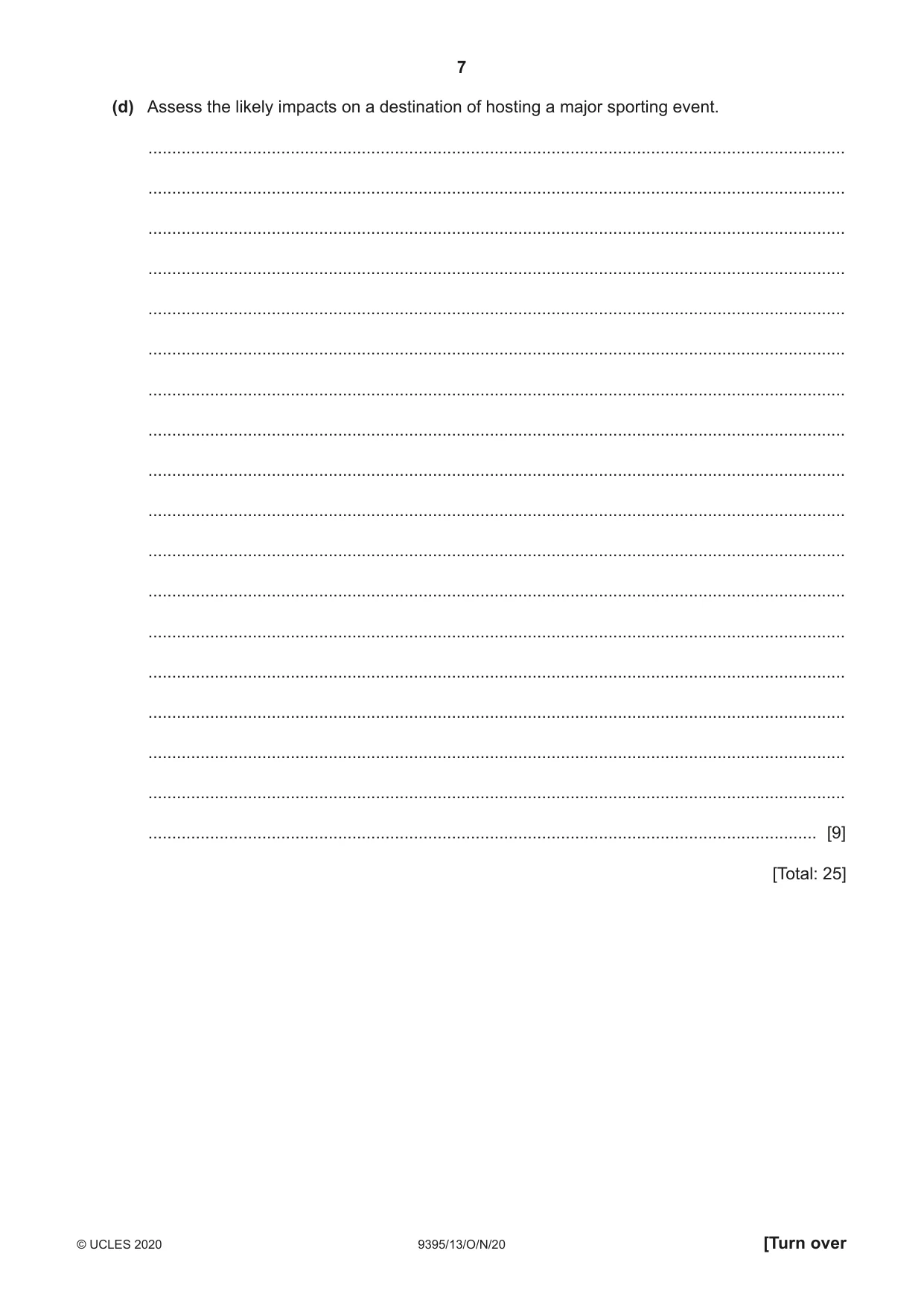
7 9395/13/O/N/20 © UCLES 2020 [Turn over (d) Assess the likely impacts on a destination of hosting a major sporting event. … … … … … … … … … … … … … … … … … … [9] [Total: 25]
Question paper, page 8
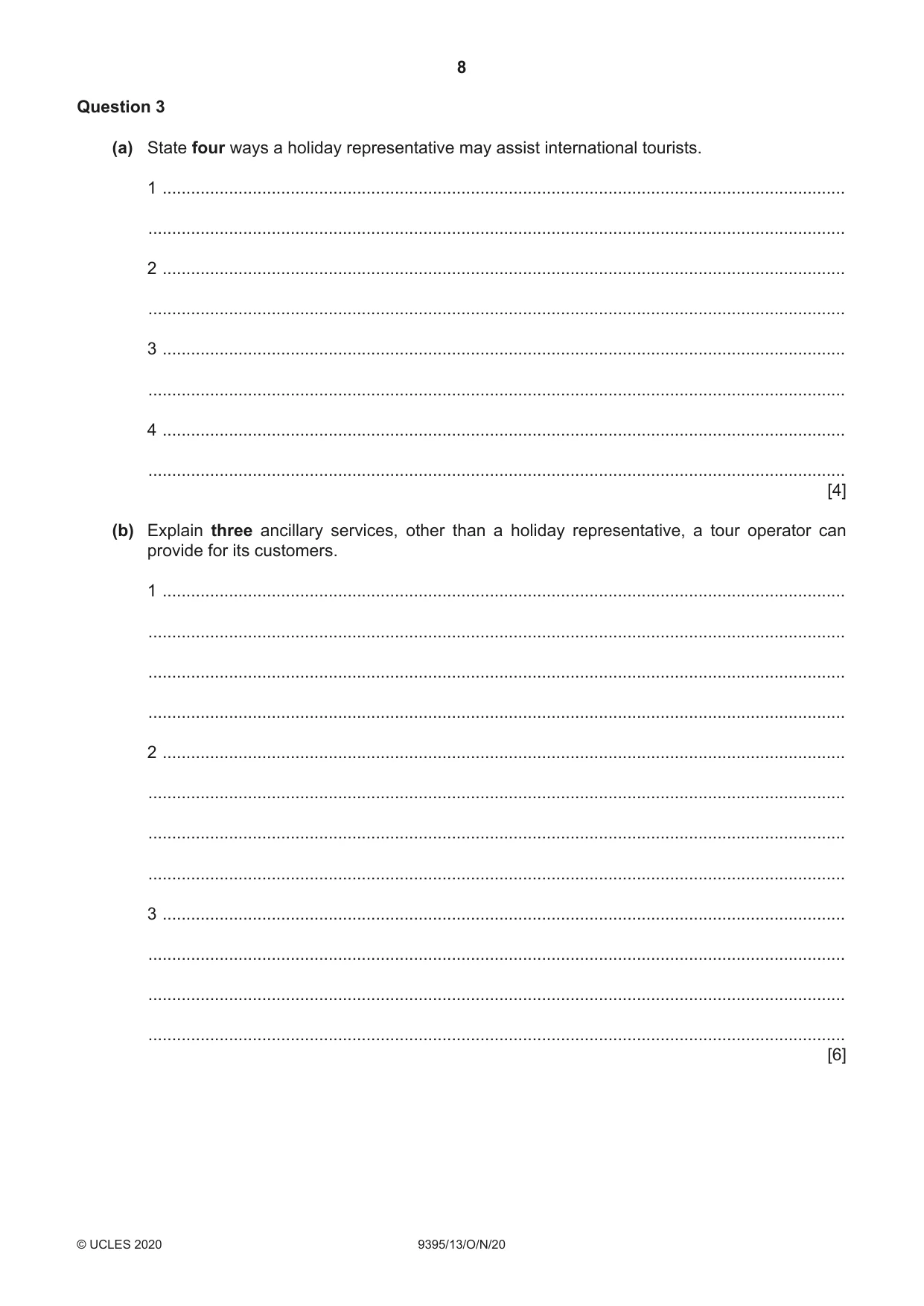
8 9395/13/O/N/20 © UCLES 2020 Question 3 (a) State four ways a holiday representative may assist international tourists. 1 … … 2 … … 3 … … 4 … … [4] (b) Explain three ancillary services, other than a holiday representative, a tour operator can provide for its customers. 1 … … … … 2 … … … … 3 … … … … [6]
Question paper, page 9
9 9395/13/O/N/20 © UCLES 2020 [Turn over (c) Explain two ways a hotel may deal with a complaint. 1 … … … … … … 2 … … … … … … [6]
Question paper, page 10
10 9395/13/O/N/20 © UCLES 2020 (d) Discuss how performance management can be used to influence the quality of customer service offered by a holiday representative. … … … … … … … … … … … … … … … … … … [9] [Total: 25]
Question paper, page 11
11 9395/13/O/N/20 © UCLES 2020 [Turn over Question 4 (a) Describe two ways a country may protect against the spread of disease. 1 … … … … 2 … … … … [4] (b) Explain three security measures that can be implemented within a visitor attraction. 1 … … … … 2 … … … … 3 … … … … [6]
Question paper, page 12
12 9395/13/O/N/20 © UCLES 2020 (c) Explain two roles of a consular service provider. 1 … … … … … … 2 … … … … … … [6]
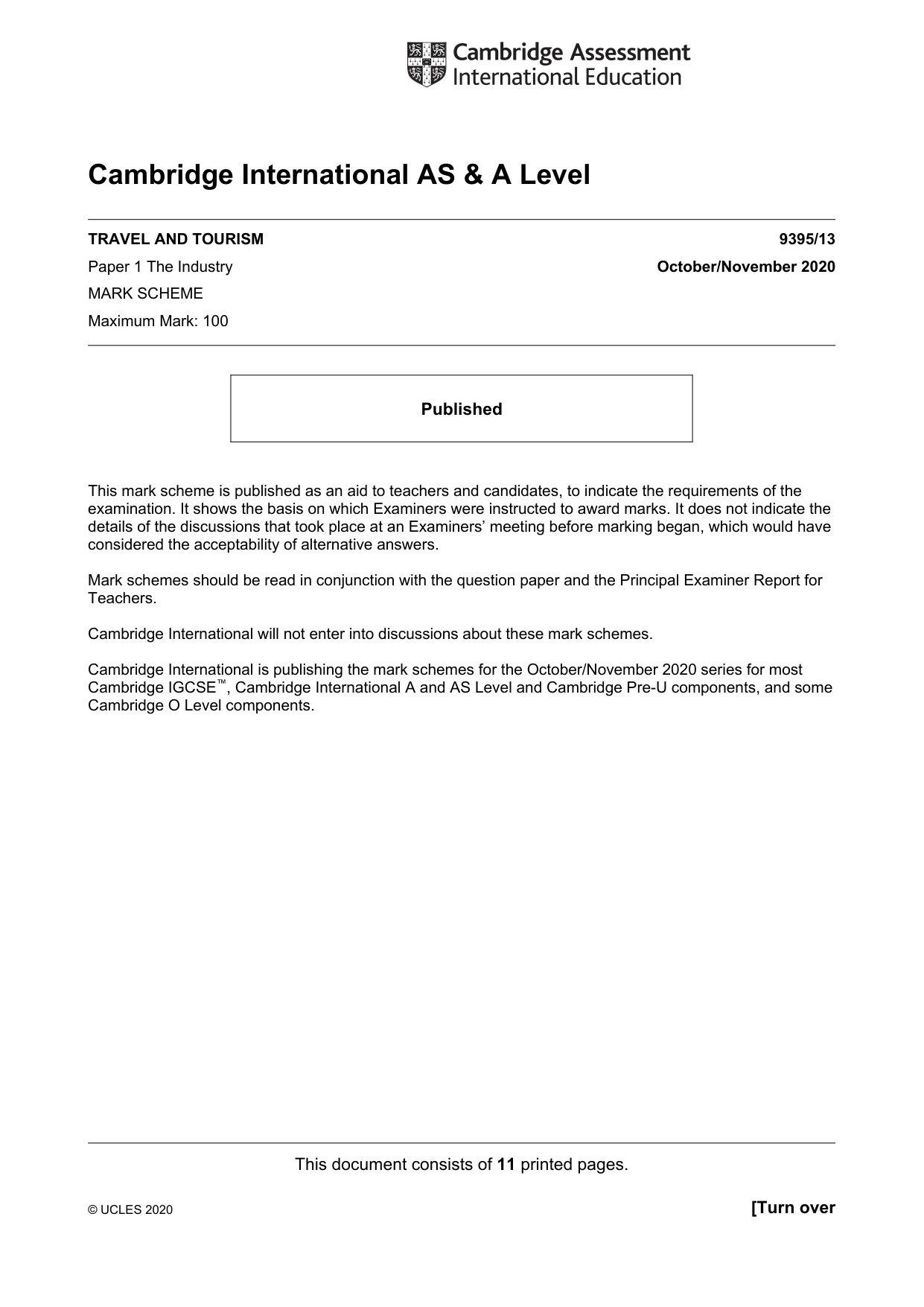
Question paper, page 13
13 9395/13/O/N/20 © UCLES 2020 (d) Analyse the likely impacts of high levels of air pollution on a destination. … … … … … … … … … … … … … … … … … … [9] [Total: 25]
Question paper, page 14
14 9395/13/O/N/20 © UCLES 2020 BLANK PAGE
Question paper, page 15
15 9395/13/O/N/20 © UCLES 2020 [Turn over BLANK PAGE
Question paper, page 16
16 9395/13/O/N/20 © UCLES 2020 Permission to reproduce items where third-party owned material protected by copyright is included has been sought and cleared where possible. Every reasonable effort has been made by the publisher (UCLES) to trace copyright holders, but if any items requiring clearance have unwittingly been included, the publisher will be pleased to make amends at the earliest possible opportunity. To avoid the issue of disclosure of answer-related information to candidates, all copyright acknowledgements are reproduced online in the Cambridge Assessment International Education Copyright Acknowledgements Booklet. This is produced for each series of examinations and is freely available to download at www.cambridgeinternational.org after the live examination series. Cambridge Assessment International Education is part of the Cambridge Assessment Group. Cambridge Assessment is the brand name of the University of Cambridge Local Examinations Syndicate (UCLES), which itself is a department of the University of Cambridge. BLANK PAGE
Mark scheme, page 1
This document consists of 11 printed pages. © UCLES 2020 [Turn over Cambridge International AS & A Level TRAVEL AND TOURISM 9395/13 Paper 1 The Industry October/November 2020 MARK SCHEME Maximum Mark: 100 Published This mark scheme is published as an aid to teachers and candidates, to indicate the requirements of the examination. It shows the basis on which Examiners were instructed to award marks. It does not indicate the details of the discussions that took place at an Examiners’ meeting before marking began, which would have considered the acceptability of alternative answers. Mark schemes should be read in conjunction with the question paper and the Principal Examiner Report for Teachers. Cambridge International will not enter into discussions about these mark schemes. Cambridge International is publishing the mark schemes for the October/November 2020 series for most Cambridge IGCSE™, Cambridge International A and AS Level and Cambridge Pre-U components, and some Cambridge O Level components.
Mark scheme, page 2
9395/13 Cambridge International AS & A Level – Mark Scheme PUBLISHED October/November 2020 © UCLES 2020 Page 2 of 11 Generic Marking Principles These general marking principles must be applied by all examiners when marking candidate answers. They should be applied alongside the specific content of the mark scheme or generic level descriptors for a question. Each question paper and mark scheme will also comply with these marking principles. GENERIC MARKING PRINCIPLE 1: Marks must be awarded in line with: • the specific content of the mark scheme or the generic level descriptors for the question • the specific skills defined in the mark scheme or in the generic level descriptors for the question • the standard of response required by a candidate as exemplified by the standardisation scripts. GENERIC MARKING PRINCIPLE 2: Marks awarded are always whole marks (not half marks, or other fractions). GENERIC MARKING PRINCIPLE 3: Marks must be awarded positively: • marks are awarded for correct/valid answers, as defined in the mark scheme. However, credit is given for valid answers which go beyond the scope of the syllabus and mark scheme, referring to your Team Leader as appropriate • marks are awarded when candidates clearly demonstrate what they know and can do • marks are not deducted for errors • marks are not deducted for omissions • answers should only be judged on the quality of spelling, punctuation and grammar when these features are specifically assessed by the question as indicated by the mark scheme. The meaning, however, should be unambiguous. GENERIC MARKING PRINCIPLE 4: Rules must be applied consistently, e.g. in situations where candidates have not followed instructions or in the application of generic level descriptors. GENERIC MARKING PRINCIPLE 5: Marks should be awarded using the full range of marks defined in the mark scheme for the question (however; the use of the full mark range may be limited according to the quality of the candidate responses seen). GENERIC MARKING PRINCIPLE 6: Marks awarded are based solely on the requirements as defined in the mark scheme. Marks should not be awarded with grade thresholds or grade descriptors in mind.
Mark scheme, page 3
9395/13 Cambridge International AS & A Level – Mark Scheme PUBLISHED October/November 2020 © UCLES 2020 Page 3 of 11 Social Sciences and Humanities Subject Specific Marking Principles (for point-based marking) 1 Components using point-based marking: • Point marking is often used to reward knowledge, understanding and application of skills. We give credit where the candidate’s answer shows relevant knowledge, understanding and application of skills in answering the question. We do not give credit where the answer shows confusion. From this it follows that we: a DO credit answers which are worded differently from the mark scheme if they clearly convey the same meaning (unless the mark scheme requires a specific term) b DO credit alternative answers/examples which are not written in the mark scheme if they are correct c DO credit answers where candidates give more than one correct answer in one prompt/numbered/scaffolded space where extended writing is required rather than list-type answers. For example, questions that require n reasons (e.g. State two reasons…). d DO NOT credit answers simply for using a ‘key term’ unless that is all that is required. (Check for evidence it is understood and not used wrongly.) e DO NOT credit answers which are obviously self-contradicting or trying to cover all possibilities, e.g. a scattergun approach to a question asking for n items f DO NOT give further credit for what is effectively repetition of a correct point already credited unless the language itself is being tested. This applies equally to ‘mirror statements’ (i.e. polluted/not polluted). g DO NOT require spellings to be correct, unless this is part of the test. However spellings of syllabus terms must allow for clear and unambiguous separation from other syllabus terms with which they may be confused (e.g. Corrasion/Corrosion) 2 Presentation of mark scheme: • Slashes (/) or the word ‘or’ separate alternative ways of making the same point. • Semi colons (;) bullet points (•) or figures in brackets (1) separate different points. • Content in the answer column in brackets is for examiner information/context to clarify the marking but is not required to earn the mark (except Accounting syllabuses where they indicate negative numbers). 3 Annotation: • For point marking, ticks can be used to indicate correct answers and crosses can be used to indicate wrong answers. There is no direct relationship between ticks and marks. Ticks have no defined meaning for levels of response marking. • For levels of response marking, the level awarded should be annotated on the script. Other annotations will be used by examiners as agreed during standardisation, and the meaning will be understood by all examiners who marked that paper.
Mark scheme, page 4
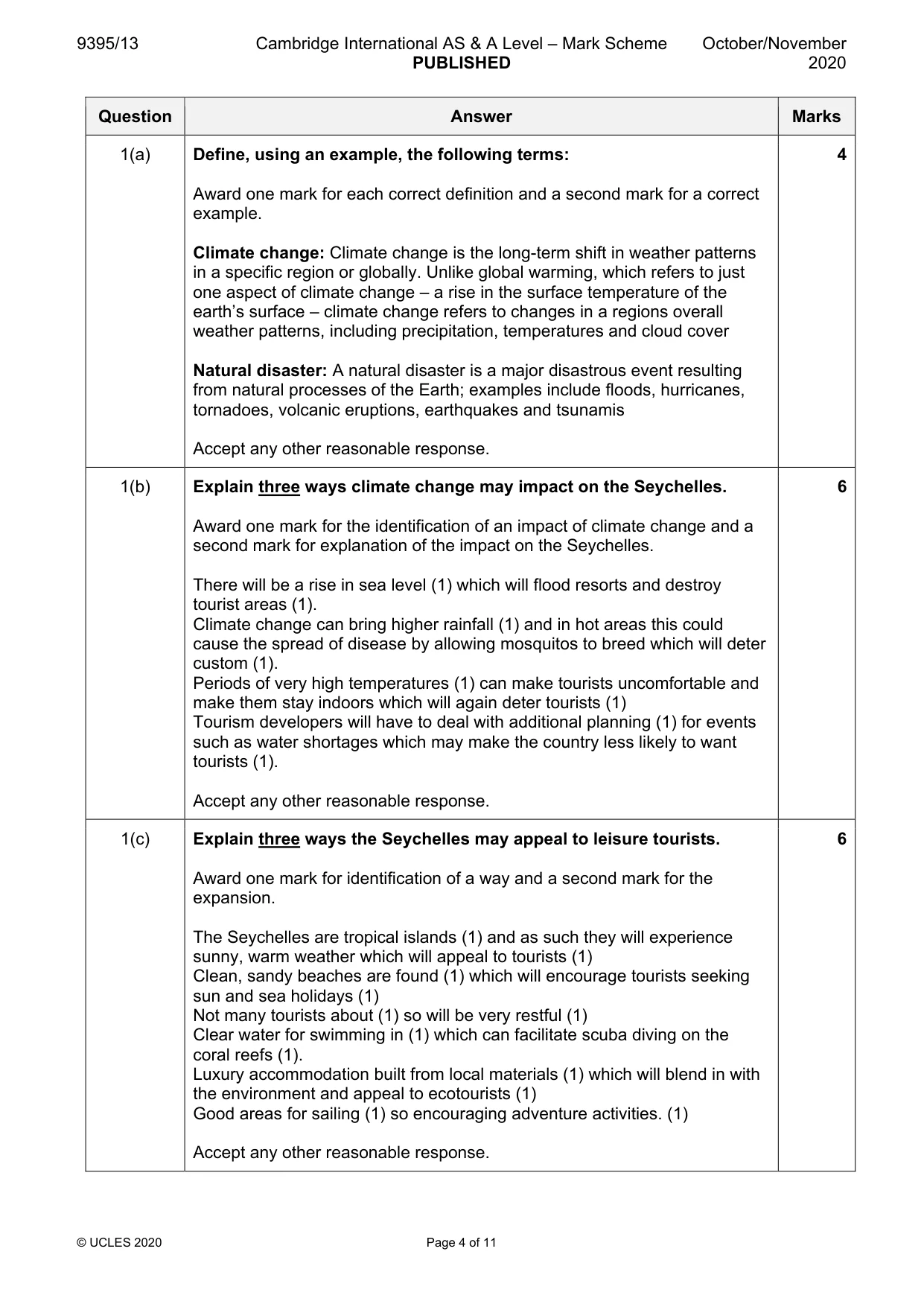
9395/13 Cambridge International AS & A Level – Mark Scheme PUBLISHED October/November 2020 © UCLES 2020 Page 4 of 11 Question Answer Marks 1(a) Define, using an example, the following terms: Award one mark for each correct definition and a second mark for a correct example. Climate change: Climate change is the long-term shift in weather patterns in a specific region or globally. Unlike global warming, which refers to just one aspect of climate change – a rise in the surface temperature of the earth’s surface – climate change refers to changes in a regions overall weather patterns, including precipitation, temperatures and cloud cover Natural disaster: A natural disaster is a major disastrous event resulting from natural processes of the Earth; examples include floods, hurricanes, tornadoes, volcanic eruptions, earthquakes and tsunamis Accept any other reasonable response. 4 1(b) Explain three ways climate change may impact on the Seychelles. Award one mark for the identification of an impact of climate change and a second mark for explanation of the impact on the Seychelles. There will be a rise in sea level (1) which will flood resorts and destroy tourist areas (1). Climate change can bring higher rainfall (1) and in hot areas this could cause the spread of disease by allowing mosquitos to breed which will deter custom (1). Periods of very high temperatures (1) can make tourists uncomfortable and make them stay indoors which will again deter tourists (1) Tourism developers will have to deal with additional planning (1) for events such as water shortages which may make the country less likely to want tourists (1). Accept any other reasonable response. 6 1(c) Explain three ways the Seychelles may appeal to leisure tourists. Award one mark for identification of a way and a second mark for the expansion. The Seychelles are tropical islands (1) and as such they will experience sunny, warm weather which will appeal to tourists (1) Clean, sandy beaches are found (1) which will encourage tourists seeking sun and sea holidays (1) Not many tourists about (1) so will be very restful (1) Clear water for swimming in (1) which can facilitate scuba diving on the coral reefs (1). Luxury accommodation built from local materials (1) which will blend in with the environment and appeal to ecotourists (1) Good areas for sailing (1) so encouraging adventure activities. (1) Accept any other reasonable response. 6
Mark scheme, page 5
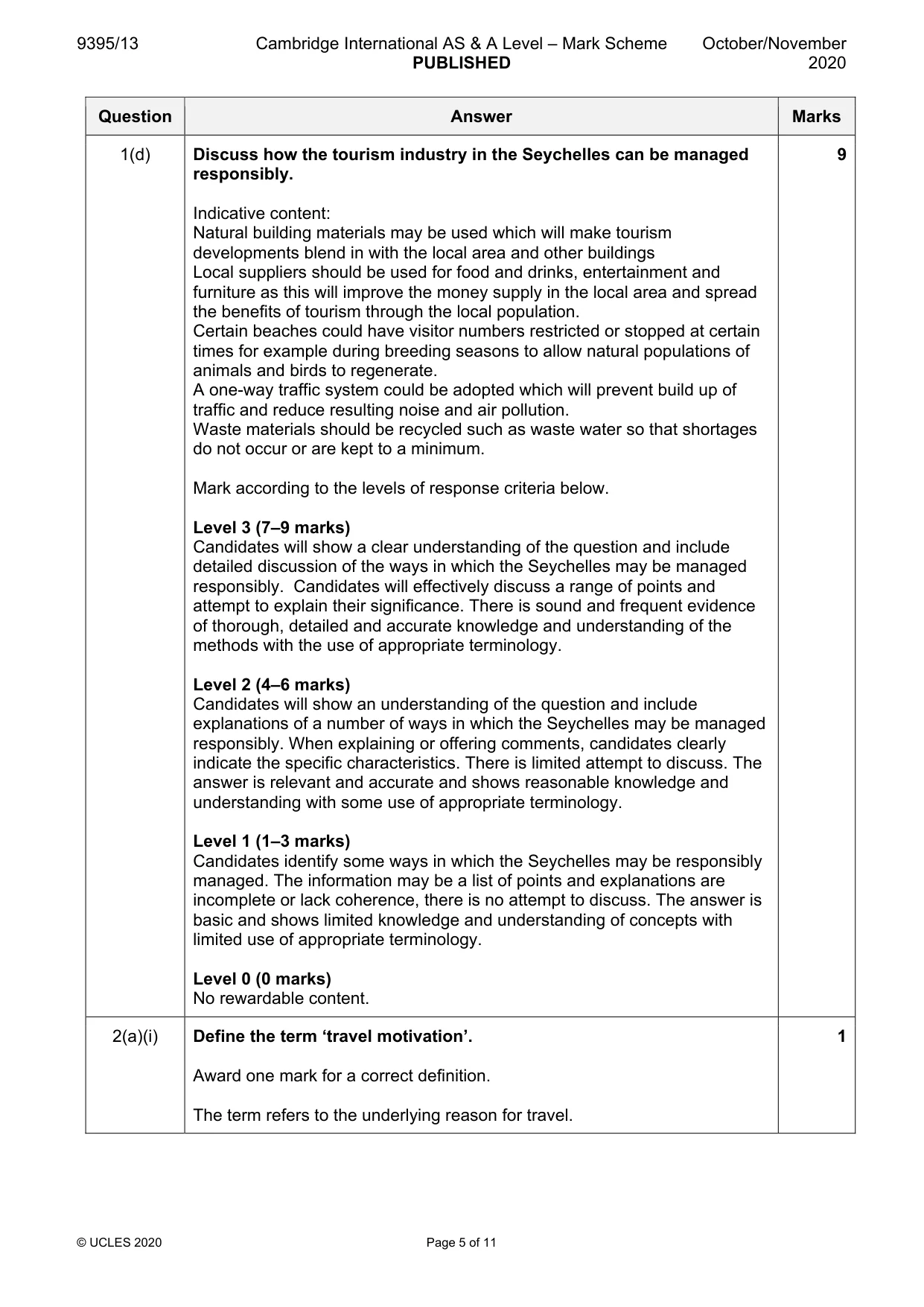
9395/13 Cambridge International AS & A Level – Mark Scheme PUBLISHED October/November 2020 © UCLES 2020 Page 5 of 11 Question Answer Marks 1(d) Discuss how the tourism industry in the Seychelles can be managed responsibly. Indicative content: Natural building materials may be used which will make tourism developments blend in with the local area and other buildings Local suppliers should be used for food and drinks, entertainment and furniture as this will improve the money supply in the local area and spread the benefits of tourism through the local population. Certain beaches could have visitor numbers restricted or stopped at certain times for example during breeding seasons to allow natural populations of animals and birds to regenerate. A one-way traffic system could be adopted which will prevent build up of traffic and reduce resulting noise and air pollution. Waste materials should be recycled such as waste water so that shortages do not occur or are kept to a minimum. Mark according to the levels of response criteria below. Level 3 (7–9 marks) Candidates will show a clear understanding of the question and include detailed discussion of the ways in which the Seychelles may be managed responsibly. Candidates will effectively discuss a range of points and attempt to explain their significance. There is sound and frequent evidence of thorough, detailed and accurate knowledge and understanding of the methods with the use of appropriate terminology. Level 2 (4–6 marks) Candidates will show an understanding of the question and include explanations of a number of ways in which the Seychelles may be managed responsibly. When explaining or offering comments, candidates clearly indicate the specific characteristics. There is limited attempt to discuss. The answer is relevant and accurate and shows reasonable knowledge and understanding with some use of appropriate terminology. Level 1 (1–3 marks) Candidates identify some ways in which the Seychelles may be responsibly managed. The information may be a list of points and explanations are incomplete or lack coherence, there is no attempt to discuss. The answer is basic and shows limited knowledge and understanding of concepts with limited use of appropriate terminology. Level 0 (0 marks) No rewardable content. 9 2(a)(i) Define the term ‘travel motivation’. Award one mark for a correct definition. The term refers to the underlying reason for travel. 1
Mark scheme, page 6
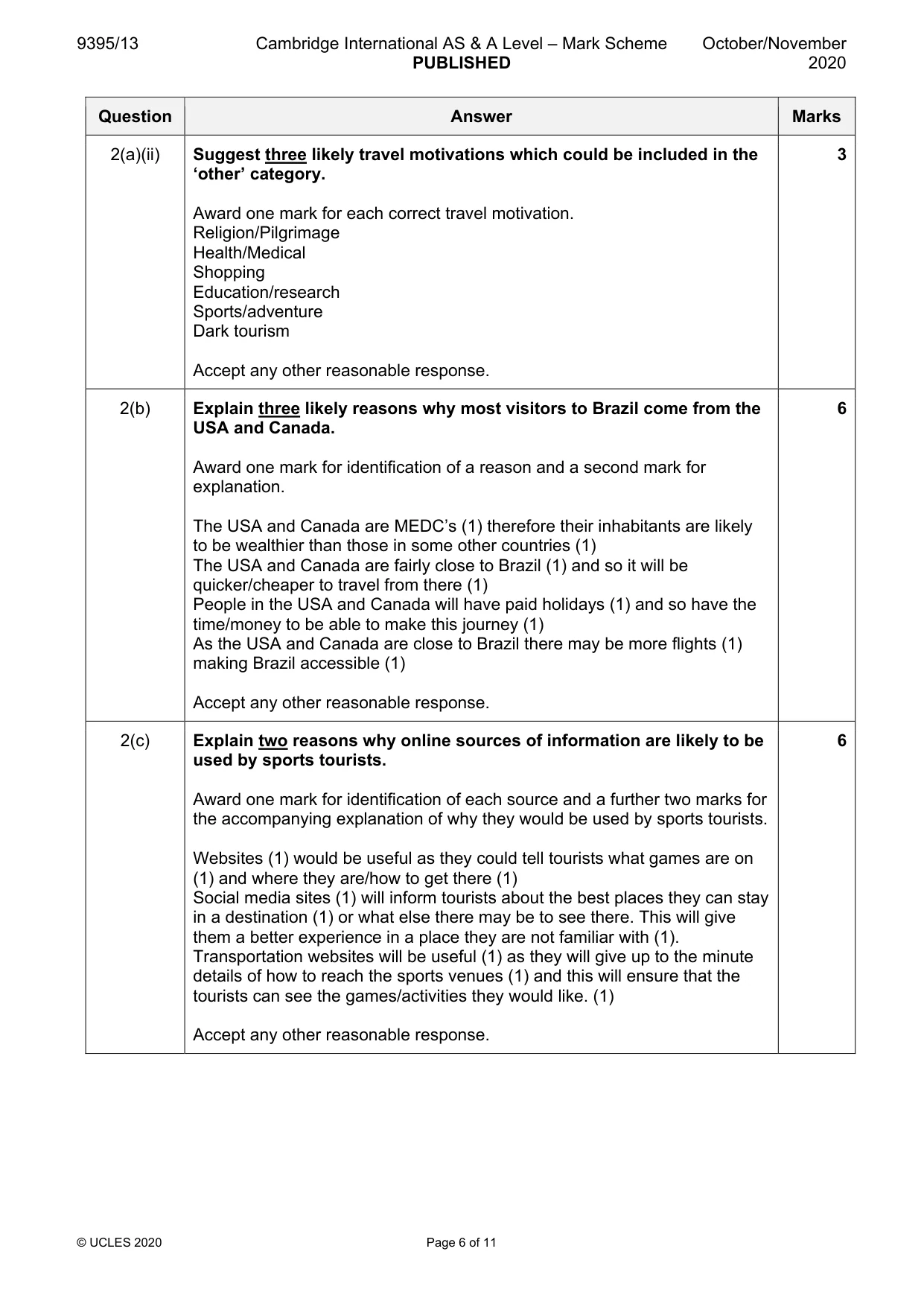
9395/13 Cambridge International AS & A Level – Mark Scheme PUBLISHED October/November 2020 © UCLES 2020 Page 6 of 11 Question Answer Marks 2(a)(ii) Suggest three likely travel motivations which could be included in the ‘other’ category. Award one mark for each correct travel motivation. Religion/Pilgrimage Health/Medical Shopping Education/research Sports/adventure Dark tourism Accept any other reasonable response. 3 2(b) Explain three likely reasons why most visitors to Brazil come from the USA and Canada. Award one mark for identification of a reason and a second mark for explanation. The USA and Canada are MEDC’s (1) therefore their inhabitants are likely to be wealthier than those in some other countries (1) The USA and Canada are fairly close to Brazil (1) and so it will be quicker/cheaper to travel from there (1) People in the USA and Canada will have paid holidays (1) and so have the time/money to be able to make this journey (1) As the USA and Canada are close to Brazil there may be more flights (1) making Brazil accessible (1) Accept any other reasonable response. 6 2(c) Explain two reasons why online sources of information are likely to be used by sports tourists. Award one mark for identification of each source and a further two marks for the accompanying explanation of why they would be used by sports tourists. Websites (1) would be useful as they could tell tourists what games are on (1) and where they are/how to get there (1) Social media sites (1) will inform tourists about the best places they can stay in a destination (1) or what else there may be to see there. This will give them a better experience in a place they are not familiar with (1). Transportation websites will be useful (1) as they will give up to the minute details of how to reach the sports venues (1) and this will ensure that the tourists can see the games/activities they would like. (1) Accept any other reasonable response. 6
Mark scheme, page 7
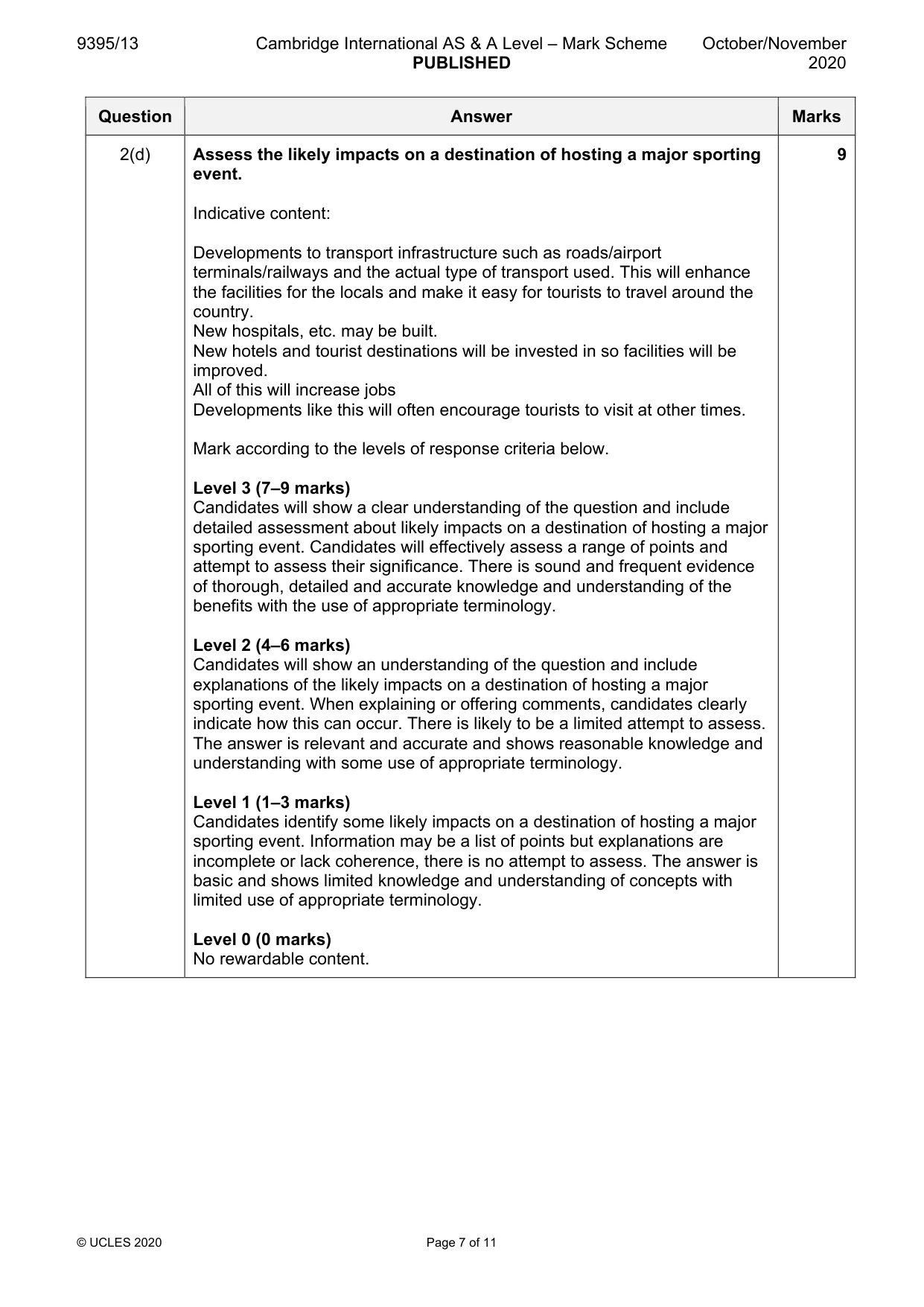
9395/13 Cambridge International AS & A Level – Mark Scheme PUBLISHED October/November 2020 © UCLES 2020 Page 7 of 11 Question Answer Marks 2(d) Assess the likely impacts on a destination of hosting a major sporting event. Indicative content: Developments to transport infrastructure such as roads/airport terminals/railways and the actual type of transport used. This will enhance the facilities for the locals and make it easy for tourists to travel around the country. New hospitals, etc. may be built. New hotels and tourist destinations will be invested in so facilities will be improved. All of this will increase jobs Developments like this will often encourage tourists to visit at other times. Mark according to the levels of response criteria below. Level 3 (7–9 marks) Candidates will show a clear understanding of the question and include detailed assessment about likely impacts on a destination of hosting a major sporting event. Candidates will effectively assess a range of points and attempt to assess their significance. There is sound and frequent evidence of thorough, detailed and accurate knowledge and understanding of the benefits with the use of appropriate terminology. Level 2 (4–6 marks) Candidates will show an understanding of the question and include explanations of the likely impacts on a destination of hosting a major sporting event. When explaining or offering comments, candidates clearly indicate how this can occur. There is likely to be a limited attempt to assess. The answer is relevant and accurate and shows reasonable knowledge and understanding with some use of appropriate terminology. Level 1 (1–3 marks) Candidates identify some likely impacts on a destination of hosting a major sporting event. Information may be a list of points but explanations are incomplete or lack coherence, there is no attempt to assess. The answer is basic and shows limited knowledge and understanding of concepts with limited use of appropriate terminology. Level 0 (0 marks) No rewardable content. 9
Mark scheme, page 8
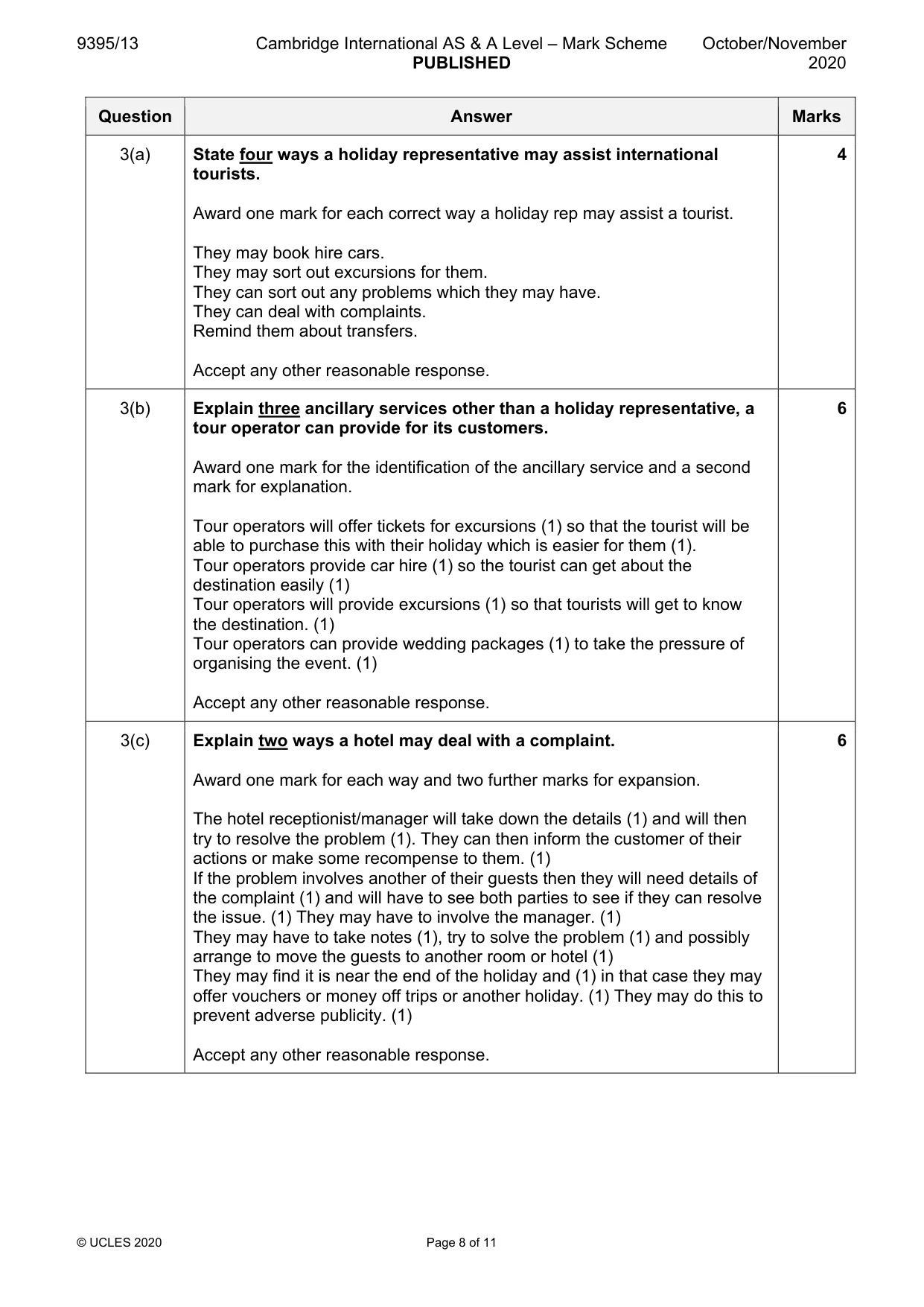
9395/13 Cambridge International AS & A Level – Mark Scheme PUBLISHED October/November 2020 © UCLES 2020 Page 8 of 11 Question Answer Marks 3(a) State four ways a holiday representative may assist international tourists. Award one mark for each correct way a holiday rep may assist a tourist. They may book hire cars. They may sort out excursions for them. They can sort out any problems which they may have. They can deal with complaints. Remind them about transfers. Accept any other reasonable response. 4 3(b) Explain three ancillary services other than a holiday representative, a tour operator can provide for its customers. Award one mark for the identification of the ancillary service and a second mark for explanation. Tour operators will offer tickets for excursions (1) so that the tourist will be able to purchase this with their holiday which is easier for them (1). Tour operators provide car hire (1) so the tourist can get about the destination easily (1) Tour operators will provide excursions (1) so that tourists will get to know the destination. (1) Tour operators can provide wedding packages (1) to take the pressure of organising the event. (1) Accept any other reasonable response. 6 3(c) Explain two ways a hotel may deal with a complaint. Award one mark for each way and two further marks for expansion. The hotel receptionist/manager will take down the details (1) and will then try to resolve the problem (1). They can then inform the customer of their actions or make some recompense to them. (1) If the problem involves another of their guests then they will need details of the complaint (1) and will have to see both parties to see if they can resolve the issue. (1) They may have to involve the manager. (1) They may have to take notes (1), try to solve the problem (1) and possibly arrange to move the guests to another room or hotel (1) They may find it is near the end of the holiday and (1) in that case they may offer vouchers or money off trips or another holiday. (1) They may do this to prevent adverse publicity. (1) Accept any other reasonable response. 6
Mark scheme, page 9
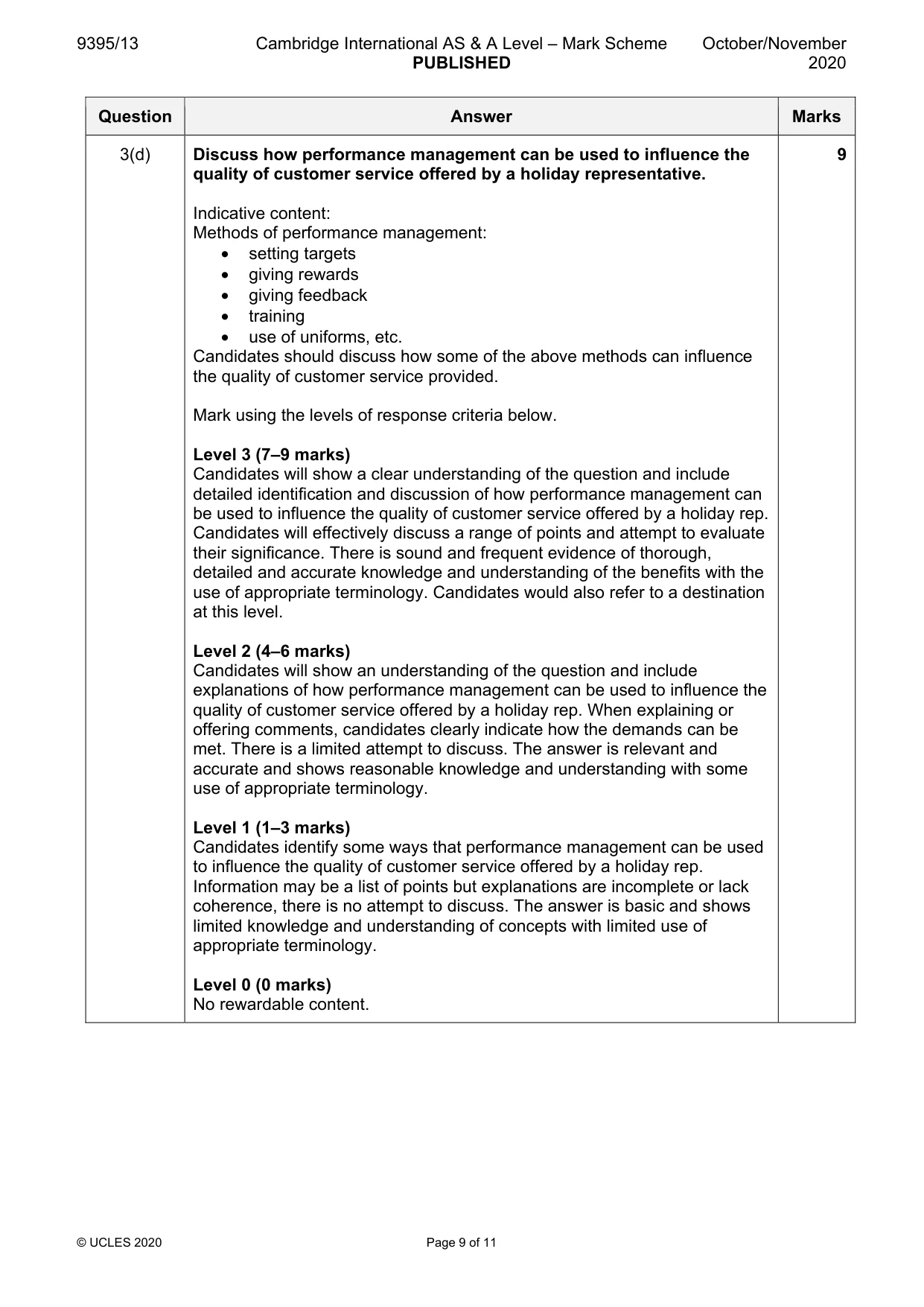
9395/13 Cambridge International AS & A Level – Mark Scheme PUBLISHED October/November 2020 © UCLES 2020 Page 9 of 11 Question Answer Marks 3(d) Discuss how performance management can be used to influence the quality of customer service offered by a holiday representative. Indicative content: Methods of performance management: • setting targets • giving rewards • giving feedback • training • use of uniforms, etc. Candidates should discuss how some of the above methods can influence the quality of customer service provided. Mark using the levels of response criteria below. Level 3 (7–9 marks) Candidates will show a clear understanding of the question and include detailed identification and discussion of how performance management can be used to influence the quality of customer service offered by a holiday rep. Candidates will effectively discuss a range of points and attempt to evaluate their significance. There is sound and frequent evidence of thorough, detailed and accurate knowledge and understanding of the benefits with the use of appropriate terminology. Candidates would also refer to a destination at this level. Level 2 (4–6 marks) Candidates will show an understanding of the question and include explanations of how performance management can be used to influence the quality of customer service offered by a holiday rep. When explaining or offering comments, candidates clearly indicate how the demands can be met. There is a limited attempt to discuss. The answer is relevant and accurate and shows reasonable knowledge and understanding with some use of appropriate terminology. Level 1 (1–3 marks) Candidates identify some ways that performance management can be used to influence the quality of customer service offered by a holiday rep. Information may be a list of points but explanations are incomplete or lack coherence, there is no attempt to discuss. The answer is basic and shows limited knowledge and understanding of concepts with limited use of appropriate terminology. Level 0 (0 marks) No rewardable content. 9
Mark scheme, page 10
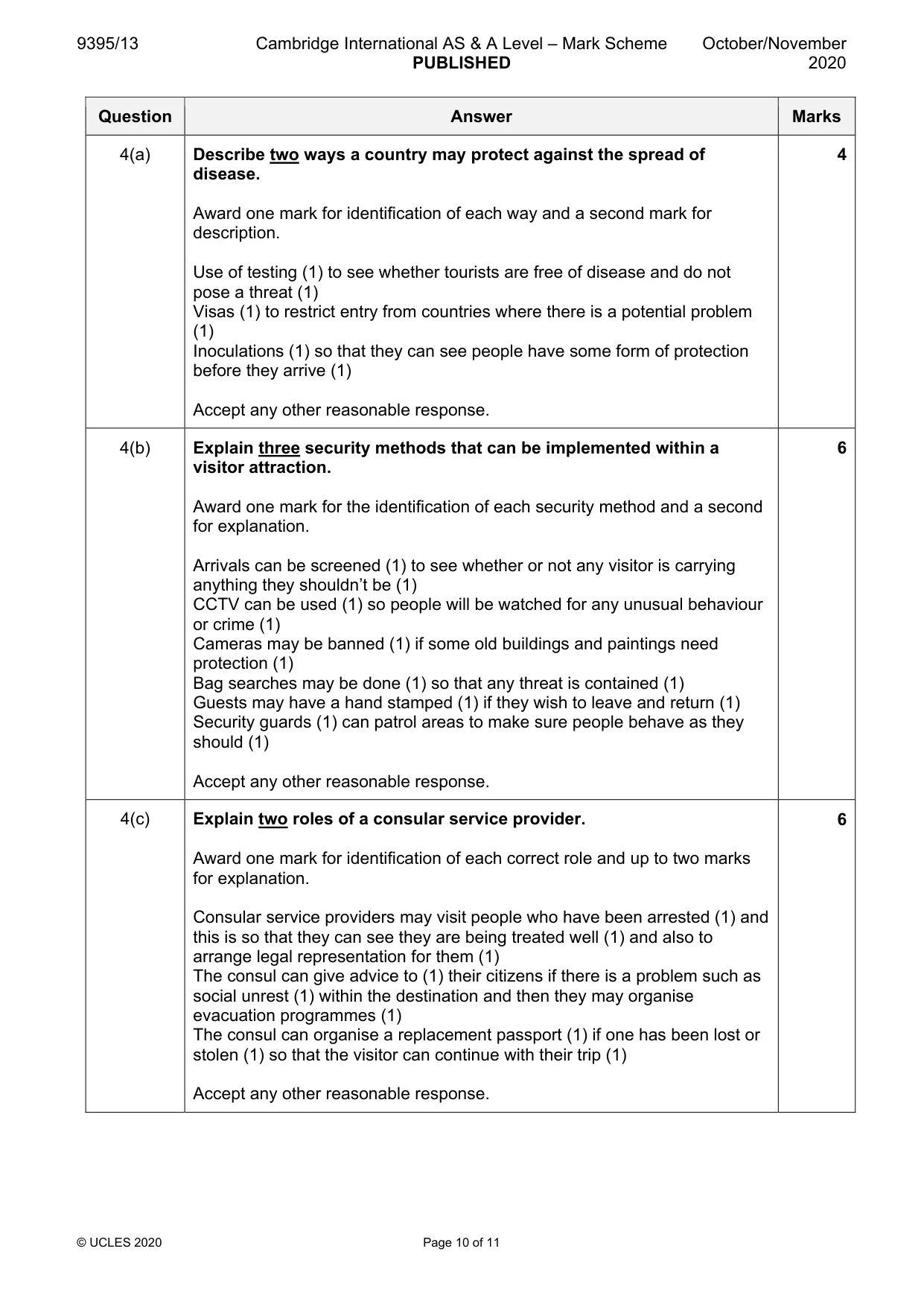
9395/13 Cambridge International AS & A Level – Mark Scheme PUBLISHED October/November 2020 © UCLES 2020 Page 10 of 11 Question Answer Marks 4(a) Describe two ways a country may protect against the spread of disease. Award one mark for identification of each way and a second mark for description. Use of testing (1) to see whether tourists are free of disease and do not pose a threat (1) Visas (1) to restrict entry from countries where there is a potential problem (1) Inoculations (1) so that they can see people have some form of protection before they arrive (1) Accept any other reasonable response. 4 4(b) Explain three security methods that can be implemented within a visitor attraction. Award one mark for the identification of each security method and a second for explanation. Arrivals can be screened (1) to see whether or not any visitor is carrying anything they shouldn’t be (1) CCTV can be used (1) so people will be watched for any unusual behaviour or crime (1) Cameras may be banned (1) if some old buildings and paintings need protection (1) Bag searches may be done (1) so that any threat is contained (1) Guests may have a hand stamped (1) if they wish to leave and return (1) Security guards (1) can patrol areas to make sure people behave as they should (1) Accept any other reasonable response. 6 4(c) Explain two roles of a consular service provider. Award one mark for identification of each correct role and up to two marks for explanation. Consular service providers may visit people who have been arrested (1) and this is so that they can see they are being treated well (1) and also to arrange legal representation for them (1) The consul can give advice to (1) their citizens if there is a problem such as social unrest (1) within the destination and then they may organise evacuation programmes (1) The consul can organise a replacement passport (1) if one has been lost or stolen (1) so that the visitor can continue with their trip (1) Accept any other reasonable response. 6
Mark scheme, page 11
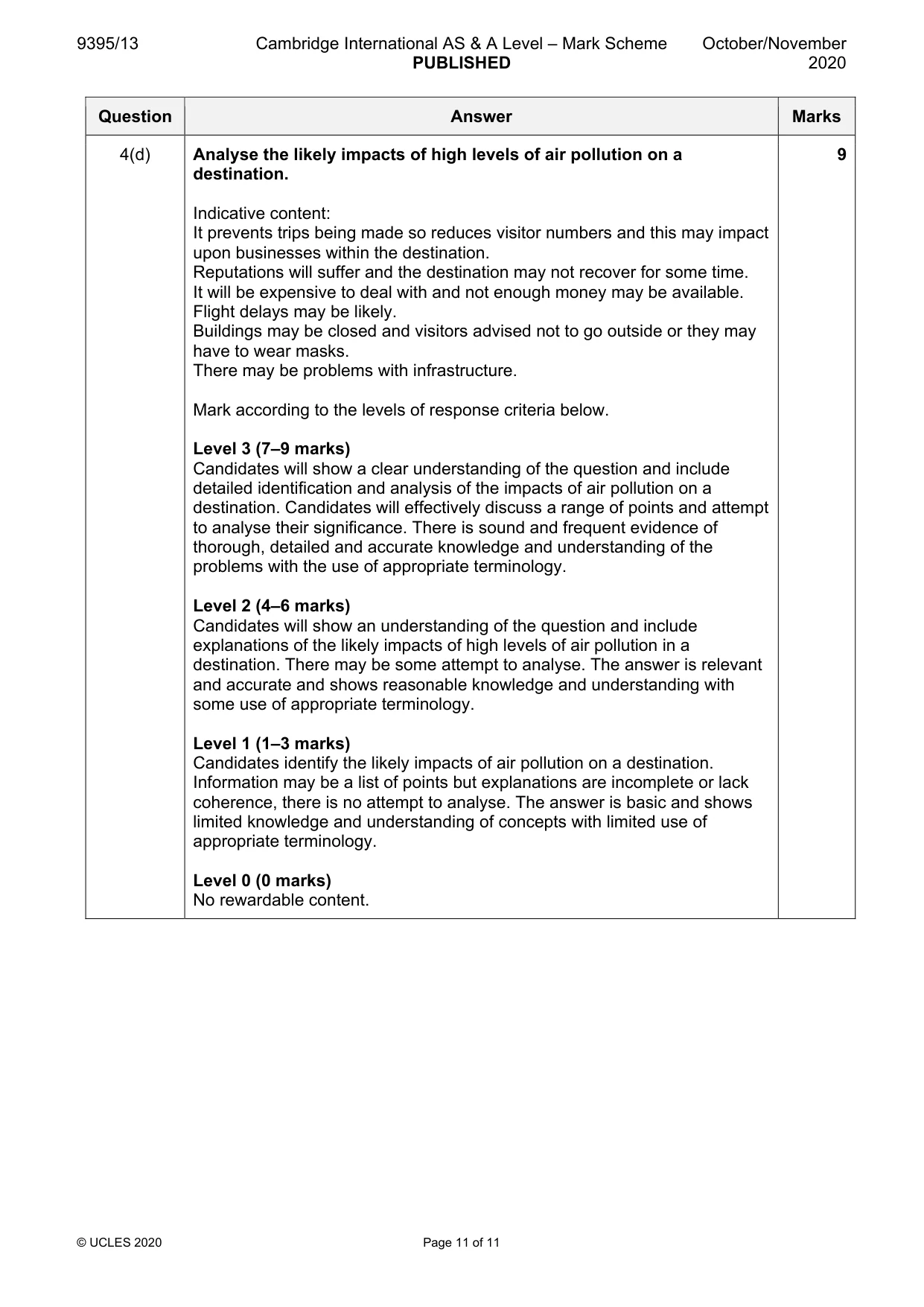
9395/13 Cambridge International AS & A Level – Mark Scheme PUBLISHED October/November 2020 © UCLES 2020 Page 11 of 11 Question Answer Marks 4(d) Analyse the likely impacts of high levels of air pollution on a destination. Indicative content: It prevents trips being made so reduces visitor numbers and this may impact upon businesses within the destination. Reputations will suffer and the destination may not recover for some time. It will be expensive to deal with and not enough money may be available. Flight delays may be likely. Buildings may be closed and visitors advised not to go outside or they may have to wear masks. There may be problems with infrastructure. Mark according to the levels of response criteria below. Level 3 (7–9 marks) Candidates will show a clear understanding of the question and include detailed identification and analysis of the impacts of air pollution on a destination. Candidates will effectively discuss a range of points and attempt to analyse their significance. There is sound and frequent evidence of thorough, detailed and accurate knowledge and understanding of the problems with the use of appropriate terminology. Level 2 (4–6 marks) Candidates will show an understanding of the question and include explanations of the likely impacts of high levels of air pollution in a destination. There may be some attempt to analyse. The answer is relevant and accurate and shows reasonable knowledge and understanding with some use of appropriate terminology. Level 1 (1–3 marks) Candidates identify the likely impacts of air pollution on a destination. Information may be a list of points but explanations are incomplete or lack coherence, there is no attempt to analyse. The answer is basic and shows limited knowledge and understanding of concepts with limited use of appropriate terminology. Level 0 (0 marks) No rewardable content. 9
What you needed in this session
Cambridge’s own grade thresholds for 2020 Oct/Nov, Paper 1 · Variant 3. A higher threshold means an easier paper — the bar moves with how the cohort did.