Cambridge A Level Travel and Tourism 9395 — 2017 May/June Paper 4 · Variant 2
9395/42/M/J/17 · 50 marks · ≈56 min
The question paper and its mark scheme, free to read here and free to download. This is Cambridge’s own paper, exactly as it was sat.
Question paper8 pages


Mark scheme5 pages
Answers below. Sit the paper first if you are practising.
Paper as text
Question paper, page 1
This document consists of 7 printed pages, 1 blank page and 1 Insert. DC (RCL(GO)) 131824/3 © UCLES 2017 [Turn over * 2 5 8 4 0 8 6 8 6 7 * TRAVEL AND TOURISM 9395/42 Paper 4 Destination Management May/June 2017 1 hour 30 minutes Candidates answer on the Question Paper. No Additional Materials are required. READ THESE INSTRUCTIONS FIRST Write your Centre number, candidate number and name on all the work you hand in. Write in dark blue or black pen. Do not use staples, paper clips, glue or correction fluid. You may use an HB pencil for any diagrams or graphs. DO NOT WRITE IN ANY BARCODES. Answer all questions. All the Figures referred to in the questions are contained in the Insert. The number of marks is given in brackets [ ] at the end of each question or part question. Cambridge International Examinations Cambridge International Advanced Subsidiary and Advanced Level
Question paper, page 2
2 9395/42/M/J/17 © UCLES 2017 Question 1 Refer to Fig. 1 (Insert), information about the Sustainable Tourism Network (STN) in Nepal. (a) Explain two reasons why partnerships are important for destination management. 1 … … … … 2 … … … …[4]
Question paper, page 3
3 9395/42/M/J/17 © UCLES 2017 [Turn over (b) Assess the benefits to the local community in Nepal of adopting sustainable tourism practices. … … … … … … … … … … … … … … … … … …[9]
Question paper, page 4
4 9395/42/M/J/17 © UCLES 2017 (c) Evaluate the economic impacts of encouraging commercial organisations to develop tourism in destinations, such as Nepal. … … … … … … … … … … … … … … … … … … … … … … … …[12] [Total: 25]
Question paper, page 5
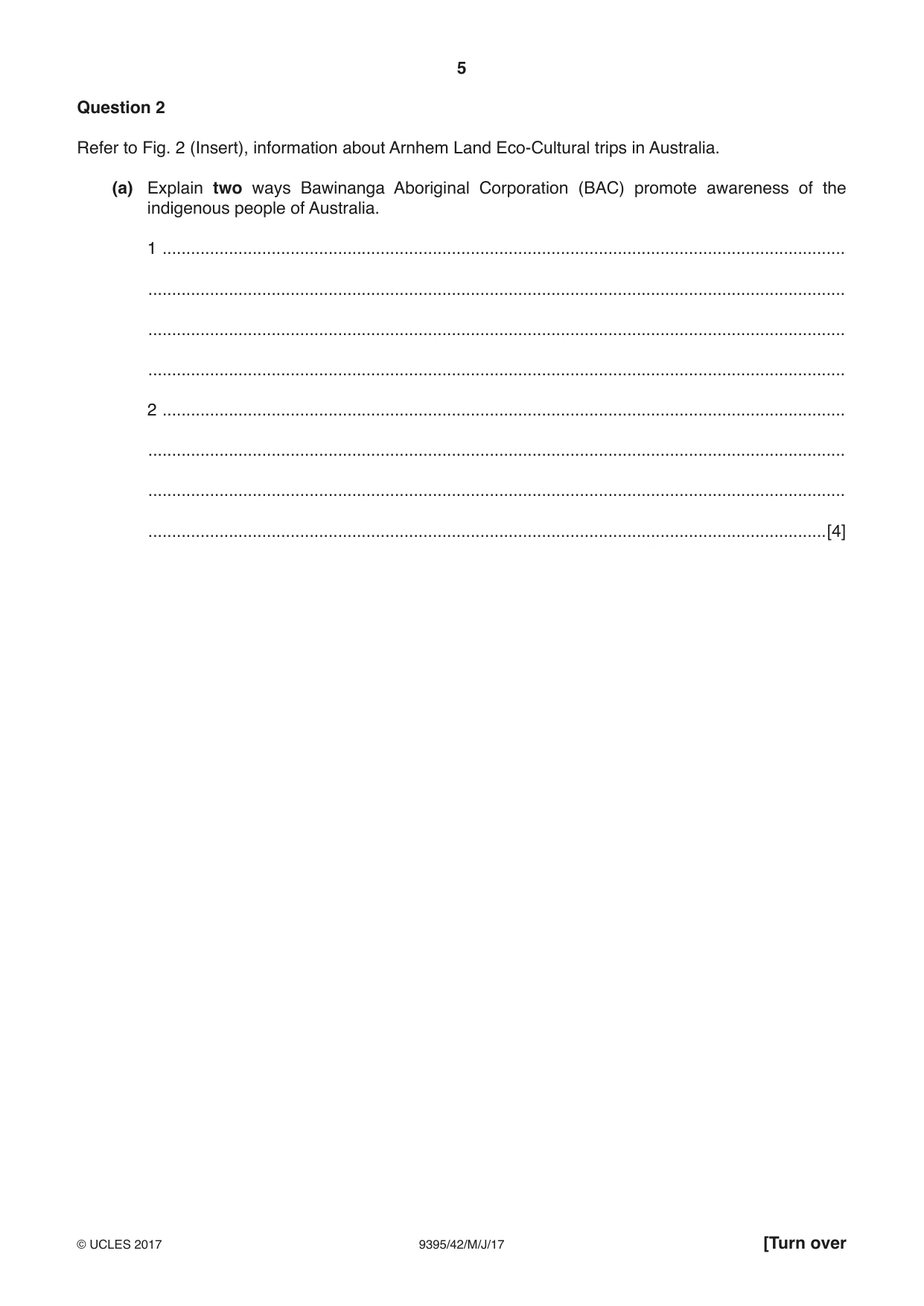
5 9395/42/M/J/17 © UCLES 2017 [Turn over Question 2 Refer to Fig. 2 (Insert), information about Arnhem Land Eco-Cultural trips in Australia. (a) Explain two ways Bawinanga Aboriginal Corporation (BAC) promote awareness of the indigenous people of Australia. 1 … … … … 2 … … … …[4]
Question paper, page 6
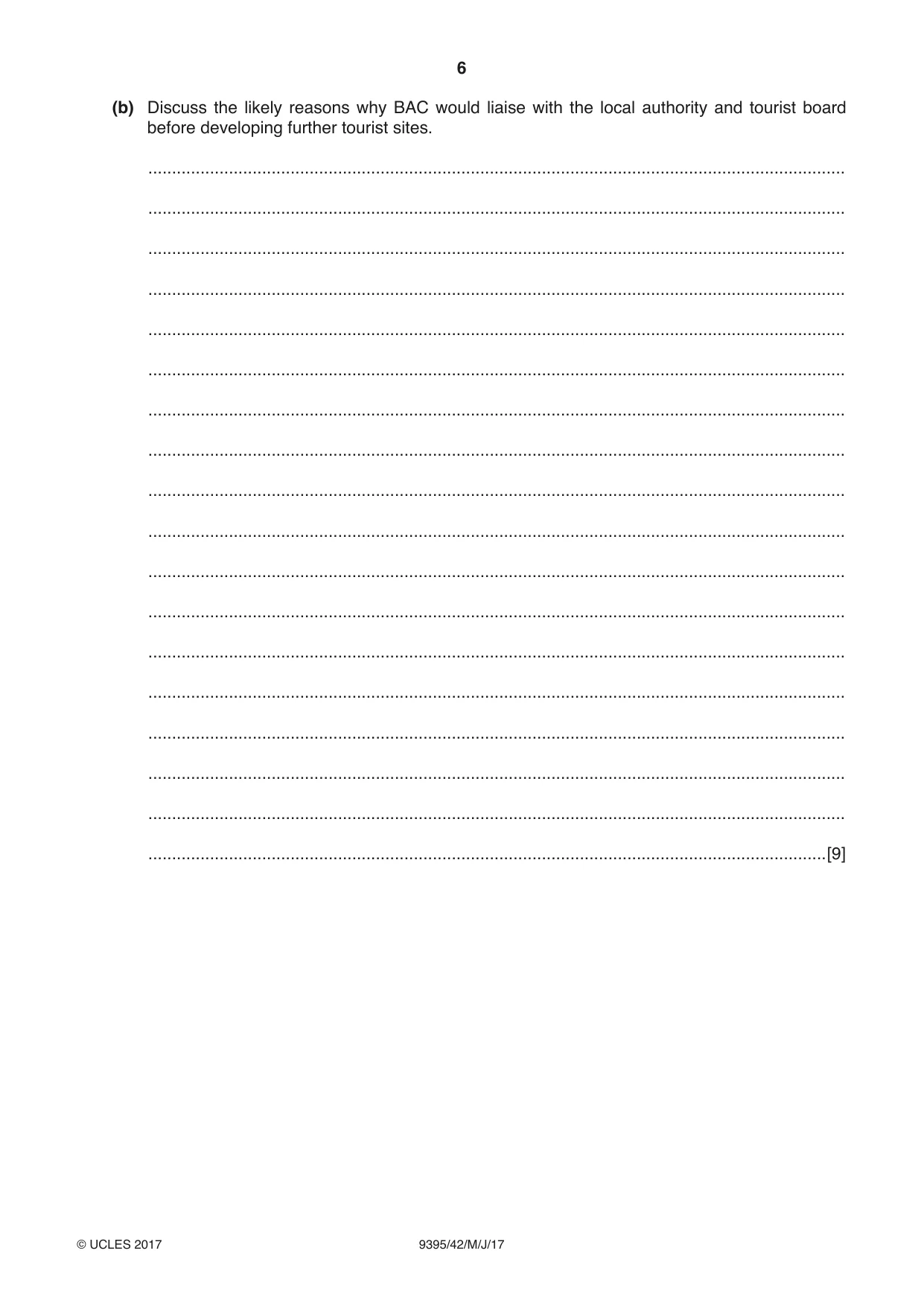
6 9395/42/M/J/17 © UCLES 2017 (b) Discuss the likely reasons why BAC would liaise with the local authority and tourist board before developing further tourist sites. … … … … … … … … … … … … … … … … … …[9]
Question paper, page 7
7 9395/42/M/J/17 © UCLES 2017 (c) Assess the ways cultural understanding is an important factor for the preservation of indigenous cultures. … … … … … … … … … … … … … … … … … … … … … … … …[12] [Total: 25]
Question paper, page 8
8 9395/42/M/J/17 © UCLES 2017 Permission to reproduce items where third-party owned material protected by copyright is included has been sought and cleared where possible. Every reasonable effort has been made by the publisher (UCLES) to trace copyright holders, but if any items requiring clearance have unwittingly been included, the publisher will be pleased to make amends at the earliest possible opportunity. To avoid the issue of disclosure of answer-related information to candidates, all copyright acknowledgements are reproduced online in the Cambridge International Examinations Copyright Acknowledgements Booklet. This is produced for each series of examinations and is freely available to download at www.cie.org.uk after the live examination series. Cambridge International Examinations is part of the Cambridge Assessment Group. Cambridge Assessment is the brand name of University of Cambridge Local Examinations Syndicate (UCLES), which is itself a department of the University of Cambridge. BLANK PAGE
Mark scheme, page 1
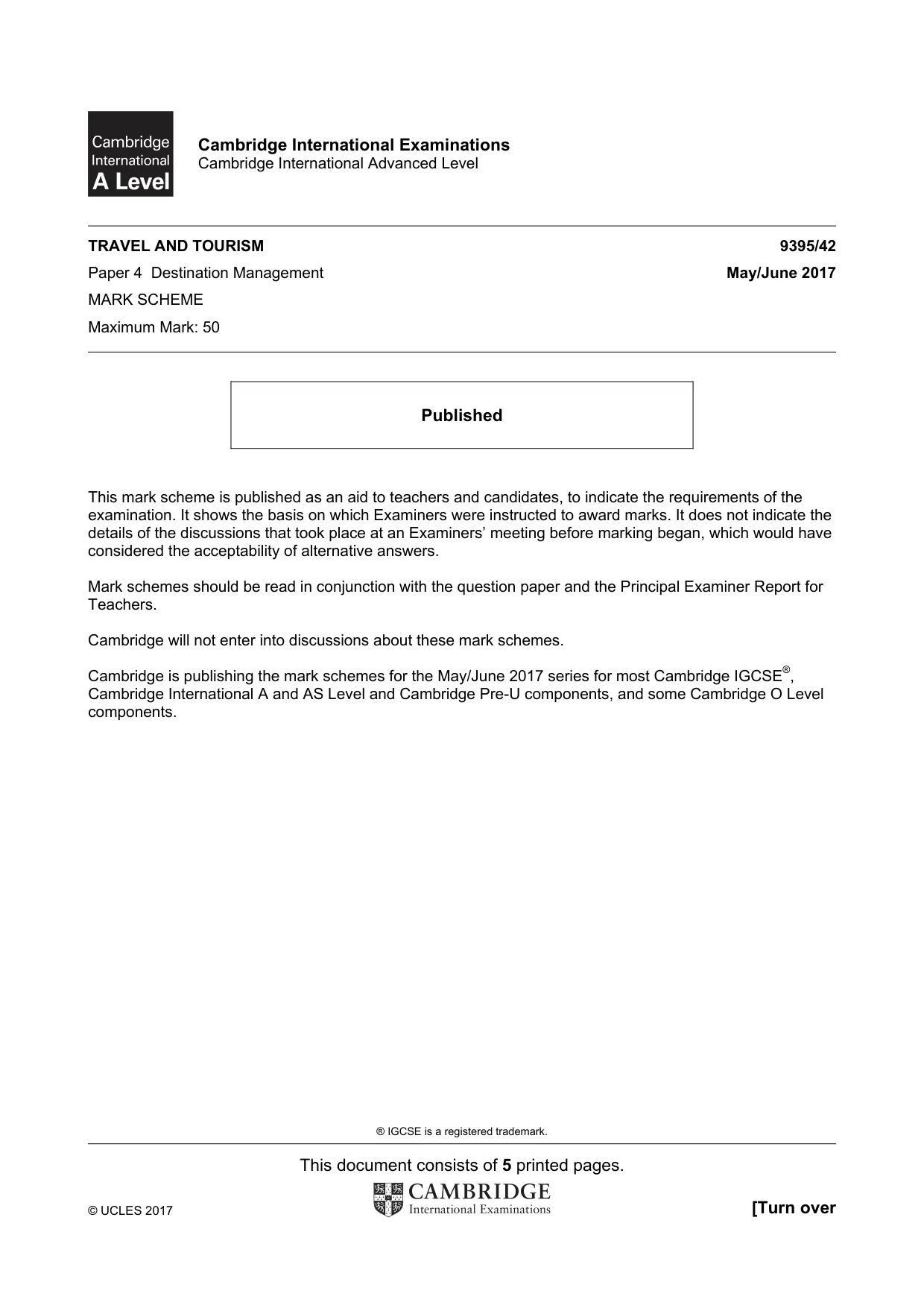
® IGCSE is a registered trademark. This document consists of 5 printed pages. © UCLES 2017 [Turn over Cambridge International Examinations Cambridge International Advanced Level TRAVEL AND TOURISM 9395/42 Paper 4 Destination Management May/June 2017 MARK SCHEME Maximum Mark: 50 Published This mark scheme is published as an aid to teachers and candidates, to indicate the requirements of the examination. It shows the basis on which Examiners were instructed to award marks. It does not indicate the details of the discussions that took place at an Examiners’ meeting before marking began, which would have considered the acceptability of alternative answers. Mark schemes should be read in conjunction with the question paper and the Principal Examiner Report for Teachers. Cambridge will not enter into discussions about these mark schemes. Cambridge is publishing the mark schemes for the May/June 2017 series for most Cambridge IGCSE®, Cambridge International A and AS Level and Cambridge Pre-U components, and some Cambridge O Level components.
Mark scheme, page 2
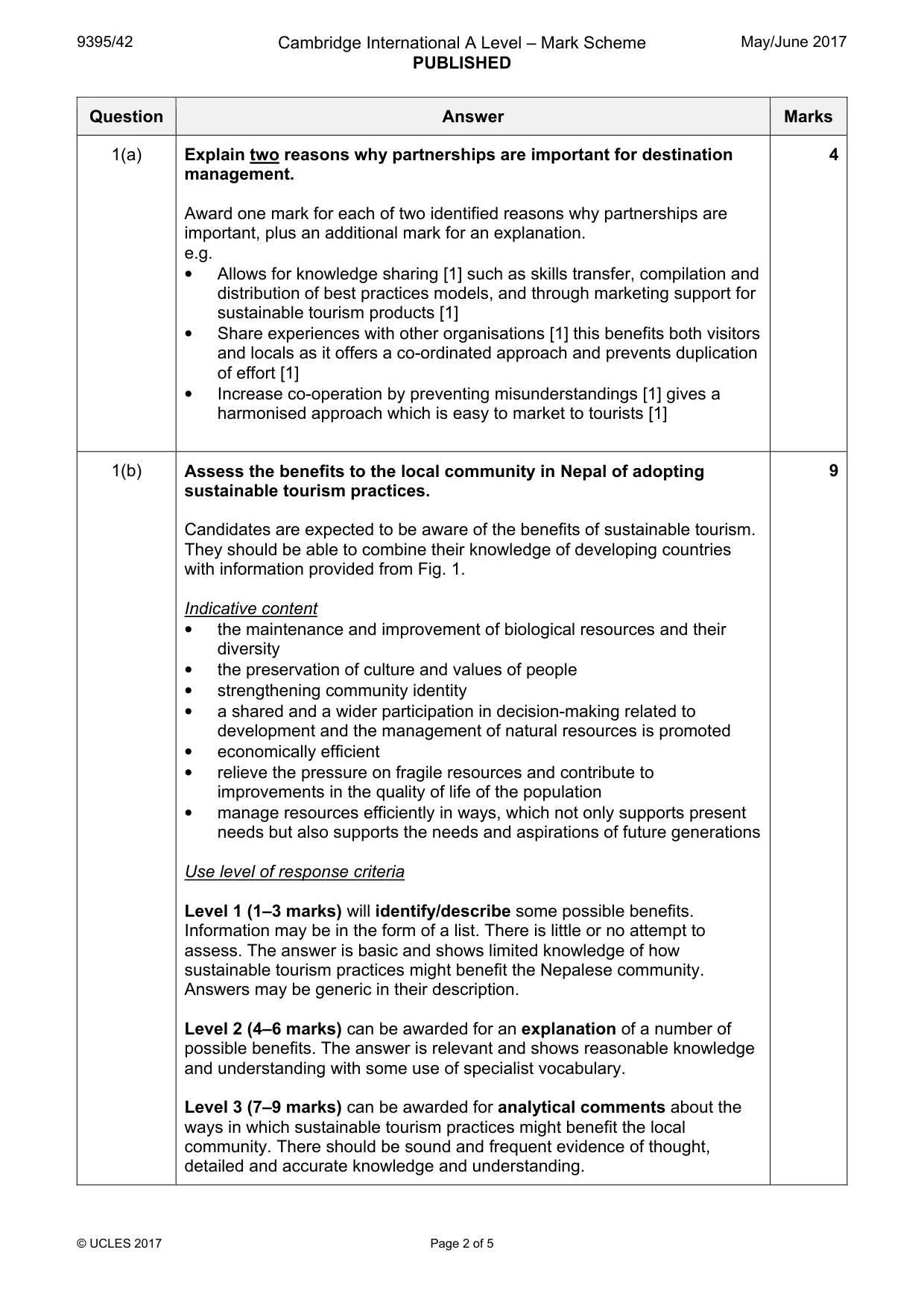
9395/42 Cambridge International A Level – Mark Scheme PUBLISHED May/June 2017 © UCLES 2017 Page 2 of 5 Question Answer Marks 1(a) Explain two reasons why partnerships are important for destination management. Award one mark for each of two identified reasons why partnerships are important, plus an additional mark for an explanation. e.g. • Allows for knowledge sharing [1] such as skills transfer, compilation and distribution of best practices models, and through marketing support for sustainable tourism products [1] • Share experiences with other organisations [1] this benefits both visitors and locals as it offers a co-ordinated approach and prevents duplication of effort [1] • Increase co-operation by preventing misunderstandings [1] gives a harmonised approach which is easy to market to tourists [1] 4 1(b) Assess the benefits to the local community in Nepal of adopting sustainable tourism practices. Candidates are expected to be aware of the benefits of sustainable tourism. They should be able to combine their knowledge of developing countries with information provided from Fig. 1. Indicative content • the maintenance and improvement of biological resources and their diversity • the preservation of culture and values of people • strengthening community identity • a shared and a wider participation in decision-making related to development and the management of natural resources is promoted • economically efficient • relieve the pressure on fragile resources and contribute to improvements in the quality of life of the population • manage resources efficiently in ways, which not only supports present needs but also supports the needs and aspirations of future generations Use level of response criteria Level 1 (1–3 marks) will identify/describe some possible benefits. Information may be in the form of a list. There is little or no attempt to assess. The answer is basic and shows limited knowledge of how sustainable tourism practices might benefit the Nepalese community. Answers may be generic in their description. Level 2 (4–6 marks) can be awarded for an explanation of a number of possible benefits. The answer is relevant and shows reasonable knowledge and understanding with some use of specialist vocabulary. Level 3 (7–9 marks) can be awarded for analytical comments about the ways in which sustainable tourism practices might benefit the local community. There should be sound and frequent evidence of thought, detailed and accurate knowledge and understanding. 9
Mark scheme, page 3
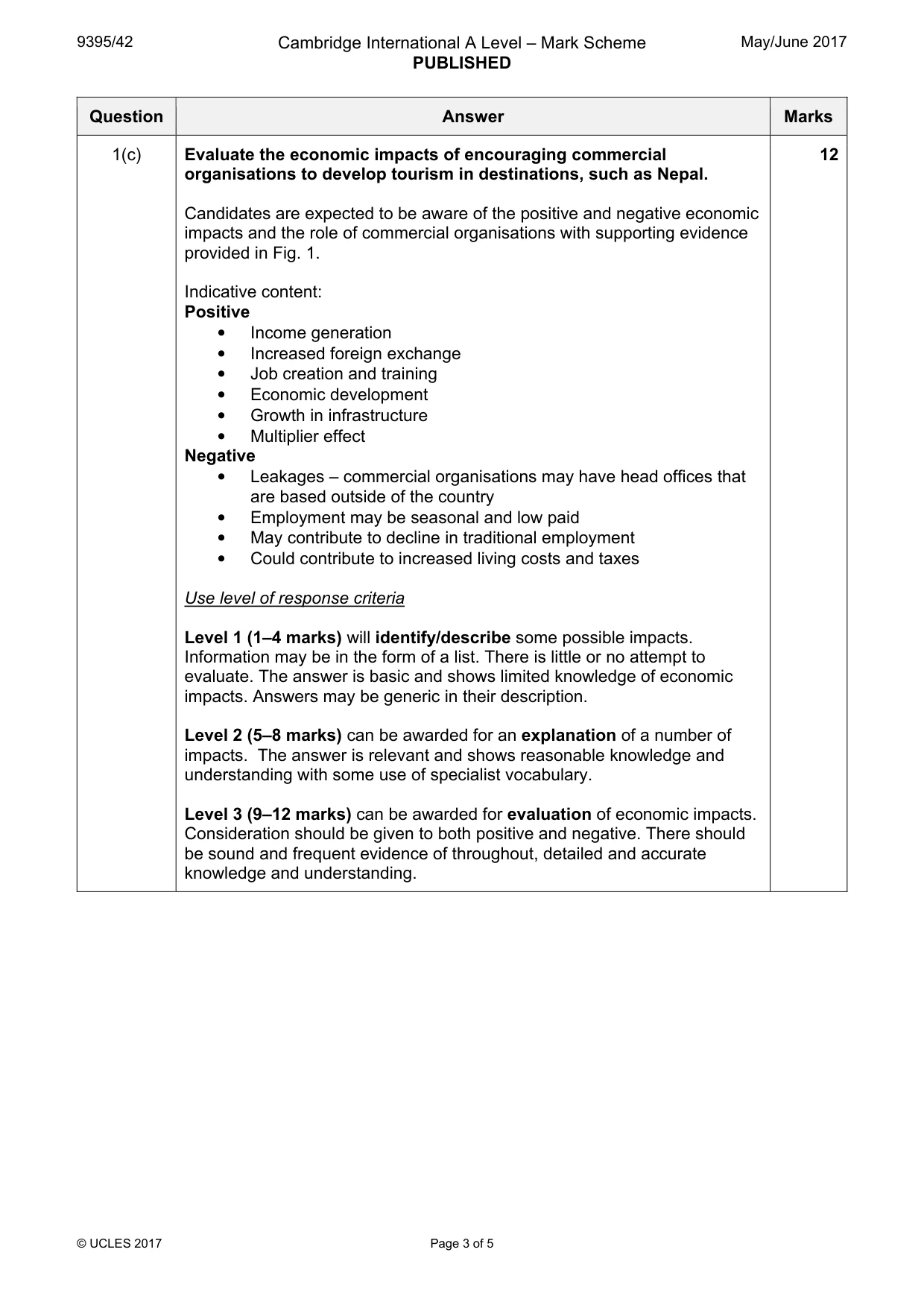
9395/42 Cambridge International A Level – Mark Scheme PUBLISHED May/June 2017 © UCLES 2017 Page 3 of 5 Question Answer Marks 1(c) Evaluate the economic impacts of encouraging commercial organisations to develop tourism in destinations, such as Nepal. Candidates are expected to be aware of the positive and negative economic impacts and the role of commercial organisations with supporting evidence provided in Fig. 1. Indicative content: Positive • Income generation • Increased foreign exchange • Job creation and training • Economic development • Growth in infrastructure • Multiplier effect Negative • Leakages – commercial organisations may have head offices that are based outside of the country • Employment may be seasonal and low paid • May contribute to decline in traditional employment • Could contribute to increased living costs and taxes Use level of response criteria Level 1 (1–4 marks) will identify/describe some possible impacts. Information may be in the form of a list. There is little or no attempt to evaluate. The answer is basic and shows limited knowledge of economic impacts. Answers may be generic in their description. Level 2 (5–8 marks) can be awarded for an explanation of a number of impacts. The answer is relevant and shows reasonable knowledge and understanding with some use of specialist vocabulary. Level 3 (9–12 marks) can be awarded for evaluation of economic impacts. Consideration should be given to both positive and negative. There should be sound and frequent evidence of throughout, detailed and accurate knowledge and understanding. 12
Mark scheme, page 4
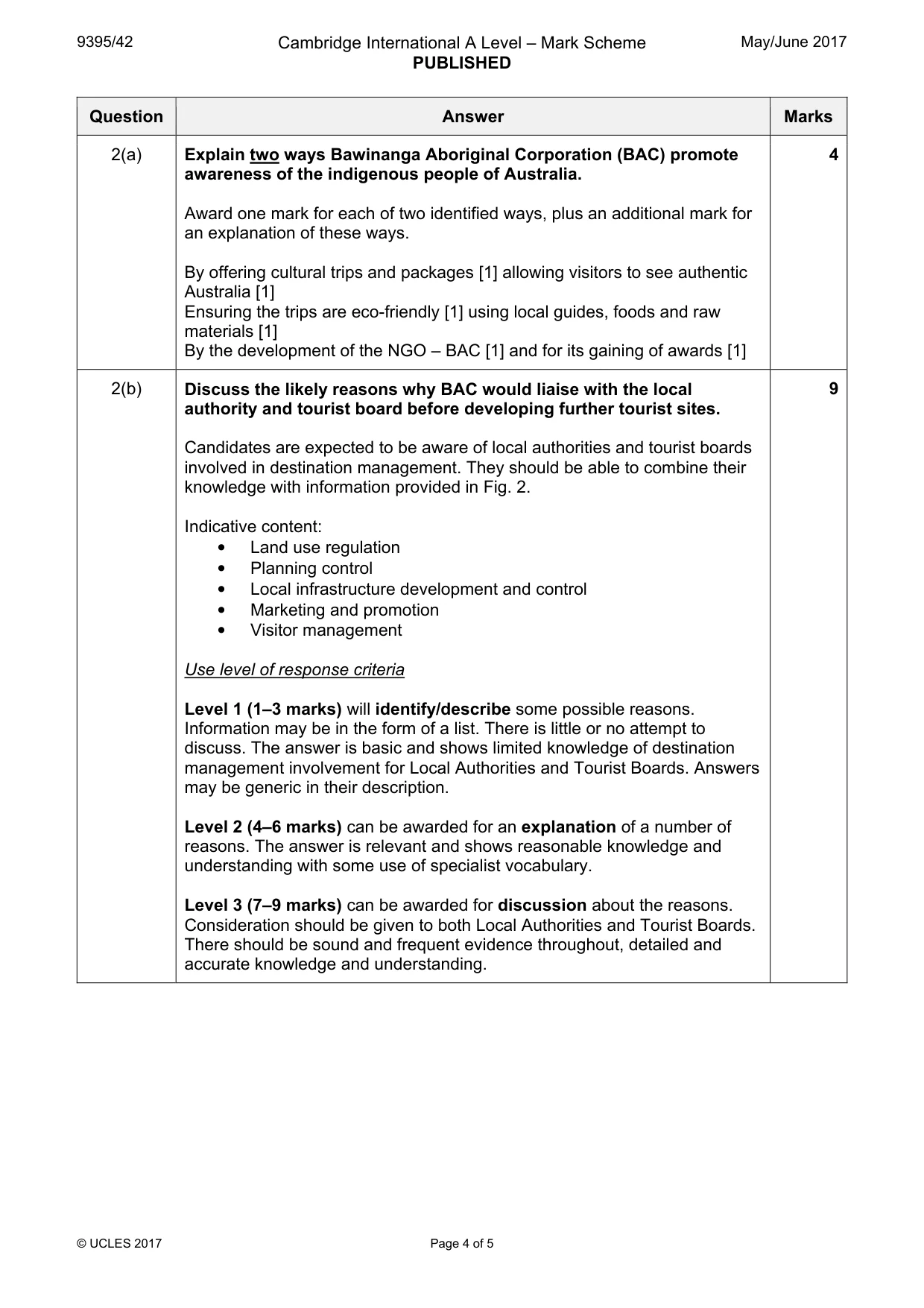
9395/42 Cambridge International A Level – Mark Scheme PUBLISHED May/June 2017 © UCLES 2017 Page 4 of 5 Question Answer Marks 2(a) Explain two ways Bawinanga Aboriginal Corporation (BAC) promote awareness of the indigenous people of Australia. Award one mark for each of two identified ways, plus an additional mark for an explanation of these ways. By offering cultural trips and packages [1] allowing visitors to see authentic Australia [1] Ensuring the trips are eco-friendly [1] using local guides, foods and raw materials [1] By the development of the NGO – BAC [1] and for its gaining of awards [1] 4 2(b) Discuss the likely reasons why BAC would liaise with the local authority and tourist board before developing further tourist sites. Candidates are expected to be aware of local authorities and tourist boards involved in destination management. They should be able to combine their knowledge with information provided in Fig. 2. Indicative content: • Land use regulation • Planning control • Local infrastructure development and control • Marketing and promotion • Visitor management Use level of response criteria Level 1 (1–3 marks) will identify/describe some possible reasons. Information may be in the form of a list. There is little or no attempt to discuss. The answer is basic and shows limited knowledge of destination management involvement for Local Authorities and Tourist Boards. Answers may be generic in their description. Level 2 (4–6 marks) can be awarded for an explanation of a number of reasons. The answer is relevant and shows reasonable knowledge and understanding with some use of specialist vocabulary. Level 3 (7–9 marks) can be awarded for discussion about the reasons. Consideration should be given to both Local Authorities and Tourist Boards. There should be sound and frequent evidence throughout, detailed and accurate knowledge and understanding. 9
Mark scheme, page 5
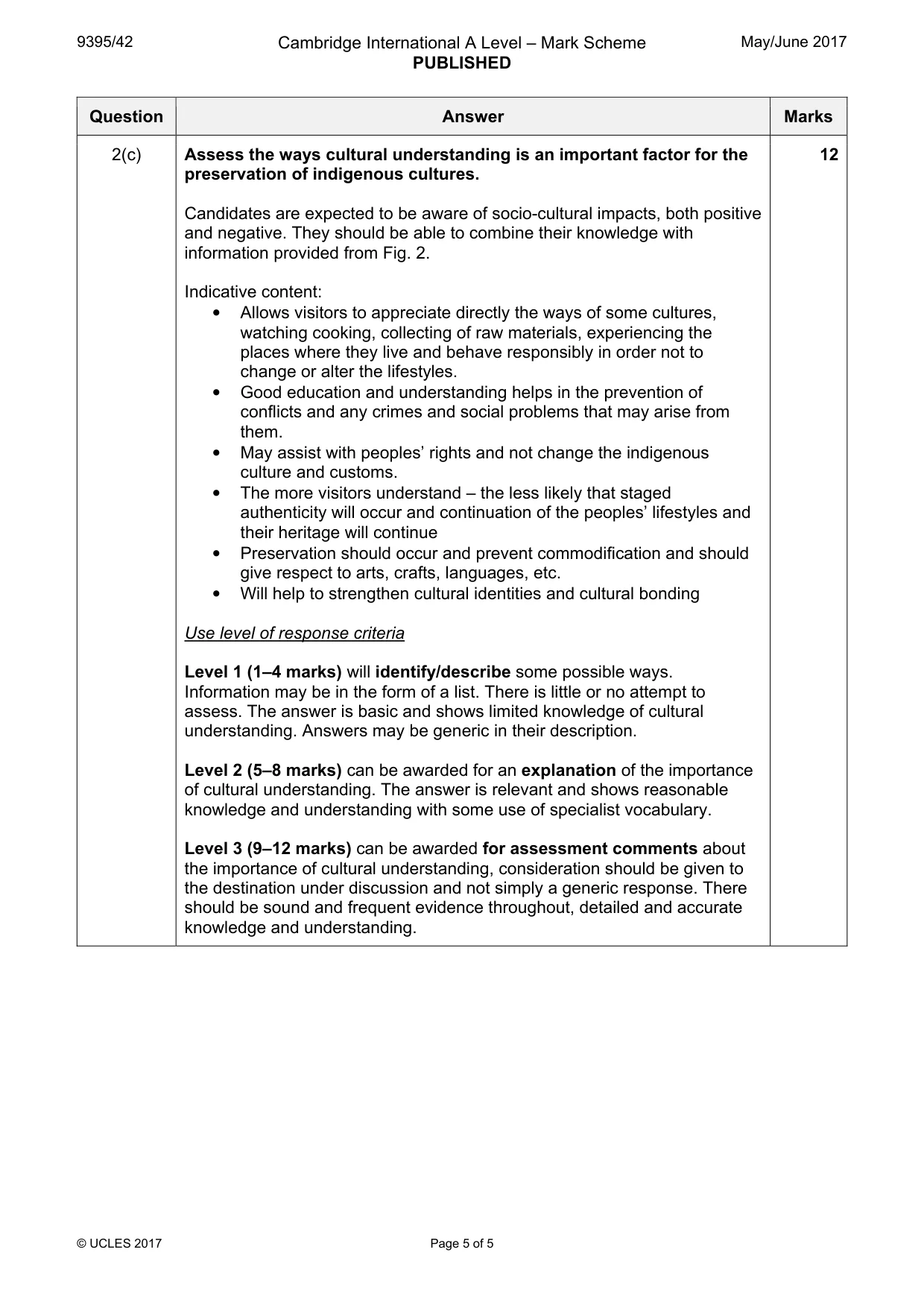
9395/42 Cambridge International A Level – Mark Scheme PUBLISHED May/June 2017 © UCLES 2017 Page 5 of 5 Question Answer Marks 2(c) Assess the ways cultural understanding is an important factor for the preservation of indigenous cultures. Candidates are expected to be aware of socio-cultural impacts, both positive and negative. They should be able to combine their knowledge with information provided from Fig. 2. Indicative content: • Allows visitors to appreciate directly the ways of some cultures, watching cooking, collecting of raw materials, experiencing the places where they live and behave responsibly in order not to change or alter the lifestyles. • Good education and understanding helps in the prevention of conflicts and any crimes and social problems that may arise from them. • May assist with peoples’ rights and not change the indigenous culture and customs. • The more visitors understand – the less likely that staged authenticity will occur and continuation of the peoples’ lifestyles and their heritage will continue • Preservation should occur and prevent commodification and should give respect to arts, crafts, languages, etc. • Will help to strengthen cultural identities and cultural bonding Use level of response criteria Level 1 (1–4 marks) will identify/describe some possible ways. Information may be in the form of a list. There is little or no attempt to assess. The answer is basic and shows limited knowledge of cultural understanding. Answers may be generic in their description. Level 2 (5–8 marks) can be awarded for an explanation of the importance of cultural understanding. The answer is relevant and shows reasonable knowledge and understanding with some use of specialist vocabulary. Level 3 (9–12 marks) can be awarded for assessment comments about the importance of cultural understanding, consideration should be given to the destination under discussion and not simply a generic response. There should be sound and frequent evidence throughout, detailed and accurate knowledge and understanding. 12
What you needed in this session
Cambridge’s own grade thresholds for 2017 May/June, Paper 4 · Variant 2. A higher threshold means an easier paper — the bar moves with how the cohort did.