Cambridge A Level Travel and Tourism 9395 — 2016 May/June Paper 4 · Variant 2
9395/42/M/J/16 · 50 marks · ≈56 min
The question paper and its mark scheme, free to read here and free to download. This is Cambridge’s own paper, exactly as it was sat.
Question paper8 pages

Mark scheme5 pages
Answers below. Sit the paper first if you are practising.
Paper as text
Question paper, page 1
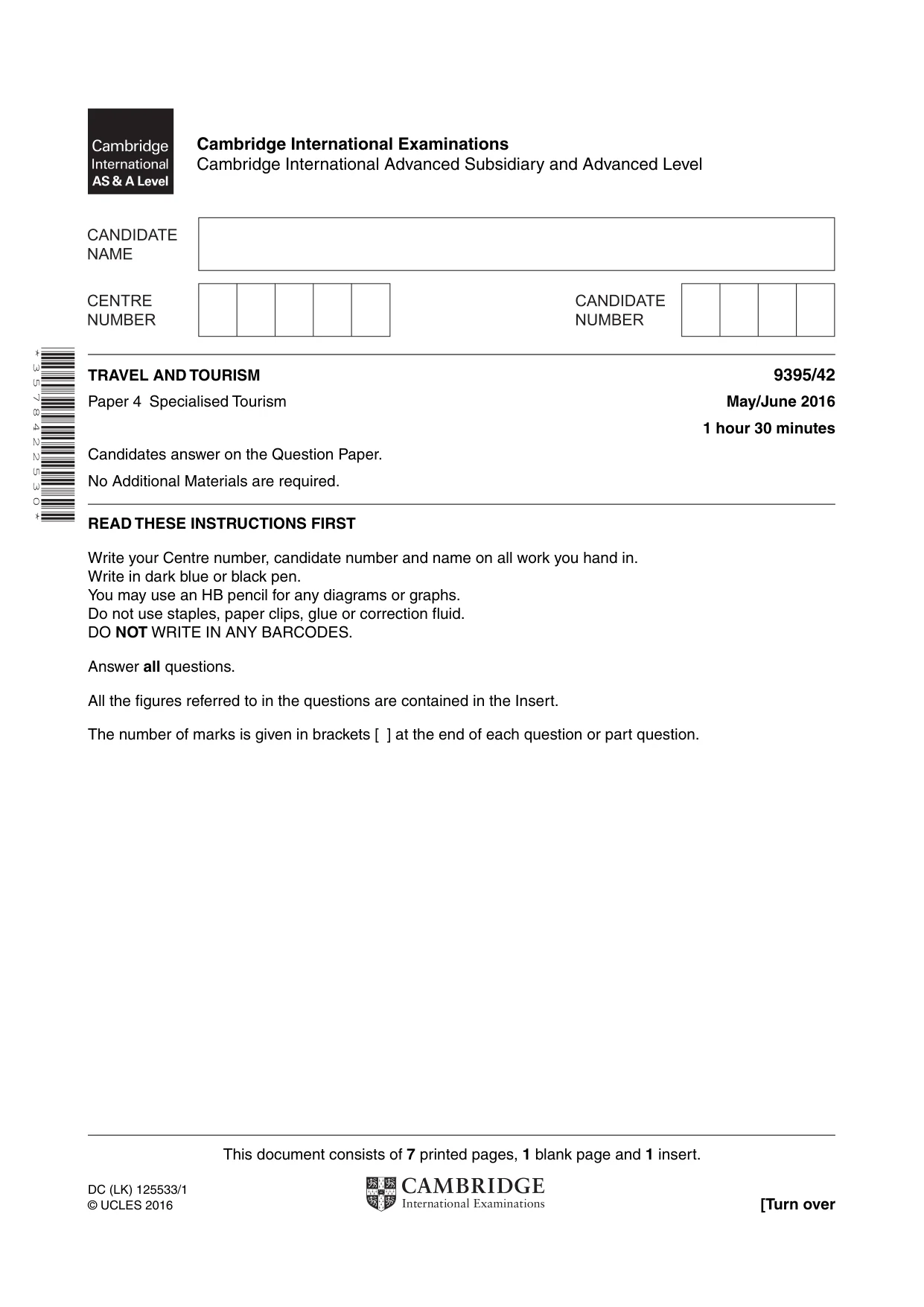
This document consists of 7 printed pages, 1 blank page and 1 insert. DC (LK) 125533/1 © UCLES 2016 [Turn over Cambridge International Examinations Cambridge International Advanced Subsidiary and Advanced Level * 3 5 7 8 4 2 2 5 3 0 * TRAVEL AND TOURISM 9395/42 Paper 4 Specialised Tourism May/June 2016 1 hour 30 minutes Candidates answer on the Question Paper. No Additional Materials are required. READ THESE INSTRUCTIONS FIRST Write your Centre number, candidate number and name on all work you hand in. Write in dark blue or black pen. You may use an HB pencil for any diagrams or graphs. Do not use staples, paper clips, glue or correction fluid. DO NOT WRITE IN ANY BARCODES. Answer all questions. All the figures referred to in the questions are contained in the Insert. The number of marks is given in brackets [ ] at the end of each question or part question.
Question paper, page 2
2 9395/42/M/J/16 © UCLES 2016 Question 1 Refer to Fig. 1 (Insert), information about Lesotho. (a) Using Fig. 1 (Insert) explain two reasons why Lesotho would appeal to adventure tourists. … … … … … … … …[4]
Question paper, page 3
3 9395/42/M/J/16 © UCLES 2016 [Turn over (b) Assess how adventure activities in Lesotho might create negative impacts for ecotourists. … … … … … … … … … … … … … … … … … …[9]
Question paper, page 4
4 9395/42/M/J/16 © UCLES 2016 (c) Evaluate how the positive impacts of tourism can be maximised for countries such as Lesotho. … … … … … … … … … … … … … … … … … … … … … … … …[12] [Total: 25]
Question paper, page 5
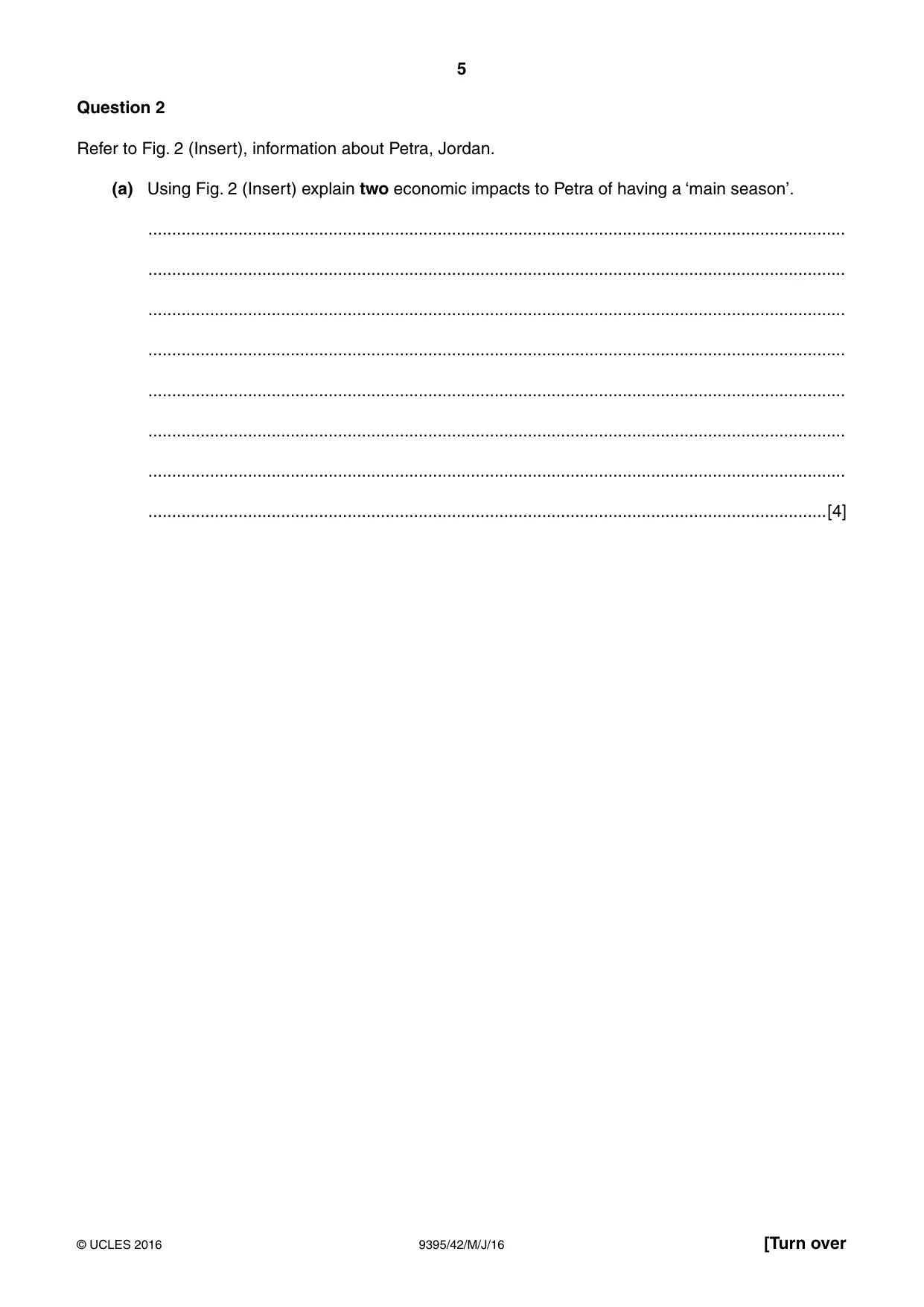
5 9395/42/M/J/16 © UCLES 2016 [Turn over Question 2 Refer to Fig. 2 (Insert), information about Petra, Jordan. (a) Using Fig. 2 (Insert) explain two economic impacts to Petra of having a ‘main season’. … … … … … … … …[4]
Question paper, page 6
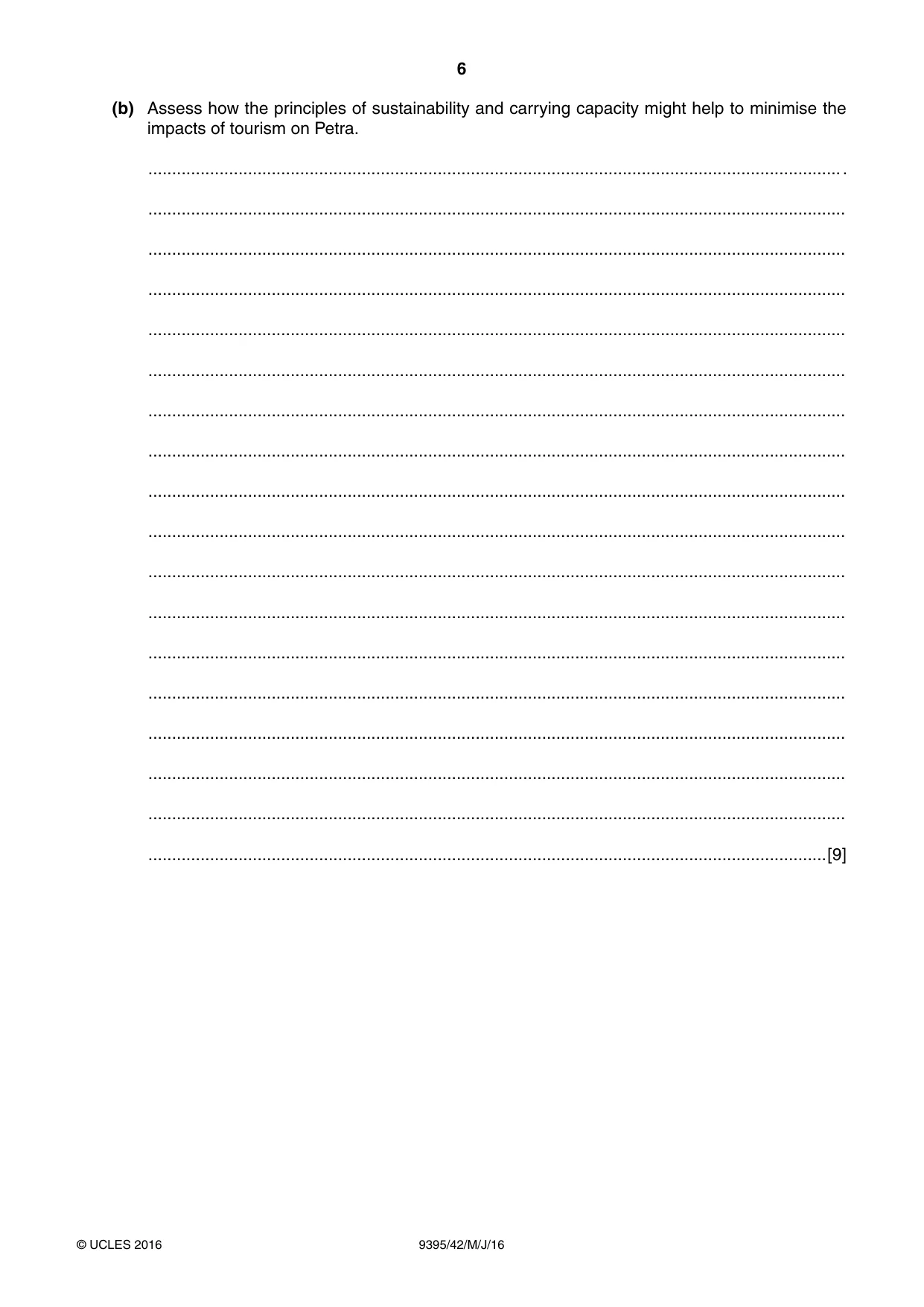
6 9395/42/M/J/16 © UCLES 2016 (b) Assess how the principles of sustainability and carrying capacity might help to minimise the impacts of tourism on Petra. … … … … … … … … … … … … … … … … … …[9]
Question paper, page 7
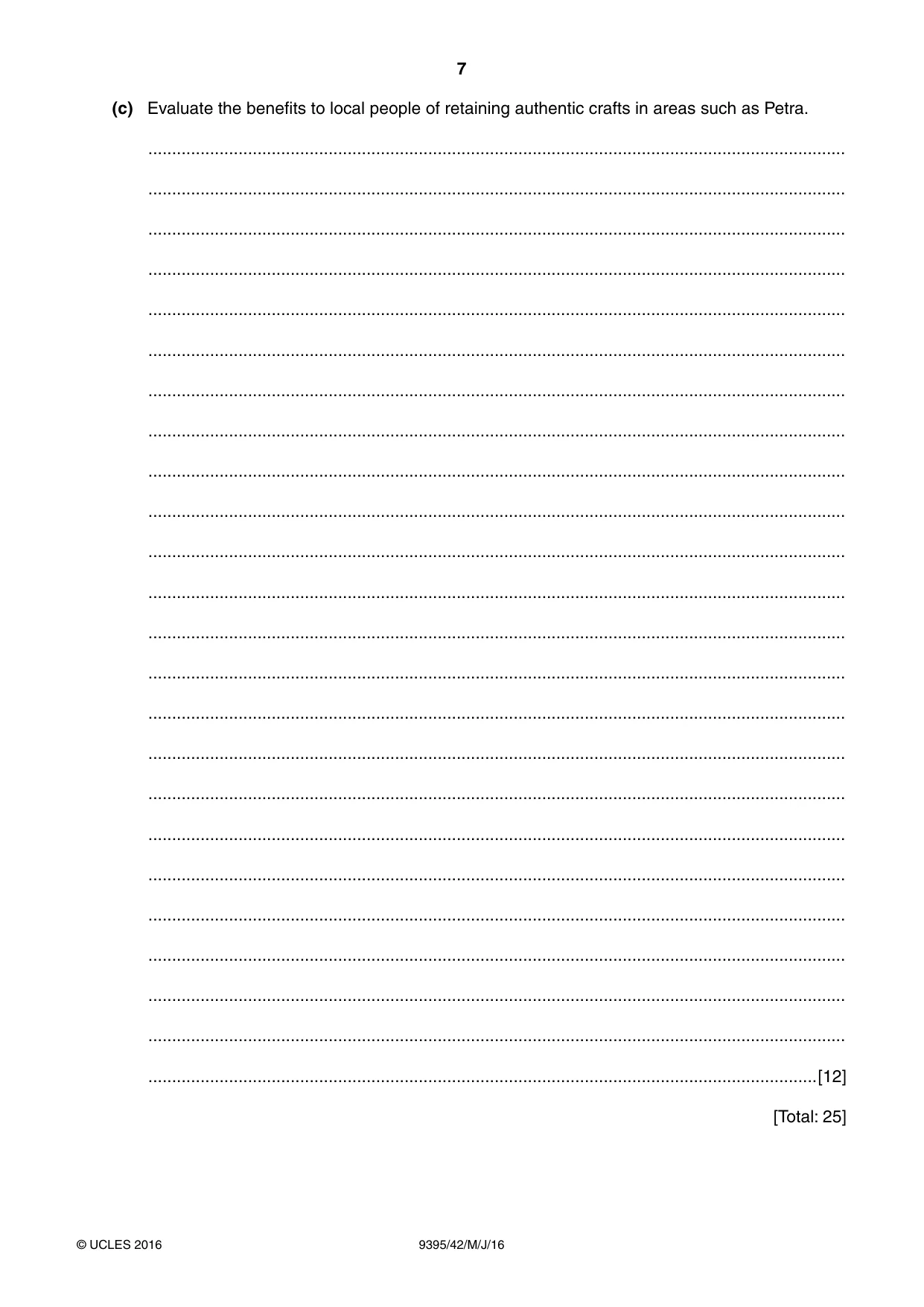
7 9395/42/M/J/16 © UCLES 2016 (c) Evaluate the benefits to local people of retaining authentic crafts in areas such as Petra. … … … … … … … … … … … … … … … … … … … … … … … …[12] [Total: 25]
Question paper, page 8
8 9395/42/M/J/16 © UCLES 2016 Permission to reproduce items where third-party owned material protected by copyright is included has been sought and cleared where possible. Every reasonable effort has been made by the publisher (UCLES) to trace copyright holders, but if any items requiring clearance have unwittingly been included, the publisher will be pleased to make amends at the earliest possible opportunity. To avoid the issue of disclosure of answer-related information to candidates, all copyright acknowledgements are reproduced online in the Cambridge International Examinations Copyright Acknowledgements Booklet. This is produced for each series of examinations and is freely available to download at www.cie.org.uk after the live examination series. Cambridge International Examinations is part of the Cambridge Assessment Group. Cambridge Assessment is the brand name of University of Cambridge Local Examinations Syndicate (UCLES), which is itself a department of the University of Cambridge. BLANK PAGE
Mark scheme, page 1
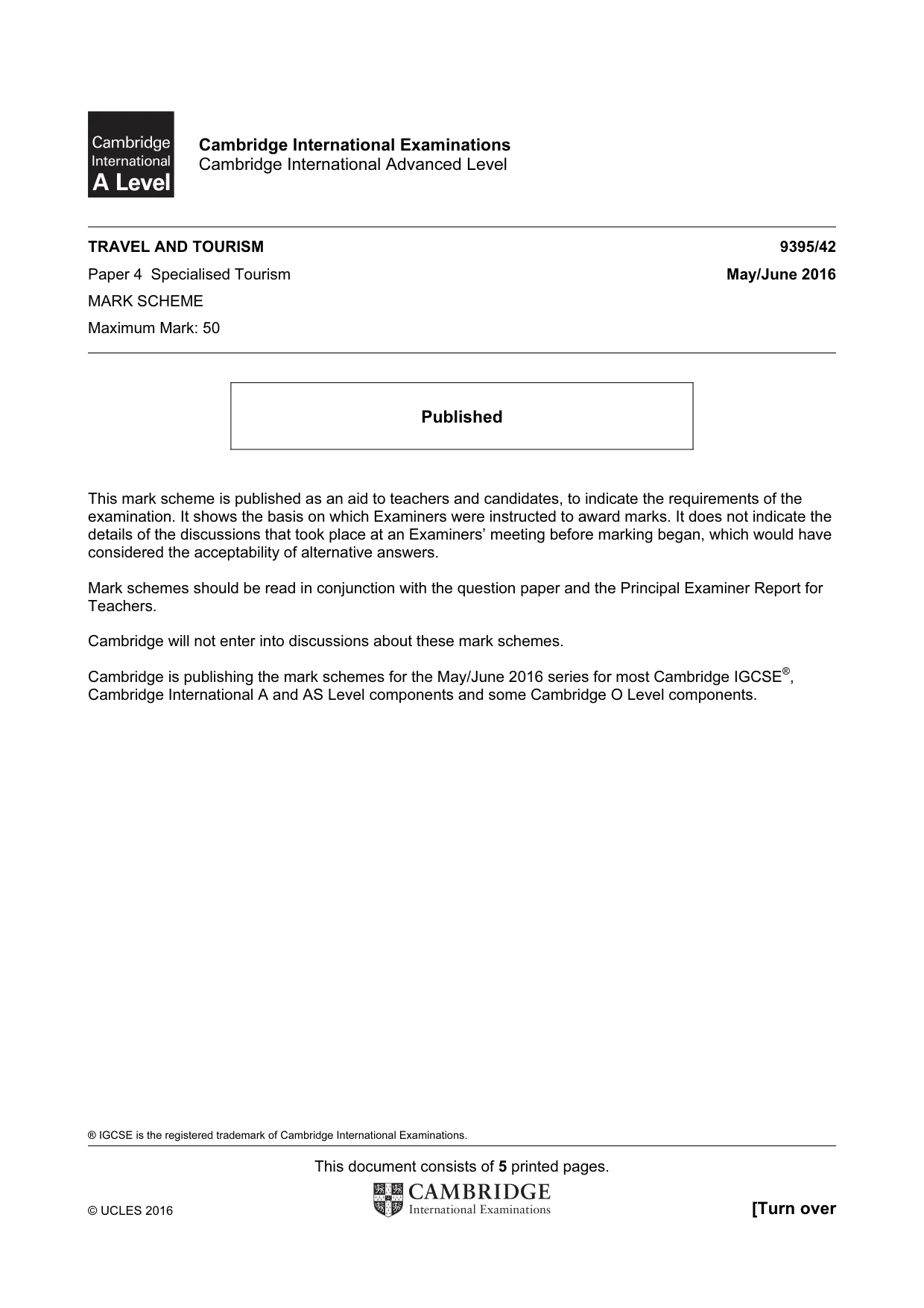
® IGCSE is the registered trademark of Cambridge International Examinations. This document consists of 5 printed pages. © UCLES 2016 [Turn over Cambridge International Examinations Cambridge International Advanced Level TRAVEL AND TOURISM 9395/42 Paper 4 Specialised Tourism May/June 2016 MARK SCHEME Maximum Mark: 50 Published This mark scheme is published as an aid to teachers and candidates, to indicate the requirements of the examination. It shows the basis on which Examiners were instructed to award marks. It does not indicate the details of the discussions that took place at an Examiners’ meeting before marking began, which would have considered the acceptability of alternative answers. Mark schemes should be read in conjunction with the question paper and the Principal Examiner Report for Teachers. Cambridge will not enter into discussions about these mark schemes. Cambridge is publishing the mark schemes for the May/June 2016 series for most Cambridge IGCSE®, Cambridge International A and AS Level components and some Cambridge O Level components.
Mark scheme, page 2
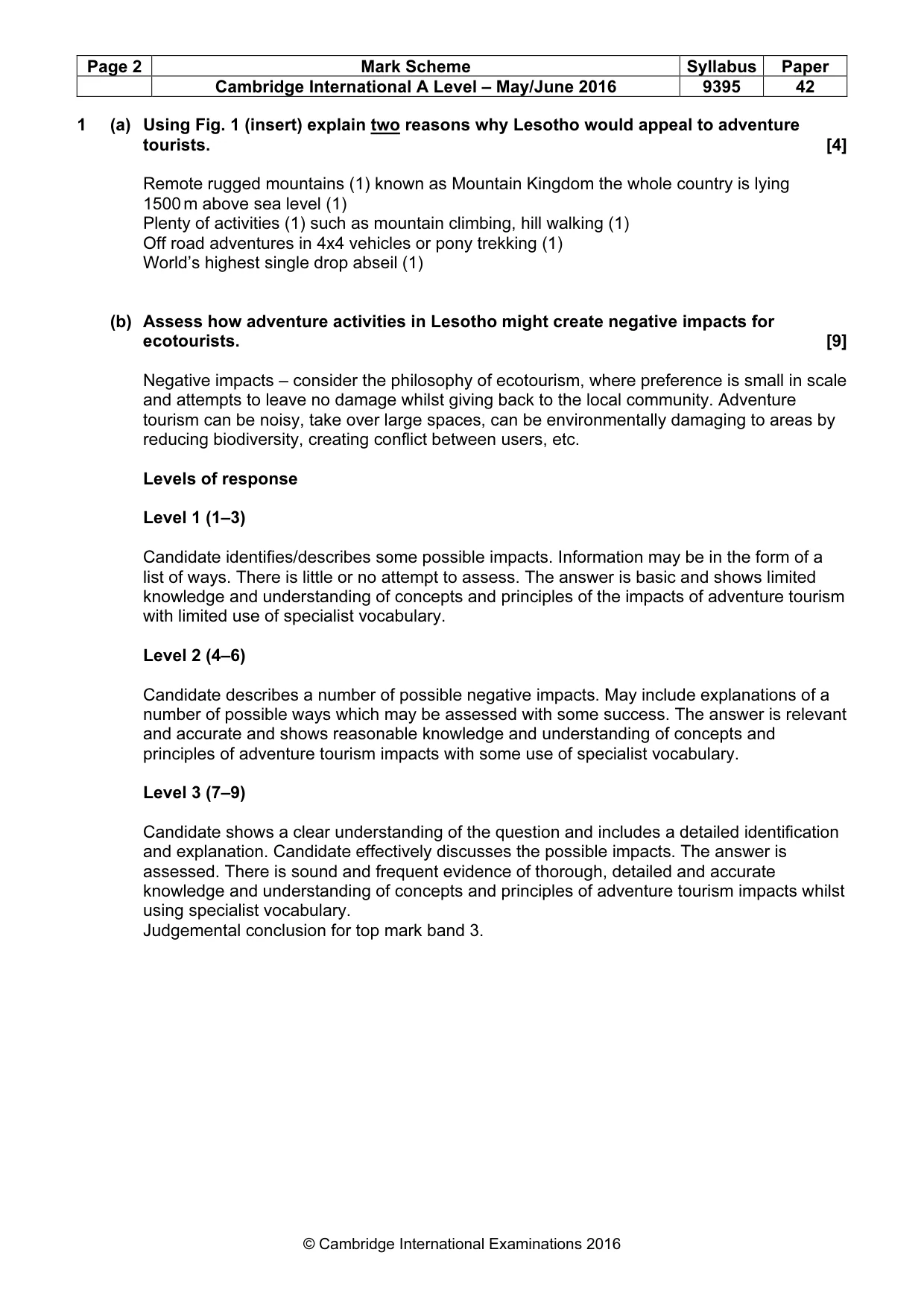
Page 2 Mark Scheme Syllabus Paper Cambridge International A Level – May/June 2016 9395 42 © Cambridge International Examinations 2016 1 (a) Using Fig. 1 (insert) explain two reasons why Lesotho would appeal to adventure tourists. [4] Remote rugged mountains (1) known as Mountain Kingdom the whole country is lying 1500 m above sea level (1) Plenty of activities (1) such as mountain climbing, hill walking (1) Off road adventures in 4x4 vehicles or pony trekking (1) World’s highest single drop abseil (1) (b) Assess how adventure activities in Lesotho might create negative impacts for ecotourists. [9] Negative impacts – consider the philosophy of ecotourism, where preference is small in scale and attempts to leave no damage whilst giving back to the local community. Adventure tourism can be noisy, take over large spaces, can be environmentally damaging to areas by reducing biodiversity, creating conflict between users, etc. Levels of response Level 1 (1–3) Candidate identifies/describes some possible impacts. Information may be in the form of a list of ways. There is little or no attempt to assess. The answer is basic and shows limited knowledge and understanding of concepts and principles of the impacts of adventure tourism with limited use of specialist vocabulary. Level 2 (4–6) Candidate describes a number of possible negative impacts. May include explanations of a number of possible ways which may be assessed with some success. The answer is relevant and accurate and shows reasonable knowledge and understanding of concepts and principles of adventure tourism impacts with some use of specialist vocabulary. Level 3 (7–9) Candidate shows a clear understanding of the question and includes a detailed identification and explanation. Candidate effectively discusses the possible impacts. The answer is assessed. There is sound and frequent evidence of thorough, detailed and accurate knowledge and understanding of concepts and principles of adventure tourism impacts whilst using specialist vocabulary. Judgemental conclusion for top mark band 3.
Mark scheme, page 3
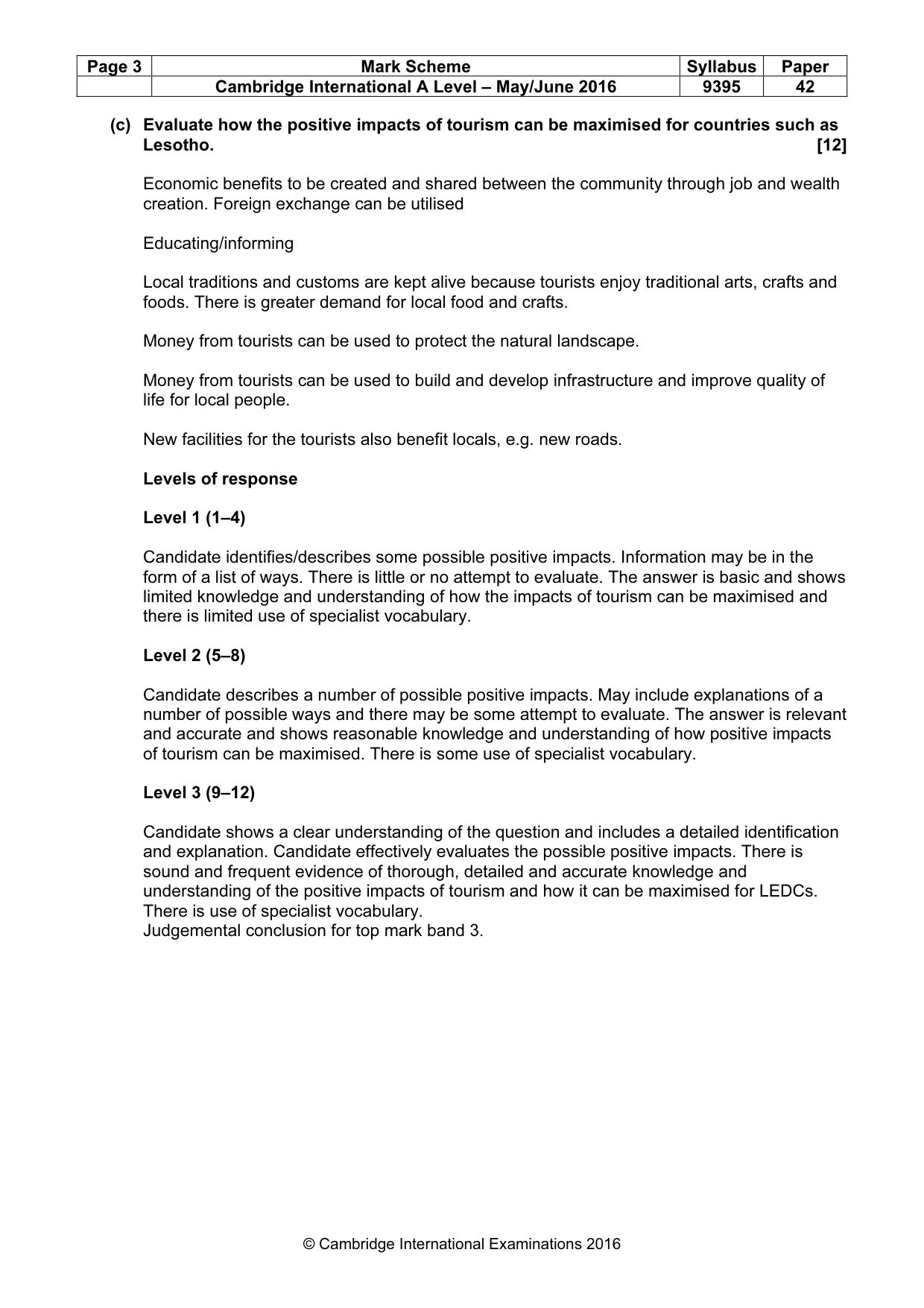
Page 3 Mark Scheme Syllabus Paper Cambridge International A Level – May/June 2016 9395 42 © Cambridge International Examinations 2016 (c) Evaluate how the positive impacts of tourism can be maximised for countries such as Lesotho. [12] Economic benefits to be created and shared between the community through job and wealth creation. Foreign exchange can be utilised Educating/informing Local traditions and customs are kept alive because tourists enjoy traditional arts, crafts and foods. There is greater demand for local food and crafts. Money from tourists can be used to protect the natural landscape. Money from tourists can be used to build and develop infrastructure and improve quality of life for local people. New facilities for the tourists also benefit locals, e.g. new roads. Levels of response Level 1 (1–4) Candidate identifies/describes some possible positive impacts. Information may be in the form of a list of ways. There is little or no attempt to evaluate. The answer is basic and shows limited knowledge and understanding of how the impacts of tourism can be maximised and there is limited use of specialist vocabulary. Level 2 (5–8) Candidate describes a number of possible positive impacts. May include explanations of a number of possible ways and there may be some attempt to evaluate. The answer is relevant and accurate and shows reasonable knowledge and understanding of how positive impacts of tourism can be maximised. There is some use of specialist vocabulary. Level 3 (9–12) Candidate shows a clear understanding of the question and includes a detailed identification and explanation. Candidate effectively evaluates the possible positive impacts. There is sound and frequent evidence of thorough, detailed and accurate knowledge and understanding of the positive impacts of tourism and how it can be maximised for LEDCs. There is use of specialist vocabulary. Judgemental conclusion for top mark band 3.
Mark scheme, page 4
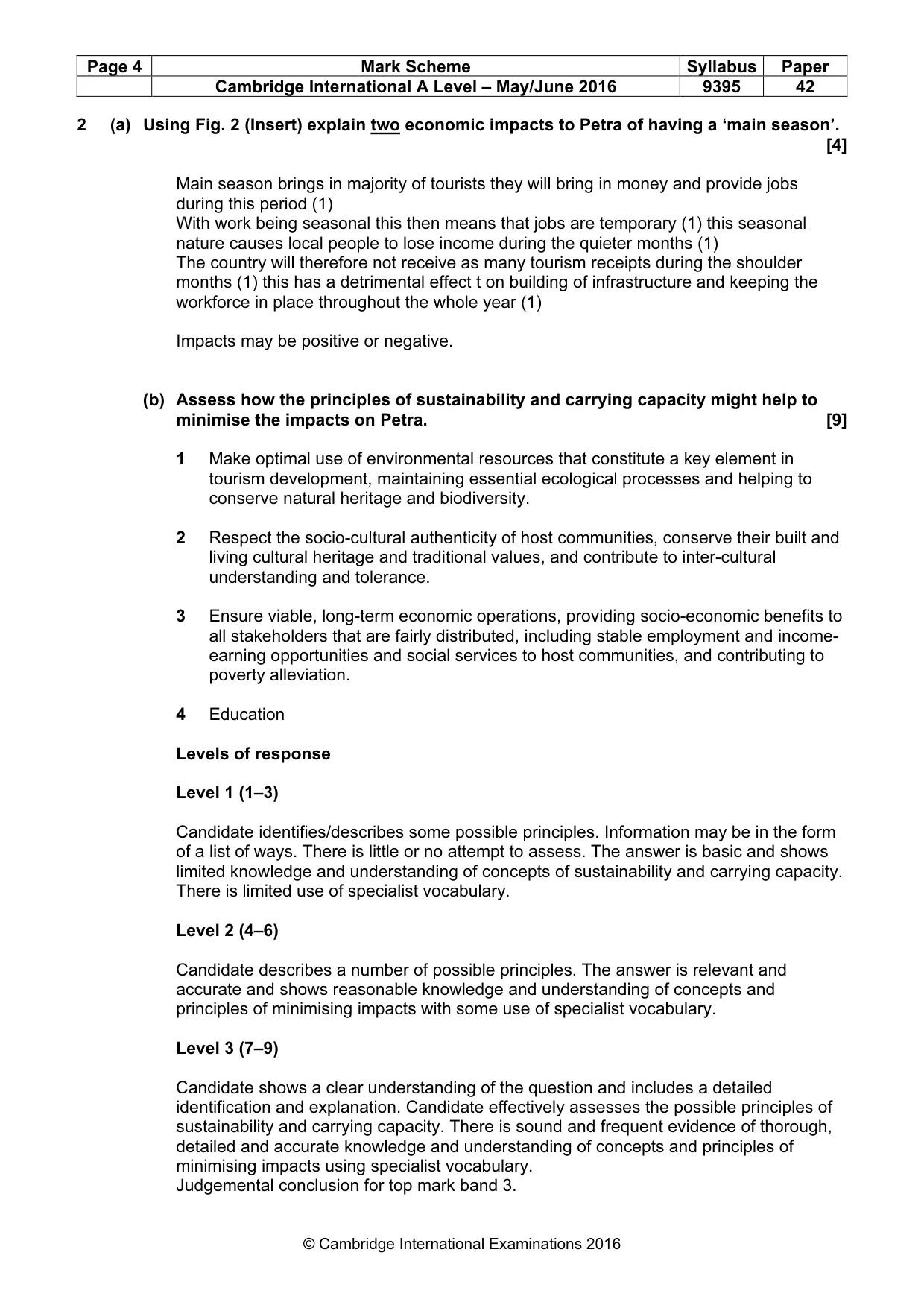
Page 4 Mark Scheme Syllabus Paper Cambridge International A Level – May/June 2016 9395 42 © Cambridge International Examinations 2016 2 (a) Using Fig. 2 (Insert) explain two economic impacts to Petra of having a ‘main season’. [4] Main season brings in majority of tourists they will bring in money and provide jobs during this period (1) With work being seasonal this then means that jobs are temporary (1) this seasonal nature causes local people to lose income during the quieter months (1) The country will therefore not receive as many tourism receipts during the shoulder months (1) this has a detrimental effect t on building of infrastructure and keeping the workforce in place throughout the whole year (1) Impacts may be positive or negative. (b) Assess how the principles of sustainability and carrying capacity might help to minimise the impacts on Petra. [9] 1 Make optimal use of environmental resources that constitute a key element in tourism development, maintaining essential ecological processes and helping to conserve natural heritage and biodiversity. 2 Respect the socio-cultural authenticity of host communities, conserve their built and living cultural heritage and traditional values, and contribute to inter-cultural understanding and tolerance. 3 Ensure viable, long-term economic operations, providing socio-economic benefits to all stakeholders that are fairly distributed, including stable employment and income- earning opportunities and social services to host communities, and contributing to poverty alleviation. 4 Education Levels of response Level 1 (1–3) Candidate identifies/describes some possible principles. Information may be in the form of a list of ways. There is little or no attempt to assess. The answer is basic and shows limited knowledge and understanding of concepts of sustainability and carrying capacity. There is limited use of specialist vocabulary. Level 2 (4–6) Candidate describes a number of possible principles. The answer is relevant and accurate and shows reasonable knowledge and understanding of concepts and principles of minimising impacts with some use of specialist vocabulary. Level 3 (7–9) Candidate shows a clear understanding of the question and includes a detailed identification and explanation. Candidate effectively assesses the possible principles of sustainability and carrying capacity. There is sound and frequent evidence of thorough, detailed and accurate knowledge and understanding of concepts and principles of minimising impacts using specialist vocabulary. Judgemental conclusion for top mark band 3.
Mark scheme, page 5
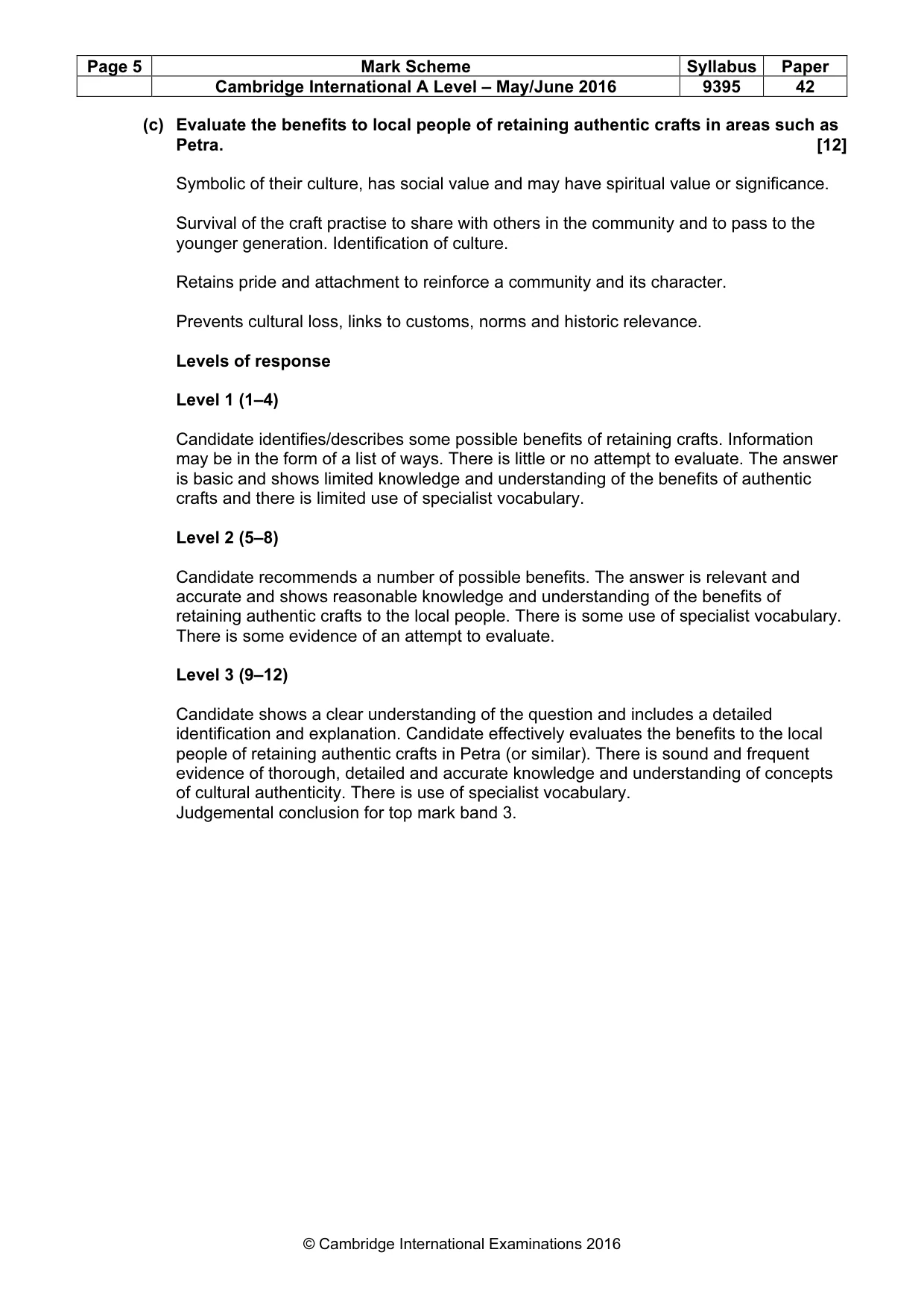
Page 5 Mark Scheme Syllabus Paper Cambridge International A Level – May/June 2016 9395 42 © Cambridge International Examinations 2016 (c) Evaluate the benefits to local people of retaining authentic crafts in areas such as Petra. [12] Symbolic of their culture, has social value and may have spiritual value or significance. Survival of the craft practise to share with others in the community and to pass to the younger generation. Identification of culture. Retains pride and attachment to reinforce a community and its character. Prevents cultural loss, links to customs, norms and historic relevance. Levels of response Level 1 (1–4) Candidate identifies/describes some possible benefits of retaining crafts. Information may be in the form of a list of ways. There is little or no attempt to evaluate. The answer is basic and shows limited knowledge and understanding of the benefits of authentic crafts and there is limited use of specialist vocabulary. Level 2 (5–8) Candidate recommends a number of possible benefits. The answer is relevant and accurate and shows reasonable knowledge and understanding of the benefits of retaining authentic crafts to the local people. There is some use of specialist vocabulary. There is some evidence of an attempt to evaluate. Level 3 (9–12) Candidate shows a clear understanding of the question and includes a detailed identification and explanation. Candidate effectively evaluates the benefits to the local people of retaining authentic crafts in Petra (or similar). There is sound and frequent evidence of thorough, detailed and accurate knowledge and understanding of concepts of cultural authenticity. There is use of specialist vocabulary. Judgemental conclusion for top mark band 3.
What you needed in this session
Cambridge’s own grade thresholds for 2016 May/June, Paper 4 · Variant 2. A higher threshold means an easier paper — the bar moves with how the cohort did.