Cambridge A Level Travel and Tourism 9395 — 2013 May/June Paper 4 · Variant 2
9395/42/M/J/13 · 50 marks · ≈56 min
The question paper and its mark scheme, free to read here and free to download. This is Cambridge’s own paper, exactly as it was sat.
Question paper8 pages

Mark scheme5 pages
Answers below. Sit the paper first if you are practising.
Paper as text
Question paper, page 1
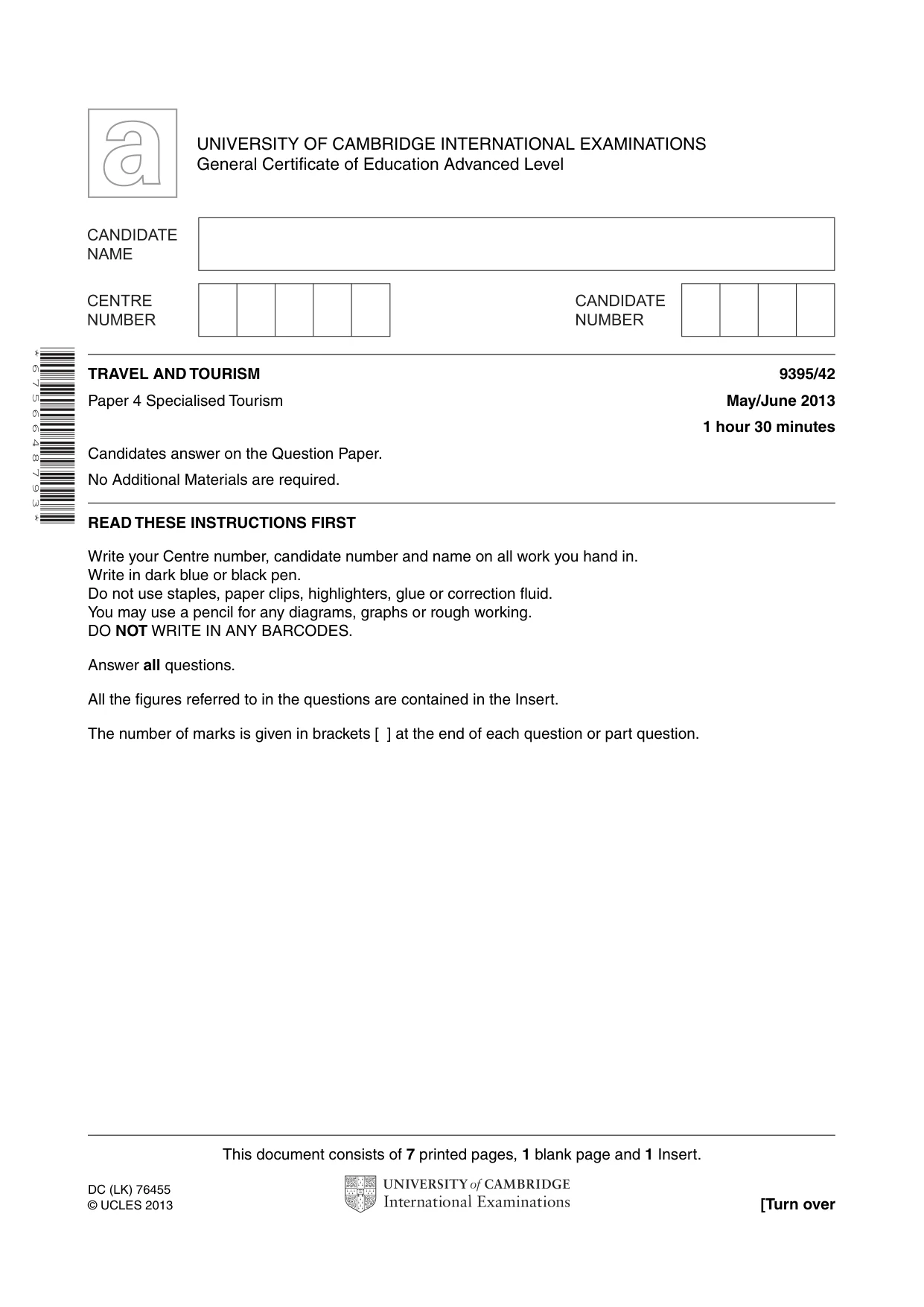
This document consists of 7 printed pages, 1 blank page and 1 Insert. DC (LK) 76455 © UCLES 2013 [Turn over UNIVERSITY OF CAMBRIDGE INTERNATIONAL EXAMINATIONS General Certificate of Education Advanced Level * 6 7 5 6 6 4 8 7 9 3 * TRAVEL AND TOURISM 9395/42 Paper 4 Specialised Tourism May/June 2013 1 hour 30 minutes Candidates answer on the Question Paper. No Additional Materials are required. READ THESE INSTRUCTIONS FIRST Write your Centre number, candidate number and name on all work you hand in. Write in dark blue or black pen. Do not use staples, paper clips, highlighters, glue or correction fluid. You may use a pencil for any diagrams, graphs or rough working. DO NOT WRITE IN ANY BARCODES. Answer all questions. All the figures referred to in the questions are contained in the Insert. The number of marks is given in brackets [ ] at the end of each question or part question.
Question paper, page 2
2 9395/42/M/J/13 © UCLES 2013 For Examiner’s Use Question 1 Refer to Fig. 1 (Insert), information about ecolodges within the Panna National Park in northern India. (a) Explain two reasons why tourists may not wish to visit Indian national parks. 1 … … … … 2 … … … …[4]
Question paper, page 3
3 9395/42/M/J/13 © UCLES 2013 [Turn over For Examiner’s Use (b) Evaluate how resorts, such as Sarai, help to raise awareness of ecotourism practices. … … … … … … … … … … … … … … … … … … … … … … … … … … …[9]
Question paper, page 4
4 9395/42/M/J/13 © UCLES 2013 For Examiner’s Use (c) Assess how the Sarai resort could help to reduce the negative sociocultural impacts of tourism in the area. … … … … … … … … … … … … … … … … … … … … … … … … … …[12] [Total: 25]
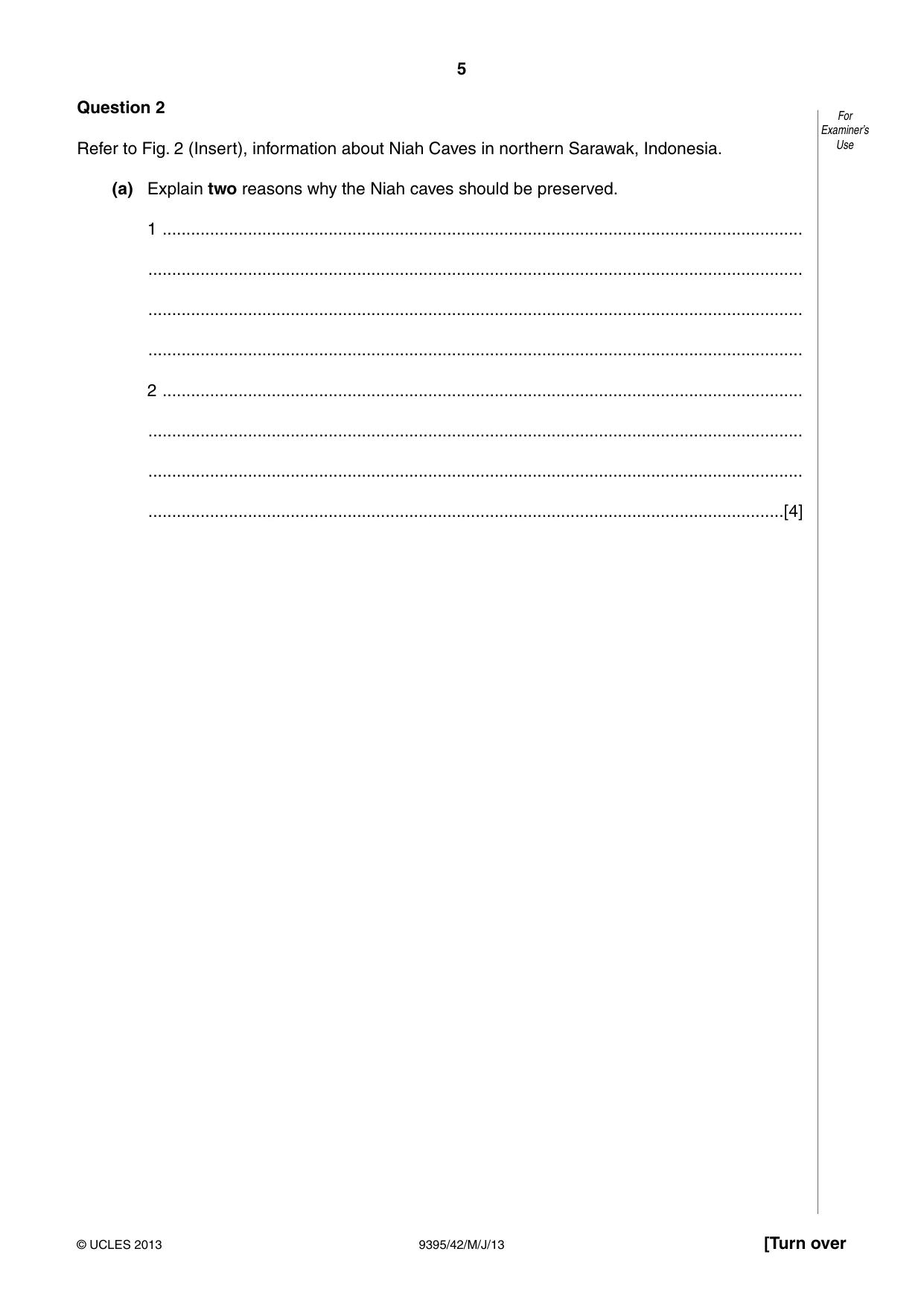
Question paper, page 5
5 9395/42/M/J/13 © UCLES 2013 [Turn over For Examiner’s Use Question 2 Refer to Fig. 2 (Insert), information about Niah Caves in northern Sarawak, Indonesia. (a) Explain two reasons why the Niah caves should be preserved. 1 … … … … 2 … … … …[4]
Question paper, page 6
6 9395/42/M/J/13 © UCLES 2013 For Examiner’s Use (b) Assess the likely benefits to the local people of a growth in adventure tourism in this area. … … … … … … … … … … … … … … … … … … … … … … … … … … …[9]
Question paper, page 7
7 9395/42/M/J/13 © UCLES 2013 For Examiner’s Use (c) Discuss possible policies that could be implemented to help manage negative environmental impacts at the caves. … … … … … … … … … … … … … … … … … … … … … … … … … …[12] [Total: 25]
Question paper, page 8
8 9395/42/M/J/13 © UCLES 2013 Permission to reproduce items where third-party owned material protected by copyright is included has been sought and cleared where possible. Every reasonable effort has been made by the publisher (UCLES) to trace copyright holders, but if any items requiring clearance have unwittingly been included, the publisher will be pleased to make amends at the earliest possible opportunity. University of Cambridge International Examinations is part of the Cambridge Assessment Group. Cambridge Assessment is the brand name of University of Cambridge Local Examinations Syndicate (UCLES), which is itself a department of the University of Cambridge. BLANK PAGE
Mark scheme, page 1
CAMBRIDGE INTERNATIONAL EXAMINATIONS GCE Advanced Level MARK SCHEME for the May/June 2013 series 9395 TRAVEL AND TOURISM 9395/42 Paper 4 (Specialised Tourism), maximum raw mark 50 This mark scheme is published as an aid to teachers and candidates, to indicate the requirements of the examination. It shows the basis on which Examiners were instructed to award marks. It does not indicate the details of the discussions that took place at an Examiners’ meeting before marking began, which would have considered the acceptability of alternative answers. Mark schemes should be read in conjunction with the question paper and the Principal Examiner Report for Teachers. Cambridge will not enter into discussions about these mark schemes. Cambridge is publishing the mark schemes for the May/June 2013 series for most IGCSE, GCE Advanced Level and Advanced Subsidiary Level components and some Ordinary Level components.
Mark scheme, page 2
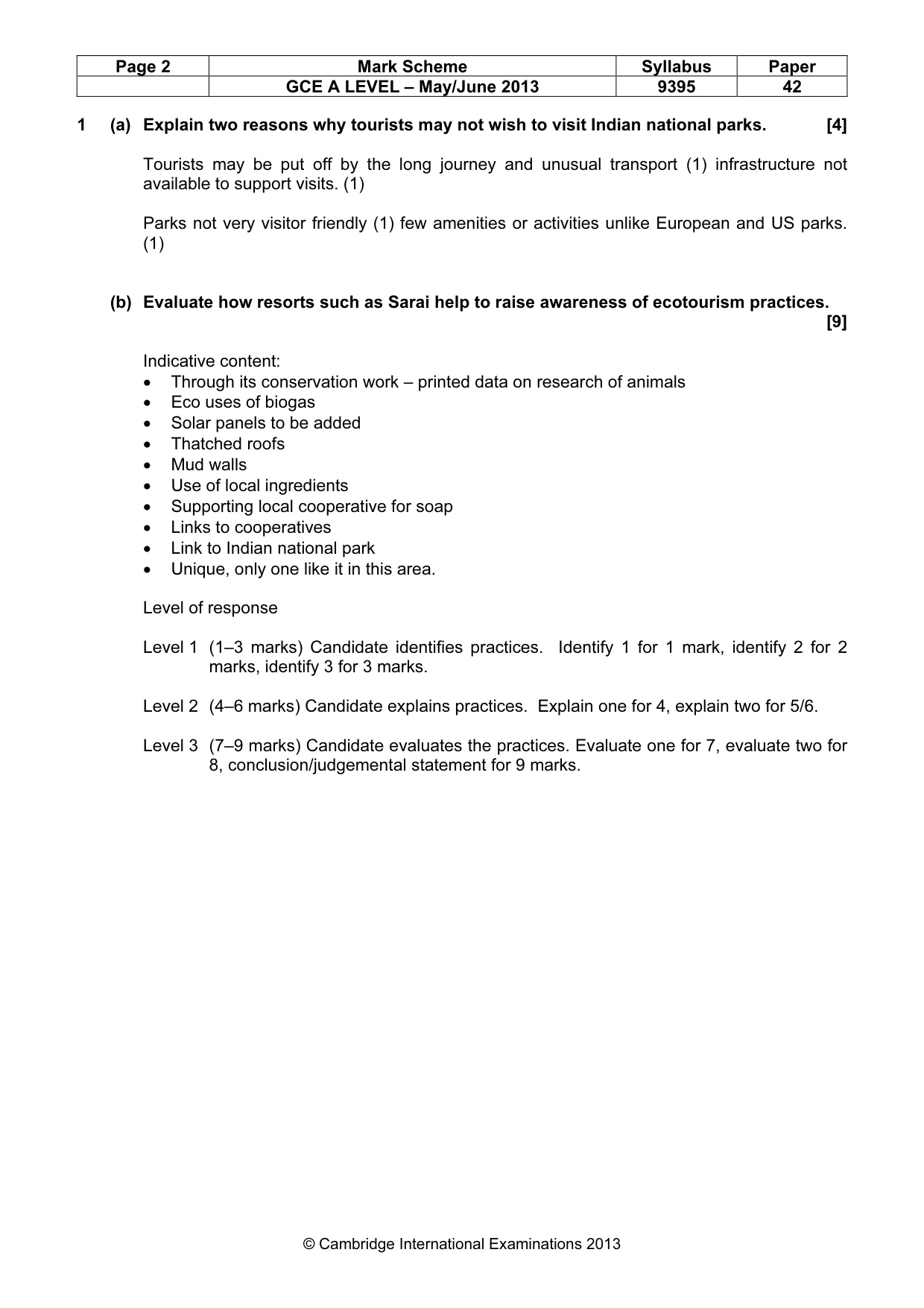
Page 2 Mark Scheme Syllabus Paper GCE A LEVEL – May/June 2013 9395 42 © Cambridge International Examinations 2013 1 (a) Explain two reasons why tourists may not wish to visit Indian national parks. [4] Tourists may be put off by the long journey and unusual transport (1) infrastructure not available to support visits. (1) Parks not very visitor friendly (1) few amenities or activities unlike European and US parks. (1) (b) Evaluate how resorts such as Sarai help to raise awareness of ecotourism practices. [9] Indicative content: • Through its conservation work – printed data on research of animals • Eco uses of biogas • Solar panels to be added • Thatched roofs • Mud walls • Use of local ingredients • Supporting local cooperative for soap • Links to cooperatives • Link to Indian national park • Unique, only one like it in this area. Level of response Level 1 (1–3 marks) Candidate identifies practices. Identify 1 for 1 mark, identify 2 for 2 marks, identify 3 for 3 marks. Level 2 (4–6 marks) Candidate explains practices. Explain one for 4, explain two for 5/6. Level 3 (7–9 marks) Candidate evaluates the practices. Evaluate one for 7, evaluate two for 8, conclusion/judgemental statement for 9 marks.
Mark scheme, page 3
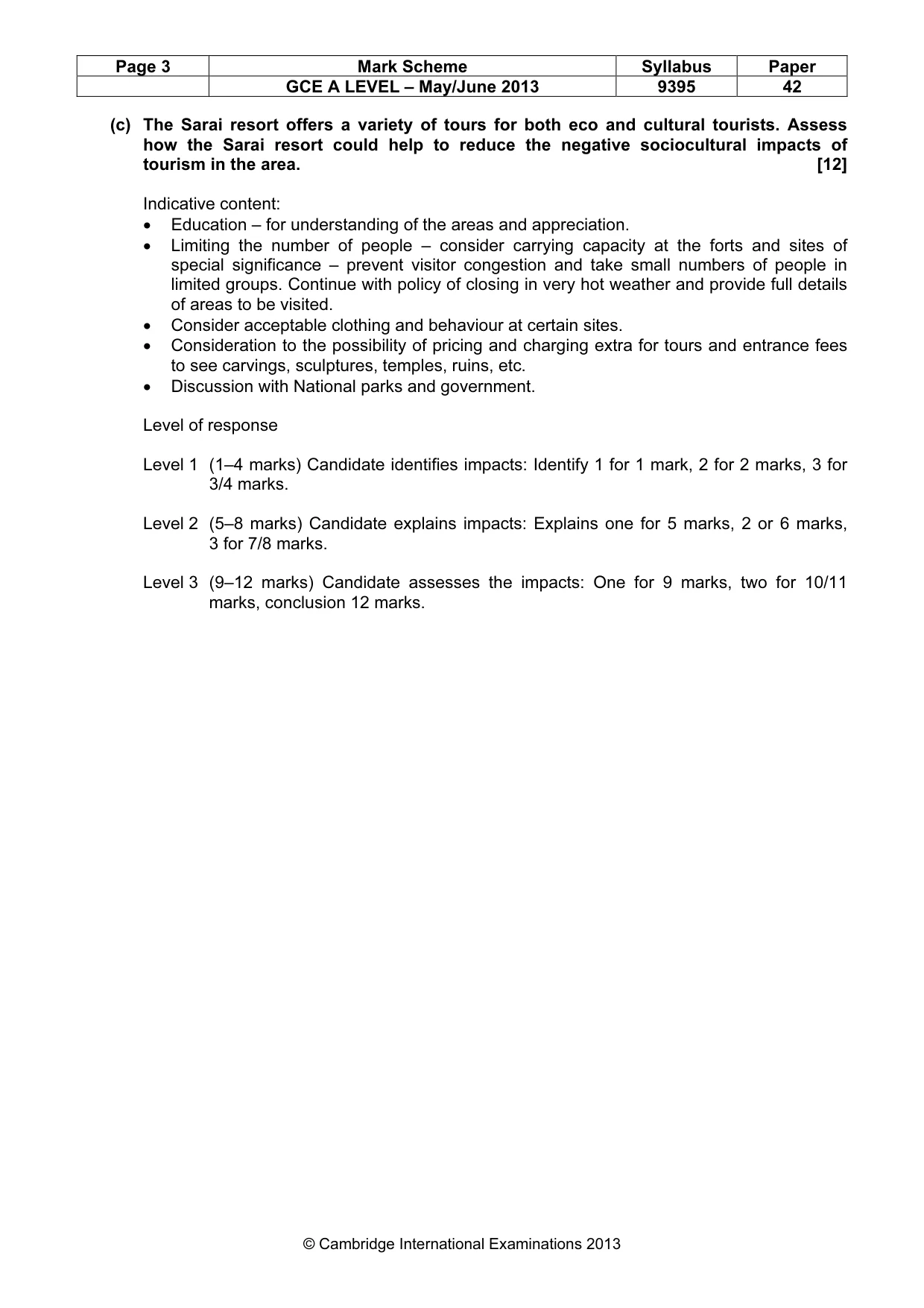
Page 3 Mark Scheme Syllabus Paper GCE A LEVEL – May/June 2013 9395 42 © Cambridge International Examinations 2013 (c) The Sarai resort offers a variety of tours for both eco and cultural tourists. Assess how the Sarai resort could help to reduce the negative sociocultural impacts of tourism in the area. [12] Indicative content: • Education – for understanding of the areas and appreciation. • Limiting the number of people – consider carrying capacity at the forts and sites of special significance – prevent visitor congestion and take small numbers of people in limited groups. Continue with policy of closing in very hot weather and provide full details of areas to be visited. • Consider acceptable clothing and behaviour at certain sites. • Consideration to the possibility of pricing and charging extra for tours and entrance fees to see carvings, sculptures, temples, ruins, etc. • Discussion with National parks and government. Level of response Level 1 (1–4 marks) Candidate identifies impacts: Identify 1 for 1 mark, 2 for 2 marks, 3 for 3/4 marks. Level 2 (5–8 marks) Candidate explains impacts: Explains one for 5 marks, 2 or 6 marks, 3 for 7/8 marks. Level 3 (9–12 marks) Candidate assesses the impacts: One for 9 marks, two for 10/11 marks, conclusion 12 marks.
Mark scheme, page 4
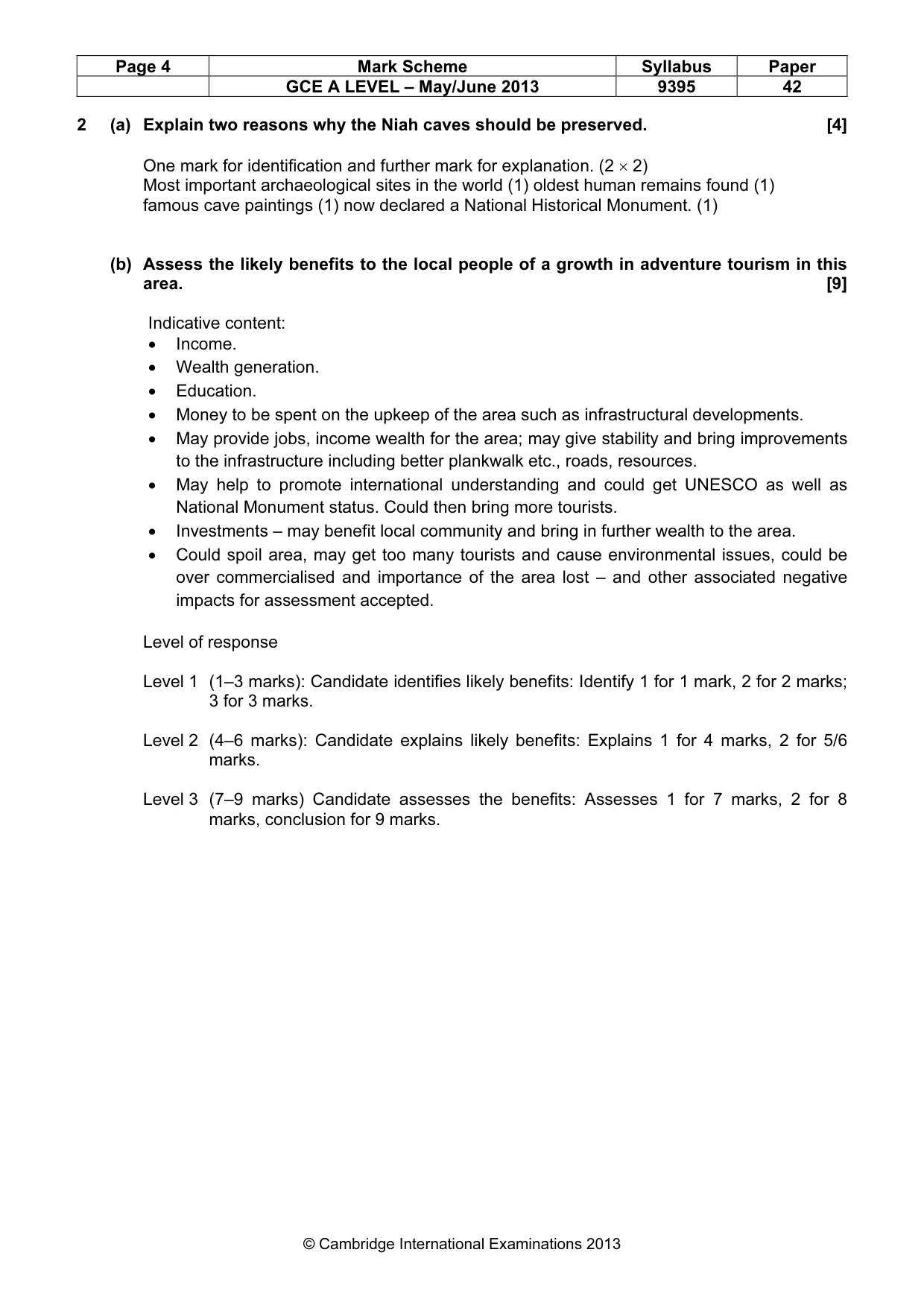
Page 4 Mark Scheme Syllabus Paper GCE A LEVEL – May/June 2013 9395 42 © Cambridge International Examinations 2013 2 (a) Explain two reasons why the Niah caves should be preserved. [4] One mark for identification and further mark for explanation. (2 × 2) Most important archaeological sites in the world (1) oldest human remains found (1) famous cave paintings (1) now declared a National Historical Monument. (1) (b) Assess the likely benefits to the local people of a growth in adventure tourism in this area. [9] Indicative content: • Income. • Wealth generation. • Education. • Money to be spent on the upkeep of the area such as infrastructural developments. • May provide jobs, income wealth for the area; may give stability and bring improvements to the infrastructure including better plankwalk etc., roads, resources. • May help to promote international understanding and could get UNESCO as well as National Monument status. Could then bring more tourists. • Investments – may benefit local community and bring in further wealth to the area. • Could spoil area, may get too many tourists and cause environmental issues, could be over commercialised and importance of the area lost – and other associated negative impacts for assessment accepted. Level of response Level 1 (1–3 marks): Candidate identifies likely benefits: Identify 1 for 1 mark, 2 for 2 marks; 3 for 3 marks. Level 2 (4–6 marks): Candidate explains likely benefits: Explains 1 for 4 marks, 2 for 5/6 marks. Level 3 (7–9 marks) Candidate assesses the benefits: Assesses 1 for 7 marks, 2 for 8 marks, conclusion for 9 marks.
Mark scheme, page 5
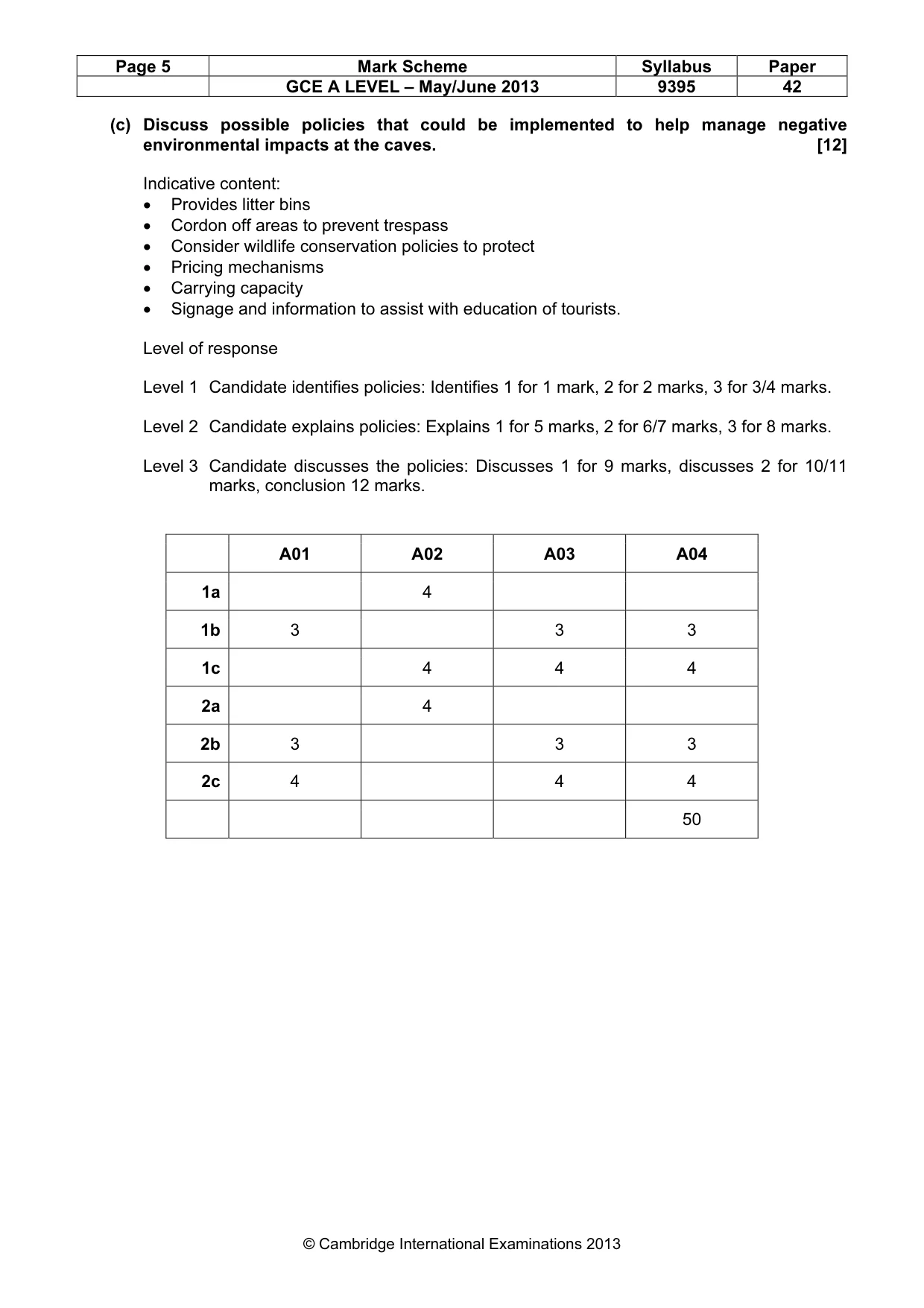
Page 5 Mark Scheme Syllabus Paper GCE A LEVEL – May/June 2013 9395 42 © Cambridge International Examinations 2013 (c) Discuss possible policies that could be implemented to help manage negative environmental impacts at the caves. [12] Indicative content: • Provides litter bins • Cordon off areas to prevent trespass • Consider wildlife conservation policies to protect • Pricing mechanisms • Carrying capacity • Signage and information to assist with education of tourists. Level of response Level 1 Candidate identifies policies: Identifies 1 for 1 mark, 2 for 2 marks, 3 for 3/4 marks. Level 2 Candidate explains policies: Explains 1 for 5 marks, 2 for 6/7 marks, 3 for 8 marks. Level 3 Candidate discusses the policies: Discusses 1 for 9 marks, discusses 2 for 10/11 marks, conclusion 12 marks. A01 A02 A03 A04 1a 4 1b 3 3 3 1c 4 4 4 2a 4 2b 3 3 3 2c 4 4 4 50
What you needed in this session
Cambridge’s own grade thresholds for 2013 May/June, Paper 4 · Variant 2. A higher threshold means an easier paper — the bar moves with how the cohort did.