Cambridge A Level Thinking Skills 9694 — 2022 Oct/Nov Paper 1 · Variant 2
9694/12/O/N/22 · 50 marks · ≈56 min
The question paper and its mark scheme, free to read here and free to download. This is Cambridge’s own paper, exactly as it was sat.
Question paper16 pages


Mark scheme9 pages
Answers below. Sit the paper first if you are practising.
Paper as text
Question paper, page 1
This document has 16 pages. Any blank pages are indicated. [Turn over DC (RW/CT) 303250/2 © UCLES 2022 * 8 3 4 5 6 1 5 1 9 9 * THINKING SKILLS 9694/12 Paper 1 Problem Solving October/November 2022 1 hour 30 minutes You must answer on the question paper. No additional materials are needed. INSTRUCTIONS ● Answer all questions. ● Use a black or dark blue pen. ● Write your name, centre number and candidate number in the boxes at the top of the page. ● Write your answer to each question in the space provided. ● Do not use an erasable pen or correction fluid. ● Do not write on any bar codes. ● You may use a calculator. ● Show your working. Where a final answer is incorrect or missing, you may still be awarded marks for correct steps towards a solution. In most questions, full marks will be awarded for a correct answer without any working. In some questions, however, you will not be awarded full marks if working needed to support an answer is not shown. INFORMATION ● The total mark for this paper is 50. ● The number of marks for each question or part question is shown in brackets [ ]. Cambridge International AS & A Level
Question paper, page 2
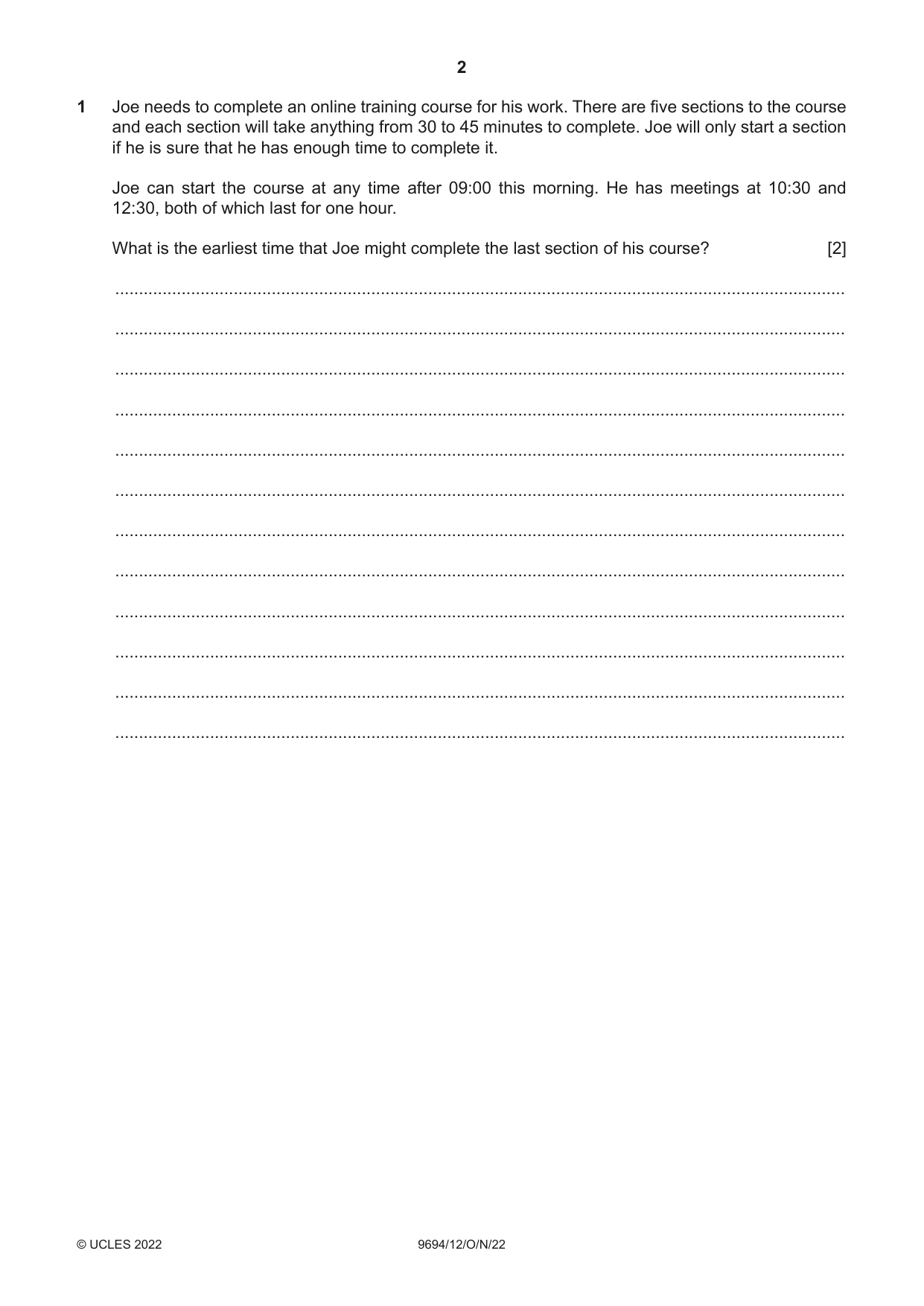
2 9694/12/O/N/22 © UCLES 2022 1 Joe needs to complete an online training course for his work. There are five sections to the course and each section will take anything from 30 to 45 minutes to complete. Joe will only start a section if he is sure that he has enough time to complete it. Joe can start the course at any time after 09:00 this morning. He has meetings at 10:30 and 12:30, both of which last for one hour. What is the earliest time that Joe might complete the last section of his course? [2] … … … … … … … … … … … …
Question paper, page 3
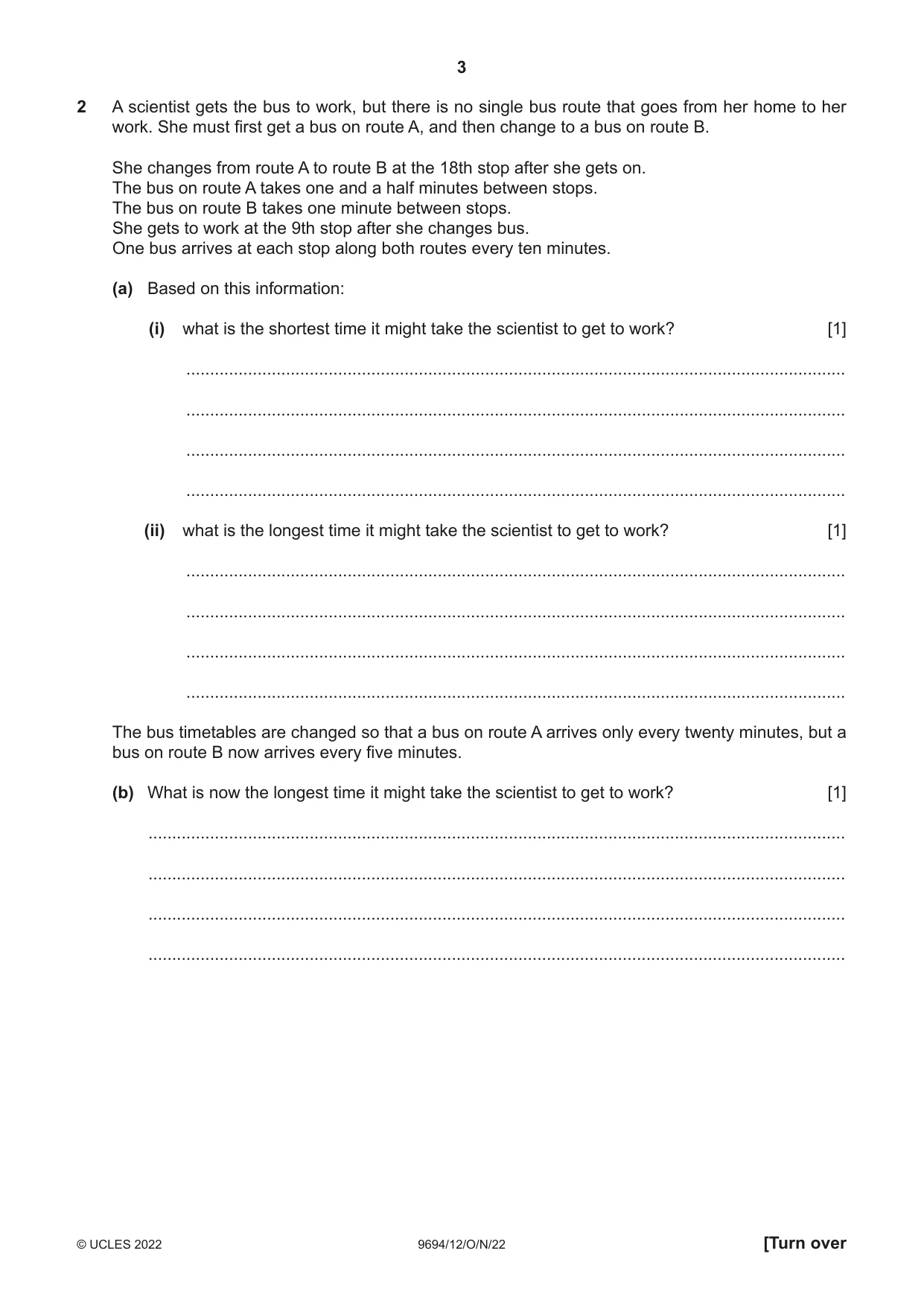
3 9694/12/O/N/22 © UCLES 2022 [Turn over 2 A scientist gets the bus to work, but there is no single bus route that goes from her home to her work. She must first get a bus on route A, and then change to a bus on route B. She changes from route A to route B at the 18th stop after she gets on. The bus on route A takes one and a half minutes between stops. The bus on route B takes one minute between stops. She gets to work at the 9th stop after she changes bus. One bus arrives at each stop along both routes every ten minutes. (a) Based on this information: (i) what is the shortest time it might take the scientist to get to work? [1] … … … … (ii) what is the longest time it might take the scientist to get to work? [1] … … … … The bus timetables are changed so that a bus on route A arrives only every twenty minutes, but a bus on route B now arrives every five minutes. (b) What is now the longest time it might take the scientist to get to work? [1] … … … …
Question paper, page 4
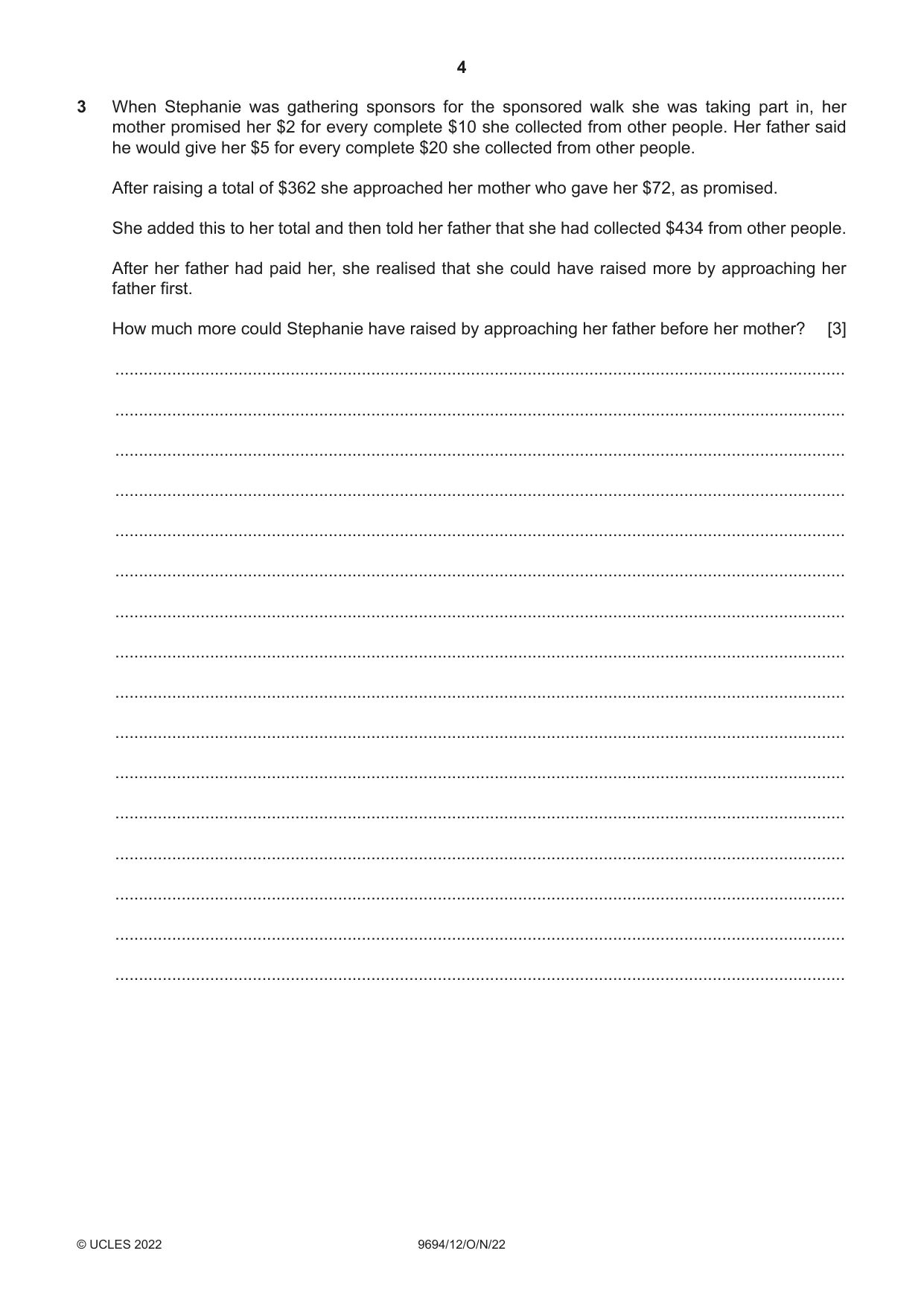
4 9694/12/O/N/22 © UCLES 2022 3 When Stephanie was gathering sponsors for the sponsored walk she was taking part in, her mother promised her $2 for every complete $10 she collected from other people. Her father said he would give her $5 for every complete $20 she collected from other people. After raising a total of $362 she approached her mother who gave her $72, as promised. She added this to her total and then told her father that she had collected $434 from other people. After her father had paid her, she realised that she could have raised more by approaching her father first. How much more could Stephanie have raised by approaching her father before her mother? [3] … … … … … … … … … … … … … … … …
Question paper, page 5
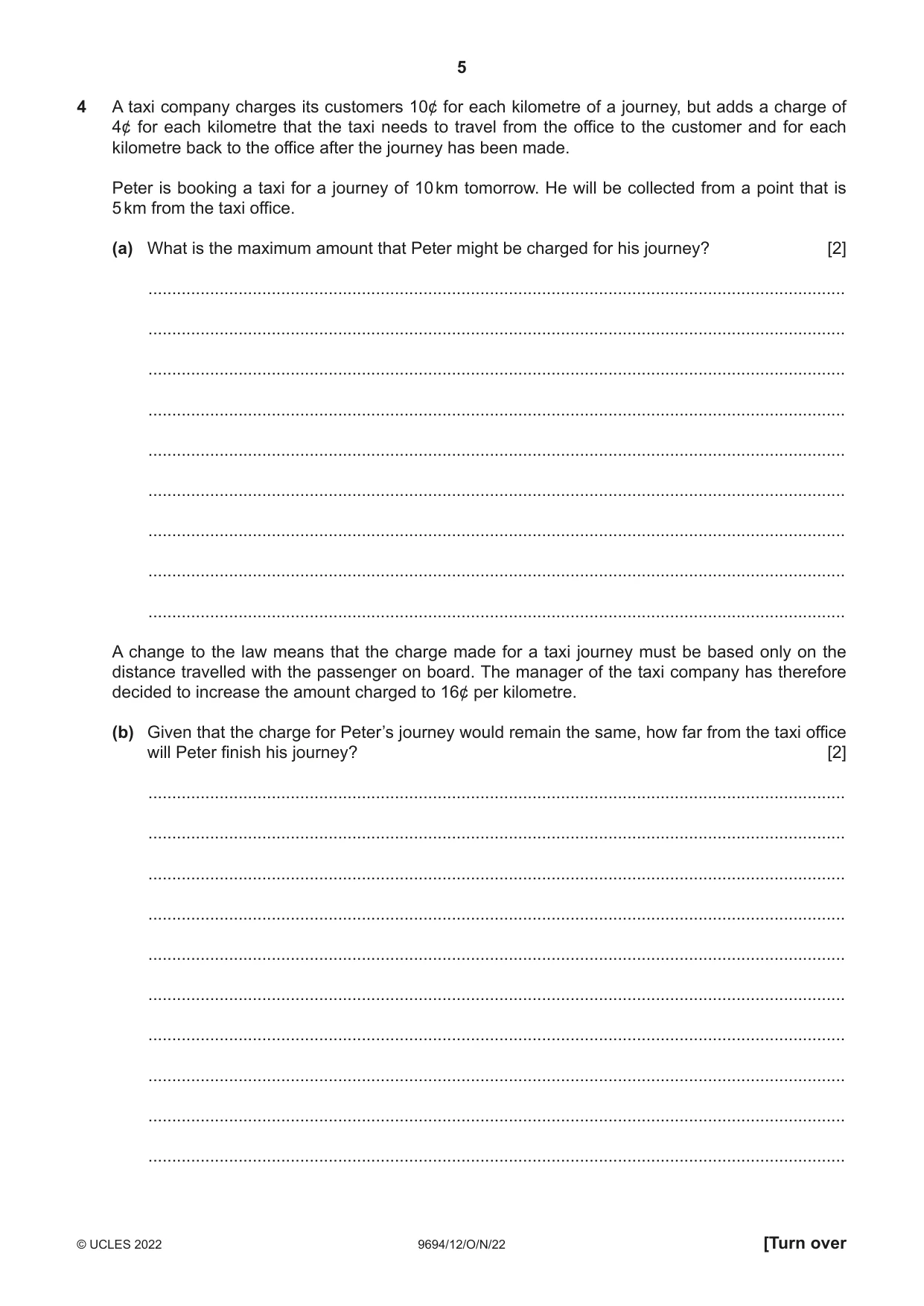
5 9694/12/O/N/22 © UCLES 2022 [Turn over 4 A taxi company charges its customers 10¢ for each kilometre of a journey, but adds a charge of 4¢ for each kilometre that the taxi needs to travel from the office to the customer and for each kilometre back to the office after the journey has been made. Peter is booking a taxi for a journey of 10 km tomorrow. He will be collected from a point that is 5 km from the taxi office. (a) What is the maximum amount that Peter might be charged for his journey? [2] … … … … … … … … … A change to the law means that the charge made for a taxi journey must be based only on the distance travelled with the passenger on board. The manager of the taxi company has therefore decided to increase the amount charged to 16¢ per kilometre. (b) Given that the charge for Peter’s journey would remain the same, how far from the taxi office will Peter finish his journey? [2] … … … … … … … … … …
Question paper, page 6
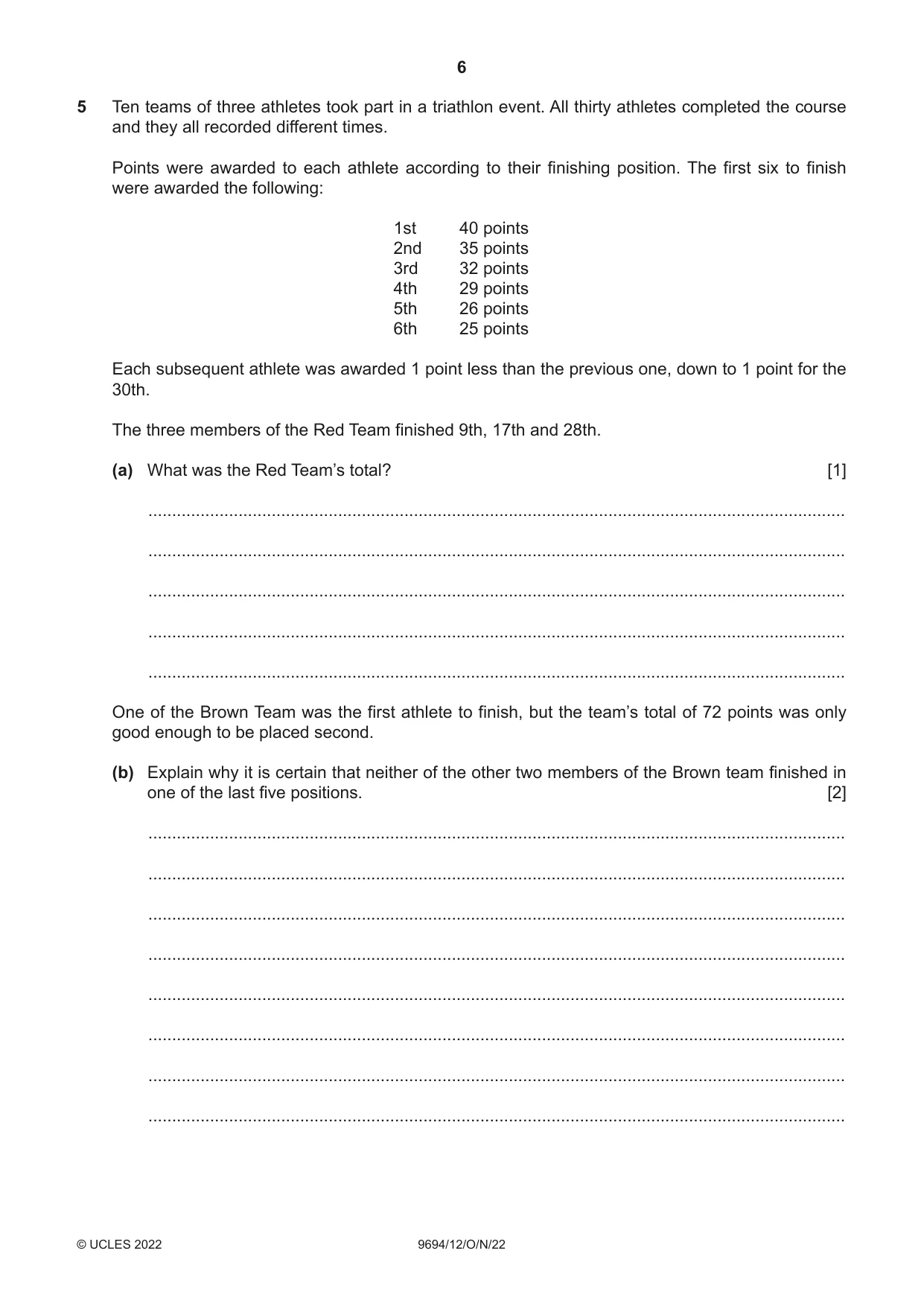
6 9694/12/O/N/22 © UCLES 2022 5 Ten teams of three athletes took part in a triathlon event. All thirty athletes completed the course and they all recorded different times. Points were awarded to each athlete according to their finishing position. The first six to finish were awarded the following: 1st 40 points 2nd 35 points 3rd 32 points 4th 29 points 5th 26 points 6th 25 points Each subsequent athlete was awarded 1 point less than the previous one, down to 1 point for the 30th. The three members of the Red Team finished 9th, 17th and 28th. (a) What was the Red Team’s total? [1] … … … … … One of the Brown Team was the first athlete to finish, but the team’s total of 72 points was only good enough to be placed second. (b) Explain why it is certain that neither of the other two members of the Brown team finished in one of the last five positions. [2] … … … … … … … …
Question paper, page 7
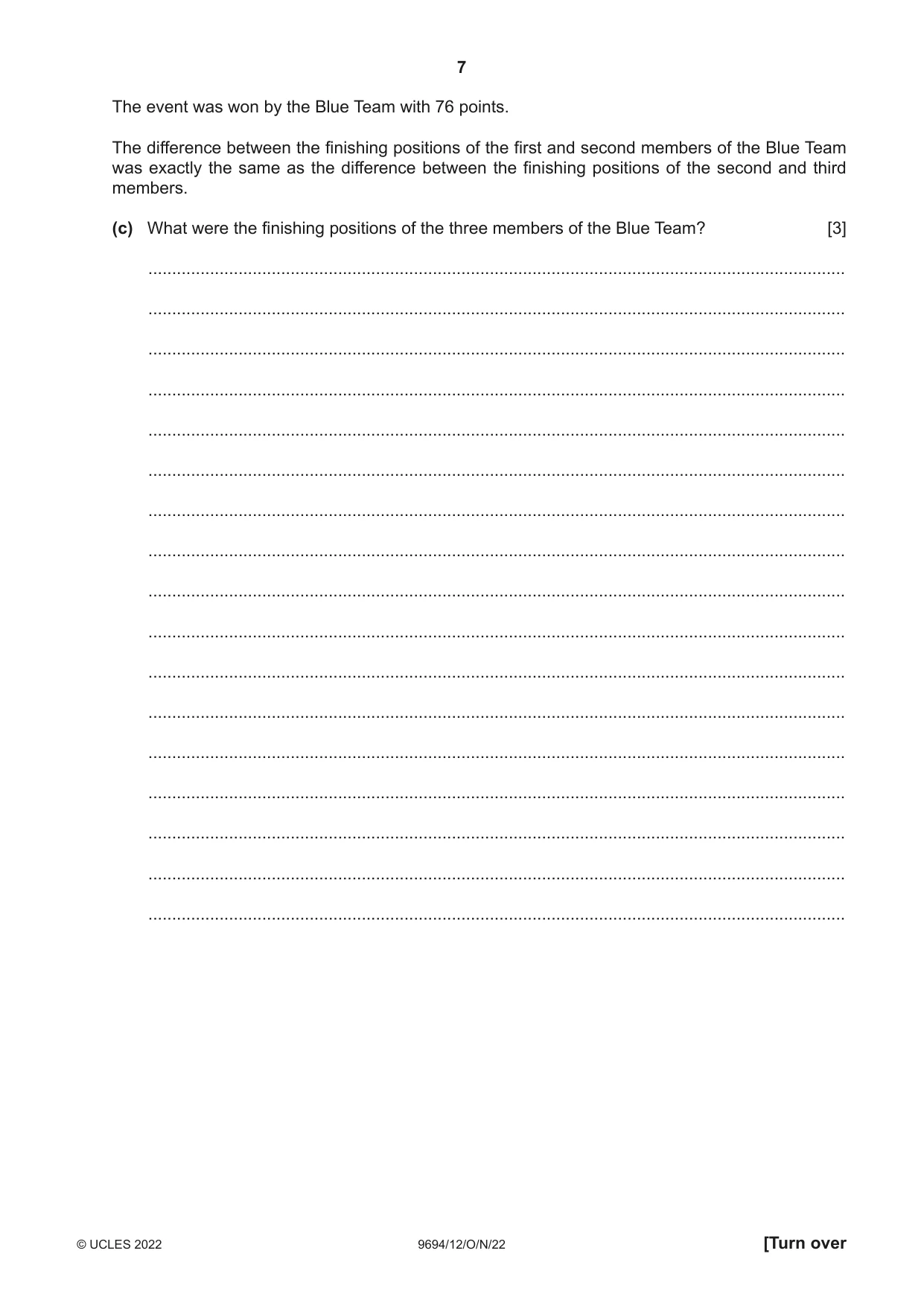
7 9694/12/O/N/22 © UCLES 2022 [Turn over The event was won by the Blue Team with 76 points. The difference between the finishing positions of the first and second members of the Blue Team was exactly the same as the difference between the finishing positions of the second and third members. (c) What were the finishing positions of the three members of the Blue Team? [3] … … … … … … … … … … … … … … … … …
Question paper, page 8
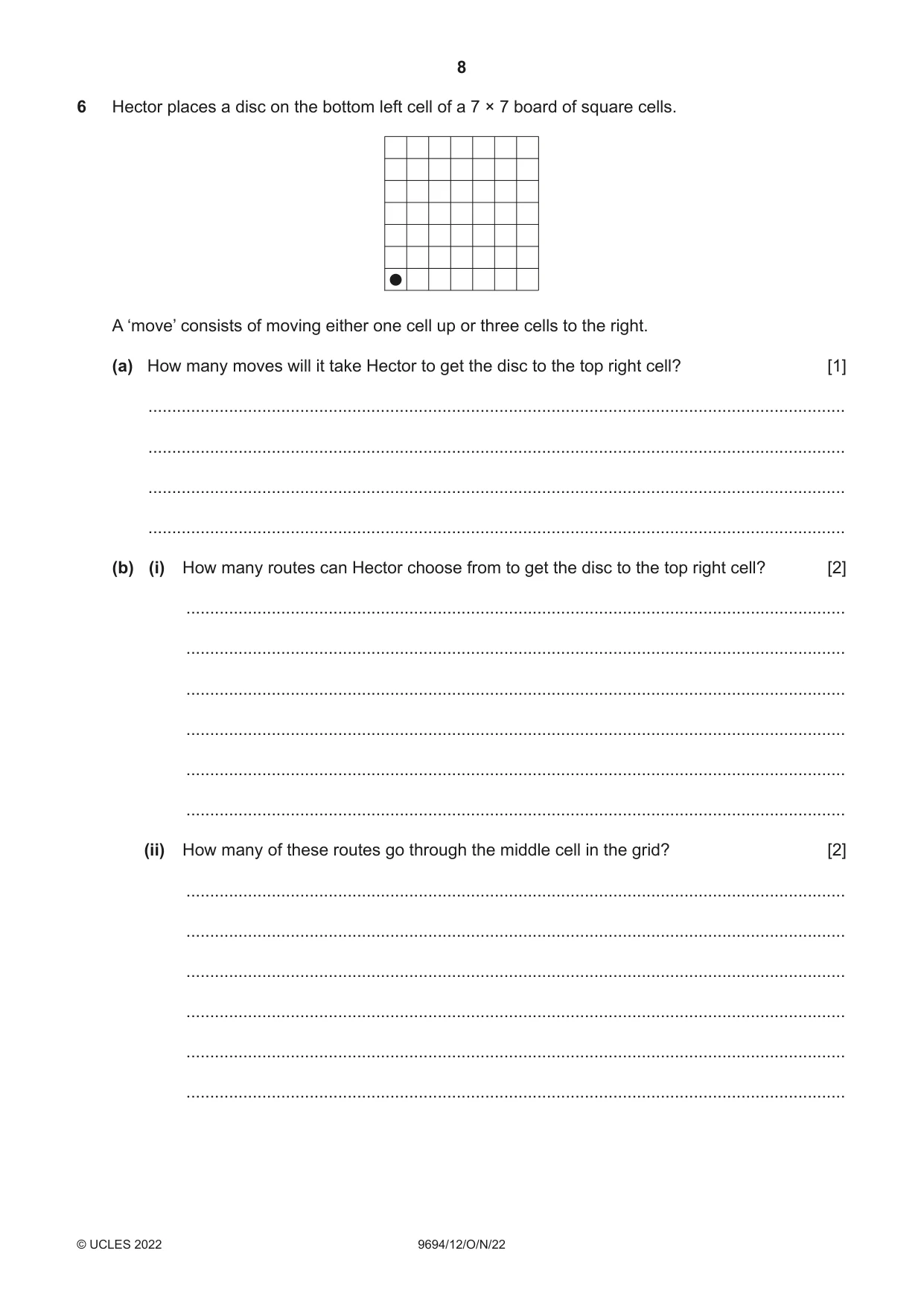
8 9694/12/O/N/22 © UCLES 2022 6 Hector places a disc on the bottom left cell of a 7 × 7 board of square cells. A ‘move’ consists of moving either one cell up or three cells to the right. (a) How many moves will it take Hector to get the disc to the top right cell? [1] … … … … (b) (i) How many routes can Hector choose from to get the disc to the top right cell? [2] … … … … … … (ii) How many of these routes go through the middle cell in the grid? [2] … … … … … …
Question paper, page 9
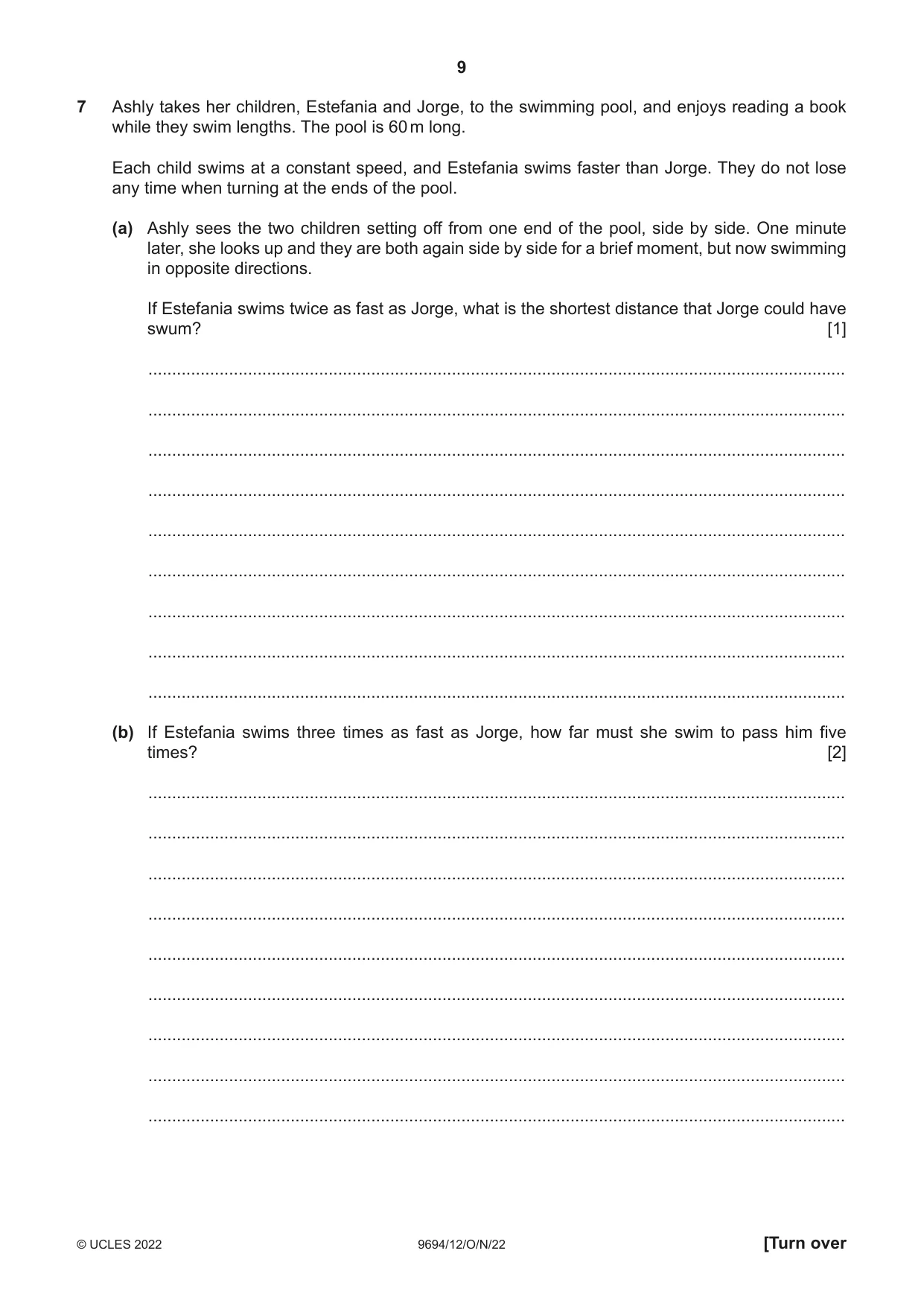
9 9694/12/O/N/22 © UCLES 2022 [Turn over 7 Ashly takes her children, Estefania and Jorge, to the swimming pool, and enjoys reading a book while they swim lengths. The pool is 60 m long. Each child swims at a constant speed, and Estefania swims faster than Jorge. They do not lose any time when turning at the ends of the pool. (a) Ashly sees the two children setting off from one end of the pool, side by side. One minute later, she looks up and they are both again side by side for a brief moment, but now swimming in opposite directions. If Estefania swims twice as fast as Jorge, what is the shortest distance that Jorge could have swum? [1] … … … … … … … … … (b) If Estefania swims three times as fast as Jorge, how far must she swim to pass him five times? [2] … … … … … … … … …
Question paper, page 10
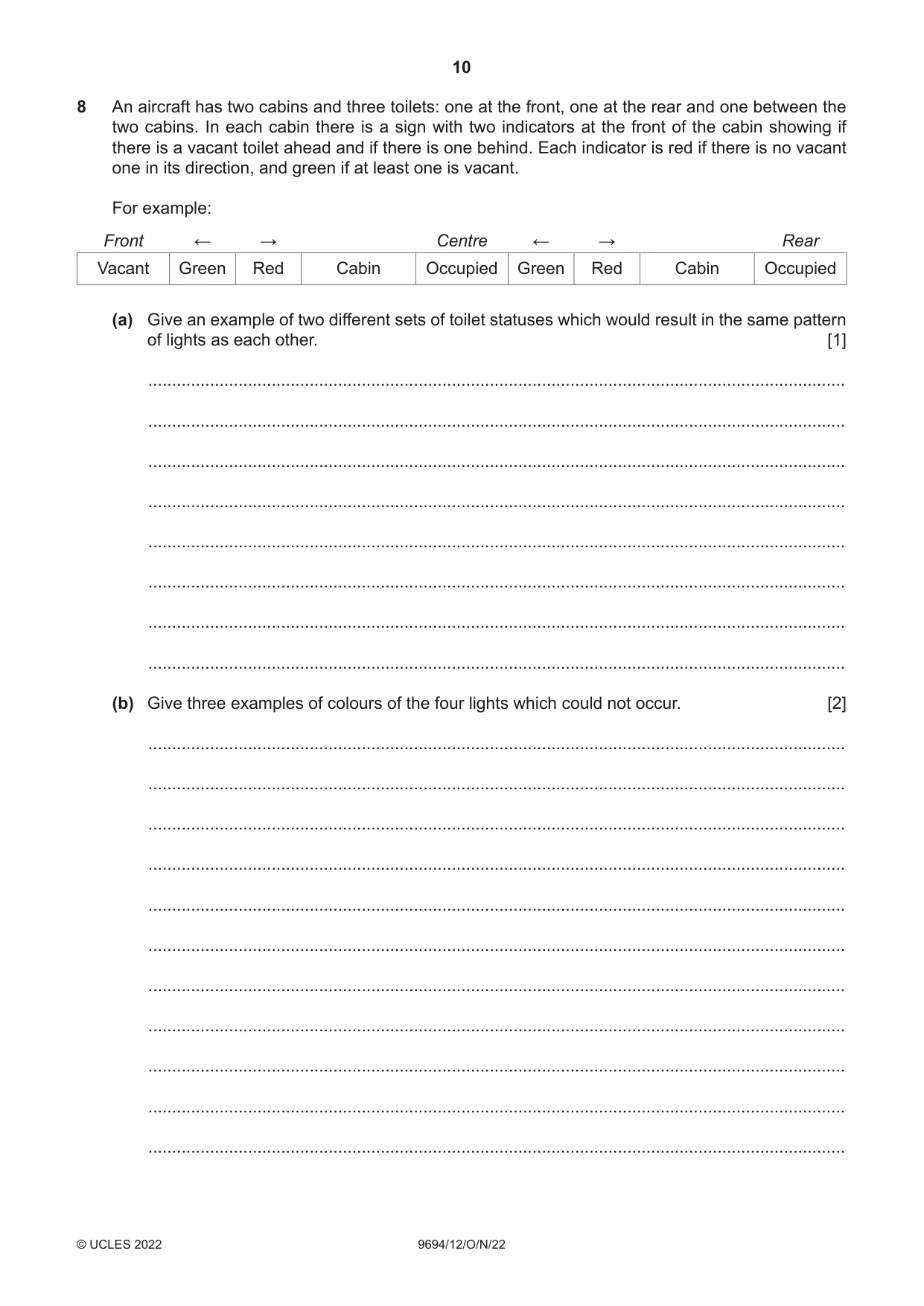
10 9694/12/O/N/22 © UCLES 2022 8 An aircraft has two cabins and three toilets: one at the front, one at the rear and one between the two cabins. In each cabin there is a sign with two indicators at the front of the cabin showing if there is a vacant toilet ahead and if there is one behind. Each indicator is red if there is no vacant one in its direction, and green if at least one is vacant. For example: Front ← → Centre ← → Rear Vacant Green Red Cabin Occupied Green Red Cabin Occupied (a) Give an example of two different sets of toilet statuses which would result in the same pattern of lights as each other. [1] … … … … … … … … (b) Give three examples of colours of the four lights which could not occur. [2] … … … … … … … … … … …
Question paper, page 11
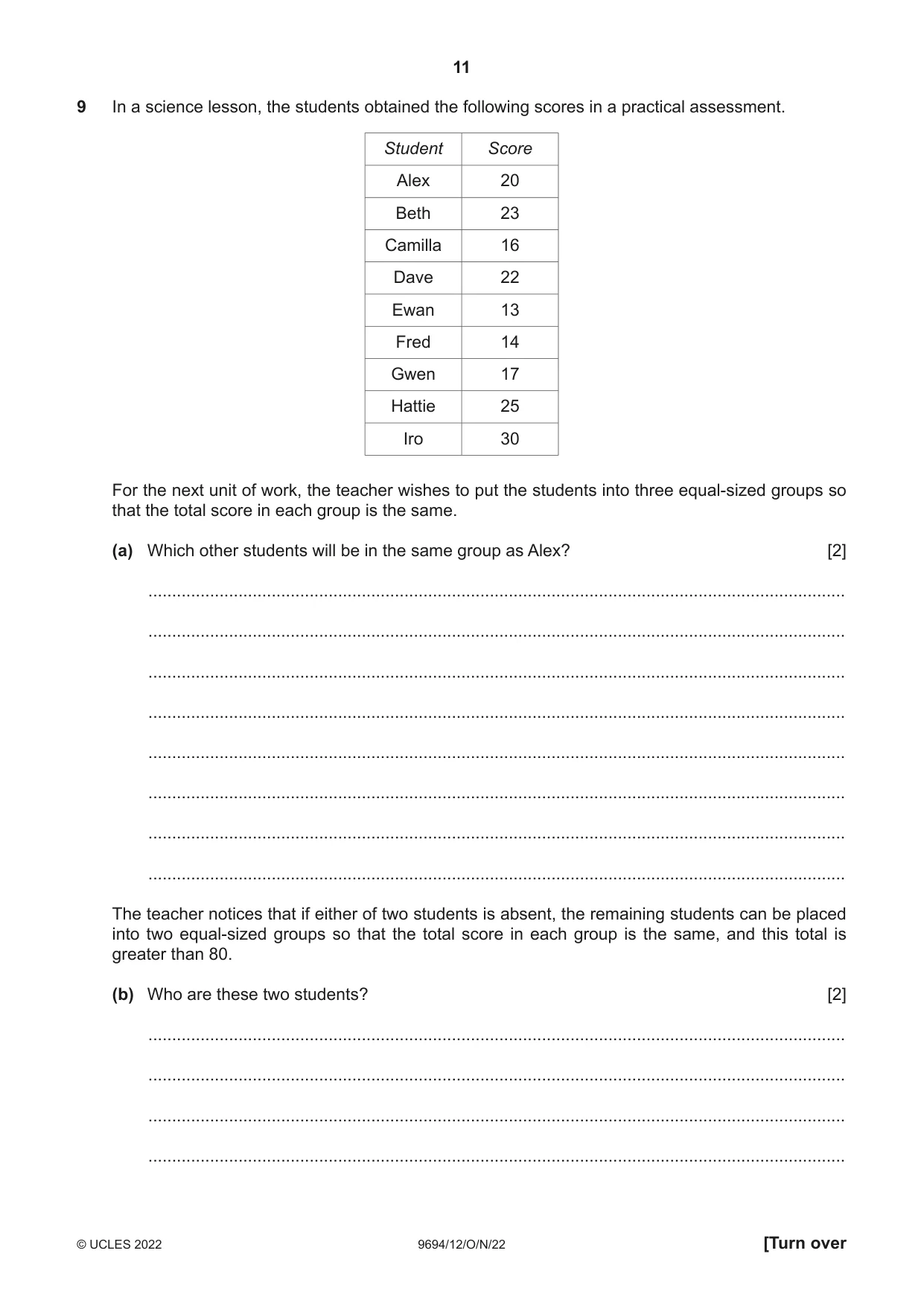
11 9694/12/O/N/22 © UCLES 2022 [Turn over 9 In a science lesson, the students obtained the following scores in a practical assessment. Student Score Alex 20 Beth 23 Camilla 16 Dave 22 Ewan 13 Fred 14 Gwen 17 Hattie 25 Iro 30 For the next unit of work, the teacher wishes to put the students into three equal-sized groups so that the total score in each group is the same. (a) Which other students will be in the same group as Alex? [2] … … … … … … … … The teacher notices that if either of two students is absent, the remaining students can be placed into two equal-sized groups so that the total score in each group is the same, and this total is greater than 80. (b) Who are these two students? [2] … … … …
Question paper, page 12
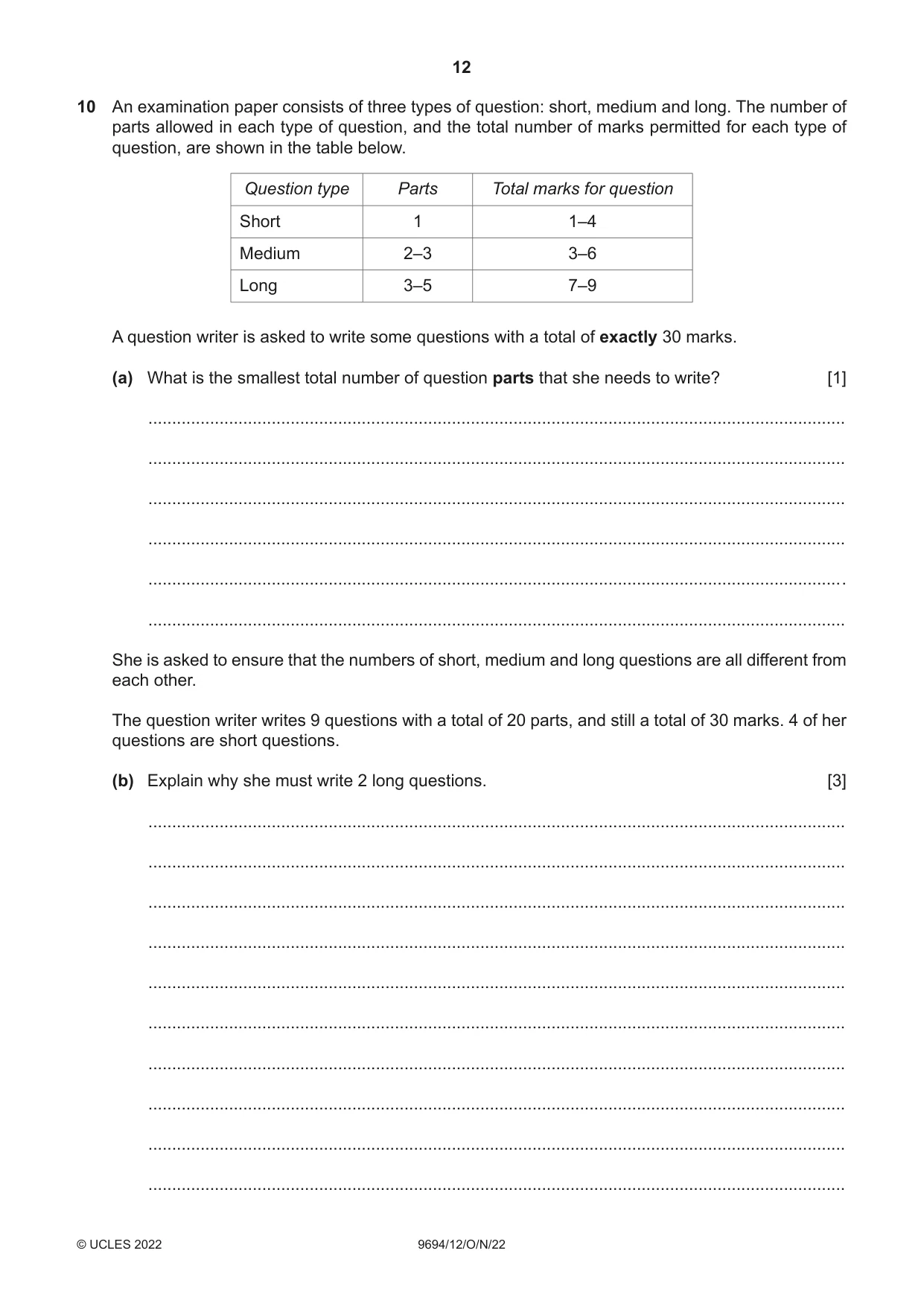
12 9694/12/O/N/22 © UCLES 2022 10 An examination paper consists of three types of question: short, medium and long. The number of parts allowed in each type of question, and the total number of marks permitted for each type of question, are shown in the table below. Question type Parts Total marks for question Short 1 1–4 Medium 2–3 3–6 Long 3–5 7–9 A question writer is asked to write some questions with a total of exactly 30 marks. (a) What is the smallest total number of question parts that she needs to write? [1] … … … … … … She is asked to ensure that the numbers of short, medium and long questions are all different from each other. The question writer writes 9 questions with a total of 20 parts, and still a total of 30 marks. 4 of her questions are short questions. (b) Explain why she must write 2 long questions. [3] … … … … … … … … … …
Question paper, page 13
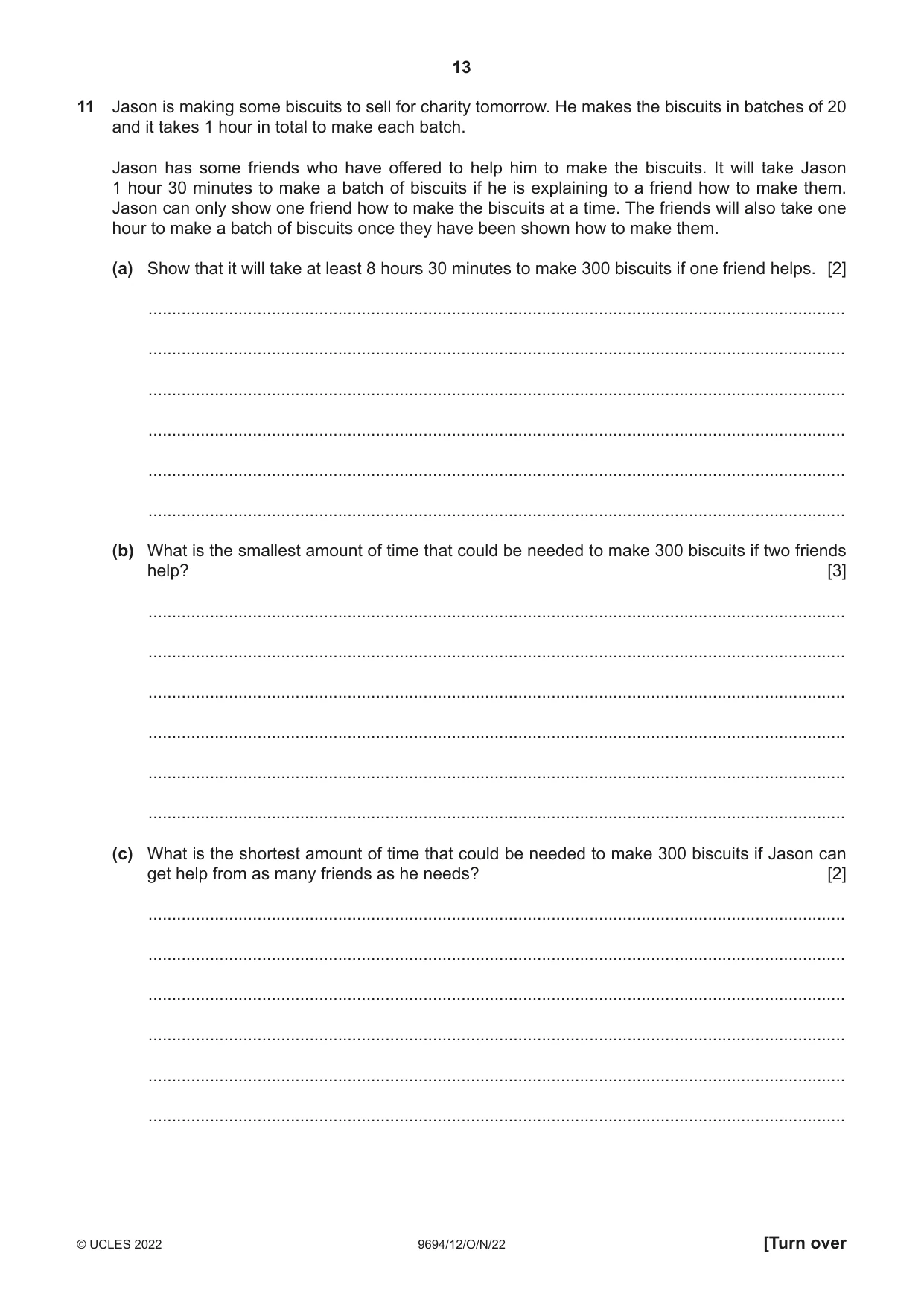
13 9694/12/O/N/22 © UCLES 2022 [Turn over 11 Jason is making some biscuits to sell for charity tomorrow. He makes the biscuits in batches of 20 and it takes 1 hour in total to make each batch. Jason has some friends who have offered to help him to make the biscuits. It will take Jason 1 hour 30 minutes to make a batch of biscuits if he is explaining to a friend how to make them. Jason can only show one friend how to make the biscuits at a time. The friends will also take one hour to make a batch of biscuits once they have been shown how to make them. (a) Show that it will take at least 8 hours 30 minutes to make 300 biscuits if one friend helps. [2] … … … … … … (b) What is the smallest amount of time that could be needed to make 300 biscuits if two friends help? [3] … … … … … … (c) What is the shortest amount of time that could be needed to make 300 biscuits if Jason can get help from as many friends as he needs? [2] … … … … … …
Question paper, page 14
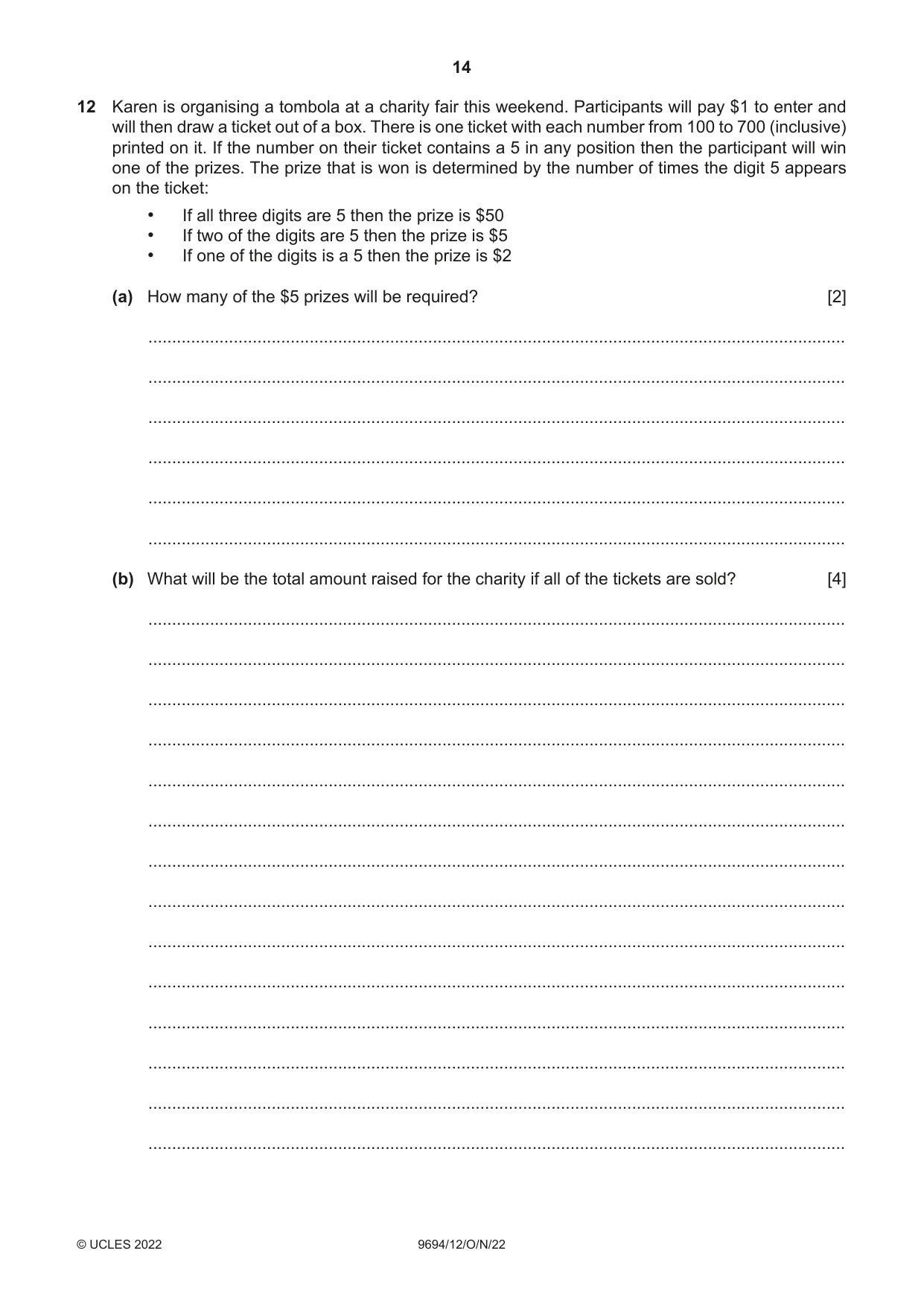
14 9694/12/O/N/22 © UCLES 2022 12 Karen is organising a tombola at a charity fair this weekend. Participants will pay $1 to enter and will then draw a ticket out of a box. There is one ticket with each number from 100 to 700 (inclusive) printed on it. If the number on their ticket contains a 5 in any position then the participant will win one of the prizes. The prize that is won is determined by the number of times the digit 5 appears on the ticket: • If all three digits are 5 then the prize is $50 • If two of the digits are 5 then the prize is $5 • If one of the digits is a 5 then the prize is $2 (a) How many of the $5 prizes will be required? [2] … … … … … … (b) What will be the total amount raised for the charity if all of the tickets are sold? [4] … … … … … … … … … … … … … …
Question paper, page 15
15 9694/12/O/N/22 © UCLES 2022 BLANK PAGE
Question paper, page 16
16 9694/12/O/N/22 © UCLES 2022 Permission to reproduce items where third-party owned material protected by copyright is included has been sought and cleared where possible. Every reasonable effort has been made by the publisher (UCLES) to trace copyright holders, but if any items requiring clearance have unwittingly been included, the publisher will be pleased to make amends at the earliest possible opportunity. To avoid the issue of disclosure of answer-related information to candidates, all copyright acknowledgements are reproduced online in the Cambridge Assessment International Education Copyright Acknowledgements Booklet. This is produced for each series of examinations and is freely available to download at www.cambridgeinternational.org after the live examination series. Cambridge Assessment International Education is part of Cambridge Assessment. Cambridge Assessment is the brand name of the University of Cambridge Local Examinations Syndicate (UCLES), which is a department of the University of Cambridge. BLANK PAGE
Mark scheme, page 1
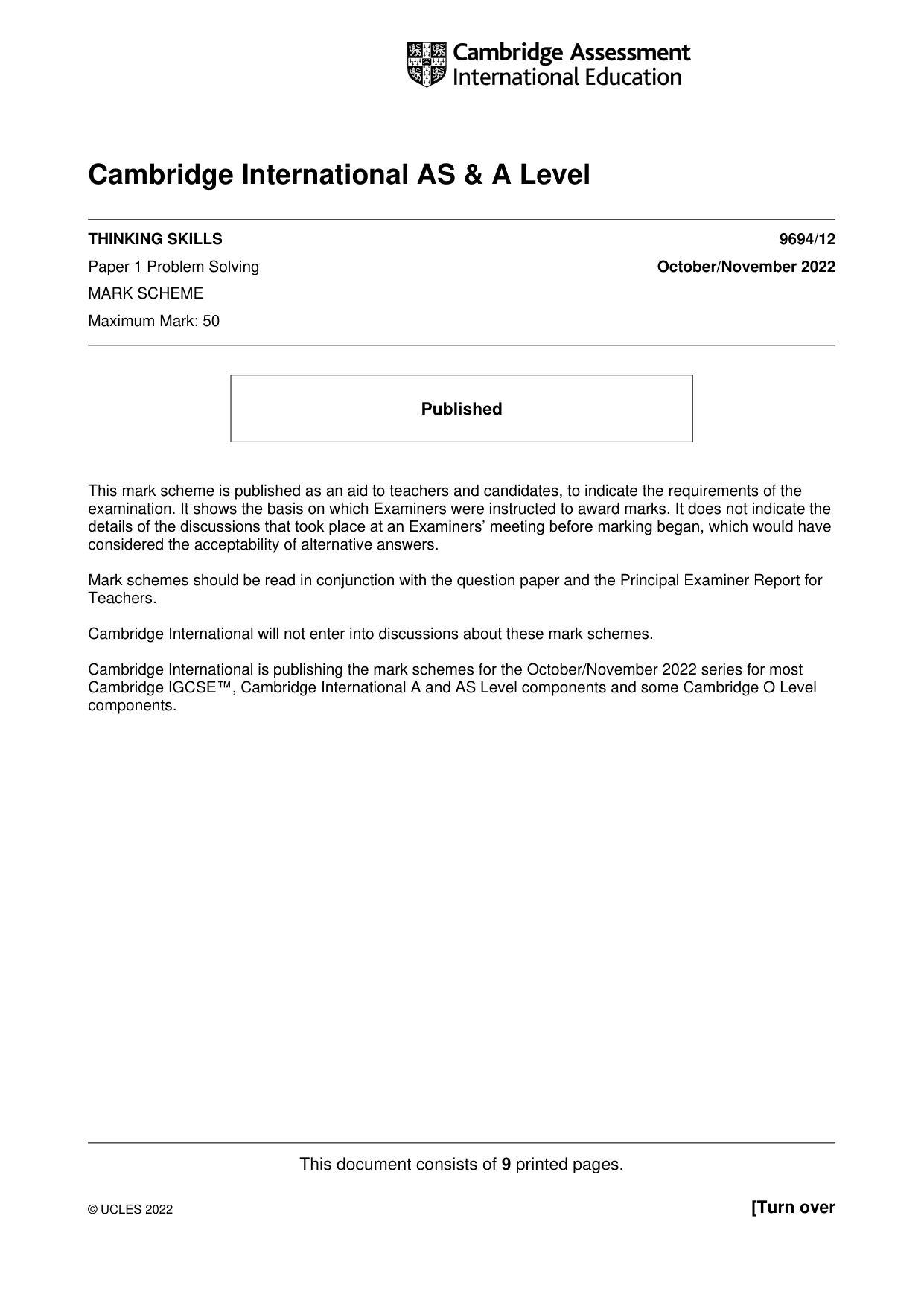
This document consists of 9 printed pages. © UCLES 2022 [Turn over Cambridge International AS & A Level THINKING SKILLS 9694/12 Paper 1 Problem Solving October/November 2022 MARK SCHEME Maximum Mark: 50 Published This mark scheme is published as an aid to teachers and candidates, to indicate the requirements of the examination. It shows the basis on which Examiners were instructed to award marks. It does not indicate the details of the discussions that took place at an Examiners’ meeting before marking began, which would have considered the acceptability of alternative answers. Mark schemes should be read in conjunction with the question paper and the Principal Examiner Report for Teachers. Cambridge International will not enter into discussions about these mark schemes. Cambridge International is publishing the mark schemes for the October/November 2022 series for most Cambridge IGCSE™, Cambridge International A and AS Level components and some Cambridge O Level components.
Mark scheme, page 2
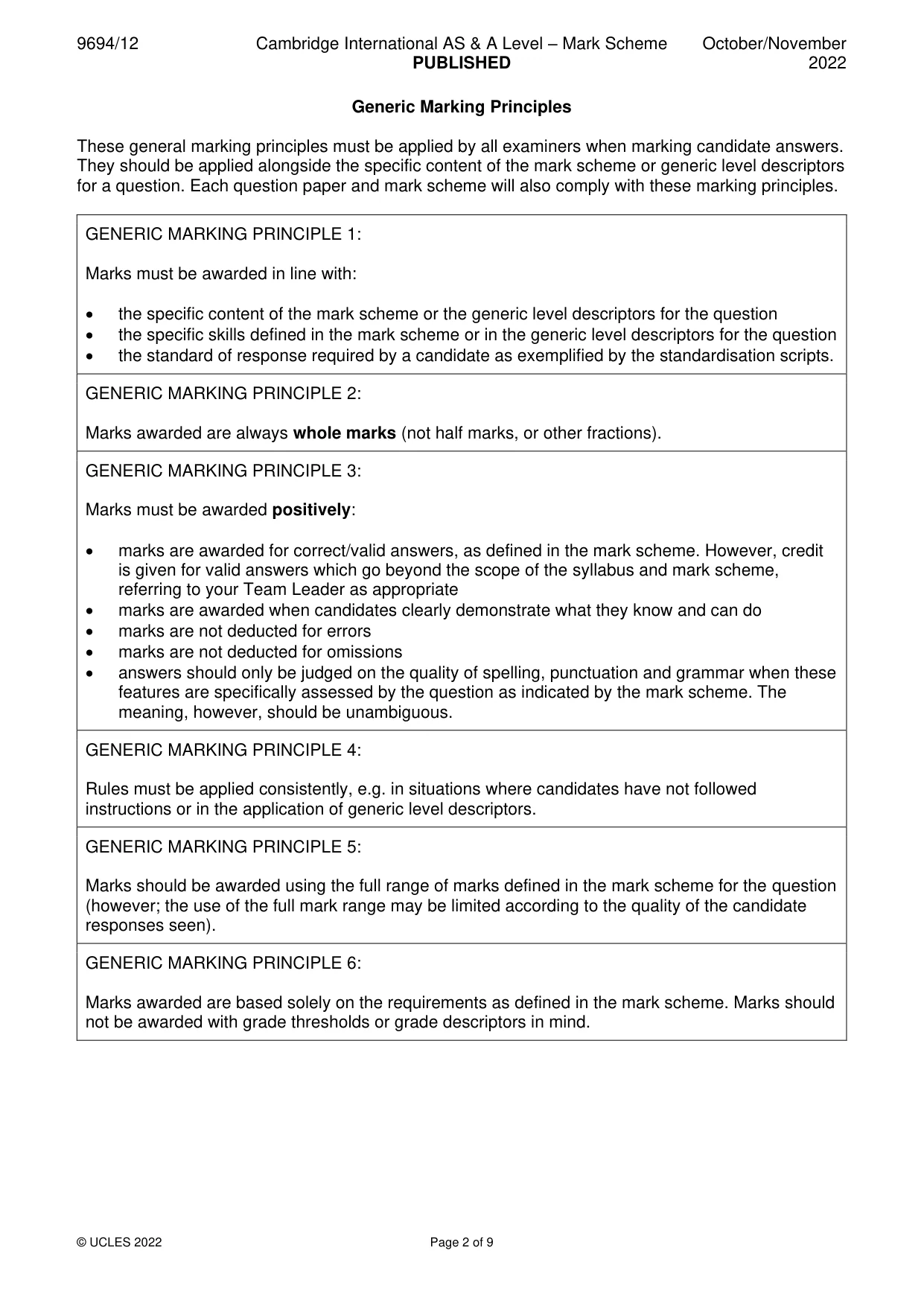
9694/12 Cambridge International AS & A Level – Mark Scheme PUBLISHED October/November 2022 © UCLES 2022 Page 2 of 9 Generic Marking Principles These general marking principles must be applied by all examiners when marking candidate answers. They should be applied alongside the specific content of the mark scheme or generic level descriptors for a question. Each question paper and mark scheme will also comply with these marking principles. GENERIC MARKING PRINCIPLE 1: Marks must be awarded in line with: • the specific content of the mark scheme or the generic level descriptors for the question • the specific skills defined in the mark scheme or in the generic level descriptors for the question • the standard of response required by a candidate as exemplified by the standardisation scripts. GENERIC MARKING PRINCIPLE 2: Marks awarded are always whole marks (not half marks, or other fractions). GENERIC MARKING PRINCIPLE 3: Marks must be awarded positively: • marks are awarded for correct/valid answers, as defined in the mark scheme. However, credit is given for valid answers which go beyond the scope of the syllabus and mark scheme, referring to your Team Leader as appropriate • marks are awarded when candidates clearly demonstrate what they know and can do • marks are not deducted for errors • marks are not deducted for omissions • answers should only be judged on the quality of spelling, punctuation and grammar when these features are specifically assessed by the question as indicated by the mark scheme. The meaning, however, should be unambiguous. GENERIC MARKING PRINCIPLE 4: Rules must be applied consistently, e.g. in situations where candidates have not followed instructions or in the application of generic level descriptors. GENERIC MARKING PRINCIPLE 5: Marks should be awarded using the full range of marks defined in the mark scheme for the question (however; the use of the full mark range may be limited according to the quality of the candidate responses seen). GENERIC MARKING PRINCIPLE 6: Marks awarded are based solely on the requirements as defined in the mark scheme. Marks should not be awarded with grade thresholds or grade descriptors in mind.
Mark scheme, page 3
9694/12 Cambridge International AS & A Level – Mark Scheme PUBLISHED October/November 2022 © UCLES 2022 Page 3 of 9 NOTES FOR MARKERS Working Where a final answer is underlined in the mark scheme, full marks are awarded for a correct answer, regardless of whether there is any supporting working, unless an exception is noted in the mark scheme. For partial credit, the evidence needed to award the mark will usually be shown on its own line in the mark scheme, or else will be defined in italic text. For explanations and verbal justifications, apply the principle of ‘words to that effect’. No response If there is any attempt at a solution award 0 marks not NR. “-” or “?” constitute no attempt at a solution. Abbreviations The following abbreviations may be used in a mark scheme: AG answer given (on question paper) awrt answer which rounds to ft follow through (from earlier error) oe or equivalent SC special case soi seen or implied
Mark scheme, page 4
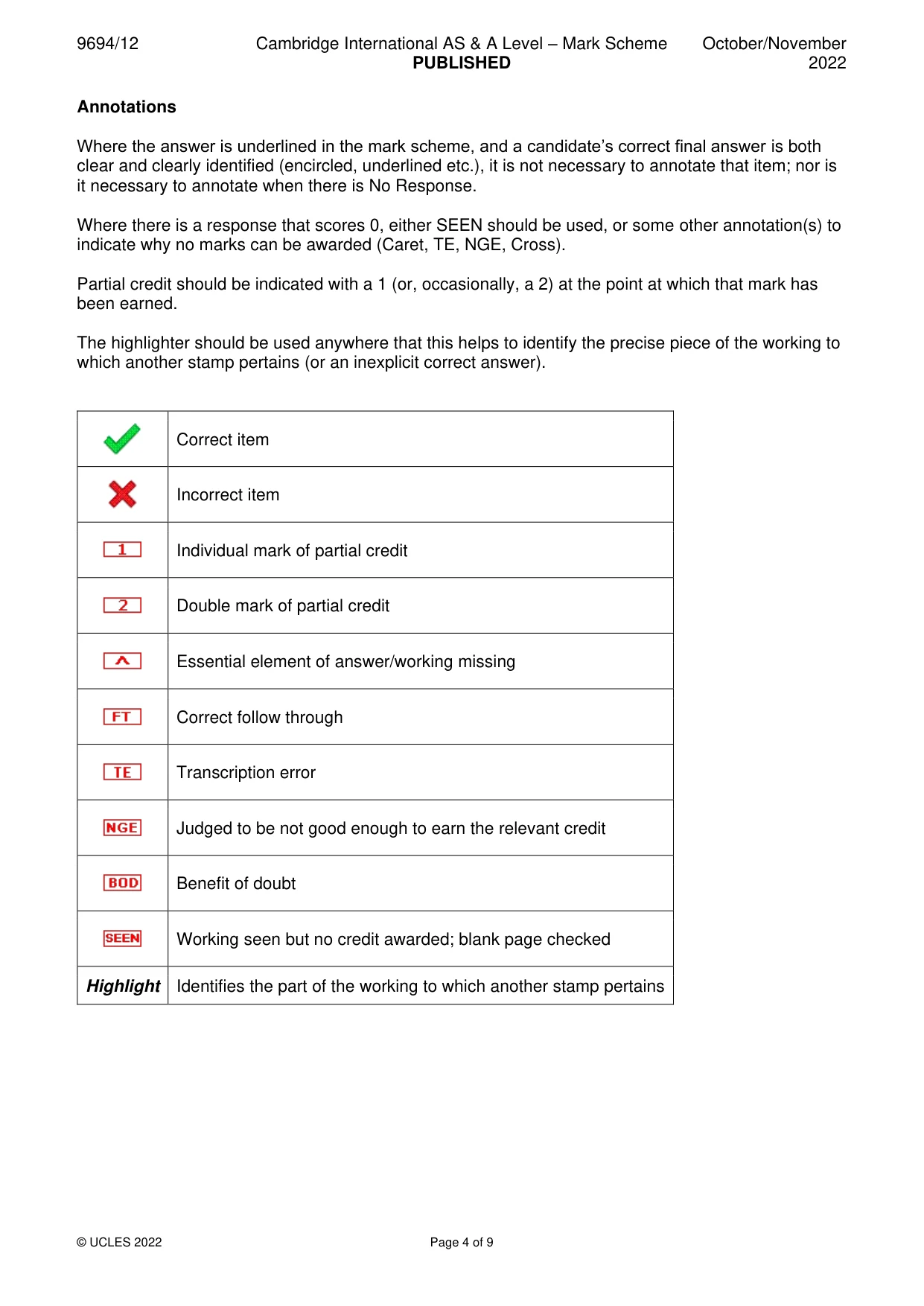
9694/12 Cambridge International AS & A Level – Mark Scheme PUBLISHED October/November 2022 © UCLES 2022 Page 4 of 9 Annotations Where the answer is underlined in the mark scheme, and a candidate’s correct final answer is both clear and clearly identified (encircled, underlined etc.), it is not necessary to annotate that item; nor is it necessary to annotate when there is No Response. Where there is a response that scores 0, either SEEN should be used, or some other annotation(s) to indicate why no marks can be awarded (Caret, TE, NGE, Cross). Partial credit should be indicated with a 1 (or, occasionally, a 2) at the point at which that mark has been earned. The highlighter should be used anywhere that this helps to identify the precise piece of the working to which another stamp pertains (or an inexplicit correct answer). Correct item Incorrect item Individual mark of partial credit Double mark of partial credit Essential element of answer/working missing Correct follow through Transcription error Judged to be not good enough to earn the relevant credit Benefit of doubt Working seen but no credit awarded; blank page checked Highlight Identifies the part of the working to which another stamp pertains
Mark scheme, page 5
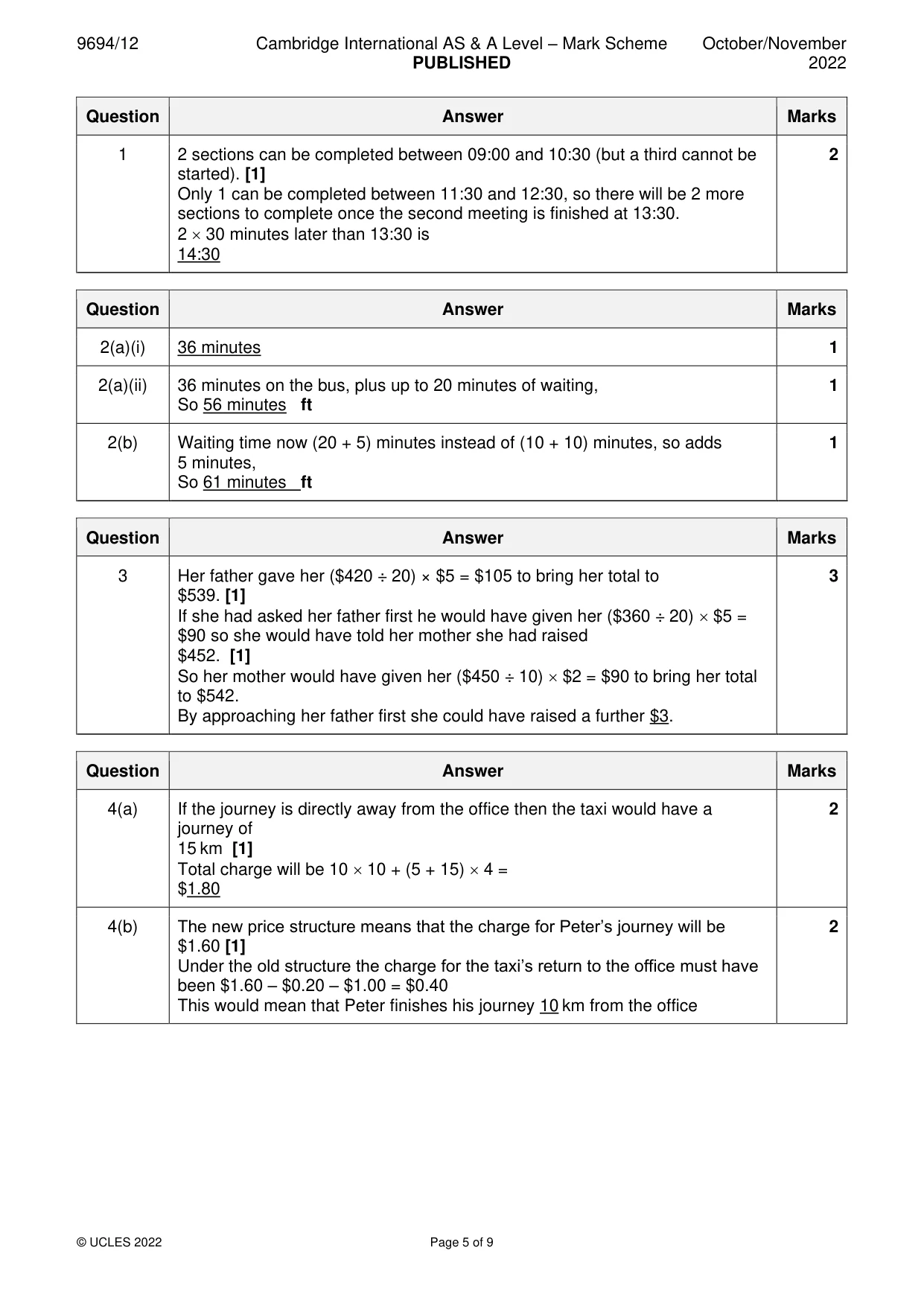
9694/12 Cambridge International AS & A Level – Mark Scheme PUBLISHED October/November 2022 © UCLES 2022 Page 5 of 9 Question Answer Marks 1 2 sections can be completed between 09:00 and 10:30 (but a third cannot be started). [1] Only 1 can be completed between 11:30 and 12:30, so there will be 2 more sections to complete once the second meeting is finished at 13:30. 2 30 minutes later than 13:30 is 14:30 2 Question Answer Marks 2(a)(i) 36 minutes 1 2(a)(ii) 36 minutes on the bus, plus up to 20 minutes of waiting, So 56 minutes ft 1 2(b) Waiting time now (20 + 5) minutes instead of (10 + 10) minutes, so adds 5 minutes, So 61 minutes ft 1 Question Answer Marks 3 Her father gave her ($420 ÷ 20) × $5 = $105 to bring her total to $539. [1] If she had asked her father first he would have given her ($360 ÷ 20) $5 = $90 so she would have told her mother she had raised $452. [1] So her mother would have given her ($450 ÷ 10) $2 = $90 to bring her total to $542. By approaching her father first she could have raised a further $3. 3 Question Answer Marks 4(a) If the journey is directly away from the office then the taxi would have a journey of 15 km [1] Total charge will be 10 10 + (5 + 15) 4 = $1.80 2 4(b) The new price structure means that the charge for Peter’s journey will be $1.60 [1] Under the old structure the charge for the taxi’s return to the office must have been $1.60 – $0.20 – $1.00 = $0.40 This would mean that Peter finishes his journey 10 km from the office 2
Mark scheme, page 6
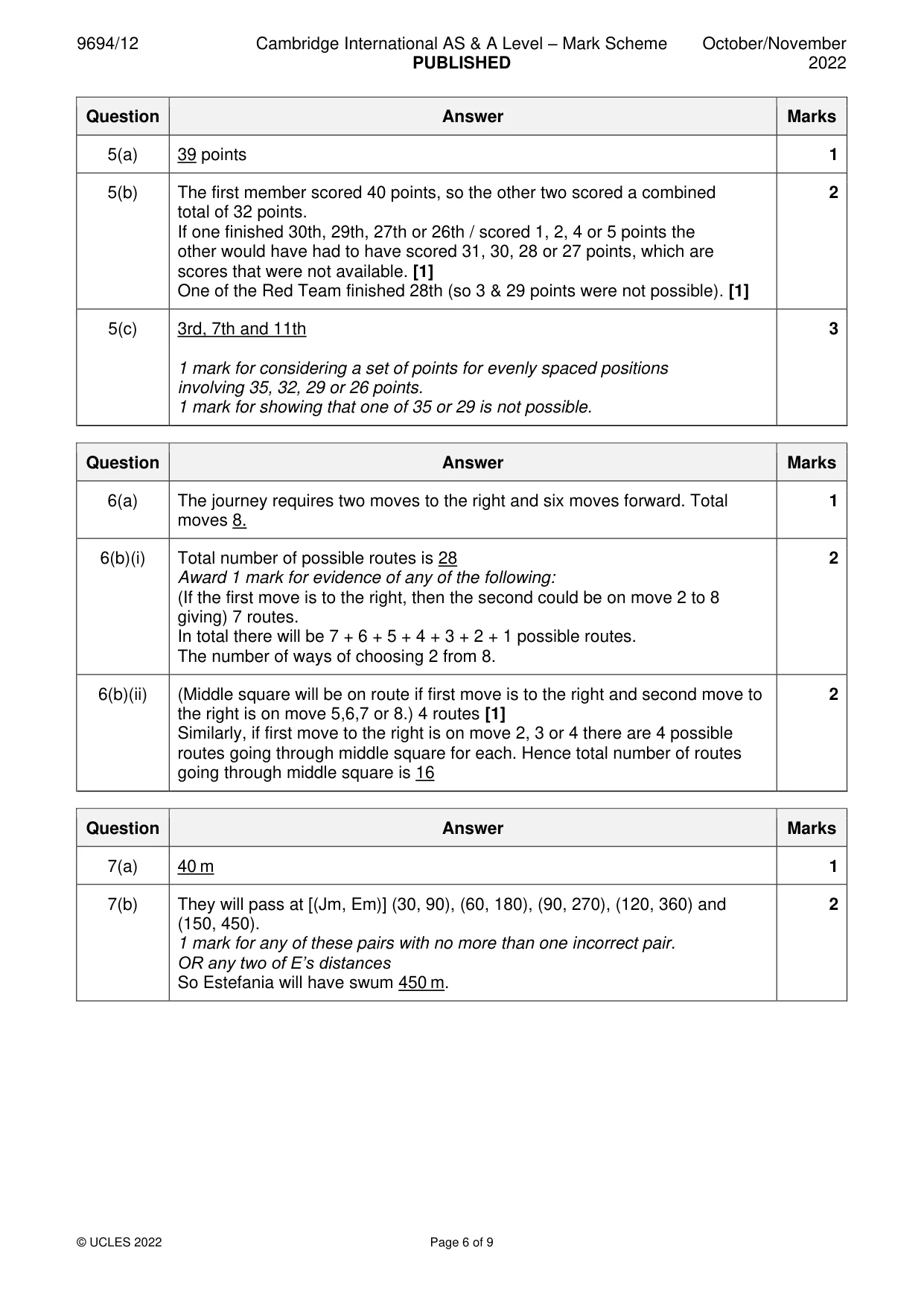
9694/12 Cambridge International AS & A Level – Mark Scheme PUBLISHED October/November 2022 © UCLES 2022 Page 6 of 9 Question Answer Marks 5(a) 39 points 1 5(b) The first member scored 40 points, so the other two scored a combined total of 32 points. If one finished 30th, 29th, 27th or 26th / scored 1, 2, 4 or 5 points the other would have had to have scored 31, 30, 28 or 27 points, which are scores that were not available. [1] One of the Red Team finished 28th (so 3 & 29 points were not possible). [1] 2 5(c) 3rd, 7th and 11th 1 mark for considering a set of points for evenly spaced positions involving 35, 32, 29 or 26 points. 1 mark for showing that one of 35 or 29 is not possible. 3 Question Answer Marks 6(a) The journey requires two moves to the right and six moves forward. Total moves 8. 1 6(b)(i) Total number of possible routes is 28 Award 1 mark for evidence of any of the following: (If the first move is to the right, then the second could be on move 2 to 8 giving) 7 routes. In total there will be 7 + 6 + 5 + 4 + 3 + 2 + 1 possible routes. The number of ways of choosing 2 from 8. 2 6(b)(ii) (Middle square will be on route if first move is to the right and second move to the right is on move 5,6,7 or 8.) 4 routes [1] Similarly, if first move to the right is on move 2, 3 or 4 there are 4 possible routes going through middle square for each. Hence total number of routes going through middle square is 16 2 Question Answer Marks 7(a) 40 m 1 7(b) They will pass at [(Jm, Em)] (30, 90), (60, 180), (90, 270), (120, 360) and (150, 450). 1 mark for any of these pairs with no more than one incorrect pair. OR any two of E’s distances So Estefania will have swum 450 m. 2
Mark scheme, page 7
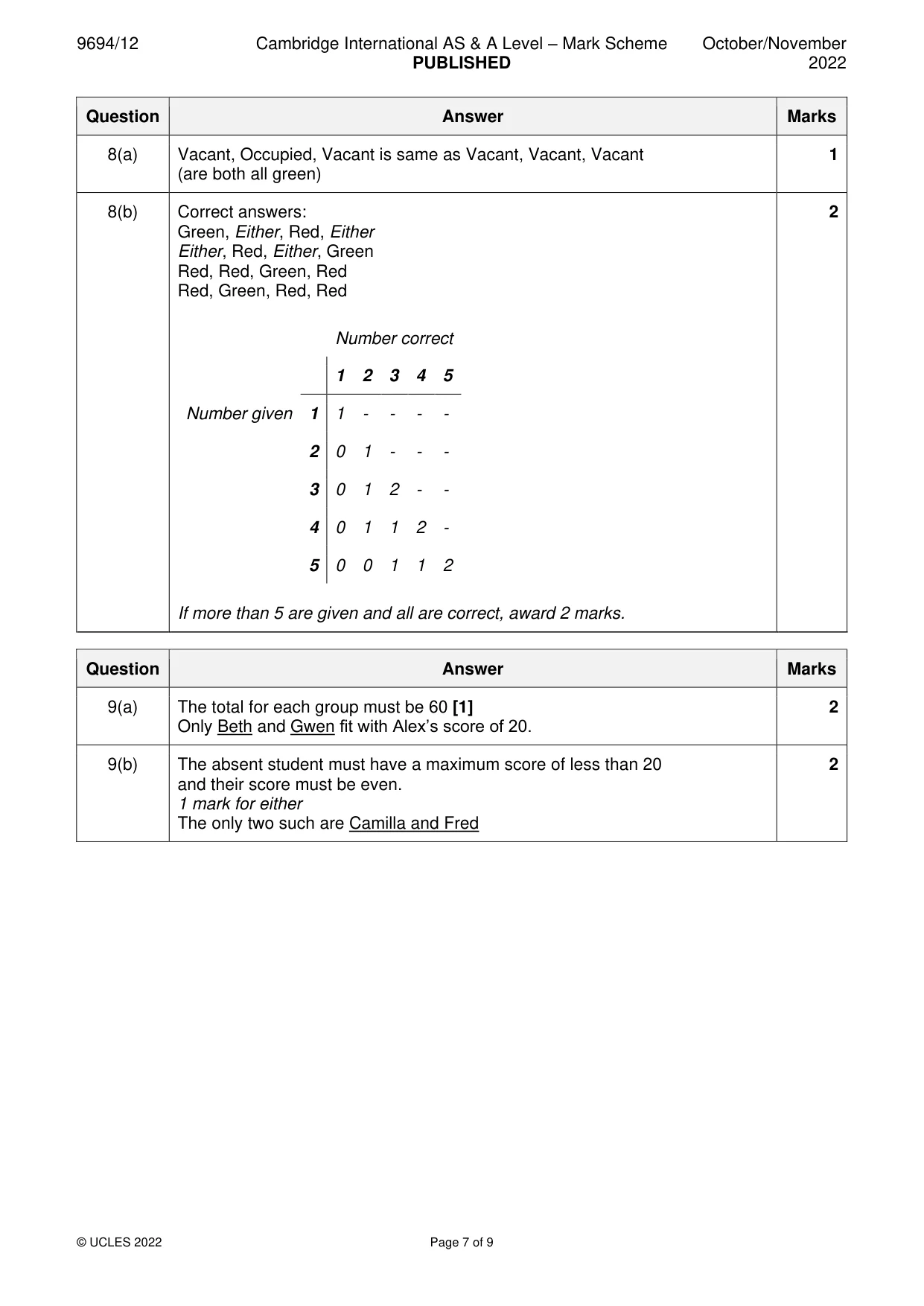
9694/12 Cambridge International AS & A Level – Mark Scheme PUBLISHED October/November 2022 © UCLES 2022 Page 7 of 9 Question Answer Marks 8(a) Vacant, Occupied, Vacant is same as Vacant, Vacant, Vacant (are both all green) 1 8(b) Correct answers: Green, Either, Red, Either Either, Red, Either, Green Red, Red, Green, Red Red, Green, Red, Red Number correct 1 2 3 4 5 Number given 1 1 - - - - 2 0 1 - - - 3 0 1 2 - - 4 0 1 1 2 - 5 0 0 1 1 2 If more than 5 are given and all are correct, award 2 marks. 2 Question Answer Marks 9(a) The total for each group must be 60 [1] Only Beth and Gwen fit with Alex’s score of 20. 2 9(b) The absent student must have a maximum score of less than 20 and their score must be even. 1 mark for either The only two such are Camilla and Fred 2
Mark scheme, page 8
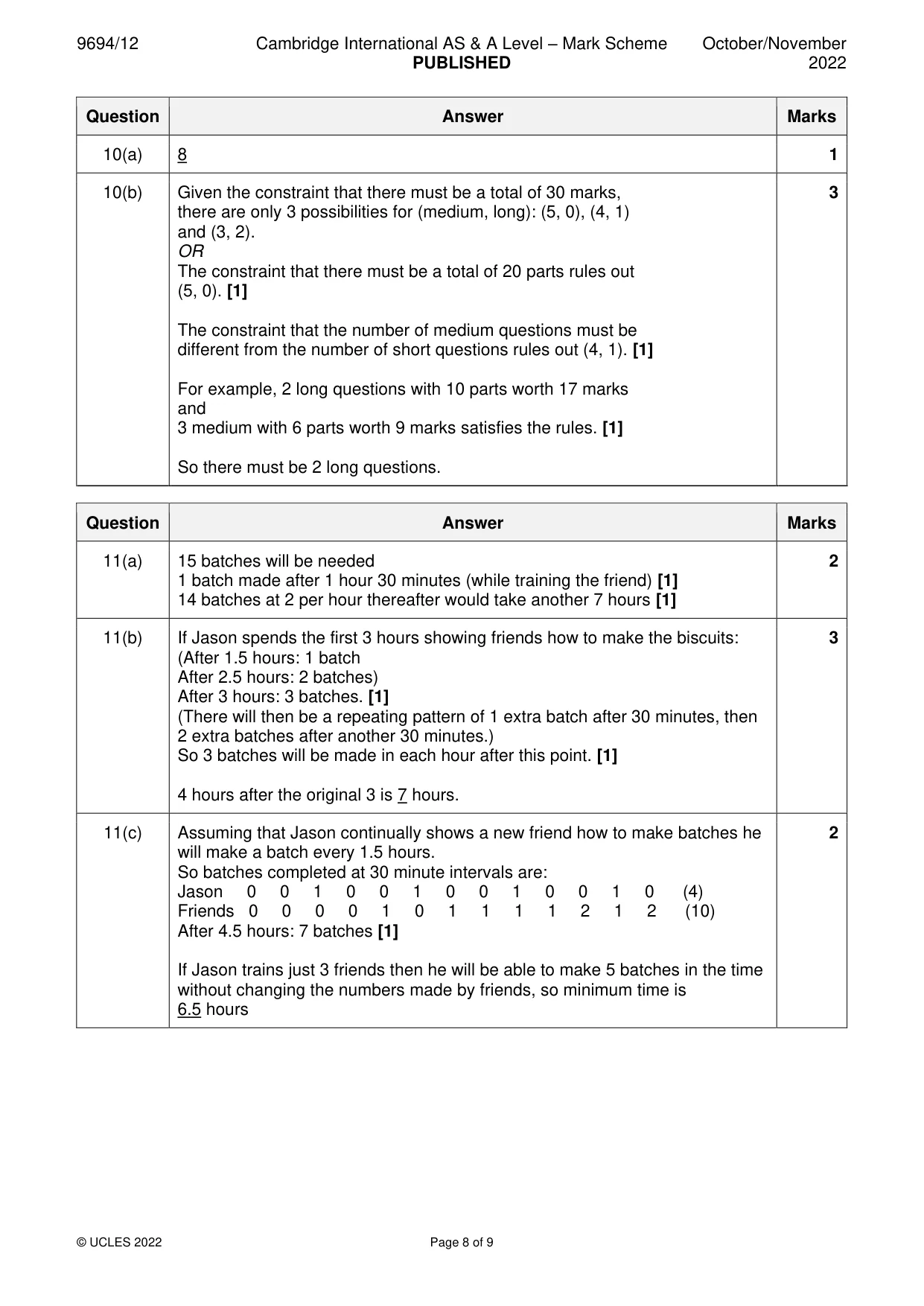
9694/12 Cambridge International AS & A Level – Mark Scheme PUBLISHED October/November 2022 © UCLES 2022 Page 8 of 9 Question Answer Marks 10(a) 8 1 10(b) Given the constraint that there must be a total of 30 marks, there are only 3 possibilities for (medium, long): (5, 0), (4, 1) and (3, 2). OR The constraint that there must be a total of 20 parts rules out (5, 0). [1] The constraint that the number of medium questions must be different from the number of short questions rules out (4, 1). [1] For example, 2 long questions with 10 parts worth 17 marks and 3 medium with 6 parts worth 9 marks satisfies the rules. [1] So there must be 2 long questions. 3 Question Answer Marks 11(a) 15 batches will be needed 1 batch made after 1 hour 30 minutes (while training the friend) [1] 14 batches at 2 per hour thereafter would take another 7 hours [1] 2 11(b) If Jason spends the first 3 hours showing friends how to make the biscuits: (After 1.5 hours: 1 batch After 2.5 hours: 2 batches) After 3 hours: 3 batches. [1] (There will then be a repeating pattern of 1 extra batch after 30 minutes, then 2 extra batches after another 30 minutes.) So 3 batches will be made in each hour after this point. [1] 4 hours after the original 3 is 7 hours. 3 11(c) Assuming that Jason continually shows a new friend how to make batches he will make a batch every 1.5 hours. So batches completed at 30 minute intervals are: Jason 0 0 1 0 0 1 0 0 1 0 0 1 0 (4) Friends 0 0 0 0 1 0 1 1 1 1 2 1 2 (10) After 4.5 hours: 7 batches [1] If Jason trains just 3 friends then he will be able to make 5 batches in the time without changing the numbers made by friends, so minimum time is 6.5 hours 2
Mark scheme, page 9
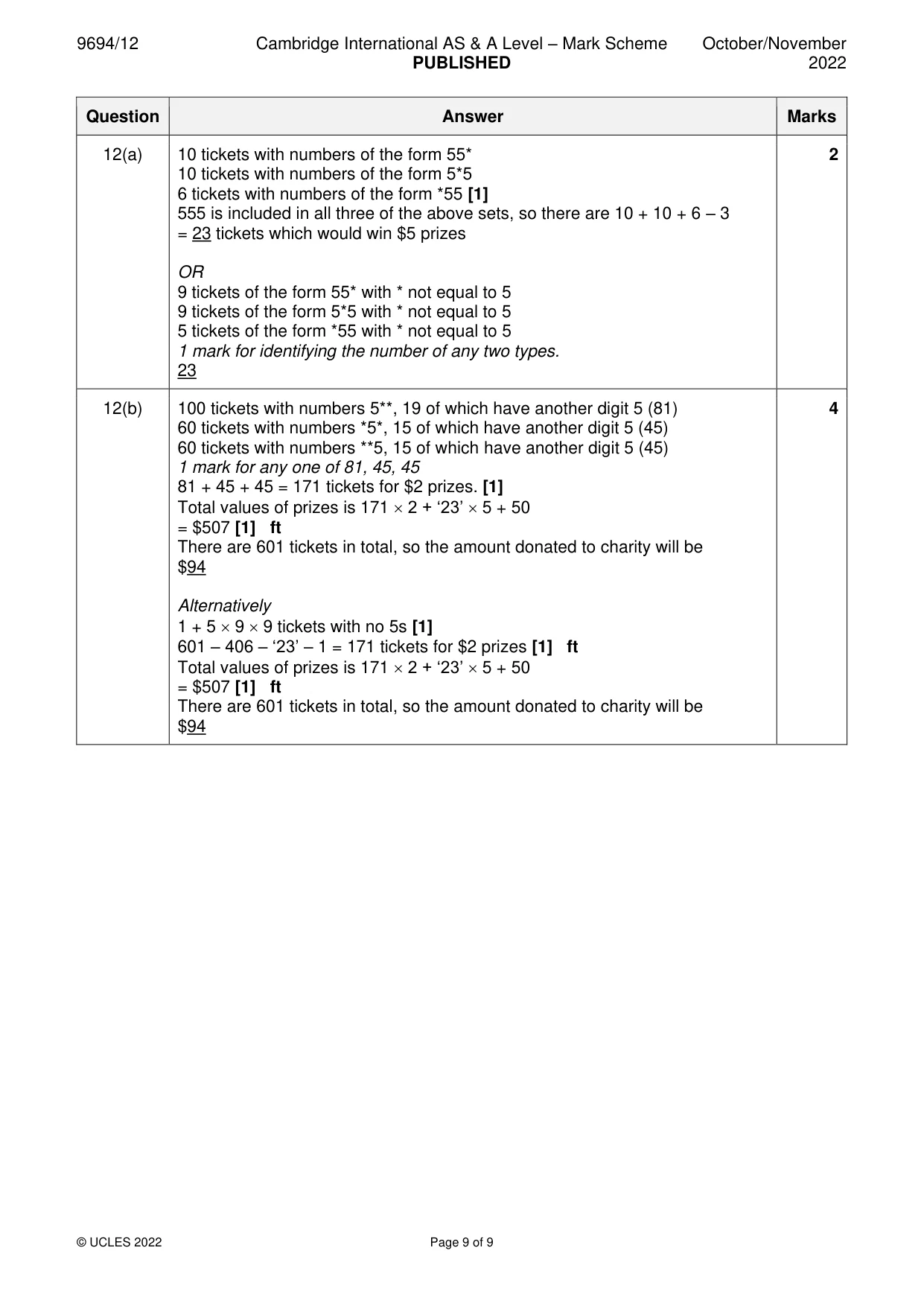
9694/12 Cambridge International AS & A Level – Mark Scheme PUBLISHED October/November 2022 © UCLES 2022 Page 9 of 9 Question Answer Marks 12(a) 10 tickets with numbers of the form 55* 10 tickets with numbers of the form 5*5 6 tickets with numbers of the form *55 [1] 555 is included in all three of the above sets, so there are 10 + 10 + 6 – 3 = 23 tickets which would win $5 prizes OR 9 tickets of the form 55* with * not equal to 5 9 tickets of the form 5*5 with * not equal to 5 5 tickets of the form *55 with * not equal to 5 1 mark for identifying the number of any two types. 23 2 12(b) 100 tickets with numbers 5**, 19 of which have another digit 5 (81) 60 tickets with numbers *5*, 15 of which have another digit 5 (45) 60 tickets with numbers **5, 15 of which have another digit 5 (45) 1 mark for any one of 81, 45, 45 81 + 45 + 45 = 171 tickets for $2 prizes. [1] Total values of prizes is 171 2 + ‘23’ 5 + 50 = $507 [1] ft There are 601 tickets in total, so the amount donated to charity will be $94 Alternatively 1 + 5 9 9 tickets with no 5s [1] 601 – 406 – ‘23’ – 1 = 171 tickets for $2 prizes [1] ft Total values of prizes is 171 2 + ‘23’ 5 + 50 = $507 [1] ft There are 601 tickets in total, so the amount donated to charity will be $94 4
What you needed in this session
Cambridge’s own grade thresholds for 2022 Oct/Nov, Paper 1 · Variant 2. A higher threshold means an easier paper — the bar moves with how the cohort did.