Cambridge A Level Spanish - Language (AS Level only) 8685 — 2017 May/June Paper 2 · Variant 2
8685/22/M/J/17 · 70 marks · ≈79 min
The question paper and its mark scheme, free to read here and free to download. This is Cambridge’s own paper, exactly as it was sat.
Question paper8 pages
Mark scheme16 pages
Answers below. Sit the paper first if you are practising.
Paper as text
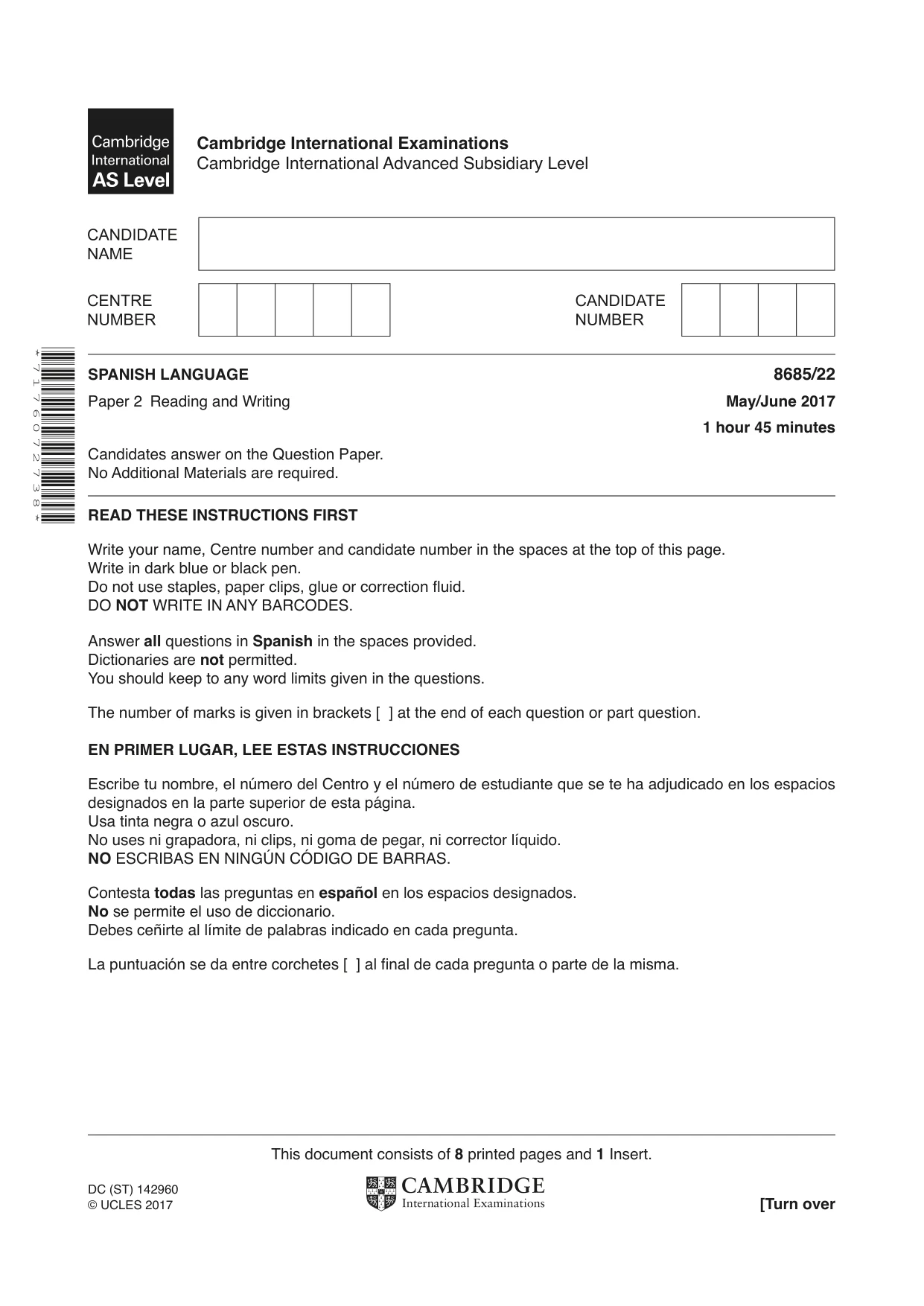
Question paper, page 1
This document consists of 8 printed pages and 1 Insert. DC (ST) 142960 © UCLES 2017 [Turn over Cambridge International Examinations Cambridge International Advanced Subsidiary Level * 7 1 7 6 0 7 2 7 3 8 * SPANISH LANGUAGE 8685/22 Paper 2 Reading and Writing May/June 2017 1 hour 45 minutes Candidates answer on the Question Paper. No Additional Materials are required. READ THESE INSTRUCTIONS FIRST Write your name, Centre number and candidate number in the spaces at the top of this page. Write in dark blue or black pen. Do not use staples, paper clips, glue or correction fluid. DO NOT WRITE IN ANY BARCODES. Answer all questions in Spanish in the spaces provided. Dictionaries are not permitted. You should keep to any word limits given in the questions. The number of marks is given in brackets [ ] at the end of each question or part question. EN PRIMER LUGAR, LEE ESTAS INSTRUCCIONES Escribe tu nombre, el número del Centro y el número de estudiante que se te ha adjudicado en los espacios designados en la parte superior de esta página. Usa tinta negra o azul oscuro. No uses ni grapadora, ni clips, ni goma de pegar, ni corrector líquido. NO ESCRIBAS EN NINGÚN CÓDIGO DE BARRAS. Contesta todas las preguntas en español en los espacios designados. No se permite el uso de diccionario. Debes ceñirte al límite de palabras indicado en cada pregunta. La puntuación se da entre corchetes [ ] al final de cada pregunta o parte de la misma.
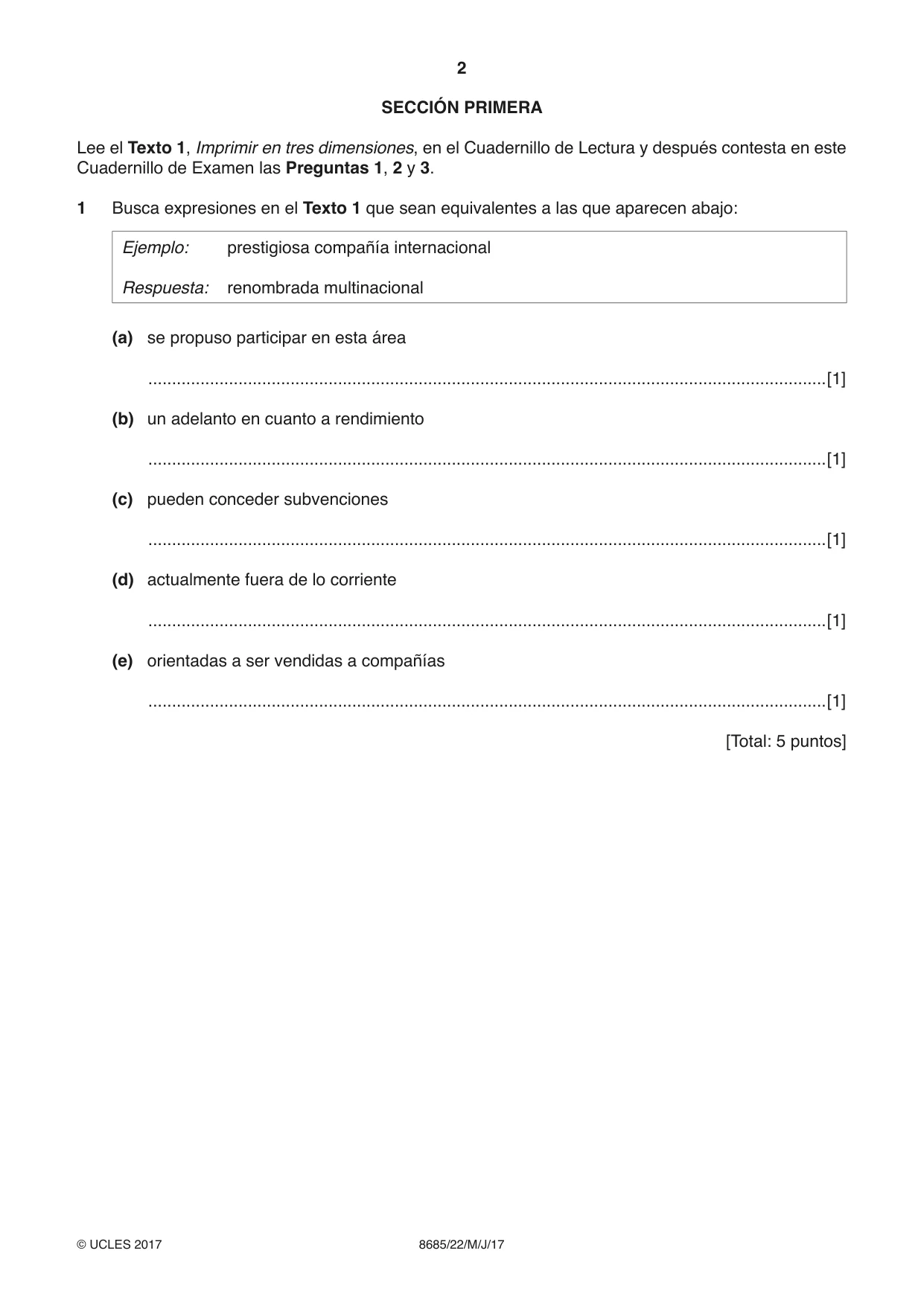
Question paper, page 2
2 8685/22/M/J/17 © UCLES 2017 SECCIÓN PRIMERA Lee el Texto 1, Imprimir en tres dimensiones, en el Cuadernillo de Lectura y después contesta en este Cuadernillo de Examen las Preguntas 1, 2 y 3. 1 Busca expresiones en el Texto 1 que sean equivalentes a las que aparecen abajo: Ejemplo: prestigiosa compañía internacional Respuesta: renombrada multinacional (a) se propuso participar en esta área …[1] (b) un adelanto en cuanto a rendimiento …[1] (c) pueden conceder subvenciones …[1] (d) actualmente fuera de lo corriente …[1] (e) orientadas a ser vendidas a compañías …[1] [Total: 5 puntos]
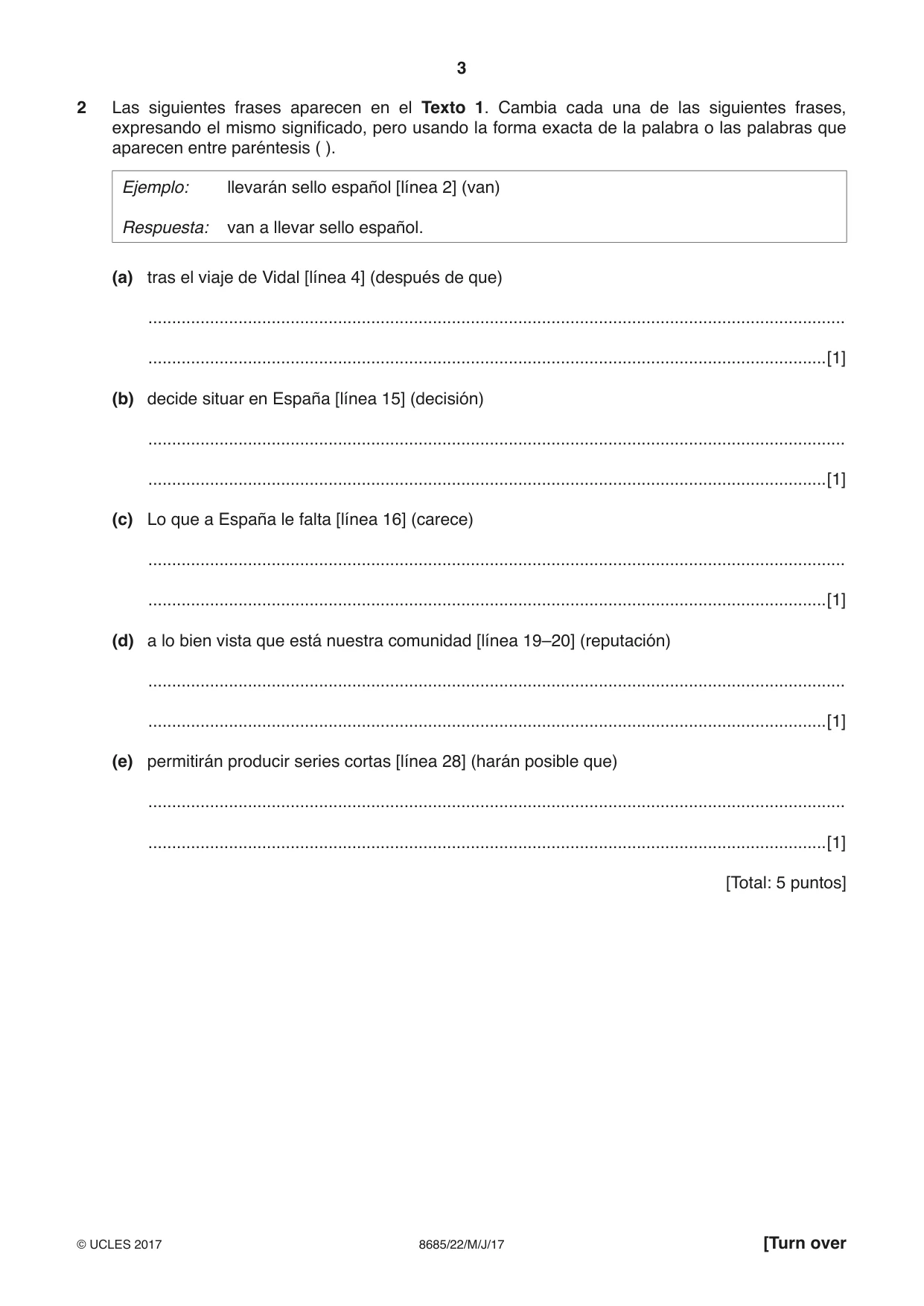
Question paper, page 3
3 8685/22/M/J/17 © UCLES 2017 [Turn over 2 Las siguientes frases aparecen en el Texto 1. Cambia cada una de las siguientes frases, expresando el mismo significado, pero usando la forma exacta de la palabra o las palabras que aparecen entre paréntesis ( ). Ejemplo: llevarán sello español [línea 2] (van) Respuesta: van a llevar sello español. (a) tras el viaje de Vidal [línea 4] (después de que) … …[1] (b) decide situar en España [línea 15] (decisión) … …[1] (c) Lo que a España le falta [línea 16] (carece) … …[1] (d) a lo bien vista que está nuestra comunidad [línea 19–20] (reputación) … …[1] (e) permitirán producir series cortas [línea 28] (harán posible que) … …[1] [Total: 5 puntos]
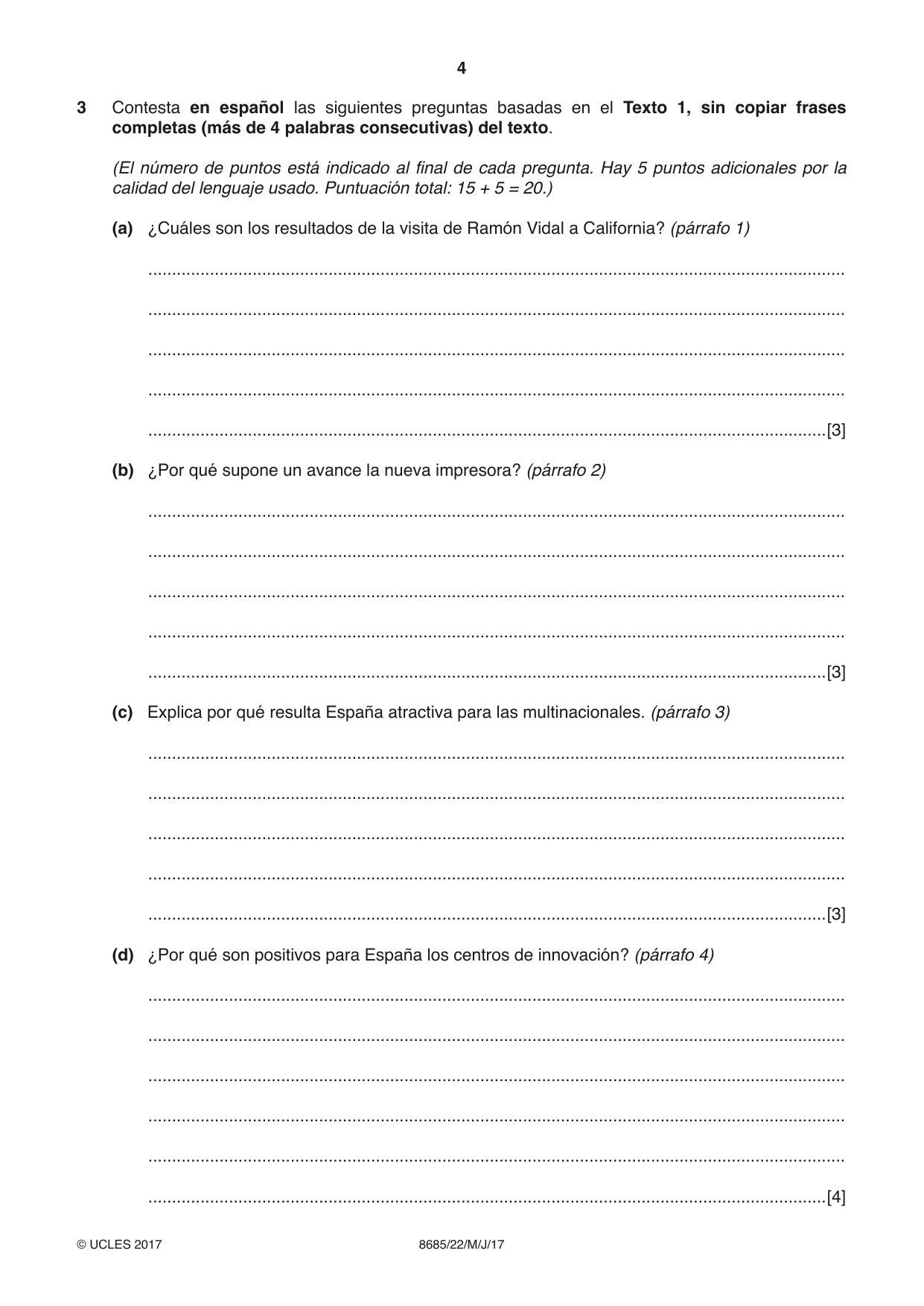
Question paper, page 4
4 8685/22/M/J/17 © UCLES 2017 3 Contesta en español las siguientes preguntas basadas en el Texto 1, sin copiar frases completas (más de 4 palabras consecutivas) del texto. (El número de puntos está indicado al final de cada pregunta. Hay 5 puntos adicionales por la calidad del lenguaje usado. Puntuación total: 15 + 5 = 20.) (a) ¿Cuáles son los resultados de la visita de Ramón Vidal a California? (párrafo 1) … … … … …[3] (b) ¿Por qué supone un avance la nueva impresora? (párrafo 2) … … … … …[3] (c) Explica por qué resulta España atractiva para las multinacionales. (párrafo 3) … … … … …[3] (d) ¿Por qué son positivos para España los centros de innovación? (párrafo 4) … … … … … …[4]
Question paper, page 5
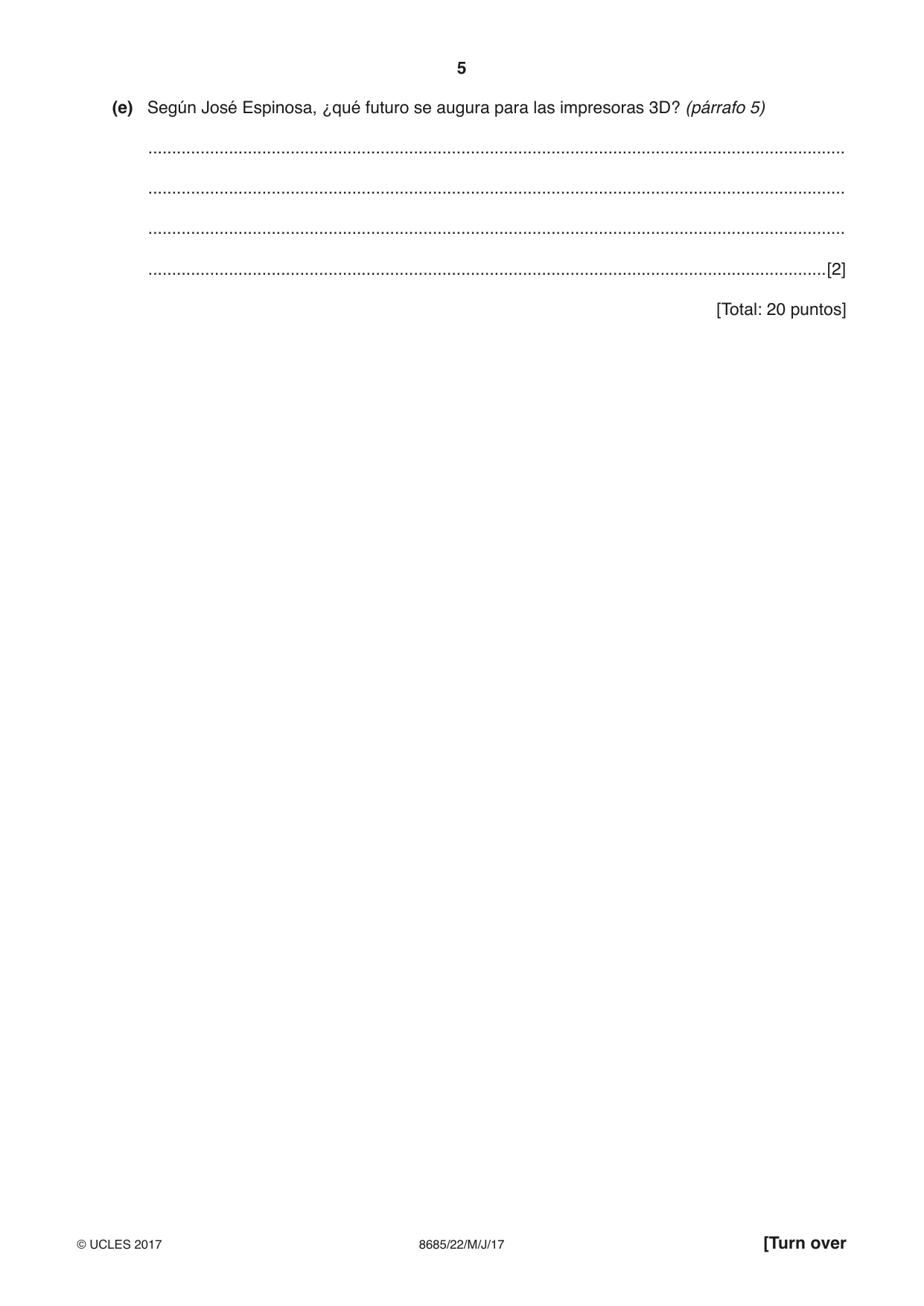
5 8685/22/M/J/17 © UCLES 2017 [Turn over (e) Según José Espinosa, ¿qué futuro se augura para las impresoras 3D? (párrafo 5) … … … …[2] [Total: 20 puntos]
Question paper, page 6
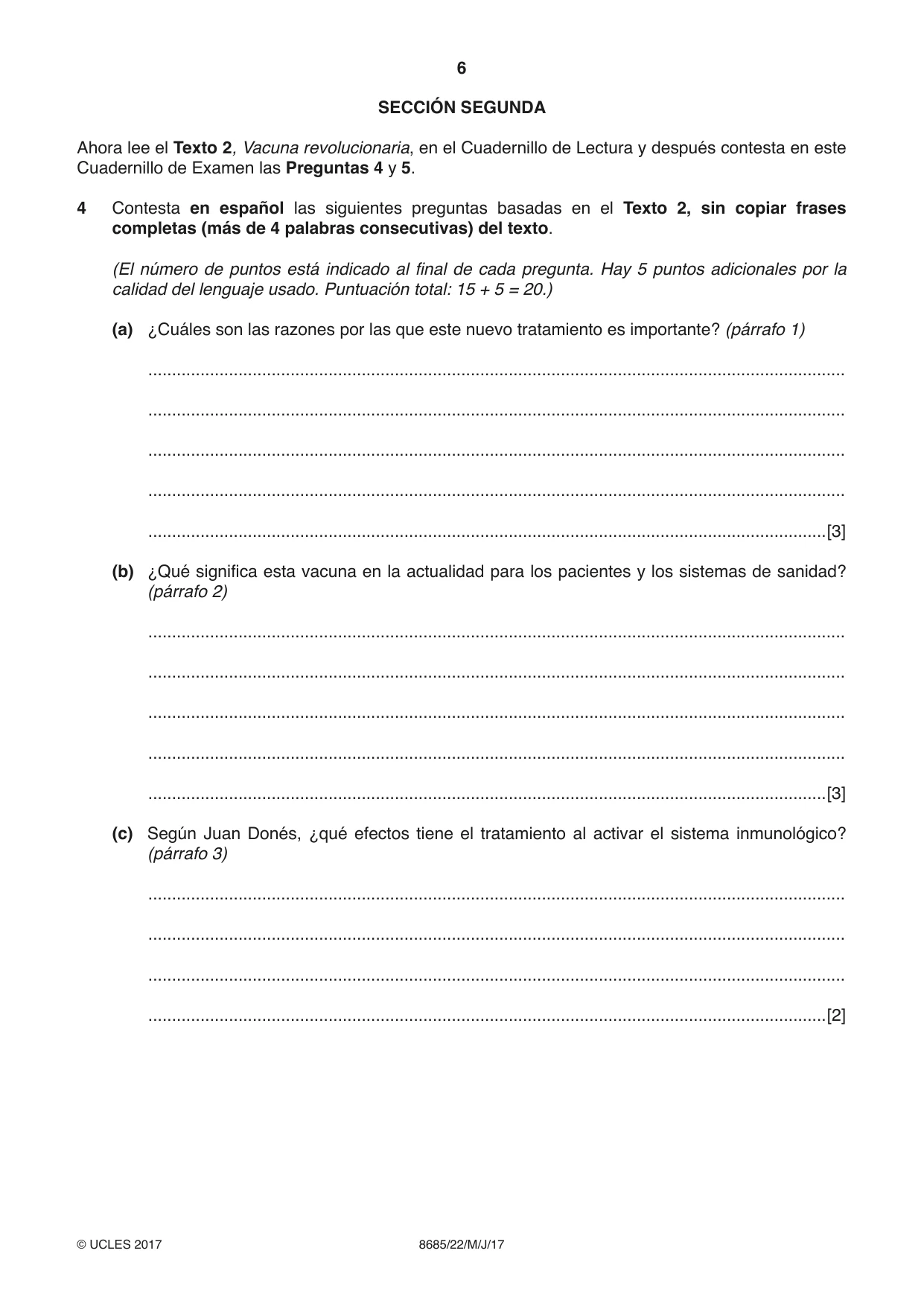
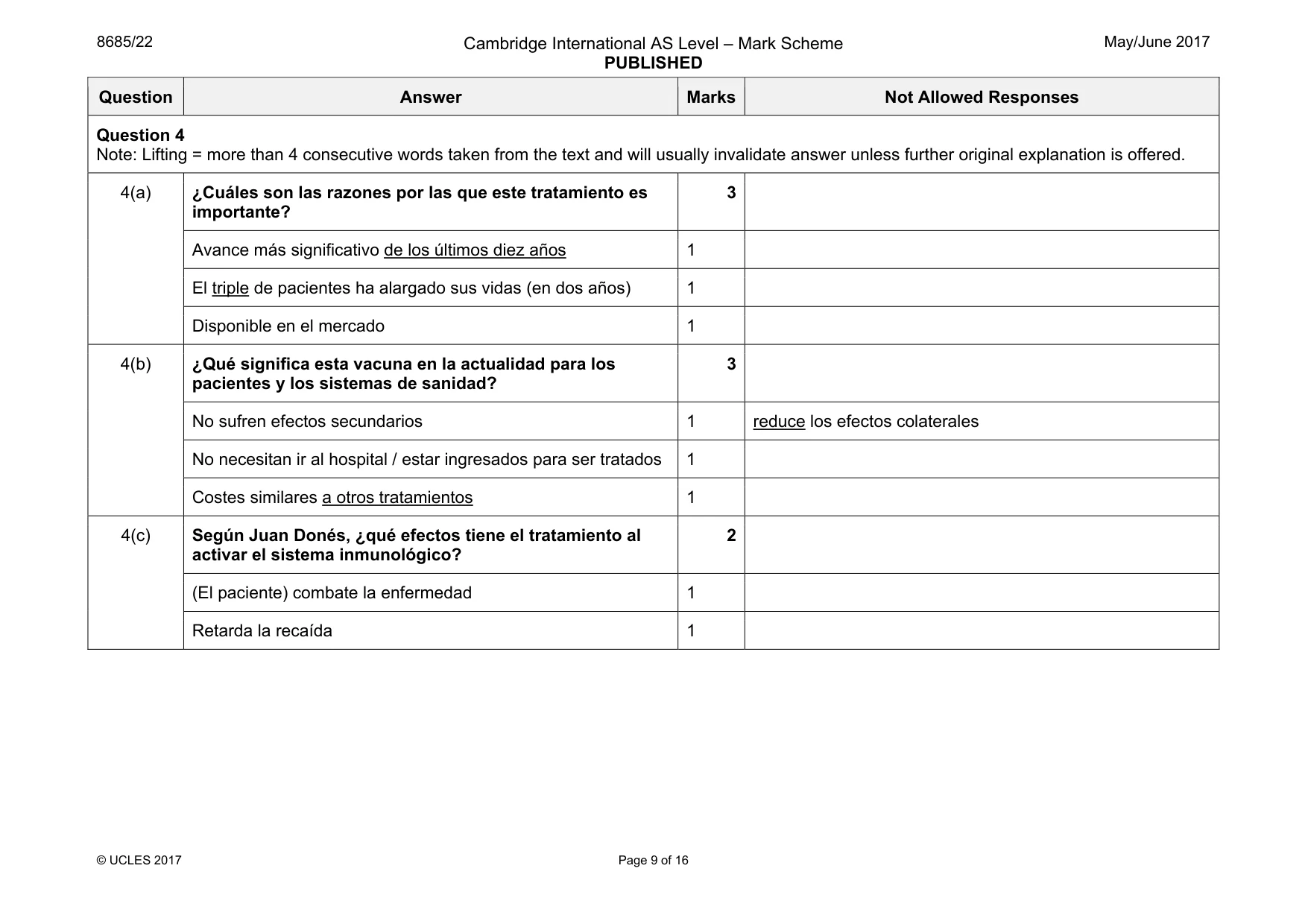
6 8685/22/M/J/17 © UCLES 2017 SECCIÓN SEGUNDA Ahora lee el Texto 2, Vacuna revolucionaria, en el Cuadernillo de Lectura y después contesta en este Cuadernillo de Examen las Preguntas 4 y 5. 4 Contesta en español las siguientes preguntas basadas en el Texto 2, sin copiar frases completas (más de 4 palabras consecutivas) del texto. (El número de puntos está indicado al final de cada pregunta. Hay 5 puntos adicionales por la calidad del lenguaje usado. Puntuación total: 15 + 5 = 20.) (a) ¿Cuáles son las razones por las que este nuevo tratamiento es importante? (párrafo 1) … … … … …[3] (b) ¿Qué significa esta vacuna en la actualidad para los pacientes y los sistemas de sanidad? (párrafo 2) … … … … …[3] (c) Según Juan Donés, ¿qué efectos tiene el tratamiento al activar el sistema inmunológico? (párrafo 3) … … … …[2]
Question paper, page 7
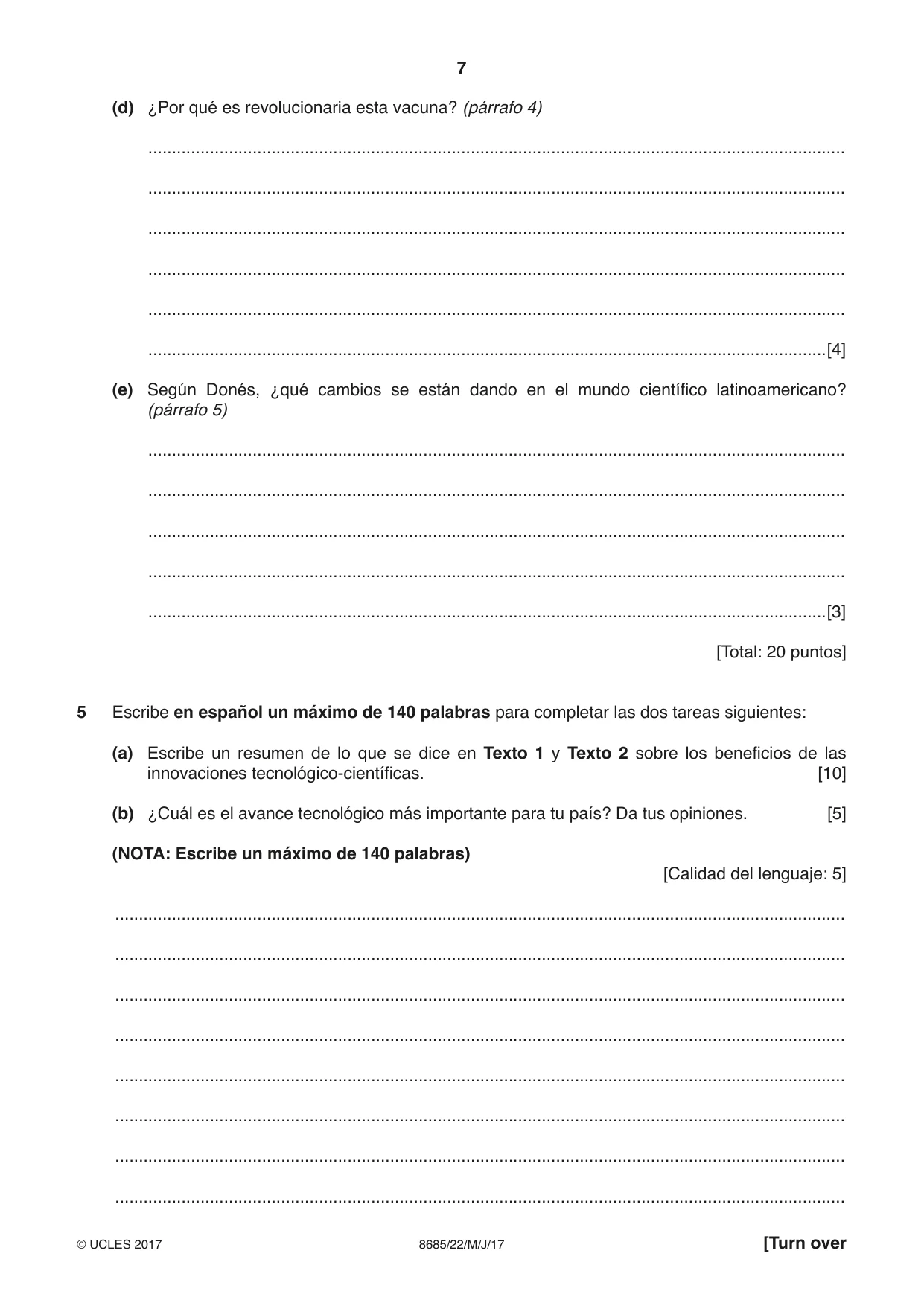
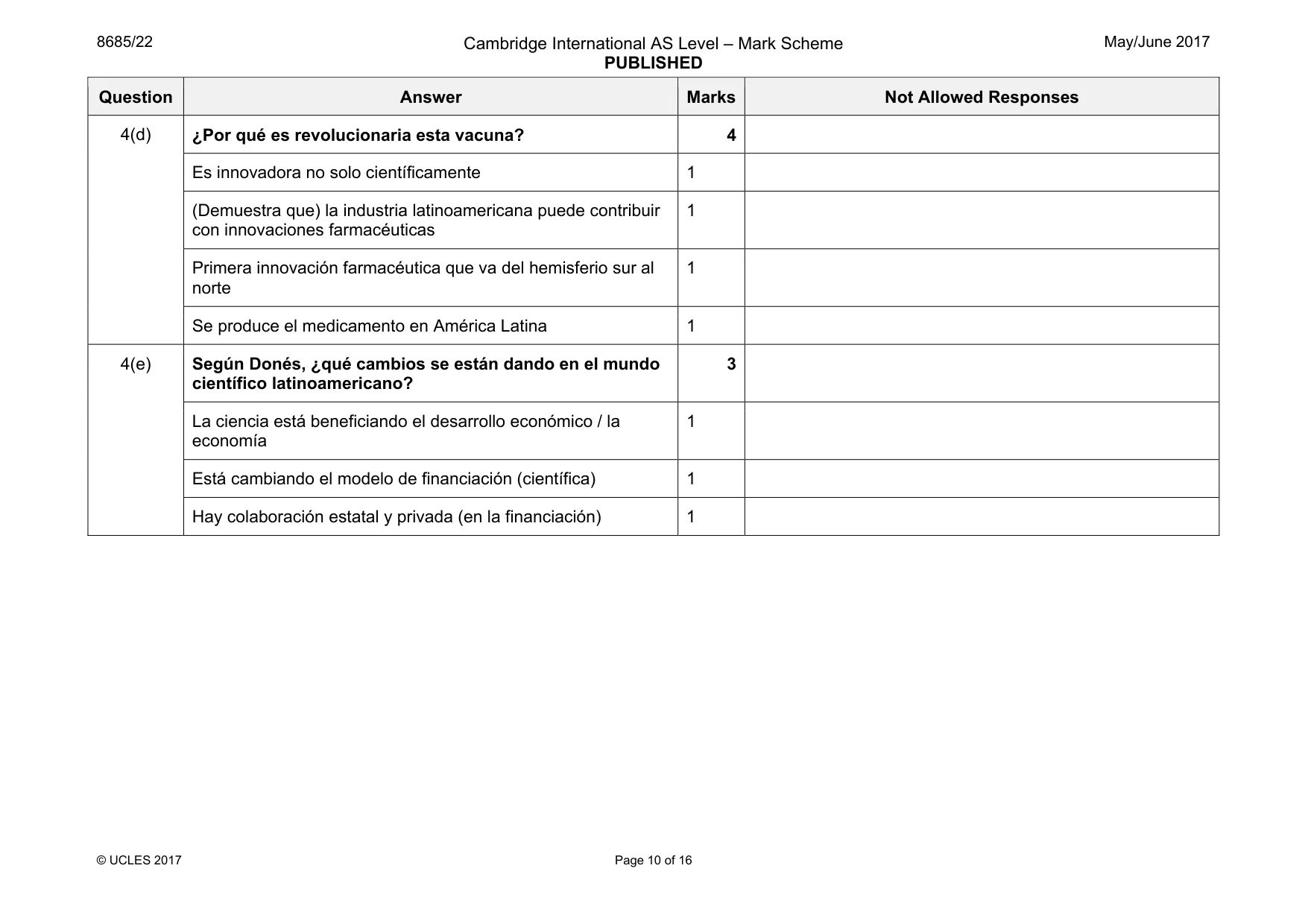
7 8685/22/M/J/17 © UCLES 2017 [Turn over (d) ¿Por qué es revolucionaria esta vacuna? (párrafo 4) … … … … … …[4] (e) Según Donés, ¿qué cambios se están dando en el mundo científico latinoamericano? (párrafo 5) … … … … …[3] [Total: 20 puntos] 5 Escribe en español un máximo de 140 palabras para completar las dos tareas siguientes: (a) Escribe un resumen de lo que se dice en Texto 1 y Texto 2 sobre los beneficios de las innovaciones tecnológico-científicas. [10] (b) ¿Cuál es el avance tecnológico más importante para tu país? Da tus opiniones. [5] (NOTA: Escribe un máximo de 140 palabras) [Calidad del lenguaje: 5] … … … … … … … …
Question paper, page 8
8 8685/22/M/J/17 © UCLES 2017 Permission to reproduce items where third-party owned material protected by copyright is included has been sought and cleared where possible. Every reasonable effort has been made by the publisher (UCLES) to trace copyright holders, but if any items requiring clearance have unwittingly been included, the publisher will be pleased to make amends at the earliest possible opportunity. To avoid the issue of disclosure of answer-related information to candidates, all copyright acknowledgements are reproduced online in the Cambridge International Examinations Copyright Acknowledgements Booklet. This is produced for each series of examinations and is freely available to download at www.cie.org.uk after the live examination series. Cambridge International Examinations is part of the Cambridge Assessment Group. Cambridge Assessment is the brand name of University of Cambridge Local Examinations Syndicate (UCLES), which is itself a department of the University of Cambridge. … … … … … … … … … … … … … … … … … … … … … … … … [Total: 20 puntos]
Mark scheme, page 1
® IGCSE is a registered trademark. This document consists of 16 printed pages. © UCLES 2017 [Turn over Cambridge International Examinations Cambridge International Advanced Subsidiary Level SPANISH LANGUAGE 8685/22 Paper 2 Reading and Writing May/June 2017 MARK SCHEME Maximum Mark: 70 Published This mark scheme is published as an aid to teachers and candidates, to indicate the requirements of the examination. It shows the basis on which Examiners were instructed to award marks. It does not indicate the details of the discussions that took place at an Examiners’ meeting before marking began, which would have considered the acceptability of alternative answers. Mark schemes should be read in conjunction with the question paper and the Principal Examiner Report for Teachers. Cambridge will not enter into discussions about these mark schemes. Cambridge is publishing the mark schemes for the May/June 2017 series for most Cambridge IGCSE®, Cambridge International A and AS Level and Cambridge Pre-U components, and some Cambridge O Level components.
Mark scheme, page 2
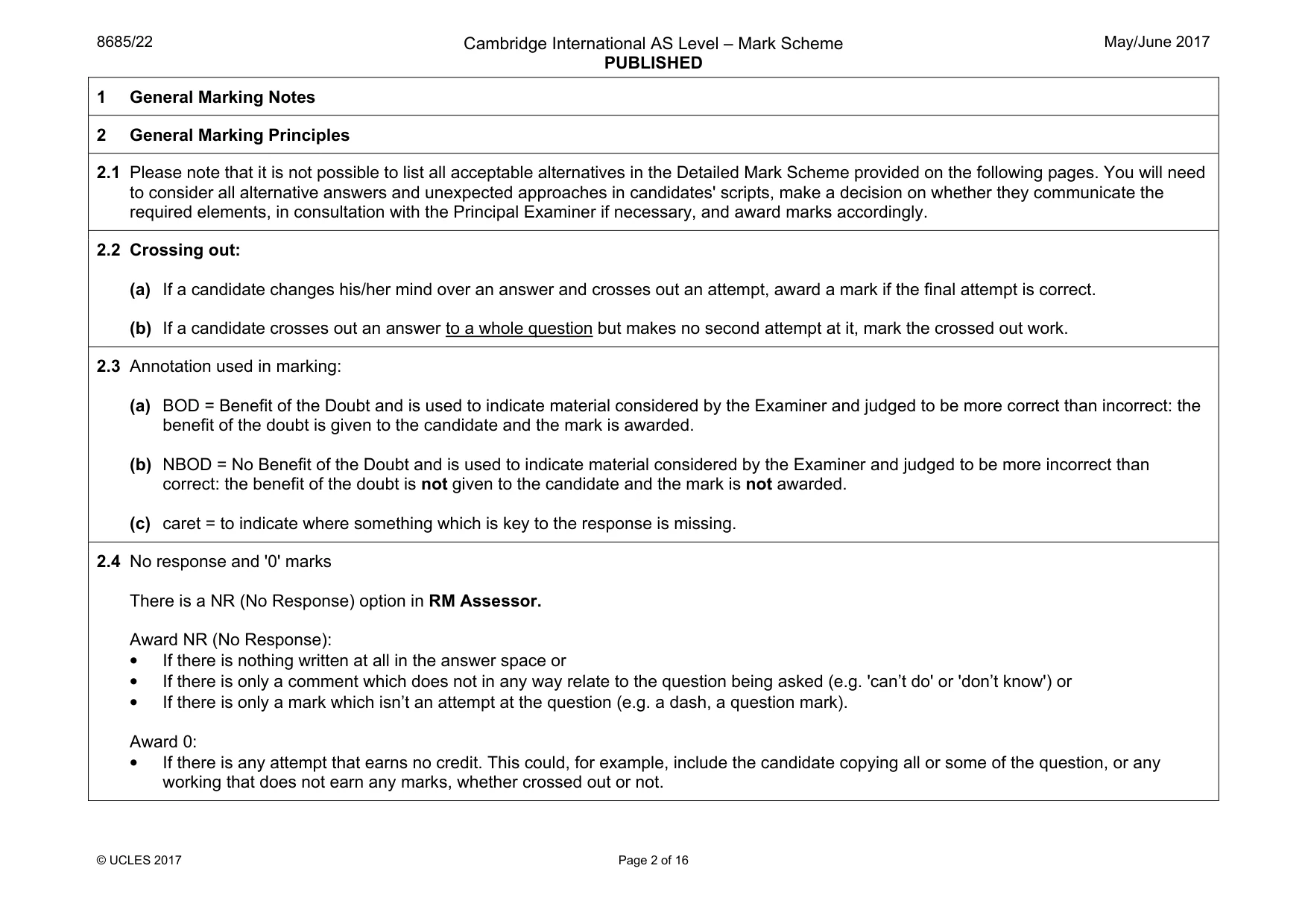
8685/22 Cambridge International AS Level – Mark Scheme PUBLISHED May/June 2017 © UCLES 2017 Page 2 of 16 1 General Marking Notes 2 General Marking Principles 2.1 Please note that it is not possible to list all acceptable alternatives in the Detailed Mark Scheme provided on the following pages. You will need to consider all alternative answers and unexpected approaches in candidates' scripts, make a decision on whether they communicate the required elements, in consultation with the Principal Examiner if necessary, and award marks accordingly. 2.2 Crossing out: (a) If a candidate changes his/her mind over an answer and crosses out an attempt, award a mark if the final attempt is correct. (b) If a candidate crosses out an answer to a whole question but makes no second attempt at it, mark the crossed out work. 2.3 Annotation used in marking: (a) BOD = Benefit of the Doubt and is used to indicate material considered by the Examiner and judged to be more correct than incorrect: the benefit of the doubt is given to the candidate and the mark is awarded. (b) NBOD = No Benefit of the Doubt and is used to indicate material considered by the Examiner and judged to be more incorrect than correct: the benefit of the doubt is not given to the candidate and the mark is not awarded. (c) caret = to indicate where something which is key to the response is missing. 2.4 No response and '0' marks There is a NR (No Response) option in RM Assessor. Award NR (No Response): • If there is nothing written at all in the answer space or • If there is only a comment which does not in any way relate to the question being asked (e.g. 'can’t do' or 'don’t know') or • If there is only a mark which isn’t an attempt at the question (e.g. a dash, a question mark). Award 0: • If there is any attempt that earns no credit. This could, for example, include the candidate copying all or some of the question, or any working that does not earn any marks, whether crossed out or not.
Mark scheme, page 3
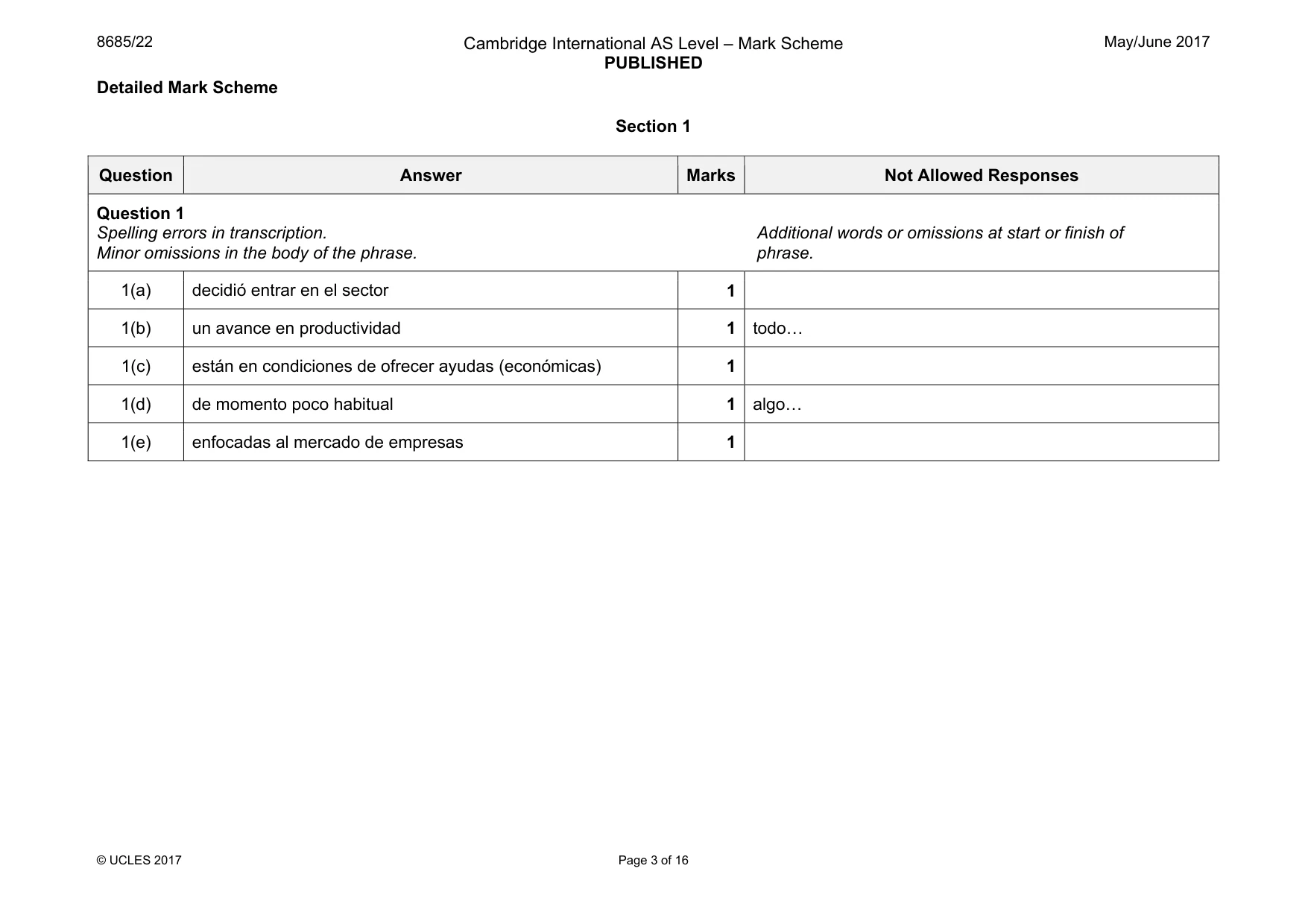
8685/22 Cambridge International AS Level – Mark Scheme PUBLISHED May/June 2017 © UCLES 2017 Page 3 of 16 Detailed Mark Scheme Section 1 Question Answer Marks Not Allowed Responses Question 1 Spelling errors in transcription. Additional words or omissions at start or finish of Minor omissions in the body of the phrase. phrase. 1(a) decidió entrar en el sector 1 1(b) un avance en productividad 1 todo« 1(c) están en condiciones de ofrecer ayudas (económicas) 1 1(d) de momento poco habitual 1 algo« 1(e) enfocadas al mercado de empresas 1
Mark scheme, page 4
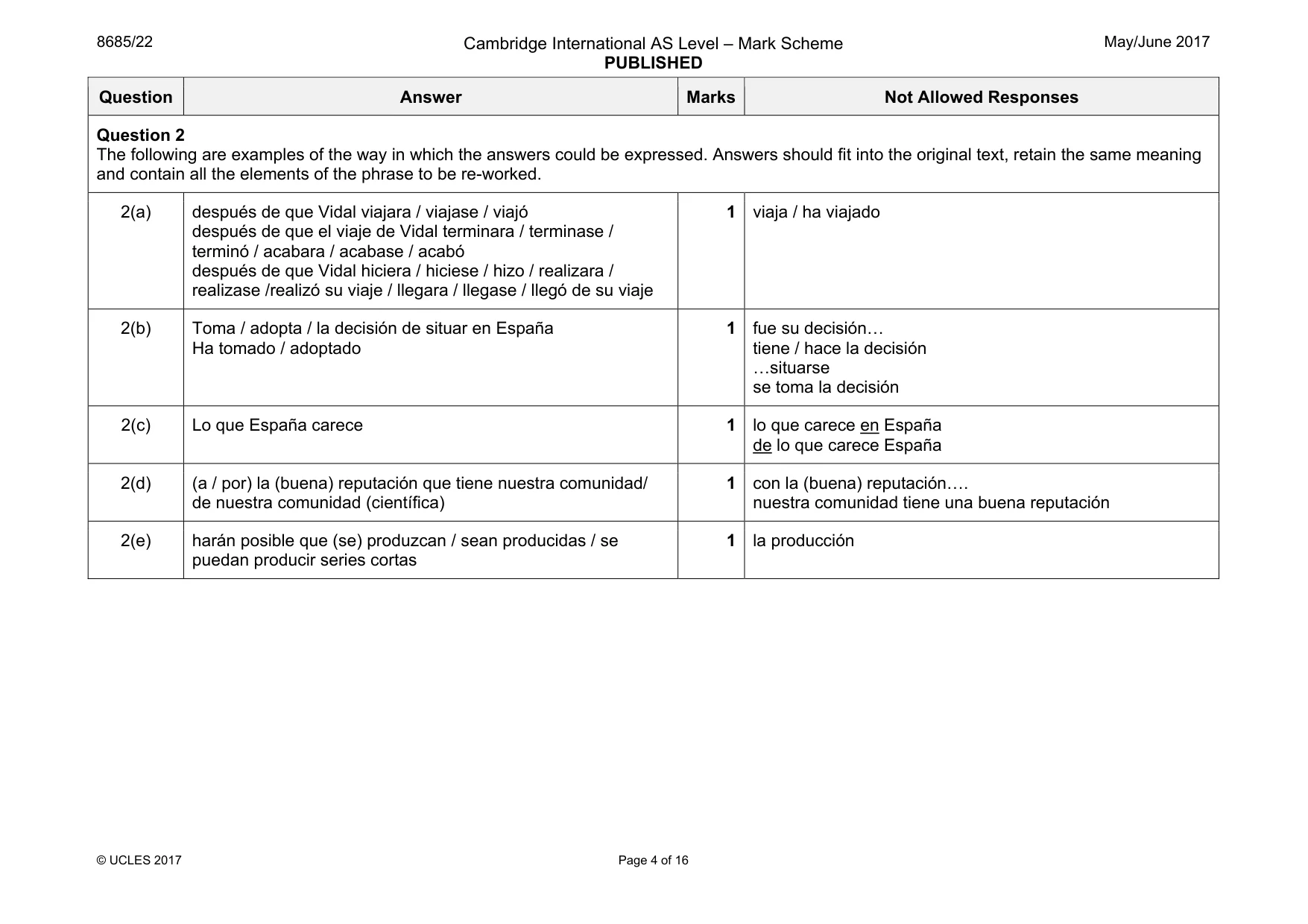
8685/22 Cambridge International AS Level – Mark Scheme PUBLISHED May/June 2017 © UCLES 2017 Page 4 of 16 Question Answer Marks Not Allowed Responses Question 2 The following are examples of the way in which the answers could be expressed. Answers should fit into the original text, retain the same meaning and contain all the elements of the phrase to be re-worked. 2(a) después de que Vidal viajara / viajase / viajó después de que el viaje de Vidal terminara / terminase / terminó / acabara / acabase / acabó después de que Vidal hiciera / hiciese / hizo / realizara / realizase /realizó su viaje / llegara / llegase / llegó de su viaje 1 viaja / ha viajado 2(b) Toma / adopta / la decisión de situar en España Ha tomado / adoptado 1 fue su decisión« tiene / hace la decisión «situarse se toma la decisión 2(c) Lo que España carece 1 lo que carece en España de lo que carece España 2(d) (a / por) la (buena) reputación que tiene nuestra comunidad/ de nuestra comunidad (científica) 1 con la (buena) reputación«. nuestra comunidad tiene una buena reputación 2(e) harán posible que (se) produzcan / sean producidas / se puedan producir series cortas 1 la producción
Mark scheme, page 5
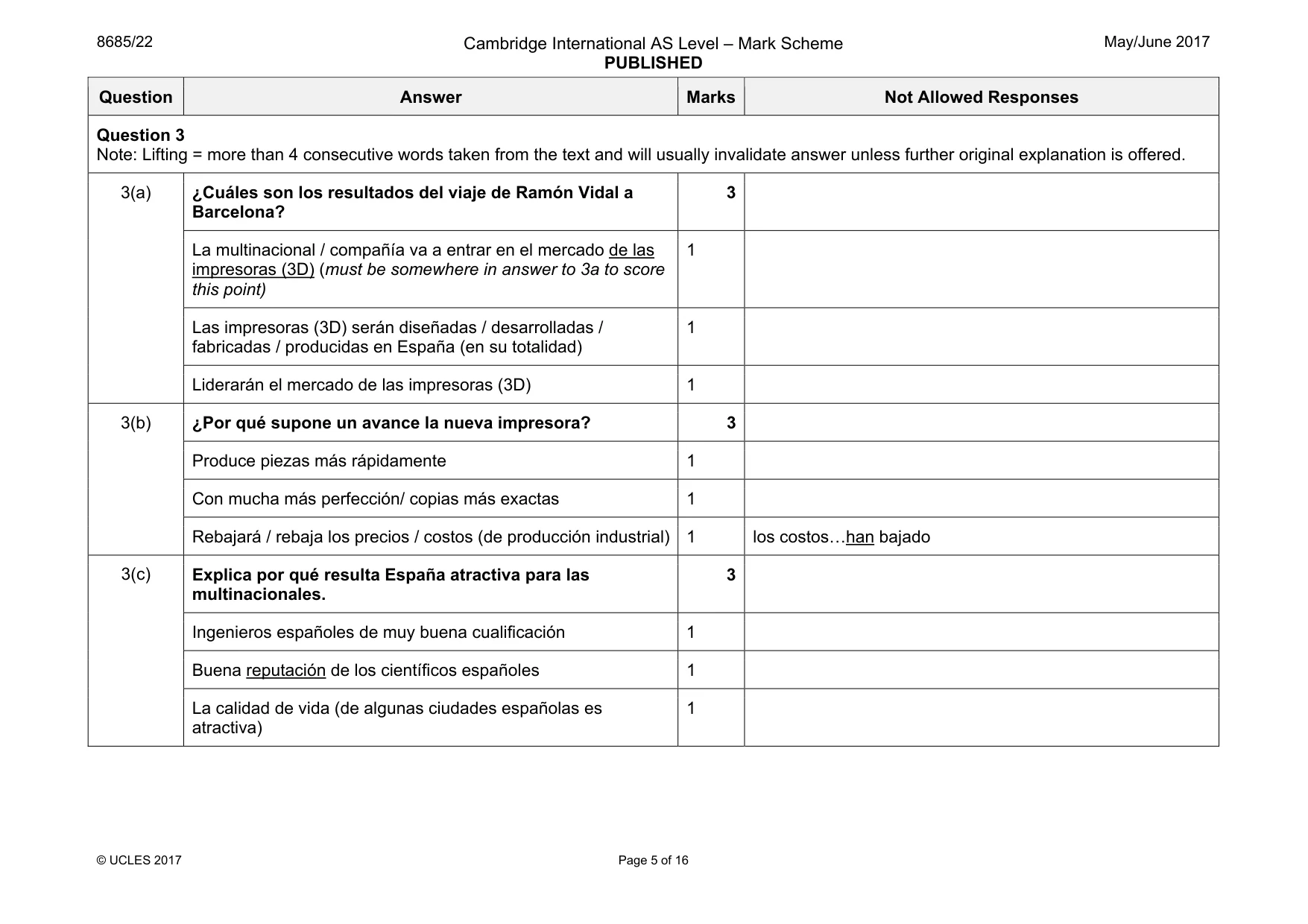
8685/22 Cambridge International AS Level – Mark Scheme PUBLISHED May/June 2017 © UCLES 2017 Page 5 of 16 Question Answer Marks Not Allowed Responses Question 3 Note: Lifting = more than 4 consecutive words taken from the text and will usually invalidate answer unless further original explanation is offered. 3(a) ¿Cuáles son los resultados del viaje de Ramón Vidal a Barcelona? 3 La multinacional / compañía va a entrar en el mercado de las impresoras (3D) (must be somewhere in answer to 3a to score this point) 1 Las impresoras (3D) serán diseñadas / desarrolladas / fabricadas / producidas en España (en su totalidad) 1 Liderarán el mercado de las impresoras (3D) 1 3(b) ¿Por qué supone un avance la nueva impresora? 3 Produce piezas más rápidamente 1 Con mucha más perfección/ copias más exactas 1 Rebajará / rebaja los precios / costos (de producción industrial) 1 los costos«han bajado 3(c) Explica por qué resulta España atractiva para las multinacionales. 3 Ingenieros españoles de muy buena cualificación 1 Buena reputación de los científicos españoles 1 La calidad de vida (de algunas ciudades españolas es atractiva) 1
Mark scheme, page 6
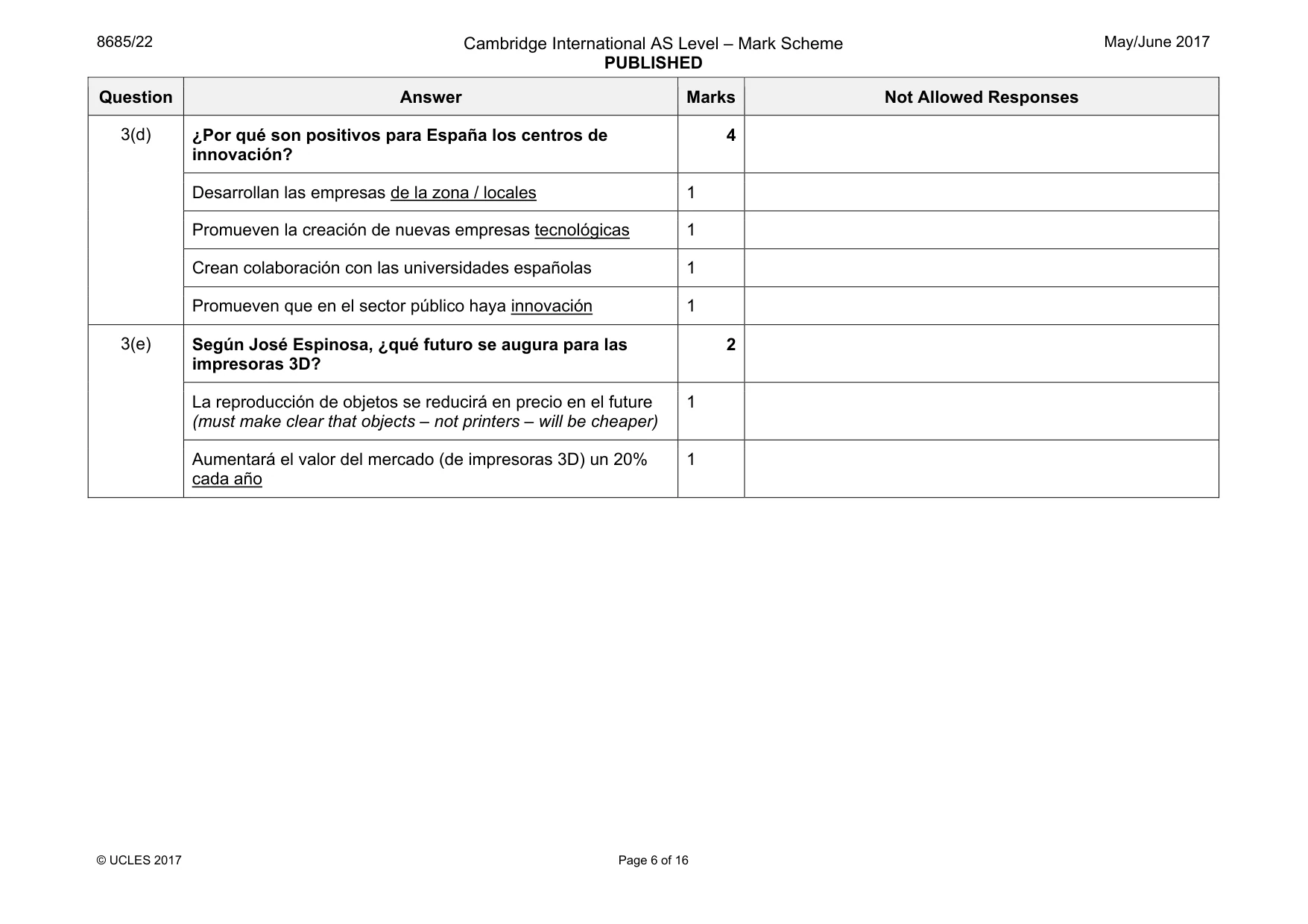
8685/22 Cambridge International AS Level – Mark Scheme PUBLISHED May/June 2017 © UCLES 2017 Page 6 of 16 Question Answer Marks Not Allowed Responses 3(d) ¿Por qué son positivos para España los centros de innovación? 4 Desarrollan las empresas de la zona / locales 1 Promueven la creación de nuevas empresas tecnológicas 1 Crean colaboración con las universidades españolas 1 Promueven que en el sector público haya innovación 1 3(e) Según José Espinosa, ¿qué futuro se augura para las impresoras 3D? 2 La reproducción de objetos se reducirá en precio en el future (must make clear that objects – not printers – will be cheaper) 1 Aumentará el valor del mercado (de impresoras 3D) un 20% cada año 1
Mark scheme, page 7
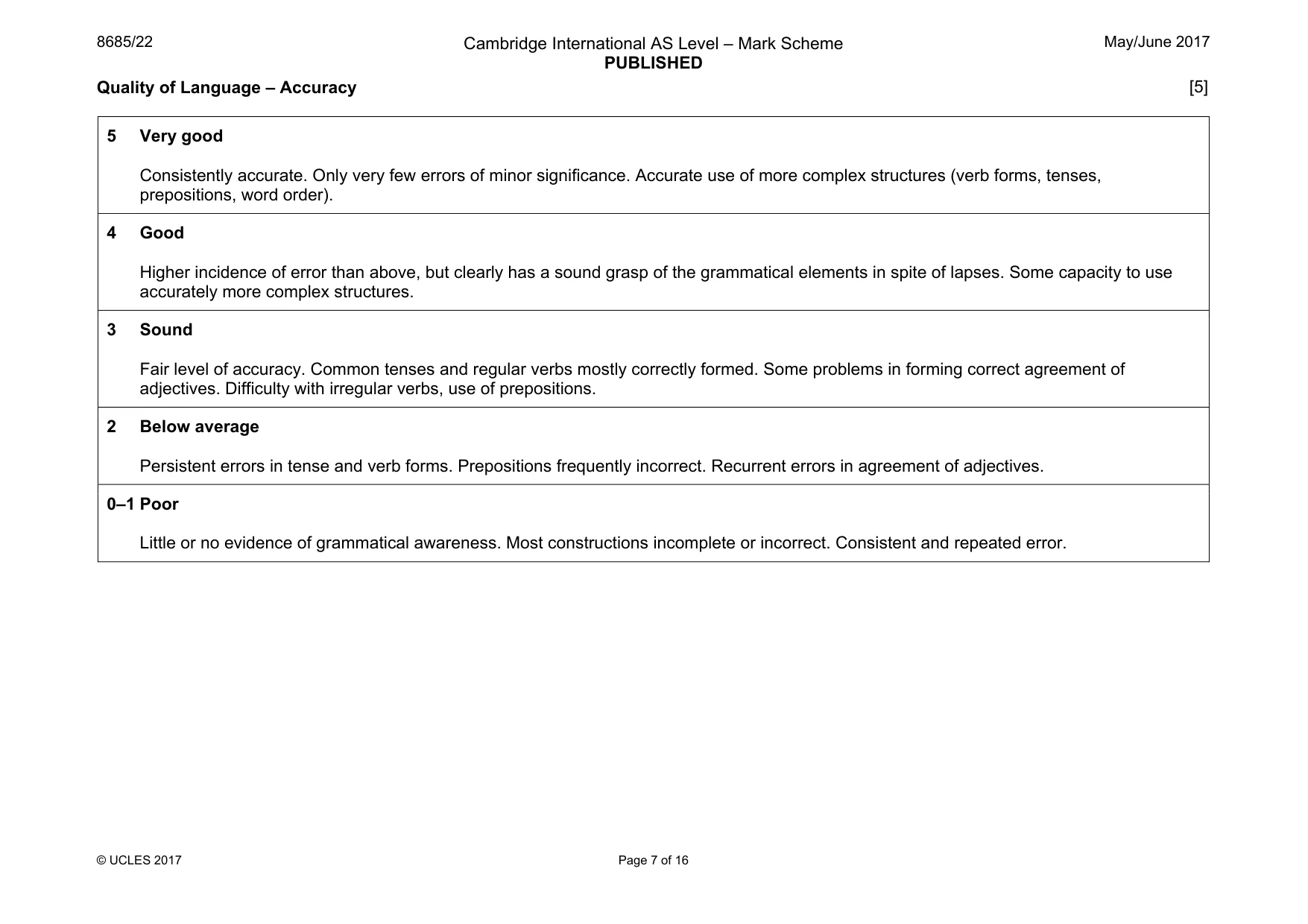
8685/22 Cambridge International AS Level – Mark Scheme PUBLISHED May/June 2017 © UCLES 2017 Page 7 of 16 Quality of Language – Accuracy [5] 5 Very good Consistently accurate. Only very few errors of minor significance. Accurate use of more complex structures (verb forms, tenses, prepositions, word order). 4 Good Higher incidence of error than above, but clearly has a sound grasp of the grammatical elements in spite of lapses. Some capacity to use accurately more complex structures. 3 Sound Fair level of accuracy. Common tenses and regular verbs mostly correctly formed. Some problems in forming correct agreement of adjectives. Difficulty with irregular verbs, use of prepositions. 2 Below average Persistent errors in tense and verb forms. Prepositions frequently incorrect. Recurrent errors in agreement of adjectives. 0–1 Poor Little or no evidence of grammatical awareness. Most constructions incomplete or incorrect. Consistent and repeated error.
Mark scheme, page 8
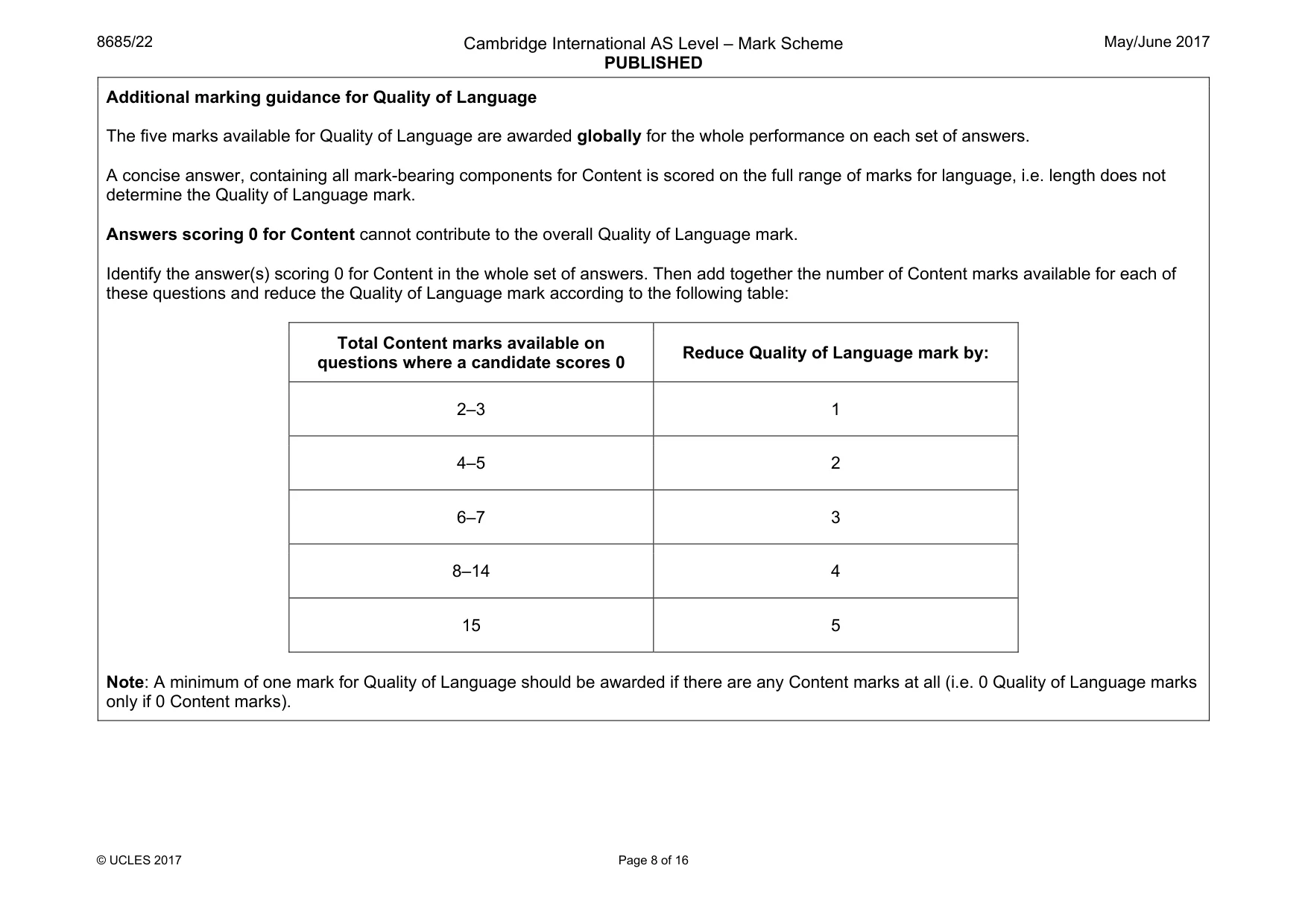
8685/22 Cambridge International AS Level – Mark Scheme PUBLISHED May/June 2017 © UCLES 2017 Page 8 of 16 Additional marking guidance for Quality of Language The five marks available for Quality of Language are awarded globally for the whole performance on each set of answers. A concise answer, containing all mark-bearing components for Content is scored on the full range of marks for language, i.e. length does not determine the Quality of Language mark. Answers scoring 0 for Content cannot contribute to the overall Quality of Language mark. Identify the answer(s) scoring 0 for Content in the whole set of answers. Then add together the number of Content marks available for each of these questions and reduce the Quality of Language mark according to the following table: Total Content marks available on questions where a candidate scores 0 Reduce Quality of Language mark by: 2–3 1 4–5 2 6–7 3 8–14 4 15 5 Note: A minimum of one mark for Quality of Language should be awarded if there are any Content marks at all (i.e. 0 Quality of Language marks only if 0 Content marks).
Mark scheme, page 9
8685/22 Cambridge International AS Level – Mark Scheme PUBLISHED May/June 2017 © UCLES 2017 Page 9 of 16 Question Answer Marks Not Allowed Responses Question 4 Note: Lifting = more than 4 consecutive words taken from the text and will usually invalidate answer unless further original explanation is offered. 4(a) ¿Cuáles son las razones por las que este tratamiento es importante? 3 Avance más significativo de los últimos diez años 1 El triple de pacientes ha alargado sus vidas (en dos años) 1 Disponible en el mercado 1 4(b) ¿Qué significa esta vacuna en la actualidad para los pacientes y los sistemas de sanidad? 3 No sufren efectos secundarios 1 reduce los efectos colaterales No necesitan ir al hospital / estar ingresados para ser tratados 1 Costes similares a otros tratamientos 1 4(c) Según Juan Donés, ¿qué efectos tiene el tratamiento al activar el sistema inmunológico? 2 (El paciente) combate la enfermedad 1 Retarda la recaída 1
Mark scheme, page 10
8685/22 Cambridge International AS Level – Mark Scheme PUBLISHED May/June 2017 © UCLES 2017 Page 10 of 16 Question Answer Marks Not Allowed Responses 4(d) ¿Por qué es revolucionaria esta vacuna? 4 Es innovadora no solo científicamente 1 (Demuestra que) la industria latinoamericana puede contribuir con innovaciones farmacéuticas 1 Primera innovación farmacéutica que va del hemisferio sur al norte 1 Se produce el medicamento en América Latina 1 4(e) Según Donés, ¿qué cambios se están dando en el mundo científico latinoamericano? 3 La ciencia está beneficiando el desarrollo económico / la economía 1 Está cambiando el modelo de financiación (científica) 1 Hay colaboración estatal y privada (en la financiación) 1
Mark scheme, page 11
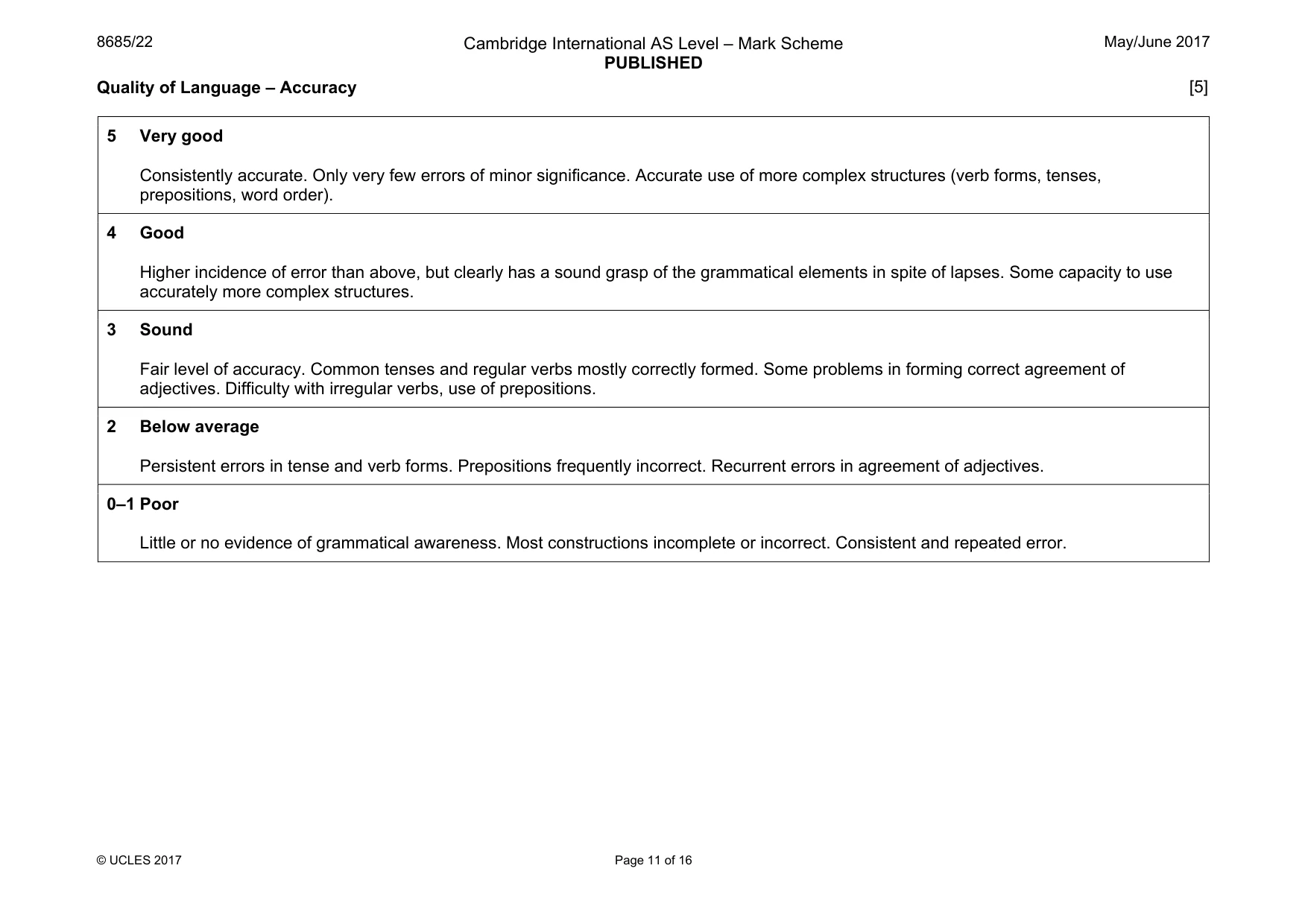
8685/22 Cambridge International AS Level – Mark Scheme PUBLISHED May/June 2017 © UCLES 2017 Page 11 of 16 Quality of Language – Accuracy [5] 5 Very good Consistently accurate. Only very few errors of minor significance. Accurate use of more complex structures (verb forms, tenses, prepositions, word order). 4 Good Higher incidence of error than above, but clearly has a sound grasp of the grammatical elements in spite of lapses. Some capacity to use accurately more complex structures. 3 Sound Fair level of accuracy. Common tenses and regular verbs mostly correctly formed. Some problems in forming correct agreement of adjectives. Difficulty with irregular verbs, use of prepositions. 2 Below average Persistent errors in tense and verb forms. Prepositions frequently incorrect. Recurrent errors in agreement of adjectives. 0–1 Poor Little or no evidence of grammatical awareness. Most constructions incomplete or incorrect. Consistent and repeated error.
Mark scheme, page 12
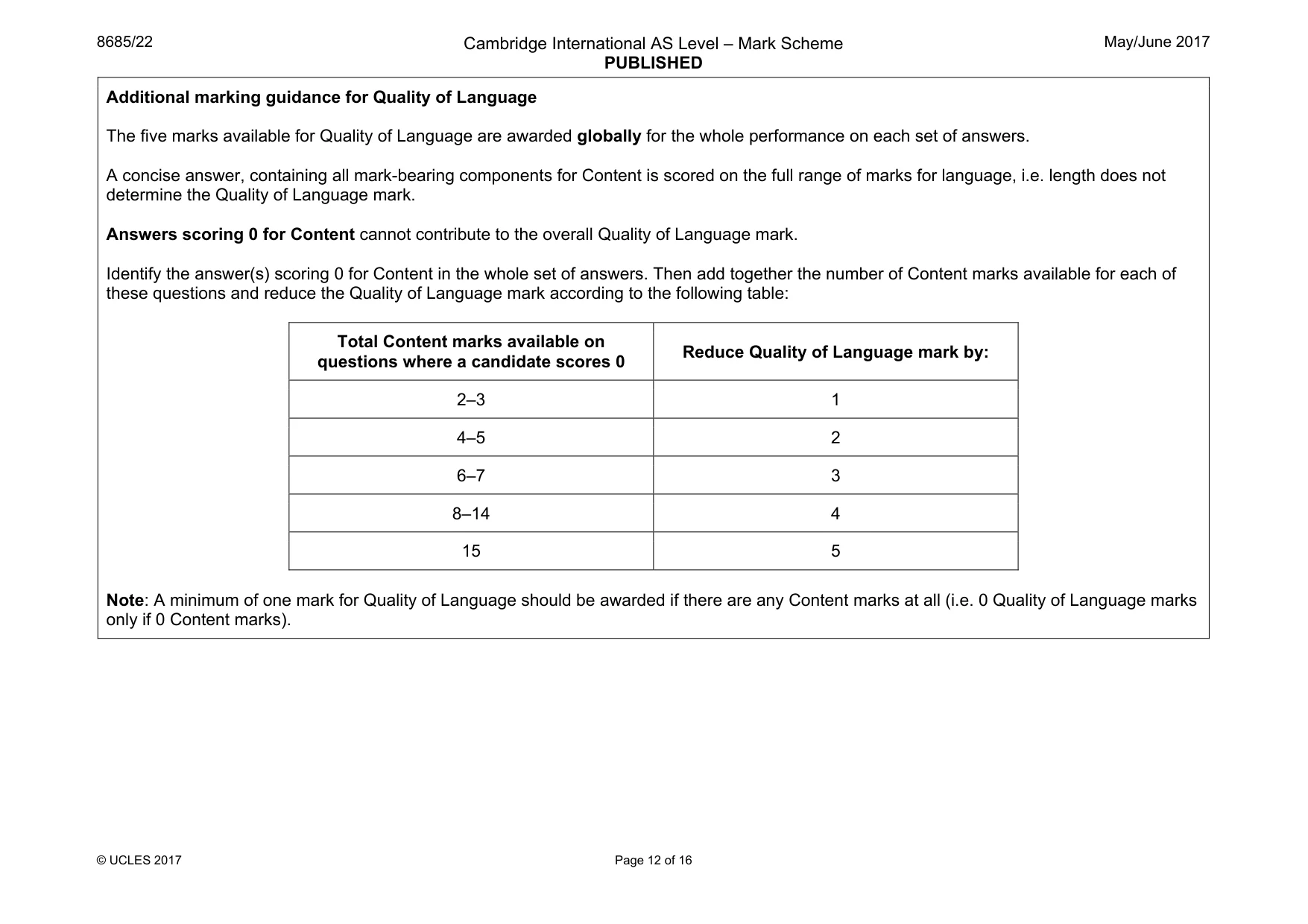
8685/22 Cambridge International AS Level – Mark Scheme PUBLISHED May/June 2017 © UCLES 2017 Page 12 of 16 Additional marking guidance for Quality of Language The five marks available for Quality of Language are awarded globally for the whole performance on each set of answers. A concise answer, containing all mark-bearing components for Content is scored on the full range of marks for language, i.e. length does not determine the Quality of Language mark. Answers scoring 0 for Content cannot contribute to the overall Quality of Language mark. Identify the answer(s) scoring 0 for Content in the whole set of answers. Then add together the number of Content marks available for each of these questions and reduce the Quality of Language mark according to the following table: Total Content marks available on questions where a candidate scores 0 Reduce Quality of Language mark by: 2–3 1 4–5 2 6–7 3 8–14 4 15 5 Note: A minimum of one mark for Quality of Language should be awarded if there are any Content marks at all (i.e. 0 Quality of Language marks only if 0 Content marks).
Mark scheme, page 13
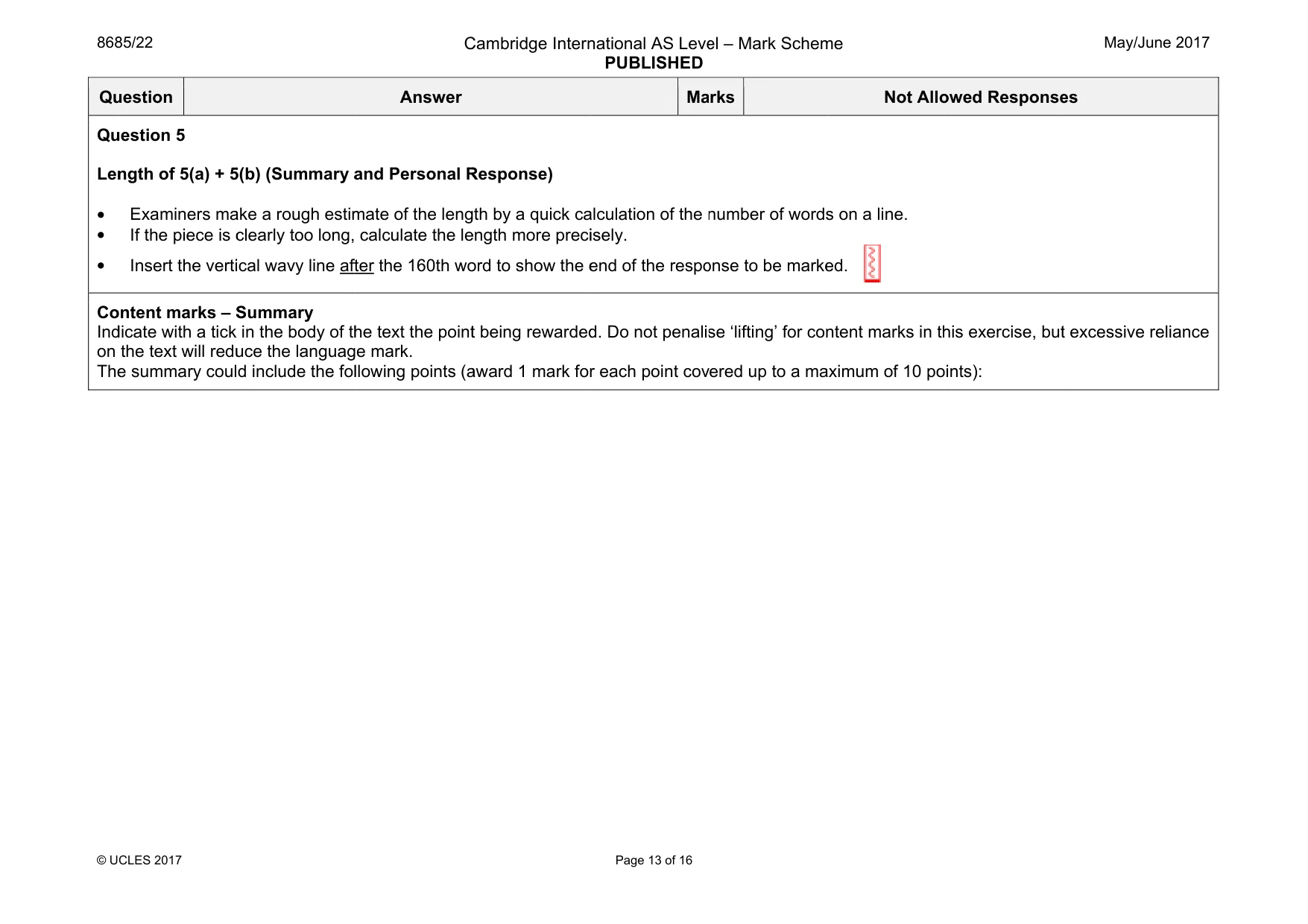
868 © U Qu Qu Len • • • Co Ind on The 85/22 CLES 2017 uestion uestion 5 ngth of 5(a) + 5 Examiners ma If the piece is c Insert the verti ontent marks – S dicate with a tick the text will redu e summary coul 5(b) (Summary a ake a rough estim clearly too long, ical wavy line aft Summary k in the body of th uce the languag d include the fol C Answer and Personal R mate of the leng calculate the le fter the 160th wo he text the point ge mark. llowing points (a Cambridge Intern Response) gth by a quick ca ength more preci ord to show the e t being rewarded award 1 mark for national AS Leve PUBLISHED Page 13 of 16 Ma alculation of the n isely. end of the respo d. Do not penalis r each point cov el – Mark Schem rks number of words onse to be marke se ‘lifting’ for con ered up to a ma me Not Allo s on a line. ed. ntent marks in th aximum of 10 po owed Response his exercise, but ints): May/June 2 es t excessive relia 2017 nce
Mark scheme, page 14
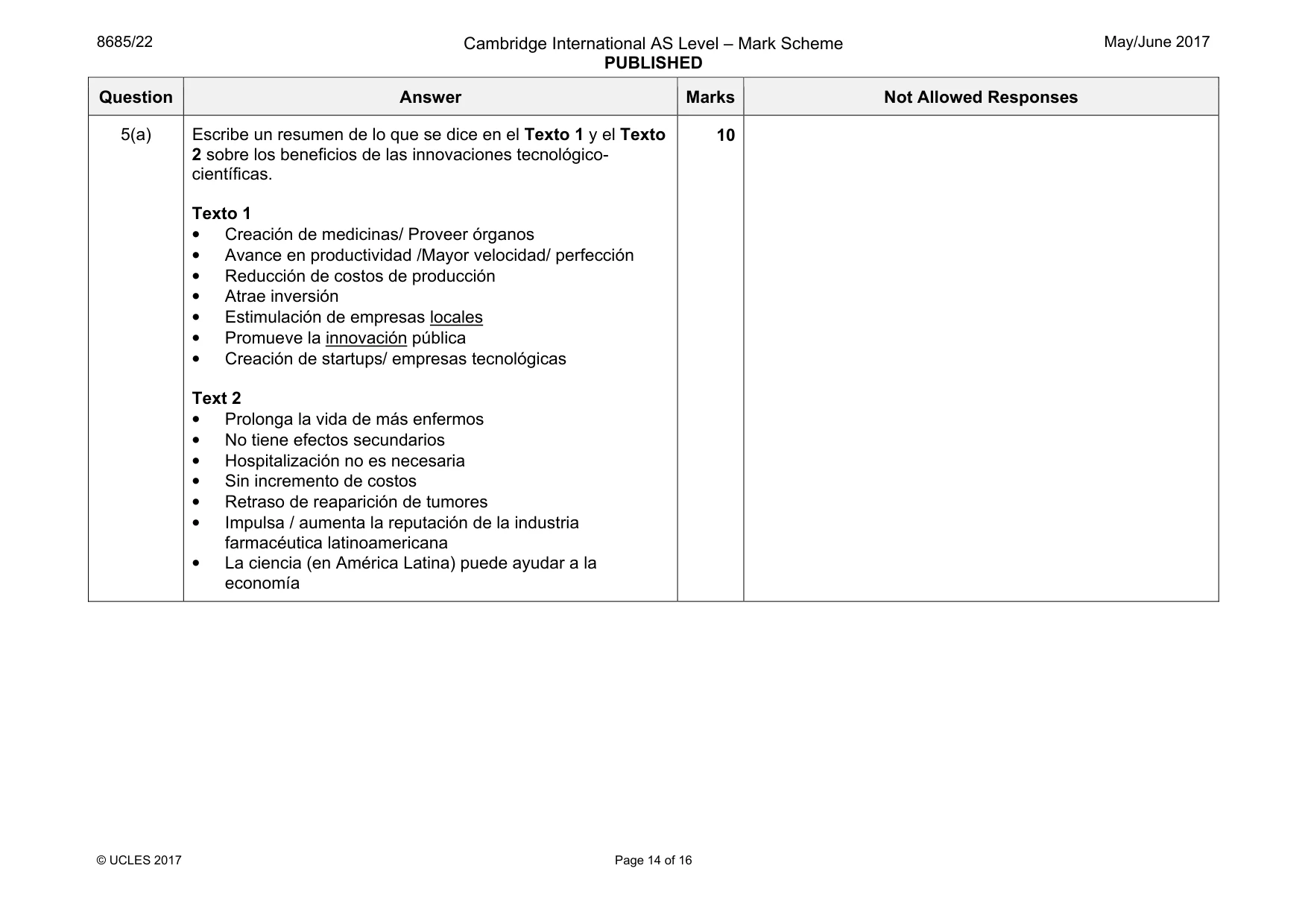
8685/22 Cambridge International AS Level – Mark Scheme PUBLISHED May/June 2017 © UCLES 2017 Page 14 of 16 Question Answer Marks Not Allowed Responses 5(a) Escribe un resumen de lo que se dice en el Texto 1 y el Texto 2 sobre los beneficios de las innovaciones tecnológico- científicas. Texto 1 • Creación de medicinas/ Proveer órganos • Avance en productividad /Mayor velocidad/ perfección • Reducción de costos de producción • Atrae inversión • Estimulación de empresas locales • Promueve la innovación pública • Creación de startups/ empresas tecnológicas Text 2 • Prolonga la vida de más enfermos • No tiene efectos secundarios • Hospitalización no es necesaria • Sin incremento de costos • Retraso de reaparición de tumores • Impulsa / aumenta la reputación de la industria farmacéutica latinoamericana • La ciencia (en América Latina) puede ayudar a la economía 10
Mark scheme, page 15
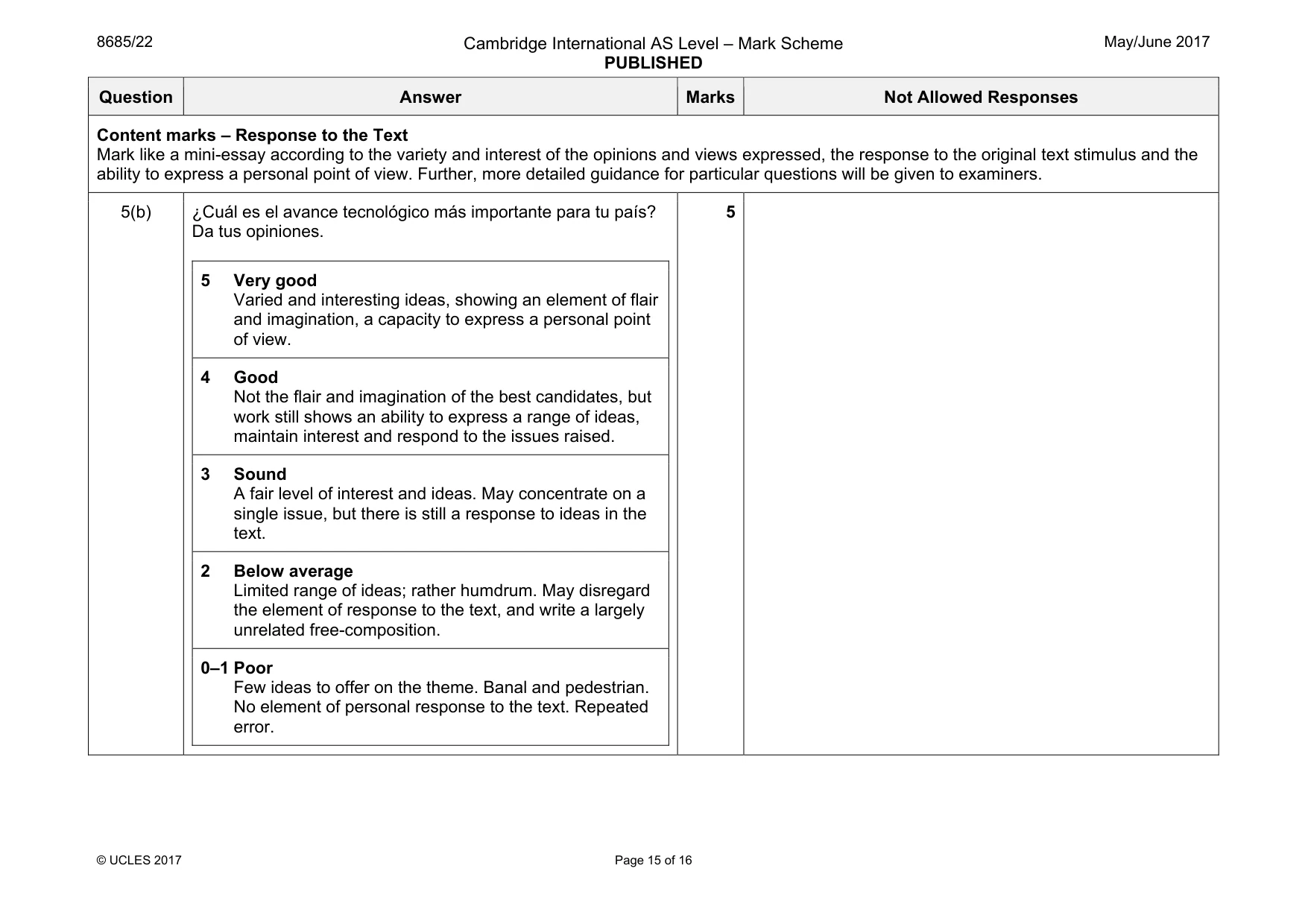
8685/22 Cambridge International AS Level – Mark Scheme PUBLISHED May/June 2017 © UCLES 2017 Page 15 of 16 Question Answer Marks Not Allowed Responses Content marks – Response to the Text Mark like a mini-essay according to the variety and interest of the opinions and views expressed, the response to the original text stimulus and the ability to express a personal point of view. Further, more detailed guidance for particular questions will be given to examiners. 5(b) ¿Cuál es el avance tecnológico más importante para tu país? Da tus opiniones. 5 Very good Varied and interesting ideas, showing an element of flair and imagination, a capacity to express a personal point of view. 4 Good Not the flair and imagination of the best candidates, but work still shows an ability to express a range of ideas, maintain interest and respond to the issues raised. 3 Sound A fair level of interest and ideas. May concentrate on a single issue, but there is still a response to ideas in the text. 2 Below average Limited range of ideas; rather humdrum. May disregard the element of response to the text, and write a largely unrelated free-composition. 0–1 Poor Few ideas to offer on the theme. Banal and pedestrian. No element of personal response to the text. Repeated error. 5
Mark scheme, page 16
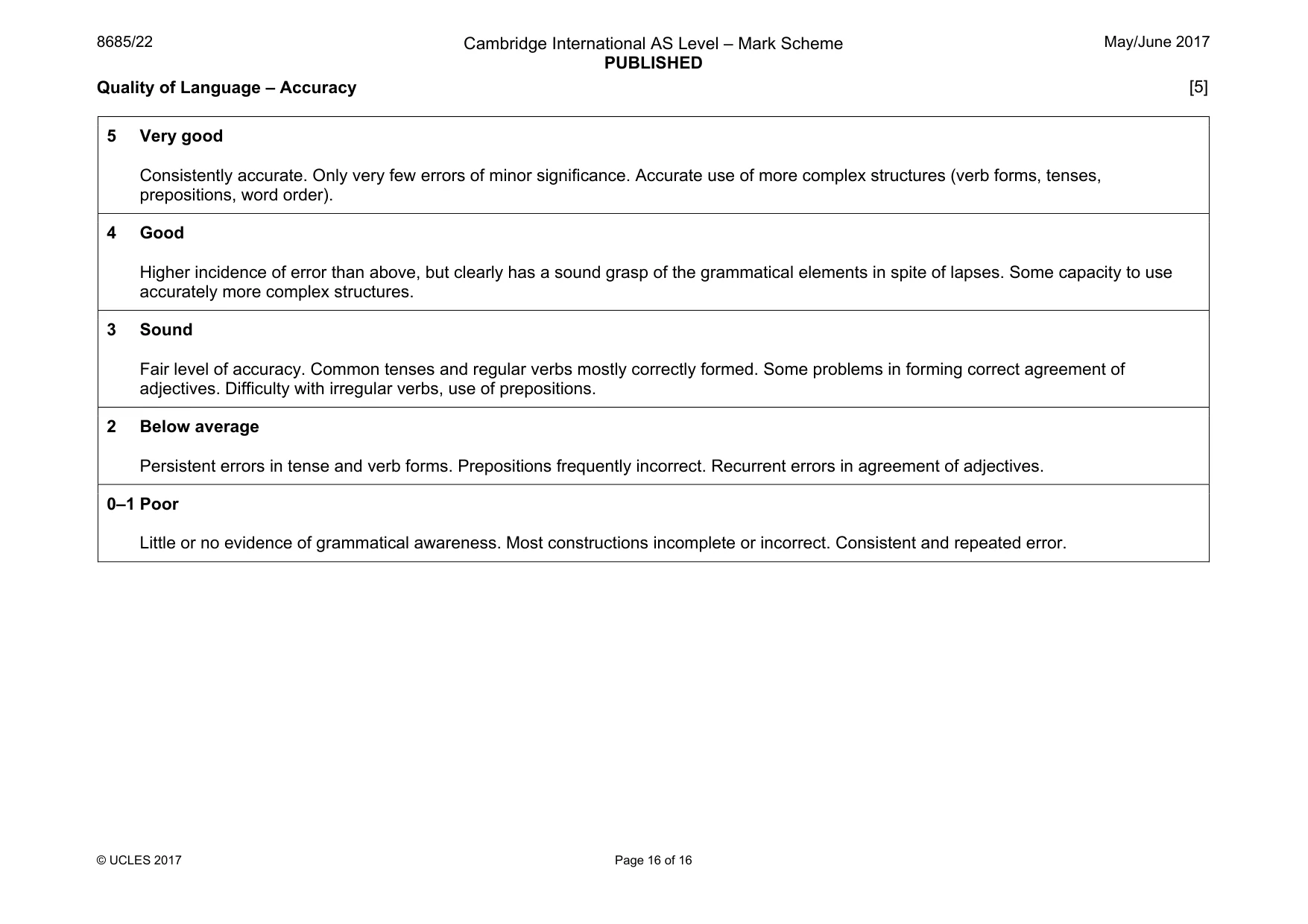
8685/22 Cambridge International AS Level – Mark Scheme PUBLISHED May/June 2017 © UCLES 2017 Page 16 of 16 Quality of Language – Accuracy [5] 5 Very good Consistently accurate. Only very few errors of minor significance. Accurate use of more complex structures (verb forms, tenses, prepositions, word order). 4 Good Higher incidence of error than above, but clearly has a sound grasp of the grammatical elements in spite of lapses. Some capacity to use accurately more complex structures. 3 Sound Fair level of accuracy. Common tenses and regular verbs mostly correctly formed. Some problems in forming correct agreement of adjectives. Difficulty with irregular verbs, use of prepositions. 2 Below average Persistent errors in tense and verb forms. Prepositions frequently incorrect. Recurrent errors in agreement of adjectives. 0–1 Poor Little or no evidence of grammatical awareness. Most constructions incomplete or incorrect. Consistent and repeated error.
What you needed in this session
Cambridge’s own grade thresholds for 2017 May/June, Paper 2 · Variant 2. A higher threshold means an easier paper — the bar moves with how the cohort did.