Cambridge A Level Spanish - First Language (AS Level only) 8665 — 2018 Oct/Nov Paper 4 · Variant 1
8665/41/O/N/18
The question paper and its mark scheme, free to read here and free to download. This is Cambridge’s own paper, exactly as it was sat.
Question paper8 pages


Mark scheme4 pages
Answers below. Sit the paper first if you are practising.
Paper as text
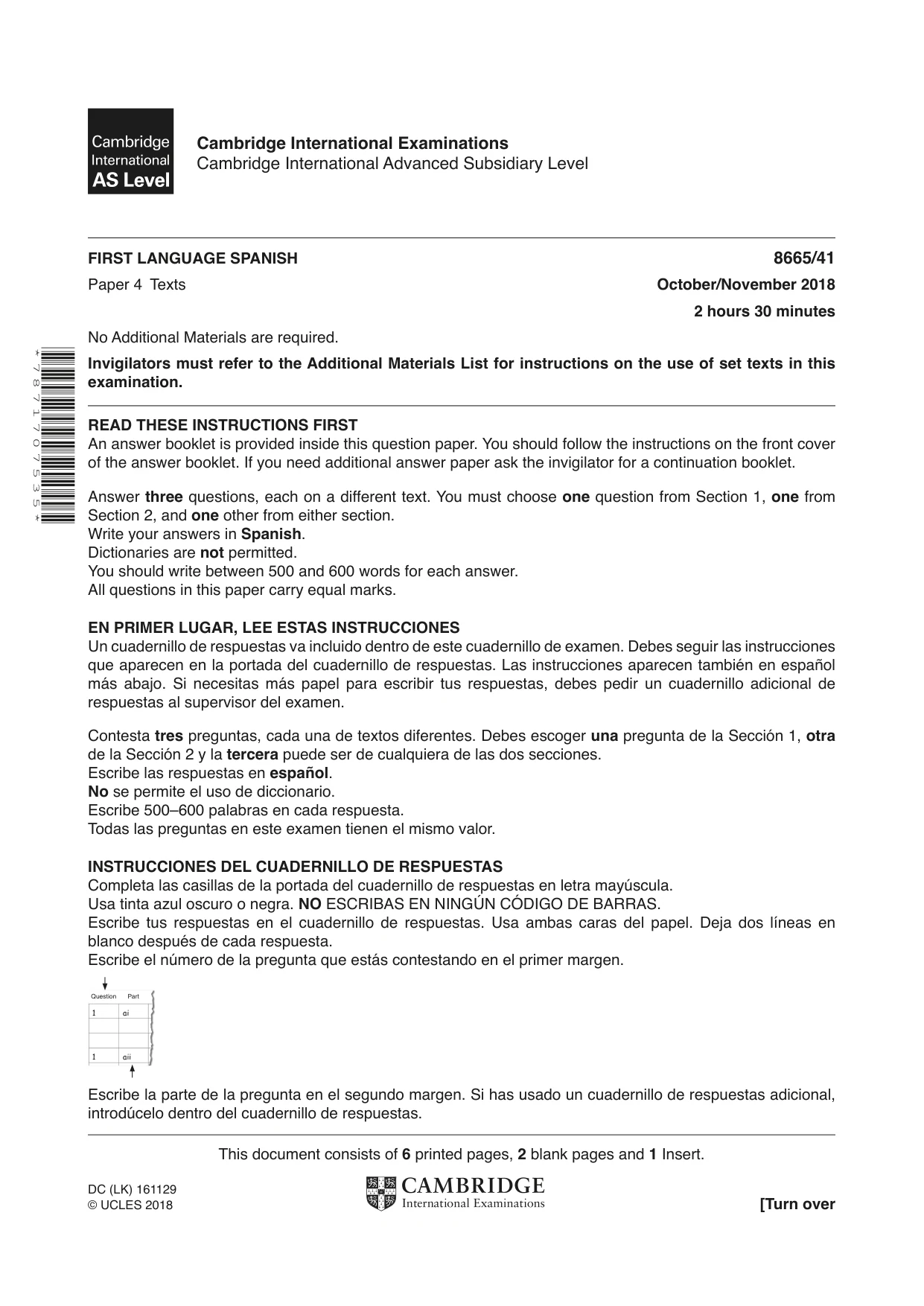
Question paper, page 1
* 7 8 7 1 7 0 7 5 3 5 * This document consists of 6 printed pages, 2 blank pages and 1 Insert. DC (LK) 161129 © UCLES 2018 [Turn over Cambridge International Examinations Cambridge International Advanced Subsidiary Level FIRST LANGUAGE SPANISH 8665/41 Paper 4 Texts October/November 2018 2 hours 30 minutes No Additional Materials are required. Invigilators must refer to the Additional Materials List for instructions on the use of set texts in this examination. READ THESE INSTRUCTIONS FIRST An answer booklet is provided inside this question paper. You should follow the instructions on the front cover of the answer booklet. If you need additional answer paper ask the invigilator for a continuation booklet. Answer three questions, each on a different text. You must choose one question from Section 1, one from Section 2, and one other from either section. Write your answers in Spanish. Dictionaries are not permitted. You should write between 500 and 600 words for each answer. All questions in this paper carry equal marks. EN PRIMER LUGAR, LEE ESTAS INSTRUCCIONES Un cuadernillo de respuestas va incluido dentro de este cuadernillo de examen. Debes seguir las instrucciones que aparecen en la portada del cuadernillo de respuestas. Las instrucciones aparecen también en español más abajo. Si necesitas más papel para escribir tus respuestas, debes pedir un cuadernillo adicional de respuestas al supervisor del examen. Contesta tres preguntas, cada una de textos diferentes. Debes escoger una pregunta de la Sección 1, otra de la Sección 2 y la tercera puede ser de cualquiera de las dos secciones. Escribe las respuestas en español. No se permite el uso de diccionario. Escribe 500–600 palabras en cada respuesta. Todas las preguntas en este examen tienen el mismo valor. INSTRUCCIONES DEL CUADERNILLO DE RESPUESTAS Completa las casillas de la portada del cuadernillo de respuestas en letra mayúscula. Usa tinta azul oscuro o negra. NO ESCRIBAS EN NINGÚN CÓDIGO DE BARRAS. Escribe tus respuestas en el cuadernillo de respuestas. Usa ambas caras del papel. Deja dos líneas en blanco después de cada respuesta. Escribe el número de la pregunta que estás contestando en el primer margen. Question Part 1 1 ai aii Escribe la parte de la pregunta en el segundo margen. Si has usado un cuadernillo de respuestas adicional, introdúcelo dentro del cuadernillo de respuestas.
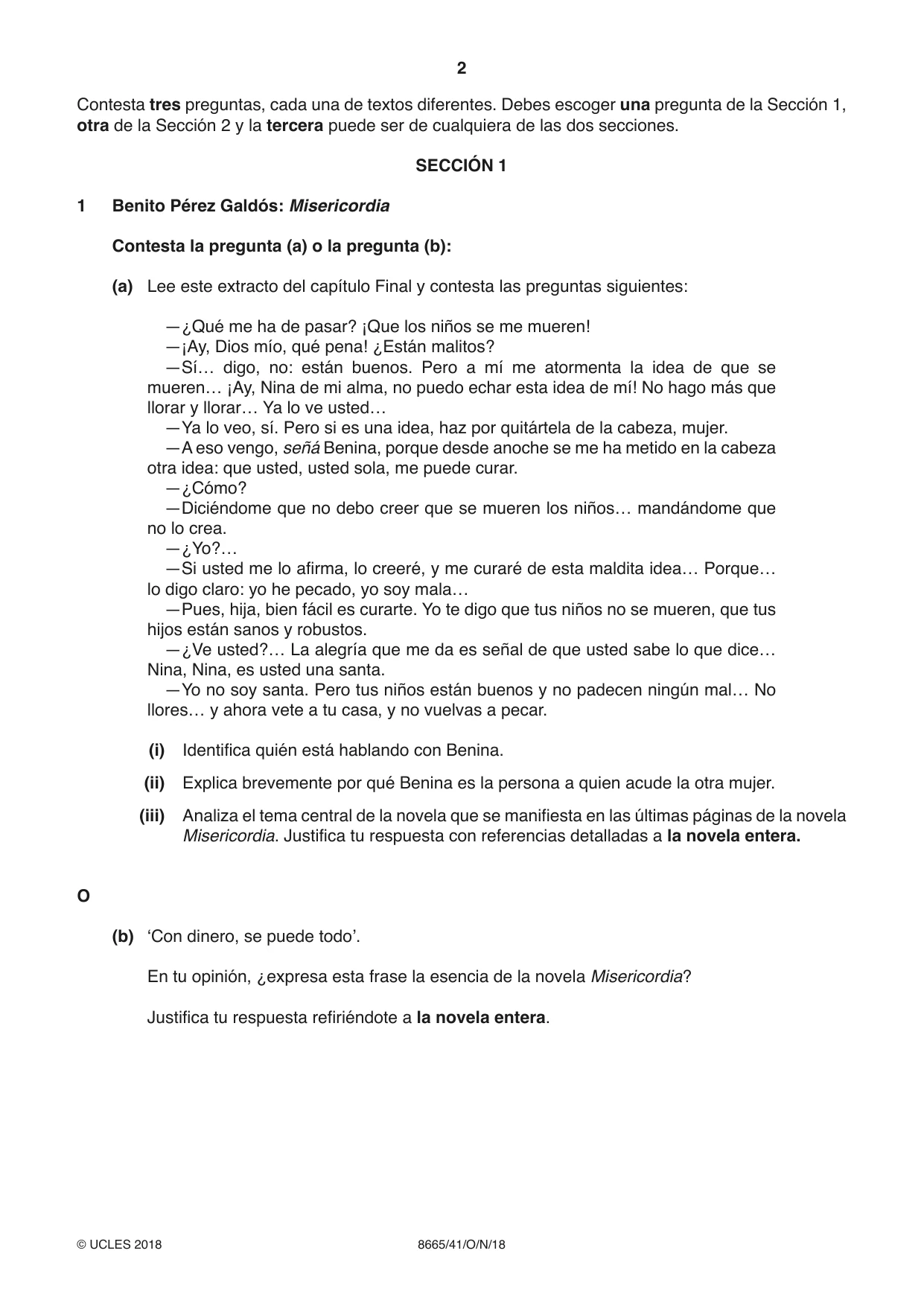
Question paper, page 2
2 8665/41/O/N/18 © UCLES 2018 Contesta tres preguntas, cada una de textos diferentes. Debes escoger una pregunta de la Sección 1, otra de la Sección 2 y la tercera puede ser de cualquiera de las dos secciones. SECCIÓN 1 1 Benito Pérez Galdós: Misericordia Contesta la pregunta (a) o la pregunta (b): (a) Lee este extracto del capítulo Final y contesta las preguntas siguientes: —¿Qué me ha de pasar? ¡Que los niños se me mueren! —¡Ay, Dios mío, qué pena! ¿Están malitos? —Sí… digo, no: están buenos. Pero a mí me atormenta la idea de que se mueren… ¡Ay, Nina de mi alma, no puedo echar esta idea de mí! No hago más que llorar y llorar… Ya lo ve usted… —Ya lo veo, sí. Pero si es una idea, haz por quitártela de la cabeza, mujer. —A eso vengo, señá Benina, porque desde anoche se me ha metido en la cabeza otra idea: que usted, usted sola, me puede curar. —¿Cómo? —Diciéndome que no debo creer que se mueren los niños… mandándome que no lo crea. —¿Yo?… —Si usted me lo afirma, lo creeré, y me curaré de esta maldita idea… Porque… lo digo claro: yo he pecado, yo soy mala… —Pues, hija, bien fácil es curarte. Yo te digo que tus niños no se mueren, que tus hijos están sanos y robustos. —¿Ve usted?… La alegría que me da es señal de que usted sabe lo que dice… Nina, Nina, es usted una santa. —Yo no soy santa. Pero tus niños están buenos y no padecen ningún mal… No llores… y ahora vete a tu casa, y no vuelvas a pecar. (i) Identifica quién está hablando con Benina. (ii) Explica brevemente por qué Benina es la persona a quien acude la otra mujer. (iii) Analiza el tema central de la novela que se manifiesta en las últimas páginas de la novela Misericordia. Justifica tu respuesta con referencias detalladas a la novela entera. O (b) ‘Con dinero, se puede todo’. En tu opinión, ¿expresa esta frase la esencia de la novela Misericordia? Justifica tu respuesta refiriéndote a la novela entera.
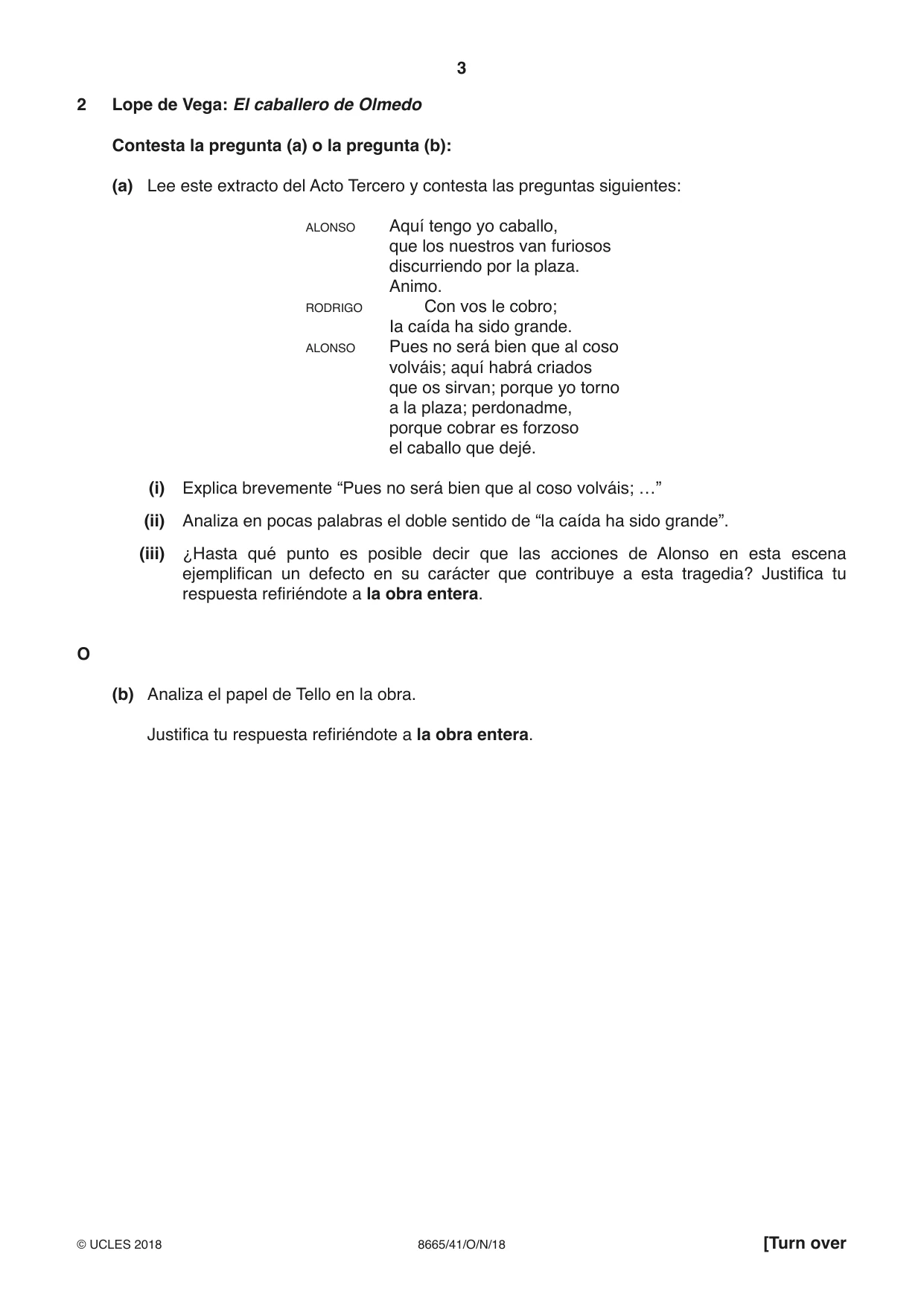
Question paper, page 3
3 8665/41/O/N/18 © UCLES 2018 [Turn over 2 Lope de Vega: El caballero de Olmedo Contesta la pregunta (a) o la pregunta (b): (a) Lee este extracto del Acto Tercero y contesta las preguntas siguientes: alonso Aquí tengo yo caballo, que los nuestros van furiosos discurriendo por la plaza. Animo. rodrigo Con vos le cobro; Ia caída ha sido grande. alonso Pues no será bien que al coso volváis; aquí habrá criados que os sirvan; porque yo torno a la plaza; perdonadme, porque cobrar es forzoso el caballo que dejé. (i) Explica brevemente “Pues no será bien que al coso volváis; …” (ii) Analiza en pocas palabras el doble sentido de “la caída ha sido grande”. (iii) ¿Hasta qué punto es posible decir que las acciones de Alonso en esta escena ejemplifican un defecto en su carácter que contribuye a esta tragedia? Justifica tu respuesta refiriéndote a la obra entera. O (b) Analiza el papel de Tello en la obra. Justifica tu respuesta refiriéndote a la obra entera.
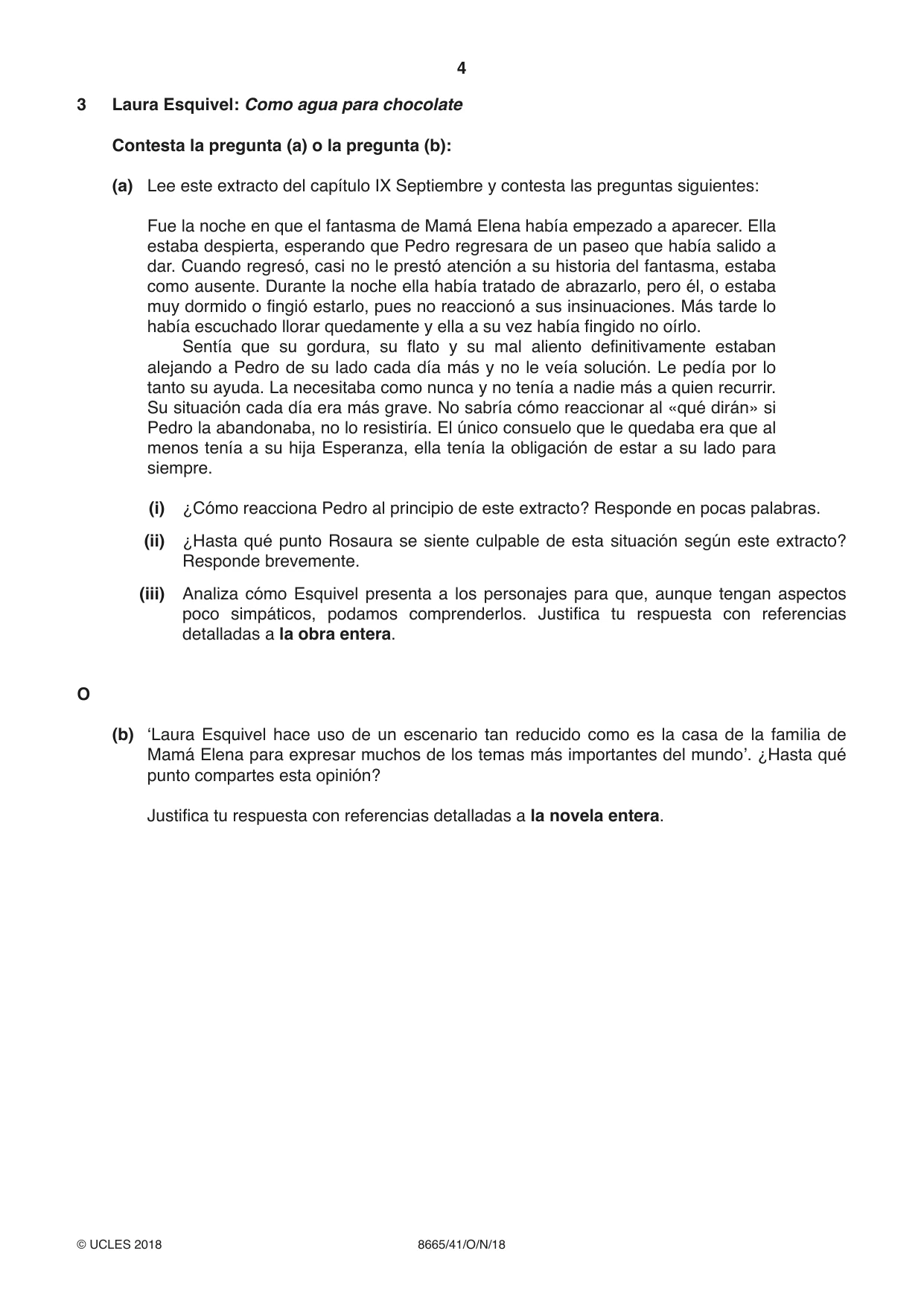
Question paper, page 4
4 8665/41/O/N/18 © UCLES 2018 3 Laura Esquivel: Como agua para chocolate Contesta la pregunta (a) o la pregunta (b): (a) Lee este extracto del capítulo IX Septiembre y contesta las preguntas siguientes: Fue la noche en que el fantasma de Mamá Elena había empezado a aparecer. Ella estaba despierta, esperando que Pedro regresara de un paseo que había salido a dar. Cuando regresó, casi no le prestó atención a su historia del fantasma, estaba como ausente. Durante la noche ella había tratado de abrazarlo, pero él, o estaba muy dormido o fingió estarlo, pues no reaccionó a sus insinuaciones. Más tarde lo había escuchado llorar quedamente y ella a su vez había fingido no oírlo. Sentía que su gordura, su flato y su mal aliento definitivamente estaban alejando a Pedro de su lado cada día más y no le veía solución. Le pedía por lo tanto su ayuda. La necesitaba como nunca y no tenía a nadie más a quien recurrir. Su situación cada día era más grave. No sabría cómo reaccionar al «qué dirán» si Pedro la abandonaba, no lo resistiría. El único consuelo que le quedaba era que al menos tenía a su hija Esperanza, ella tenía la obligación de estar a su lado para siempre. (i) ¿Cómo reacciona Pedro al principio de este extracto? Responde en pocas palabras. (ii) ¿Hasta qué punto Rosaura se siente culpable de esta situación según este extracto? Responde brevemente. (iii) Analiza cómo Esquivel presenta a los personajes para que, aunque tengan aspectos poco simpáticos, podamos comprenderlos. Justifica tu respuesta con referencias detalladas a la obra entera. O (b) ‘Laura Esquivel hace uso de un escenario tan reducido como es la casa de la familia de Mamá Elena para expresar muchos de los temas más importantes del mundo’. ¿Hasta qué punto compartes esta opinión? Justifica tu respuesta con referencias detalladas a la novela entera.
Question paper, page 5
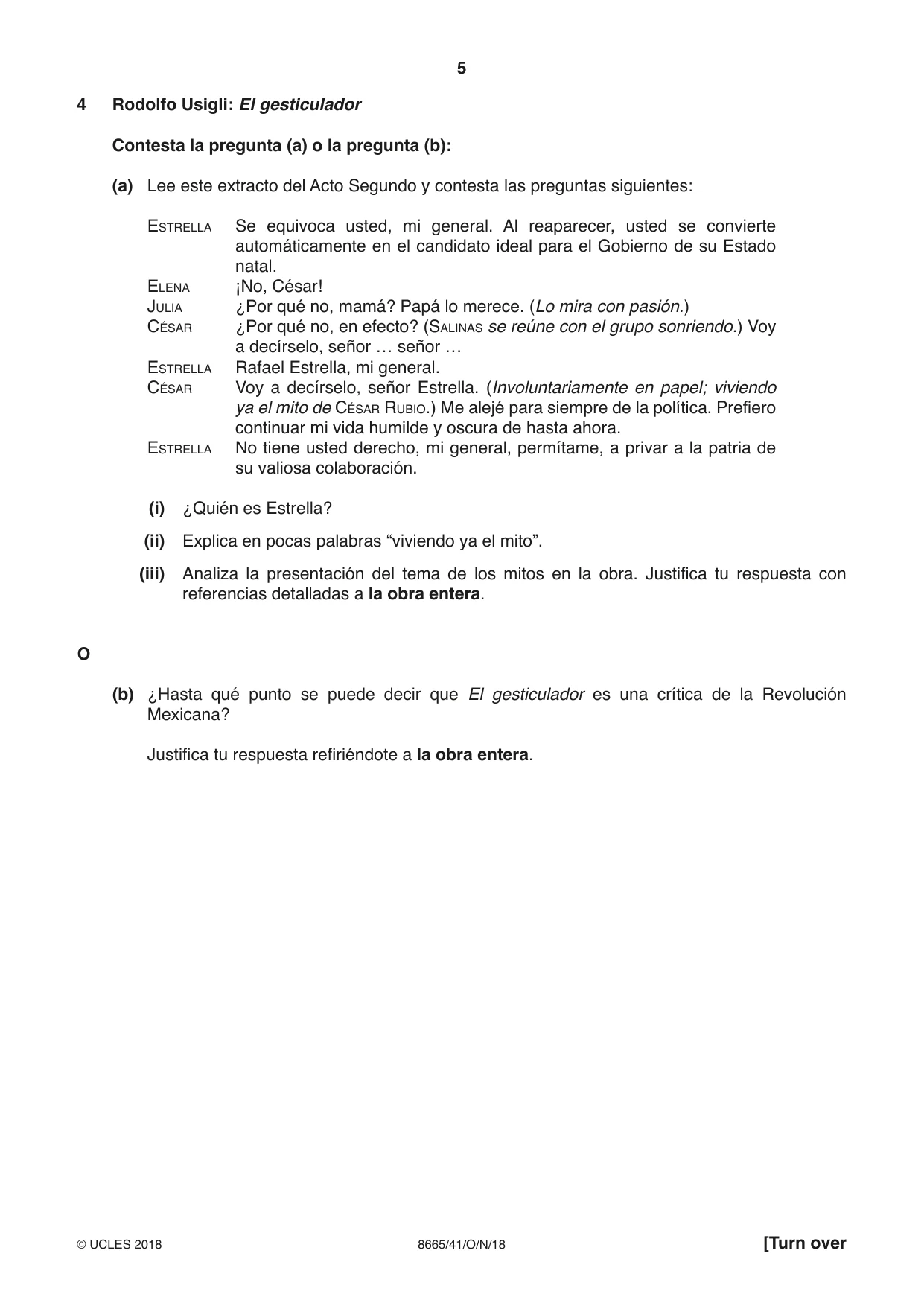
5 8665/41/O/N/18 © UCLES 2018 [Turn over 4 Rodolfo Usigli: El gesticulador Contesta la pregunta (a) o la pregunta (b): (a) Lee este extracto del Acto Segundo y contesta las preguntas siguientes: EstrElla Se equivoca usted, mi general. Al reaparecer, usted se convierte automáticamente en el candidato ideal para el Gobierno de su Estado natal. ElEna ¡No, César! Julia ¿Por qué no, mamá? Papá lo merece. (Lo mira con pasión.) César ¿Por qué no, en efecto? (salinas se reúne con el grupo sonriendo.) Voy a decírselo, señor … señor … EstrElla Rafael Estrella, mi general. César Voy a decírselo, señor Estrella. (Involuntariamente en papel; viviendo ya el mito de César rubio.) Me alejé para siempre de la política. Prefiero continuar mi vida humilde y oscura de hasta ahora. EstrElla No tiene usted derecho, mi general, permítame, a privar a la patria de su valiosa colaboración. (i) ¿Quién es Estrella? (ii) Explica en pocas palabras “viviendo ya el mito”. (iii) Analiza la presentación del tema de los mitos en la obra. Justifica tu respuesta con referencias detalladas a la obra entera. O (b) ¿Hasta qué punto se puede decir que El gesticulador es una crítica de la Revolución Mexicana? Justifica tu respuesta refiriéndote a la obra entera.
Question paper, page 6
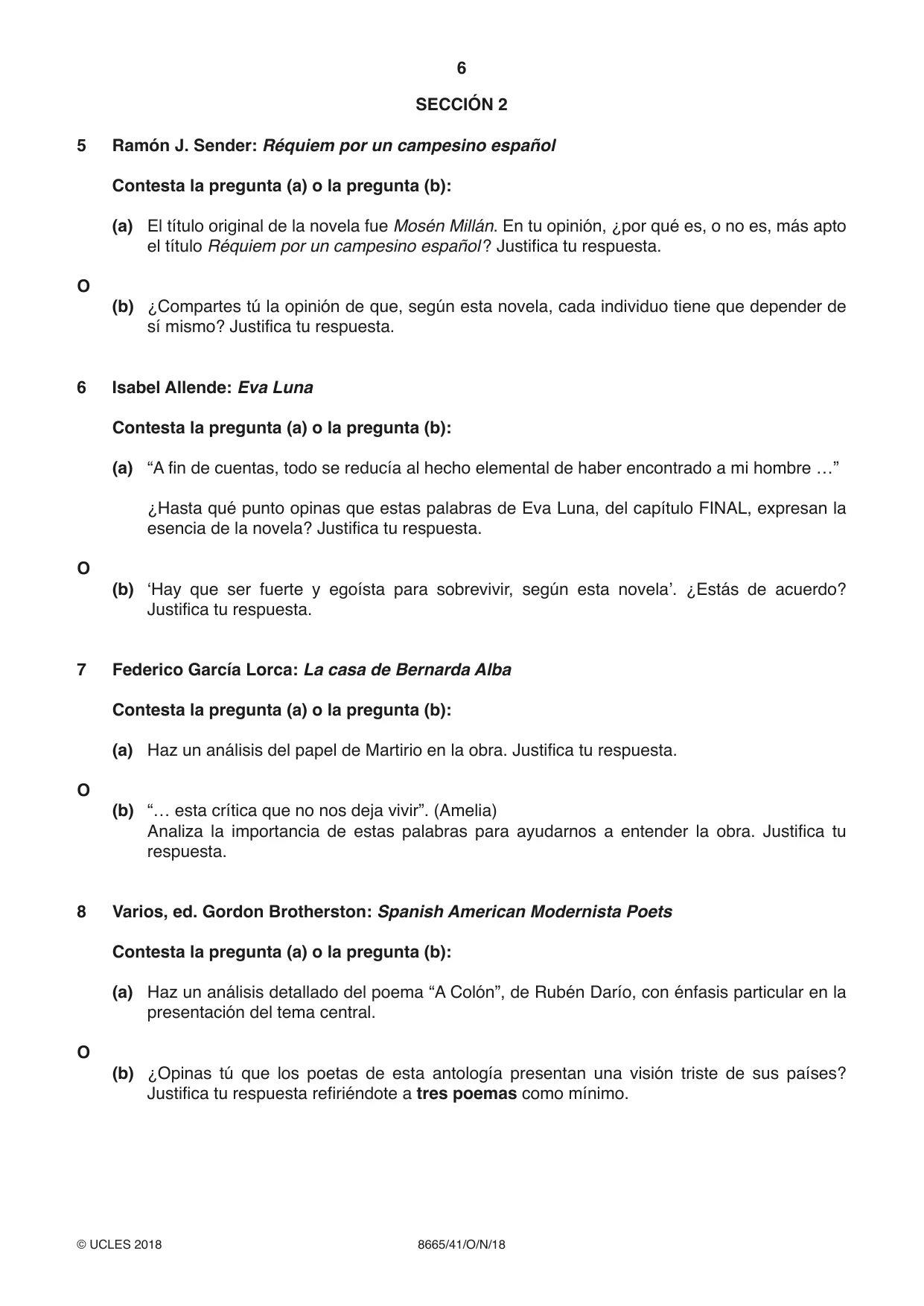
6 8665/41/O/N/18 © UCLES 2018 SECCIÓN 2 5 Ramón J. Sender: Réquiem por un campesino español Contesta la pregunta (a) o la pregunta (b): (a) El título original de la novela fue Mosén Millán. En tu opinión, ¿por qué es, o no es, más apto el título Réquiem por un campesino español ? Justifica tu respuesta. O (b) ¿Compartes tú la opinión de que, según esta novela, cada individuo tiene que depender de sí mismo? Justifica tu respuesta. 6 Isabel Allende: Eva Luna Contesta la pregunta (a) o la pregunta (b): (a) “A fin de cuentas, todo se reducía al hecho elemental de haber encontrado a mi hombre …” ¿Hasta qué punto opinas que estas palabras de Eva Luna, del capítulo FINAL, expresan la esencia de la novela? Justifica tu respuesta. O (b) ‘Hay que ser fuerte y egoísta para sobrevivir, según esta novela’. ¿Estás de acuerdo? Justifica tu respuesta. 7 Federico García Lorca: La casa de Bernarda Alba Contesta la pregunta (a) o la pregunta (b): (a) Haz un análisis del papel de Martirio en la obra. Justifica tu respuesta. O (b) “… esta crítica que no nos deja vivir”. (Amelia) Analiza la importancia de estas palabras para ayudarnos a entender la obra. Justifica tu respuesta. 8 Varios, ed. Gordon Brotherston: Spanish American Modernista Poets Contesta la pregunta (a) o la pregunta (b): (a) Haz un análisis detallado del poema “A Colón”, de Rubén Darío, con énfasis particular en la presentación del tema central. O (b) ¿Opinas tú que los poetas de esta antología presentan una visión triste de sus países? Justifica tu respuesta refiriéndote a tres poemas como mínimo.
Question paper, page 7
7 8665/41/O/N/18 © UCLES 2018 BLANK PAGE
Question paper, page 8
8 8665/41/O/N/18 © UCLES 2018 BLANK PAGE Permission to reproduce items where third-party owned material protected by copyright is included has been sought and cleared where possible. Every reasonable effort has been made by the publisher (UCLES) to trace copyright holders, but if any items requiring clearance have unwittingly been included, the publisher will be pleased to make amends at the earliest possible opportunity. To avoid the issue of disclosure of answer-related information to candidates, all copyright acknowledgements are reproduced online in the Cambridge International Examinations Copyright Acknowledgements Booklet. This is produced for each series of examinations and is freely available to download at www.cie.org.uk after the live examination series. Cambridge International Examinations is part of the Cambridge Assessment Group. Cambridge Assessment is the brand name of University of Cambridge Local Examinations Syndicate (UCLES), which is itself a department of the University of Cambridge.
Mark scheme, page 1
This document consists of 4 printed pages. © UCLES 2018 [Turn over Cambridge Assessment International Education Cambridge International Advanced Subsidiary Level FIRST LANGUAGE SPANISH 8665/41 Paper 4 Texts October/November 2018 MARK SCHEME Maximum Mark: 75 Published This mark scheme is published as an aid to teachers and candidates, to indicate the requirements of the examination. It shows the basis on which Examiners were instructed to award marks. It does not indicate the details of the discussions that took place at an Examiners’ meeting before marking began, which would have considered the acceptability of alternative answers. Mark schemes should be read in conjunction with the question paper and the Principal Examiner Report for Teachers. Cambridge International will not enter into discussions about these mark schemes. Cambridge International is publishing the mark schemes for the October/November 2018 series for most Cambridge IGCSE™, Cambridge International A and AS Level components and some Cambridge O Level components.
Mark scheme, page 2
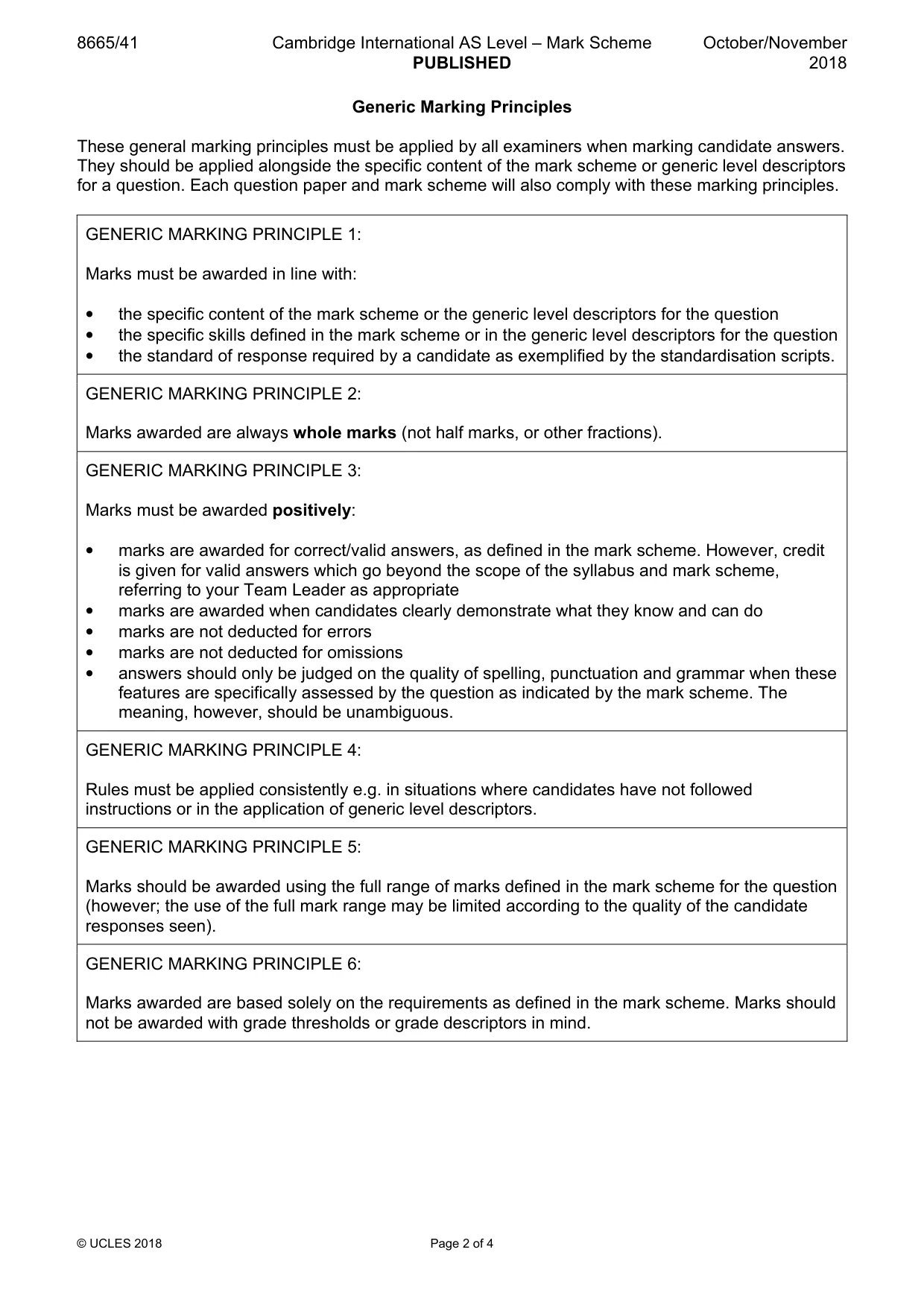
8665/41 Cambridge International AS Level – Mark Scheme PUBLISHED October/November 2018 © UCLES 2018 Page 2 of 4 Generic Marking Principles These general marking principles must be applied by all examiners when marking candidate answers. They should be applied alongside the specific content of the mark scheme or generic level descriptors for a question. Each question paper and mark scheme will also comply with these marking principles. GENERIC MARKING PRINCIPLE 1: Marks must be awarded in line with: • the specific content of the mark scheme or the generic level descriptors for the question • the specific skills defined in the mark scheme or in the generic level descriptors for the question • the standard of response required by a candidate as exemplified by the standardisation scripts. GENERIC MARKING PRINCIPLE 2: Marks awarded are always whole marks (not half marks, or other fractions). GENERIC MARKING PRINCIPLE 3: Marks must be awarded positively: • marks are awarded for correct/valid answers, as defined in the mark scheme. However, credit is given for valid answers which go beyond the scope of the syllabus and mark scheme, referring to your Team Leader as appropriate • marks are awarded when candidates clearly demonstrate what they know and can do • marks are not deducted for errors • marks are not deducted for omissions • answers should only be judged on the quality of spelling, punctuation and grammar when these features are specifically assessed by the question as indicated by the mark scheme. The meaning, however, should be unambiguous. GENERIC MARKING PRINCIPLE 4: Rules must be applied consistently e.g. in situations where candidates have not followed instructions or in the application of generic level descriptors. GENERIC MARKING PRINCIPLE 5: Marks should be awarded using the full range of marks defined in the mark scheme for the question (however; the use of the full mark range may be limited according to the quality of the candidate responses seen). GENERIC MARKING PRINCIPLE 6: Marks awarded are based solely on the requirements as defined in the mark scheme. Marks should not be awarded with grade thresholds or grade descriptors in mind.
Mark scheme, page 3
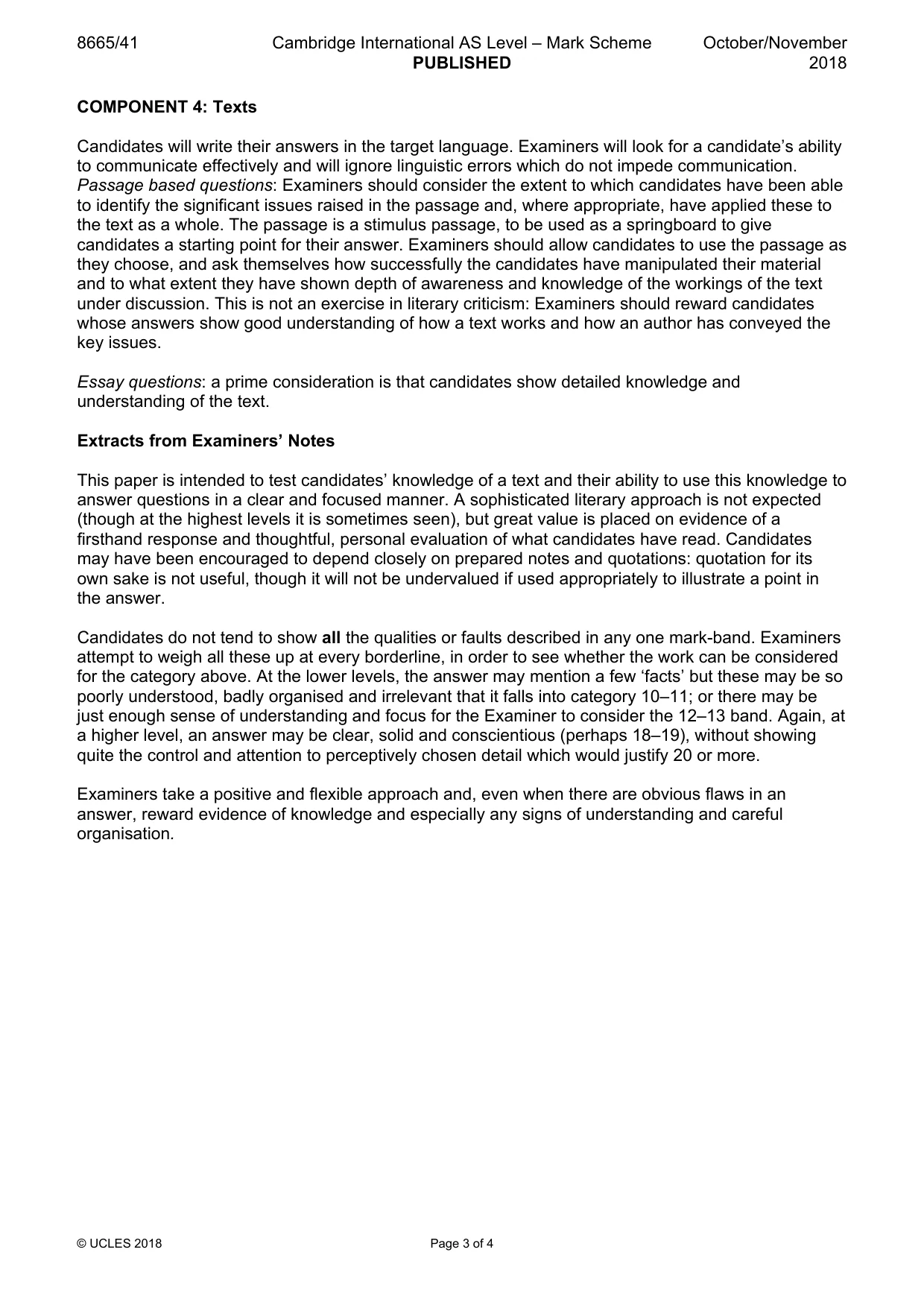
8665/41 Cambridge International AS Level – Mark Scheme PUBLISHED October/November 2018 © UCLES 2018 Page 3 of 4 COMPONENT 4: Texts Candidates will write their answers in the target language. Examiners will look for a candidate’s ability to communicate effectively and will ignore linguistic errors which do not impede communication. Passage based questions: Examiners should consider the extent to which candidates have been able to identify the significant issues raised in the passage and, where appropriate, have applied these to the text as a whole. The passage is a stimulus passage, to be used as a springboard to give candidates a starting point for their answer. Examiners should allow candidates to use the passage as they choose, and ask themselves how successfully the candidates have manipulated their material and to what extent they have shown depth of awareness and knowledge of the workings of the text under discussion. This is not an exercise in literary criticism: Examiners should reward candidates whose answers show good understanding of how a text works and how an author has conveyed the key issues. Essay questions: a prime consideration is that candidates show detailed knowledge and understanding of the text. Extracts from Examiners’ Notes This paper is intended to test candidates’ knowledge of a text and their ability to use this knowledge to answer questions in a clear and focused manner. A sophisticated literary approach is not expected (though at the highest levels it is sometimes seen), but great value is placed on evidence of a firsthand response and thoughtful, personal evaluation of what candidates have read. Candidates may have been encouraged to depend closely on prepared notes and quotations: quotation for its own sake is not useful, though it will not be undervalued if used appropriately to illustrate a point in the answer. Candidates do not tend to show all the qualities or faults described in any one mark-band. Examiners attempt to weigh all these up at every borderline, in order to see whether the work can be considered for the category above. At the lower levels, the answer may mention a few ‘facts’ but these may be so poorly understood, badly organised and irrelevant that it falls into category 10–11; or there may be just enough sense of understanding and focus for the Examiner to consider the 12–13 band. Again, at a higher level, an answer may be clear, solid and conscientious (perhaps 18–19), without showing quite the control and attention to perceptively chosen detail which would justify 20 or more. Examiners take a positive and flexible approach and, even when there are obvious flaws in an answer, reward evidence of knowledge and especially any signs of understanding and careful organisation.
Mark scheme, page 4
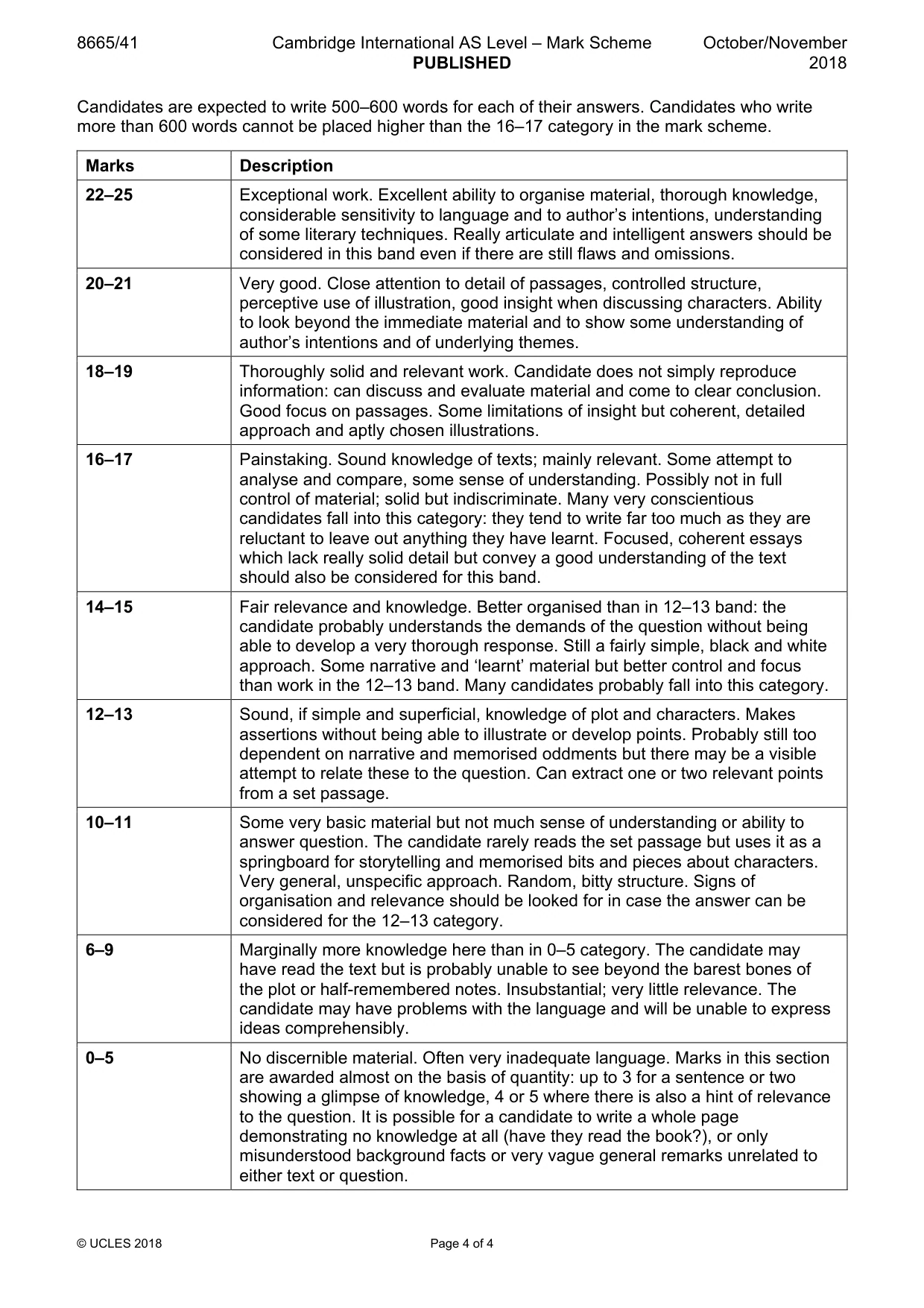
8665/41 Cambridge International AS Level – Mark Scheme PUBLISHED October/November 2018 © UCLES 2018 Page 4 of 4 Candidates are expected to write 500–600 words for each of their answers. Candidates who write more than 600 words cannot be placed higher than the 16–17 category in the mark scheme. Marks Description 22–25 Exceptional work. Excellent ability to organise material, thorough knowledge, considerable sensitivity to language and to author’s intentions, understanding of some literary techniques. Really articulate and intelligent answers should be considered in this band even if there are still flaws and omissions. 20–21 Very good. Close attention to detail of passages, controlled structure, perceptive use of illustration, good insight when discussing characters. Ability to look beyond the immediate material and to show some understanding of author’s intentions and of underlying themes. 18–19 Thoroughly solid and relevant work. Candidate does not simply reproduce information: can discuss and evaluate material and come to clear conclusion. Good focus on passages. Some limitations of insight but coherent, detailed approach and aptly chosen illustrations. 16–17 Painstaking. Sound knowledge of texts; mainly relevant. Some attempt to analyse and compare, some sense of understanding. Possibly not in full control of material; solid but indiscriminate. Many very conscientious candidates fall into this category: they tend to write far too much as they are reluctant to leave out anything they have learnt. Focused, coherent essays which lack really solid detail but convey a good understanding of the text should also be considered for this band. 14–15 Fair relevance and knowledge. Better organised than in 12–13 band: the candidate probably understands the demands of the question without being able to develop a very thorough response. Still a fairly simple, black and white approach. Some narrative and ‘learnt’ material but better control and focus than work in the 12–13 band. Many candidates probably fall into this category. 12–13 Sound, if simple and superficial, knowledge of plot and characters. Makes assertions without being able to illustrate or develop points. Probably still too dependent on narrative and memorised oddments but there may be a visible attempt to relate these to the question. Can extract one or two relevant points from a set passage. 10–11 Some very basic material but not much sense of understanding or ability to answer question. The candidate rarely reads the set passage but uses it as a springboard for storytelling and memorised bits and pieces about characters. Very general, unspecific approach. Random, bitty structure. Signs of organisation and relevance should be looked for in case the answer can be considered for the 12–13 category. 6–9 Marginally more knowledge here than in 0–5 category. The candidate may have read the text but is probably unable to see beyond the barest bones of the plot or half-remembered notes. Insubstantial; very little relevance. The candidate may have problems with the language and will be unable to express ideas comprehensibly. 0–5 No discernible material. Often very inadequate language. Marks in this section are awarded almost on the basis of quantity: up to 3 for a sentence or two showing a glimpse of knowledge, 4 or 5 where there is also a hint of relevance to the question. It is possible for a candidate to write a whole page demonstrating no knowledge at all (have they read the book?), or only misunderstood background facts or very vague general remarks unrelated to either text or question.