Cambridge A Level Spanish - First Language (AS Level only) 8665 — 2018 May/June Paper 2 · Variant 1
8665/21/M/J/18 · 70 marks · ≈79 min
The question paper and its mark scheme, free to read here and free to download. This is Cambridge’s own paper, exactly as it was sat.
Question paper8 pages
Mark scheme18 pages
Answers below. Sit the paper first if you are practising.
Paper as text
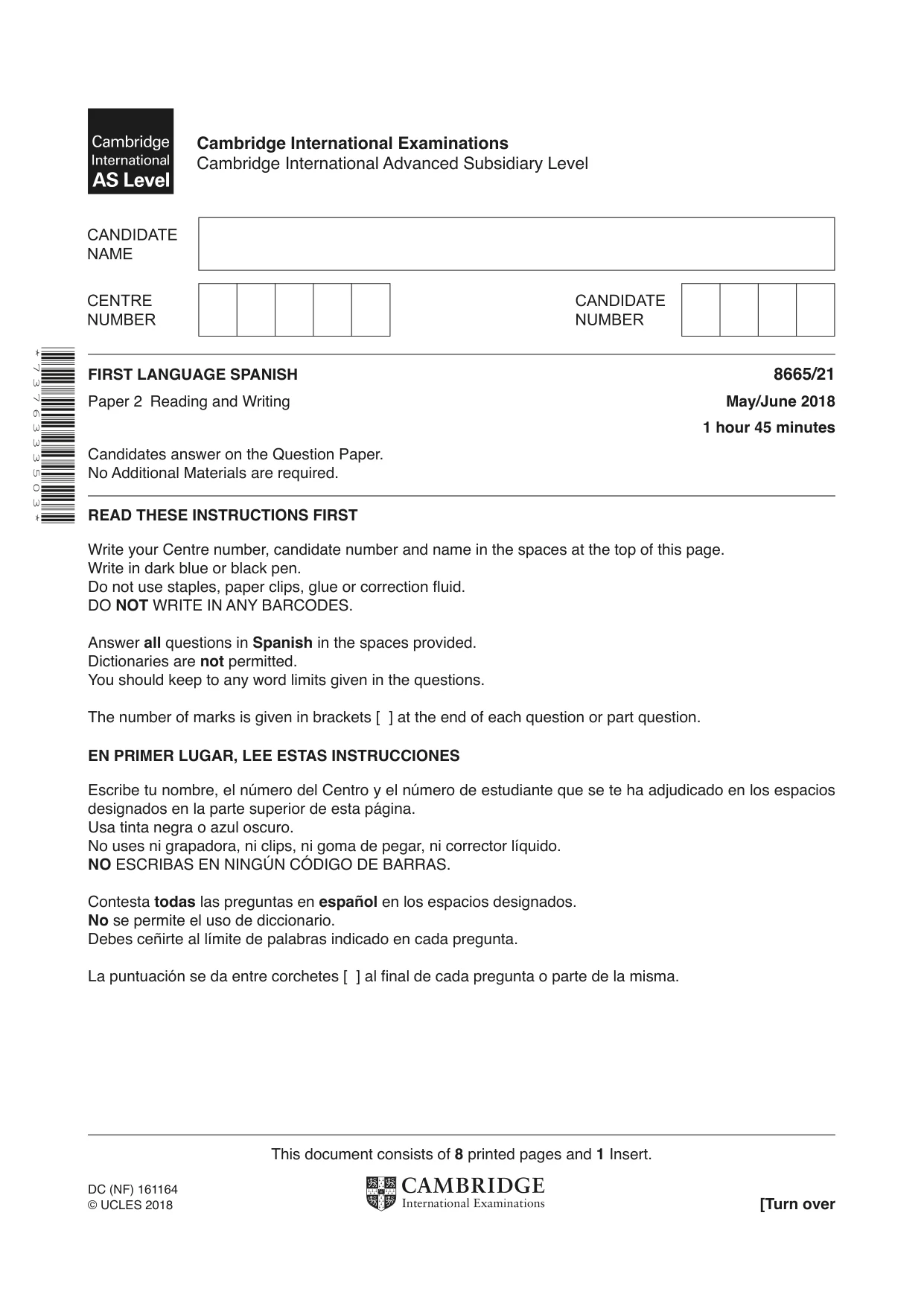
Question paper, page 1
* 7 3 7 6 3 3 3 5 0 3 * This document consists of 8 printed pages and 1 Insert. DC (NF) 161164 © UCLES 2018 [Turn over Cambridge International Examinations Cambridge International Advanced Subsidiary Level FIRST LANGUAGE SPANISH 8665/21 Paper 2 Reading and Writing May/June 2018 1 hour 45 minutes Candidates answer on the Question Paper. No Additional Materials are required. READ THESE INSTRUCTIONS FIRST Write your Centre number, candidate number and name in the spaces at the top of this page. Write in dark blue or black pen. Do not use staples, paper clips, glue or correction fluid. DO NOT WRITE IN ANY BARCODES. Answer all questions in Spanish in the spaces provided. Dictionaries are not permitted. You should keep to any word limits given in the questions. The number of marks is given in brackets [ ] at the end of each question or part question. EN PRIMER LUGAR, LEE ESTAS INSTRUCCIONES Escribe tu nombre, el número del Centro y el número de estudiante que se te ha adjudicado en los espacios designados en la parte superior de esta página. Usa tinta negra o azul oscuro. No uses ni grapadora, ni clips, ni goma de pegar, ni corrector líquido. NO ESCRIBAS EN NINGÚN CÓDIGO DE BARRAS. Contesta todas las preguntas en español en los espacios designados. No se permite el uso de diccionario. Debes ceñirte al límite de palabras indicado en cada pregunta. La puntuación se da entre corchetes [ ] al final de cada pregunta o parte de la misma.
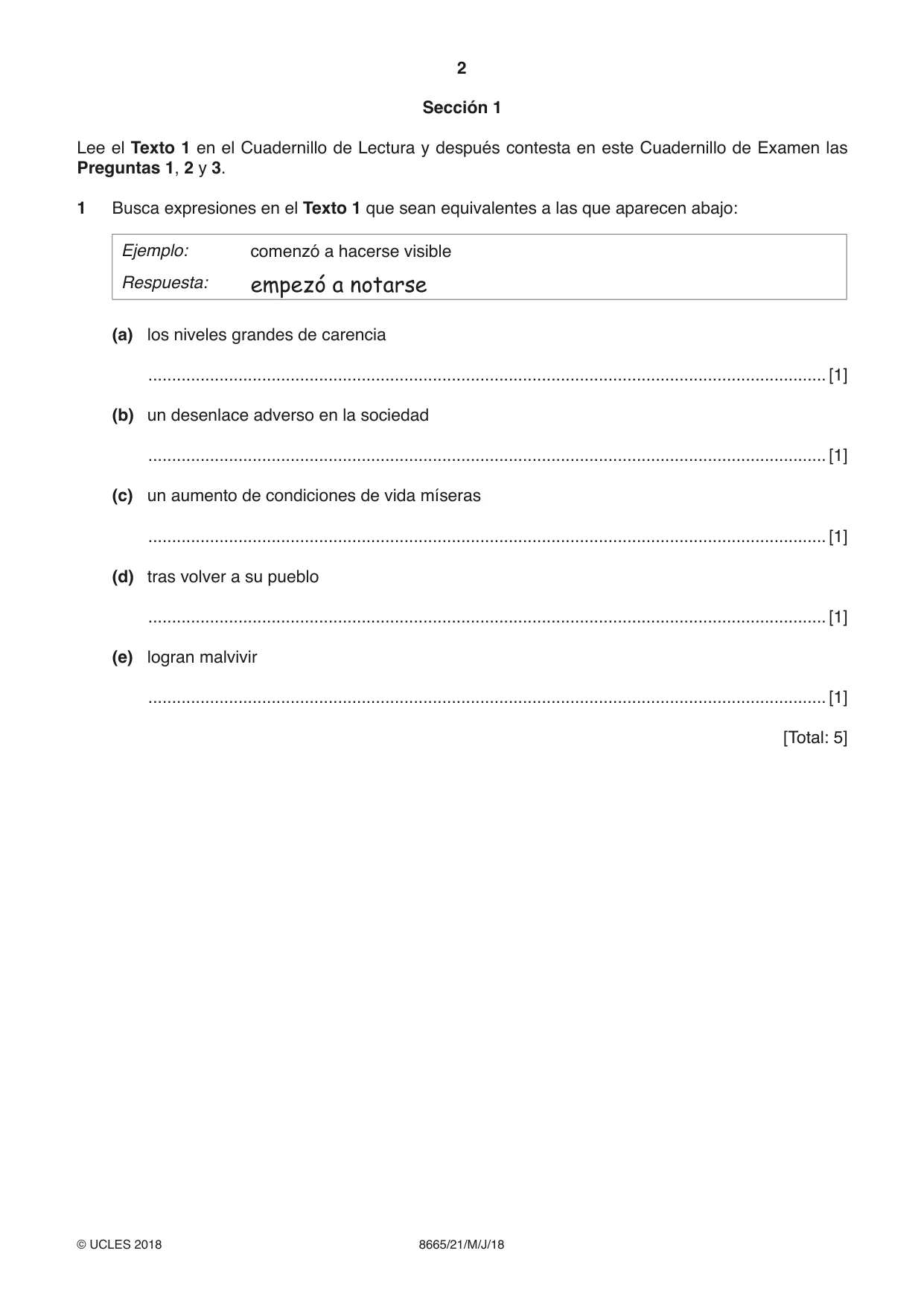
Question paper, page 2
2 8665/21/M/J/18 © UCLES 2018 Sección 1 Lee el Texto 1 en el Cuadernillo de Lectura y después contesta en este Cuadernillo de Examen las Preguntas 1, 2 y 3. 1 Busca expresiones en el Texto 1 que sean equivalentes a las que aparecen abajo: Ejemplo: comenzó a hacerse visible Respuesta: empezó a notarse (a) los niveles grandes de carencia … [1] (b) un desenlace adverso en la sociedad … [1] (c) un aumento de condiciones de vida míseras … [1] (d) tras volver a su pueblo … [1] (e) logran malvivir … [1] [Total: 5]
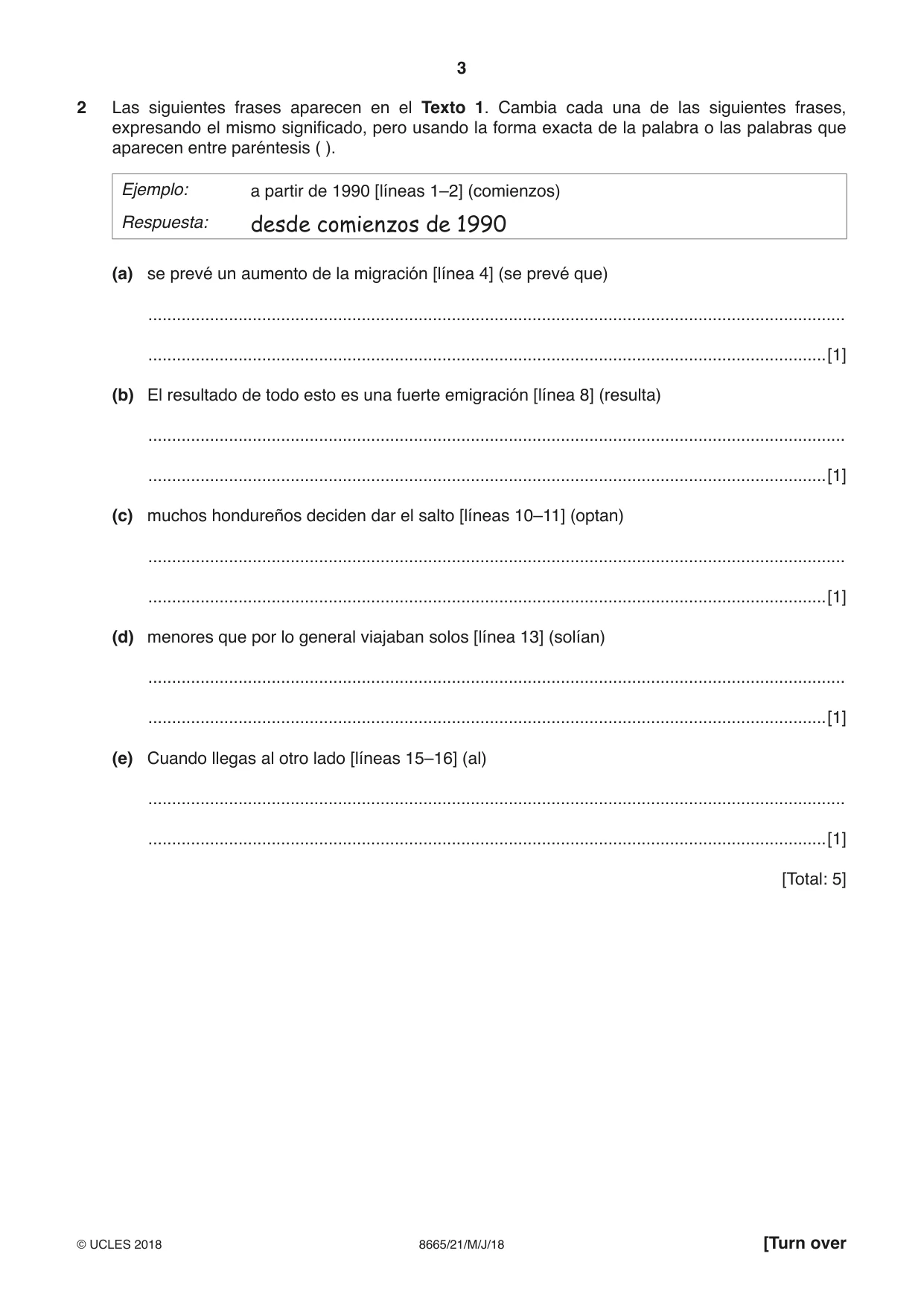
Question paper, page 3
3 8665/21/M/J/18 © UCLES 2018 [Turn over 2 Las siguientes frases aparecen en el Texto 1. Cambia cada una de las siguientes frases, expresando el mismo significado, pero usando la forma exacta de la palabra o las palabras que aparecen entre paréntesis ( ). Ejemplo: a partir de 1990 [líneas 1–2] (comienzos) Respuesta: desde comienzos de 1990 (a) se prevé un aumento de la migración [línea 4] (se prevé que) … …[1] (b) El resultado de todo esto es una fuerte emigración [línea 8] (resulta) … …[1] (c) muchos hondureños deciden dar el salto [líneas 10–11] (optan) … …[1] (d) menores que por lo general viajaban solos [línea 13] (solían) … …[1] (e) Cuando llegas al otro lado [líneas 15–16] (al) … …[1] [Total: 5]
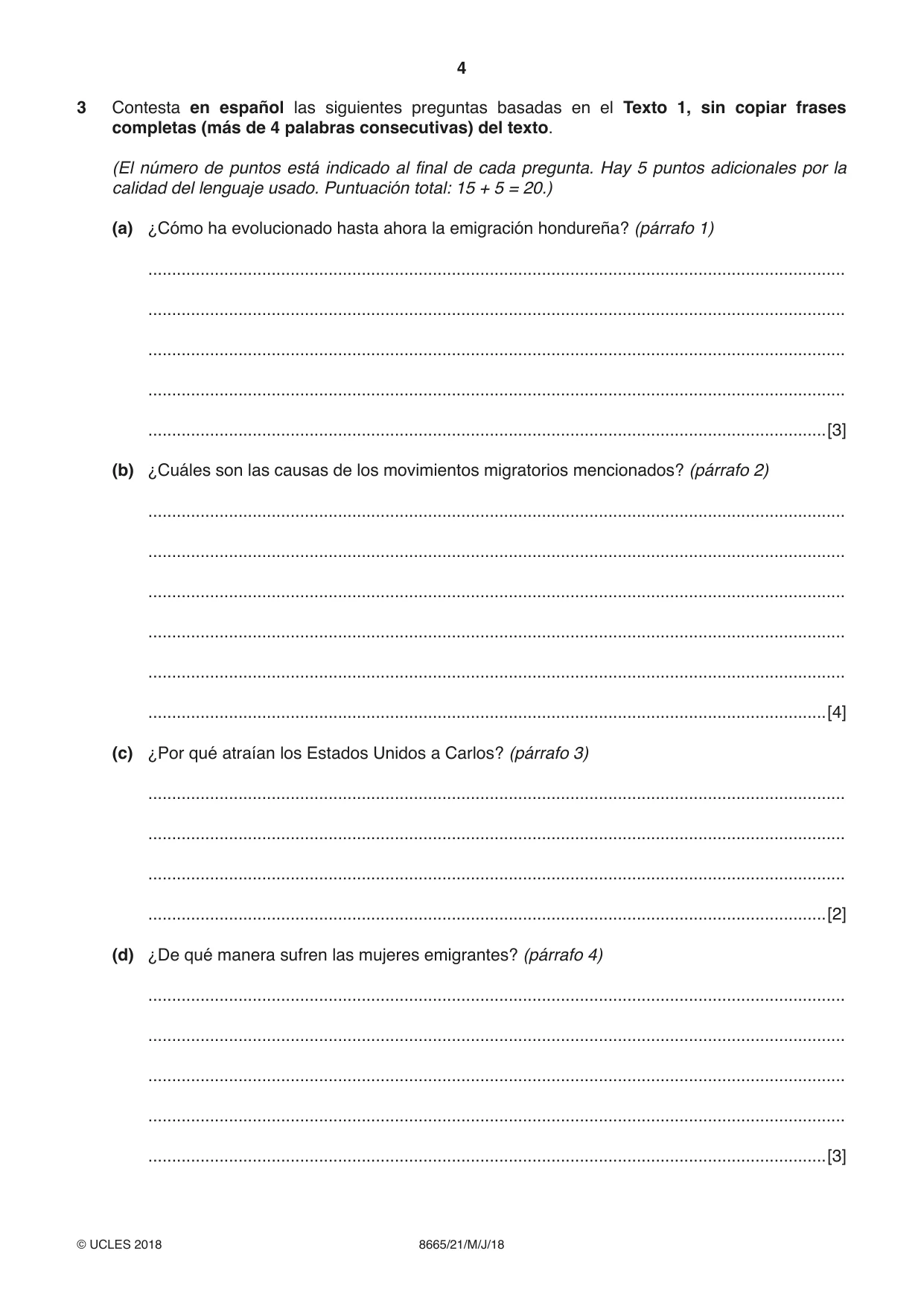
Question paper, page 4
4 8665/21/M/J/18 © UCLES 2018 3 Contesta en español las siguientes preguntas basadas en el Texto 1, sin copiar frases completas (más de 4 palabras consecutivas) del texto. (El número de puntos está indicado al final de cada pregunta. Hay 5 puntos adicionales por la calidad del lenguaje usado. Puntuación total: 15 + 5 = 20.) (a) ¿Cómo ha evolucionado hasta ahora la emigración hondureña? (párrafo 1) … … … … …[3] (b) ¿Cuáles son las causas de los movimientos migratorios mencionados? (párrafo 2) … … … … … …[4] (c) ¿Por qué atraían los Estados Unidos a Carlos? (párrafo 3) … … … …[2] (d) ¿De qué manera sufren las mujeres emigrantes? (párrafo 4) … … … … …[3]
Question paper, page 5
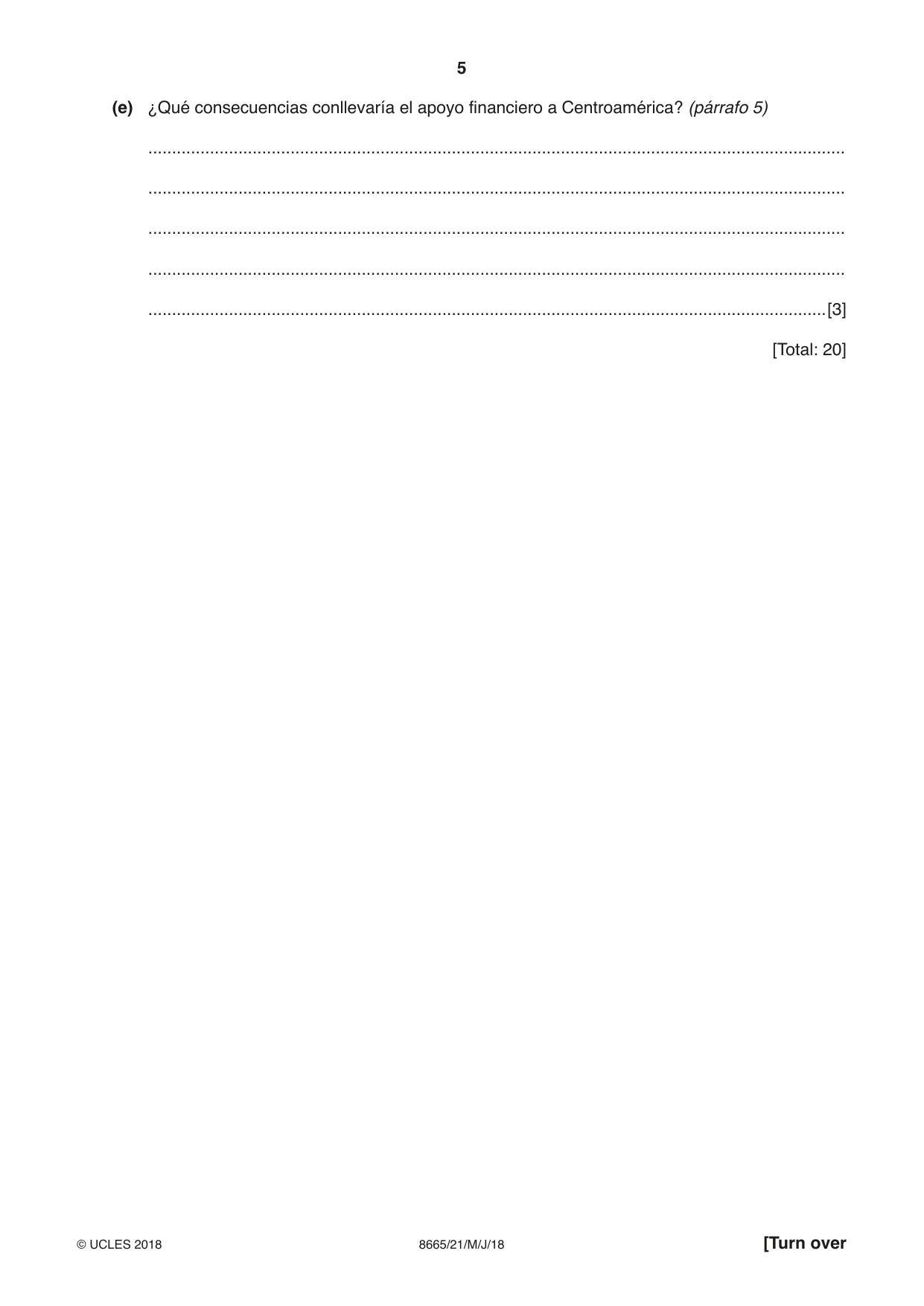
5 8665/21/M/J/18 © UCLES 2018 [Turn over (e) ¿Qué consecuencias conllevaría el apoyo financiero a Centroamérica? (párrafo 5) … … … … …[3] [Total: 20]
Question paper, page 6
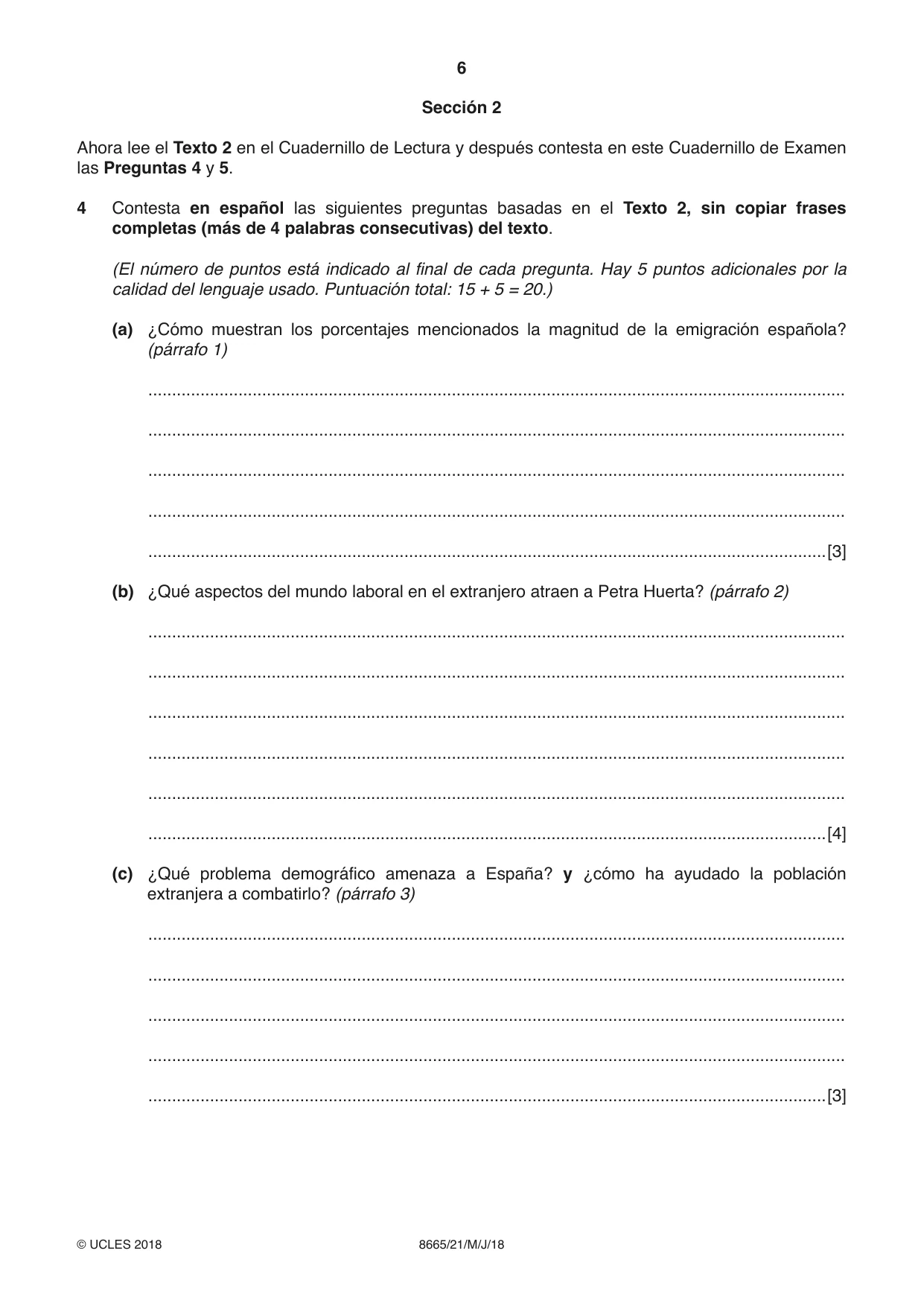
6 8665/21/M/J/18 © UCLES 2018 Sección 2 Ahora lee el Texto 2 en el Cuadernillo de Lectura y después contesta en este Cuadernillo de Examen las Preguntas 4 y 5. 4 Contesta en español las siguientes preguntas basadas en el Texto 2, sin copiar frases completas (más de 4 palabras consecutivas) del texto. (El número de puntos está indicado al final de cada pregunta. Hay 5 puntos adicionales por la calidad del lenguaje usado. Puntuación total: 15 + 5 = 20.) (a) ¿Cómo muestran los porcentajes mencionados la magnitud de la emigración española? (párrafo 1) … … … … …[3] (b) ¿Qué aspectos del mundo laboral en el extranjero atraen a Petra Huerta? (párrafo 2) … … … … … …[4] (c) ¿Qué problema demográfico amenaza a España? y ¿cómo ha ayudado la población extranjera a combatirlo? (párrafo 3) … … … … …[3]
Question paper, page 7
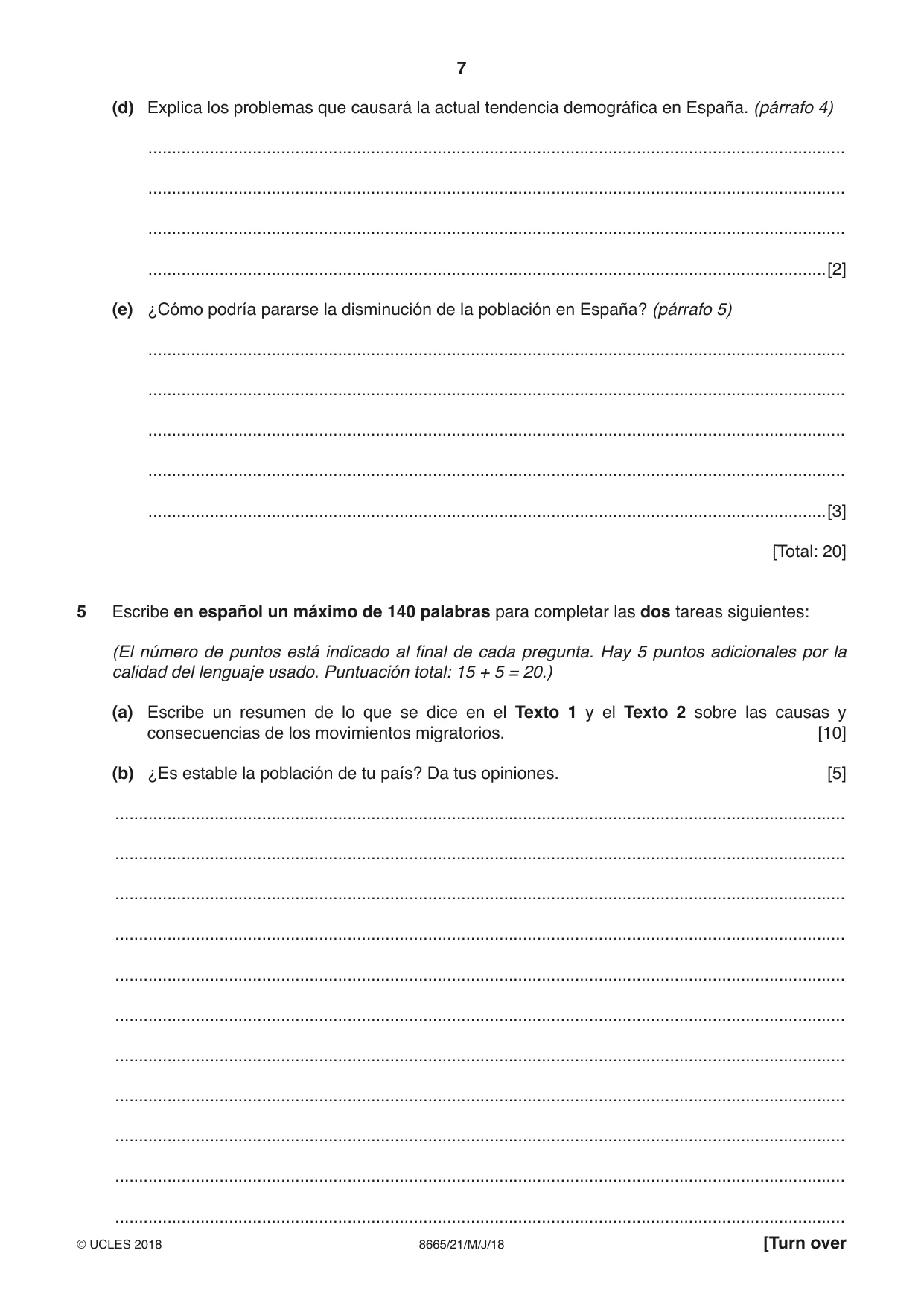
7 8665/21/M/J/18 © UCLES 2018 [Turn over (d) Explica los problemas que causará la actual tendencia demográfica en España. (párrafo 4) … … … …[2] (e) ¿Cómo podría pararse la disminución de la población en España? (párrafo 5) … … … … …[3] [Total: 20] 5 Escribe en español un máximo de 140 palabras para completar las dos tareas siguientes: (El número de puntos está indicado al final de cada pregunta. Hay 5 puntos adicionales por la calidad del lenguaje usado. Puntuación total: 15 + 5 = 20.) (a) Escribe un resumen de lo que se dice en el Texto 1 y el Texto 2 sobre las causas y consecuencias de los movimientos migratorios. [10] (b) ¿Es estable la población de tu país? Da tus opiniones. [5] … … … … … … … … … … …
Question paper, page 8
8 8665/21/M/J/18 © UCLES 2018 Permission to reproduce items where third-party owned material protected by copyright is included has been sought and cleared where possible. Every reasonable effort has been made by the publisher (UCLES) to trace copyright holders, but if any items requiring clearance have unwittingly been included, the publisher will be pleased to make amends at the earliest possible opportunity. To avoid the issue of disclosure of answer-related information to candidates, all copyright acknowledgements are reproduced online in the Cambridge International Examinations Copyright Acknowledgements Booklet. This is produced for each series of examinations and is freely available to download at www.cie.org.uk after the live examination series. Cambridge International Examinations is part of the Cambridge Assessment Group. Cambridge Assessment is the brand name of University of Cambridge Local Examinations Syndicate (UCLES), which is itself a department of the University of Cambridge. … … … … … … … … … … … … … … … … … … … … … [Total: 20]
Mark scheme, page 1
IGCSE™ is a registered trademark. This document consists of 18 printed pages. © UCLES 2018 [Turn over Cambridge Assessment International Education Cambridge International Advanced Subsidiary Level FIRST LANGUAGE SPANISH 8665/21 Paper 2 Reading and Writing May/June 2018 MARK SCHEME Maximum Mark: 70 Published This mark scheme is published as an aid to teachers and candidates, to indicate the requirements of the examination. It shows the basis on which Examiners were instructed to award marks. It does not indicate the details of the discussions that took place at an Examiners’ meeting before marking began, which would have considered the acceptability of alternative answers. Mark schemes should be read in conjunction with the question paper and the Principal Examiner Report for Teachers. Cambridge International will not enter into discussions about these mark schemes. Cambridge International is publishing the mark schemes for the May/June 2018 series for most Cambridge IGCSE™, Cambridge International A and AS Level and Cambridge Pre-U components, and some Cambridge O Level components.
Mark scheme, page 2
8665/21 Cambridge International AS Level – Mark Scheme PUBLISHED May/June 2018 © UCLES 2018 Page 2 of 18 Generic Marking Principles These general marking principles must be applied by all examiners when marking candidate answers. They should be applied alongside the specific content of the mark scheme or generic level descriptors for a question. Each question paper and mark scheme will also comply with these marking principles. GENERIC MARKING PRINCIPLE 1: Marks must be awarded in line with: • the specific content of the mark scheme or the generic level descriptors for the question • the specific skills defined in the mark scheme or in the generic level descriptors for the question • the standard of response required by a candidate as exemplified by the standardisation scripts. GENERIC MARKING PRINCIPLE 2: Marks awarded are always whole marks (not half marks, or other fractions). GENERIC MARKING PRINCIPLE 3: Marks must be awarded positively: • marks are awarded for correct/valid answers, as defined in the mark scheme. However, credit is given for valid answers which go beyond the scope of the syllabus and mark scheme, referring to your Team Leader as appropriate • marks are awarded when candidates clearly demonstrate what they know and can do • marks are not deducted for errors • marks are not deducted for omissions • answers should only be judged on the quality of spelling, punctuation and grammar when these features are specifically assessed by the question as indicated by the mark scheme. The meaning, however, should be unambiguous. GENERIC MARKING PRINCIPLE 4: Rules must be applied consistently e.g. in situations where candidates have not followed instructions or in the application of generic level descriptors.
Mark scheme, page 3
8665/21 Cambridge International AS Level – Mark Scheme PUBLISHED May/June 2018 © UCLES 2018 Page 3 of 18 GENERIC MARKING PRINCIPLE 5: Marks should be awarded using the full range of marks defined in the mark scheme for the question (however; the use of the full mark range may be limited according to the quality of the candidate responses seen). GENERIC MARKING PRINCIPLE 6: Marks awarded are based solely on the requirements as defined in the mark scheme. Marks should not be awarded with grade thresholds or grade descriptors in mind.
Mark scheme, page 4
8665/21 Cambridge International AS Level – Mark Scheme PUBLISHED May/June 2018 © UCLES 2018 Page 4 of 18 1 General Marking Notes 2 General Marking Principles 2.1 Please note that it is not possible to list all acceptable alternatives in the Detailed Mark Scheme provided on the following pages. You will need to consider all alternative answers and unexpected approaches in candidates' scripts, make a decision on whether they communicate the required elements, in consultation with the Principal Examiner if necessary, and award marks accordingly. 2.2 Crossing out: (a) If a candidate changes his/her mind over an answer and crosses out an attempt, award a mark if the final attempt is correct. (b) If a candidate crosses out an answer to a whole question but makes no second attempt at it, mark the crossed out work. 2.3 Annotation used in marking: (a) BOD = Benefit of the Doubt and is used to indicate material considered by the Examiner and judged to be more correct than incorrect: the benefit of the doubt is given to the candidate and the mark is awarded. (b) NBOD = No Benefit of the Doubt and is used to indicate material considered by the Examiner and judged to be more incorrect than correct: the benefit of the doubt is not given to the candidate and the mark is not awarded. (c) caret = to indicate where something which is key to the response is missing. 2.4 No response and '0' marks There is a NR (No Response) option in scoris. Award NR (No Response): • If there is nothing written at all in the answer space or • If there is only a comment which does not in any way relate to the question being asked (e.g. 'can’t do' or 'don’t know') or • If there is only a mark which isn’t an attempt at the question (e.g. a dash, a question mark). Award 0: • If there is any attempt that earns no credit. This could, for example, include the candidate copying all or some of the question, or any working that does not earn any marks, whether crossed out or not. Detailed Mark Scheme
Mark scheme, page 5
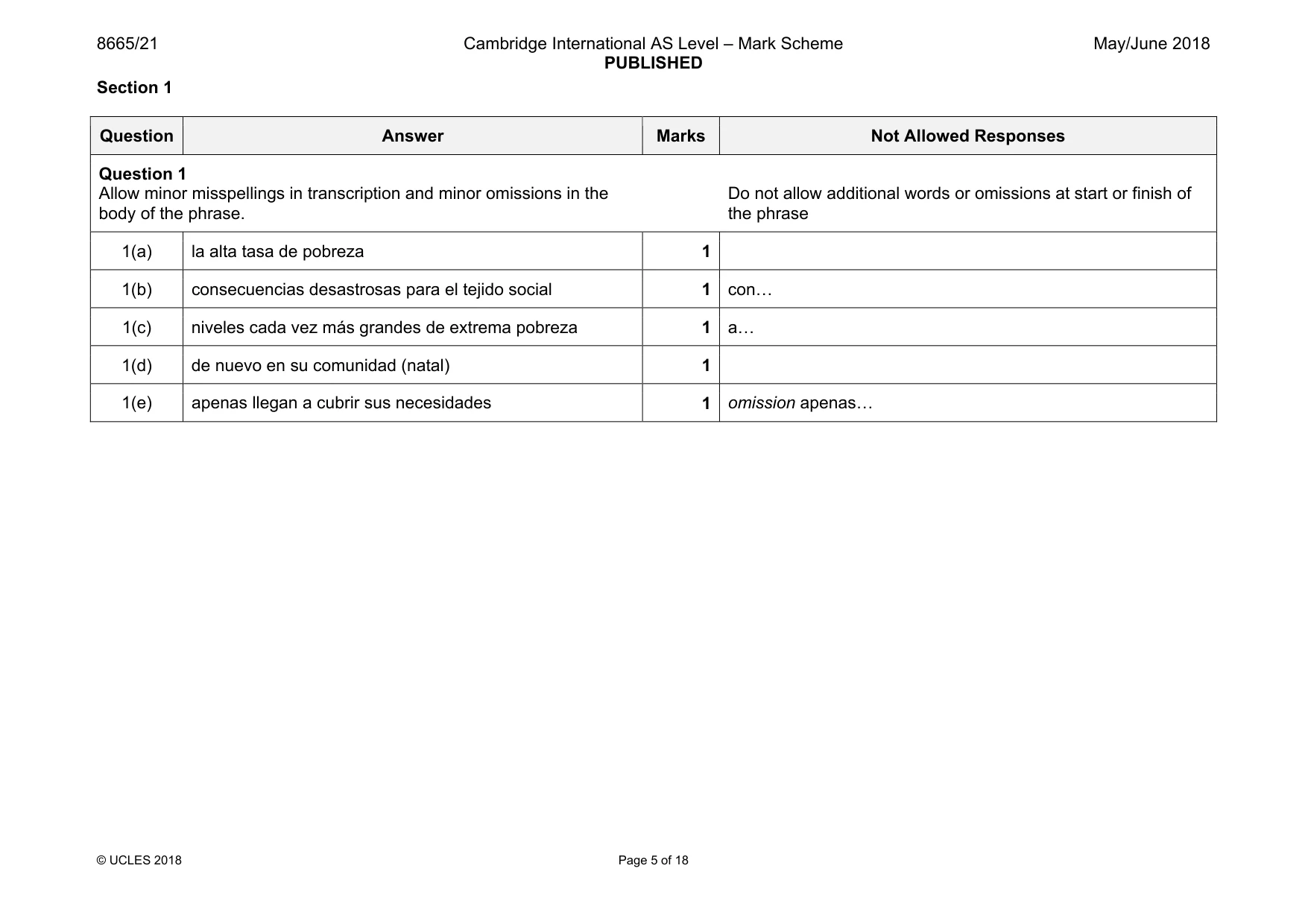
8665/21 Cambridge International AS Level – Mark Scheme PUBLISHED May/June 2018 © UCLES 2018 Page 5 of 18 Section 1 Question Answer Marks Not Allowed Responses Question 1 Allow minor misspellings in transcription and minor omissions in the body of the phrase. Do not allow additional words or omissions at start or finish of the phrase 1(a) la alta tasa de pobreza 1 1(b) consecuencias desastrosas para el tejido social 1 con« 1(c) niveles cada vez más grandes de extrema pobreza 1 a« 1(d) de nuevo en su comunidad (natal) 1 1(e) apenas llegan a cubrir sus necesidades 1 omission apenas«
Mark scheme, page 6
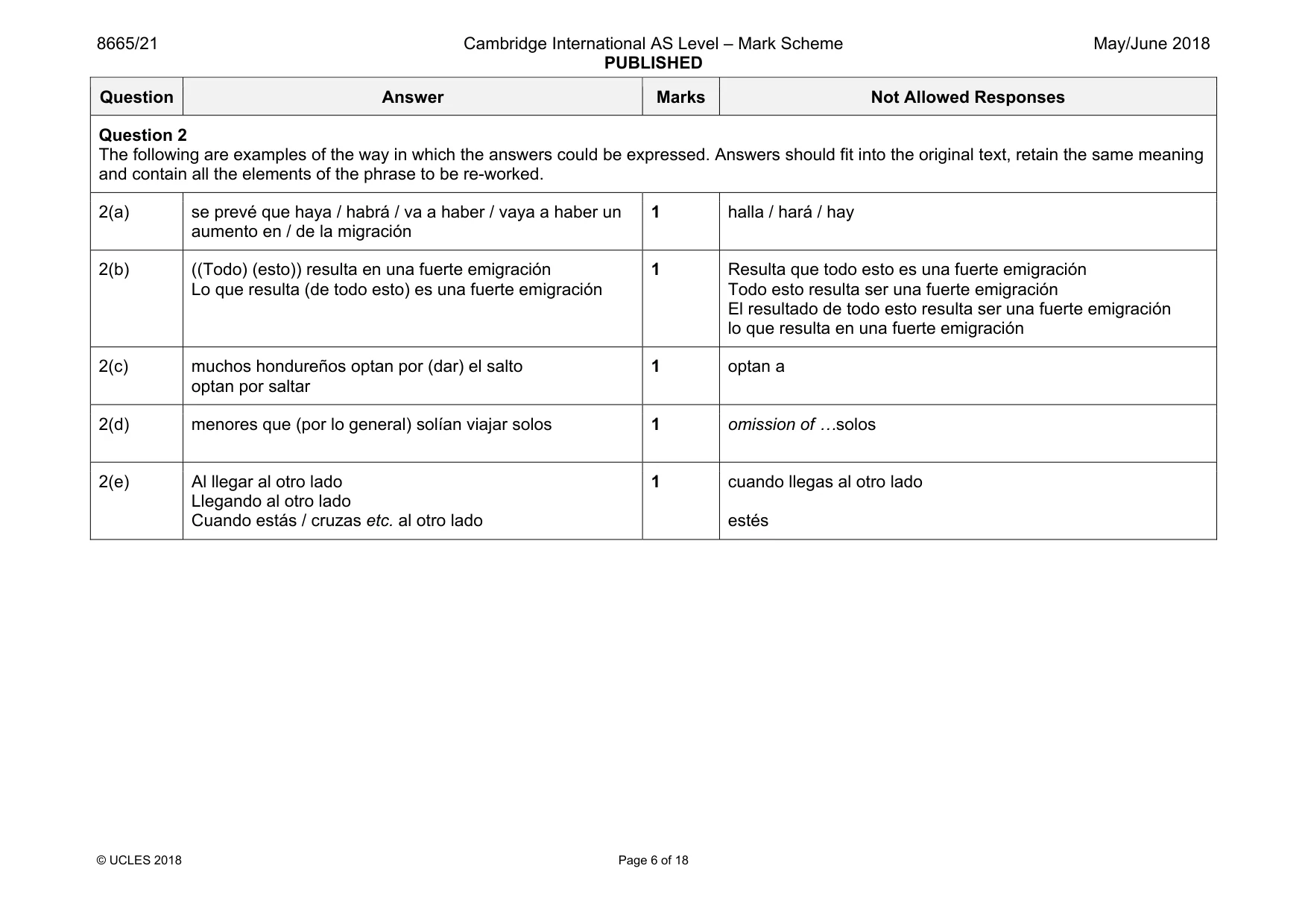
8665/21 Cambridge International AS Level – Mark Scheme PUBLISHED May/June 2018 © UCLES 2018 Page 6 of 18 Question Answer Marks Not Allowed Responses Question 2 The following are examples of the way in which the answers could be expressed. Answers should fit into the original text, retain the same meaning and contain all the elements of the phrase to be re-worked. 2(a) se prevé que haya / habrá / va a haber / vaya a haber un aumento en / de la migración 1 halla / hará / hay 2(b) ((Todo) (esto)) resulta en una fuerte emigración Lo que resulta (de todo esto) es una fuerte emigración 1 Resulta que todo esto es una fuerte emigración Todo esto resulta ser una fuerte emigración El resultado de todo esto resulta ser una fuerte emigración lo que resulta en una fuerte emigración 2(c) muchos hondureños optan por (dar) el salto optan por saltar 1 optan a 2(d) menores que (por lo general) solían viajar solos 1 omission of «solos 2(e) Al llegar al otro lado Llegando al otro lado Cuando estás / cruzas etc. al otro lado 1 cuando llegas al otro lado estés
Mark scheme, page 7
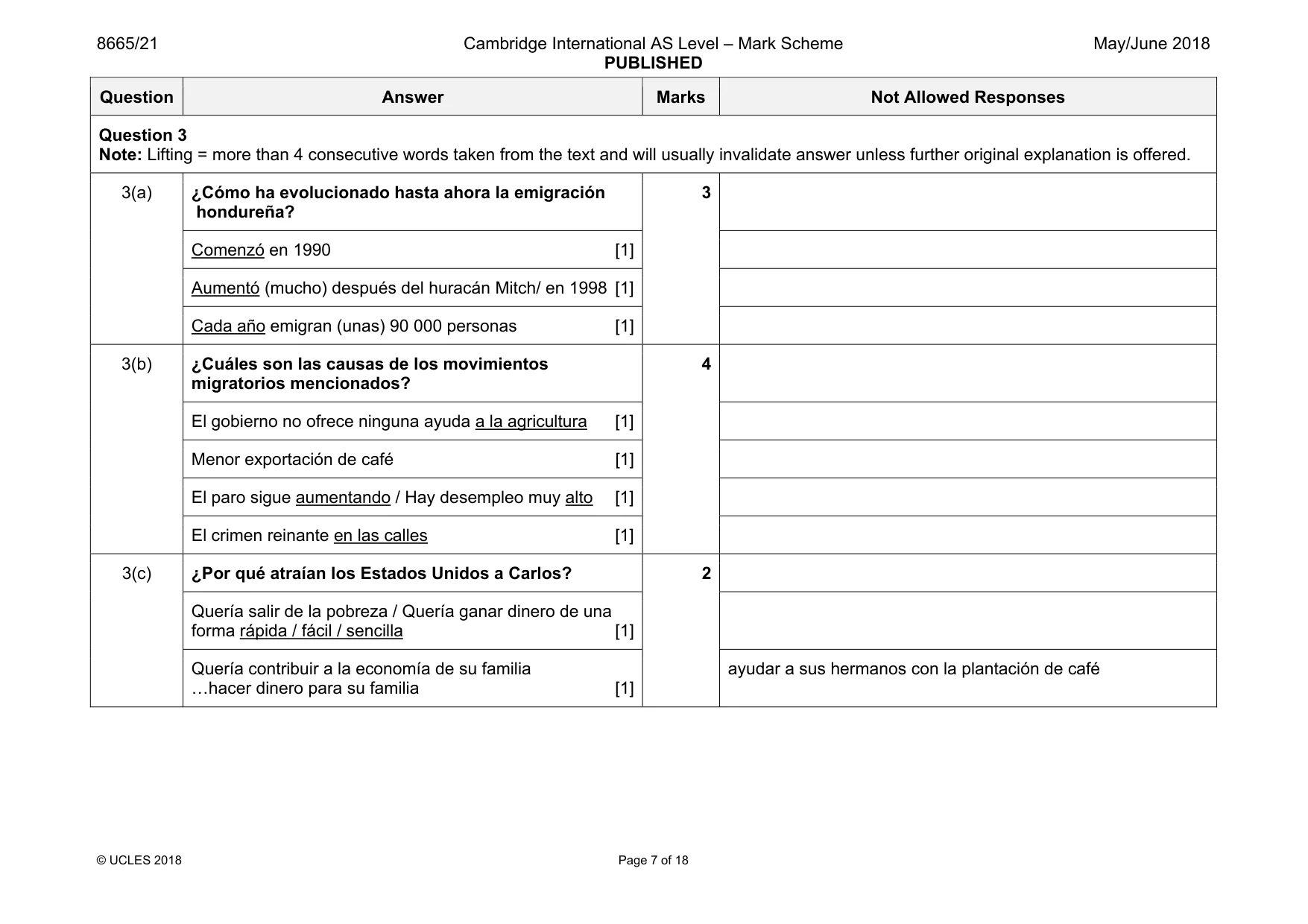
8665/21 Cambridge International AS Level – Mark Scheme PUBLISHED May/June 2018 © UCLES 2018 Page 7 of 18 Question Answer Marks Not Allowed Responses Question 3 Note: Lifting = more than 4 consecutive words taken from the text and will usually invalidate answer unless further original explanation is offered. 3(a) ¿Cómo ha evolucionado hasta ahora la emigración hondureña? 3 Comenzó en 1990 [1] Aumentó (mucho) después del huracán Mitch/ en 1998 [1] Cada año emigran (unas) 90 000 personas [1] 3(b) ¿Cuáles son las causas de los movimientos migratorios mencionados? 4 El gobierno no ofrece ninguna ayuda a la agricultura [1] Menor exportación de café [1] El paro sigue aumentando / Hay desempleo muy alto [1] El crimen reinante en las calles [1] 3(c) ¿Por qué atraían los Estados Unidos a Carlos? 2 Quería salir de la pobreza / Quería ganar dinero de una forma rápida / fácil / sencilla [1] Quería contribuir a la economía de su familia «hacer dinero para su familia [1] ayudar a sus hermanos con la plantación de café
Mark scheme, page 8
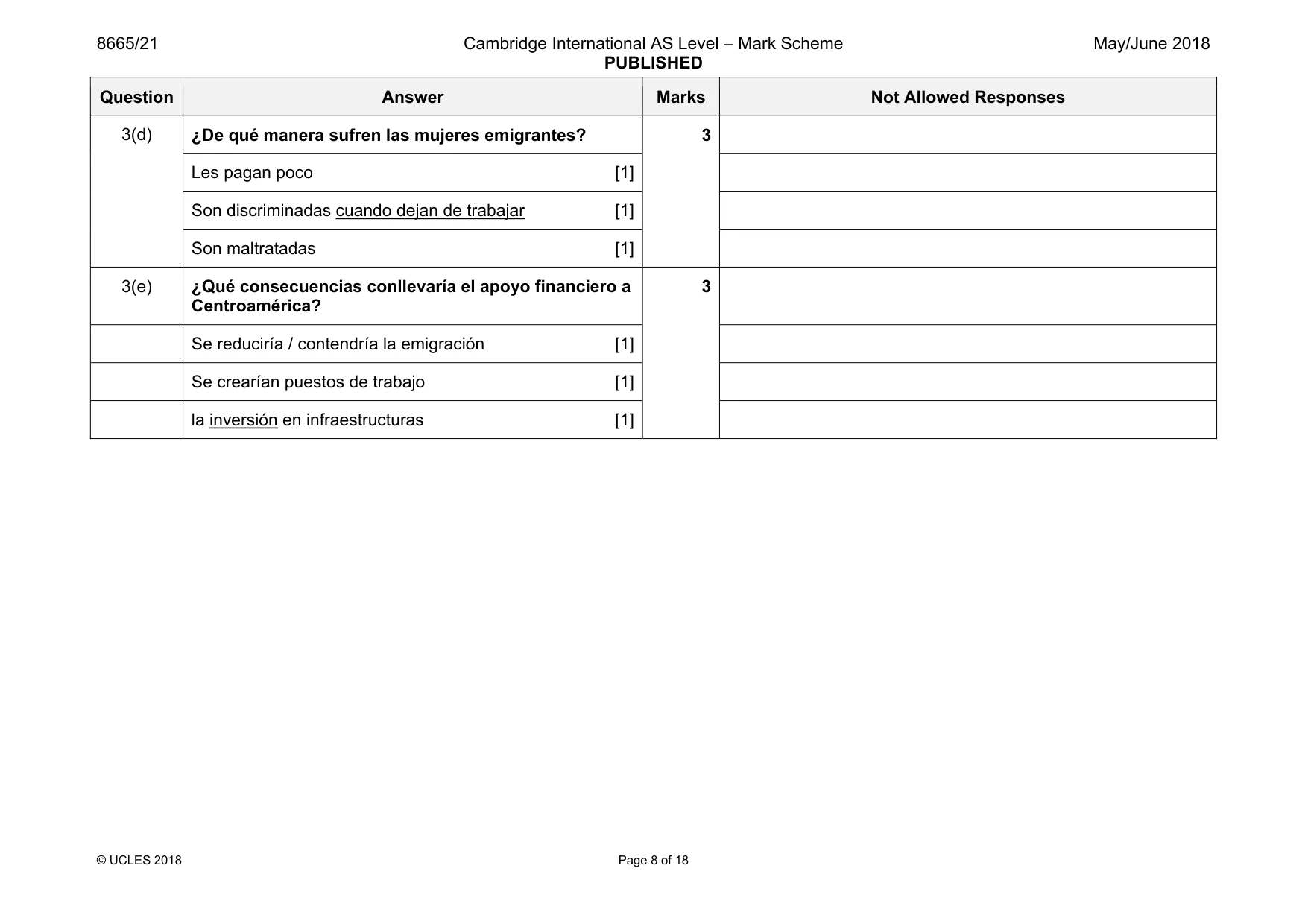
8665/21 Cambridge International AS Level – Mark Scheme PUBLISHED May/June 2018 © UCLES 2018 Page 8 of 18 Question Answer Marks Not Allowed Responses 3(d) ¿De qué manera sufren las mujeres emigrantes? 3 Les pagan poco [1] Son discriminadas cuando dejan de trabajar [1] Son maltratadas [1] 3(e) ¿Qué consecuencias conllevaría el apoyo financiero a Centroamérica? 3 Se reduciría / contendría la emigración [1] Se crearían puestos de trabajo [1] la inversión en infraestructuras [1]
Mark scheme, page 9
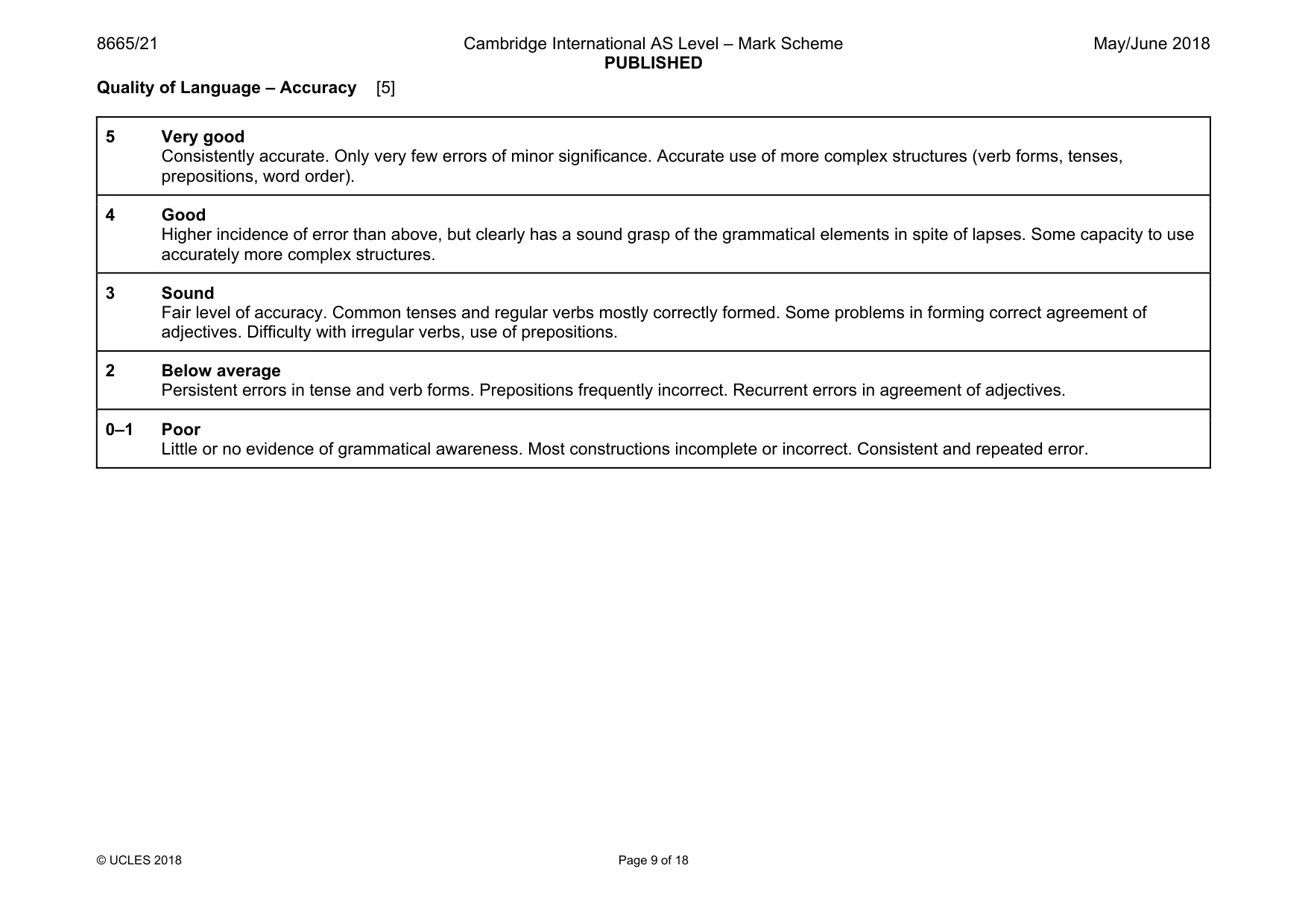
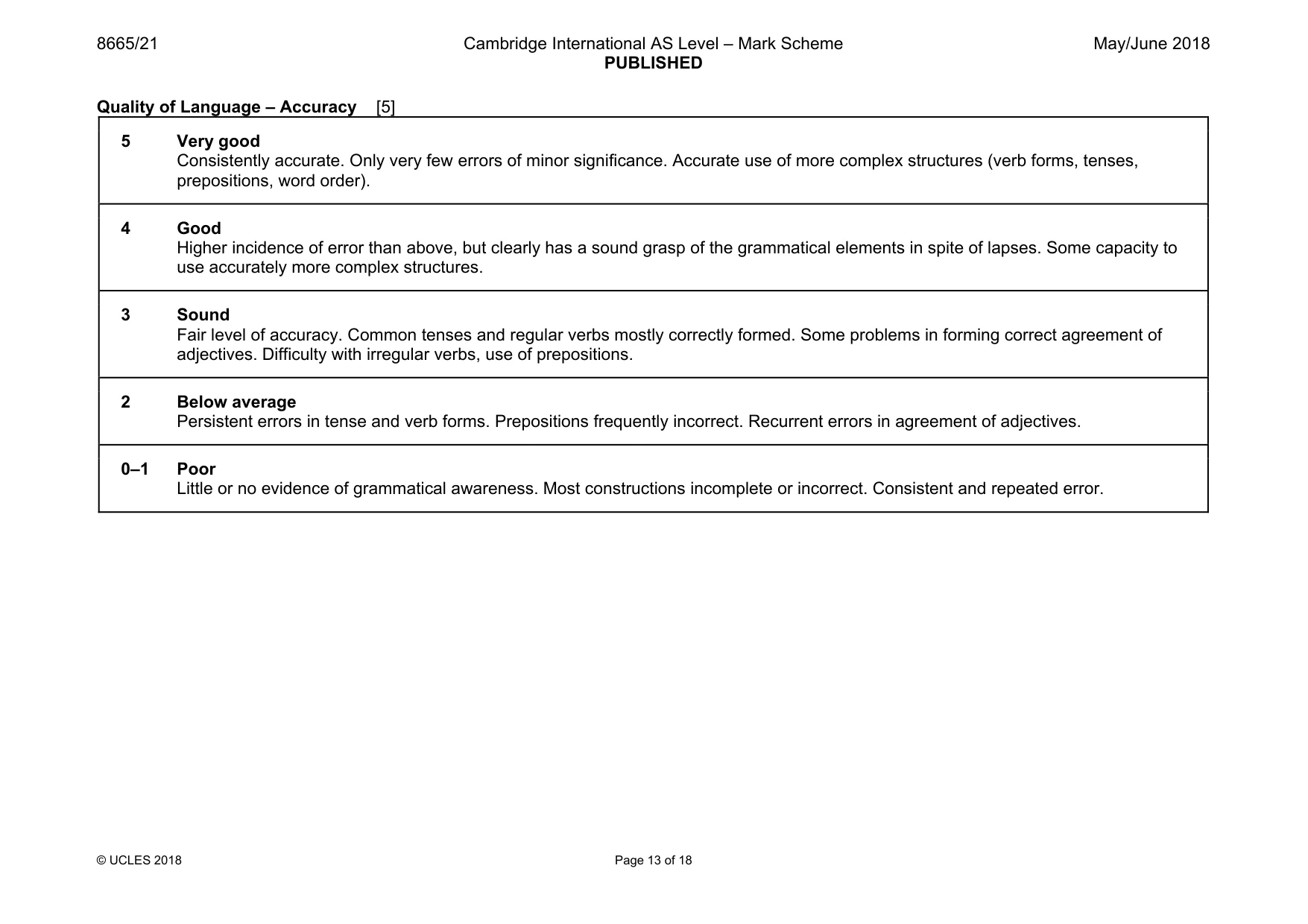
8665/21 Cambridge International AS Level – Mark Scheme PUBLISHED May/June 2018 © UCLES 2018 Page 9 of 18 Quality of Language – Accuracy [5] 5 Very good Consistently accurate. Only very few errors of minor significance. Accurate use of more complex structures (verb forms, tenses, prepositions, word order). 4 Good Higher incidence of error than above, but clearly has a sound grasp of the grammatical elements in spite of lapses. Some capacity to use accurately more complex structures. 3 Sound Fair level of accuracy. Common tenses and regular verbs mostly correctly formed. Some problems in forming correct agreement of adjectives. Difficulty with irregular verbs, use of prepositions. 2 Below average Persistent errors in tense and verb forms. Prepositions frequently incorrect. Recurrent errors in agreement of adjectives. 0–1 Poor Little or no evidence of grammatical awareness. Most constructions incomplete or incorrect. Consistent and repeated error.
Mark scheme, page 10
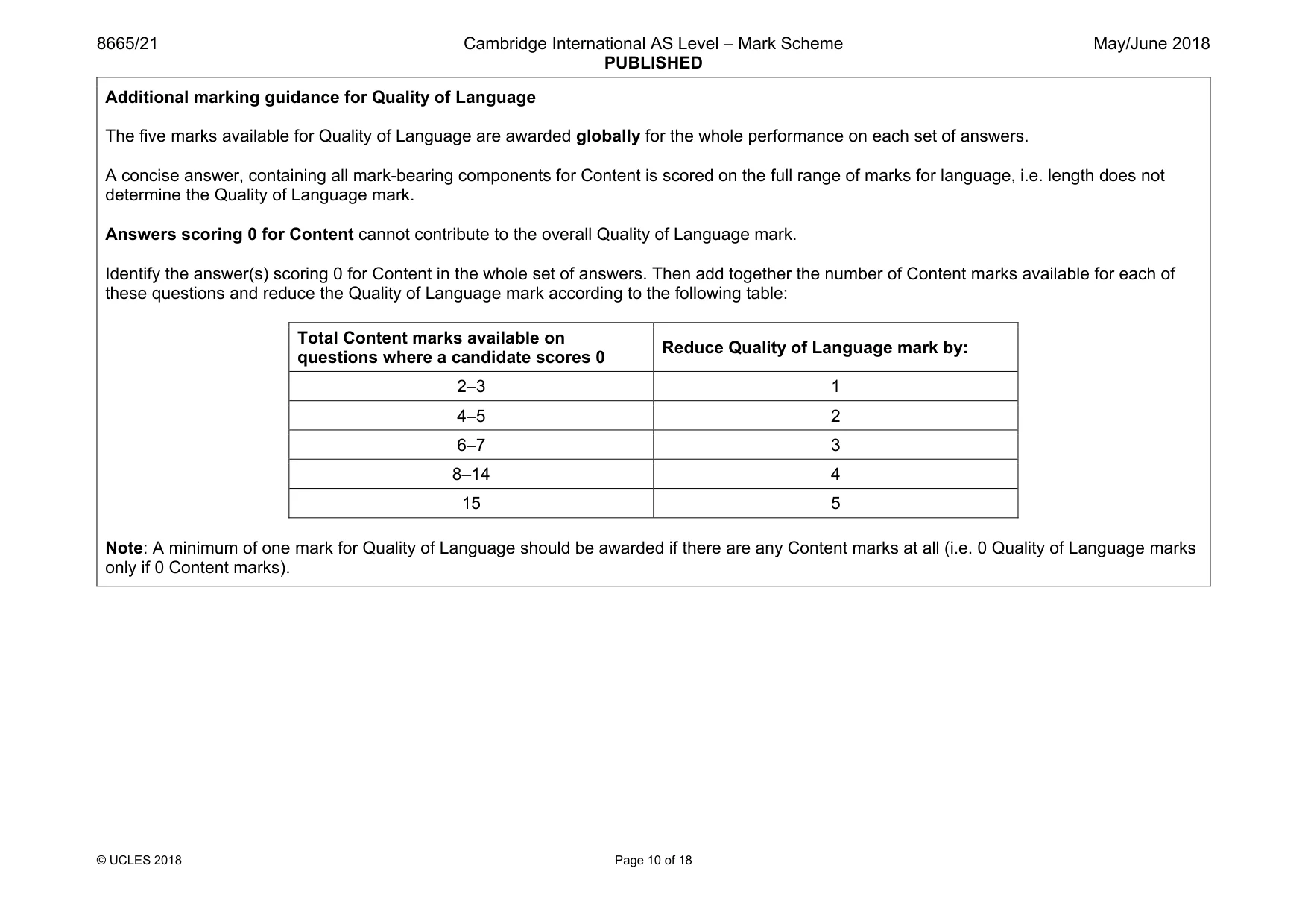
8665/21 Cambridge International AS Level – Mark Scheme PUBLISHED May/June 2018 © UCLES 2018 Page 10 of 18 Additional marking guidance for Quality of Language The five marks available for Quality of Language are awarded globally for the whole performance on each set of answers. A concise answer, containing all mark-bearing components for Content is scored on the full range of marks for language, i.e. length does not determine the Quality of Language mark. Answers scoring 0 for Content cannot contribute to the overall Quality of Language mark. Identify the answer(s) scoring 0 for Content in the whole set of answers. Then add together the number of Content marks available for each of these questions and reduce the Quality of Language mark according to the following table: Total Content marks available on questions where a candidate scores 0 Reduce Quality of Language mark by: 2–3 1 4–5 2 6–7 3 8–14 4 15 5 Note: A minimum of one mark for Quality of Language should be awarded if there are any Content marks at all (i.e. 0 Quality of Language marks only if 0 Content marks).
Mark scheme, page 11
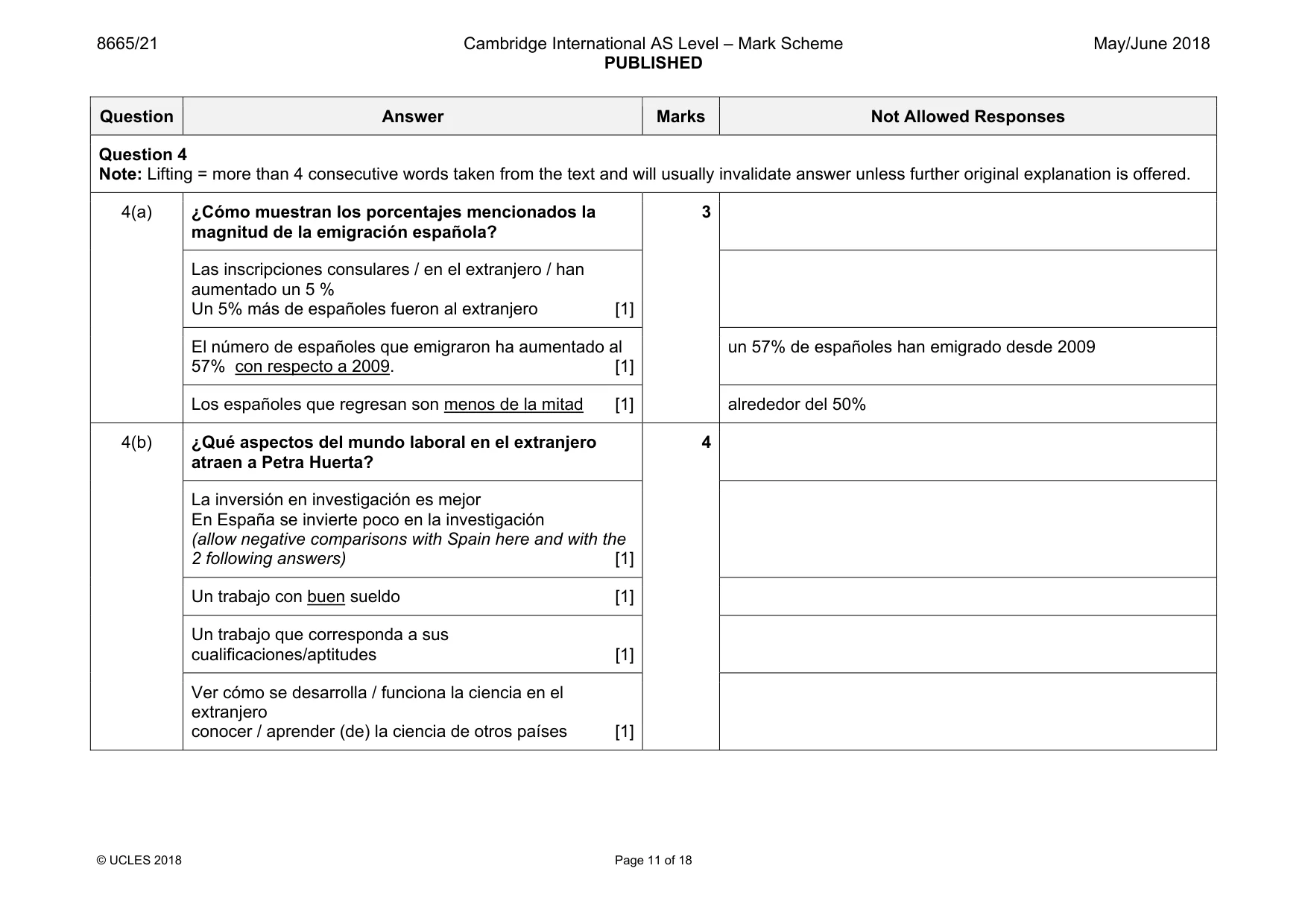
8665/21 Cambridge International AS Level – Mark Scheme PUBLISHED May/June 2018 © UCLES 2018 Page 11 of 18 Question Answer Marks Not Allowed Responses Question 4 Note: Lifting = more than 4 consecutive words taken from the text and will usually invalidate answer unless further original explanation is offered. 4(a) ¿Cómo muestran los porcentajes mencionados la magnitud de la emigración española? 3 Las inscripciones consulares / en el extranjero / han aumentado un 5 % Un 5% más de españoles fueron al extranjero [1] El número de españoles que emigraron ha aumentado al 57% con respecto a 2009. [1] un 57% de españoles han emigrado desde 2009 Los españoles que regresan son menos de la mitad [1] alrededor del 50% 4(b) ¿Qué aspectos del mundo laboral en el extranjero atraen a Petra Huerta? 4 La inversión en investigación es mejor En España se invierte poco en la investigación (allow negative comparisons with Spain here and with the 2 following answers) [1] Un trabajo con buen sueldo [1] Un trabajo que corresponda a sus cualificaciones/aptitudes [1] Ver cómo se desarrolla / funciona la ciencia en el extranjero conocer / aprender (de) la ciencia de otros países [1]
Mark scheme, page 12
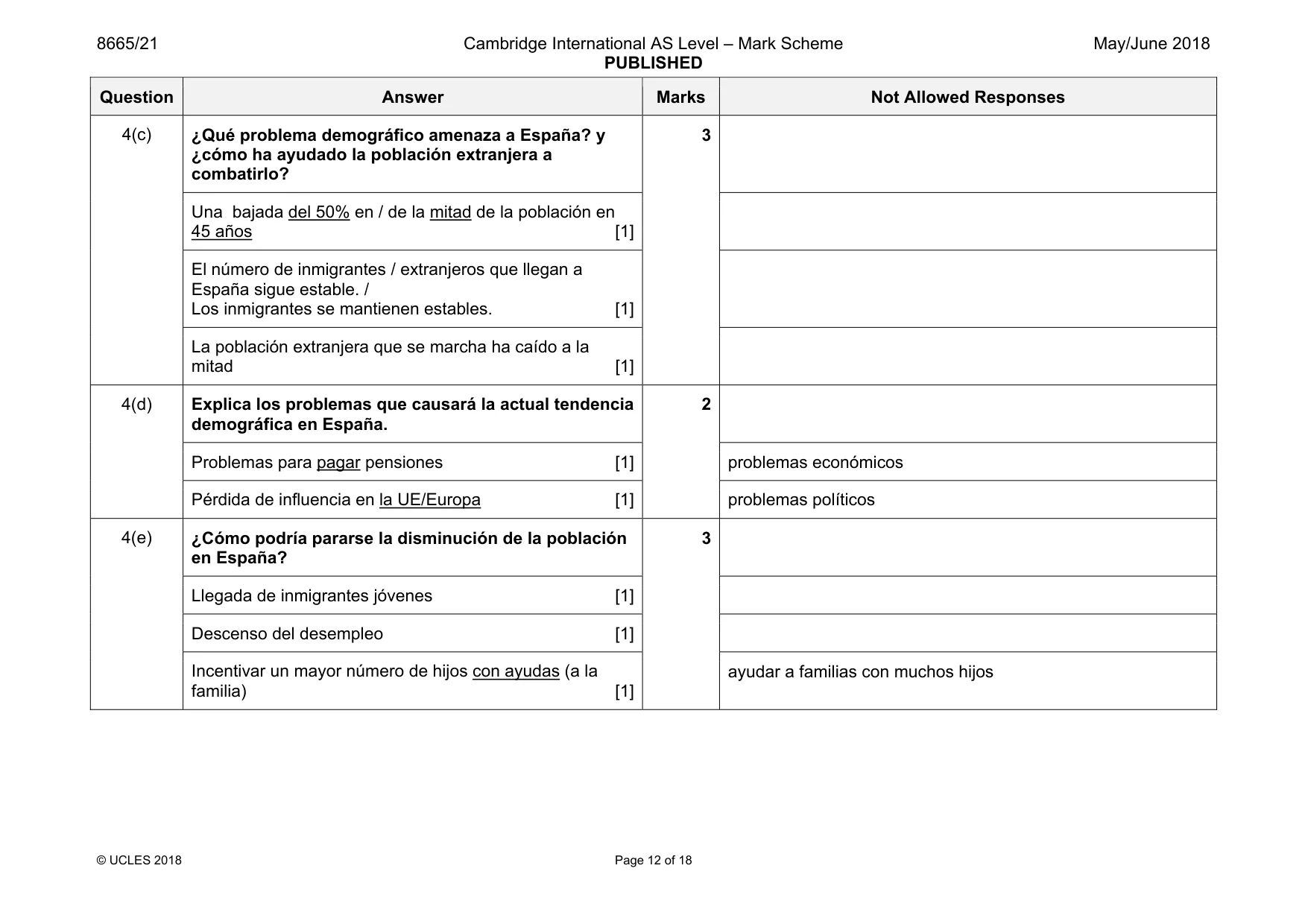
8665/21 Cambridge International AS Level – Mark Scheme PUBLISHED May/June 2018 © UCLES 2018 Page 12 of 18 Question Answer Marks Not Allowed Responses 4(c) ¿Qué problema demográfico amenaza a España? y ¿cómo ha ayudado la población extranjera a combatirlo? 3 Una bajada del 50% en / de la mitad de la población en 45 años [1] El número de inmigrantes / extranjeros que llegan a España sigue estable. / Los inmigrantes se mantienen estables. [1] La población extranjera que se marcha ha caído a la mitad [1] 4(d) Explica los problemas que causará la actual tendencia demográfica en España. 2 Problemas para pagar pensiones [1] problemas económicos Pérdida de influencia en la UE/Europa [1] problemas políticos 4(e) ¿Cómo podría pararse la disminución de la población en España? 3 Llegada de inmigrantes jóvenes [1] Descenso del desempleo [1] Incentivar un mayor número de hijos con ayudas (a la familia) [1] ayudar a familias con muchos hijos
Mark scheme, page 13
8665/21 Cambridge International AS Level – Mark Scheme PUBLISHED May/June 2018 © UCLES 2018 Page 13 of 18 Quality of Language – Accuracy [5] 5 Very good Consistently accurate. Only very few errors of minor significance. Accurate use of more complex structures (verb forms, tenses, prepositions, word order). 4 Good Higher incidence of error than above, but clearly has a sound grasp of the grammatical elements in spite of lapses. Some capacity to use accurately more complex structures. 3 Sound Fair level of accuracy. Common tenses and regular verbs mostly correctly formed. Some problems in forming correct agreement of adjectives. Difficulty with irregular verbs, use of prepositions. 2 Below average Persistent errors in tense and verb forms. Prepositions frequently incorrect. Recurrent errors in agreement of adjectives. 0–1 Poor Little or no evidence of grammatical awareness. Most constructions incomplete or incorrect. Consistent and repeated error.
Mark scheme, page 14
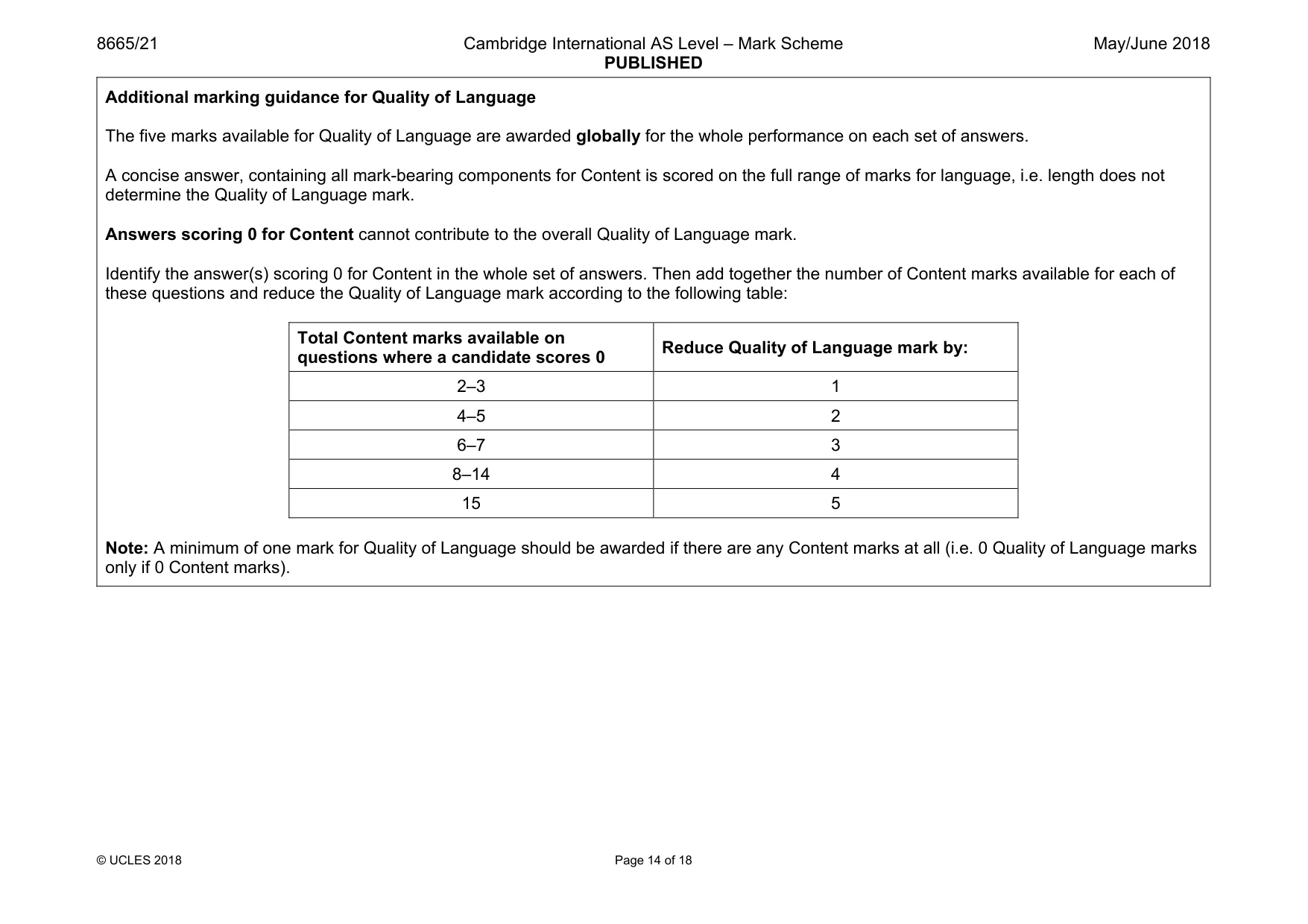
8665/21 Cambridge International AS Level – Mark Scheme PUBLISHED May/June 2018 © UCLES 2018 Page 14 of 18 Additional marking guidance for Quality of Language The five marks available for Quality of Language are awarded globally for the whole performance on each set of answers. A concise answer, containing all mark-bearing components for Content is scored on the full range of marks for language, i.e. length does not determine the Quality of Language mark. Answers scoring 0 for Content cannot contribute to the overall Quality of Language mark. Identify the answer(s) scoring 0 for Content in the whole set of answers. Then add together the number of Content marks available for each of these questions and reduce the Quality of Language mark according to the following table: Total Content marks available on questions where a candidate scores 0 Reduce Quality of Language mark by: 2–3 1 4–5 2 6–7 3 8–14 4 15 5 Note: A minimum of one mark for Quality of Language should be awarded if there are any Content marks at all (i.e. 0 Quality of Language marks only if 0 Content marks).
Mark scheme, page 15
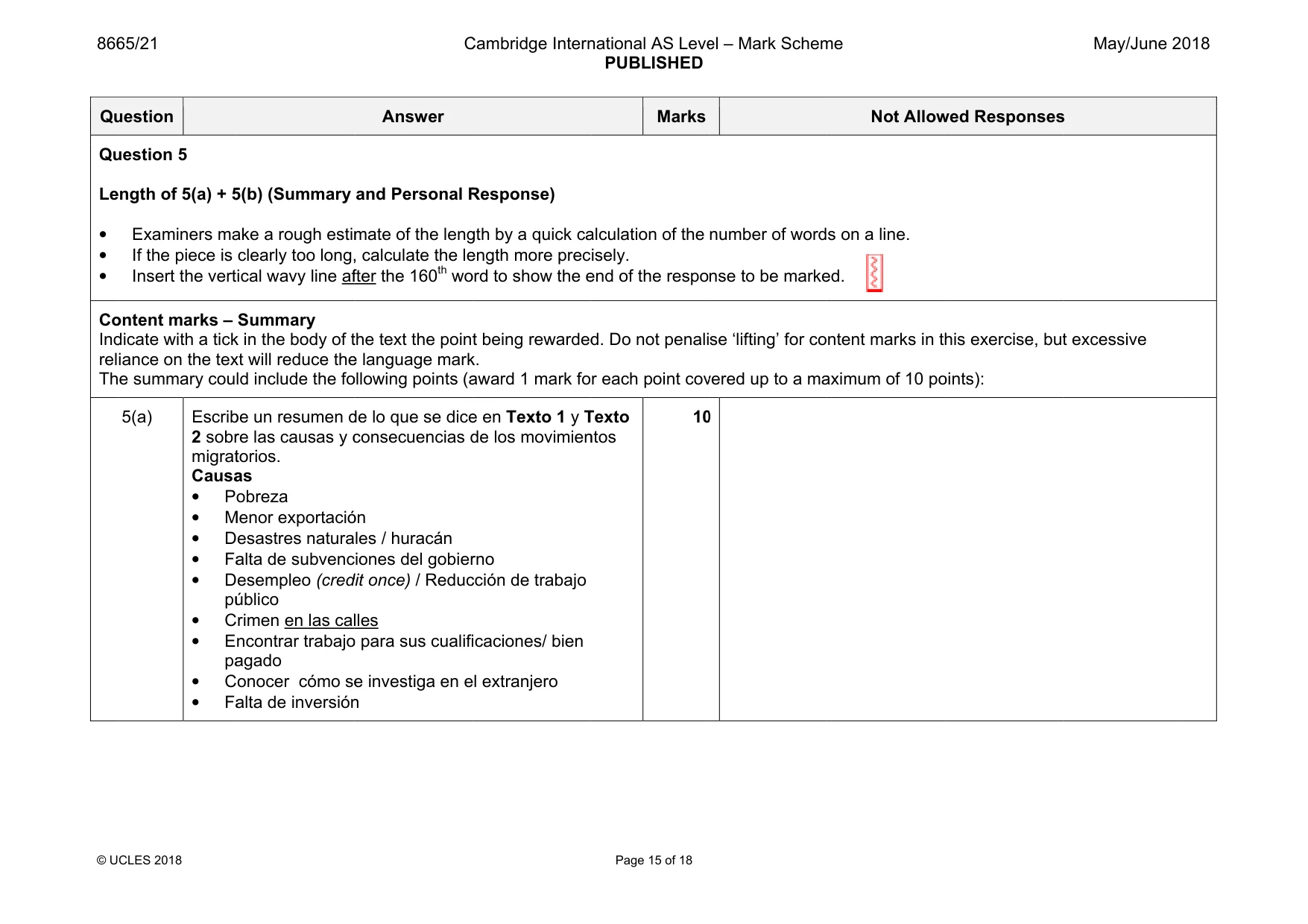
866 © U Qu Qu Le • • • Co Ind rel Th 65/21 CLES 2018 uestion uestion 5 ength of 5(a) + 5 Examiners ma If the piece is Insert the vert ontent marks – dicate with a tick iance on the tex e summary cou 5(a) Escrib 2 sobr migrat Causa • P • M • D • Fa • D pú • C • E pa • C • Fa 5(b) (Summary ake a rough estim clearly too long, ical wavy line af Summary k in the body of t xt will reduce the ld include the fo be un resumen d re las causas y c torios. as obreza Menor exportació esastres natura alta de subvenc esempleo (cred úblico rimen en las cal ncontrar trabajo agado onocer cómo se alta de inversión C Answer and Personal R mate of the leng , calculate the le fter the 160th wo the text the point e language mark ollowing points (a de lo que se dice consecuencias d ón les / huracán iones del gobier dit once) / Reduc lles o para sus cualifi e investiga en e n Cambridge Intern Response) gth by a quick ca ength more prec ord to show the e t being rewarded k. award 1 mark fo e en Texto 1 y T de los movimien rno cción de trabajo icaciones/ bien el extranjero national AS Leve PUBLISHED Page 15 of 18 Marks alculation of the isely. end of the respo d. Do not penali r each point cov Texto ntos 10 el – Mark Schem number of word nse to be marke se ‘lifting’ for co vered up to a ma 0 me Not Allow s on a line. ed. ntent marks in th aximum of 10 po wed Responses his exercise, but oints): May/June 2 s t excessive 018
Mark scheme, page 16
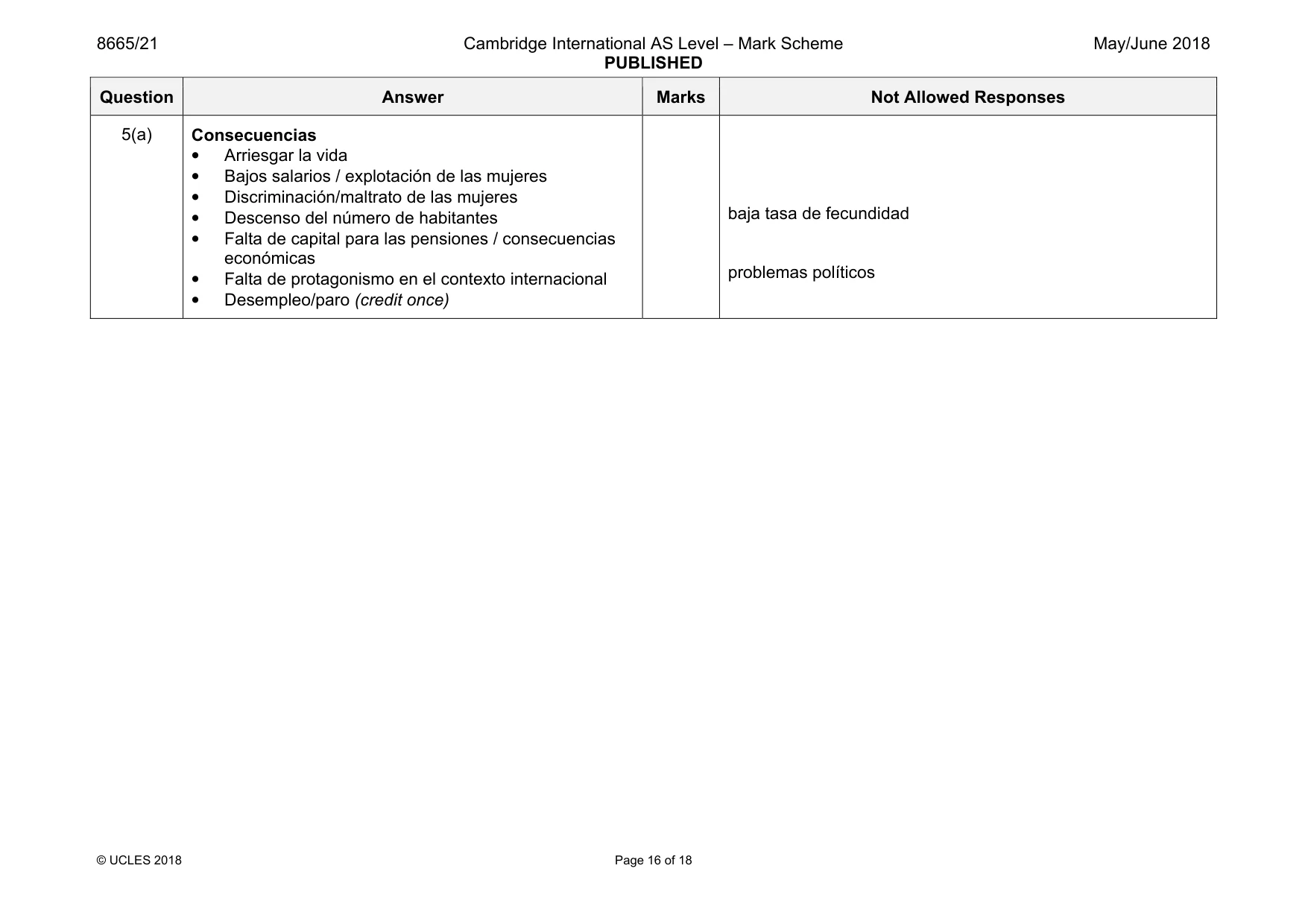
8665/21 Cambridge International AS Level – Mark Scheme PUBLISHED May/June 2018 © UCLES 2018 Page 16 of 18 Question Answer Marks Not Allowed Responses 5(a) Consecuencias • Arriesgar la vida • Bajos salarios / explotación de las mujeres • Discriminación/maltrato de las mujeres • Descenso del número de habitantes • Falta de capital para las pensiones / consecuencias económicas • Falta de protagonismo en el contexto internacional • Desempleo/paro (credit once) baja tasa de fecundidad problemas políticos
Mark scheme, page 17
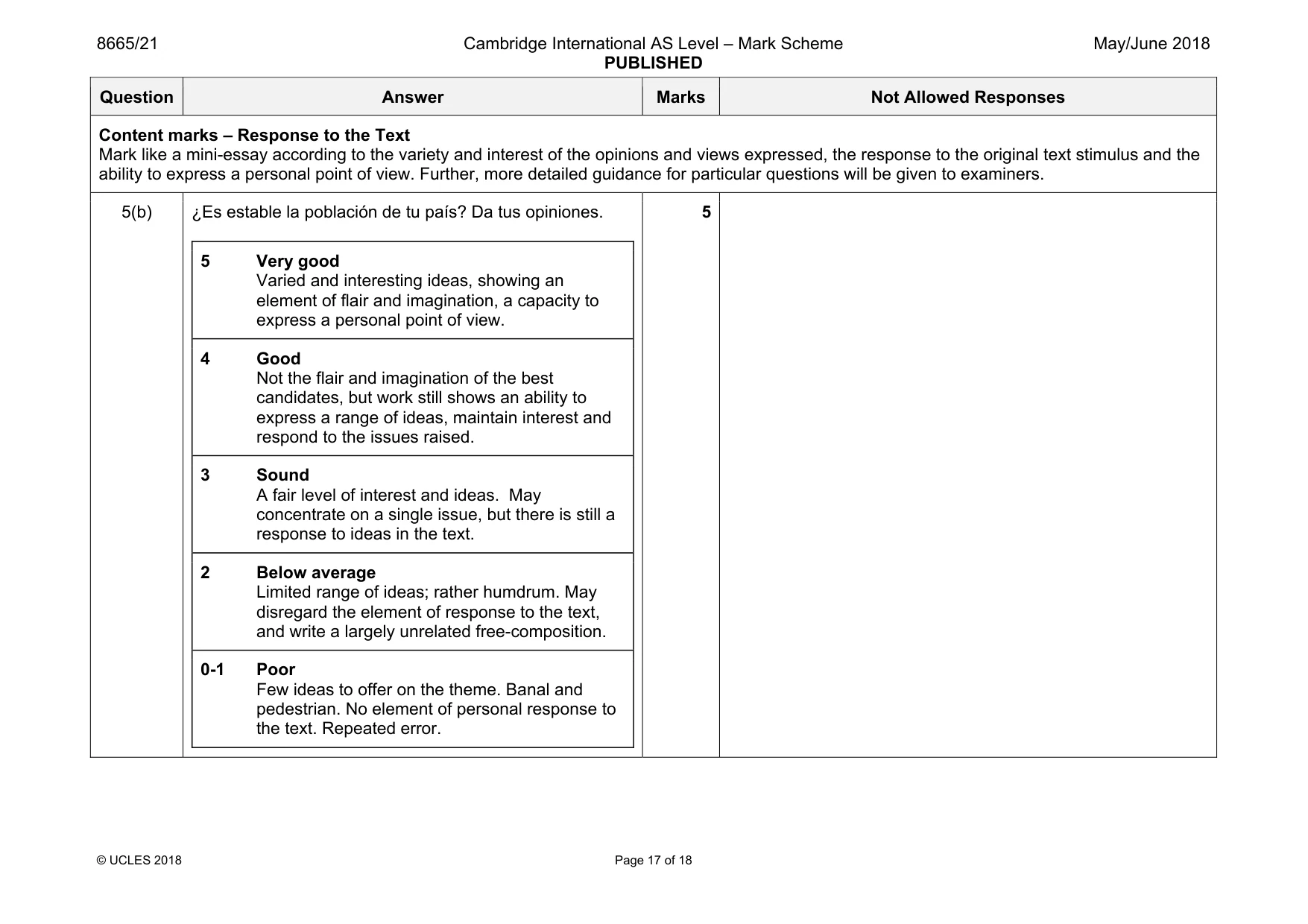
8665/21 Cambridge International AS Level – Mark Scheme PUBLISHED May/June 2018 © UCLES 2018 Page 17 of 18 Question Answer Marks Not Allowed Responses Content marks – Response to the Text Mark like a mini-essay according to the variety and interest of the opinions and views expressed, the response to the original text stimulus and the ability to express a personal point of view. Further, more detailed guidance for particular questions will be given to examiners. 5(b) ¿Es estable la población de tu país? Da tus opiniones. 5 Very good Varied and interesting ideas, showing an element of flair and imagination, a capacity to express a personal point of view. 4 Good Not the flair and imagination of the best candidates, but work still shows an ability to express a range of ideas, maintain interest and respond to the issues raised. 3 Sound A fair level of interest and ideas. May concentrate on a single issue, but there is still a response to ideas in the text. 2 Below average Limited range of ideas; rather humdrum. May disregard the element of response to the text, and write a largely unrelated free-composition. 0-1 Poor Few ideas to offer on the theme. Banal and pedestrian. No element of personal response to the text. Repeated error. 5
Mark scheme, page 18
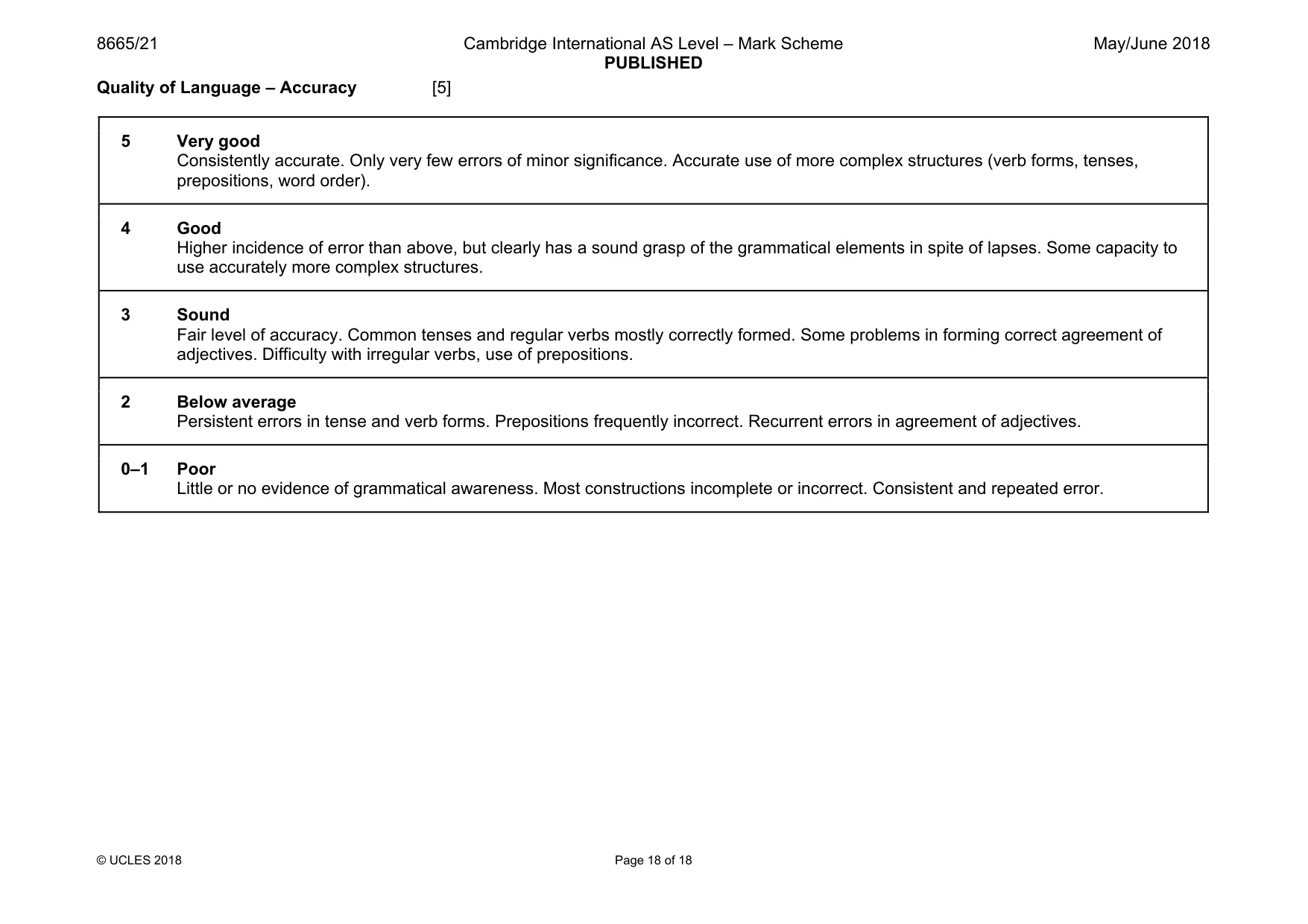
8665/21 Cambridge International AS Level – Mark Scheme PUBLISHED May/June 2018 © UCLES 2018 Page 18 of 18 Quality of Language – Accuracy [5] 5 Very good Consistently accurate. Only very few errors of minor significance. Accurate use of more complex structures (verb forms, tenses, prepositions, word order). 4 Good Higher incidence of error than above, but clearly has a sound grasp of the grammatical elements in spite of lapses. Some capacity to use accurately more complex structures. 3 Sound Fair level of accuracy. Common tenses and regular verbs mostly correctly formed. Some problems in forming correct agreement of adjectives. Difficulty with irregular verbs, use of prepositions. 2 Below average Persistent errors in tense and verb forms. Prepositions frequently incorrect. Recurrent errors in agreement of adjectives. 0–1 Poor Little or no evidence of grammatical awareness. Most constructions incomplete or incorrect. Consistent and repeated error.
What you needed in this session
Cambridge’s own grade thresholds for 2018 May/June, Paper 2 · Variant 1. A higher threshold means an easier paper — the bar moves with how the cohort did.