Cambridge A Level Spanish - First Language (AS Level only) 8665 — 2013 Oct/Nov Paper 4 · Variant 2
8665/42/O/N/13 · 75 marks · ≈84 min
The question paper and its mark scheme, free to read here and free to download. This is Cambridge’s own paper, exactly as it was sat.
Question paper8 pages

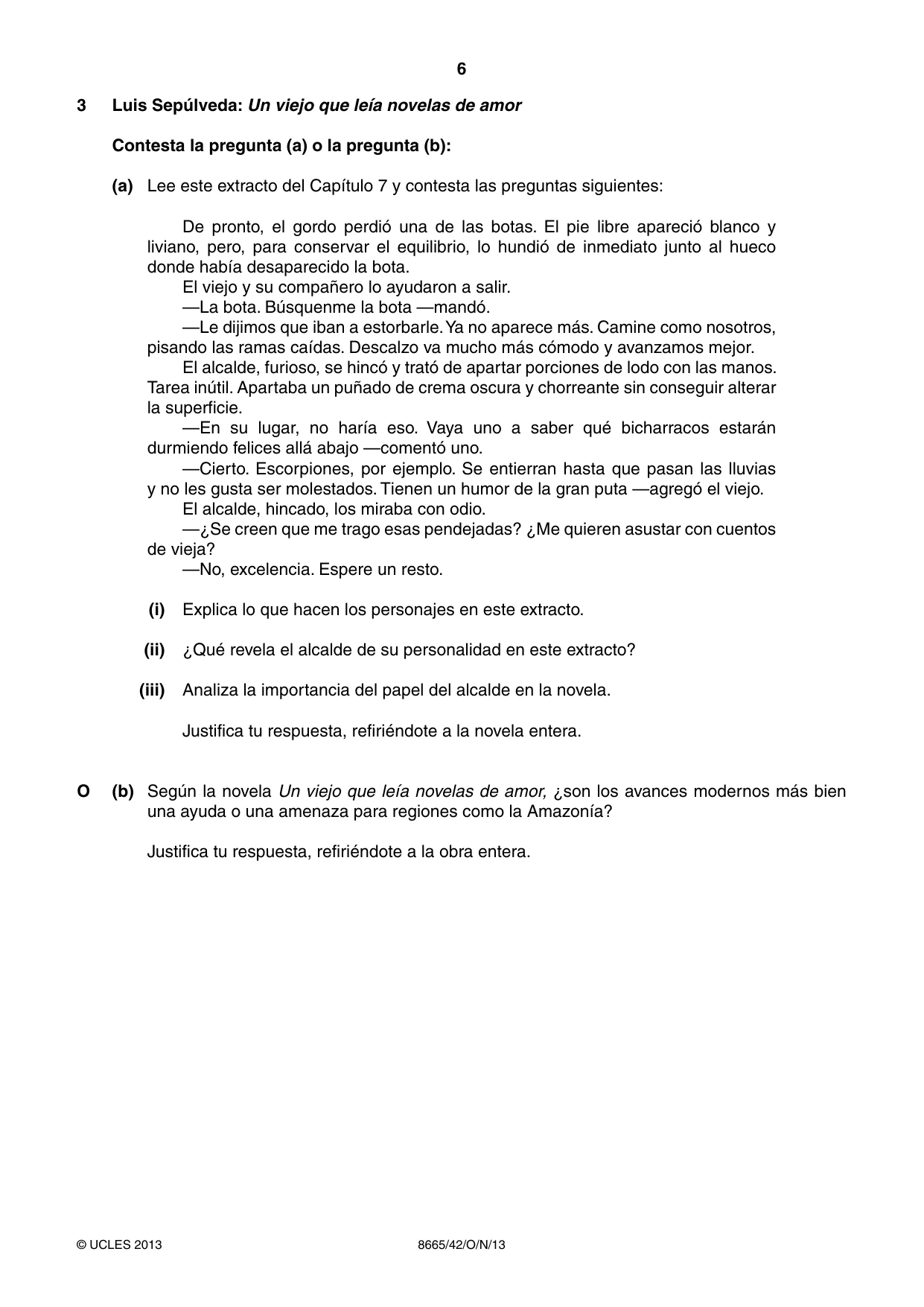
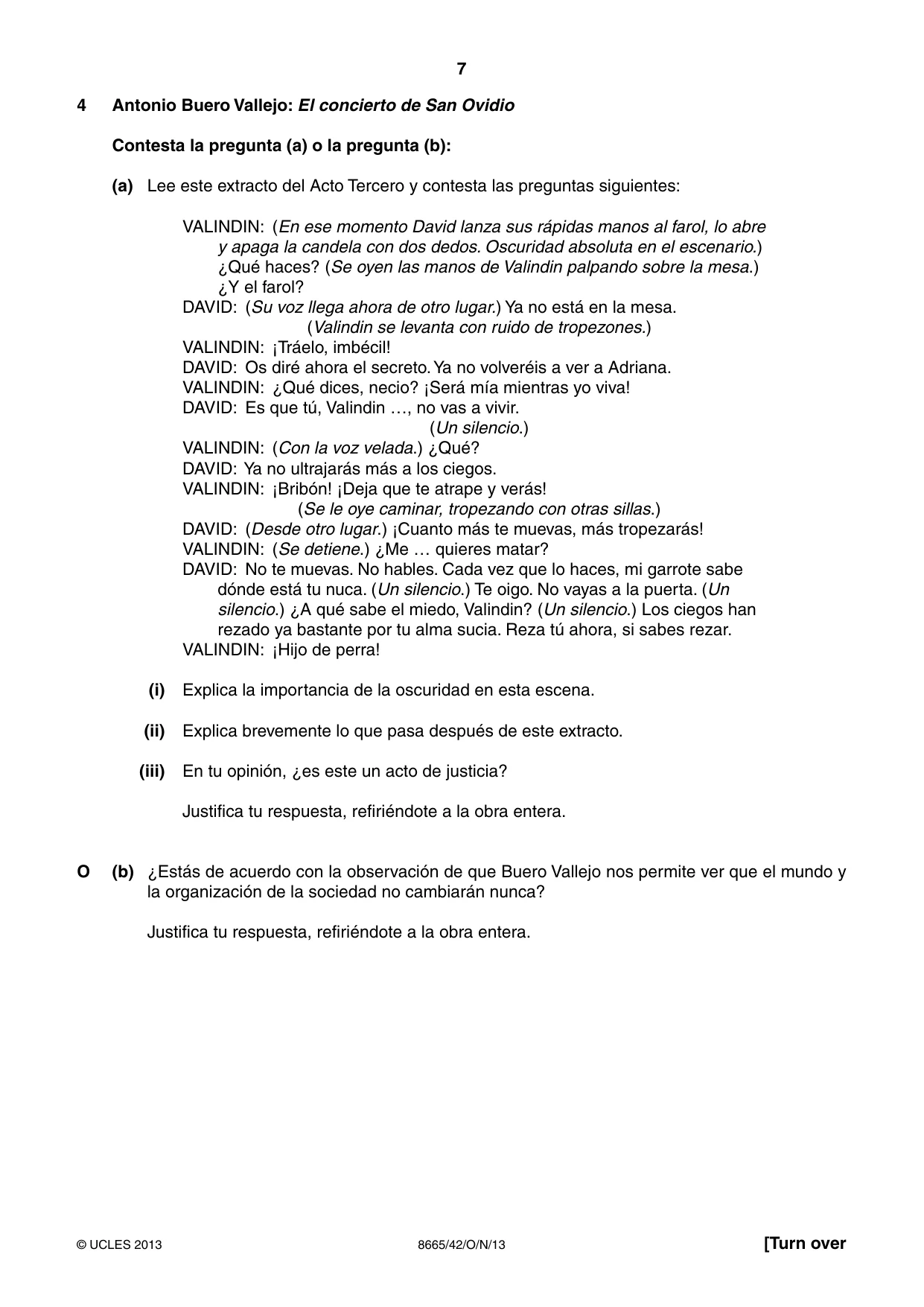
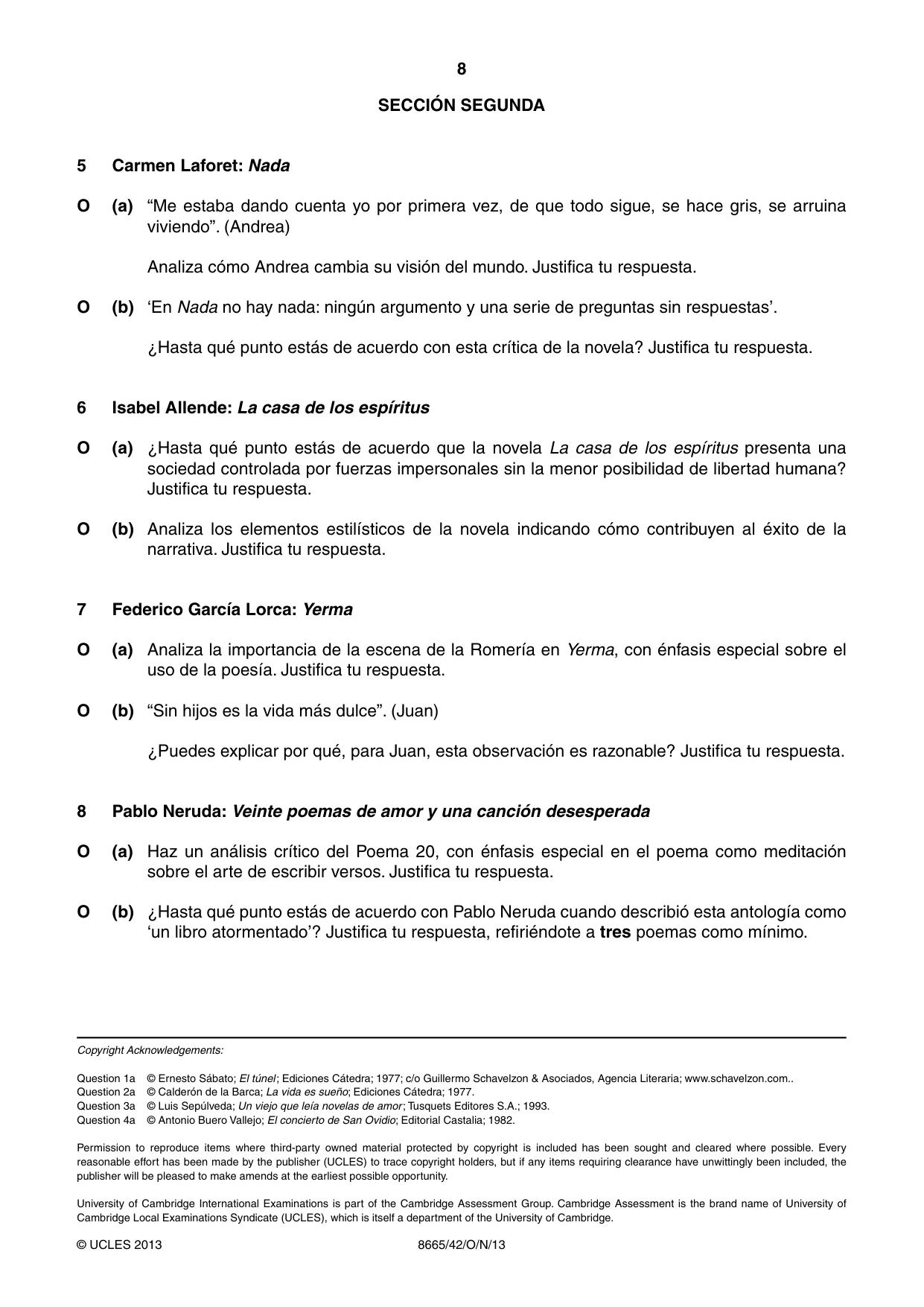
Mark scheme3 pages
Answers below. Sit the paper first if you are practising.
Paper as text
Question paper, page 1
This document consists of 7 printed pages and 1 blank page. DC (LEG) 91433 © UCLES 2013 [Turn over UNIVERSITY OF CAMBRIDGE INTERNATIONAL EXAMINATIONS General Certificate of Education Advanced Subsidiary Level * 2 7 0 0 9 5 4 4 4 3 * FIRST LANGUAGE SPANISH 8665/42 Paper 4 Texts October/November 2013 2 hours 30 minutes Additional Materials: Answer Booklet/Paper Invigilators must refer to the Additional Materials List for instructions on the use of set texts in the examination. READ THESE INSTRUCTIONS FIRST If you have been given an Answer Booklet, follow the instructions on the front cover of the Booklet. Write your Centre number, candidate number and name on all the work you hand in. Write in dark blue or black pen. Do not use staples, paper clips, highlighters, glue or correction fluid. Answer three questions, each on a different text. You must choose one question from Section 1, one from Section 2 and one other. Write your answers in Spanish. Dictionaries are not permitted. You should write between 500 and 600 words for each answer. If you write more than 600 words for each answer, you will be penalised. At the end of the examination, fasten all your work securely together. All questions in this paper carry equal marks. EN PRIMER LUGAR, LEE ESTAS INSTRUCCIONES Si se te ha dado un Cuadernillo de Respuestas, sigue las instrucciones de la tapa del Cuadernillo. Escribe el número del Centro, el número de estudiante que se te ha adjudicado y tu nombre en todo el trabajo que vayas a entregar. Usa tinta azul oscuro o negra. No uses ni grapas, ni clips, ni rotulador, ni goma de pegar, ni corrector líquido. Contesta tres preguntas, cada una de textos diferentes. Debes escoger una pregunta de la Sección 1, otra de la Sección 2 y la tercera puede ser de cualquiera de las dos secciones. Escribe las respuestas en español. No se permite el uso de diccionario. Escribe 500-600 palabras en cada respuesta. Se penalizará el exceso en el número de palabras estipulado. Al terminar el examen, sujeta bien todo tu trabajo. Todas las preguntas en este examen tienen el mismo valor.
Question paper, page 2
2 8665/42/O/N/13 © UCLES 2013 BLANK PAGE
Question paper, page 3
3 8665/42/O/N/13 © UCLES 2013 [Turn over SECCIÓN PRIMERA 1 Ernesto Sábato: El túnel Contesta la pregunta (a) o la pregunta (b): (a) Lee este extracto del Capítulo XXV y contesta las preguntas siguientes: Fue una vez en la mesa que la flaca me preguntó a qué pintores prefería. Cité torpemente algunos nombres: Van Gogh, el Greco. —¿Por qué no decís Zózimo, Mimí? A menos que te decidas a decirlo en ruso. —Ya empiezas con tus tonterías puristas. (i) Explica dónde tiene lugar este extracto. (ii) Analiza la presentación de Mimí en este extracto. (iii) ¿Compartes la opinión de que el humor hace un papel importante en la novela? Justifica tu respuesta con referencias detalladas a la novela entera. O (b) ‘El aislamiento es inevitable en el mundo moderno. Este es un mensaje central en la novela El túnel ’. ¿Hasta qué punto estás de acuerdo con esta interpretación de la novela? Justifica tu respuesta, refiriéndote a la novela entera. Content removed due to copyright restrictions.
Question paper, page 4
4 8665/42/O/N/13 © UCLES 2013 2 Calderón de la Barca: La vida es sueño Contesta la pregunta (a) o la pregunta (b): (a) Lee este extracto de la Escena XVI de la Primera Jornada y contesta las preguntas siguientes: BASILIO: … Ya sabéis, estadme atentos, amados sobrinos míos, corte ilustre de Polonia, vasallos, deudos y amigos, Ya sabéis que yo en el mundo por mi ciencia he merecido el sobrenombre de docto; pues, contra el tiempo y olvido, los pinceles de Timantes, los mármoles de Lisipo, en el ámbito del orbe me aclaman el gran Basilio. Ya sabéis que son las ciencias que más curso y más estimo, matemáticas sutiles, por quien al tiempo le quito, por quien a la fama rompo la jurisdicción y oficio de enseñar más cada día; pues cuando en mis tablas miro presentes las novedades de los venideros siglos, le gano al tiempo las gracias de contar lo que yo he dicho. Esos círculos de nieve, esos doseles de vidrio que el sol ilumina a rayos, que parte la una a giros; esos orbes de diamantes, esos globos cristalinos que las estrellas adornan y que campean los signos, son el estudio mayor de mis años, son los libros, donde en papel de diamante, en cuadernos de zafiros, escribe con líneas de oro en caracteres distintos el cielo nuestros sucesos ya adversos o ya benignos.
Question paper, page 5
5 8665/42/O/N/13 © UCLES 2013 [Turn over (i) Explica lo que Basilio estudia. (ii) ¿Qué impresión tenemos de Basilio cuando pronuncia estas palabras? (iii) ¿Compartes tú la opinión de que las acciones de Basilio a lo largo de la obra resultaron en presentarle como ridículo a los ojos del auditorio de Calderón? Justifica tu respuesta, refiriéndote a la obra entera. O (b) ‘Segismundo es un hombre magnánimo con virtudes naturales desde el primer momento; solo que los demás han faltado a la obligación de educarle’. ¿Estás de acuerdo con esta observación? Justifica tu respuesta, refiriéndote a la obra entera.
Question paper, page 6
6 8665/42/O/N/13 © UCLES 2013 3 Luis Sepúlveda: Un viejo que leía novelas de amor Contesta la pregunta (a) o la pregunta (b): (a) Lee este extracto del Capítulo 7 y contesta las preguntas siguientes: De pronto, el gordo perdió una de las botas. El pie libre apareció blanco y liviano, pero, para conservar el equilibrio, lo hundió de inmediato junto al hueco donde había desaparecido la bota. El viejo y su compañero lo ayudaron a salir. —La bota. Búsquenme la bota —mandó. —Le dijimos que iban a estorbarle. Ya no aparece más. Camine como nosotros, pisando las ramas caídas. Descalzo va mucho más cómodo y avanzamos mejor. El alcalde, furioso, se hincó y trató de apartar porciones de lodo con las manos. Tarea inútil. Apartaba un puñado de crema oscura y chorreante sin conseguir alterar la superficie. —En su lugar, no haría eso. Vaya uno a saber qué bicharracos estarán durmiendo felices allá abajo —comentó uno. —Cierto. Escorpiones, por ejemplo. Se entierran hasta que pasan las lluvias y no les gusta ser molestados. Tienen un humor de la gran puta —agregó el viejo. El alcalde, hincado, los miraba con odio. —¿Se creen que me trago esas pendejadas? ¿Me quieren asustar con cuentos de vieja? —No, excelencia. Espere un resto. (i) Explica lo que hacen los personajes en este extracto. (ii) ¿Qué revela el alcalde de su personalidad en este extracto? (iii) Analiza la importancia del papel del alcalde en la novela. Justifica tu respuesta, refiriéndote a la novela entera. O (b) Según la novela Un viejo que leía novelas de amor, ¿son los avances modernos más bien una ayuda o una amenaza para regiones como la Amazonía? Justifica tu respuesta, refiriéndote a la obra entera.
Question paper, page 7
7 8665/42/O/N/13 © UCLES 2013 [Turn over 4 Antonio Buero Vallejo: El concierto de San Ovidio Contesta la pregunta (a) o la pregunta (b): (a) Lee este extracto del Acto Tercero y contesta las preguntas siguientes: VALINDIN: (En ese momento David lanza sus rápidas manos al farol, lo abre y apaga la candela con dos dedos. Oscuridad absoluta en el escenario.) ¿Qué haces? (Se oyen las manos de Valindin palpando sobre la mesa.) ¿Y el farol? DAVID: (Su voz llega ahora de otro lugar.) Ya no está en la mesa. (Valindin se levanta con ruido de tropezones.) VALINDIN: ¡Tráelo, imbécil! DAVID: Os diré ahora el secreto. Ya no volveréis a ver a Adriana. VALINDIN: ¿Qué dices, necio? ¡Será mía mientras yo viva! DAVID: Es que tú, Valindin …, no vas a vivir. (Un silencio.) VALINDIN: (Con la voz velada.) ¿Qué? DAVID: Ya no ultrajarás más a los ciegos. VALINDIN: ¡Bribón! ¡Deja que te atrape y verás! (Se le oye caminar, tropezando con otras sillas.) DAVID: (Desde otro lugar.) ¡Cuanto más te muevas, más tropezarás! VALINDIN: (Se detiene.) ¿Me … quieres matar? DAVID: No te muevas. No hables. Cada vez que lo haces, mi garrote sabe dónde está tu nuca. (Un silencio.) Te oigo. No vayas a la puerta. (Un silencio.) ¿A qué sabe el miedo, Valindin? (Un silencio.) Los ciegos han rezado ya bastante por tu alma sucia. Reza tú ahora, si sabes rezar. VALINDIN: ¡Hijo de perra! (i) Explica la importancia de la oscuridad en esta escena. (ii) Explica brevemente lo que pasa después de este extracto. (iii) En tu opinión, ¿es este un acto de justicia? Justifica tu respuesta, refiriéndote a la obra entera. O (b) ¿Estás de acuerdo con la observación de que Buero Vallejo nos permite ver que el mundo y la organización de la sociedad no cambiarán nunca? Justifica tu respuesta, refiriéndote a la obra entera.
Question paper, page 8
8 8665/42/O/N/13 © UCLES 2013 SECCIÓN SEGUNDA 5 Carmen Laforet: Nada O (a) “Me estaba dando cuenta yo por primera vez, de que todo sigue, se hace gris, se arruina viviendo”. (Andrea) Analiza cómo Andrea cambia su visión del mundo. Justifica tu respuesta. O (b) ‘En Nada no hay nada: ningún argumento y una serie de preguntas sin respuestas’. ¿Hasta qué punto estás de acuerdo con esta crítica de la novela? Justifica tu respuesta. 6 Isabel Allende: La casa de los espíritus O (a) ¿Hasta qué punto estás de acuerdo que la novela La casa de los espíritus presenta una sociedad controlada por fuerzas impersonales sin la menor posibilidad de libertad humana? Justifica tu respuesta. O (b) Analiza los elementos estilísticos de la novela indicando cómo contribuyen al éxito de la narrativa. Justifica tu respuesta. 7 Federico García Lorca: Yerma O (a) Analiza la importancia de la escena de la Romería en Yerma, con énfasis especial sobre el uso de la poesía. Justifica tu respuesta. O (b) “Sin hijos es la vida más dulce”. (Juan) ¿Puedes explicar por qué, para Juan, esta observación es razonable? Justifica tu respuesta. 8 Pablo Neruda: Veinte poemas de amor y una canción desesperada O (a) Haz un análisis crítico del Poema 20, con énfasis especial en el poema como meditación sobre el arte de escribir versos. Justifica tu respuesta. O (b) ¿Hasta qué punto estás de acuerdo con Pablo Neruda cuando describió esta antología como ‘un libro atormentado’? Justifica tu respuesta, refiriéndote a tres poemas como mínimo. Copyright Acknowledgements: Question 1a © Ernesto Sábato; El túnel ; Ediciones Cátedra; 1977; c/o Guillermo Schavelzon & Asociados, Agencia Literaria; www.schavelzon.com.. Question 2a © Calderón de la Barca; La vida es sueño; Ediciones Cátedra; 1977. Question 3a © Luis Sepúlveda; Un viejo que leía novelas de amor ; Tusquets Editores S.A.; 1993. Question 4a © Antonio Buero Vallejo; El concierto de San Ovidio; Editorial Castalia; 1982. Permission to reproduce items where third-party owned material protected by copyright is included has been sought and cleared where possible. Every reasonable effort has been made by the publisher (UCLES) to trace copyright holders, but if any items requiring clearance have unwittingly been included, the publisher will be pleased to make amends at the earliest possible opportunity. University of Cambridge International Examinations is part of the Cambridge Assessment Group. Cambridge Assessment is the brand name of University of Cambridge Local Examinations Syndicate (UCLES), which is itself a department of the University of Cambridge.
Mark scheme, page 1
CAMBRIDGE INTERNATIONAL EXAMINATIONS GCE Advanced Subsidiary Level MARK SCHEME for the October/November 2013 series 8665 FIRST LANGUAGE SPANISH 8665/42 Paper 4 (Texts), maximum raw mark 75 This mark scheme is published as an aid to teachers and candidates, to indicate the requirements of the examination. It shows the basis on which Examiners were instructed to award marks. It does not indicate the details of the discussions that took place at an Examiners’ meeting before marking began, which would have considered the acceptability of alternative answers. Mark schemes should be read in conjunction with the question paper and the Principal Examiner Report for Teachers. Cambridge will not enter into discussions about these mark schemes. Cambridge is publishing the mark schemes for the October/November 2013 series for most IGCSE, GCE Advanced Level and Advanced Subsidiary Level components and some Ordinary Level components.
Mark scheme, page 2
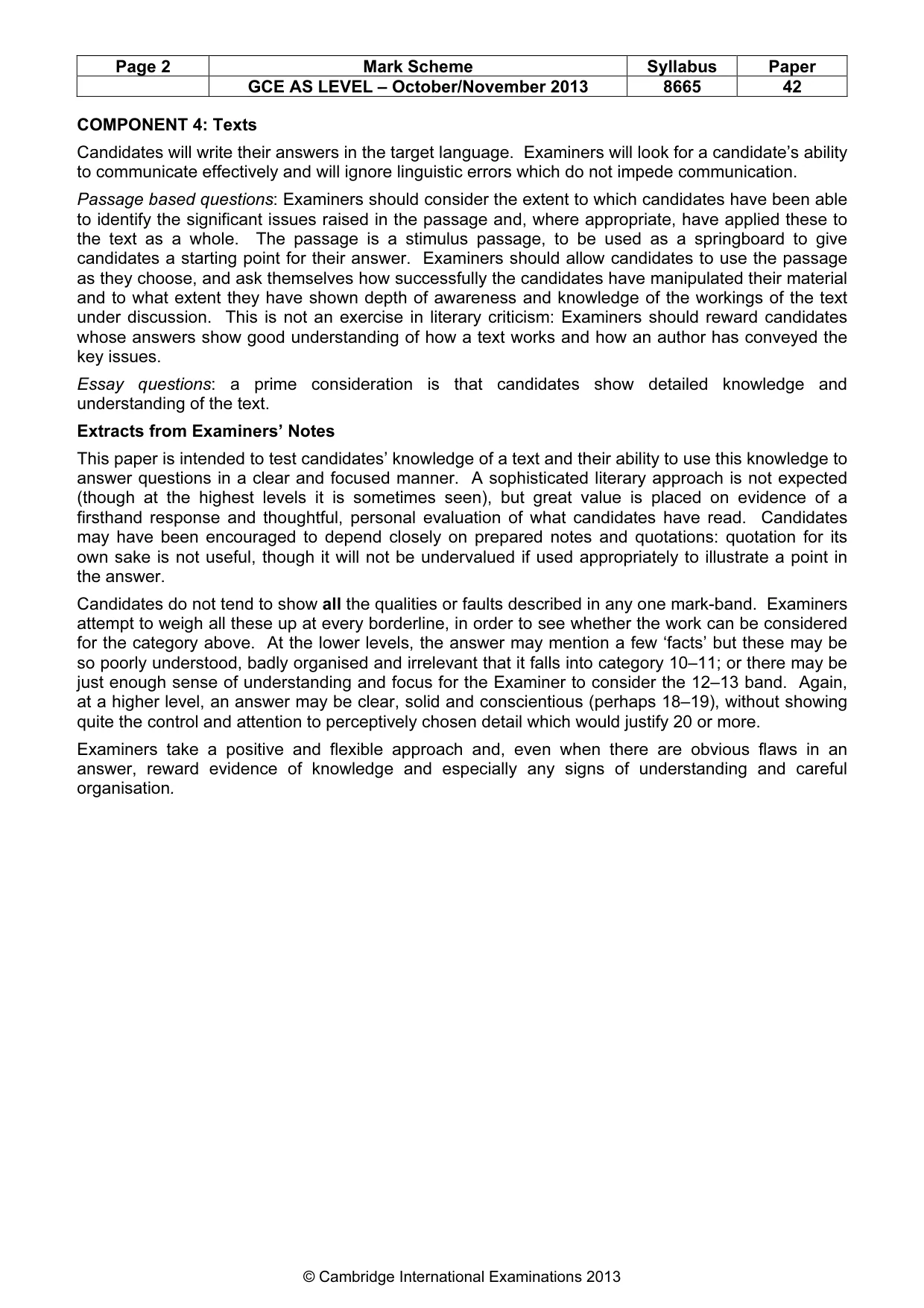
Page 2 Mark Scheme Syllabus Paper GCE AS LEVEL – October/November 2013 8665 42 © Cambridge International Examinations 2013 COMPONENT 4: Texts Candidates will write their answers in the target language. Examiners will look for a candidate’s ability to communicate effectively and will ignore linguistic errors which do not impede communication. Passage based questions: Examiners should consider the extent to which candidates have been able to identify the significant issues raised in the passage and, where appropriate, have applied these to the text as a whole. The passage is a stimulus passage, to be used as a springboard to give candidates a starting point for their answer. Examiners should allow candidates to use the passage as they choose, and ask themselves how successfully the candidates have manipulated their material and to what extent they have shown depth of awareness and knowledge of the workings of the text under discussion. This is not an exercise in literary criticism: Examiners should reward candidates whose answers show good understanding of how a text works and how an author has conveyed the key issues. Essay questions: a prime consideration is that candidates show detailed knowledge and understanding of the text. Extracts from Examiners’ Notes This paper is intended to test candidates’ knowledge of a text and their ability to use this knowledge to answer questions in a clear and focused manner. A sophisticated literary approach is not expected (though at the highest levels it is sometimes seen), but great value is placed on evidence of a firsthand response and thoughtful, personal evaluation of what candidates have read. Candidates may have been encouraged to depend closely on prepared notes and quotations: quotation for its own sake is not useful, though it will not be undervalued if used appropriately to illustrate a point in the answer. Candidates do not tend to show all the qualities or faults described in any one mark-band. Examiners attempt to weigh all these up at every borderline, in order to see whether the work can be considered for the category above. At the lower levels, the answer may mention a few ‘facts’ but these may be so poorly understood, badly organised and irrelevant that it falls into category 10–11; or there may be just enough sense of understanding and focus for the Examiner to consider the 12–13 band. Again, at a higher level, an answer may be clear, solid and conscientious (perhaps 18–19), without showing quite the control and attention to perceptively chosen detail which would justify 20 or more. Examiners take a positive and flexible approach and, even when there are obvious flaws in an answer, reward evidence of knowledge and especially any signs of understanding and careful organisation.
Mark scheme, page 3
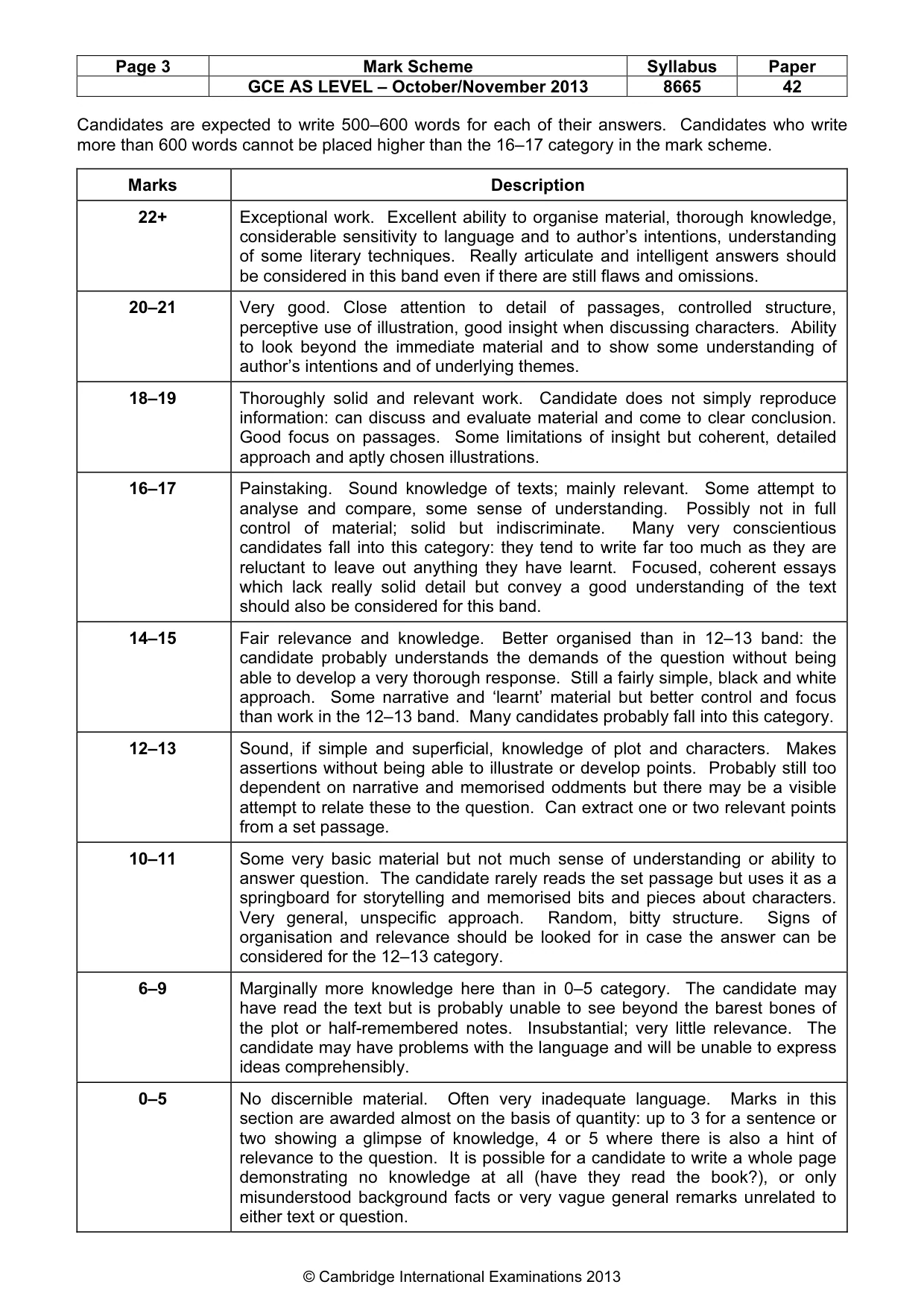
Page 3 Mark Scheme Syllabus Paper GCE AS LEVEL – October/November 2013 8665 42 © Cambridge International Examinations 2013 Candidates are expected to write 500–600 words for each of their answers. Candidates who write more than 600 words cannot be placed higher than the 16–17 category in the mark scheme. Marks Description 22+ Exceptional work. Excellent ability to organise material, thorough knowledge, considerable sensitivity to language and to author’s intentions, understanding of some literary techniques. Really articulate and intelligent answers should be considered in this band even if there are still flaws and omissions. 20–21 Very good. Close attention to detail of passages, controlled structure, perceptive use of illustration, good insight when discussing characters. Ability to look beyond the immediate material and to show some understanding of author’s intentions and of underlying themes. 18–19 Thoroughly solid and relevant work. Candidate does not simply reproduce information: can discuss and evaluate material and come to clear conclusion. Good focus on passages. Some limitations of insight but coherent, detailed approach and aptly chosen illustrations. 16–17 Painstaking. Sound knowledge of texts; mainly relevant. Some attempt to analyse and compare, some sense of understanding. Possibly not in full control of material; solid but indiscriminate. Many very conscientious candidates fall into this category: they tend to write far too much as they are reluctant to leave out anything they have learnt. Focused, coherent essays which lack really solid detail but convey a good understanding of the text should also be considered for this band. 14–15 Fair relevance and knowledge. Better organised than in 12–13 band: the candidate probably understands the demands of the question without being able to develop a very thorough response. Still a fairly simple, black and white approach. Some narrative and ‘learnt’ material but better control and focus than work in the 12–13 band. Many candidates probably fall into this category. 12–13 Sound, if simple and superficial, knowledge of plot and characters. Makes assertions without being able to illustrate or develop points. Probably still too dependent on narrative and memorised oddments but there may be a visible attempt to relate these to the question. Can extract one or two relevant points from a set passage. 10–11 Some very basic material but not much sense of understanding or ability to answer question. The candidate rarely reads the set passage but uses it as a springboard for storytelling and memorised bits and pieces about characters. Very general, unspecific approach. Random, bitty structure. Signs of organisation and relevance should be looked for in case the answer can be considered for the 12–13 category. 6–9 Marginally more knowledge here than in 0–5 category. The candidate may have read the text but is probably unable to see beyond the barest bones of the plot or half-remembered notes. Insubstantial; very little relevance. The candidate may have problems with the language and will be unable to express ideas comprehensibly. 0–5 No discernible material. Often very inadequate language. Marks in this section are awarded almost on the basis of quantity: up to 3 for a sentence or two showing a glimpse of knowledge, 4 or 5 where there is also a hint of relevance to the question. It is possible for a candidate to write a whole page demonstrating no knowledge at all (have they read the book?), or only misunderstood background facts or very vague general remarks unrelated to either text or question.
What you needed in this session
Cambridge’s own grade thresholds for 2013 Oct/Nov, Paper 4 · Variant 2. A higher threshold means an easier paper — the bar moves with how the cohort did.