Cambridge A Level Spanish - First Language (AS Level only) 8665 — 2011 May/June Paper 4 · Variant 1
8665/41/M/J/11 · 75 marks · ≈84 min
The question paper and its mark scheme, free to read here and free to download. This is Cambridge’s own paper, exactly as it was sat.
Question paper8 pages


Mark scheme3 pages
Answers below. Sit the paper first if you are practising.
Paper as text
Question paper, page 1
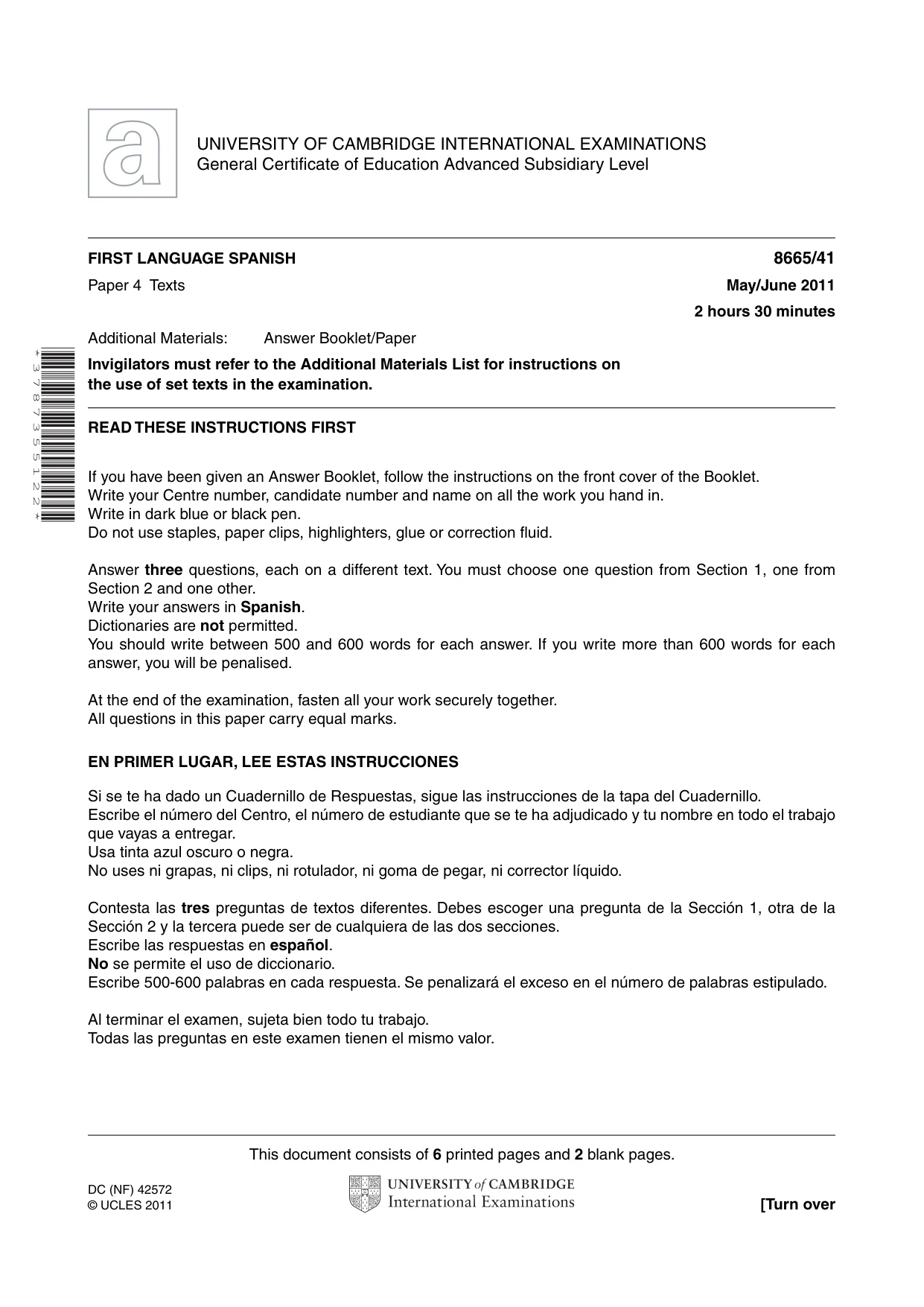
This document consists of 6 printed pages and 2 blank pages. DC (NF) 42572 © UCLES 2011 [Turn over UNIVERSITY OF CAMBRIDGE INTERNATIONAL EXAMINATIONS General Certificate of Education Advanced Subsidiary Level FIRST LANGUAGE SPANISH 8665/41 Paper 4 Texts May/June 2011 2 hours 30 minutes Additional Materials: Answer Booklet/Paper Invigilators must refer to the Additional Materials List for instructions on the use of set texts in the examination. READ THESE INSTRUCTIONS FIRST If you have been given an Answer Booklet, follow the instructions on the front cover of the Booklet. Write your Centre number, candidate number and name on all the work you hand in. Write in dark blue or black pen. Do not use staples, paper clips, highlighters, glue or correction fluid. Answer three questions, each on a different text. You must choose one question from Section 1, one from Section 2 and one other. Write your answers in Spanish. Dictionaries are not permitted. You should write between 500 and 600 words for each answer. If you write more than 600 words for each answer, you will be penalised. At the end of the examination, fasten all your work securely together. All questions in this paper carry equal marks. EN PRIMER LUGAR, LEE ESTAS INSTRUCCIONES Si se te ha dado un Cuadernillo de Respuestas, sigue las instrucciones de la tapa del Cuadernillo. Escribe el número del Centro, el número de estudiante que se te ha adjudicado y tu nombre en todo el trabajo que vayas a entregar. Usa tinta azul oscuro o negra. No uses ni grapas, ni clips, ni rotulador, ni goma de pegar, ni corrector líquido. Contesta las tres preguntas de textos diferentes. Debes escoger una pregunta de la Sección 1, otra de la Sección 2 y la tercera puede ser de cualquiera de las dos secciones. Escribe las respuestas en español. No se permite el uso de diccionario. Escribe 500-600 palabras en cada respuesta. Se penalizará el exceso en el número de palabras estipulado. Al terminar el examen, sujeta bien todo tu trabajo. Todas las preguntas en este examen tienen el mismo valor. * 3 7 8 7 3 5 5 1 2 2 *
Question paper, page 2
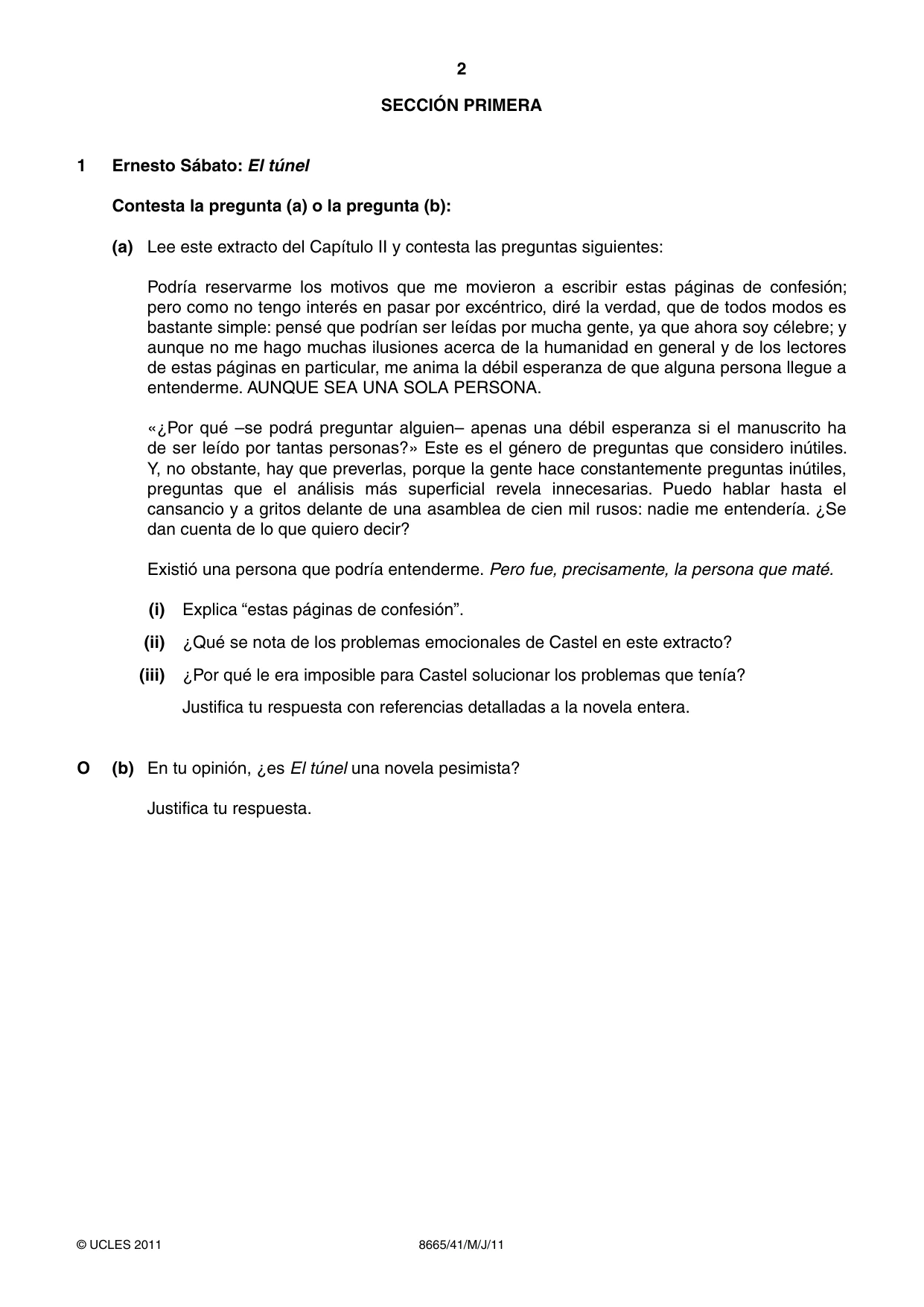
2 8665/41/M/J/11 © UCLES 2011 SECCIÓN PRIMERA 1 Ernesto Sábato: El túnel Contesta la pregunta (a) o la pregunta (b): (a) Lee este extracto del Capítulo II y contesta las preguntas siguientes: Podría reservarme los motivos que me movieron a escribir estas páginas de confesión; pero como no tengo interés en pasar por excéntrico, diré la verdad, que de todos modos es bastante simple: pensé que podrían ser leídas por mucha gente, ya que ahora soy célebre; y aunque no me hago muchas ilusiones acerca de la humanidad en general y de los lectores de estas páginas en particular, me anima la débil esperanza de que alguna persona llegue a entenderme. AUNQUE SEA UNA SOLA PERSONA. «¿Por qué –se podrá preguntar alguien– apenas una débil esperanza si el manuscrito ha de ser leído por tantas personas?» Este es el género de preguntas que considero inútiles. Y, no obstante, hay que preverlas, porque la gente hace constantemente preguntas inútiles, preguntas que el análisis más superficial revela innecesarias. Puedo hablar hasta el cansancio y a gritos delante de una asamblea de cien mil rusos: nadie me entendería. ¿Se dan cuenta de lo que quiero decir? Existió una persona que podría entenderme. Pero fue, precisamente, la persona que maté. (i) Explica “estas páginas de confesión”. (ii) ¿Qué se nota de los problemas emocionales de Castel en este extracto? (iii) ¿Por qué le era imposible para Castel solucionar los problemas que tenía? Justifica tu respuesta con referencias detalladas a la novela entera. O (b) En tu opinión, ¿es El túnel una novela pesimista? Justifica tu respuesta.
Question paper, page 3
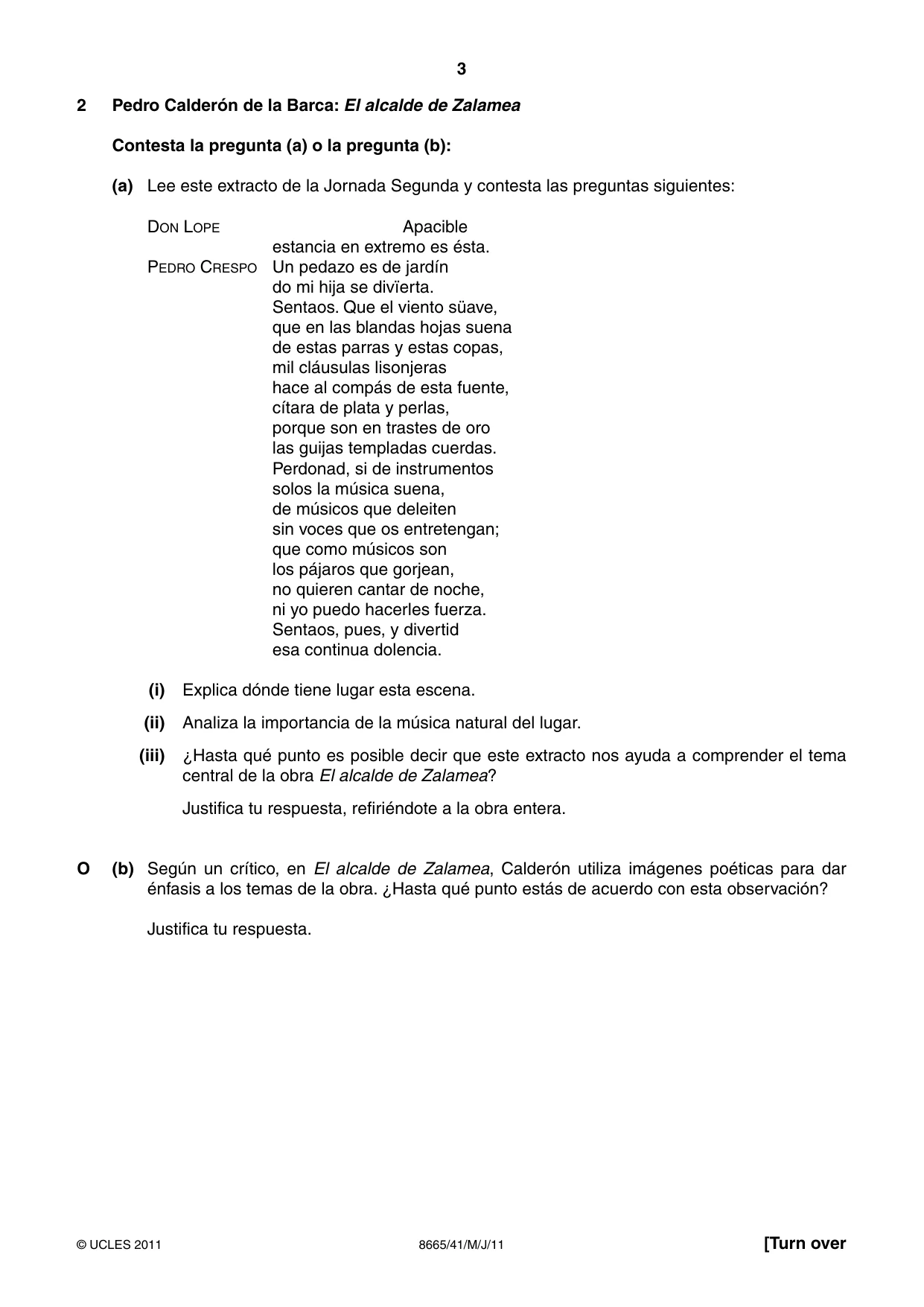
3 8665/41/M/J/11 © UCLES 2011 [Turn over 2 Pedro Calderón de la Barca: El alcalde de Zalamea Contesta la pregunta (a) o la pregunta (b): (a) Lee este extracto de la Jornada Segunda y contesta las preguntas siguientes: DON LOPE Apacible estancia en extremo es ésta. PEDRO CRESPO Un pedazo es de jardín do mi hija se divïerta. Sentaos. Que el viento süave, que en las blandas hojas suena de estas parras y estas copas, mil cláusulas lisonjeras hace al compás de esta fuente, cítara de plata y perlas, porque son en trastes de oro las guijas templadas cuerdas. Perdonad, si de instrumentos solos la música suena, de músicos que deleiten sin voces que os entretengan; que como músicos son los pájaros que gorjean, no quieren cantar de noche, ni yo puedo hacerles fuerza. Sentaos, pues, y divertid esa continua dolencia. (i) Explica dónde tiene lugar esta escena. (ii) Analiza la importancia de la música natural del lugar. (iii) ¿Hasta qué punto es posible decir que este extracto nos ayuda a comprender el tema central de la obra El alcalde de Zalamea? Justifica tu respuesta, refiriéndote a la obra entera. O (b) Según un crítico, en El alcalde de Zalamea, Calderón utiliza imágenes poéticas para dar énfasis a los temas de la obra. ¿Hasta qué punto estás de acuerdo con esta observación? Justifica tu respuesta.
Question paper, page 4
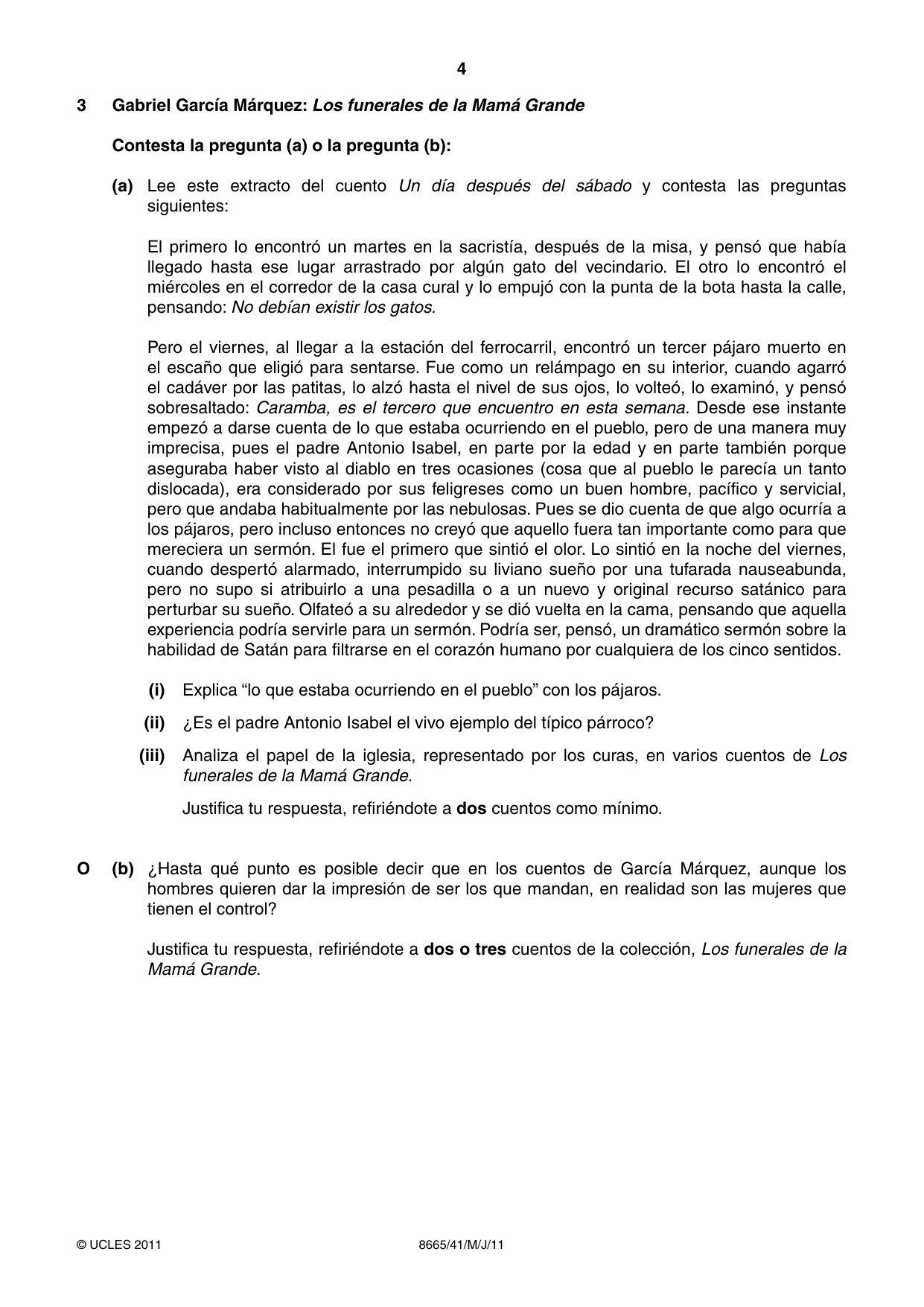
4 8665/41/M/J/11 © UCLES 2011 3 Gabriel García Márquez: Los funerales de la Mamá Grande Contesta la pregunta (a) o la pregunta (b): (a) Lee este extracto del cuento Un día después del sábado y contesta las preguntas siguientes: El primero lo encontró un martes en la sacristía, después de la misa, y pensó que había llegado hasta ese lugar arrastrado por algún gato del vecindario. El otro lo encontró el miércoles en el corredor de la casa cural y lo empujó con la punta de la bota hasta la calle, pensando: No debían existir los gatos. Pero el viernes, al llegar a la estación del ferrocarril, encontró un tercer pájaro muerto en el escaño que eligió para sentarse. Fue como un relámpago en su interior, cuando agarró el cadáver por las patitas, lo alzó hasta el nivel de sus ojos, lo volteó, lo examinó, y pensó sobresaltado: Caramba, es el tercero que encuentro en esta semana. Desde ese instante empezó a darse cuenta de lo que estaba ocurriendo en el pueblo, pero de una manera muy imprecisa, pues el padre Antonio Isabel, en parte por la edad y en parte también porque aseguraba haber visto al diablo en tres ocasiones (cosa que al pueblo le parecía un tanto dislocada), era considerado por sus feligreses como un buen hombre, pacífico y servicial, pero que andaba habitualmente por las nebulosas. Pues se dio cuenta de que algo ocurría a los pájaros, pero incluso entonces no creyó que aquello fuera tan importante como para que mereciera un sermón. El fue el primero que sintió el olor. Lo sintió en la noche del viernes, cuando despertó alarmado, interrumpido su liviano sueño por una tufarada nauseabunda, pero no supo si atribuirlo a una pesadilla o a un nuevo y original recurso satánico para perturbar su sueño. Olfateó a su alrededor y se dió vuelta en la cama, pensando que aquella experiencia podría servirle para un sermón. Podría ser, pensó, un dramático sermón sobre la habilidad de Satán para filtrarse en el corazón humano por cualquiera de los cinco sentidos. (i) Explica “lo que estaba ocurriendo en el pueblo” con los pájaros. (ii) ¿Es el padre Antonio Isabel el vivo ejemplo del típico párroco? (iii) Analiza el papel de la iglesia, representado por los curas, en varios cuentos de Los funerales de la Mamá Grande. Justifica tu respuesta, refiriéndote a dos cuentos como mínimo. O (b) ¿Hasta qué punto es posible decir que en los cuentos de García Márquez, aunque los hombres quieren dar la impresión de ser los que mandan, en realidad son las mujeres que tienen el control? Justifica tu respuesta, refiriéndote a dos o tres cuentos de la colección, Los funerales de la Mamá Grande.
Question paper, page 5
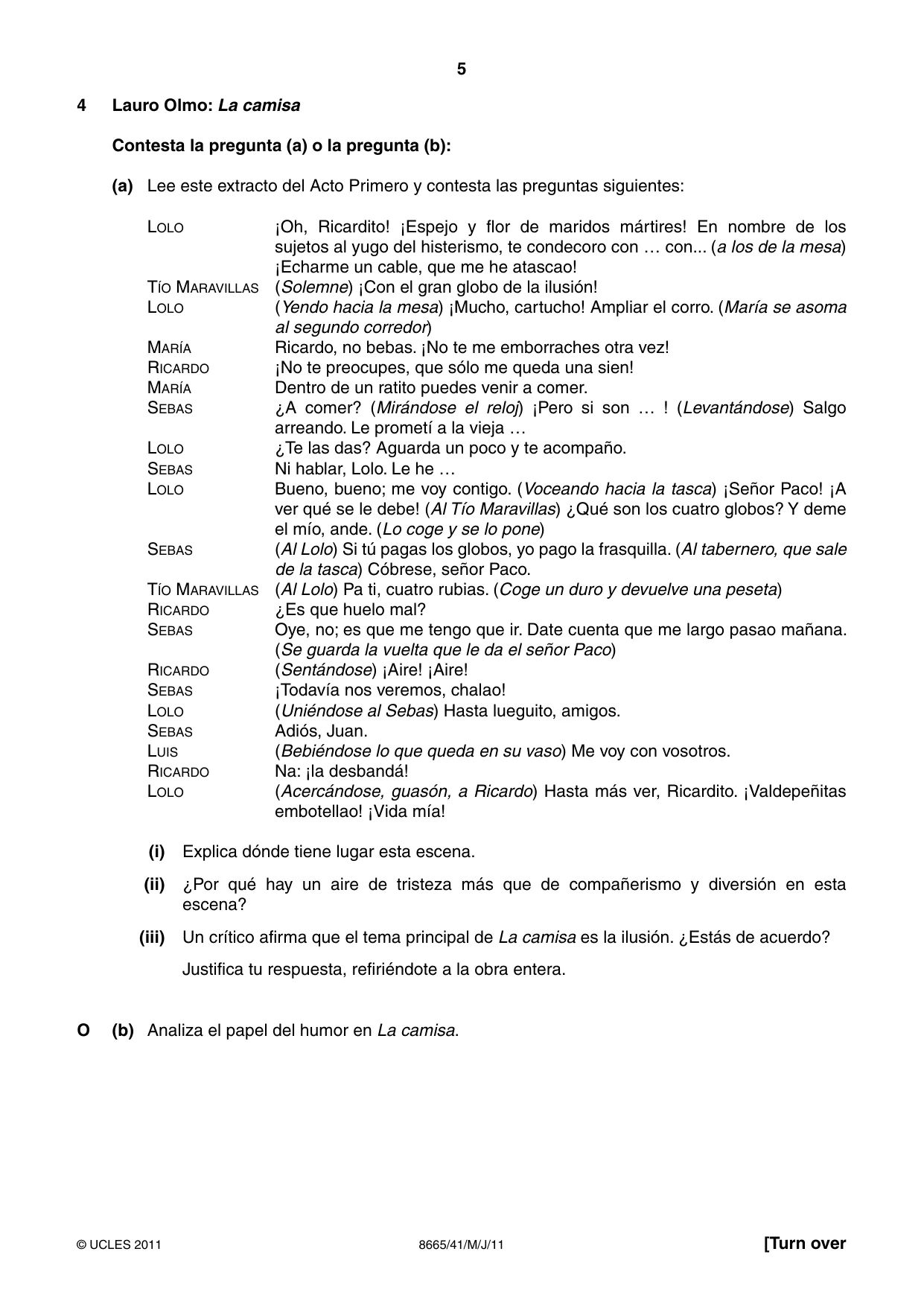
5 8665/41/M/J/11 © UCLES 2011 [Turn over 4 Lauro Olmo: La camisa Contesta la pregunta (a) o la pregunta (b): (a) Lee este extracto del Acto Primero y contesta las preguntas siguientes: LOLO ¡Oh, Ricardito! ¡Espejo y flor de maridos mártires! En nombre de los sujetos al yugo del histerismo, te condecoro con … con... (a los de la mesa) ¡Echarme un cable, que me he atascao! TÍO MARAVILLAS (Solemne) ¡Con el gran globo de la ilusión! LOLO (Yendo hacia la mesa) ¡Mucho, cartucho! Ampliar el corro. (María se asoma al segundo corredor) MARÍA Ricardo, no bebas. ¡No te me emborraches otra vez! RICARDO ¡No te preocupes, que sólo me queda una sien! MARÍA Dentro de un ratito puedes venir a comer. SEBAS ¿A comer? (Mirándose el reloj) ¡Pero si son … ! (Levantándose) Salgo arreando. Le prometí a la vieja … LOLO ¿Te las das? Aguarda un poco y te acompaño. SEBAS Ni hablar, Lolo. Le he … LOLO Bueno, bueno; me voy contigo. (Voceando hacia la tasca) ¡Señor Paco! ¡A ver qué se le debe! (Al Tío Maravillas) ¿Qué son los cuatro globos? Y deme el mío, ande. (Lo coge y se lo pone) SEBAS (Al Lolo) Si tú pagas los globos, yo pago la frasquilla. (Al tabernero, que sale de la tasca) Cóbrese, señor Paco. TÍO MARAVILLAS (Al Lolo) Pa ti, cuatro rubias. (Coge un duro y devuelve una peseta) RICARDO ¿Es que huelo mal? SEBAS Oye, no; es que me tengo que ir. Date cuenta que me largo pasao mañana. (Se guarda la vuelta que le da el señor Paco) RICARDO (Sentándose) ¡Aire! ¡Aire! SEBAS ¡Todavía nos veremos, chalao! LOLO (Uniéndose al Sebas) Hasta lueguito, amigos. SEBAS Adiós, Juan. LUIS (Bebiéndose lo que queda en su vaso) Me voy con vosotros. RICARDO Na: ¡la desbandá! LOLO (Acercándose, guasón, a Ricardo) Hasta más ver, Ricardito. ¡Valdepeñitas embotellao! ¡Vida mía! (i) Explica dónde tiene lugar esta escena. (ii) ¿Por qué hay un aire de tristeza más que de compañerismo y diversión en esta escena? (iii) Un crítico afirma que el tema principal de La camisa es la ilusión. ¿Estás de acuerdo? Justifica tu respuesta, refiriéndote a la obra entera. O (b) Analiza el papel del humor en La camisa.
Question paper, page 6
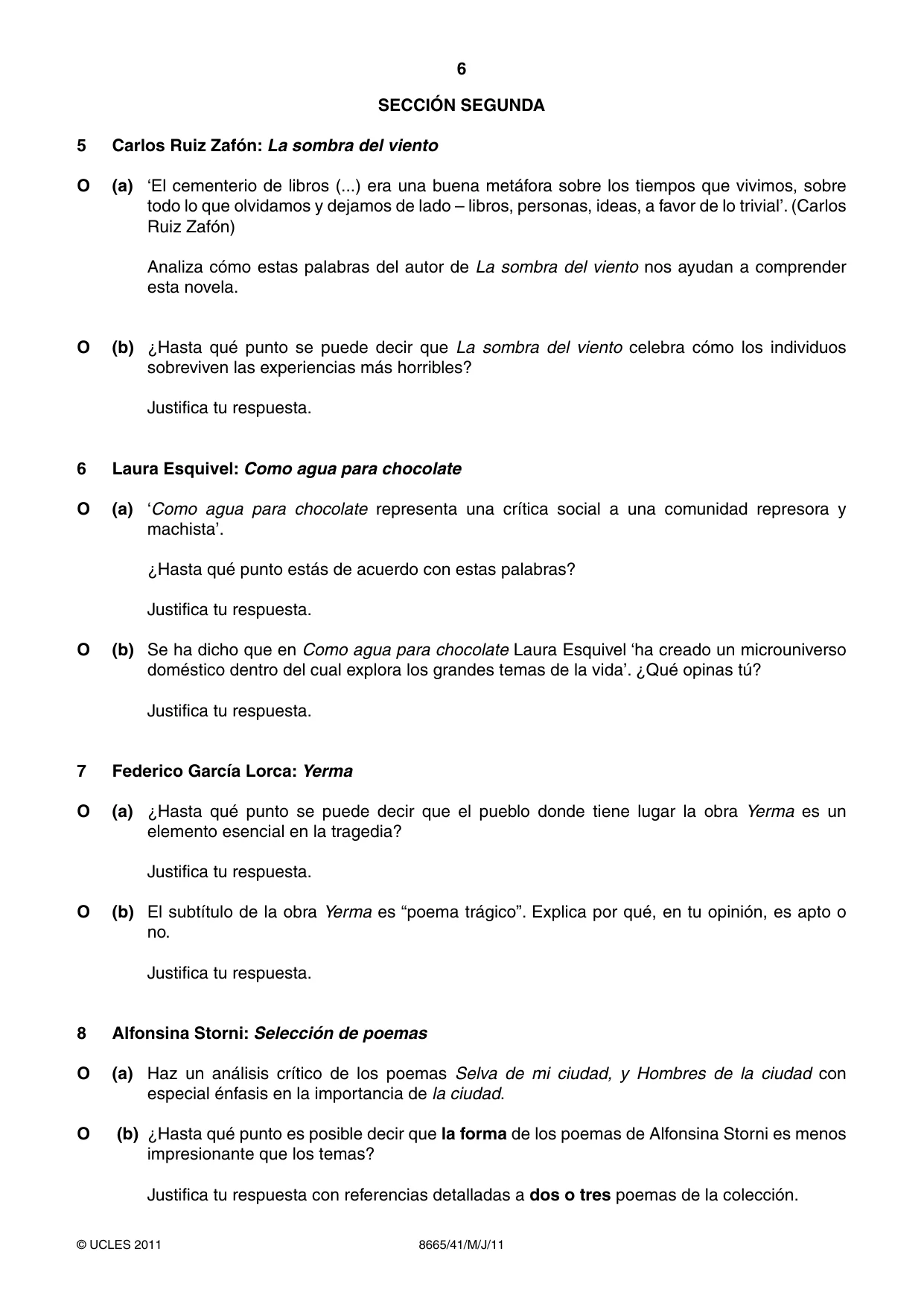
6 8665/41/M/J/11 © UCLES 2011 SECCIÓN SEGUNDA 5 Carlos Ruiz Zafón: La sombra del viento O (a) ‘El cementerio de libros (...) era una buena metáfora sobre los tiempos que vivimos, sobre todo lo que olvidamos y dejamos de lado – libros, personas, ideas, a favor de lo trivial’. (Carlos Ruiz Zafón) Analiza cómo estas palabras del autor de La sombra del viento nos ayudan a comprender esta novela. O (b) ¿Hasta qué punto se puede decir que La sombra del viento celebra cómo los individuos sobreviven las experiencias más horribles? Justifica tu respuesta. 6 Laura Esquivel: Como agua para chocolate O (a) ‘Como agua para chocolate representa una crítica social a una comunidad represora y machista’. ¿Hasta qué punto estás de acuerdo con estas palabras? Justifica tu respuesta. O (b) Se ha dicho que en Como agua para chocolate Laura Esquivel ‘ha creado un microuniverso doméstico dentro del cual explora los grandes temas de la vida’. ¿Qué opinas tú? Justifica tu respuesta. 7 Federico García Lorca: Yerma O (a) ¿Hasta qué punto se puede decir que el pueblo donde tiene lugar la obra Yerma es un elemento esencial en la tragedia? Justifica tu respuesta. O (b) El subtítulo de la obra Yerma es “poema trágico”. Explica por qué, en tu opinión, es apto o no. Justifica tu respuesta. 8 Alfonsina Storni: Selección de poemas O (a) Haz un análisis crítico de los poemas Selva de mi ciudad, y Hombres de la ciudad con especial énfasis en la importancia de la ciudad. O (b) ¿Hasta qué punto es posible decir que la forma de los poemas de Alfonsina Storni es menos impresionante que los temas? Justifica tu respuesta con referencias detalladas a dos o tres poemas de la colección.
Question paper, page 7
7 8665/41/M/J/11 © UCLES 2011 BLANK PAGE
Question paper, page 8
8 8665/41/M/J/11 © UCLES 2011 Copyright Acknowledgements: Question 1a © Ernesto Sábato: El túnel; Ediciones Cátedra; 1977. Question 2a © Pedro Calderón de la Barca; El alcalde de Zalamea; Ediciones Cátedra; 1986. Question 3a © Gabriel Garcia Márquez; Los funerales de la Mamá Grande; Ediciones Alfaguara S.A.; 1979. Question 4a © Lauro Olmo; La camisa; Pergamon Press; 1968. Permission to reproduce items where third-party owned material protected by copyright is included has been sought and cleared where possible. Every reasonable effort has been made by the publisher (UCLES) to trace copyright holders, but if any items requiring clearance have unwittingly been included, the publisher will be pleased to make amends at the earliest possible opportunity. University of Cambridge International Examinations is part of the Cambridge Assessment Group. Cambridge Assessment is the brand name of University of Cambridge Local Examinations Syndicate (UCLES), which is itself a department of the University of Cambridge. BLANK PAGE
Mark scheme, page 1
UNIVERSITY OF CAMBRIDGE INTERNATIONAL EXAMINATIONS GCE Advanced Subsidiary Level MARK SCHEME for the May/June 2011 question paper for the guidance of teachers 8665 FIRST LANGUAGE SPANISH 8665/41 Paper 4 (Texts), maximum raw mark 75 This mark scheme is published as an aid to teachers and candidates, to indicate the requirements of the examination. It shows the basis on which Examiners were instructed to award marks. It does not indicate the details of the discussions that took place at an Examiners’ meeting before marking began, which would have considered the acceptability of alternative answers. Mark schemes must be read in conjunction with the question papers and the report on the examination. • Cambridge will not enter into discussions or correspondence in connection with these mark schemes. Cambridge is publishing the mark schemes for the May/June 2011 question papers for most IGCSE, GCE Advanced Level and Advanced Subsidiary Level syllabuses and some Ordinary Level syllabuses.
Mark scheme, page 2
Page 2 Mark Scheme: Teachers’ version Syllabus Paper GCE AS LEVEL – May/June 2011 8665 41 © University of Cambridge International Examinations 2011 COMPONENT 4: Texts Candidates will write their answers in the target language. Examiners will look for a candidate’s ability to communicate effectively and will ignore linguistic errors which do not impede communication. Passage based questions: Examiners should consider the extent to which candidates have been able to identify the significant issues raised in the passage and, where appropriate, have applied these to the text as a whole. The passage is a stimulus passage, to be used as a springboard to give candidates a starting point for their answer. Examiners should allow candidates to use the passage as they choose, and ask themselves how successfully the candidates have manipulated their material and to what extent they have shown depth of awareness and knowledge of the workings of the text under discussion. This is not an exercise in literary criticism: Examiners should reward candidates whose answers show good understanding of how a text works and how an author has conveyed the key issues. Essay questions: a prime consideration is that candidates show detailed knowledge and understanding of the text. Extracts from Examiners’ Notes This paper is intended to test candidates’ knowledge of a text and their ability to use this knowledge to answer questions in a clear and focused manner. A sophisticated literary approach is not expected (though at the highest levels it is sometimes seen), but great value is placed on evidence of a firsthand response and thoughtful, personal evaluation of what candidates have read. Candidates may have been encouraged to depend closely on prepared notes and quotations: quotation for its own sake is not useful, though it will not be undervalued if used appropriately to illustrate a point in the answer. Candidates do not tend to show all the qualities or faults described in any one mark-band. Examiners attempt to weigh all these up at every borderline, in order to see whether the work can be considered for the category above. At the lower levels, the answer may mention a few ‘facts’ but these may be so poorly understood, badly organised and irrelevant that it falls into category 10–11; or there may be just enough sense of understanding and focus for the Examiner to consider the 12–13 band. Again, at a higher level, an answer may be clear, solid and conscientious (perhaps 18–19), without showing quite the control and attention to perceptively chosen detail which would justify 20 or more. Examiners take a positive and flexible approach and, even when there are obvious flaws in an answer, reward evidence of knowledge and especially any signs of understanding and careful organisation.
Mark scheme, page 3
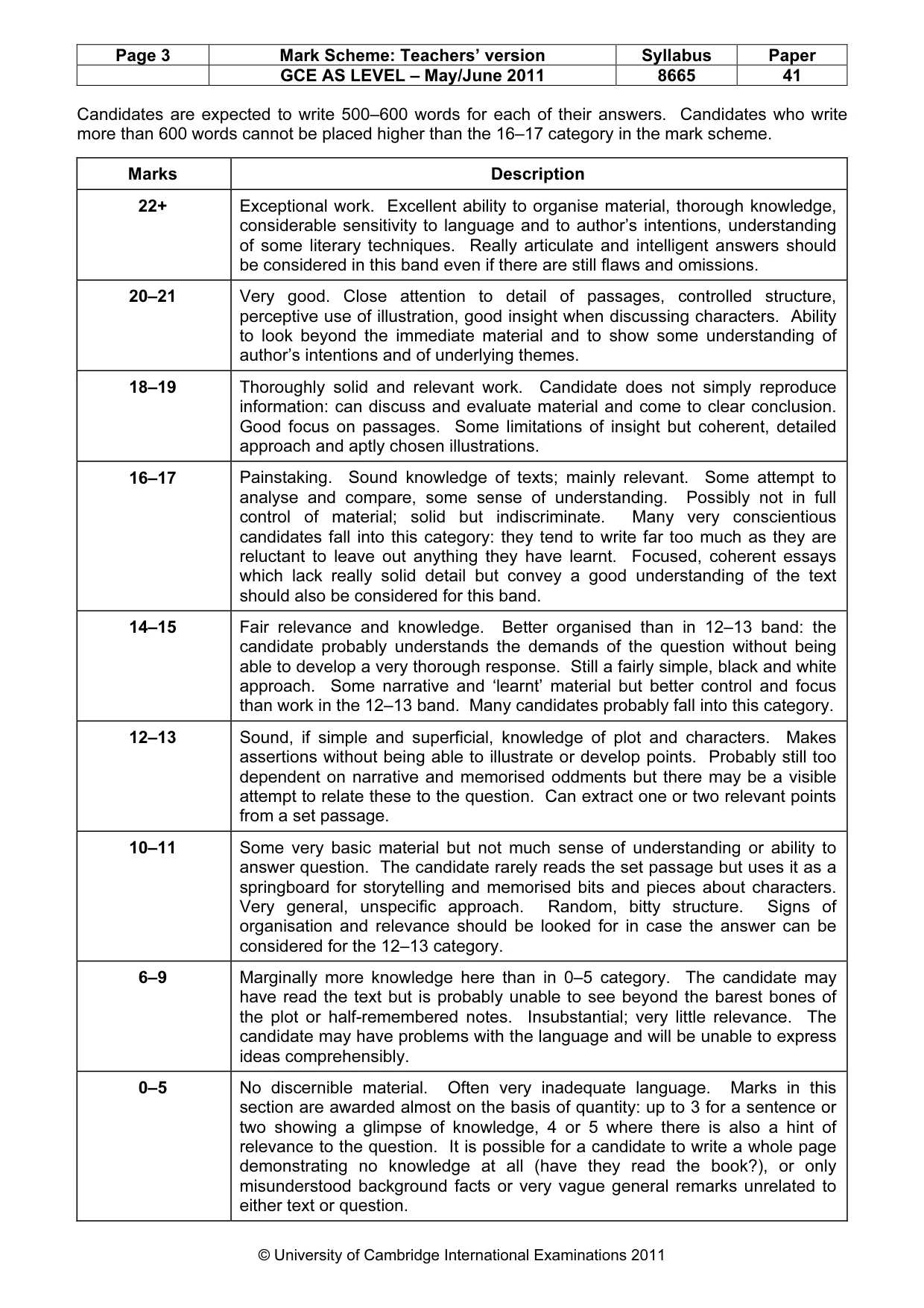
Page 3 Mark Scheme: Teachers’ version Syllabus Paper GCE AS LEVEL – May/June 2011 8665 41 © University of Cambridge International Examinations 2011 Candidates are expected to write 500–600 words for each of their answers. Candidates who write more than 600 words cannot be placed higher than the 16–17 category in the mark scheme. Marks Description 22+ Exceptional work. Excellent ability to organise material, thorough knowledge, considerable sensitivity to language and to author’s intentions, understanding of some literary techniques. Really articulate and intelligent answers should be considered in this band even if there are still flaws and omissions. 20–21 Very good. Close attention to detail of passages, controlled structure, perceptive use of illustration, good insight when discussing characters. Ability to look beyond the immediate material and to show some understanding of author’s intentions and of underlying themes. 18–19 Thoroughly solid and relevant work. Candidate does not simply reproduce information: can discuss and evaluate material and come to clear conclusion. Good focus on passages. Some limitations of insight but coherent, detailed approach and aptly chosen illustrations. 16–17 Painstaking. Sound knowledge of texts; mainly relevant. Some attempt to analyse and compare, some sense of understanding. Possibly not in full control of material; solid but indiscriminate. Many very conscientious candidates fall into this category: they tend to write far too much as they are reluctant to leave out anything they have learnt. Focused, coherent essays which lack really solid detail but convey a good understanding of the text should also be considered for this band. 14–15 Fair relevance and knowledge. Better organised than in 12–13 band: the candidate probably understands the demands of the question without being able to develop a very thorough response. Still a fairly simple, black and white approach. Some narrative and ‘learnt’ material but better control and focus than work in the 12–13 band. Many candidates probably fall into this category. 12–13 Sound, if simple and superficial, knowledge of plot and characters. Makes assertions without being able to illustrate or develop points. Probably still too dependent on narrative and memorised oddments but there may be a visible attempt to relate these to the question. Can extract one or two relevant points from a set passage. 10–11 Some very basic material but not much sense of understanding or ability to answer question. The candidate rarely reads the set passage but uses it as a springboard for storytelling and memorised bits and pieces about characters. Very general, unspecific approach. Random, bitty structure. Signs of organisation and relevance should be looked for in case the answer can be considered for the 12–13 category. 6–9 Marginally more knowledge here than in 0–5 category. The candidate may have read the text but is probably unable to see beyond the barest bones of the plot or half-remembered notes. Insubstantial; very little relevance. The candidate may have problems with the language and will be unable to express ideas comprehensibly. 0–5 No discernible material. Often very inadequate language. Marks in this section are awarded almost on the basis of quantity: up to 3 for a sentence or two showing a glimpse of knowledge, 4 or 5 where there is also a hint of relevance to the question. It is possible for a candidate to write a whole page demonstrating no knowledge at all (have they read the book?), or only misunderstood background facts or very vague general remarks unrelated to either text or question.
What you needed in this session
Cambridge’s own grade thresholds for 2011 May/June, Paper 4 · Variant 1. A higher threshold means an easier paper — the bar moves with how the cohort did.