Cambridge A Level Spanish - First Language (AS Level only) 8665 — 2010 Oct/Nov Paper 4 · Variant 2
8665/42/O/N/10 · 75 marks · ≈84 min
The question paper and its mark scheme, free to read here and free to download. This is Cambridge’s own paper, exactly as it was sat.
Question paper8 pages
Mark scheme3 pages
Answers below. Sit the paper first if you are practising.
Paper as text
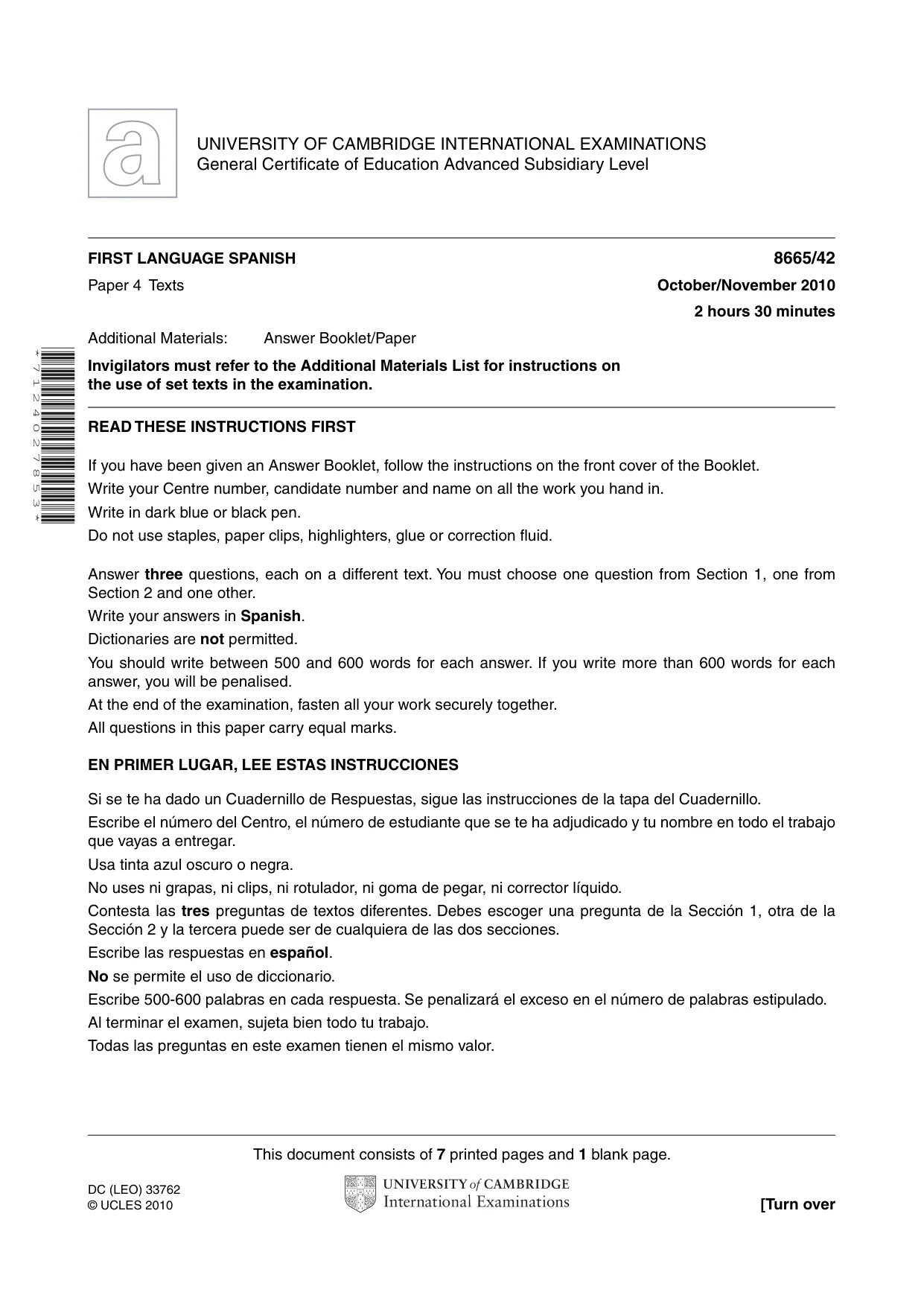
Question paper, page 1
* 7 1 2 4 0 2 7 8 5 3 * This document consists of 7 printed pages and 1 blank page. DC (LEO) 33762 © UCLES 2010 [Turn over UNIVERSITY OF CAMBRIDGE INTERNATIONAL EXAMINATIONS General Certificate of Education Advanced Subsidiary Level FIRST LANGUAGE SPANISH 8665/42 Paper 4 Texts October/November 2010 2 hours 30 minutes Additional Materials: Answer Booklet/Paper Invigilators must refer to the Additional Materials List for instructions on the use of set texts in the examination. READ THESE INSTRUCTIONS FIRST If you have been given an Answer Booklet, follow the instructions on the front cover of the Booklet. Write your Centre number, candidate number and name on all the work you hand in. Write in dark blue or black pen. Do not use staples, paper clips, highlighters, glue or correction fluid. Answer three questions, each on a different text. You must choose one question from Section 1, one from Section 2 and one other. Write your answers in Spanish. Dictionaries are not permitted. You should write between 500 and 600 words for each answer. If you write more than 600 words for each answer, you will be penalised. At the end of the examination, fasten all your work securely together. All questions in this paper carry equal marks. EN PRIMER LUGAR, LEE ESTAS INSTRUCCIONES Si se te ha dado un Cuadernillo de Respuestas, sigue las instrucciones de la tapa del Cuadernillo. Escribe el número del Centro, el número de estudiante que se te ha adjudicado y tu nombre en todo el trabajo que vayas a entregar. Usa tinta azul oscuro o negra. No uses ni grapas, ni clips, ni rotulador, ni goma de pegar, ni corrector líquido. Contesta las tres preguntas de textos diferentes. Debes escoger una pregunta de la Sección 1, otra de la Sección 2 y la tercera puede ser de cualquiera de las dos secciones. Escribe las respuestas en español. No se permite el uso de diccionario. Escribe 500-600 palabras en cada respuesta. Se penalizará el exceso en el número de palabras estipulado. Al terminar el examen, sujeta bien todo tu trabajo. Todas las preguntas en este examen tienen el mismo valor.
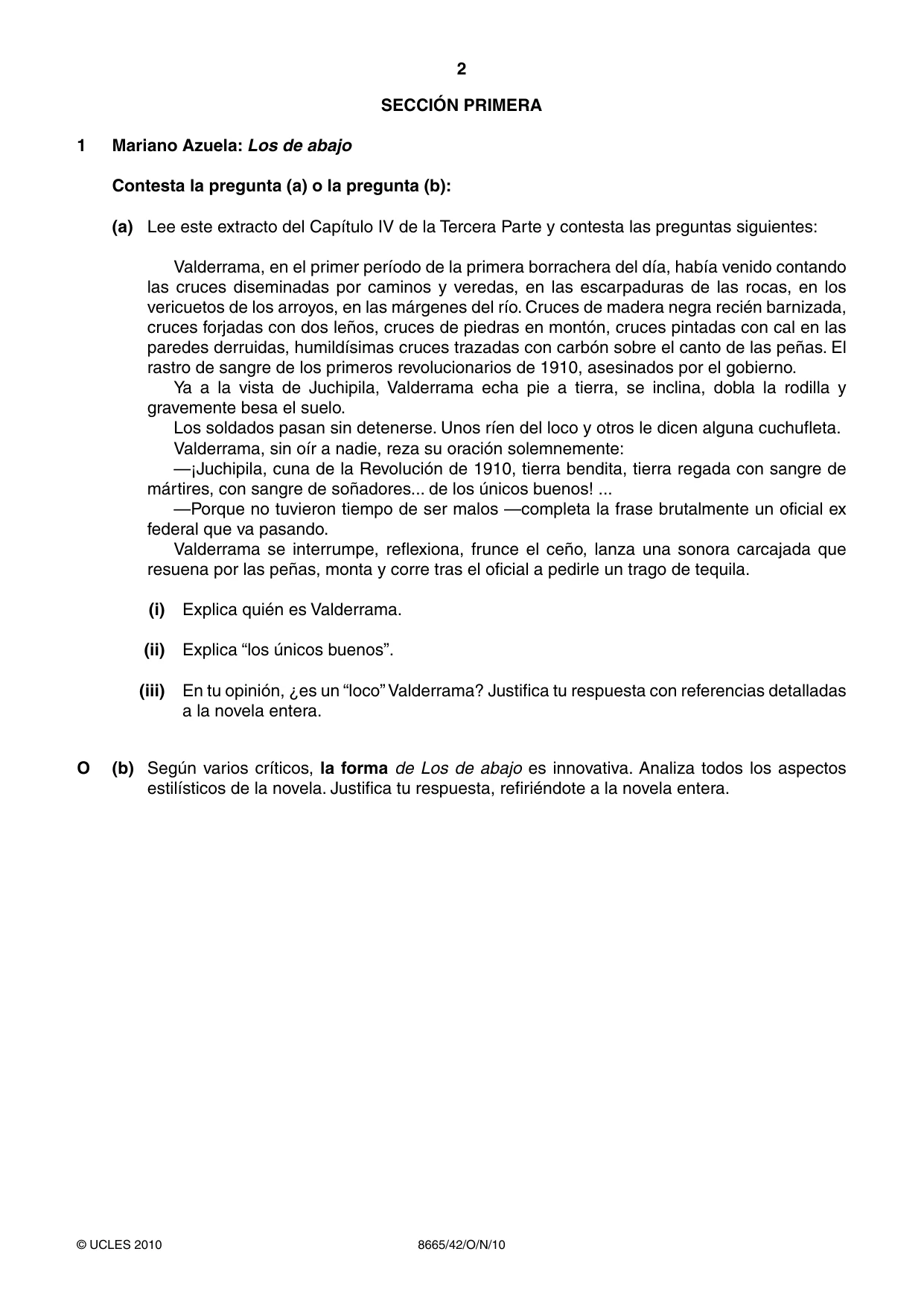
Question paper, page 2
2 8665/42/O/N/10 © UCLES 2010 SECCIÓN PRIMERA 1 Mariano Azuela: Los de abajo Contesta la pregunta (a) o la pregunta (b): (a) Lee este extracto del Capítulo IV de la Tercera Parte y contesta las preguntas siguientes: Valderrama, en el primer período de la primera borrachera del día, había venido contando las cruces diseminadas por caminos y veredas, en las escarpaduras de las rocas, en los vericuetos de los arroyos, en las márgenes del río. Cruces de madera negra recién barnizada, cruces forjadas con dos leños, cruces de piedras en montón, cruces pintadas con cal en las paredes derruidas, humildísimas cruces trazadas con carbón sobre el canto de las peñas. El rastro de sangre de los primeros revolucionarios de 1910, asesinados por el gobierno. Ya a la vista de Juchipila, Valderrama echa pie a tierra, se inclina, dobla la rodilla y gravemente besa el suelo. Los soldados pasan sin detenerse. Unos ríen del loco y otros le dicen alguna cuchufleta. Valderrama, sin oír a nadie, reza su oración solemnemente: —¡Juchipila, cuna de la Revolución de 1910, tierra bendita, tierra regada con sangre de mártires, con sangre de soñadores... de los únicos buenos! ... —Porque no tuvieron tiempo de ser malos —completa la frase brutalmente un oficial ex federal que va pasando. Valderrama se interrumpe, reflexiona, frunce el ceño, lanza una sonora carcajada que resuena por las peñas, monta y corre tras el oficial a pedirle un trago de tequila. (i) Explica quién es Valderrama. (ii) Explica “los únicos buenos”. (iii) En tu opinión, ¿es un “loco” Valderrama? Justifica tu respuesta con referencias detalladas a la novela entera. O (b) Según varios críticos, la forma de Los de abajo es innovativa. Analiza todos los aspectos estilísticos de la novela. Justifica tu respuesta, refiriéndote a la novela entera.
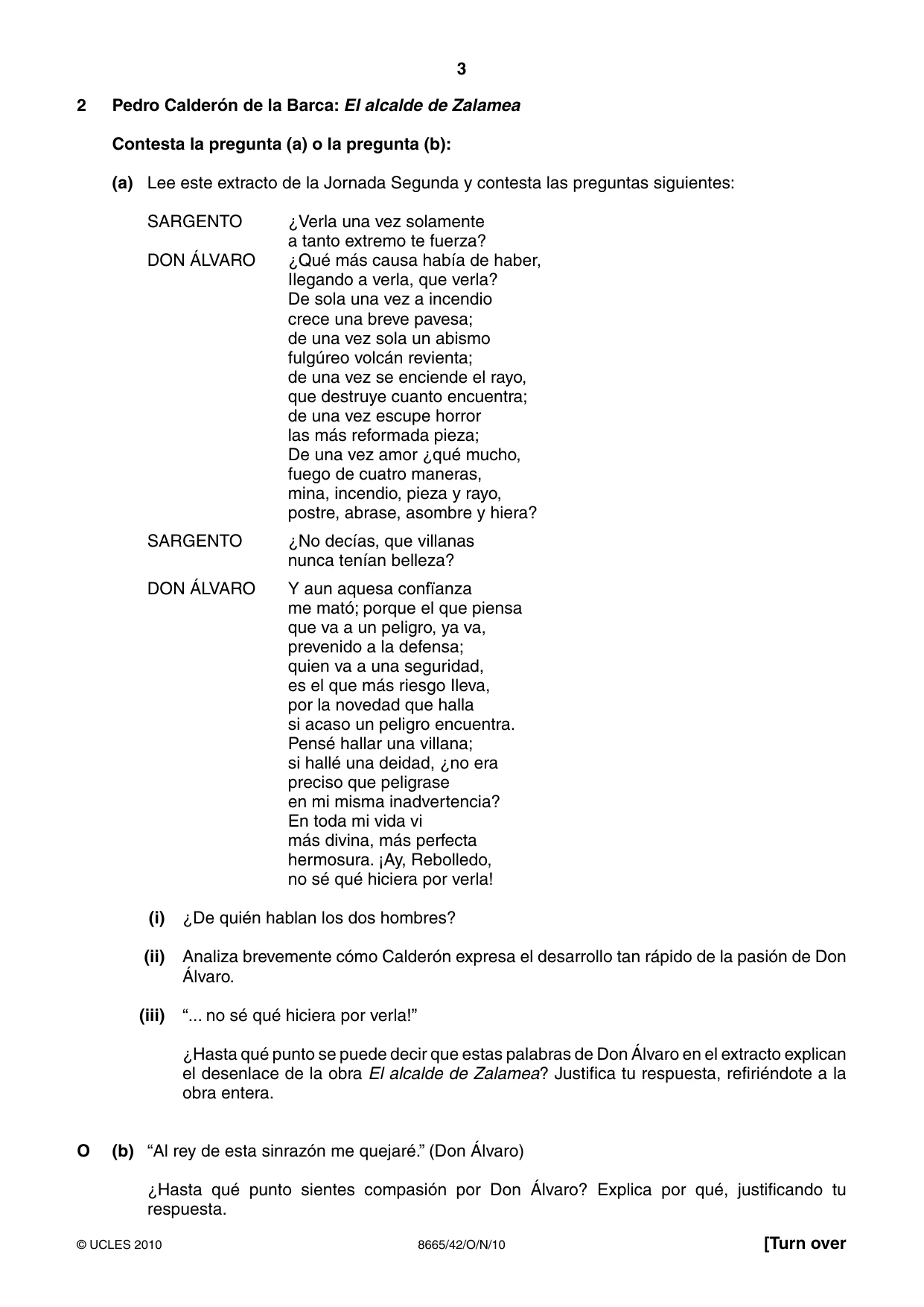
Question paper, page 3
3 8665/42/O/N/10 © UCLES 2010 [Turn over 2 Pedro Calderón de la Barca: El alcalde de Zalamea Contesta la pregunta (a) o la pregunta (b): (a) Lee este extracto de la Jornada Segunda y contesta las preguntas siguientes: SARGENTO ¿Verla una vez solamente a tanto extremo te fuerza? DON ÁLVARO ¿Qué más causa había de haber, Ilegando a verla, que verla? De sola una vez a incendio crece una breve pavesa; de una vez sola un abismo fulgúreo volcán revienta; de una vez se enciende el rayo, que destruye cuanto encuentra; de una vez escupe horror las más reformada pieza; De una vez amor ¿qué mucho, fuego de cuatro maneras, mina, incendio, pieza y rayo, postre, abrase, asombre y hiera? SARGENTO ¿No decías, que villanas nunca tenían belleza? DON ÁLVARO Y aun aquesa confïanza me mató; porque el que piensa que va a un peligro, ya va, prevenido a la defensa; quien va a una seguridad, es el que más riesgo Ileva, por la novedad que halla si acaso un peligro encuentra. Pensé hallar una villana; si hallé una deidad, ¿no era preciso que peligrase en mi misma inadvertencia? En toda mi vida vi más divina, más perfecta hermosura. ¡Ay, Rebolledo, no sé qué hiciera por verla! (i) ¿De quién hablan los dos hombres? (ii) Analiza brevemente cómo Calderón expresa el desarrollo tan rápido de la pasión de Don Álvaro. (iii) “... no sé qué hiciera por verla!” ¿Hasta qué punto se puede decir que estas palabras de Don Álvaro en el extracto explican el desenlace de la obra El alcalde de Zalamea? Justifica tu respuesta, refiriéndote a la obra entera. O (b) “Al rey de esta sinrazón me quejaré.” (Don Álvaro) ¿Hasta qué punto sientes compasión por Don Álvaro? Explica por qué, justificando tu respuesta.
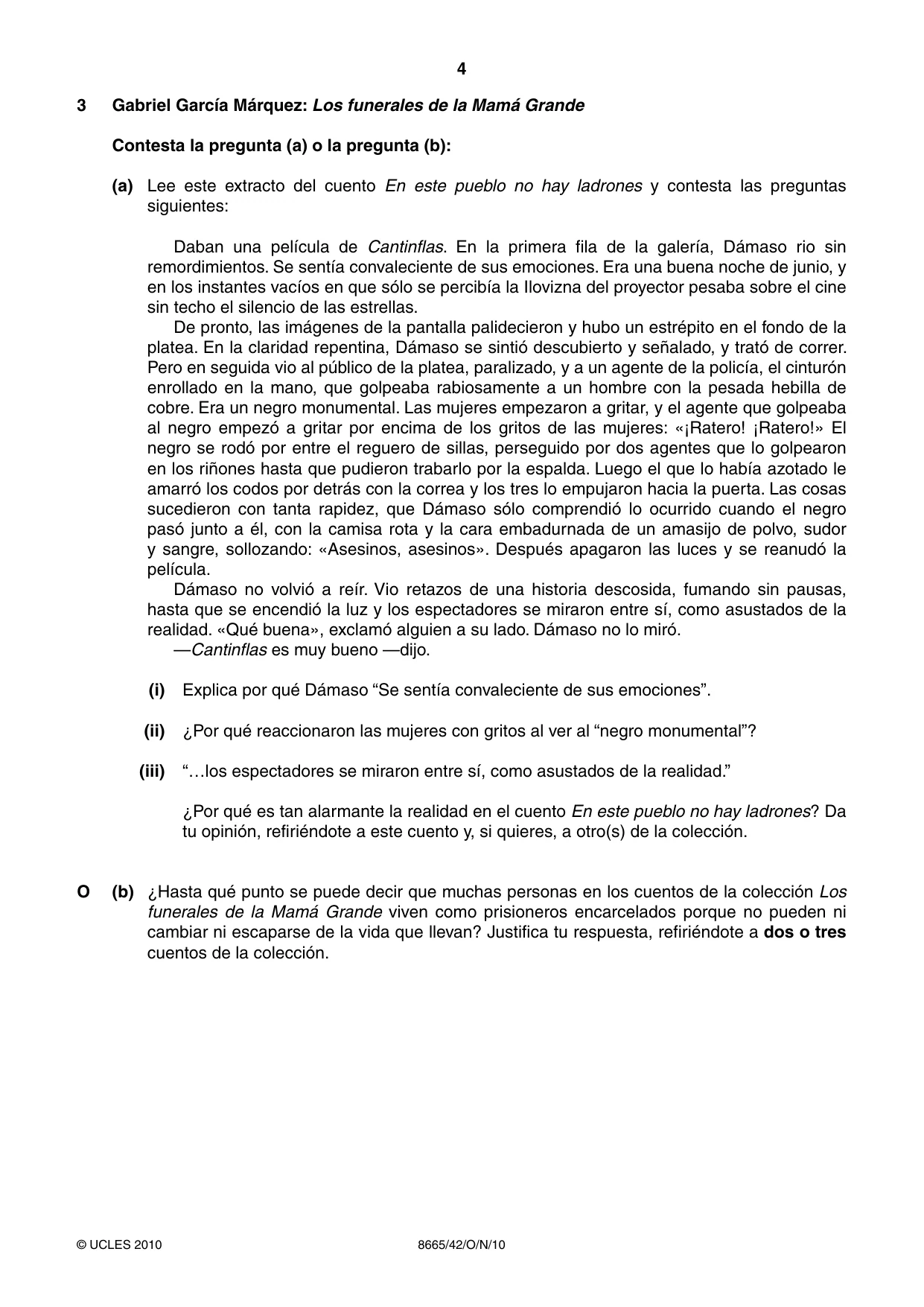
Question paper, page 4
4 8665/42/O/N/10 © UCLES 2010 3 Gabriel García Márquez: Los funerales de la Mamá Grande Contesta la pregunta (a) o la pregunta (b): (a) Lee este extracto del cuento En este pueblo no hay ladrones y contesta las preguntas siguientes: Daban una película de Cantinflas. En la primera fila de la galería, Dámaso rio sin remordimientos. Se sentía convaleciente de sus emociones. Era una buena noche de junio, y en los instantes vacíos en que sólo se percibía la Ilovizna del proyector pesaba sobre el cine sin techo el silencio de las estrellas. De pronto, las imágenes de la pantalla palidecieron y hubo un estrépito en el fondo de la platea. En la claridad repentina, Dámaso se sintió descubierto y señalado, y trató de correr. Pero en seguida vio al público de la platea, paralizado, y a un agente de la policía, el cinturón enrollado en la mano, que golpeaba rabiosamente a un hombre con la pesada hebilla de cobre. Era un negro monumental. Las mujeres empezaron a gritar, y el agente que golpeaba al negro empezó a gritar por encima de los gritos de las mujeres: «¡Ratero! ¡Ratero!» El negro se rodó por entre el reguero de sillas, perseguido por dos agentes que lo golpearon en los riñones hasta que pudieron trabarlo por la espalda. Luego el que lo había azotado le amarró los codos por detrás con la correa y los tres lo empujaron hacia la puerta. Las cosas sucedieron con tanta rapidez, que Dámaso sólo comprendió lo ocurrido cuando el negro pasó junto a él, con la camisa rota y la cara embadurnada de un amasijo de polvo, sudor y sangre, sollozando: «Asesinos, asesinos». Después apagaron las luces y se reanudó la película. Dámaso no volvió a reír. Vio retazos de una historia descosida, fumando sin pausas, hasta que se encendió la luz y los espectadores se miraron entre sí, como asustados de la realidad. «Qué buena», exclamó alguien a su lado. Dámaso no lo miró. —Cantinflas es muy bueno —dijo. (i) Explica por qué Dámaso “Se sentía convaleciente de sus emociones”. (ii) ¿Por qué reaccionaron las mujeres con gritos al ver al “negro monumental”? (iii) “…los espectadores se miraron entre sí, como asustados de la realidad.” ¿Por qué es tan alarmante la realidad en el cuento En este pueblo no hay ladrones? Da tu opinión, refiriéndote a este cuento y, si quieres, a otro(s) de la colección. O (b) ¿Hasta qué punto se puede decir que muchas personas en los cuentos de la colección Los funerales de la Mamá Grande viven como prisioneros encarcelados porque no pueden ni cambiar ni escaparse de la vida que llevan? Justifica tu respuesta, refiriéndote a dos o tres cuentos de la colección.
Question paper, page 5
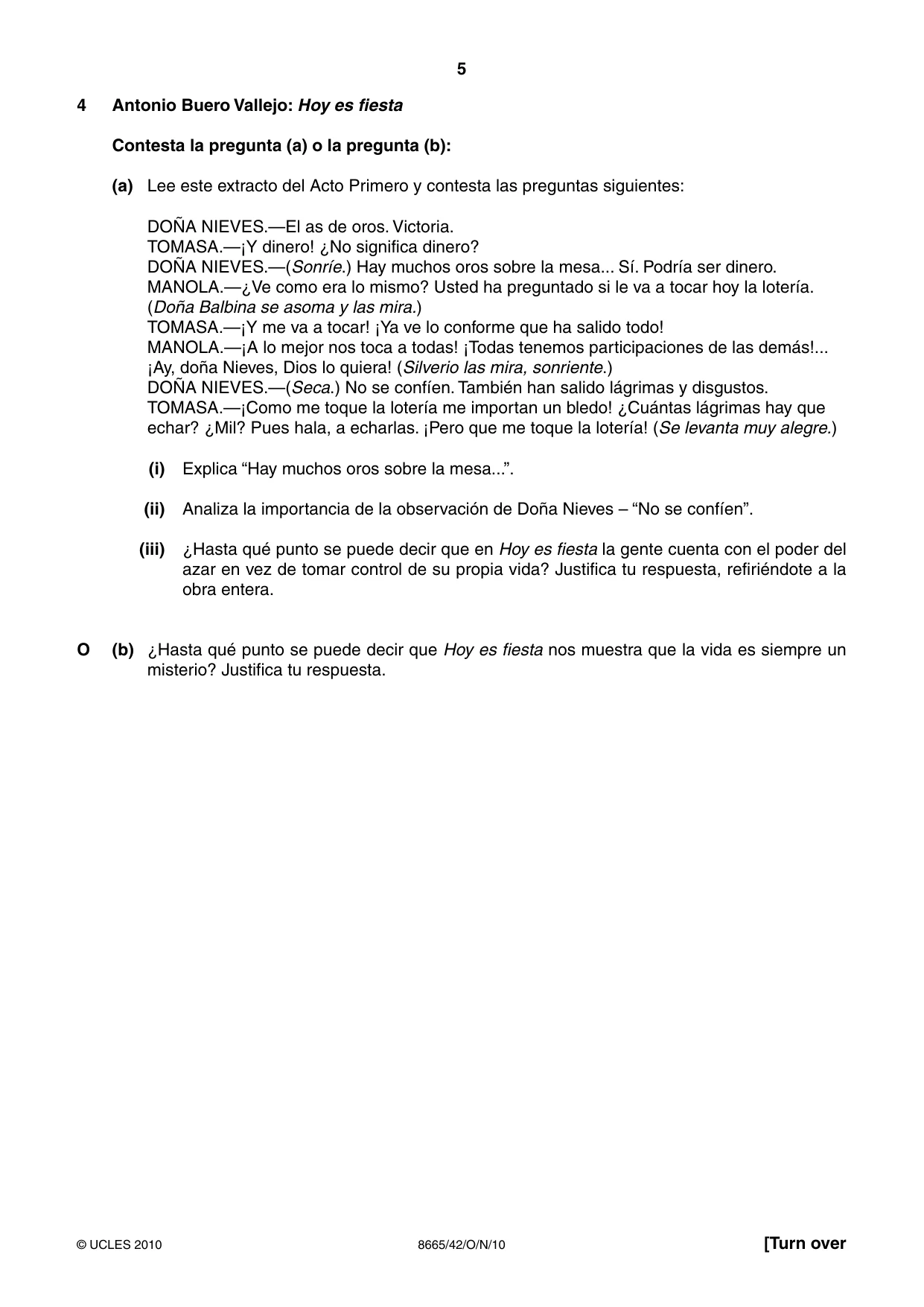
5 8665/42/O/N/10 © UCLES 2010 [Turn over 4 Antonio Buero Vallejo: Hoy es fiesta Contesta la pregunta (a) o la pregunta (b): (a) Lee este extracto del Acto Primero y contesta las preguntas siguientes: DOÑA NIEVES.—El as de oros. Victoria. TOMASA.—¡Y dinero! ¿No significa dinero? DOÑA NIEVES.—(Sonríe.) Hay muchos oros sobre la mesa... Sí. Podría ser dinero. MANOLA.—¿Ve como era lo mismo? Usted ha preguntado si le va a tocar hoy la lotería. (Doña Balbina se asoma y las mira.) TOMASA.—¡Y me va a tocar! ¡Ya ve lo conforme que ha salido todo! MANOLA.—¡A lo mejor nos toca a todas! ¡Todas tenemos participaciones de las demás!... ¡Ay, doña Nieves, Dios lo quiera! (Silverio las mira, sonriente.) DOÑA NIEVES.—(Seca.) No se confíen. También han salido lágrimas y disgustos. TOMASA.—¡Como me toque la lotería me importan un bledo! ¿Cuántas lágrimas hay que echar? ¿Mil? Pues hala, a echarlas. ¡Pero que me toque la lotería! (Se levanta muy alegre.) (i) Explica “Hay muchos oros sobre la mesa...”. (ii) Analiza la importancia de la observación de Doña Nieves – “No se confíen”. (iii) ¿Hasta qué punto se puede decir que en Hoy es fiesta la gente cuenta con el poder del azar en vez de tomar control de su propia vida? Justifica tu respuesta, refiriéndote a la obra entera. O (b) ¿Hasta qué punto se puede decir que Hoy es fiesta nos muestra que la vida es siempre un misterio? Justifica tu respuesta.
Question paper, page 6
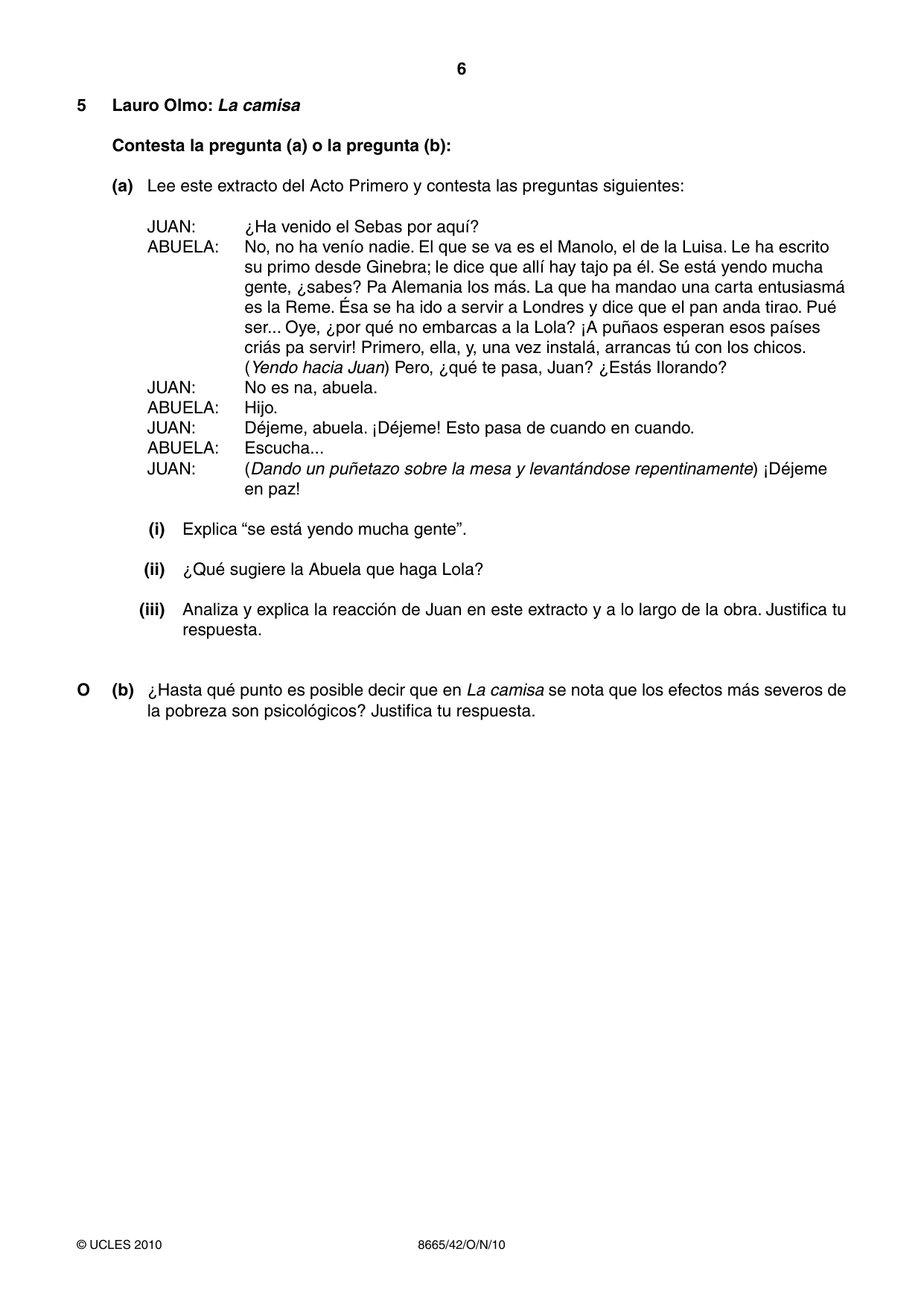
6 8665/42/O/N/10 © UCLES 2010 5 Lauro Olmo: La camisa Contesta la pregunta (a) o la pregunta (b): (a) Lee este extracto del Acto Primero y contesta las preguntas siguientes: JUAN: ¿Ha venido el Sebas por aquí? ABUELA: No, no ha venío nadie. El que se va es el Manolo, el de la Luisa. Le ha escrito su primo desde Ginebra; le dice que allí hay tajo pa él. Se está yendo mucha gente, ¿sabes? Pa Alemania los más. La que ha mandao una carta entusiasmá es la Reme. Ésa se ha ido a servir a Londres y dice que el pan anda tirao. Pué ser... Oye, ¿por qué no embarcas a la Lola? ¡A puñaos esperan esos países criás pa servir! Primero, ella, y, una vez instalá, arrancas tú con los chicos. (Yendo hacia Juan) Pero, ¿qué te pasa, Juan? ¿Estás Ilorando? JUAN: No es na, abuela. ABUELA: Hijo. JUAN: Déjeme, abuela. ¡Déjeme! Esto pasa de cuando en cuando. ABUELA: Escucha... JUAN: (Dando un puñetazo sobre la mesa y levantándose repentinamente) ¡Déjeme en paz! (i) Explica “se está yendo mucha gente”. (ii) ¿Qué sugiere la Abuela que haga Lola? (iii) Analiza y explica la reacción de Juan en este extracto y a lo largo de la obra. Justifica tu respuesta. O (b) ¿Hasta qué punto es posible decir que en La camisa se nota que los efectos más severos de la pobreza son psicológicos? Justifica tu respuesta.
Question paper, page 7
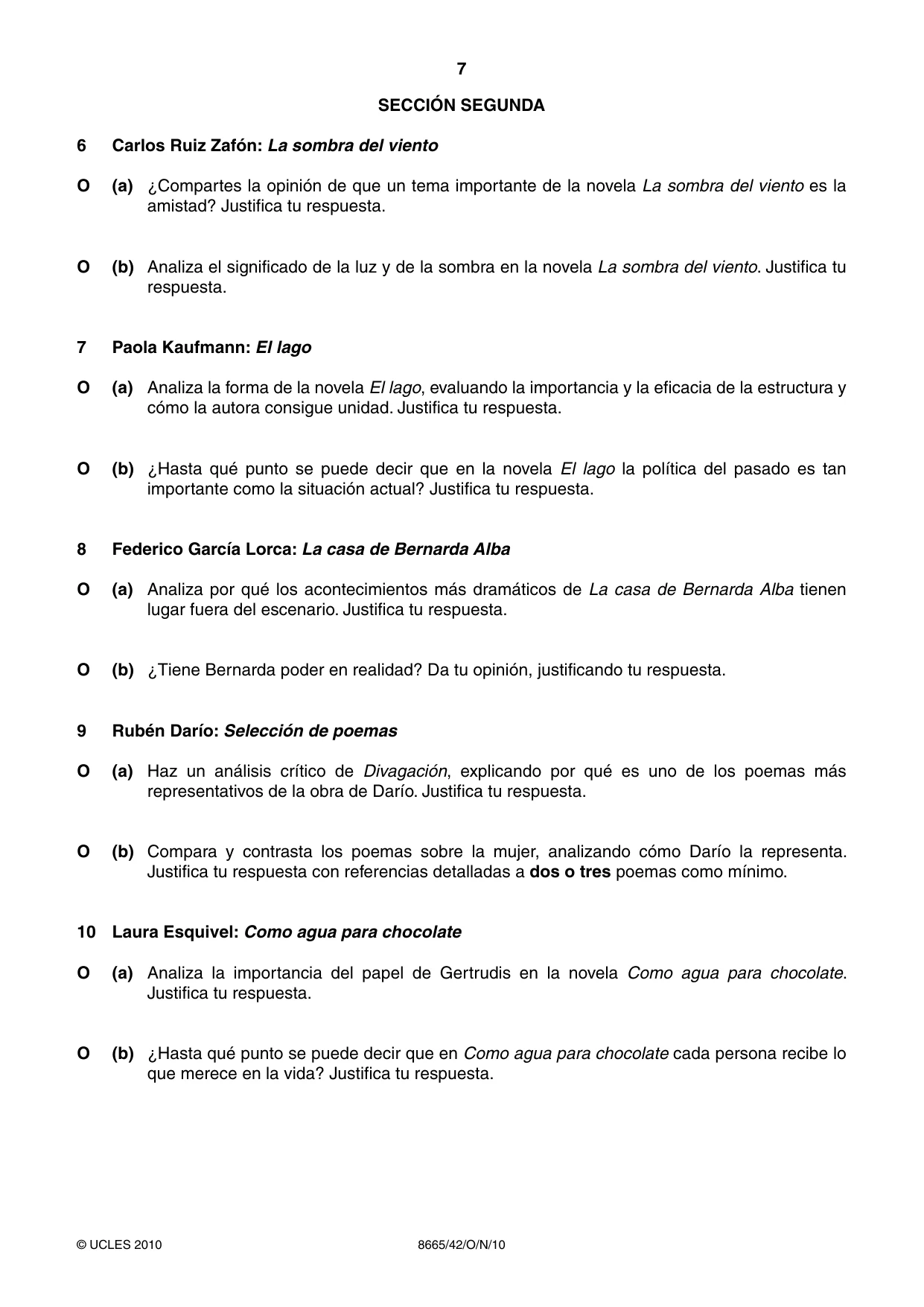
7 8665/42/O/N/10 © UCLES 2010 SECCIÓN SEGUNDA 6 Carlos Ruiz Zafón: La sombra del viento O (a) ¿Compartes la opinión de que un tema importante de la novela La sombra del viento es la amistad? Justifica tu respuesta. O (b) Analiza el significado de la luz y de la sombra en la novela La sombra del viento. Justifica tu respuesta. 7 Paola Kaufmann: El lago O (a) Analiza la forma de la novela El lago, evaluando la importancia y la eficacia de la estructura y cómo la autora consigue unidad. Justifica tu respuesta. O (b) ¿Hasta qué punto se puede decir que en la novela El lago la política del pasado es tan importante como la situación actual? Justifica tu respuesta. 8 Federico García Lorca: La casa de Bernarda Alba O (a) Analiza por qué los acontecimientos más dramáticos de La casa de Bernarda Alba tienen lugar fuera del escenario. Justifica tu respuesta. O (b) ¿Tiene Bernarda poder en realidad? Da tu opinión, justificando tu respuesta. 9 Rubén Darío: Selección de poemas O (a) Haz un análisis crítico de Divagación, explicando por qué es uno de los poemas más representativos de la obra de Darío. Justifica tu respuesta. O (b) Compara y contrasta los poemas sobre la mujer, analizando cómo Darío la representa. Justifica tu respuesta con referencias detalladas a dos o tres poemas como mínimo. 10 Laura Esquivel: Como agua para chocolate O (a) Analiza la importancia del papel de Gertrudis en la novela Como agua para chocolate. Justifica tu respuesta. O (b) ¿Hasta qué punto se puede decir que en Como agua para chocolate cada persona recibe lo que merece en la vida? Justifica tu respuesta.
Question paper, page 8
8 8665/42/O/N/10 © UCLES 2010 BLANK PAGE Copyright Acknowledgements: Question 1a © Mariano Azuela; Los de abajo; Harrap; 1973. Question 2a © Pedro Calderón de la Barca; El alcalde de Zalamea; 1986; Catedra. Question 3a © Gabriel García Márquez; Los funerales de la Mamá Grande; Alfaguara; 1985. Question 4a © Antonio Buero Vallejo; Hoy es fiesta; Harrap; 1964. Question 5a © Lauro Olmo; La camisa; Pergamon Press; 1968. Permission to reproduce items where third-party owned material protected by copyright is included has been sought and cleared where possible. Every reasonable effort has been made by the publisher (UCLES) to trace copyright holders, but if any items requiring clearance have unwittingly been included, the publisher will be pleased to make amends at the earliest possible opportunity. University of Cambridge International Examinations is part of the Cambridge Assessment Group. Cambridge Assessment is the brand name of University of Cambridge Local Examinations Syndicate (UCLES), which is itself a department of the University of Cambridge.
Mark scheme, page 1
UNIVERSITY OF CAMBRIDGE INTERNATIONAL EXAMINATIONS GCE Advanced Subsidiary Level MARK SCHEME for the October/November 2010 question paper for the guidance of teachers 8665 FIRST LANGUAGE SPANISH 8665/42 Paper 4 (Texts), maximum raw mark 75 This mark scheme is published as an aid to teachers and candidates, to indicate the requirements of the examination. It shows the basis on which Examiners were instructed to award marks. It does not indicate the details of the discussions that took place at an Examiners’ meeting before marking began, which would have considered the acceptability of alternative answers. Mark schemes must be read in conjunction with the question papers and the report on the examination. • CIE will not enter into discussions or correspondence in connection with these mark schemes. CIE is publishing the mark schemes for the October/November 2010 question papers for most IGCSE, GCE Advanced Level and Advanced Subsidiary Level syllabuses and some Ordinary Level syllabuses.
Mark scheme, page 2
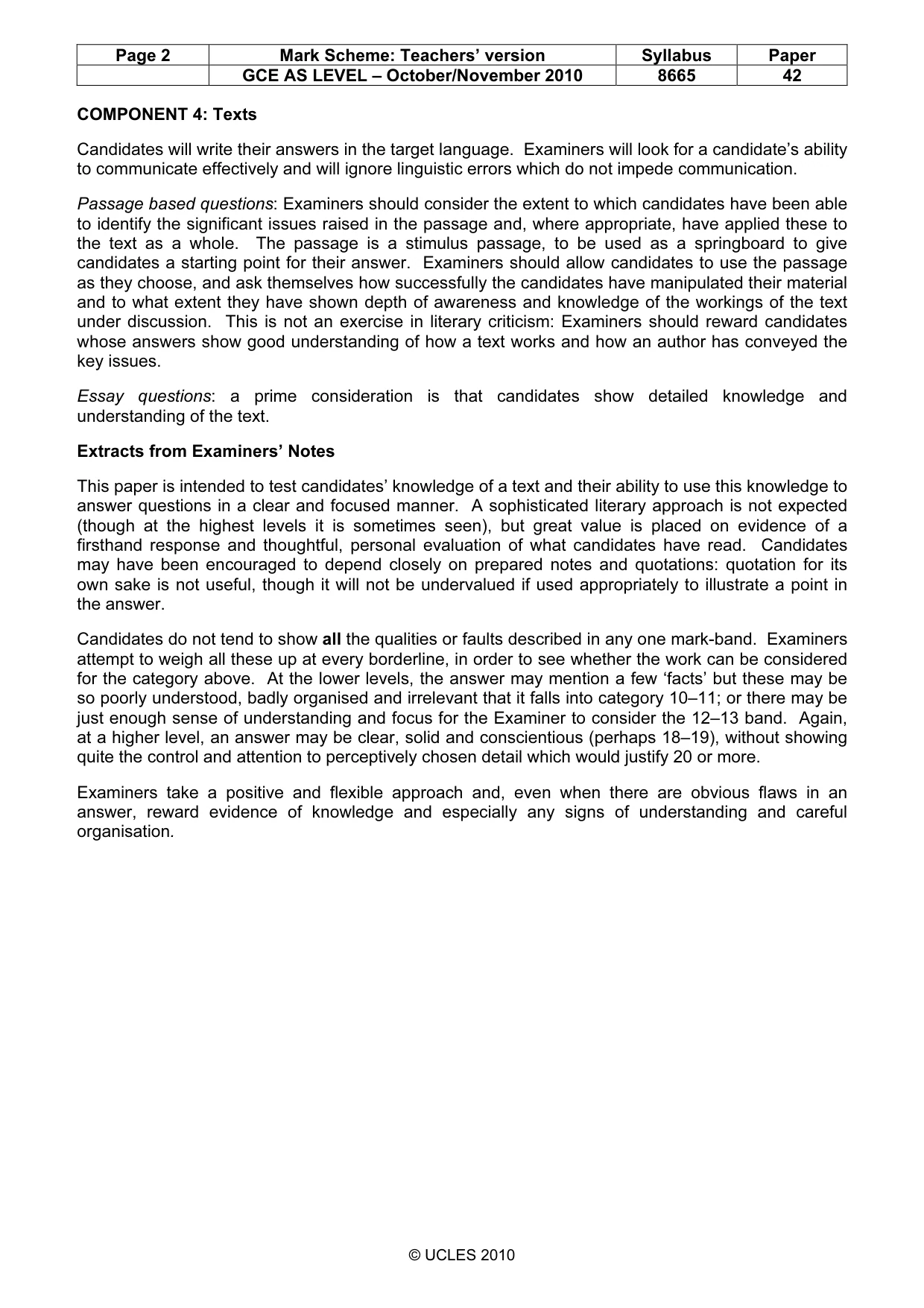
Page 2 Mark Scheme: Teachers’ version Syllabus Paper GCE AS LEVEL – October/November 2010 8665 42 © UCLES 2010 COMPONENT 4: Texts Candidates will write their answers in the target language. Examiners will look for a candidate’s ability to communicate effectively and will ignore linguistic errors which do not impede communication. Passage based questions: Examiners should consider the extent to which candidates have been able to identify the significant issues raised in the passage and, where appropriate, have applied these to the text as a whole. The passage is a stimulus passage, to be used as a springboard to give candidates a starting point for their answer. Examiners should allow candidates to use the passage as they choose, and ask themselves how successfully the candidates have manipulated their material and to what extent they have shown depth of awareness and knowledge of the workings of the text under discussion. This is not an exercise in literary criticism: Examiners should reward candidates whose answers show good understanding of how a text works and how an author has conveyed the key issues. Essay questions: a prime consideration is that candidates show detailed knowledge and understanding of the text. Extracts from Examiners’ Notes This paper is intended to test candidates’ knowledge of a text and their ability to use this knowledge to answer questions in a clear and focused manner. A sophisticated literary approach is not expected (though at the highest levels it is sometimes seen), but great value is placed on evidence of a firsthand response and thoughtful, personal evaluation of what candidates have read. Candidates may have been encouraged to depend closely on prepared notes and quotations: quotation for its own sake is not useful, though it will not be undervalued if used appropriately to illustrate a point in the answer. Candidates do not tend to show all the qualities or faults described in any one mark-band. Examiners attempt to weigh all these up at every borderline, in order to see whether the work can be considered for the category above. At the lower levels, the answer may mention a few ‘facts’ but these may be so poorly understood, badly organised and irrelevant that it falls into category 10–11; or there may be just enough sense of understanding and focus for the Examiner to consider the 12–13 band. Again, at a higher level, an answer may be clear, solid and conscientious (perhaps 18–19), without showing quite the control and attention to perceptively chosen detail which would justify 20 or more. Examiners take a positive and flexible approach and, even when there are obvious flaws in an answer, reward evidence of knowledge and especially any signs of understanding and careful organisation.
Mark scheme, page 3
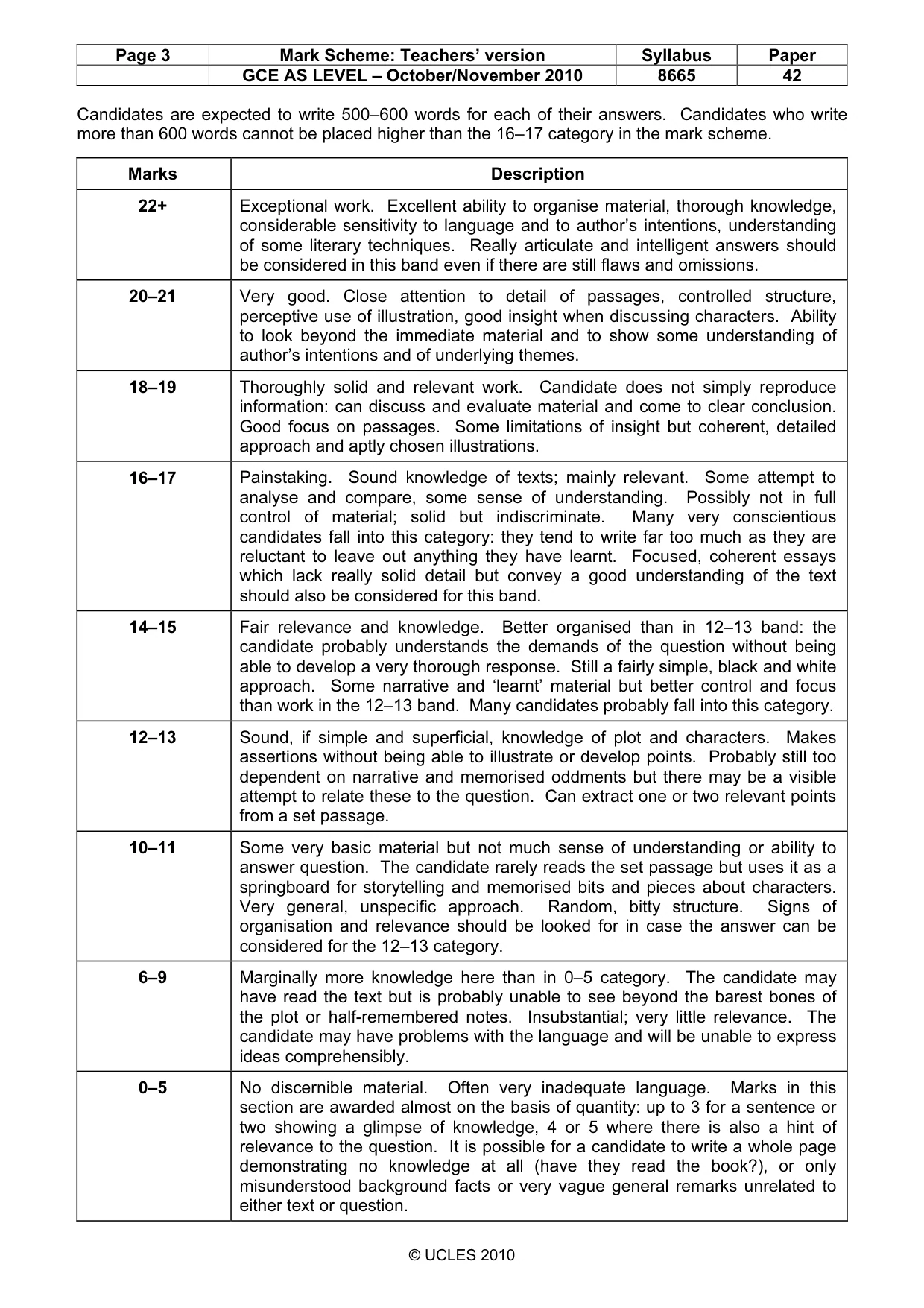
Page 3 Mark Scheme: Teachers’ version Syllabus Paper GCE AS LEVEL – October/November 2010 8665 42 © UCLES 2010 Candidates are expected to write 500–600 words for each of their answers. Candidates who write more than 600 words cannot be placed higher than the 16–17 category in the mark scheme. Marks Description 22+ Exceptional work. Excellent ability to organise material, thorough knowledge, considerable sensitivity to language and to author’s intentions, understanding of some literary techniques. Really articulate and intelligent answers should be considered in this band even if there are still flaws and omissions. 20–21 Very good. Close attention to detail of passages, controlled structure, perceptive use of illustration, good insight when discussing characters. Ability to look beyond the immediate material and to show some understanding of author’s intentions and of underlying themes. 18–19 Thoroughly solid and relevant work. Candidate does not simply reproduce information: can discuss and evaluate material and come to clear conclusion. Good focus on passages. Some limitations of insight but coherent, detailed approach and aptly chosen illustrations. 16–17 Painstaking. Sound knowledge of texts; mainly relevant. Some attempt to analyse and compare, some sense of understanding. Possibly not in full control of material; solid but indiscriminate. Many very conscientious candidates fall into this category: they tend to write far too much as they are reluctant to leave out anything they have learnt. Focused, coherent essays which lack really solid detail but convey a good understanding of the text should also be considered for this band. 14–15 Fair relevance and knowledge. Better organised than in 12–13 band: the candidate probably understands the demands of the question without being able to develop a very thorough response. Still a fairly simple, black and white approach. Some narrative and ‘learnt’ material but better control and focus than work in the 12–13 band. Many candidates probably fall into this category. 12–13 Sound, if simple and superficial, knowledge of plot and characters. Makes assertions without being able to illustrate or develop points. Probably still too dependent on narrative and memorised oddments but there may be a visible attempt to relate these to the question. Can extract one or two relevant points from a set passage. 10–11 Some very basic material but not much sense of understanding or ability to answer question. The candidate rarely reads the set passage but uses it as a springboard for storytelling and memorised bits and pieces about characters. Very general, unspecific approach. Random, bitty structure. Signs of organisation and relevance should be looked for in case the answer can be considered for the 12–13 category. 6–9 Marginally more knowledge here than in 0–5 category. The candidate may have read the text but is probably unable to see beyond the barest bones of the plot or half-remembered notes. Insubstantial; very little relevance. The candidate may have problems with the language and will be unable to express ideas comprehensibly. 0–5 No discernible material. Often very inadequate language. Marks in this section are awarded almost on the basis of quantity: up to 3 for a sentence or two showing a glimpse of knowledge, 4 or 5 where there is also a hint of relevance to the question. It is possible for a candidate to write a whole page demonstrating no knowledge at all (have they read the book?), or only misunderstood background facts or very vague general remarks unrelated to either text or question.
What you needed in this session
Cambridge’s own grade thresholds for 2010 Oct/Nov, Paper 4 · Variant 2. A higher threshold means an easier paper — the bar moves with how the cohort did.