Cambridge A Level Spanish - First Language (AS Level only) 8665 — 2010 May/June Paper 4 · Variant 2
8665/42/M/J/10 · 75 marks · ≈84 min
The question paper and its mark scheme, free to read here and free to download. This is Cambridge’s own paper, exactly as it was sat.
Question paper8 pages

Mark scheme3 pages
Answers below. Sit the paper first if you are practising.
Paper as text
Question paper, page 1
This document consists of 7 printed pages and 1 blank page. DC (LEO) 26590 © UCLES 2010 [Turn over UNIVERSITY OF CAMBRIDGE INTERNATIONAL EXAMINATIONS General Certificate of Education Advanced Subsidiary Level FIRST LANGUAGE SPANISH 8665/42 Paper 4 Texts May/June 2010 2 hours 30 minutes Additional Materials: Answer Booklet/Paper Invigilators must refer to the Additional Materials List for instructions on the use of set texts in the examination. READ THESE INSTRUCTIONS FIRST If you have been given an Answer Booklet, follow the instructions on the front cover of the Booklet. Write your Centre number, candidate number and name on all the work you hand in. Write in dark blue or black pen. Do not use staples, paper clips, highlighters, glue or correction fluid. Answer three questions, each on a different text. You must choose one question from Section 1, one from Section 2 and one other. Write your answers in Spanish. Dictionaries are not permitted. You should write between 500 and 600 words for each answer. If you write more than 600 words for each answer, you will be penalised. At the end of the examination, fasten all your work securely together. All questions in this paper carry equal marks. EN PRIMER LUGAR, LEE ESTAS INSTRUCCIONES Si se te ha dado un Cuadernillo de Respuestas, sigue las instrucciones de la tapa del Cuadernillo. Escribe el número del Centro, el número de estudiante que se te ha adjudicado y tu nombre en todo el trabajo que vayas a entregar. Usa tinta azul oscuro o negra. No uses ni grapas, ni clips, ni rotulador, ni goma de pegar, ni corrector líquido. Contesta las tres preguntas de textos diferentes. Debes escoger una pregunta de la Sección 1, otra de la Sección 2 y la tercera puede ser de cualquiera de las dos secciones. Escribe las respuestas en español. No se permite el uso de diccionario. Escribe 500-600 palabras en cada respuesta. Se penalizará el exceso en el número de palabras estipulado. Al terminar el examen, sujeta bien todo tu trabajo. Todas las preguntas en este examen tienen el mismo valor. * 9 4 9 8 8 9 3 1 1 3 *
Question paper, page 2
2 8665/42/M/J/10 © UCLES 2010 SECCIÓN PRIMERA 1 Mariano Azuela: Los de abajo Contesta la pregunta (a) o la pregunta (b): (a) Lee este extracto del Capítulo IV de la Tercera Parte y contesta las preguntas siguientes: Soldados mancos, cojos, reumáticos y tosigosos dicen mal de Demetrio. Advenedizos de banqueta causan alta con barras de latón en el sombrero, antes de saber siquiera cómo se coge un fusil, mientras que el veterano fogueado en cien combates, inútil ya para el trabajo, el veterano que comenzó de soldado raso, soldado raso es todavía. Y los pocos jefes que quedan, camaradas viejos de Macías, se indignan también porque se cubren las bajas del Estado Mayor con señoritines de capital, perfumados y peripuestos. –Pero lo peor de todo –dice Venancio– es que nos estamos llenando de ex federales. El mismo Anastasio, que de ordinario encuentra muy bien hecho todo lo que su compadre Demetrio hace, ahora, en causa común con los descontentos, exclama: – Miren, compañeros, yo soy muy claridoso … y yo le digo a mi compadre que si vamos a tener aquí a los federales siempre, malamente andamos … ¡De veras! ¿A que no me lo creen? … Pero yo no tengo pelos en la lengua, y por vida de la madre que me parió, que se lo digo a mi compadre Demetrio. Y se lo dijo. Demetrio lo escuchó con mucha benevolencia, y luego que acabó de hablar, le contestó: – Compadre, es cierto lo que usted dice. Malamente andamos: los soldados hablan mal de las clases, las clases de los oficiales y los oficiales de nosotros … Y nosotros estamos ya pa despachar a Villa y a Carranza a la … a que se diviertan solos … Pero se me figura que nos está sucediendo lo que a aquel peón de Tepatitlán. ¿Se acuerda, compadre? No paraba de rezongar de su patrón, pero no paraba de trabajar tampoco. Y así estamos nosotros: a reniega y reniega y a mátenos y mátenos … Pero eso no hay que decirlo, compadre … – ¿Por qué, compadre Demetrio? … – Pos yo no sé … Porque no … ¿ya me entiende? Lo que ha de hacer es dármele ánimo a la gente. He recibido órdenes de regresar a detener una partida que viene por Cuquío. Dentro de muy poquitos días tenemos que darnos un encontronazo con los carranclanes, y es bueno pegarles ahora hasta por debajo de la lengua. (i) Analiza por qué estaba tan baja la moral de los revolucionarios. (ii) Explica cómo Demetrio trata de darles ánimo. (iii) ¿Hasta qué punto se puede decir que este extracto refleja los problemas de los revolucionarios? Justifica tu respuesta con referencias detalladas a la novela entera. O (b) En tu opinión, ¿es Los de abajo una novela que sigue teniendo un mensaje para la gente del siglo 21? Justifica tu respuesta, refiriéndote a la novela entera.
Question paper, page 3
3 8665/42/M/J/10 © UCLES 2010 [Turn over 2 Pedro Calderón de la Barca: El alcalde de Zalamea Contesta la pregunta (a) o la pregunta (b): (a) Lee este extracto de la Jornada Primera y contesta las preguntas siguientes: Pedro Crespo: Pues ¿cómo puedo excusarlos ni excusarme? Juan: Comprando una ejecutoria. Pedro Crespo: Dime por tu vida, ¿hay alguien que no sepa, que yo soy, si bien de limpio linaje, hombre Ilano? No por cierto. Pues ¿qué gano yo en comprarle una ejecutoria al Rey, si no le compro la sangre? ¿Dirán entonces, que soy mejor que ahora? No, es dislate. Pues ¿qué dirán? Que soy noble por cinco o seis mil reales; y esto es dinero y no es honra; que honra no la compra nadie. ¿Quieres, aunque sea trivial, un ejemplillo escucharme? «Es calvo un hombre mil años, y al cabo de ellos se hace una cabellera. Este, en opiniones vulgares, ¿deja de ser calvo? No. Pues ¿qué dicen al mirarle? Bien puesta la cabellera trae fulano.» Pues ¿qué hace, si, aunque no le vean la calva, todos que la tiene saben? (i) ¿De qué niega Pedro Crespo excusarse? (ii) Analiza la actitud de Pedro Crespo en cuanto al honor. (iii) ¿Qué importancia tienen estas palabras para ayudarnos a comprender la obra? Justifica tu respuesta, refiriéndote a la obra entera. O (b) Analiza el papel del rey en la obra El alcalde de Zalamea. Justifica tu respuesta.
Question paper, page 4
4 8665/42/M/J/10 © UCLES 2010 3 Gabriel García Márquez: Los funerales de la Mamá Grande Contesta la pregunta (a) o la pregunta (b): (a) Lee este extracto del cuento La viuda de Montiel y contesta las preguntas siguientes: Cuando murió don José Montiel, todo el mundo se sintió vengado, menos su viuda; pero se necesitaron varias horas para que todo el mundo creyera que en verdad había muerto. Muchos lo seguían poniendo en duda después de ver el cadáver en cámara ardiente, embutido con almohadas y sábanas de lino dentro de una caja amarilla y abombada como un melón. Estaba muy bien afeitado, vestido de blanco y con botas de charol, y tenía tan buen semblante que nunca pareció tan vivo como entonces. Era el mismo don Chepe Montiel de los domingos, oyendo misa de ocho, sólo que en lugar de la fusta tenía un crucifijo entre las manos. Fue preciso que atornillaran la tapa del ataúd y que lo emparedaran en el aparatoso mausoleo familiar, para que el pueblo entero se convenciera de que no se estaba haciendo el muerto. Después del entierro, lo único que a todos pareció increíble, menos a su viuda, fue que José Montiel hubiera muerto de muerte natural. Mientras todo el mundo esperaba que lo acribillaran por la espalda en una emboscada, su viuda estaba segura de verlo morir de viejo en su cama, confesado y sin agonía, como un santo moderno. Se equivocó apenas en algunos detalles. José Montiel murió en su hamaca, un miércoles a las dos de la tarde, a consecuencia de la rabieta que el médico le había prohibido. (i) Analiza la personalidad de José Montiel según la información en el extracto. (ii) Explica el significado de estas palabras: “todo el mundo se sintió vengado”. (iii) ‘El tono predominante de este cuento es la tristeza.’ ¿Estás de acuerdo? Justifica tu respuesta, refiriéndote a La viuda de Montiel y, si quieres, a otros cuentos de la colección. O (b) ¿Hasta qué punto se puede decir que el tema más importante de estos cuentos es la búsqueda del amor? Justifica tu respuesta, refiriéndote a tres cuentos de la colección.
Question paper, page 5
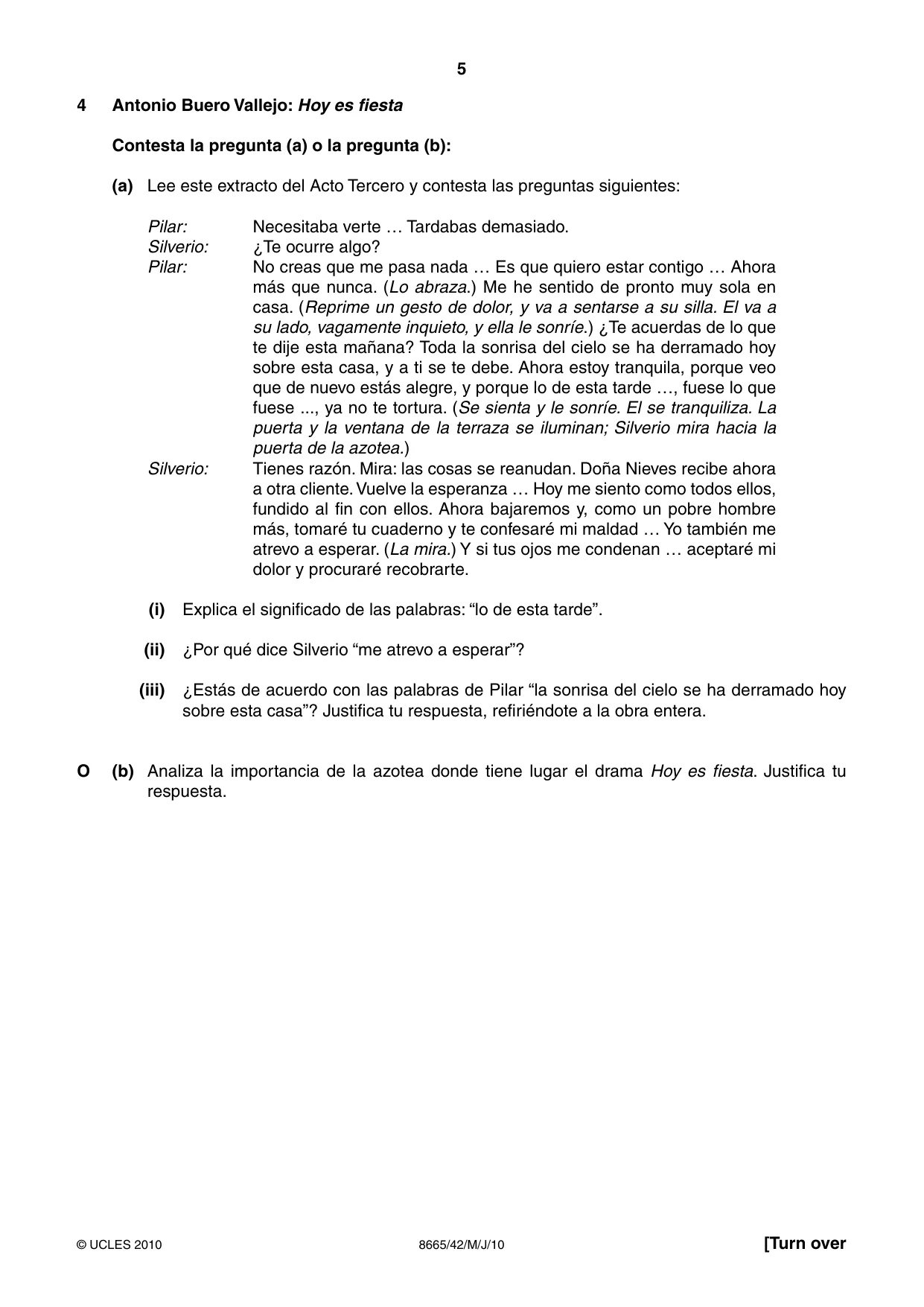
5 8665/42/M/J/10 © UCLES 2010 [Turn over 4 Antonio Buero Vallejo: Hoy es fiesta Contesta la pregunta (a) o la pregunta (b): (a) Lee este extracto del Acto Tercero y contesta las preguntas siguientes: Pilar: Necesitaba verte … Tardabas demasiado. Silverio: ¿Te ocurre algo? Pilar: No creas que me pasa nada … Es que quiero estar contigo … Ahora más que nunca. (Lo abraza.) Me he sentido de pronto muy sola en casa. (Reprime un gesto de dolor, y va a sentarse a su silla. El va a su lado, vagamente inquieto, y ella le sonríe.) ¿Te acuerdas de lo que te dije esta mañana? Toda la sonrisa del cielo se ha derramado hoy sobre esta casa, y a ti se te debe. Ahora estoy tranquila, porque veo que de nuevo estás alegre, y porque lo de esta tarde …, fuese lo que fuese ..., ya no te tortura. (Se sienta y le sonríe. El se tranquiliza. La puerta y la ventana de la terraza se iluminan; Silverio mira hacia la puerta de la azotea.) Silverio: Tienes razón. Mira: las cosas se reanudan. Doña Nieves recibe ahora a otra cliente. Vuelve la esperanza … Hoy me siento como todos ellos, fundido al fin con ellos. Ahora bajaremos y, como un pobre hombre más, tomaré tu cuaderno y te confesaré mi maldad … Yo también me atrevo a esperar. (La mira.) Y si tus ojos me condenan … aceptaré mi dolor y procuraré recobrarte. (i) Explica el significado de las palabras: “lo de esta tarde”. (ii) ¿Por qué dice Silverio “me atrevo a esperar”? (iii) ¿Estás de acuerdo con las palabras de Pilar “la sonrisa del cielo se ha derramado hoy sobre esta casa”? Justifica tu respuesta, refiriéndote a la obra entera. O (b) Analiza la importancia de la azotea donde tiene lugar el drama Hoy es fiesta. Justifica tu respuesta.
Question paper, page 6
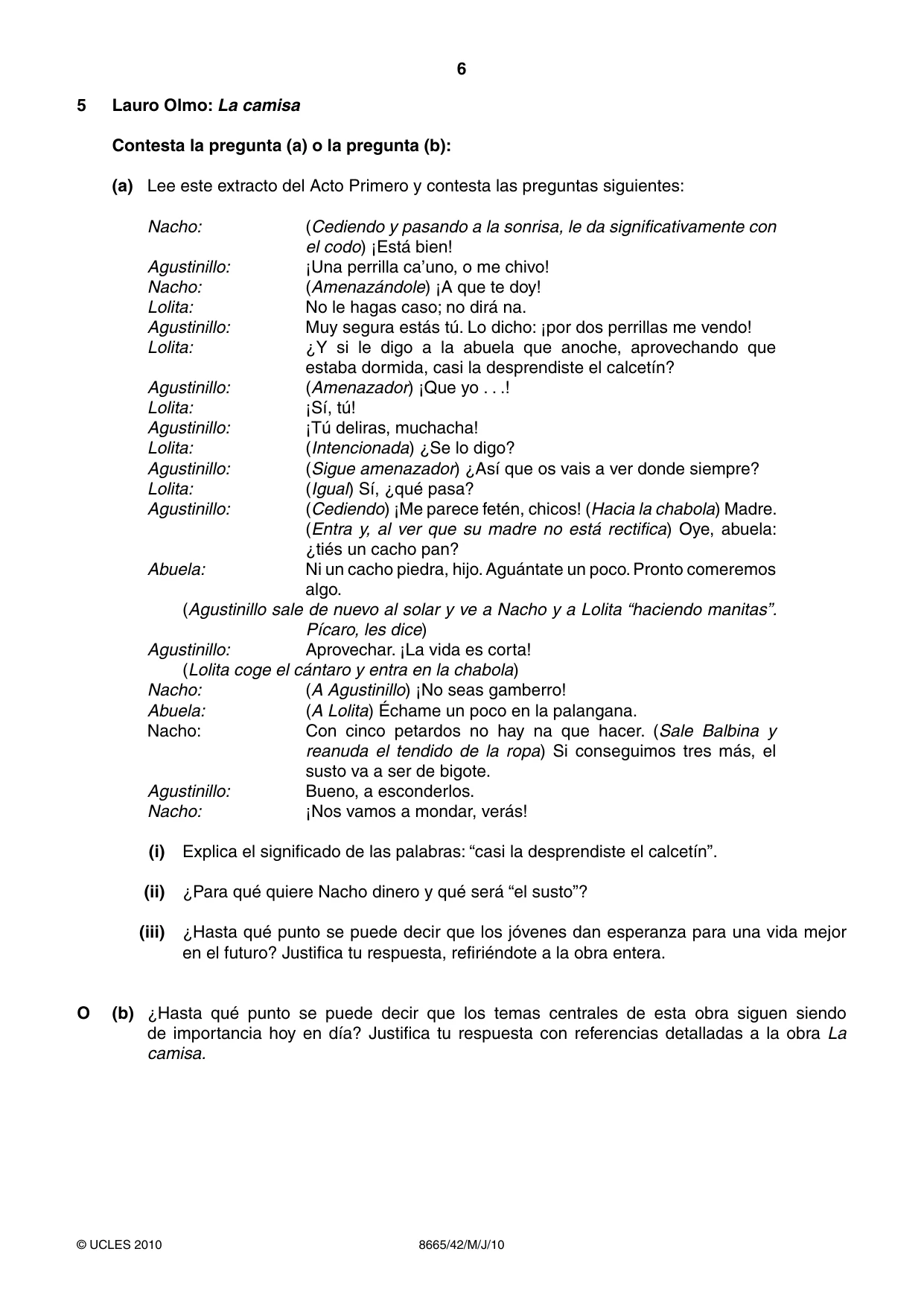
6 8665/42/M/J/10 © UCLES 2010 5 Lauro Olmo: La camisa Contesta la pregunta (a) o la pregunta (b): (a) Lee este extracto del Acto Primero y contesta las preguntas siguientes: Nacho: (Cediendo y pasando a la sonrisa, le da significativamente con el codo) ¡Está bien! Agustinillo: ¡Una perrilla ca’uno, o me chivo! Nacho: (Amenazándole) ¡A que te doy! Lolita: No le hagas caso; no dirá na. Agustinillo: Muy segura estás tú. Lo dicho: ¡por dos perrillas me vendo! Lolita: ¿Y si le digo a la abuela que anoche, aprovechando que estaba dormida, casi la desprendiste el calcetín? Agustinillo: (Amenazador) ¡Que yo . . .! Lolita: ¡Sí, tú! Agustinillo: ¡Tú deliras, muchacha! Lolita: (Intencionada) ¿Se lo digo? Agustinillo: (Sigue amenazador) ¿Así que os vais a ver donde siempre? Lolita: (Igual) Sí, ¿qué pasa? Agustinillo: (Cediendo) ¡Me parece fetén, chicos! (Hacia la chabola) Madre. (Entra y, al ver que su madre no está rectifica) Oye, abuela: ¿tiés un cacho pan? Abuela: Ni un cacho piedra, hijo. Aguántate un poco. Pronto comeremos algo. (Agustinillo sale de nuevo al solar y ve a Nacho y a Lolita “haciendo manitas”. Pícaro, les dice) Agustinillo: Aprovechar. ¡La vida es corta! (Lolita coge el cántaro y entra en la chabola) Nacho: (A Agustinillo) ¡No seas gamberro! Abuela: (A Lolita) Échame un poco en la palangana. Nacho: Con cinco petardos no hay na que hacer. (Sale Balbina y reanuda el tendido de la ropa) Si conseguimos tres más, el susto va a ser de bigote. Agustinillo: Bueno, a esconderlos. Nacho: ¡Nos vamos a mondar, verás! (i) Explica el significado de las palabras: “casi la desprendiste el calcetín”. (ii) ¿Para qué quiere Nacho dinero y qué será “el susto”? (iii) ¿Hasta qué punto se puede decir que los jóvenes dan esperanza para una vida mejor en el futuro? Justifica tu respuesta, refiriéndote a la obra entera. O (b) ¿Hasta qué punto se puede decir que los temas centrales de esta obra siguen siendo de importancia hoy en día? Justifica tu respuesta con referencias detalladas a la obra La camisa.
Question paper, page 7
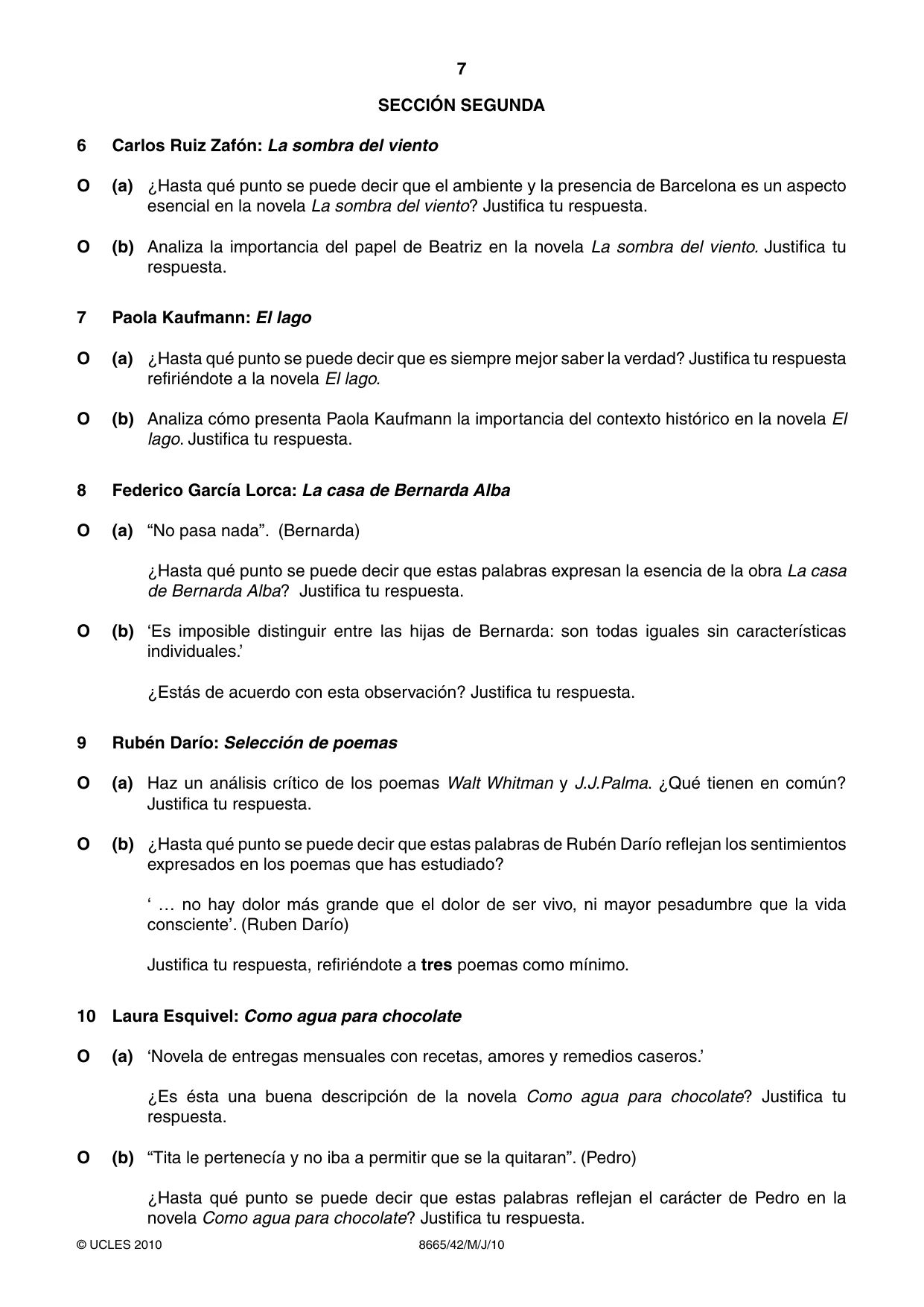
7 8665/42/M/J/10 © UCLES 2010 SECCIÓN SEGUNDA 6 Carlos Ruiz Zafón: La sombra del viento O (a) ¿Hasta qué punto se puede decir que el ambiente y la presencia de Barcelona es un aspecto esencial en la novela La sombra del viento? Justifica tu respuesta. O (b) Analiza la importancia del papel de Beatriz en la novela La sombra del viento. Justifica tu respuesta. 7 Paola Kaufmann: El lago O (a) ¿Hasta qué punto se puede decir que es siempre mejor saber la verdad? Justifica tu respuesta refiriéndote a la novela El lago. O (b) Analiza cómo presenta Paola Kaufmann la importancia del contexto histórico en la novela El lago. Justifica tu respuesta. 8 Federico García Lorca: La casa de Bernarda Alba O (a) “No pasa nada”. (Bernarda) ¿Hasta qué punto se puede decir que estas palabras expresan la esencia de la obra La casa de Bernarda Alba? Justifica tu respuesta. O (b) ‘Es imposible distinguir entre las hijas de Bernarda: son todas iguales sin características individuales.’ ¿Estás de acuerdo con esta observación? Justifica tu respuesta. 9 Rubén Darío: Selección de poemas O (a) Haz un análisis crítico de los poemas Walt Whitman y J.J.Palma. ¿Qué tienen en común? Justifica tu respuesta. O (b) ¿Hasta qué punto se puede decir que estas palabras de Rubén Darío reflejan los sentimientos expresados en los poemas que has estudiado? ‘ … no hay dolor más grande que el dolor de ser vivo, ni mayor pesadumbre que la vida consciente’. (Ruben Darío) Justifica tu respuesta, refiriéndote a tres poemas como mínimo. 10 Laura Esquivel: Como agua para chocolate O (a) ‘Novela de entregas mensuales con recetas, amores y remedios caseros.’ ¿Es ésta una buena descripción de la novela Como agua para chocolate? Justifica tu respuesta. O (b) “Tita le pertenecía y no iba a permitir que se la quitaran”. (Pedro) ¿Hasta qué punto se puede decir que estas palabras reflejan el carácter de Pedro en la novela Como agua para chocolate? Justifica tu respuesta.
Question paper, page 8
8 8665/42/M/J/10 © UCLES 2010 BLANK PAGE Copyright Acknowledgements: Question 1a © Mariano Azuela; Los de abajo; Harrap; 1973. Question 2a © Pedro Calderón de la Barca; El alcalde de Zalamea; Catedra SA; 1986. Question 3a © Gabriel García Márquez; Los funerales de La Mamá Grande; Alfaguara; 1985. Question 4a © Antonio Buero Vallejo; Hoy es fiesta; Harrap; 1964. Question 5a © Lauro Olmo; La camisa; Pergamon Press; 1968. Permission to reproduce items where third-party owned material protected by copyright is included has been sought and cleared where possible. Every reasonable effort has been made by the publisher (UCLES) to trace copyright holders, but if any items requiring clearance have unwittingly been included, the publisher will be pleased to make amends at the earliest possible opportunity. University of Cambridge International Examinations is part of the Cambridge Assessment Group. Cambridge Assessment is the brand name of University of Cambridge Local Examinations Syndicate (UCLES), which is itself a department of the University of Cambridge.
Mark scheme, page 1
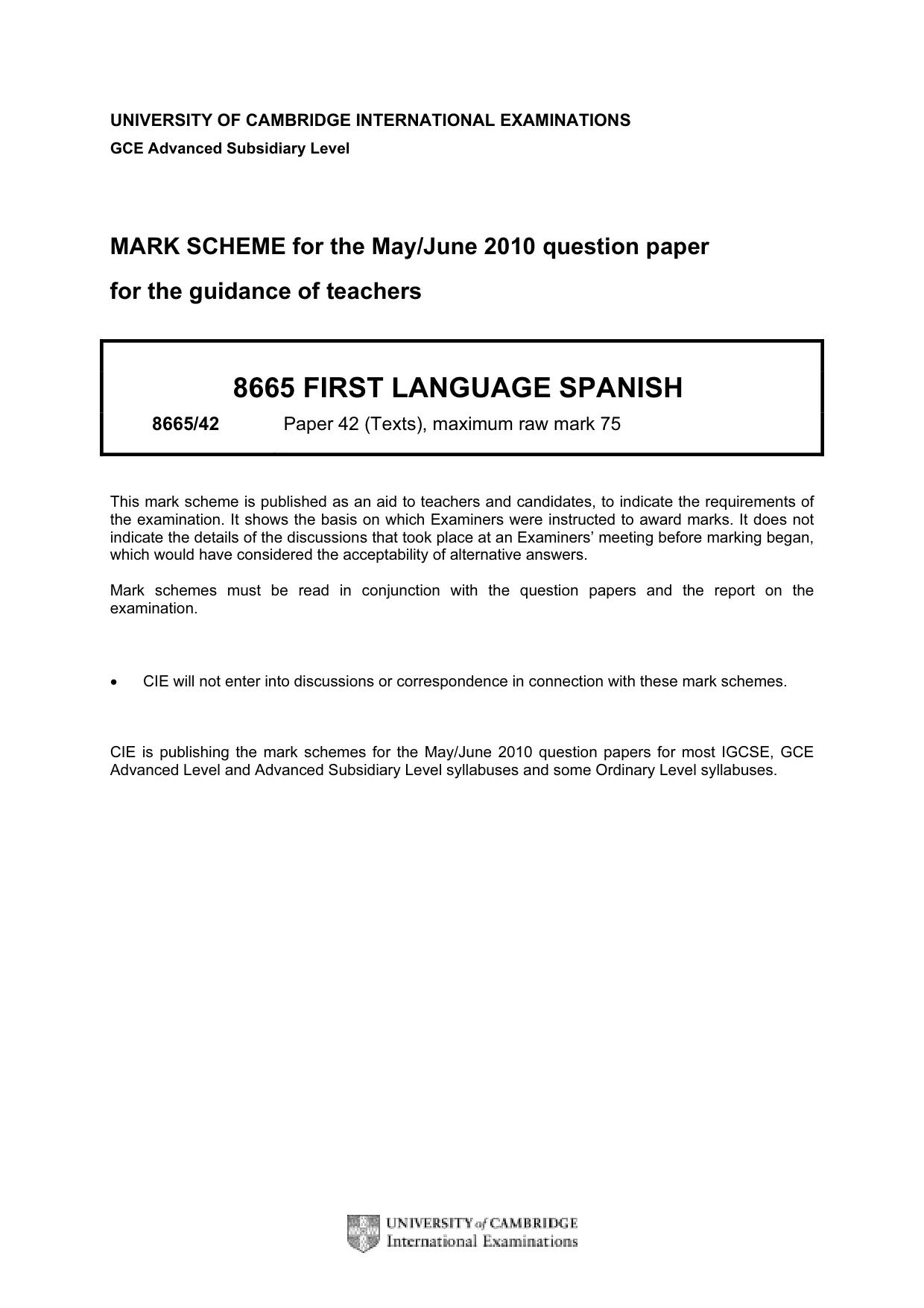
UNIVERSITY OF CAMBRIDGE INTERNATIONAL EXAMINATIONS GCE Advanced Subsidiary Level MARK SCHEME for the May/June 2010 question paper for the guidance of teachers 8665 FIRST LANGUAGE SPANISH 8665/42 Paper 42 (Texts), maximum raw mark 75 This mark scheme is published as an aid to teachers and candidates, to indicate the requirements of the examination. It shows the basis on which Examiners were instructed to award marks. It does not indicate the details of the discussions that took place at an Examiners’ meeting before marking began, which would have considered the acceptability of alternative answers. Mark schemes must be read in conjunction with the question papers and the report on the examination. • CIE will not enter into discussions or correspondence in connection with these mark schemes. CIE is publishing the mark schemes for the May/June 2010 question papers for most IGCSE, GCE Advanced Level and Advanced Subsidiary Level syllabuses and some Ordinary Level syllabuses.
Mark scheme, page 2
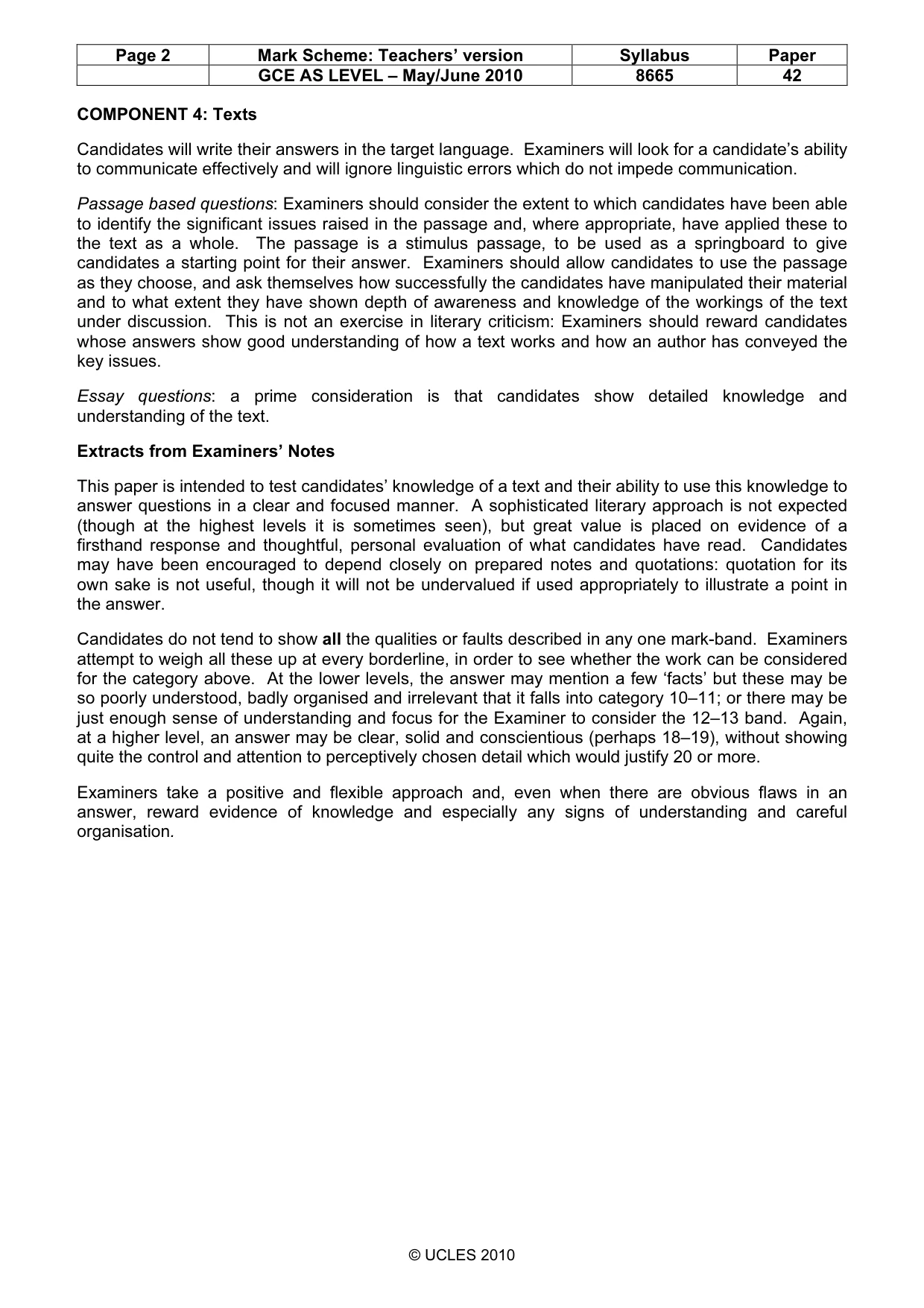
Page 2 Mark Scheme: Teachers’ version Syllabus Paper GCE AS LEVEL – May/June 2010 8665 42 © UCLES 2010 COMPONENT 4: Texts Candidates will write their answers in the target language. Examiners will look for a candidate’s ability to communicate effectively and will ignore linguistic errors which do not impede communication. Passage based questions: Examiners should consider the extent to which candidates have been able to identify the significant issues raised in the passage and, where appropriate, have applied these to the text as a whole. The passage is a stimulus passage, to be used as a springboard to give candidates a starting point for their answer. Examiners should allow candidates to use the passage as they choose, and ask themselves how successfully the candidates have manipulated their material and to what extent they have shown depth of awareness and knowledge of the workings of the text under discussion. This is not an exercise in literary criticism: Examiners should reward candidates whose answers show good understanding of how a text works and how an author has conveyed the key issues. Essay questions: a prime consideration is that candidates show detailed knowledge and understanding of the text. Extracts from Examiners’ Notes This paper is intended to test candidates’ knowledge of a text and their ability to use this knowledge to answer questions in a clear and focused manner. A sophisticated literary approach is not expected (though at the highest levels it is sometimes seen), but great value is placed on evidence of a firsthand response and thoughtful, personal evaluation of what candidates have read. Candidates may have been encouraged to depend closely on prepared notes and quotations: quotation for its own sake is not useful, though it will not be undervalued if used appropriately to illustrate a point in the answer. Candidates do not tend to show all the qualities or faults described in any one mark-band. Examiners attempt to weigh all these up at every borderline, in order to see whether the work can be considered for the category above. At the lower levels, the answer may mention a few ‘facts’ but these may be so poorly understood, badly organised and irrelevant that it falls into category 10–11; or there may be just enough sense of understanding and focus for the Examiner to consider the 12–13 band. Again, at a higher level, an answer may be clear, solid and conscientious (perhaps 18–19), without showing quite the control and attention to perceptively chosen detail which would justify 20 or more. Examiners take a positive and flexible approach and, even when there are obvious flaws in an answer, reward evidence of knowledge and especially any signs of understanding and careful organisation.
Mark scheme, page 3
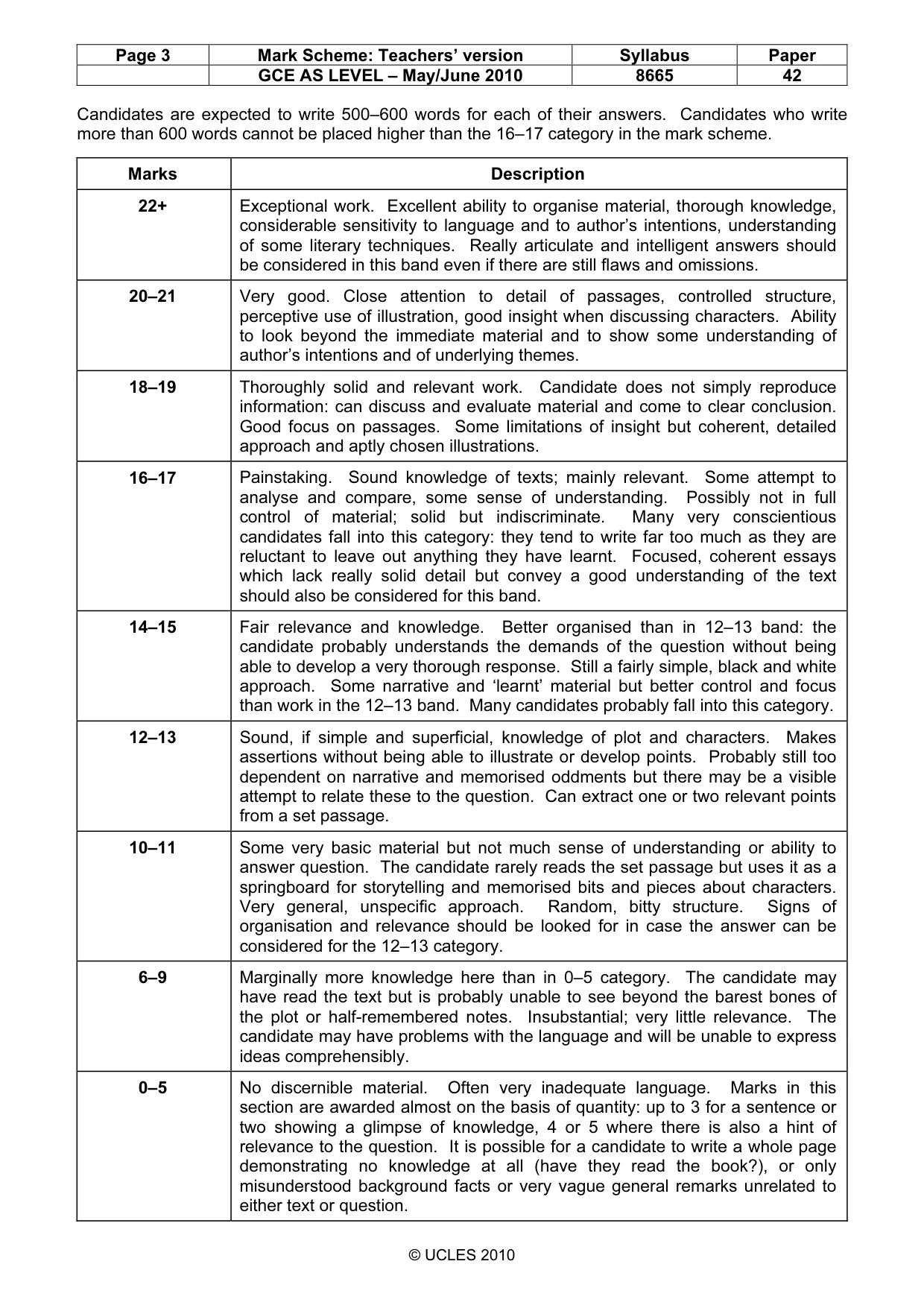
Page 3 Mark Scheme: Teachers’ version Syllabus Paper GCE AS LEVEL – May/June 2010 8665 42 © UCLES 2010 Candidates are expected to write 500–600 words for each of their answers. Candidates who write more than 600 words cannot be placed higher than the 16–17 category in the mark scheme. Marks Description 22+ Exceptional work. Excellent ability to organise material, thorough knowledge, considerable sensitivity to language and to author’s intentions, understanding of some literary techniques. Really articulate and intelligent answers should be considered in this band even if there are still flaws and omissions. 20–21 Very good. Close attention to detail of passages, controlled structure, perceptive use of illustration, good insight when discussing characters. Ability to look beyond the immediate material and to show some understanding of author’s intentions and of underlying themes. 18–19 Thoroughly solid and relevant work. Candidate does not simply reproduce information: can discuss and evaluate material and come to clear conclusion. Good focus on passages. Some limitations of insight but coherent, detailed approach and aptly chosen illustrations. 16–17 Painstaking. Sound knowledge of texts; mainly relevant. Some attempt to analyse and compare, some sense of understanding. Possibly not in full control of material; solid but indiscriminate. Many very conscientious candidates fall into this category: they tend to write far too much as they are reluctant to leave out anything they have learnt. Focused, coherent essays which lack really solid detail but convey a good understanding of the text should also be considered for this band. 14–15 Fair relevance and knowledge. Better organised than in 12–13 band: the candidate probably understands the demands of the question without being able to develop a very thorough response. Still a fairly simple, black and white approach. Some narrative and ‘learnt’ material but better control and focus than work in the 12–13 band. Many candidates probably fall into this category. 12–13 Sound, if simple and superficial, knowledge of plot and characters. Makes assertions without being able to illustrate or develop points. Probably still too dependent on narrative and memorised oddments but there may be a visible attempt to relate these to the question. Can extract one or two relevant points from a set passage. 10–11 Some very basic material but not much sense of understanding or ability to answer question. The candidate rarely reads the set passage but uses it as a springboard for storytelling and memorised bits and pieces about characters. Very general, unspecific approach. Random, bitty structure. Signs of organisation and relevance should be looked for in case the answer can be considered for the 12–13 category. 6–9 Marginally more knowledge here than in 0–5 category. The candidate may have read the text but is probably unable to see beyond the barest bones of the plot or half-remembered notes. Insubstantial; very little relevance. The candidate may have problems with the language and will be unable to express ideas comprehensibly. 0–5 No discernible material. Often very inadequate language. Marks in this section are awarded almost on the basis of quantity: up to 3 for a sentence or two showing a glimpse of knowledge, 4 or 5 where there is also a hint of relevance to the question. It is possible for a candidate to write a whole page demonstrating no knowledge at all (have they read the book?), or only misunderstood background facts or very vague general remarks unrelated to either text or question.
What you needed in this session
Cambridge’s own grade thresholds for 2010 May/June, Paper 4 · Variant 2. A higher threshold means an easier paper — the bar moves with how the cohort did.