Cambridge A Level Spanish (A Level only) 9719 — 2022 May/June Paper 3 · Variant 1
9719/31/M/J/22 · 40 marks · ≈45 min
The question paper and its mark scheme, free to read here and free to download. This is Cambridge’s own paper, exactly as it was sat.
Question paper8 pages
Mark scheme3 pages
Answers below. Sit the paper first if you are practising.
Paper as text
Question paper, page 1
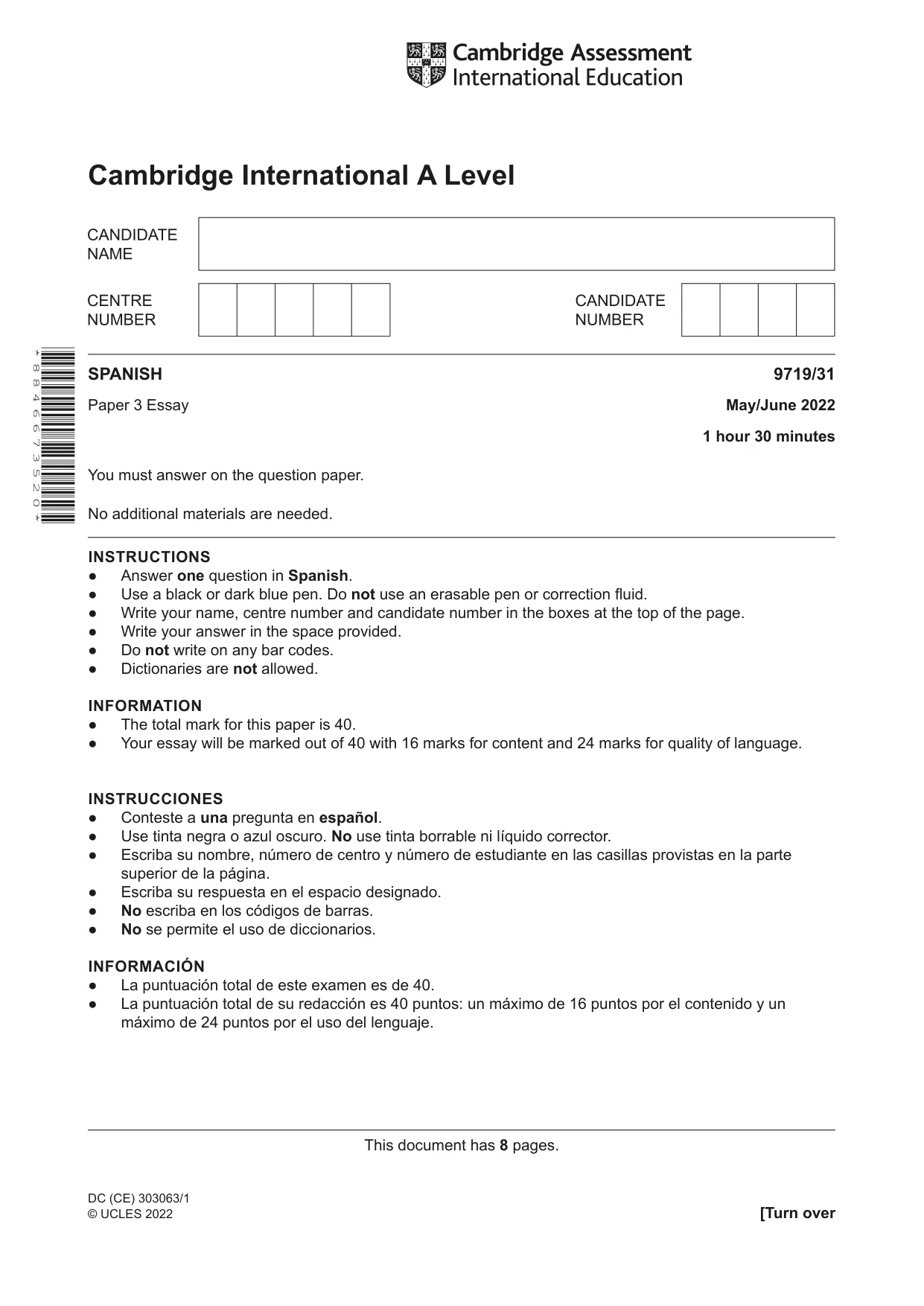
This document has 8 pages. [Turn over Cambridge International A Level DC (CE) 303063/1 © UCLES 2022 * 8 8 4 6 6 7 3 5 2 0 * SPANISH 9719/31 Paper 3 Essay May/June 2022 1 hour 30 minutes You must answer on the question paper. No additional materials are needed. INSTRUCTIONS ● Answer one question in Spanish. ● Use a black or dark blue pen. Do not use an erasable pen or correction fluid. ● Write your name, centre number and candidate number in the boxes at the top of the page. ● Write your answer in the space provided. ● Do not write on any bar codes. ● Dictionaries are not allowed. INFORMATION ● The total mark for this paper is 40. ● Your essay will be marked out of 40 with 16 marks for content and 24 marks for quality of language. INSTRUCCIONES ● Conteste a una pregunta en español. ● Use tinta negra o azul oscuro. No use tinta borrable ni líquido corrector. ● Escriba su nombre, número de centro y número de estudiante en las casillas provistas en la parte superior de la página. ● Escriba su respuesta en el espacio designado. ● No escriba en los códigos de barras. ● No se permite el uso de diccionarios. INFORMACIÓN ● La puntuación total de este examen es de 40. ● La puntuación total de su redacción es 40 puntos: un máximo de 16 puntos por el contenido y un máximo de 24 puntos por el uso del lenguaje.
Question paper, page 2
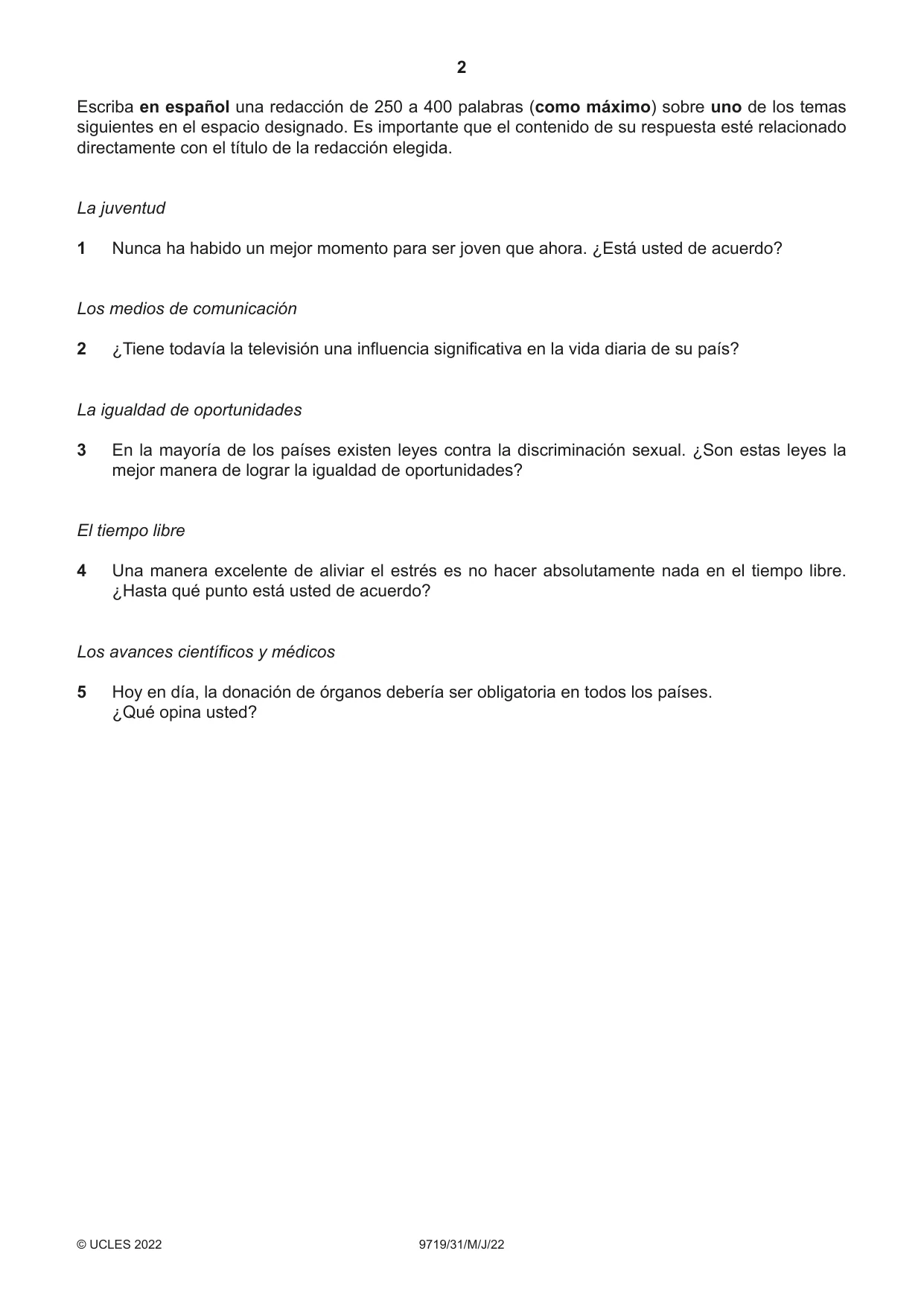
2 9719/31/M/J/22 © UCLES 2022 Escriba en español una redacción de 250 a 400 palabras (como máximo) sobre uno de los temas siguientes en el espacio designado. Es importante que el contenido de su respuesta esté relacionado directamente con el título de la redacción elegida. La juventud 1 Nunca ha habido un mejor momento para ser joven que ahora. ¿Está usted de acuerdo? Los medios de comunicación 2 ¿Tiene todavía la televisión una influencia significativa en la vida diaria de su país? La igualdad de oportunidades 3 En la mayoría de los países existen leyes contra la discriminación sexual. ¿Son estas leyes la mejor manera de lograr la igualdad de oportunidades? El tiempo libre 4 Una manera excelente de aliviar el estrés es no hacer absolutamente nada en el tiempo libre. ¿Hasta qué punto está usted de acuerdo? Los avances científicos y médicos 5 Hoy en día, la donación de órganos debería ser obligatoria en todos los países. ¿Qué opina usted?
Question paper, page 3
3 9719/31/M/J/22 © UCLES 2022 [Turn over Escriba el número de la pregunta que usted ha elegido aquí: … … … … … … … … … … … … … … … … … … … … … … … … … … … …
Question paper, page 4
4 9719/31/M/J/22 © UCLES 2022 … … … … … … … … … … … … … … … … … … … … … … … … … … … …
Question paper, page 5
5 9719/31/M/J/22 © UCLES 2022 [Turn over … … … … … … … … … … … … … … … … … … … … … … … … … … … …
Question paper, page 6
6 9719/31/M/J/22 © UCLES 2022 … … … … … … … … … … … … … … … … … … … … … … … … … … … …
Question paper, page 7
7 9719/31/M/J/22 © UCLES 2022 [Turn over … … … … … … … … … … … … … … … … … … … … … … … … … … … …
Question paper, page 8
8 9719/31/M/J/22 © UCLES 2022 Permission to reproduce items where third-party owned material protected by copyright is included has been sought and cleared where possible. Every reasonable effort has been made by the publisher (UCLES) to trace copyright holders, but if any items requiring clearance have unwittingly been included, the publisher will be pleased to make amends at the earliest possible opportunity. To avoid the issue of disclosure of answer-related information to candidates, all copyright acknowledgements are reproduced online in the Cambridge Assessment International Education Copyright Acknowledgements Booklet. This is produced for each series of examinations and is freely available to download at www.cambridgeinternational.org after the live examination series. Cambridge Assessment International Education is part of Cambridge Assessment. Cambridge Assessment is the brand name of the University of Cambridge Local Examinations Syndicate (UCLES), which is a department of the University of Cambridge. … … … … … … … … … … … … … … … … … … … … … … … …
Mark scheme, page 1
This document consists of 3 printed pages. © UCLES 2022 [Turn over Cambridge International A Level SPANISH 9719/31 Paper 3 Essay May/June 2022 MARK SCHEME Maximum Mark: 40 Published This mark scheme is published as an aid to teachers and candidates, to indicate the requirements of the examination. It shows the basis on which Examiners were instructed to award marks. It does not indicate the details of the discussions that took place at an Examiners’ meeting before marking began, which would have considered the acceptability of alternative answers. Mark schemes should be read in conjunction with the question paper and the Principal Examiner Report for Teachers. Cambridge International will not enter into discussions about these mark schemes. Cambridge International is publishing the mark schemes for the May/June 2022 series for most Cambridge IGCSE, Cambridge International A and AS Level and Cambridge Pre-U components, and some Cambridge O Level components.
Mark scheme, page 2
9719/31 Cambridge International A Level – Mark Scheme PUBLISHED May/June 2022 © UCLES 2022 Page 2 of 3 Generic Marking Principles These general marking principles must be applied by all examiners when marking candidate answers. They should be applied alongside the specific content of the mark scheme or generic level descriptors for a question. Each question paper and mark scheme will also comply with these marking principles. GENERIC MARKING PRINCIPLE 1: Marks must be awarded in line with: the specific content of the mark scheme or the generic level descriptors for the question the specific skills defined in the mark scheme or in the generic level descriptors for the question the standard of response required by a candidate as exemplified by the standardisation scripts. GENERIC MARKING PRINCIPLE 2: Marks awarded are always whole marks (not half marks, or other fractions). GENERIC MARKING PRINCIPLE 3: Marks must be awarded positively: marks are awarded for correct/valid answers, as defined in the mark scheme. However, credit is given for valid answers which go beyond the scope of the syllabus and mark scheme, referring to your Team Leader as appropriate marks are awarded when candidates clearly demonstrate what they know and can do marks are not deducted for errors marks are not deducted for omissions answers should only be judged on the quality of spelling, punctuation and grammar when these features are specifically assessed by the question as indicated by the mark scheme. The meaning, however, should be unambiguous. GENERIC MARKING PRINCIPLE 4: Rules must be applied consistently, e.g. in situations where candidates have not followed instructions or in the application of generic level descriptors. GENERIC MARKING PRINCIPLE 5: Marks should be awarded using the full range of marks defined in the mark scheme for the question (however; the use of the full mark range may be limited according to the quality of the candidate responses seen). GENERIC MARKING PRINCIPLE 6: Marks awarded are based solely on the requirements as defined in the mark scheme. Marks should not be awarded with grade thresholds or grade descriptors in mind.
Mark scheme, page 3
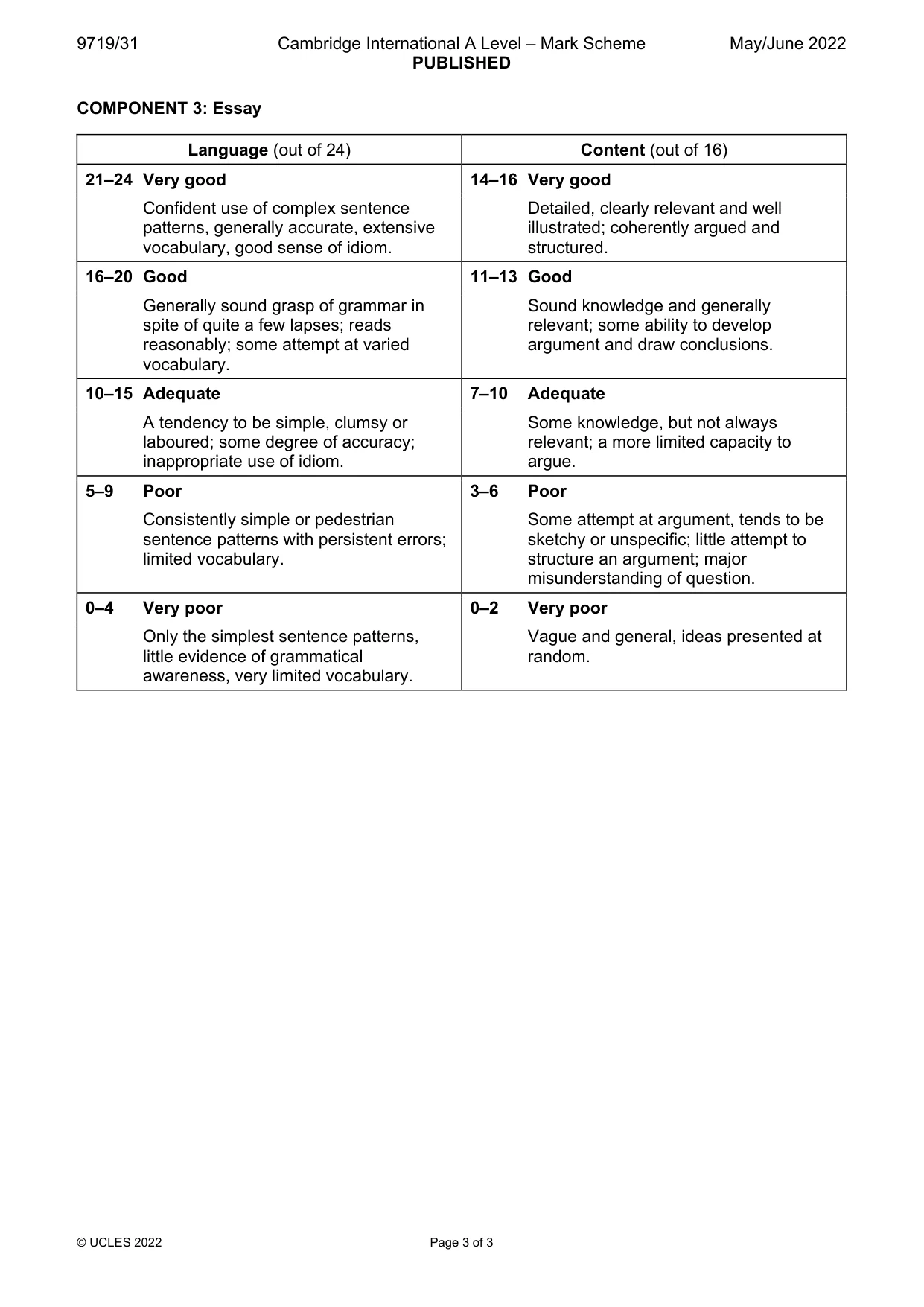
9719/31 Cambridge International A Level – Mark Scheme PUBLISHED May/June 2022 © UCLES 2022 Page 3 of 3 COMPONENT 3: Essay Language (out of 24) Content (out of 16) 21–24 Very good 14–16 Very good Confident use of complex sentence patterns, generally accurate, extensive vocabulary, good sense of idiom. Detailed, clearly relevant and well illustrated; coherently argued and structured. 16–20 Good 11–13 Good Generally sound grasp of grammar in spite of quite a few lapses; reads reasonably; some attempt at varied vocabulary. Sound knowledge and generally relevant; some ability to develop argument and draw conclusions. 10–15 Adequate 7–10 Adequate A tendency to be simple, clumsy or laboured; some degree of accuracy; inappropriate use of idiom. Some knowledge, but not always relevant; a more limited capacity to argue. 5–9 Poor 3–6 Poor Consistently simple or pedestrian sentence patterns with persistent errors; limited vocabulary. Some attempt at argument, tends to be sketchy or unspecific; little attempt to structure an argument; major misunderstanding of question. 0–4 Very poor 0–2 Very poor Only the simplest sentence patterns, little evidence of grammatical awareness, very limited vocabulary. Vague and general, ideas presented at random.
What you needed in this session
Cambridge’s own grade thresholds for 2022 May/June, Paper 3 · Variant 1. A higher threshold means an easier paper — the bar moves with how the cohort did.