Cambridge A Level Spanish (A Level only) 9719 — 2015 Oct/Nov Paper 2 · Variant 2
9719/22/O/N/15 · 70 marks · ≈79 min
The question paper and its mark scheme, free to read here and free to download. This is Cambridge’s own paper, exactly as it was sat.
Question paper8 pages

Mark scheme12 pages
Answers below. Sit the paper first if you are practising.
Paper as text
Question paper, page 1
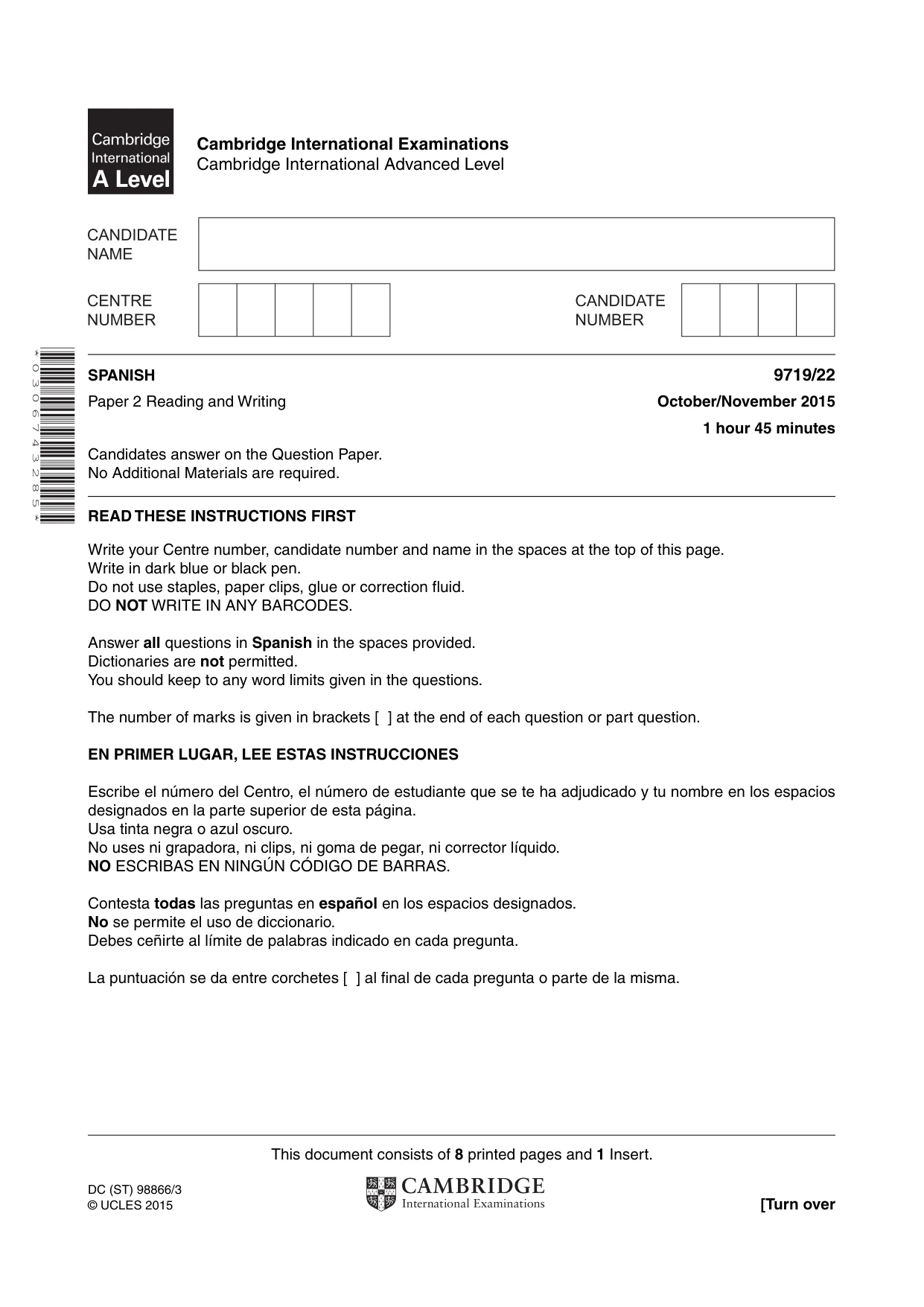
This document consists of 8 printed pages and 1 Insert. DC (ST) 98866/3 © UCLES 2015 [Turn over Cambridge International Examinations Cambridge International Advanced Level * 0 3 0 6 7 4 3 2 8 5 * SPANISH 9719/22 Paper 2 Reading and Writing October/November 2015 1 hour 45 minutes Candidates answer on the Question Paper. No Additional Materials are required. READ THESE INSTRUCTIONS FIRST Write your Centre number, candidate number and name in the spaces at the top of this page. Write in dark blue or black pen. Do not use staples, paper clips, glue or correction fluid. DO NOT WRITE IN ANY BARCODES. Answer all questions in Spanish in the spaces provided. Dictionaries are not permitted. You should keep to any word limits given in the questions. The number of marks is given in brackets [ ] at the end of each question or part question. EN PRIMER LUGAR, LEE ESTAS INSTRUCCIONES Escribe el número del Centro, el número de estudiante que se te ha adjudicado y tu nombre en los espacios designados en la parte superior de esta página. Usa tinta negra o azul oscuro. No uses ni grapadora, ni clips, ni goma de pegar, ni corrector líquido. NO ESCRIBAS EN NINGÚN CÓDIGO DE BARRAS. Contesta todas las preguntas en español en los espacios designados. No se permite el uso de diccionario. Debes ceñirte al límite de palabras indicado en cada pregunta. La puntuación se da entre corchetes [ ] al final de cada pregunta o parte de la misma.
Question paper, page 2
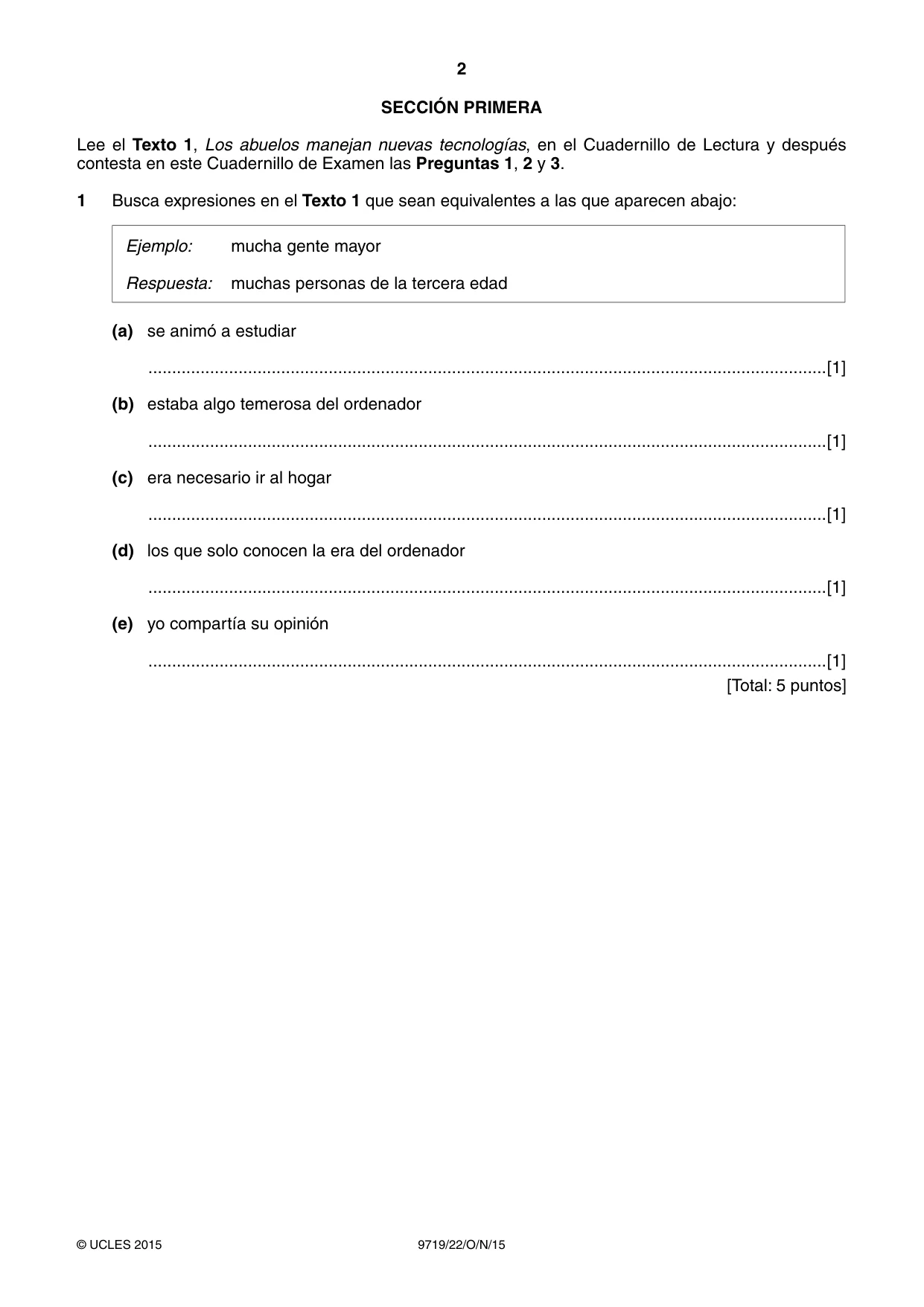
2 9719/22/O/N/15 © UCLES 2015 SECCIÓN PRIMERA Lee el Texto 1, Los abuelos manejan nuevas tecnologías, en el Cuadernillo de Lectura y después contesta en este Cuadernillo de Examen las Preguntas 1, 2 y 3. 1 Busca expresiones en el Texto 1 que sean equivalentes a las que aparecen abajo: Ejemplo: mucha gente mayor Respuesta: muchas personas de la tercera edad (a) se animó a estudiar …[1] (b) estaba algo temerosa del ordenador …[1] (c) era necesario ir al hogar …[1] (d) los que solo conocen la era del ordenador …[1] (e) yo compartía su opinión …[1] [Total: 5 puntos]
Question paper, page 3
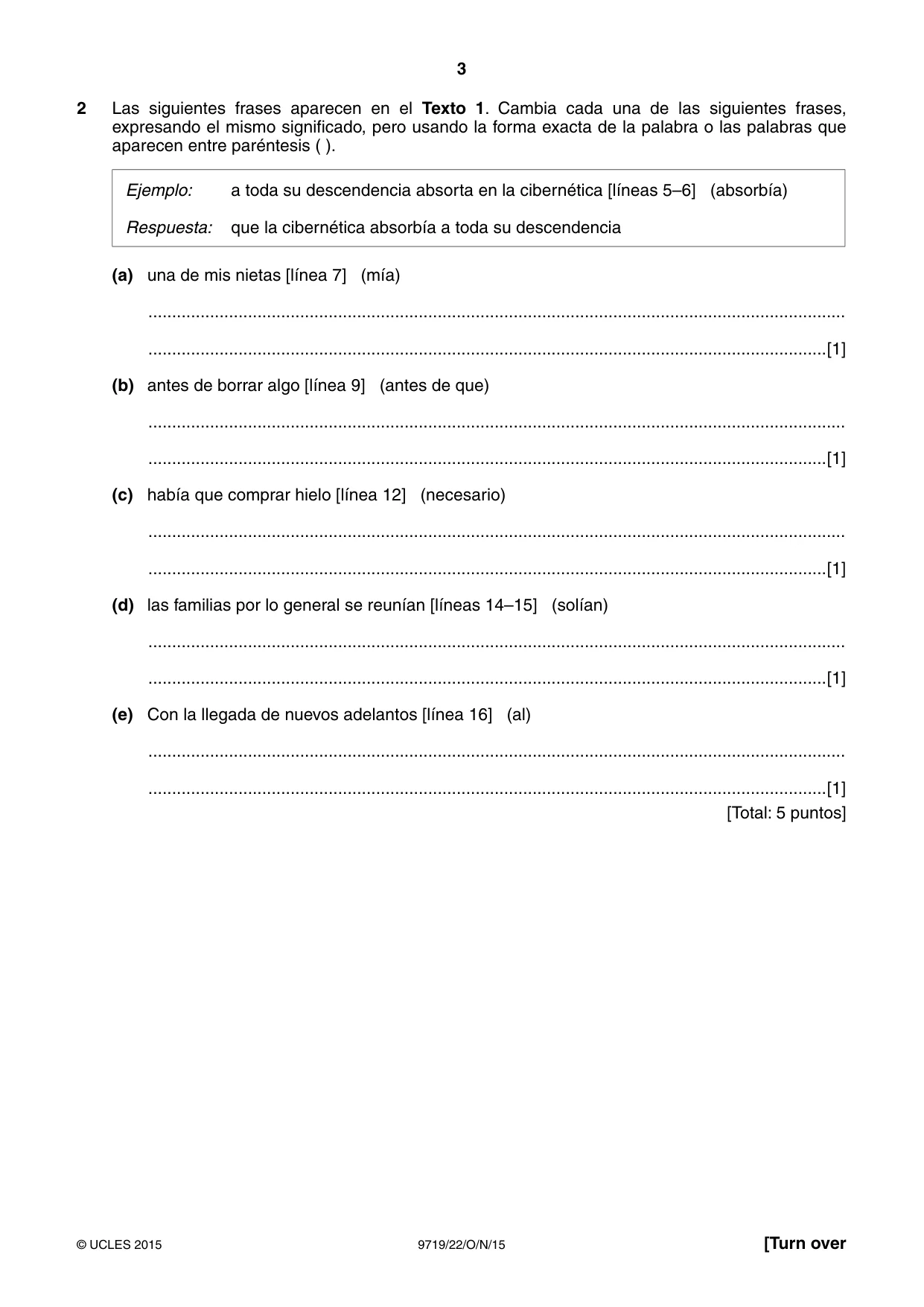
3 9719/22/O/N/15 © UCLES 2015 [Turn over 2 Las siguientes frases aparecen en el Texto 1. Cambia cada una de las siguientes frases, expresando el mismo significado, pero usando la forma exacta de la palabra o las palabras que aparecen entre paréntesis ( ). Ejemplo: a toda su descendencia absorta en la cibernética [líneas 5–6] (absorbía) Respuesta: que la cibernética absorbía a toda su descendencia (a) una de mis nietas [línea 7] (mía) … …[1] (b) antes de borrar algo [línea 9] (antes de que) … …[1] (c) había que comprar hielo [línea 12] (necesario) … …[1] (d) las familias por lo general se reunían [líneas 14–15] (solían) … …[1] (e) Con la llegada de nuevos adelantos [línea 16] (al) … …[1] [Total: 5 puntos]
Question paper, page 4
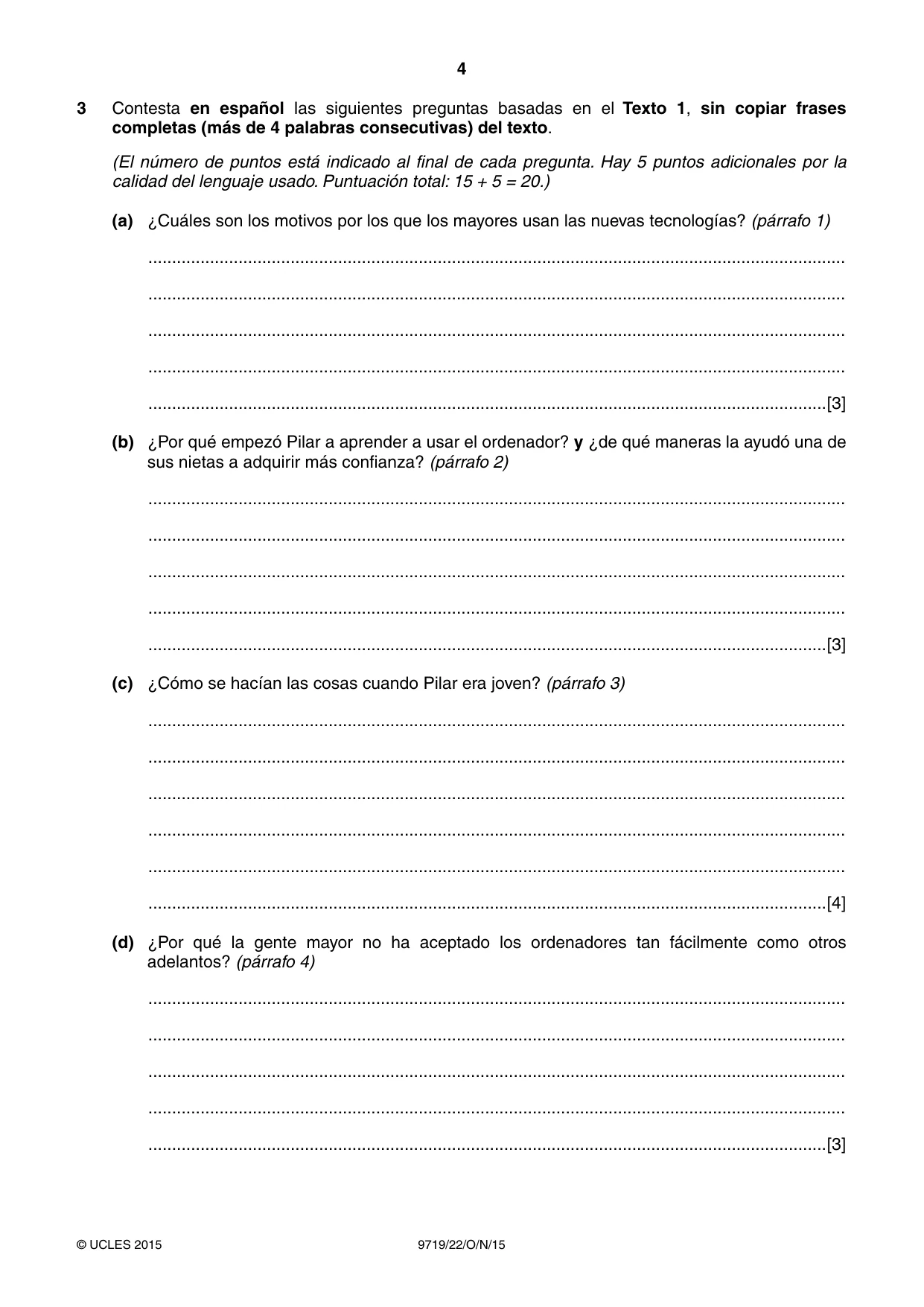
4 9719/22/O/N/15 © UCLES 2015 3 Contesta en español las siguientes preguntas basadas en el Texto 1, sin copiar frases completas (más de 4 palabras consecutivas) del texto. (El número de puntos está indicado al final de cada pregunta. Hay 5 puntos adicionales por la calidad del lenguaje usado. Puntuación total: 15 + 5 = 20.) (a) ¿Cuáles son los motivos por los que los mayores usan las nuevas tecnologías? (párrafo 1) … … … … …[3] (b) ¿Por qué empezó Pilar a aprender a usar el ordenador? y ¿de qué maneras la ayudó una de sus nietas a adquirir más confianza? (párrafo 2) … … … … …[3] (c) ¿Cómo se hacían las cosas cuando Pilar era joven? (párrafo 3) … … … … … …[4] (d) ¿Por qué la gente mayor no ha aceptado los ordenadores tan fácilmente como otros adelantos? (párrafo 4) … … … … …[3]
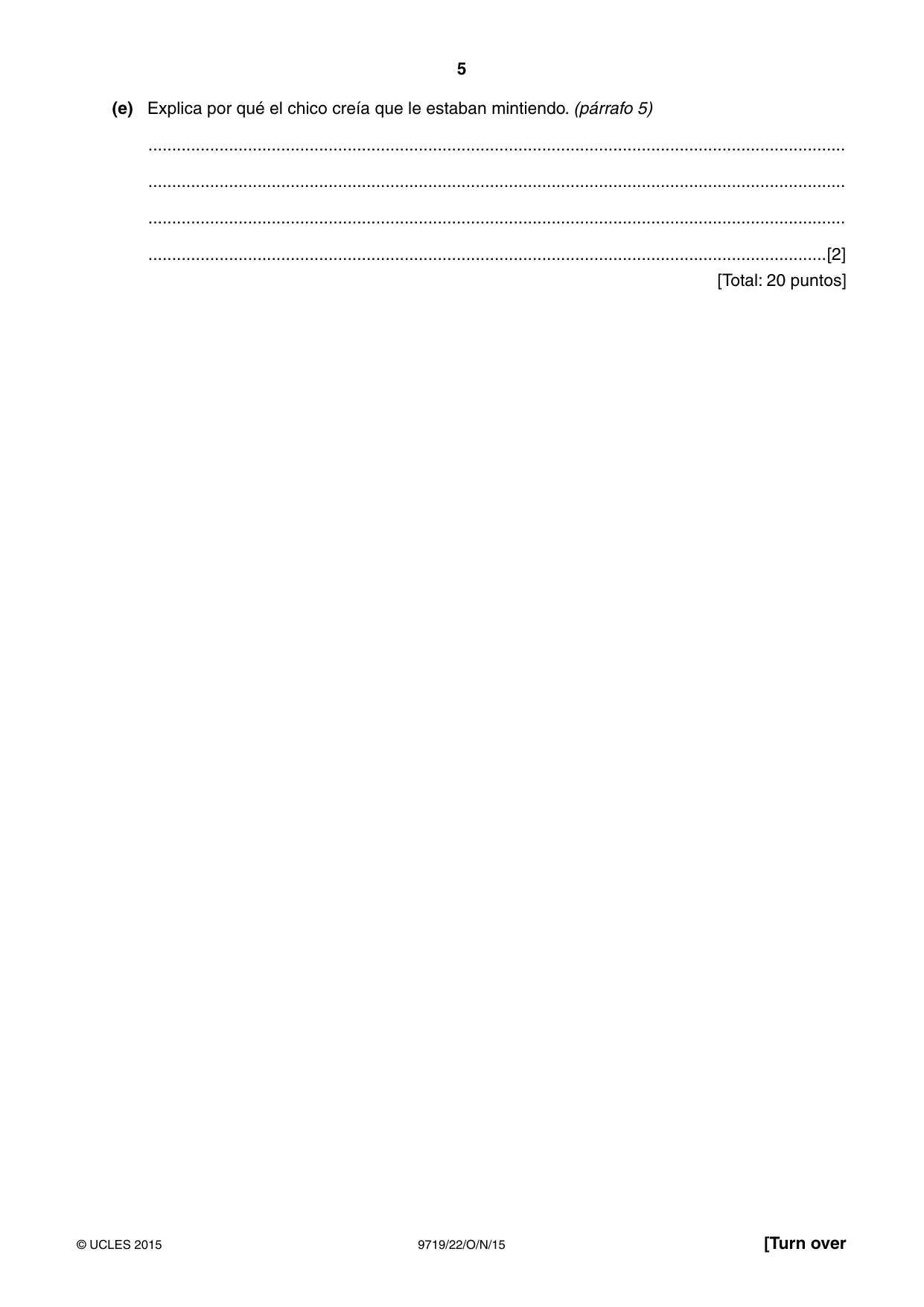
Question paper, page 5
5 9719/22/O/N/15 © UCLES 2015 [Turn over (e) Explica por qué el chico creía que le estaban mintiendo. (párrafo 5) … … … …[2] [Total: 20 puntos]
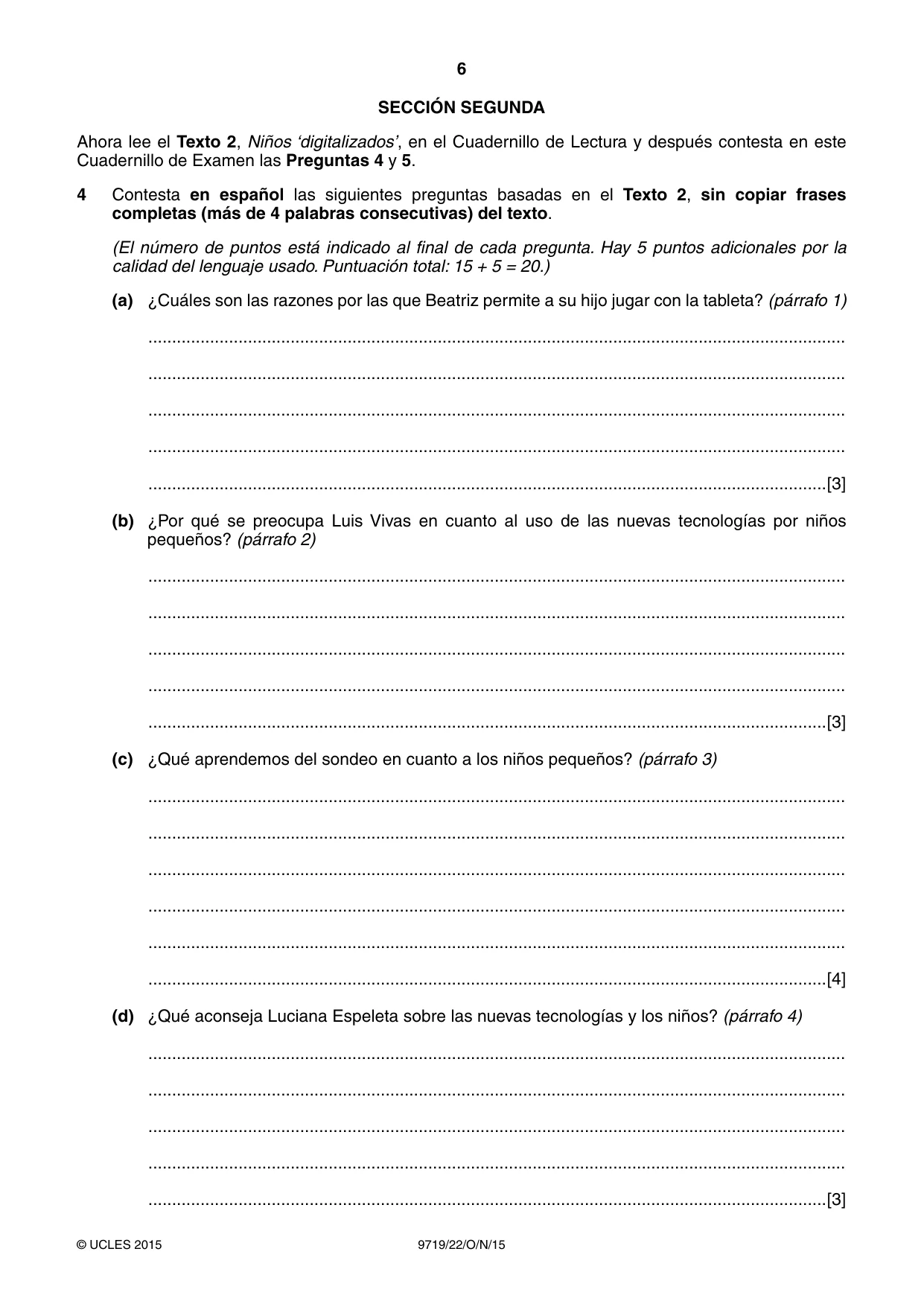
Question paper, page 6
6 9719/22/O/N/15 © UCLES 2015 SECCIÓN SEGUNDA Ahora lee el Texto 2, Niños ‘digitalizados’, en el Cuadernillo de Lectura y después contesta en este Cuadernillo de Examen las Preguntas 4 y 5. 4 Contesta en español las siguientes preguntas basadas en el Texto 2, sin copiar frases completas (más de 4 palabras consecutivas) del texto. (El número de puntos está indicado al final de cada pregunta. Hay 5 puntos adicionales por la calidad del lenguaje usado. Puntuación total: 15 + 5 = 20.) (a) ¿Cuáles son las razones por las que Beatriz permite a su hijo jugar con la tableta? (párrafo 1) … … … … …[3] (b) ¿Por qué se preocupa Luis Vivas en cuanto al uso de las nuevas tecnologías por niños pequeños? (párrafo 2) … … … … …[3] (c) ¿Qué aprendemos del sondeo en cuanto a los niños pequeños? (párrafo 3) … … … … … …[4] (d) ¿Qué aconseja Luciana Espeleta sobre las nuevas tecnologías y los niños? (párrafo 4) … … … … …[3]
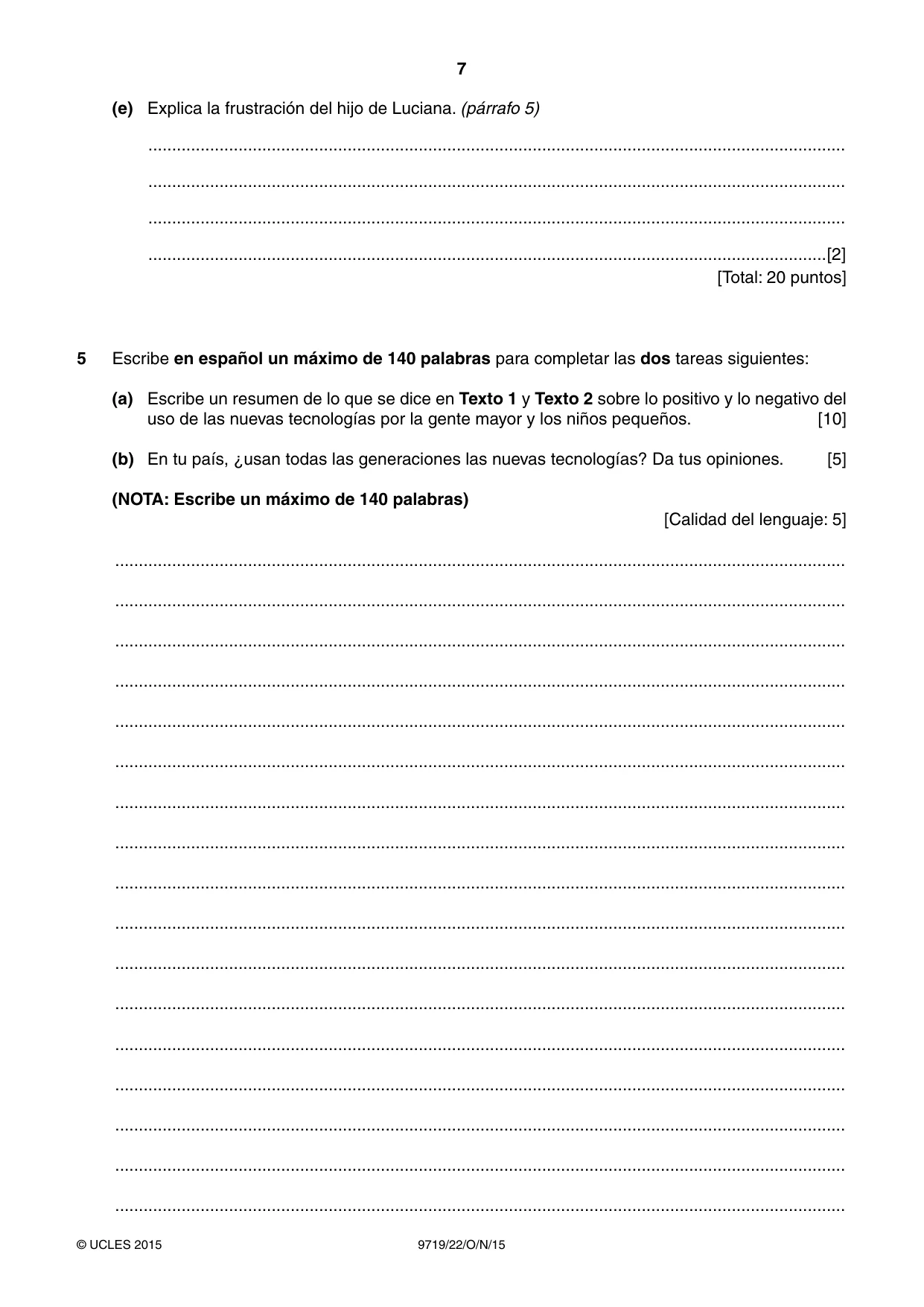
Question paper, page 7
7 9719/22/O/N/15 © UCLES 2015 (e) Explica la frustración del hijo de Luciana. (párrafo 5) … … … …[2] [Total: 20 puntos] 5 Escribe en español un máximo de 140 palabras para completar las dos tareas siguientes: (a) Escribe un resumen de lo que se dice en Texto 1 y Texto 2 sobre lo positivo y lo negativo del uso de las nuevas tecnologías por la gente mayor y los niños pequeños. [10] (b) En tu país, ¿usan todas las generaciones las nuevas tecnologías? Da tus opiniones. [5] (NOTA: Escribe un máximo de 140 palabras) [Calidad del lenguaje: 5] … … … … … … … … … … … … … … … … …
Question paper, page 8
8 9719/22/O/N/15 © UCLES 2015 Permission to reproduce items where third-party owned material protected by copyright is included has been sought and cleared where possible. Every reasonable effort has been made by the publisher (UCLES) to trace copyright holders, but if any items requiring clearance have unwittingly been included, the publisher will be pleased to make amends at the earliest possible opportunity. To avoid the issue of disclosure of answer-related information to candidates, all copyright acknowledgements are reproduced online in the Cambridge International Examinations Copyright Acknowledgements Booklet. This is produced for each series of examinations and is freely available to download at www.cie.org.uk after the live examination series. Cambridge International Examinations is part of the Cambridge Assessment Group. Cambridge Assessment is the brand name of University of Cambridge Local Examinations Syndicate (UCLES), which is itself a department of the University of Cambridge. … … … … … … … … … … … … … … … … … … … … … [Total: 20 puntos]
Mark scheme, page 1
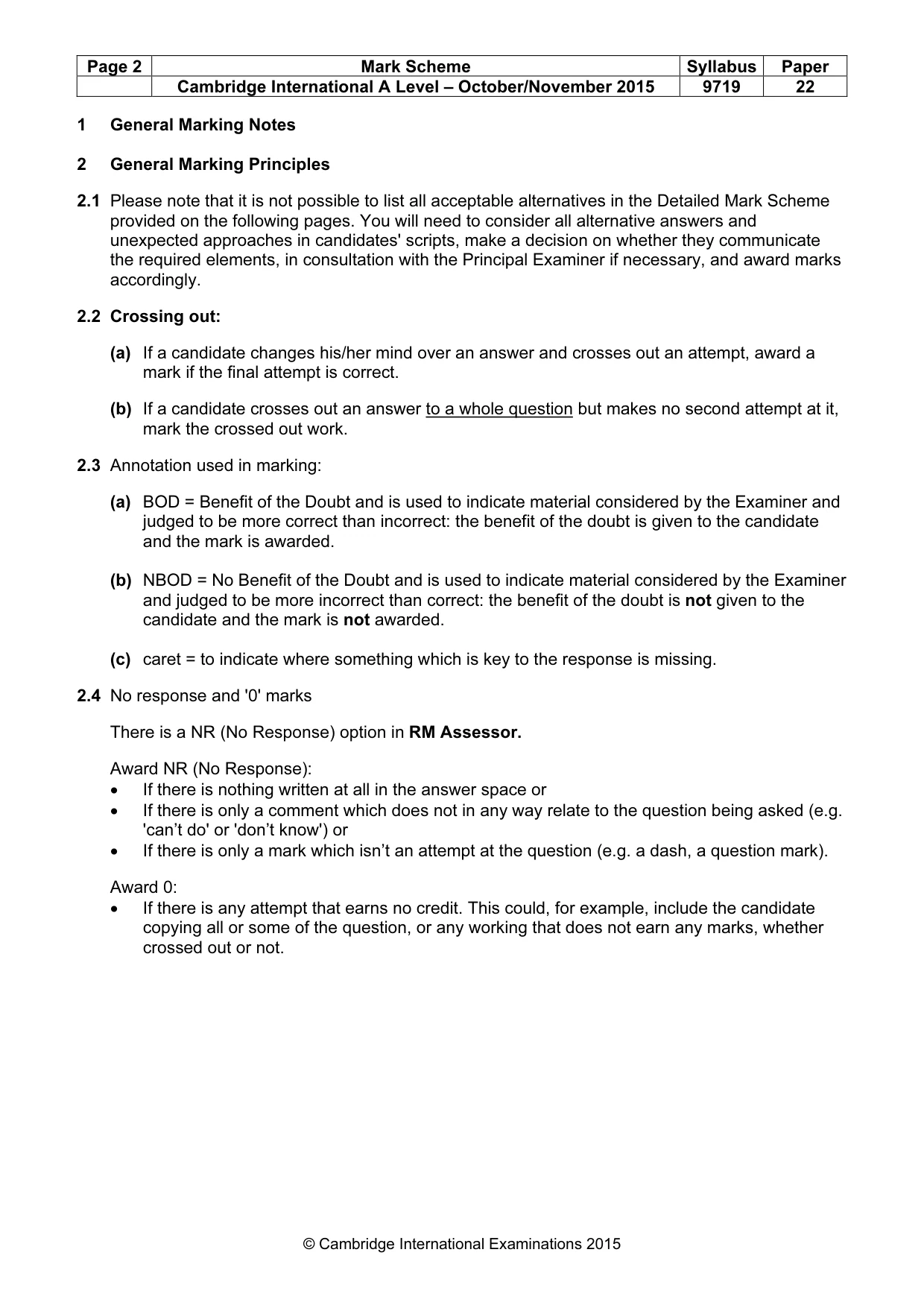
® IGCSE is the registered trademark of Cambridge International Examinations. CAMBRIDGE INTERNATIONAL EXAMINATIONS Cambridge International Advanced Level MARK SCHEME for the October/November 2015 series 9719 SPANISH 9719/22 Paper 2 (Reading and Writing), maximum raw mark 70 This mark scheme is published as an aid to teachers and candidates, to indicate the requirements of the examination. It shows the basis on which Examiners were instructed to award marks. It does not indicate the details of the discussions that took place at an Examiners’ meeting before marking began, which would have considered the acceptability of alternative answers. Mark schemes should be read in conjunction with the question paper and the Principal Examiner Report for Teachers. Cambridge will not enter into discussions about these mark schemes. Cambridge is publishing the mark schemes for the October/November 2015 series for most Cambridge IGCSE®, Cambridge International A and AS Level components and some Cambridge O Level components.
Mark scheme, page 2
Page 2 Mark Scheme Syllabus Paper Cambridge International A Level – October/November 2015 9719 22 © Cambridge International Examinations 2015 1 General Marking Notes 2 General Marking Principles 2.1 Please note that it is not possible to list all acceptable alternatives in the Detailed Mark Scheme provided on the following pages. You will need to consider all alternative answers and unexpected approaches in candidates' scripts, make a decision on whether they communicate the required elements, in consultation with the Principal Examiner if necessary, and award marks accordingly. 2.2 Crossing out: (a) If a candidate changes his/her mind over an answer and crosses out an attempt, award a mark if the final attempt is correct. (b) If a candidate crosses out an answer to a whole question but makes no second attempt at it, mark the crossed out work. 2.3 Annotation used in marking: (a) BOD = Benefit of the Doubt and is used to indicate material considered by the Examiner and judged to be more correct than incorrect: the benefit of the doubt is given to the candidate and the mark is awarded. (b) NBOD = No Benefit of the Doubt and is used to indicate material considered by the Examiner and judged to be more incorrect than correct: the benefit of the doubt is not given to the candidate and the mark is not awarded. (c) caret = to indicate where something which is key to the response is missing. 2.4 No response and '0' marks There is a NR (No Response) option in RM Assessor. Award NR (No Response): • If there is nothing written at all in the answer space or • If there is only a comment which does not in any way relate to the question being asked (e.g. 'can’t do' or 'don’t know') or • If there is only a mark which isn’t an attempt at the question (e.g. a dash, a question mark). Award 0: • If there is any attempt that earns no credit. This could, for example, include the candidate copying all or some of the question, or any working that does not earn any marks, whether crossed out or not.
Mark scheme, page 3
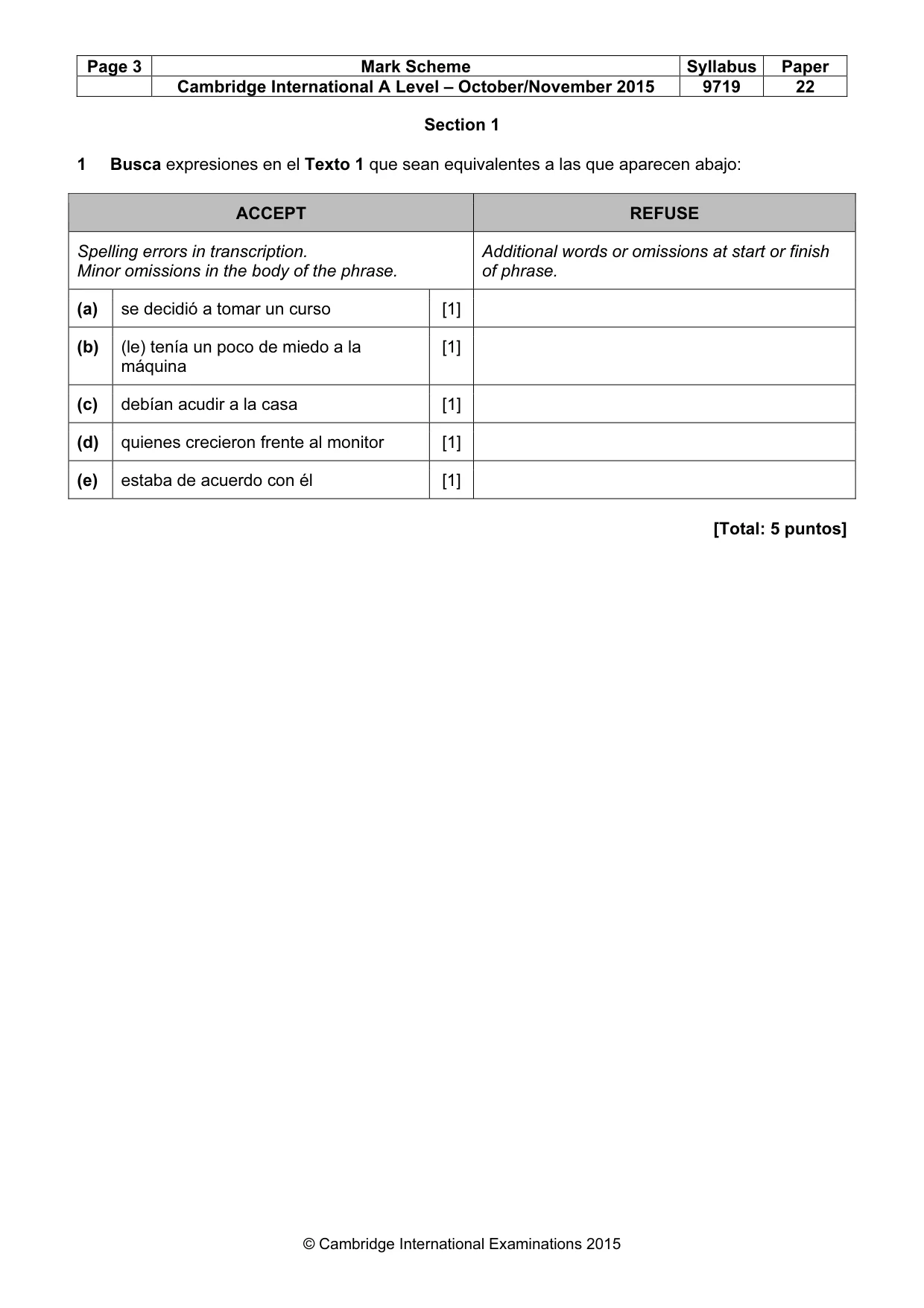
Page 3 Mark Scheme Syllabus Paper Cambridge International A Level – October/November 2015 9719 22 © Cambridge International Examinations 2015 Section 1 1 Busca expresiones en el Texto 1 que sean equivalentes a las que aparecen abajo: ACCEPT REFUSE Spelling errors in transcription. Minor omissions in the body of the phrase. Additional words or omissions at start or finish of phrase. (a) se decidió a tomar un curso [1] (b) (le) tenía un poco de miedo a la máquina [1] (c) debían acudir a la casa [1] (d) quienes crecieron frente al monitor [1] (e) estaba de acuerdo con él [1] [Total: 5 puntos]
Mark scheme, page 4
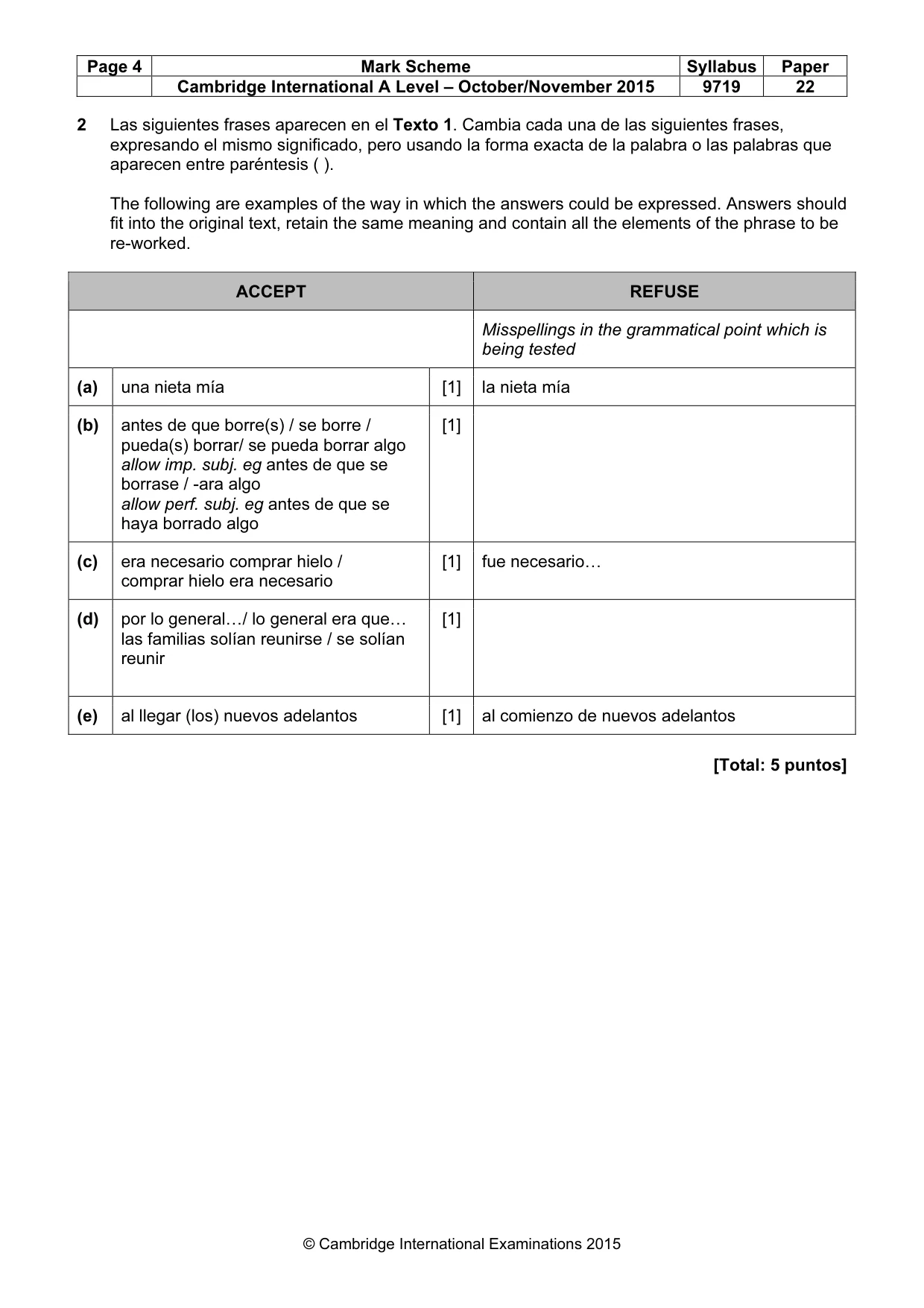
Page 4 Mark Scheme Syllabus Paper Cambridge International A Level – October/November 2015 9719 22 © Cambridge International Examinations 2015 2 Las siguientes frases aparecen en el Texto 1. Cambia cada una de las siguientes frases, expresando el mismo significado, pero usando la forma exacta de la palabra o las palabras que aparecen entre paréntesis ( ). The following are examples of the way in which the answers could be expressed. Answers should fit into the original text, retain the same meaning and contain all the elements of the phrase to be re-worked. ACCEPT REFUSE Misspellings in the grammatical point which is being tested (a) una nieta mía [1] la nieta mía (b) antes de que borre(s) / se borre / pueda(s) borrar/ se pueda borrar algo allow imp. subj. eg antes de que se borrase / -ara algo allow perf. subj. eg antes de que se haya borrado algo [1] (c) era necesario comprar hielo / comprar hielo era necesario [1] fue necesario… (d) por lo general…/ lo general era que… las familias solían reunirse / se solían reunir [1] (e) al llegar (los) nuevos adelantos [1] al comienzo de nuevos adelantos [Total: 5 puntos]
Mark scheme, page 5
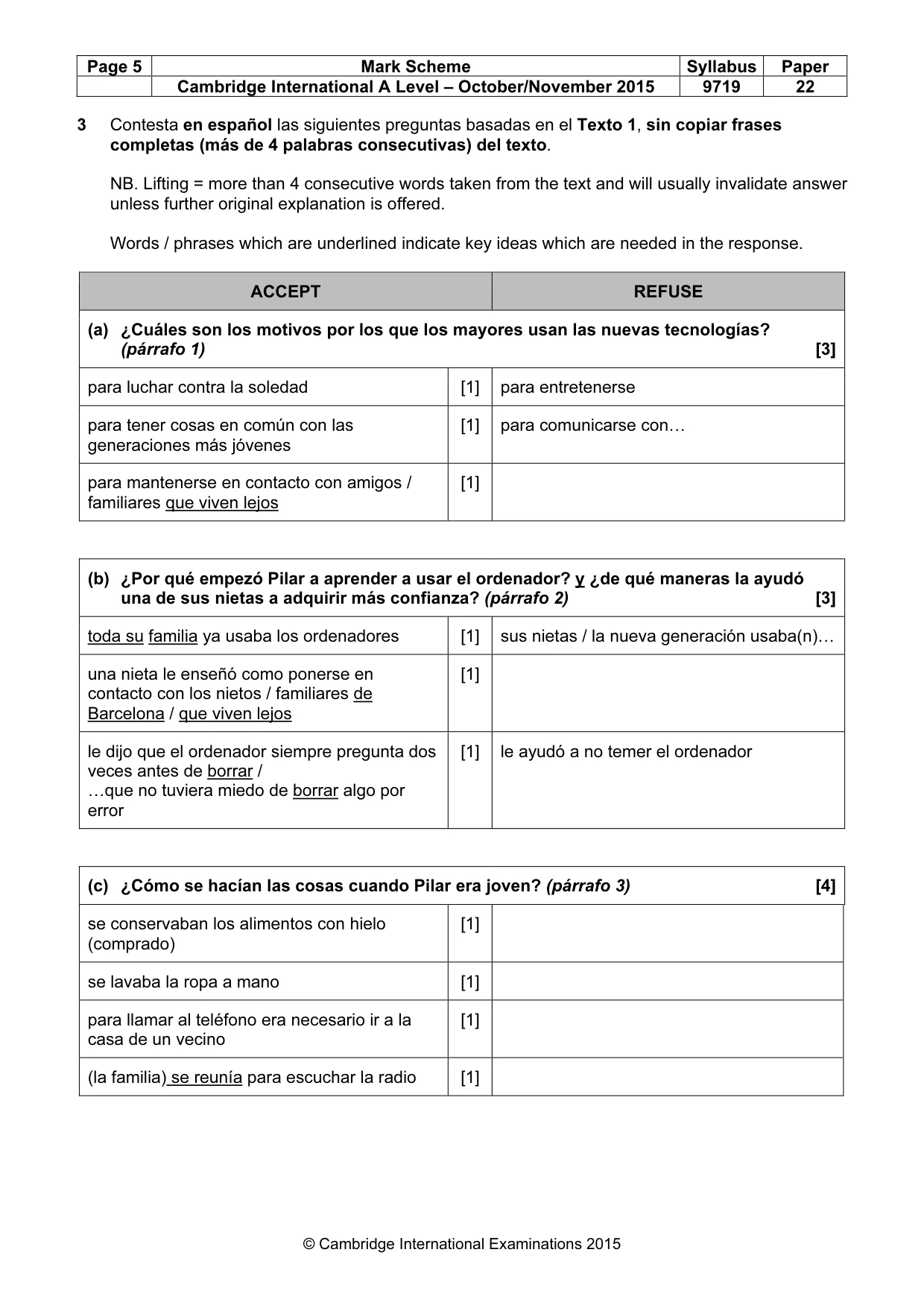
Page 5 Mark Scheme Syllabus Paper Cambridge International A Level – October/November 2015 9719 22 © Cambridge International Examinations 2015 3 Contesta en español las siguientes preguntas basadas en el Texto 1, sin copiar frases completas (más de 4 palabras consecutivas) del texto. NB. Lifting = more than 4 consecutive words taken from the text and will usually invalidate answer unless further original explanation is offered. Words / phrases which are underlined indicate key ideas which are needed in the response. ACCEPT REFUSE (a) ¿Cuáles son los motivos por los que los mayores usan las nuevas tecnologías? (párrafo 1) [3] para luchar contra la soledad [1] para entretenerse para tener cosas en común con las generaciones más jóvenes [1] para comunicarse con… para mantenerse en contacto con amigos / familiares que viven lejos [1] (b) ¿Por qué empezó Pilar a aprender a usar el ordenador? y ¿de qué maneras la ayudó una de sus nietas a adquirir más confianza? (párrafo 2) [3] toda su familia ya usaba los ordenadores [1] sus nietas / la nueva generación usaba(n)… una nieta le enseñó como ponerse en contacto con los nietos / familiares de Barcelona / que viven lejos [1] le dijo que el ordenador siempre pregunta dos veces antes de borrar / …que no tuviera miedo de borrar algo por error [1] le ayudó a no temer el ordenador (c) ¿Cómo se hacían las cosas cuando Pilar era joven? (párrafo 3) [4] se conservaban los alimentos con hielo (comprado) [1] se lavaba la ropa a mano [1] para llamar al teléfono era necesario ir a la casa de un vecino [1] (la familia) se reunía para escuchar la radio [1]
Mark scheme, page 6
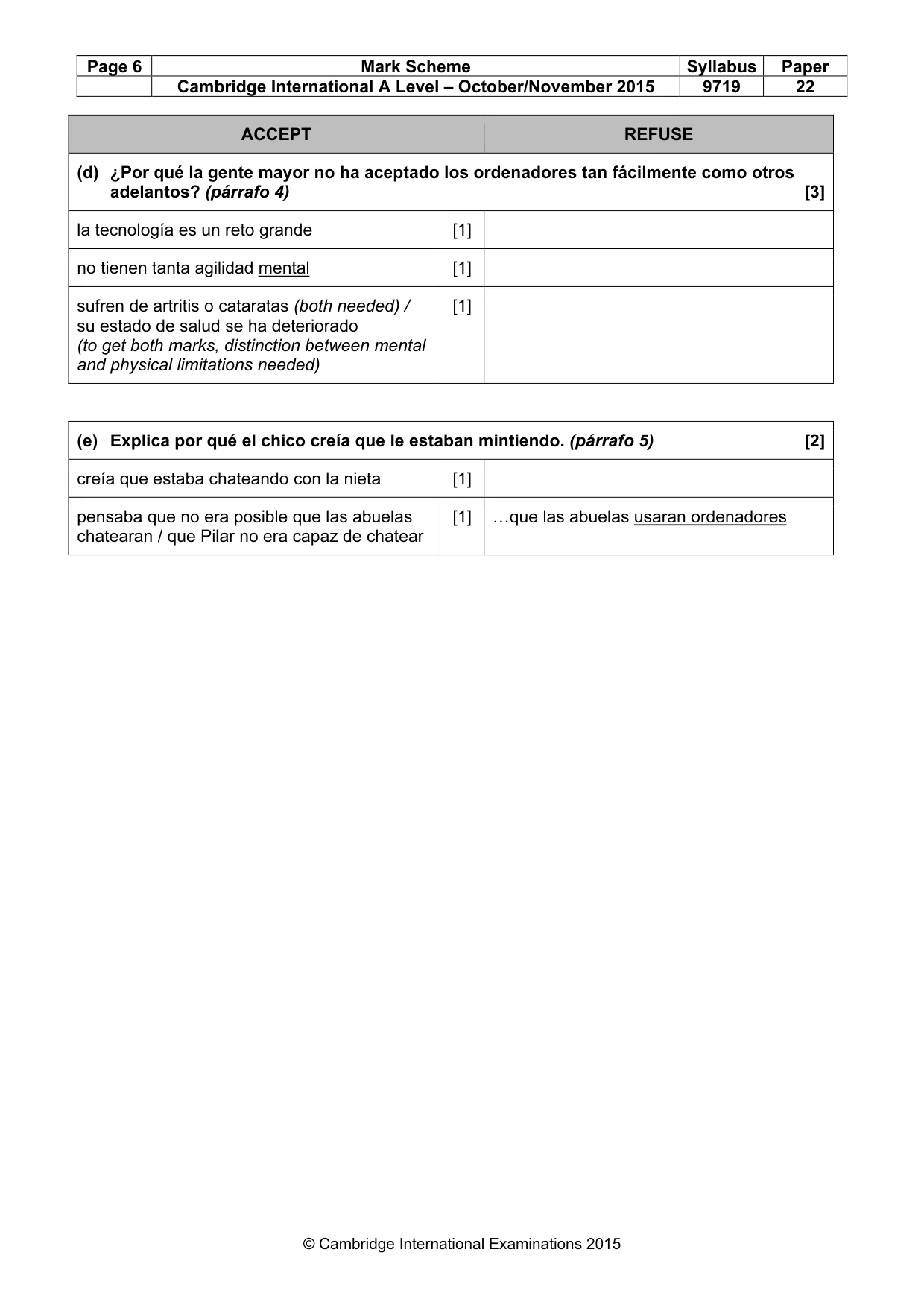
Page 6 Mark Scheme Syllabus Paper Cambridge International A Level – October/November 2015 9719 22 © Cambridge International Examinations 2015 ACCEPT REFUSE (d) ¿Por qué la gente mayor no ha aceptado los ordenadores tan fácilmente como otros adelantos? (párrafo 4) [3] la tecnología es un reto grande [1] no tienen tanta agilidad mental [1] sufren de artritis o cataratas (both needed) / su estado de salud se ha deteriorado (to get both marks, distinction between mental and physical limitations needed) [1] (e) Explica por qué el chico creía que le estaban mintiendo. (párrafo 5) [2] creía que estaba chateando con la nieta [1] pensaba que no era posible que las abuelas chatearan / que Pilar no era capaz de chatear [1] …que las abuelas usaran ordenadores
Mark scheme, page 7
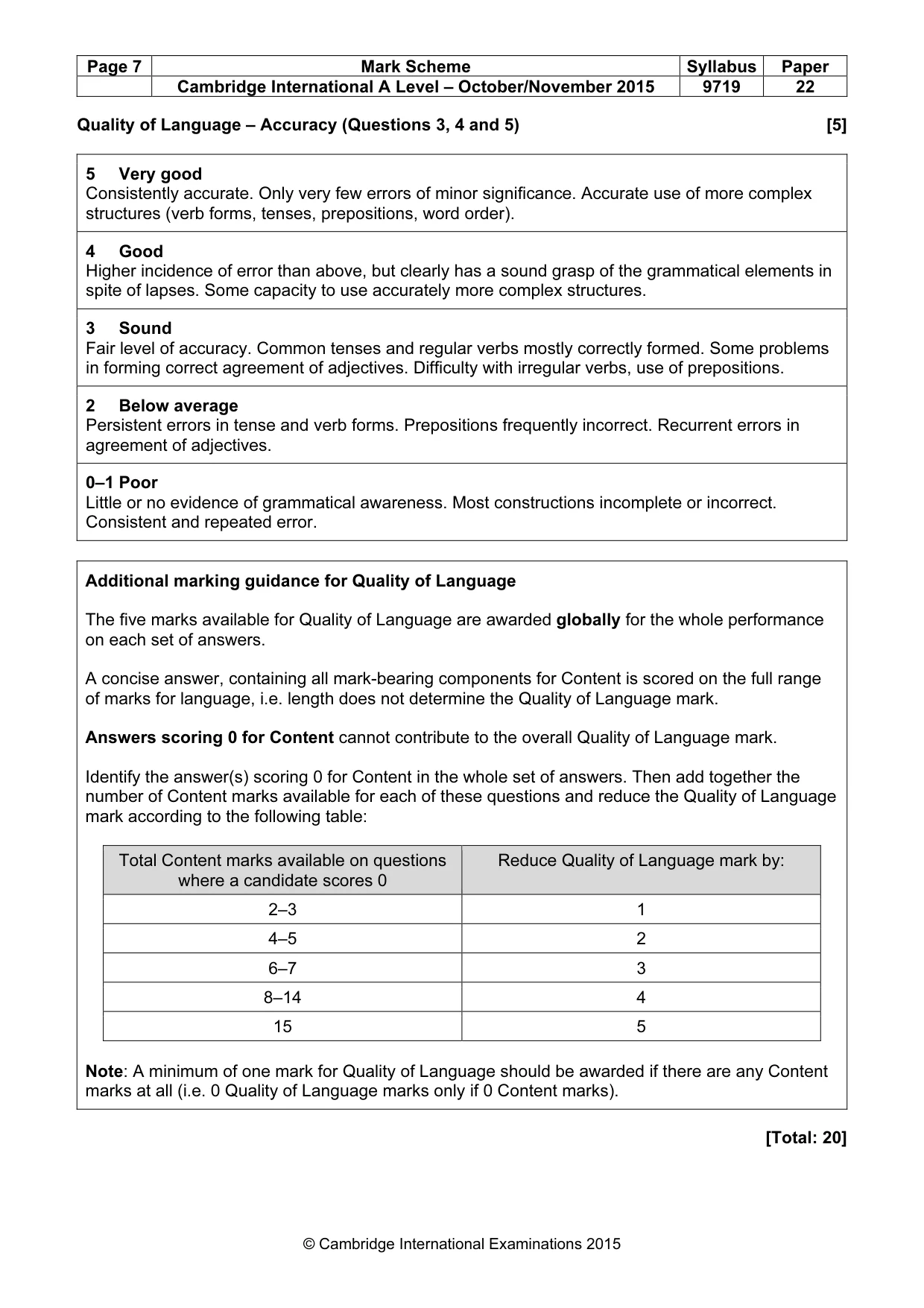
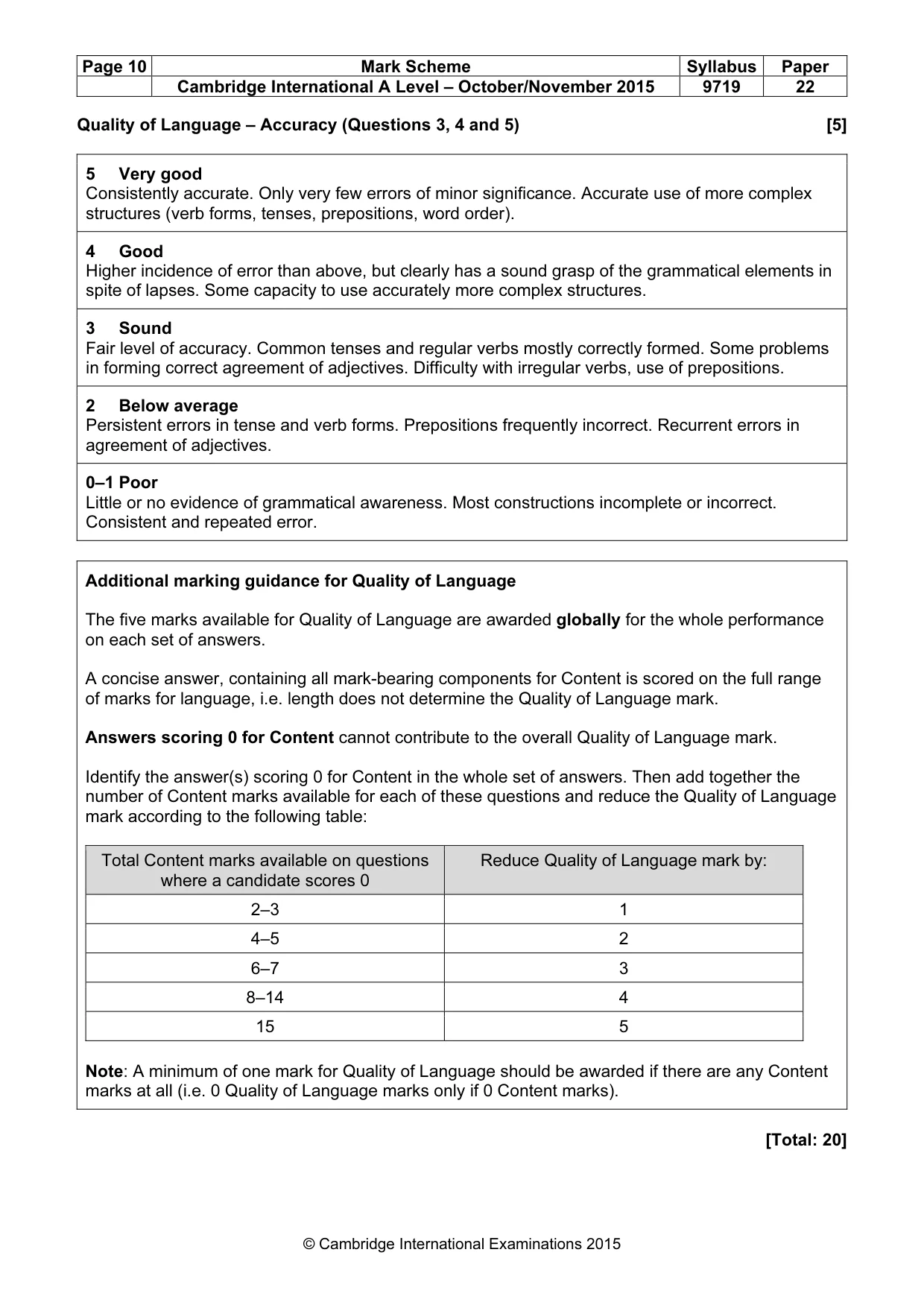
Page 7 Mark Scheme Syllabus Paper Cambridge International A Level – October/November 2015 9719 22 © Cambridge International Examinations 2015 Quality of Language – Accuracy (Questions 3, 4 and 5) [5] 5 Very good Consistently accurate. Only very few errors of minor significance. Accurate use of more complex structures (verb forms, tenses, prepositions, word order). 4 Good Higher incidence of error than above, but clearly has a sound grasp of the grammatical elements in spite of lapses. Some capacity to use accurately more complex structures. 3 Sound Fair level of accuracy. Common tenses and regular verbs mostly correctly formed. Some problems in forming correct agreement of adjectives. Difficulty with irregular verbs, use of prepositions. 2 Below average Persistent errors in tense and verb forms. Prepositions frequently incorrect. Recurrent errors in agreement of adjectives. 0–1 Poor Little or no evidence of grammatical awareness. Most constructions incomplete or incorrect. Consistent and repeated error. Additional marking guidance for Quality of Language The five marks available for Quality of Language are awarded globally for the whole performance on each set of answers. A concise answer, containing all mark-bearing components for Content is scored on the full range of marks for language, i.e. length does not determine the Quality of Language mark. Answers scoring 0 for Content cannot contribute to the overall Quality of Language mark. Identify the answer(s) scoring 0 for Content in the whole set of answers. Then add together the number of Content marks available for each of these questions and reduce the Quality of Language mark according to the following table: Total Content marks available on questions where a candidate scores 0 Reduce Quality of Language mark by: 2–3 1 4–5 2 6–7 3 8–14 4 15 5 Note: A minimum of one mark for Quality of Language should be awarded if there are any Content marks at all (i.e. 0 Quality of Language marks only if 0 Content marks). [Total: 20]
Mark scheme, page 8
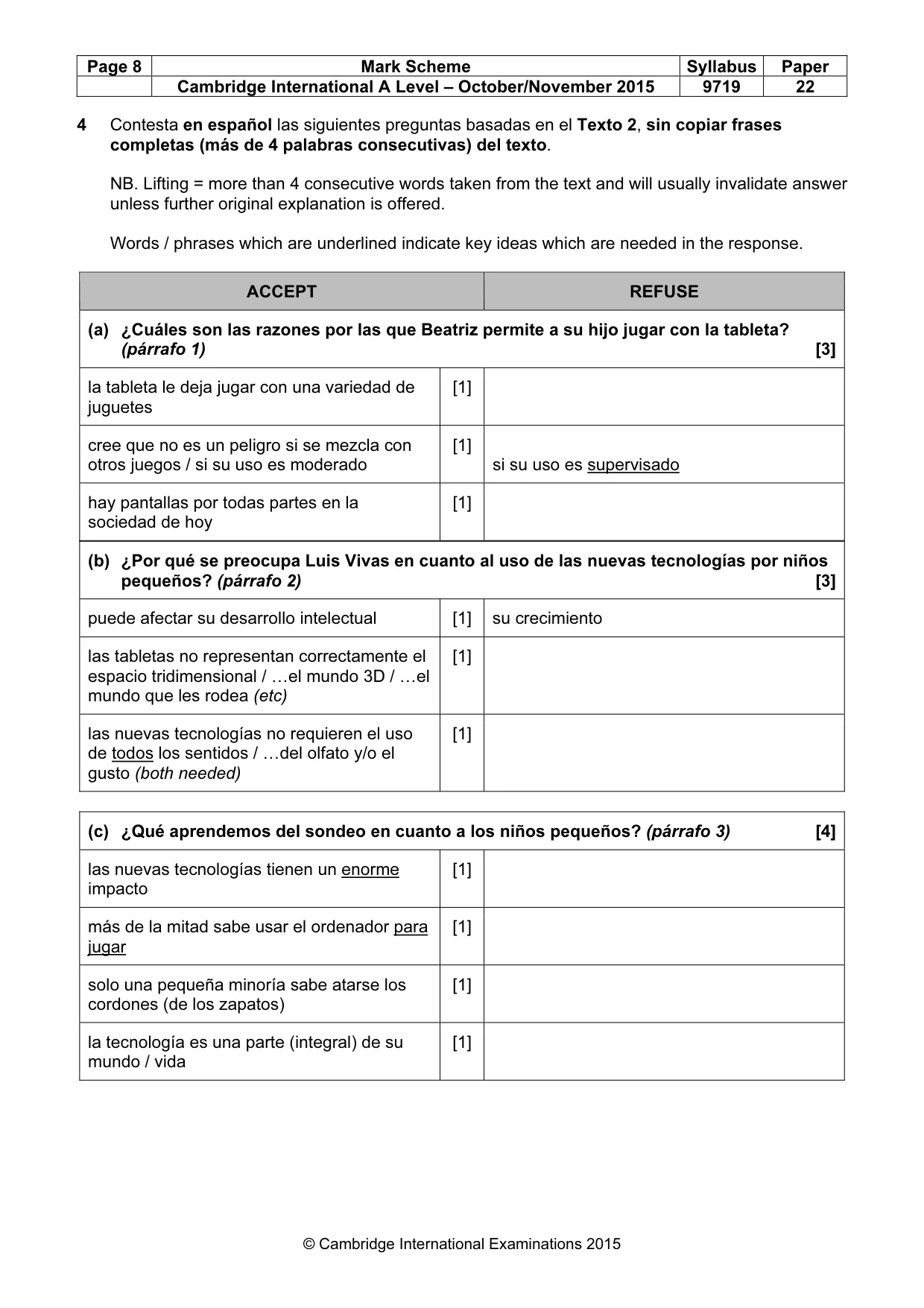
Page 8 Mark Scheme Syllabus Paper Cambridge International A Level – October/November 2015 9719 22 © Cambridge International Examinations 2015 4 Contesta en español las siguientes preguntas basadas en el Texto 2, sin copiar frases completas (más de 4 palabras consecutivas) del texto. NB. Lifting = more than 4 consecutive words taken from the text and will usually invalidate answer unless further original explanation is offered. Words / phrases which are underlined indicate key ideas which are needed in the response. ACCEPT REFUSE (a) ¿Cuáles son las razones por las que Beatriz permite a su hijo jugar con la tableta? (párrafo 1) [3] la tableta le deja jugar con una variedad de juguetes [1] cree que no es un peligro si se mezcla con otros juegos / si su uso es moderado [1] si su uso es supervisado hay pantallas por todas partes en la sociedad de hoy [1] (b) ¿Por qué se preocupa Luis Vivas en cuanto al uso de las nuevas tecnologías por niños pequeños? (párrafo 2) [3] puede afectar su desarrollo intelectual [1] su crecimiento las tabletas no representan correctamente el espacio tridimensional / …el mundo 3D / …el mundo que les rodea (etc) [1] las nuevas tecnologías no requieren el uso de todos los sentidos / …del olfato y/o el gusto (both needed) [1] (c) ¿Qué aprendemos del sondeo en cuanto a los niños pequeños? (párrafo 3) [4] las nuevas tecnologías tienen un enorme impacto [1] más de la mitad sabe usar el ordenador para jugar [1] solo una pequeña minoría sabe atarse los cordones (de los zapatos) [1] la tecnología es una parte (integral) de su mundo / vida [1]
Mark scheme, page 9
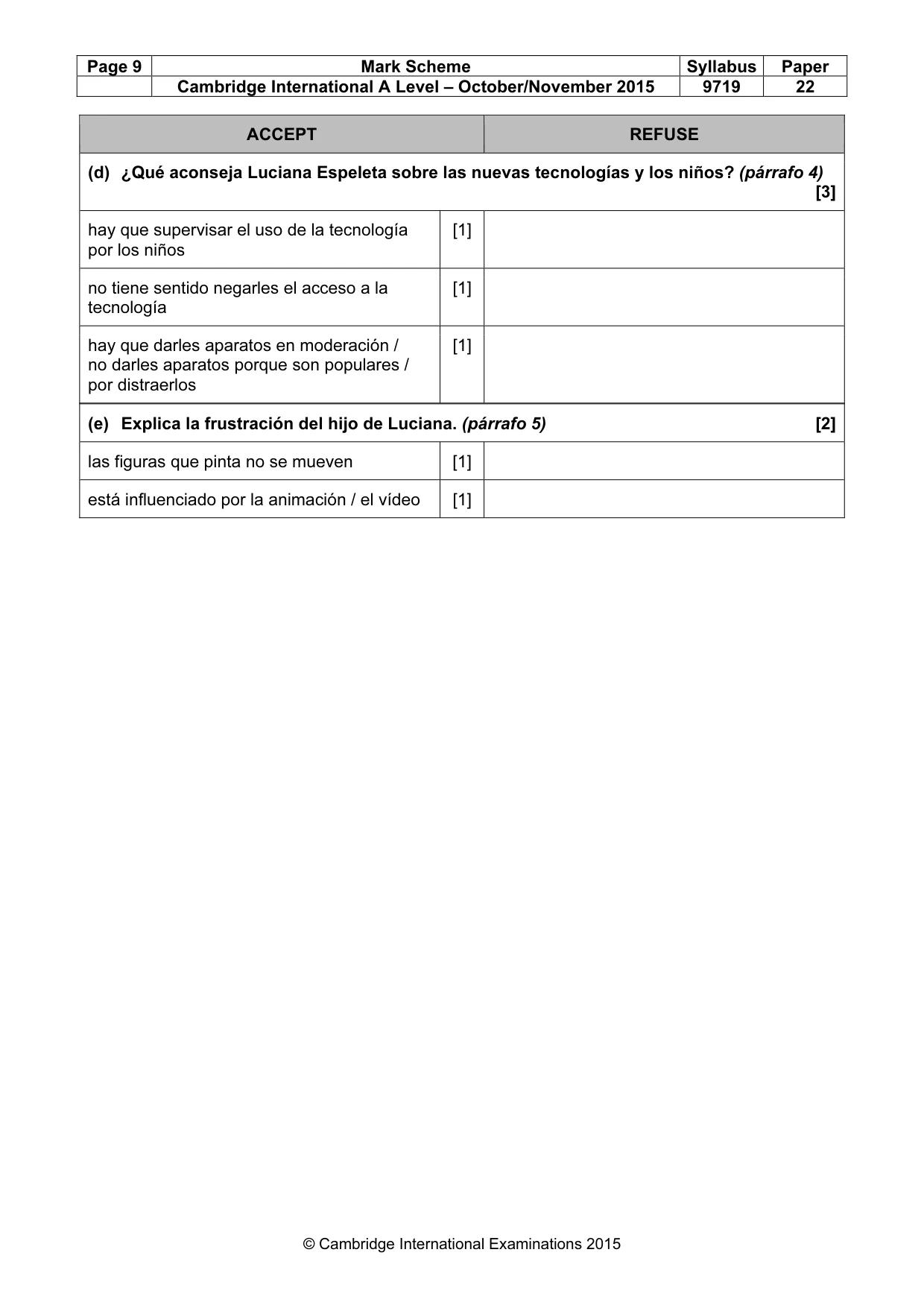
Page 9 Mark Scheme Syllabus Paper Cambridge International A Level – October/November 2015 9719 22 © Cambridge International Examinations 2015 ACCEPT REFUSE (d) ¿Qué aconseja Luciana Espeleta sobre las nuevas tecnologías y los niños? (párrafo 4) [3] hay que supervisar el uso de la tecnología por los niños [1] no tiene sentido negarles el acceso a la tecnología [1] hay que darles aparatos en moderación / no darles aparatos porque son populares / por distraerlos [1] (e) Explica la frustración del hijo de Luciana. (párrafo 5) [2] las figuras que pinta no se mueven [1] está influenciado por la animación / el vídeo [1]
Mark scheme, page 10
Page 10 Mark Scheme Syllabus Paper Cambridge International A Level – October/November 2015 9719 22 © Cambridge International Examinations 2015 Quality of Language – Accuracy (Questions 3, 4 and 5) [5] 5 Very good Consistently accurate. Only very few errors of minor significance. Accurate use of more complex structures (verb forms, tenses, prepositions, word order). 4 Good Higher incidence of error than above, but clearly has a sound grasp of the grammatical elements in spite of lapses. Some capacity to use accurately more complex structures. 3 Sound Fair level of accuracy. Common tenses and regular verbs mostly correctly formed. Some problems in forming correct agreement of adjectives. Difficulty with irregular verbs, use of prepositions. 2 Below average Persistent errors in tense and verb forms. Prepositions frequently incorrect. Recurrent errors in agreement of adjectives. 0–1 Poor Little or no evidence of grammatical awareness. Most constructions incomplete or incorrect. Consistent and repeated error. Additional marking guidance for Quality of Language The five marks available for Quality of Language are awarded globally for the whole performance on each set of answers. A concise answer, containing all mark-bearing components for Content is scored on the full range of marks for language, i.e. length does not determine the Quality of Language mark. Answers scoring 0 for Content cannot contribute to the overall Quality of Language mark. Identify the answer(s) scoring 0 for Content in the whole set of answers. Then add together the number of Content marks available for each of these questions and reduce the Quality of Language mark according to the following table: Total Content marks available on questions where a candidate scores 0 Reduce Quality of Language mark by: 2–3 1 4–5 2 6–7 3 8–14 4 15 5 Note: A minimum of one mark for Quality of Language should be awarded if there are any Content marks at all (i.e. 0 Quality of Language marks only if 0 Content marks). [Total: 20]
Mark scheme, page 11
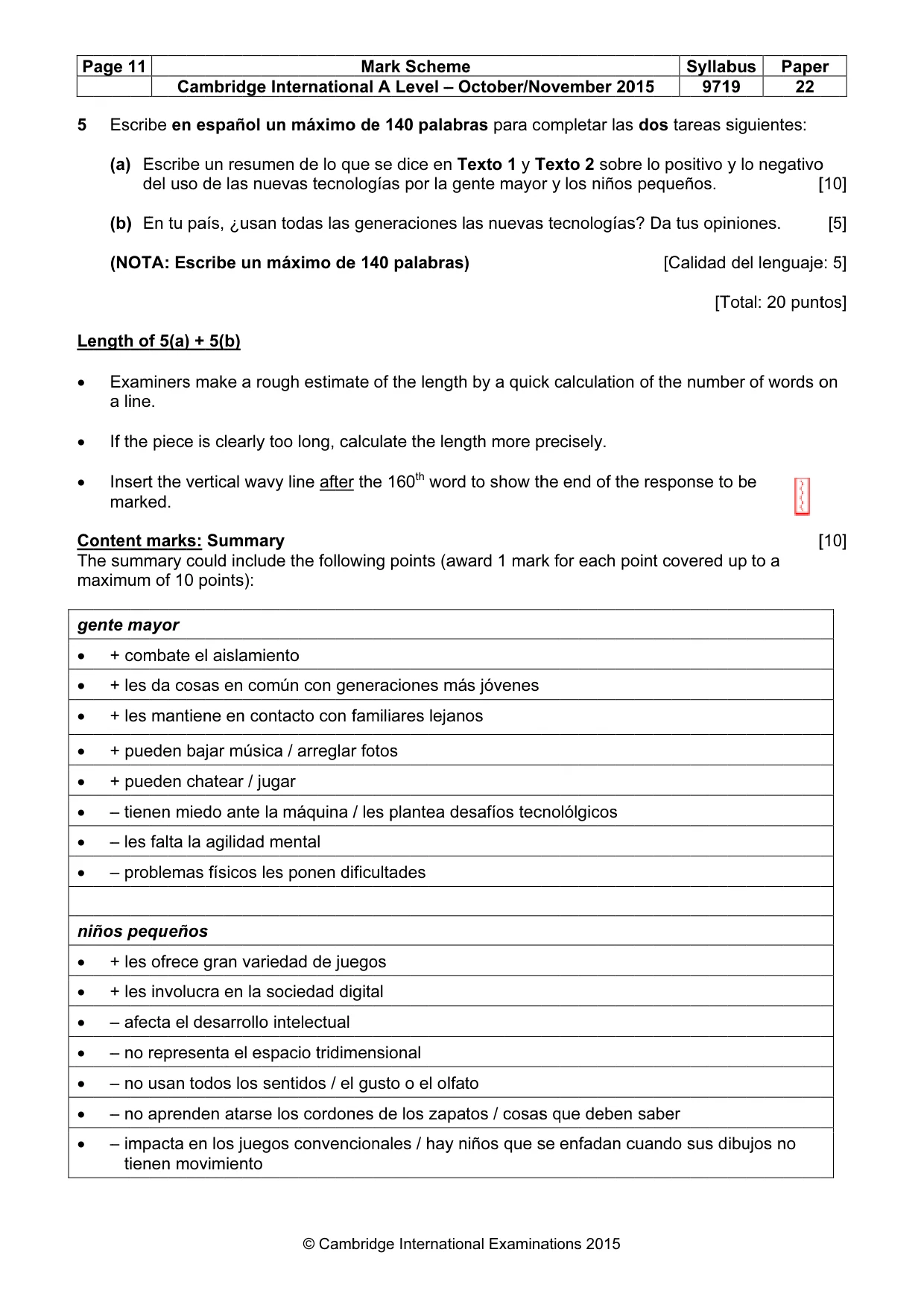
P 5 Le • • • Co Th ma ge • • • • • • • • niñ • • • • • • • ag E ( ( ( eng E a I I m ont he s axi ent + + + + + – – – ño + + – – – – – ge 1 Esc (a) (b) (NO gth Exa a li If th Ins ma ten sum mu te m + c + le + le + p + p – ti – le – p os p + le + le – a – n – n – n – im ti 11 crib E d ) E OT h of am ine he sert arke nt m mm um ma com es es pue pue ien es pro peq es es afec no r no u no a mp ien be Esc del En TA: f 5 mine e. pie t th ed ma ma m of ayo mba da ma ede ede nen fal ble qu ofr inv cta rep usa ap pac nen C en crib us tu : Es 5(a) ers ece he v . ark ry f 10 or ate a co ant en en n m ta ema ueñ rec vol a el pre an ren cta n m Cam n e be so d pa sc ) + s m e is ver ks: cou 0 p e e osa tien baj cha mied la as ños ce g uc l de ese tod nde en mov mb sp un de aís, rib 5( mak s c rtic Su uld poin l ai as ne jar ate do ag fís s gra ra esa nta dos en n lo vim rid pañ re las ¿u be u (b) ke a lea cal um d in nts isla en en r m ear an ilid sico an v en arro a e s lo ata os j mien dge ñol esu s n usa un a r arly wa mma nclu s): am co n co ús r / j nte dad os va la ollo el e os ars ue nto e In un me nue an m rou y to avy ary ude mien om ont ica ug la d m les rie so o in esp se se l ego o nte n m en eva tod máx gh oo y lin y e th nto ún tac a / a ar má men s po da ocie nte ac enti os os c ern © máx de as t das xim es lon ne he o co cto arr áqu nta on d d eda elec io t do co con nati Ca xim e lo tec s la mo stim ng, aft fol on co reg uin l en de j ad ctu trid s / ord nve ion amb mo qu no as de ma ca ter low ge on f glar na / dif jue dig al dim el on enc M nal brid o de ue log ge e 14 te alcu th win ene fam r fo / le ficu ego gita men gu nes cion Mar A dge e 1 se gía ne 40 of ula e 1 ng p erac mili otos es p ulta os al nsio usto de nal k S Le e In 40 di s p erac pa the ate 160 poi cio are s pla ade ona o o e lo les Sch eve nter 0 p ce por cio alab e le the 0th ints ne es ante es al o e os z s / h hem el – rnat ala en r la ne bra eng e le wo s (a es m leja ea l o za hay me – O tion abr n T ge es la as) gth eng ord aw má ano de lfat pat y n e Oct nal ras Tex ent as ) by gth to ward s jó os esa to tos iño tob Ex s pa xto te m nu y a h m sh d 1 óve afío s / c os ber xam ara 1 y ma uev a qu more how m ene os t cos qu r/No mina a c y T ayo vas uic e p w th mar es tec sas e s ov atio om Tex r y s te k c pre he rk f cno s q se vem ons mple xto y lo ecn calc cis en or olólg que en mbe s 20 eta o 2 s n nolo cul sely nd o ea gic e de fad er 015 ar l so niño ogí ati y. of t ach cos ebe dan 20 5 as obre os ías on the po s en n c 015 do e lo pe s? D of e re oin sa cua 5 os o p equ Da [C f th esp t co abe nd S tar pos ueñ tu Ca e n pon ove er o s Syl 9 rea sitiv ños s o lida num nse ere sus llab 971 as s vo y s. opin ad [T mb e to ed s d bu 19 sig y lo nio de Tota ber o b up ibu s uie o n one el le al: of be to ujos P ent neg es. eng 20 wo o a s n Pa 2 tes gat gua 0 pu ord no pe 22 : ivo [ aje unt ds o [ er o [10 [5 e: 5 tos on [10 0] 5] 5] s] 0]
Mark scheme, page 12
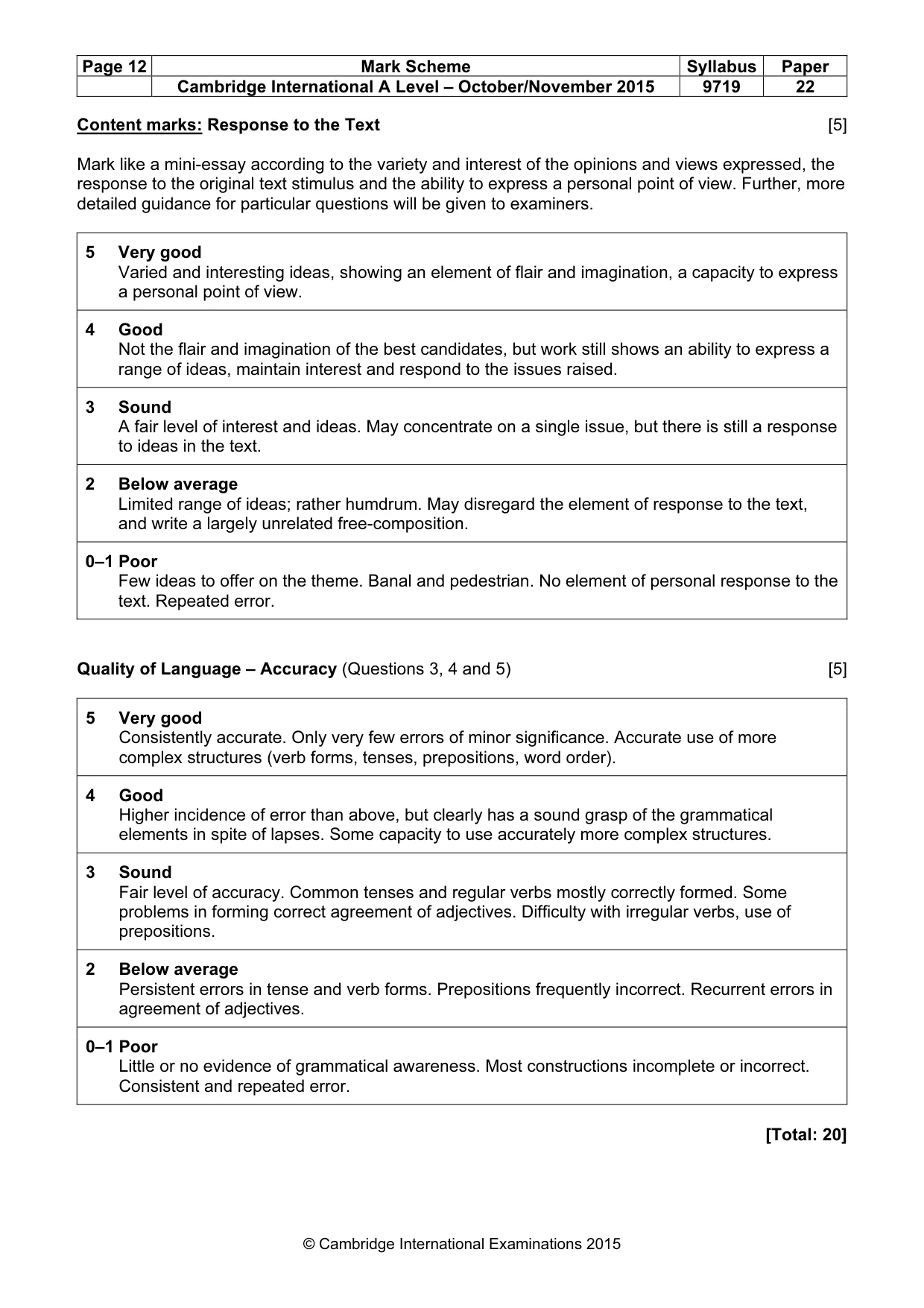
Page 12 Mark Scheme Syllabus Paper Cambridge International A Level – October/November 2015 9719 22 © Cambridge International Examinations 2015 Content marks: Response to the Text [5] Mark like a mini-essay according to the variety and interest of the opinions and views expressed, the response to the original text stimulus and the ability to express a personal point of view. Further, more detailed guidance for particular questions will be given to examiners. 5 Very good Varied and interesting ideas, showing an element of flair and imagination, a capacity to express a personal point of view. 4 Good Not the flair and imagination of the best candidates, but work still shows an ability to express a range of ideas, maintain interest and respond to the issues raised. 3 Sound A fair level of interest and ideas. May concentrate on a single issue, but there is still a response to ideas in the text. 2 Below average Limited range of ideas; rather humdrum. May disregard the element of response to the text, and write a largely unrelated free-composition. 0–1 Poor Few ideas to offer on the theme. Banal and pedestrian. No element of personal response to the text. Repeated error. Quality of Language – Accuracy (Questions 3, 4 and 5) [5] 5 Very good Consistently accurate. Only very few errors of minor significance. Accurate use of more complex structures (verb forms, tenses, prepositions, word order). 4 Good Higher incidence of error than above, but clearly has a sound grasp of the grammatical elements in spite of lapses. Some capacity to use accurately more complex structures. 3 Sound Fair level of accuracy. Common tenses and regular verbs mostly correctly formed. Some problems in forming correct agreement of adjectives. Difficulty with irregular verbs, use of prepositions. 2 Below average Persistent errors in tense and verb forms. Prepositions frequently incorrect. Recurrent errors in agreement of adjectives. 0–1 Poor Little or no evidence of grammatical awareness. Most constructions incomplete or incorrect. Consistent and repeated error. [Total: 20]
What you needed in this session
Cambridge’s own grade thresholds for 2015 Oct/Nov, Paper 2 · Variant 2. A higher threshold means an easier paper — the bar moves with how the cohort did.