Cambridge A Level Spanish (A Level only) 9719 — 2015 May/June Paper 2 · Variant 2
9719/22/M/J/15 · 70 marks · ≈79 min
The question paper and its mark scheme, free to read here and free to download. This is Cambridge’s own paper, exactly as it was sat.
Question paper8 pages
Mark scheme13 pages
Answers below. Sit the paper first if you are practising.
Paper as text
Question paper, page 1
This document consists of 8 printed pages and 1 Insert. DC (KN) 98756/3 © UCLES 2015 [Turn over Cambridge International Examinations Cambridge International Advanced Level * 6 8 7 8 3 3 0 8 6 9 * SPANISH 9719/22 Paper 2 Reading and Writing May/June 2015 1 hour 45 minutes Candidates answer on the Question Paper. No Additional Materials are required. READ THESE INSTRUCTIONS FIRST Write your Centre number, candidate number and name in the spaces at the top of this page. Write in dark blue or black pen. Do not use staples, paper clips, glue or correction fluid. DO NOT WRITE IN ANY BARCODES. Answer all questions in Spanish in the spaces provided. Dictionaries are not permitted. You should keep to any word limits given in the questions. The number of marks is given in brackets [ ] at the end of each question or part question. EN PRIMER LUGAR, LEE ESTAS INSTRUCCIONES Escribe el número del Centro, el número de estudiante que se te ha adjudicado y tu nombre en los espacios designados en la parte superior de esta página. Usa tinta negra o azul oscuro. No uses ni grapadora, ni clips, ni goma de pegar, ni corrector líquido. NO ESCRIBAS EN NINGÚN CÓDIGO DE BARRAS. Contesta todas las preguntas en español en los espacios designados. No se permite el uso de diccionario. Debes ceñirte al límite de palabras indicado en cada pregunta. La puntuación se da entre corchetes [ ] al final de cada pregunta o parte de la misma.
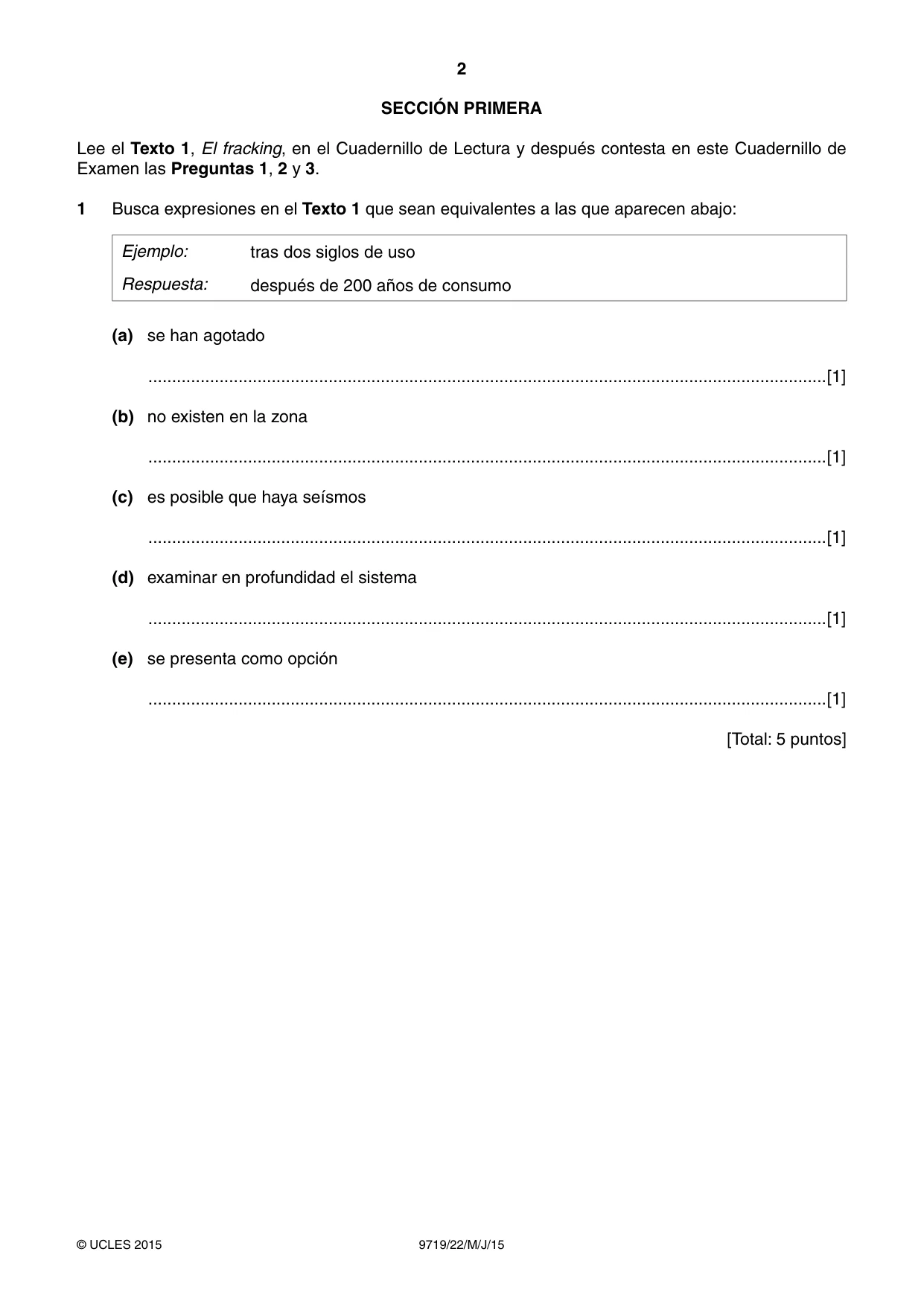
Question paper, page 2
2 9719/22/M/J/15 © UCLES 2015 SECCIÓN PRIMERA Lee el Texto 1, El fracking, en el Cuadernillo de Lectura y después contesta en este Cuadernillo de Examen las Preguntas 1, 2 y 3. 1 Busca expresiones en el Texto 1 que sean equivalentes a las que aparecen abajo: Ejemplo: tras dos siglos de uso Respuesta: después de 200 años de consumo (a) se han agotado …[1] (b) no existen en la zona …[1] (c) es posible que haya seísmos …[1] (d) examinar en profundidad el sistema …[1] (e) se presenta como opción …[1] [Total: 5 puntos]
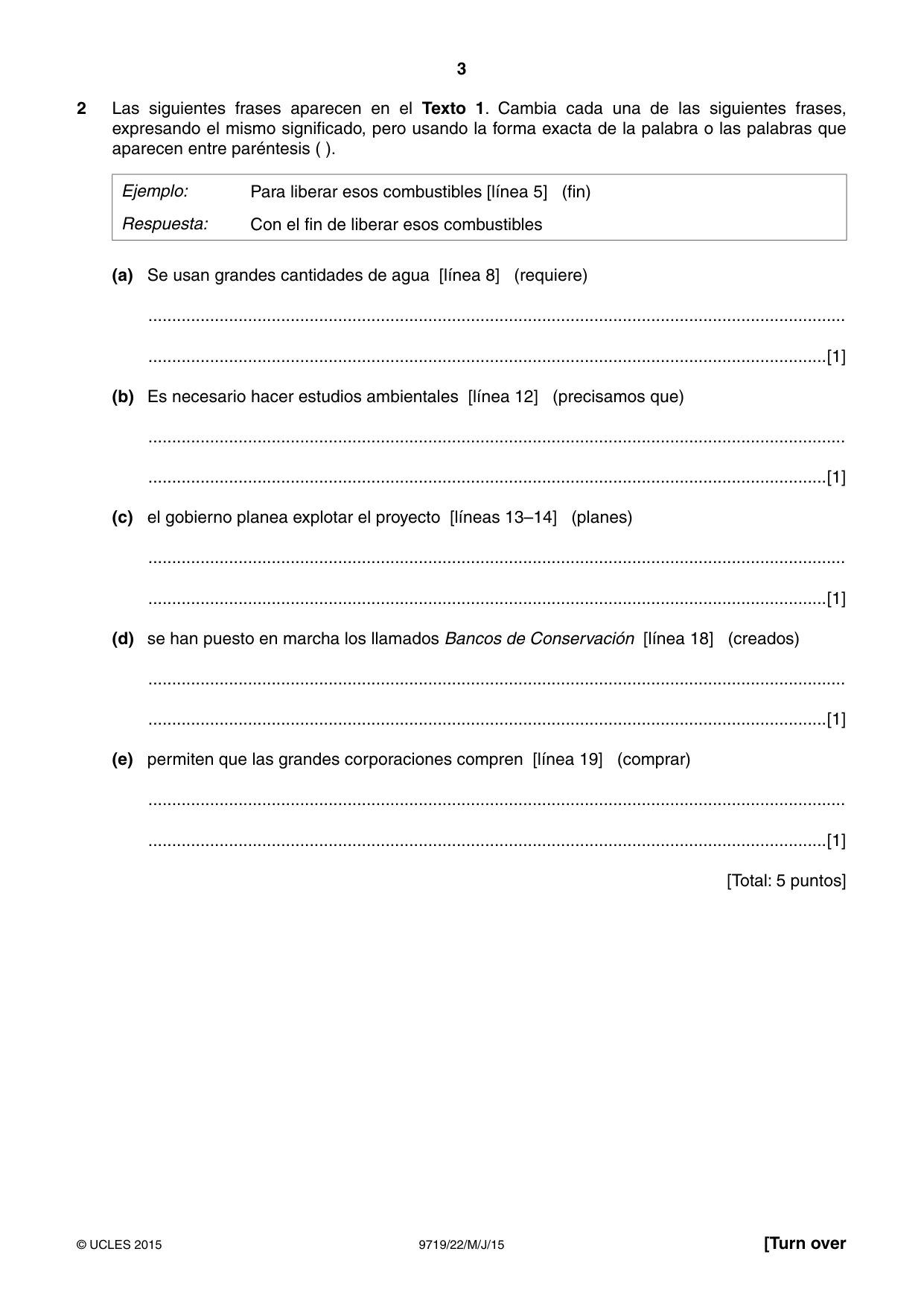
Question paper, page 3
3 9719/22/M/J/15 © UCLES 2015 [Turn over 2 Las siguientes frases aparecen en el Texto 1. Cambia cada una de las siguientes frases, expresando el mismo significado, pero usando la forma exacta de la palabra o las palabras que aparecen entre paréntesis ( ). Ejemplo: Para liberar esos combustibles [línea 5] (fin) Respuesta: Con el fin de liberar esos combustibles (a) Se usan grandes cantidades de agua [línea 8] (requiere) … …[1] (b) Es necesario hacer estudios ambientales [línea 12] (precisamos que) … …[1] (c) el gobierno planea explotar el proyecto [líneas 13–14] (planes) … …[1] (d) se han puesto en marcha los llamados Bancos de Conservación [línea 18] (creados) … …[1] (e) permiten que las grandes corporaciones compren [línea 19] (comprar) … …[1] [Total: 5 puntos]
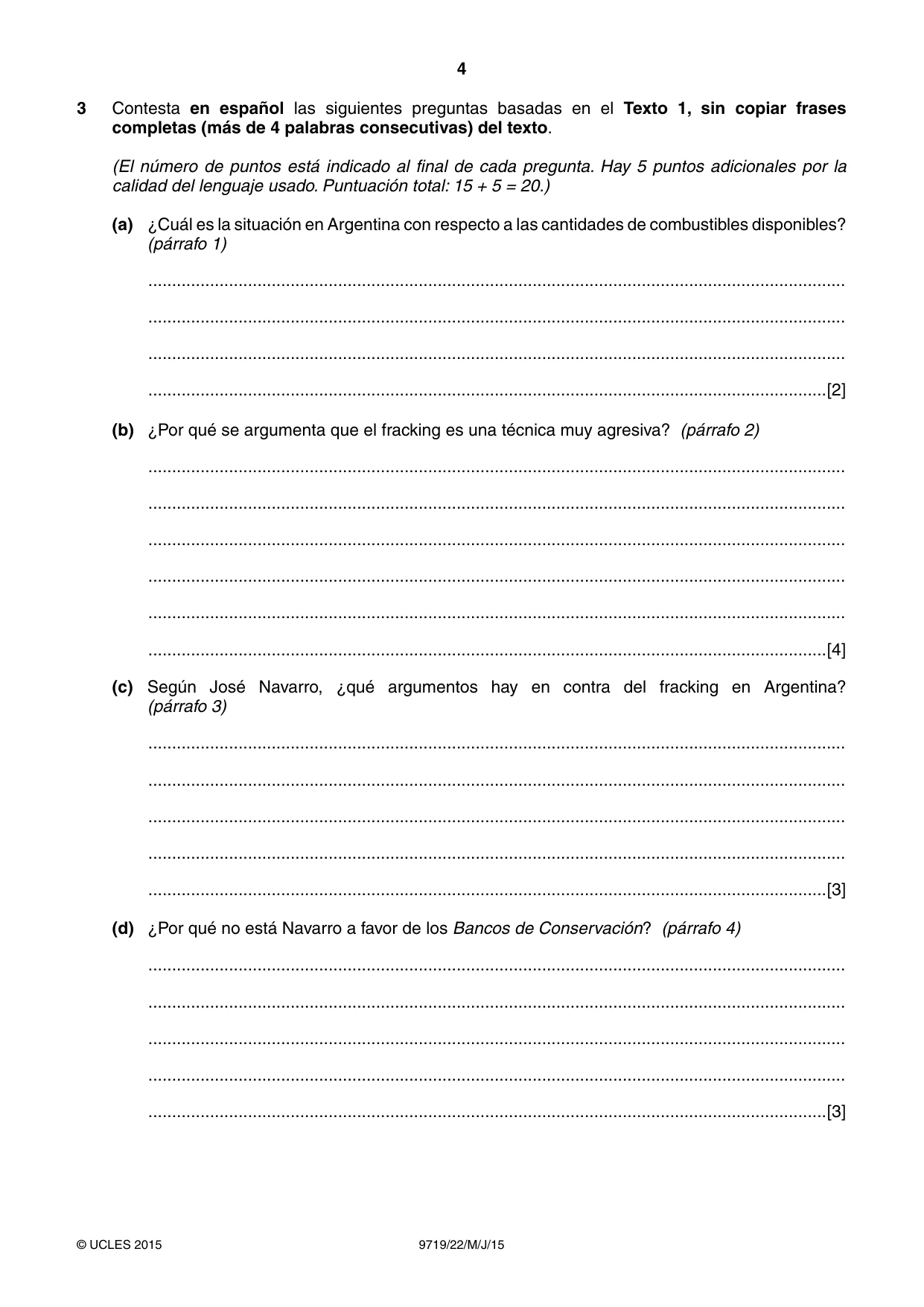
Question paper, page 4
4 9719/22/M/J/15 © UCLES 2015 3 Contesta en español las siguientes preguntas basadas en el Texto 1, sin copiar frases completas (más de 4 palabras consecutivas) del texto. (El número de puntos está indicado al final de cada pregunta. Hay 5 puntos adicionales por la calidad del lenguaje usado. Puntuación total: 15 + 5 = 20.) (a) ¿Cuál es la situación en Argentina con respecto a las cantidades de combustibles disponibles? (párrafo 1) … … … …[2] (b) ¿Por qué se argumenta que el fracking es una técnica muy agresiva? (párrafo 2) … … … … … …[4] (c) Según José Navarro, ¿qué argumentos hay en contra del fracking en Argentina? (párrafo 3) … … … … …[3] (d) ¿Por qué no está Navarro a favor de los Bancos de Conservación? (párrafo 4) … … … … …[3]
Question paper, page 5
5 9719/22/M/J/15 © UCLES 2015 [Turn over (e) ¿Qué ventajas supone el fracking? (párrafo 5) … … … … …[3] [Total: 20 puntos]
Question paper, page 6
6 9719/22/M/J/15 © UCLES 2015 SECCIÓN SEGUNDA Ahora lee el Texto 2, Azoteas verdes, en el Cuadernillo de Lectura y después contesta en este Cuadernillo de Examen las Preguntas 4 y 5. 4 Contesta en español las siguientes preguntas basadas en el Texto 2, sin copiar frases completas (más de 4 palabras consecutivas) del texto. (El número de puntos está indicado al final de cada pregunta. Hay 5 puntos adicionales por la calidad del lenguaje usado. Puntuación total: 15 + 5 = 20.) (a) (i) ¿Para qué sirven las azoteas verdes? (párrafo 1) … … … …[2] (ii) ¿Cómo ha apoyado la Ciudad de México esta iniciativa? (párrafo 1) … … … …[2] (b) ¿Por qué están adoptando estos tejados los mejicanos? (párrafo 2) … … … …[2] (c) ¿Qué otros beneficios suponen las azoteas verdes? (párrafo 3) … … … … … …[4]
Question paper, page 7
7 9719/22/M/J/15 © UCLES 2015 [Turn over (d) Según Elisa Sampere, ¿qué dificultades presenta la creación de una azotea verde? (párrafo 4) … … … … …[3] (e) ¿Por qué considera Sampere que las azoteas verdes son elitistas? (párrafo 5) … … … …[2] [Total: 20 puntos] 5 Escribe en español un máximo de 140 palabras para completar las dos tareas siguientes: (a) Escribe un resumen de lo que se dice en Texto 1 y Texto 2 sobre el impacto medioambiental del fracking y las azoteas verdes. [10] (b) ¿Está adoptando tu país buenas medidas para proteger el medio ambiente? Da tus opiniones. [5] (NOTA: Escribe un máximo de 140 palabras) [Calidad del lenguaje: 5] … … … … … … … … … … … … …
Question paper, page 8
8 9719/22/M/J/15 © UCLES 2015 Permission to reproduce items where third-party owned material protected by copyright is included has been sought and cleared where possible. Every reasonable effort has been made by the publisher (UCLES) to trace copyright holders, but if any items requiring clearance have unwittingly been included, the publisher will be pleased to make amends at the earliest possible opportunity. To avoid the issue of disclosure of answer-related information to candidates, all copyright acknowledgements are reproduced online in the Cambridge International Examinations Copyright Acknowledgements Booklet. This is produced for each series of examinations and is freely available to download at www.cie.org.uk after the live examination series. Cambridge International Examinations is part of the Cambridge Assessment Group. Cambridge Assessment is the brand name of University of Cambridge Local Examinations Syndicate (UCLES), which is itself a department of the University of Cambridge. … … … … … … … … … … … … … … … … … … … … … … … … … [Total: 20 puntos]
Mark scheme, page 1
® IGCSE is the registered trademark of Cambridge International Examinations. CAMBRIDGE INTERNATIONAL EXAMINATIONS Cambridge International Advanced Level MARK SCHEME for the May/June 2015 series 9719 SPANISH 9719/22 Paper 2 (Reading and Writing), maximum raw mark 70 This mark scheme is published as an aid to teachers and candidates, to indicate the requirements of the examination. It shows the basis on which Examiners were instructed to award marks. It does not indicate the details of the discussions that took place at an Examiners’ meeting before marking began, which would have considered the acceptability of alternative answers. Mark schemes should be read in conjunction with the question paper and the Principal Examiner Report for Teachers. Cambridge will not enter into discussions about these mark schemes. Cambridge is publishing the mark schemes for the May/June 2015 series for most Cambridge IGCSE®, Cambridge International A and AS Level components and some Cambridge O Level components.
Mark scheme, page 2
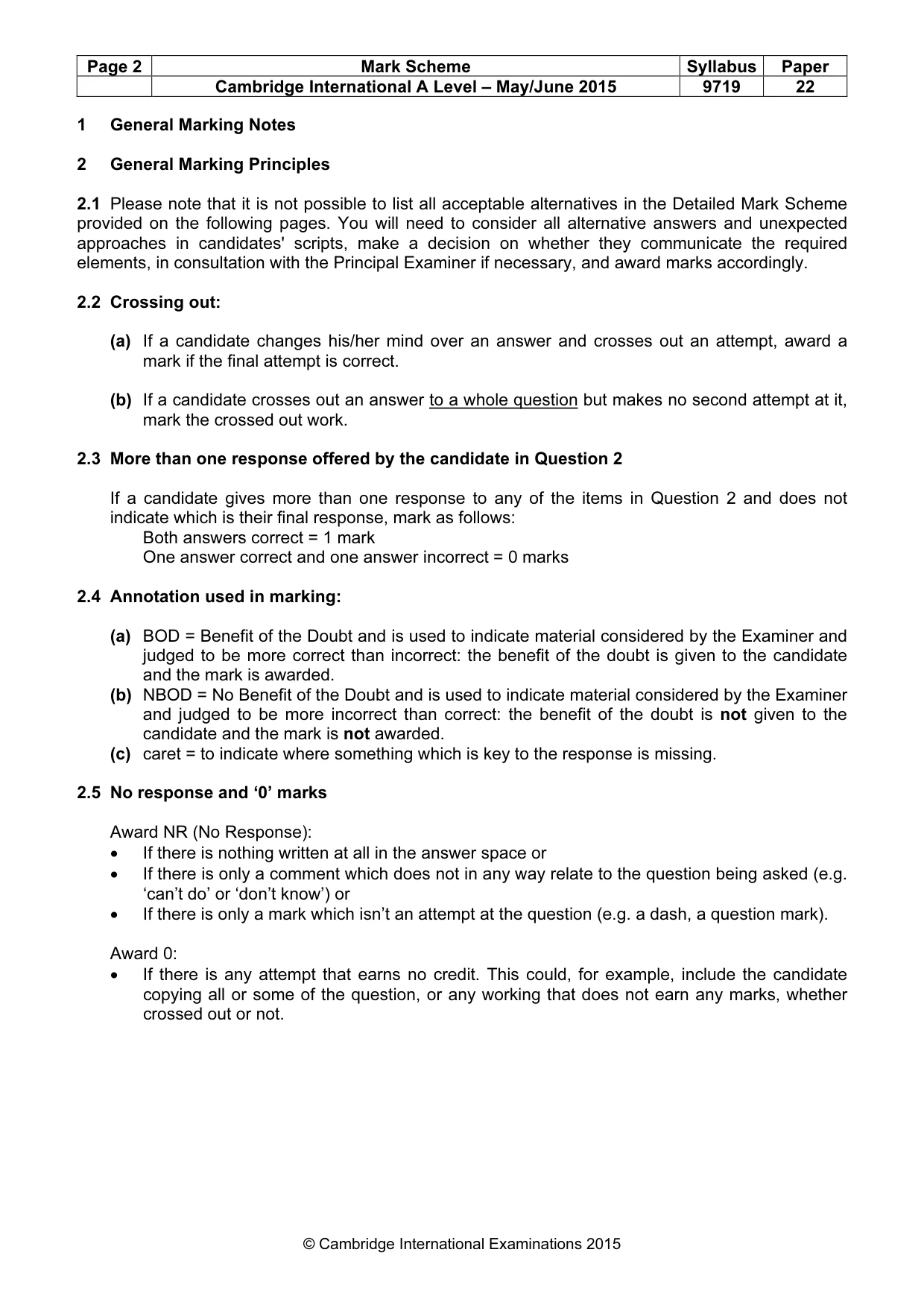
Page 2 Mark Scheme Syllabus Paper Cambridge International A Level – May/June 2015 9719 22 © Cambridge International Examinations 2015 1 General Marking Notes 2 General Marking Principles 2.1 Please note that it is not possible to list all acceptable alternatives in the Detailed Mark Scheme provided on the following pages. You will need to consider all alternative answers and unexpected approaches in candidates' scripts, make a decision on whether they communicate the required elements, in consultation with the Principal Examiner if necessary, and award marks accordingly. 2.2 Crossing out: (a) If a candidate changes his/her mind over an answer and crosses out an attempt, award a mark if the final attempt is correct. (b) If a candidate crosses out an answer to a whole question but makes no second attempt at it, mark the crossed out work. 2.3 More than one response offered by the candidate in Question 2 If a candidate gives more than one response to any of the items in Question 2 and does not indicate which is their final response, mark as follows: Both answers correct = 1 mark One answer correct and one answer incorrect = 0 marks 2.4 Annotation used in marking: (a) BOD = Benefit of the Doubt and is used to indicate material considered by the Examiner and judged to be more correct than incorrect: the benefit of the doubt is given to the candidate and the mark is awarded. (b) NBOD = No Benefit of the Doubt and is used to indicate material considered by the Examiner and judged to be more incorrect than correct: the benefit of the doubt is not given to the candidate and the mark is not awarded. (c) caret = to indicate where something which is key to the response is missing. 2.5 No response and ‘0’ marks Award NR (No Response): • If there is nothing written at all in the answer space or • If there is only a comment which does not in any way relate to the question being asked (e.g. ‘can’t do’ or ‘don’t know’) or • If there is only a mark which isn’t an attempt at the question (e.g. a dash, a question mark). Award 0: • If there is any attempt that earns no credit. This could, for example, include the candidate copying all or some of the question, or any working that does not earn any marks, whether crossed out or not.
Mark scheme, page 3
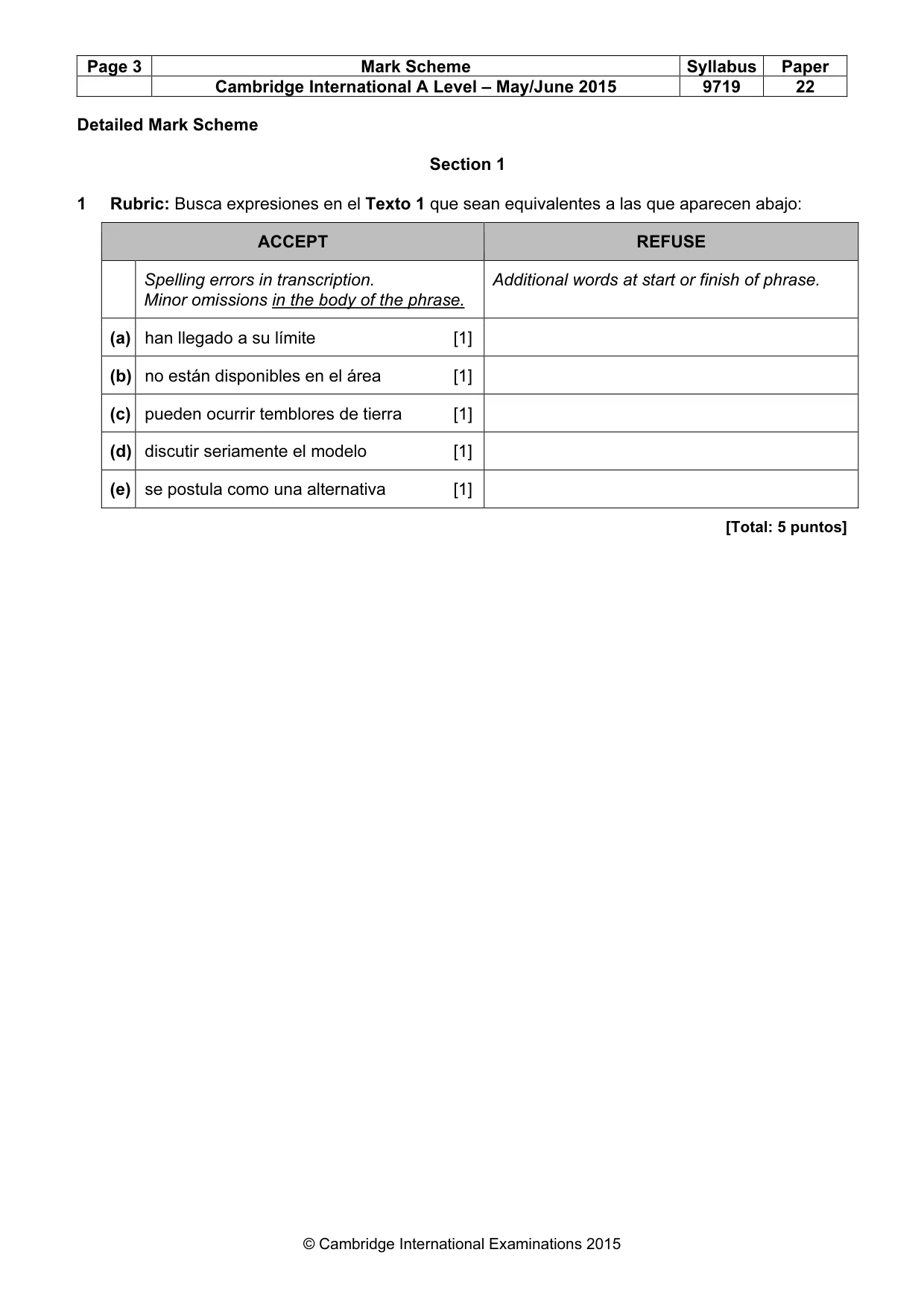
Page 3 Mark Scheme Syllabus Paper Cambridge International A Level – May/June 2015 9719 22 © Cambridge International Examinations 2015 Detailed Mark Scheme Section 1 1 Rubric: Busca expresiones en el Texto 1 que sean equivalentes a las que aparecen abajo: ACCEPT REFUSE Spelling errors in transcription. Minor omissions in the body of the phrase. Additional words at start or finish of phrase. (a) han llegado a su límite [1] (b) no están disponibles en el área [1] (c) pueden ocurrir temblores de tierra [1] (d) discutir seriamente el modelo [1] (e) se postula como una alternativa [1] [Total: 5 puntos]
Mark scheme, page 4
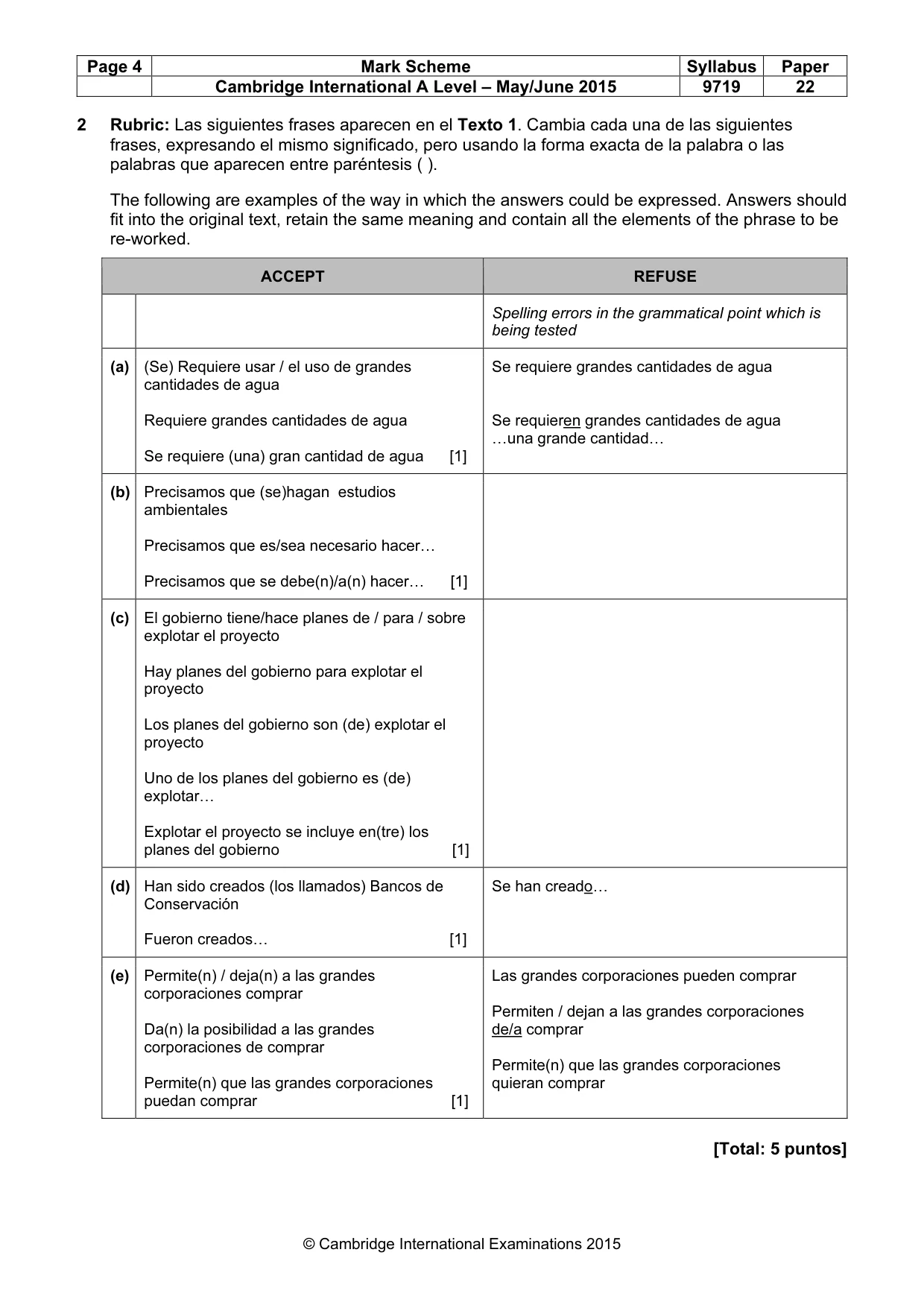
Page 4 Mark Scheme Syllabus Paper Cambridge International A Level – May/June 2015 9719 22 © Cambridge International Examinations 2015 2 Rubric: Las siguientes frases aparecen en el Texto 1. Cambia cada una de las siguientes frases, expresando el mismo significado, pero usando la forma exacta de la palabra o las palabras que aparecen entre paréntesis ( ). The following are examples of the way in which the answers could be expressed. Answers should fit into the original text, retain the same meaning and contain all the elements of the phrase to be re-worked. ACCEPT REFUSE Spelling errors in the grammatical point which is being tested (a) (Se) Requiere usar / el uso de grandes cantidades de agua Requiere grandes cantidades de agua Se requiere (una) gran cantidad de agua [1] Se requiere grandes cantidades de agua Se requieren grandes cantidades de agua …una grande cantidad… (b) Precisamos que (se)hagan estudios ambientales Precisamos que es/sea necesario hacer… Precisamos que se debe(n)/a(n) hacer… [1] (c) El gobierno tiene/hace planes de / para / sobre explotar el proyecto Hay planes del gobierno para explotar el proyecto Los planes del gobierno son (de) explotar el proyecto Uno de los planes del gobierno es (de) explotar… Explotar el proyecto se incluye en(tre) los planes del gobierno [1] (d) Han sido creados (los llamados) Bancos de Conservación Fueron creados… [1] Se han creado… (e) Permite(n) / deja(n) a las grandes corporaciones comprar Da(n) la posibilidad a las grandes corporaciones de comprar Permite(n) que las grandes corporaciones puedan comprar [1] Las grandes corporaciones pueden comprar Permiten / dejan a las grandes corporaciones de/a comprar Permite(n) que las grandes corporaciones quieran comprar [Total: 5 puntos]
Mark scheme, page 5
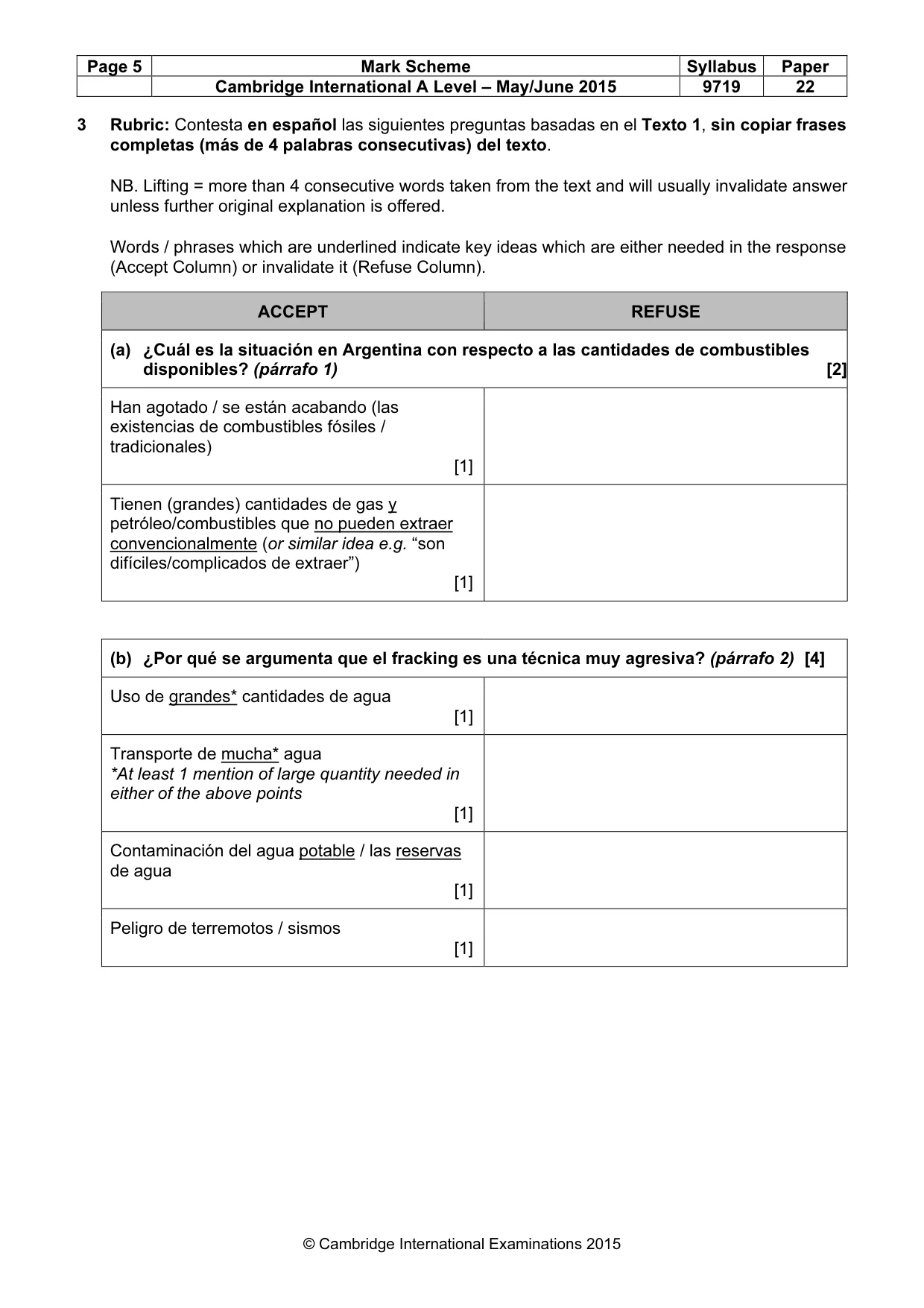
Page 5 Mark Scheme Syllabus Paper Cambridge International A Level – May/June 2015 9719 22 © Cambridge International Examinations 2015 3 Rubric: Contesta en español las siguientes preguntas basadas en el Texto 1, sin copiar frases completas (más de 4 palabras consecutivas) del texto. NB. Lifting = more than 4 consecutive words taken from the text and will usually invalidate answer unless further original explanation is offered. Words / phrases which are underlined indicate key ideas which are either needed in the response (Accept Column) or invalidate it (Refuse Column). ACCEPT REFUSE (a) ¿Cuál es la situación en Argentina con respecto a las cantidades de combustibles disponibles? (párrafo 1) [2] Han agotado / se están acabando (las existencias de combustibles fósiles / tradicionales) [1] Tienen (grandes) cantidades de gas y petróleo/combustibles que no pueden extraer convencionalmente (or similar idea e.g. “son difíciles/complicados de extraer”) [1] (b) ¿Por qué se argumenta que el fracking es una técnica muy agresiva? (párrafo 2) [4] Uso de grandes* cantidades de agua [1] Transporte de mucha* agua *At least 1 mention of large quantity needed in either of the above points [1] Contaminación del agua potable / las reservas de agua [1] Peligro de terremotos / sismos [1]
Mark scheme, page 6
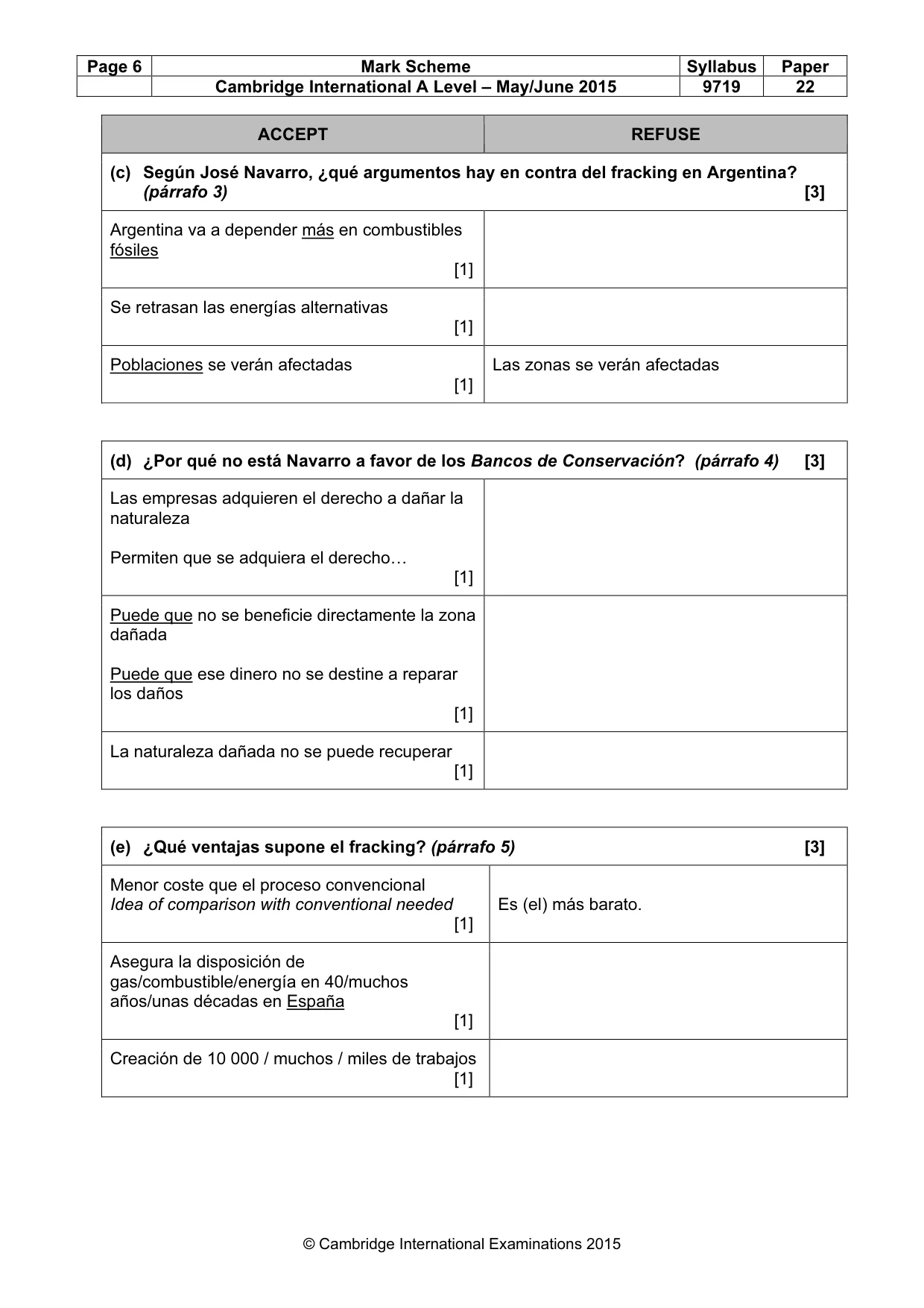
Page 6 Mark Scheme Syllabus Paper Cambridge International A Level – May/June 2015 9719 22 © Cambridge International Examinations 2015 ACCEPT REFUSE (c) Según José Navarro, ¿qué argumentos hay en contra del fracking en Argentina? (párrafo 3) [3] Argentina va a depender más en combustibles fósiles [1] Se retrasan las energías alternativas [1] Poblaciones se verán afectadas [1] Las zonas se verán afectadas (d) ¿Por qué no está Navarro a favor de los Bancos de Conservación? (párrafo 4) [3] Las empresas adquieren el derecho a dañar la naturaleza Permiten que se adquiera el derecho… [1] Puede que no se beneficie directamente la zona dañada Puede que ese dinero no se destine a reparar los daños [1] La naturaleza dañada no se puede recuperar [1] (e) ¿Qué ventajas supone el fracking? (párrafo 5) [3] Menor coste que el proceso convencional Idea of comparison with conventional needed [1] Es (el) más barato. Asegura la disposición de gas/combustible/energía en 40/muchos años/unas décadas en España [1] Creación de 10 000 / muchos / miles de trabajos [1]
Mark scheme, page 7
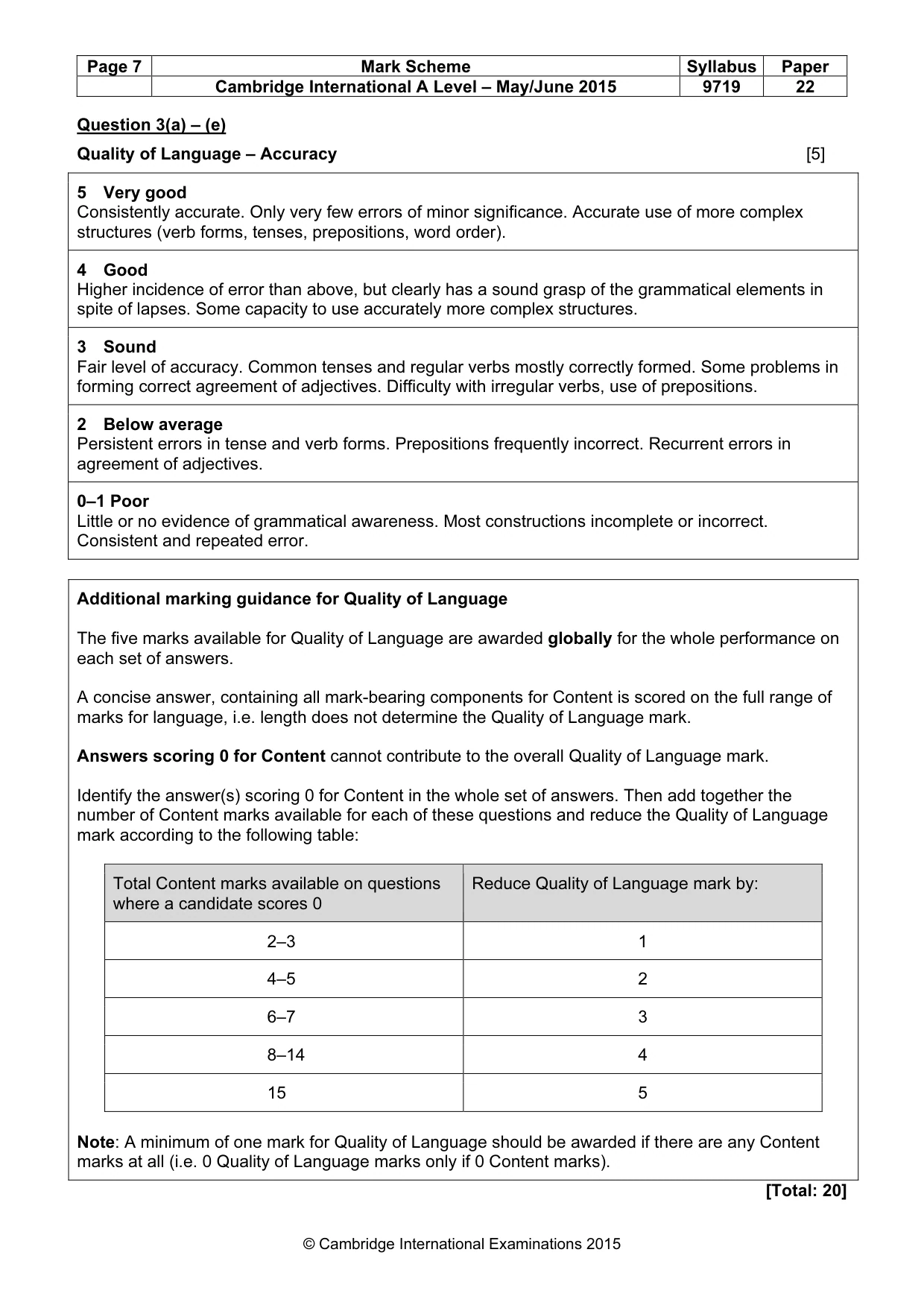
Page 7 Mark Scheme Syllabus Paper Cambridge International A Level – May/June 2015 9719 22 © Cambridge International Examinations 2015 Question 3(a) – (e) Quality of Language – Accuracy [5] 5 Very good Consistently accurate. Only very few errors of minor significance. Accurate use of more complex structures (verb forms, tenses, prepositions, word order). 4 Good Higher incidence of error than above, but clearly has a sound grasp of the grammatical elements in spite of lapses. Some capacity to use accurately more complex structures. 3 Sound Fair level of accuracy. Common tenses and regular verbs mostly correctly formed. Some problems in forming correct agreement of adjectives. Difficulty with irregular verbs, use of prepositions. 2 Below average Persistent errors in tense and verb forms. Prepositions frequently incorrect. Recurrent errors in agreement of adjectives. 0–1 Poor Little or no evidence of grammatical awareness. Most constructions incomplete or incorrect. Consistent and repeated error. Additional marking guidance for Quality of Language The five marks available for Quality of Language are awarded globally for the whole performance on each set of answers. A concise answer, containing all mark-bearing components for Content is scored on the full range of marks for language, i.e. length does not determine the Quality of Language mark. Answers scoring 0 for Content cannot contribute to the overall Quality of Language mark. Identify the answer(s) scoring 0 for Content in the whole set of answers. Then add together the number of Content marks available for each of these questions and reduce the Quality of Language mark according to the following table: Total Content marks available on questions where a candidate scores 0 Reduce Quality of Language mark by: 2–3 1 4–5 2 6–7 3 8–14 4 15 5 Note: A minimum of one mark for Quality of Language should be awarded if there are any Content marks at all (i.e. 0 Quality of Language marks only if 0 Content marks). [Total: 20]
Mark scheme, page 8
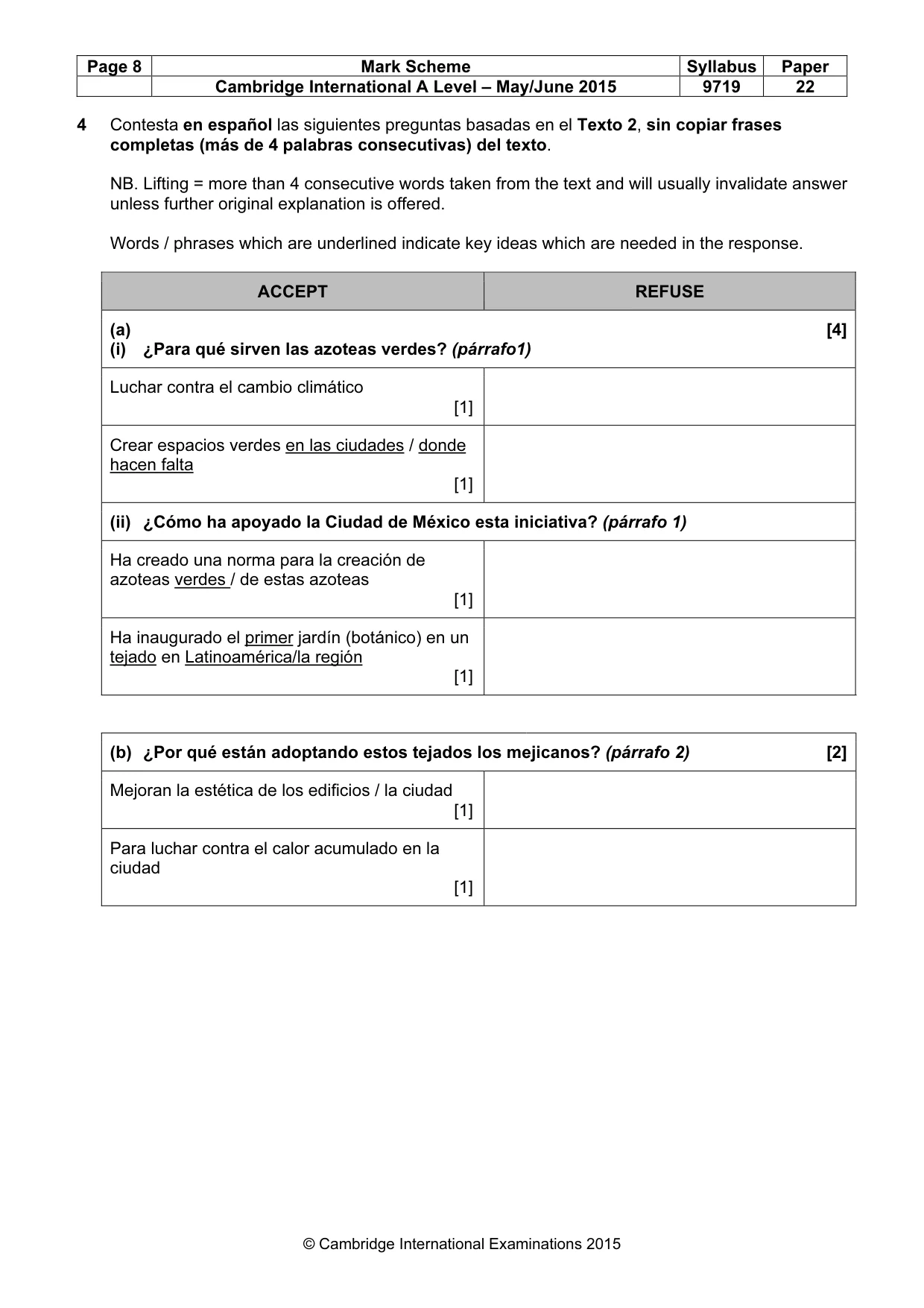
Page 8 Mark Scheme Syllabus Paper Cambridge International A Level – May/June 2015 9719 22 © Cambridge International Examinations 2015 4 Contesta en español las siguientes preguntas basadas en el Texto 2, sin copiar frases completas (más de 4 palabras consecutivas) del texto. NB. Lifting = more than 4 consecutive words taken from the text and will usually invalidate answer unless further original explanation is offered. Words / phrases which are underlined indicate key ideas which are needed in the response. ACCEPT REFUSE (a) [4] (i) ¿Para qué sirven las azoteas verdes? (párrafo1) Luchar contra el cambio climático [1] Crear espacios verdes en las ciudades / donde hacen falta [1] (ii) ¿Cómo ha apoyado la Ciudad de México esta iniciativa? (párrafo 1) Ha creado una norma para la creación de azoteas verdes / de estas azoteas [1] Ha inaugurado el primer jardín (botánico) en un tejado en Latinoamérica/la región [1] (b) ¿Por qué están adoptando estos tejados los mejicanos? (párrafo 2) [2] Mejoran la estética de los edificios / la ciudad [1] Para luchar contra el calor acumulado en la ciudad [1]
Mark scheme, page 9
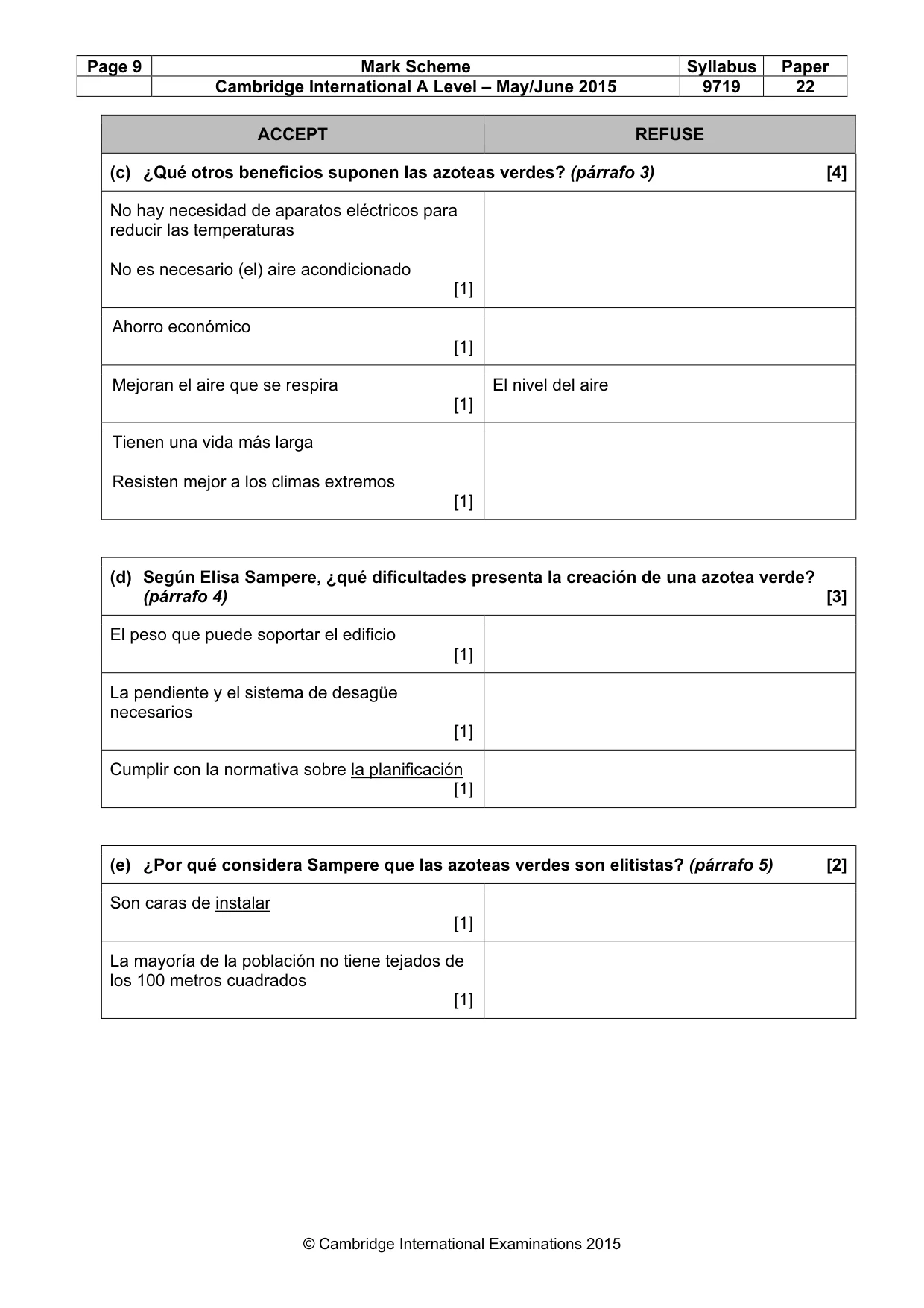
Page 9 Mark Scheme Syllabus Paper Cambridge International A Level – May/June 2015 9719 22 © Cambridge International Examinations 2015 ACCEPT REFUSE (c) ¿Qué otros beneficios suponen las azoteas verdes? (párrafo 3) [4] No hay necesidad de aparatos eléctricos para reducir las temperaturas No es necesario (el) aire acondicionado [1] Ahorro económico [1] Mejoran el aire que se respira [1] El nivel del aire Tienen una vida más larga Resisten mejor a los climas extremos [1] (d) Según Elisa Sampere, ¿qué dificultades presenta la creación de una azotea verde? (párrafo 4) [3] El peso que puede soportar el edificio [1] La pendiente y el sistema de desagüe necesarios [1] Cumplir con la normativa sobre la planificación [1] (e) ¿Por qué considera Sampere que las azoteas verdes son elitistas? (párrafo 5) [2] Son caras de instalar [1] La mayoría de la población no tiene tejados de los 100 metros cuadrados [1]
Mark scheme, page 10
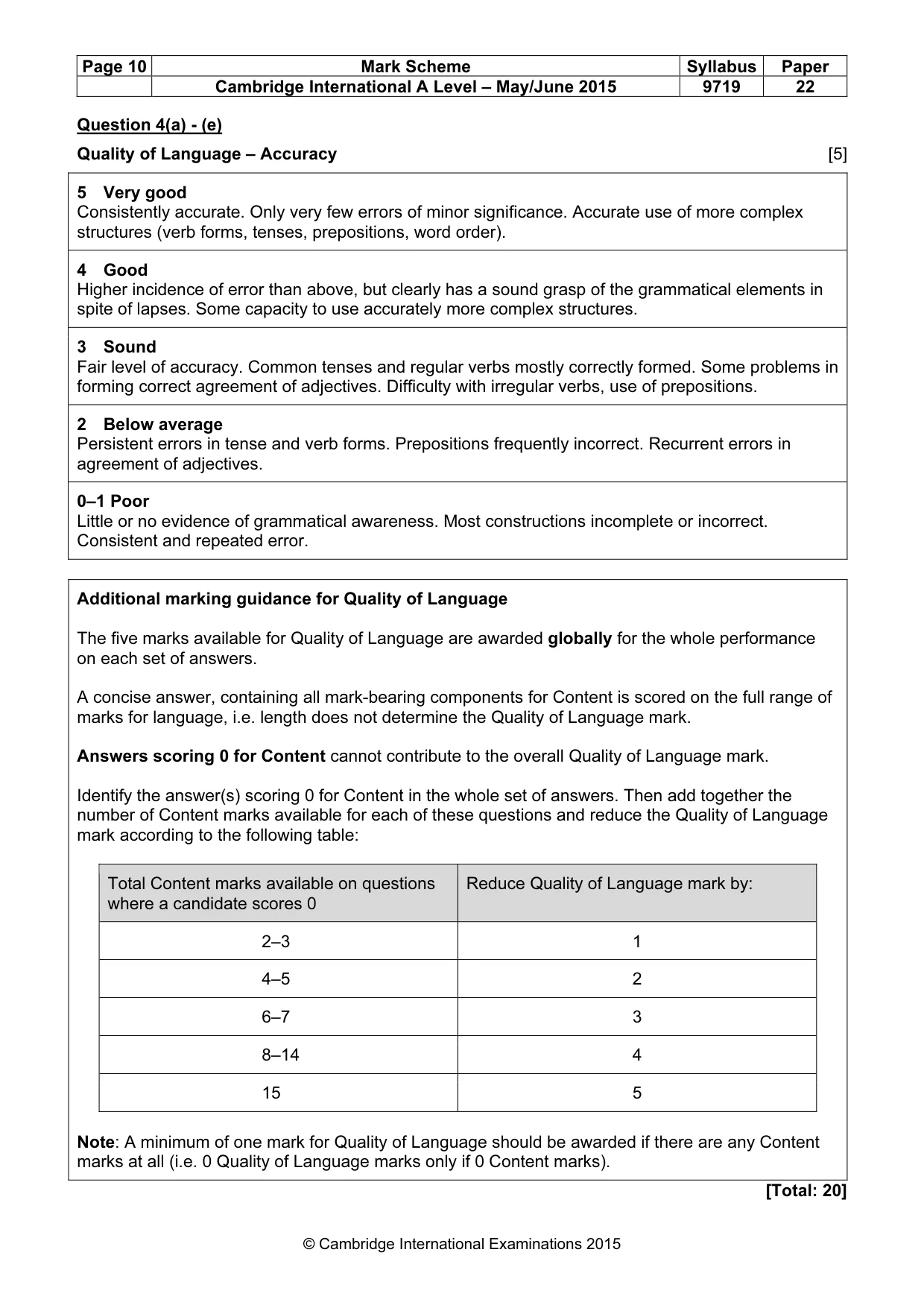
Page 10 Mark Scheme Syllabus Paper Cambridge International A Level – May/June 2015 9719 22 © Cambridge International Examinations 2015 Question 4(a) - (e) Quality of Language – Accuracy [5] 5 Very good Consistently accurate. Only very few errors of minor significance. Accurate use of more complex structures (verb forms, tenses, prepositions, word order). 4 Good Higher incidence of error than above, but clearly has a sound grasp of the grammatical elements in spite of lapses. Some capacity to use accurately more complex structures. 3 Sound Fair level of accuracy. Common tenses and regular verbs mostly correctly formed. Some problems in forming correct agreement of adjectives. Difficulty with irregular verbs, use of prepositions. 2 Below average Persistent errors in tense and verb forms. Prepositions frequently incorrect. Recurrent errors in agreement of adjectives. 0–1 Poor Little or no evidence of grammatical awareness. Most constructions incomplete or incorrect. Consistent and repeated error. Additional marking guidance for Quality of Language The five marks available for Quality of Language are awarded globally for the whole performance on each set of answers. A concise answer, containing all mark-bearing components for Content is scored on the full range of marks for language, i.e. length does not determine the Quality of Language mark. Answers scoring 0 for Content cannot contribute to the overall Quality of Language mark. Identify the answer(s) scoring 0 for Content in the whole set of answers. Then add together the number of Content marks available for each of these questions and reduce the Quality of Language mark according to the following table: Total Content marks available on questions where a candidate scores 0 Reduce Quality of Language mark by: 2–3 1 4–5 2 6–7 3 8–14 4 15 5 Note: A minimum of one mark for Quality of Language should be awarded if there are any Content marks at all (i.e. 0 Quality of Language marks only if 0 Content marks). [Total: 20]
Mark scheme, page 11
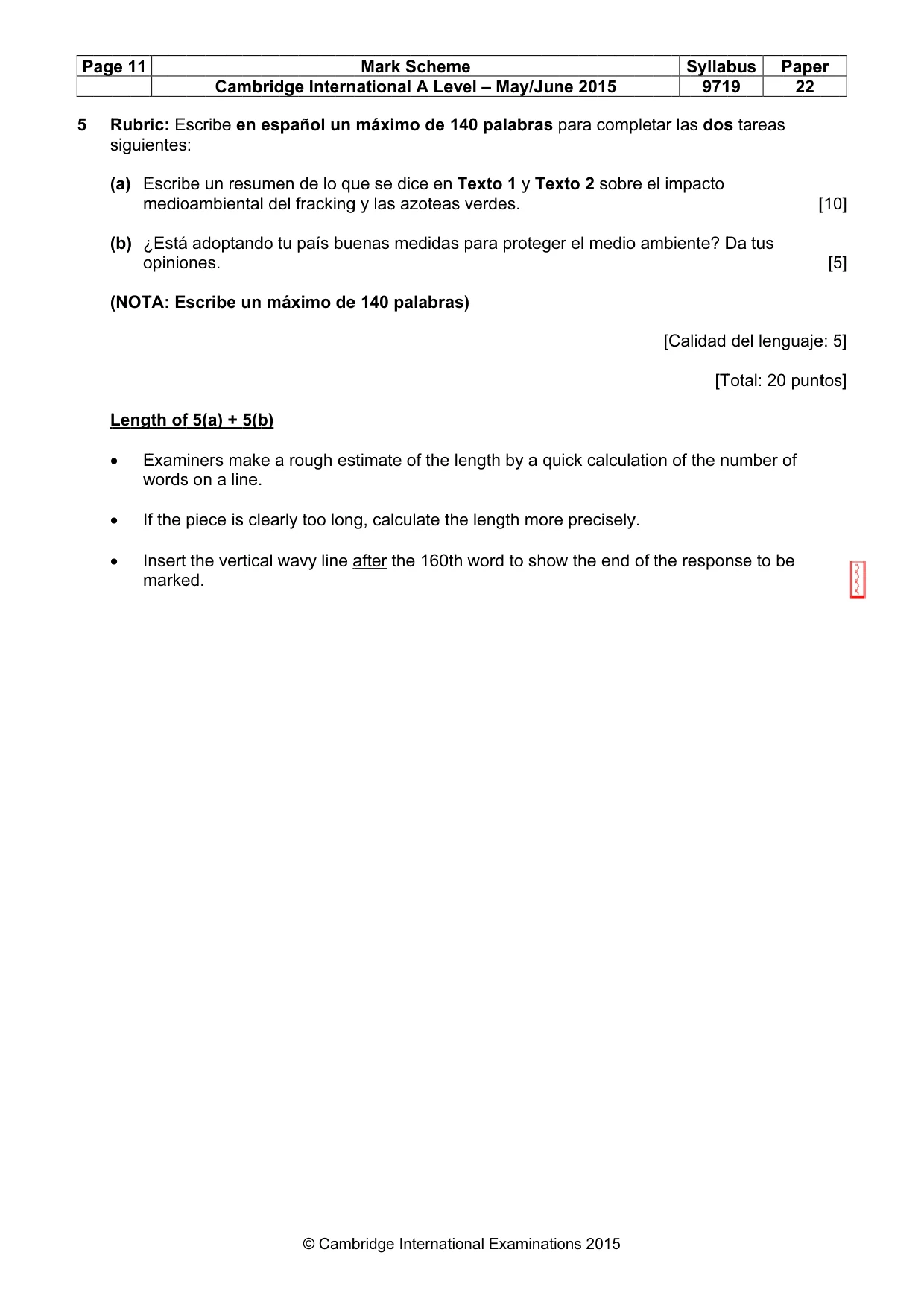
P 5 ag R s ( ( ( L • • • ge 1 Ru sig (a) (b) (NO Le • • • 11 ubr guie E m ) ¿ o OT ng E w If In m ric: ent Esc med ¿Es opin TA: gth Exa wor f th nse mar : Es tes crib dio stá nio : Es of am rds he ert rke scr : be oam á ad one sc f 5( ine s on pie th ed. C ribe un mbi dop es. rib (a) ers n a ece e v Cam e e re ien pta be u + m a lin e is ver mb en esu ntal and un 5(b ak ne. s cl rtica brid es me l de do t m b) e a ea al w dge pa en el f tu p máx a ro rly wa e In © año de frac paí xim oug to avy nte Ca ol u e lo cki ís b mo gh o lo lin ern amb un o qu ng bue de es ong ne a M nati brid má ue g y ena e 14 stim g, afte Mar ion dge áxi se las as 40 mat cal er k S nal e In imo e di s az me pa te o lcu the Sch A nter o d ce zot edi alab of t ulat e 1 hem Le rnat de en tea ida bra the te t 60 me eve tion 14 n T as v as p as) e le the 0th e el – nal 40 p Tex ver par ) eng e le wo – M Ex pa xto rde ra p gth eng ord May xam lab 1 y es. pro by gth to y/J mina bra y T ote y a mo o sh Jun atio as p Tex ege qu ore how ne ons par xto er e uick e p w t 20 s 20 ra o 2 el m k ca rec he 15 015 co so med alc cise en 5 5 mp obre dio cula ely nd plet e e o am atio y. of tar el im mb [C on the S r las mp bien Ca of e re Syl 9 s d pac nte lida the esp llab 971 dos cto e? D ad [T e n pon bu 19 s ta Da de Tota num nse s are tu el le al: mbe e to P eas s eng 20 er o o b Pa 2 s gua 0 pu of be pe 22 [ aje unt er [10 [5 e: 5 tos 0] 5] 5] s]
Mark scheme, page 12
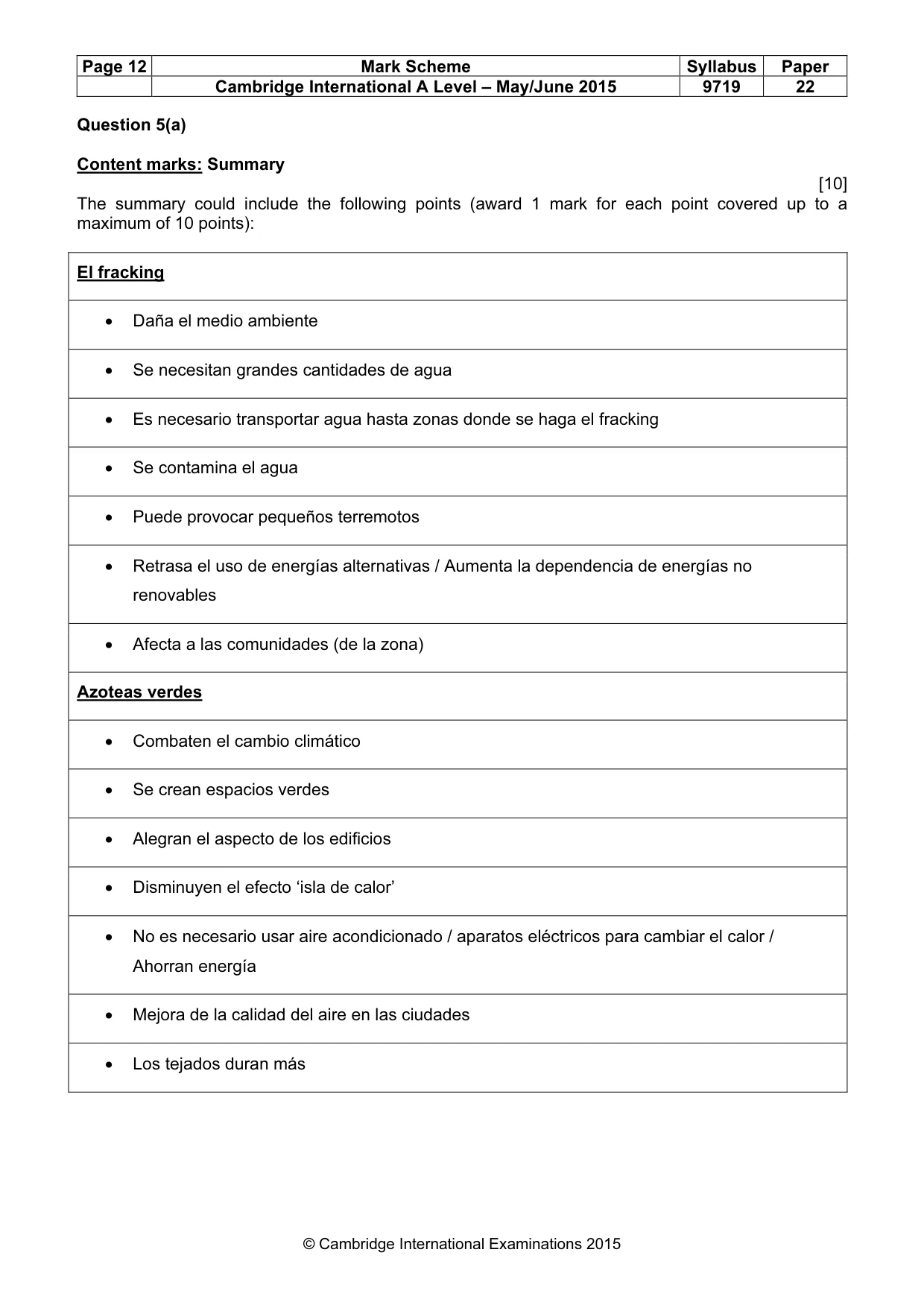
Page 12 Mark Scheme Syllabus Paper Cambridge International A Level – May/June 2015 9719 22 © Cambridge International Examinations 2015 Question 5(a) Content marks: Summary [10] The summary could include the following points (award 1 mark for each point covered up to a maximum of 10 points): El fracking • Daña el medio ambiente • Se necesitan grandes cantidades de agua • Es necesario transportar agua hasta zonas donde se haga el fracking • Se contamina el agua • Puede provocar pequeños terremotos • Retrasa el uso de energías alternativas / Aumenta la dependencia de energías no renovables • Afecta a las comunidades (de la zona) Azoteas verdes • Combaten el cambio climático • Se crean espacios verdes • Alegran el aspecto de los edificios • Disminuyen el efecto ‘isla de calor’ • No es necesario usar aire acondicionado / aparatos eléctricos para cambiar el calor / Ahorran energía • Mejora de la calidad del aire en las ciudades • Los tejados duran más
Mark scheme, page 13
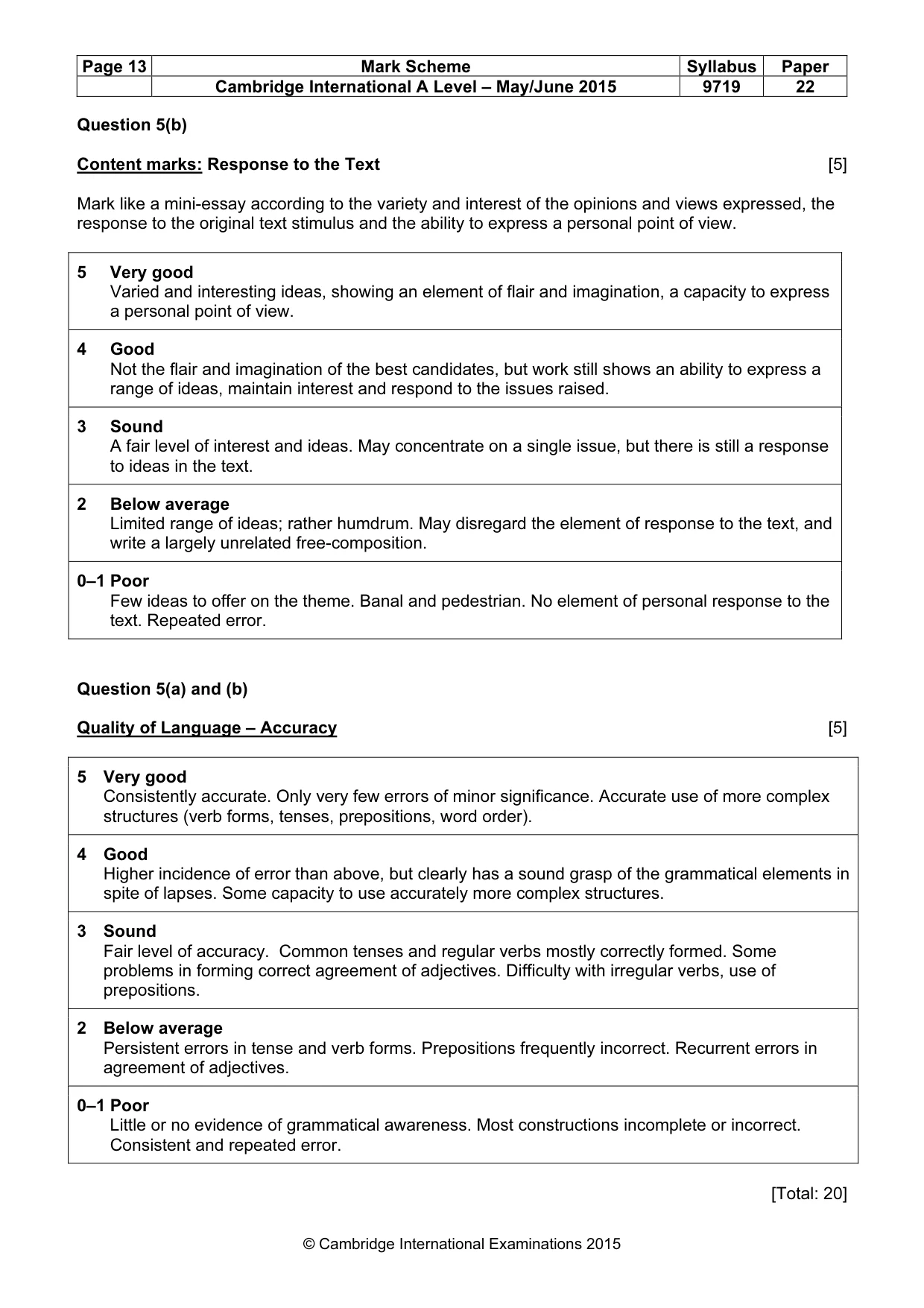
Page 13 Mark Scheme Syllabus Paper Cambridge International A Level – May/June 2015 9719 22 © Cambridge International Examinations 2015 Question 5(b) Content marks: Response to the Text [5] Mark like a mini-essay according to the variety and interest of the opinions and views expressed, the response to the original text stimulus and the ability to express a personal point of view. 5 Very good Varied and interesting ideas, showing an element of flair and imagination, a capacity to express a personal point of view. 4 Good Not the flair and imagination of the best candidates, but work still shows an ability to express a range of ideas, maintain interest and respond to the issues raised. 3 Sound A fair level of interest and ideas. May concentrate on a single issue, but there is still a response to ideas in the text. 2 Below average Limited range of ideas; rather humdrum. May disregard the element of response to the text, and write a largely unrelated free-composition. 0–1 Poor Few ideas to offer on the theme. Banal and pedestrian. No element of personal response to the text. Repeated error. Question 5(a) and (b) Quality of Language – Accuracy [5] 5 Very good Consistently accurate. Only very few errors of minor significance. Accurate use of more complex structures (verb forms, tenses, prepositions, word order). 4 Good Higher incidence of error than above, but clearly has a sound grasp of the grammatical elements in spite of lapses. Some capacity to use accurately more complex structures. 3 Sound Fair level of accuracy. Common tenses and regular verbs mostly correctly formed. Some problems in forming correct agreement of adjectives. Difficulty with irregular verbs, use of prepositions. 2 Below average Persistent errors in tense and verb forms. Prepositions frequently incorrect. Recurrent errors in agreement of adjectives. 0–1 Poor Little or no evidence of grammatical awareness. Most constructions incomplete or incorrect. Consistent and repeated error. [Total: 20]
What you needed in this session
Cambridge’s own grade thresholds for 2015 May/June, Paper 2 · Variant 2. A higher threshold means an easier paper — the bar moves with how the cohort did.