Cambridge A Level Spanish (A Level only) 9719 — 2014 Oct/Nov Paper 2 · Variant 1
9719/21/O/N/14 · 70 marks · ≈79 min
The question paper and its mark scheme, free to read here and free to download. This is Cambridge’s own paper, exactly as it was sat.
Question paper8 pages


Mark scheme13 pages
Answers below. Sit the paper first if you are practising.
Paper as text
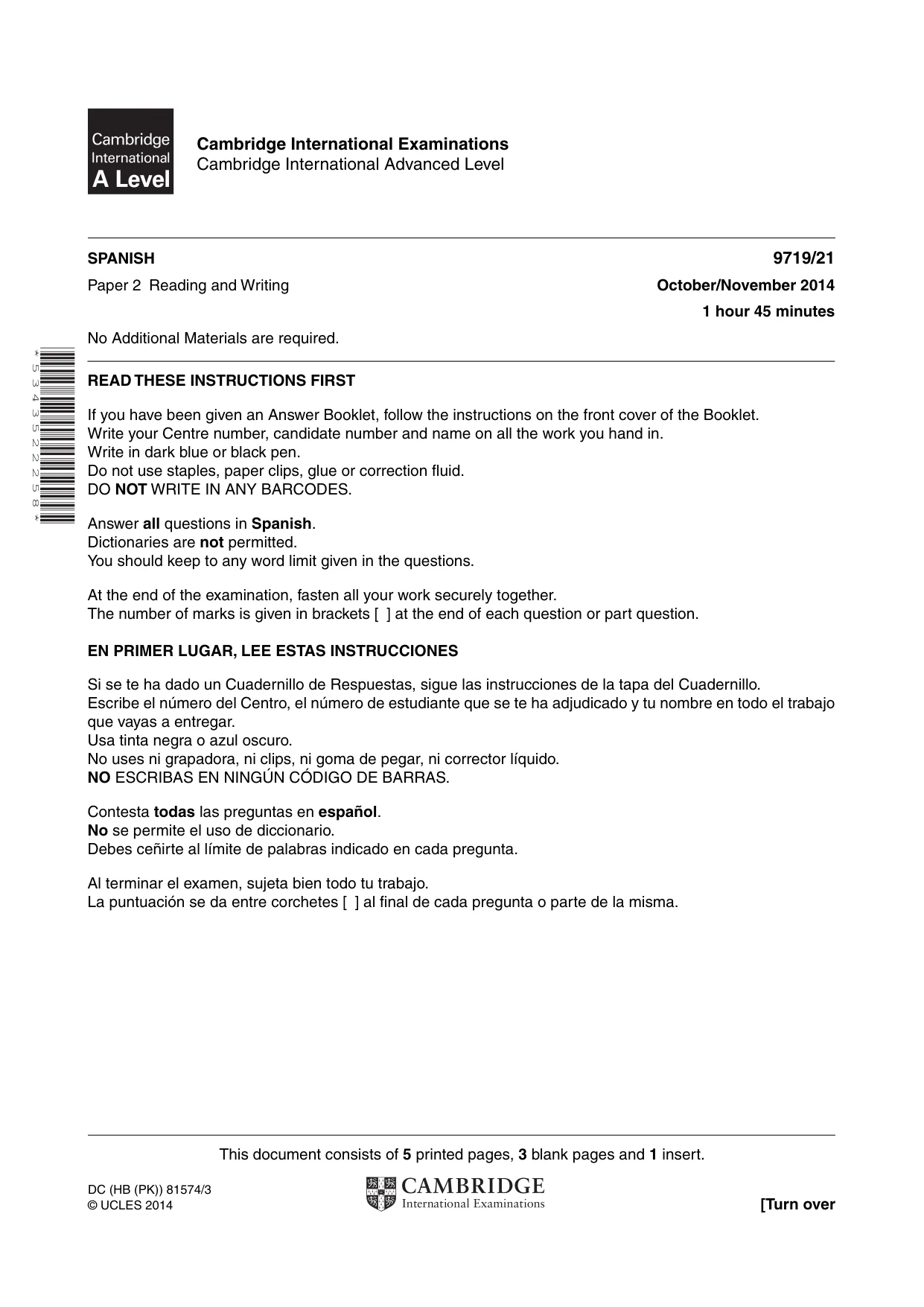
Question paper, page 1
This document consists of 5 printed pages, 3 blank pages and 1 insert. DC (HB (PK)) 81574/3 © UCLES 2014 [Turn over Cambridge International Examinations Cambridge International Advanced Level * 5 3 4 3 5 2 2 2 5 8 * SPANISH 9719/21 Paper 2 Reading and Writing October/November 2014 1 hour 45 minutes No Additional Materials are required. READ THESE INSTRUCTIONS FIRST If you have been given an Answer Booklet, follow the instructions on the front cover of the Booklet. Write your Centre number, candidate number and name on all the work you hand in. Write in dark blue or black pen. Do not use staples, paper clips, glue or correction fluid. DO NOT WRITE IN ANY BARCODES. Answer all questions in Spanish. Dictionaries are not permitted. You should keep to any word limit given in the questions. At the end of the examination, fasten all your work securely together. The number of marks is given in brackets [ ] at the end of each question or part question. EN PRIMER LUGAR, LEE ESTAS INSTRUCCIONES Si se te ha dado un Cuadernillo de Respuestas, sigue las instrucciones de la tapa del Cuadernillo. Escribe el número del Centro, el número de estudiante que se te ha adjudicado y tu nombre en todo el trabajo que vayas a entregar. Usa tinta negra o azul oscuro. No uses ni grapadora, ni clips, ni goma de pegar, ni corrector líquido. NO ESCRIBAS EN NINGÚN CÓDIGO DE BARRAS. Contesta todas las preguntas en español. No se permite el uso de diccionario. Debes ceñirte al límite de palabras indicado en cada pregunta. Al terminar el examen, sujeta bien todo tu trabajo. La puntuación se da entre corchetes [ ] al final de cada pregunta o parte de la misma.
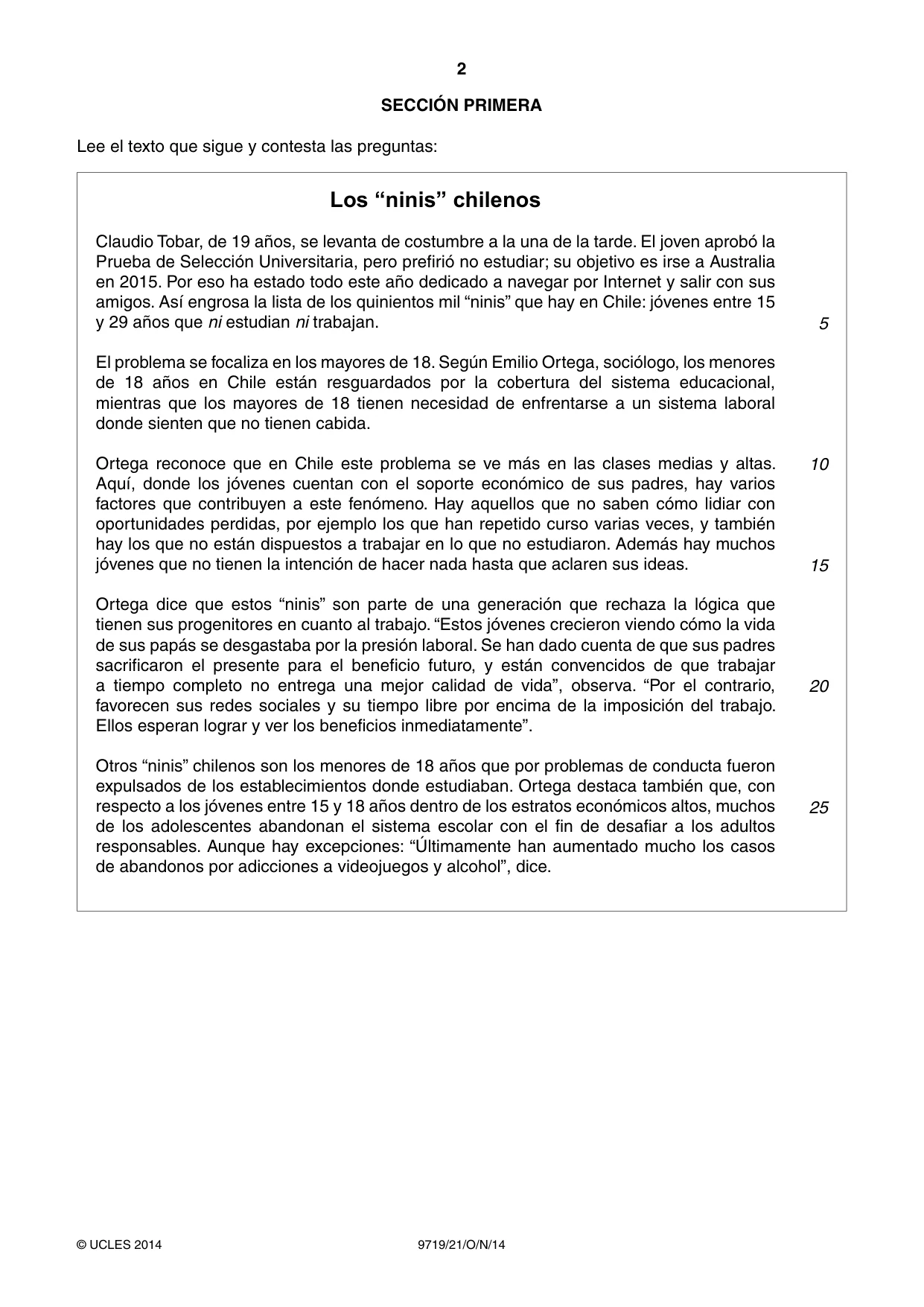
Question paper, page 2
2 9719/21/O/N/14 © UCLES 2014 SECCIÓN PRIMERA Lee el texto que sigue y contesta las preguntas: Los “ninis” chilenos Claudio Tobar, de 19 años, se levanta de costumbre a la una de la tarde. El joven aprobó la Prueba de Selección Universitaria, pero prefirió no estudiar; su objetivo es irse a Australia en 2015. Por eso ha estado todo este año dedicado a navegar por Internet y salir con sus amigos. Así engrosa la lista de los quinientos mil “ninis” que hay en Chile: jóvenes entre 15 y 29 años que ni estudian ni trabajan. El problema se focaliza en los mayores de 18. Según Emilio Ortega, sociólogo, los menores de 18 años en Chile están resguardados por la cobertura del sistema educacional, mientras que los mayores de 18 tienen necesidad de enfrentarse a un sistema laboral donde sienten que no tienen cabida. Ortega reconoce que en Chile este problema se ve más en las clases medias y altas. Aquí, donde los jóvenes cuentan con el soporte económico de sus padres, hay varios factores que contribuyen a este fenómeno. Hay aquellos que no saben cómo lidiar con oportunidades perdidas, por ejemplo los que han repetido curso varias veces, y también hay los que no están dispuestos a trabajar en lo que no estudiaron. Además hay muchos jóvenes que no tienen la intención de hacer nada hasta que aclaren sus ideas. Ortega dice que estos “ninis” son parte de una generación que rechaza la lógica que tienen sus progenitores en cuanto al trabajo. “Estos jóvenes crecieron viendo cómo la vida de sus papás se desgastaba por la presión laboral. Se han dado cuenta de que sus padres sacrificaron el presente para el beneficio futuro, y están convencidos de que trabajar a tiempo completo no entrega una mejor calidad de vida”, observa. “Por el contrario, favorecen sus redes sociales y su tiempo libre por encima de la imposición del trabajo. Ellos esperan lograr y ver los beneficios inmediatamente”. Otros “ninis” chilenos son los menores de 18 años que por problemas de conducta fueron expulsados de los establecimientos donde estudiaban. Ortega destaca también que, con respecto a los jóvenes entre 15 y 18 años dentro de los estratos económicos altos, muchos de los adolescentes abandonan el sistema escolar con el fin de desafiar a los adultos responsables. Aunque hay excepciones: “Últimamente han aumentado mucho los casos de abandonos por adicciones a videojuegos y alcohol”, dice. 5 10 15 20 25
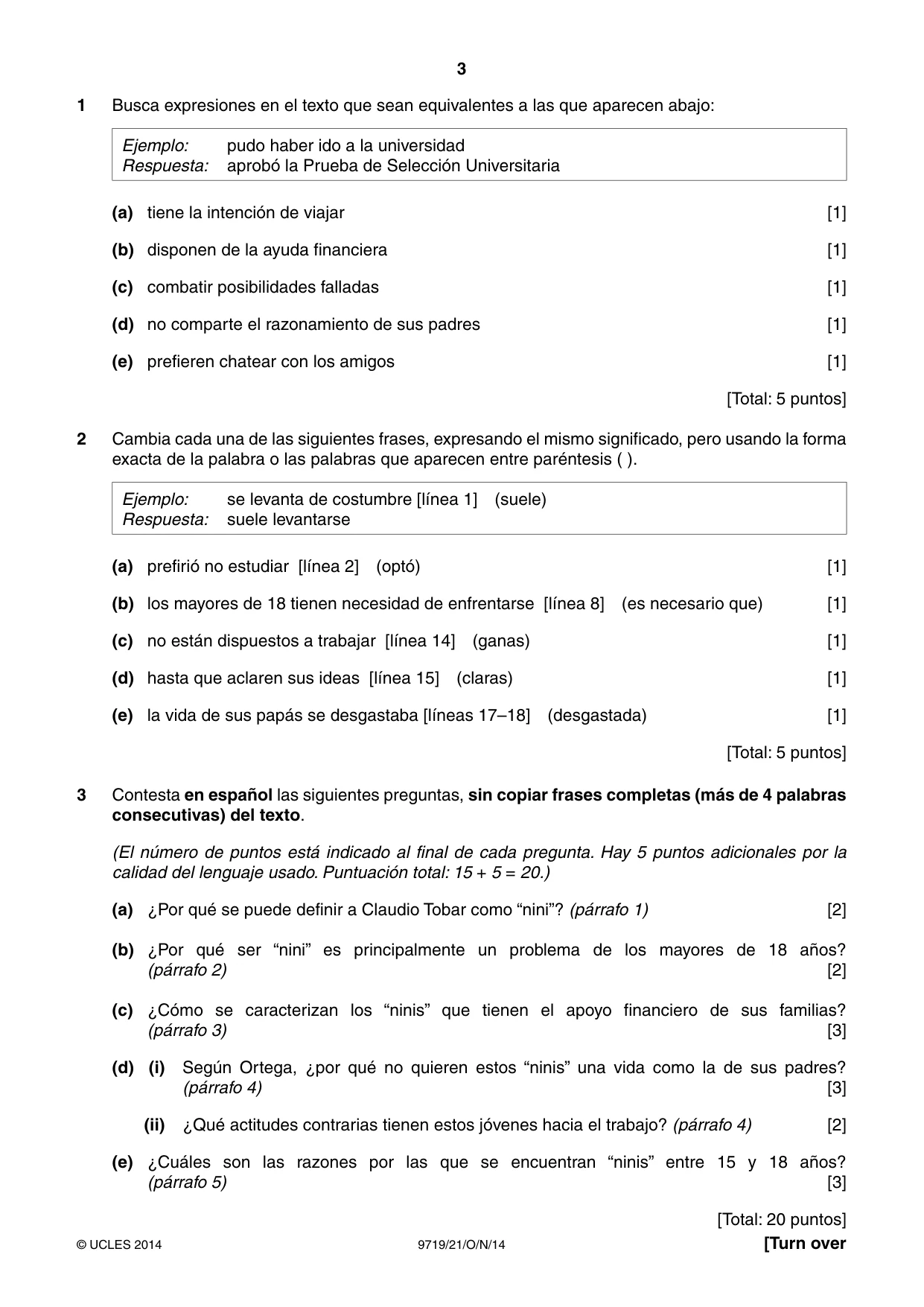
Question paper, page 3
3 9719/21/O/N/14 © UCLES 2014 [Turn over 1 Busca expresiones en el texto que sean equivalentes a las que aparecen abajo: Ejemplo: pudo haber ido a la universidad Respuesta: aprobó la Prueba de Selección Universitaria (a) tiene la intención de viajar [1] (b) disponen de la ayuda financiera [1] (c) combatir posibilidades falladas [1] (d) no comparte el razonamiento de sus padres [1] (e) prefieren chatear con los amigos [1] [Total: 5 puntos] 2 Cambia cada una de las siguientes frases, expresando el mismo significado, pero usando la forma exacta de la palabra o las palabras que aparecen entre paréntesis ( ). Ejemplo: se levanta de costumbre [línea 1] (suele) Respuesta: suele levantarse (a) prefirió no estudiar [línea 2] (optó) [1] (b) los mayores de 18 tienen necesidad de enfrentarse [línea 8] (es necesario que) [1] (c) no están dispuestos a trabajar [línea 14] (ganas) [1] (d) hasta que aclaren sus ideas [línea 15] (claras) [1] (e) la vida de sus papás se desgastaba [líneas 17–18] (desgastada) [1] [Total: 5 puntos] 3 Contesta en español las siguientes preguntas, sin copiar frases completas (más de 4 palabras consecutivas) del texto. (El número de puntos está indicado al final de cada pregunta. Hay 5 puntos adicionales por la calidad del lenguaje usado. Puntuación total: 15 + 5 = 20.) (a) ¿Por qué se puede definir a Claudio Tobar como “nini”? (párrafo 1) [2] (b) ¿Por qué ser “nini” es principalmente un problema de los mayores de 18 años? (párrafo 2) [2] (c) ¿Cómo se caracterizan los “ninis” que tienen el apoyo financiero de sus familias? (párrafo 3) [3] (d) (i) Según Ortega, ¿por qué no quieren estos “ninis” una vida como la de sus padres? (párrafo 4) [3] (ii) ¿Qué actitudes contrarias tienen estos jóvenes hacia el trabajo? (párrafo 4) [2] (e) ¿Cuáles son las razones por las que se encuentran “ninis” entre 15 y 18 años? (párrafo 5) [3] [Total: 20 puntos]
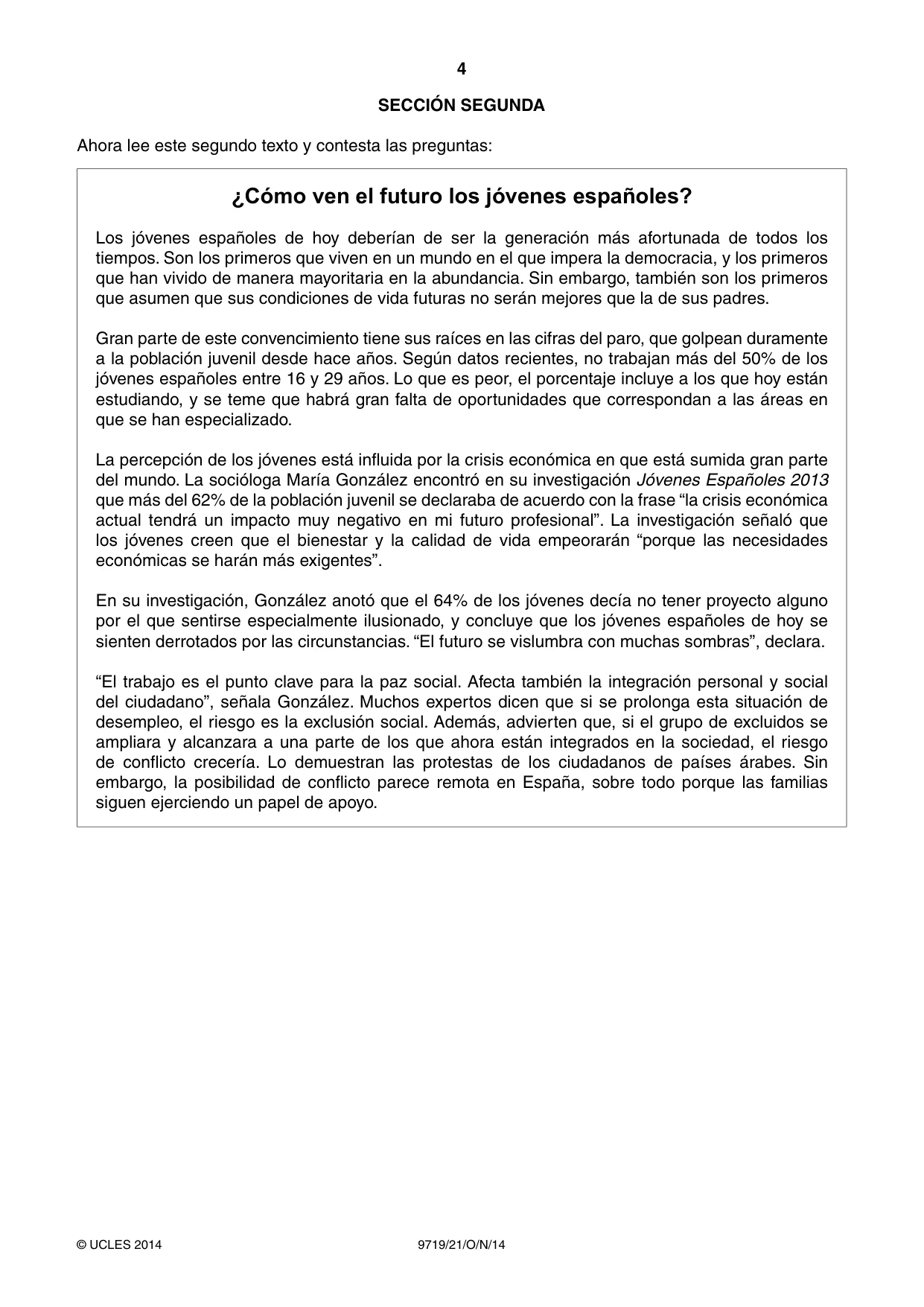
Question paper, page 4
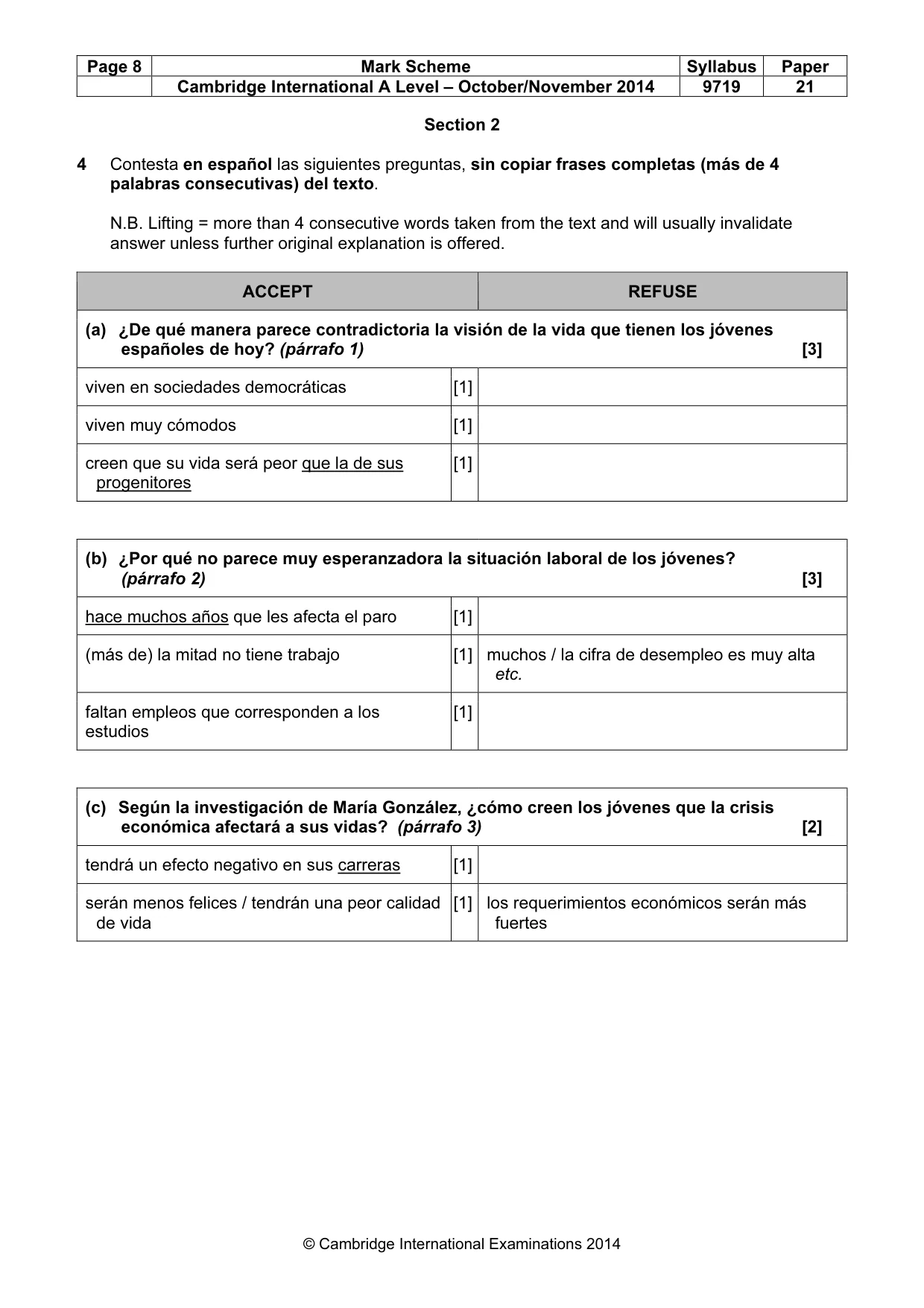
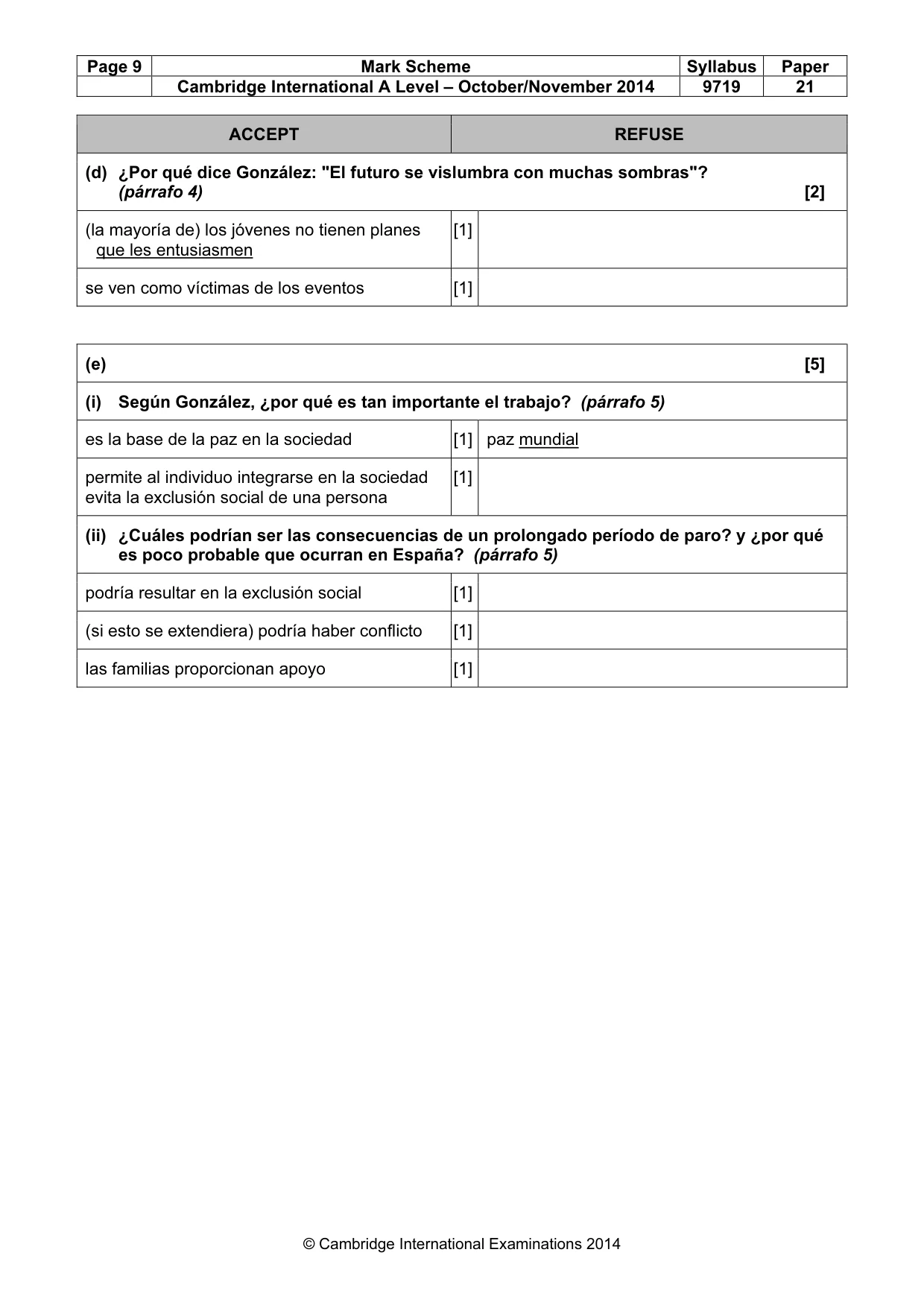
4 9719/21/O/N/14 © UCLES 2014 SECCIÓN SEGUNDA Ahora lee este segundo texto y contesta las preguntas: ¿Cómo ven el futuro los jóvenes españoles? Los jóvenes españoles de hoy deberían de ser la generación más afortunada de todos los tiempos. Son los primeros que viven en un mundo en el que impera la democracia, y los primeros que han vivido de manera mayoritaria en la abundancia. Sin embargo, también son los primeros que asumen que sus condiciones de vida futuras no serán mejores que la de sus padres. Gran parte de este convencimiento tiene sus raíces en las cifras del paro, que golpean duramente a la población juvenil desde hace años. Según datos recientes, no trabajan más del 50% de los jóvenes españoles entre 16 y 29 años. Lo que es peor, el porcentaje incluye a los que hoy están estudiando, y se teme que habrá gran falta de oportunidades que correspondan a las áreas en que se han especializado. La percepción de los jóvenes está influida por la crisis económica en que está sumida gran parte del mundo. La socióloga María González encontró en su investigación Jóvenes Españoles 2013 que más del 62% de la población juvenil se declaraba de acuerdo con la frase “la crisis económica actual tendrá un impacto muy negativo en mi futuro profesional”. La investigación señaló que los jóvenes creen que el bienestar y la calidad de vida empeorarán “porque las necesidades económicas se harán más exigentes”. En su investigación, González anotó que el 64% de los jóvenes decía no tener proyecto alguno por el que sentirse especialmente ilusionado, y concluye que los jóvenes españoles de hoy se sienten derrotados por las circunstancias. “El futuro se vislumbra con muchas sombras”, declara. “El trabajo es el punto clave para la paz social. Afecta también la integración personal y social del ciudadano”, señala González. Muchos expertos dicen que si se prolonga esta situación de desempleo, el riesgo es la exclusión social. Además, advierten que, si el grupo de excluidos se ampliara y alcanzara a una parte de los que ahora están integrados en la sociedad, el riesgo de conflicto crecería. Lo demuestran las protestas de los ciudadanos de países árabes. Sin embargo, la posibilidad de conflicto parece remota en España, sobre todo porque las familias siguen ejerciendo un papel de apoyo.
Question paper, page 5
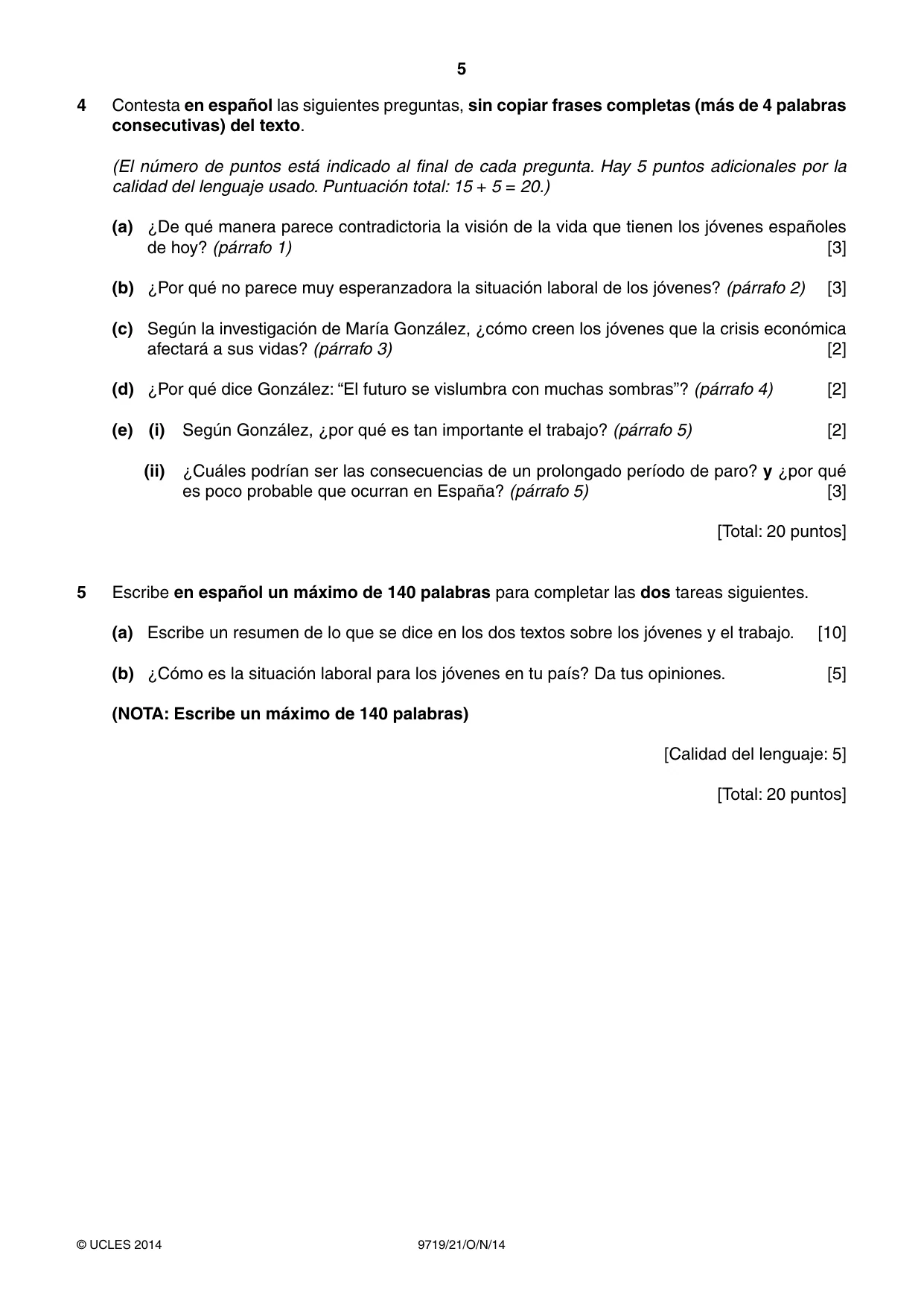
5 9719/21/O/N/14 © UCLES 2014 4 Contesta en español las siguientes preguntas, sin copiar frases completas (más de 4 palabras consecutivas) del texto. (El número de puntos está indicado al final de cada pregunta. Hay 5 puntos adicionales por la calidad del lenguaje usado. Puntuación total: 15 + 5 = 20.) (a) ¿De qué manera parece contradictoria la visión de la vida que tienen los jóvenes españoles de hoy? (párrafo 1) [3] (b) ¿Por qué no parece muy esperanzadora la situación laboral de los jóvenes? (párrafo 2) [3] (c) Según la investigación de María González, ¿cómo creen los jóvenes que la crisis económica afectará a sus vidas? (párrafo 3) [2] (d) ¿Por qué dice González: “El futuro se vislumbra con muchas sombras”? (párrafo 4) [2] (e) (i) Según González, ¿por qué es tan importante el trabajo? (párrafo 5) [2] (ii) ¿Cuáles podrían ser las consecuencias de un prolongado período de paro? y ¿por qué es poco probable que ocurran en España? (párrafo 5) [3] [Total: 20 puntos] 5 Escribe en español un máximo de 140 palabras para completar las dos tareas siguientes. (a) Escribe un resumen de lo que se dice en los dos textos sobre los jóvenes y el trabajo. [10] (b) ¿Cómo es la situación laboral para los jóvenes en tu país? Da tus opiniones. [5] (NOTA: Escribe un máximo de 140 palabras) [Calidad del lenguaje: 5] [Total: 20 puntos]
Question paper, page 6
6 9719/21/O/N/14 © UCLES 2014 BLANK PAGE
Question paper, page 7
7 9719/21/O/N/14 © UCLES 2014 BLANK PAGE
Question paper, page 8
8 9719/21/O/N/14 © UCLES 2014 Copyright Acknowledgements: Section 1 © http://diario.latercera.com/2011/07/23/01/contenido/pais/31-77458-9-uno-de-cada-cinco-jovenes-chilenos-entre-18-y-24-anos-ni-estudia-ni- trabaja.shtml; 23 July 2011. Section 2 © http://www.lavanguardia.com/vida/20110222/54118176519/por-primera-vez-los-jovenes-creen-que-su-vida-sera-peor-que-la-de-sus-padres.html; 22 February 2011. Permission to reproduce items where third-party owned material protected by copyright is included has been sought and cleared where possible. Every reasonable effort has been made by the publisher (UCLES) to trace copyright holders, but if any items requiring clearance have unwittingly been included, the publisher will be pleased to make amends at the earliest possible opportunity. Cambridge International Examinations is part of the Cambridge Assessment Group. Cambridge Assessment is the brand name of University of Cambridge Local Examinations Syndicate (UCLES), which is itself a department of the University of Cambridge. BLANK PAGE
Mark scheme, page 1
® IGCSE is the registered trademark of Cambridge International Examinations. CAMBRIDGE INTERNATIONAL EXAMINATIONS Cambridge International Advanced Level MARK SCHEME for the October/November 2014 series 9719 SPANISH 9719/21 Paper 2 (Reading and Writing), maximum raw mark 70 This mark scheme is published as an aid to teachers and candidates, to indicate the requirements of the examination. It shows the basis on which Examiners were instructed to award marks. It does not indicate the details of the discussions that took place at an Examiners’ meeting before marking began, which would have considered the acceptability of alternative answers. Mark schemes should be read in conjunction with the question paper and the Principal Examiner Report for Teachers. Cambridge will not enter into discussions about these mark schemes. Cambridge is publishing the mark schemes for the October/November 2014 series for most Cambridge IGCSE®, Cambridge International A and AS Level components and some Cambridge O Level components.
Mark scheme, page 2
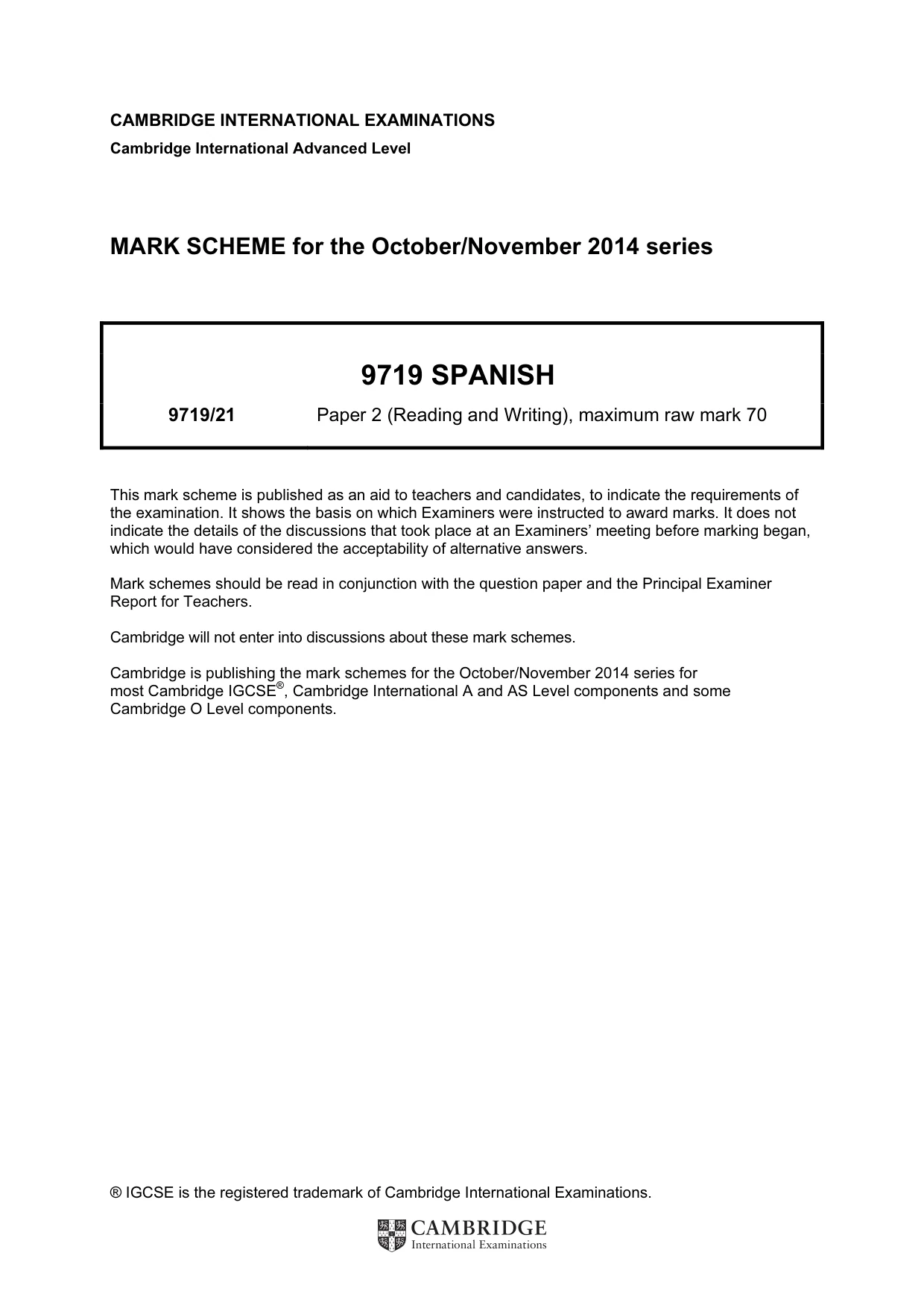
Page 2 Mark Scheme Syllabus Paper Cambridge International A Level – October/November 2014 9719 21 © Cambridge International Examinations 2014 1 General Marking Notes 2 General Marking Principles 2.1 Please note that it is not possible to list all acceptable alternatives in the Detailed Mark Scheme provided on the following pages. You will need to consider all alternative answers and unexpected approaches in candidates' scripts, make a decision on whether they communicate the required elements, in consultation with the Principal Examiner if necessary, and award marks accordingly. 2.2 Crossing out: (a) If a candidate changes his/her mind over an answer and crosses out an attempt, award a mark if the final attempt is correct. (b) If a candidate crosses out an answer to a whole question but makes no second attempt at it, mark the crossed out work. 2.3 Annotation used in marking: (a) BOD = Benefit of the Doubt and is used to indicate material considered by the Examiner and judged to be more correct than incorrect: the benefit of the doubt is given to the candidate and the mark is awarded. (b) NBOD = No Benefit of the Doubt and is used to indicate material considered by the Examiner and judged to be more incorrect than correct: the benefit of the doubt is not given to the candidate and the mark is not awarded. (c) caret = to indicate where something which is key to the response is missing. 2.4 No response and '0' marks There is a NR (No Response) option in scoris. Award NR (No Response): • If there is nothing written at all in the answer space or • If there is only a comment which does not in any way relate to the question being asked (e.g. 'can’t do' or 'don’t know') or • If there is only a mark which isn’t an attempt at the question (e.g. a dash, a question mark). Award 0: • If there is any attempt that earns no credit. This could, for example, include the candidate copying all or some of the question, or any working that does not earn any marks, whether crossed out or not.
Mark scheme, page 3
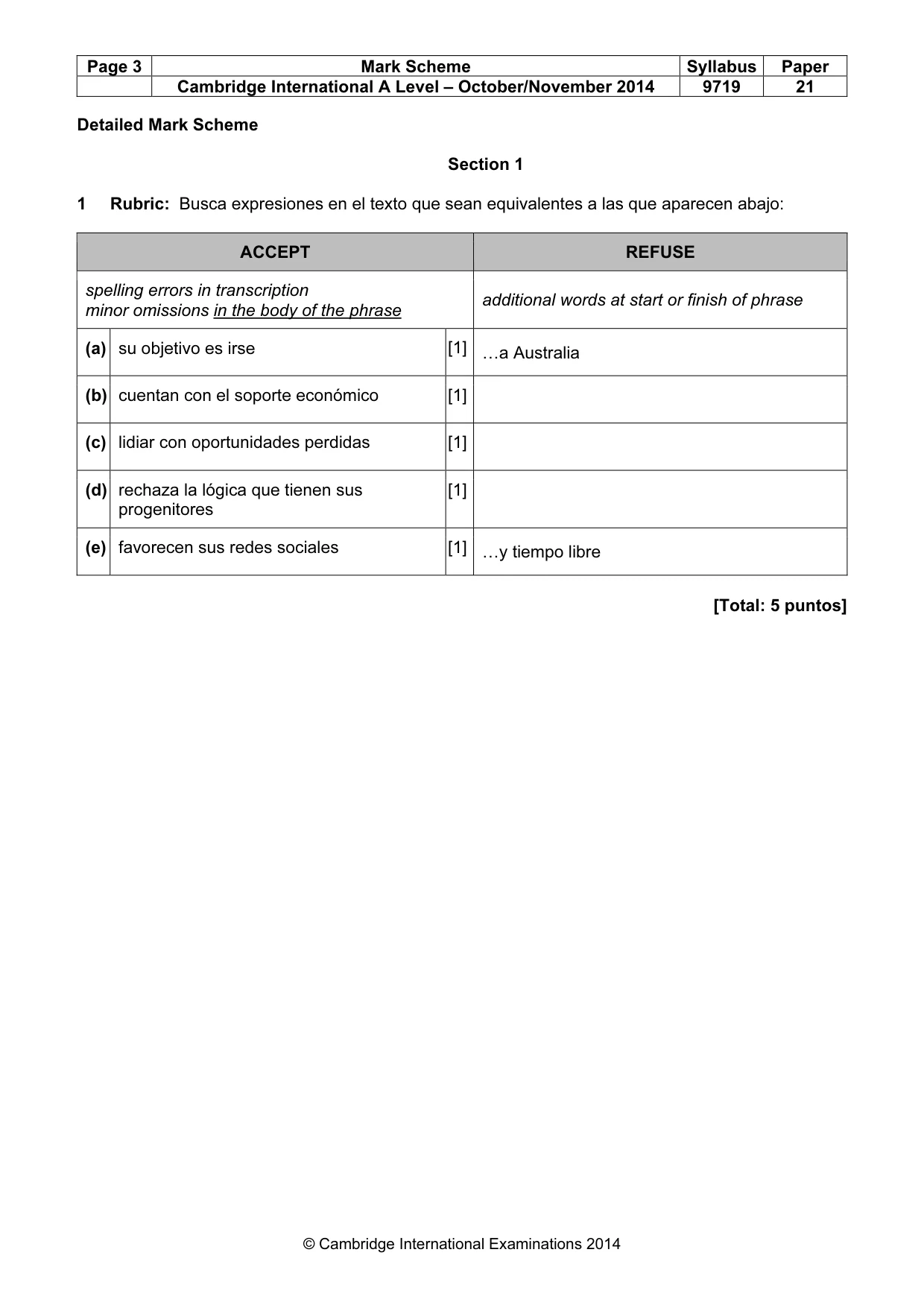
Page 3 Mark Scheme Syllabus Paper Cambridge International A Level – October/November 2014 9719 21 © Cambridge International Examinations 2014 Detailed Mark Scheme Section 1 1 Rubric: Busca expresiones en el texto que sean equivalentes a las que aparecen abajo: ACCEPT REFUSE spelling errors in transcription minor omissions in the body of the phrase additional words at start or finish of phrase (a) su objetivo es irse [1] …a Australia (b) cuentan con el soporte económico [1] (c) lidiar con oportunidades perdidas [1] (d) rechaza la lógica que tienen sus progenitores [1] (e) favorecen sus redes sociales [1] …y tiempo libre [Total: 5 puntos]
Mark scheme, page 4
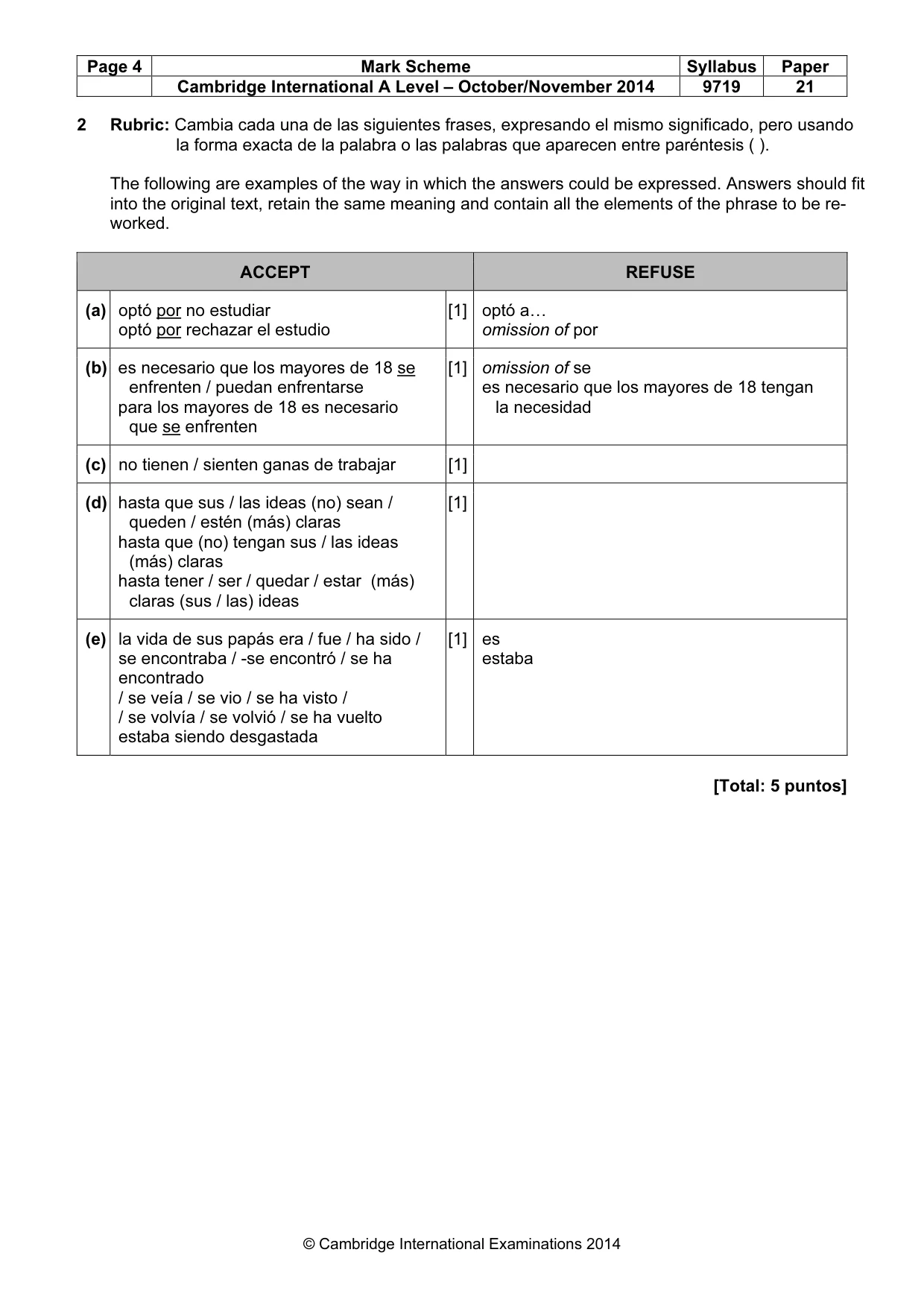
Page 4 Mark Scheme Syllabus Paper Cambridge International A Level – October/November 2014 9719 21 © Cambridge International Examinations 2014 2 Rubric: Cambia cada una de las siguientes frases, expresando el mismo significado, pero usando la forma exacta de la palabra o las palabras que aparecen entre paréntesis ( ). The following are examples of the way in which the answers could be expressed. Answers should fit into the original text, retain the same meaning and contain all the elements of the phrase to be re- worked. ACCEPT REFUSE (a) optó por no estudiar optó por rechazar el estudio [1] optó a… omission of por (b) es necesario que los mayores de 18 se enfrenten / puedan enfrentarse para los mayores de 18 es necesario que se enfrenten [1] omission of se es necesario que los mayores de 18 tengan la necesidad (c) no tienen / sienten ganas de trabajar [1] (d) hasta que sus / las ideas (no) sean / queden / estén (más) claras hasta que (no) tengan sus / las ideas (más) claras hasta tener / ser / quedar / estar (más) claras (sus / las) ideas [1] (e) la vida de sus papás era / fue / ha sido / se encontraba / -se encontró / se ha encontrado / se veía / se vio / se ha visto / / se volvía / se volvió / se ha vuelto estaba siendo desgastada [1] es estaba [Total: 5 puntos]
Mark scheme, page 5
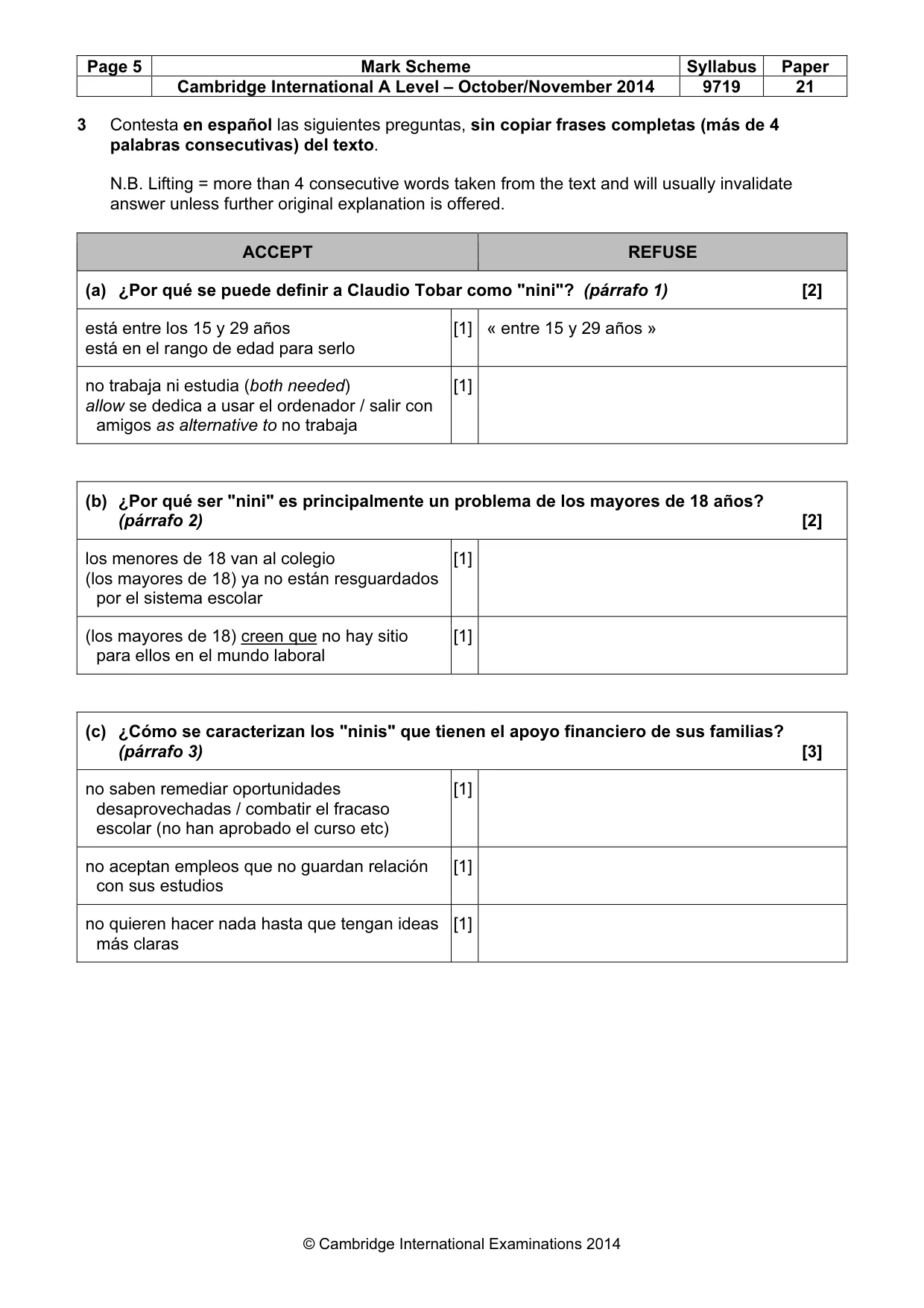
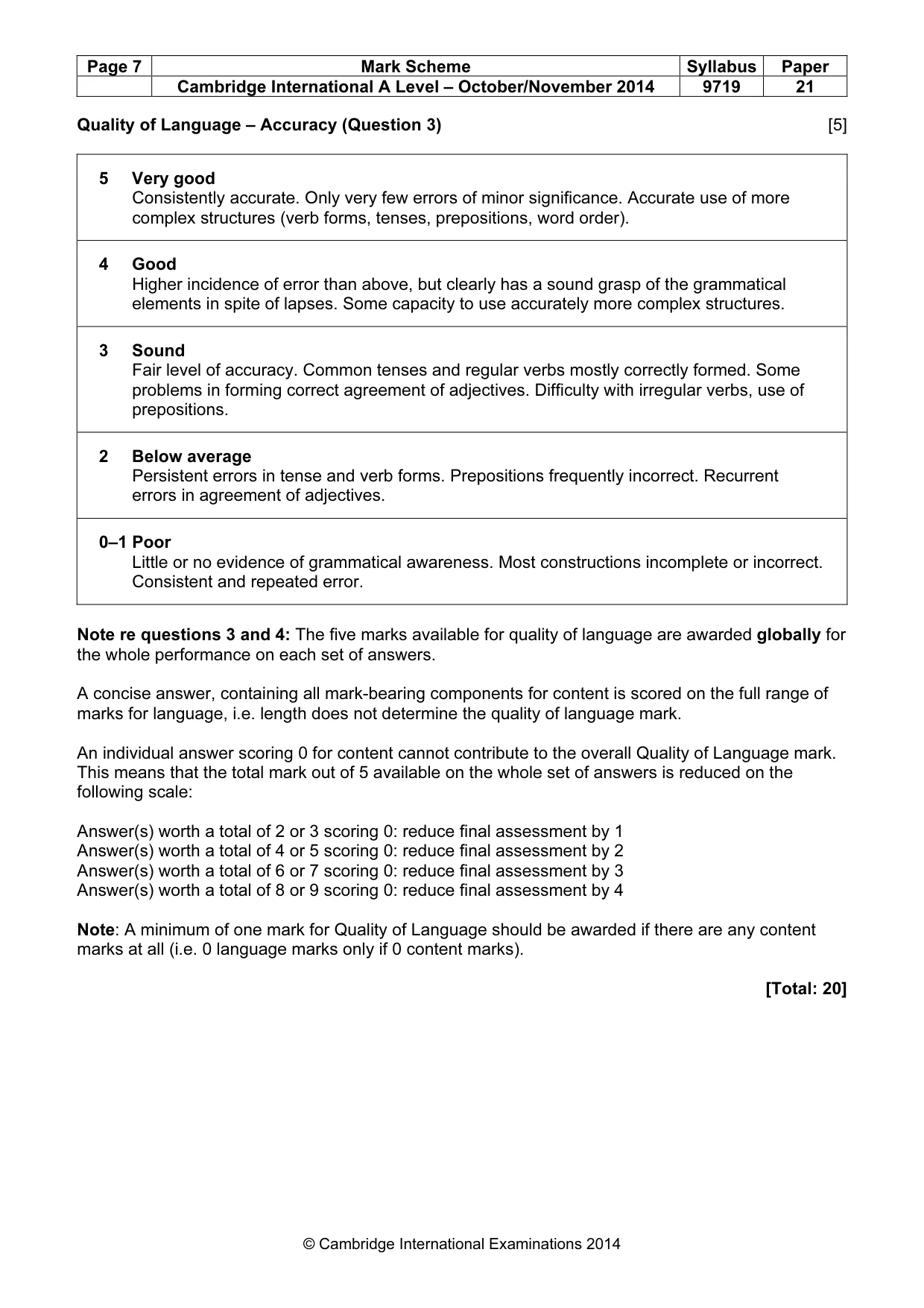
Page 5 Mark Scheme Syllabus Paper Cambridge International A Level – October/November 2014 9719 21 © Cambridge International Examinations 2014 3 Contesta en español las siguientes preguntas, sin copiar frases completas (más de 4 palabras consecutivas) del texto. N.B. Lifting = more than 4 consecutive words taken from the text and will usually invalidate answer unless further original explanation is offered. ACCEPT REFUSE (a) ¿Por qué se puede definir a Claudio Tobar como "nini"? (párrafo 1) [2] está entre los 15 y 29 años está en el rango de edad para serlo [1] « entre 15 y 29 años » no trabaja ni estudia (both needed) allow se dedica a usar el ordenador / salir con amigos as alternative to no trabaja [1] (b) ¿Por qué ser "nini" es principalmente un problema de los mayores de 18 años? (párrafo 2) [2] los menores de 18 van al colegio (los mayores de 18) ya no están resguardados por el sistema escolar [1] (los mayores de 18) creen que no hay sitio para ellos en el mundo laboral [1] (c) ¿Cómo se caracterizan los "ninis" que tienen el apoyo financiero de sus familias? (párrafo 3) [3] no saben remediar oportunidades desaprovechadas / combatir el fracaso escolar (no han aprobado el curso etc) [1] no aceptan empleos que no guardan relación con sus estudios [1] no quieren hacer nada hasta que tengan ideas más claras [1]
Mark scheme, page 6
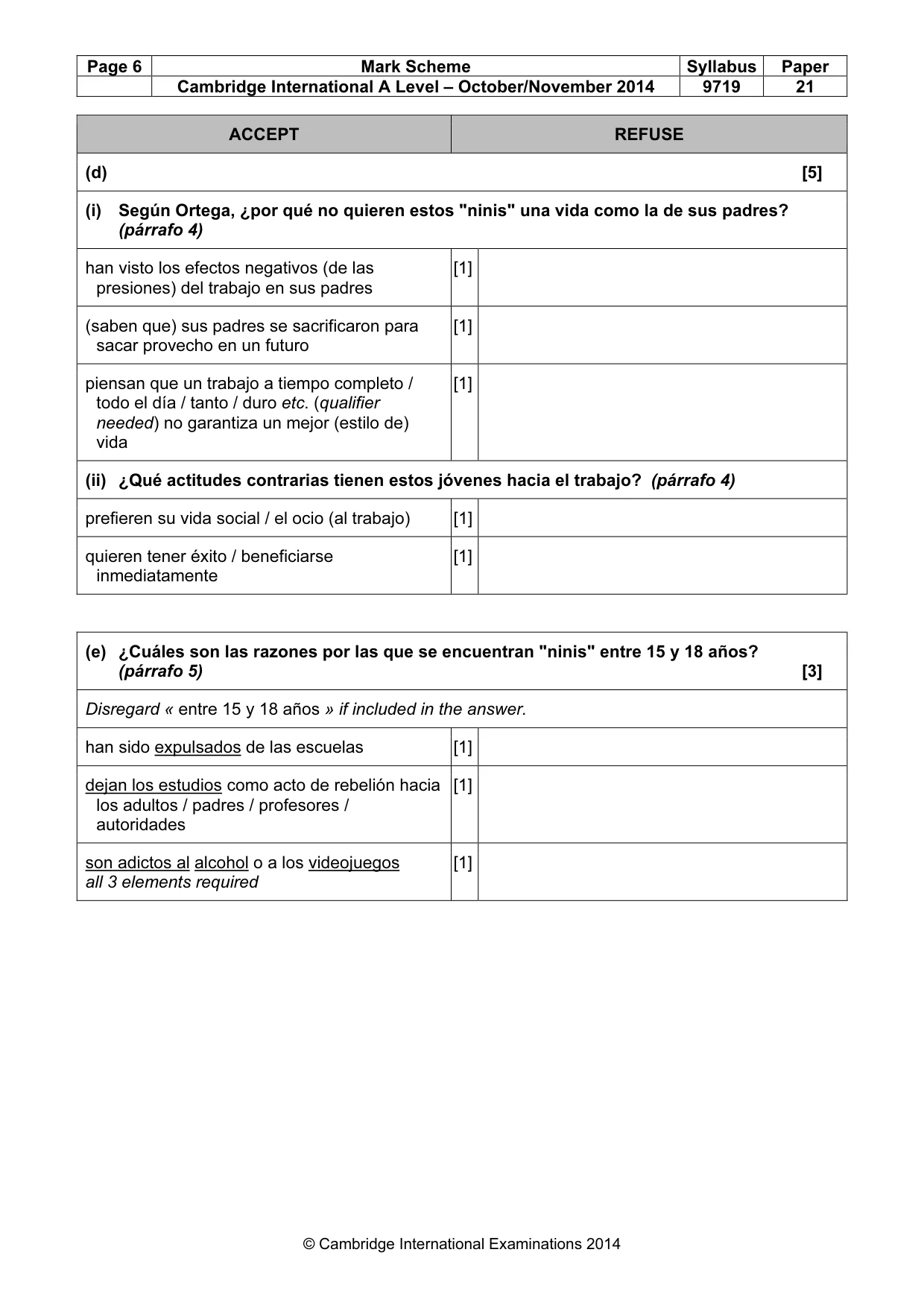
Page 6 Mark Scheme Syllabus Paper Cambridge International A Level – October/November 2014 9719 21 © Cambridge International Examinations 2014 ACCEPT REFUSE (d) [5] (i) Según Ortega, ¿por qué no quieren estos "ninis" una vida como la de sus padres? (párrafo 4) han visto los efectos negativos (de las presiones) del trabajo en sus padres [1] (saben que) sus padres se sacrificaron para sacar provecho en un futuro [1] piensan que un trabajo a tiempo completo / todo el día / tanto / duro etc. (qualifier needed) no garantiza un mejor (estilo de) vida [1] (ii) ¿Qué actitudes contrarias tienen estos jóvenes hacia el trabajo? (párrafo 4) prefieren su vida social / el ocio (al trabajo) [1] quieren tener éxito / beneficiarse inmediatamente [1] (e) ¿Cuáles son las razones por las que se encuentran "ninis" entre 15 y 18 años? (párrafo 5) [3] Disregard « entre 15 y 18 años » if included in the answer. han sido expulsados de las escuelas [1] dejan los estudios como acto de rebelión hacia los adultos / padres / profesores / autoridades [1] son adictos al alcohol o a los videojuegos all 3 elements required [1]
Mark scheme, page 7
Page 7 Mark Scheme Syllabus Paper Cambridge International A Level – October/November 2014 9719 21 © Cambridge International Examinations 2014 Quality of Language – Accuracy (Question 3) [5] 5 Very good Consistently accurate. Only very few errors of minor significance. Accurate use of more complex structures (verb forms, tenses, prepositions, word order). 4 Good Higher incidence of error than above, but clearly has a sound grasp of the grammatical elements in spite of lapses. Some capacity to use accurately more complex structures. 3 Sound Fair level of accuracy. Common tenses and regular verbs mostly correctly formed. Some problems in forming correct agreement of adjectives. Difficulty with irregular verbs, use of prepositions. 2 Below average Persistent errors in tense and verb forms. Prepositions frequently incorrect. Recurrent errors in agreement of adjectives. 0–1 Poor Little or no evidence of grammatical awareness. Most constructions incomplete or incorrect. Consistent and repeated error. Note re questions 3 and 4: The five marks available for quality of language are awarded globally for the whole performance on each set of answers. A concise answer, containing all mark-bearing components for content is scored on the full range of marks for language, i.e. length does not determine the quality of language mark. An individual answer scoring 0 for content cannot contribute to the overall Quality of Language mark. This means that the total mark out of 5 available on the whole set of answers is reduced on the following scale: Answer(s) worth a total of 2 or 3 scoring 0: reduce final assessment by 1 Answer(s) worth a total of 4 or 5 scoring 0: reduce final assessment by 2 Answer(s) worth a total of 6 or 7 scoring 0: reduce final assessment by 3 Answer(s) worth a total of 8 or 9 scoring 0: reduce final assessment by 4 Note: A minimum of one mark for Quality of Language should be awarded if there are any content marks at all (i.e. 0 language marks only if 0 content marks). [Total: 20]
Mark scheme, page 8
Page 8 Mark Scheme Syllabus Paper Cambridge International A Level – October/November 2014 9719 21 © Cambridge International Examinations 2014 Section 2 4 Contesta en español las siguientes preguntas, sin copiar frases completas (más de 4 palabras consecutivas) del texto. N.B. Lifting = more than 4 consecutive words taken from the text and will usually invalidate answer unless further original explanation is offered. ACCEPT REFUSE (a) ¿De qué manera parece contradictoria la visión de la vida que tienen los jóvenes españoles de hoy? (párrafo 1) [3] viven en sociedades democráticas [1] viven muy cómodos [1] creen que su vida será peor que la de sus progenitores [1] (b) ¿Por qué no parece muy esperanzadora la situación laboral de los jóvenes? (párrafo 2) [3] hace muchos años que les afecta el paro [1] (más de) la mitad no tiene trabajo [1] muchos / la cifra de desempleo es muy alta etc. faltan empleos que corresponden a los estudios [1] (c) Según la investigación de María González, ¿cómo creen los jóvenes que la crisis económica afectará a sus vidas? (párrafo 3) [2] tendrá un efecto negativo en sus carreras [1] serán menos felices / tendrán una peor calidad de vida [1] los requerimientos económicos serán más fuertes
Mark scheme, page 9
Page 9 Mark Scheme Syllabus Paper Cambridge International A Level – October/November 2014 9719 21 © Cambridge International Examinations 2014 ACCEPT REFUSE (d) ¿Por qué dice González: "El futuro se vislumbra con muchas sombras"? (párrafo 4) [2] (la mayoría de) los jóvenes no tienen planes que les entusiasmen [1] se ven como víctimas de los eventos [1] (e) [5] (i) Según González, ¿por qué es tan importante el trabajo? (párrafo 5) es la base de la paz en la sociedad [1] paz mundial permite al individuo integrarse en la sociedad evita la exclusión social de una persona [1] (ii) ¿Cuáles podrían ser las consecuencias de un prolongado período de paro? y ¿por qué es poco probable que ocurran en España? (párrafo 5) podría resultar en la exclusión social [1] (si esto se extendiera) podría haber conflicto [1] las familias proporcionan apoyo [1]
Mark scheme, page 10
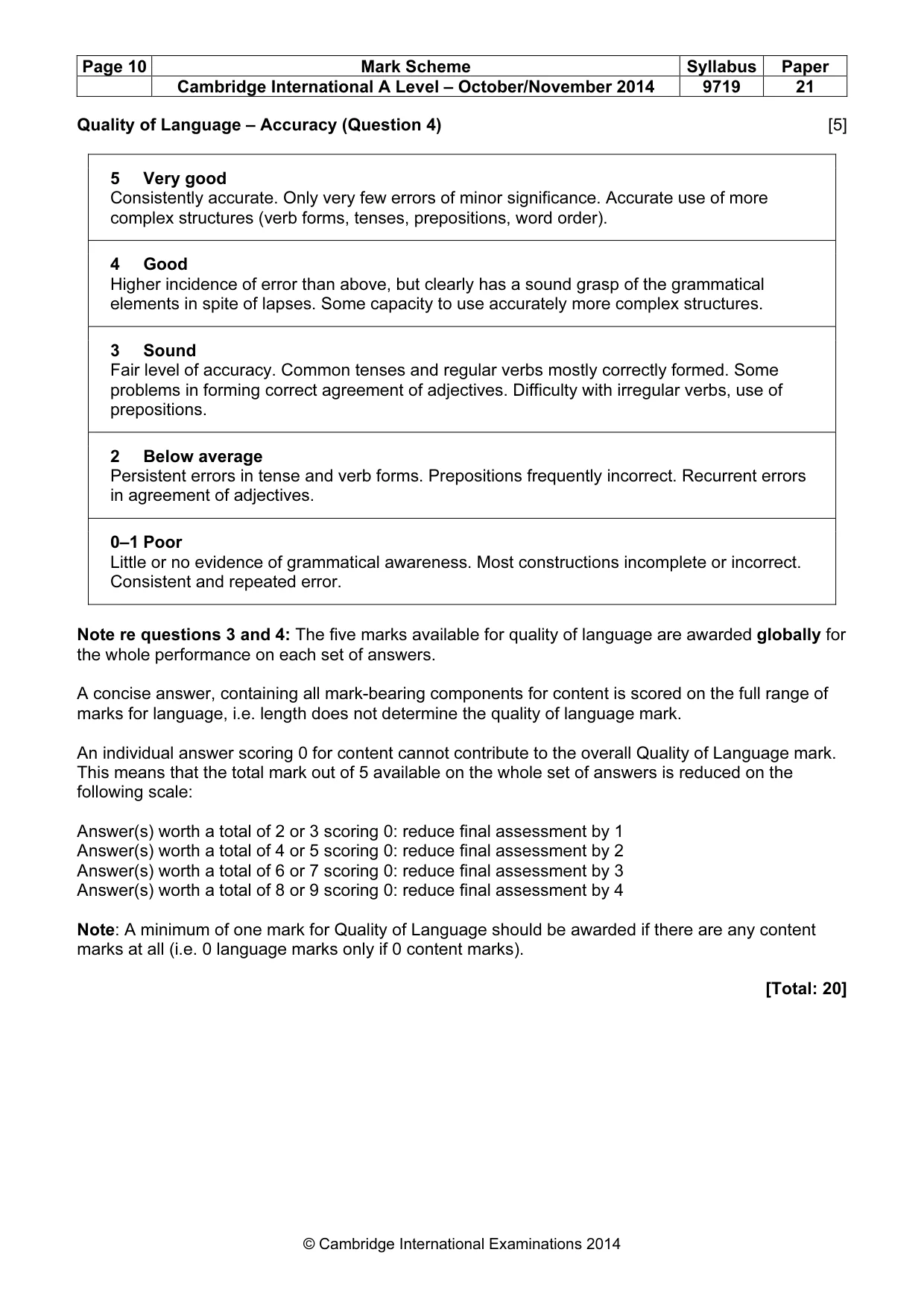
Page 10 Mark Scheme Syllabus Paper Cambridge International A Level – October/November 2014 9719 21 © Cambridge International Examinations 2014 Quality of Language – Accuracy (Question 4) [5] 5 Very good Consistently accurate. Only very few errors of minor significance. Accurate use of more complex structures (verb forms, tenses, prepositions, word order). 4 Good Higher incidence of error than above, but clearly has a sound grasp of the grammatical elements in spite of lapses. Some capacity to use accurately more complex structures. 3 Sound Fair level of accuracy. Common tenses and regular verbs mostly correctly formed. Some problems in forming correct agreement of adjectives. Difficulty with irregular verbs, use of prepositions. 2 Below average Persistent errors in tense and verb forms. Prepositions frequently incorrect. Recurrent errors in agreement of adjectives. 0–1 Poor Little or no evidence of grammatical awareness. Most constructions incomplete or incorrect. Consistent and repeated error. Note re questions 3 and 4: The five marks available for quality of language are awarded globally for the whole performance on each set of answers. A concise answer, containing all mark-bearing components for content is scored on the full range of marks for language, i.e. length does not determine the quality of language mark. An individual answer scoring 0 for content cannot contribute to the overall Quality of Language mark. This means that the total mark out of 5 available on the whole set of answers is reduced on the following scale: Answer(s) worth a total of 2 or 3 scoring 0: reduce final assessment by 1 Answer(s) worth a total of 4 or 5 scoring 0: reduce final assessment by 2 Answer(s) worth a total of 6 or 7 scoring 0: reduce final assessment by 3 Answer(s) worth a total of 8 or 9 scoring 0: reduce final assessment by 4 Note: A minimum of one mark for Quality of Language should be awarded if there are any content marks at all (i.e. 0 language marks only if 0 content marks). [Total: 20]
Mark scheme, page 11
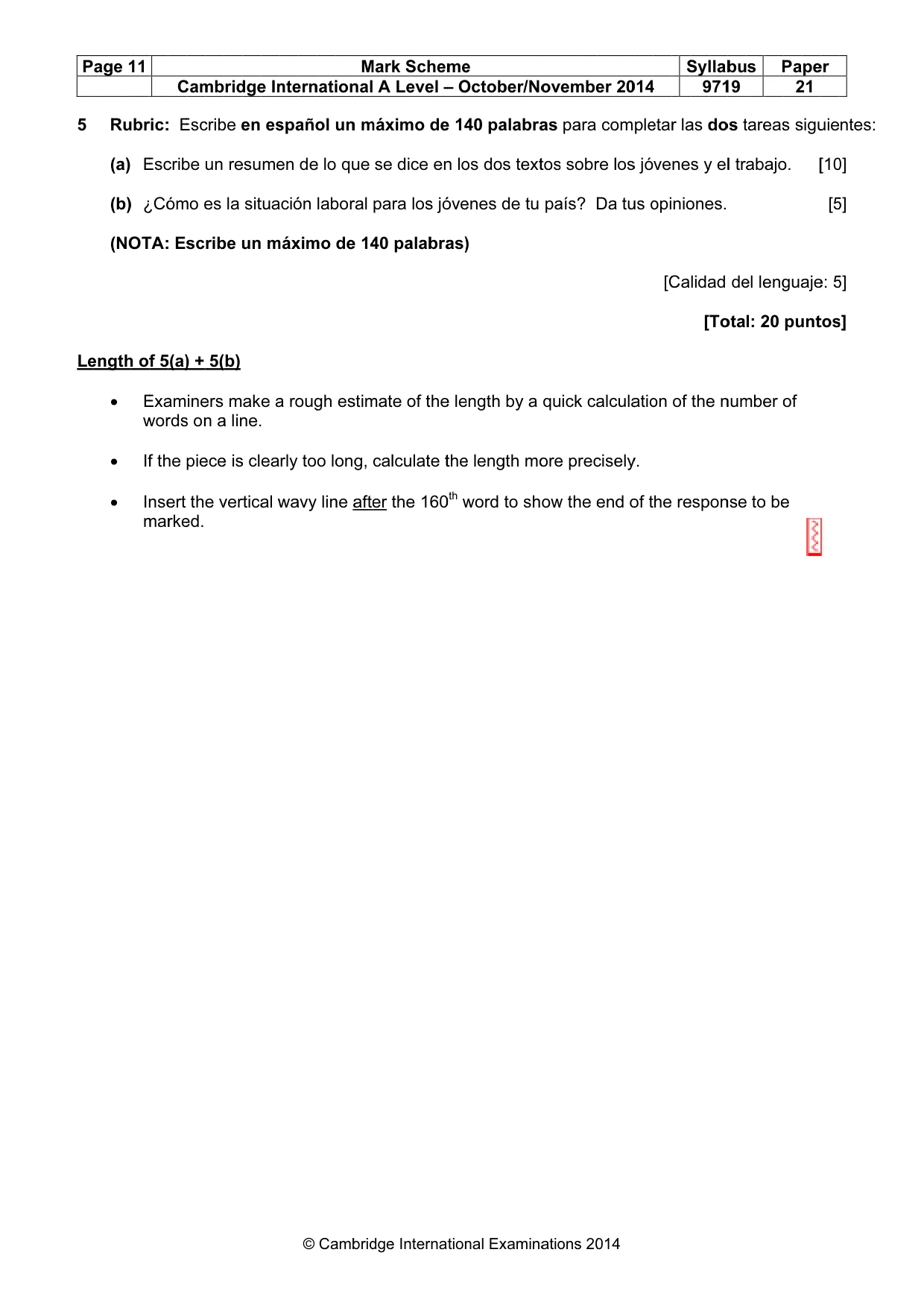
P 5 Le ag R ( ( ( eng • • • ge 1 Ru (a) (b) (NO gth • • • 11 ubr E ) ¿ OT h of E w If In m ric: Esc ¿Có TA: f 5 Exa wor f th nse mar C : E crib óm : Es 5(a) am rds he ert rke Cam Esc be mo e sc ) + ine s on pie th ed. mb crib un es rib 5( ers n a ece e v rid be e re la be u (b) m a lin e is ver dge en esu sit un ak ne. s cl rtica e In es me tua m e a ea al w nte spa en ció máx a ro rly wa ern © año de ón xim oug to avy nati Ca ol e lo lab mo gh o lo lin ion amb un qu bor de es ong ne a M nal brid n m ue ral e 14 stim g, afte Mar A dge máx se pa 40 mat cal er k S Le e In xim di ra pa te o lcu the Sch eve nter mo ce los alab of t ulat e 1 hem el – rnat de en s jó bra the te t 60 me – O tion e 14 n lo óve as) e le the 0th w e Oct nal 40 os d ene ) eng e le wo tob Ex pa dos es d gth eng rd ber xam ala s te de by gth to r/No mina bra ext tu y a mo sh ov atio as tos pa qu ore ow vem ons pa s so aís? uick e p w th mbe s 20 ara obr ? D k ca rec he e er 014 co re l Da alc cise end 20 4 om los a tu cula ely d o 014 ple s jó us o atio y. of t 4 etar ve opi [C on he S r la ne nio Ca of re Syl 9 as d s y one lida [ the esp llab 971 do y el es. ad To e n pon bu 19 os t l tra de ota num nse s tare aba el le l: 2 mbe to P eas ajo eng 20 er o o be Pa 2 s s o. gua pu of e pe 21 sigu [ aje unt er uie [10 [5 e: 5 tos nte 0] 5] 5] s] es:
Mark scheme, page 12
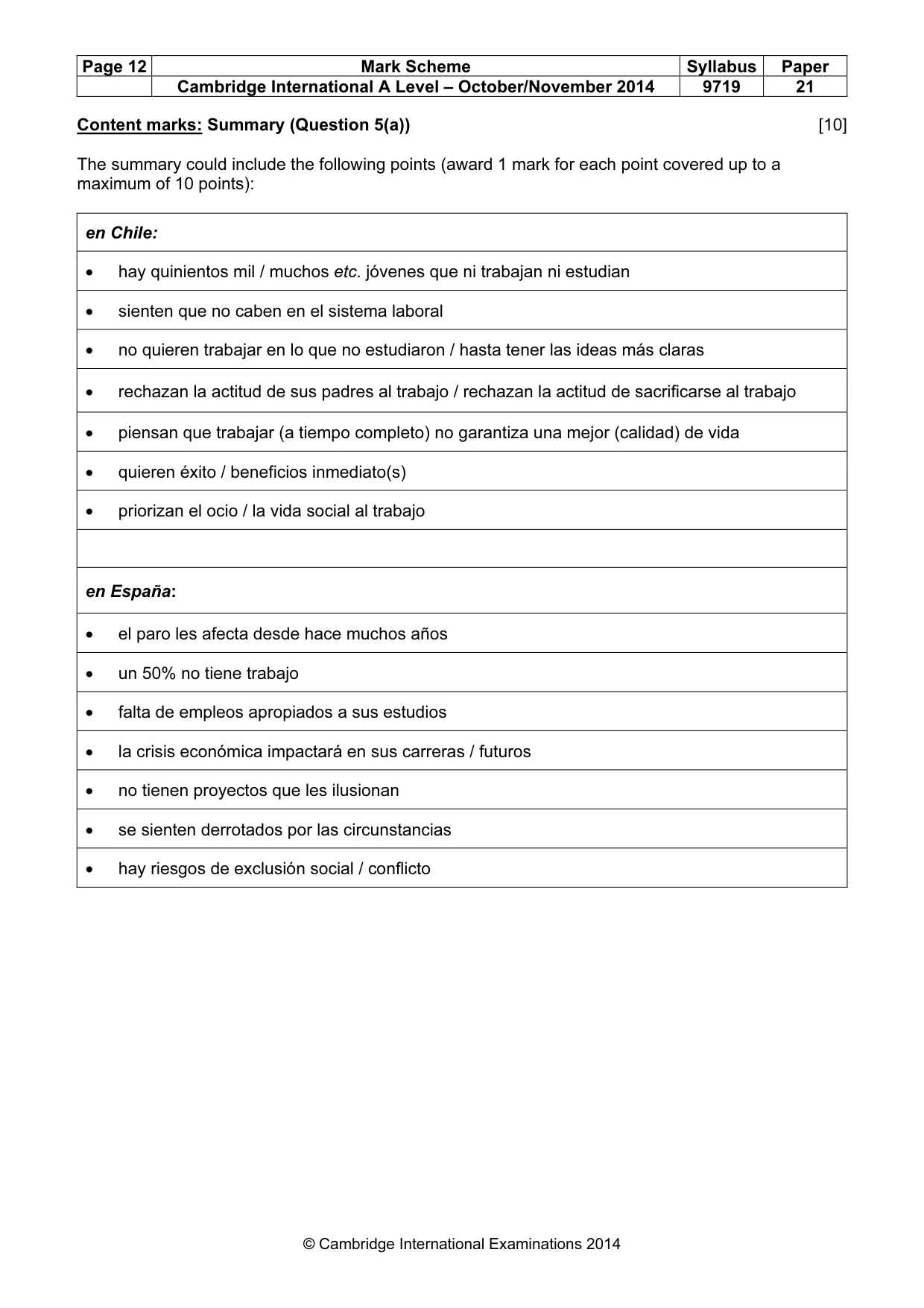
Page 12 Mark Scheme Syllabus Paper Cambridge International A Level – October/November 2014 9719 21 © Cambridge International Examinations 2014 Content marks: Summary (Question 5(a)) [10] The summary could include the following points (award 1 mark for each point covered up to a maximum of 10 points): en Chile: • hay quinientos mil / muchos etc. jóvenes que ni trabajan ni estudian • sienten que no caben en el sistema laboral • no quieren trabajar en lo que no estudiaron / hasta tener las ideas más claras • rechazan la actitud de sus padres al trabajo / rechazan la actitud de sacrificarse al trabajo • piensan que trabajar (a tiempo completo) no garantiza una mejor (calidad) de vida • quieren éxito / beneficios inmediato(s) • priorizan el ocio / la vida social al trabajo en España: • el paro les afecta desde hace muchos años • un 50% no tiene trabajo • falta de empleos apropiados a sus estudios • la crisis económica impactará en sus carreras / futuros • no tienen proyectos que les ilusionan • se sienten derrotados por las circunstancias • hay riesgos de exclusión social / conflicto
Mark scheme, page 13
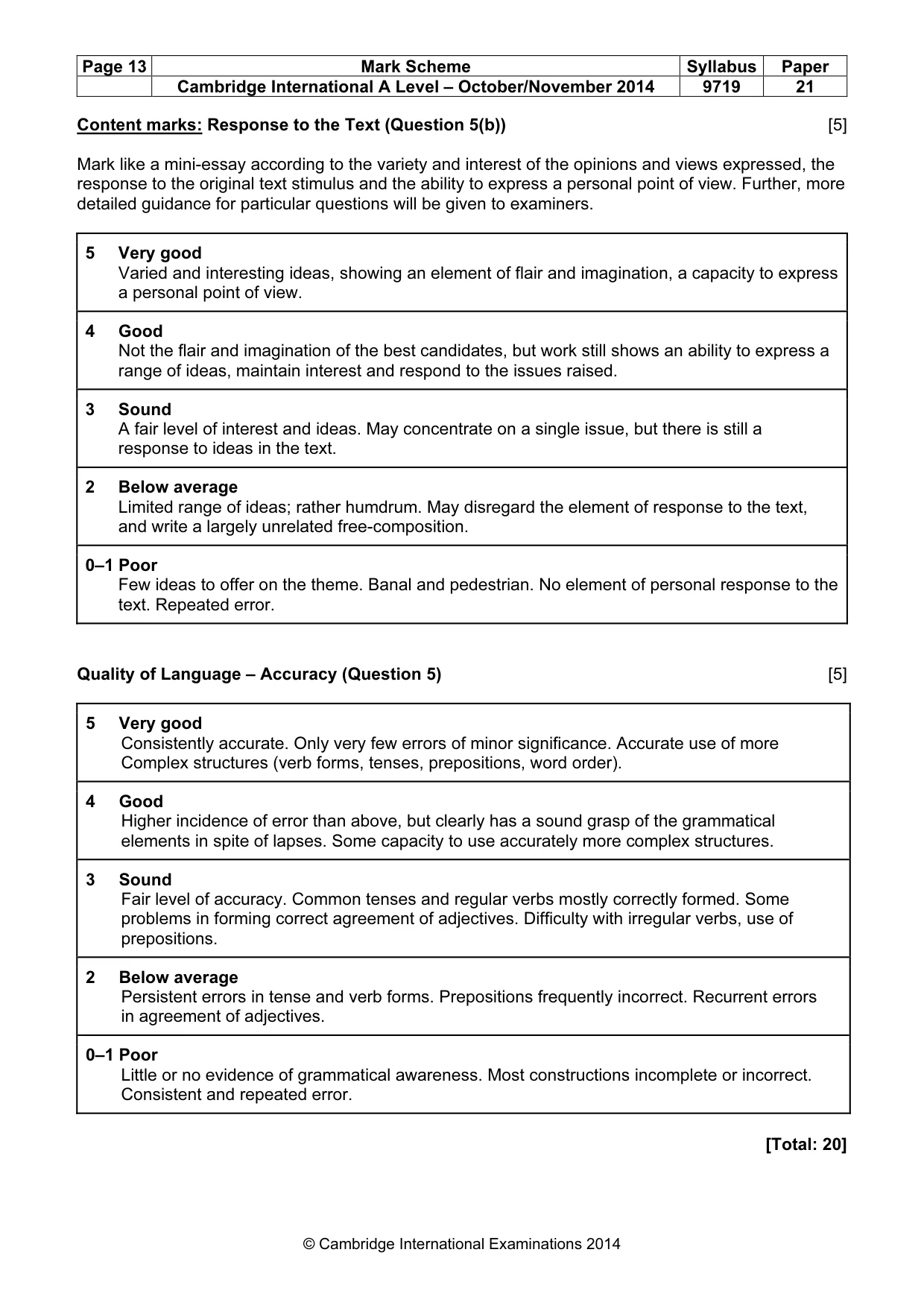
Page 13 Mark Scheme Syllabus Paper Cambridge International A Level – October/November 2014 9719 21 © Cambridge International Examinations 2014 Content marks: Response to the Text (Question 5(b)) [5] Mark like a mini-essay according to the variety and interest of the opinions and views expressed, the response to the original text stimulus and the ability to express a personal point of view. Further, more detailed guidance for particular questions will be given to examiners. 5 Very good Varied and interesting ideas, showing an element of flair and imagination, a capacity to express a personal point of view. 4 Good Not the flair and imagination of the best candidates, but work still shows an ability to express a range of ideas, maintain interest and respond to the issues raised. 3 Sound A fair level of interest and ideas. May concentrate on a single issue, but there is still a response to ideas in the text. 2 Below average Limited range of ideas; rather humdrum. May disregard the element of response to the text, and write a largely unrelated free-composition. 0–1 Poor Few ideas to offer on the theme. Banal and pedestrian. No element of personal response to the text. Repeated error. Quality of Language – Accuracy (Question 5) [5] 5 Very good Consistently accurate. Only very few errors of minor significance. Accurate use of more Complex structures (verb forms, tenses, prepositions, word order). 4 Good Higher incidence of error than above, but clearly has a sound grasp of the grammatical elements in spite of lapses. Some capacity to use accurately more complex structures. 3 Sound Fair level of accuracy. Common tenses and regular verbs mostly correctly formed. Some problems in forming correct agreement of adjectives. Difficulty with irregular verbs, use of prepositions. 2 Below average Persistent errors in tense and verb forms. Prepositions frequently incorrect. Recurrent errors in agreement of adjectives. 0–1 Poor Little or no evidence of grammatical awareness. Most constructions incomplete or incorrect. Consistent and repeated error. [Total: 20]
What you needed in this session
Cambridge’s own grade thresholds for 2014 Oct/Nov, Paper 2 · Variant 1. A higher threshold means an easier paper — the bar moves with how the cohort did.