Cambridge A Level Sociology 9699 — 2022 Oct/Nov Paper 1 · Variant 2
9699/12/O/N/22 · 60 marks · ≈68 min
The question paper and its mark scheme, free to read here and free to download. This is Cambridge’s own paper, exactly as it was sat.
Question paper4 pages


Mark scheme18 pages
Answers below. Sit the paper first if you are practising.

Paper as text
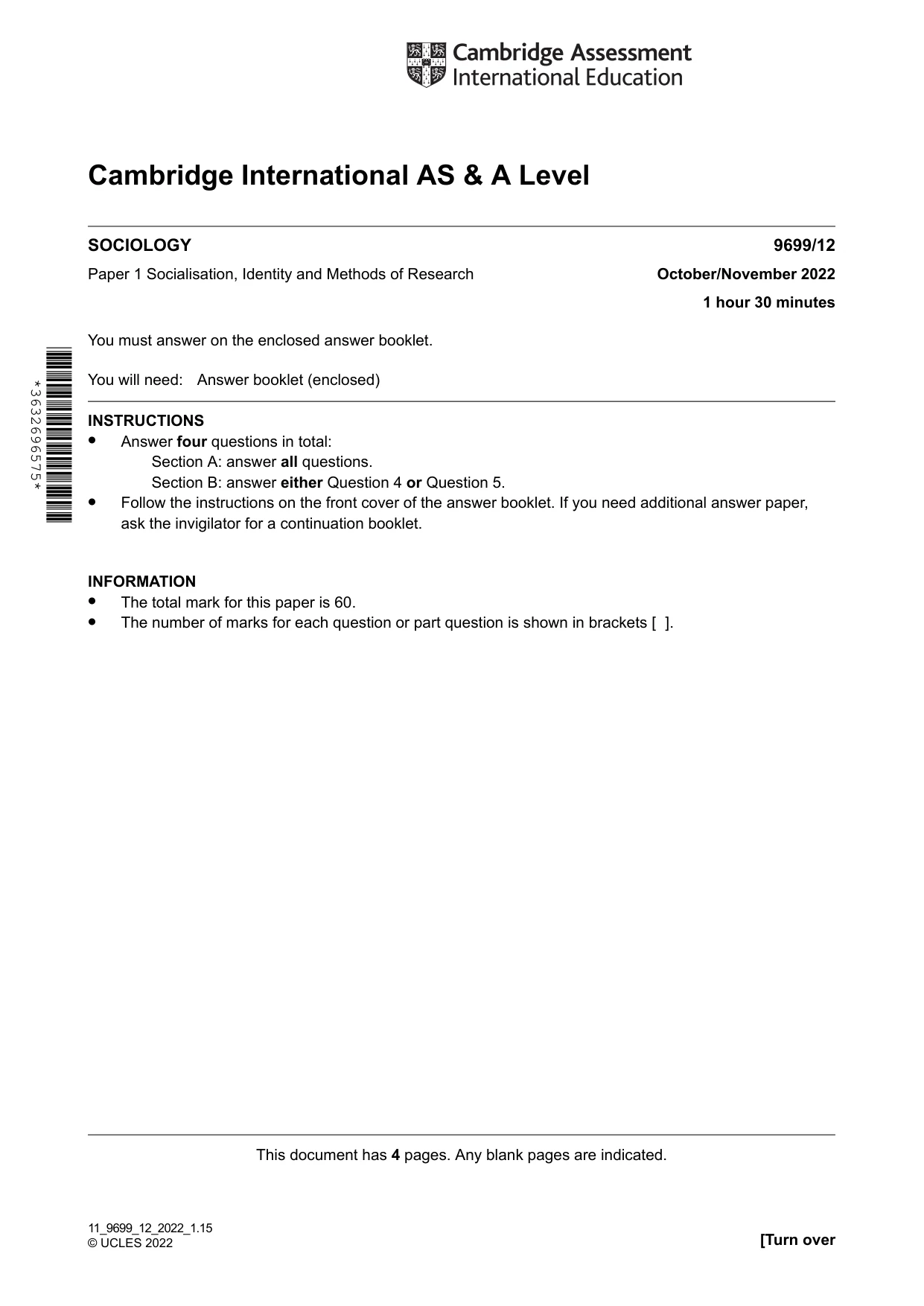
Question paper, page 1
Cambridge International AS & A Level 9699/12 October/November 2022 1 hour 30 minutes SOCIOLOGY Paper 1 Socialisation, Identity and Methods of Research You must answer on the enclosed answer booklet. You will need: Answer booklet (enclosed) INSTRUCTIONS • Answer four questions in total: Section A: answer all questions. Section B: answer either Question 4 or Question 5. • Follow the instructions on the front cover of the answer booklet. If you need additional answer paper, ask the invigilator for a continuation booklet. INFORMATION • The total mark for this paper is 60. • The number of marks for each question or part question is shown in brackets [ ]. This document has 4 pages. Any blank pages are indicated. [Turn over 11_9699_12_2022_1.15 © UCLES 2022 *3632696575*
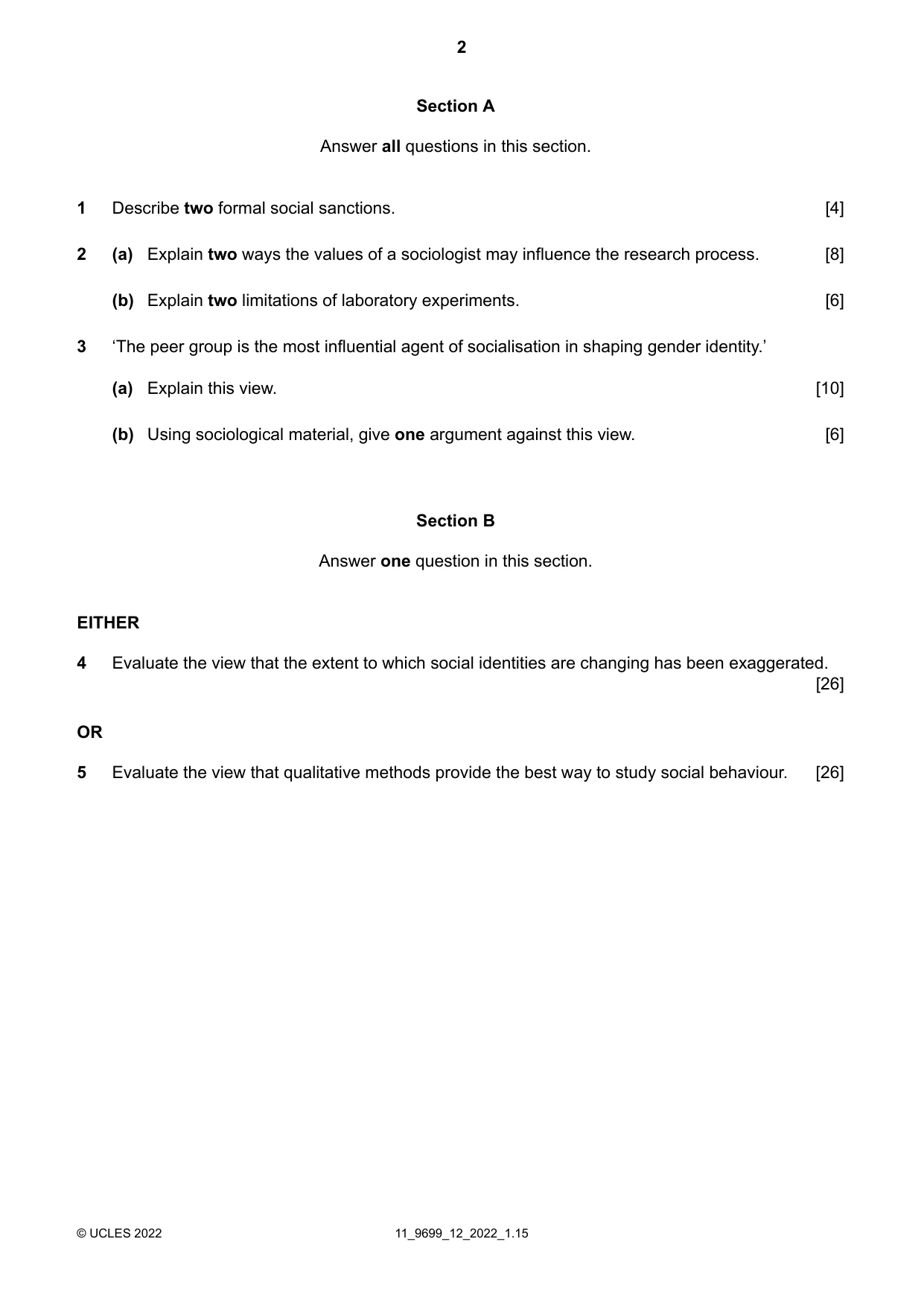
Question paper, page 2
Section A Answer all questions in this section. Describe two formal social sanctions. [4] 1 Explain two ways the values of a sociologist may influence the research process. [8] (a) 2 Explain two limitations of laboratory experiments. [6] (b) ‘The peer group is the most influential agent of socialisation in shaping gender identity.’ 3 Explain this view. [10] (a) Using sociological material, give one argument against this view. [6] (b) Section B Answer one question in this section. EITHER Evaluate the view that the extent to which social identities are changing has been exaggerated. [26] 4 OR Evaluate the view that qualitative methods provide the best way to study social behaviour. [26] 5 11_9699_12_2022_1.15 © UCLES 2022 2
Question paper, page 3
BLANK PAGE 11_9699_12_2022_1.15 © UCLES 2022 3
Question paper, page 4
BLANK PAGE Permission to reproduce items where third-party owned material protected by copyright is included has been sought and cleared where possible. Every reasonable effort has been made by the publisher (UCLES) to trace copyright holders, but if any items requiring clearance have unwittingly been included, the publisher will be pleased to make amends at the earliest possible opportunity. To avoid the issue of disclosure of answer-related information to candidates, all copyright acknowledgements are reproduced online in the Cambridge Assessment International Education Copyright Acknowledgements Booklet. This is produced for each series of examinations and is freely available to download at www.cambridgeinternational.org after the live examination series. Cambridge Assessment International Education is part of Cambridge Assessment. Cambridge Assessment is the brand name of the University of Cambridge Local Examinations Syndicate (UCLES), which is a department of the University of Cambridge. 11_9699_12_2022_1.15 © UCLES 2022 4
Mark scheme, page 1
This document consists of 18 printed pages. © UCLES 2022 [Turn over Cambridge International AS & A Level SOCIOLOGY 9699/12 Paper 1 Socialisation, Identity and Methods of Research October/November 2022 MARK SCHEME Maximum Mark: 60 Published This mark scheme is published as an aid to teachers and candidates, to indicate the requirements of the examination. It shows the basis on which Examiners were instructed to award marks. It does not indicate the details of the discussions that took place at an Examiners’ meeting before marking began, which would have considered the acceptability of alternative answers. Mark schemes should be read in conjunction with the question paper and the Principal Examiner Report for Teachers. Cambridge International will not enter into discussions about these mark schemes. Cambridge International is publishing the mark schemes for the October/November 2022 series for most Cambridge IGCSE™, Cambridge International A and AS Level components and some Cambridge O Level components.
Mark scheme, page 2
9699/12 Cambridge International AS & A Level – Mark Scheme PUBLISHED October/November 2022 © UCLES 2022 Page 2 of 18 Generic Marking Principles These general marking principles must be applied by all examiners when marking candidate answers. They should be applied alongside the specific content of the mark scheme or generic level descriptors for a question. Each question paper and mark scheme will also comply with these marking principles. GENERIC MARKING PRINCIPLE 1: Marks must be awarded in line with: • the specific content of the mark scheme or the generic level descriptors for the question • the specific skills defined in the mark scheme or in the generic level descriptors for the question • the standard of response required by a candidate as exemplified by the standardisation scripts. GENERIC MARKING PRINCIPLE 2: Marks awarded are always whole marks (not half marks, or other fractions). GENERIC MARKING PRINCIPLE 3: Marks must be awarded positively: • marks are awarded for correct/valid answers, as defined in the mark scheme. However, credit is given for valid answers which go beyond the scope of the syllabus and mark scheme, referring to your Team Leader as appropriate • marks are awarded when candidates clearly demonstrate what they know and can do • marks are not deducted for errors • marks are not deducted for omissions • answers should only be judged on the quality of spelling, punctuation and grammar when these features are specifically assessed by the question as indicated by the mark scheme. The meaning, however, should be unambiguous. GENERIC MARKING PRINCIPLE 4: Rules must be applied consistently, e.g. in situations where candidates have not followed instructions or in the application of generic level descriptors. GENERIC MARKING PRINCIPLE 5: Marks should be awarded using the full range of marks defined in the mark scheme for the question (however; the use of the full mark range may be limited according to the quality of the candidate responses seen). GENERIC MARKING PRINCIPLE 6: Marks awarded are based solely on the requirements as defined in the mark scheme. Marks should not be awarded with grade thresholds or grade descriptors in mind.
Mark scheme, page 3
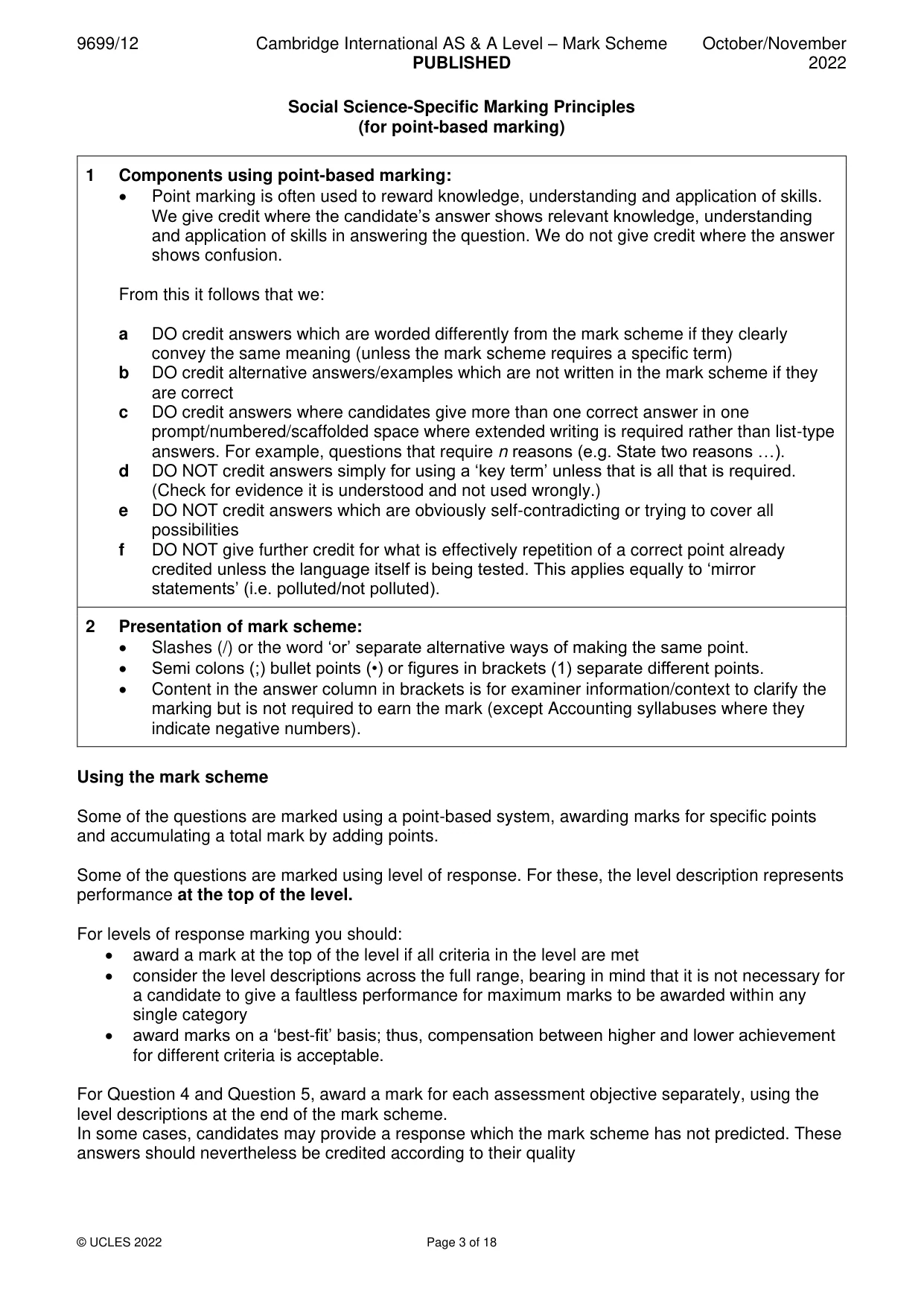
9699/12 Cambridge International AS & A Level – Mark Scheme PUBLISHED October/November 2022 © UCLES 2022 Page 3 of 18 Social Science-Specific Marking Principles (for point-based marking) 1 Components using point-based marking: • Point marking is often used to reward knowledge, understanding and application of skills. We give credit where the candidate’s answer shows relevant knowledge, understanding and application of skills in answering the question. We do not give credit where the answer shows confusion. From this it follows that we: a DO credit answers which are worded differently from the mark scheme if they clearly convey the same meaning (unless the mark scheme requires a specific term) b DO credit alternative answers/examples which are not written in the mark scheme if they are correct c DO credit answers where candidates give more than one correct answer in one prompt/numbered/scaffolded space where extended writing is required rather than list-type answers. For example, questions that require n reasons (e.g. State two reasons …). d DO NOT credit answers simply for using a ‘key term’ unless that is all that is required. (Check for evidence it is understood and not used wrongly.) e DO NOT credit answers which are obviously self-contradicting or trying to cover all possibilities f DO NOT give further credit for what is effectively repetition of a correct point already credited unless the language itself is being tested. This applies equally to ‘mirror statements’ (i.e. polluted/not polluted). 2 Presentation of mark scheme: • Slashes (/) or the word ‘or’ separate alternative ways of making the same point. • Semi colons (;) bullet points (•) or figures in brackets (1) separate different points. • Content in the answer column in brackets is for examiner information/context to clarify the marking but is not required to earn the mark (except Accounting syllabuses where they indicate negative numbers). Using the mark scheme Some of the questions are marked using a point-based system, awarding marks for specific points and accumulating a total mark by adding points. Some of the questions are marked using level of response. For these, the level description represents performance at the top of the level. For levels of response marking you should: • award a mark at the top of the level if all criteria in the level are met • consider the level descriptions across the full range, bearing in mind that it is not necessary for a candidate to give a faultless performance for maximum marks to be awarded within any single category • award marks on a ‘best-fit’ basis; thus, compensation between higher and lower achievement for different criteria is acceptable. For Question 4 and Question 5, award a mark for each assessment objective separately, using the level descriptions at the end of the mark scheme. In some cases, candidates may provide a response which the mark scheme has not predicted. These answers should nevertheless be credited according to their quality
Mark scheme, page 4
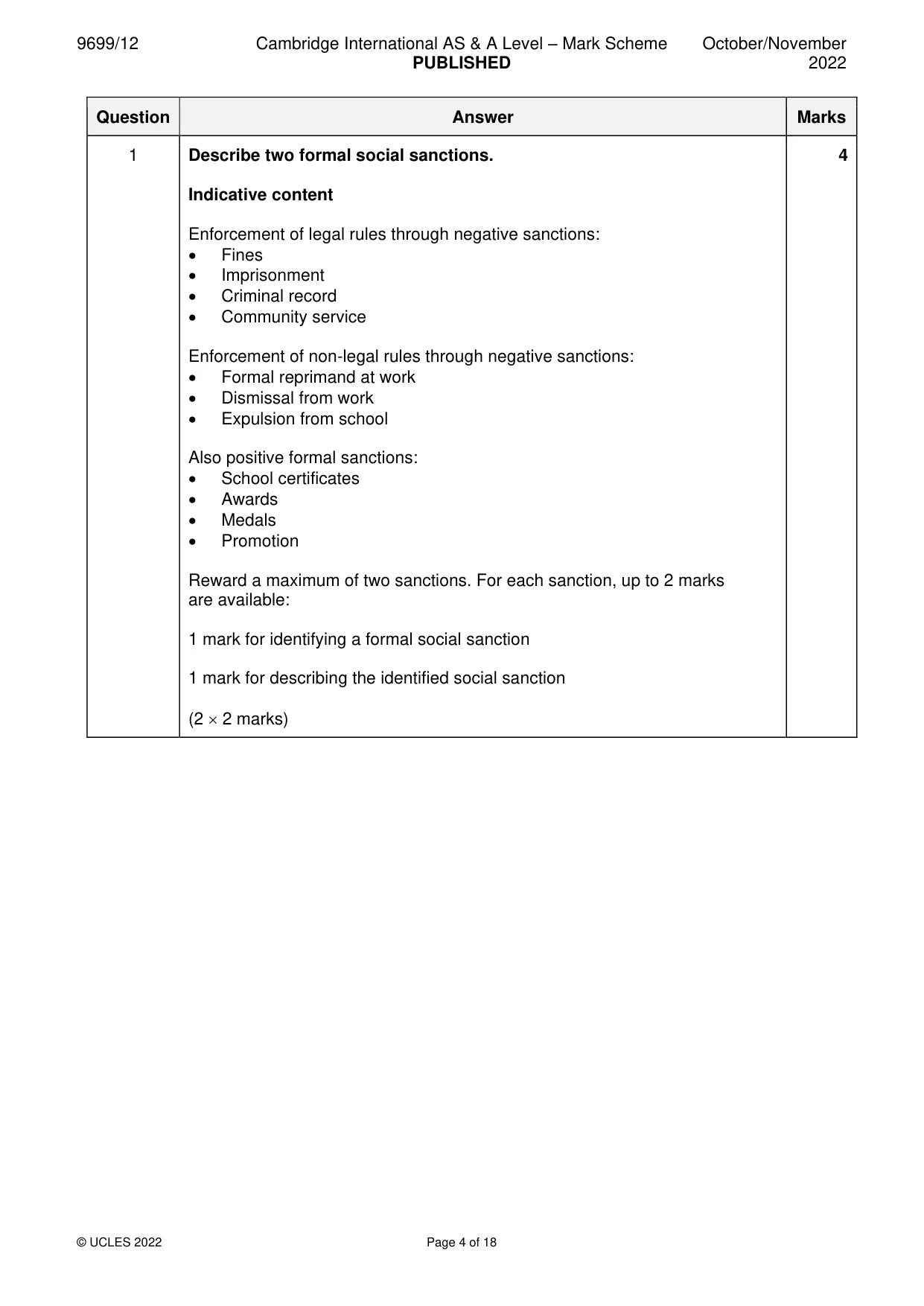
9699/12 Cambridge International AS & A Level – Mark Scheme PUBLISHED October/November 2022 © UCLES 2022 Page 4 of 18 Question Answer Marks 1 Describe two formal social sanctions. Indicative content Enforcement of legal rules through negative sanctions: • Fines • Imprisonment • Criminal record • Community service Enforcement of non-legal rules through negative sanctions: • Formal reprimand at work • Dismissal from work • Expulsion from school Also positive formal sanctions: • School certificates • Awards • Medals • Promotion Reward a maximum of two sanctions. For each sanction, up to 2 marks are available: 1 mark for identifying a formal social sanction 1 mark for describing the identified social sanction (2 2 marks) 4
Mark scheme, page 5
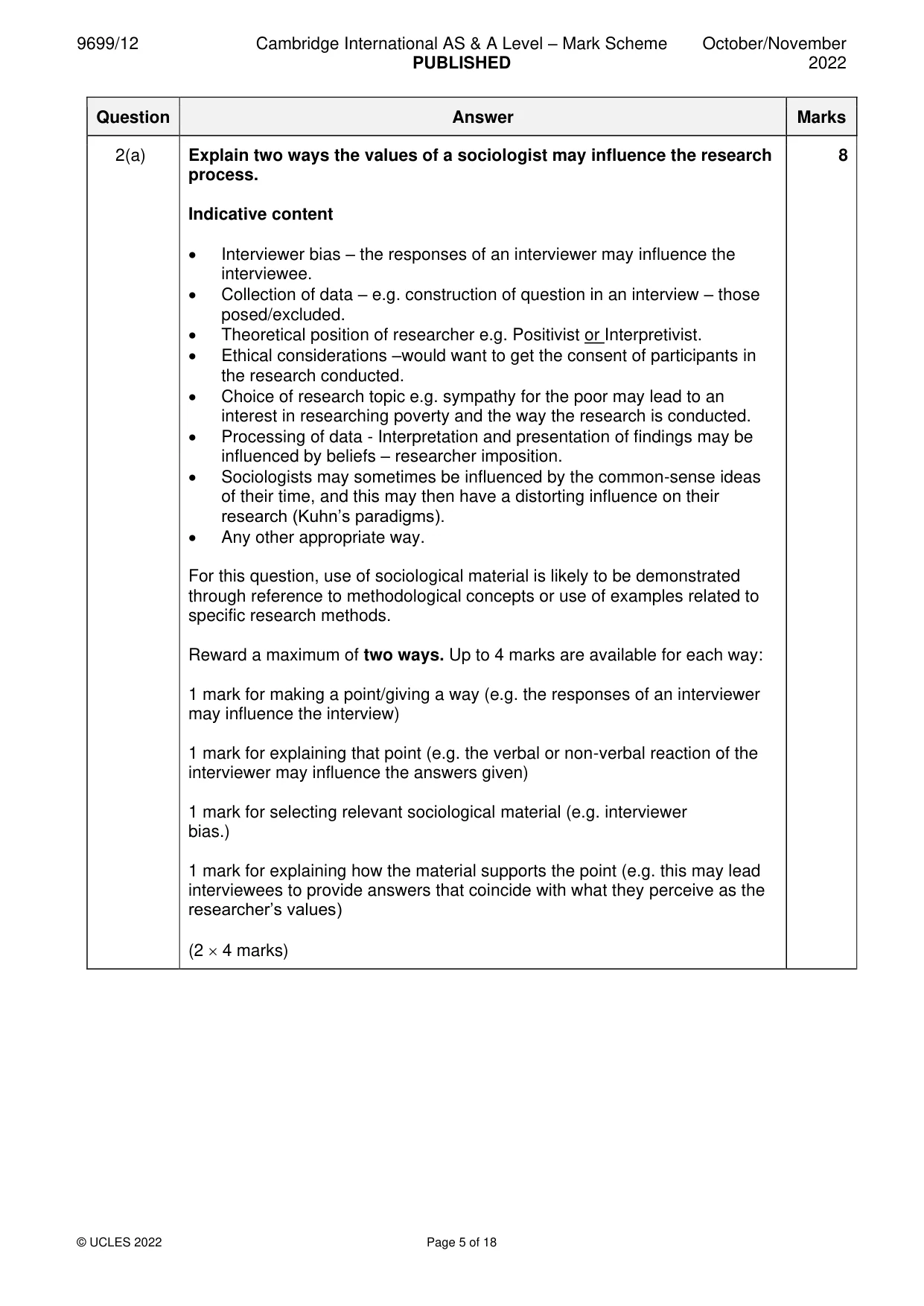
9699/12 Cambridge International AS & A Level – Mark Scheme PUBLISHED October/November 2022 © UCLES 2022 Page 5 of 18 Question Answer Marks 2(a) Explain two ways the values of a sociologist may influence the research process. Indicative content • Interviewer bias – the responses of an interviewer may influence the interviewee. • Collection of data – e.g. construction of question in an interview – those posed/excluded. • Theoretical position of researcher e.g. Positivist or Interpretivist. • Ethical considerations –would want to get the consent of participants in the research conducted. • Choice of research topic e.g. sympathy for the poor may lead to an interest in researching poverty and the way the research is conducted. • Processing of data - Interpretation and presentation of findings may be influenced by beliefs – researcher imposition. • Sociologists may sometimes be influenced by the common-sense ideas of their time, and this may then have a distorting influence on their research (Kuhn’s paradigms). • Any other appropriate way. For this question, use of sociological material is likely to be demonstrated through reference to methodological concepts or use of examples related to specific research methods. Reward a maximum of two ways. Up to 4 marks are available for each way: 1 mark for making a point/giving a way (e.g. the responses of an interviewer may influence the interview) 1 mark for explaining that point (e.g. the verbal or non-verbal reaction of the interviewer may influence the answers given) 1 mark for selecting relevant sociological material (e.g. interviewer bias.) 1 mark for explaining how the material supports the point (e.g. this may lead interviewees to provide answers that coincide with what they perceive as the researcher’s values) (2 4 marks) 8
Mark scheme, page 6
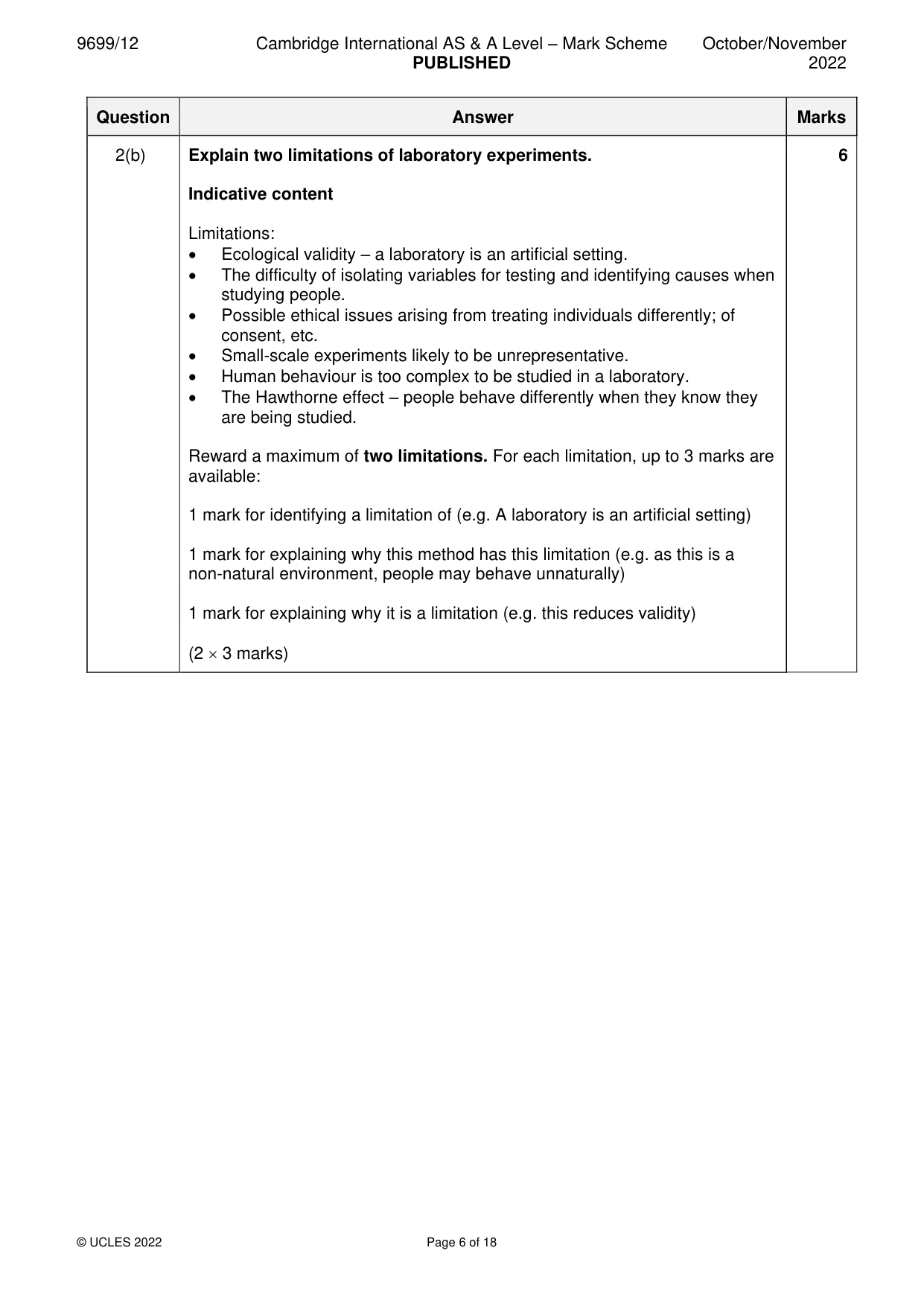
9699/12 Cambridge International AS & A Level – Mark Scheme PUBLISHED October/November 2022 © UCLES 2022 Page 6 of 18 Question Answer Marks 2(b) Explain two limitations of laboratory experiments. Indicative content Limitations: • Ecological validity – a laboratory is an artificial setting. • The difficulty of isolating variables for testing and identifying causes when studying people. • Possible ethical issues arising from treating individuals differently; of consent, etc. • Small-scale experiments likely to be unrepresentative. • Human behaviour is too complex to be studied in a laboratory. • The Hawthorne effect – people behave differently when they know they are being studied. Reward a maximum of two limitations. For each limitation, up to 3 marks are available: 1 mark for identifying a limitation of (e.g. A laboratory is an artificial setting) 1 mark for explaining why this method has this limitation (e.g. as this is a non-natural environment, people may behave unnaturally) 1 mark for explaining why it is a limitation (e.g. this reduces validity) (2 3 marks) 6
Mark scheme, page 7
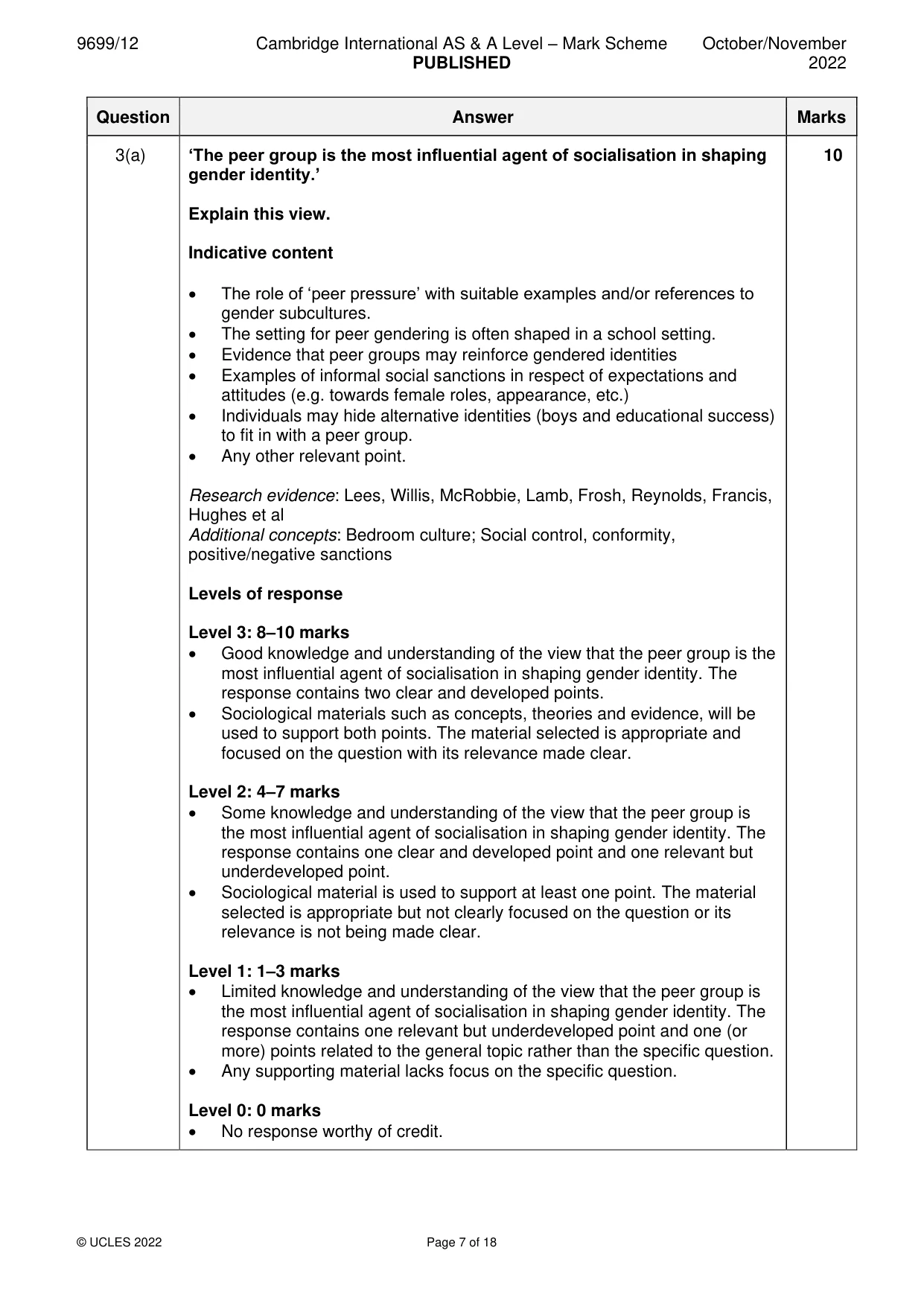
9699/12 Cambridge International AS & A Level – Mark Scheme PUBLISHED October/November 2022 © UCLES 2022 Page 7 of 18 Question Answer Marks 3(a) ‘The peer group is the most influential agent of socialisation in shaping gender identity.’ Explain this view. Indicative content • The role of ‘peer pressure’ with suitable examples and/or references to gender subcultures. • The setting for peer gendering is often shaped in a school setting. • Evidence that peer groups may reinforce gendered identities • Examples of informal social sanctions in respect of expectations and attitudes (e.g. towards female roles, appearance, etc.) • Individuals may hide alternative identities (boys and educational success) to fit in with a peer group. • Any other relevant point. Research evidence: Lees, Willis, McRobbie, Lamb, Frosh, Reynolds, Francis, Hughes et al Additional concepts: Bedroom culture; Social control, conformity, positive/negative sanctions Levels of response Level 3: 8–10 marks • Good knowledge and understanding of the view that the peer group is the most influential agent of socialisation in shaping gender identity. The response contains two clear and developed points. • Sociological materials such as concepts, theories and evidence, will be used to support both points. The material selected is appropriate and focused on the question with its relevance made clear. Level 2: 4–7 marks • Some knowledge and understanding of the view that the peer group is the most influential agent of socialisation in shaping gender identity. The response contains one clear and developed point and one relevant but underdeveloped point. • Sociological material is used to support at least one point. The material selected is appropriate but not clearly focused on the question or its relevance is not being made clear. Level 1: 1–3 marks • Limited knowledge and understanding of the view that the peer group is the most influential agent of socialisation in shaping gender identity. The response contains one relevant but underdeveloped point and one (or more) points related to the general topic rather than the specific question. • Any supporting material lacks focus on the specific question. Level 0: 0 marks • No response worthy of credit. 10
Mark scheme, page 8
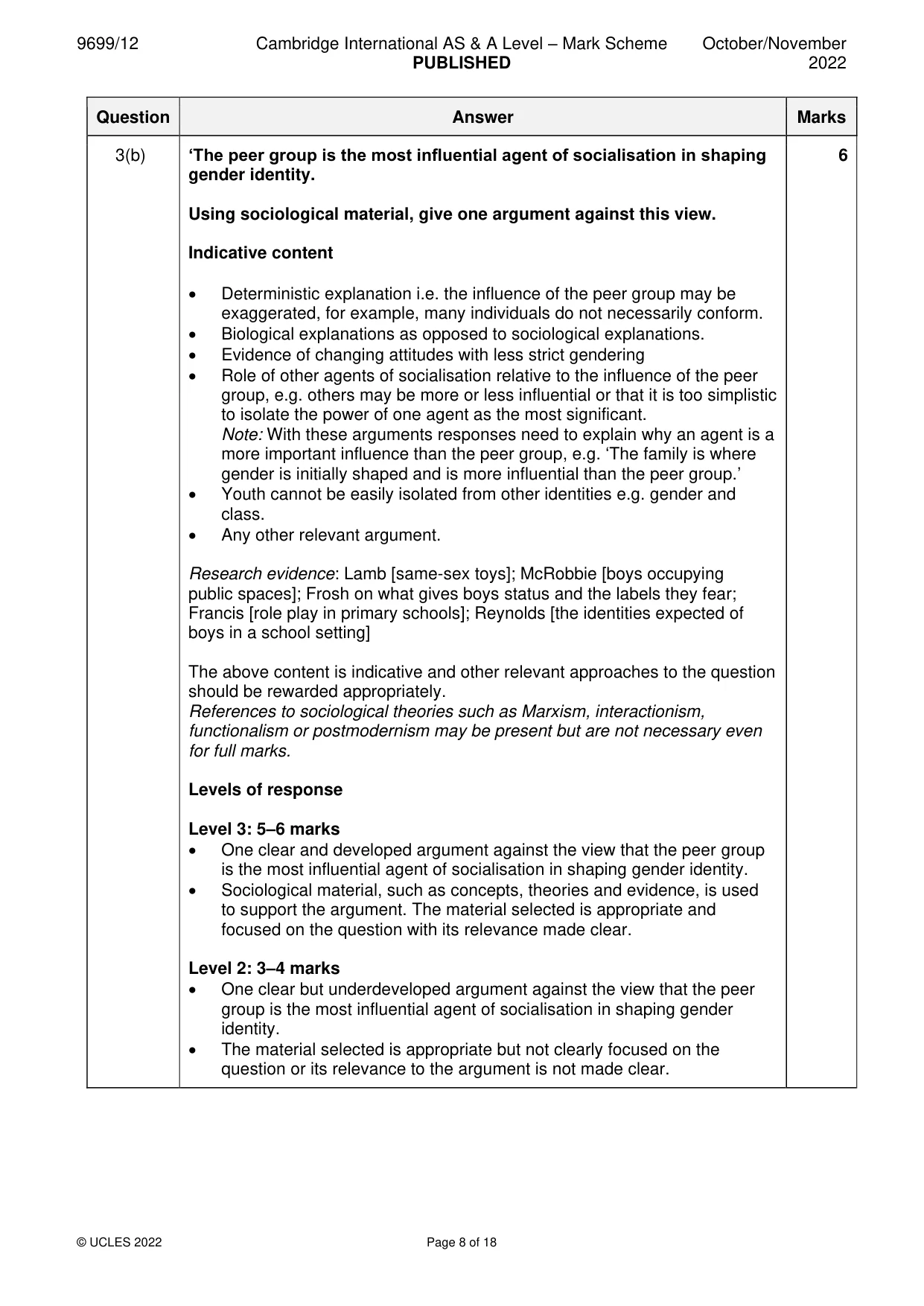
9699/12 Cambridge International AS & A Level – Mark Scheme PUBLISHED October/November 2022 © UCLES 2022 Page 8 of 18 Question Answer Marks 3(b) ‘The peer group is the most influential agent of socialisation in shaping gender identity. Using sociological material, give one argument against this view. Indicative content • Deterministic explanation i.e. the influence of the peer group may be exaggerated, for example, many individuals do not necessarily conform. • Biological explanations as opposed to sociological explanations. • Evidence of changing attitudes with less strict gendering • Role of other agents of socialisation relative to the influence of the peer group, e.g. others may be more or less influential or that it is too simplistic to isolate the power of one agent as the most significant. Note: With these arguments responses need to explain why an agent is a more important influence than the peer group, e.g. ‘The family is where gender is initially shaped and is more influential than the peer group.’ • Youth cannot be easily isolated from other identities e.g. gender and class. • Any other relevant argument. Research evidence: Lamb [same-sex toys]; McRobbie [boys occupying public spaces]; Frosh on what gives boys status and the labels they fear; Francis [role play in primary schools]; Reynolds [the identities expected of boys in a school setting] The above content is indicative and other relevant approaches to the question should be rewarded appropriately. References to sociological theories such as Marxism, interactionism, functionalism or postmodernism may be present but are not necessary even for full marks. Levels of response Level 3: 5–6 marks • One clear and developed argument against the view that the peer group is the most influential agent of socialisation in shaping gender identity. • Sociological material, such as concepts, theories and evidence, is used to support the argument. The material selected is appropriate and focused on the question with its relevance made clear. Level 2: 3–4 marks • One clear but underdeveloped argument against the view that the peer group is the most influential agent of socialisation in shaping gender identity. • The material selected is appropriate but not clearly focused on the question or its relevance to the argument is not made clear. 6
Mark scheme, page 9
9699/12 Cambridge International AS & A Level – Mark Scheme PUBLISHED October/November 2022 © UCLES 2022 Page 9 of 18 Question Answer Marks 3(b) Level 1: 1–2 marks • One point disagreeing with the view that the peer group is the most influential agent of socialisation in shaping gender identity, which is undeveloped or lacking clarity. • Any supporting material lacks focus on the specific question. Level 0: 0 marks • No response worthy of credit.
Mark scheme, page 10
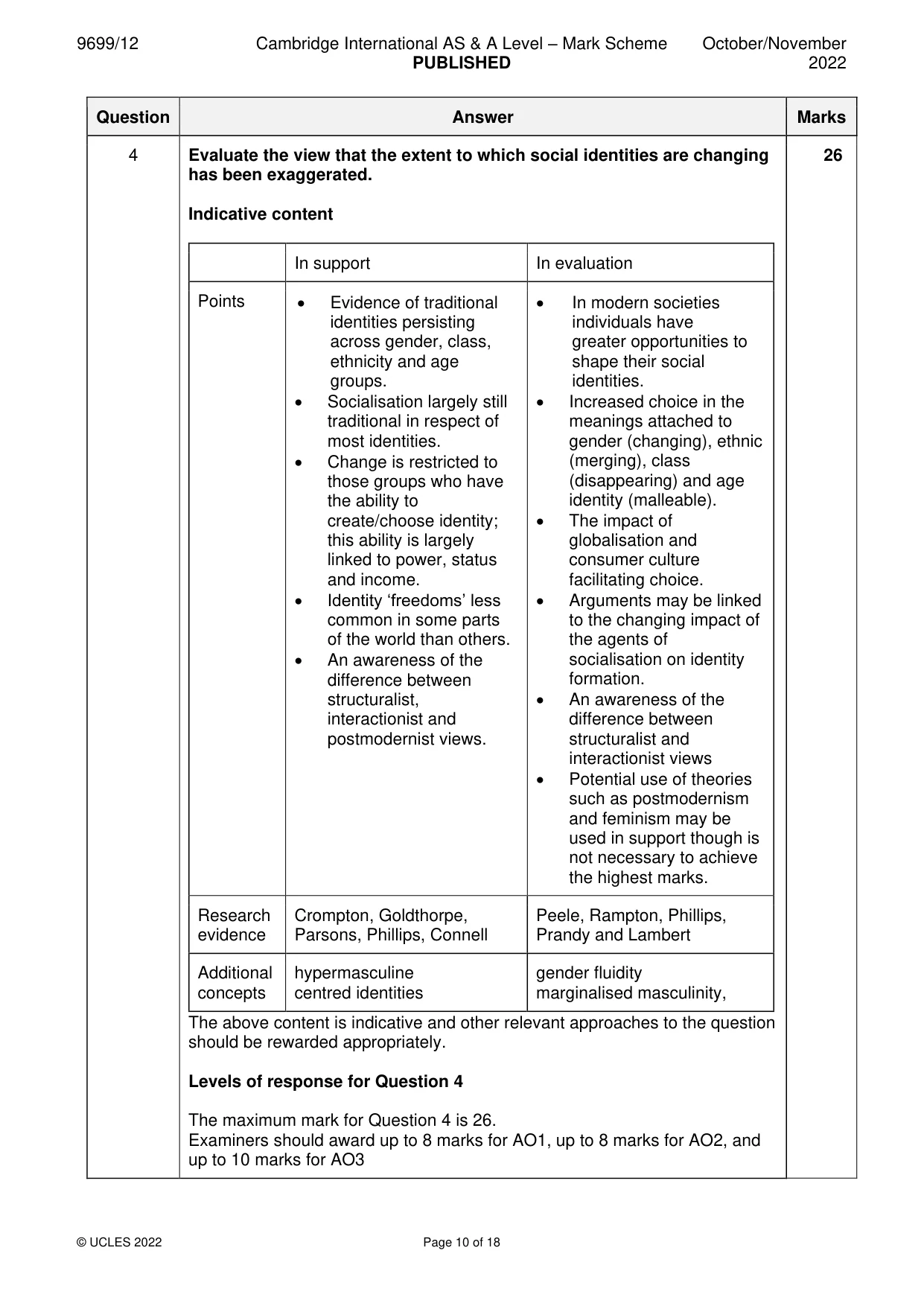
9699/12 Cambridge International AS & A Level – Mark Scheme PUBLISHED October/November 2022 © UCLES 2022 Page 10 of 18 Question Answer Marks 4 Evaluate the view that the extent to which social identities are changing has been exaggerated. Indicative content In support In evaluation Points • Evidence of traditional identities persisting across gender, class, ethnicity and age groups. • Socialisation largely still traditional in respect of most identities. • Change is restricted to those groups who have the ability to create/choose identity; this ability is largely linked to power, status and income. • Identity ‘freedoms’ less common in some parts of the world than others. • An awareness of the difference between structuralist, interactionist and postmodernist views. • In modern societies individuals have greater opportunities to shape their social identities. • Increased choice in the meanings attached to gender (changing), ethnic (merging), class (disappearing) and age identity (malleable). • The impact of globalisation and consumer culture facilitating choice. • Arguments may be linked to the changing impact of the agents of socialisation on identity formation. • An awareness of the difference between structuralist and interactionist views • Potential use of theories such as postmodernism and feminism may be used in support though is not necessary to achieve the highest marks. Research evidence Crompton, Goldthorpe, Parsons, Phillips, Connell Peele, Rampton, Phillips, Prandy and Lambert Additional concepts hypermasculine centred identities gender fluidity marginalised masculinity, The above content is indicative and other relevant approaches to the question should be rewarded appropriately. Levels of response for Question 4 The maximum mark for Question 4 is 26. Examiners should award up to 8 marks for AO1, up to 8 marks for AO2, and up to 10 marks for AO3 26
Mark scheme, page 11
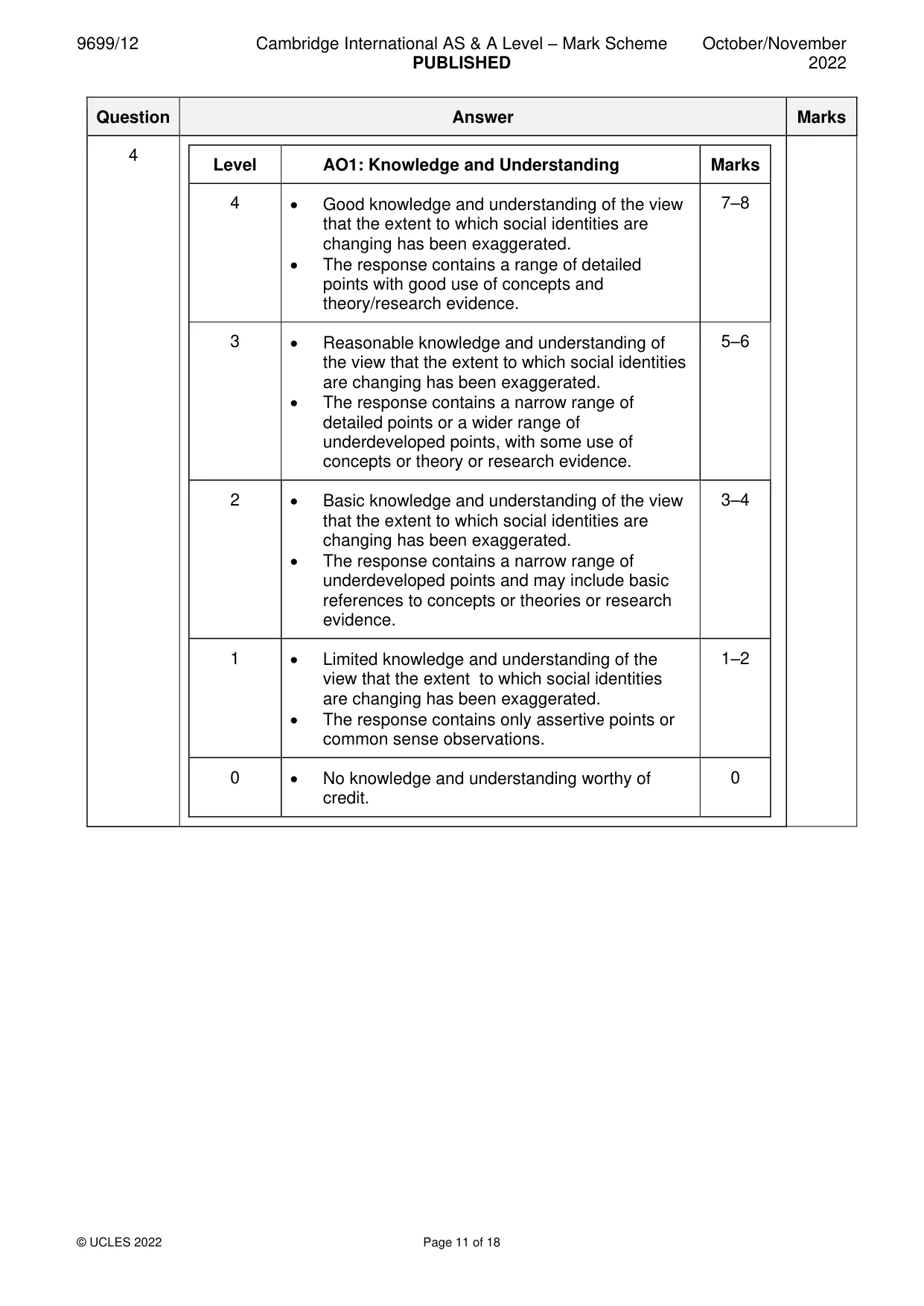
9699/12 Cambridge International AS & A Level – Mark Scheme PUBLISHED October/November 2022 © UCLES 2022 Page 11 of 18 Question Answer Marks 4 Level AO1: Knowledge and Understanding Marks 4 • Good knowledge and understanding of the view that the extent to which social identities are changing has been exaggerated. • The response contains a range of detailed points with good use of concepts and theory/research evidence. 7–8 3 • Reasonable knowledge and understanding of the view that the extent to which social identities are changing has been exaggerated. • The response contains a narrow range of detailed points or a wider range of underdeveloped points, with some use of concepts or theory or research evidence. 5–6 2 • Basic knowledge and understanding of the view that the extent to which social identities are changing has been exaggerated. • The response contains a narrow range of underdeveloped points and may include basic references to concepts or theories or research evidence. 3–4 1 • Limited knowledge and understanding of the view that the extent to which social identities are changing has been exaggerated. • The response contains only assertive points or common sense observations. 1–2 0 • No knowledge and understanding worthy of credit. 0
Mark scheme, page 12
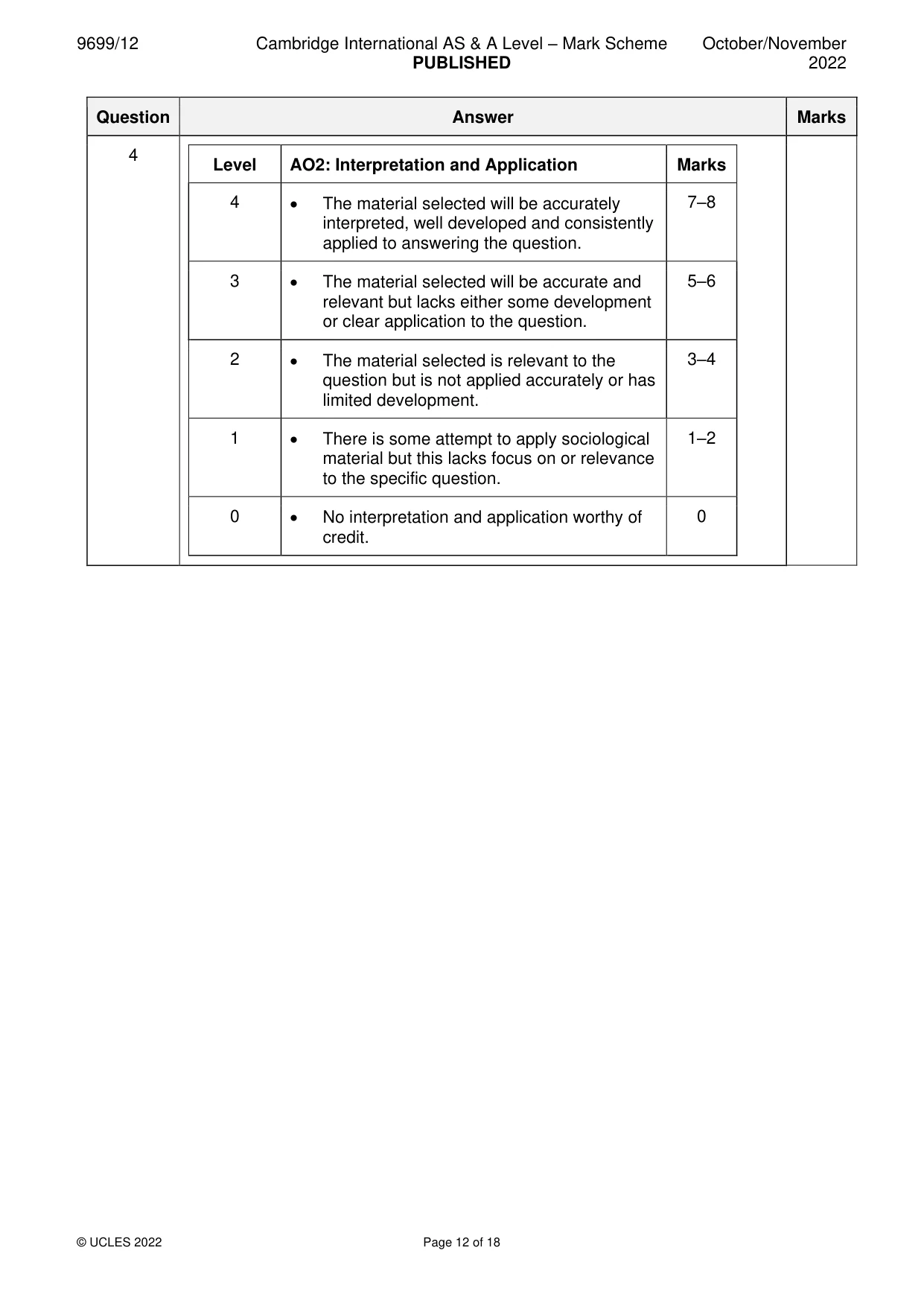
9699/12 Cambridge International AS & A Level – Mark Scheme PUBLISHED October/November 2022 © UCLES 2022 Page 12 of 18 Question Answer Marks 4 Level AO2: Interpretation and Application Marks 4 • The material selected will be accurately interpreted, well developed and consistently applied to answering the question. 7–8 3 • The material selected will be accurate and relevant but lacks either some development or clear application to the question. 5–6 2 • The material selected is relevant to the question but is not applied accurately or has limited development. 3–4 1 • There is some attempt to apply sociological material but this lacks focus on or relevance to the specific question. 1–2 0 • No interpretation and application worthy of credit. 0
Mark scheme, page 13
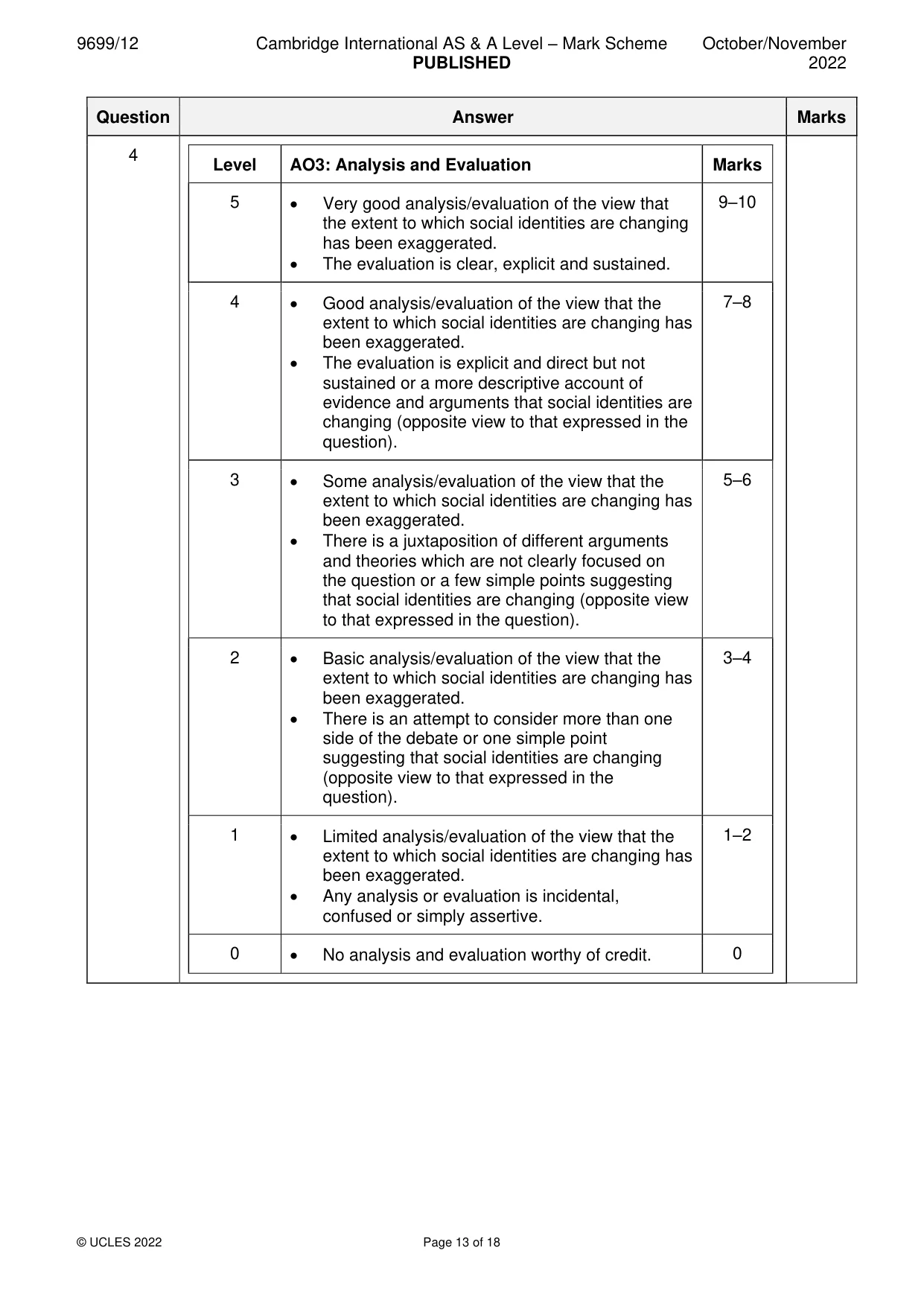
9699/12 Cambridge International AS & A Level – Mark Scheme PUBLISHED October/November 2022 © UCLES 2022 Page 13 of 18 Question Answer Marks 4 Level AO3: Analysis and Evaluation Marks 5 • Very good analysis/evaluation of the view that the extent to which social identities are changing has been exaggerated. • The evaluation is clear, explicit and sustained. 9–10 4 • Good analysis/evaluation of the view that the extent to which social identities are changing has been exaggerated. • The evaluation is explicit and direct but not sustained or a more descriptive account of evidence and arguments that social identities are changing (opposite view to that expressed in the question). 7–8 3 • Some analysis/evaluation of the view that the extent to which social identities are changing has been exaggerated. • There is a juxtaposition of different arguments and theories which are not clearly focused on the question or a few simple points suggesting that social identities are changing (opposite view to that expressed in the question). 5–6 2 • Basic analysis/evaluation of the view that the extent to which social identities are changing has been exaggerated. • There is an attempt to consider more than one side of the debate or one simple point suggesting that social identities are changing (opposite view to that expressed in the question). 3–4 1 • Limited analysis/evaluation of the view that the extent to which social identities are changing has been exaggerated. • Any analysis or evaluation is incidental, confused or simply assertive. 1–2 0 • No analysis and evaluation worthy of credit. 0
Mark scheme, page 14
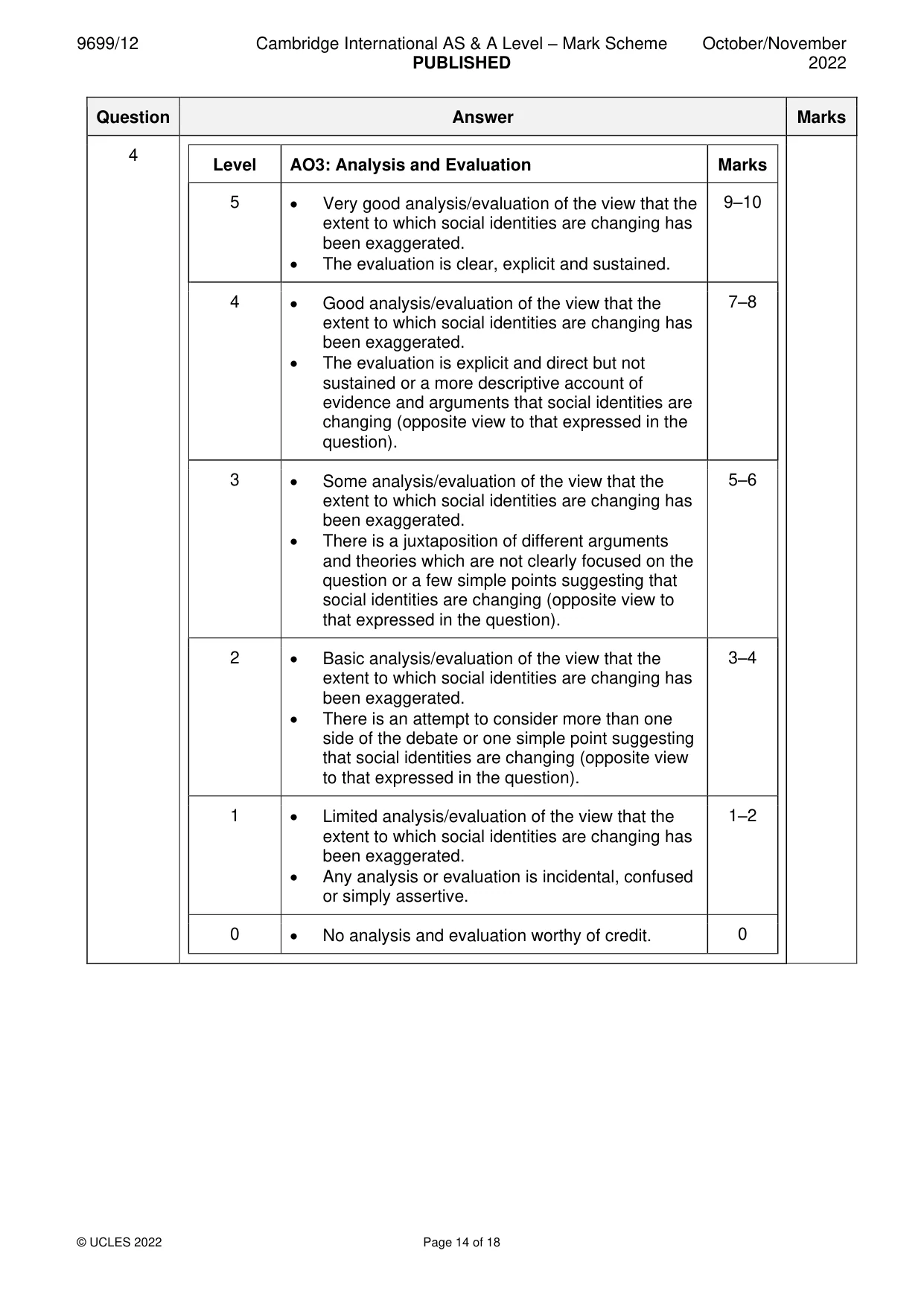
9699/12 Cambridge International AS & A Level – Mark Scheme PUBLISHED October/November 2022 © UCLES 2022 Page 14 of 18 Question Answer Marks 4 Level AO3: Analysis and Evaluation Marks 5 • Very good analysis/evaluation of the view that the extent to which social identities are changing has been exaggerated. • The evaluation is clear, explicit and sustained. 9–10 4 • Good analysis/evaluation of the view that the extent to which social identities are changing has been exaggerated. • The evaluation is explicit and direct but not sustained or a more descriptive account of evidence and arguments that social identities are changing (opposite view to that expressed in the question). 7–8 3 • Some analysis/evaluation of the view that the extent to which social identities are changing has been exaggerated. • There is a juxtaposition of different arguments and theories which are not clearly focused on the question or a few simple points suggesting that social identities are changing (opposite view to that expressed in the question). 5–6 2 • Basic analysis/evaluation of the view that the extent to which social identities are changing has been exaggerated. • There is an attempt to consider more than one side of the debate or one simple point suggesting that social identities are changing (opposite view to that expressed in the question). 3–4 1 • Limited analysis/evaluation of the view that the extent to which social identities are changing has been exaggerated. • Any analysis or evaluation is incidental, confused or simply assertive. 1–2 0 • No analysis and evaluation worthy of credit. 0
Mark scheme, page 15
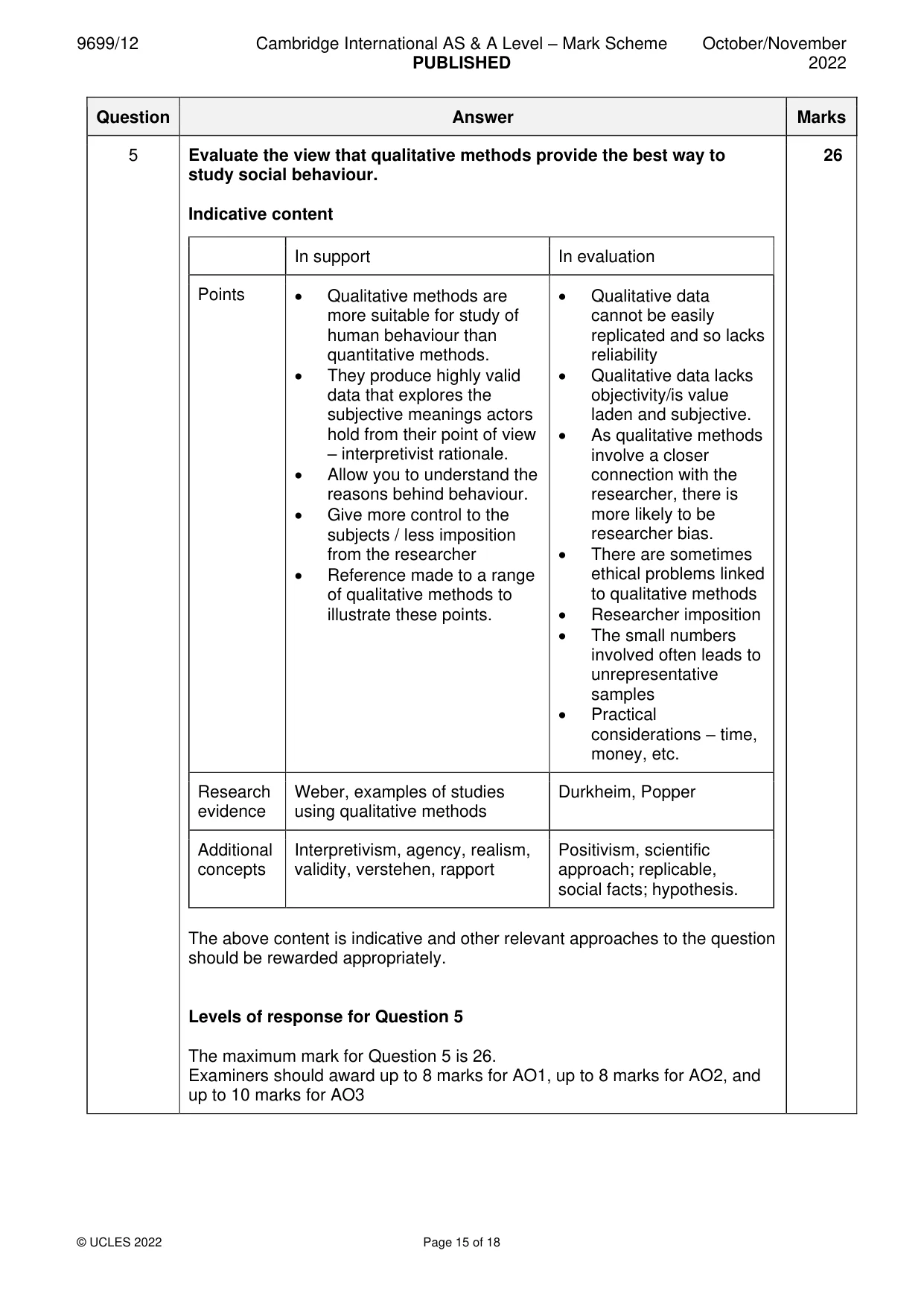
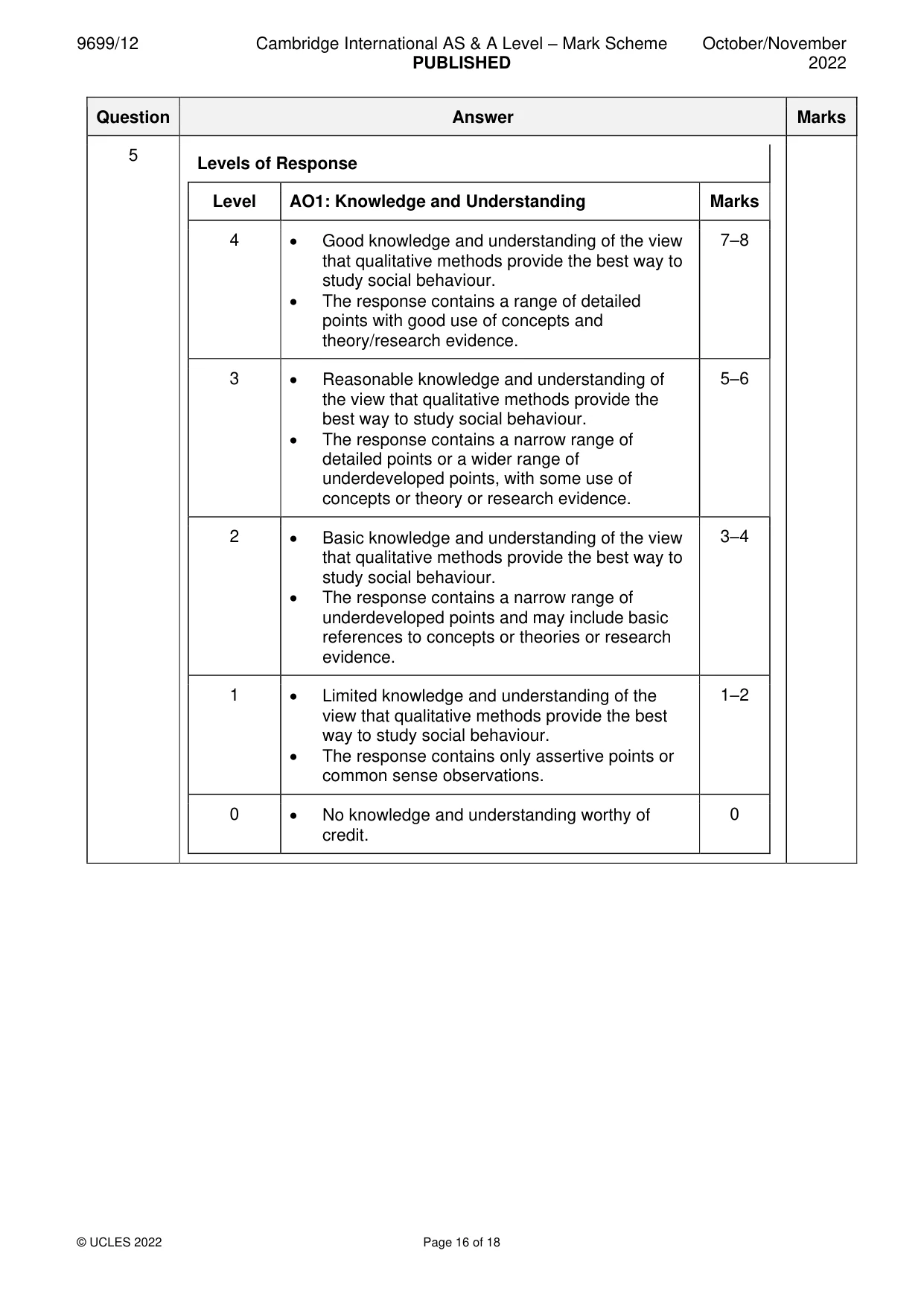
9699/12 Cambridge International AS & A Level – Mark Scheme PUBLISHED October/November 2022 © UCLES 2022 Page 15 of 18 Question Answer Marks 5 Evaluate the view that qualitative methods provide the best way to study social behaviour. Indicative content The above content is indicative and other relevant approaches to the question should be rewarded appropriately. Levels of response for Question 5 The maximum mark for Question 5 is 26. Examiners should award up to 8 marks for AO1, up to 8 marks for AO2, and up to 10 marks for AO3 In support In evaluation Points • Qualitative methods are more suitable for study of human behaviour than quantitative methods. • They produce highly valid data that explores the subjective meanings actors hold from their point of view – interpretivist rationale. • Allow you to understand the reasons behind behaviour. • Give more control to the subjects / less imposition from the researcher • Reference made to a range of qualitative methods to illustrate these points. • Qualitative data cannot be easily replicated and so lacks reliability • Qualitative data lacks objectivity/is value laden and subjective. • As qualitative methods involve a closer connection with the researcher, there is more likely to be researcher bias. • There are sometimes ethical problems linked to qualitative methods • Researcher imposition • The small numbers involved often leads to unrepresentative samples • Practical considerations – time, money, etc. Research evidence Weber, examples of studies using qualitative methods Durkheim, Popper Additional concepts Interpretivism, agency, realism, validity, verstehen, rapport Positivism, scientific approach; replicable, social facts; hypothesis. 26
Mark scheme, page 16
9699/12 Cambridge International AS & A Level – Mark Scheme PUBLISHED October/November 2022 © UCLES 2022 Page 16 of 18 Question Answer Marks 5 Levels of Response Level AO1: Knowledge and Understanding Marks 4 • Good knowledge and understanding of the view that qualitative methods provide the best way to study social behaviour. • The response contains a range of detailed points with good use of concepts and theory/research evidence. 7–8 3 • Reasonable knowledge and understanding of the view that qualitative methods provide the best way to study social behaviour. • The response contains a narrow range of detailed points or a wider range of underdeveloped points, with some use of concepts or theory or research evidence. 5–6 2 • Basic knowledge and understanding of the view that qualitative methods provide the best way to study social behaviour. • The response contains a narrow range of underdeveloped points and may include basic references to concepts or theories or research evidence. 3–4 1 • Limited knowledge and understanding of the view that qualitative methods provide the best way to study social behaviour. • The response contains only assertive points or common sense observations. 1–2 0 • No knowledge and understanding worthy of credit. 0
Mark scheme, page 17
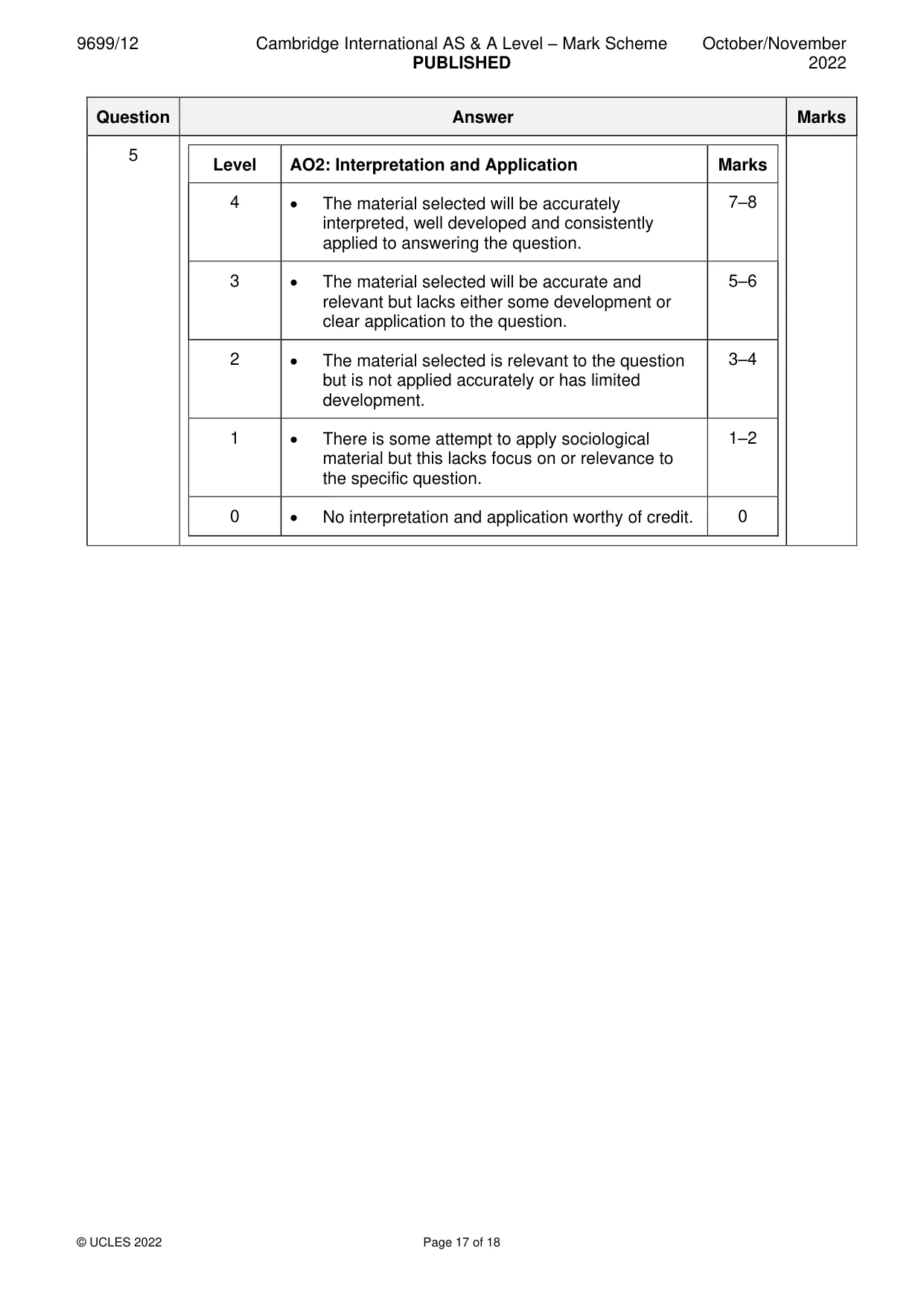
9699/12 Cambridge International AS & A Level – Mark Scheme PUBLISHED October/November 2022 © UCLES 2022 Page 17 of 18 Question Answer Marks 5 Level AO2: Interpretation and Application Marks 4 • The material selected will be accurately interpreted, well developed and consistently applied to answering the question. 7–8 3 • The material selected will be accurate and relevant but lacks either some development or clear application to the question. 5–6 2 • The material selected is relevant to the question but is not applied accurately or has limited development. 3–4 1 • There is some attempt to apply sociological material but this lacks focus on or relevance to the specific question. 1–2 0 • No interpretation and application worthy of credit. 0
Mark scheme, page 18
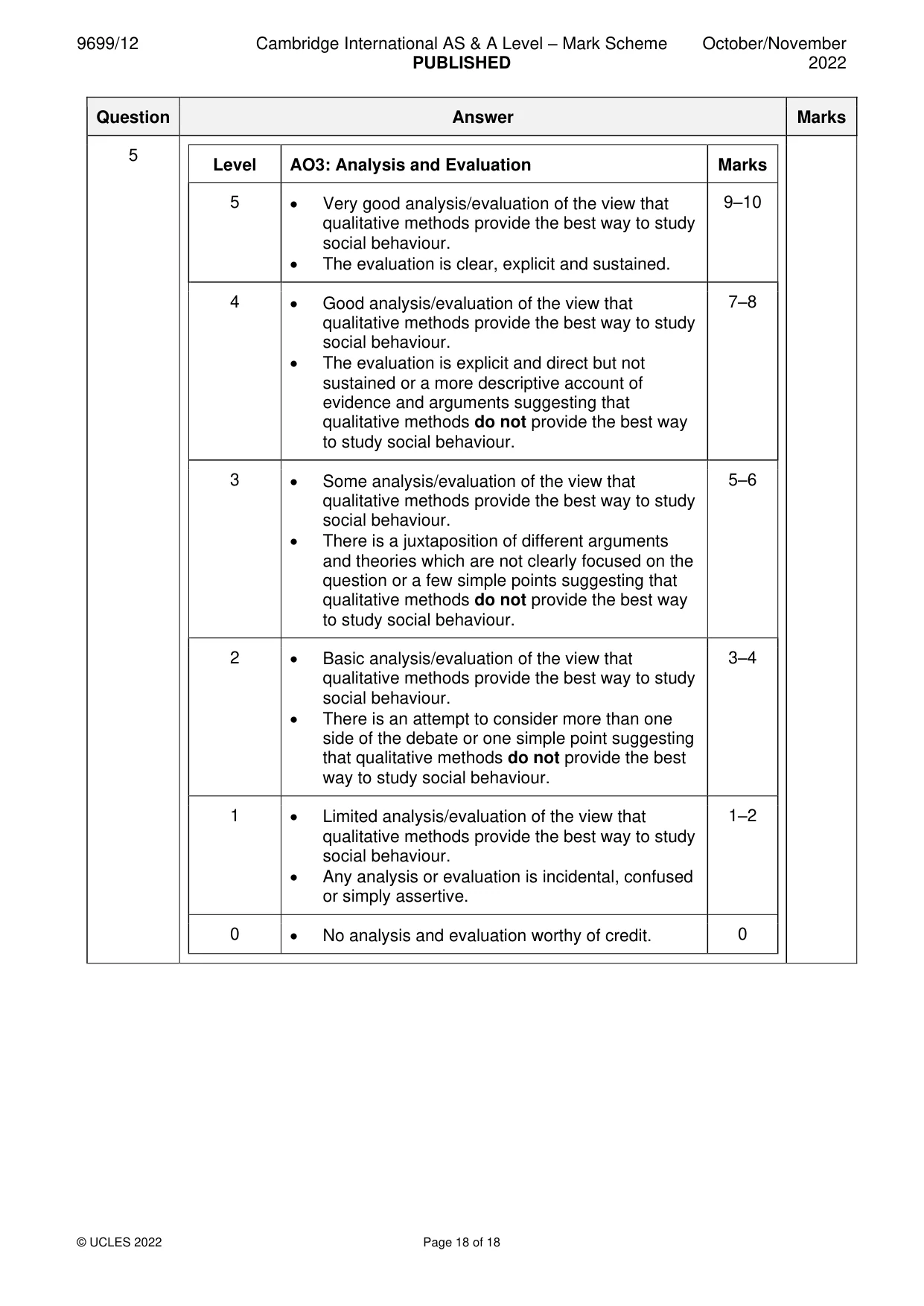
9699/12 Cambridge International AS & A Level – Mark Scheme PUBLISHED October/November 2022 © UCLES 2022 Page 18 of 18 Question Answer Marks 5 Level AO3: Analysis and Evaluation Marks 5 • Very good analysis/evaluation of the view that qualitative methods provide the best way to study social behaviour. • The evaluation is clear, explicit and sustained. 9–10 4 • Good analysis/evaluation of the view that qualitative methods provide the best way to study social behaviour. • The evaluation is explicit and direct but not sustained or a more descriptive account of evidence and arguments suggesting that qualitative methods do not provide the best way to study social behaviour. 7–8 3 • Some analysis/evaluation of the view that qualitative methods provide the best way to study social behaviour. • There is a juxtaposition of different arguments and theories which are not clearly focused on the question or a few simple points suggesting that qualitative methods do not provide the best way to study social behaviour. 5–6 2 • Basic analysis/evaluation of the view that qualitative methods provide the best way to study social behaviour. • There is an attempt to consider more than one side of the debate or one simple point suggesting that qualitative methods do not provide the best way to study social behaviour. 3–4 1 • Limited analysis/evaluation of the view that qualitative methods provide the best way to study social behaviour. • Any analysis or evaluation is incidental, confused or simply assertive. 1–2 0 • No analysis and evaluation worthy of credit. 0
What you needed in this session
Cambridge’s own grade thresholds for 2022 Oct/Nov, Paper 1 · Variant 2. A higher threshold means an easier paper — the bar moves with how the cohort did.