Cambridge A Level Sociology 9699 — 2022 May/June Paper 4 · Variant 3
9699/43/M/J/22 · 70 marks · ≈79 min
The question paper and its mark scheme, free to read here and free to download. This is Cambridge’s own paper, exactly as it was sat.
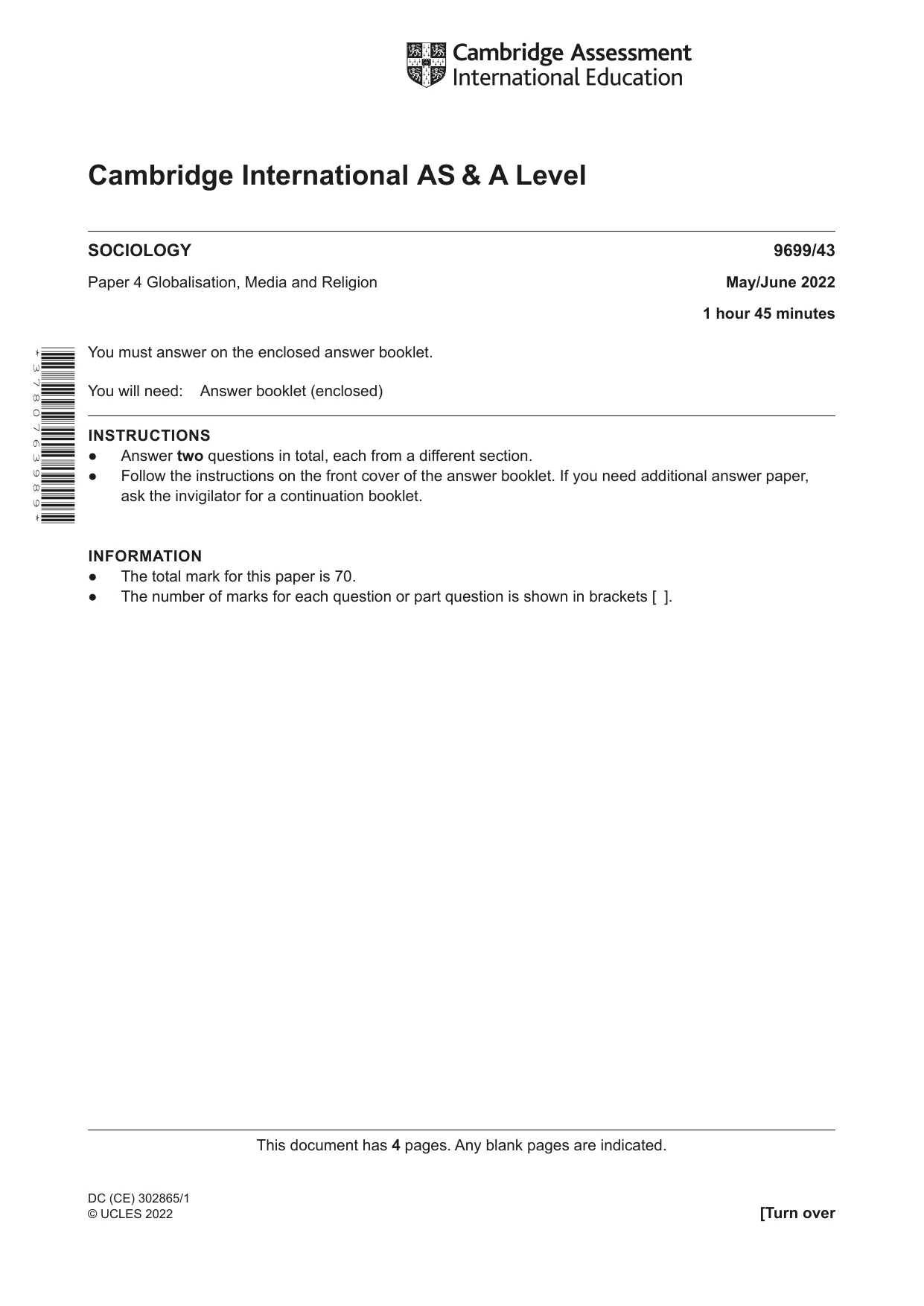
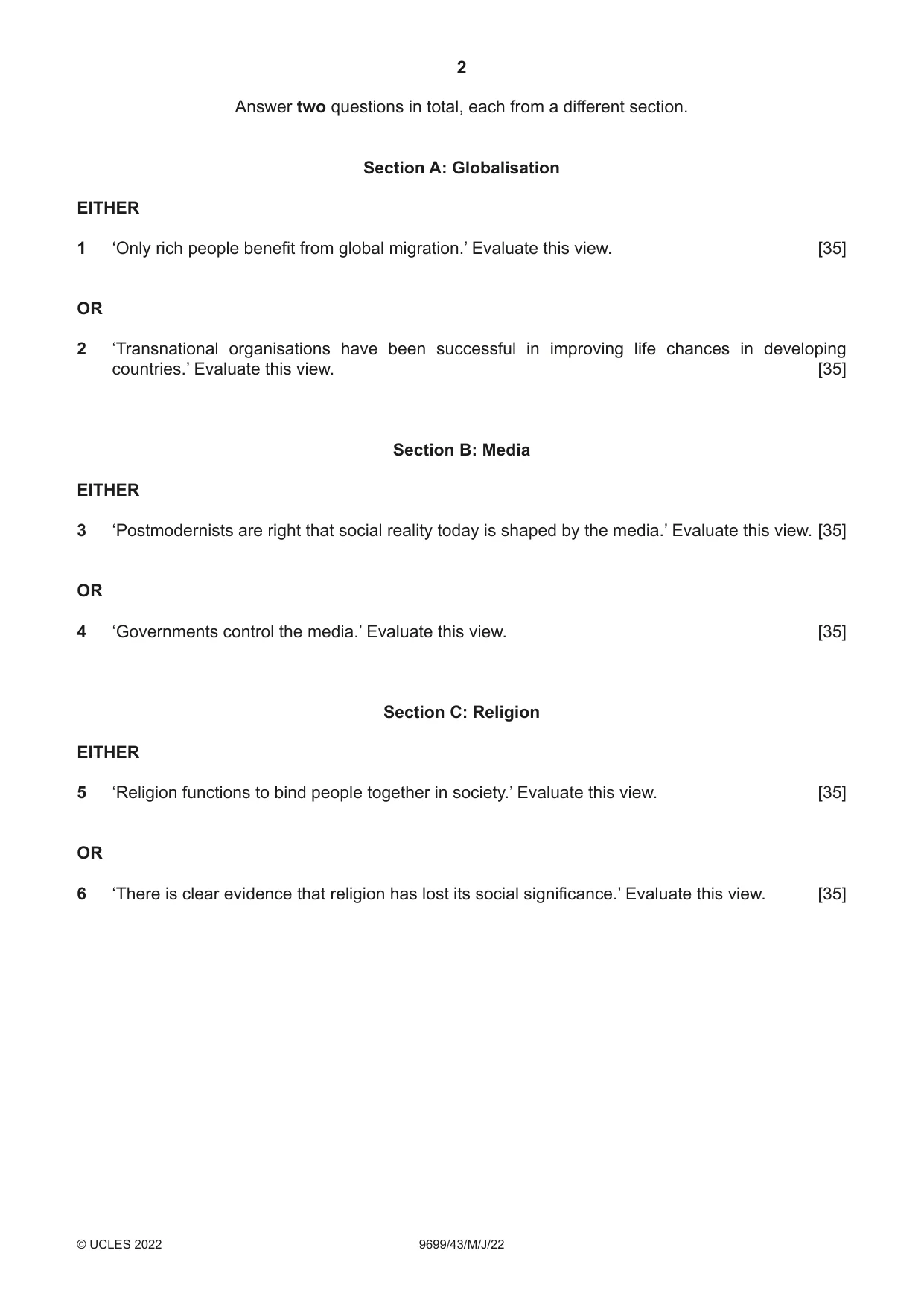
Question paper4 pages


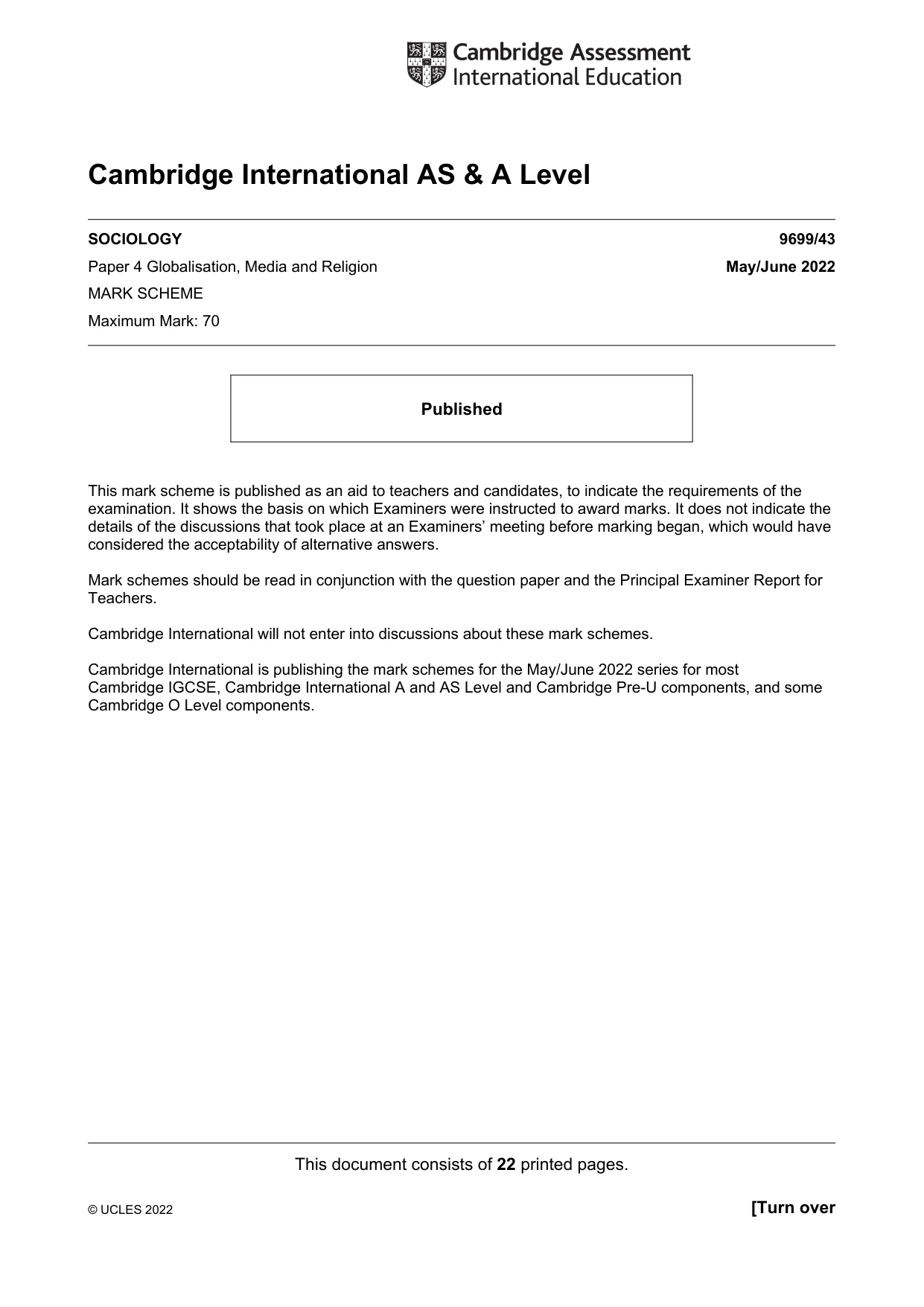
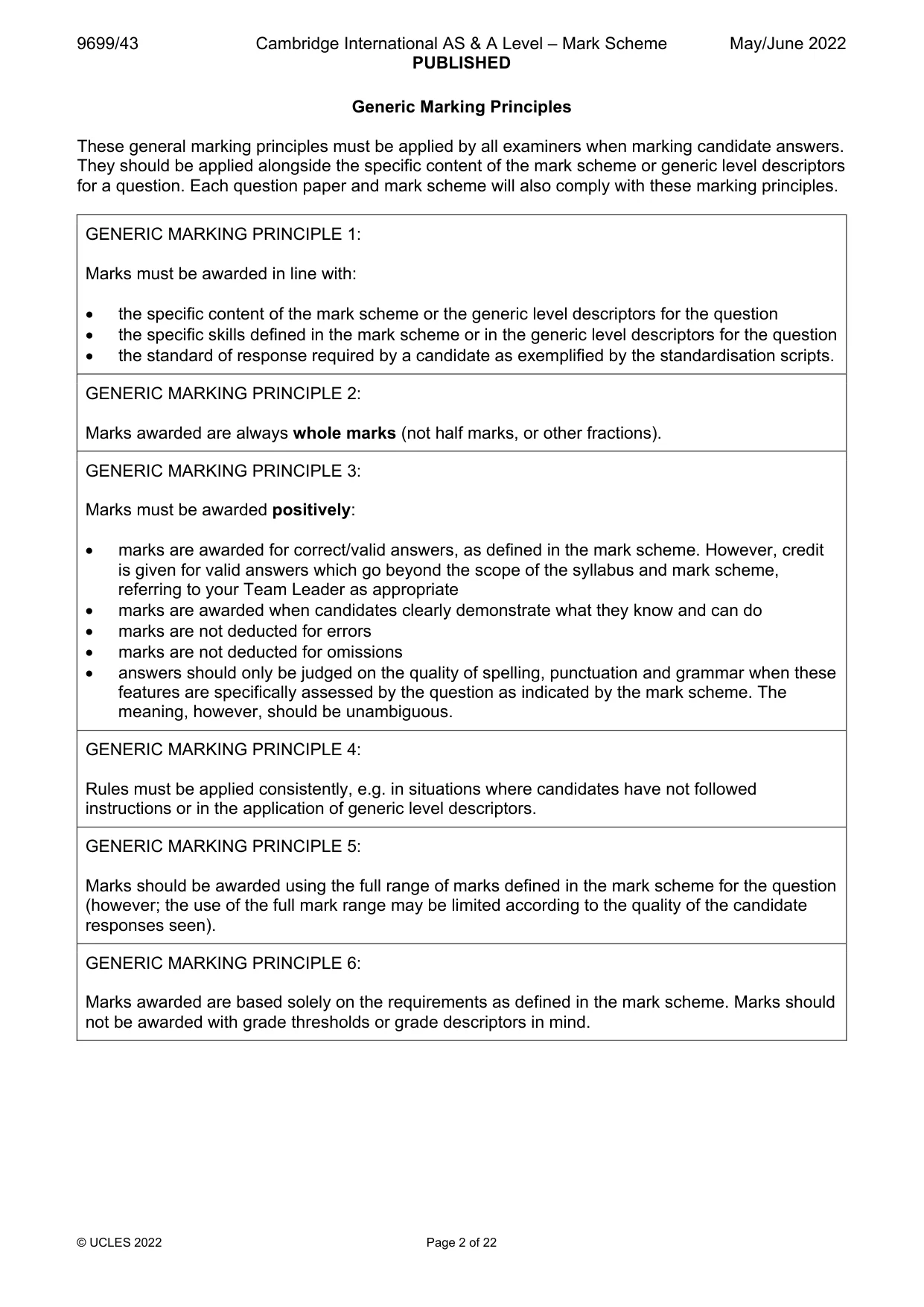
Mark scheme22 pages
Answers below. Sit the paper first if you are practising.
Paper as text
Question paper, page 1
This document has 4 pages. Any blank pages are indicated. [Turn over Cambridge International AS & A Level DC (CE) 302865/1 © UCLES 2022 SOCIOLOGY 9699/43 Paper 4 Globalisation, Media and Religion May/June 2022 1 hour 45 minutes You must answer on the enclosed answer booklet. You will need: Answer booklet (enclosed) INSTRUCTIONS ● Answer two questions in total, each from a different section. ● Follow the instructions on the front cover of the answer booklet. If you need additional answer paper, ask the invigilator for a continuation booklet. INFORMATION ● The total mark for this paper is 70. ● The number of marks for each question or part question is shown in brackets [ ]. * 3 7 8 0 7 6 3 9 8 9 *
Question paper, page 2
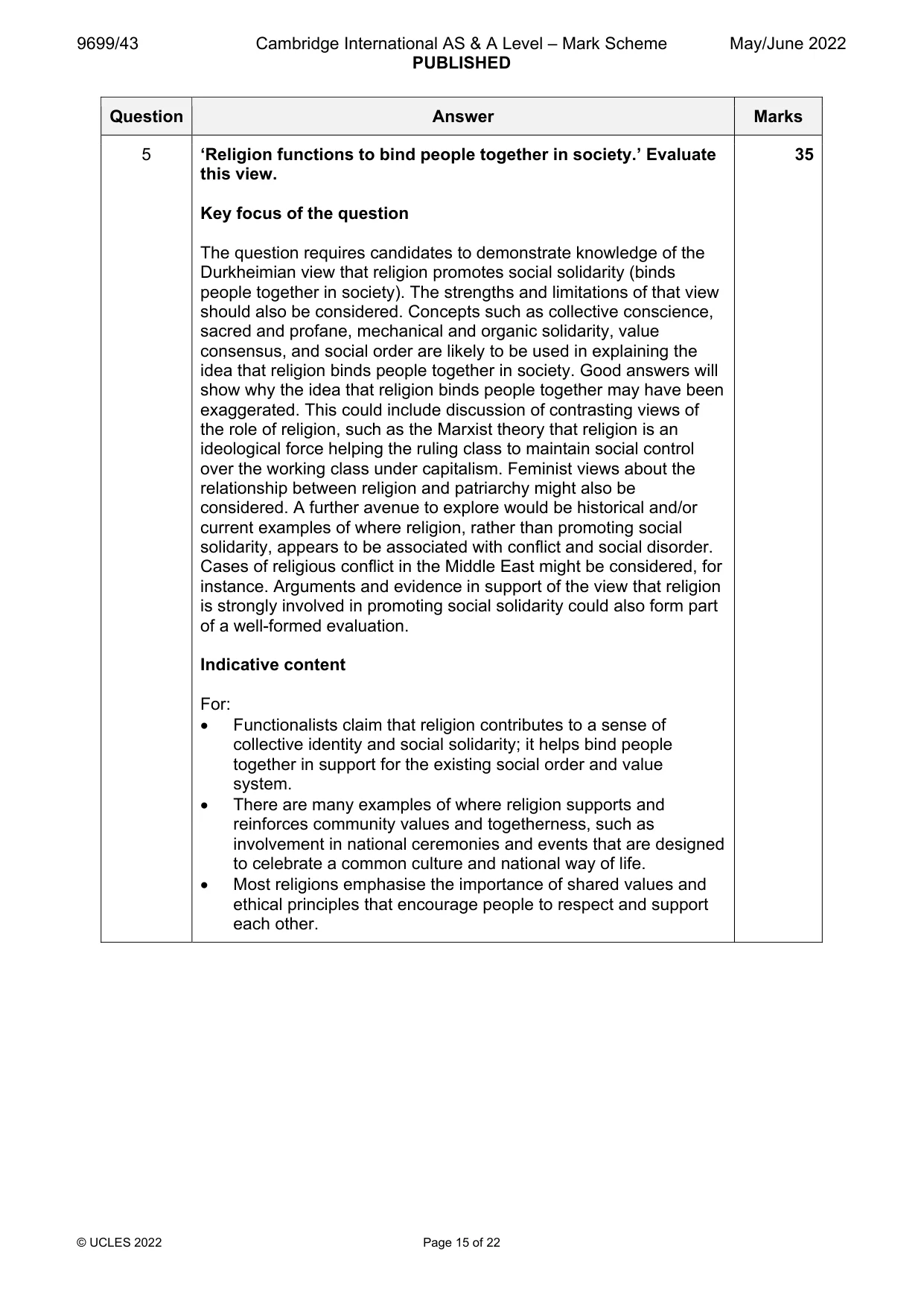
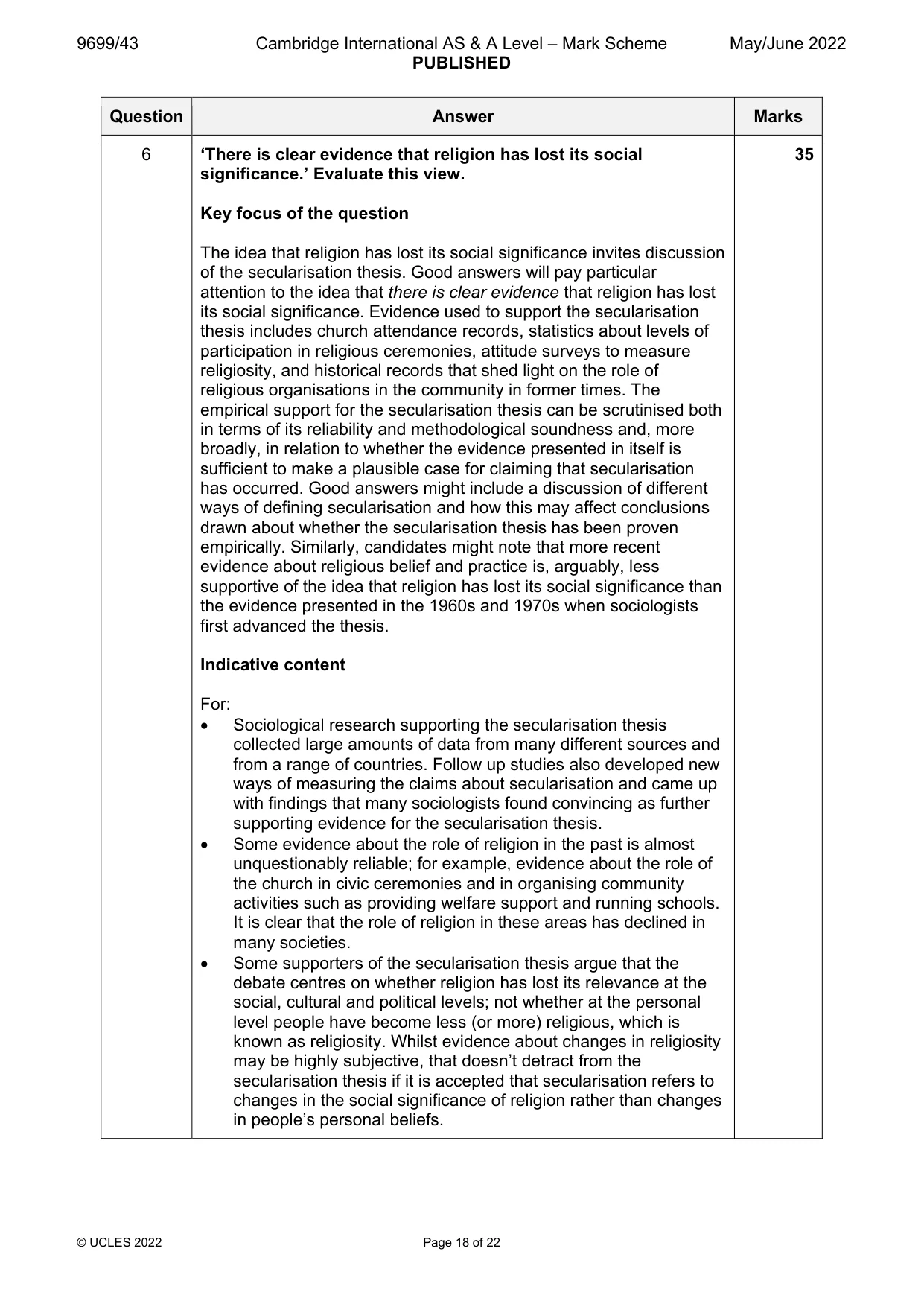
2 9699/43/M/J/22 © UCLES 2022 Answer two questions in total, each from a different section. Section A: Globalisation EITHER 1 ‘Only rich people benefit from global migration.’ Evaluate this view. [35] OR 2 ‘Transnational organisations have been successful in improving life chances in developing countries.’ Evaluate this view. [35] Section B: Media EITHER 3 ‘Postmodernists are right that social reality today is shaped by the media.’ Evaluate this view. [35] OR 4 ‘Governments control the media.’ Evaluate this view. [35] Section C: Religion EITHER 5 ‘Religion functions to bind people together in society.’ Evaluate this view. [35] OR 6 ‘There is clear evidence that religion has lost its social significance.’ Evaluate this view. [35]
Question paper, page 3
3 9699/43/M/J/22 © UCLES 2022 BLANK PAGE
Question paper, page 4
4 9699/43/M/J/22 © UCLES 2022 Permission to reproduce items where third-party owned material protected by copyright is included has been sought and cleared where possible. Every reasonable effort has been made by the publisher (UCLES) to trace copyright holders, but if any items requiring clearance have unwittingly been included, the publisher will be pleased to make amends at the earliest possible opportunity. To avoid the issue of disclosure of answer-related information to candidates, all copyright acknowledgements are reproduced online in the Cambridge Assessment International Education Copyright Acknowledgements Booklet. This is produced for each series of examinations and is freely available to download at www.cambridgeinternational.org after the live examination series. Cambridge Assessment International Education is part of Cambridge Assessment. Cambridge Assessment is the brand name of the University of Cambridge Local Examinations Syndicate (UCLES), which is a department of the University of Cambridge. BLANK PAGE
Mark scheme, page 1
This document consists of 22 printed pages. © UCLES 2022 [Turn over Cambridge International AS & A Level SOCIOLOGY 9699/43 Paper 4 Globalisation, Media and Religion May/June 2022 MARK SCHEME Maximum Mark: 70 Published This mark scheme is published as an aid to teachers and candidates, to indicate the requirements of the examination. It shows the basis on which Examiners were instructed to award marks. It does not indicate the details of the discussions that took place at an Examiners’ meeting before marking began, which would have considered the acceptability of alternative answers. Mark schemes should be read in conjunction with the question paper and the Principal Examiner Report for Teachers. Cambridge International will not enter into discussions about these mark schemes. Cambridge International is publishing the mark schemes for the May/June 2022 series for most Cambridge IGCSE, Cambridge International A and AS Level and Cambridge Pre-U components, and some Cambridge O Level components.
Mark scheme, page 2
9699/43 Cambridge International AS & A Level – Mark Scheme PUBLISHED May/June 2022 © UCLES 2022 Page 2 of 22 Generic Marking Principles These general marking principles must be applied by all examiners when marking candidate answers. They should be applied alongside the specific content of the mark scheme or generic level descriptors for a question. Each question paper and mark scheme will also comply with these marking principles. GENERIC MARKING PRINCIPLE 1: Marks must be awarded in line with: the specific content of the mark scheme or the generic level descriptors for the question the specific skills defined in the mark scheme or in the generic level descriptors for the question the standard of response required by a candidate as exemplified by the standardisation scripts. GENERIC MARKING PRINCIPLE 2: Marks awarded are always whole marks (not half marks, or other fractions). GENERIC MARKING PRINCIPLE 3: Marks must be awarded positively: marks are awarded for correct/valid answers, as defined in the mark scheme. However, credit is given for valid answers which go beyond the scope of the syllabus and mark scheme, referring to your Team Leader as appropriate marks are awarded when candidates clearly demonstrate what they know and can do marks are not deducted for errors marks are not deducted for omissions answers should only be judged on the quality of spelling, punctuation and grammar when these features are specifically assessed by the question as indicated by the mark scheme. The meaning, however, should be unambiguous. GENERIC MARKING PRINCIPLE 4: Rules must be applied consistently, e.g. in situations where candidates have not followed instructions or in the application of generic level descriptors. GENERIC MARKING PRINCIPLE 5: Marks should be awarded using the full range of marks defined in the mark scheme for the question (however; the use of the full mark range may be limited according to the quality of the candidate responses seen). GENERIC MARKING PRINCIPLE 6: Marks awarded are based solely on the requirements as defined in the mark scheme. Marks should not be awarded with grade thresholds or grade descriptors in mind.
Mark scheme, page 3
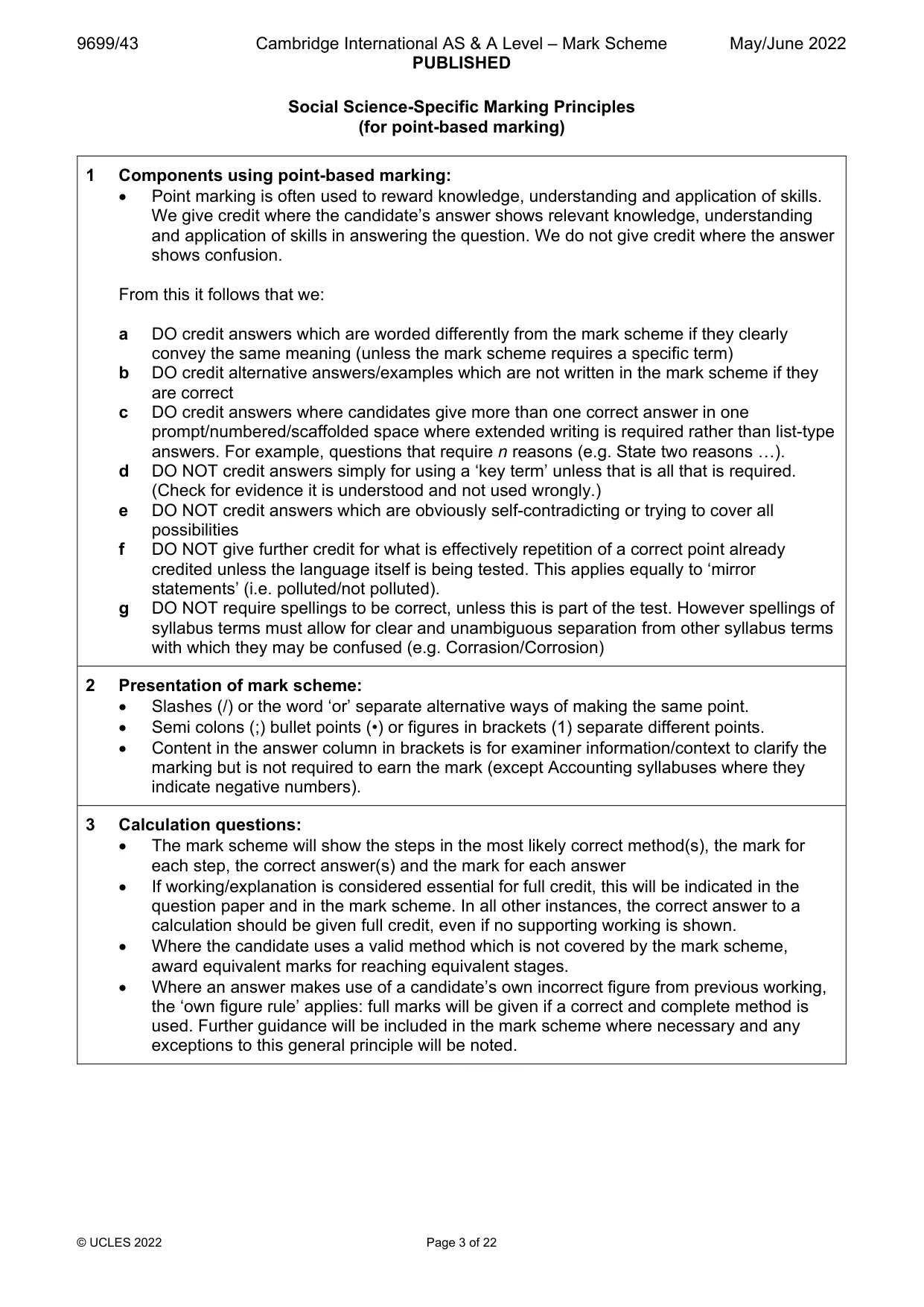
9699/43 Cambridge International AS & A Level – Mark Scheme PUBLISHED May/June 2022 © UCLES 2022 Page 3 of 22 Social Science-Specific Marking Principles (for point-based marking) 1 Components using point-based marking: Point marking is often used to reward knowledge, understanding and application of skills. We give credit where the candidate’s answer shows relevant knowledge, understanding and application of skills in answering the question. We do not give credit where the answer shows confusion. From this it follows that we: a DO credit answers which are worded differently from the mark scheme if they clearly convey the same meaning (unless the mark scheme requires a specific term) b DO credit alternative answers/examples which are not written in the mark scheme if they are correct c DO credit answers where candidates give more than one correct answer in one prompt/numbered/scaffolded space where extended writing is required rather than list-type answers. For example, questions that require n reasons (e.g. State two reasons …). d DO NOT credit answers simply for using a ‘key term’ unless that is all that is required. (Check for evidence it is understood and not used wrongly.) e DO NOT credit answers which are obviously self-contradicting or trying to cover all possibilities f DO NOT give further credit for what is effectively repetition of a correct point already credited unless the language itself is being tested. This applies equally to ‘mirror statements’ (i.e. polluted/not polluted). g DO NOT require spellings to be correct, unless this is part of the test. However spellings of syllabus terms must allow for clear and unambiguous separation from other syllabus terms with which they may be confused (e.g. Corrasion/Corrosion) 2 Presentation of mark scheme: Slashes (/) or the word ‘or’ separate alternative ways of making the same point. Semi colons (;) bullet points (•) or figures in brackets (1) separate different points. Content in the answer column in brackets is for examiner information/context to clarify the marking but is not required to earn the mark (except Accounting syllabuses where they indicate negative numbers). 3 Calculation questions: The mark scheme will show the steps in the most likely correct method(s), the mark for each step, the correct answer(s) and the mark for each answer If working/explanation is considered essential for full credit, this will be indicated in the question paper and in the mark scheme. In all other instances, the correct answer to a calculation should be given full credit, even if no supporting working is shown. Where the candidate uses a valid method which is not covered by the mark scheme, award equivalent marks for reaching equivalent stages. Where an answer makes use of a candidate’s own incorrect figure from previous working, the ‘own figure rule’ applies: full marks will be given if a correct and complete method is used. Further guidance will be included in the mark scheme where necessary and any exceptions to this general principle will be noted.
Mark scheme, page 4
9699/43 Cambridge International AS & A Level – Mark Scheme PUBLISHED May/June 2022 © UCLES 2022 Page 4 of 22 4 Annotation: For point marking, ticks can be used to indicate correct answers and crosses can be used to indicate wrong answers. There is no direct relationship between ticks and marks. Ticks have no defined meaning for levels of response marking. For levels of response marking, the level awarded should be annotated on the script. Other annotations will be used by examiners as agreed during standardisation, and the meaning will be understood by all examiners who marked that paper.
Mark scheme, page 5
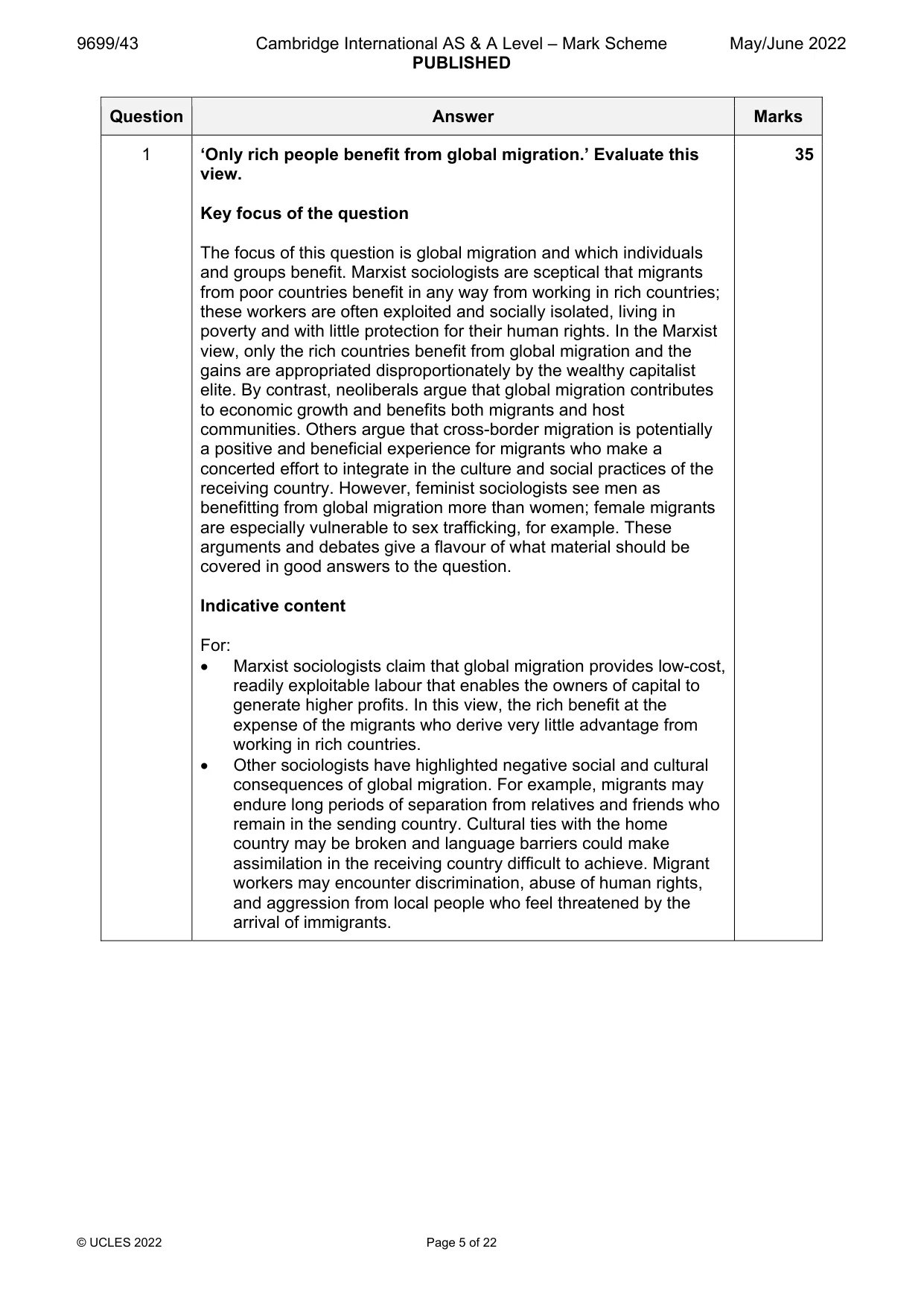
9699/43 Cambridge International AS & A Level – Mark Scheme PUBLISHED May/June 2022 © UCLES 2022 Page 5 of 22 Question Answer Marks 1 ‘Only rich people benefit from global migration.’ Evaluate this view. Key focus of the question The focus of this question is global migration and which individuals and groups benefit. Marxist sociologists are sceptical that migrants from poor countries benefit in any way from working in rich countries; these workers are often exploited and socially isolated, living in poverty and with little protection for their human rights. In the Marxist view, only the rich countries benefit from global migration and the gains are appropriated disproportionately by the wealthy capitalist elite. By contrast, neoliberals argue that global migration contributes to economic growth and benefits both migrants and host communities. Others argue that cross-border migration is potentially a positive and beneficial experience for migrants who make a concerted effort to integrate in the culture and social practices of the receiving country. However, feminist sociologists see men as benefitting from global migration more than women; female migrants are especially vulnerable to sex trafficking, for example. These arguments and debates give a flavour of what material should be covered in good answers to the question. Indicative content For: Marxist sociologists claim that global migration provides low-cost, readily exploitable labour that enables the owners of capital to generate higher profits. In this view, the rich benefit at the expense of the migrants who derive very little advantage from working in rich countries. Other sociologists have highlighted negative social and cultural consequences of global migration. For example, migrants may endure long periods of separation from relatives and friends who remain in the sending country. Cultural ties with the home country may be broken and language barriers could make assimilation in the receiving country difficult to achieve. Migrant workers may encounter discrimination, abuse of human rights, and aggression from local people who feel threatened by the arrival of immigrants. 35
Mark scheme, page 6
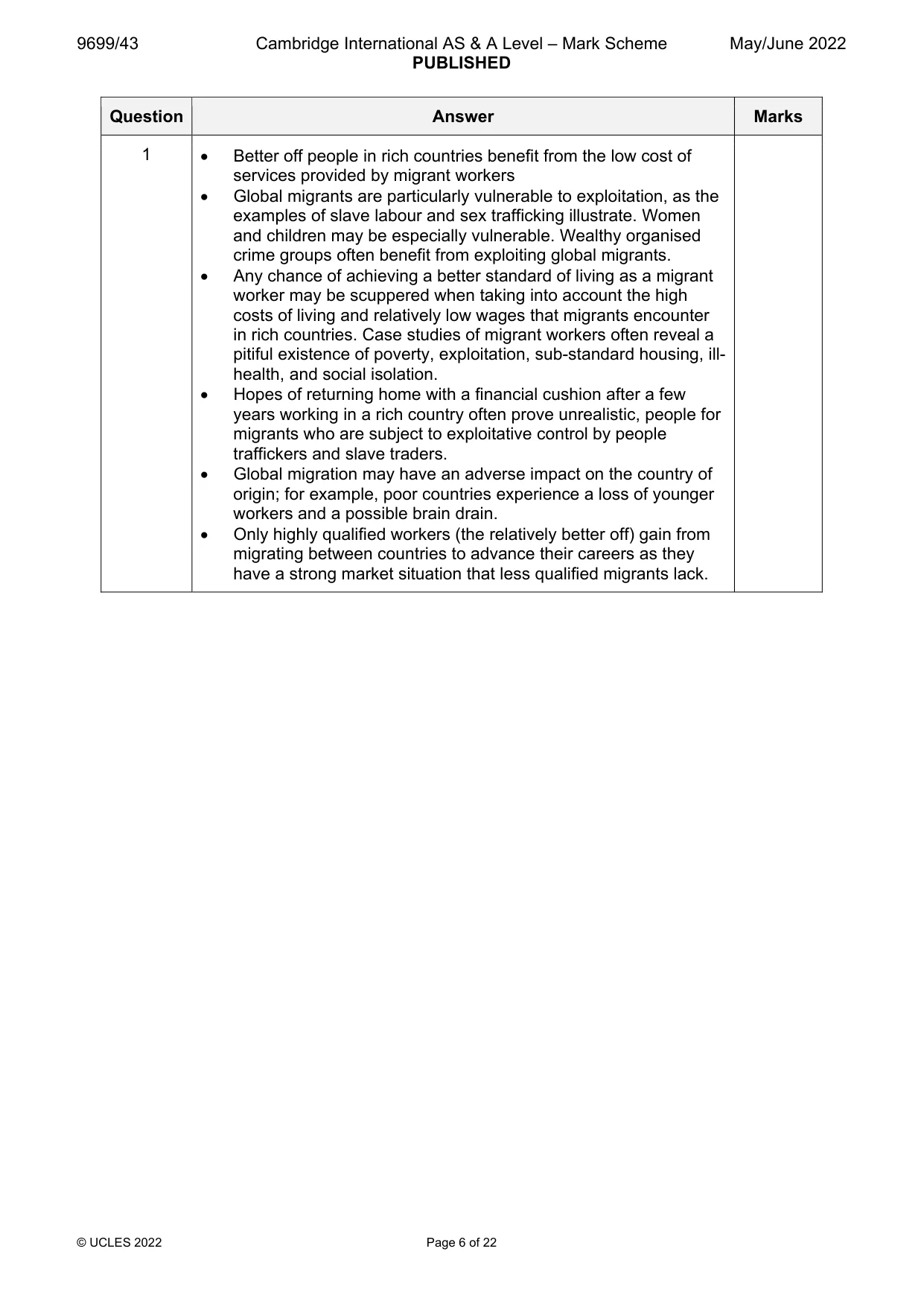
9699/43 Cambridge International AS & A Level – Mark Scheme PUBLISHED May/June 2022 © UCLES 2022 Page 6 of 22 Question Answer Marks 1 Better off people in rich countries benefit from the low cost of services provided by migrant workers Global migrants are particularly vulnerable to exploitation, as the examples of slave labour and sex trafficking illustrate. Women and children may be especially vulnerable. Wealthy organised crime groups often benefit from exploiting global migrants. Any chance of achieving a better standard of living as a migrant worker may be scuppered when taking into account the high costs of living and relatively low wages that migrants encounter in rich countries. Case studies of migrant workers often reveal a pitiful existence of poverty, exploitation, sub-standard housing, ill- health, and social isolation. Hopes of returning home with a financial cushion after a few years working in a rich country often prove unrealistic, people for migrants who are subject to exploitative control by people traffickers and slave traders. Global migration may have an adverse impact on the country of origin; for example, poor countries experience a loss of younger workers and a possible brain drain. Only highly qualified workers (the relatively better off) gain from migrating between countries to advance their careers as they have a strong market situation that less qualified migrants lack.
Mark scheme, page 7
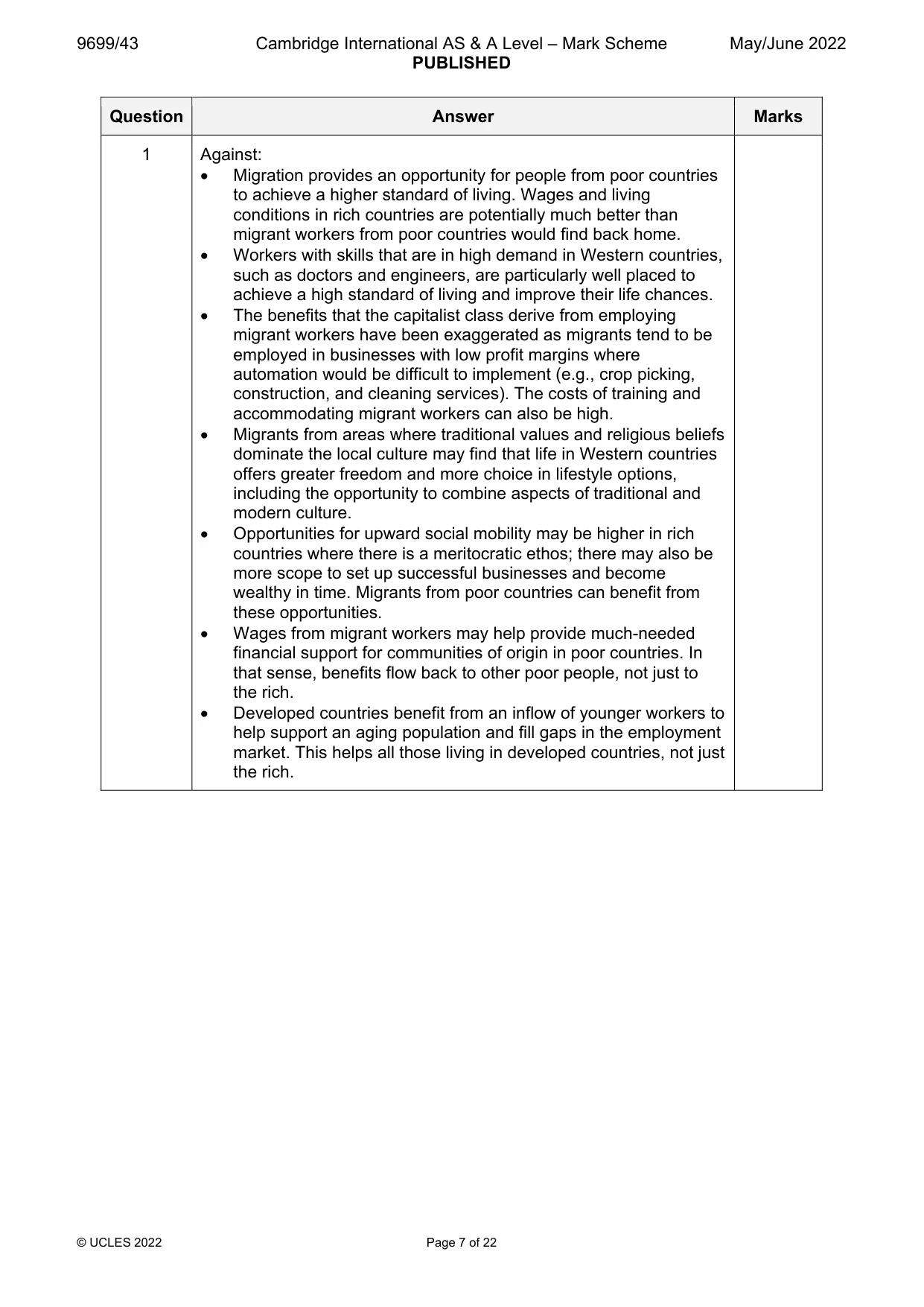
9699/43 Cambridge International AS & A Level – Mark Scheme PUBLISHED May/June 2022 © UCLES 2022 Page 7 of 22 Question Answer Marks 1 Against: Migration provides an opportunity for people from poor countries to achieve a higher standard of living. Wages and living conditions in rich countries are potentially much better than migrant workers from poor countries would find back home. Workers with skills that are in high demand in Western countries, such as doctors and engineers, are particularly well placed to achieve a high standard of living and improve their life chances. The benefits that the capitalist class derive from employing migrant workers have been exaggerated as migrants tend to be employed in businesses with low profit margins where automation would be difficult to implement (e.g., crop picking, construction, and cleaning services). The costs of training and accommodating migrant workers can also be high. Migrants from areas where traditional values and religious beliefs dominate the local culture may find that life in Western countries offers greater freedom and more choice in lifestyle options, including the opportunity to combine aspects of traditional and modern culture. Opportunities for upward social mobility may be higher in rich countries where there is a meritocratic ethos; there may also be more scope to set up successful businesses and become wealthy in time. Migrants from poor countries can benefit from these opportunities. Wages from migrant workers may help provide much-needed financial support for communities of origin in poor countries. In that sense, benefits flow back to other poor people, not just to the rich. Developed countries benefit from an inflow of younger workers to help support an aging population and fill gaps in the employment market. This helps all those living in developed countries, not just the rich.
Mark scheme, page 8
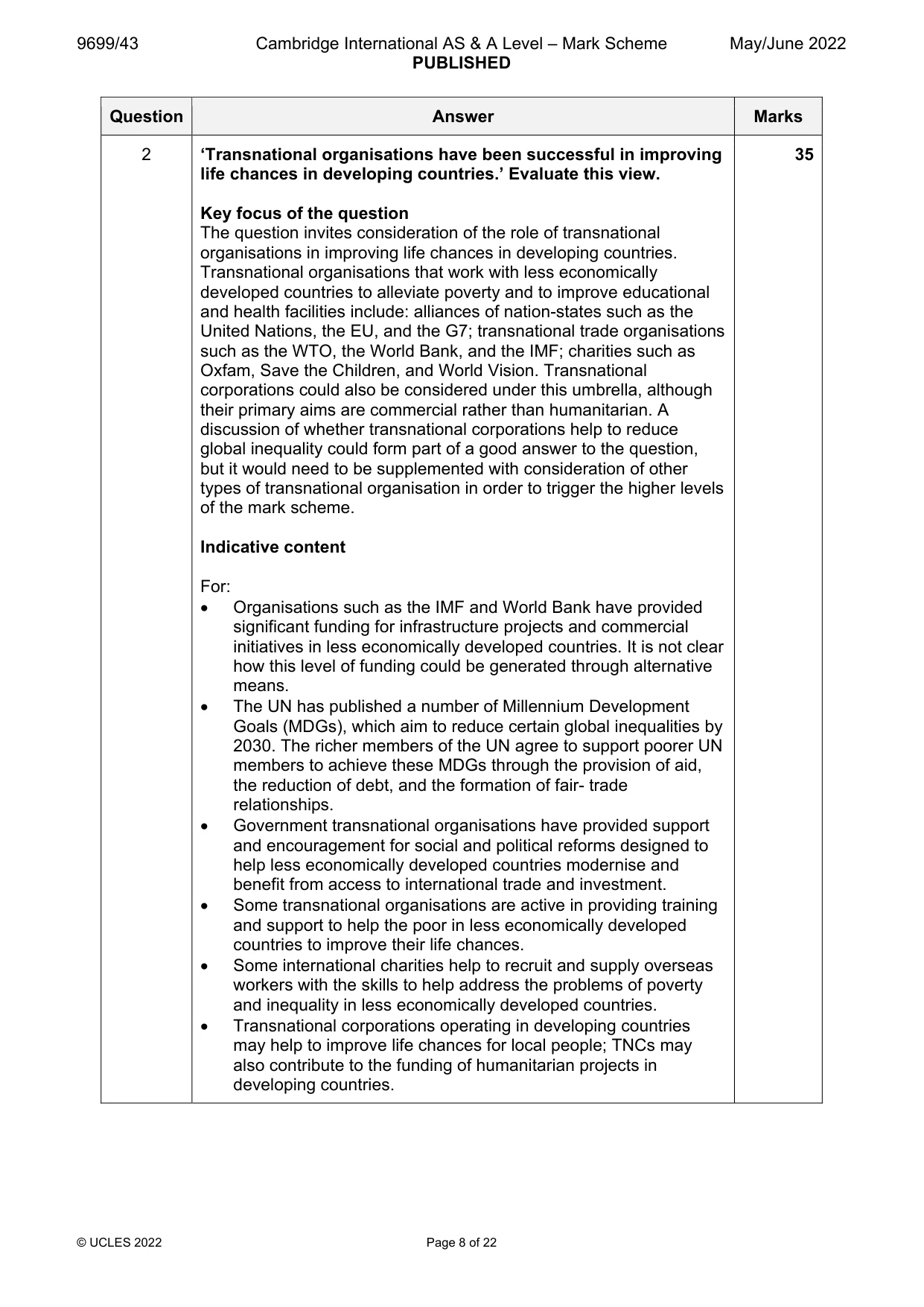
9699/43 Cambridge International AS & A Level – Mark Scheme PUBLISHED May/June 2022 © UCLES 2022 Page 8 of 22 Question Answer Marks 2 ‘Transnational organisations have been successful in improving life chances in developing countries.’ Evaluate this view. Key focus of the question The question invites consideration of the role of transnational organisations in improving life chances in developing countries. Transnational organisations that work with less economically developed countries to alleviate poverty and to improve educational and health facilities include: alliances of nation-states such as the United Nations, the EU, and the G7; transnational trade organisations such as the WTO, the World Bank, and the IMF; charities such as Oxfam, Save the Children, and World Vision. Transnational corporations could also be considered under this umbrella, although their primary aims are commercial rather than humanitarian. A discussion of whether transnational corporations help to reduce global inequality could form part of a good answer to the question, but it would need to be supplemented with consideration of other types of transnational organisation in order to trigger the higher levels of the mark scheme. Indicative content For: Organisations such as the IMF and World Bank have provided significant funding for infrastructure projects and commercial initiatives in less economically developed countries. It is not clear how this level of funding could be generated through alternative means. The UN has published a number of Millennium Development Goals (MDGs), which aim to reduce certain global inequalities by 2030. The richer members of the UN agree to support poorer UN members to achieve these MDGs through the provision of aid, the reduction of debt, and the formation of fair- trade relationships. Government transnational organisations have provided support and encouragement for social and political reforms designed to help less economically developed countries modernise and benefit from access to international trade and investment. Some transnational organisations are active in providing training and support to help the poor in less economically developed countries to improve their life chances. Some international charities help to recruit and supply overseas workers with the skills to help address the problems of poverty and inequality in less economically developed countries. Transnational corporations operating in developing countries may help to improve life chances for local people; TNCs may also contribute to the funding of humanitarian projects in developing countries. 35
Mark scheme, page 9
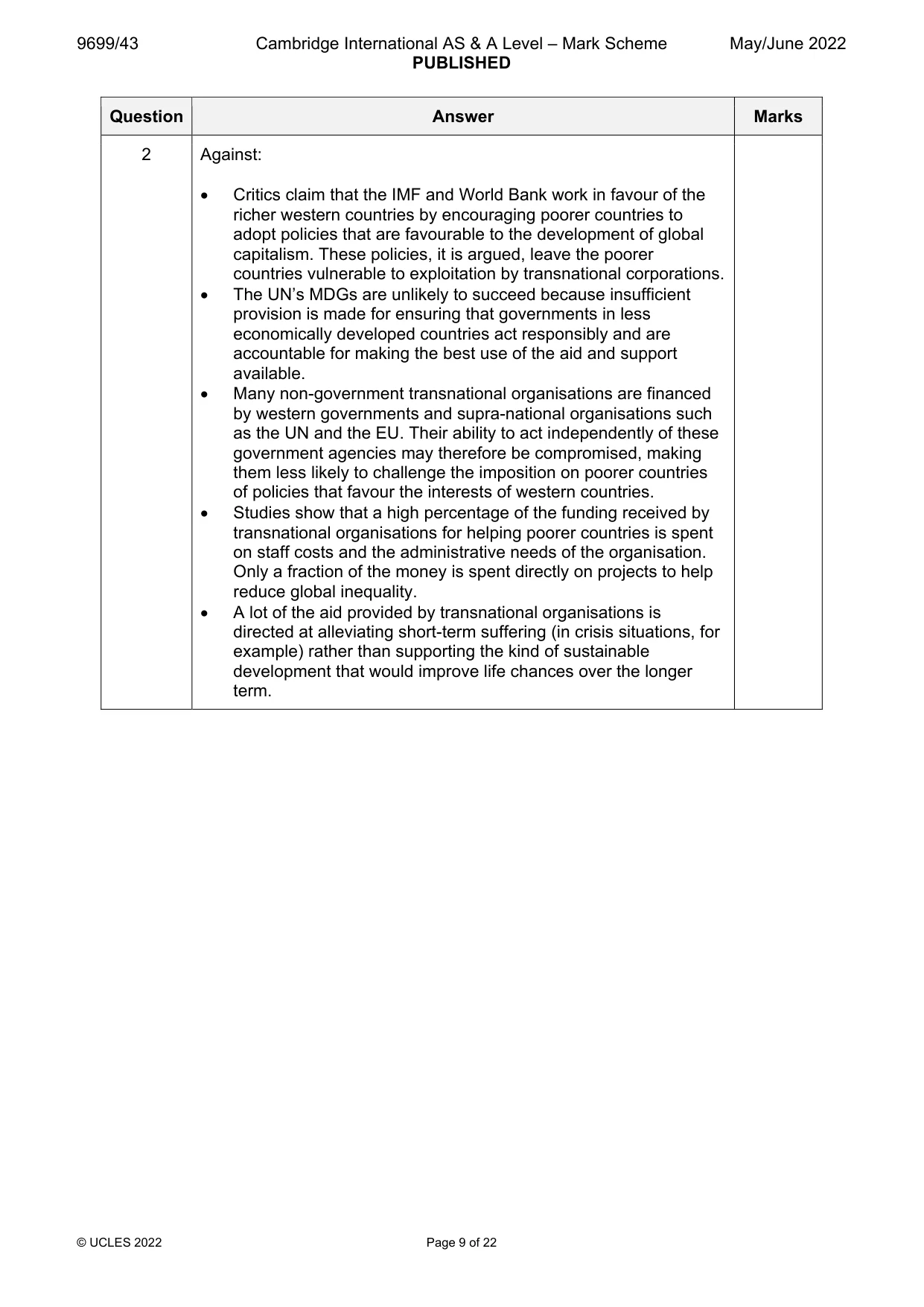
9699/43 Cambridge International AS & A Level – Mark Scheme PUBLISHED May/June 2022 © UCLES 2022 Page 9 of 22 Question Answer Marks 2 Against: Critics claim that the IMF and World Bank work in favour of the richer western countries by encouraging poorer countries to adopt policies that are favourable to the development of global capitalism. These policies, it is argued, leave the poorer countries vulnerable to exploitation by transnational corporations. The UN’s MDGs are unlikely to succeed because insufficient provision is made for ensuring that governments in less economically developed countries act responsibly and are accountable for making the best use of the aid and support available. Many non-government transnational organisations are financed by western governments and supra-national organisations such as the UN and the EU. Their ability to act independently of these government agencies may therefore be compromised, making them less likely to challenge the imposition on poorer countries of policies that favour the interests of western countries. Studies show that a high percentage of the funding received by transnational organisations for helping poorer countries is spent on staff costs and the administrative needs of the organisation. Only a fraction of the money is spent directly on projects to help reduce global inequality. A lot of the aid provided by transnational organisations is directed at alleviating short-term suffering (in crisis situations, for example) rather than supporting the kind of sustainable development that would improve life chances over the longer term.
Mark scheme, page 10
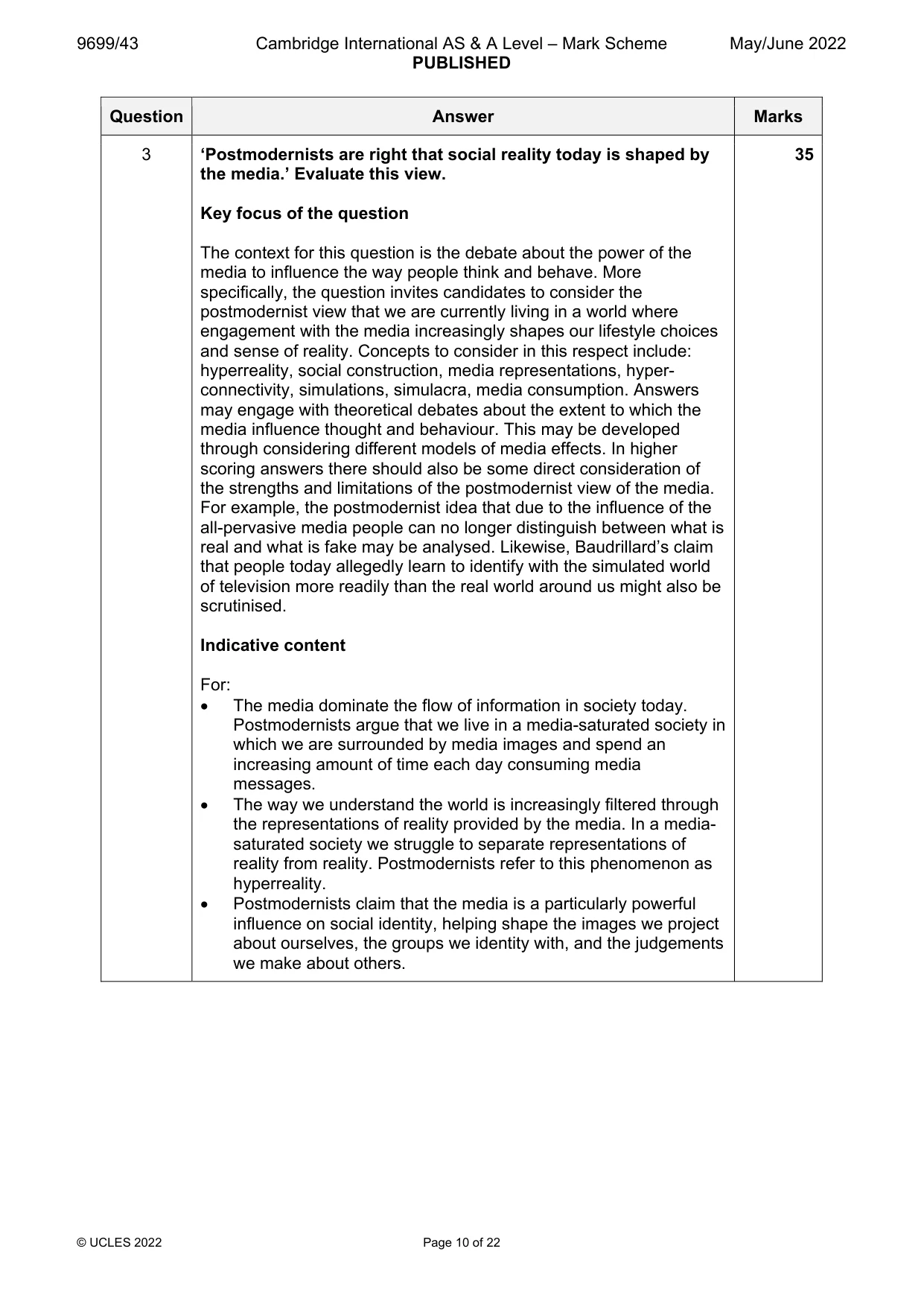
9699/43 Cambridge International AS & A Level – Mark Scheme PUBLISHED May/June 2022 © UCLES 2022 Page 10 of 22 Question Answer Marks 3 ‘Postmodernists are right that social reality today is shaped by the media.’ Evaluate this view. Key focus of the question The context for this question is the debate about the power of the media to influence the way people think and behave. More specifically, the question invites candidates to consider the postmodernist view that we are currently living in a world where engagement with the media increasingly shapes our lifestyle choices and sense of reality. Concepts to consider in this respect include: hyperreality, social construction, media representations, hyper- connectivity, simulations, simulacra, media consumption. Answers may engage with theoretical debates about the extent to which the media influence thought and behaviour. This may be developed through considering different models of media effects. In higher scoring answers there should also be some direct consideration of the strengths and limitations of the postmodernist view of the media. For example, the postmodernist idea that due to the influence of the all-pervasive media people can no longer distinguish between what is real and what is fake may be analysed. Likewise, Baudrillard’s claim that people today allegedly learn to identify with the simulated world of television more readily than the real world around us might also be scrutinised. Indicative content For: The media dominate the flow of information in society today. Postmodernists argue that we live in a media-saturated society in which we are surrounded by media images and spend an increasing amount of time each day consuming media messages. The way we understand the world is increasingly filtered through the representations of reality provided by the media. In a media- saturated society we struggle to separate representations of reality from reality. Postmodernists refer to this phenomenon as hyperreality. Postmodernists claim that the media is a particularly powerful influence on social identity, helping shape the images we project about ourselves, the groups we identity with, and the judgements we make about others. 35
Mark scheme, page 11
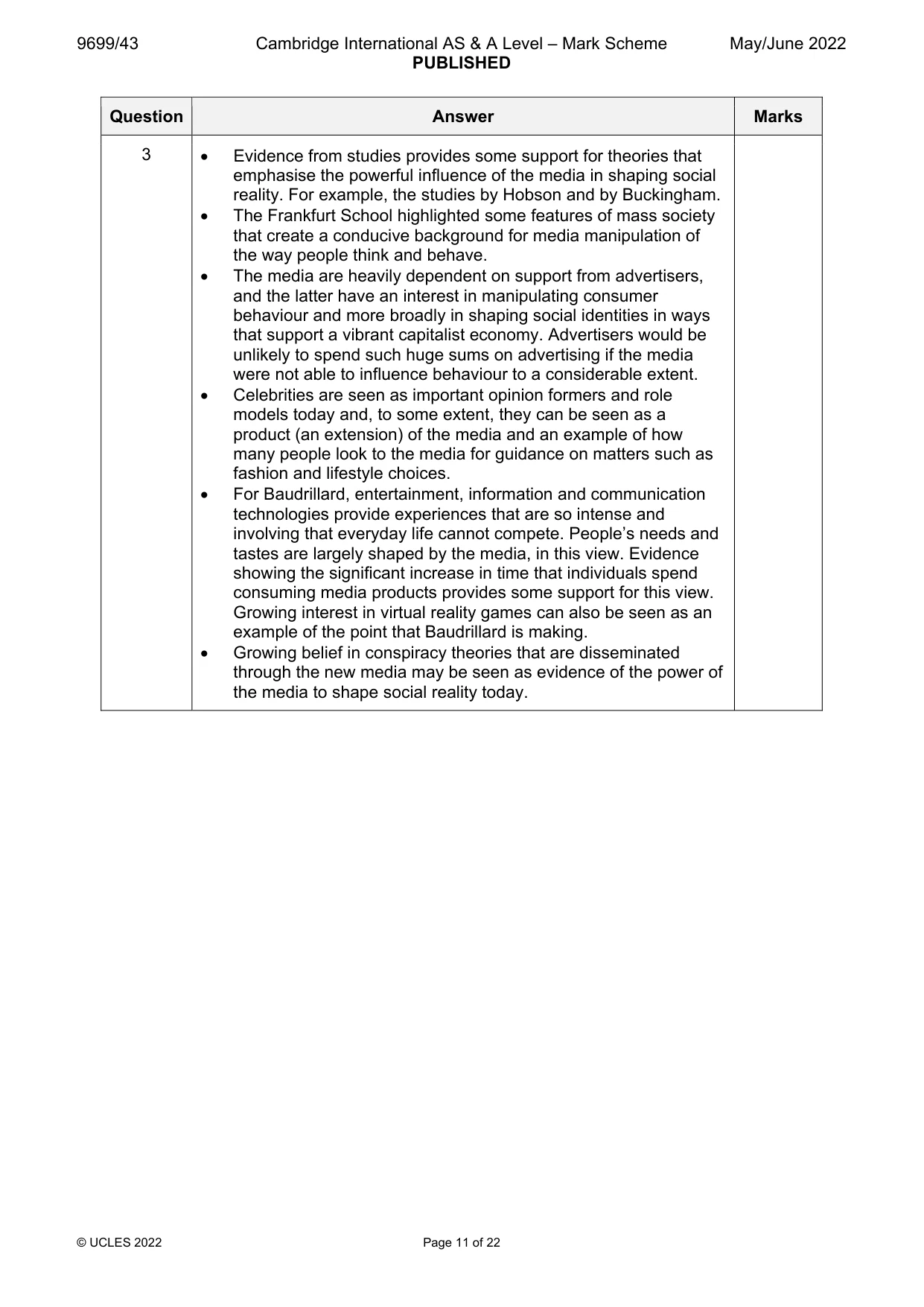
9699/43 Cambridge International AS & A Level – Mark Scheme PUBLISHED May/June 2022 © UCLES 2022 Page 11 of 22 Question Answer Marks 3 Evidence from studies provides some support for theories that emphasise the powerful influence of the media in shaping social reality. For example, the studies by Hobson and by Buckingham. The Frankfurt School highlighted some features of mass society that create a conducive background for media manipulation of the way people think and behave. The media are heavily dependent on support from advertisers, and the latter have an interest in manipulating consumer behaviour and more broadly in shaping social identities in ways that support a vibrant capitalist economy. Advertisers would be unlikely to spend such huge sums on advertising if the media were not able to influence behaviour to a considerable extent. Celebrities are seen as important opinion formers and role models today and, to some extent, they can be seen as a product (an extension) of the media and an example of how many people look to the media for guidance on matters such as fashion and lifestyle choices. For Baudrillard, entertainment, information and communication technologies provide experiences that are so intense and involving that everyday life cannot compete. People’s needs and tastes are largely shaped by the media, in this view. Evidence showing the significant increase in time that individuals spend consuming media products provides some support for this view. Growing interest in virtual reality games can also be seen as an example of the point that Baudrillard is making. Growing belief in conspiracy theories that are disseminated through the new media may be seen as evidence of the power of the media to shape social reality today.
Mark scheme, page 12
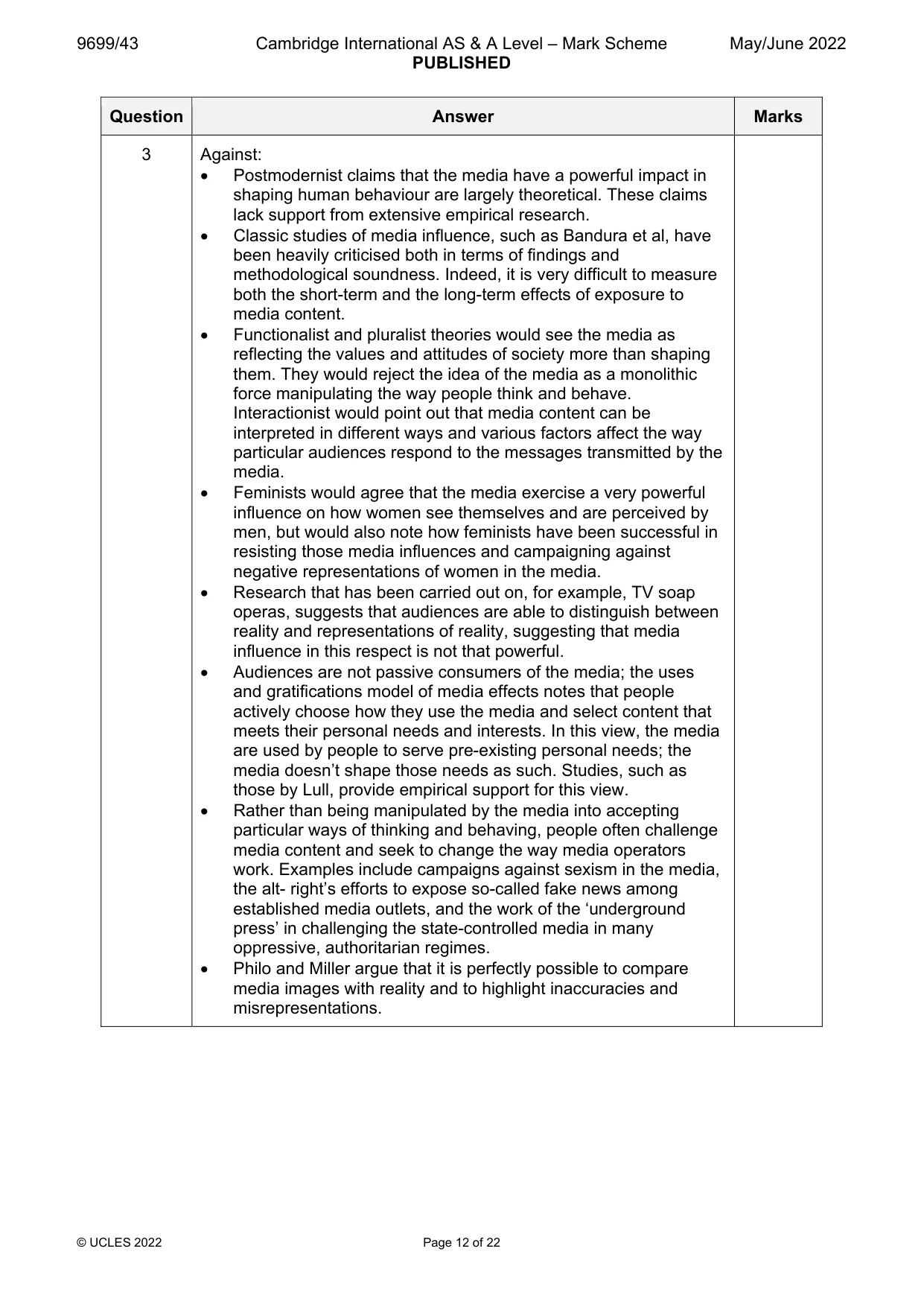
9699/43 Cambridge International AS & A Level – Mark Scheme PUBLISHED May/June 2022 © UCLES 2022 Page 12 of 22 Question Answer Marks 3 Against: Postmodernist claims that the media have a powerful impact in shaping human behaviour are largely theoretical. These claims lack support from extensive empirical research. Classic studies of media influence, such as Bandura et al, have been heavily criticised both in terms of findings and methodological soundness. Indeed, it is very difficult to measure both the short-term and the long-term effects of exposure to media content. Functionalist and pluralist theories would see the media as reflecting the values and attitudes of society more than shaping them. They would reject the idea of the media as a monolithic force manipulating the way people think and behave. Interactionist would point out that media content can be interpreted in different ways and various factors affect the way particular audiences respond to the messages transmitted by the media. Feminists would agree that the media exercise a very powerful influence on how women see themselves and are perceived by men, but would also note how feminists have been successful in resisting those media influences and campaigning against negative representations of women in the media. Research that has been carried out on, for example, TV soap operas, suggests that audiences are able to distinguish between reality and representations of reality, suggesting that media influence in this respect is not that powerful. Audiences are not passive consumers of the media; the uses and gratifications model of media effects notes that people actively choose how they use the media and select content that meets their personal needs and interests. In this view, the media are used by people to serve pre-existing personal needs; the media doesn’t shape those needs as such. Studies, such as those by Lull, provide empirical support for this view. Rather than being manipulated by the media into accepting particular ways of thinking and behaving, people often challenge media content and seek to change the way media operators work. Examples include campaigns against sexism in the media, the alt- right’s efforts to expose so-called fake news among established media outlets, and the work of the ‘underground press’ in challenging the state-controlled media in many oppressive, authoritarian regimes. Philo and Miller argue that it is perfectly possible to compare media images with reality and to highlight inaccuracies and misrepresentations.
Mark scheme, page 13
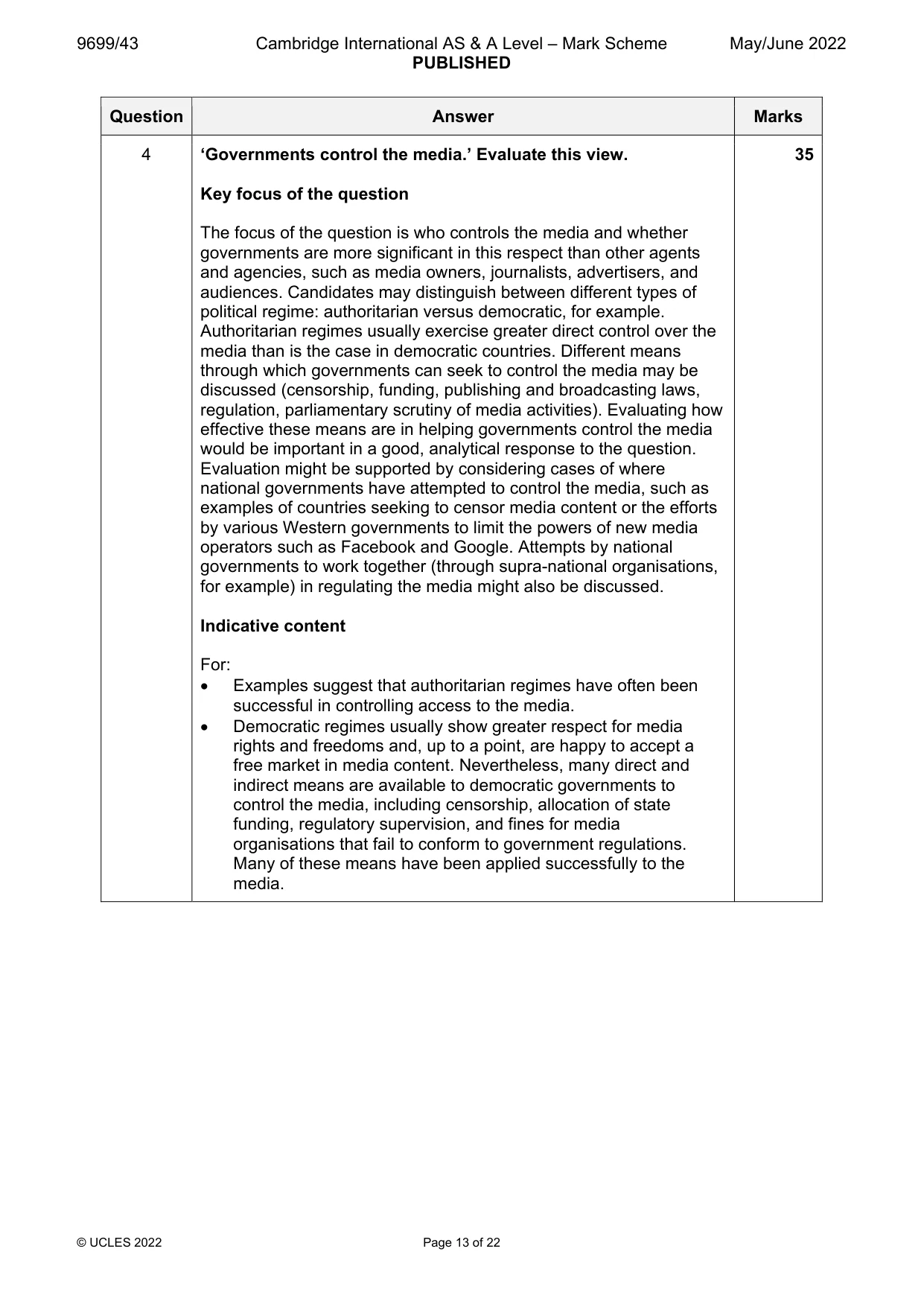
9699/43 Cambridge International AS & A Level – Mark Scheme PUBLISHED May/June 2022 © UCLES 2022 Page 13 of 22 Question Answer Marks 4 ‘Governments control the media.’ Evaluate this view. Key focus of the question The focus of the question is who controls the media and whether governments are more significant in this respect than other agents and agencies, such as media owners, journalists, advertisers, and audiences. Candidates may distinguish between different types of political regime: authoritarian versus democratic, for example. Authoritarian regimes usually exercise greater direct control over the media than is the case in democratic countries. Different means through which governments can seek to control the media may be discussed (censorship, funding, publishing and broadcasting laws, regulation, parliamentary scrutiny of media activities). Evaluating how effective these means are in helping governments control the media would be important in a good, analytical response to the question. Evaluation might be supported by considering cases of where national governments have attempted to control the media, such as examples of countries seeking to censor media content or the efforts by various Western governments to limit the powers of new media operators such as Facebook and Google. Attempts by national governments to work together (through supra-national organisations, for example) in regulating the media might also be discussed. Indicative content For: Examples suggest that authoritarian regimes have often been successful in controlling access to the media. Democratic regimes usually show greater respect for media rights and freedoms and, up to a point, are happy to accept a free market in media content. Nevertheless, many direct and indirect means are available to democratic governments to control the media, including censorship, allocation of state funding, regulatory supervision, and fines for media organisations that fail to conform to government regulations. Many of these means have been applied successfully to the media. 35
Mark scheme, page 14
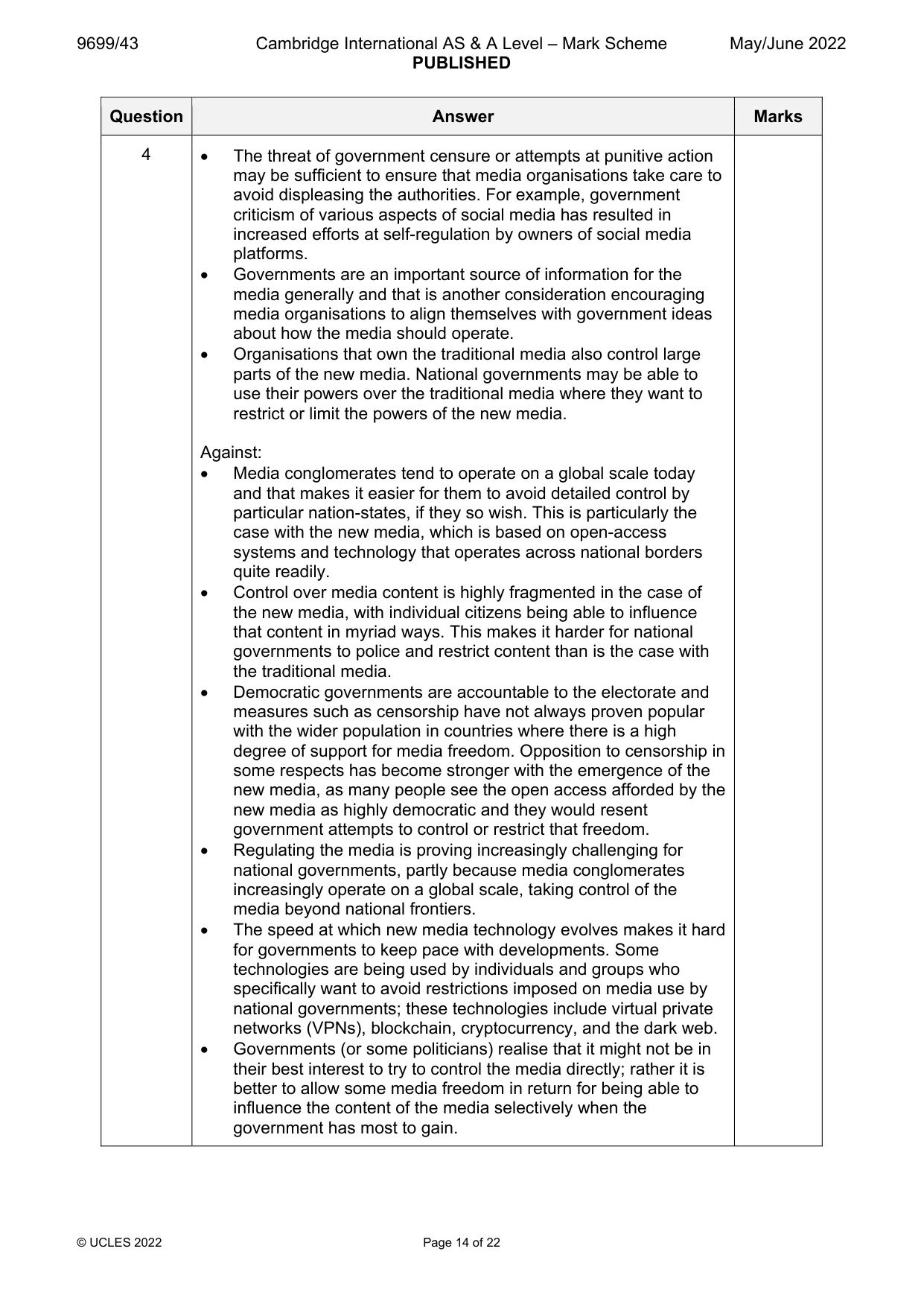
9699/43 Cambridge International AS & A Level – Mark Scheme PUBLISHED May/June 2022 © UCLES 2022 Page 14 of 22 Question Answer Marks 4 The threat of government censure or attempts at punitive action may be sufficient to ensure that media organisations take care to avoid displeasing the authorities. For example, government criticism of various aspects of social media has resulted in increased efforts at self-regulation by owners of social media platforms. Governments are an important source of information for the media generally and that is another consideration encouraging media organisations to align themselves with government ideas about how the media should operate. Organisations that own the traditional media also control large parts of the new media. National governments may be able to use their powers over the traditional media where they want to restrict or limit the powers of the new media. Against: Media conglomerates tend to operate on a global scale today and that makes it easier for them to avoid detailed control by particular nation-states, if they so wish. This is particularly the case with the new media, which is based on open-access systems and technology that operates across national borders quite readily. Control over media content is highly fragmented in the case of the new media, with individual citizens being able to influence that content in myriad ways. This makes it harder for national governments to police and restrict content than is the case with the traditional media. Democratic governments are accountable to the electorate and measures such as censorship have not always proven popular with the wider population in countries where there is a high degree of support for media freedom. Opposition to censorship in some respects has become stronger with the emergence of the new media, as many people see the open access afforded by the new media as highly democratic and they would resent government attempts to control or restrict that freedom. Regulating the media is proving increasingly challenging for national governments, partly because media conglomerates increasingly operate on a global scale, taking control of the media beyond national frontiers. The speed at which new media technology evolves makes it hard for governments to keep pace with developments. Some technologies are being used by individuals and groups who specifically want to avoid restrictions imposed on media use by national governments; these technologies include virtual private networks (VPNs), blockchain, cryptocurrency, and the dark web. Governments (or some politicians) realise that it might not be in their best interest to try to control the media directly; rather it is better to allow some media freedom in return for being able to influence the content of the media selectively when the government has most to gain.
Mark scheme, page 15
9699/43 Cambridge International AS & A Level – Mark Scheme PUBLISHED May/June 2022 © UCLES 2022 Page 15 of 22 Question Answer Marks 5 ‘Religion functions to bind people together in society.’ Evaluate this view. Key focus of the question The question requires candidates to demonstrate knowledge of the Durkheimian view that religion promotes social solidarity (binds people together in society). The strengths and limitations of that view should also be considered. Concepts such as collective conscience, sacred and profane, mechanical and organic solidarity, value consensus, and social order are likely to be used in explaining the idea that religion binds people together in society. Good answers will show why the idea that religion binds people together may have been exaggerated. This could include discussion of contrasting views of the role of religion, such as the Marxist theory that religion is an ideological force helping the ruling class to maintain social control over the working class under capitalism. Feminist views about the relationship between religion and patriarchy might also be considered. A further avenue to explore would be historical and/or current examples of where religion, rather than promoting social solidarity, appears to be associated with conflict and social disorder. Cases of religious conflict in the Middle East might be considered, for instance. Arguments and evidence in support of the view that religion is strongly involved in promoting social solidarity could also form part of a well-formed evaluation. Indicative content For: Functionalists claim that religion contributes to a sense of collective identity and social solidarity; it helps bind people together in support for the existing social order and value system. There are many examples of where religion supports and reinforces community values and togetherness, such as involvement in national ceremonies and events that are designed to celebrate a common culture and national way of life. Most religions emphasise the importance of shared values and ethical principles that encourage people to respect and support each other. 35
Mark scheme, page 16
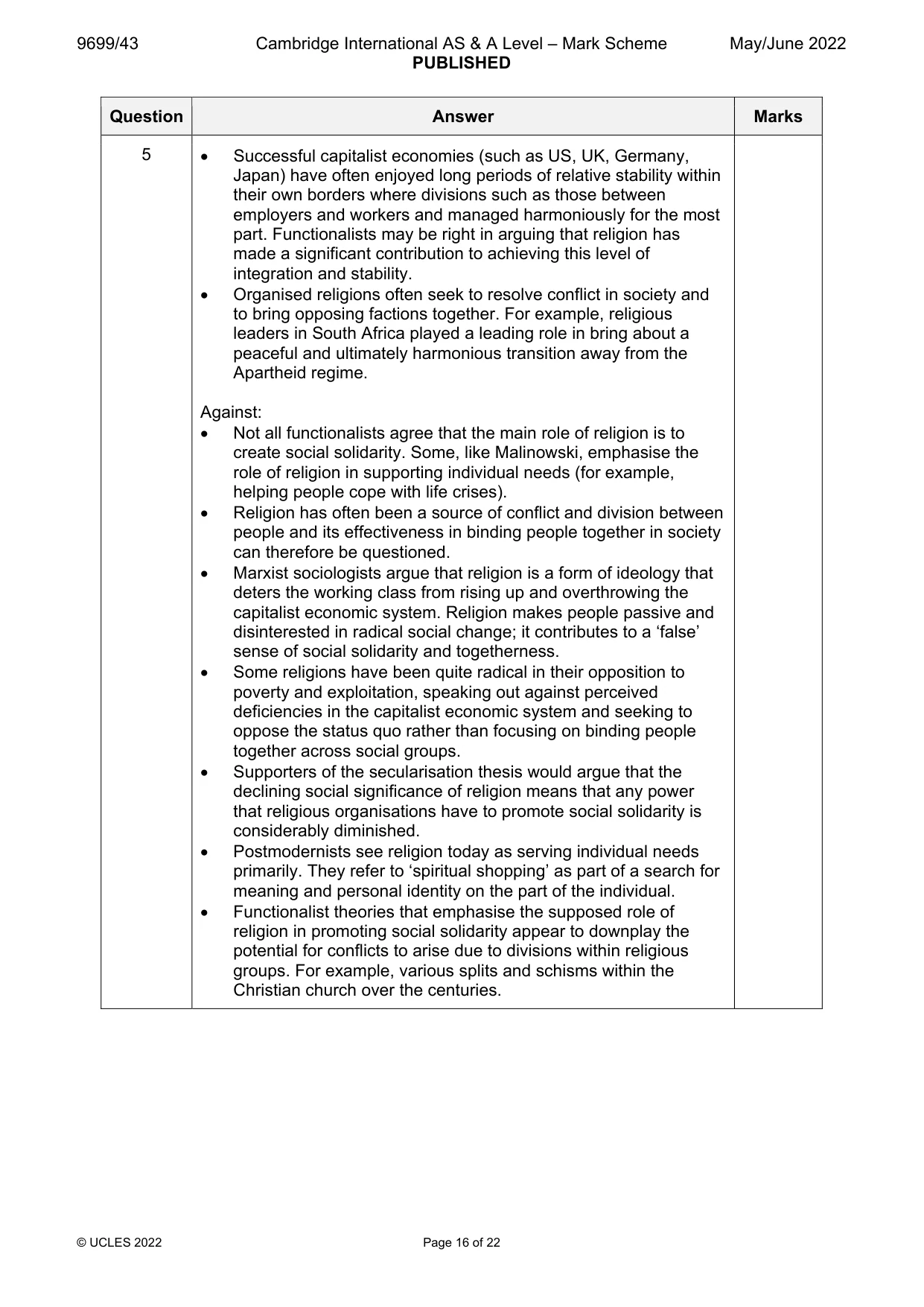
9699/43 Cambridge International AS & A Level – Mark Scheme PUBLISHED May/June 2022 © UCLES 2022 Page 16 of 22 Question Answer Marks 5 Successful capitalist economies (such as US, UK, Germany, Japan) have often enjoyed long periods of relative stability within their own borders where divisions such as those between employers and workers and managed harmoniously for the most part. Functionalists may be right in arguing that religion has made a significant contribution to achieving this level of integration and stability. Organised religions often seek to resolve conflict in society and to bring opposing factions together. For example, religious leaders in South Africa played a leading role in bring about a peaceful and ultimately harmonious transition away from the Apartheid regime. Against: Not all functionalists agree that the main role of religion is to create social solidarity. Some, like Malinowski, emphasise the role of religion in supporting individual needs (for example, helping people cope with life crises). Religion has often been a source of conflict and division between people and its effectiveness in binding people together in society can therefore be questioned. Marxist sociologists argue that religion is a form of ideology that deters the working class from rising up and overthrowing the capitalist economic system. Religion makes people passive and disinterested in radical social change; it contributes to a ‘false’ sense of social solidarity and togetherness. Some religions have been quite radical in their opposition to poverty and exploitation, speaking out against perceived deficiencies in the capitalist economic system and seeking to oppose the status quo rather than focusing on binding people together across social groups. Supporters of the secularisation thesis would argue that the declining social significance of religion means that any power that religious organisations have to promote social solidarity is considerably diminished. Postmodernists see religion today as serving individual needs primarily. They refer to ‘spiritual shopping’ as part of a search for meaning and personal identity on the part of the individual. Functionalist theories that emphasise the supposed role of religion in promoting social solidarity appear to downplay the potential for conflicts to arise due to divisions within religious groups. For example, various splits and schisms within the Christian church over the centuries.
Mark scheme, page 17
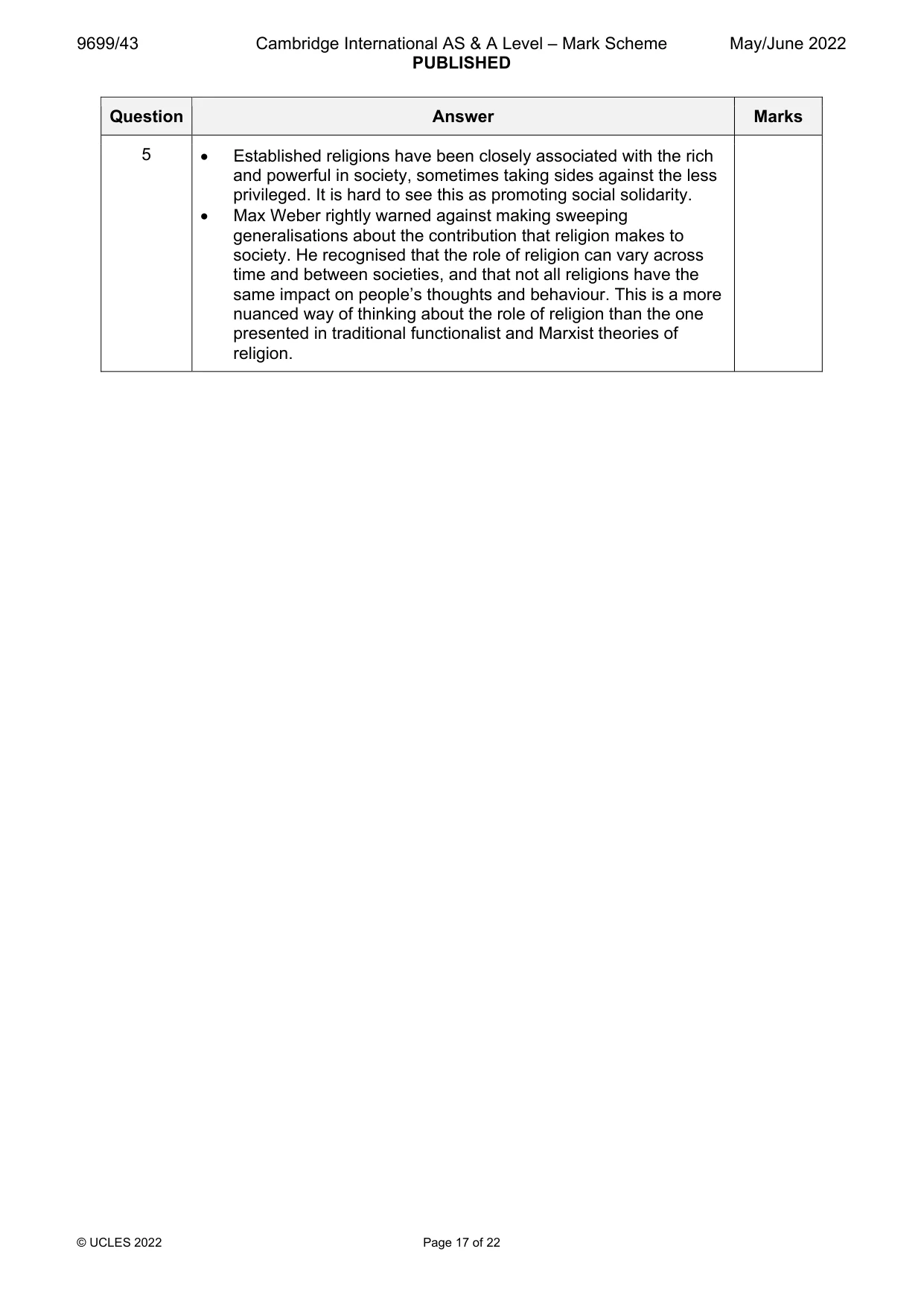
9699/43 Cambridge International AS & A Level – Mark Scheme PUBLISHED May/June 2022 © UCLES 2022 Page 17 of 22 Question Answer Marks 5 Established religions have been closely associated with the rich and powerful in society, sometimes taking sides against the less privileged. It is hard to see this as promoting social solidarity. Max Weber rightly warned against making sweeping generalisations about the contribution that religion makes to society. He recognised that the role of religion can vary across time and between societies, and that not all religions have the same impact on people’s thoughts and behaviour. This is a more nuanced way of thinking about the role of religion than the one presented in traditional functionalist and Marxist theories of religion.
Mark scheme, page 18
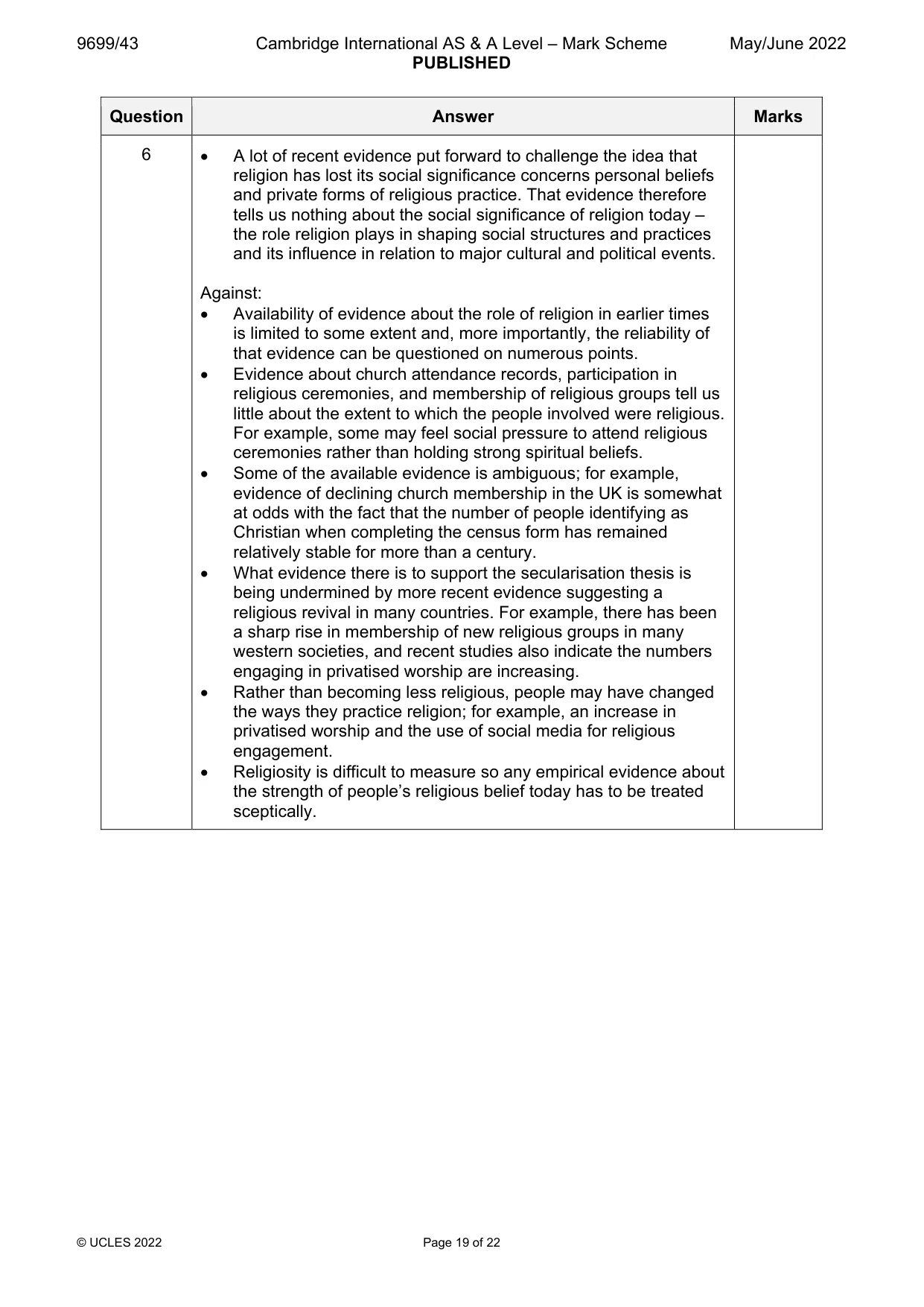
9699/43 Cambridge International AS & A Level – Mark Scheme PUBLISHED May/June 2022 © UCLES 2022 Page 18 of 22 Question Answer Marks 6 ‘There is clear evidence that religion has lost its social significance.’ Evaluate this view. Key focus of the question The idea that religion has lost its social significance invites discussion of the secularisation thesis. Good answers will pay particular attention to the idea that there is clear evidence that religion has lost its social significance. Evidence used to support the secularisation thesis includes church attendance records, statistics about levels of participation in religious ceremonies, attitude surveys to measure religiosity, and historical records that shed light on the role of religious organisations in the community in former times. The empirical support for the secularisation thesis can be scrutinised both in terms of its reliability and methodological soundness and, more broadly, in relation to whether the evidence presented in itself is sufficient to make a plausible case for claiming that secularisation has occurred. Good answers might include a discussion of different ways of defining secularisation and how this may affect conclusions drawn about whether the secularisation thesis has been proven empirically. Similarly, candidates might note that more recent evidence about religious belief and practice is, arguably, less supportive of the idea that religion has lost its social significance than the evidence presented in the 1960s and 1970s when sociologists first advanced the thesis. Indicative content For: Sociological research supporting the secularisation thesis collected large amounts of data from many different sources and from a range of countries. Follow up studies also developed new ways of measuring the claims about secularisation and came up with findings that many sociologists found convincing as further supporting evidence for the secularisation thesis. Some evidence about the role of religion in the past is almost unquestionably reliable; for example, evidence about the role of the church in civic ceremonies and in organising community activities such as providing welfare support and running schools. It is clear that the role of religion in these areas has declined in many societies. Some supporters of the secularisation thesis argue that the debate centres on whether religion has lost its relevance at the social, cultural and political levels; not whether at the personal level people have become less (or more) religious, which is known as religiosity. Whilst evidence about changes in religiosity may be highly subjective, that doesn’t detract from the secularisation thesis if it is accepted that secularisation refers to changes in the social significance of religion rather than changes in people’s personal beliefs. 35
Mark scheme, page 19
9699/43 Cambridge International AS & A Level – Mark Scheme PUBLISHED May/June 2022 © UCLES 2022 Page 19 of 22 Question Answer Marks 6 A lot of recent evidence put forward to challenge the idea that religion has lost its social significance concerns personal beliefs and private forms of religious practice. That evidence therefore tells us nothing about the social significance of religion today – the role religion plays in shaping social structures and practices and its influence in relation to major cultural and political events. Against: Availability of evidence about the role of religion in earlier times is limited to some extent and, more importantly, the reliability of that evidence can be questioned on numerous points. Evidence about church attendance records, participation in religious ceremonies, and membership of religious groups tell us little about the extent to which the people involved were religious. For example, some may feel social pressure to attend religious ceremonies rather than holding strong spiritual beliefs. Some of the available evidence is ambiguous; for example, evidence of declining church membership in the UK is somewhat at odds with the fact that the number of people identifying as Christian when completing the census form has remained relatively stable for more than a century. What evidence there is to support the secularisation thesis is being undermined by more recent evidence suggesting a religious revival in many countries. For example, there has been a sharp rise in membership of new religious groups in many western societies, and recent studies also indicate the numbers engaging in privatised worship are increasing. Rather than becoming less religious, people may have changed the ways they practice religion; for example, an increase in privatised worship and the use of social media for religious engagement. Religiosity is difficult to measure so any empirical evidence about the strength of people’s religious belief today has to be treated sceptically.
Mark scheme, page 20
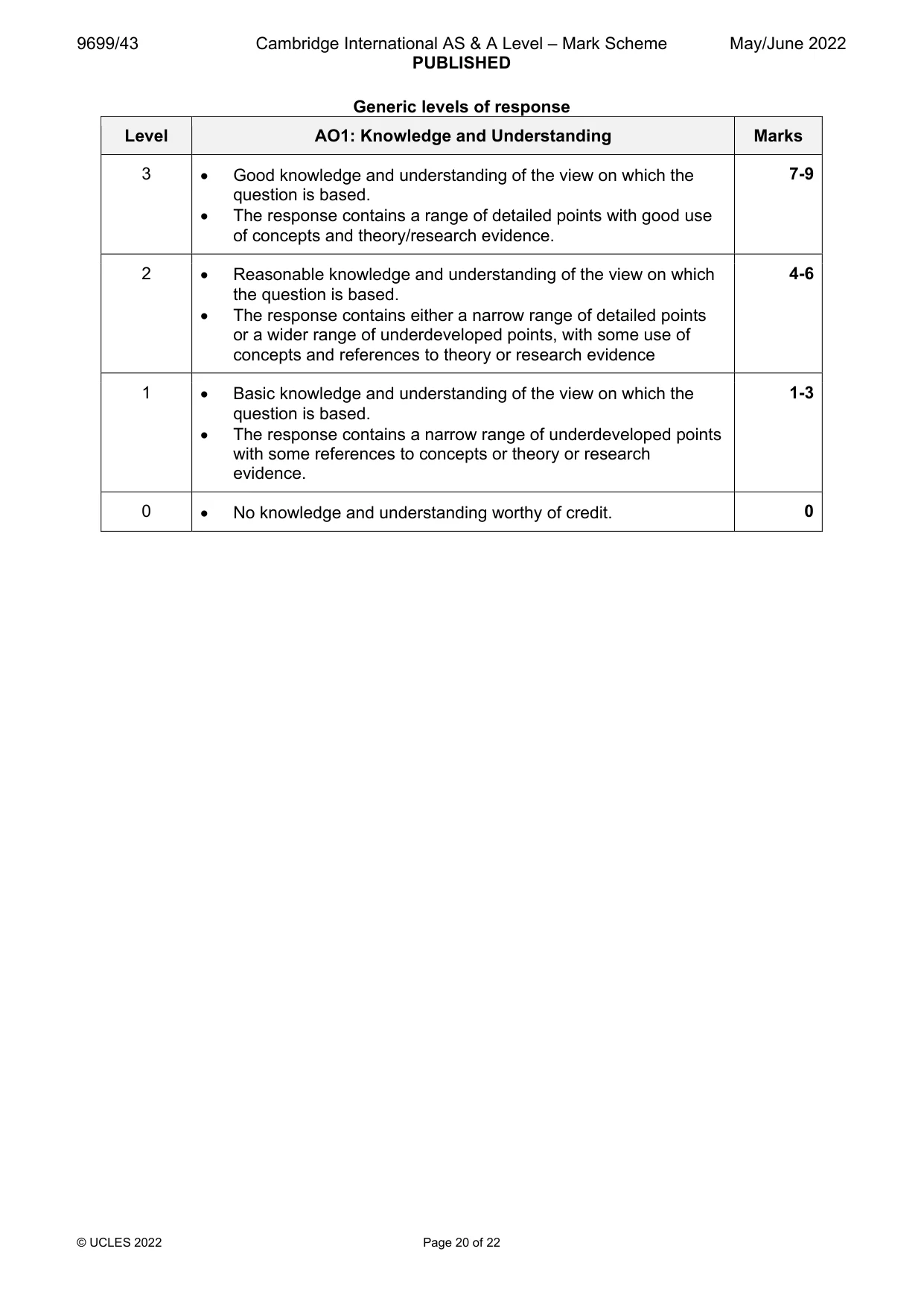
9699/43 Cambridge International AS & A Level – Mark Scheme PUBLISHED May/June 2022 © UCLES 2022 Page 20 of 22 Generic levels of response Level AO1: Knowledge and Understanding Marks 3 Good knowledge and understanding of the view on which the question is based. The response contains a range of detailed points with good use of concepts and theory/research evidence. 7-9 2 Reasonable knowledge and understanding of the view on which the question is based. The response contains either a narrow range of detailed points or a wider range of underdeveloped points, with some use of concepts and references to theory or research evidence 4-6 1 Basic knowledge and understanding of the view on which the question is based. The response contains a narrow range of underdeveloped points with some references to concepts or theory or research evidence. 1-3 0 No knowledge and understanding worthy of credit. 0
Mark scheme, page 21
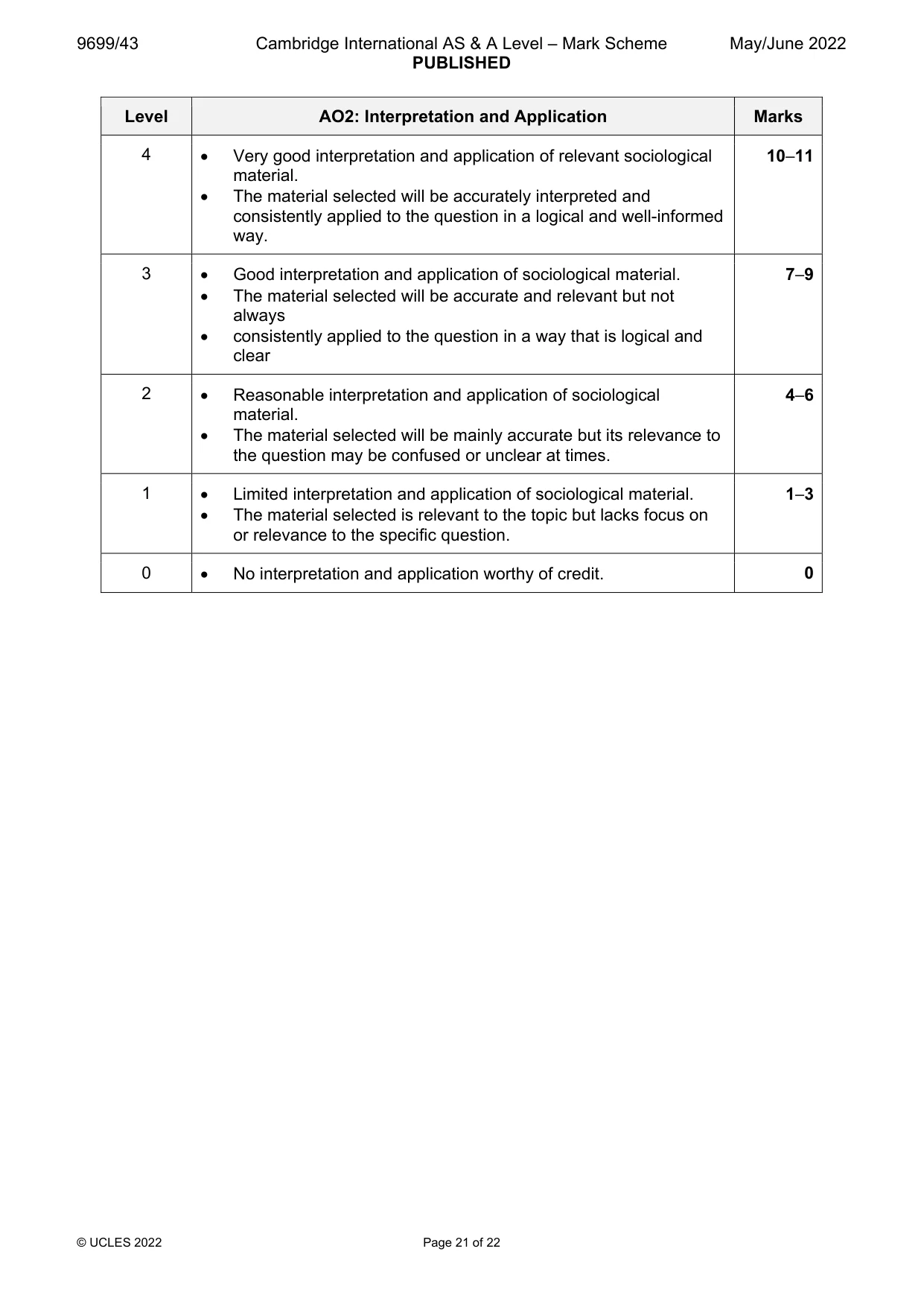
9699/43 Cambridge International AS & A Level – Mark Scheme PUBLISHED May/June 2022 © UCLES 2022 Page 21 of 22 Level AO2: Interpretation and Application Marks 4 Very good interpretation and application of relevant sociological material. The material selected will be accurately interpreted and consistently applied to the question in a logical and well-informed way. 1011 3 Good interpretation and application of sociological material. The material selected will be accurate and relevant but not always consistently applied to the question in a way that is logical and clear 79 2 Reasonable interpretation and application of sociological material. The material selected will be mainly accurate but its relevance to the question may be confused or unclear at times. 46 1 Limited interpretation and application of sociological material. The material selected is relevant to the topic but lacks focus on or relevance to the specific question. 13 0 No interpretation and application worthy of credit. 0
Mark scheme, page 22
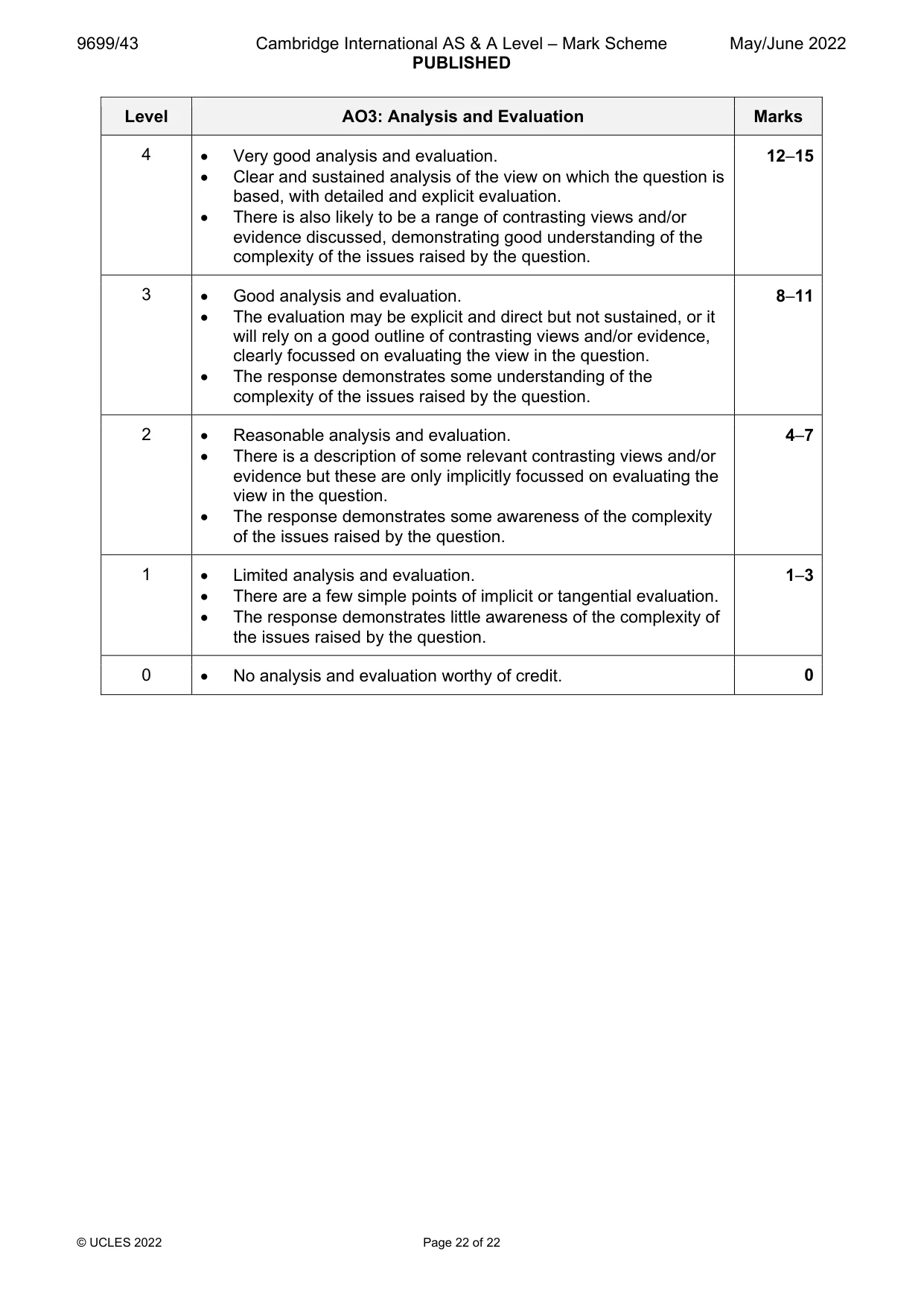
9699/43 Cambridge International AS & A Level – Mark Scheme PUBLISHED May/June 2022 © UCLES 2022 Page 22 of 22 Level AO3: Analysis and Evaluation Marks 4 Very good analysis and evaluation. Clear and sustained analysis of the view on which the question is based, with detailed and explicit evaluation. There is also likely to be a range of contrasting views and/or evidence discussed, demonstrating good understanding of the complexity of the issues raised by the question. 1215 3 Good analysis and evaluation. The evaluation may be explicit and direct but not sustained, or it will rely on a good outline of contrasting views and/or evidence, clearly focussed on evaluating the view in the question. The response demonstrates some understanding of the complexity of the issues raised by the question. 811 2 Reasonable analysis and evaluation. There is a description of some relevant contrasting views and/or evidence but these are only implicitly focussed on evaluating the view in the question. The response demonstrates some awareness of the complexity of the issues raised by the question. 47 1 Limited analysis and evaluation. There are a few simple points of implicit or tangential evaluation. The response demonstrates little awareness of the complexity of the issues raised by the question. 13 0 No analysis and evaluation worthy of credit. 0
What you needed in this session
Cambridge’s own grade thresholds for 2022 May/June, Paper 4 · Variant 3. A higher threshold means an easier paper — the bar moves with how the cohort did.