Cambridge A Level Sociology 9699 — 2021 May/June Paper 3 · Variant 4
9699/34/M/J/21 · 75 marks · ≈84 min
The question paper and its mark scheme, free to read here and free to download. This is Cambridge’s own paper, exactly as it was sat.
Question paper4 pages

Mark scheme17 pages
Answers below. Sit the paper first if you are practising.
Paper as text
Question paper, page 1
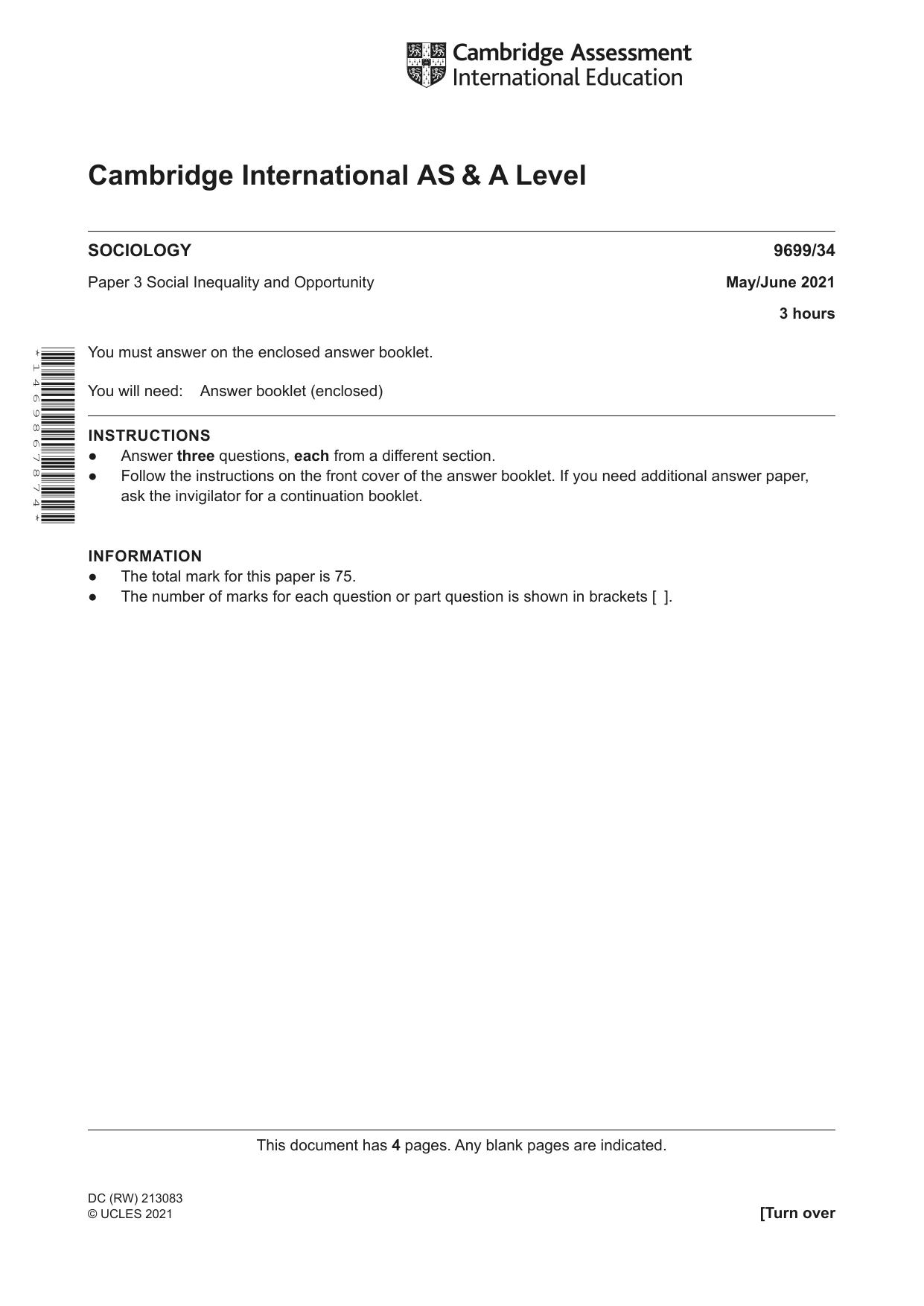
This document has 4 pages. Any blank pages are indicated. DC (RW) 213083 © UCLES 2021 [Turn over * 1 4 6 9 8 6 7 8 7 4 * Cambridge International AS & A Level SOCIOLOGY 9699/34 Paper 3 Social Inequality and Opportunity May/June 2021 3 hours You must answer on the enclosed answer booklet. You will need: Answer booklet (enclosed) INSTRUCTIONS ● Answer three questions, each from a different section. ● Follow the instructions on the front cover of the answer booklet. If you need additional answer paper, ask the invigilator for a continuation booklet. INFORMATION ● The total mark for this paper is 75. ● The number of marks for each question or part question is shown in brackets [ ].
Question paper, page 2
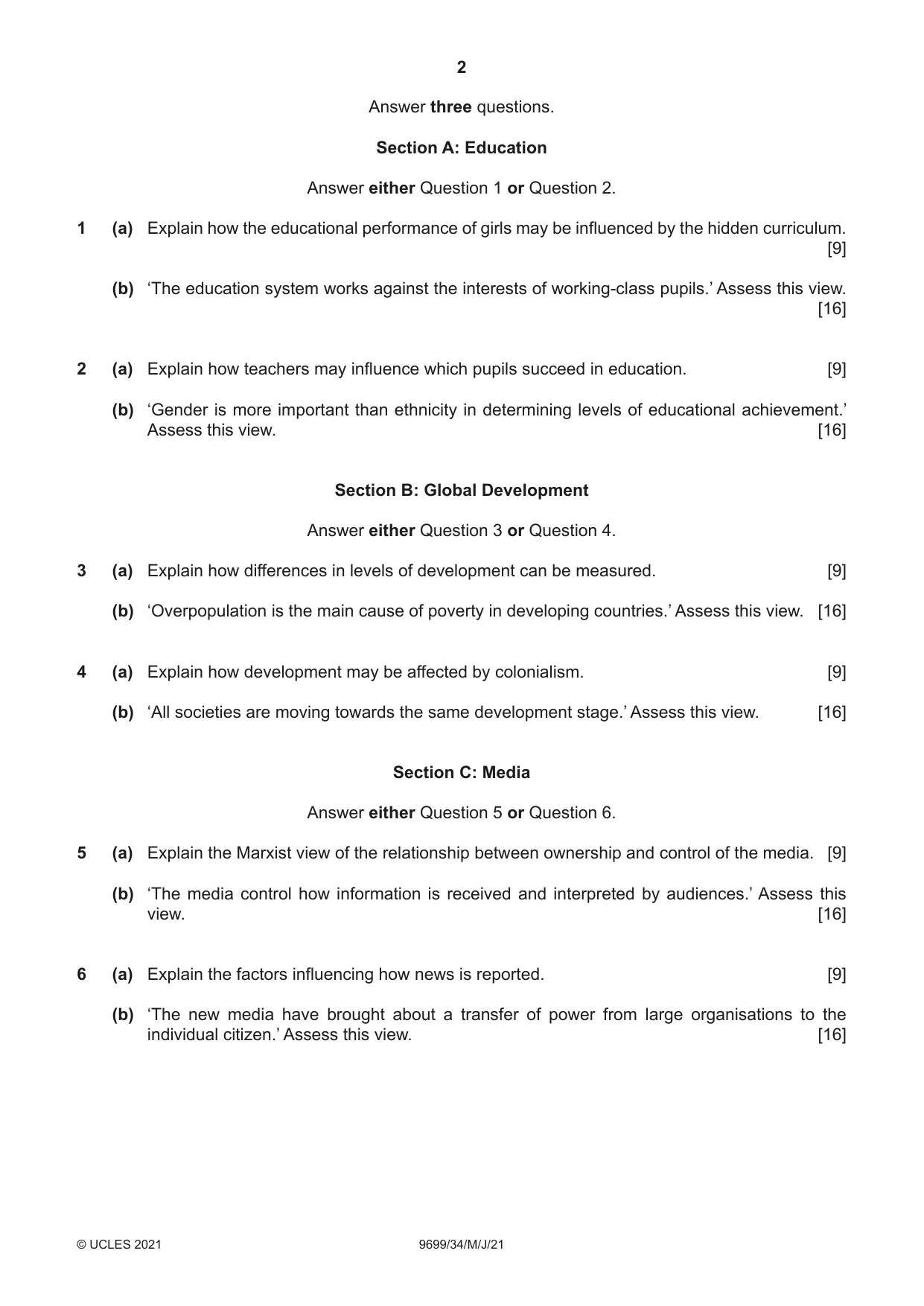
2 9699/34/M/J/21 © UCLES 2021 Answer three questions. Section A: Education Answer either Question 1 or Question 2. 1 (a) Explain how the educational performance of girls may be influenced by the hidden curriculum. [9] (b) ‘The education system works against the interests of working‑class pupils.’ Assess this view. [16] 2 (a) Explain how teachers may influence which pupils succeed in education. [9] (b) ‘Gender is more important than ethnicity in determining levels of educational achievement.’ Assess this view. [16] Section B: Global Development Answer either Question 3 or Question 4. 3 (a) Explain how differences in levels of development can be measured. [9] (b) ‘Overpopulation is the main cause of poverty in developing countries.’ Assess this view. [16] 4 (a) Explain how development may be affected by colonialism. [9] (b) ‘All societies are moving towards the same development stage.’ Assess this view. [16] Section C: Media Answer either Question 5 or Question 6. 5 (a) Explain the Marxist view of the relationship between ownership and control of the media. [9] (b) ‘The media control how information is received and interpreted by audiences.’ Assess this view. [16] 6 (a) Explain the factors influencing how news is reported. [9] (b) ‘The new media have brought about a transfer of power from large organisations to the individual citizen.’ Assess this view. [16]
Question paper, page 3
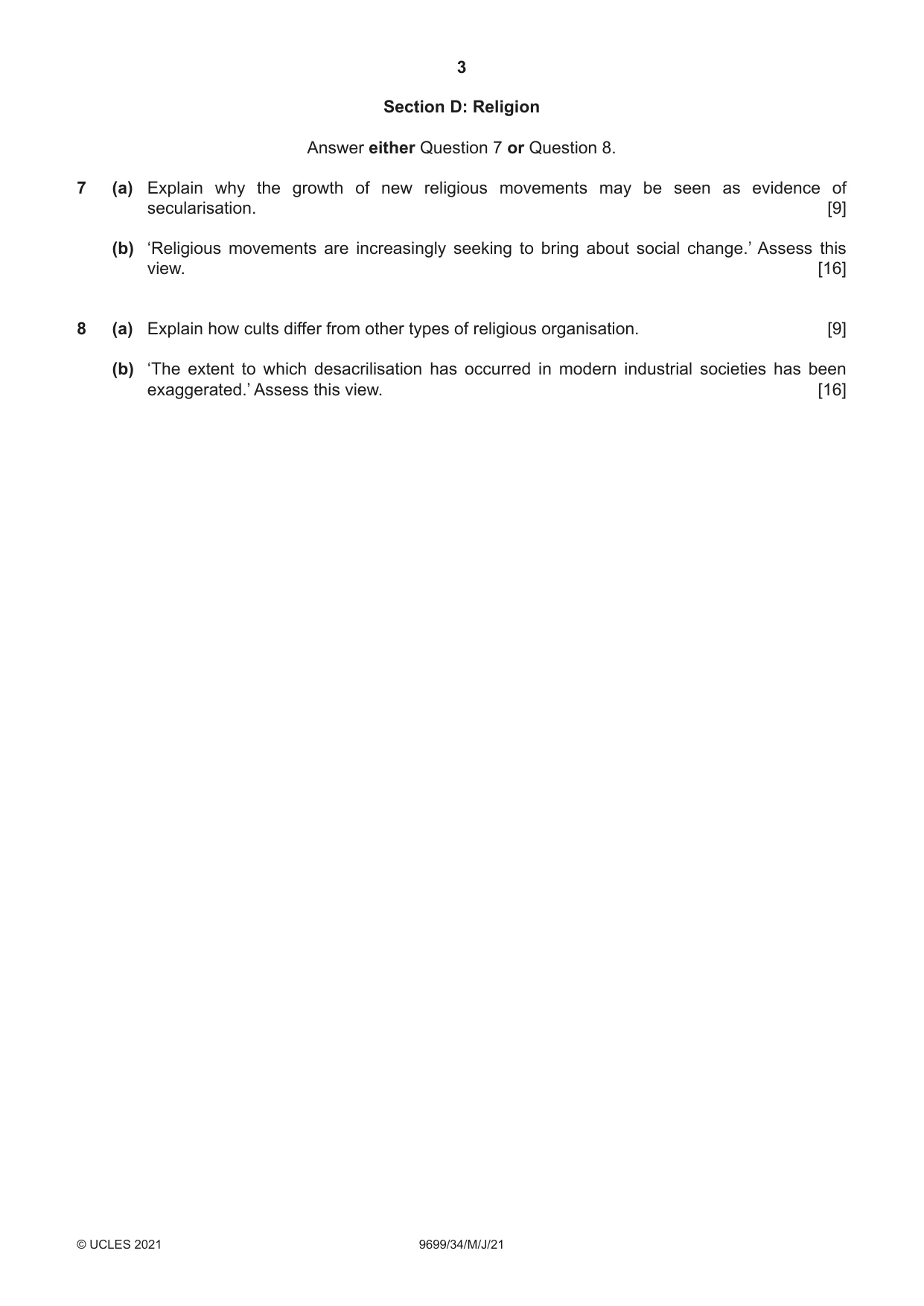
3 9699/34/M/J/21 © UCLES 2021 Section D: Religion Answer either Question 7 or Question 8. 7 (a) Explain why the growth of new religious movements may be seen as evidence of secularisation. [9] (b) ‘Religious movements are increasingly seeking to bring about social change.’ Assess this view. [16] 8 (a) Explain how cults differ from other types of religious organisation. [9] (b) ‘The extent to which desacrilisation has occurred in modern industrial societies has been exaggerated.’ Assess this view. [16]
Question paper, page 4
4 9699/34/M/J/21 © UCLES 2021 Permission to reproduce items where third‑party owned material protected by copyright is included has been sought and cleared where possible. Every reasonable effort has been made by the publisher (UCLES) to trace copyright holders, but if any items requiring clearance have unwittingly been included, the publisher will be pleased to make amends at the earliest possible opportunity. To avoid the issue of disclosure of answer‑related information to candidates, all copyright acknowledgements are reproduced online in the Cambridge Assessment International Education Copyright Acknowledgements Booklet. This is produced for each series of examinations and is freely available to download at www.cambridgeinternational.org after the live examination series. Cambridge Assessment International Education is part of the Cambridge Assessment Group. Cambridge Assessment is the brand name of the University of Cambridge Local Examinations Syndicate (UCLES), which itself is a department of the University of Cambridge. BLANK PAGE
Mark scheme, page 1
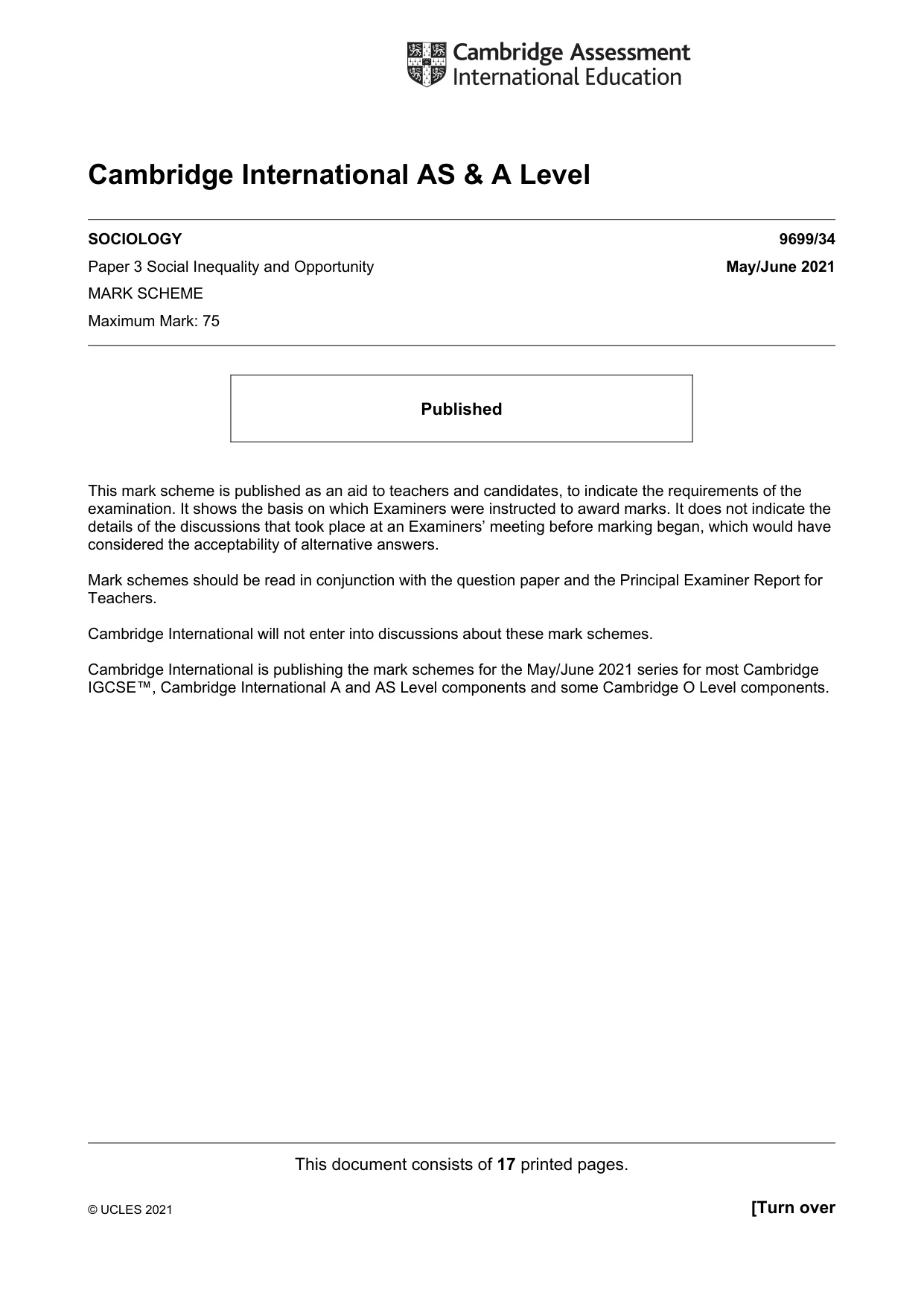
This document consists of 17 printed pages. © UCLES 2021 [Turn over Cambridge International AS & A Level SOCIOLOGY 9699/34 Paper 3 Social Inequality and Opportunity May/June 2021 MARK SCHEME Maximum Mark: 75 Published This mark scheme is published as an aid to teachers and candidates, to indicate the requirements of the examination. It shows the basis on which Examiners were instructed to award marks. It does not indicate the details of the discussions that took place at an Examiners’ meeting before marking began, which would have considered the acceptability of alternative answers. Mark schemes should be read in conjunction with the question paper and the Principal Examiner Report for Teachers. Cambridge International will not enter into discussions about these mark schemes. Cambridge International is publishing the mark schemes for the May/June 2021 series for most Cambridge IGCSE™, Cambridge International A and AS Level components and some Cambridge O Level components.
Mark scheme, page 2
9699/34 Cambridge International AS & A Level – Mark Scheme PUBLISHED May/June 2021 © UCLES 2021 Page 2 of 17 Generic Marking Principles These general marking principles must be applied by all examiners when marking candidate answers. They should be applied alongside the specific content of the mark scheme or generic level descriptors for a question. Each question paper and mark scheme will also comply with these marking principles. GENERIC MARKING PRINCIPLE 1: Marks must be awarded in line with: • the specific content of the mark scheme or the generic level descriptors for the question • the specific skills defined in the mark scheme or in the generic level descriptors for the question • the standard of response required by a candidate as exemplified by the standardisation scripts. GENERIC MARKING PRINCIPLE 2: Marks awarded are always whole marks (not half marks, or other fractions). GENERIC MARKING PRINCIPLE 3: Marks must be awarded positively: • marks are awarded for correct/valid answers, as defined in the mark scheme. However, credit is given for valid answers which go beyond the scope of the syllabus and mark scheme, referring to your Team Leader as appropriate • marks are awarded when candidates clearly demonstrate what they know and can do • marks are not deducted for errors • marks are not deducted for omissions • answers should only be judged on the quality of spelling, punctuation and grammar when these features are specifically assessed by the question as indicated by the mark scheme. The meaning, however, should be unambiguous. GENERIC MARKING PRINCIPLE 4: Rules must be applied consistently, e.g. in situations where candidates have not followed instructions or in the application of generic level descriptors. GENERIC MARKING PRINCIPLE 5: Marks should be awarded using the full range of marks defined in the mark scheme for the question (however; the use of the full mark range may be limited according to the quality of the candidate responses seen). GENERIC MARKING PRINCIPLE 6: Marks awarded are based solely on the requirements as defined in the mark scheme. Marks should not be awarded with grade thresholds or grade descriptors in mind.
Mark scheme, page 3
9699/34 Cambridge International AS & A Level – Mark Scheme PUBLISHED May/June 2021 © UCLES 2021 Page 3 of 17 Social Science-Specific Marking Principles (for point-based marking) 1 Components using point-based marking: • Point marking is often used to reward knowledge, understanding and application of skills. We give credit where the candidate’s answer shows relevant knowledge, understanding and application of skills in answering the question. We do not give credit where the answer shows confusion. From this it follows that we: a DO credit answers which are worded differently from the mark scheme if they clearly convey the same meaning (unless the mark scheme requires a specific term) b DO credit alternative answers/examples which are not written in the mark scheme if they are correct c DO credit answers where candidates give more than one correct answer in one prompt/numbered/scaffolded space where extended writing is required rather than list-type answers. For example, questions that require n reasons (e.g. State two reasons …). d DO NOT credit answers simply for using a ‘key term’ unless that is all that is required. (Check for evidence it is understood and not used wrongly.) e DO NOT credit answers which are obviously self-contradicting or trying to cover all possibilities f DO NOT give further credit for what is effectively repetition of a correct point already credited unless the language itself is being tested. This applies equally to ‘mirror statements’ (i.e. polluted/not polluted). g DO NOT require spellings to be correct, unless this is part of the test. However spellings of syllabus terms must allow for clear and unambiguous separation from other syllabus terms with which they may be confused (e.g. Corrasion/Corrosion) 2 Presentation of mark scheme: • Slashes (/) or the word ‘or’ separate alternative ways of making the same point. • Semi colons (;) bullet points (•) or figures in brackets (1) separate different points. • Content in the answer column in brackets is for examiner information/context to clarify the marking but is not required to earn the mark (except Accounting syllabuses where they indicate negative numbers). 3 Calculation questions: • The mark scheme will show the steps in the most likely correct method(s), the mark for each step, the correct answer(s) and the mark for each answer • If working/explanation is considered essential for full credit, this will be indicated in the question paper and in the mark scheme. In all other instances, the correct answer to a calculation should be given full credit, even if no supporting working is shown. • Where the candidate uses a valid method which is not covered by the mark scheme, award equivalent marks for reaching equivalent stages. • Where an answer makes use of a candidate’s own incorrect figure from previous working, the ‘own figure rule’ applies: full marks will be given if a correct and complete method is used. Further guidance will be included in the mark scheme where necessary and any exceptions to this general principle will be noted.
Mark scheme, page 4
9699/34 Cambridge International AS & A Level – Mark Scheme PUBLISHED May/June 2021 © UCLES 2021 Page 4 of 17 4 Annotation: • For point marking, ticks can be used to indicate correct answers and crosses can be used to indicate wrong answers. There is no direct relationship between ticks and marks. Ticks have no defined meaning for levels of response marking. • For levels of response marking, the level awarded should be annotated on the script. • Other annotations will be used by examiners as agreed during standardisation, and the meaning will be understood by all examiners who marked that paper.
Mark scheme, page 5
9699/34 Cambridge International AS & A Level – Mark Scheme PUBLISHED May/June 2021 © UCLES 2021 Page 5 of 17 Question Answer Marks 1(a) Explain how the educational performance of girls may be influenced by the hidden curriculum. 0–4 marks At this level, there may be little or no reference to relevant sociological sources. Answers may rely on general knowledge and/or personal observation. Explanations will be brief and cover only a narrow range of relevant points. An attempt to define what is meant by the hidden curriculum, with no further development, would be worth up to two marks. One or two simple points about how the educational performance of girls may be influenced by the hidden curriculum would fit the upper part of the band. 5–9 marks At this level, there will be some use of relevant sociological sources, such as concepts, theories and explanations. Answers will cover a range of points and show a sound understanding of the issues raised by the question. A basic account of two or three ways in which the educational performance of girls may be influenced by the hidden curriculum would be worth up to 7 marks. To go higher, the account would have to be more detailed and/or cover a wider range of points. Good answers may distinguish between the different types of messages that are communicated through the hidden curriculum; for example, socialisation messages and status messages. High scoring responses might also feature references to labelling and the notion of self-fulfilling prophecies. To reach the higher part of the band, it is important that the answer includes well-chosen illustrations of how the hidden curriculum may affect the educational performance of girls specifically. 9
Mark scheme, page 6
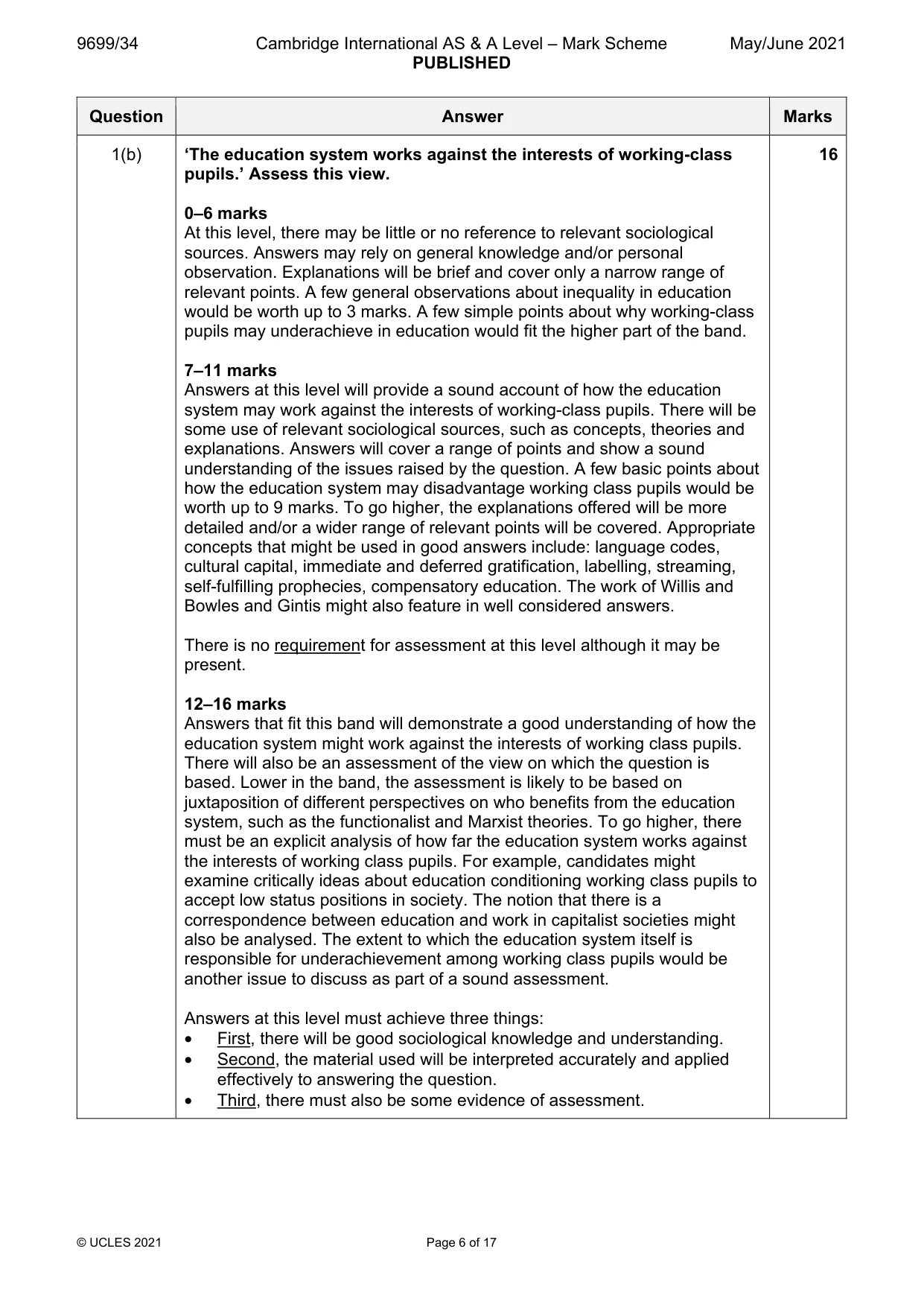
9699/34 Cambridge International AS & A Level – Mark Scheme PUBLISHED May/June 2021 © UCLES 2021 Page 6 of 17 Question Answer Marks 1(b) ‘The education system works against the interests of working-class pupils.’ Assess this view. 0–6 marks At this level, there may be little or no reference to relevant sociological sources. Answers may rely on general knowledge and/or personal observation. Explanations will be brief and cover only a narrow range of relevant points. A few general observations about inequality in education would be worth up to 3 marks. A few simple points about why working-class pupils may underachieve in education would fit the higher part of the band. 7–11 marks Answers at this level will provide a sound account of how the education system may work against the interests of working-class pupils. There will be some use of relevant sociological sources, such as concepts, theories and explanations. Answers will cover a range of points and show a sound understanding of the issues raised by the question. A few basic points about how the education system may disadvantage working class pupils would be worth up to 9 marks. To go higher, the explanations offered will be more detailed and/or a wider range of relevant points will be covered. Appropriate concepts that might be used in good answers include: language codes, cultural capital, immediate and deferred gratification, labelling, streaming, self-fulfilling prophecies, compensatory education. The work of Willis and Bowles and Gintis might also feature in well considered answers. There is no requirement for assessment at this level although it may be present. 12–16 marks Answers that fit this band will demonstrate a good understanding of how the education system might work against the interests of working class pupils. There will also be an assessment of the view on which the question is based. Lower in the band, the assessment is likely to be based on juxtaposition of different perspectives on who benefits from the education system, such as the functionalist and Marxist theories. To go higher, there must be an explicit analysis of how far the education system works against the interests of working class pupils. For example, candidates might examine critically ideas about education conditioning working class pupils to accept low status positions in society. The notion that there is a correspondence between education and work in capitalist societies might also be analysed. The extent to which the education system itself is responsible for underachievement among working class pupils would be another issue to discuss as part of a sound assessment. Answers at this level must achieve three things: • First, there will be good sociological knowledge and understanding. • Second, the material used will be interpreted accurately and applied effectively to answering the question. • Third, there must also be some evidence of assessment. 16
Mark scheme, page 7
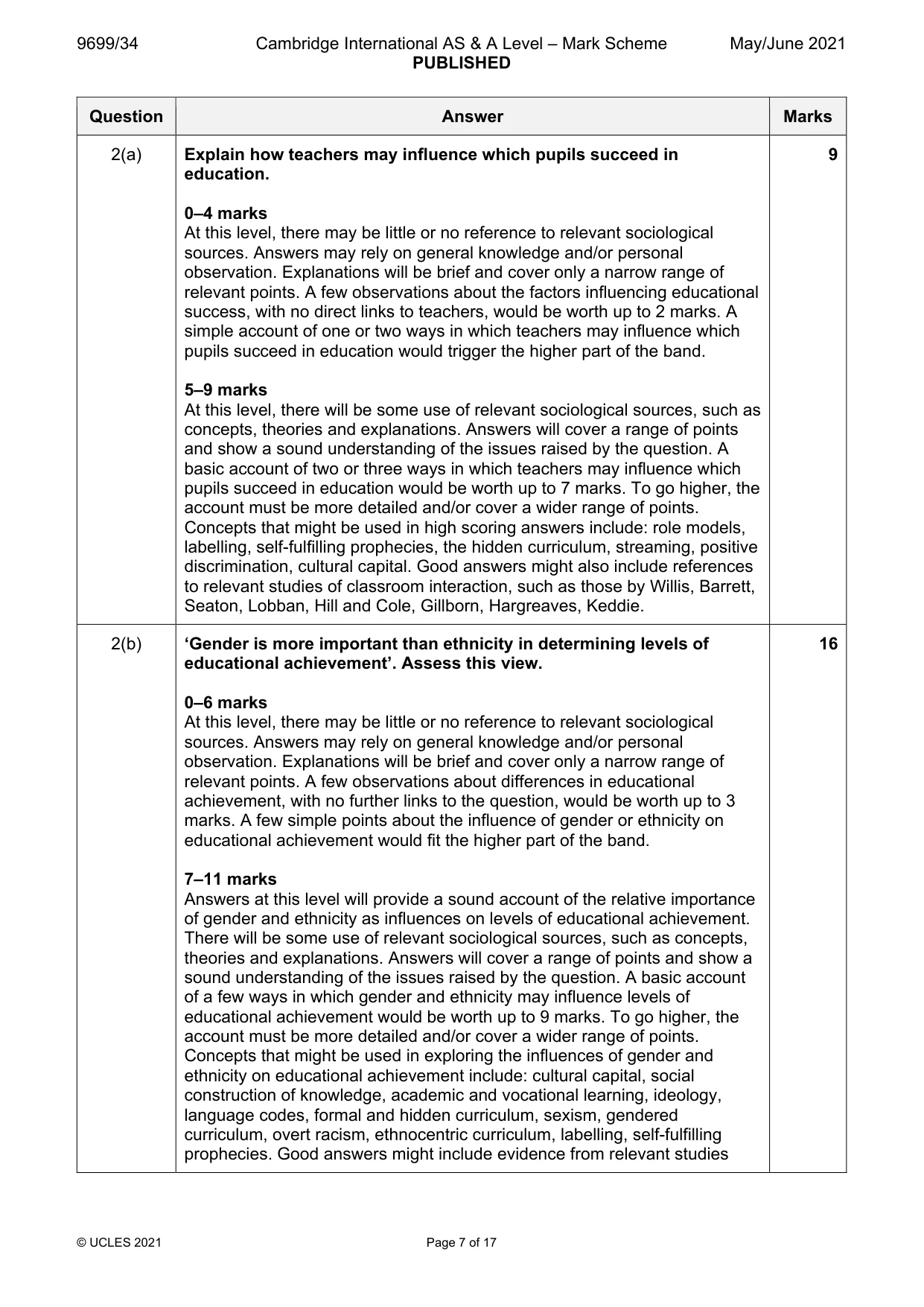
9699/34 Cambridge International AS & A Level – Mark Scheme PUBLISHED May/June 2021 © UCLES 2021 Page 7 of 17 Question Answer Marks 2(a) Explain how teachers may influence which pupils succeed in education. 0–4 marks At this level, there may be little or no reference to relevant sociological sources. Answers may rely on general knowledge and/or personal observation. Explanations will be brief and cover only a narrow range of relevant points. A few observations about the factors influencing educational success, with no direct links to teachers, would be worth up to 2 marks. A simple account of one or two ways in which teachers may influence which pupils succeed in education would trigger the higher part of the band. 5–9 marks At this level, there will be some use of relevant sociological sources, such as concepts, theories and explanations. Answers will cover a range of points and show a sound understanding of the issues raised by the question. A basic account of two or three ways in which teachers may influence which pupils succeed in education would be worth up to 7 marks. To go higher, the account must be more detailed and/or cover a wider range of points. Concepts that might be used in high scoring answers include: role models, labelling, self-fulfilling prophecies, the hidden curriculum, streaming, positive discrimination, cultural capital. Good answers might also include references to relevant studies of classroom interaction, such as those by Willis, Barrett, Seaton, Lobban, Hill and Cole, Gillborn, Hargreaves, Keddie. 9 2(b) ‘Gender is more important than ethnicity in determining levels of educational achievement’. Assess this view. 0–6 marks At this level, there may be little or no reference to relevant sociological sources. Answers may rely on general knowledge and/or personal observation. Explanations will be brief and cover only a narrow range of relevant points. A few observations about differences in educational achievement, with no further links to the question, would be worth up to 3 marks. A few simple points about the influence of gender or ethnicity on educational achievement would fit the higher part of the band. 7–11 marks Answers at this level will provide a sound account of the relative importance of gender and ethnicity as influences on levels of educational achievement. There will be some use of relevant sociological sources, such as concepts, theories and explanations. Answers will cover a range of points and show a sound understanding of the issues raised by the question. A basic account of a few ways in which gender and ethnicity may influence levels of educational achievement would be worth up to 9 marks. To go higher, the account must be more detailed and/or cover a wider range of points. Concepts that might be used in exploring the influences of gender and ethnicity on educational achievement include: cultural capital, social construction of knowledge, academic and vocational learning, ideology, language codes, formal and hidden curriculum, sexism, gendered curriculum, overt racism, ethnocentric curriculum, labelling, self-fulfilling prophecies. Good answers might include evidence from relevant studies 16
Mark scheme, page 8
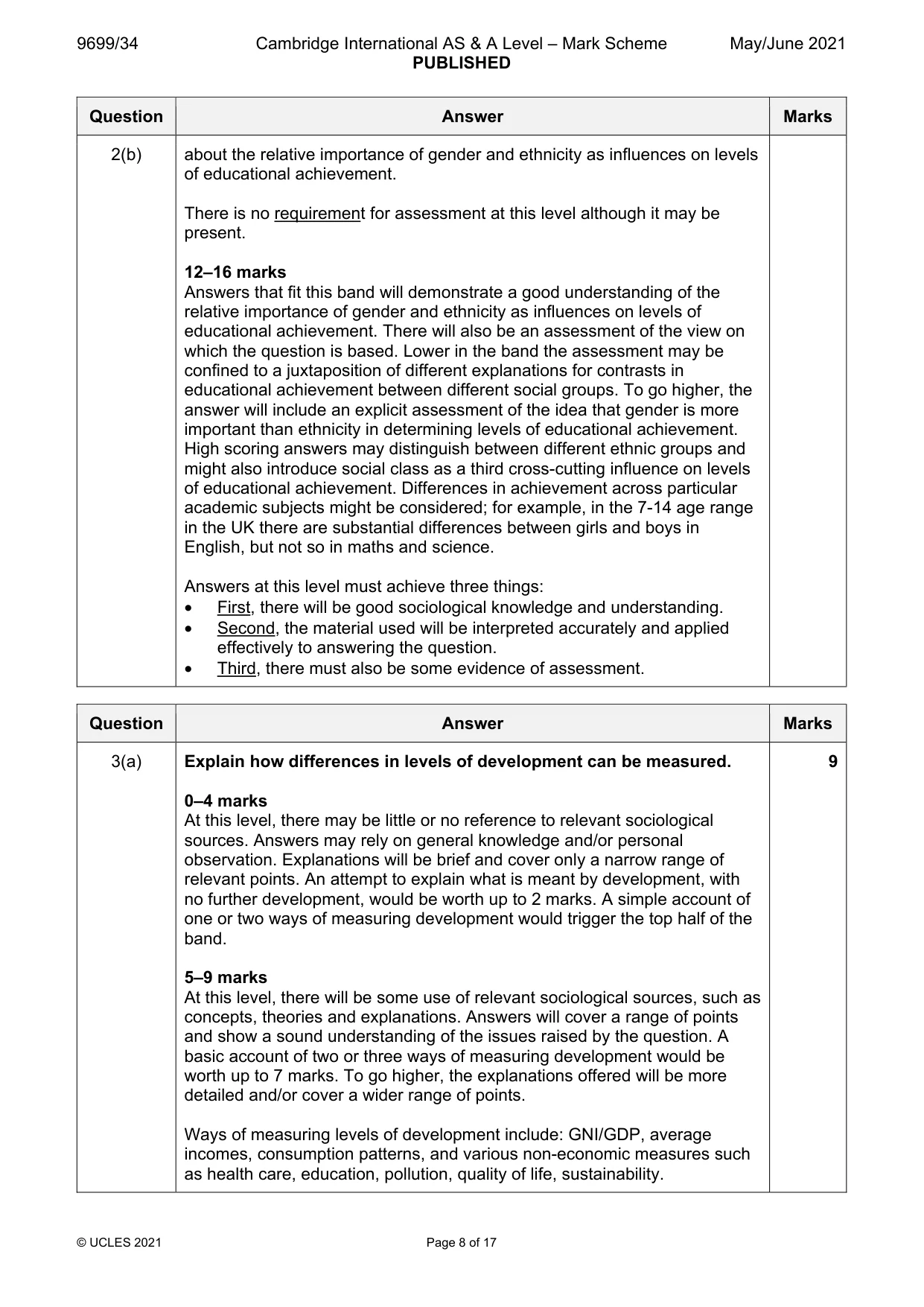
9699/34 Cambridge International AS & A Level – Mark Scheme PUBLISHED May/June 2021 © UCLES 2021 Page 8 of 17 Question Answer Marks 2(b) about the relative importance of gender and ethnicity as influences on levels of educational achievement. There is no requirement for assessment at this level although it may be present. 12–16 marks Answers that fit this band will demonstrate a good understanding of the relative importance of gender and ethnicity as influences on levels of educational achievement. There will also be an assessment of the view on which the question is based. Lower in the band the assessment may be confined to a juxtaposition of different explanations for contrasts in educational achievement between different social groups. To go higher, the answer will include an explicit assessment of the idea that gender is more important than ethnicity in determining levels of educational achievement. High scoring answers may distinguish between different ethnic groups and might also introduce social class as a third cross-cutting influence on levels of educational achievement. Differences in achievement across particular academic subjects might be considered; for example, in the 7-14 age range in the UK there are substantial differences between girls and boys in English, but not so in maths and science. Answers at this level must achieve three things: • First, there will be good sociological knowledge and understanding. • Second, the material used will be interpreted accurately and applied effectively to answering the question. • Third, there must also be some evidence of assessment. Question Answer Marks 3(a) Explain how differences in levels of development can be measured. 0–4 marks At this level, there may be little or no reference to relevant sociological sources. Answers may rely on general knowledge and/or personal observation. Explanations will be brief and cover only a narrow range of relevant points. An attempt to explain what is meant by development, with no further development, would be worth up to 2 marks. A simple account of one or two ways of measuring development would trigger the top half of the band. 5–9 marks At this level, there will be some use of relevant sociological sources, such as concepts, theories and explanations. Answers will cover a range of points and show a sound understanding of the issues raised by the question. A basic account of two or three ways of measuring development would be worth up to 7 marks. To go higher, the explanations offered will be more detailed and/or cover a wider range of points. Ways of measuring levels of development include: GNI/GDP, average incomes, consumption patterns, and various non-economic measures such as health care, education, pollution, quality of life, sustainability. 9
Mark scheme, page 9
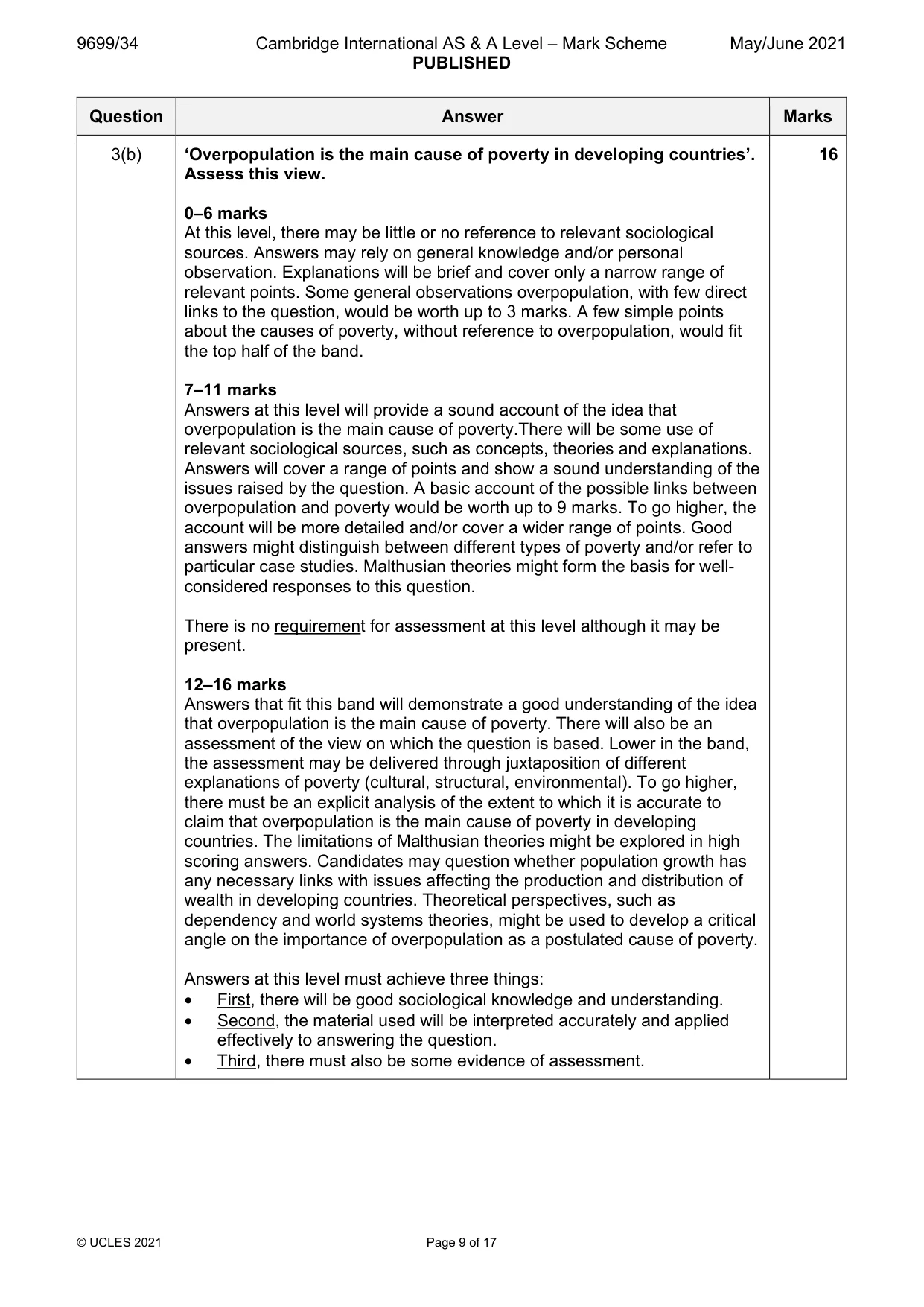
9699/34 Cambridge International AS & A Level – Mark Scheme PUBLISHED May/June 2021 © UCLES 2021 Page 9 of 17 Question Answer Marks 3(b) ‘Overpopulation is the main cause of poverty in developing countries’. Assess this view. 0–6 marks At this level, there may be little or no reference to relevant sociological sources. Answers may rely on general knowledge and/or personal observation. Explanations will be brief and cover only a narrow range of relevant points. Some general observations overpopulation, with few direct links to the question, would be worth up to 3 marks. A few simple points about the causes of poverty, without reference to overpopulation, would fit the top half of the band. 7–11 marks Answers at this level will provide a sound account of the idea that overpopulation is the main cause of poverty.There will be some use of relevant sociological sources, such as concepts, theories and explanations. Answers will cover a range of points and show a sound understanding of the issues raised by the question. A basic account of the possible links between overpopulation and poverty would be worth up to 9 marks. To go higher, the account will be more detailed and/or cover a wider range of points. Good answers might distinguish between different types of poverty and/or refer to particular case studies. Malthusian theories might form the basis for well- considered responses to this question. There is no requirement for assessment at this level although it may be present. 12–16 marks Answers that fit this band will demonstrate a good understanding of the idea that overpopulation is the main cause of poverty. There will also be an assessment of the view on which the question is based. Lower in the band, the assessment may be delivered through juxtaposition of different explanations of poverty (cultural, structural, environmental). To go higher, there must be an explicit analysis of the extent to which it is accurate to claim that overpopulation is the main cause of poverty in developing countries. The limitations of Malthusian theories might be explored in high scoring answers. Candidates may question whether population growth has any necessary links with issues affecting the production and distribution of wealth in developing countries. Theoretical perspectives, such as dependency and world systems theories, might be used to develop a critical angle on the importance of overpopulation as a postulated cause of poverty. Answers at this level must achieve three things: • First, there will be good sociological knowledge and understanding. • Second, the material used will be interpreted accurately and applied effectively to answering the question. • Third, there must also be some evidence of assessment. 16
Mark scheme, page 10
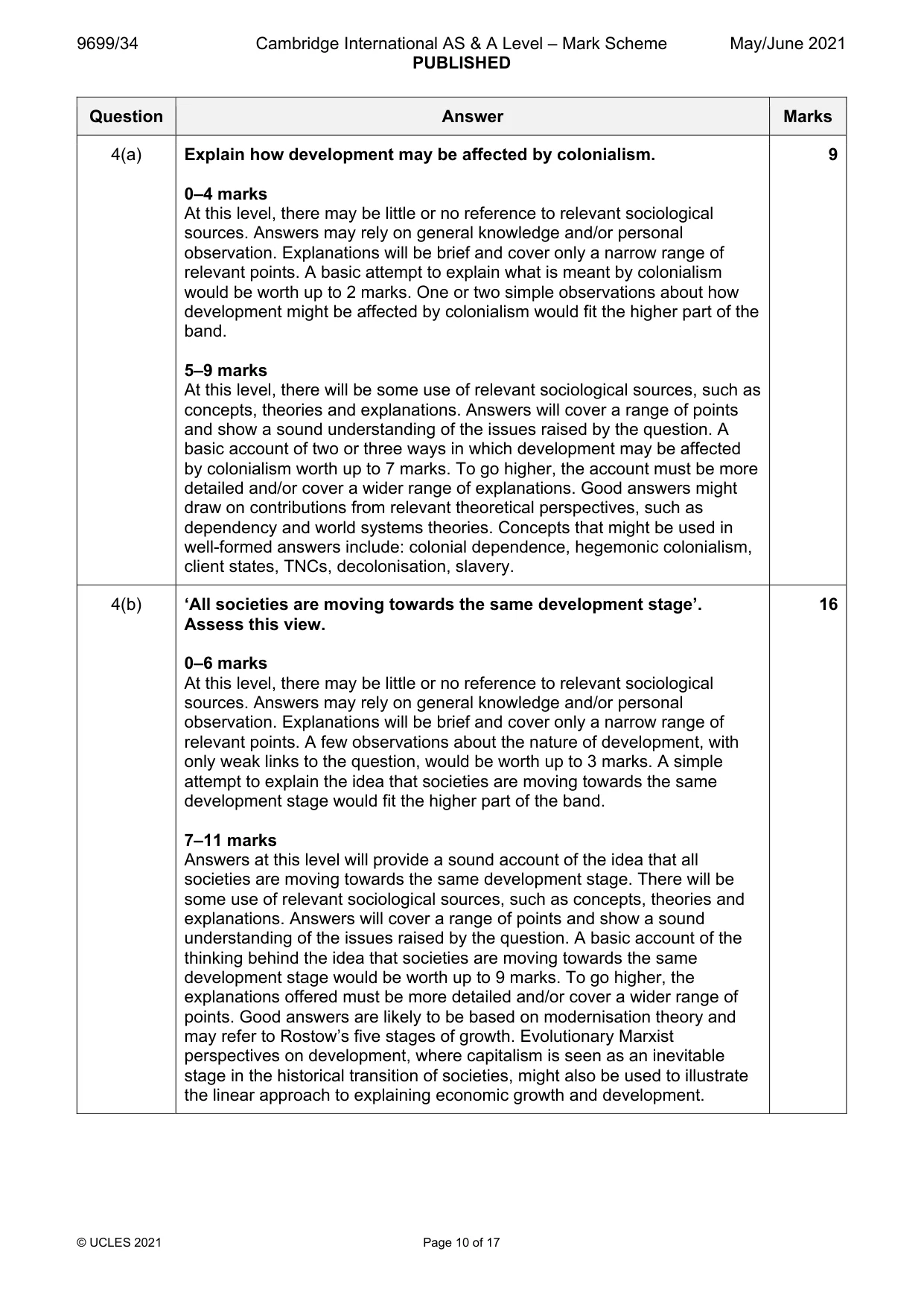
9699/34 Cambridge International AS & A Level – Mark Scheme PUBLISHED May/June 2021 © UCLES 2021 Page 10 of 17 Question Answer Marks 4(a) Explain how development may be affected by colonialism. 0–4 marks At this level, there may be little or no reference to relevant sociological sources. Answers may rely on general knowledge and/or personal observation. Explanations will be brief and cover only a narrow range of relevant points. A basic attempt to explain what is meant by colonialism would be worth up to 2 marks. One or two simple observations about how development might be affected by colonialism would fit the higher part of the band. 5–9 marks At this level, there will be some use of relevant sociological sources, such as concepts, theories and explanations. Answers will cover a range of points and show a sound understanding of the issues raised by the question. A basic account of two or three ways in which development may be affected by colonialism worth up to 7 marks. To go higher, the account must be more detailed and/or cover a wider range of explanations. Good answers might draw on contributions from relevant theoretical perspectives, such as dependency and world systems theories. Concepts that might be used in well-formed answers include: colonial dependence, hegemonic colonialism, client states, TNCs, decolonisation, slavery. 9 4(b) ‘All societies are moving towards the same development stage’. Assess this view. 0–6 marks At this level, there may be little or no reference to relevant sociological sources. Answers may rely on general knowledge and/or personal observation. Explanations will be brief and cover only a narrow range of relevant points. A few observations about the nature of development, with only weak links to the question, would be worth up to 3 marks. A simple attempt to explain the idea that societies are moving towards the same development stage would fit the higher part of the band. 7–11 marks Answers at this level will provide a sound account of the idea that all societies are moving towards the same development stage. There will be some use of relevant sociological sources, such as concepts, theories and explanations. Answers will cover a range of points and show a sound understanding of the issues raised by the question. A basic account of the thinking behind the idea that societies are moving towards the same development stage would be worth up to 9 marks. To go higher, the explanations offered must be more detailed and/or cover a wider range of points. Good answers are likely to be based on modernisation theory and may refer to Rostow’s five stages of growth. Evolutionary Marxist perspectives on development, where capitalism is seen as an inevitable stage in the historical transition of societies, might also be used to illustrate the linear approach to explaining economic growth and development. 16
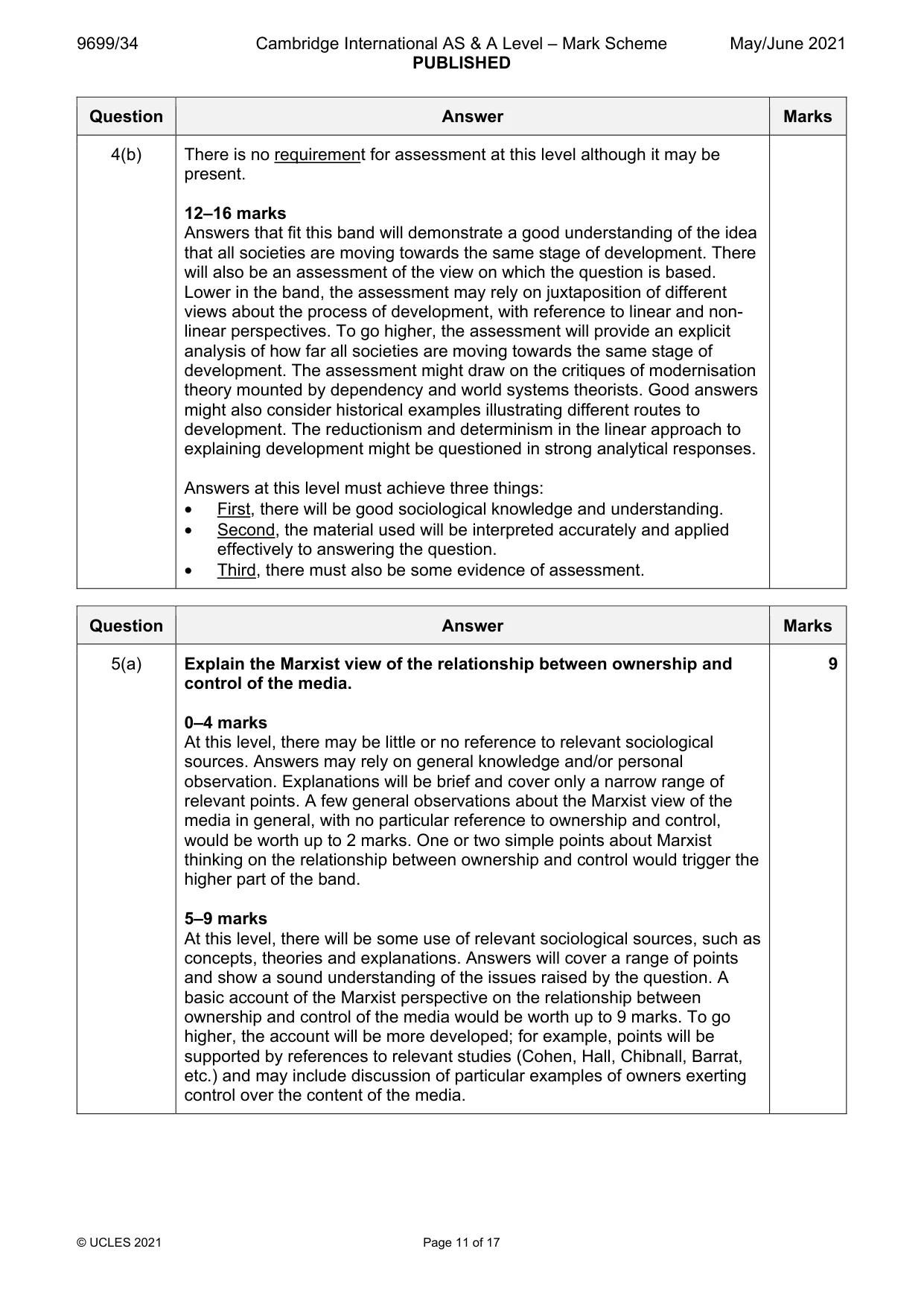
Mark scheme, page 11
9699/34 Cambridge International AS & A Level – Mark Scheme PUBLISHED May/June 2021 © UCLES 2021 Page 11 of 17 Question Answer Marks 4(b) There is no requirement for assessment at this level although it may be present. 12–16 marks Answers that fit this band will demonstrate a good understanding of the idea that all societies are moving towards the same stage of development. There will also be an assessment of the view on which the question is based. Lower in the band, the assessment may rely on juxtaposition of different views about the process of development, with reference to linear and non- linear perspectives. To go higher, the assessment will provide an explicit analysis of how far all societies are moving towards the same stage of development. The assessment might draw on the critiques of modernisation theory mounted by dependency and world systems theorists. Good answers might also consider historical examples illustrating different routes to development. The reductionism and determinism in the linear approach to explaining development might be questioned in strong analytical responses. Answers at this level must achieve three things: • First, there will be good sociological knowledge and understanding. • Second, the material used will be interpreted accurately and applied effectively to answering the question. • Third, there must also be some evidence of assessment. Question Answer Marks 5(a) Explain the Marxist view of the relationship between ownership and control of the media. 0–4 marks At this level, there may be little or no reference to relevant sociological sources. Answers may rely on general knowledge and/or personal observation. Explanations will be brief and cover only a narrow range of relevant points. A few general observations about the Marxist view of the media in general, with no particular reference to ownership and control, would be worth up to 2 marks. One or two simple points about Marxist thinking on the relationship between ownership and control would trigger the higher part of the band. 5–9 marks At this level, there will be some use of relevant sociological sources, such as concepts, theories and explanations. Answers will cover a range of points and show a sound understanding of the issues raised by the question. A basic account of the Marxist perspective on the relationship between ownership and control of the media would be worth up to 9 marks. To go higher, the account will be more developed; for example, points will be supported by references to relevant studies (Cohen, Hall, Chibnall, Barrat, etc.) and may include discussion of particular examples of owners exerting control over the content of the media. 9
Mark scheme, page 12
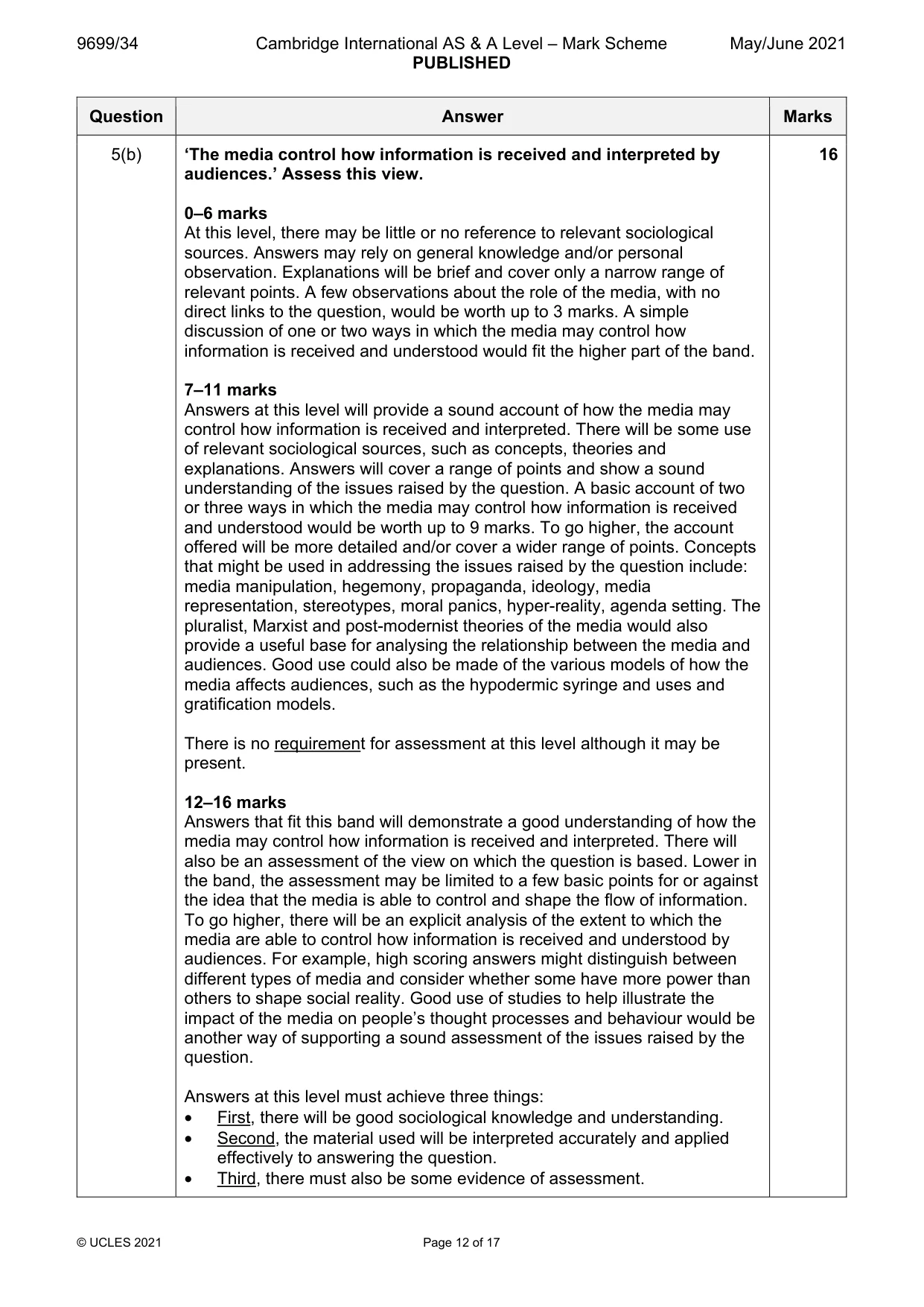
9699/34 Cambridge International AS & A Level – Mark Scheme PUBLISHED May/June 2021 © UCLES 2021 Page 12 of 17 Question Answer Marks 5(b) ‘The media control how information is received and interpreted by audiences.’ Assess this view. 0–6 marks At this level, there may be little or no reference to relevant sociological sources. Answers may rely on general knowledge and/or personal observation. Explanations will be brief and cover only a narrow range of relevant points. A few observations about the role of the media, with no direct links to the question, would be worth up to 3 marks. A simple discussion of one or two ways in which the media may control how information is received and understood would fit the higher part of the band. 7–11 marks Answers at this level will provide a sound account of how the media may control how information is received and interpreted. There will be some use of relevant sociological sources, such as concepts, theories and explanations. Answers will cover a range of points and show a sound understanding of the issues raised by the question. A basic account of two or three ways in which the media may control how information is received and understood would be worth up to 9 marks. To go higher, the account offered will be more detailed and/or cover a wider range of points. Concepts that might be used in addressing the issues raised by the question include: media manipulation, hegemony, propaganda, ideology, media representation, stereotypes, moral panics, hyper-reality, agenda setting. The pluralist, Marxist and post-modernist theories of the media would also provide a useful base for analysing the relationship between the media and audiences. Good use could also be made of the various models of how the media affects audiences, such as the hypodermic syringe and uses and gratification models. There is no requirement for assessment at this level although it may be present. 12–16 marks Answers that fit this band will demonstrate a good understanding of how the media may control how information is received and interpreted. There will also be an assessment of the view on which the question is based. Lower in the band, the assessment may be limited to a few basic points for or against the idea that the media is able to control and shape the flow of information. To go higher, there will be an explicit analysis of the extent to which the media are able to control how information is received and understood by audiences. For example, high scoring answers might distinguish between different types of media and consider whether some have more power than others to shape social reality. Good use of studies to help illustrate the impact of the media on people’s thought processes and behaviour would be another way of supporting a sound assessment of the issues raised by the question. Answers at this level must achieve three things: • First, there will be good sociological knowledge and understanding. • Second, the material used will be interpreted accurately and applied effectively to answering the question. • Third, there must also be some evidence of assessment. 16
Mark scheme, page 13
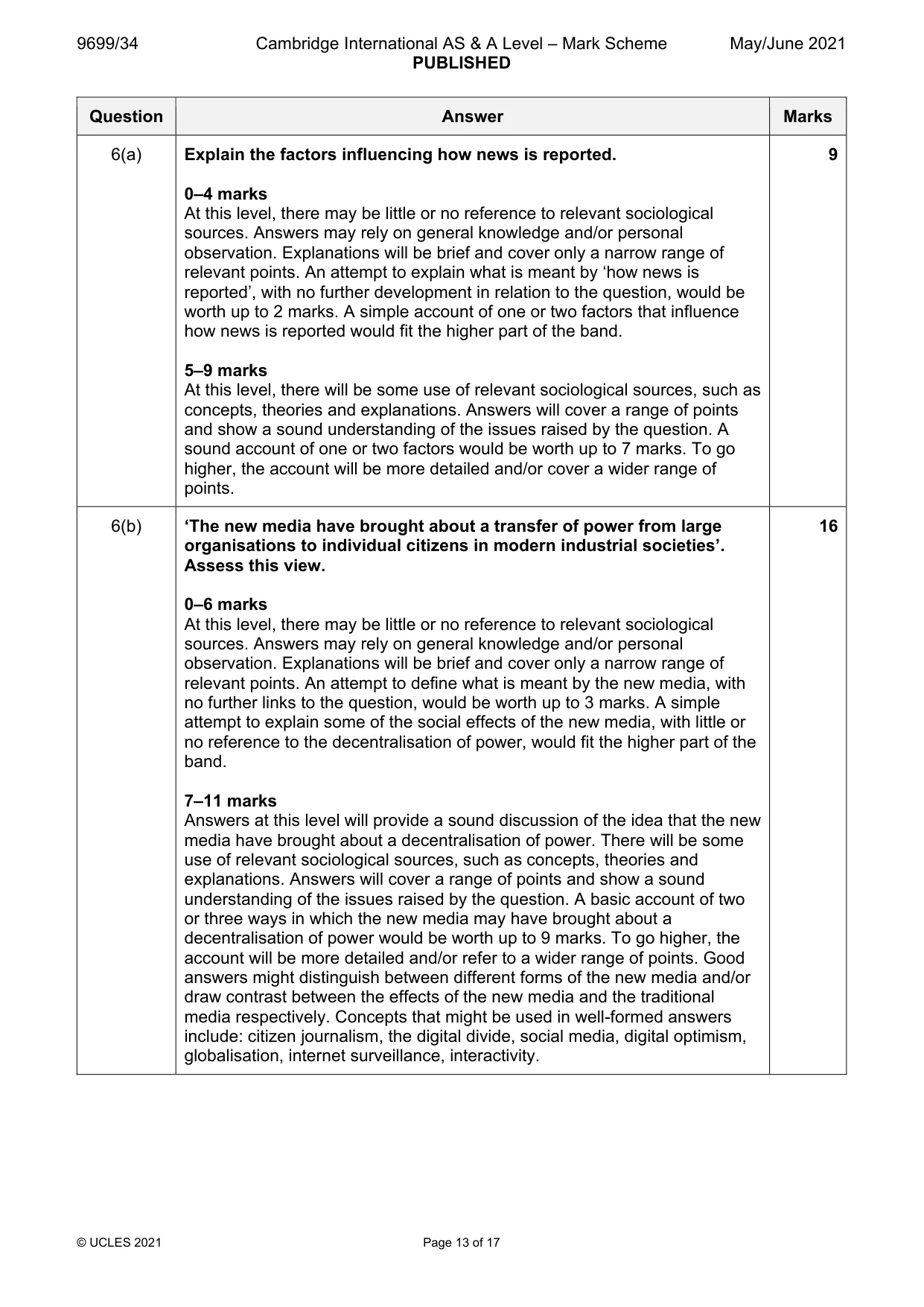
9699/34 Cambridge International AS & A Level – Mark Scheme PUBLISHED May/June 2021 © UCLES 2021 Page 13 of 17 Question Answer Marks 6(a) Explain the factors influencing how news is reported. 0–4 marks At this level, there may be little or no reference to relevant sociological sources. Answers may rely on general knowledge and/or personal observation. Explanations will be brief and cover only a narrow range of relevant points. An attempt to explain what is meant by ‘how news is reported’, with no further development in relation to the question, would be worth up to 2 marks. A simple account of one or two factors that influence how news is reported would fit the higher part of the band. 5–9 marks At this level, there will be some use of relevant sociological sources, such as concepts, theories and explanations. Answers will cover a range of points and show a sound understanding of the issues raised by the question. A sound account of one or two factors would be worth up to 7 marks. To go higher, the account will be more detailed and/or cover a wider range of points. 9 6(b) ‘The new media have brought about a transfer of power from large organisations to individual citizens in modern industrial societies’. Assess this view. 0–6 marks At this level, there may be little or no reference to relevant sociological sources. Answers may rely on general knowledge and/or personal observation. Explanations will be brief and cover only a narrow range of relevant points. An attempt to define what is meant by the new media, with no further links to the question, would be worth up to 3 marks. A simple attempt to explain some of the social effects of the new media, with little or no reference to the decentralisation of power, would fit the higher part of the band. 7–11 marks Answers at this level will provide a sound discussion of the idea that the new media have brought about a decentralisation of power. There will be some use of relevant sociological sources, such as concepts, theories and explanations. Answers will cover a range of points and show a sound understanding of the issues raised by the question. A basic account of two or three ways in which the new media may have brought about a decentralisation of power would be worth up to 9 marks. To go higher, the account will be more detailed and/or refer to a wider range of points. Good answers might distinguish between different forms of the new media and/or draw contrast between the effects of the new media and the traditional media respectively. Concepts that might be used in well-formed answers include: citizen journalism, the digital divide, social media, digital optimism, globalisation, internet surveillance, interactivity. 16
Mark scheme, page 14
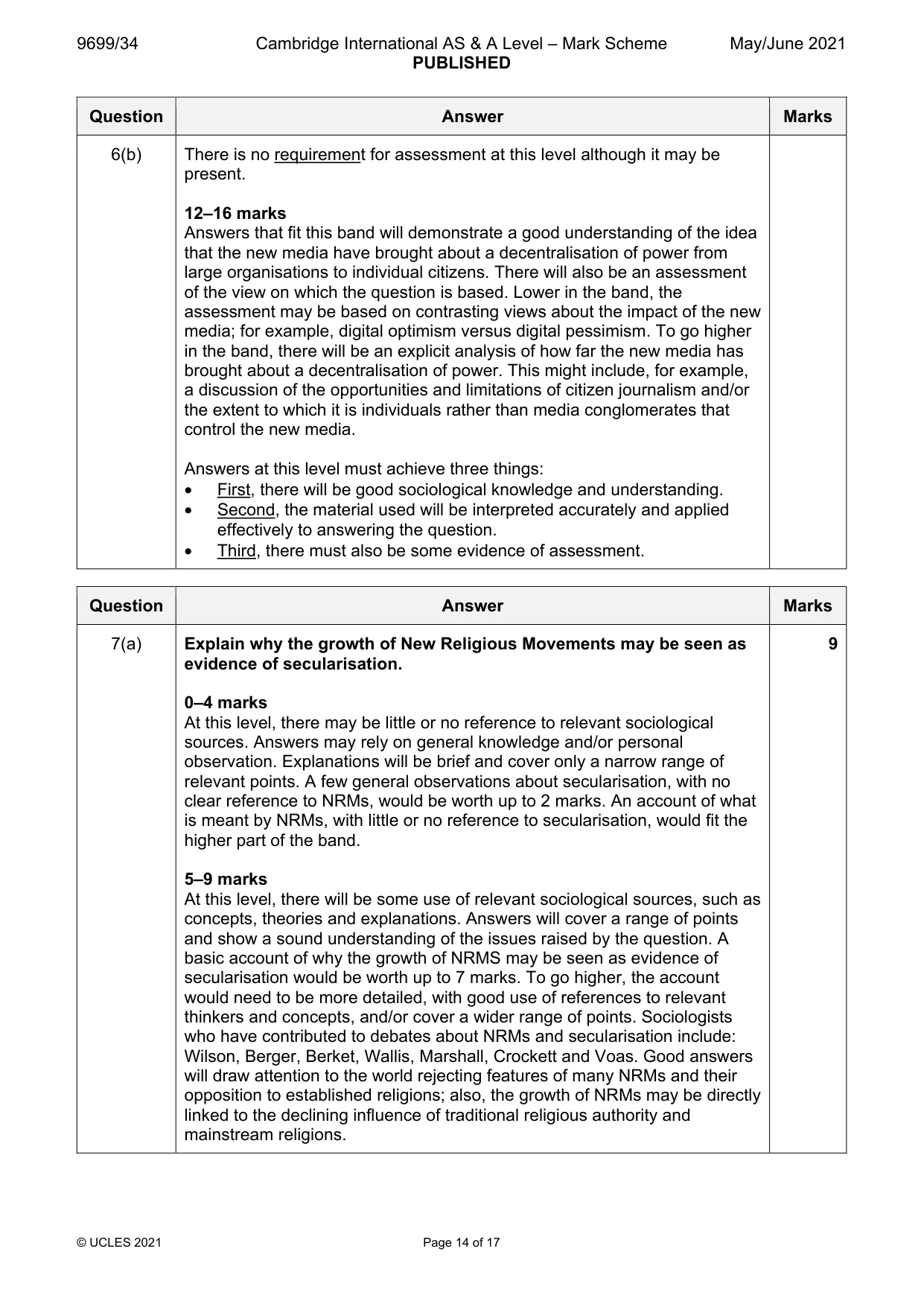
9699/34 Cambridge International AS & A Level – Mark Scheme PUBLISHED May/June 2021 © UCLES 2021 Page 14 of 17 Question Answer Marks 6(b) There is no requirement for assessment at this level although it may be present. 12–16 marks Answers that fit this band will demonstrate a good understanding of the idea that the new media have brought about a decentralisation of power from large organisations to individual citizens. There will also be an assessment of the view on which the question is based. Lower in the band, the assessment may be based on contrasting views about the impact of the new media; for example, digital optimism versus digital pessimism. To go higher in the band, there will be an explicit analysis of how far the new media has brought about a decentralisation of power. This might include, for example, a discussion of the opportunities and limitations of citizen journalism and/or the extent to which it is individuals rather than media conglomerates that control the new media. Answers at this level must achieve three things: • First, there will be good sociological knowledge and understanding. • Second, the material used will be interpreted accurately and applied effectively to answering the question. • Third, there must also be some evidence of assessment. Question Answer Marks 7(a) Explain why the growth of New Religious Movements may be seen as evidence of secularisation. 0–4 marks At this level, there may be little or no reference to relevant sociological sources. Answers may rely on general knowledge and/or personal observation. Explanations will be brief and cover only a narrow range of relevant points. A few general observations about secularisation, with no clear reference to NRMs, would be worth up to 2 marks. An account of what is meant by NRMs, with little or no reference to secularisation, would fit the higher part of the band. 5–9 marks At this level, there will be some use of relevant sociological sources, such as concepts, theories and explanations. Answers will cover a range of points and show a sound understanding of the issues raised by the question. A basic account of why the growth of NRMS may be seen as evidence of secularisation would be worth up to 7 marks. To go higher, the account would need to be more detailed, with good use of references to relevant thinkers and concepts, and/or cover a wider range of points. Sociologists who have contributed to debates about NRMs and secularisation include: Wilson, Berger, Berket, Wallis, Marshall, Crockett and Voas. Good answers will draw attention to the world rejecting features of many NRMs and their opposition to established religions; also, the growth of NRMs may be directly linked to the declining influence of traditional religious authority and mainstream religions. 9
Mark scheme, page 15
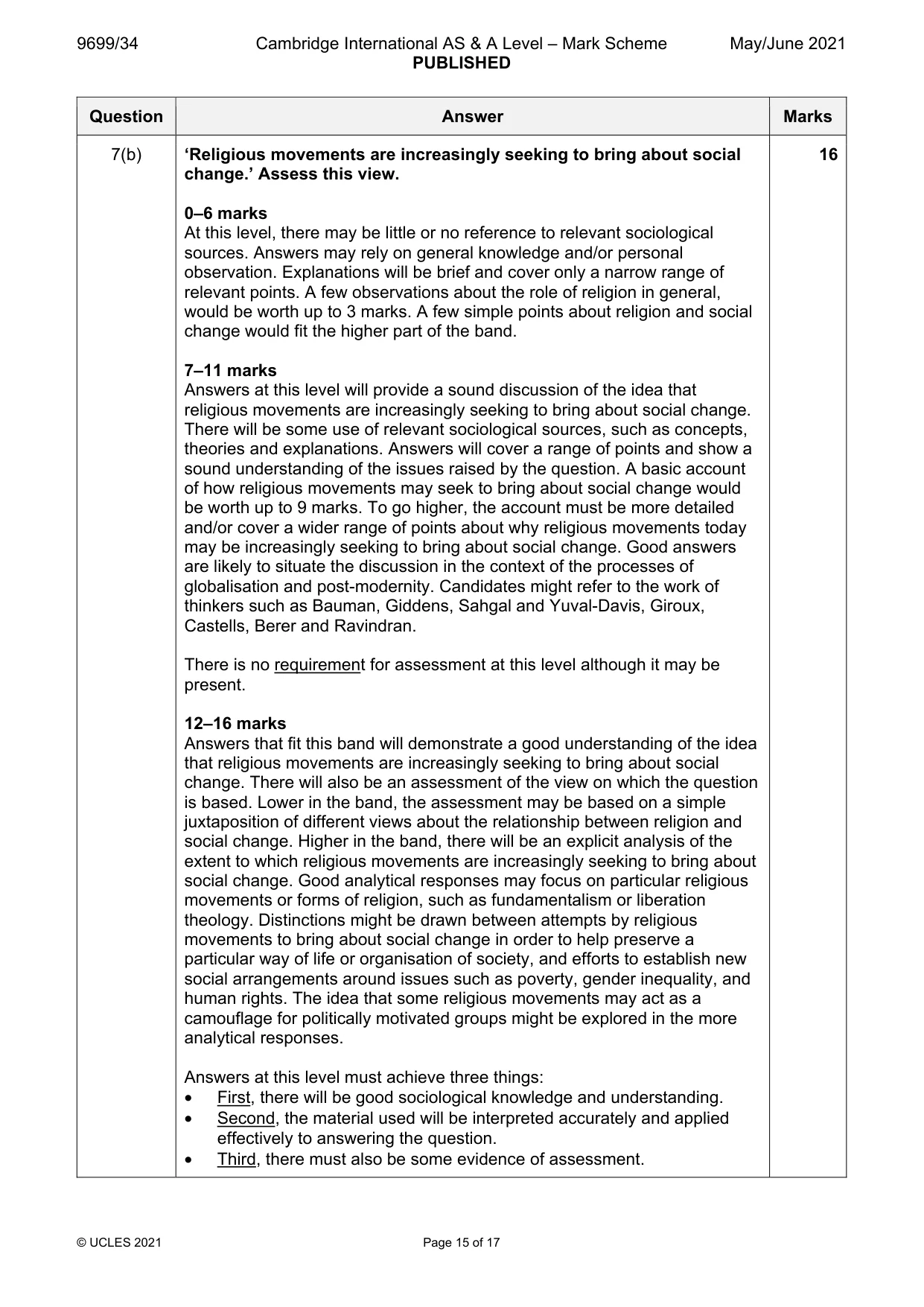
9699/34 Cambridge International AS & A Level – Mark Scheme PUBLISHED May/June 2021 © UCLES 2021 Page 15 of 17 Question Answer Marks 7(b) ‘Religious movements are increasingly seeking to bring about social change.’ Assess this view. 0–6 marks At this level, there may be little or no reference to relevant sociological sources. Answers may rely on general knowledge and/or personal observation. Explanations will be brief and cover only a narrow range of relevant points. A few observations about the role of religion in general, would be worth up to 3 marks. A few simple points about religion and social change would fit the higher part of the band. 7–11 marks Answers at this level will provide a sound discussion of the idea that religious movements are increasingly seeking to bring about social change. There will be some use of relevant sociological sources, such as concepts, theories and explanations. Answers will cover a range of points and show a sound understanding of the issues raised by the question. A basic account of how religious movements may seek to bring about social change would be worth up to 9 marks. To go higher, the account must be more detailed and/or cover a wider range of points about why religious movements today may be increasingly seeking to bring about social change. Good answers are likely to situate the discussion in the context of the processes of globalisation and post-modernity. Candidates might refer to the work of thinkers such as Bauman, Giddens, Sahgal and Yuval-Davis, Giroux, Castells, Berer and Ravindran. There is no requirement for assessment at this level although it may be present. 12–16 marks Answers that fit this band will demonstrate a good understanding of the idea that religious movements are increasingly seeking to bring about social change. There will also be an assessment of the view on which the question is based. Lower in the band, the assessment may be based on a simple juxtaposition of different views about the relationship between religion and social change. Higher in the band, there will be an explicit analysis of the extent to which religious movements are increasingly seeking to bring about social change. Good analytical responses may focus on particular religious movements or forms of religion, such as fundamentalism or liberation theology. Distinctions might be drawn between attempts by religious movements to bring about social change in order to help preserve a particular way of life or organisation of society, and efforts to establish new social arrangements around issues such as poverty, gender inequality, and human rights. The idea that some religious movements may act as a camouflage for politically motivated groups might be explored in the more analytical responses. Answers at this level must achieve three things: • First, there will be good sociological knowledge and understanding. • Second, the material used will be interpreted accurately and applied effectively to answering the question. • Third, there must also be some evidence of assessment. 16
Mark scheme, page 16
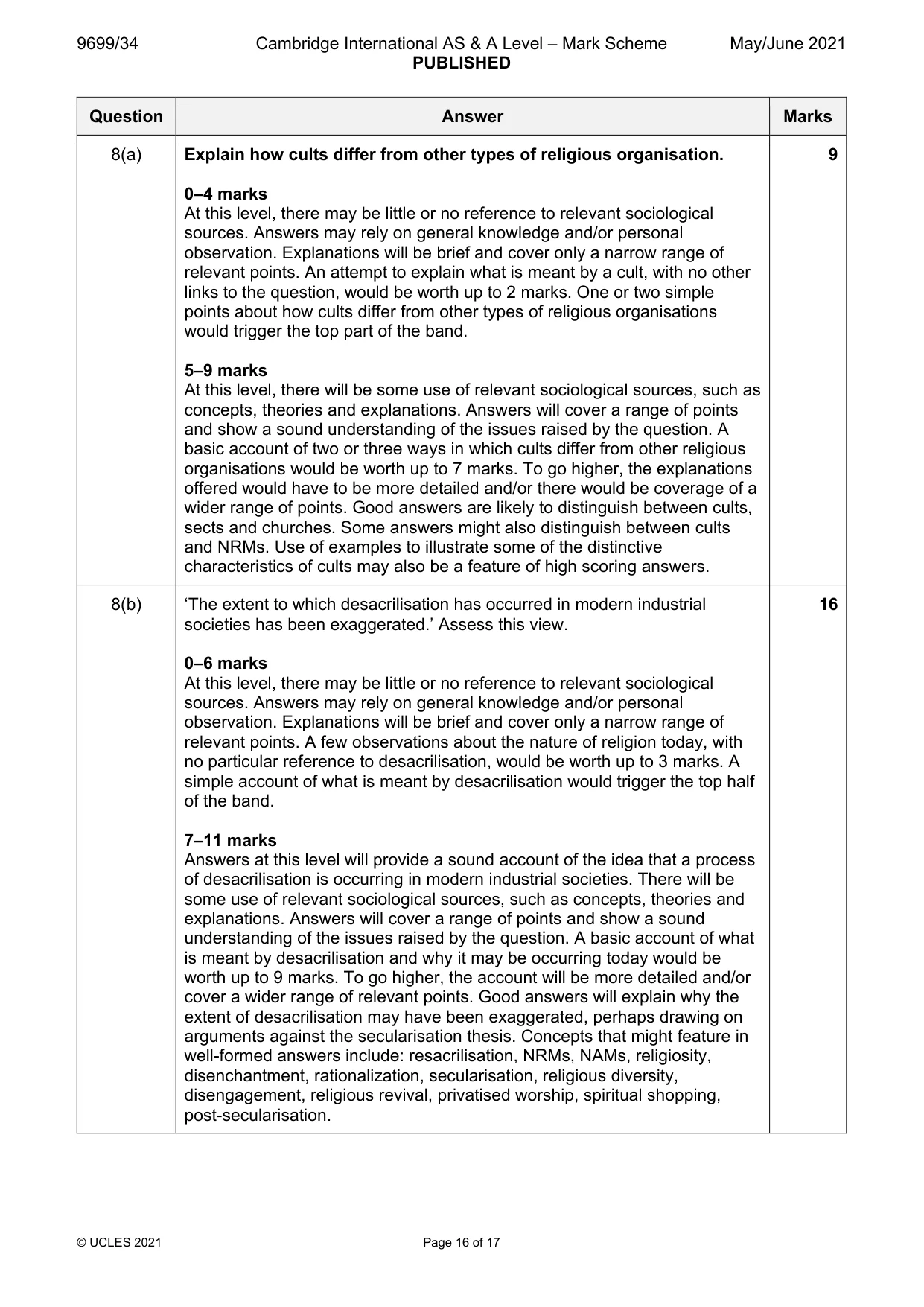
9699/34 Cambridge International AS & A Level – Mark Scheme PUBLISHED May/June 2021 © UCLES 2021 Page 16 of 17 Question Answer Marks 8(a) Explain how cults differ from other types of religious organisation. 0–4 marks At this level, there may be little or no reference to relevant sociological sources. Answers may rely on general knowledge and/or personal observation. Explanations will be brief and cover only a narrow range of relevant points. An attempt to explain what is meant by a cult, with no other links to the question, would be worth up to 2 marks. One or two simple points about how cults differ from other types of religious organisations would trigger the top part of the band. 5–9 marks At this level, there will be some use of relevant sociological sources, such as concepts, theories and explanations. Answers will cover a range of points and show a sound understanding of the issues raised by the question. A basic account of two or three ways in which cults differ from other religious organisations would be worth up to 7 marks. To go higher, the explanations offered would have to be more detailed and/or there would be coverage of a wider range of points. Good answers are likely to distinguish between cults, sects and churches. Some answers might also distinguish between cults and NRMs. Use of examples to illustrate some of the distinctive characteristics of cults may also be a feature of high scoring answers. 9 8(b) ‘The extent to which desacrilisation has occurred in modern industrial societies has been exaggerated.’ Assess this view. 0–6 marks At this level, there may be little or no reference to relevant sociological sources. Answers may rely on general knowledge and/or personal observation. Explanations will be brief and cover only a narrow range of relevant points. A few observations about the nature of religion today, with no particular reference to desacrilisation, would be worth up to 3 marks. A simple account of what is meant by desacrilisation would trigger the top half of the band. 7–11 marks Answers at this level will provide a sound account of the idea that a process of desacrilisation is occurring in modern industrial societies. There will be some use of relevant sociological sources, such as concepts, theories and explanations. Answers will cover a range of points and show a sound understanding of the issues raised by the question. A basic account of what is meant by desacrilisation and why it may be occurring today would be worth up to 9 marks. To go higher, the account will be more detailed and/or cover a wider range of relevant points. Good answers will explain why the extent of desacrilisation may have been exaggerated, perhaps drawing on arguments against the secularisation thesis. Concepts that might feature in well-formed answers include: resacrilisation, NRMs, NAMs, religiosity, disenchantment, rationalization, secularisation, religious diversity, disengagement, religious revival, privatised worship, spiritual shopping, post-secularisation. 16
Mark scheme, page 17
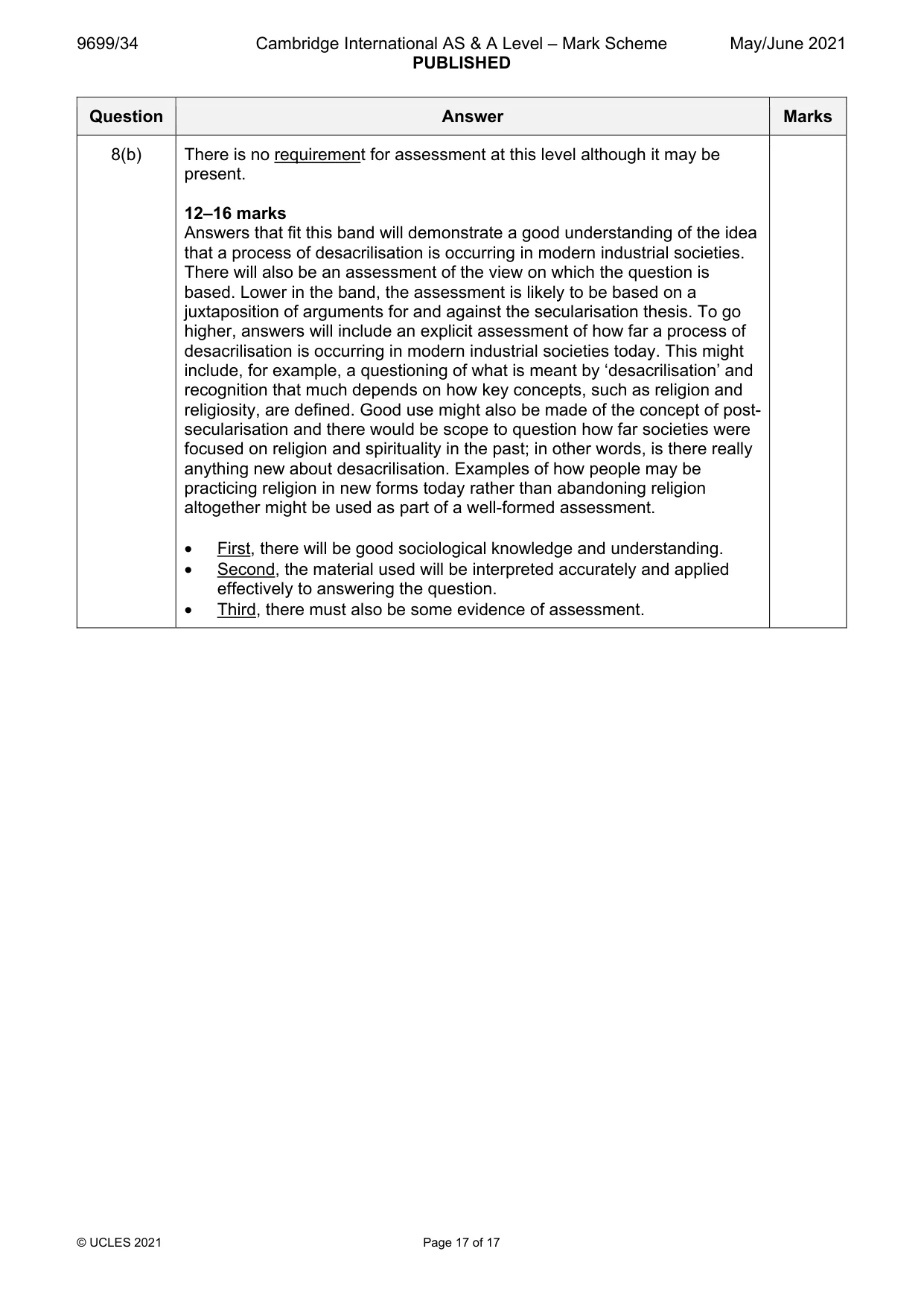
9699/34 Cambridge International AS & A Level – Mark Scheme PUBLISHED May/June 2021 © UCLES 2021 Page 17 of 17 Question Answer Marks 8(b) There is no requirement for assessment at this level although it may be present. 12–16 marks Answers that fit this band will demonstrate a good understanding of the idea that a process of desacrilisation is occurring in modern industrial societies. There will also be an assessment of the view on which the question is based. Lower in the band, the assessment is likely to be based on a juxtaposition of arguments for and against the secularisation thesis. To go higher, answers will include an explicit assessment of how far a process of desacrilisation is occurring in modern industrial societies today. This might include, for example, a questioning of what is meant by ‘desacrilisation’ and recognition that much depends on how key concepts, such as religion and religiosity, are defined. Good use might also be made of the concept of post- secularisation and there would be scope to question how far societies were focused on religion and spirituality in the past; in other words, is there really anything new about desacrilisation. Examples of how people may be practicing religion in new forms today rather than abandoning religion altogether might be used as part of a well-formed assessment. • First, there will be good sociological knowledge and understanding. • Second, the material used will be interpreted accurately and applied effectively to answering the question. • Third, there must also be some evidence of assessment.
What you needed in this session
Cambridge’s own grade thresholds for 2021 May/June, Paper 3 · Variant 4. A higher threshold means an easier paper — the bar moves with how the cohort did.