Cambridge A Level Sociology 9699 — 2021 May/June Paper 1 · Variant 4
9699/14/M/J/21 · 50 marks · ≈56 min
The question paper and its mark scheme, free to read here and free to download. This is Cambridge’s own paper, exactly as it was sat.
Question paper4 pages

Mark scheme14 pages
Answers below. Sit the paper first if you are practising.
Paper as text
Question paper, page 1
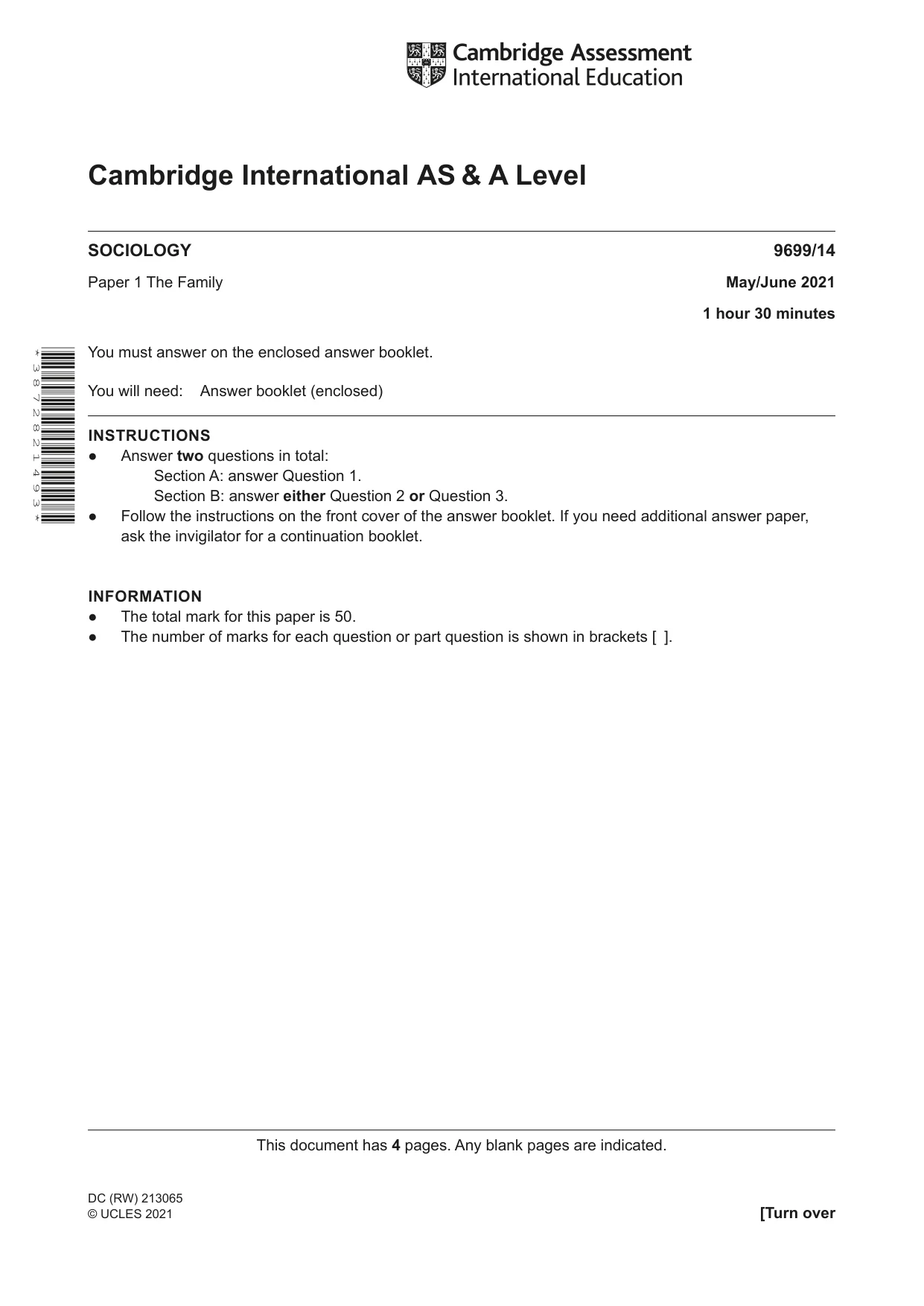
This document has 4 pages. Any blank pages are indicated. DC (RW) 213065 © UCLES 2021 [Turn over * 3 8 7 2 8 2 1 4 9 3 * Cambridge International AS & A Level SOCIOLOGY 9699/14 Paper 1 The Family May/June 2021 1 hour 30 minutes You must answer on the enclosed answer booklet. You will need: Answer booklet (enclosed) INSTRUCTIONS ● Answer two questions in total: Section A: answer Question 1. Section B: answer either Question 2 or Question 3. ● Follow the instructions on the front cover of the answer booklet. If you need additional answer paper, ask the invigilator for a continuation booklet. INFORMATION ● The total mark for this paper is 50. ● The number of marks for each question or part question is shown in brackets [ ].
Question paper, page 2
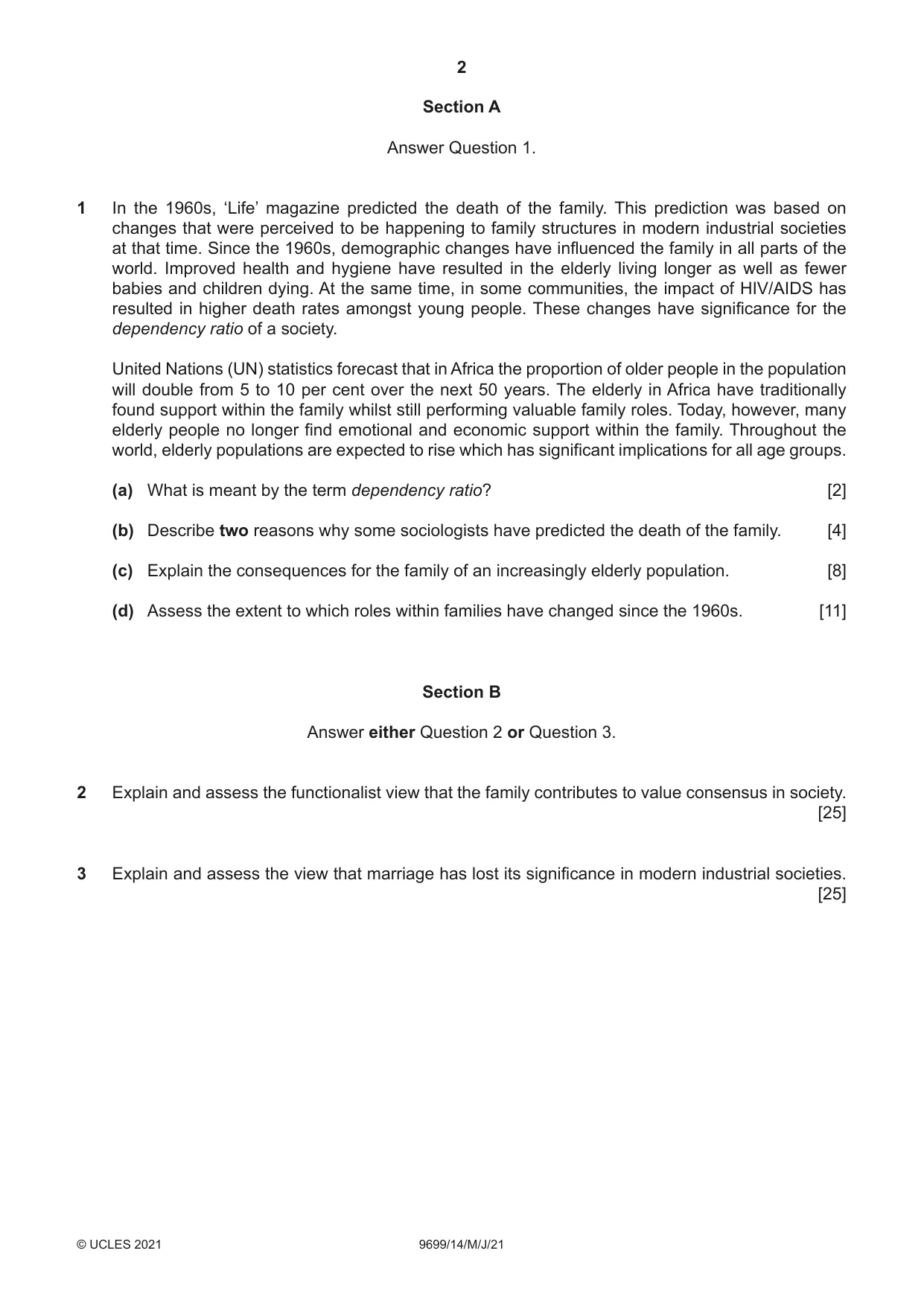
2 9699/14/M/J/21 © UCLES 2021 Section A Answer Question 1. 1 In the 1960s, ‘Life’ magazine predicted the death of the family. This prediction was based on changes that were perceived to be happening to family structures in modern industrial societies at that time. Since the 1960s, demographic changes have influenced the family in all parts of the world. Improved health and hygiene have resulted in the elderly living longer as well as fewer babies and children dying. At the same time, in some communities, the impact of HIV/AIDS has resulted in higher death rates amongst young people. These changes have significance for the dependency ratio of a society. United Nations (UN) statistics forecast that in Africa the proportion of older people in the population will double from 5 to 10 per cent over the next 50 years. The elderly in Africa have traditionally found support within the family whilst still performing valuable family roles. Today, however, many elderly people no longer find emotional and economic support within the family. Throughout the world, elderly populations are expected to rise which has significant implications for all age groups. (a) What is meant by the term dependency ratio? [2] (b) Describe two reasons why some sociologists have predicted the death of the family. [4] (c) Explain the consequences for the family of an increasingly elderly population. [8] (d) Assess the extent to which roles within families have changed since the 1960s. [11] Section B Answer either Question 2 or Question 3. 2 Explain and assess the functionalist view that the family contributes to value consensus in society. [25] 3 Explain and assess the view that marriage has lost its significance in modern industrial societies. [25]
Question paper, page 3
3 9699/14/M/J/21 © UCLES 2021 BLANK PAGE
Question paper, page 4
4 9699/14/M/J/21 © UCLES 2021 Permission to reproduce items where third-party owned material protected by copyright is included has been sought and cleared where possible. Every reasonable effort has been made by the publisher (UCLES) to trace copyright holders, but if any items requiring clearance have unwittingly been included, the publisher will be pleased to make amends at the earliest possible opportunity. To avoid the issue of disclosure of answer-related information to candidates, all copyright acknowledgements are reproduced online in the Cambridge Assessment International Education Copyright Acknowledgements Booklet. This is produced for each series of examinations and is freely available to download at www.cambridgeinternational.org after the live examination series. Cambridge Assessment International Education is part of the Cambridge Assessment Group. Cambridge Assessment is the brand name of the University of Cambridge Local Examinations Syndicate (UCLES), which itself is a department of the University of Cambridge. BLANK PAGE
Mark scheme, page 1
This document consists of 14 printed pages. © UCLES 2021 [Turn over Cambridge International AS & A Level SOCIOLOGY 9699/14 Paper 1 The Family May/June 2021 MARK SCHEME Maximum Mark: 50 Published This mark scheme is published as an aid to teachers and candidates, to indicate the requirements of the examination. It shows the basis on which Examiners were instructed to award marks. It does not indicate the details of the discussions that took place at an Examiners’ meeting before marking began, which would have considered the acceptability of alternative answers. Mark schemes should be read in conjunction with the question paper and the Principal Examiner Report for Teachers. Cambridge International will not enter into discussions about these mark schemes. Cambridge International is publishing the mark schemes for the May/June 2021 series for most Cambridge IGCSE™, Cambridge International A and AS Level components and some Cambridge O Level components.
Mark scheme, page 2
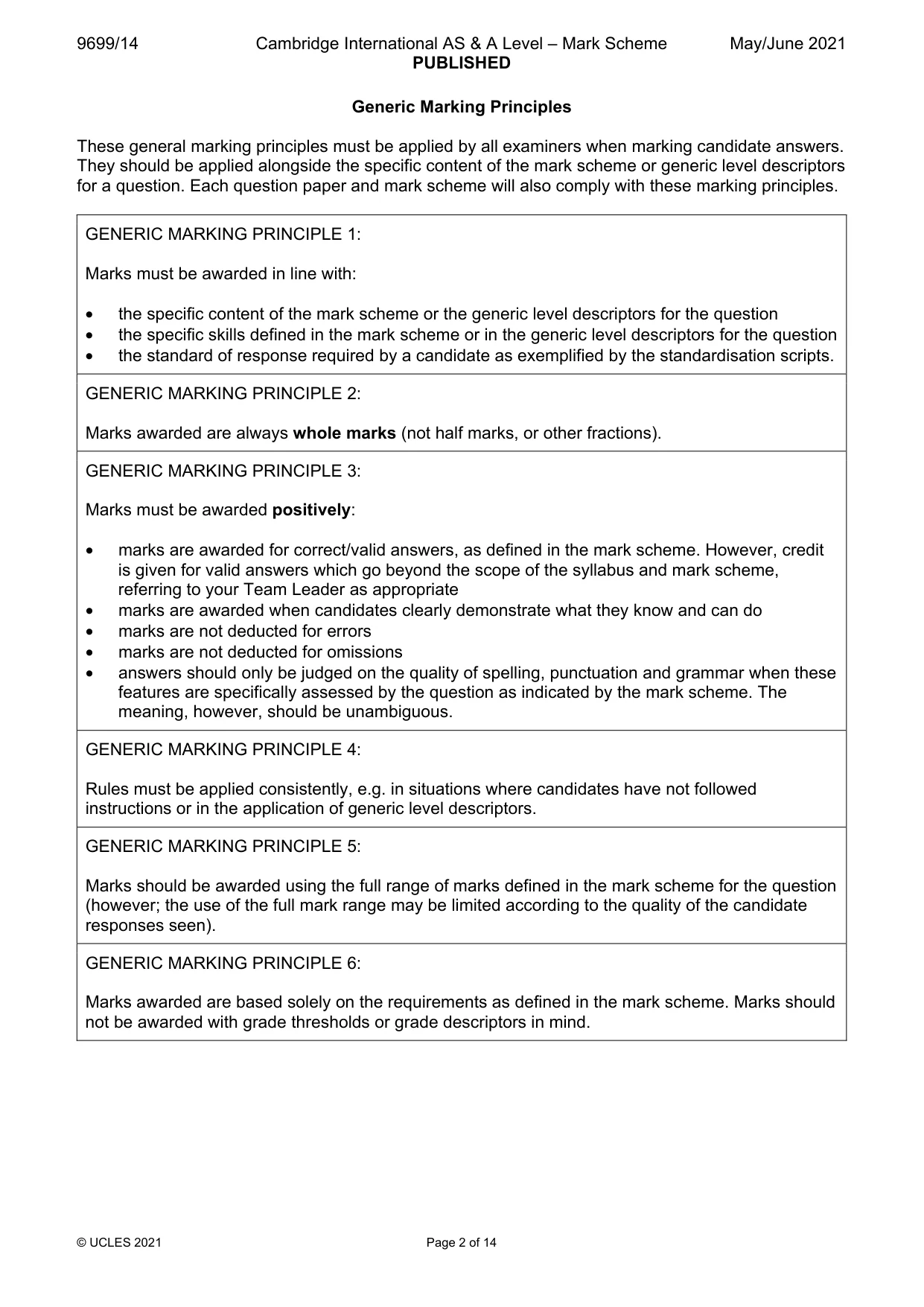
9699/14 Cambridge International AS & A Level – Mark Scheme PUBLISHED May/June 2021 © UCLES 2021 Page 2 of 14 Generic Marking Principles These general marking principles must be applied by all examiners when marking candidate answers. They should be applied alongside the specific content of the mark scheme or generic level descriptors for a question. Each question paper and mark scheme will also comply with these marking principles. GENERIC MARKING PRINCIPLE 1: Marks must be awarded in line with: • the specific content of the mark scheme or the generic level descriptors for the question • the specific skills defined in the mark scheme or in the generic level descriptors for the question • the standard of response required by a candidate as exemplified by the standardisation scripts. GENERIC MARKING PRINCIPLE 2: Marks awarded are always whole marks (not half marks, or other fractions). GENERIC MARKING PRINCIPLE 3: Marks must be awarded positively: • marks are awarded for correct/valid answers, as defined in the mark scheme. However, credit is given for valid answers which go beyond the scope of the syllabus and mark scheme, referring to your Team Leader as appropriate • marks are awarded when candidates clearly demonstrate what they know and can do • marks are not deducted for errors • marks are not deducted for omissions • answers should only be judged on the quality of spelling, punctuation and grammar when these features are specifically assessed by the question as indicated by the mark scheme. The meaning, however, should be unambiguous. GENERIC MARKING PRINCIPLE 4: Rules must be applied consistently, e.g. in situations where candidates have not followed instructions or in the application of generic level descriptors. GENERIC MARKING PRINCIPLE 5: Marks should be awarded using the full range of marks defined in the mark scheme for the question (however; the use of the full mark range may be limited according to the quality of the candidate responses seen). GENERIC MARKING PRINCIPLE 6: Marks awarded are based solely on the requirements as defined in the mark scheme. Marks should not be awarded with grade thresholds or grade descriptors in mind.
Mark scheme, page 3
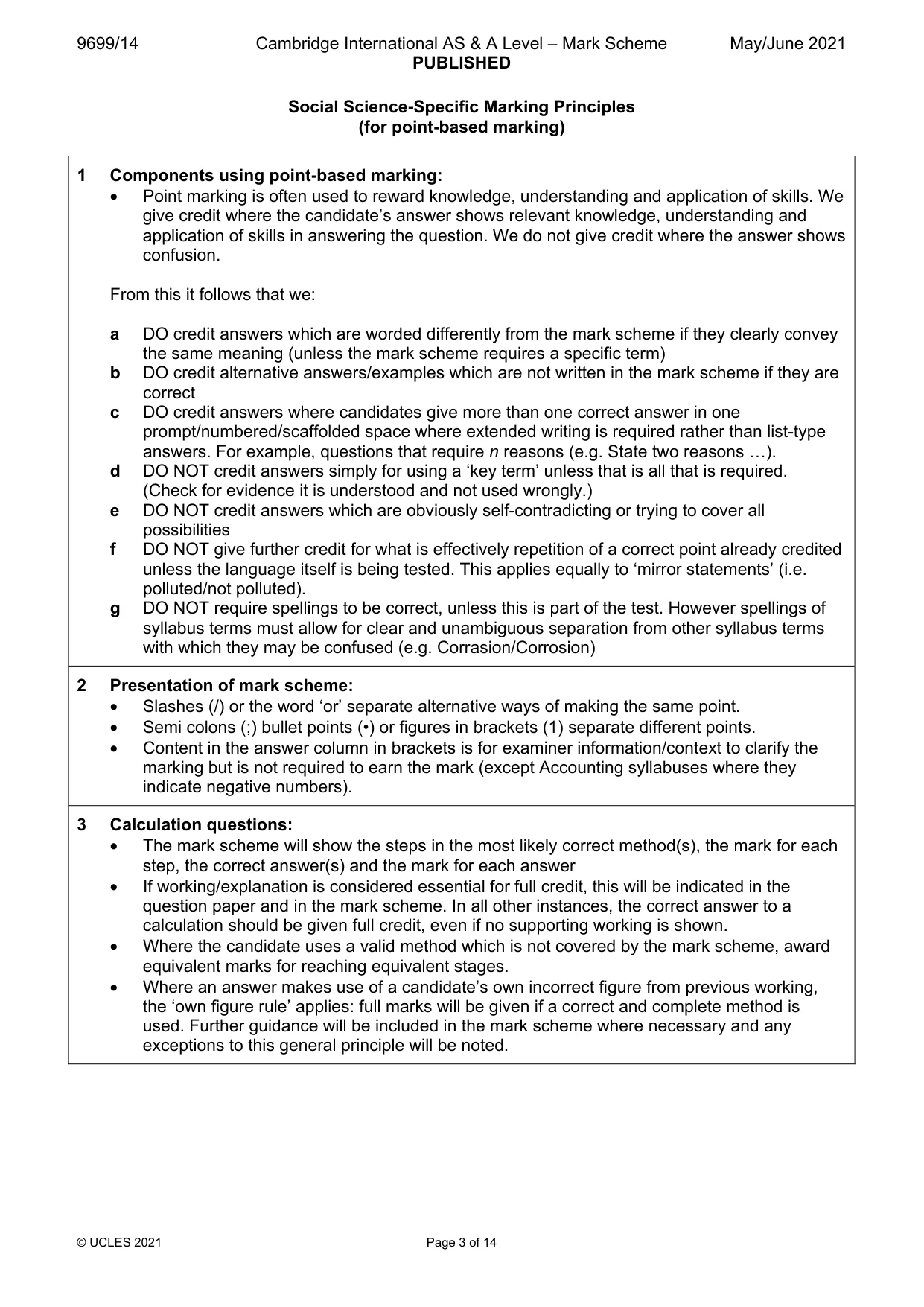
9699/14 Cambridge International AS & A Level – Mark Scheme PUBLISHED May/June 2021 © UCLES 2021 Page 3 of 14 Social Science-Specific Marking Principles (for point-based marking) 1 Components using point-based marking: • Point marking is often used to reward knowledge, understanding and application of skills. We give credit where the candidate’s answer shows relevant knowledge, understanding and application of skills in answering the question. We do not give credit where the answer shows confusion. From this it follows that we: a DO credit answers which are worded differently from the mark scheme if they clearly convey the same meaning (unless the mark scheme requires a specific term) b DO credit alternative answers/examples which are not written in the mark scheme if they are correct c DO credit answers where candidates give more than one correct answer in one prompt/numbered/scaffolded space where extended writing is required rather than list-type answers. For example, questions that require n reasons (e.g. State two reasons …). d DO NOT credit answers simply for using a ‘key term’ unless that is all that is required. (Check for evidence it is understood and not used wrongly.) e DO NOT credit answers which are obviously self-contradicting or trying to cover all possibilities f DO NOT give further credit for what is effectively repetition of a correct point already credited unless the language itself is being tested. This applies equally to ‘mirror statements’ (i.e. polluted/not polluted). g DO NOT require spellings to be correct, unless this is part of the test. However spellings of syllabus terms must allow for clear and unambiguous separation from other syllabus terms with which they may be confused (e.g. Corrasion/Corrosion) 2 Presentation of mark scheme: • Slashes (/) or the word ‘or’ separate alternative ways of making the same point. • Semi colons (;) bullet points (•) or figures in brackets (1) separate different points. • Content in the answer column in brackets is for examiner information/context to clarify the marking but is not required to earn the mark (except Accounting syllabuses where they indicate negative numbers). 3 Calculation questions: • The mark scheme will show the steps in the most likely correct method(s), the mark for each step, the correct answer(s) and the mark for each answer • If working/explanation is considered essential for full credit, this will be indicated in the question paper and in the mark scheme. In all other instances, the correct answer to a calculation should be given full credit, even if no supporting working is shown. • Where the candidate uses a valid method which is not covered by the mark scheme, award equivalent marks for reaching equivalent stages. • Where an answer makes use of a candidate’s own incorrect figure from previous working, the ‘own figure rule’ applies: full marks will be given if a correct and complete method is used. Further guidance will be included in the mark scheme where necessary and any exceptions to this general principle will be noted.
Mark scheme, page 4
9699/14 Cambridge International AS & A Level – Mark Scheme PUBLISHED May/June 2021 © UCLES 2021 Page 4 of 14 4 Annotation: • For point marking, ticks can be used to indicate correct answers and crosses can be used to indicate wrong answers. There is no direct relationship between ticks and marks. Ticks have no defined meaning for levels of response marking. • For levels of response marking, the level awarded should be annotated on the script. • Other annotations will be used by examiners as agreed during standardisation, and the meaning will be understood by all examiners who marked that paper.
Mark scheme, page 5
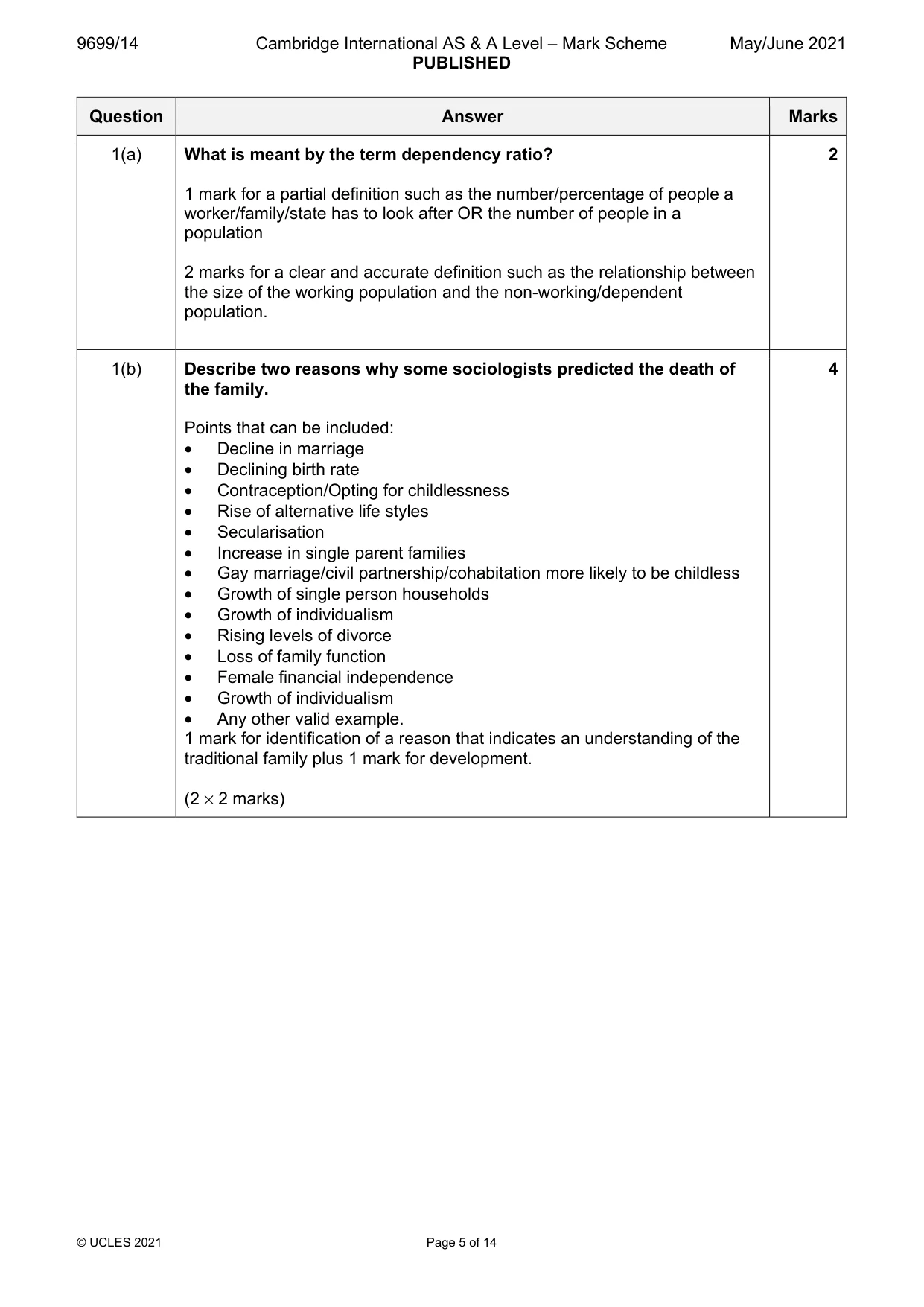
9699/14 Cambridge International AS & A Level – Mark Scheme PUBLISHED May/June 2021 © UCLES 2021 Page 5 of 14 Question Answer Marks 1(a) What is meant by the term dependency ratio? 1 mark for a partial definition such as the number/percentage of people a worker/family/state has to look after OR the number of people in a population 2 marks for a clear and accurate definition such as the relationship between the size of the working population and the non-working/dependent population. 2 1(b) Describe two reasons why some sociologists predicted the death of the family. Points that can be included: • Decline in marriage • Declining birth rate • Contraception/Opting for childlessness • Rise of alternative life styles • Secularisation • Increase in single parent families • Gay marriage/civil partnership/cohabitation more likely to be childless • Growth of single person households • Growth of individualism • Rising levels of divorce • Loss of family function • Female financial independence • Growth of individualism • Any other valid example. 1 mark for identification of a reason that indicates an understanding of the traditional family plus 1 mark for development. (2 × 2 marks) 4
Mark scheme, page 6
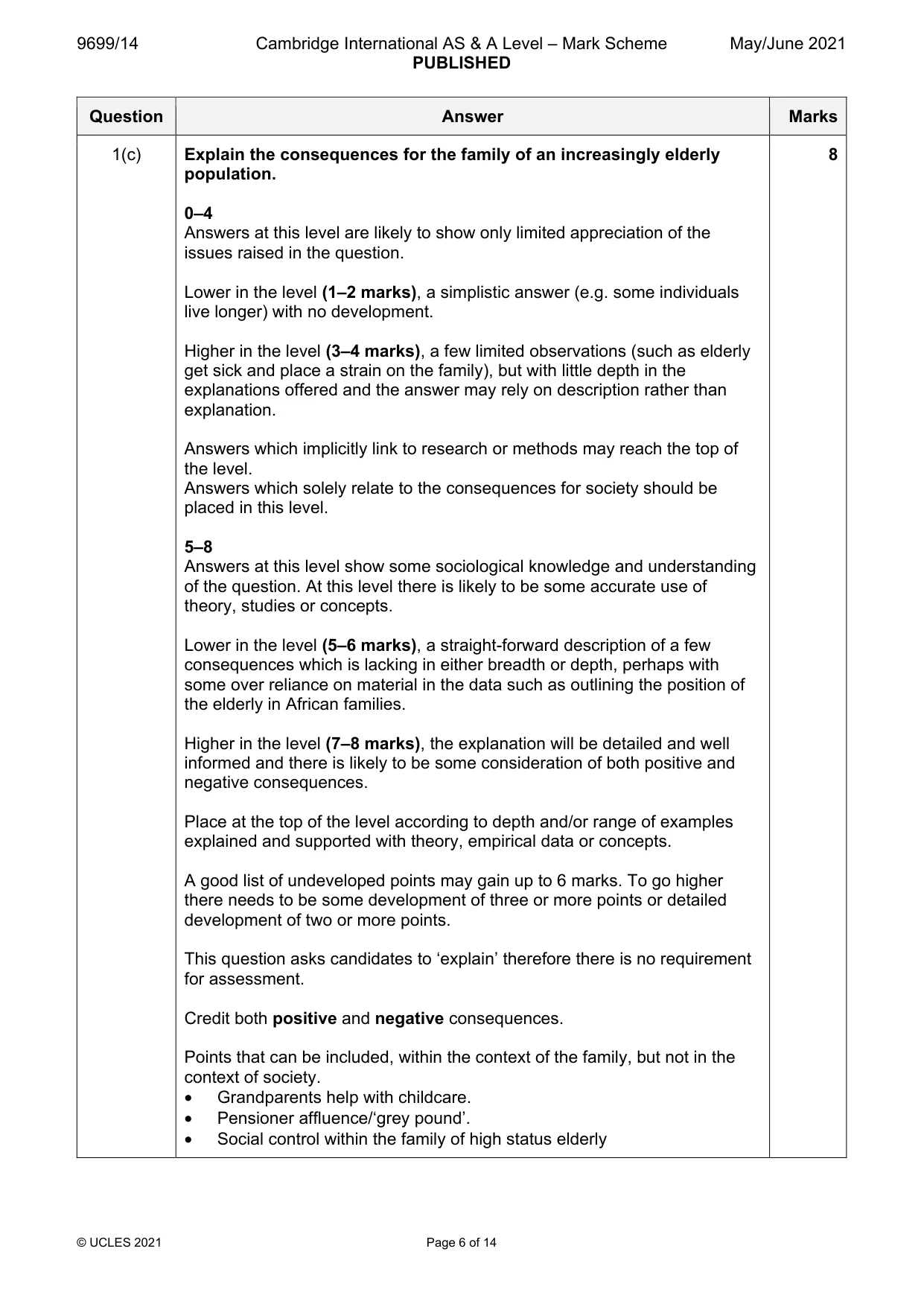
9699/14 Cambridge International AS & A Level – Mark Scheme PUBLISHED May/June 2021 © UCLES 2021 Page 6 of 14 Question Answer Marks 1(c) Explain the consequences for the family of an increasingly elderly population. 0–4 Answers at this level are likely to show only limited appreciation of the issues raised in the question. Lower in the level (1–2 marks), a simplistic answer (e.g. some individuals live longer) with no development. Higher in the level (3–4 marks), a few limited observations (such as elderly get sick and place a strain on the family), but with little depth in the explanations offered and the answer may rely on description rather than explanation. Answers which implicitly link to research or methods may reach the top of the level. Answers which solely relate to the consequences for society should be placed in this level. 5–8 Answers at this level show some sociological knowledge and understanding of the question. At this level there is likely to be some accurate use of theory, studies or concepts. Lower in the level (5–6 marks), a straight-forward description of a few consequences which is lacking in either breadth or depth, perhaps with some over reliance on material in the data such as outlining the position of the elderly in African families. Higher in the level (7–8 marks), the explanation will be detailed and well informed and there is likely to be some consideration of both positive and negative consequences. Place at the top of the level according to depth and/or range of examples explained and supported with theory, empirical data or concepts. A good list of undeveloped points may gain up to 6 marks. To go higher there needs to be some development of three or more points or detailed development of two or more points. This question asks candidates to ‘explain’ therefore there is no requirement for assessment. Credit both positive and negative consequences. Points that can be included, within the context of the family, but not in the context of society. • Grandparents help with childcare. • Pensioner affluence/‘grey pound’. • Social control within the family of high status elderly 8
Mark scheme, page 7
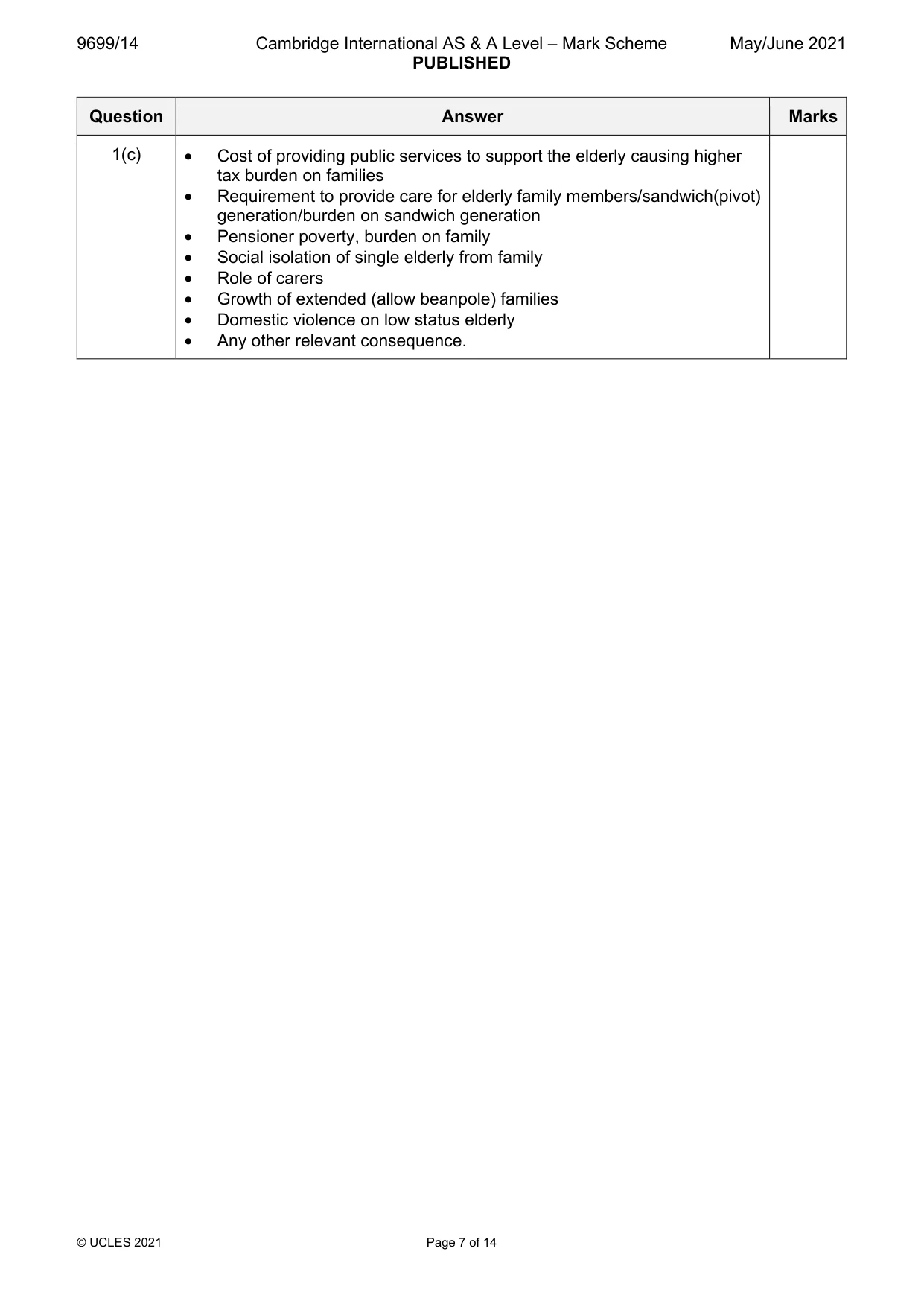
9699/14 Cambridge International AS & A Level – Mark Scheme PUBLISHED May/June 2021 © UCLES 2021 Page 7 of 14 Question Answer Marks 1(c) • Cost of providing public services to support the elderly causing higher tax burden on families • Requirement to provide care for elderly family members/sandwich(pivot) generation/burden on sandwich generation • Pensioner poverty, burden on family • Social isolation of single elderly from family • Role of carers • Growth of extended (allow beanpole) families • Domestic violence on low status elderly • Any other relevant consequence.
Mark scheme, page 8
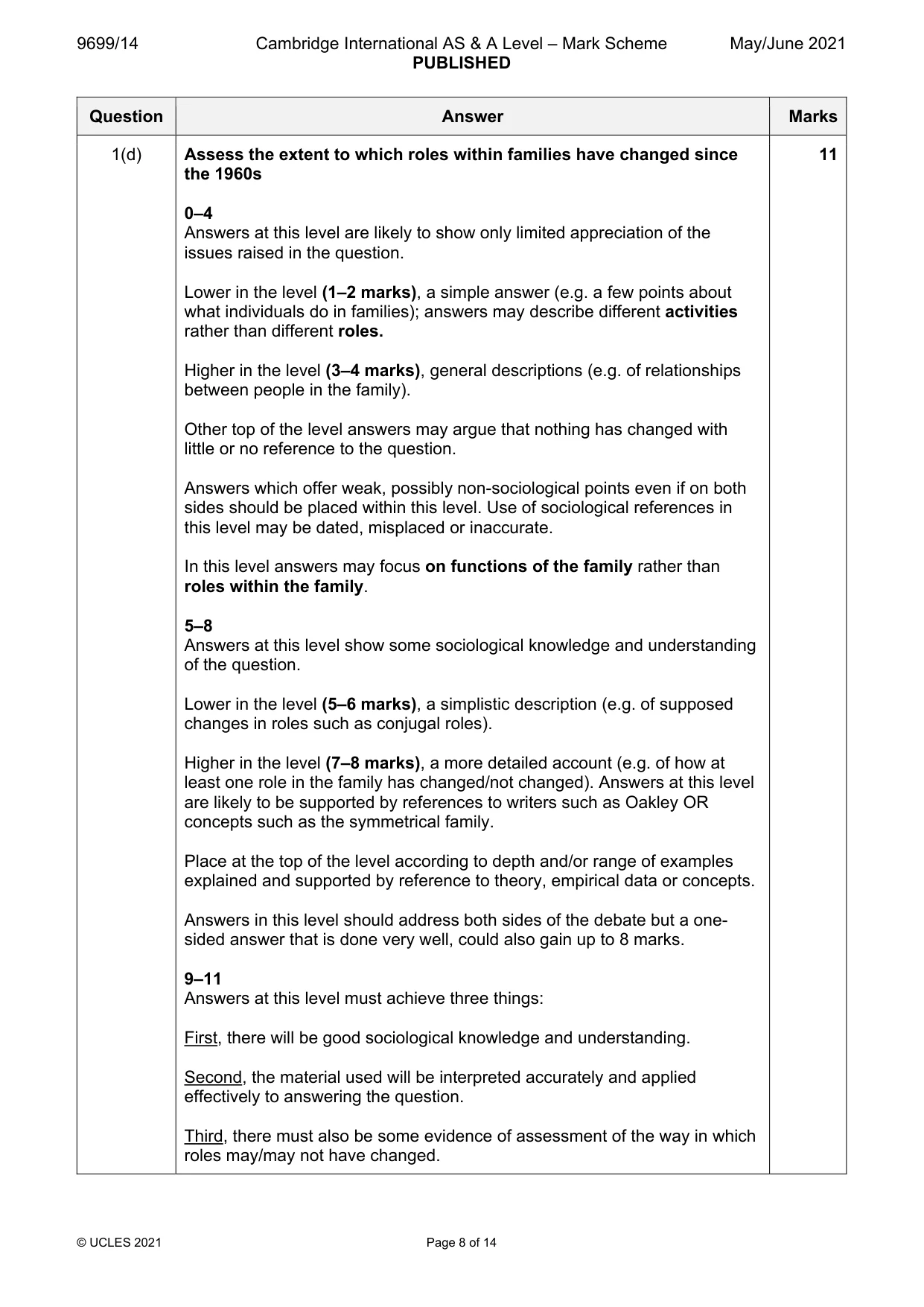
9699/14 Cambridge International AS & A Level – Mark Scheme PUBLISHED May/June 2021 © UCLES 2021 Page 8 of 14 Question Answer Marks 1(d) Assess the extent to which roles within families have changed since the 1960s 0–4 Answers at this level are likely to show only limited appreciation of the issues raised in the question. Lower in the level (1–2 marks), a simple answer (e.g. a few points about what individuals do in families); answers may describe different activities rather than different roles. Higher in the level (3–4 marks), general descriptions (e.g. of relationships between people in the family). Other top of the level answers may argue that nothing has changed with little or no reference to the question. Answers which offer weak, possibly non-sociological points even if on both sides should be placed within this level. Use of sociological references in this level may be dated, misplaced or inaccurate. In this level answers may focus on functions of the family rather than roles within the family. 5–8 Answers at this level show some sociological knowledge and understanding of the question. Lower in the level (5–6 marks), a simplistic description (e.g. of supposed changes in roles such as conjugal roles). Higher in the level (7–8 marks), a more detailed account (e.g. of how at least one role in the family has changed/not changed). Answers at this level are likely to be supported by references to writers such as Oakley OR concepts such as the symmetrical family. Place at the top of the level according to depth and/or range of examples explained and supported by reference to theory, empirical data or concepts. Answers in this level should address both sides of the debate but a one- sided answer that is done very well, could also gain up to 8 marks. 9–11 Answers at this level must achieve three things: First, there will be good sociological knowledge and understanding. Second, the material used will be interpreted accurately and applied effectively to answering the question. Third, there must also be some evidence of assessment of the way in which roles may/may not have changed. 11
Mark scheme, page 9
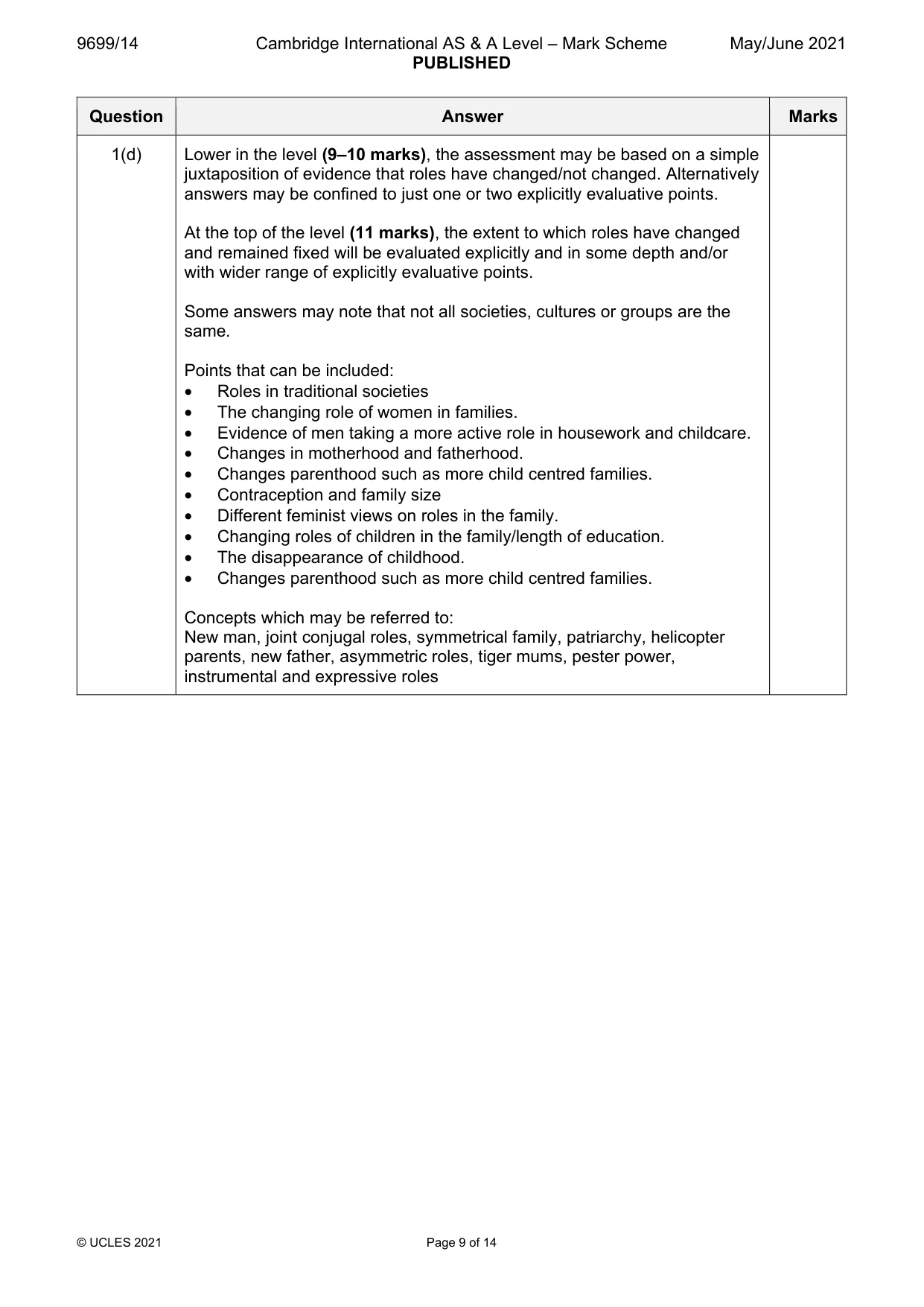
9699/14 Cambridge International AS & A Level – Mark Scheme PUBLISHED May/June 2021 © UCLES 2021 Page 9 of 14 Question Answer Marks 1(d) Lower in the level (9–10 marks), the assessment may be based on a simple juxtaposition of evidence that roles have changed/not changed. Alternatively answers may be confined to just one or two explicitly evaluative points. At the top of the level (11 marks), the extent to which roles have changed and remained fixed will be evaluated explicitly and in some depth and/or with wider range of explicitly evaluative points. Some answers may note that not all societies, cultures or groups are the same. Points that can be included: • Roles in traditional societies • The changing role of women in families. • Evidence of men taking a more active role in housework and childcare. • Changes in motherhood and fatherhood. • Changes parenthood such as more child centred families. • Contraception and family size • Different feminist views on roles in the family. • Changing roles of children in the family/length of education. • The disappearance of childhood. • Changes parenthood such as more child centred families. Concepts which may be referred to: New man, joint conjugal roles, symmetrical family, patriarchy, helicopter parents, new father, asymmetric roles, tiger mums, pester power, instrumental and expressive roles
Mark scheme, page 10
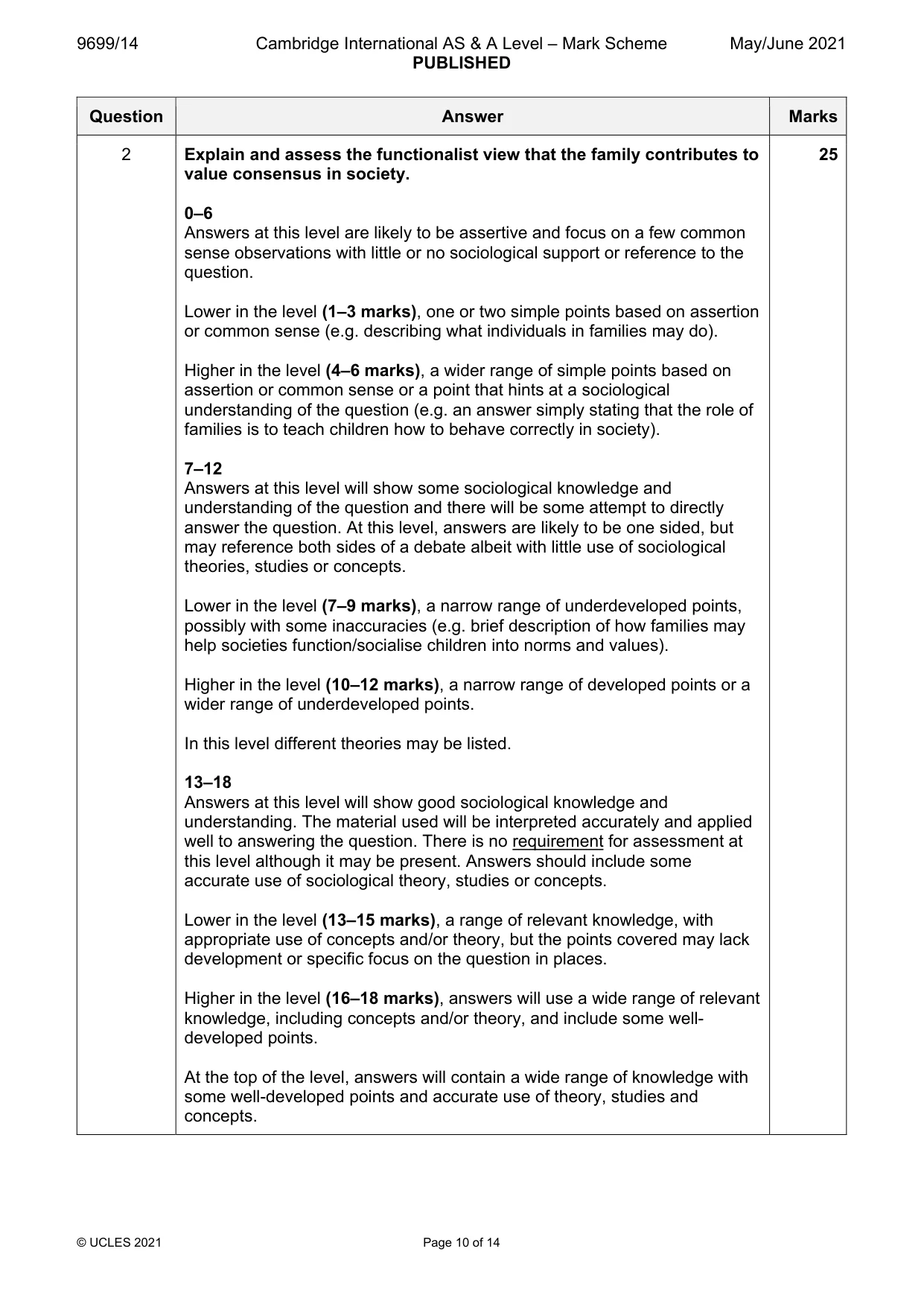
9699/14 Cambridge International AS & A Level – Mark Scheme PUBLISHED May/June 2021 © UCLES 2021 Page 10 of 14 Question Answer Marks 2 Explain and assess the functionalist view that the family contributes to value consensus in society. 0–6 Answers at this level are likely to be assertive and focus on a few common sense observations with little or no sociological support or reference to the question. Lower in the level (1–3 marks), one or two simple points based on assertion or common sense (e.g. describing what individuals in families may do). Higher in the level (4–6 marks), a wider range of simple points based on assertion or common sense or a point that hints at a sociological understanding of the question (e.g. an answer simply stating that the role of families is to teach children how to behave correctly in society). 7–12 Answers at this level will show some sociological knowledge and understanding of the question and there will be some attempt to directly answer the question. At this level, answers are likely to be one sided, but may reference both sides of a debate albeit with little use of sociological theories, studies or concepts. Lower in the level (7–9 marks), a narrow range of underdeveloped points, possibly with some inaccuracies (e.g. brief description of how families may help societies function/socialise children into norms and values). Higher in the level (10–12 marks), a narrow range of developed points or a wider range of underdeveloped points. In this level different theories may be listed. 13–18 Answers at this level will show good sociological knowledge and understanding. The material used will be interpreted accurately and applied well to answering the question. There is no requirement for assessment at this level although it may be present. Answers should include some accurate use of sociological theory, studies or concepts. Lower in the level (13–15 marks), a range of relevant knowledge, with appropriate use of concepts and/or theory, but the points covered may lack development or specific focus on the question in places. Higher in the level (16–18 marks), answers will use a wide range of relevant knowledge, including concepts and/or theory, and include some well- developed points. At the top of the level, answers will contain a wide range of knowledge with some well-developed points and accurate use of theory, studies and concepts. 25
Mark scheme, page 11
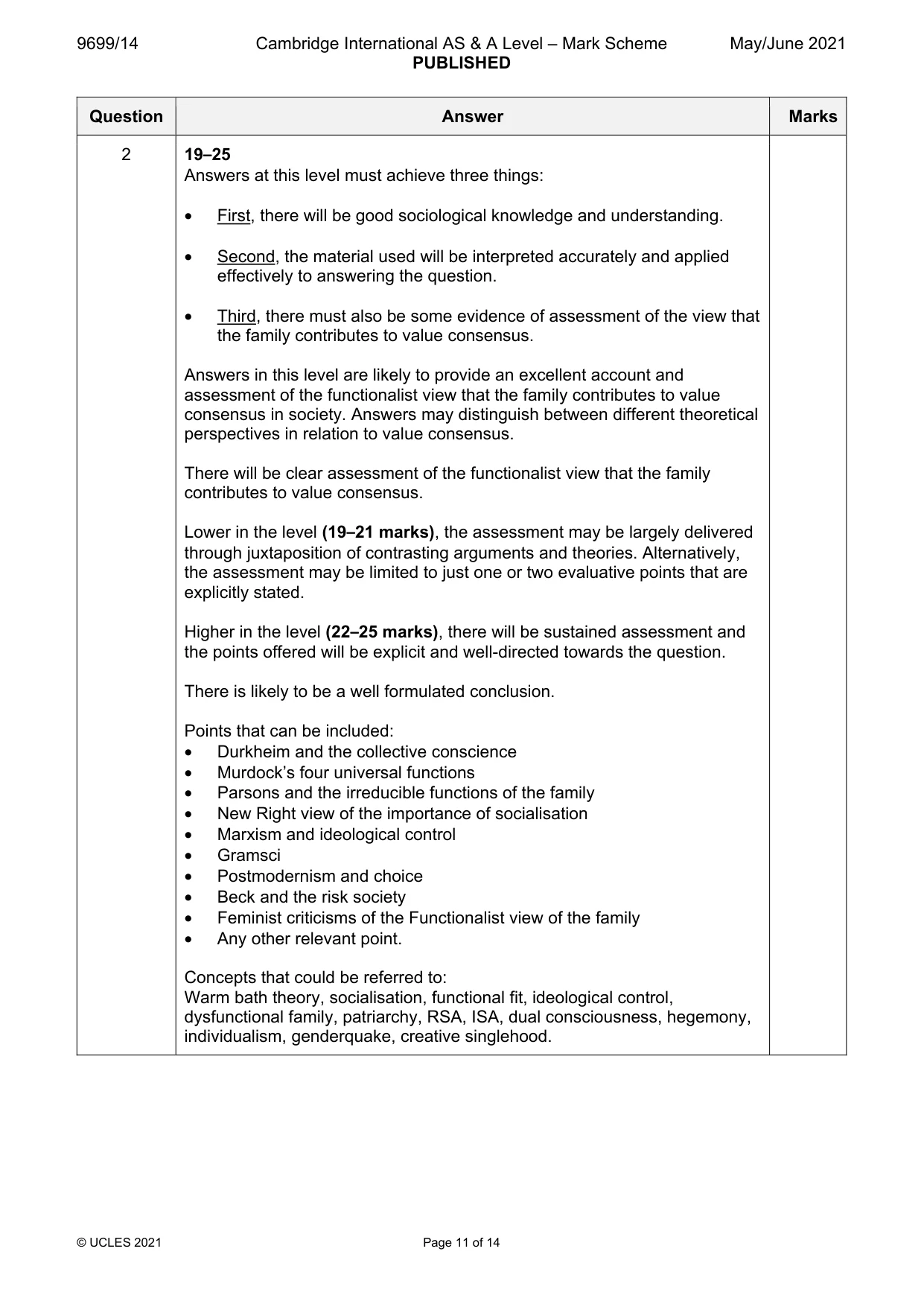
9699/14 Cambridge International AS & A Level – Mark Scheme PUBLISHED May/June 2021 © UCLES 2021 Page 11 of 14 Question Answer Marks 2 19–25 Answers at this level must achieve three things: • First, there will be good sociological knowledge and understanding. • Second, the material used will be interpreted accurately and applied effectively to answering the question. • Third, there must also be some evidence of assessment of the view that the family contributes to value consensus. Answers in this level are likely to provide an excellent account and assessment of the functionalist view that the family contributes to value consensus in society. Answers may distinguish between different theoretical perspectives in relation to value consensus. There will be clear assessment of the functionalist view that the family contributes to value consensus. Lower in the level (19–21 marks), the assessment may be largely delivered through juxtaposition of contrasting arguments and theories. Alternatively, the assessment may be limited to just one or two evaluative points that are explicitly stated. Higher in the level (22–25 marks), there will be sustained assessment and the points offered will be explicit and well-directed towards the question. There is likely to be a well formulated conclusion. Points that can be included: • Durkheim and the collective conscience • Murdock’s four universal functions • Parsons and the irreducible functions of the family • New Right view of the importance of socialisation • Marxism and ideological control • Gramsci • Postmodernism and choice • Beck and the risk society • Feminist criticisms of the Functionalist view of the family • Any other relevant point. Concepts that could be referred to: Warm bath theory, socialisation, functional fit, ideological control, dysfunctional family, patriarchy, RSA, ISA, dual consciousness, hegemony, individualism, genderquake, creative singlehood.
Mark scheme, page 12
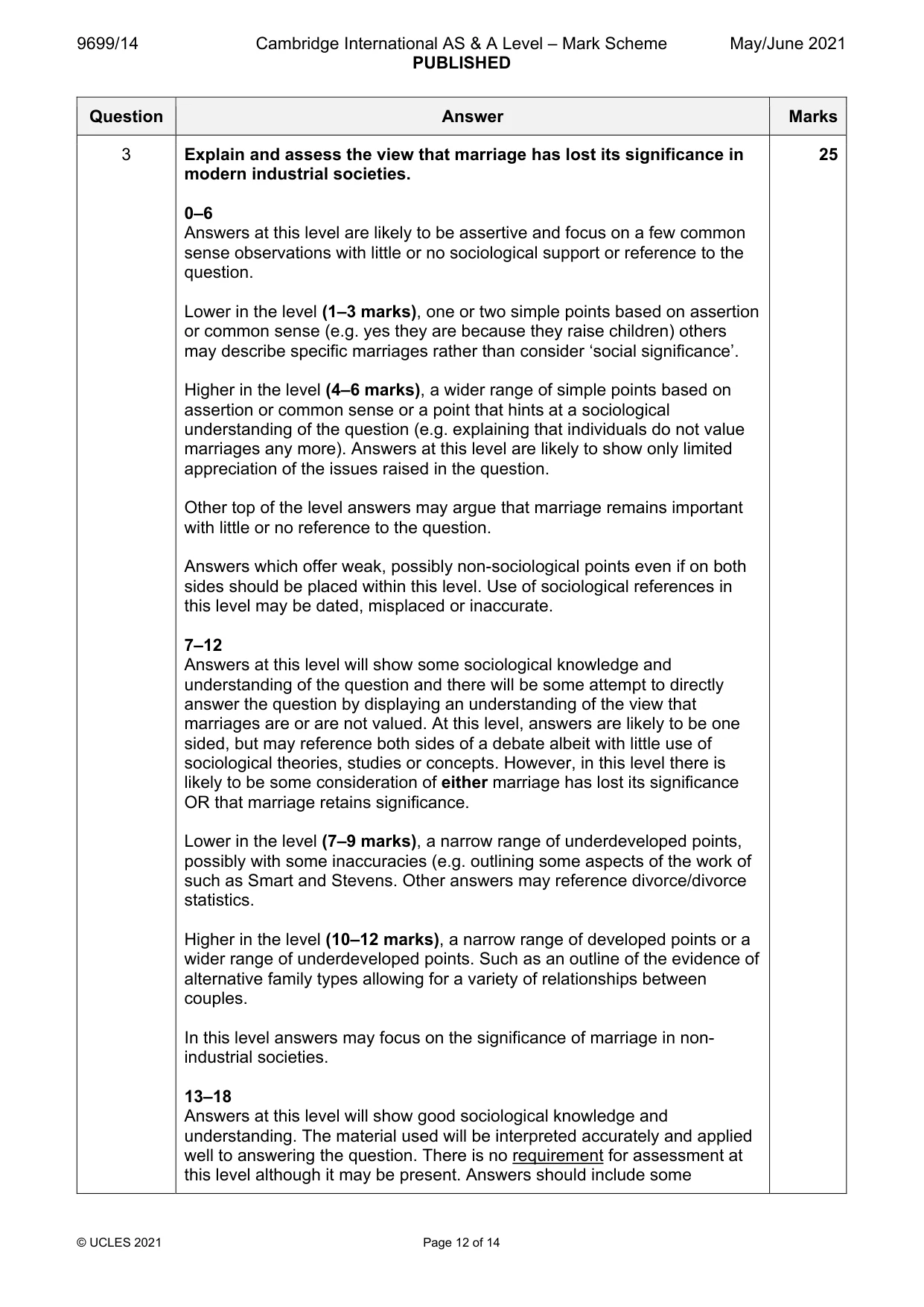
9699/14 Cambridge International AS & A Level – Mark Scheme PUBLISHED May/June 2021 © UCLES 2021 Page 12 of 14 Question Answer Marks 3 Explain and assess the view that marriage has lost its significance in modern industrial societies. 0–6 Answers at this level are likely to be assertive and focus on a few common sense observations with little or no sociological support or reference to the question. Lower in the level (1–3 marks), one or two simple points based on assertion or common sense (e.g. yes they are because they raise children) others may describe specific marriages rather than consider ‘social significance’. Higher in the level (4–6 marks), a wider range of simple points based on assertion or common sense or a point that hints at a sociological understanding of the question (e.g. explaining that individuals do not value marriages any more). Answers at this level are likely to show only limited appreciation of the issues raised in the question. Other top of the level answers may argue that marriage remains important with little or no reference to the question. Answers which offer weak, possibly non-sociological points even if on both sides should be placed within this level. Use of sociological references in this level may be dated, misplaced or inaccurate. 7–12 Answers at this level will show some sociological knowledge and understanding of the question and there will be some attempt to directly answer the question by displaying an understanding of the view that marriages are or are not valued. At this level, answers are likely to be one sided, but may reference both sides of a debate albeit with little use of sociological theories, studies or concepts. However, in this level there is likely to be some consideration of either marriage has lost its significance OR that marriage retains significance. Lower in the level (7–9 marks), a narrow range of underdeveloped points, possibly with some inaccuracies (e.g. outlining some aspects of the work of such as Smart and Stevens. Other answers may reference divorce/divorce statistics. Higher in the level (10–12 marks), a narrow range of developed points or a wider range of underdeveloped points. Such as an outline of the evidence of alternative family types allowing for a variety of relationships between couples. In this level answers may focus on the significance of marriage in non- industrial societies. 13–18 Answers at this level will show good sociological knowledge and understanding. The material used will be interpreted accurately and applied well to answering the question. There is no requirement for assessment at this level although it may be present. Answers should include some 25
Mark scheme, page 13
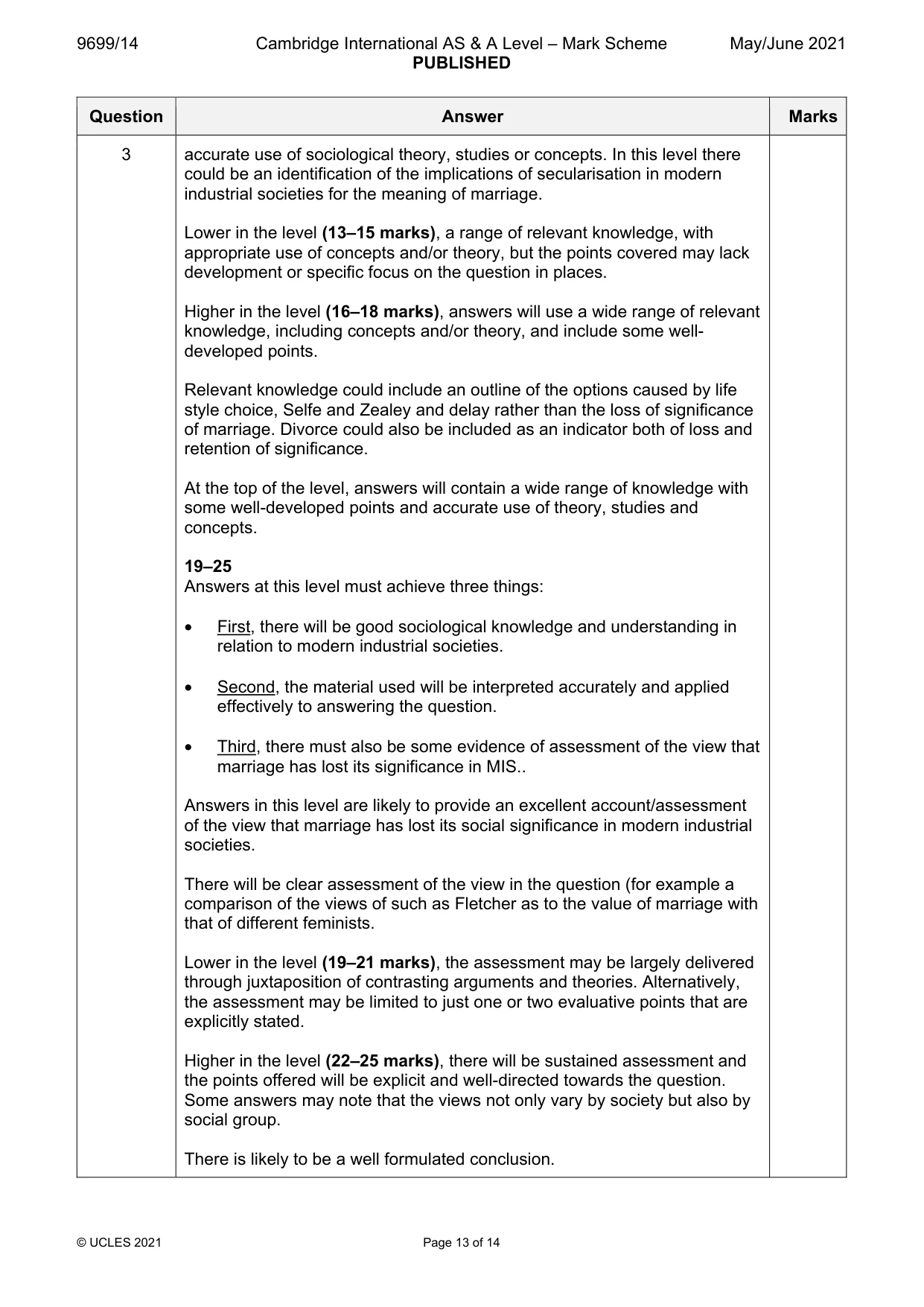
9699/14 Cambridge International AS & A Level – Mark Scheme PUBLISHED May/June 2021 © UCLES 2021 Page 13 of 14 Question Answer Marks 3 accurate use of sociological theory, studies or concepts. In this level there could be an identification of the implications of secularisation in modern industrial societies for the meaning of marriage. Lower in the level (13–15 marks), a range of relevant knowledge, with appropriate use of concepts and/or theory, but the points covered may lack development or specific focus on the question in places. Higher in the level (16–18 marks), answers will use a wide range of relevant knowledge, including concepts and/or theory, and include some well- developed points. Relevant knowledge could include an outline of the options caused by life style choice, Selfe and Zealey and delay rather than the loss of significance of marriage. Divorce could also be included as an indicator both of loss and retention of significance. At the top of the level, answers will contain a wide range of knowledge with some well-developed points and accurate use of theory, studies and concepts. 19–25 Answers at this level must achieve three things: • First, there will be good sociological knowledge and understanding in relation to modern industrial societies. • Second, the material used will be interpreted accurately and applied effectively to answering the question. • Third, there must also be some evidence of assessment of the view that marriage has lost its significance in MIS.. Answers in this level are likely to provide an excellent account/assessment of the view that marriage has lost its social significance in modern industrial societies. There will be clear assessment of the view in the question (for example a comparison of the views of such as Fletcher as to the value of marriage with that of different feminists. Lower in the level (19–21 marks), the assessment may be largely delivered through juxtaposition of contrasting arguments and theories. Alternatively, the assessment may be limited to just one or two evaluative points that are explicitly stated. Higher in the level (22–25 marks), there will be sustained assessment and the points offered will be explicit and well-directed towards the question. Some answers may note that the views not only vary by society but also by social group. There is likely to be a well formulated conclusion.
Mark scheme, page 14
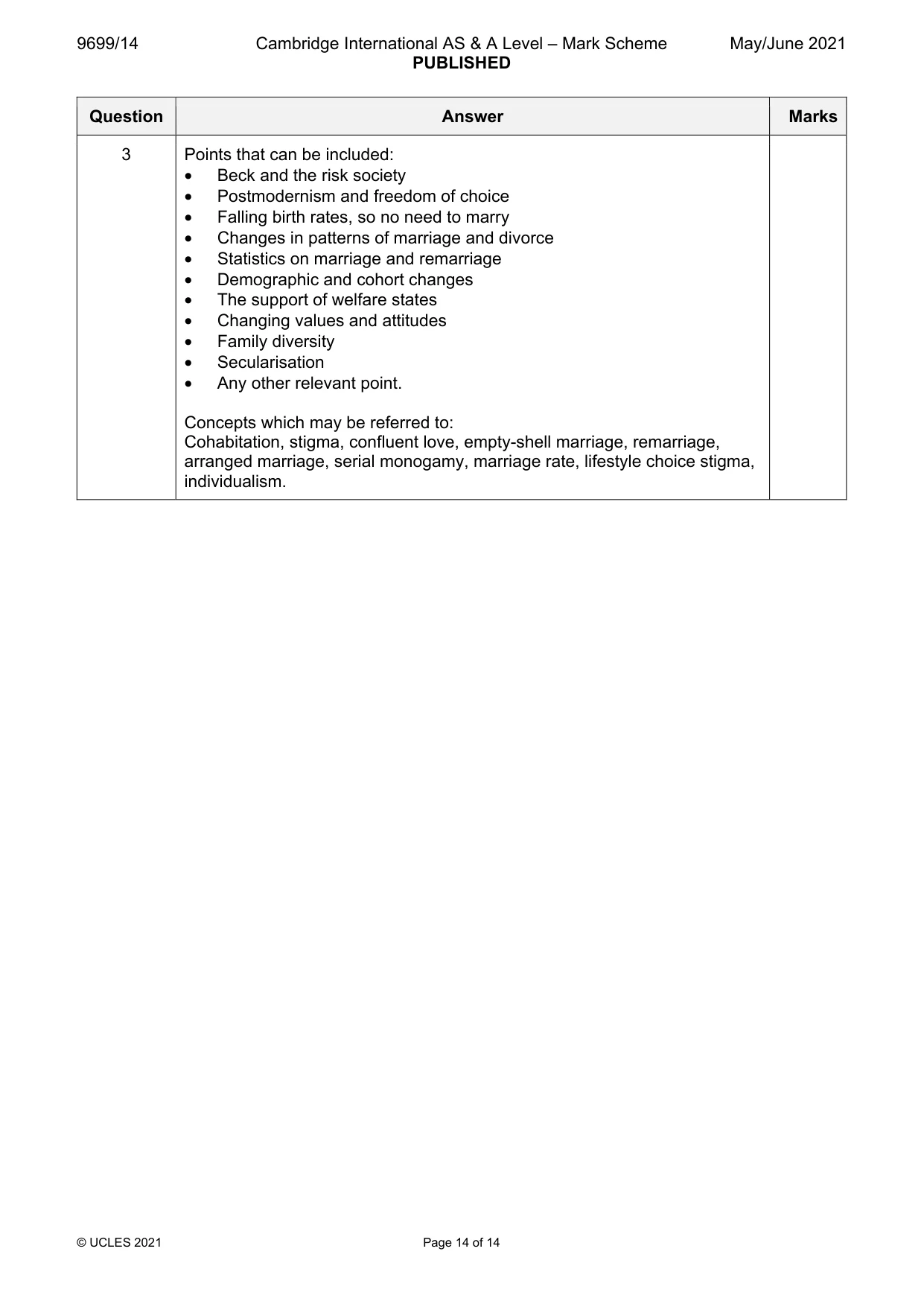
9699/14 Cambridge International AS & A Level – Mark Scheme PUBLISHED May/June 2021 © UCLES 2021 Page 14 of 14 Question Answer Marks 3 Points that can be included: • Beck and the risk society • Postmodernism and freedom of choice • Falling birth rates, so no need to marry • Changes in patterns of marriage and divorce • Statistics on marriage and remarriage • Demographic and cohort changes • The support of welfare states • Changing values and attitudes • Family diversity • Secularisation • Any other relevant point. Concepts which may be referred to: Cohabitation, stigma, confluent love, empty-shell marriage, remarriage, arranged marriage, serial monogamy, marriage rate, lifestyle choice stigma, individualism.
What you needed in this session
Cambridge’s own grade thresholds for 2021 May/June, Paper 1 · Variant 4. A higher threshold means an easier paper — the bar moves with how the cohort did.