Cambridge A Level Sociology 9699 — 2020 Oct/Nov Paper 3 · Variant 3
9699/33/O/N/20 · 75 marks · ≈84 min
The question paper and its mark scheme, free to read here and free to download. This is Cambridge’s own paper, exactly as it was sat.
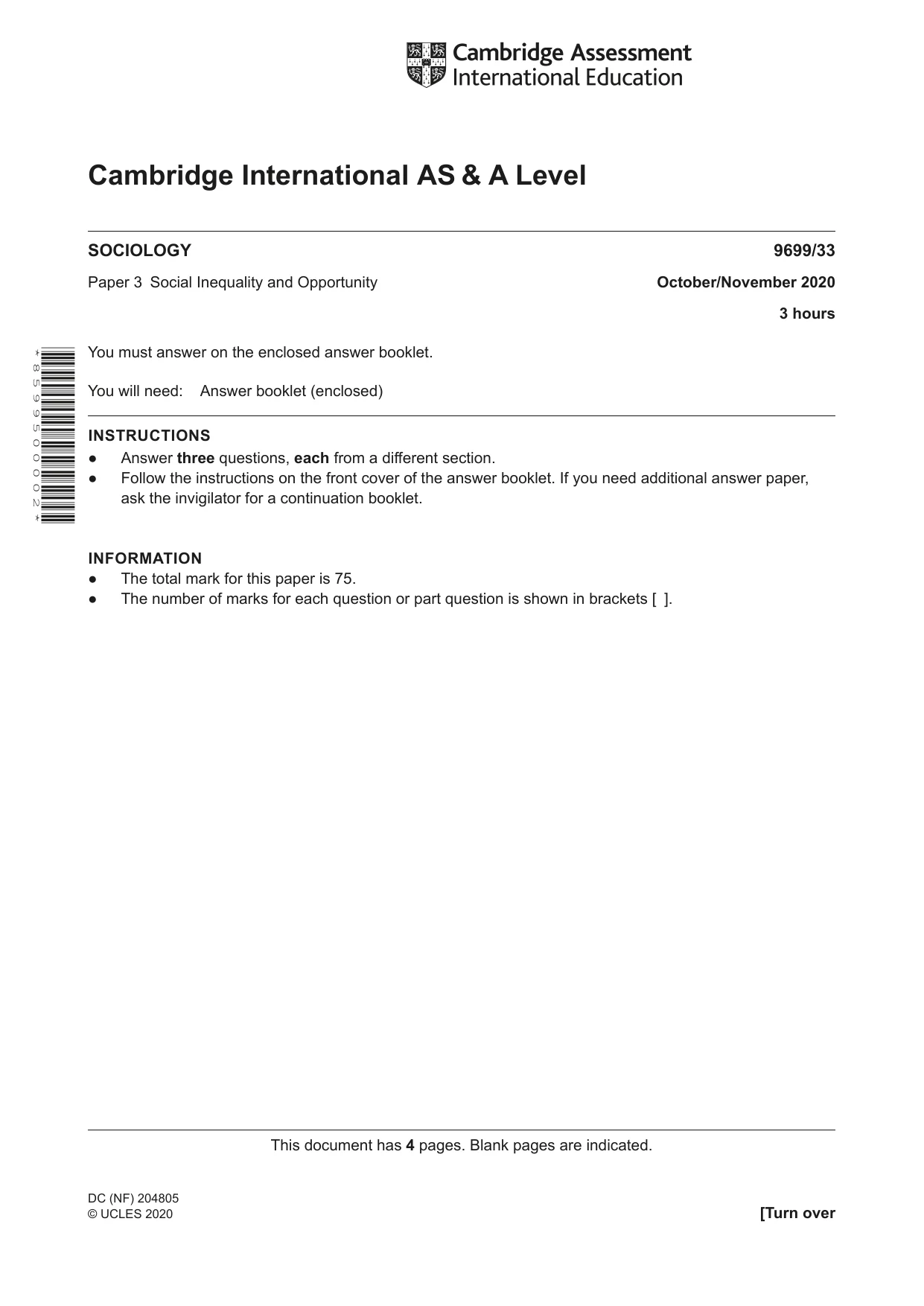
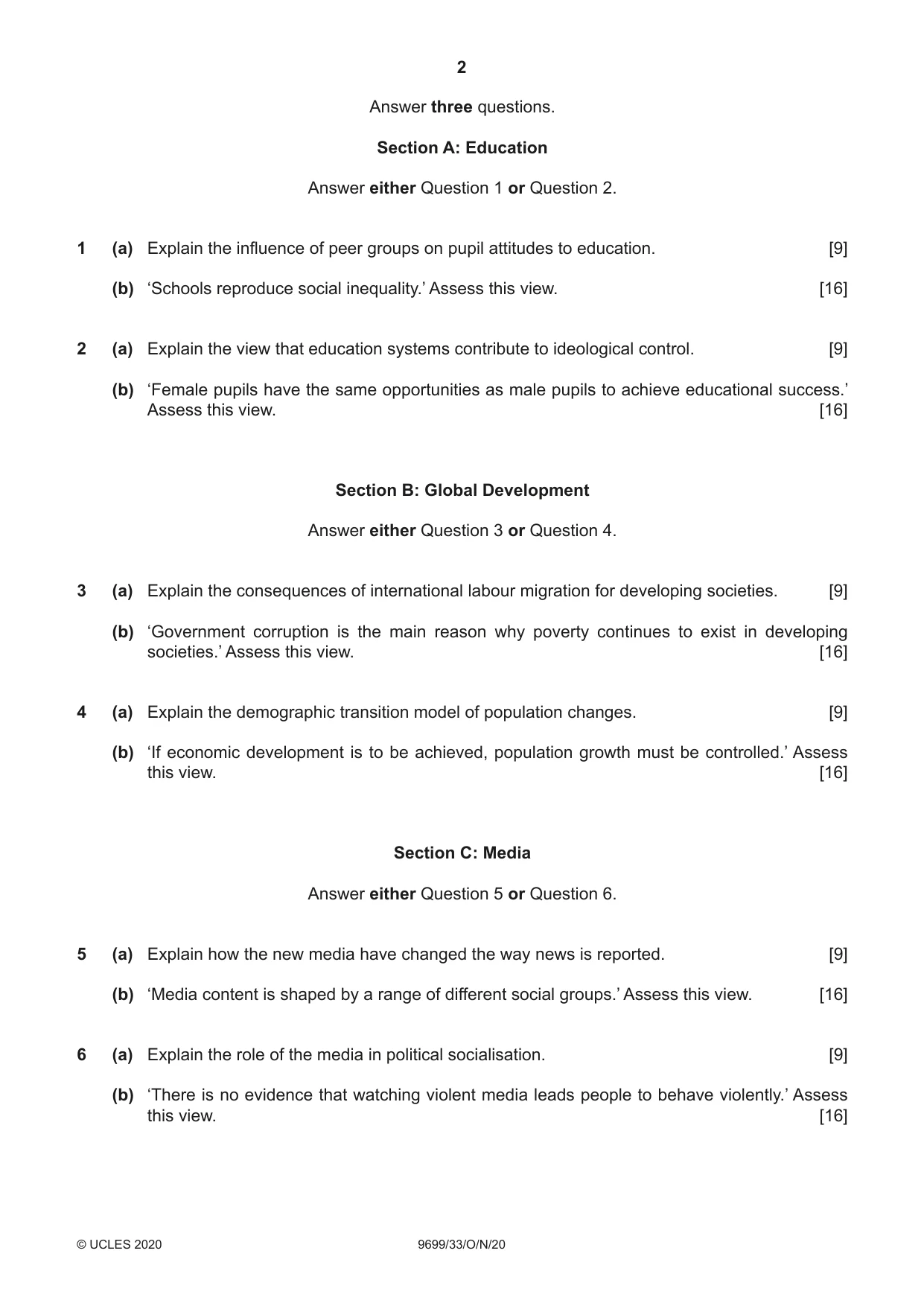
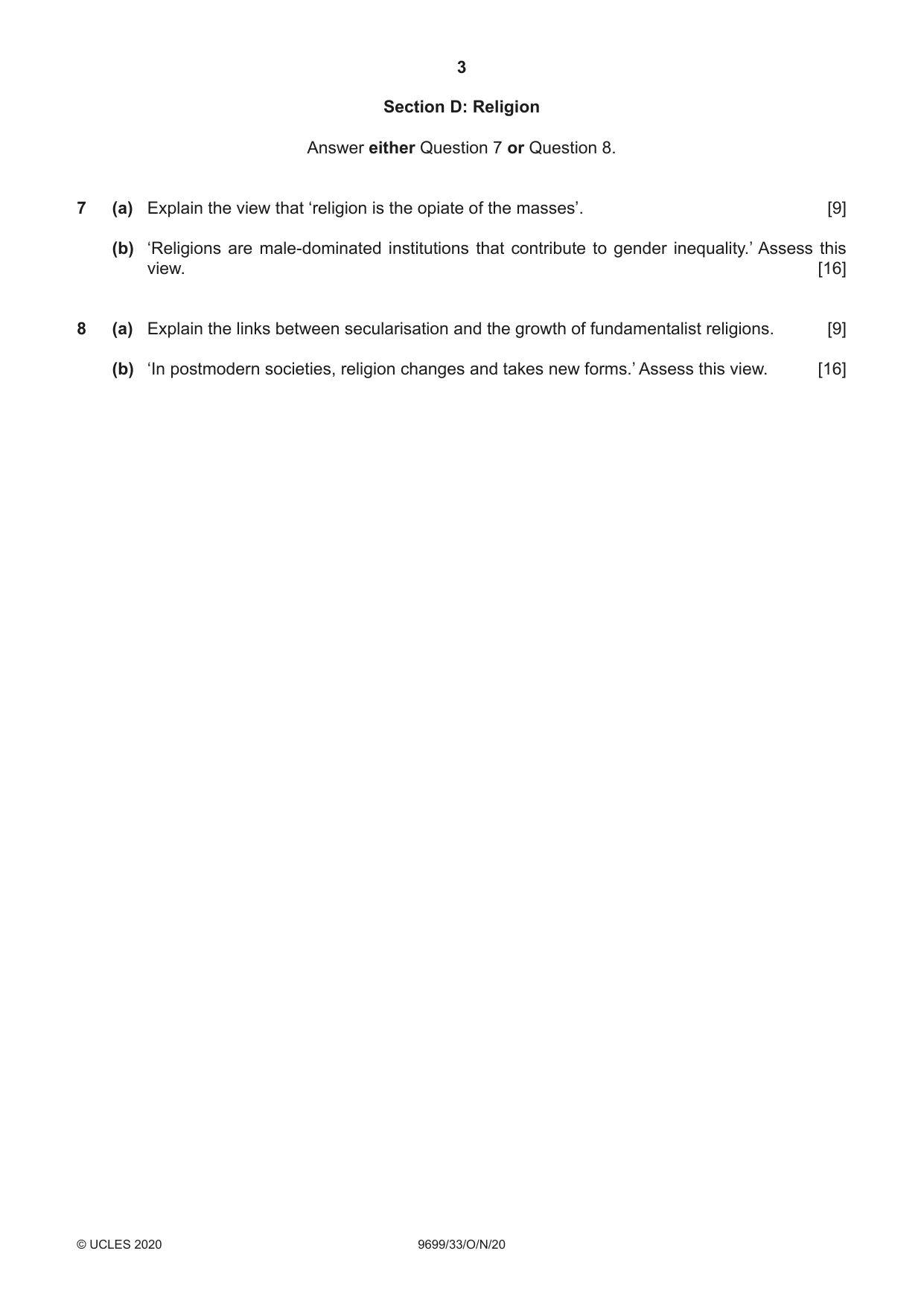
Question paper4 pages

Mark scheme16 pages
Answers below. Sit the paper first if you are practising.

Paper as text
Question paper, page 1
Cambridge International AS & A Level DC (NF) 204805 © UCLES 2020 [Turn over This document has 4 pages. Blank pages are indicated. SOCIOLOGY 9699/33 Paper 3 Social Inequality and Opportunity October/November 2020 3 hours You must answer on the enclosed answer booklet. You will need: Answer booklet (enclosed) INSTRUCTIONS ● Answer three questions, each from a different section. ● Follow the instructions on the front cover of the answer booklet. If you need additional answer paper, ask the invigilator for a continuation booklet. INFORMATION ● The total mark for this paper is 75. ● The number of marks for each question or part question is shown in brackets [ ]. * 8 5 9 9 5 0 0 0 0 2 *
Question paper, page 2
2 9699/33/O/N/20 © UCLES 2020 Answer three questions. Section A: Education Answer either Question 1 or Question 2. 1 (a) Explain the influence of peer groups on pupil attitudes to education. [9] (b) ‘Schools reproduce social inequality.’ Assess this view. [16] 2 (a) Explain the view that education systems contribute to ideological control. [9] (b) ‘Female pupils have the same opportunities as male pupils to achieve educational success.’ Assess this view. [16] Section B: Global Development Answer either Question 3 or Question 4. 3 (a) Explain the consequences of international labour migration for developing societies. [9] (b) ‘Government corruption is the main reason why poverty continues to exist in developing societies.’ Assess this view. [16] 4 (a) Explain the demographic transition model of population changes. [9] (b) ‘If economic development is to be achieved, population growth must be controlled.’ Assess this view. [16] Section C: Media Answer either Question 5 or Question 6. 5 (a) Explain how the new media have changed the way news is reported. [9] (b) ‘Media content is shaped by a range of different social groups.’ Assess this view. [16] 6 (a) Explain the role of the media in political socialisation. [9] (b) ‘There is no evidence that watching violent media leads people to behave violently.’ Assess this view. [16]
Question paper, page 3
3 9699/33/O/N/20 © UCLES 2020 Section D: Religion Answer either Question 7 or Question 8. 7 (a) Explain the view that ‘religion is the opiate of the masses’. [9] (b) ‘Religions are male-dominated institutions that contribute to gender inequality.’ Assess this view. [16] 8 (a) Explain the links between secularisation and the growth of fundamentalist religions. [9] (b) ‘In postmodern societies, religion changes and takes new forms.’ Assess this view. [16]
Question paper, page 4
4 9699/33/O/N/20 © UCLES 2020 Permission to reproduce items where third-party owned material protected by copyright is included has been sought and cleared where possible. Every reasonable effort has been made by the publisher (UCLES) to trace copyright holders, but if any items requiring clearance have unwittingly been included, the publisher will be pleased to make amends at the earliest possible opportunity. To avoid the issue of disclosure of answer-related information to candidates, all copyright acknowledgements are reproduced online in the Cambridge Assessment International Education Copyright Acknowledgements Booklet. This is produced for each series of examinations and is freely available to download at www.cambridgeinternational.org after the live examination series. Cambridge Assessment International Education is part of the Cambridge Assessment Group. Cambridge Assessment is the brand name of the University of Cambridge Local Examinations Syndicate (UCLES), which itself is a department of the University of Cambridge. BLANK PAGE
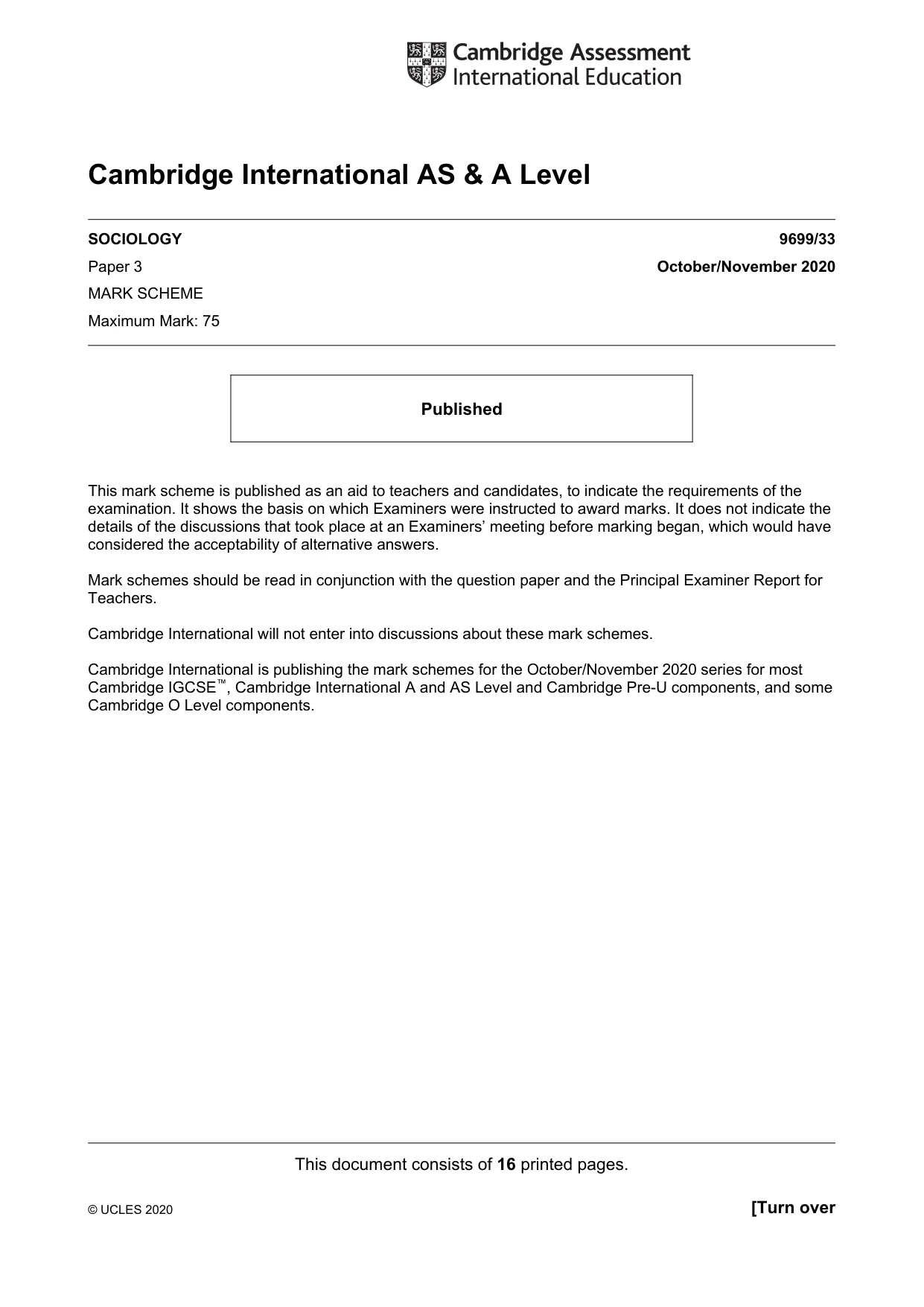
Mark scheme, page 1
This document consists of 16 printed pages. © UCLES 2020 [Turn over Cambridge International AS & A Level SOCIOLOGY 9699/33 Paper 3 October/November 2020 MARK SCHEME Maximum Mark: 75 Published This mark scheme is published as an aid to teachers and candidates, to indicate the requirements of the examination. It shows the basis on which Examiners were instructed to award marks. It does not indicate the details of the discussions that took place at an Examiners’ meeting before marking began, which would have considered the acceptability of alternative answers. Mark schemes should be read in conjunction with the question paper and the Principal Examiner Report for Teachers. Cambridge International will not enter into discussions about these mark schemes. Cambridge International is publishing the mark schemes for the October/November 2020 series for most Cambridge IGCSE™, Cambridge International A and AS Level and Cambridge Pre-U components, and some Cambridge O Level components.
Mark scheme, page 2
9699/33 Cambridge International AS & A Level – Mark Scheme PUBLISHED October/November 2020 © UCLES 2020 Page 2 of 16 Generic Marking Principles These general marking principles must be applied by all examiners when marking candidate answers. They should be applied alongside the specific content of the mark scheme or generic level descriptors for a question. Each question paper and mark scheme will also comply with these marking principles. GENERIC MARKING PRINCIPLE 1: Marks must be awarded in line with: • the specific content of the mark scheme or the generic level descriptors for the question • the specific skills defined in the mark scheme or in the generic level descriptors for the question • the standard of response required by a candidate as exemplified by the standardisation scripts. GENERIC MARKING PRINCIPLE 2: Marks awarded are always whole marks (not half marks, or other fractions). GENERIC MARKING PRINCIPLE 3: Marks must be awarded positively: • marks are awarded for correct/valid answers, as defined in the mark scheme. However, credit is given for valid answers which go beyond the scope of the syllabus and mark scheme, referring to your Team Leader as appropriate • marks are awarded when candidates clearly demonstrate what they know and can do • marks are not deducted for errors • marks are not deducted for omissions • answers should only be judged on the quality of spelling, punctuation and grammar when these features are specifically assessed by the question as indicated by the mark scheme. The meaning, however, should be unambiguous. GENERIC MARKING PRINCIPLE 4: Rules must be applied consistently, e.g. in situations where candidates have not followed instructions or in the application of generic level descriptors. GENERIC MARKING PRINCIPLE 5: Marks should be awarded using the full range of marks defined in the mark scheme for the question (however; the use of the full mark range may be limited according to the quality of the candidate responses seen). GENERIC MARKING PRINCIPLE 6: Marks awarded are based solely on the requirements as defined in the mark scheme. Marks should not be awarded with grade thresholds or grade descriptors in mind.
Mark scheme, page 3
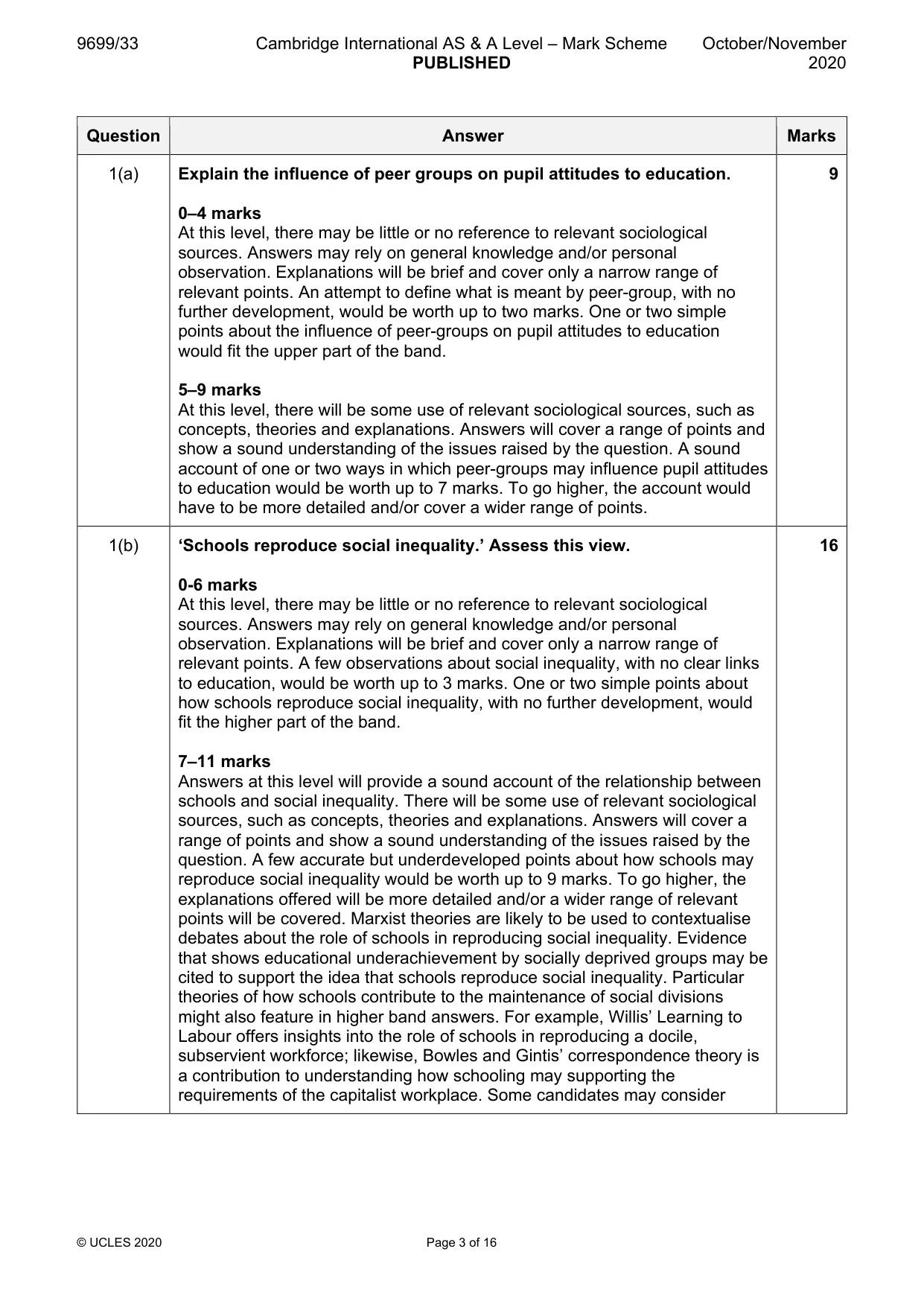
9699/33 Cambridge International AS & A Level – Mark Scheme PUBLISHED October/November 2020 © UCLES 2020 Page 3 of 16 Question Answer Marks 1(a) Explain the influence of peer groups on pupil attitudes to education. 0–4 marks At this level, there may be little or no reference to relevant sociological sources. Answers may rely on general knowledge and/or personal observation. Explanations will be brief and cover only a narrow range of relevant points. An attempt to define what is meant by peer-group, with no further development, would be worth up to two marks. One or two simple points about the influence of peer-groups on pupil attitudes to education would fit the upper part of the band. 5–9 marks At this level, there will be some use of relevant sociological sources, such as concepts, theories and explanations. Answers will cover a range of points and show a sound understanding of the issues raised by the question. A sound account of one or two ways in which peer-groups may influence pupil attitudes to education would be worth up to 7 marks. To go higher, the account would have to be more detailed and/or cover a wider range of points. 9 1(b) ‘Schools reproduce social inequality.’ Assess this view. 0-6 marks At this level, there may be little or no reference to relevant sociological sources. Answers may rely on general knowledge and/or personal observation. Explanations will be brief and cover only a narrow range of relevant points. A few observations about social inequality, with no clear links to education, would be worth up to 3 marks. One or two simple points about how schools reproduce social inequality, with no further development, would fit the higher part of the band. 7–11 marks Answers at this level will provide a sound account of the relationship between schools and social inequality. There will be some use of relevant sociological sources, such as concepts, theories and explanations. Answers will cover a range of points and show a sound understanding of the issues raised by the question. A few accurate but underdeveloped points about how schools may reproduce social inequality would be worth up to 9 marks. To go higher, the explanations offered will be more detailed and/or a wider range of relevant points will be covered. Marxist theories are likely to be used to contextualise debates about the role of schools in reproducing social inequality. Evidence that shows educational underachievement by socially deprived groups may be cited to support the idea that schools reproduce social inequality. Particular theories of how schools contribute to the maintenance of social divisions might also feature in higher band answers. For example, Willis’ Learning to Labour offers insights into the role of schools in reproducing a docile, subservient workforce; likewise, Bowles and Gintis’ correspondence theory is a contribution to understanding how schooling may supporting the requirements of the capitalist workplace. Some candidates may consider 16
Mark scheme, page 4
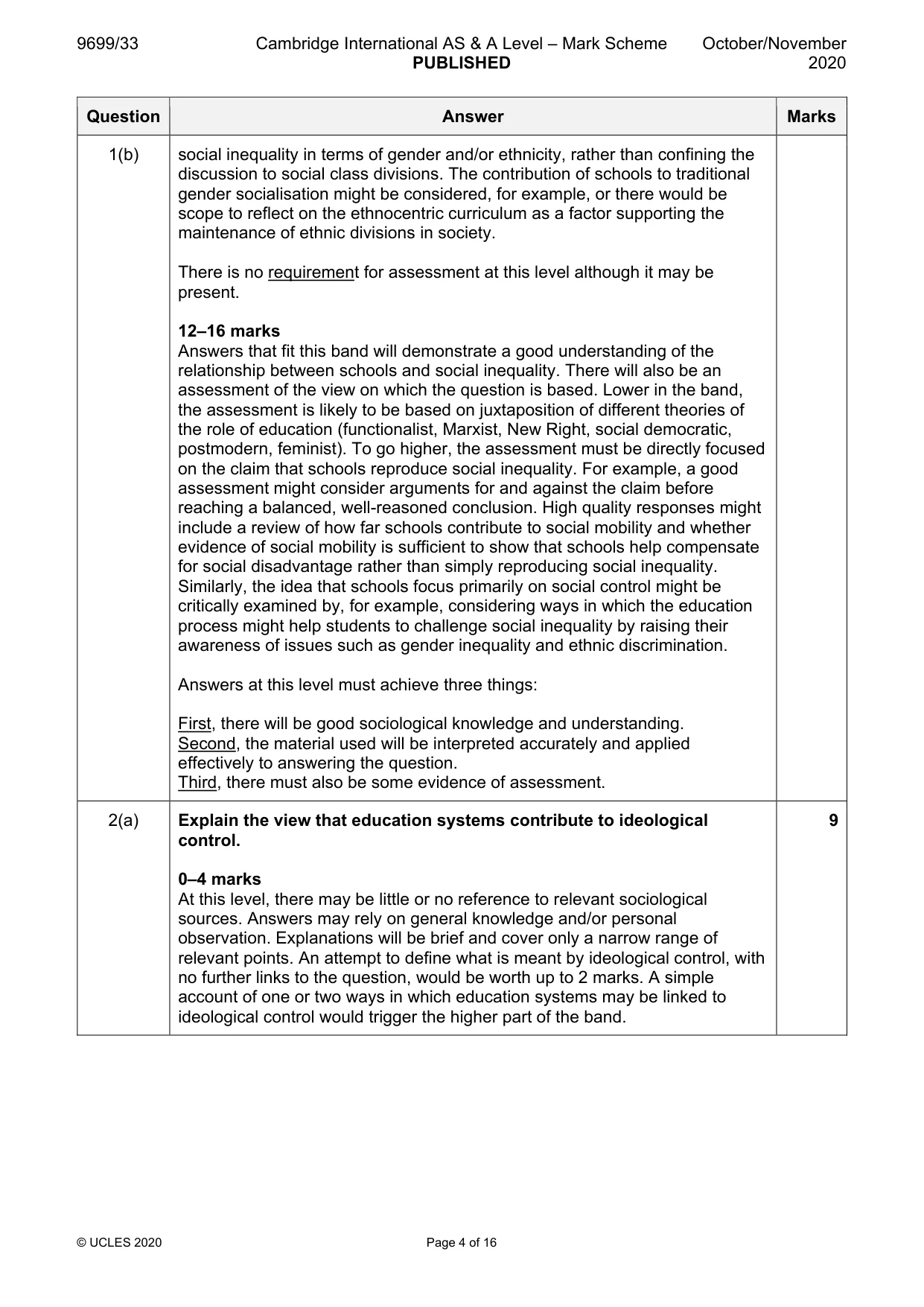
9699/33 Cambridge International AS & A Level – Mark Scheme PUBLISHED October/November 2020 © UCLES 2020 Page 4 of 16 Question Answer Marks 1(b) social inequality in terms of gender and/or ethnicity, rather than confining the discussion to social class divisions. The contribution of schools to traditional gender socialisation might be considered, for example, or there would be scope to reflect on the ethnocentric curriculum as a factor supporting the maintenance of ethnic divisions in society. There is no requirement for assessment at this level although it may be present. 12–16 marks Answers that fit this band will demonstrate a good understanding of the relationship between schools and social inequality. There will also be an assessment of the view on which the question is based. Lower in the band, the assessment is likely to be based on juxtaposition of different theories of the role of education (functionalist, Marxist, New Right, social democratic, postmodern, feminist). To go higher, the assessment must be directly focused on the claim that schools reproduce social inequality. For example, a good assessment might consider arguments for and against the claim before reaching a balanced, well-reasoned conclusion. High quality responses might include a review of how far schools contribute to social mobility and whether evidence of social mobility is sufficient to show that schools help compensate for social disadvantage rather than simply reproducing social inequality. Similarly, the idea that schools focus primarily on social control might be critically examined by, for example, considering ways in which the education process might help students to challenge social inequality by raising their awareness of issues such as gender inequality and ethnic discrimination. Answers at this level must achieve three things: First, there will be good sociological knowledge and understanding. Second, the material used will be interpreted accurately and applied effectively to answering the question. Third, there must also be some evidence of assessment. 2(a) Explain the view that education systems contribute to ideological control. 0–4 marks At this level, there may be little or no reference to relevant sociological sources. Answers may rely on general knowledge and/or personal observation. Explanations will be brief and cover only a narrow range of relevant points. An attempt to define what is meant by ideological control, with no further links to the question, would be worth up to 2 marks. A simple account of one or two ways in which education systems may be linked to ideological control would trigger the higher part of the band. 9
Mark scheme, page 5
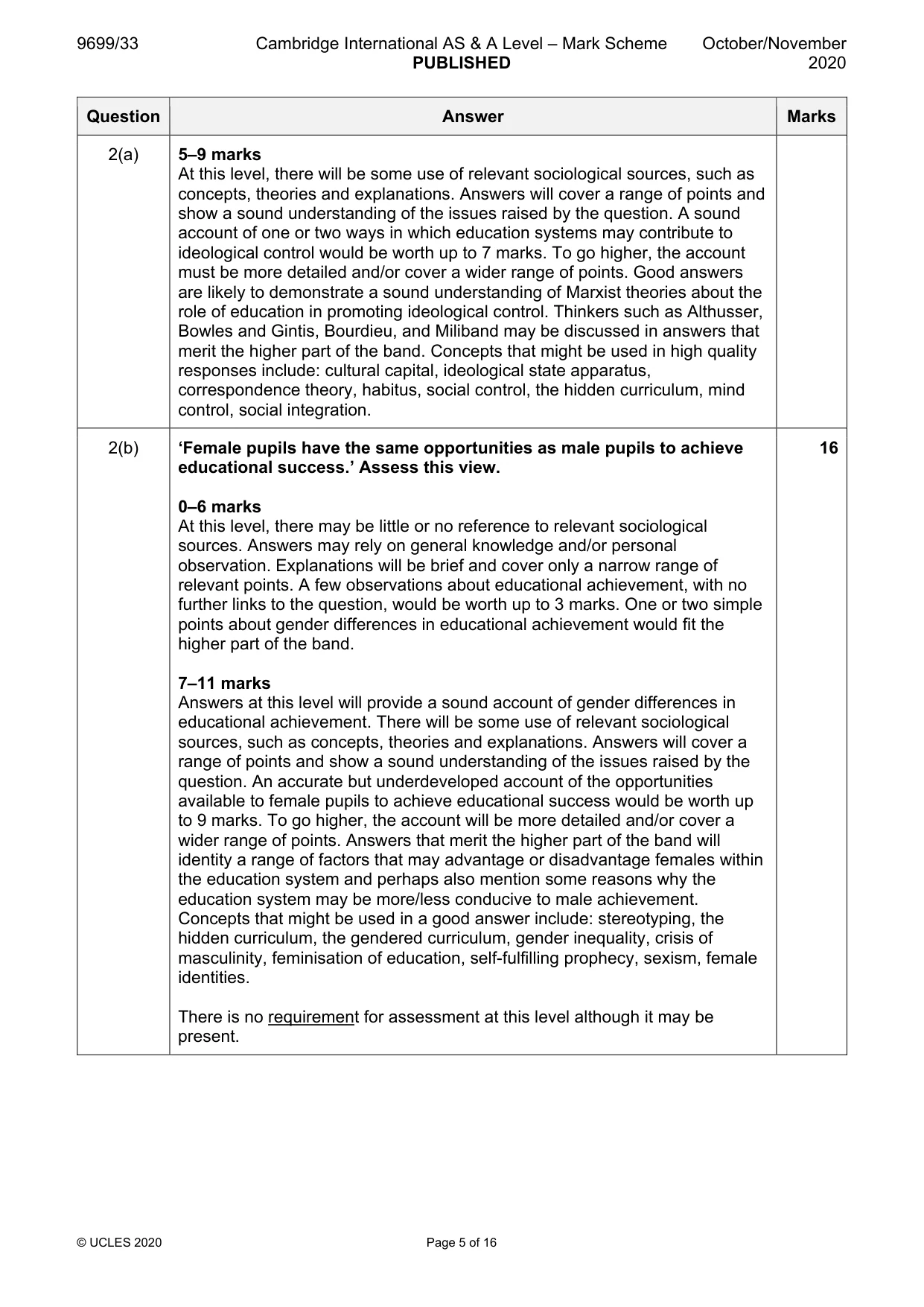
9699/33 Cambridge International AS & A Level – Mark Scheme PUBLISHED October/November 2020 © UCLES 2020 Page 5 of 16 Question Answer Marks 2(a) 5–9 marks At this level, there will be some use of relevant sociological sources, such as concepts, theories and explanations. Answers will cover a range of points and show a sound understanding of the issues raised by the question. A sound account of one or two ways in which education systems may contribute to ideological control would be worth up to 7 marks. To go higher, the account must be more detailed and/or cover a wider range of points. Good answers are likely to demonstrate a sound understanding of Marxist theories about the role of education in promoting ideological control. Thinkers such as Althusser, Bowles and Gintis, Bourdieu, and Miliband may be discussed in answers that merit the higher part of the band. Concepts that might be used in high quality responses include: cultural capital, ideological state apparatus, correspondence theory, habitus, social control, the hidden curriculum, mind control, social integration. 2(b) ‘Female pupils have the same opportunities as male pupils to achieve educational success.’ Assess this view. 0–6 marks At this level, there may be little or no reference to relevant sociological sources. Answers may rely on general knowledge and/or personal observation. Explanations will be brief and cover only a narrow range of relevant points. A few observations about educational achievement, with no further links to the question, would be worth up to 3 marks. One or two simple points about gender differences in educational achievement would fit the higher part of the band. 7–11 marks Answers at this level will provide a sound account of gender differences in educational achievement. There will be some use of relevant sociological sources, such as concepts, theories and explanations. Answers will cover a range of points and show a sound understanding of the issues raised by the question. An accurate but underdeveloped account of the opportunities available to female pupils to achieve educational success would be worth up to 9 marks. To go higher, the account will be more detailed and/or cover a wider range of points. Answers that merit the higher part of the band will identity a range of factors that may advantage or disadvantage females within the education system and perhaps also mention some reasons why the education system may be more/less conducive to male achievement. Concepts that might be used in a good answer include: stereotyping, the hidden curriculum, the gendered curriculum, gender inequality, crisis of masculinity, feminisation of education, self-fulfilling prophecy, sexism, female identities. There is no requirement for assessment at this level although it may be present. 16
Mark scheme, page 6
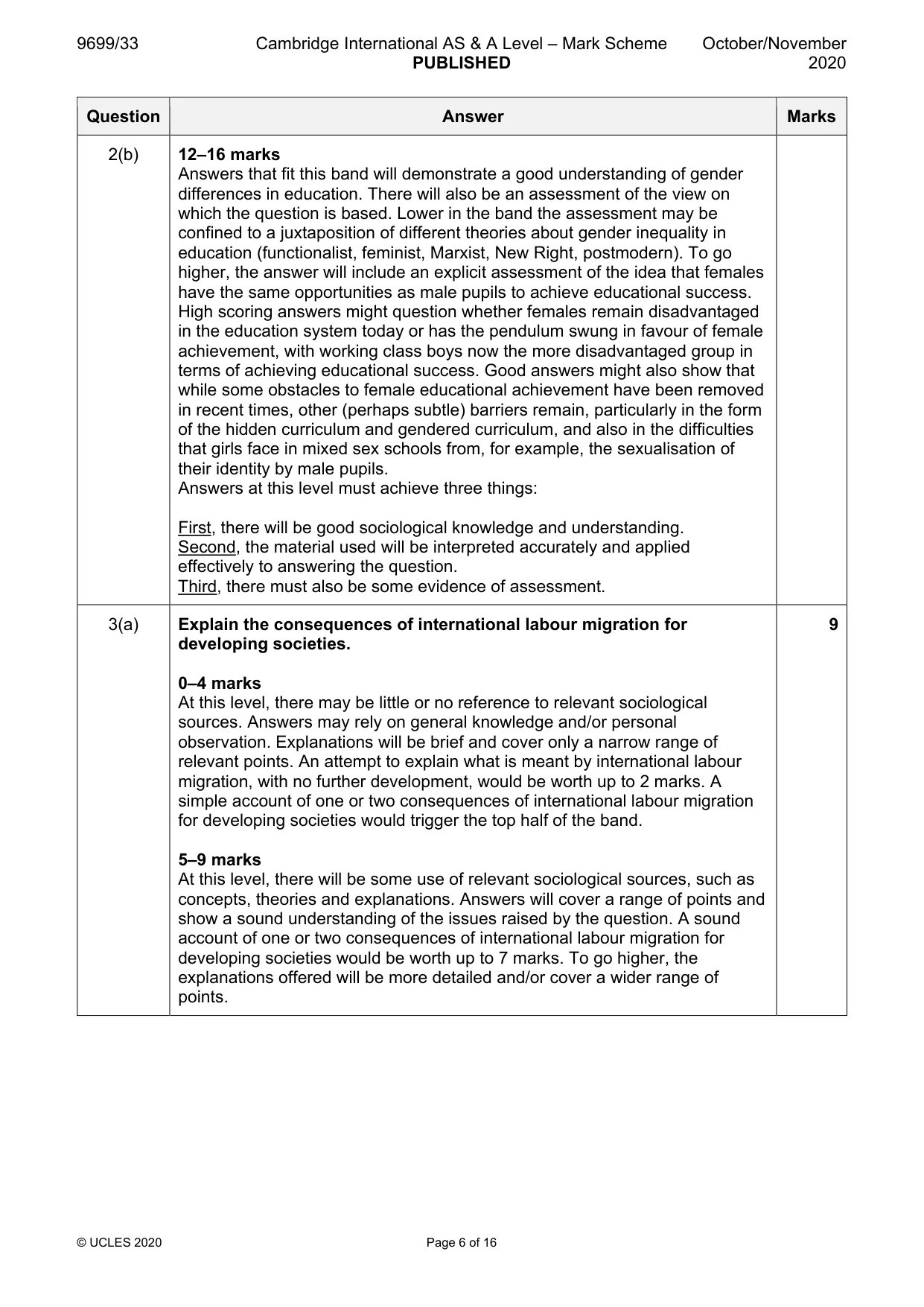
9699/33 Cambridge International AS & A Level – Mark Scheme PUBLISHED October/November 2020 © UCLES 2020 Page 6 of 16 Question Answer Marks 2(b) 12–16 marks Answers that fit this band will demonstrate a good understanding of gender differences in education. There will also be an assessment of the view on which the question is based. Lower in the band the assessment may be confined to a juxtaposition of different theories about gender inequality in education (functionalist, feminist, Marxist, New Right, postmodern). To go higher, the answer will include an explicit assessment of the idea that females have the same opportunities as male pupils to achieve educational success. High scoring answers might question whether females remain disadvantaged in the education system today or has the pendulum swung in favour of female achievement, with working class boys now the more disadvantaged group in terms of achieving educational success. Good answers might also show that while some obstacles to female educational achievement have been removed in recent times, other (perhaps subtle) barriers remain, particularly in the form of the hidden curriculum and gendered curriculum, and also in the difficulties that girls face in mixed sex schools from, for example, the sexualisation of their identity by male pupils. Answers at this level must achieve three things: First, there will be good sociological knowledge and understanding. Second, the material used will be interpreted accurately and applied effectively to answering the question. Third, there must also be some evidence of assessment. 3(a) Explain the consequences of international labour migration for developing societies. 0–4 marks At this level, there may be little or no reference to relevant sociological sources. Answers may rely on general knowledge and/or personal observation. Explanations will be brief and cover only a narrow range of relevant points. An attempt to explain what is meant by international labour migration, with no further development, would be worth up to 2 marks. A simple account of one or two consequences of international labour migration for developing societies would trigger the top half of the band. 5–9 marks At this level, there will be some use of relevant sociological sources, such as concepts, theories and explanations. Answers will cover a range of points and show a sound understanding of the issues raised by the question. A sound account of one or two consequences of international labour migration for developing societies would be worth up to 7 marks. To go higher, the explanations offered will be more detailed and/or cover a wider range of points. 9
Mark scheme, page 7
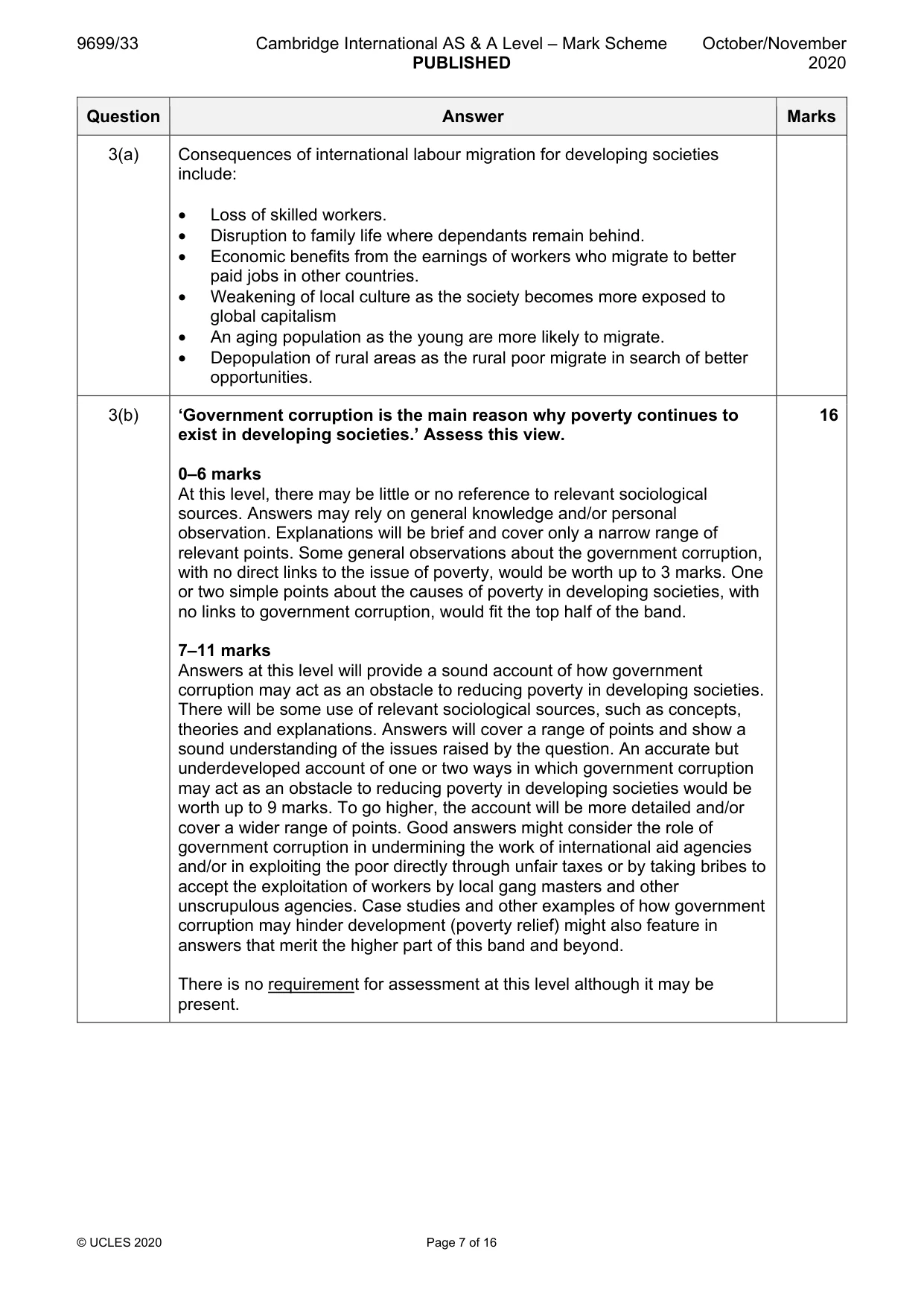
9699/33 Cambridge International AS & A Level – Mark Scheme PUBLISHED October/November 2020 © UCLES 2020 Page 7 of 16 Question Answer Marks 3(a) Consequences of international labour migration for developing societies include: • Loss of skilled workers. • Disruption to family life where dependants remain behind. • Economic benefits from the earnings of workers who migrate to better paid jobs in other countries. • Weakening of local culture as the society becomes more exposed to global capitalism • An aging population as the young are more likely to migrate. • Depopulation of rural areas as the rural poor migrate in search of better opportunities. 3(b) ‘Government corruption is the main reason why poverty continues to exist in developing societies.’ Assess this view. 0–6 marks At this level, there may be little or no reference to relevant sociological sources. Answers may rely on general knowledge and/or personal observation. Explanations will be brief and cover only a narrow range of relevant points. Some general observations about the government corruption, with no direct links to the issue of poverty, would be worth up to 3 marks. One or two simple points about the causes of poverty in developing societies, with no links to government corruption, would fit the top half of the band. 7–11 marks Answers at this level will provide a sound account of how government corruption may act as an obstacle to reducing poverty in developing societies. There will be some use of relevant sociological sources, such as concepts, theories and explanations. Answers will cover a range of points and show a sound understanding of the issues raised by the question. An accurate but underdeveloped account of one or two ways in which government corruption may act as an obstacle to reducing poverty in developing societies would be worth up to 9 marks. To go higher, the account will be more detailed and/or cover a wider range of points. Good answers might consider the role of government corruption in undermining the work of international aid agencies and/or in exploiting the poor directly through unfair taxes or by taking bribes to accept the exploitation of workers by local gang masters and other unscrupulous agencies. Case studies and other examples of how government corruption may hinder development (poverty relief) might also feature in answers that merit the higher part of this band and beyond. There is no requirement for assessment at this level although it may be present. 16
Mark scheme, page 8
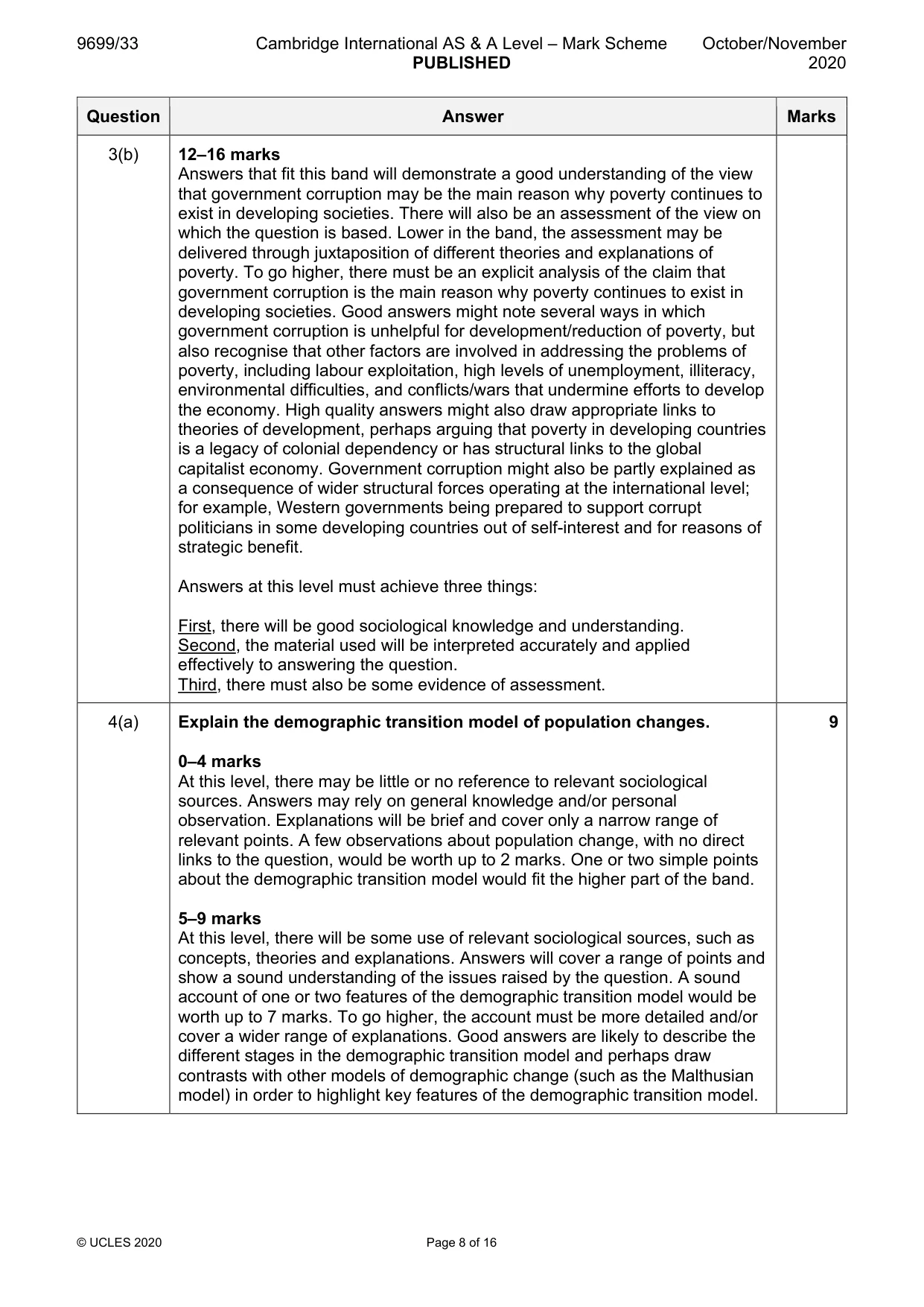
9699/33 Cambridge International AS & A Level – Mark Scheme PUBLISHED October/November 2020 © UCLES 2020 Page 8 of 16 Question Answer Marks 3(b) 12–16 marks Answers that fit this band will demonstrate a good understanding of the view that government corruption may be the main reason why poverty continues to exist in developing societies. There will also be an assessment of the view on which the question is based. Lower in the band, the assessment may be delivered through juxtaposition of different theories and explanations of poverty. To go higher, there must be an explicit analysis of the claim that government corruption is the main reason why poverty continues to exist in developing societies. Good answers might note several ways in which government corruption is unhelpful for development/reduction of poverty, but also recognise that other factors are involved in addressing the problems of poverty, including labour exploitation, high levels of unemployment, illiteracy, environmental difficulties, and conflicts/wars that undermine efforts to develop the economy. High quality answers might also draw appropriate links to theories of development, perhaps arguing that poverty in developing countries is a legacy of colonial dependency or has structural links to the global capitalist economy. Government corruption might also be partly explained as a consequence of wider structural forces operating at the international level; for example, Western governments being prepared to support corrupt politicians in some developing countries out of self-interest and for reasons of strategic benefit. Answers at this level must achieve three things: First, there will be good sociological knowledge and understanding. Second, the material used will be interpreted accurately and applied effectively to answering the question. Third, there must also be some evidence of assessment. 4(a) Explain the demographic transition model of population changes. 0–4 marks At this level, there may be little or no reference to relevant sociological sources. Answers may rely on general knowledge and/or personal observation. Explanations will be brief and cover only a narrow range of relevant points. A few observations about population change, with no direct links to the question, would be worth up to 2 marks. One or two simple points about the demographic transition model would fit the higher part of the band. 5–9 marks At this level, there will be some use of relevant sociological sources, such as concepts, theories and explanations. Answers will cover a range of points and show a sound understanding of the issues raised by the question. A sound account of one or two features of the demographic transition model would be worth up to 7 marks. To go higher, the account must be more detailed and/or cover a wider range of explanations. Good answers are likely to describe the different stages in the demographic transition model and perhaps draw contrasts with other models of demographic change (such as the Malthusian model) in order to highlight key features of the demographic transition model. 9
Mark scheme, page 9
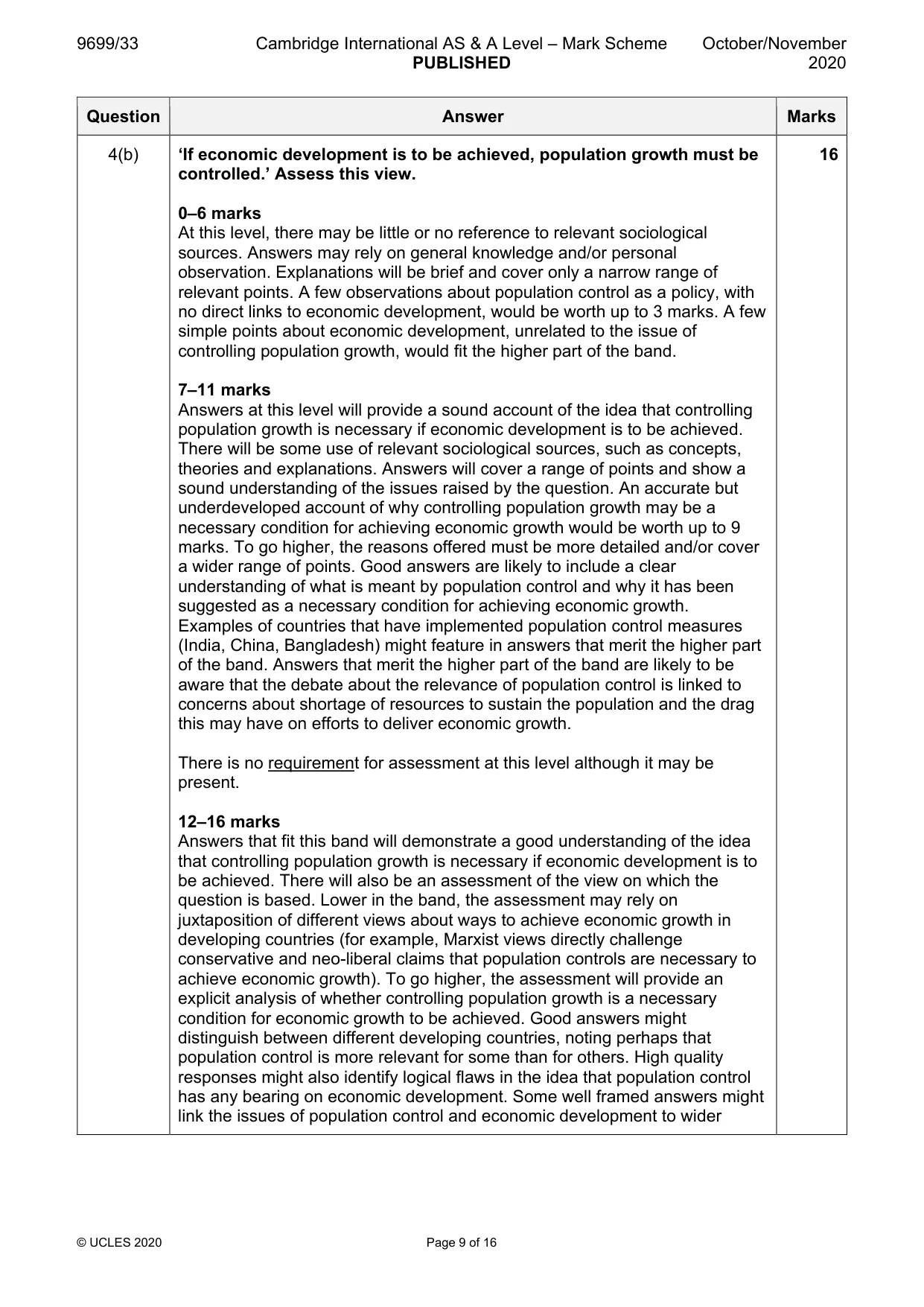
9699/33 Cambridge International AS & A Level – Mark Scheme PUBLISHED October/November 2020 © UCLES 2020 Page 9 of 16 Question Answer Marks 4(b) ‘If economic development is to be achieved, population growth must be controlled.’ Assess this view. 0–6 marks At this level, there may be little or no reference to relevant sociological sources. Answers may rely on general knowledge and/or personal observation. Explanations will be brief and cover only a narrow range of relevant points. A few observations about population control as a policy, with no direct links to economic development, would be worth up to 3 marks. A few simple points about economic development, unrelated to the issue of controlling population growth, would fit the higher part of the band. 7–11 marks Answers at this level will provide a sound account of the idea that controlling population growth is necessary if economic development is to be achieved. There will be some use of relevant sociological sources, such as concepts, theories and explanations. Answers will cover a range of points and show a sound understanding of the issues raised by the question. An accurate but underdeveloped account of why controlling population growth may be a necessary condition for achieving economic growth would be worth up to 9 marks. To go higher, the reasons offered must be more detailed and/or cover a wider range of points. Good answers are likely to include a clear understanding of what is meant by population control and why it has been suggested as a necessary condition for achieving economic growth. Examples of countries that have implemented population control measures (India, China, Bangladesh) might feature in answers that merit the higher part of the band. Answers that merit the higher part of the band are likely to be aware that the debate about the relevance of population control is linked to concerns about shortage of resources to sustain the population and the drag this may have on efforts to deliver economic growth. There is no requirement for assessment at this level although it may be present. 12–16 marks Answers that fit this band will demonstrate a good understanding of the idea that controlling population growth is necessary if economic development is to be achieved. There will also be an assessment of the view on which the question is based. Lower in the band, the assessment may rely on juxtaposition of different views about ways to achieve economic growth in developing countries (for example, Marxist views directly challenge conservative and neo-liberal claims that population controls are necessary to achieve economic growth). To go higher, the assessment will provide an explicit analysis of whether controlling population growth is a necessary condition for economic growth to be achieved. Good answers might distinguish between different developing countries, noting perhaps that population control is more relevant for some than for others. High quality responses might also identify logical flaws in the idea that population control has any bearing on economic development. Some well framed answers might link the issues of population control and economic development to wider 16
Mark scheme, page 10
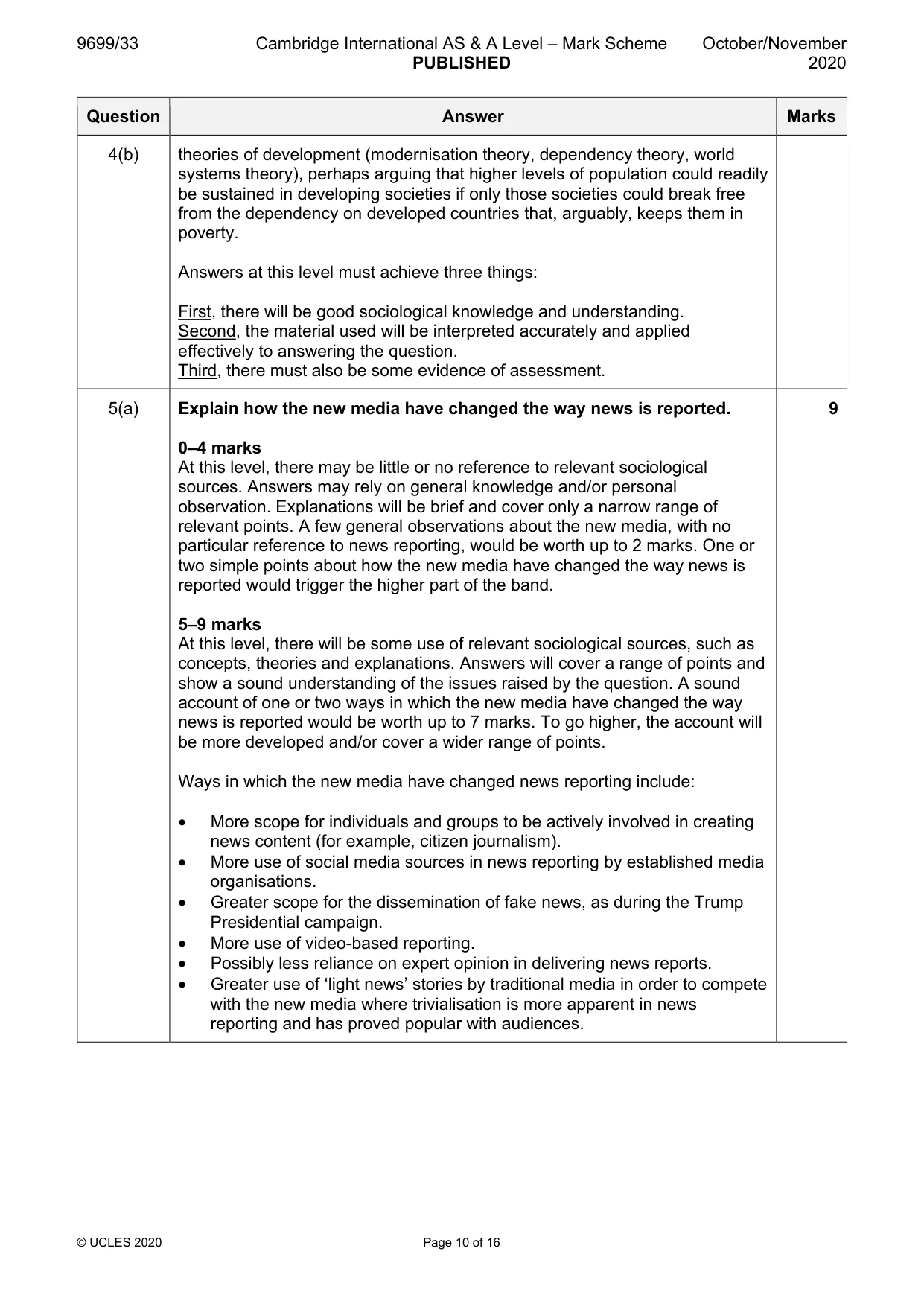
9699/33 Cambridge International AS & A Level – Mark Scheme PUBLISHED October/November 2020 © UCLES 2020 Page 10 of 16 Question Answer Marks 4(b) theories of development (modernisation theory, dependency theory, world systems theory), perhaps arguing that higher levels of population could readily be sustained in developing societies if only those societies could break free from the dependency on developed countries that, arguably, keeps them in poverty. Answers at this level must achieve three things: First, there will be good sociological knowledge and understanding. Second, the material used will be interpreted accurately and applied effectively to answering the question. Third, there must also be some evidence of assessment. 5(a) Explain how the new media have changed the way news is reported. 0–4 marks At this level, there may be little or no reference to relevant sociological sources. Answers may rely on general knowledge and/or personal observation. Explanations will be brief and cover only a narrow range of relevant points. A few general observations about the new media, with no particular reference to news reporting, would be worth up to 2 marks. One or two simple points about how the new media have changed the way news is reported would trigger the higher part of the band. 5–9 marks At this level, there will be some use of relevant sociological sources, such as concepts, theories and explanations. Answers will cover a range of points and show a sound understanding of the issues raised by the question. A sound account of one or two ways in which the new media have changed the way news is reported would be worth up to 7 marks. To go higher, the account will be more developed and/or cover a wider range of points. Ways in which the new media have changed news reporting include: • More scope for individuals and groups to be actively involved in creating news content (for example, citizen journalism). • More use of social media sources in news reporting by established media organisations. • Greater scope for the dissemination of fake news, as during the Trump Presidential campaign. • More use of video-based reporting. • Possibly less reliance on expert opinion in delivering news reports. • Greater use of ‘light news’ stories by traditional media in order to compete with the new media where trivialisation is more apparent in news reporting and has proved popular with audiences. 9
Mark scheme, page 11
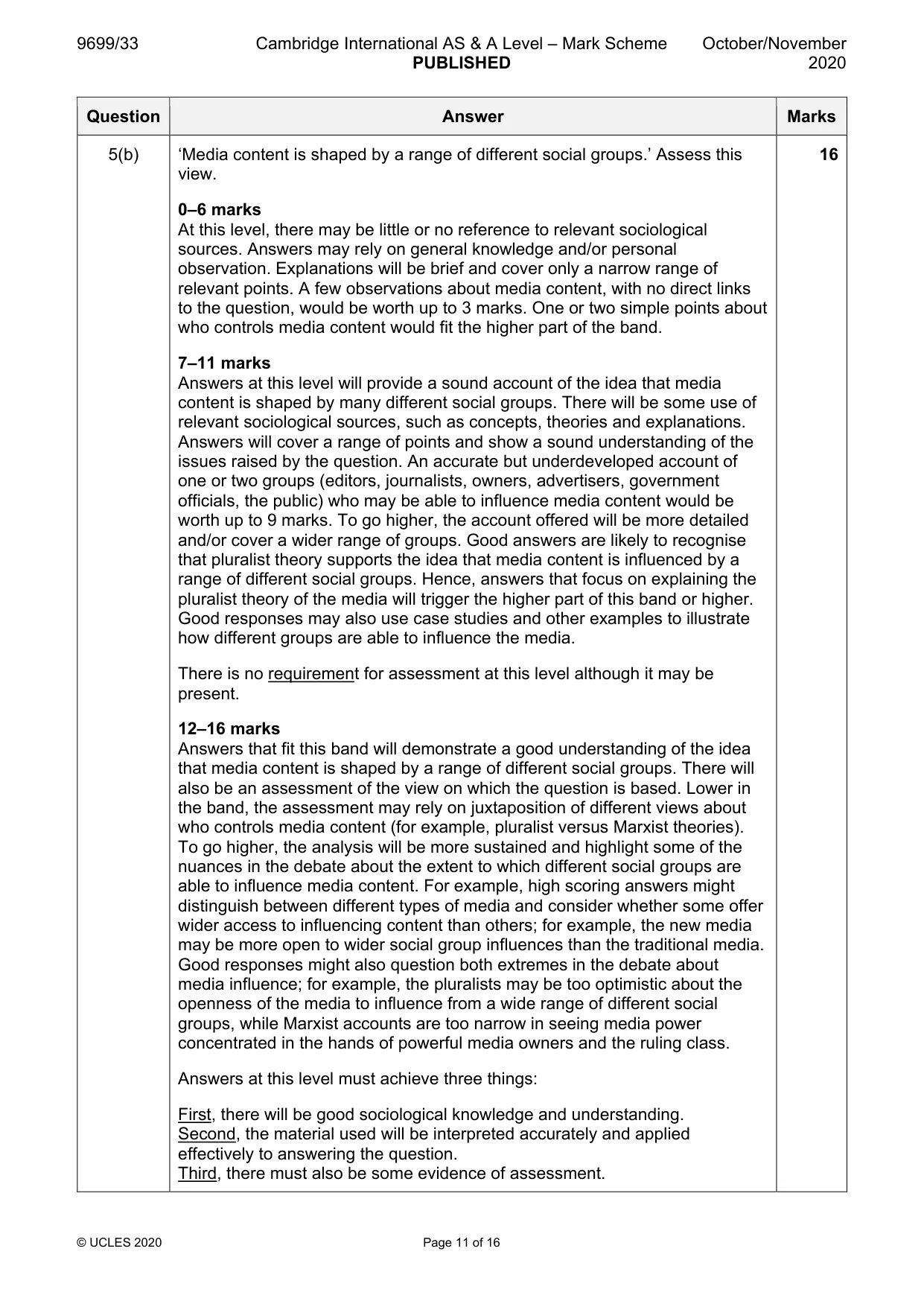
9699/33 Cambridge International AS & A Level – Mark Scheme PUBLISHED October/November 2020 © UCLES 2020 Page 11 of 16 Question Answer Marks 5(b) ‘Media content is shaped by a range of different social groups.’ Assess this view. 0–6 marks At this level, there may be little or no reference to relevant sociological sources. Answers may rely on general knowledge and/or personal observation. Explanations will be brief and cover only a narrow range of relevant points. A few observations about media content, with no direct links to the question, would be worth up to 3 marks. One or two simple points about who controls media content would fit the higher part of the band. 7–11 marks Answers at this level will provide a sound account of the idea that media content is shaped by many different social groups. There will be some use of relevant sociological sources, such as concepts, theories and explanations. Answers will cover a range of points and show a sound understanding of the issues raised by the question. An accurate but underdeveloped account of one or two groups (editors, journalists, owners, advertisers, government officials, the public) who may be able to influence media content would be worth up to 9 marks. To go higher, the account offered will be more detailed and/or cover a wider range of groups. Good answers are likely to recognise that pluralist theory supports the idea that media content is influenced by a range of different social groups. Hence, answers that focus on explaining the pluralist theory of the media will trigger the higher part of this band or higher. Good responses may also use case studies and other examples to illustrate how different groups are able to influence the media. There is no requirement for assessment at this level although it may be present. 12–16 marks Answers that fit this band will demonstrate a good understanding of the idea that media content is shaped by a range of different social groups. There will also be an assessment of the view on which the question is based. Lower in the band, the assessment may rely on juxtaposition of different views about who controls media content (for example, pluralist versus Marxist theories). To go higher, the analysis will be more sustained and highlight some of the nuances in the debate about the extent to which different social groups are able to influence media content. For example, high scoring answers might distinguish between different types of media and consider whether some offer wider access to influencing content than others; for example, the new media may be more open to wider social group influences than the traditional media. Good responses might also question both extremes in the debate about media influence; for example, the pluralists may be too optimistic about the openness of the media to influence from a wide range of different social groups, while Marxist accounts are too narrow in seeing media power concentrated in the hands of powerful media owners and the ruling class. Answers at this level must achieve three things: First, there will be good sociological knowledge and understanding. Second, the material used will be interpreted accurately and applied effectively to answering the question. Third, there must also be some evidence of assessment. 16
Mark scheme, page 12
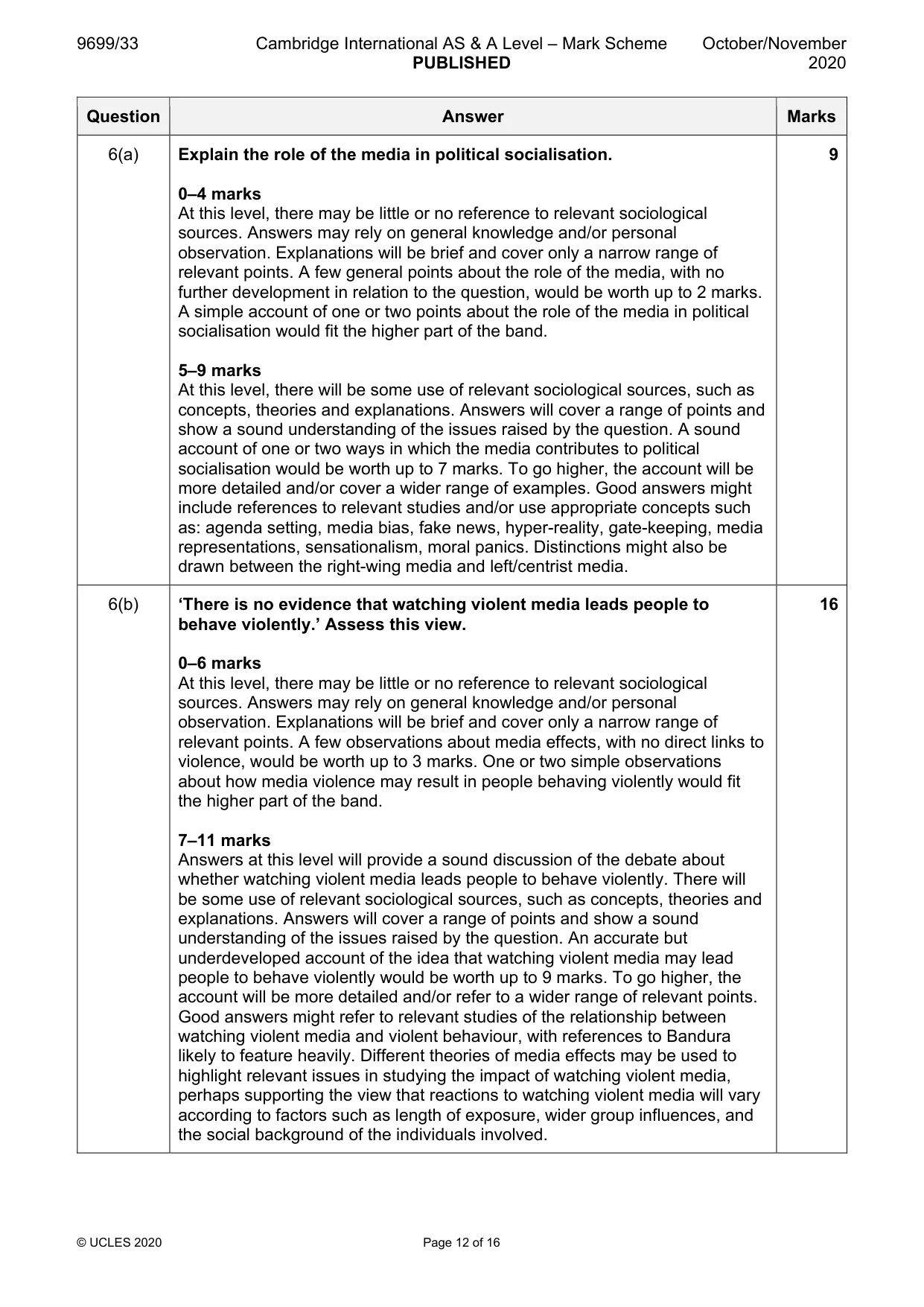
9699/33 Cambridge International AS & A Level – Mark Scheme PUBLISHED October/November 2020 © UCLES 2020 Page 12 of 16 Question Answer Marks 6(a) Explain the role of the media in political socialisation. 0–4 marks At this level, there may be little or no reference to relevant sociological sources. Answers may rely on general knowledge and/or personal observation. Explanations will be brief and cover only a narrow range of relevant points. A few general points about the role of the media, with no further development in relation to the question, would be worth up to 2 marks. A simple account of one or two points about the role of the media in political socialisation would fit the higher part of the band. 5–9 marks At this level, there will be some use of relevant sociological sources, such as concepts, theories and explanations. Answers will cover a range of points and show a sound understanding of the issues raised by the question. A sound account of one or two ways in which the media contributes to political socialisation would be worth up to 7 marks. To go higher, the account will be more detailed and/or cover a wider range of examples. Good answers might include references to relevant studies and/or use appropriate concepts such as: agenda setting, media bias, fake news, hyper-reality, gate-keeping, media representations, sensationalism, moral panics. Distinctions might also be drawn between the right-wing media and left/centrist media. 9 6(b) ‘There is no evidence that watching violent media leads people to behave violently.’ Assess this view. 0–6 marks At this level, there may be little or no reference to relevant sociological sources. Answers may rely on general knowledge and/or personal observation. Explanations will be brief and cover only a narrow range of relevant points. A few observations about media effects, with no direct links to violence, would be worth up to 3 marks. One or two simple observations about how media violence may result in people behaving violently would fit the higher part of the band. 7–11 marks Answers at this level will provide a sound discussion of the debate about whether watching violent media leads people to behave violently. There will be some use of relevant sociological sources, such as concepts, theories and explanations. Answers will cover a range of points and show a sound understanding of the issues raised by the question. An accurate but underdeveloped account of the idea that watching violent media may lead people to behave violently would be worth up to 9 marks. To go higher, the account will be more detailed and/or refer to a wider range of relevant points. Good answers might refer to relevant studies of the relationship between watching violent media and violent behaviour, with references to Bandura likely to feature heavily. Different theories of media effects may be used to highlight relevant issues in studying the impact of watching violent media, perhaps supporting the view that reactions to watching violent media will vary according to factors such as length of exposure, wider group influences, and the social background of the individuals involved. 16
Mark scheme, page 13
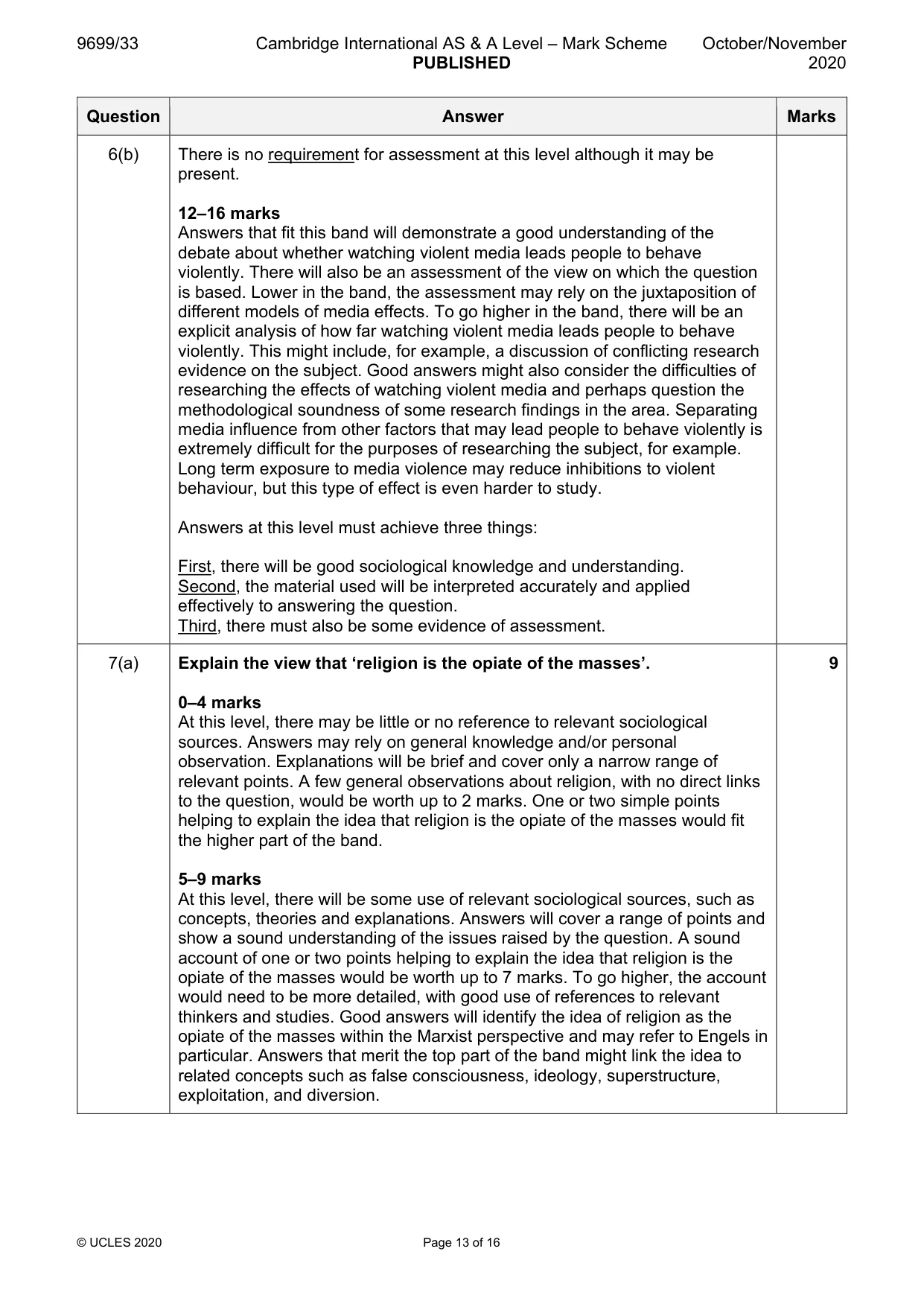
9699/33 Cambridge International AS & A Level – Mark Scheme PUBLISHED October/November 2020 © UCLES 2020 Page 13 of 16 Question Answer Marks 6(b) There is no requirement for assessment at this level although it may be present. 12–16 marks Answers that fit this band will demonstrate a good understanding of the debate about whether watching violent media leads people to behave violently. There will also be an assessment of the view on which the question is based. Lower in the band, the assessment may rely on the juxtaposition of different models of media effects. To go higher in the band, there will be an explicit analysis of how far watching violent media leads people to behave violently. This might include, for example, a discussion of conflicting research evidence on the subject. Good answers might also consider the difficulties of researching the effects of watching violent media and perhaps question the methodological soundness of some research findings in the area. Separating media influence from other factors that may lead people to behave violently is extremely difficult for the purposes of researching the subject, for example. Long term exposure to media violence may reduce inhibitions to violent behaviour, but this type of effect is even harder to study. Answers at this level must achieve three things: First, there will be good sociological knowledge and understanding. Second, the material used will be interpreted accurately and applied effectively to answering the question. Third, there must also be some evidence of assessment. 7(a) Explain the view that ‘religion is the opiate of the masses’. 0–4 marks At this level, there may be little or no reference to relevant sociological sources. Answers may rely on general knowledge and/or personal observation. Explanations will be brief and cover only a narrow range of relevant points. A few general observations about religion, with no direct links to the question, would be worth up to 2 marks. One or two simple points helping to explain the idea that religion is the opiate of the masses would fit the higher part of the band. 5–9 marks At this level, there will be some use of relevant sociological sources, such as concepts, theories and explanations. Answers will cover a range of points and show a sound understanding of the issues raised by the question. A sound account of one or two points helping to explain the idea that religion is the opiate of the masses would be worth up to 7 marks. To go higher, the account would need to be more detailed, with good use of references to relevant thinkers and studies. Good answers will identify the idea of religion as the opiate of the masses within the Marxist perspective and may refer to Engels in particular. Answers that merit the top part of the band might link the idea to related concepts such as false consciousness, ideology, superstructure, exploitation, and diversion. 9
Mark scheme, page 14
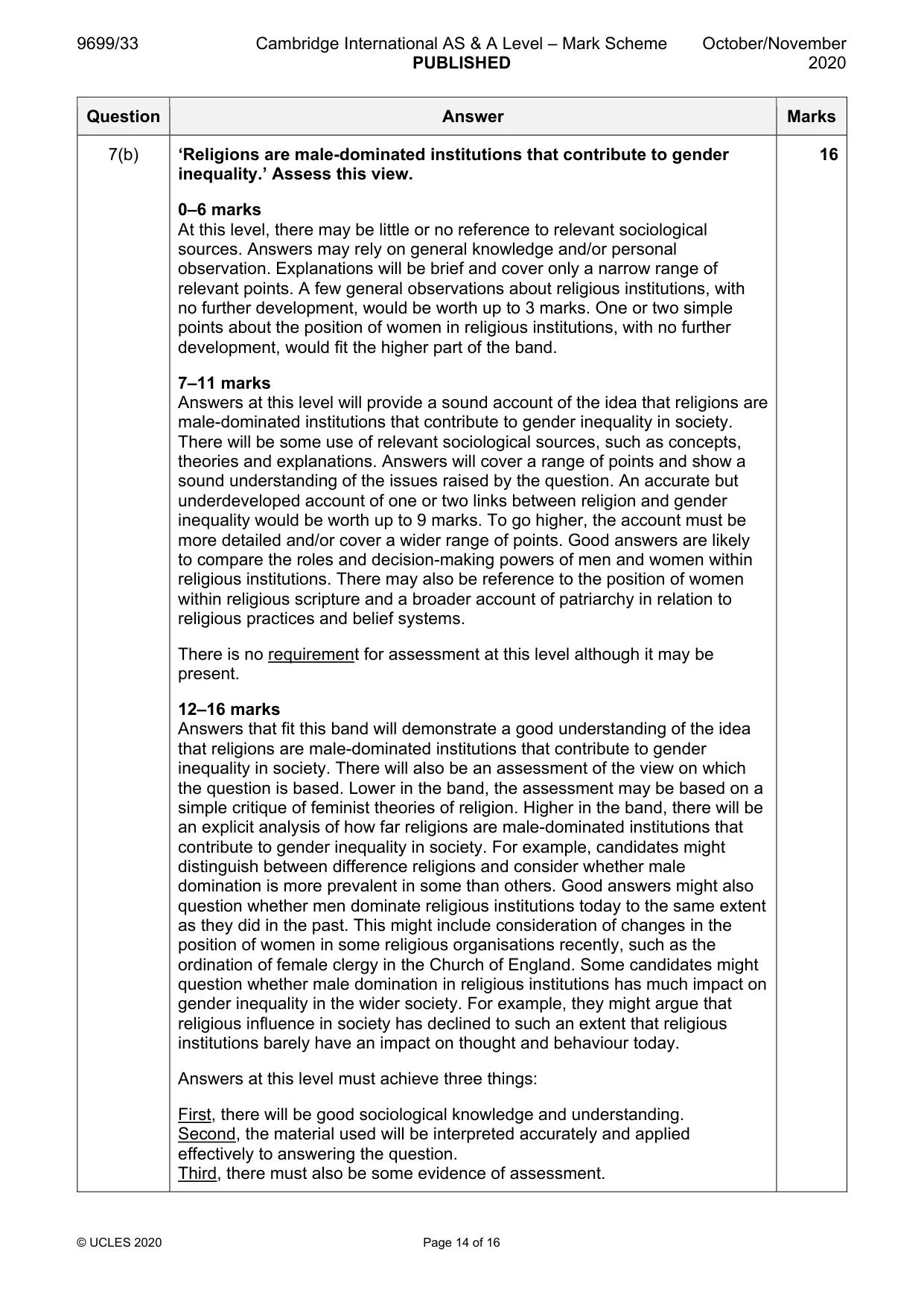
9699/33 Cambridge International AS & A Level – Mark Scheme PUBLISHED October/November 2020 © UCLES 2020 Page 14 of 16 Question Answer Marks 7(b) ‘Religions are male-dominated institutions that contribute to gender inequality.’ Assess this view. 0–6 marks At this level, there may be little or no reference to relevant sociological sources. Answers may rely on general knowledge and/or personal observation. Explanations will be brief and cover only a narrow range of relevant points. A few general observations about religious institutions, with no further development, would be worth up to 3 marks. One or two simple points about the position of women in religious institutions, with no further development, would fit the higher part of the band. 7–11 marks Answers at this level will provide a sound account of the idea that religions are male-dominated institutions that contribute to gender inequality in society. There will be some use of relevant sociological sources, such as concepts, theories and explanations. Answers will cover a range of points and show a sound understanding of the issues raised by the question. An accurate but underdeveloped account of one or two links between religion and gender inequality would be worth up to 9 marks. To go higher, the account must be more detailed and/or cover a wider range of points. Good answers are likely to compare the roles and decision-making powers of men and women within religious institutions. There may also be reference to the position of women within religious scripture and a broader account of patriarchy in relation to religious practices and belief systems. There is no requirement for assessment at this level although it may be present. 12–16 marks Answers that fit this band will demonstrate a good understanding of the idea that religions are male-dominated institutions that contribute to gender inequality in society. There will also be an assessment of the view on which the question is based. Lower in the band, the assessment may be based on a simple critique of feminist theories of religion. Higher in the band, there will be an explicit analysis of how far religions are male-dominated institutions that contribute to gender inequality in society. For example, candidates might distinguish between difference religions and consider whether male domination is more prevalent in some than others. Good answers might also question whether men dominate religious institutions today to the same extent as they did in the past. This might include consideration of changes in the position of women in some religious organisations recently, such as the ordination of female clergy in the Church of England. Some candidates might question whether male domination in religious institutions has much impact on gender inequality in the wider society. For example, they might argue that religious influence in society has declined to such an extent that religious institutions barely have an impact on thought and behaviour today. Answers at this level must achieve three things: First, there will be good sociological knowledge and understanding. Second, the material used will be interpreted accurately and applied effectively to answering the question. Third, there must also be some evidence of assessment. 16
Mark scheme, page 15
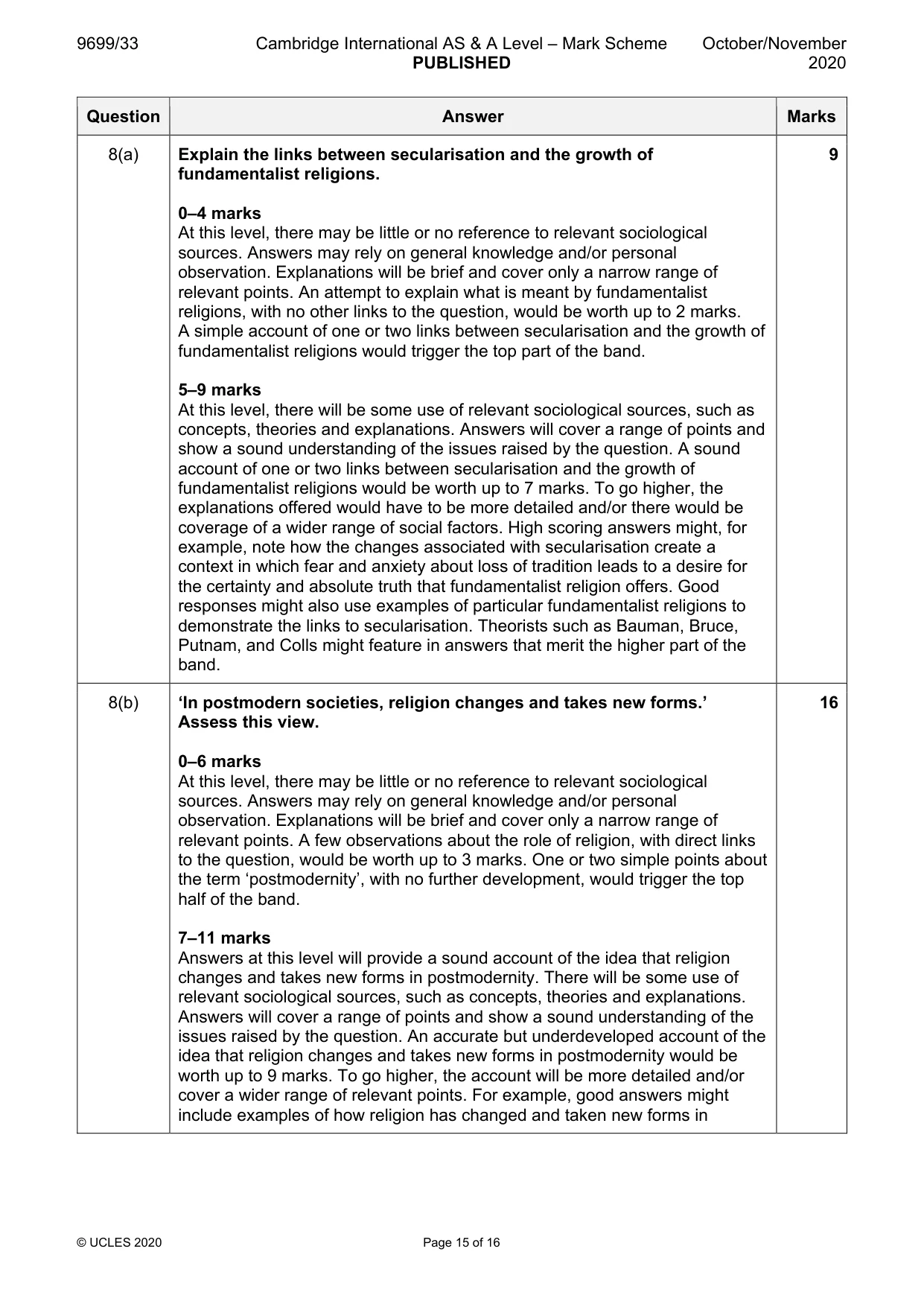
9699/33 Cambridge International AS & A Level – Mark Scheme PUBLISHED October/November 2020 © UCLES 2020 Page 15 of 16 Question Answer Marks 8(a) Explain the links between secularisation and the growth of fundamentalist religions. 0–4 marks At this level, there may be little or no reference to relevant sociological sources. Answers may rely on general knowledge and/or personal observation. Explanations will be brief and cover only a narrow range of relevant points. An attempt to explain what is meant by fundamentalist religions, with no other links to the question, would be worth up to 2 marks. A simple account of one or two links between secularisation and the growth of fundamentalist religions would trigger the top part of the band. 5–9 marks At this level, there will be some use of relevant sociological sources, such as concepts, theories and explanations. Answers will cover a range of points and show a sound understanding of the issues raised by the question. A sound account of one or two links between secularisation and the growth of fundamentalist religions would be worth up to 7 marks. To go higher, the explanations offered would have to be more detailed and/or there would be coverage of a wider range of social factors. High scoring answers might, for example, note how the changes associated with secularisation create a context in which fear and anxiety about loss of tradition leads to a desire for the certainty and absolute truth that fundamentalist religion offers. Good responses might also use examples of particular fundamentalist religions to demonstrate the links to secularisation. Theorists such as Bauman, Bruce, Putnam, and Colls might feature in answers that merit the higher part of the band. 9 8(b) ‘In postmodern societies, religion changes and takes new forms.’ Assess this view. 0–6 marks At this level, there may be little or no reference to relevant sociological sources. Answers may rely on general knowledge and/or personal observation. Explanations will be brief and cover only a narrow range of relevant points. A few observations about the role of religion, with direct links to the question, would be worth up to 3 marks. One or two simple points about the term ‘postmodernity’, with no further development, would trigger the top half of the band. 7–11 marks Answers at this level will provide a sound account of the idea that religion changes and takes new forms in postmodernity. There will be some use of relevant sociological sources, such as concepts, theories and explanations. Answers will cover a range of points and show a sound understanding of the issues raised by the question. An accurate but underdeveloped account of the idea that religion changes and takes new forms in postmodernity would be worth up to 9 marks. To go higher, the account will be more detailed and/or cover a wider range of relevant points. For example, good answers might include examples of how religion has changed and taken new forms in 16
Mark scheme, page 16
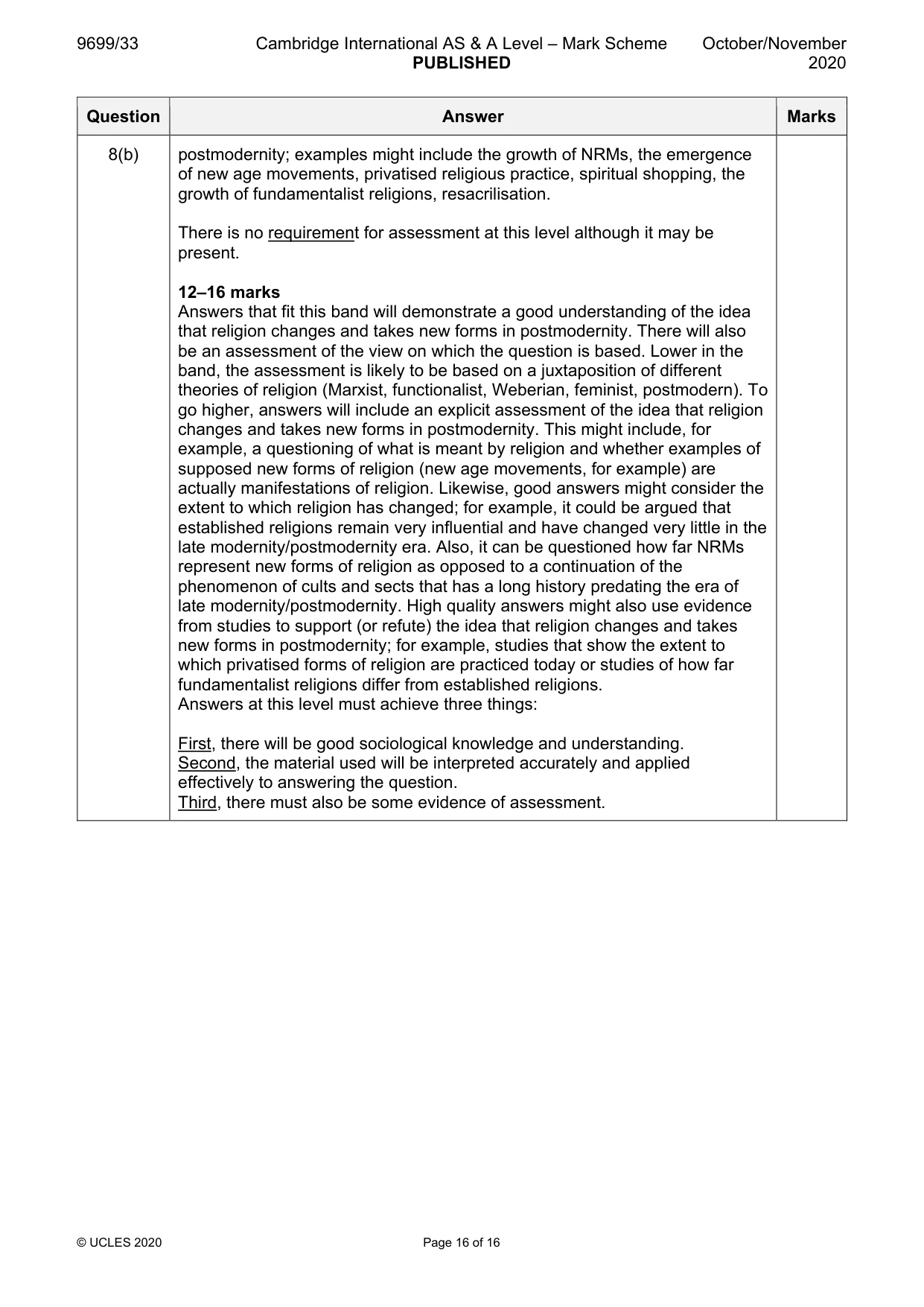
9699/33 Cambridge International AS & A Level – Mark Scheme PUBLISHED October/November 2020 © UCLES 2020 Page 16 of 16 Question Answer Marks 8(b) postmodernity; examples might include the growth of NRMs, the emergence of new age movements, privatised religious practice, spiritual shopping, the growth of fundamentalist religions, resacrilisation. There is no requirement for assessment at this level although it may be present. 12–16 marks Answers that fit this band will demonstrate a good understanding of the idea that religion changes and takes new forms in postmodernity. There will also be an assessment of the view on which the question is based. Lower in the band, the assessment is likely to be based on a juxtaposition of different theories of religion (Marxist, functionalist, Weberian, feminist, postmodern). To go higher, answers will include an explicit assessment of the idea that religion changes and takes new forms in postmodernity. This might include, for example, a questioning of what is meant by religion and whether examples of supposed new forms of religion (new age movements, for example) are actually manifestations of religion. Likewise, good answers might consider the extent to which religion has changed; for example, it could be argued that established religions remain very influential and have changed very little in the late modernity/postmodernity era. Also, it can be questioned how far NRMs represent new forms of religion as opposed to a continuation of the phenomenon of cults and sects that has a long history predating the era of late modernity/postmodernity. High quality answers might also use evidence from studies to support (or refute) the idea that religion changes and takes new forms in postmodernity; for example, studies that show the extent to which privatised forms of religion are practiced today or studies of how far fundamentalist religions differ from established religions. Answers at this level must achieve three things: First, there will be good sociological knowledge and understanding. Second, the material used will be interpreted accurately and applied effectively to answering the question. Third, there must also be some evidence of assessment.
What you needed in this session
Cambridge’s own grade thresholds for 2020 Oct/Nov, Paper 3 · Variant 3. A higher threshold means an easier paper — the bar moves with how the cohort did.