Cambridge A Level Sociology 9699 — 2019 May/June Paper 2 · Variant 1
9699/21/M/J/19 · 50 marks · ≈56 min
The question paper and its mark scheme, free to read here and free to download. This is Cambridge’s own paper, exactly as it was sat.
Question paper4 pages


Mark scheme13 pages
Answers below. Sit the paper first if you are practising.
Paper as text
Question paper, page 1
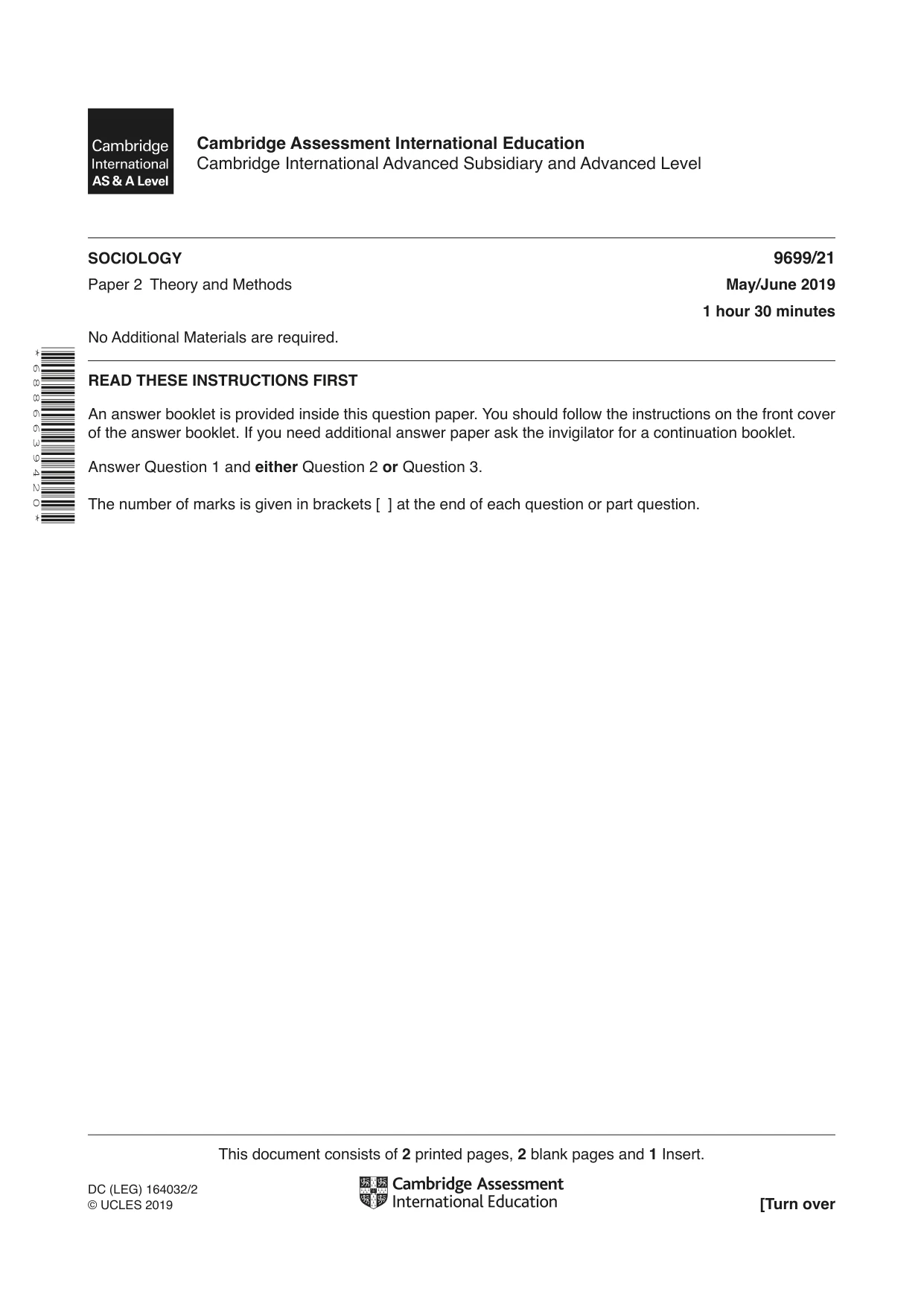
This document consists of 2 printed pages, 2 blank pages and 1 Insert. DC (LEG) 164032/2 © UCLES 2019 [Turn over Cambridge Assessment International Education Cambridge International Advanced Subsidiary and Advanced Level * 6 8 8 6 6 3 9 4 2 0 * SOCIOLOGY 9699/21 Paper 2 Theory and Methods May/June 2019 1 hour 30 minutes No Additional Materials are required. READ THESE INSTRUCTIONS FIRST An answer booklet is provided inside this question paper. You should follow the instructions on the front cover of the answer booklet. If you need additional answer paper ask the invigilator for a continuation booklet. Answer Question 1 and either Question 2 or Question 3. The number of marks is given in brackets [ ] at the end of each question or part question.
Question paper, page 2
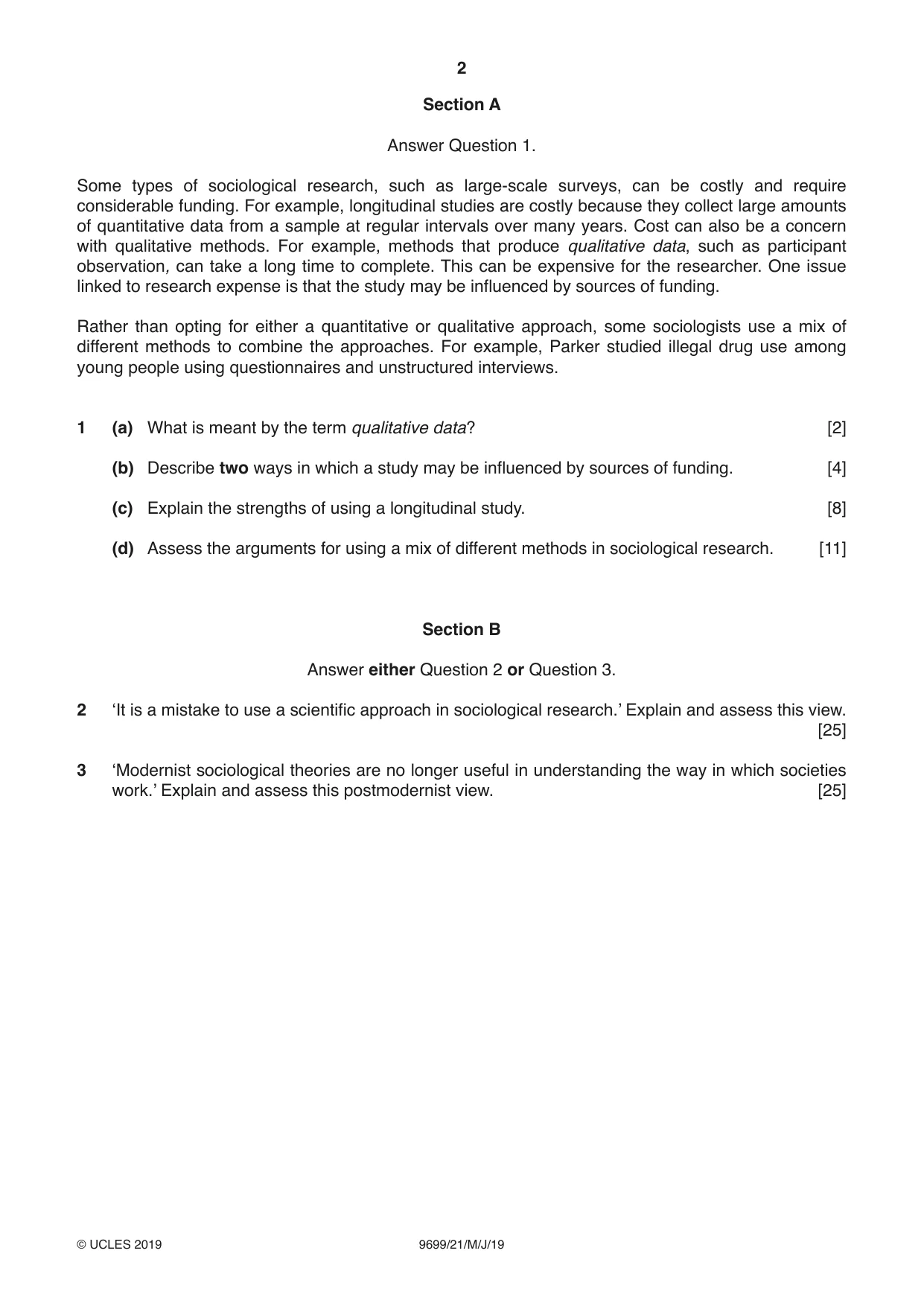
2 9699/21/M/J/19 © UCLES 2019 Section A Answer Question 1. Some types of sociological research, such as large-scale surveys, can be costly and require considerable funding. For example, longitudinal studies are costly because they collect large amounts of quantitative data from a sample at regular intervals over many years. Cost can also be a concern with qualitative methods. For example, methods that produce qualitative data, such as participant observation, can take a long time to complete. This can be expensive for the researcher. One issue linked to research expense is that the study may be influenced by sources of funding. Rather than opting for either a quantitative or qualitative approach, some sociologists use a mix of different methods to combine the approaches. For example, Parker studied illegal drug use among young people using questionnaires and unstructured interviews. 1 (a) What is meant by the term qualitative data? [2] (b) Describe two ways in which a study may be influenced by sources of funding. [4] (c) Explain the strengths of using a longitudinal study. [8] (d) Assess the arguments for using a mix of different methods in sociological research. [11] Section B Answer either Question 2 or Question 3. 2 ‘It is a mistake to use a scientific approach in sociological research.’ Explain and assess this view. [25] 3 ‘Modernist sociological theories are no longer useful in understanding the way in which societies work.’ Explain and assess this postmodernist view. [25]
Question paper, page 3
3 9699/21/M/J/19 © UCLES 2019 BLANK PAGE
Question paper, page 4
4 9699/21/M/J/19 © UCLES 2019 Permission to reproduce items where third-party owned material protected by copyright is included has been sought and cleared where possible. Every reasonable effort has been made by the publisher (UCLES) to trace copyright holders, but if any items requiring clearance have unwittingly been included, the publisher will be pleased to make amends at the earliest possible opportunity. To avoid the issue of disclosure of answer-related information to candidates, all copyright acknowledgements are reproduced online in the Cambridge Assessment International Education Copyright Acknowledgements Booklet. This is produced for each series of examinations and is freely available to download at www.cambridgeinternational.org after the live examination series. Cambridge Assessment International Education is part of the Cambridge Assessment Group. Cambridge Assessment is the brand name of the University of Cambridge Local Examinations Syndicate (UCLES), which itself is a department of the University of Cambridge. BLANK PAGE
Mark scheme, page 1
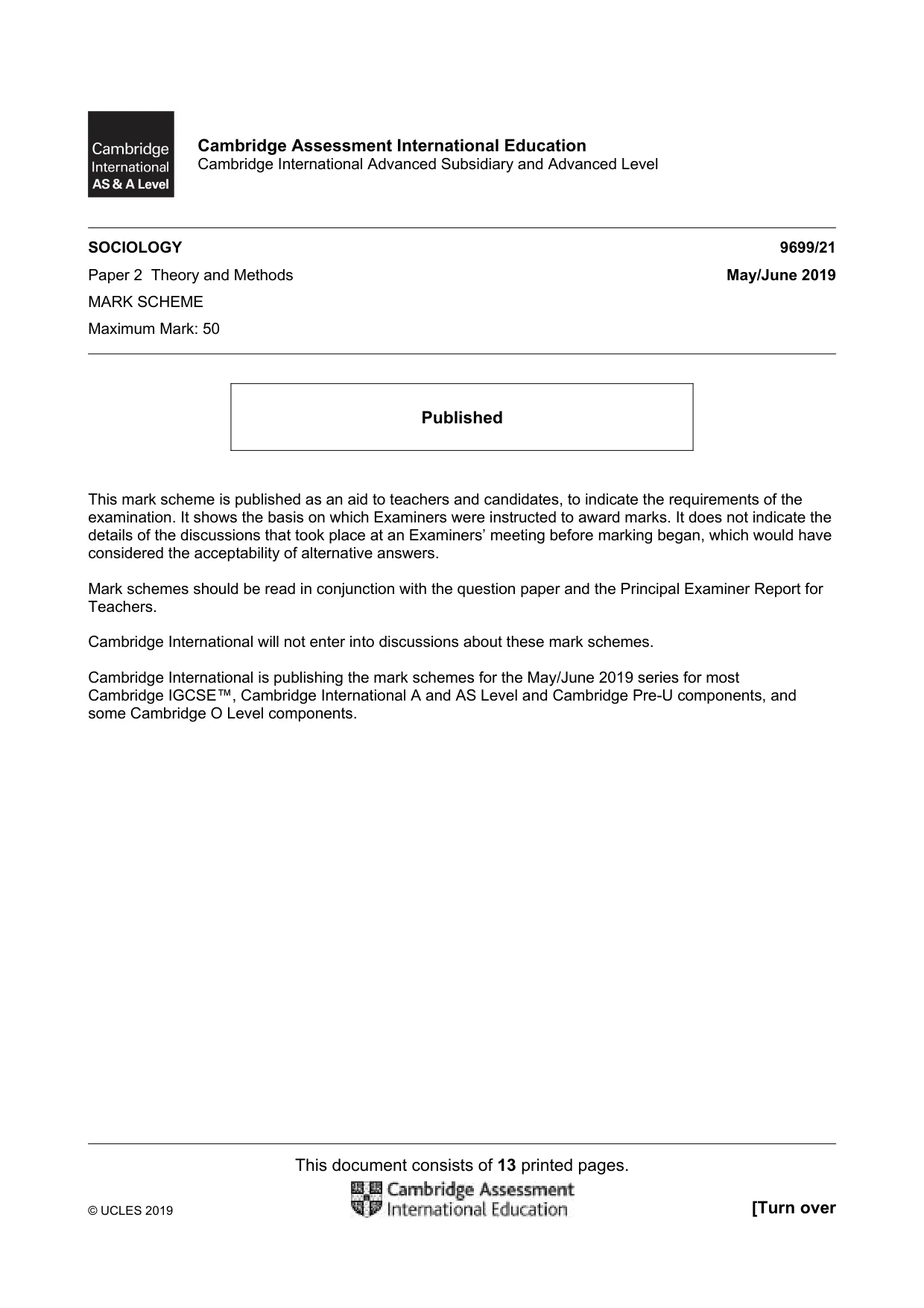
This document consists of 13 printed pages. © UCLES 2019 [Turn over Cambridge Assessment International Education Cambridge International Advanced Subsidiary and Advanced Level SOCIOLOGY 9699/21 Paper 2 Theory and Methods May/June 2019 MARK SCHEME Maximum Mark: 50 Published This mark scheme is published as an aid to teachers and candidates, to indicate the requirements of the examination. It shows the basis on which Examiners were instructed to award marks. It does not indicate the details of the discussions that took place at an Examiners’ meeting before marking began, which would have considered the acceptability of alternative answers. Mark schemes should be read in conjunction with the question paper and the Principal Examiner Report for Teachers. Cambridge International will not enter into discussions about these mark schemes. Cambridge International is publishing the mark schemes for the May/June 2019 series for most Cambridge IGCSE™, Cambridge International A and AS Level and Cambridge Pre-U components, and some Cambridge O Level components.
Mark scheme, page 2
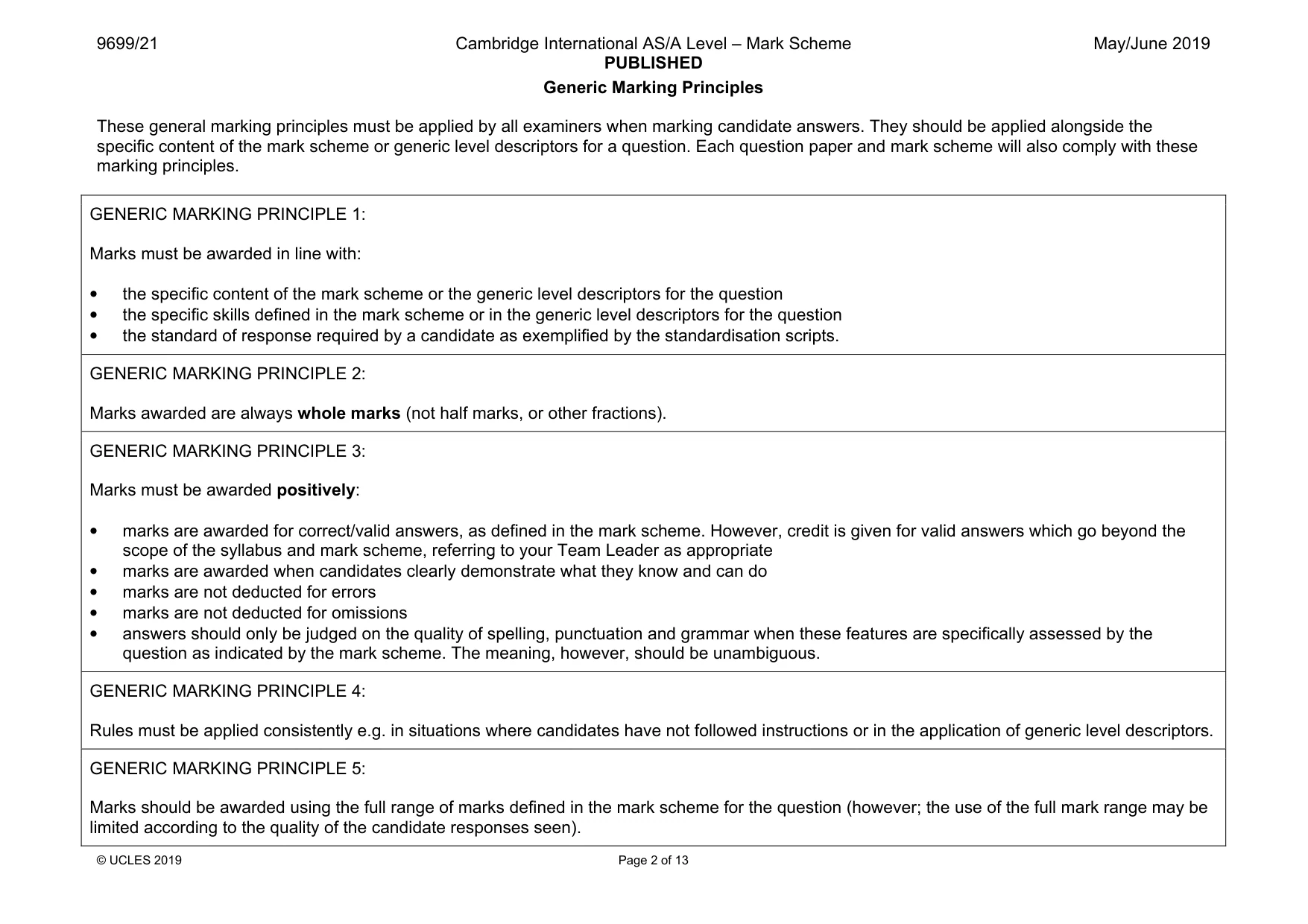
9699/21 Cambridge International AS/A Level – Mark Scheme PUBLISHED May/June 2019 © UCLES 2019 Page 2 of 13 Generic Marking Principles These general marking principles must be applied by all examiners when marking candidate answers. They should be applied alongside the specific content of the mark scheme or generic level descriptors for a question. Each question paper and mark scheme will also comply with these marking principles. GENERIC MARKING PRINCIPLE 1: Marks must be awarded in line with: • the specific content of the mark scheme or the generic level descriptors for the question • the specific skills defined in the mark scheme or in the generic level descriptors for the question • the standard of response required by a candidate as exemplified by the standardisation scripts. GENERIC MARKING PRINCIPLE 2: Marks awarded are always whole marks (not half marks, or other fractions). GENERIC MARKING PRINCIPLE 3: Marks must be awarded positively: • marks are awarded for correct/valid answers, as defined in the mark scheme. However, credit is given for valid answers which go beyond the scope of the syllabus and mark scheme, referring to your Team Leader as appropriate • marks are awarded when candidates clearly demonstrate what they know and can do • marks are not deducted for errors • marks are not deducted for omissions • answers should only be judged on the quality of spelling, punctuation and grammar when these features are specifically assessed by the question as indicated by the mark scheme. The meaning, however, should be unambiguous. GENERIC MARKING PRINCIPLE 4: Rules must be applied consistently e.g. in situations where candidates have not followed instructions or in the application of generic level descriptors. GENERIC MARKING PRINCIPLE 5: Marks should be awarded using the full range of marks defined in the mark scheme for the question (however; the use of the full mark range may be limited according to the quality of the candidate responses seen).
Mark scheme, page 3
9699/21 Cambridge International AS/A Level – Mark Scheme PUBLISHED May/June 2019 © UCLES 2019 Page 3 of 13 GENERIC MARKING PRINCIPLE 6: Marks awarded are based solely on the requirements as defined in the mark scheme. Marks should not be awarded with grade thresholds or grade descriptors in mind.
Mark scheme, page 4
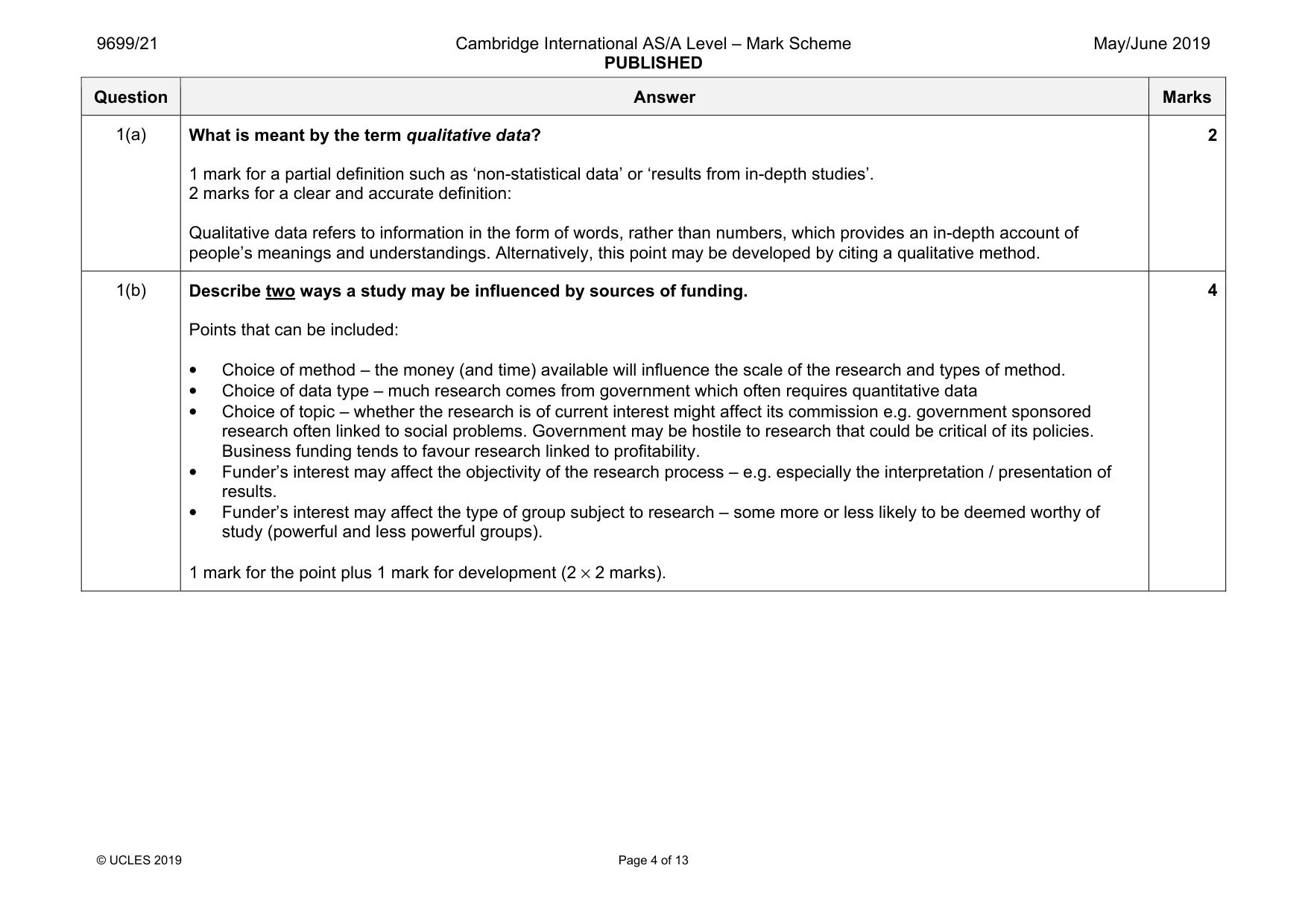
9699/21 Cambridge International AS/A Level – Mark Scheme PUBLISHED May/June 2019 © UCLES 2019 Page 4 of 13 Question Answer Marks 1(a) What is meant by the term qualitative data? 1 mark for a partial definition such as ‘non-statistical data’ or ‘results from in-depth studies’. 2 marks for a clear and accurate definition: Qualitative data refers to information in the form of words, rather than numbers, which provides an in-depth account of people’s meanings and understandings. Alternatively, this point may be developed by citing a qualitative method. 2 1(b) Describe two ways a study may be influenced by sources of funding. Points that can be included: • Choice of method – the money (and time) available will influence the scale of the research and types of method. • Choice of data type – much research comes from government which often requires quantitative data • Choice of topic – whether the research is of current interest might affect its commission e.g. government sponsored research often linked to social problems. Government may be hostile to research that could be critical of its policies. Business funding tends to favour research linked to profitability. • Funder’s interest may affect the objectivity of the research process – e.g. especially the interpretation / presentation of results. • Funder’s interest may affect the type of group subject to research – some more or less likely to be deemed worthy of study (powerful and less powerful groups). 1 mark for the point plus 1 mark for development (2 × 2 marks). 4
Mark scheme, page 5
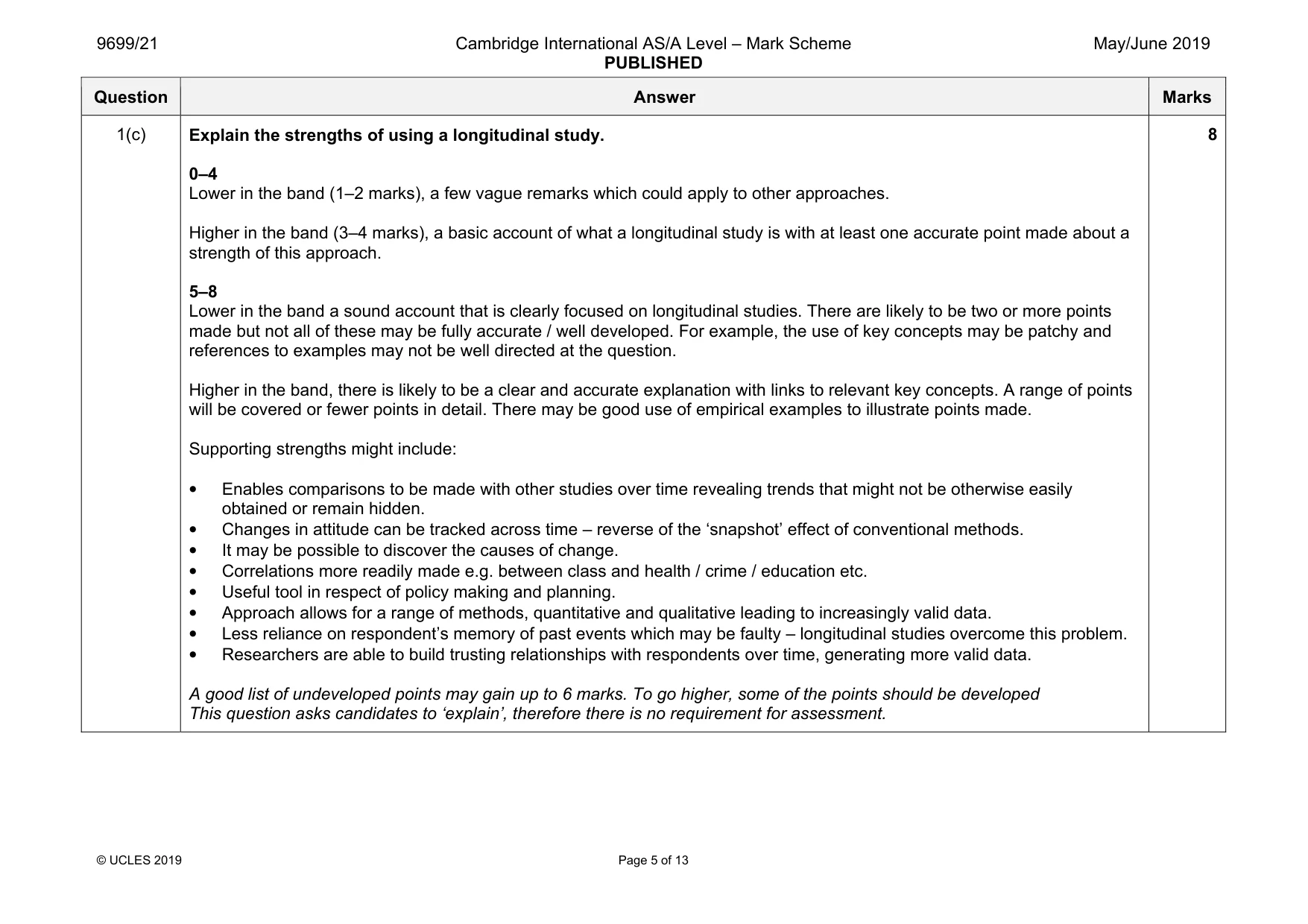
9699/21 Cambridge International AS/A Level – Mark Scheme PUBLISHED May/June 2019 © UCLES 2019 Page 5 of 13 Question Answer Marks 1(c) Explain the strengths of using a longitudinal study. 0–4 Lower in the band (1–2 marks), a few vague remarks which could apply to other approaches. Higher in the band (3–4 marks), a basic account of what a longitudinal study is with at least one accurate point made about a strength of this approach. 5–8 Lower in the band a sound account that is clearly focused on longitudinal studies. There are likely to be two or more points made but not all of these may be fully accurate / well developed. For example, the use of key concepts may be patchy and references to examples may not be well directed at the question. Higher in the band, there is likely to be a clear and accurate explanation with links to relevant key concepts. A range of points will be covered or fewer points in detail. There may be good use of empirical examples to illustrate points made. Supporting strengths might include: • Enables comparisons to be made with other studies over time revealing trends that might not be otherwise easily obtained or remain hidden. • Changes in attitude can be tracked across time – reverse of the ‘snapshot’ effect of conventional methods. • It may be possible to discover the causes of change. • Correlations more readily made e.g. between class and health / crime / education etc. • Useful tool in respect of policy making and planning. • Approach allows for a range of methods, quantitative and qualitative leading to increasingly valid data. • Less reliance on respondent’s memory of past events which may be faulty – longitudinal studies overcome this problem. • Researchers are able to build trusting relationships with respondents over time, generating more valid data. A good list of undeveloped points may gain up to 6 marks. To go higher, some of the points should be developed This question asks candidates to ‘explain’, therefore there is no requirement for assessment. 8
Mark scheme, page 6
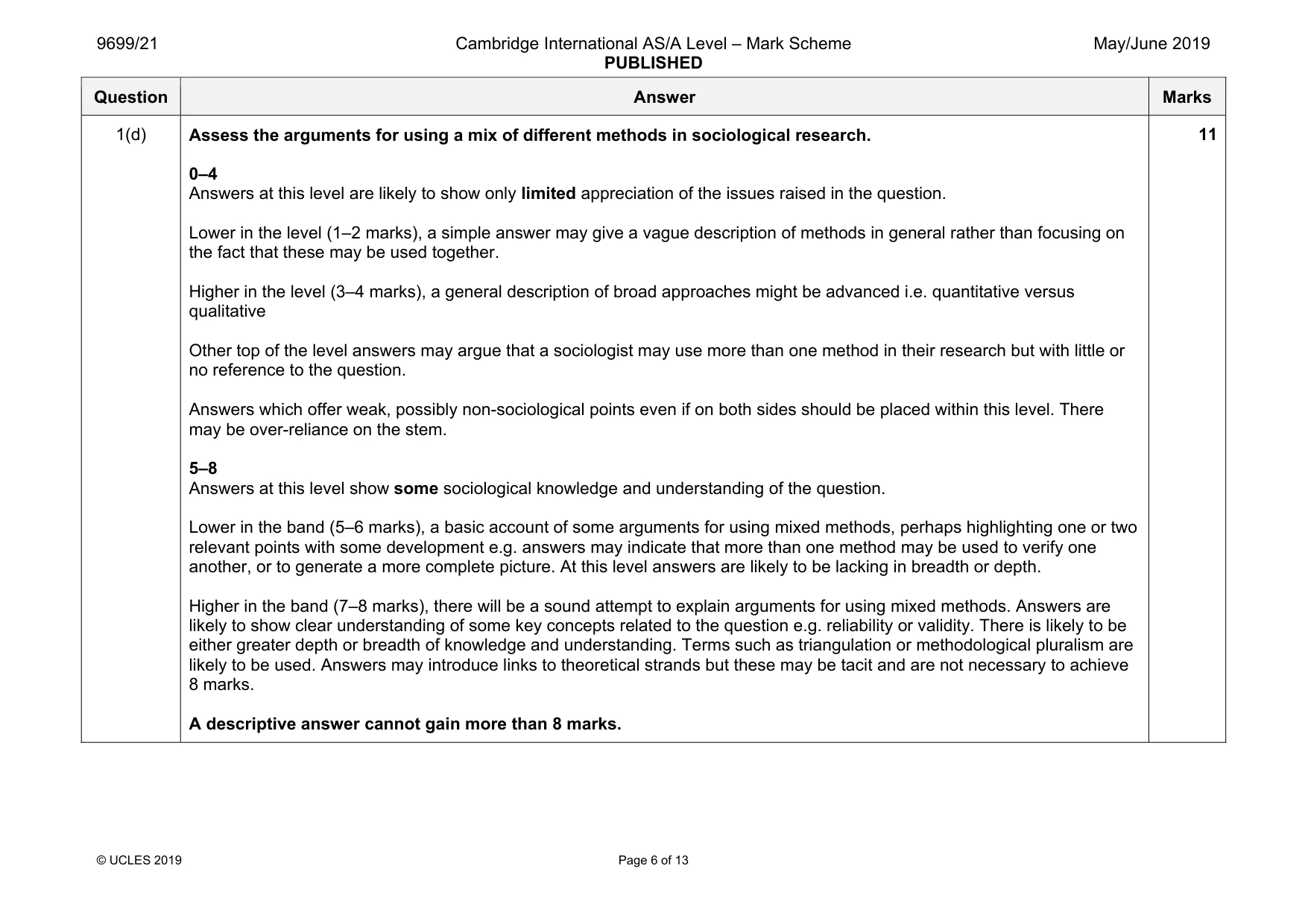
9699/21 Cambridge International AS/A Level – Mark Scheme PUBLISHED May/June 2019 © UCLES 2019 Page 6 of 13 Question Answer Marks 1(d) Assess the arguments for using a mix of different methods in sociological research. 0–4 Answers at this level are likely to show only limited appreciation of the issues raised in the question. Lower in the level (1–2 marks), a simple answer may give a vague description of methods in general rather than focusing on the fact that these may be used together. Higher in the level (3–4 marks), a general description of broad approaches might be advanced i.e. quantitative versus qualitative Other top of the level answers may argue that a sociologist may use more than one method in their research but with little or no reference to the question. Answers which offer weak, possibly non-sociological points even if on both sides should be placed within this level. There may be over-reliance on the stem. 5–8 Answers at this level show some sociological knowledge and understanding of the question. Lower in the band (5–6 marks), a basic account of some arguments for using mixed methods, perhaps highlighting one or two relevant points with some development e.g. answers may indicate that more than one method may be used to verify one another, or to generate a more complete picture. At this level answers are likely to be lacking in breadth or depth. Higher in the band (7–8 marks), there will be a sound attempt to explain arguments for using mixed methods. Answers are likely to show clear understanding of some key concepts related to the question e.g. reliability or validity. There is likely to be either greater depth or breadth of knowledge and understanding. Terms such as triangulation or methodological pluralism are likely to be used. Answers may introduce links to theoretical strands but these may be tacit and are not necessary to achieve 8 marks. A descriptive answer cannot gain more than 8 marks. 11
Mark scheme, page 7
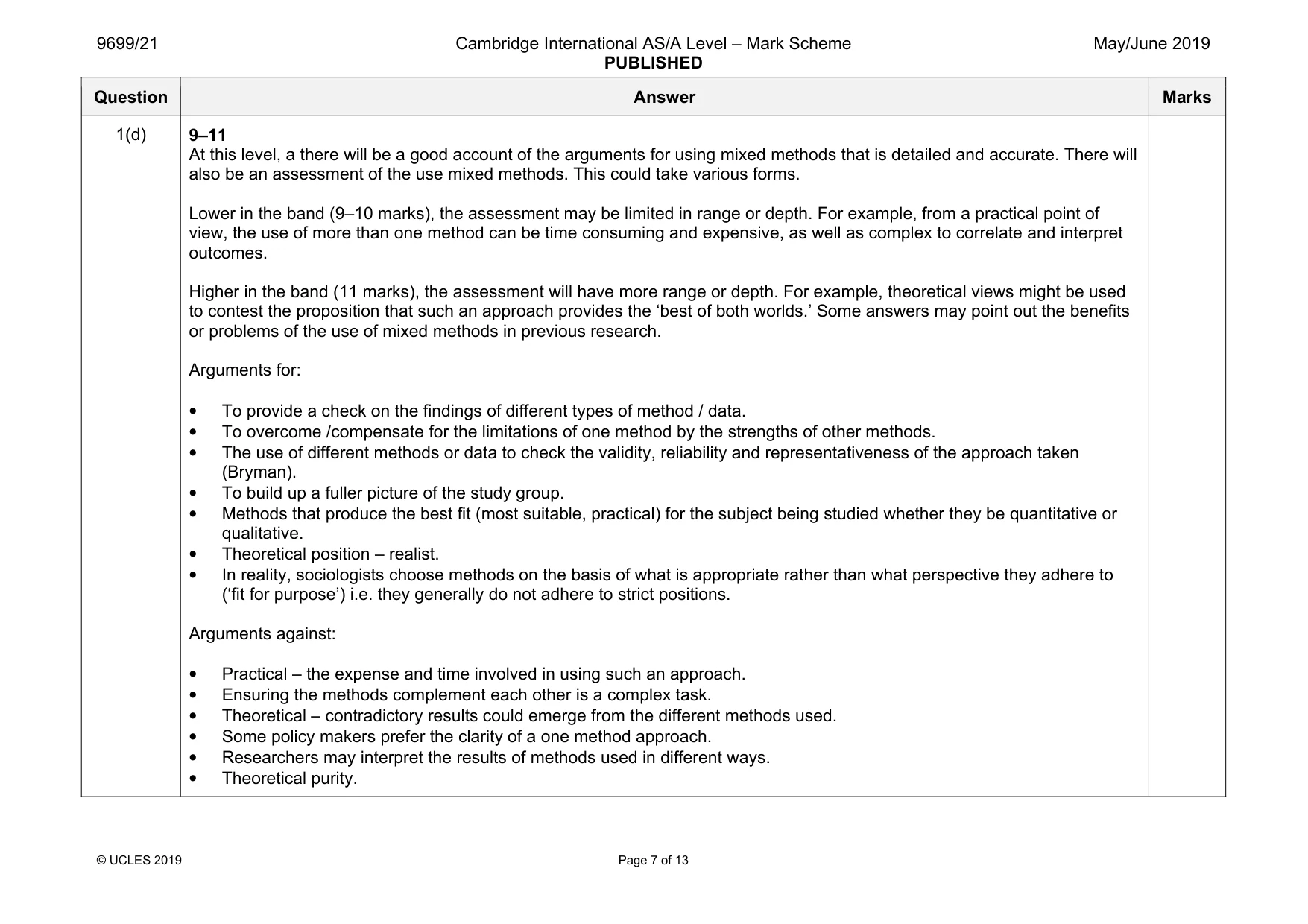
9699/21 Cambridge International AS/A Level – Mark Scheme PUBLISHED May/June 2019 © UCLES 2019 Page 7 of 13 Question Answer Marks 1(d) 9–11 At this level, a there will be a good account of the arguments for using mixed methods that is detailed and accurate. There will also be an assessment of the use mixed methods. This could take various forms. Lower in the band (9–10 marks), the assessment may be limited in range or depth. For example, from a practical point of view, the use of more than one method can be time consuming and expensive, as well as complex to correlate and interpret outcomes. Higher in the band (11 marks), the assessment will have more range or depth. For example, theoretical views might be used to contest the proposition that such an approach provides the ‘best of both worlds.’ Some answers may point out the benefits or problems of the use of mixed methods in previous research. Arguments for: • To provide a check on the findings of different types of method / data. • To overcome /compensate for the limitations of one method by the strengths of other methods. • The use of different methods or data to check the validity, reliability and representativeness of the approach taken (Bryman). • To build up a fuller picture of the study group. • Methods that produce the best fit (most suitable, practical) for the subject being studied whether they be quantitative or qualitative. • Theoretical position – realist. • In reality, sociologists choose methods on the basis of what is appropriate rather than what perspective they adhere to (‘fit for purpose’) i.e. they generally do not adhere to strict positions. Arguments against: • Practical – the expense and time involved in using such an approach. • Ensuring the methods complement each other is a complex task. • Theoretical – contradictory results could emerge from the different methods used. • Some policy makers prefer the clarity of a one method approach. • Researchers may interpret the results of methods used in different ways. • Theoretical purity.
Mark scheme, page 8
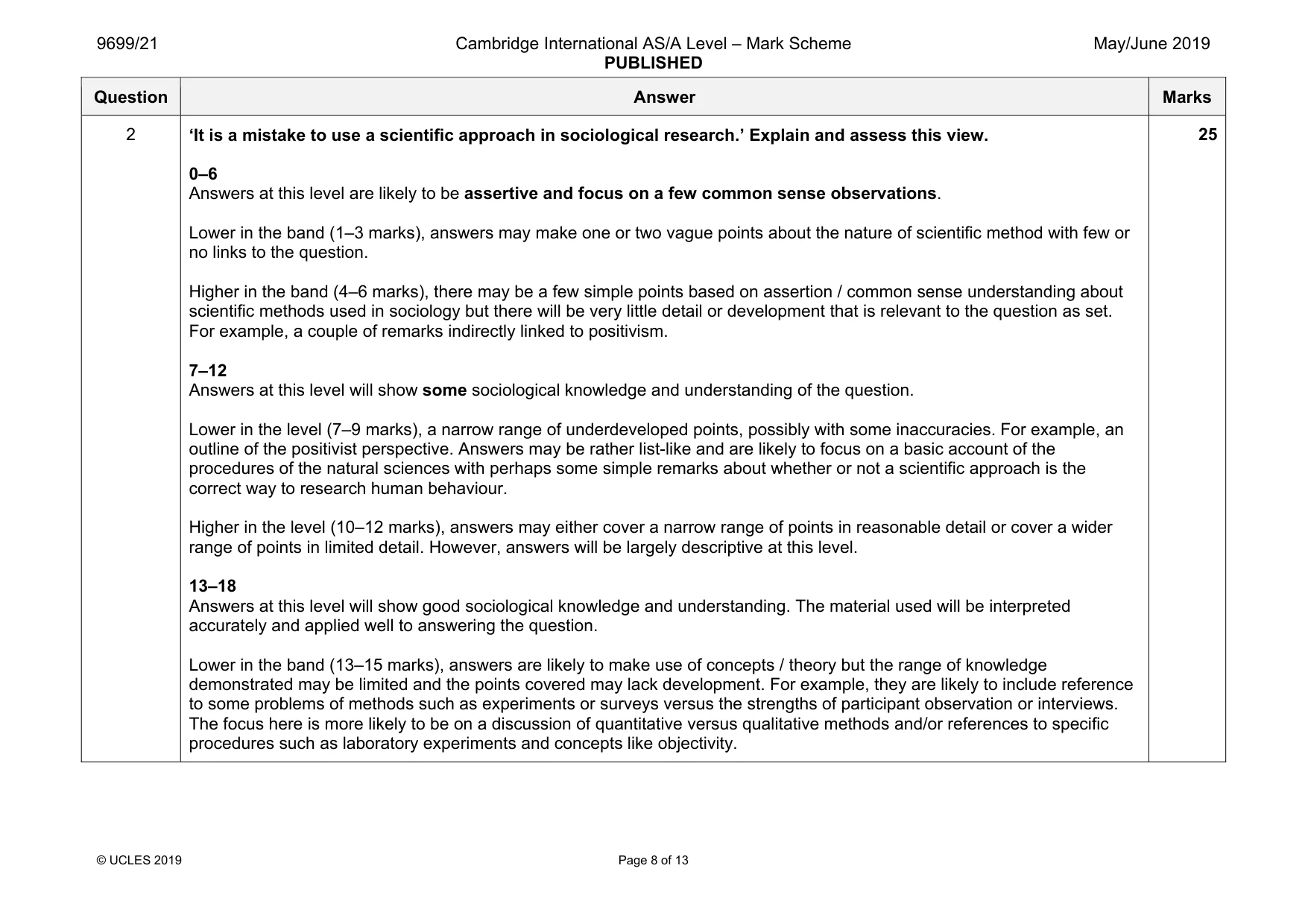
9699/21 Cambridge International AS/A Level – Mark Scheme PUBLISHED May/June 2019 © UCLES 2019 Page 8 of 13 Question Answer Marks 2 ‘It is a mistake to use a scientific approach in sociological research.’ Explain and assess this view. 0–6 Answers at this level are likely to be assertive and focus on a few common sense observations. Lower in the band (1–3 marks), answers may make one or two vague points about the nature of scientific method with few or no links to the question. Higher in the band (4–6 marks), there may be a few simple points based on assertion / common sense understanding about scientific methods used in sociology but there will be very little detail or development that is relevant to the question as set. For example, a couple of remarks indirectly linked to positivism. 7–12 Answers at this level will show some sociological knowledge and understanding of the question. Lower in the level (7–9 marks), a narrow range of underdeveloped points, possibly with some inaccuracies. For example, an outline of the positivist perspective. Answers may be rather list-like and are likely to focus on a basic account of the procedures of the natural sciences with perhaps some simple remarks about whether or not a scientific approach is the correct way to research human behaviour. Higher in the level (10–12 marks), answers may either cover a narrow range of points in reasonable detail or cover a wider range of points in limited detail. However, answers will be largely descriptive at this level. 13–18 Answers at this level will show good sociological knowledge and understanding. The material used will be interpreted accurately and applied well to answering the question. Lower in the band (13–15 marks), answers are likely to make use of concepts / theory but the range of knowledge demonstrated may be limited and the points covered may lack development. For example, they are likely to include reference to some problems of methods such as experiments or surveys versus the strengths of participant observation or interviews. The focus here is more likely to be on a discussion of quantitative versus qualitative methods and/or references to specific procedures such as laboratory experiments and concepts like objectivity. 25
Mark scheme, page 9
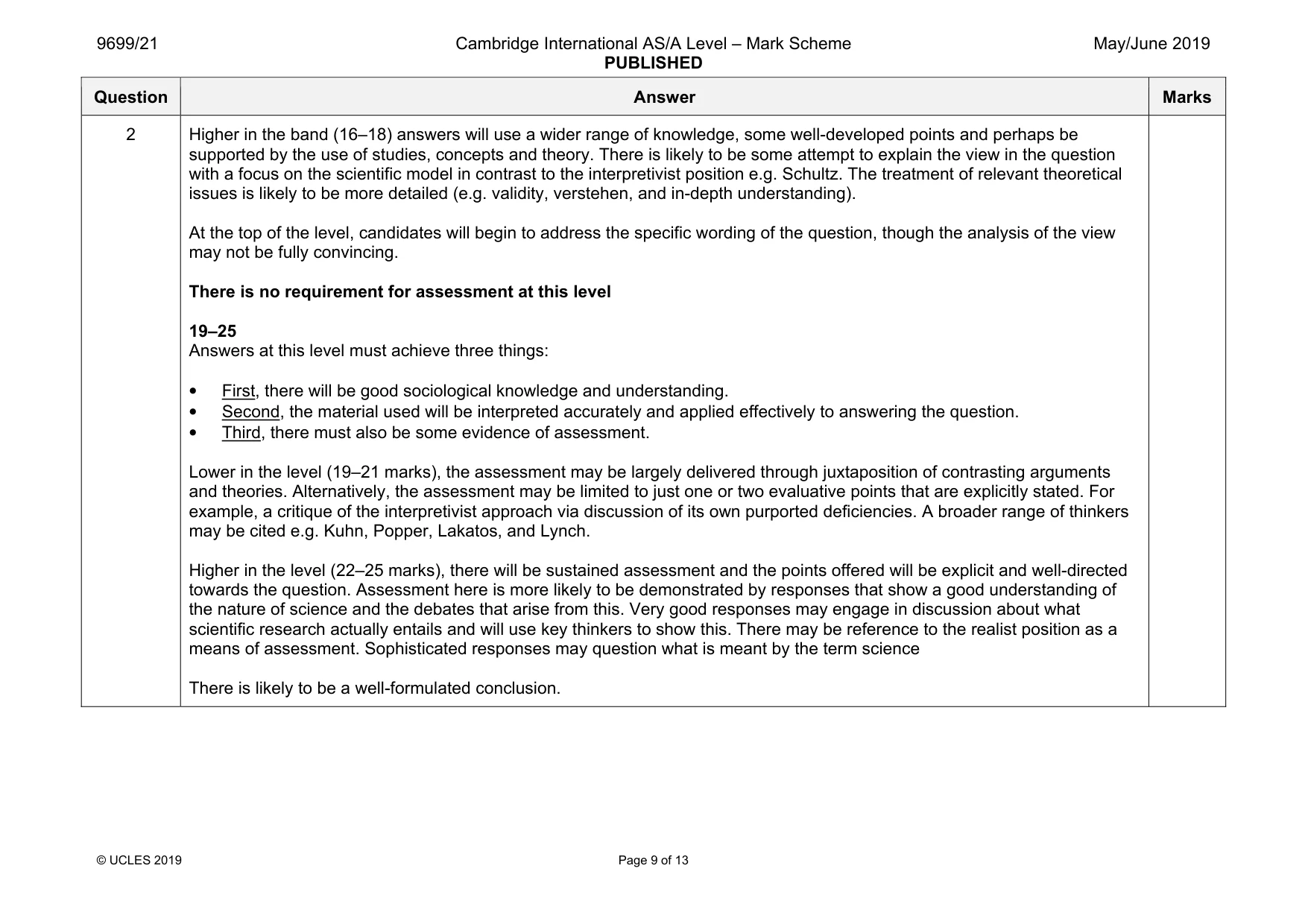
9699/21 Cambridge International AS/A Level – Mark Scheme PUBLISHED May/June 2019 © UCLES 2019 Page 9 of 13 Question Answer Marks 2 Higher in the band (16–18) answers will use a wider range of knowledge, some well-developed points and perhaps be supported by the use of studies, concepts and theory. There is likely to be some attempt to explain the view in the question with a focus on the scientific model in contrast to the interpretivist position e.g. Schultz. The treatment of relevant theoretical issues is likely to be more detailed (e.g. validity, verstehen, and in-depth understanding). At the top of the level, candidates will begin to address the specific wording of the question, though the analysis of the view may not be fully convincing. There is no requirement for assessment at this level 19–25 Answers at this level must achieve three things: • First, there will be good sociological knowledge and understanding. • Second, the material used will be interpreted accurately and applied effectively to answering the question. • Third, there must also be some evidence of assessment. Lower in the level (19–21 marks), the assessment may be largely delivered through juxtaposition of contrasting arguments and theories. Alternatively, the assessment may be limited to just one or two evaluative points that are explicitly stated. For example, a critique of the interpretivist approach via discussion of its own purported deficiencies. A broader range of thinkers may be cited e.g. Kuhn, Popper, Lakatos, and Lynch. Higher in the level (22–25 marks), there will be sustained assessment and the points offered will be explicit and well-directed towards the question. Assessment here is more likely to be demonstrated by responses that show a good understanding of the nature of science and the debates that arise from this. Very good responses may engage in discussion about what scientific research actually entails and will use key thinkers to show this. There may be reference to the realist position as a means of assessment. Sophisticated responses may question what is meant by the term science There is likely to be a well-formulated conclusion.
Mark scheme, page 10
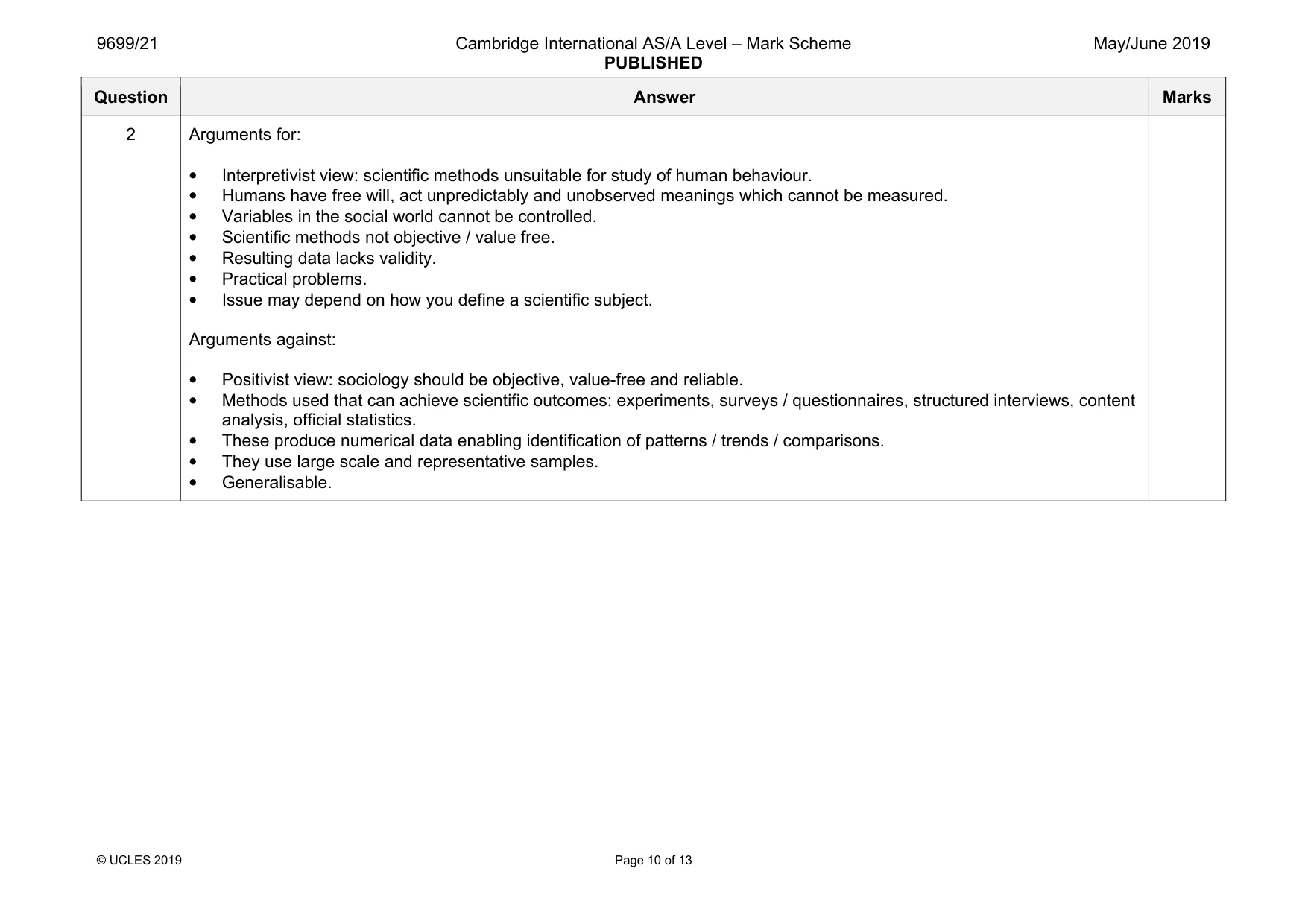
9699/21 Cambridge International AS/A Level – Mark Scheme PUBLISHED May/June 2019 © UCLES 2019 Page 10 of 13 Question Answer Marks 2 Arguments for: • Interpretivist view: scientific methods unsuitable for study of human behaviour. • Humans have free will, act unpredictably and unobserved meanings which cannot be measured. • Variables in the social world cannot be controlled. • Scientific methods not objective / value free. • Resulting data lacks validity. • Practical problems. • Issue may depend on how you define a scientific subject. Arguments against: • Positivist view: sociology should be objective, value-free and reliable. • Methods used that can achieve scientific outcomes: experiments, surveys / questionnaires, structured interviews, content analysis, official statistics. • These produce numerical data enabling identification of patterns / trends / comparisons. • They use large scale and representative samples. • Generalisable.
Mark scheme, page 11
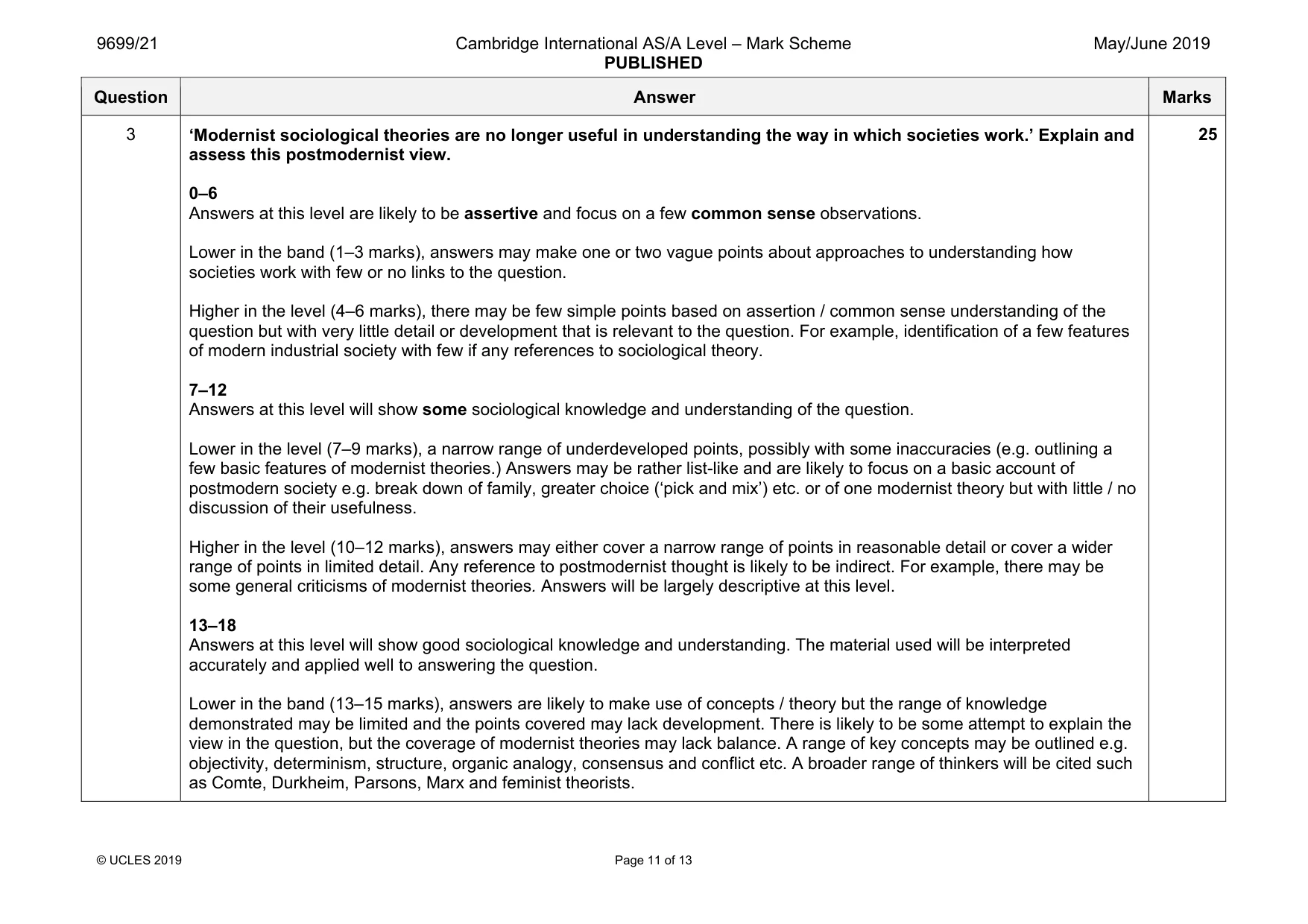
9699/21 Cambridge International AS/A Level – Mark Scheme PUBLISHED May/June 2019 © UCLES 2019 Page 11 of 13 Question Answer Marks 3 ‘Modernist sociological theories are no longer useful in understanding the way in which societies work.’ Explain and assess this postmodernist view. 0–6 Answers at this level are likely to be assertive and focus on a few common sense observations. Lower in the band (1–3 marks), answers may make one or two vague points about approaches to understanding how societies work with few or no links to the question. Higher in the level (4–6 marks), there may be few simple points based on assertion / common sense understanding of the question but with very little detail or development that is relevant to the question. For example, identification of a few features of modern industrial society with few if any references to sociological theory. 7–12 Answers at this level will show some sociological knowledge and understanding of the question. Lower in the level (7–9 marks), a narrow range of underdeveloped points, possibly with some inaccuracies (e.g. outlining a few basic features of modernist theories.) Answers may be rather list-like and are likely to focus on a basic account of postmodern society e.g. break down of family, greater choice (‘pick and mix’) etc. or of one modernist theory but with little / no discussion of their usefulness. Higher in the level (10–12 marks), answers may either cover a narrow range of points in reasonable detail or cover a wider range of points in limited detail. Any reference to postmodernist thought is likely to be indirect. For example, there may be some general criticisms of modernist theories. Answers will be largely descriptive at this level. 13–18 Answers at this level will show good sociological knowledge and understanding. The material used will be interpreted accurately and applied well to answering the question. Lower in the band (13–15 marks), answers are likely to make use of concepts / theory but the range of knowledge demonstrated may be limited and the points covered may lack development. There is likely to be some attempt to explain the view in the question, but the coverage of modernist theories may lack balance. A range of key concepts may be outlined e.g. objectivity, determinism, structure, organic analogy, consensus and conflict etc. A broader range of thinkers will be cited such as Comte, Durkheim, Parsons, Marx and feminist theorists. 25
Mark scheme, page 12
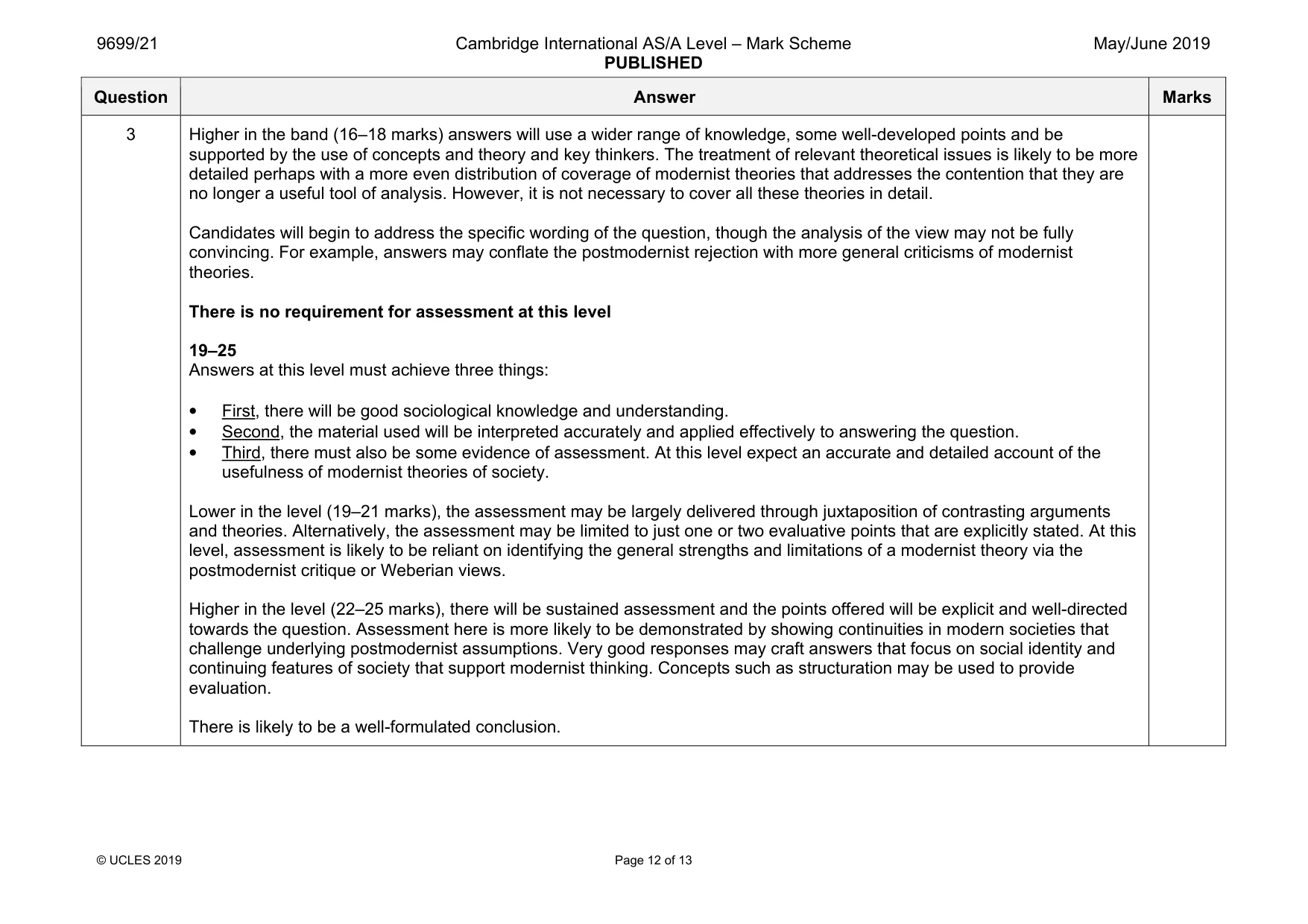
9699/21 Cambridge International AS/A Level – Mark Scheme PUBLISHED May/June 2019 © UCLES 2019 Page 12 of 13 Question Answer Marks 3 Higher in the band (16–18 marks) answers will use a wider range of knowledge, some well-developed points and be supported by the use of concepts and theory and key thinkers. The treatment of relevant theoretical issues is likely to be more detailed perhaps with a more even distribution of coverage of modernist theories that addresses the contention that they are no longer a useful tool of analysis. However, it is not necessary to cover all these theories in detail. Candidates will begin to address the specific wording of the question, though the analysis of the view may not be fully convincing. For example, answers may conflate the postmodernist rejection with more general criticisms of modernist theories. There is no requirement for assessment at this level 19–25 Answers at this level must achieve three things: • First, there will be good sociological knowledge and understanding. • Second, the material used will be interpreted accurately and applied effectively to answering the question. • Third, there must also be some evidence of assessment. At this level expect an accurate and detailed account of the usefulness of modernist theories of society. Lower in the level (19–21 marks), the assessment may be largely delivered through juxtaposition of contrasting arguments and theories. Alternatively, the assessment may be limited to just one or two evaluative points that are explicitly stated. At this level, assessment is likely to be reliant on identifying the general strengths and limitations of a modernist theory via the postmodernist critique or Weberian views. Higher in the level (22–25 marks), there will be sustained assessment and the points offered will be explicit and well-directed towards the question. Assessment here is more likely to be demonstrated by showing continuities in modern societies that challenge underlying postmodernist assumptions. Very good responses may craft answers that focus on social identity and continuing features of society that support modernist thinking. Concepts such as structuration may be used to provide evaluation. There is likely to be a well-formulated conclusion.
Mark scheme, page 13
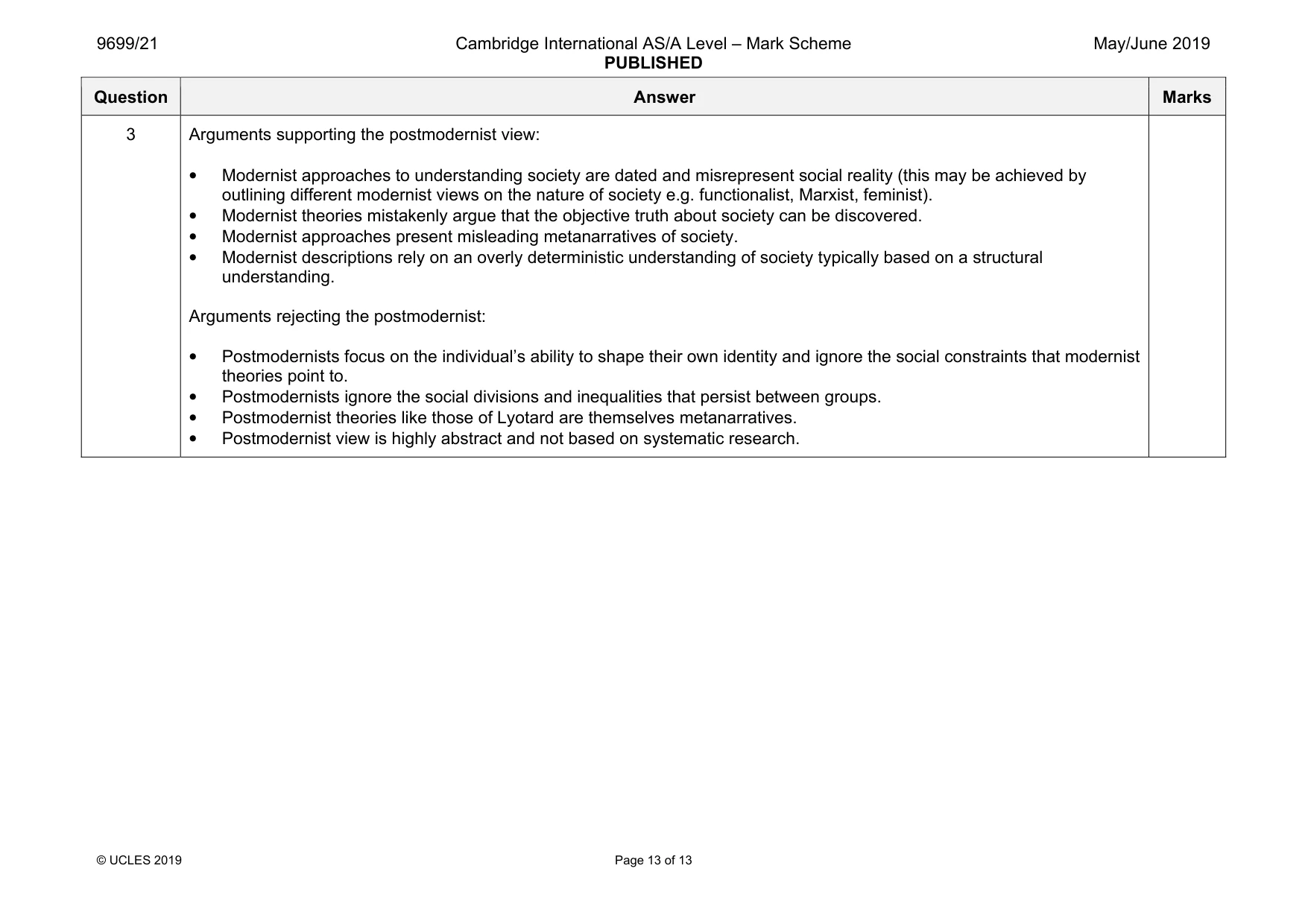
9699/21 Cambridge International AS/A Level – Mark Scheme PUBLISHED May/June 2019 © UCLES 2019 Page 13 of 13 Question Answer Marks 3 Arguments supporting the postmodernist view: • Modernist approaches to understanding society are dated and misrepresent social reality (this may be achieved by outlining different modernist views on the nature of society e.g. functionalist, Marxist, feminist). • Modernist theories mistakenly argue that the objective truth about society can be discovered. • Modernist approaches present misleading metanarratives of society. • Modernist descriptions rely on an overly deterministic understanding of society typically based on a structural understanding. Arguments rejecting the postmodernist: • Postmodernists focus on the individual’s ability to shape their own identity and ignore the social constraints that modernist theories point to. • Postmodernists ignore the social divisions and inequalities that persist between groups. • Postmodernist theories like those of Lyotard are themselves metanarratives. • Postmodernist view is highly abstract and not based on systematic research.
What you needed in this session
Cambridge’s own grade thresholds for 2019 May/June, Paper 2 · Variant 1. A higher threshold means an easier paper — the bar moves with how the cohort did.