Cambridge A Level Sociology 9699 — 2019 May/June Paper 1 · Variant 2
9699/12/M/J/19 · 50 marks · ≈56 min
The question paper and its mark scheme, free to read here and free to download. This is Cambridge’s own paper, exactly as it was sat.
Question paper4 pages


Mark scheme14 pages
Answers below. Sit the paper first if you are practising.
Paper as text
Question paper, page 1
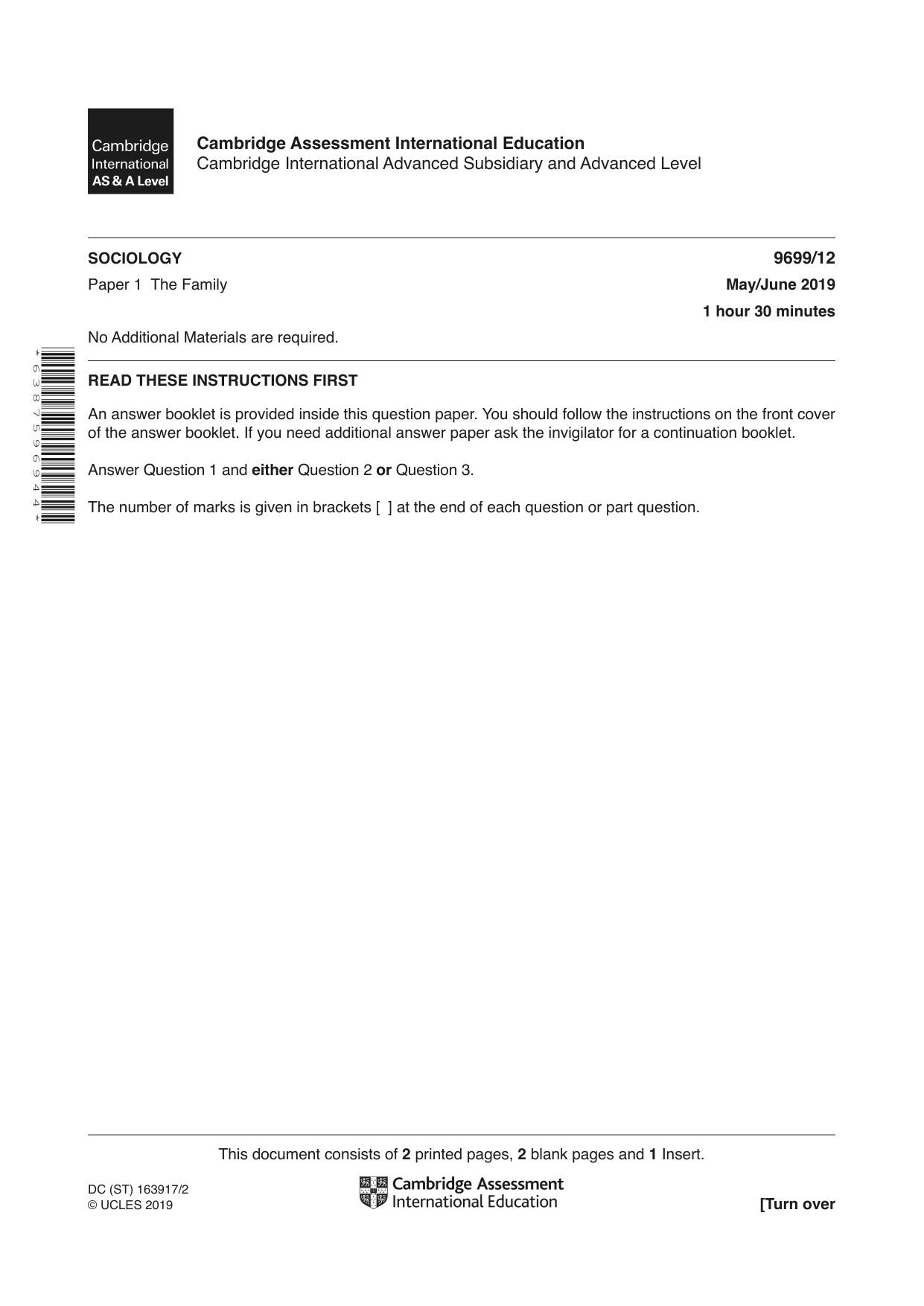
This document consists of 2 printed pages, 2 blank pages and 1 Insert. DC (ST) 163917/2 © UCLES 2019 [Turn over Cambridge Assessment International Education Cambridge International Advanced Subsidiary and Advanced Level * 6 3 8 7 5 9 6 9 4 4 * SOCIOLOGY 9699/12 Paper 1 The Family May/June 2019 1 hour 30 minutes No Additional Materials are required. READ THESE INSTRUCTIONS FIRST An answer booklet is provided inside this question paper. You should follow the instructions on the front cover of the answer booklet. If you need additional answer paper ask the invigilator for a continuation booklet. Answer Question 1 and either Question 2 or Question 3. The number of marks is given in brackets [ ] at the end of each question or part question.
Question paper, page 2
2 9699/12/M/J/19 © UCLES 2019 Section A Answer Question 1. 1 Functionalists, such as Parsons, believe that the traditional nuclear family best meets the needs of society. They argue that a family should have a male parent to fulfil the instrumental role and a female parent to fulfil the expressive role. The New Right agree that families should have two parents of the opposite sex and they are therefore critical of lone-parent families which they see as harmful for society. The New Right argue that state policies should support nuclear families and discourage alternative family types, such as lone-parent families. Neo-functionalists, such as Swenson, take a different view. Swenson has argued that a lone- parent family is not necessarily a dysfunctional family as one parent can successfully combine both the expressive and instrumental roles. (a) Define the term dysfunctional family. [2] (b) Describe two features of the expressive role. [4] (c) Explain how state policies may influence family life. [8] (d) Assess the New Right view that lone-parent families are harmful for society. [11] Section B Answer either Question 2 or Question 3. 2 ‘The nuclear family continues to be the dominant family form in modern industrial societies.’ Explain and assess this view. [25] 3 ‘In the past family roles were fixed but today there is more choice for the individual.’ Explain and assess this view. [25]
Question paper, page 3
3 9699/12/M/J/19 © UCLES 2019 BLANK PAGE
Question paper, page 4
4 9699/12/M/J/19 © UCLES 2019 Permission to reproduce items where third-party owned material protected by copyright is included has been sought and cleared where possible. Every reasonable effort has been made by the publisher (UCLES) to trace copyright holders, but if any items requiring clearance have unwittingly been included, the publisher will be pleased to make amends at the earliest possible opportunity. To avoid the issue of disclosure of answer-related information to candidates, all copyright acknowledgements are reproduced online in the Cambridge Assessment International Education Copyright Acknowledgements Booklet. This is produced for each series of examinations and is freely available to download at www.cambridgeinternational.org after the live examination series. Cambridge Assessment International Education is part of the Cambridge Assessment Group. Cambridge Assessment is the brand name of the University of Cambridge Local Examinations Syndicate (UCLES), which itself is a department of the University of Cambridge. BLANK PAGE
Mark scheme, page 1
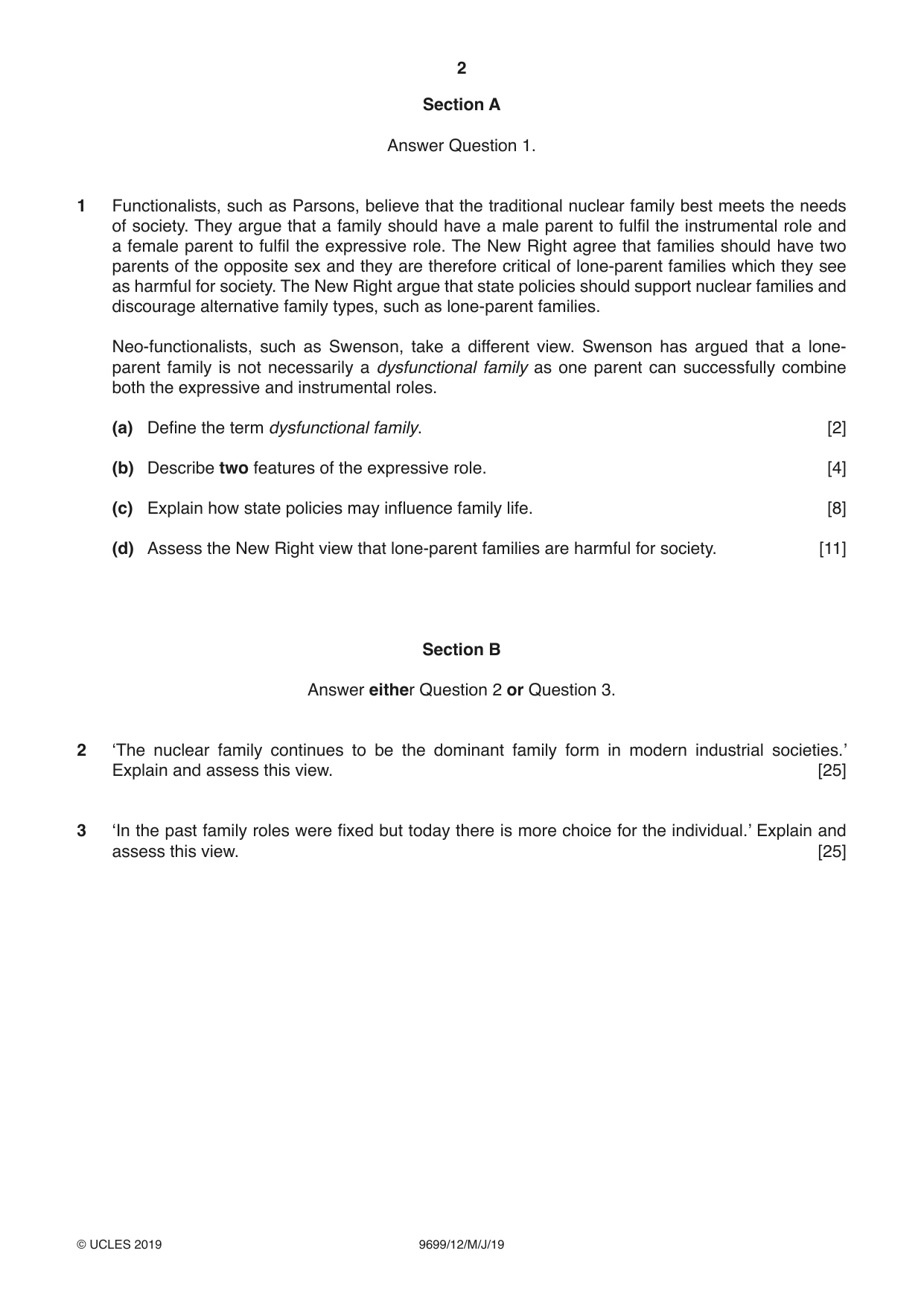
This document consists of 14 printed pages. © UCLES 2019 [Turn over Cambridge Assessment International Education Cambridge International Advanced Subsidiary and Advanced Level SOCIOLOGY 9699/12 Paper 1 The Family May/June 2019 MARK SCHEME Maximum Mark: 50 Published This mark scheme is published as an aid to teachers and candidates, to indicate the requirements of the examination. It shows the basis on which Examiners were instructed to award marks. It does not indicate the details of the discussions that took place at an Examiners’ meeting before marking began, which would have considered the acceptability of alternative answers. Mark schemes should be read in conjunction with the question paper and the Principal Examiner Report for Teachers. Cambridge International will not enter into discussions about these mark schemes. Cambridge International is publishing the mark schemes for the May/June 2019 series for most Cambridge IGCSE™, Cambridge International A and AS Level and Cambridge Pre-U components, and some Cambridge O Level components.
Mark scheme, page 2
9699/12 Cambridge International AS/A Level – Mark Scheme PUBLISHED May/June 2019 © UCLES 2019 Page 2 of 14 Generic Marking Principles These general marking principles must be applied by all examiners when marking candidate answers. They should be applied alongside the specific content of the mark scheme or generic level descriptors for a question. Each question paper and mark scheme will also comply with these marking principles. GENERIC MARKING PRINCIPLE 1: Marks must be awarded in line with: • the specific content of the mark scheme or the generic level descriptors for the question • the specific skills defined in the mark scheme or in the generic level descriptors for the question • the standard of response required by a candidate as exemplified by the standardisation scripts. GENERIC MARKING PRINCIPLE 2: Marks awarded are always whole marks (not half marks, or other fractions). GENERIC MARKING PRINCIPLE 3: Marks must be awarded positively: • marks are awarded for correct/valid answers, as defined in the mark scheme. However, credit is given for valid answers which go beyond the scope of the syllabus and mark scheme, referring to your Team Leader as appropriate • marks are awarded when candidates clearly demonstrate what they know and can do • marks are not deducted for errors • marks are not deducted for omissions • answers should only be judged on the quality of spelling, punctuation and grammar when these features are specifically assessed by the question as indicated by the mark scheme. The meaning, however, should be unambiguous. GENERIC MARKING PRINCIPLE 4: Rules must be applied consistently e.g. in situations where candidates have not followed instructions or in the application of generic level descriptors. GENERIC MARKING PRINCIPLE 5: Marks should be awarded using the full range of marks defined in the mark scheme for the question (however; the use of the full mark range may be limited according to the quality of the candidate responses seen).
Mark scheme, page 3
9699/12 Cambridge International AS/A Level – Mark Scheme PUBLISHED May/June 2019 © UCLES 2019 Page 3 of 14 GENERIC MARKING PRINCIPLE 6: Marks awarded are based solely on the requirements as defined in the mark scheme. Marks should not be awarded with grade thresholds or grade descriptors in mind.
Mark scheme, page 4
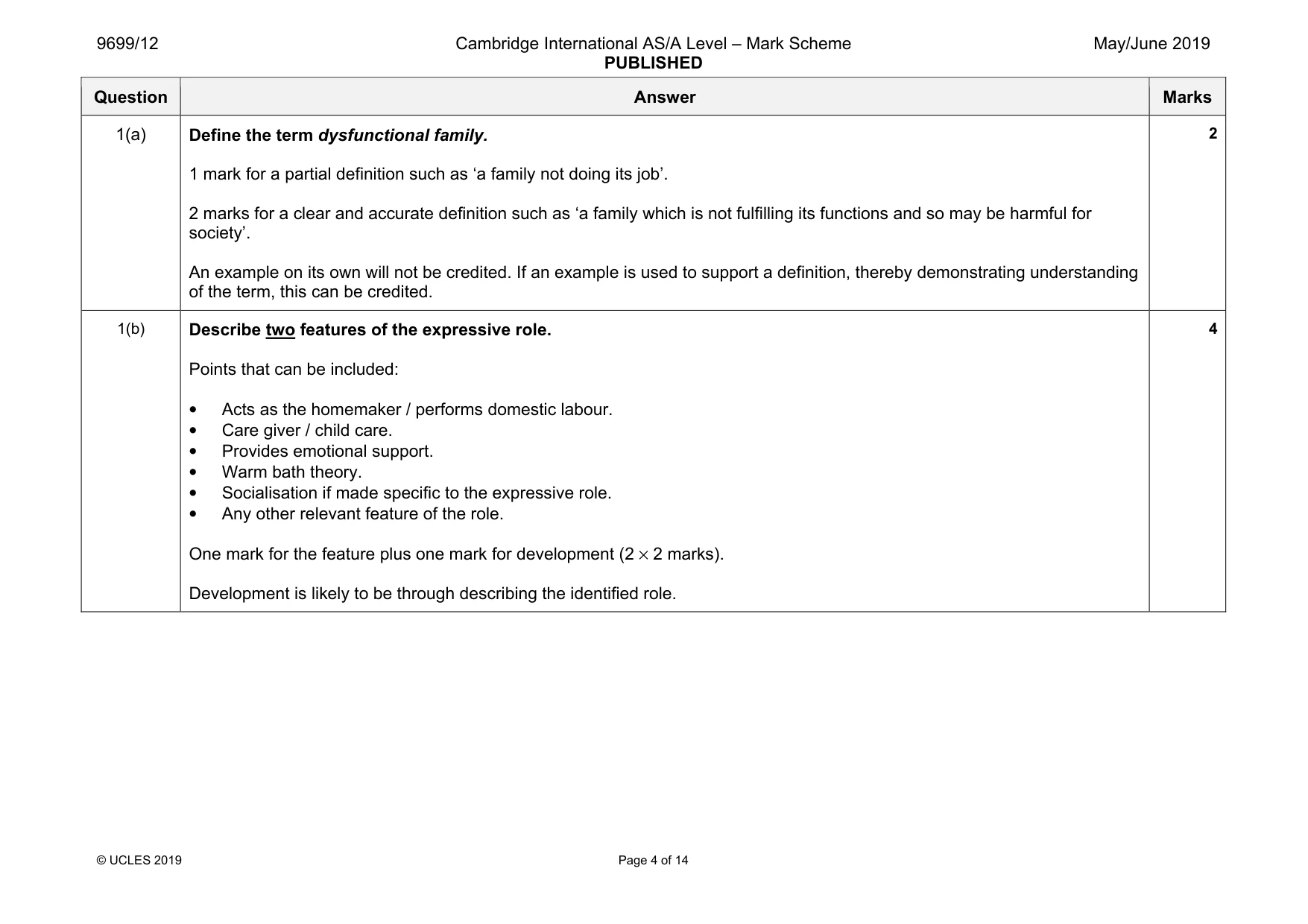
9699/12 Cambridge International AS/A Level – Mark Scheme PUBLISHED May/June 2019 © UCLES 2019 Page 4 of 14 Question Answer Marks 1(a) Define the term dysfunctional family. 1 mark for a partial definition such as ‘a family not doing its job’. 2 marks for a clear and accurate definition such as ‘a family which is not fulfilling its functions and so may be harmful for society’. An example on its own will not be credited. If an example is used to support a definition, thereby demonstrating understanding of the term, this can be credited. 2 1(b) Describe two features of the expressive role. Points that can be included: • Acts as the homemaker / performs domestic labour. • Care giver / child care. • Provides emotional support. • Warm bath theory. • Socialisation if made specific to the expressive role. • Any other relevant feature of the role. One mark for the feature plus one mark for development (2 × 2 marks). Development is likely to be through describing the identified role. 4
Mark scheme, page 5
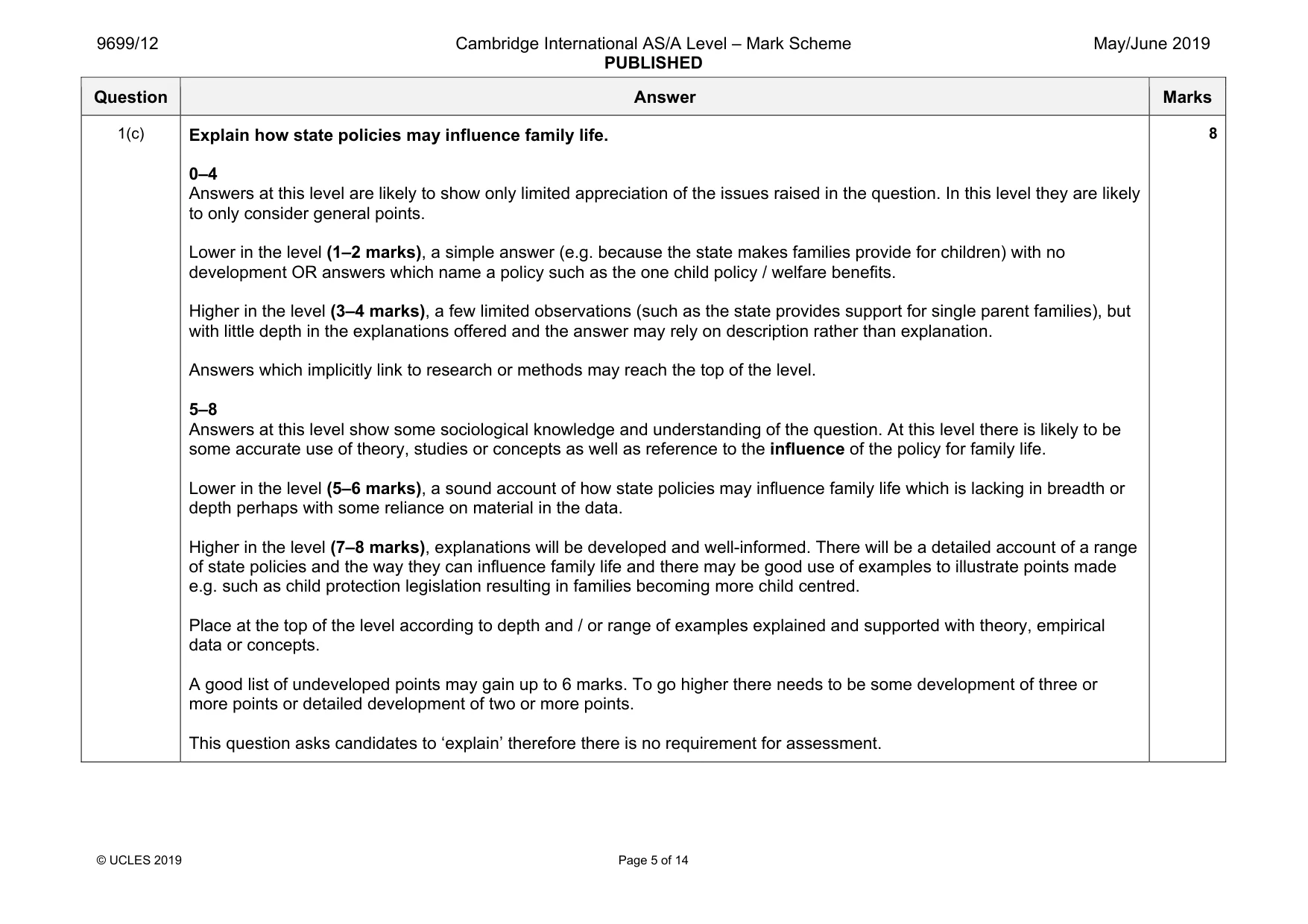
9699/12 Cambridge International AS/A Level – Mark Scheme PUBLISHED May/June 2019 © UCLES 2019 Page 5 of 14 Question Answer Marks 1(c) Explain how state policies may influence family life. 0–4 Answers at this level are likely to show only limited appreciation of the issues raised in the question. In this level they are likely to only consider general points. Lower in the level (1–2 marks), a simple answer (e.g. because the state makes families provide for children) with no development OR answers which name a policy such as the one child policy / welfare benefits. Higher in the level (3–4 marks), a few limited observations (such as the state provides support for single parent families), but with little depth in the explanations offered and the answer may rely on description rather than explanation. Answers which implicitly link to research or methods may reach the top of the level. 5–8 Answers at this level show some sociological knowledge and understanding of the question. At this level there is likely to be some accurate use of theory, studies or concepts as well as reference to the influence of the policy for family life. Lower in the level (5–6 marks), a sound account of how state policies may influence family life which is lacking in breadth or depth perhaps with some reliance on material in the data. Higher in the level (7–8 marks), explanations will be developed and well-informed. There will be a detailed account of a range of state policies and the way they can influence family life and there may be good use of examples to illustrate points made e.g. such as child protection legislation resulting in families becoming more child centred. Place at the top of the level according to depth and / or range of examples explained and supported with theory, empirical data or concepts. A good list of undeveloped points may gain up to 6 marks. To go higher there needs to be some development of three or more points or detailed development of two or more points. This question asks candidates to ‘explain’ therefore there is no requirement for assessment. 8
Mark scheme, page 6
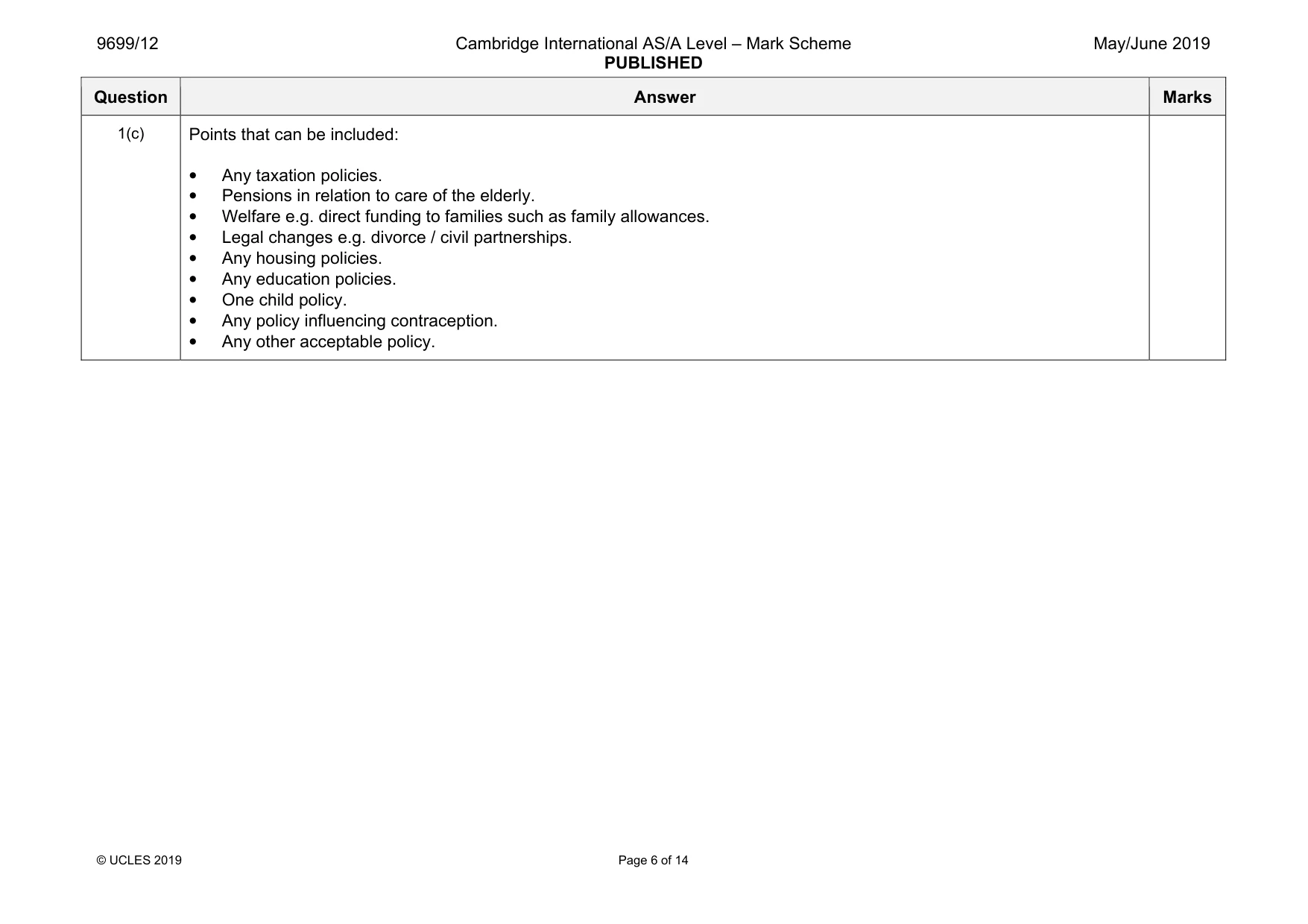
9699/12 Cambridge International AS/A Level – Mark Scheme PUBLISHED May/June 2019 © UCLES 2019 Page 6 of 14 Question Answer Marks 1(c) Points that can be included: • Any taxation policies. • Pensions in relation to care of the elderly. • Welfare e.g. direct funding to families such as family allowances. • Legal changes e.g. divorce / civil partnerships. • Any housing policies. • Any education policies. • One child policy. • Any policy influencing contraception. • Any other acceptable policy.
Mark scheme, page 7
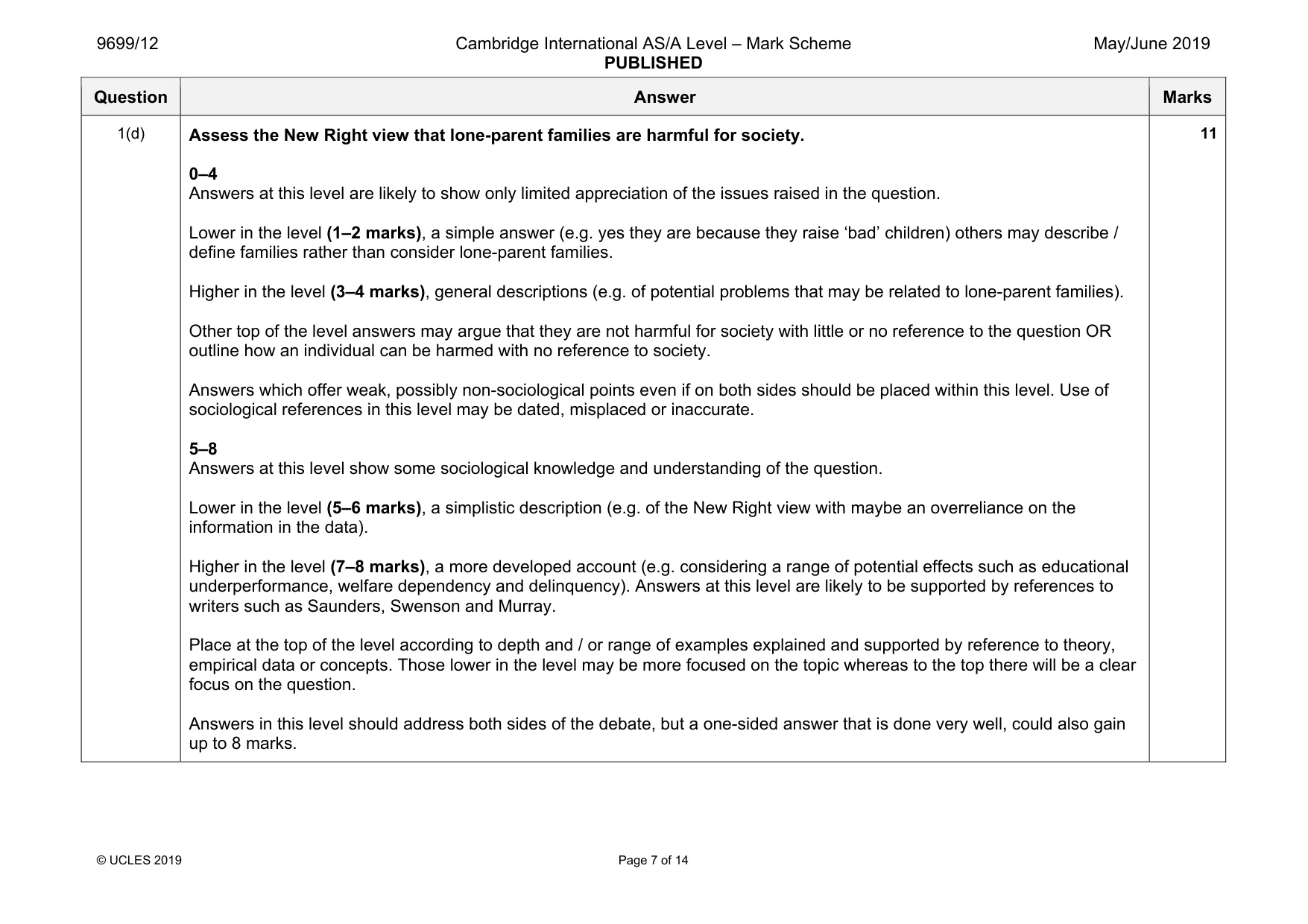
9699/12 Cambridge International AS/A Level – Mark Scheme PUBLISHED May/June 2019 © UCLES 2019 Page 7 of 14 Question Answer Marks 1(d) Assess the New Right view that lone-parent families are harmful for society. 0–4 Answers at this level are likely to show only limited appreciation of the issues raised in the question. Lower in the level (1–2 marks), a simple answer (e.g. yes they are because they raise ‘bad’ children) others may describe / define families rather than consider lone-parent families. Higher in the level (3–4 marks), general descriptions (e.g. of potential problems that may be related to lone-parent families). Other top of the level answers may argue that they are not harmful for society with little or no reference to the question OR outline how an individual can be harmed with no reference to society. Answers which offer weak, possibly non-sociological points even if on both sides should be placed within this level. Use of sociological references in this level may be dated, misplaced or inaccurate. 5–8 Answers at this level show some sociological knowledge and understanding of the question. Lower in the level (5–6 marks), a simplistic description (e.g. of the New Right view with maybe an overreliance on the information in the data). Higher in the level (7–8 marks), a more developed account (e.g. considering a range of potential effects such as educational underperformance, welfare dependency and delinquency). Answers at this level are likely to be supported by references to writers such as Saunders, Swenson and Murray. Place at the top of the level according to depth and / or range of examples explained and supported by reference to theory, empirical data or concepts. Those lower in the level may be more focused on the topic whereas to the top there will be a clear focus on the question. Answers in this level should address both sides of the debate, but a one-sided answer that is done very well, could also gain up to 8 marks. 11
Mark scheme, page 8
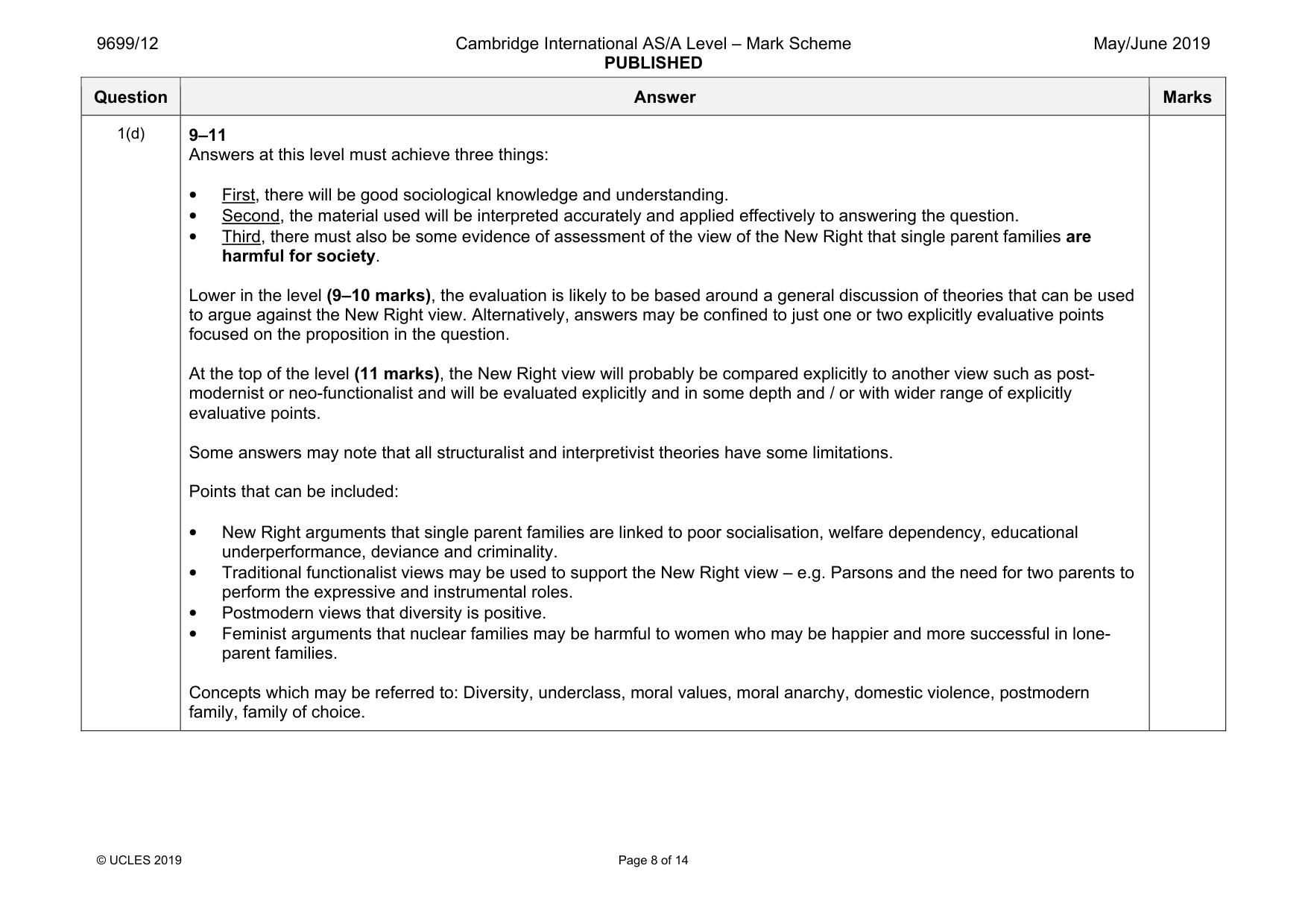
9699/12 Cambridge International AS/A Level – Mark Scheme PUBLISHED May/June 2019 © UCLES 2019 Page 8 of 14 Question Answer Marks 1(d) 9–11 Answers at this level must achieve three things: • First, there will be good sociological knowledge and understanding. • Second, the material used will be interpreted accurately and applied effectively to answering the question. • Third, there must also be some evidence of assessment of the view of the New Right that single parent families are harmful for society. Lower in the level (9–10 marks), the evaluation is likely to be based around a general discussion of theories that can be used to argue against the New Right view. Alternatively, answers may be confined to just one or two explicitly evaluative points focused on the proposition in the question. At the top of the level (11 marks), the New Right view will probably be compared explicitly to another view such as post- modernist or neo-functionalist and will be evaluated explicitly and in some depth and / or with wider range of explicitly evaluative points. Some answers may note that all structuralist and interpretivist theories have some limitations. Points that can be included: • New Right arguments that single parent families are linked to poor socialisation, welfare dependency, educational underperformance, deviance and criminality. • Traditional functionalist views may be used to support the New Right view – e.g. Parsons and the need for two parents to perform the expressive and instrumental roles. • Postmodern views that diversity is positive. • Feminist arguments that nuclear families may be harmful to women who may be happier and more successful in lone- parent families. Concepts which may be referred to: Diversity, underclass, moral values, moral anarchy, domestic violence, postmodern family, family of choice.
Mark scheme, page 9
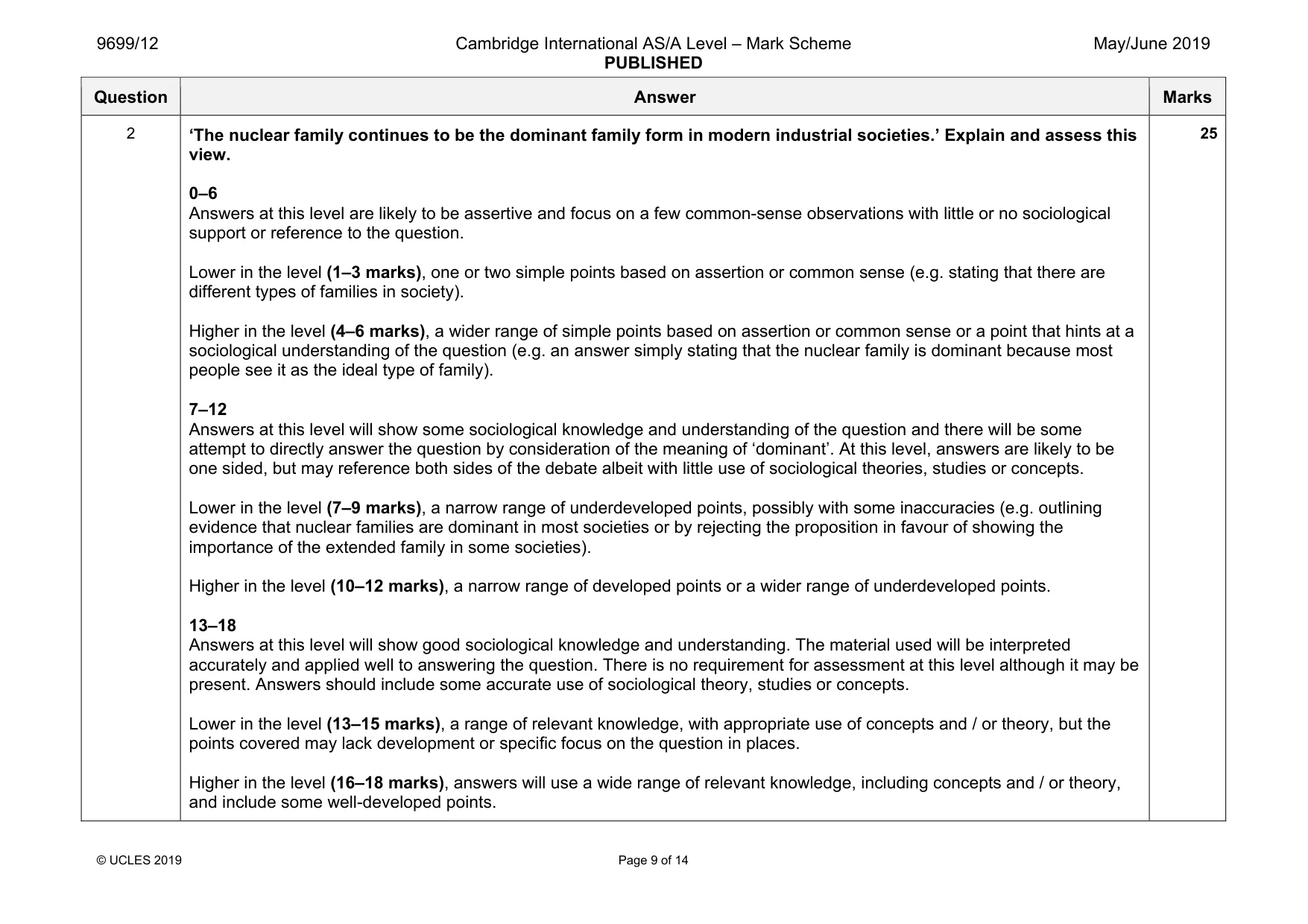
9699/12 Cambridge International AS/A Level – Mark Scheme PUBLISHED May/June 2019 © UCLES 2019 Page 9 of 14 Question Answer Marks 2 ‘The nuclear family continues to be the dominant family form in modern industrial societies.’ Explain and assess this view. 0–6 Answers at this level are likely to be assertive and focus on a few common-sense observations with little or no sociological support or reference to the question. Lower in the level (1–3 marks), one or two simple points based on assertion or common sense (e.g. stating that there are different types of families in society). Higher in the level (4–6 marks), a wider range of simple points based on assertion or common sense or a point that hints at a sociological understanding of the question (e.g. an answer simply stating that the nuclear family is dominant because most people see it as the ideal type of family). 7–12 Answers at this level will show some sociological knowledge and understanding of the question and there will be some attempt to directly answer the question by consideration of the meaning of ‘dominant’. At this level, answers are likely to be one sided, but may reference both sides of the debate albeit with little use of sociological theories, studies or concepts. Lower in the level (7–9 marks), a narrow range of underdeveloped points, possibly with some inaccuracies (e.g. outlining evidence that nuclear families are dominant in most societies or by rejecting the proposition in favour of showing the importance of the extended family in some societies). Higher in the level (10–12 marks), a narrow range of developed points or a wider range of underdeveloped points. 13–18 Answers at this level will show good sociological knowledge and understanding. The material used will be interpreted accurately and applied well to answering the question. There is no requirement for assessment at this level although it may be present. Answers should include some accurate use of sociological theory, studies or concepts. Lower in the level (13–15 marks), a range of relevant knowledge, with appropriate use of concepts and / or theory, but the points covered may lack development or specific focus on the question in places. Higher in the level (16–18 marks), answers will use a wide range of relevant knowledge, including concepts and / or theory, and include some well-developed points. 25
Mark scheme, page 10
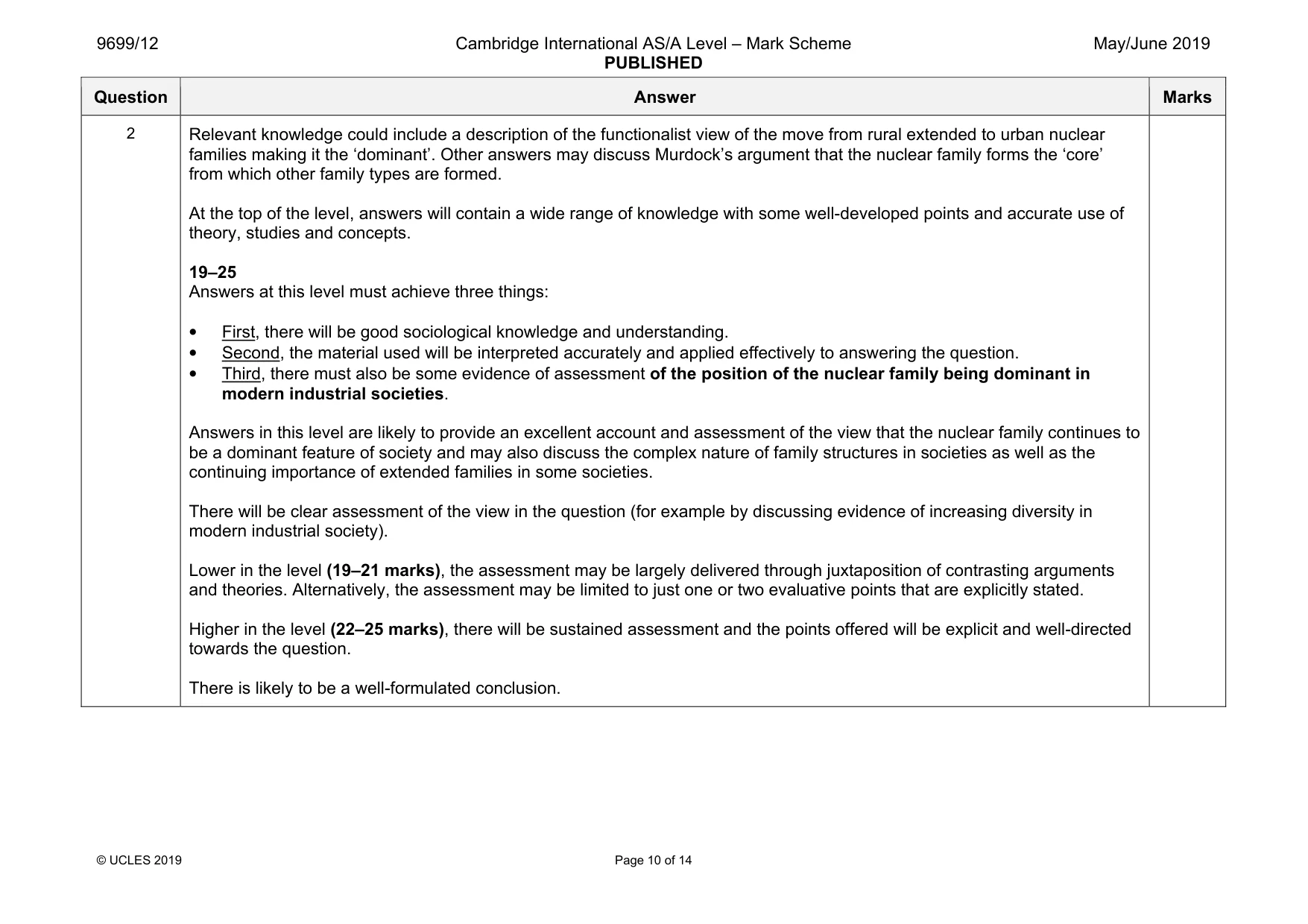
9699/12 Cambridge International AS/A Level – Mark Scheme PUBLISHED May/June 2019 © UCLES 2019 Page 10 of 14 Question Answer Marks 2 Relevant knowledge could include a description of the functionalist view of the move from rural extended to urban nuclear families making it the ‘dominant’. Other answers may discuss Murdock’s argument that the nuclear family forms the ‘core’ from which other family types are formed. At the top of the level, answers will contain a wide range of knowledge with some well-developed points and accurate use of theory, studies and concepts. 19–25 Answers at this level must achieve three things: • First, there will be good sociological knowledge and understanding. • Second, the material used will be interpreted accurately and applied effectively to answering the question. • Third, there must also be some evidence of assessment of the position of the nuclear family being dominant in modern industrial societies. Answers in this level are likely to provide an excellent account and assessment of the view that the nuclear family continues to be a dominant feature of society and may also discuss the complex nature of family structures in societies as well as the continuing importance of extended families in some societies. There will be clear assessment of the view in the question (for example by discussing evidence of increasing diversity in modern industrial society). Lower in the level (19–21 marks), the assessment may be largely delivered through juxtaposition of contrasting arguments and theories. Alternatively, the assessment may be limited to just one or two evaluative points that are explicitly stated. Higher in the level (22–25 marks), there will be sustained assessment and the points offered will be explicit and well-directed towards the question. There is likely to be a well-formulated conclusion.
Mark scheme, page 11
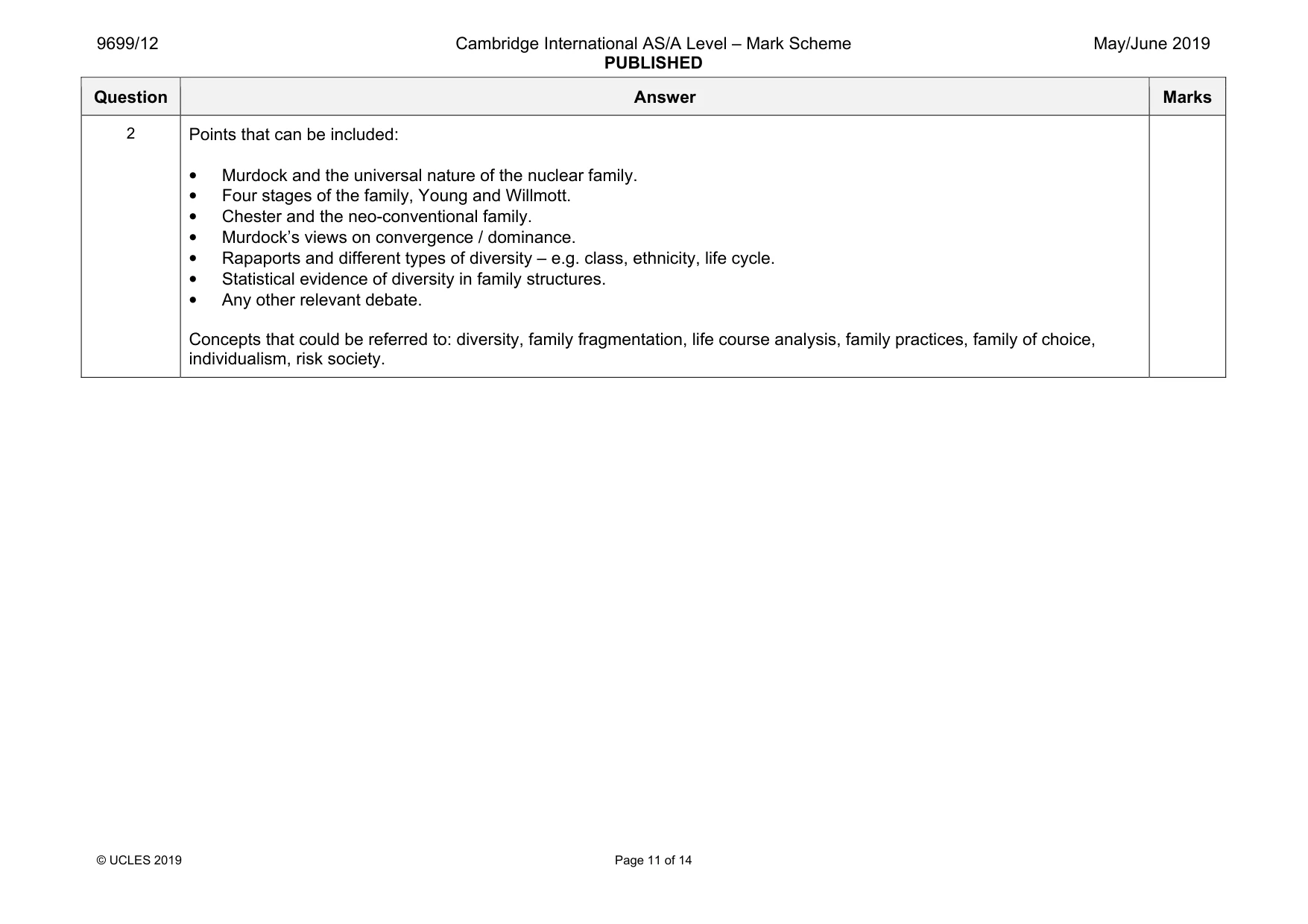
9699/12 Cambridge International AS/A Level – Mark Scheme PUBLISHED May/June 2019 © UCLES 2019 Page 11 of 14 Question Answer Marks 2 Points that can be included: • Murdock and the universal nature of the nuclear family. • Four stages of the family, Young and Willmott. • Chester and the neo-conventional family. • Murdock’s views on convergence / dominance. • Rapaports and different types of diversity – e.g. class, ethnicity, life cycle. • Statistical evidence of diversity in family structures. • Any other relevant debate. Concepts that could be referred to: diversity, family fragmentation, life course analysis, family practices, family of choice, individualism, risk society.
Mark scheme, page 12
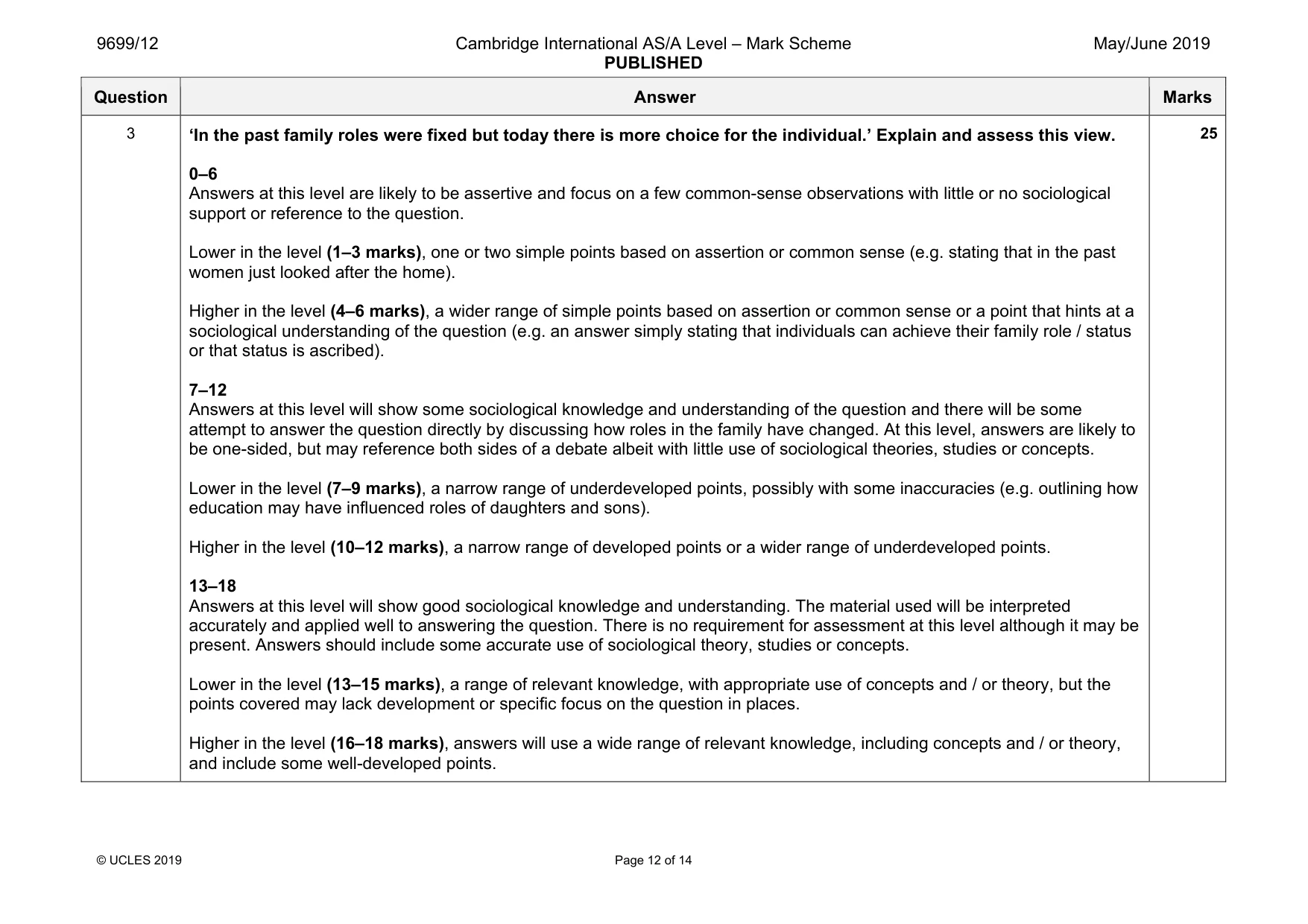
9699/12 Cambridge International AS/A Level – Mark Scheme PUBLISHED May/June 2019 © UCLES 2019 Page 12 of 14 Question Answer Marks 3 ‘In the past family roles were fixed but today there is more choice for the individual.’ Explain and assess this view. 0–6 Answers at this level are likely to be assertive and focus on a few common-sense observations with little or no sociological support or reference to the question. Lower in the level (1–3 marks), one or two simple points based on assertion or common sense (e.g. stating that in the past women just looked after the home). Higher in the level (4–6 marks), a wider range of simple points based on assertion or common sense or a point that hints at a sociological understanding of the question (e.g. an answer simply stating that individuals can achieve their family role / status or that status is ascribed). 7–12 Answers at this level will show some sociological knowledge and understanding of the question and there will be some attempt to answer the question directly by discussing how roles in the family have changed. At this level, answers are likely to be one-sided, but may reference both sides of a debate albeit with little use of sociological theories, studies or concepts. Lower in the level (7–9 marks), a narrow range of underdeveloped points, possibly with some inaccuracies (e.g. outlining how education may have influenced roles of daughters and sons). Higher in the level (10–12 marks), a narrow range of developed points or a wider range of underdeveloped points. 13–18 Answers at this level will show good sociological knowledge and understanding. The material used will be interpreted accurately and applied well to answering the question. There is no requirement for assessment at this level although it may be present. Answers should include some accurate use of sociological theory, studies or concepts. Lower in the level (13–15 marks), a range of relevant knowledge, with appropriate use of concepts and / or theory, but the points covered may lack development or specific focus on the question in places. Higher in the level (16–18 marks), answers will use a wide range of relevant knowledge, including concepts and / or theory, and include some well-developed points. 25
Mark scheme, page 13
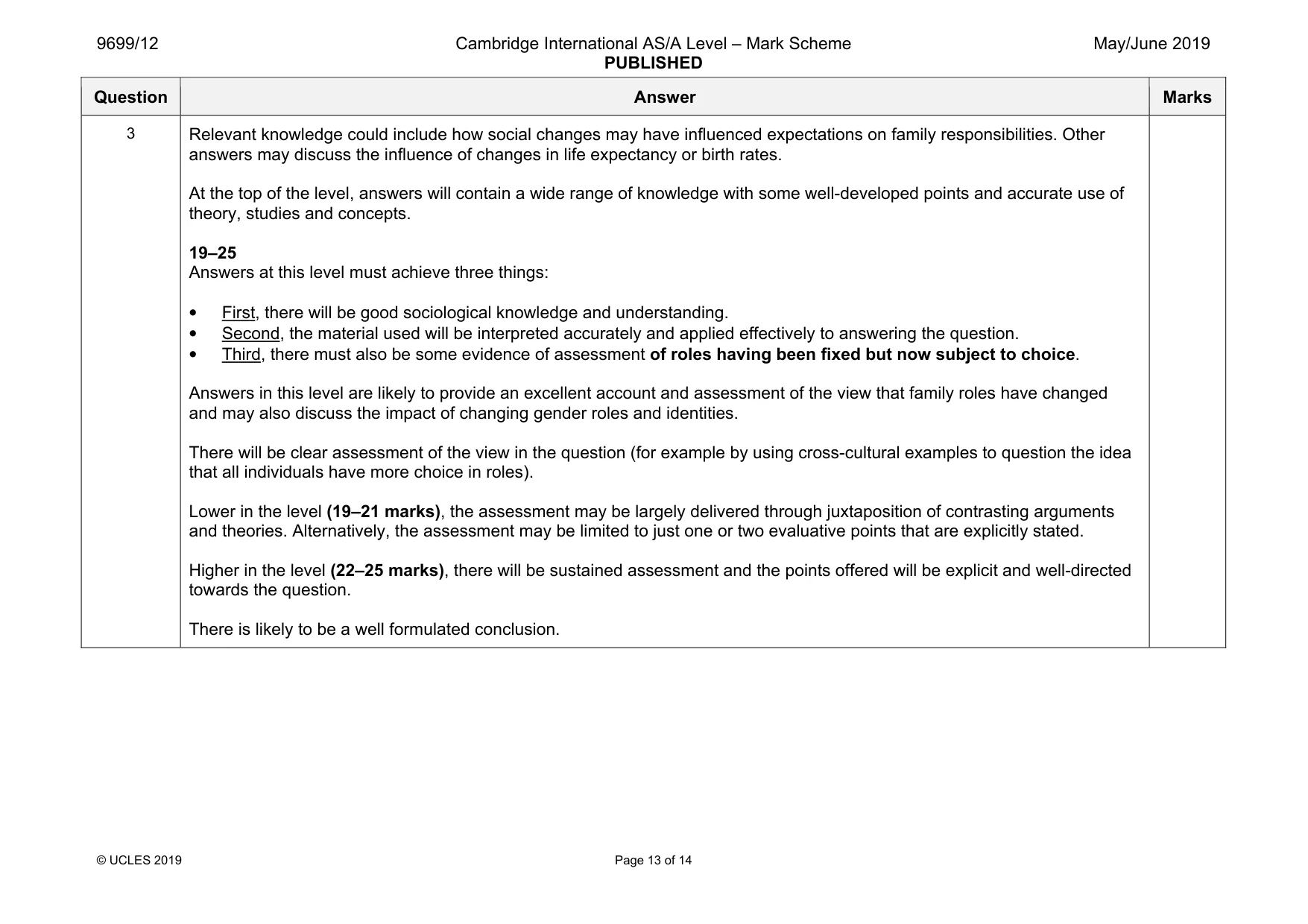
9699/12 Cambridge International AS/A Level – Mark Scheme PUBLISHED May/June 2019 © UCLES 2019 Page 13 of 14 Question Answer Marks 3 Relevant knowledge could include how social changes may have influenced expectations on family responsibilities. Other answers may discuss the influence of changes in life expectancy or birth rates. At the top of the level, answers will contain a wide range of knowledge with some well-developed points and accurate use of theory, studies and concepts. 19–25 Answers at this level must achieve three things: • First, there will be good sociological knowledge and understanding. • Second, the material used will be interpreted accurately and applied effectively to answering the question. • Third, there must also be some evidence of assessment of roles having been fixed but now subject to choice. Answers in this level are likely to provide an excellent account and assessment of the view that family roles have changed and may also discuss the impact of changing gender roles and identities. There will be clear assessment of the view in the question (for example by using cross-cultural examples to question the idea that all individuals have more choice in roles). Lower in the level (19–21 marks), the assessment may be largely delivered through juxtaposition of contrasting arguments and theories. Alternatively, the assessment may be limited to just one or two evaluative points that are explicitly stated. Higher in the level (22–25 marks), there will be sustained assessment and the points offered will be explicit and well-directed towards the question. There is likely to be a well formulated conclusion.
Mark scheme, page 14
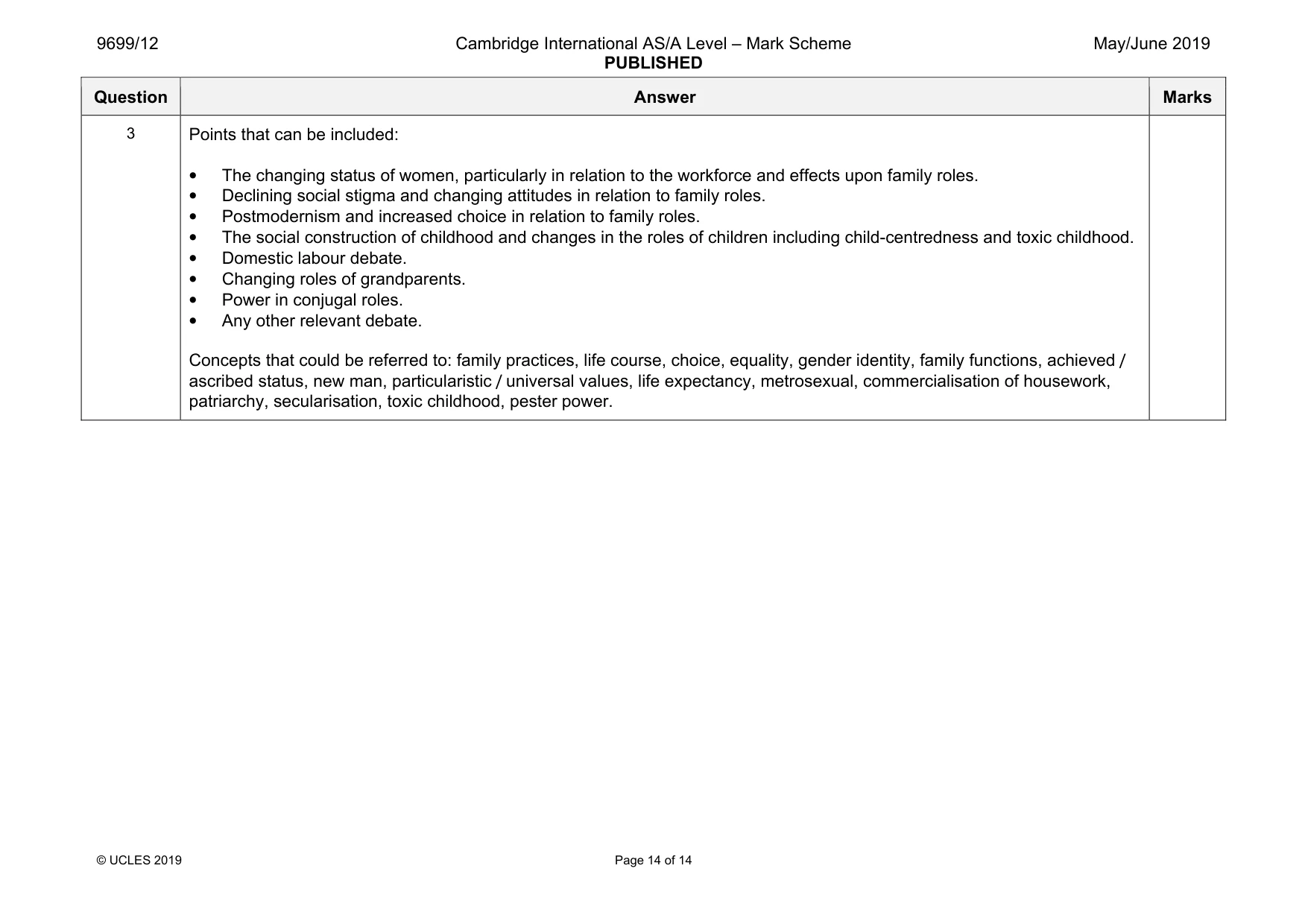
9699/12 Cambridge International AS/A Level – Mark Scheme PUBLISHED May/June 2019 © UCLES 2019 Page 14 of 14 Question Answer Marks 3 Points that can be included: • The changing status of women, particularly in relation to the workforce and effects upon family roles. • Declining social stigma and changing attitudes in relation to family roles. • Postmodernism and increased choice in relation to family roles. • The social construction of childhood and changes in the roles of children including child-centredness and toxic childhood. • Domestic labour debate. • Changing roles of grandparents. • Power in conjugal roles. • Any other relevant debate. Concepts that could be referred to: family practices, life course, choice, equality, gender identity, family functions, achieved / ascribed status, new man, particularistic / universal values, life expectancy, metrosexual, commercialisation of housework, patriarchy, secularisation, toxic childhood, pester power.
What you needed in this session
Cambridge’s own grade thresholds for 2019 May/June, Paper 1 · Variant 2. A higher threshold means an easier paper — the bar moves with how the cohort did.