Cambridge A Level Sociology 9699 — 2018 May/June Paper 3 · Variant 1
9699/31/M/J/18 · 75 marks · ≈84 min
The question paper and its mark scheme, free to read here and free to download. This is Cambridge’s own paper, exactly as it was sat.
Question paper4 pages
Mark scheme18 pages
Answers below. Sit the paper first if you are practising.
Paper as text
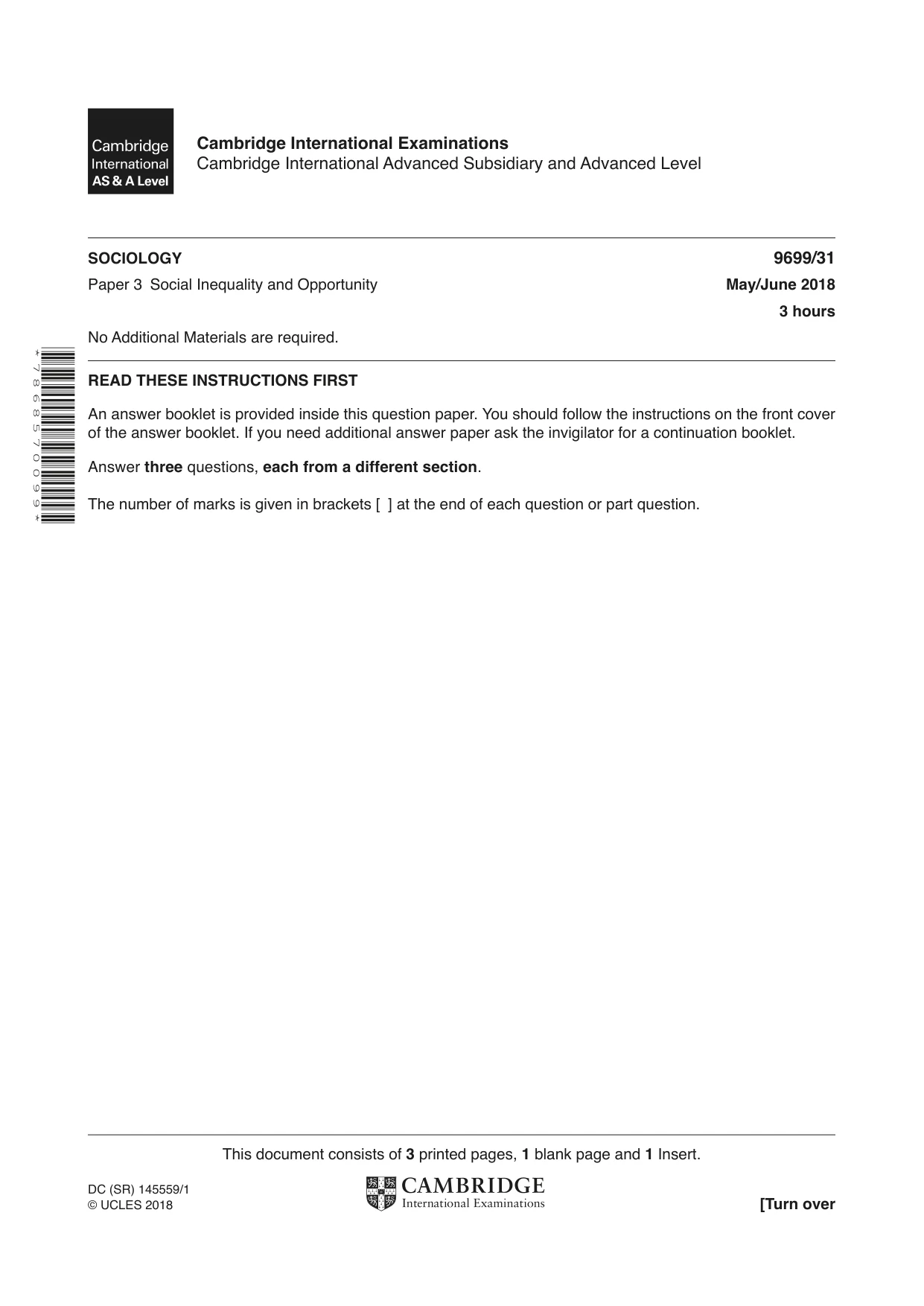
Question paper, page 1
* 7 8 6 8 5 7 0 0 9 9 * This document consists of 3 printed pages, 1 blank page and 1 Insert. DC (SR) 145559/1 © UCLES 2018 [Turn over Cambridge International Examinations Cambridge International Advanced Subsidiary and Advanced Level SOCIOLOGY 9699/31 Paper 3 Social Inequality and Opportunity May/June 2018 3 hours No Additional Materials are required. READ THESE INSTRUCTIONS FIRST An answer booklet is provided inside this question paper. You should follow the instructions on the front cover of the answer booklet. If you need additional answer paper ask the invigilator for a continuation booklet. Answer three questions, each from a different section. The number of marks is given in brackets [ ] at the end of each question or part question.
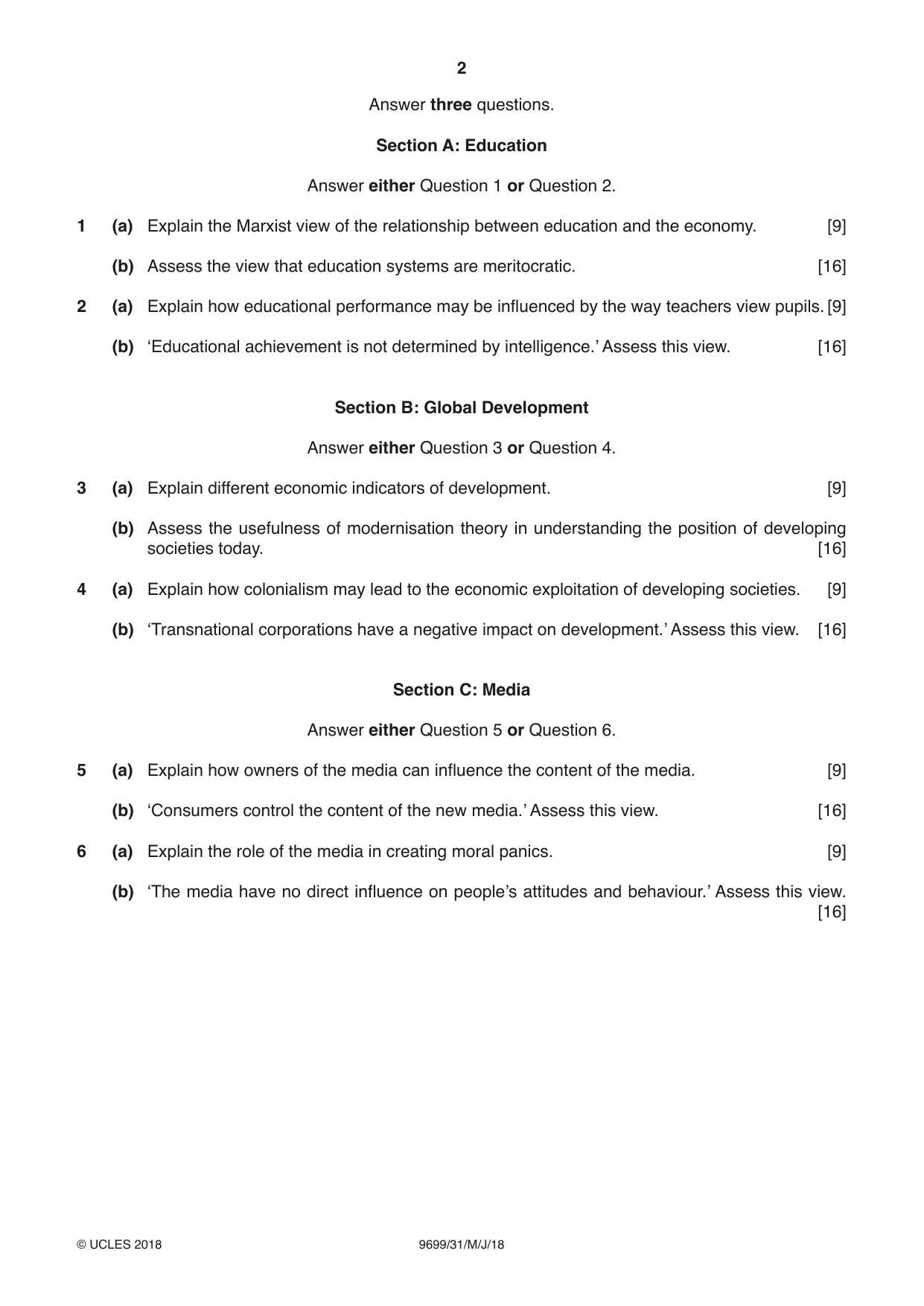
Question paper, page 2
2 9699/31/M/J/18 © UCLES 2018 Answer three questions. Section A: Education Answer either Question 1 or Question 2. 1 (a) Explain the Marxist view of the relationship between education and the economy. [9] (b) Assess the view that education systems are meritocratic. [16] 2 (a) Explain how educational performance may be influenced by the way teachers view pupils. [9] (b) ‘Educational achievement is not determined by intelligence.’ Assess this view. [16] Section B: Global Development Answer either Question 3 or Question 4. 3 (a) Explain different economic indicators of development. [9] (b) Assess the usefulness of modernisation theory in understanding the position of developing societies today. [16] 4 (a) Explain how colonialism may lead to the economic exploitation of developing societies. [9] (b) ‘Transnational corporations have a negative impact on development.’ Assess this view. [16] Section C: Media Answer either Question 5 or Question 6. 5 (a) Explain how owners of the media can influence the content of the media. [9] (b) ‘Consumers control the content of the new media.’ Assess this view. [16] 6 (a) Explain the role of the media in creating moral panics. [9] (b) ‘The media have no direct influence on people’s attitudes and behaviour.’ Assess this view. [16]
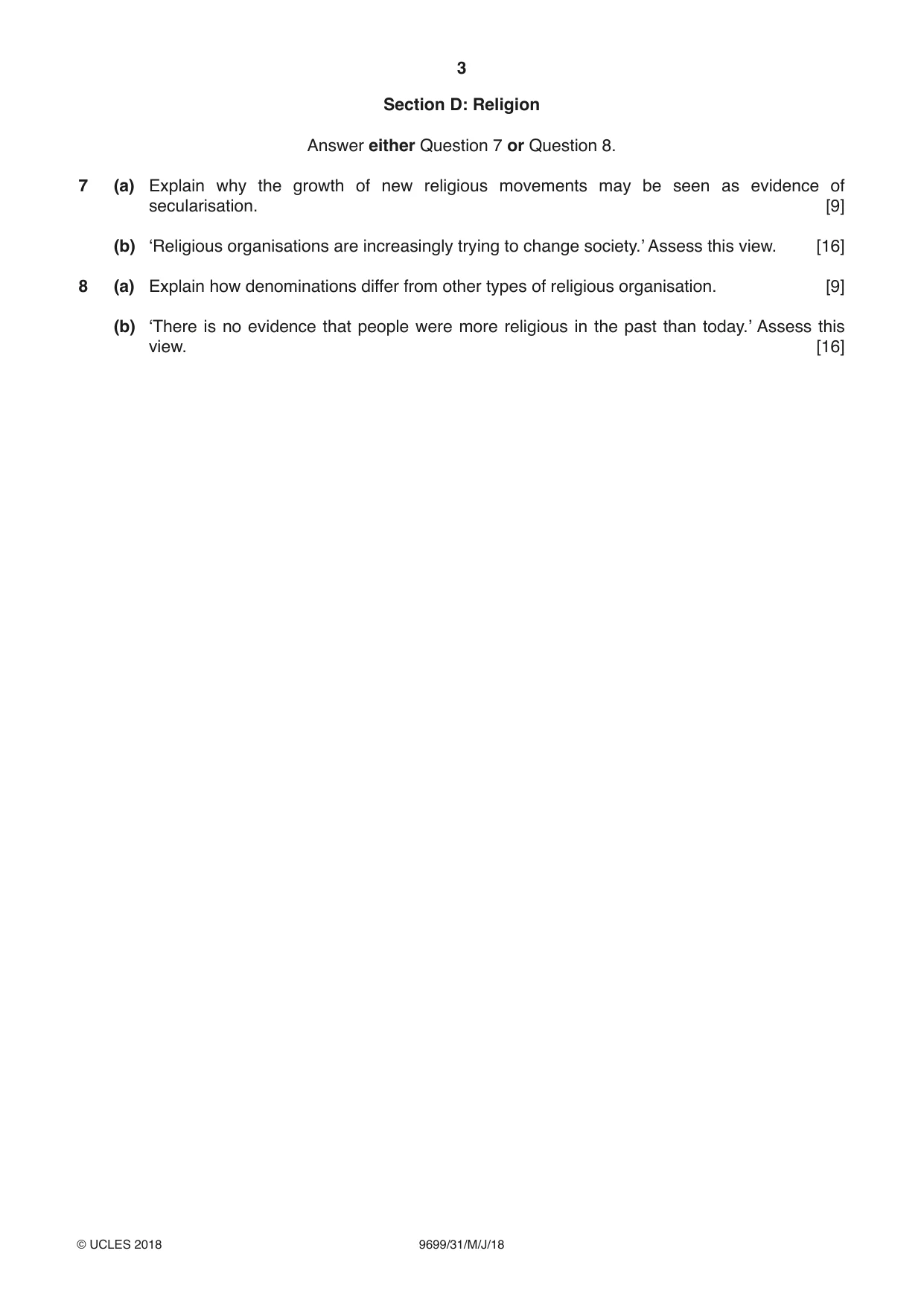
Question paper, page 3
3 9699/31/M/J/18 © UCLES 2018 Section D: Religion Answer either Question 7 or Question 8. 7 (a) Explain why the growth of new religious movements may be seen as evidence of secularisation. [9] (b) ‘Religious organisations are increasingly trying to change society.’ Assess this view. [16] 8 (a) Explain how denominations differ from other types of religious organisation. [9] (b) ‘There is no evidence that people were more religious in the past than today.’ Assess this view. [16]
Question paper, page 4
4 9699/31/M/J/18 © UCLES 2018 BLANK PAGE Permission to reproduce items where third-party owned material protected by copyright is included has been sought and cleared where possible. Every reasonable effort has been made by the publisher (UCLES) to trace copyright holders, but if any items requiring clearance have unwittingly been included, the publisher will be pleased to make amends at the earliest possible opportunity. To avoid the issue of disclosure of answer-related information to candidates, all copyright acknowledgements are reproduced online in the Cambridge International Examinations Copyright Acknowledgements Booklet. This is produced for each series of examinations and is freely available to download at www.cie.org.uk after the live examination series. Cambridge International Examinations is part of the Cambridge Assessment Group. Cambridge Assessment is the brand name of University of Cambridge Local Examinations Syndicate (UCLES), which is itself a department of the University of Cambridge.
Mark scheme, page 1
IGCSE™ is a registered trademark. This document consists of 18 printed pages. © UCLES 2018 [Turn over Cambridge Assessment International Education Cambridge International Advanced Subsidiary and Advanced Level SOCIOLOGY 9699/31 Paper 3 Social Inequality and Opportunity May/June 2018 MARK SCHEME Maximum Mark: 75 Published This mark scheme is published as an aid to teachers and candidates, to indicate the requirements of the examination. It shows the basis on which Examiners were instructed to award marks. It does not indicate the details of the discussions that took place at an Examiners’ meeting before marking began, which would have considered the acceptability of alternative answers. Mark schemes should be read in conjunction with the question paper and the Principal Examiner Report for Teachers. Cambridge International will not enter into discussions about these mark schemes. Cambridge International is publishing the mark schemes for the May/June 2018 series for most Cambridge IGCSE™, Cambridge International A and AS Level and Cambridge Pre-U components, and some Cambridge O Level components.
Mark scheme, page 2
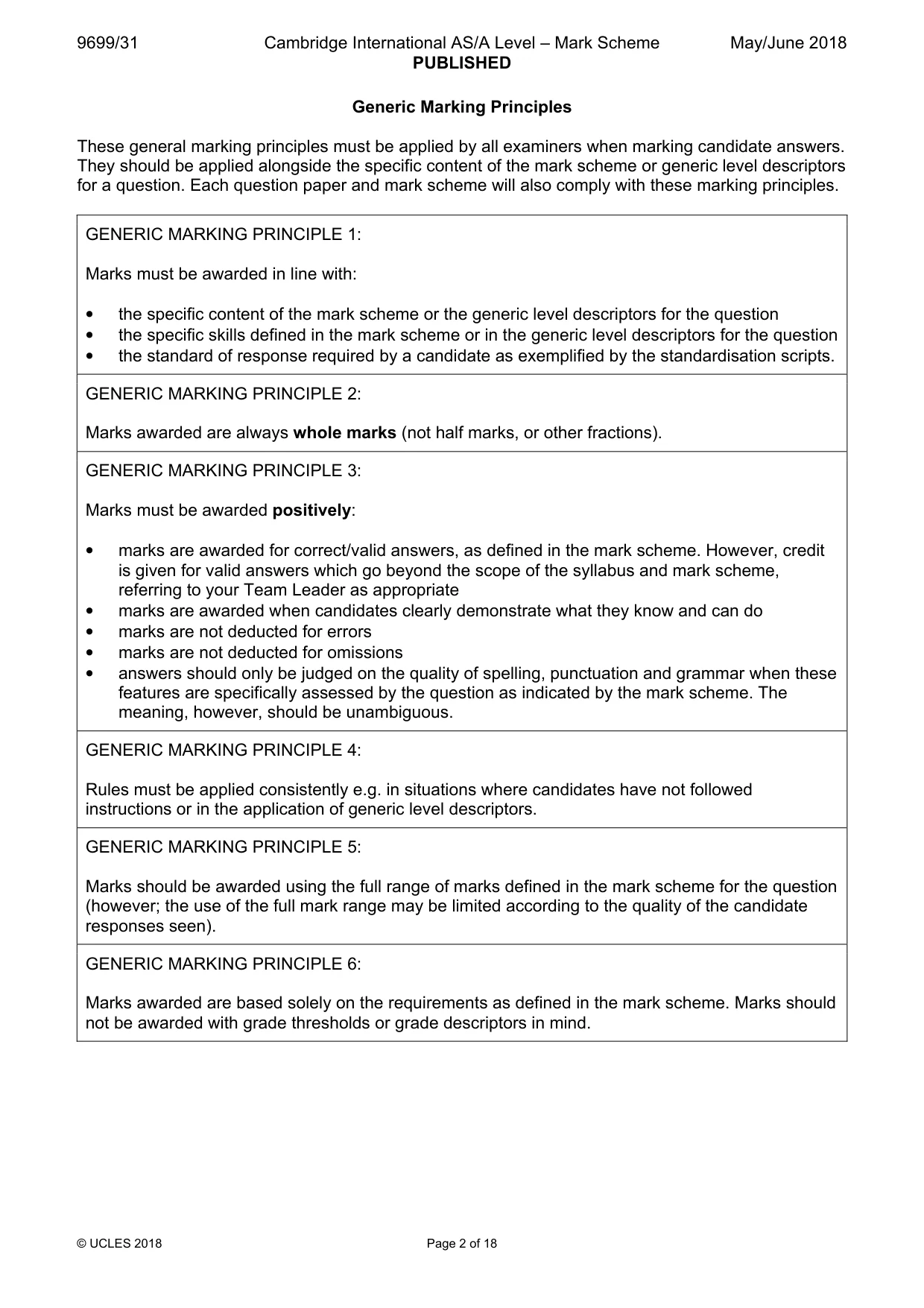
9699/31 Cambridge International AS/A Level – Mark Scheme PUBLISHED May/June 2018 © UCLES 2018 Page 2 of 18 Generic Marking Principles These general marking principles must be applied by all examiners when marking candidate answers. They should be applied alongside the specific content of the mark scheme or generic level descriptors for a question. Each question paper and mark scheme will also comply with these marking principles. GENERIC MARKING PRINCIPLE 1: Marks must be awarded in line with: • the specific content of the mark scheme or the generic level descriptors for the question • the specific skills defined in the mark scheme or in the generic level descriptors for the question • the standard of response required by a candidate as exemplified by the standardisation scripts. GENERIC MARKING PRINCIPLE 2: Marks awarded are always whole marks (not half marks, or other fractions). GENERIC MARKING PRINCIPLE 3: Marks must be awarded positively: • marks are awarded for correct/valid answers, as defined in the mark scheme. However, credit is given for valid answers which go beyond the scope of the syllabus and mark scheme, referring to your Team Leader as appropriate • marks are awarded when candidates clearly demonstrate what they know and can do • marks are not deducted for errors • marks are not deducted for omissions • answers should only be judged on the quality of spelling, punctuation and grammar when these features are specifically assessed by the question as indicated by the mark scheme. The meaning, however, should be unambiguous. GENERIC MARKING PRINCIPLE 4: Rules must be applied consistently e.g. in situations where candidates have not followed instructions or in the application of generic level descriptors. GENERIC MARKING PRINCIPLE 5: Marks should be awarded using the full range of marks defined in the mark scheme for the question (however; the use of the full mark range may be limited according to the quality of the candidate responses seen). GENERIC MARKING PRINCIPLE 6: Marks awarded are based solely on the requirements as defined in the mark scheme. Marks should not be awarded with grade thresholds or grade descriptors in mind.
Mark scheme, page 3
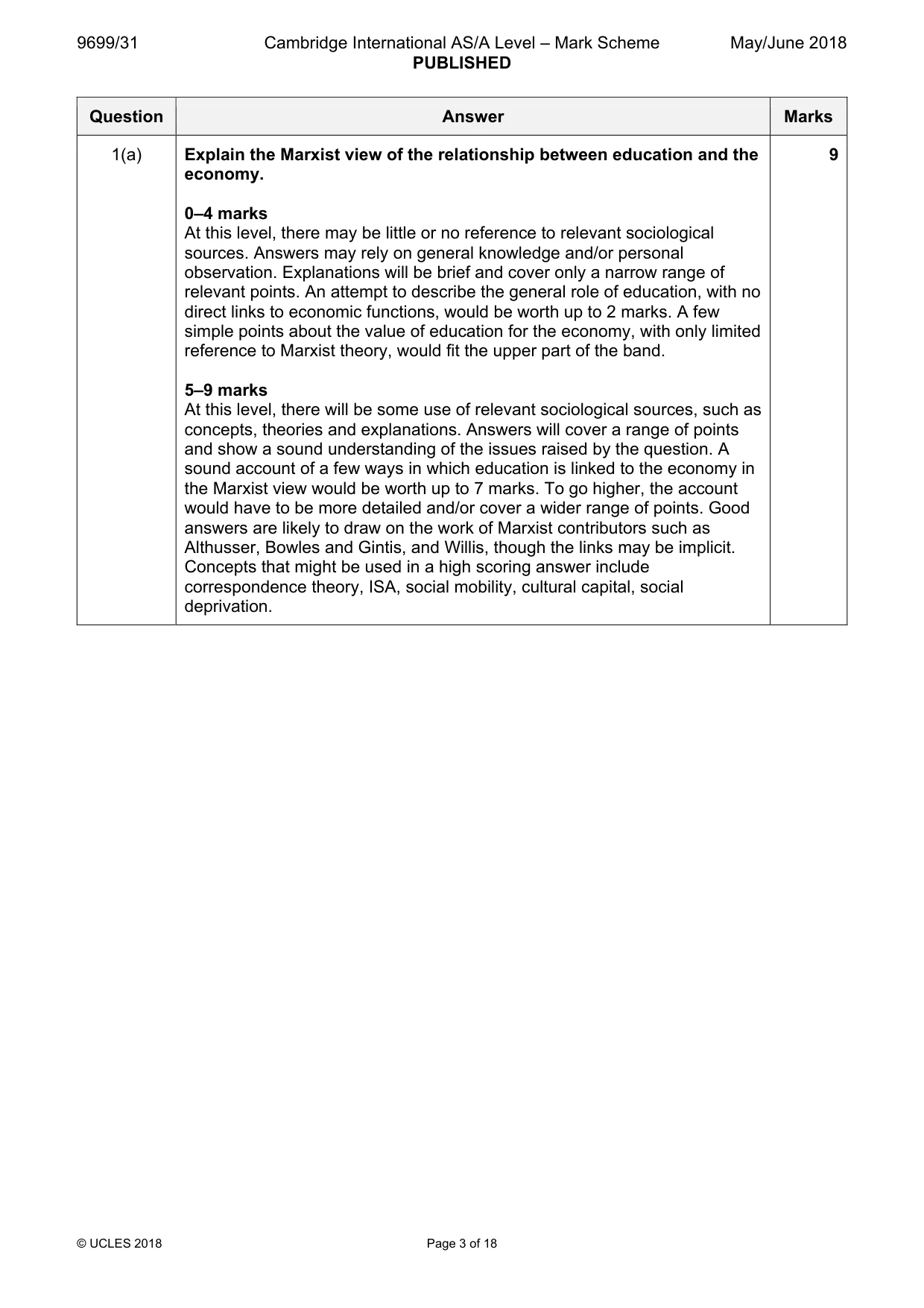
9699/31 Cambridge International AS/A Level – Mark Scheme PUBLISHED May/June 2018 © UCLES 2018 Page 3 of 18 Question Answer Marks 1(a) Explain the Marxist view of the relationship between education and the economy. 0–4 marks At this level, there may be little or no reference to relevant sociological sources. Answers may rely on general knowledge and/or personal observation. Explanations will be brief and cover only a narrow range of relevant points. An attempt to describe the general role of education, with no direct links to economic functions, would be worth up to 2 marks. A few simple points about the value of education for the economy, with only limited reference to Marxist theory, would fit the upper part of the band. 5–9 marks At this level, there will be some use of relevant sociological sources, such as concepts, theories and explanations. Answers will cover a range of points and show a sound understanding of the issues raised by the question. A sound account of a few ways in which education is linked to the economy in the Marxist view would be worth up to 7 marks. To go higher, the account would have to be more detailed and/or cover a wider range of points. Good answers are likely to draw on the work of Marxist contributors such as Althusser, Bowles and Gintis, and Willis, though the links may be implicit. Concepts that might be used in a high scoring answer include correspondence theory, ISA, social mobility, cultural capital, social deprivation. 9
Mark scheme, page 4
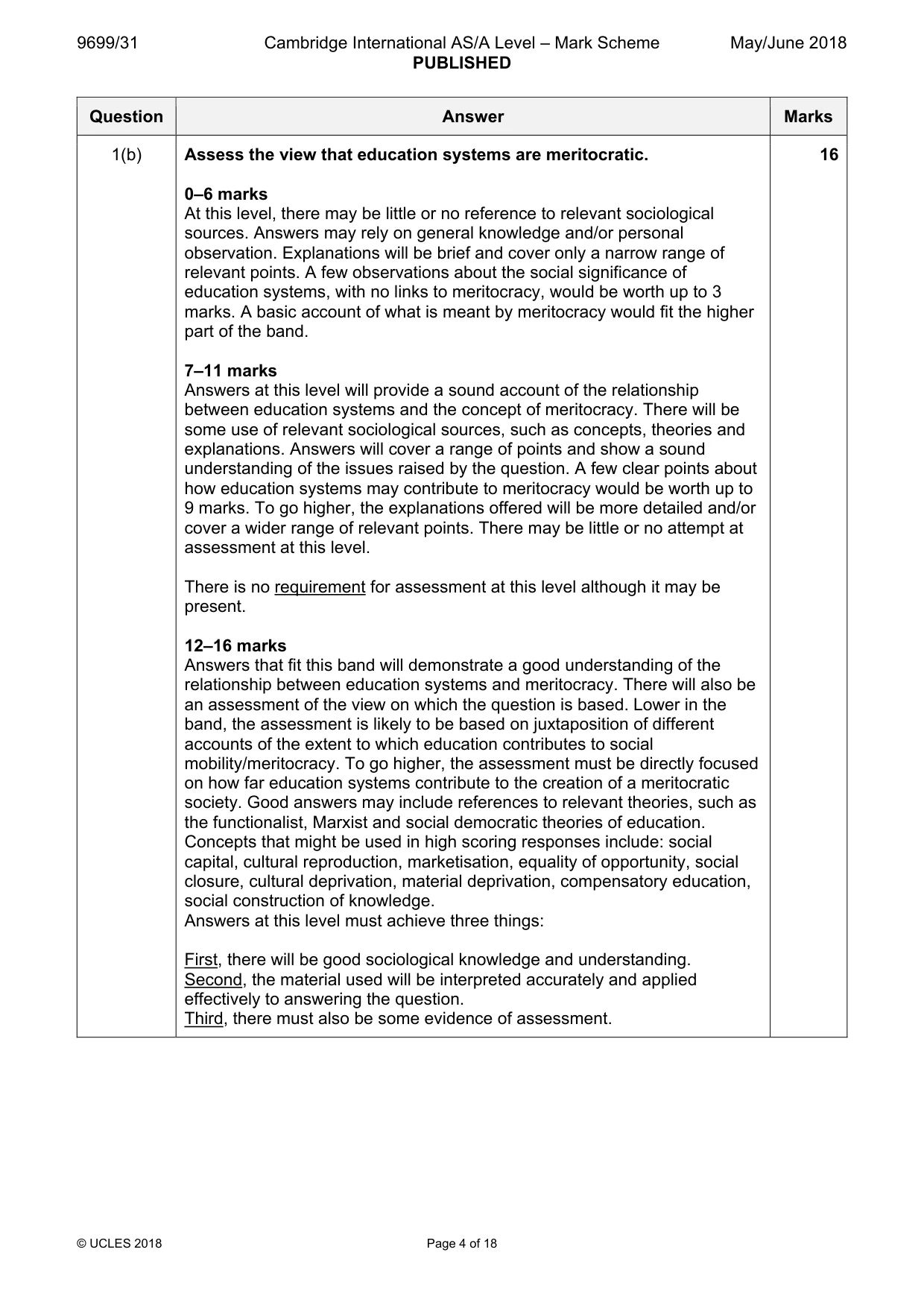
9699/31 Cambridge International AS/A Level – Mark Scheme PUBLISHED May/June 2018 © UCLES 2018 Page 4 of 18 Question Answer Marks 1(b) Assess the view that education systems are meritocratic. 0–6 marks At this level, there may be little or no reference to relevant sociological sources. Answers may rely on general knowledge and/or personal observation. Explanations will be brief and cover only a narrow range of relevant points. A few observations about the social significance of education systems, with no links to meritocracy, would be worth up to 3 marks. A basic account of what is meant by meritocracy would fit the higher part of the band. 7–11 marks Answers at this level will provide a sound account of the relationship between education systems and the concept of meritocracy. There will be some use of relevant sociological sources, such as concepts, theories and explanations. Answers will cover a range of points and show a sound understanding of the issues raised by the question. A few clear points about how education systems may contribute to meritocracy would be worth up to 9 marks. To go higher, the explanations offered will be more detailed and/or cover a wider range of relevant points. There may be little or no attempt at assessment at this level. There is no requirement for assessment at this level although it may be present. 12–16 marks Answers that fit this band will demonstrate a good understanding of the relationship between education systems and meritocracy. There will also be an assessment of the view on which the question is based. Lower in the band, the assessment is likely to be based on juxtaposition of different accounts of the extent to which education contributes to social mobility/meritocracy. To go higher, the assessment must be directly focused on how far education systems contribute to the creation of a meritocratic society. Good answers may include references to relevant theories, such as the functionalist, Marxist and social democratic theories of education. Concepts that might be used in high scoring responses include: social capital, cultural reproduction, marketisation, equality of opportunity, social closure, cultural deprivation, material deprivation, compensatory education, social construction of knowledge. Answers at this level must achieve three things: First, there will be good sociological knowledge and understanding. Second, the material used will be interpreted accurately and applied effectively to answering the question. Third, there must also be some evidence of assessment. 16
Mark scheme, page 5
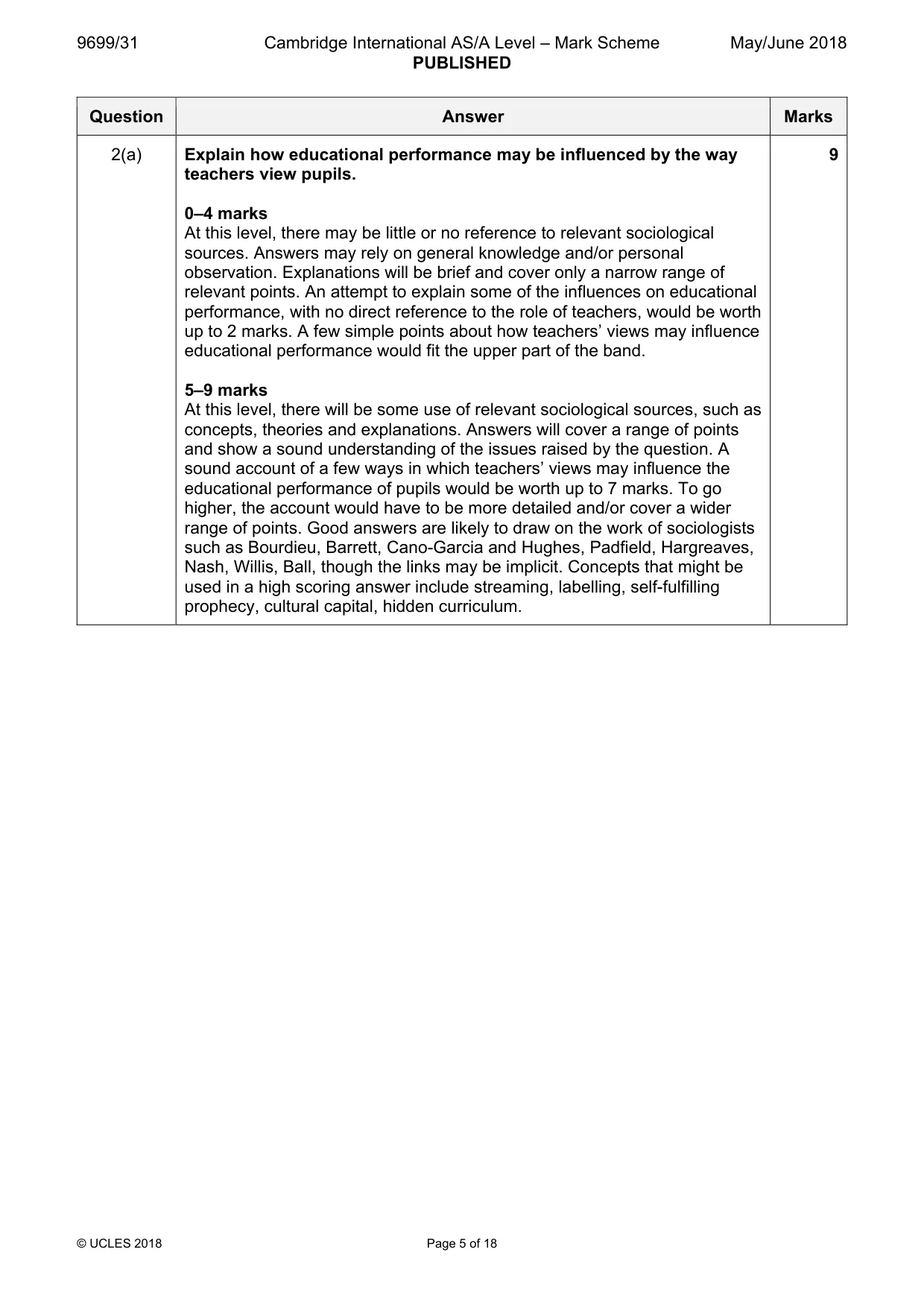
9699/31 Cambridge International AS/A Level – Mark Scheme PUBLISHED May/June 2018 © UCLES 2018 Page 5 of 18 Question Answer Marks 2(a) Explain how educational performance may be influenced by the way teachers view pupils. 0–4 marks At this level, there may be little or no reference to relevant sociological sources. Answers may rely on general knowledge and/or personal observation. Explanations will be brief and cover only a narrow range of relevant points. An attempt to explain some of the influences on educational performance, with no direct reference to the role of teachers, would be worth up to 2 marks. A few simple points about how teachers’ views may influence educational performance would fit the upper part of the band. 5–9 marks At this level, there will be some use of relevant sociological sources, such as concepts, theories and explanations. Answers will cover a range of points and show a sound understanding of the issues raised by the question. A sound account of a few ways in which teachers’ views may influence the educational performance of pupils would be worth up to 7 marks. To go higher, the account would have to be more detailed and/or cover a wider range of points. Good answers are likely to draw on the work of sociologists such as Bourdieu, Barrett, Cano-Garcia and Hughes, Padfield, Hargreaves, Nash, Willis, Ball, though the links may be implicit. Concepts that might be used in a high scoring answer include streaming, labelling, self-fulfilling prophecy, cultural capital, hidden curriculum. 9
Mark scheme, page 6
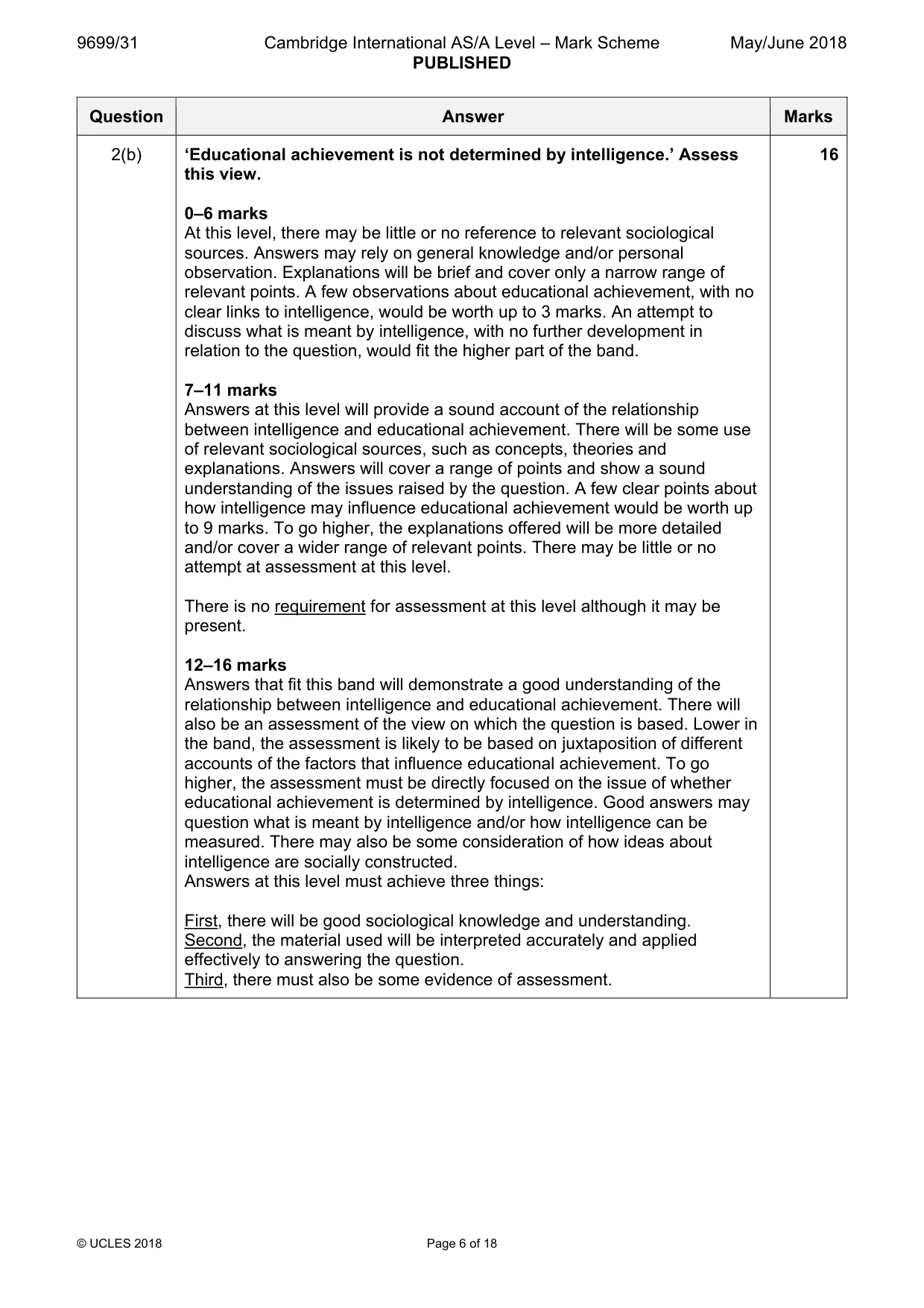
9699/31 Cambridge International AS/A Level – Mark Scheme PUBLISHED May/June 2018 © UCLES 2018 Page 6 of 18 Question Answer Marks 2(b) ‘Educational achievement is not determined by intelligence.’ Assess this view. 0–6 marks At this level, there may be little or no reference to relevant sociological sources. Answers may rely on general knowledge and/or personal observation. Explanations will be brief and cover only a narrow range of relevant points. A few observations about educational achievement, with no clear links to intelligence, would be worth up to 3 marks. An attempt to discuss what is meant by intelligence, with no further development in relation to the question, would fit the higher part of the band. 7–11 marks Answers at this level will provide a sound account of the relationship between intelligence and educational achievement. There will be some use of relevant sociological sources, such as concepts, theories and explanations. Answers will cover a range of points and show a sound understanding of the issues raised by the question. A few clear points about how intelligence may influence educational achievement would be worth up to 9 marks. To go higher, the explanations offered will be more detailed and/or cover a wider range of relevant points. There may be little or no attempt at assessment at this level. There is no requirement for assessment at this level although it may be present. 12–16 marks Answers that fit this band will demonstrate a good understanding of the relationship between intelligence and educational achievement. There will also be an assessment of the view on which the question is based. Lower in the band, the assessment is likely to be based on juxtaposition of different accounts of the factors that influence educational achievement. To go higher, the assessment must be directly focused on the issue of whether educational achievement is determined by intelligence. Good answers may question what is meant by intelligence and/or how intelligence can be measured. There may also be some consideration of how ideas about intelligence are socially constructed. Answers at this level must achieve three things: First, there will be good sociological knowledge and understanding. Second, the material used will be interpreted accurately and applied effectively to answering the question. Third, there must also be some evidence of assessment. 16
Mark scheme, page 7
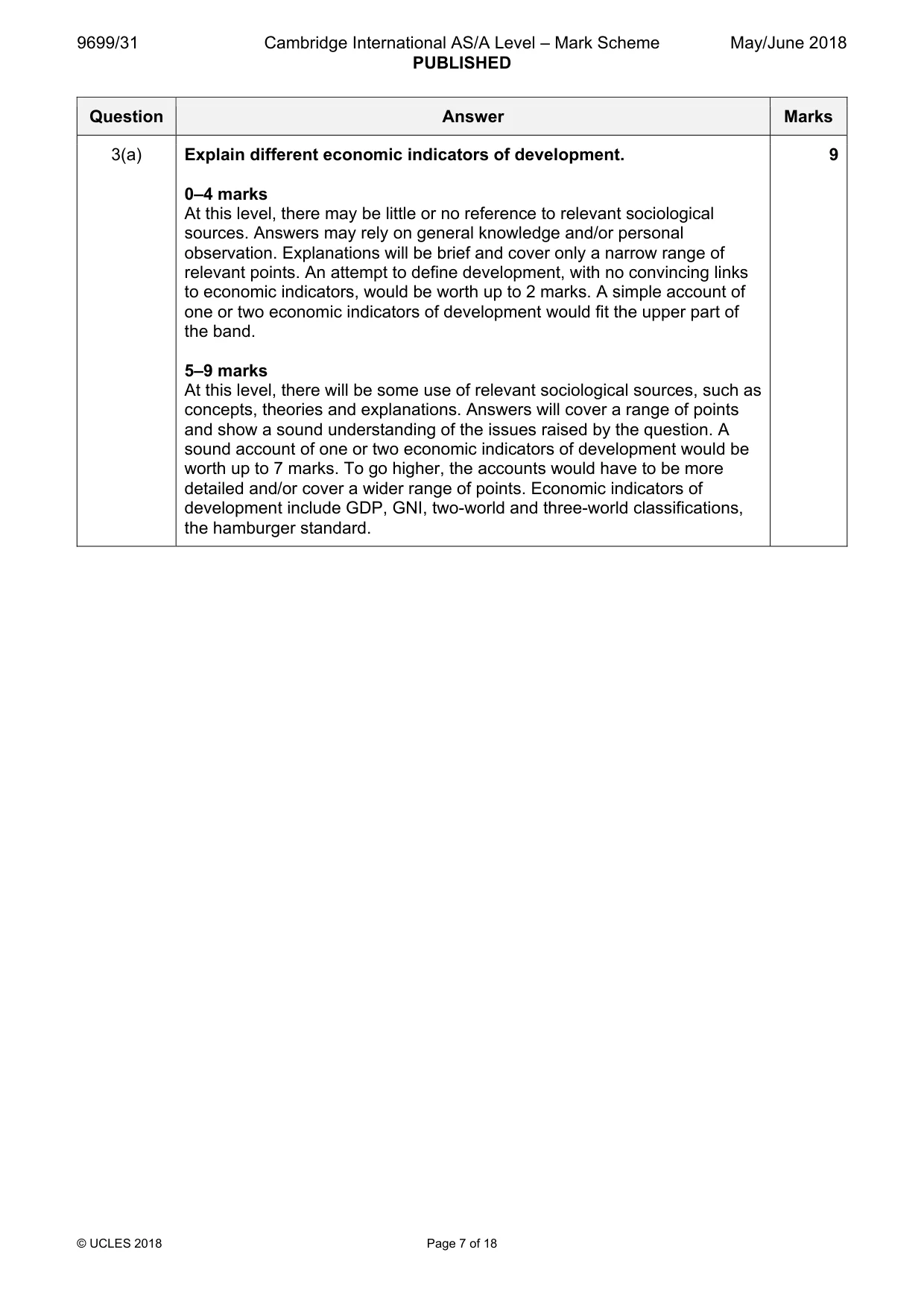
9699/31 Cambridge International AS/A Level – Mark Scheme PUBLISHED May/June 2018 © UCLES 2018 Page 7 of 18 Question Answer Marks 3(a) Explain different economic indicators of development. 0–4 marks At this level, there may be little or no reference to relevant sociological sources. Answers may rely on general knowledge and/or personal observation. Explanations will be brief and cover only a narrow range of relevant points. An attempt to define development, with no convincing links to economic indicators, would be worth up to 2 marks. A simple account of one or two economic indicators of development would fit the upper part of the band. 5–9 marks At this level, there will be some use of relevant sociological sources, such as concepts, theories and explanations. Answers will cover a range of points and show a sound understanding of the issues raised by the question. A sound account of one or two economic indicators of development would be worth up to 7 marks. To go higher, the accounts would have to be more detailed and/or cover a wider range of points. Economic indicators of development include GDP, GNI, two-world and three-world classifications, the hamburger standard. 9
Mark scheme, page 8
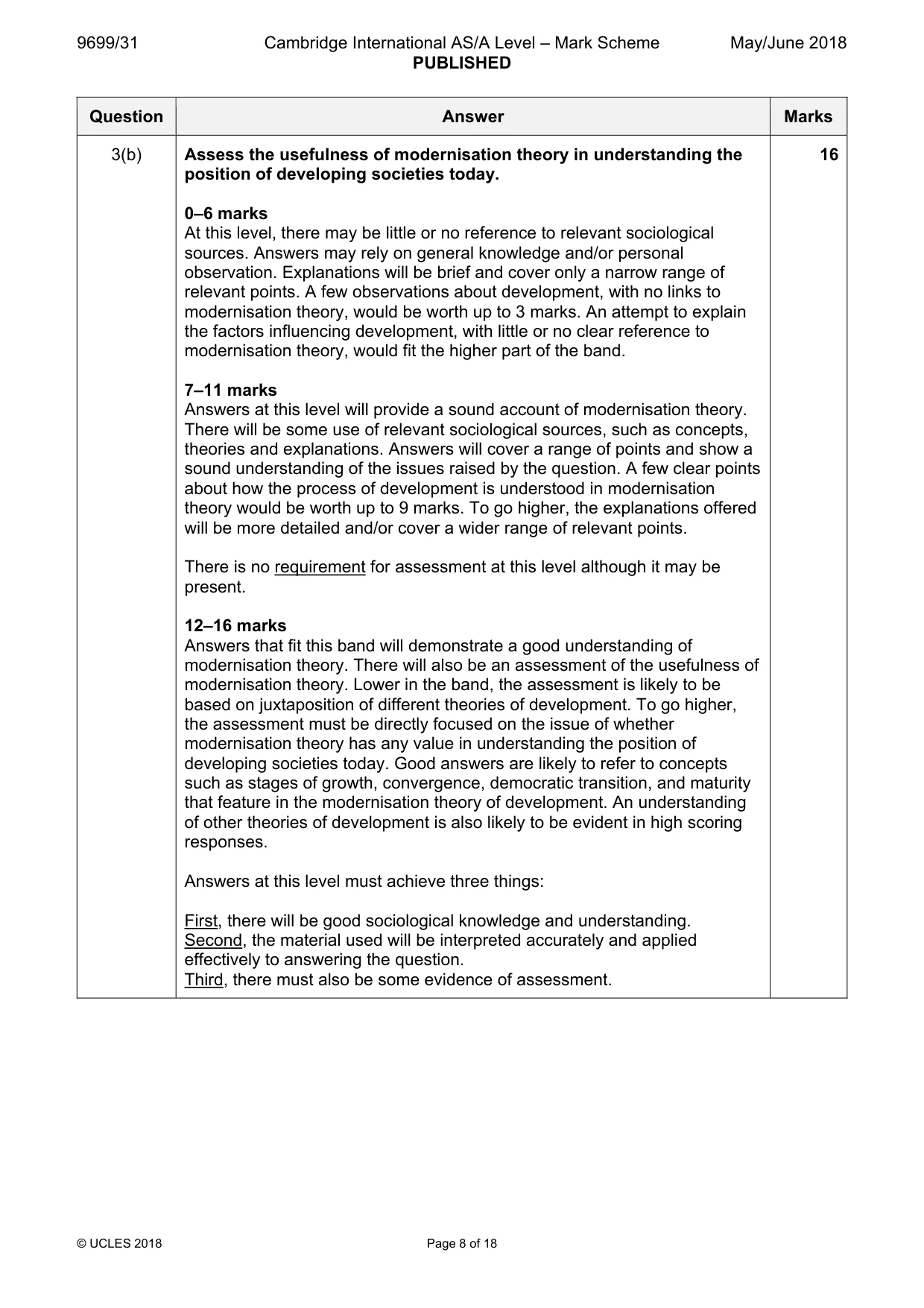
9699/31 Cambridge International AS/A Level – Mark Scheme PUBLISHED May/June 2018 © UCLES 2018 Page 8 of 18 Question Answer Marks 3(b) Assess the usefulness of modernisation theory in understanding the position of developing societies today. 0–6 marks At this level, there may be little or no reference to relevant sociological sources. Answers may rely on general knowledge and/or personal observation. Explanations will be brief and cover only a narrow range of relevant points. A few observations about development, with no links to modernisation theory, would be worth up to 3 marks. An attempt to explain the factors influencing development, with little or no clear reference to modernisation theory, would fit the higher part of the band. 7–11 marks Answers at this level will provide a sound account of modernisation theory. There will be some use of relevant sociological sources, such as concepts, theories and explanations. Answers will cover a range of points and show a sound understanding of the issues raised by the question. A few clear points about how the process of development is understood in modernisation theory would be worth up to 9 marks. To go higher, the explanations offered will be more detailed and/or cover a wider range of relevant points. There is no requirement for assessment at this level although it may be present. 12–16 marks Answers that fit this band will demonstrate a good understanding of modernisation theory. There will also be an assessment of the usefulness of modernisation theory. Lower in the band, the assessment is likely to be based on juxtaposition of different theories of development. To go higher, the assessment must be directly focused on the issue of whether modernisation theory has any value in understanding the position of developing societies today. Good answers are likely to refer to concepts such as stages of growth, convergence, democratic transition, and maturity that feature in the modernisation theory of development. An understanding of other theories of development is also likely to be evident in high scoring responses. Answers at this level must achieve three things: First, there will be good sociological knowledge and understanding. Second, the material used will be interpreted accurately and applied effectively to answering the question. Third, there must also be some evidence of assessment. 16
Mark scheme, page 9
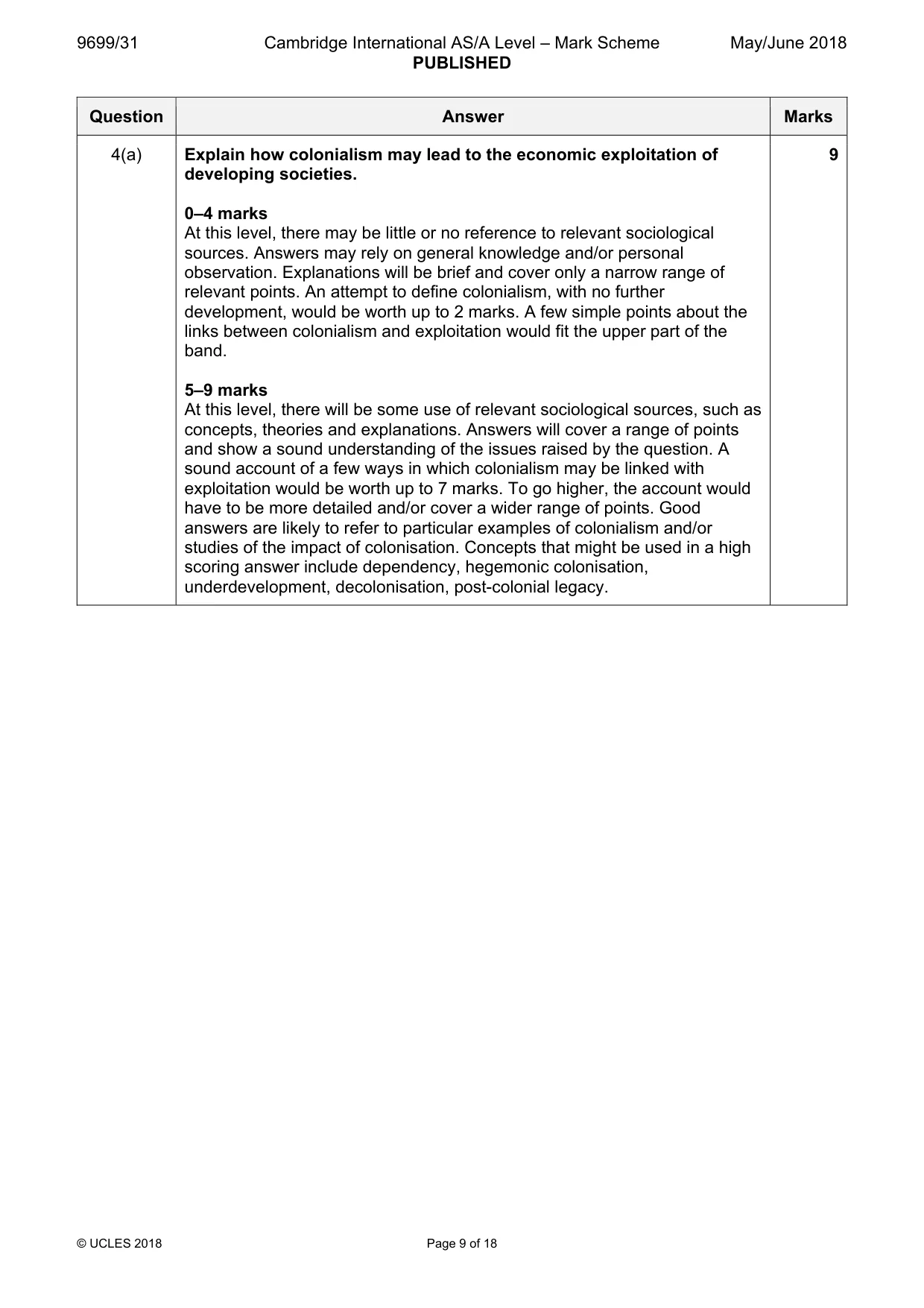
9699/31 Cambridge International AS/A Level – Mark Scheme PUBLISHED May/June 2018 © UCLES 2018 Page 9 of 18 Question Answer Marks 4(a) Explain how colonialism may lead to the economic exploitation of developing societies. 0–4 marks At this level, there may be little or no reference to relevant sociological sources. Answers may rely on general knowledge and/or personal observation. Explanations will be brief and cover only a narrow range of relevant points. An attempt to define colonialism, with no further development, would be worth up to 2 marks. A few simple points about the links between colonialism and exploitation would fit the upper part of the band. 5–9 marks At this level, there will be some use of relevant sociological sources, such as concepts, theories and explanations. Answers will cover a range of points and show a sound understanding of the issues raised by the question. A sound account of a few ways in which colonialism may be linked with exploitation would be worth up to 7 marks. To go higher, the account would have to be more detailed and/or cover a wider range of points. Good answers are likely to refer to particular examples of colonialism and/or studies of the impact of colonisation. Concepts that might be used in a high scoring answer include dependency, hegemonic colonisation, underdevelopment, decolonisation, post-colonial legacy. 9
Mark scheme, page 10
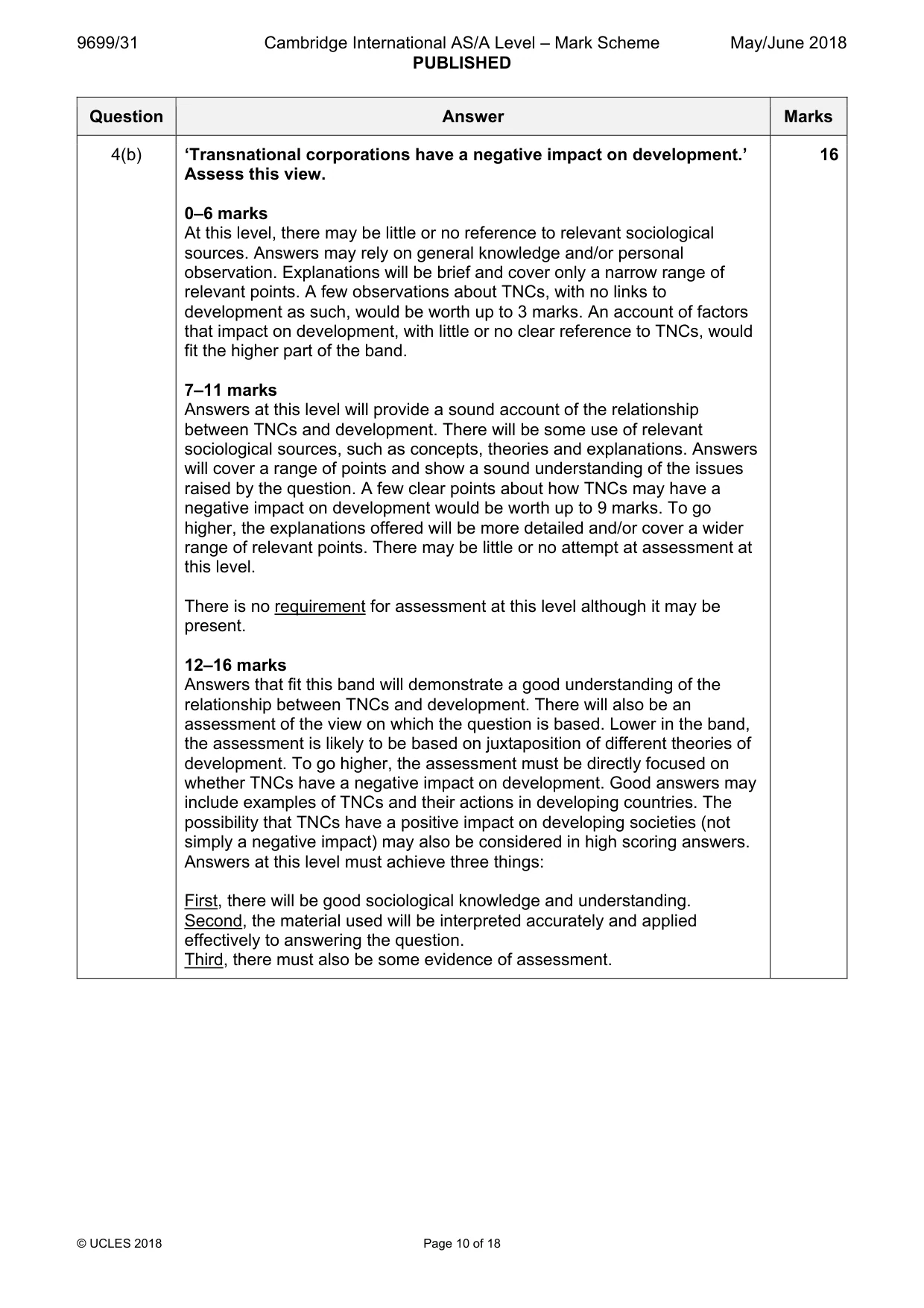
9699/31 Cambridge International AS/A Level – Mark Scheme PUBLISHED May/June 2018 © UCLES 2018 Page 10 of 18 Question Answer Marks 4(b) ‘Transnational corporations have a negative impact on development.’ Assess this view. 0–6 marks At this level, there may be little or no reference to relevant sociological sources. Answers may rely on general knowledge and/or personal observation. Explanations will be brief and cover only a narrow range of relevant points. A few observations about TNCs, with no links to development as such, would be worth up to 3 marks. An account of factors that impact on development, with little or no clear reference to TNCs, would fit the higher part of the band. 7–11 marks Answers at this level will provide a sound account of the relationship between TNCs and development. There will be some use of relevant sociological sources, such as concepts, theories and explanations. Answers will cover a range of points and show a sound understanding of the issues raised by the question. A few clear points about how TNCs may have a negative impact on development would be worth up to 9 marks. To go higher, the explanations offered will be more detailed and/or cover a wider range of relevant points. There may be little or no attempt at assessment at this level. There is no requirement for assessment at this level although it may be present. 12–16 marks Answers that fit this band will demonstrate a good understanding of the relationship between TNCs and development. There will also be an assessment of the view on which the question is based. Lower in the band, the assessment is likely to be based on juxtaposition of different theories of development. To go higher, the assessment must be directly focused on whether TNCs have a negative impact on development. Good answers may include examples of TNCs and their actions in developing countries. The possibility that TNCs have a positive impact on developing societies (not simply a negative impact) may also be considered in high scoring answers. Answers at this level must achieve three things: First, there will be good sociological knowledge and understanding. Second, the material used will be interpreted accurately and applied effectively to answering the question. Third, there must also be some evidence of assessment. 16
Mark scheme, page 11
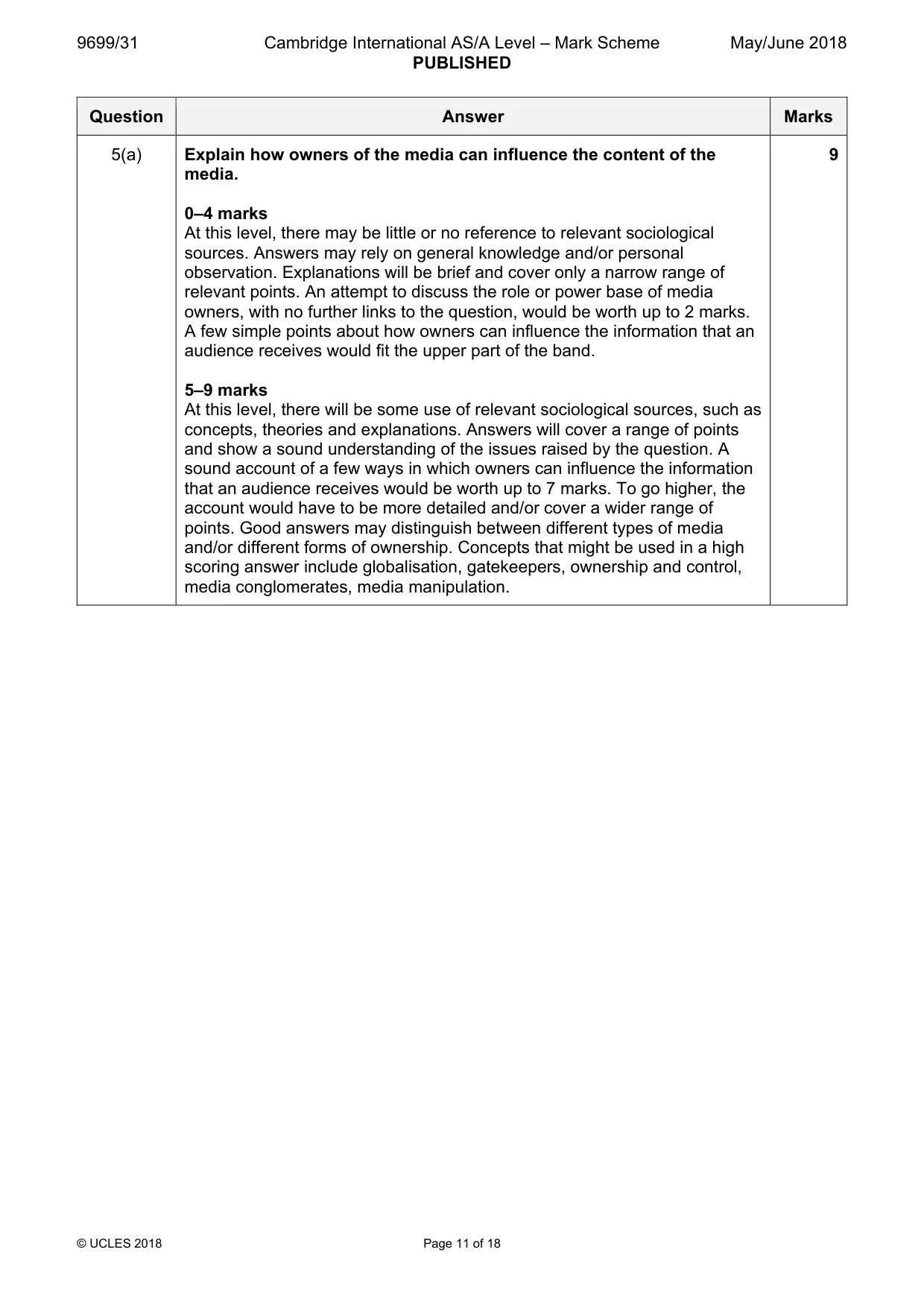
9699/31 Cambridge International AS/A Level – Mark Scheme PUBLISHED May/June 2018 © UCLES 2018 Page 11 of 18 Question Answer Marks 5(a) Explain how owners of the media can influence the content of the media. 0–4 marks At this level, there may be little or no reference to relevant sociological sources. Answers may rely on general knowledge and/or personal observation. Explanations will be brief and cover only a narrow range of relevant points. An attempt to discuss the role or power base of media owners, with no further links to the question, would be worth up to 2 marks. A few simple points about how owners can influence the information that an audience receives would fit the upper part of the band. 5–9 marks At this level, there will be some use of relevant sociological sources, such as concepts, theories and explanations. Answers will cover a range of points and show a sound understanding of the issues raised by the question. A sound account of a few ways in which owners can influence the information that an audience receives would be worth up to 7 marks. To go higher, the account would have to be more detailed and/or cover a wider range of points. Good answers may distinguish between different types of media and/or different forms of ownership. Concepts that might be used in a high scoring answer include globalisation, gatekeepers, ownership and control, media conglomerates, media manipulation. 9
Mark scheme, page 12
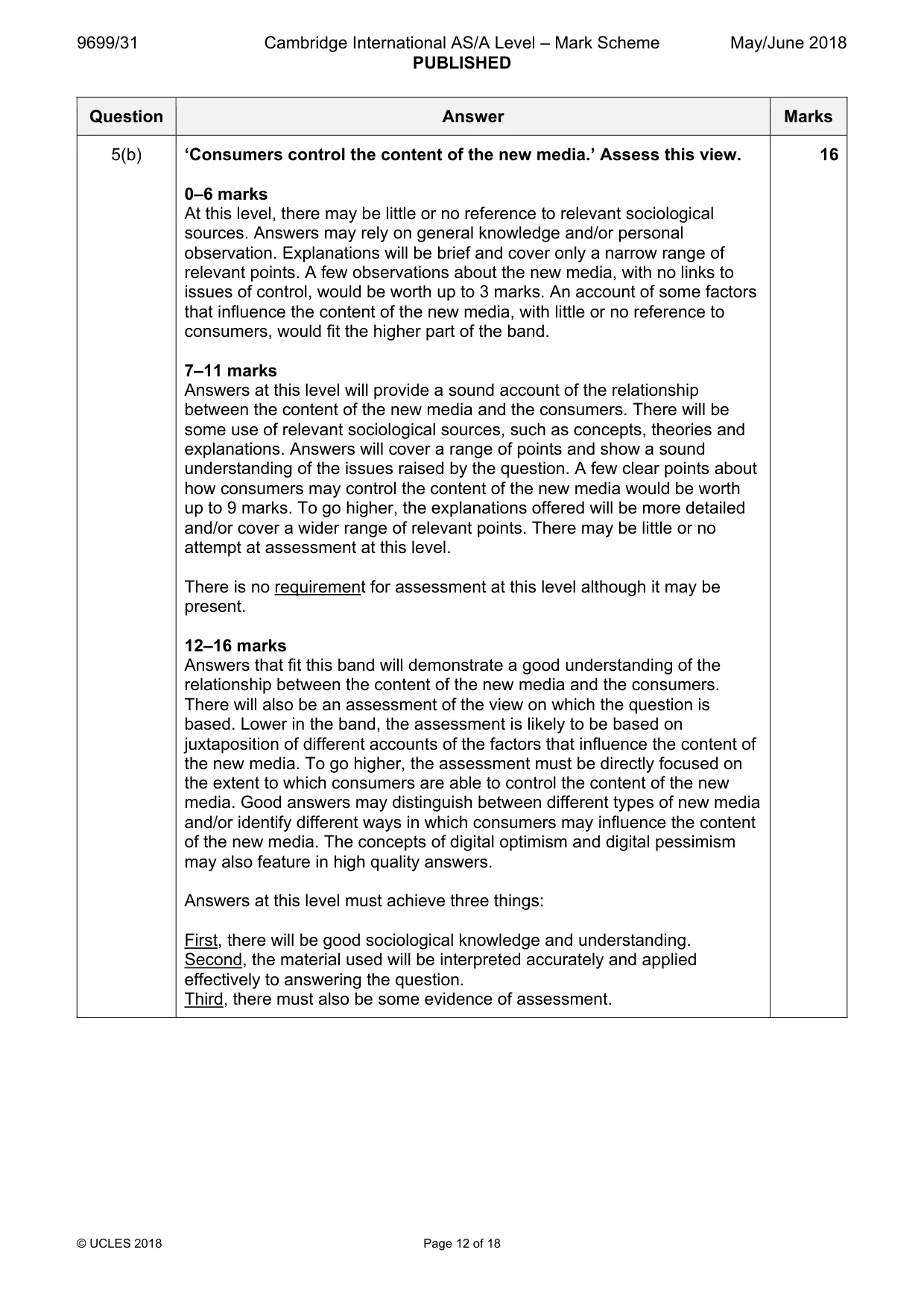
9699/31 Cambridge International AS/A Level – Mark Scheme PUBLISHED May/June 2018 © UCLES 2018 Page 12 of 18 Question Answer Marks 5(b) ‘Consumers control the content of the new media.’ Assess this view. 0–6 marks At this level, there may be little or no reference to relevant sociological sources. Answers may rely on general knowledge and/or personal observation. Explanations will be brief and cover only a narrow range of relevant points. A few observations about the new media, with no links to issues of control, would be worth up to 3 marks. An account of some factors that influence the content of the new media, with little or no reference to consumers, would fit the higher part of the band. 7–11 marks Answers at this level will provide a sound account of the relationship between the content of the new media and the consumers. There will be some use of relevant sociological sources, such as concepts, theories and explanations. Answers will cover a range of points and show a sound understanding of the issues raised by the question. A few clear points about how consumers may control the content of the new media would be worth up to 9 marks. To go higher, the explanations offered will be more detailed and/or cover a wider range of relevant points. There may be little or no attempt at assessment at this level. There is no requirement for assessment at this level although it may be present. 12–16 marks Answers that fit this band will demonstrate a good understanding of the relationship between the content of the new media and the consumers. There will also be an assessment of the view on which the question is based. Lower in the band, the assessment is likely to be based on juxtaposition of different accounts of the factors that influence the content of the new media. To go higher, the assessment must be directly focused on the extent to which consumers are able to control the content of the new media. Good answers may distinguish between different types of new media and/or identify different ways in which consumers may influence the content of the new media. The concepts of digital optimism and digital pessimism may also feature in high quality answers. Answers at this level must achieve three things: First, there will be good sociological knowledge and understanding. Second, the material used will be interpreted accurately and applied effectively to answering the question. Third, there must also be some evidence of assessment. 16
Mark scheme, page 13
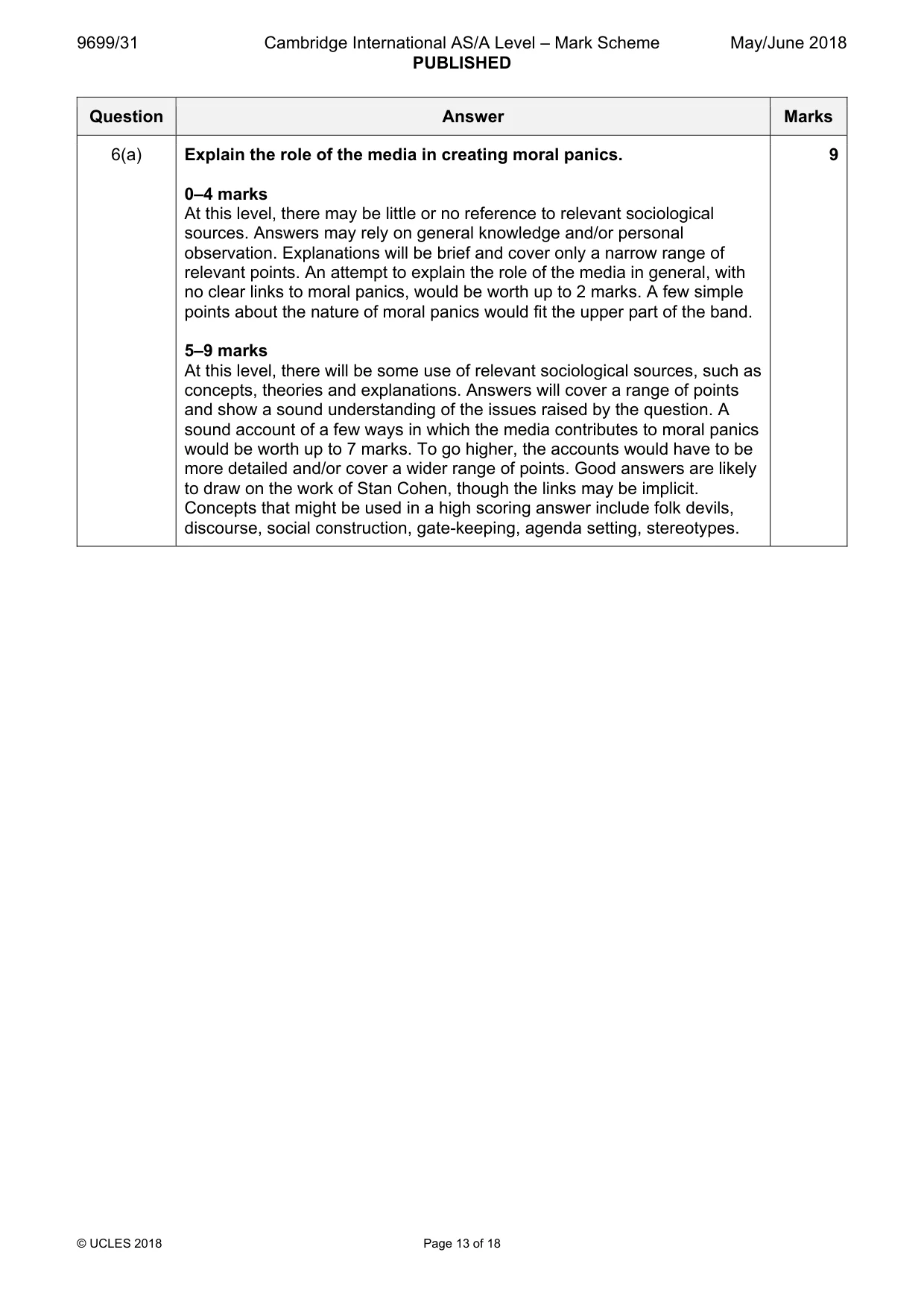
9699/31 Cambridge International AS/A Level – Mark Scheme PUBLISHED May/June 2018 © UCLES 2018 Page 13 of 18 Question Answer Marks 6(a) Explain the role of the media in creating moral panics. 0–4 marks At this level, there may be little or no reference to relevant sociological sources. Answers may rely on general knowledge and/or personal observation. Explanations will be brief and cover only a narrow range of relevant points. An attempt to explain the role of the media in general, with no clear links to moral panics, would be worth up to 2 marks. A few simple points about the nature of moral panics would fit the upper part of the band. 5–9 marks At this level, there will be some use of relevant sociological sources, such as concepts, theories and explanations. Answers will cover a range of points and show a sound understanding of the issues raised by the question. A sound account of a few ways in which the media contributes to moral panics would be worth up to 7 marks. To go higher, the accounts would have to be more detailed and/or cover a wider range of points. Good answers are likely to draw on the work of Stan Cohen, though the links may be implicit. Concepts that might be used in a high scoring answer include folk devils, discourse, social construction, gate-keeping, agenda setting, stereotypes. 9
Mark scheme, page 14
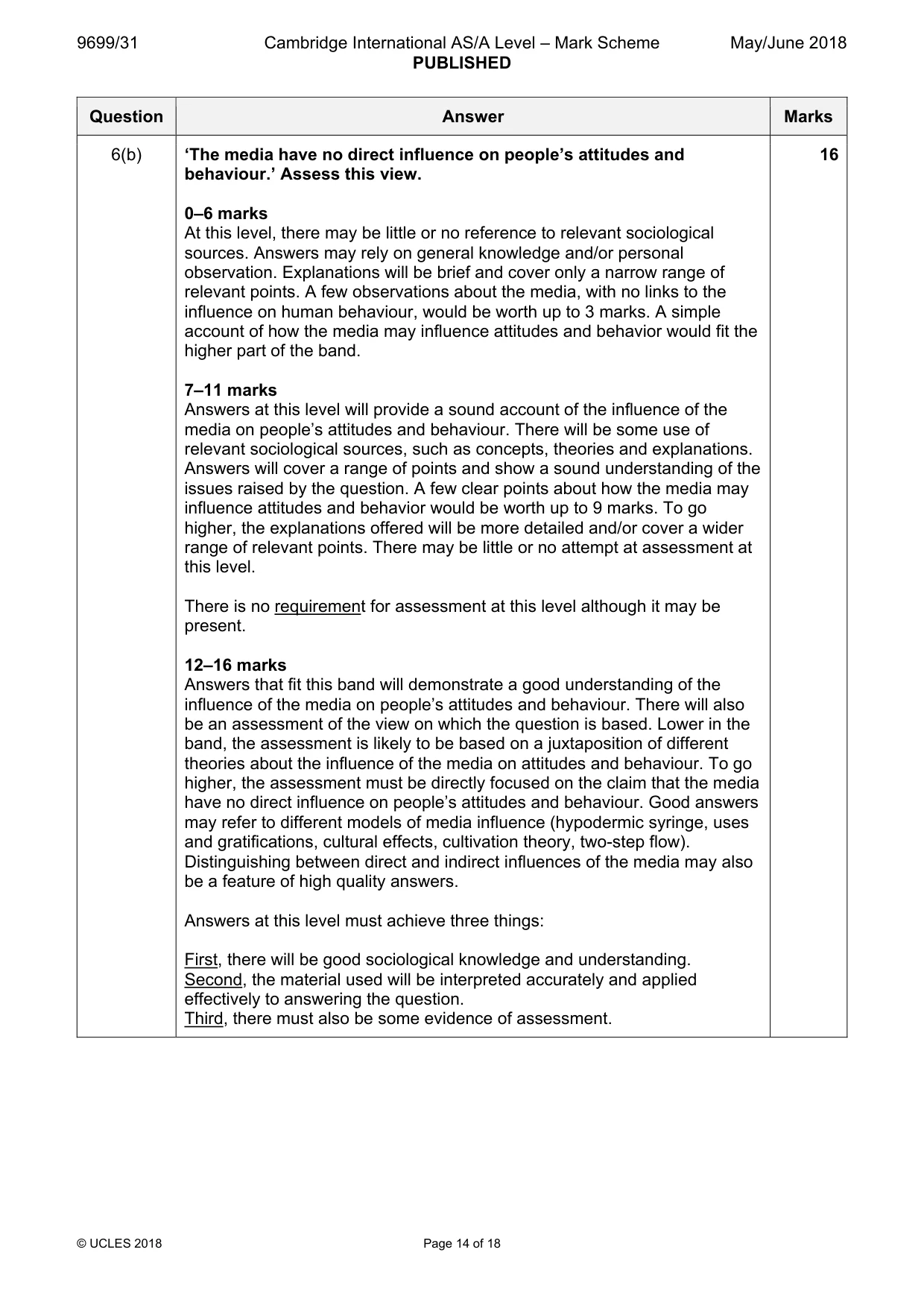
9699/31 Cambridge International AS/A Level – Mark Scheme PUBLISHED May/June 2018 © UCLES 2018 Page 14 of 18 Question Answer Marks 6(b) ‘The media have no direct influence on people’s attitudes and behaviour.’ Assess this view. 0–6 marks At this level, there may be little or no reference to relevant sociological sources. Answers may rely on general knowledge and/or personal observation. Explanations will be brief and cover only a narrow range of relevant points. A few observations about the media, with no links to the influence on human behaviour, would be worth up to 3 marks. A simple account of how the media may influence attitudes and behavior would fit the higher part of the band. 7–11 marks Answers at this level will provide a sound account of the influence of the media on people’s attitudes and behaviour. There will be some use of relevant sociological sources, such as concepts, theories and explanations. Answers will cover a range of points and show a sound understanding of the issues raised by the question. A few clear points about how the media may influence attitudes and behavior would be worth up to 9 marks. To go higher, the explanations offered will be more detailed and/or cover a wider range of relevant points. There may be little or no attempt at assessment at this level. There is no requirement for assessment at this level although it may be present. 12–16 marks Answers that fit this band will demonstrate a good understanding of the influence of the media on people’s attitudes and behaviour. There will also be an assessment of the view on which the question is based. Lower in the band, the assessment is likely to be based on a juxtaposition of different theories about the influence of the media on attitudes and behaviour. To go higher, the assessment must be directly focused on the claim that the media have no direct influence on people’s attitudes and behaviour. Good answers may refer to different models of media influence (hypodermic syringe, uses and gratifications, cultural effects, cultivation theory, two-step flow). Distinguishing between direct and indirect influences of the media may also be a feature of high quality answers. Answers at this level must achieve three things: First, there will be good sociological knowledge and understanding. Second, the material used will be interpreted accurately and applied effectively to answering the question. Third, there must also be some evidence of assessment. 16
Mark scheme, page 15
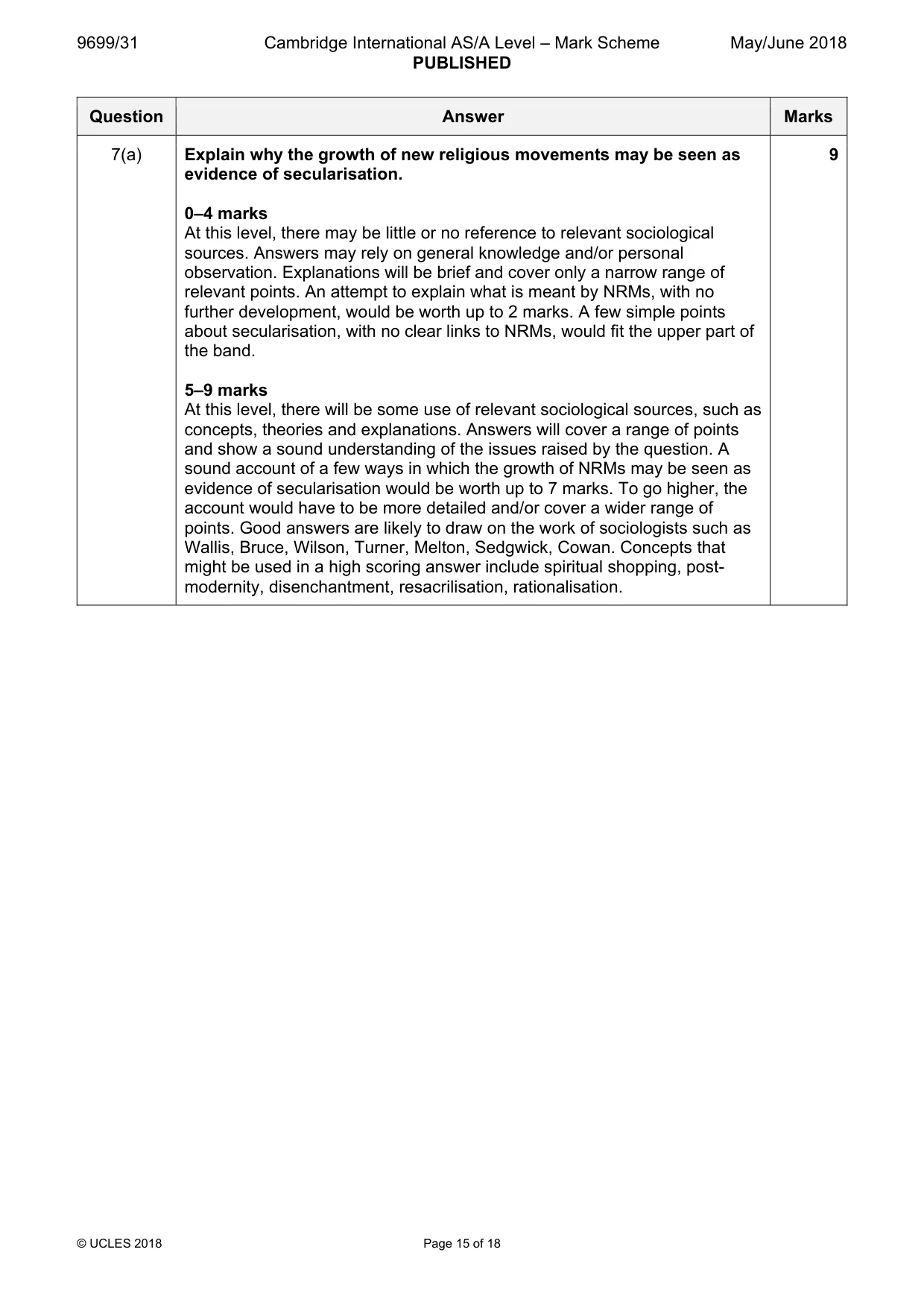
9699/31 Cambridge International AS/A Level – Mark Scheme PUBLISHED May/June 2018 © UCLES 2018 Page 15 of 18 Question Answer Marks 7(a) Explain why the growth of new religious movements may be seen as evidence of secularisation. 0–4 marks At this level, there may be little or no reference to relevant sociological sources. Answers may rely on general knowledge and/or personal observation. Explanations will be brief and cover only a narrow range of relevant points. An attempt to explain what is meant by NRMs, with no further development, would be worth up to 2 marks. A few simple points about secularisation, with no clear links to NRMs, would fit the upper part of the band. 5–9 marks At this level, there will be some use of relevant sociological sources, such as concepts, theories and explanations. Answers will cover a range of points and show a sound understanding of the issues raised by the question. A sound account of a few ways in which the growth of NRMs may be seen as evidence of secularisation would be worth up to 7 marks. To go higher, the account would have to be more detailed and/or cover a wider range of points. Good answers are likely to draw on the work of sociologists such as Wallis, Bruce, Wilson, Turner, Melton, Sedgwick, Cowan. Concepts that might be used in a high scoring answer include spiritual shopping, post- modernity, disenchantment, resacrilisation, rationalisation. 9
Mark scheme, page 16
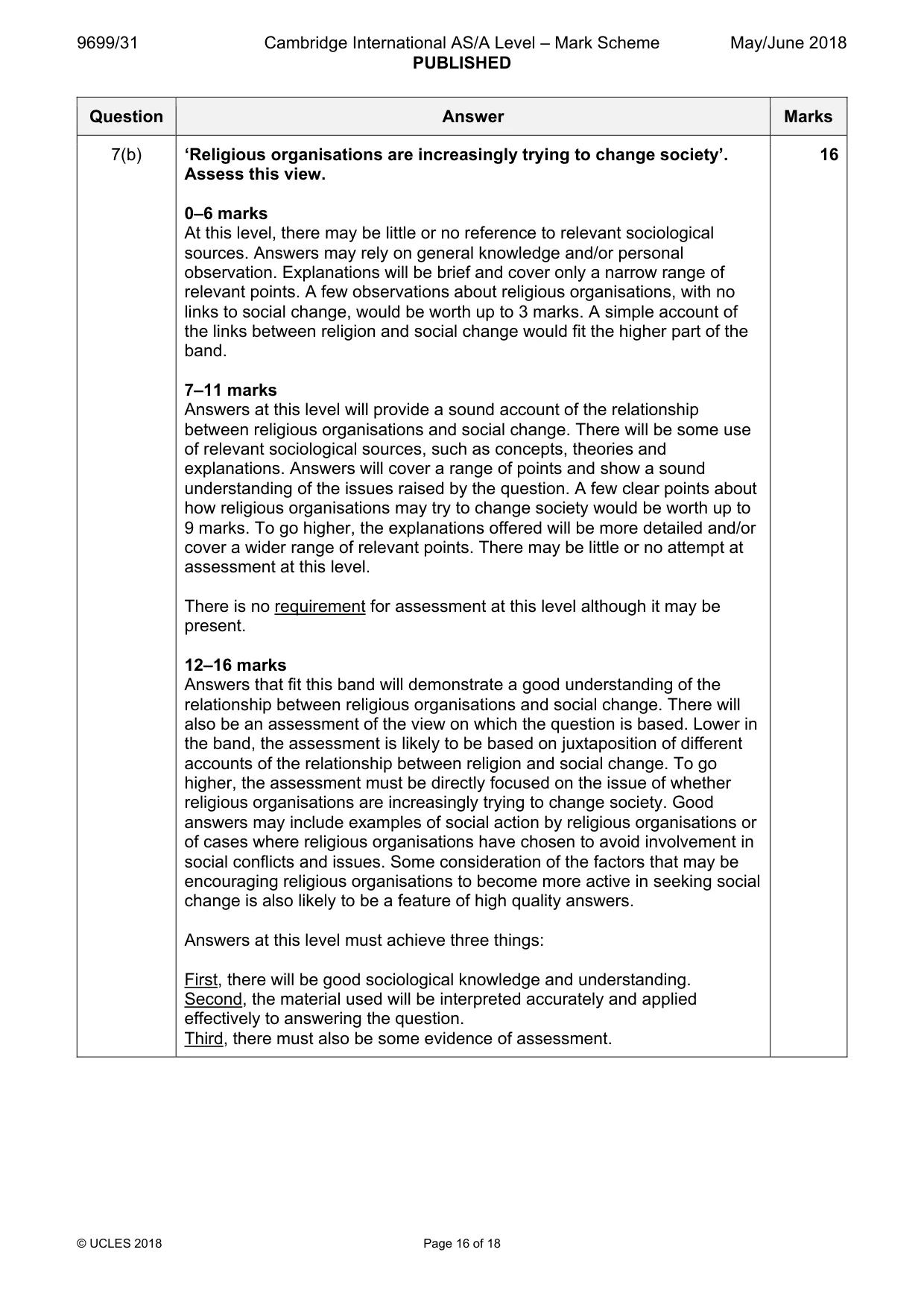
9699/31 Cambridge International AS/A Level – Mark Scheme PUBLISHED May/June 2018 © UCLES 2018 Page 16 of 18 Question Answer Marks 7(b) ‘Religious organisations are increasingly trying to change society’. Assess this view. 0–6 marks At this level, there may be little or no reference to relevant sociological sources. Answers may rely on general knowledge and/or personal observation. Explanations will be brief and cover only a narrow range of relevant points. A few observations about religious organisations, with no links to social change, would be worth up to 3 marks. A simple account of the links between religion and social change would fit the higher part of the band. 7–11 marks Answers at this level will provide a sound account of the relationship between religious organisations and social change. There will be some use of relevant sociological sources, such as concepts, theories and explanations. Answers will cover a range of points and show a sound understanding of the issues raised by the question. A few clear points about how religious organisations may try to change society would be worth up to 9 marks. To go higher, the explanations offered will be more detailed and/or cover a wider range of relevant points. There may be little or no attempt at assessment at this level. There is no requirement for assessment at this level although it may be present. 12–16 marks Answers that fit this band will demonstrate a good understanding of the relationship between religious organisations and social change. There will also be an assessment of the view on which the question is based. Lower in the band, the assessment is likely to be based on juxtaposition of different accounts of the relationship between religion and social change. To go higher, the assessment must be directly focused on the issue of whether religious organisations are increasingly trying to change society. Good answers may include examples of social action by religious organisations or of cases where religious organisations have chosen to avoid involvement in social conflicts and issues. Some consideration of the factors that may be encouraging religious organisations to become more active in seeking social change is also likely to be a feature of high quality answers. Answers at this level must achieve three things: First, there will be good sociological knowledge and understanding. Second, the material used will be interpreted accurately and applied effectively to answering the question. Third, there must also be some evidence of assessment. 16
Mark scheme, page 17
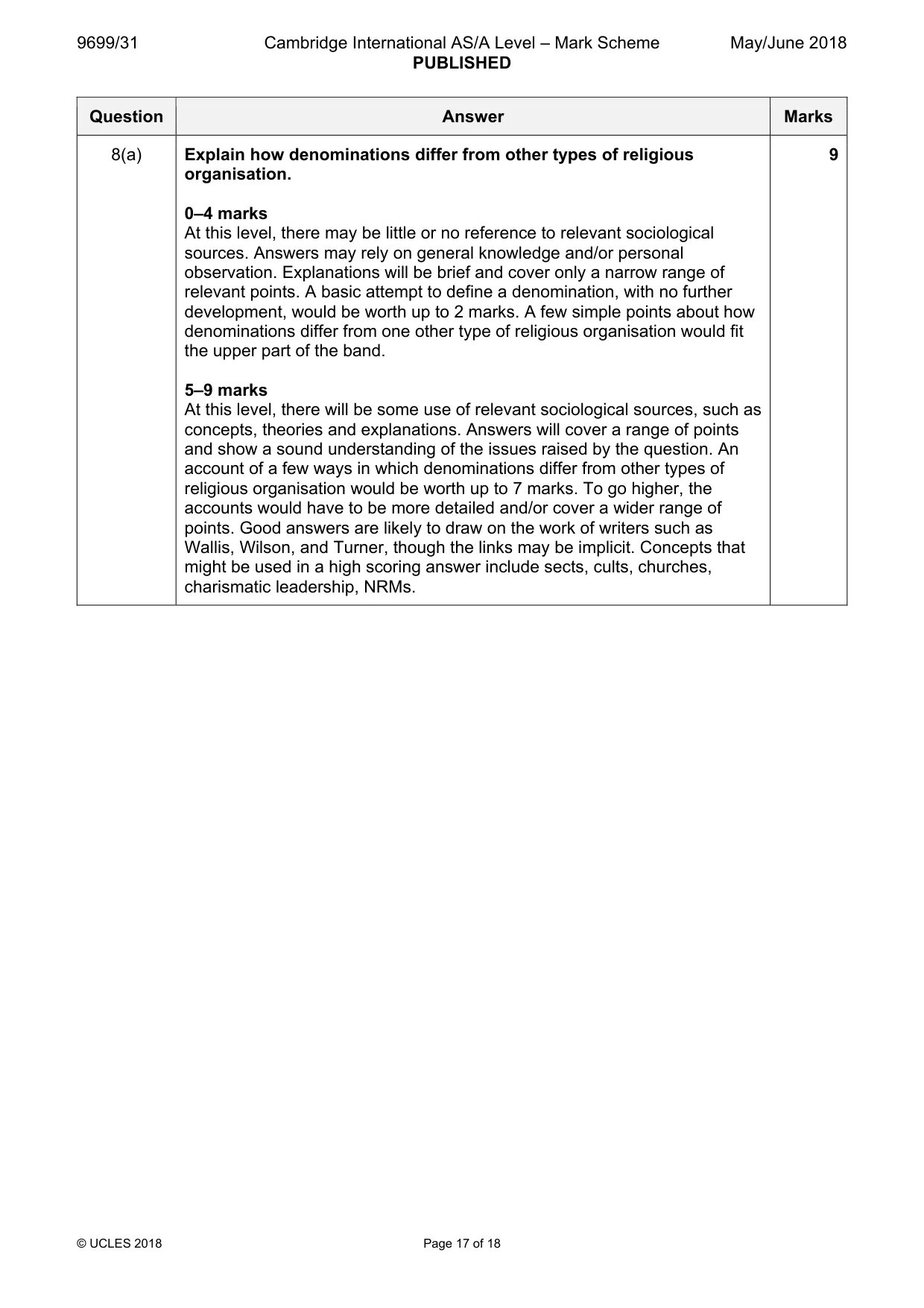
9699/31 Cambridge International AS/A Level – Mark Scheme PUBLISHED May/June 2018 © UCLES 2018 Page 17 of 18 Question Answer Marks 8(a) Explain how denominations differ from other types of religious organisation. 0–4 marks At this level, there may be little or no reference to relevant sociological sources. Answers may rely on general knowledge and/or personal observation. Explanations will be brief and cover only a narrow range of relevant points. A basic attempt to define a denomination, with no further development, would be worth up to 2 marks. A few simple points about how denominations differ from one other type of religious organisation would fit the upper part of the band. 5–9 marks At this level, there will be some use of relevant sociological sources, such as concepts, theories and explanations. Answers will cover a range of points and show a sound understanding of the issues raised by the question. An account of a few ways in which denominations differ from other types of religious organisation would be worth up to 7 marks. To go higher, the accounts would have to be more detailed and/or cover a wider range of points. Good answers are likely to draw on the work of writers such as Wallis, Wilson, and Turner, though the links may be implicit. Concepts that might be used in a high scoring answer include sects, cults, churches, charismatic leadership, NRMs. 9
Mark scheme, page 18
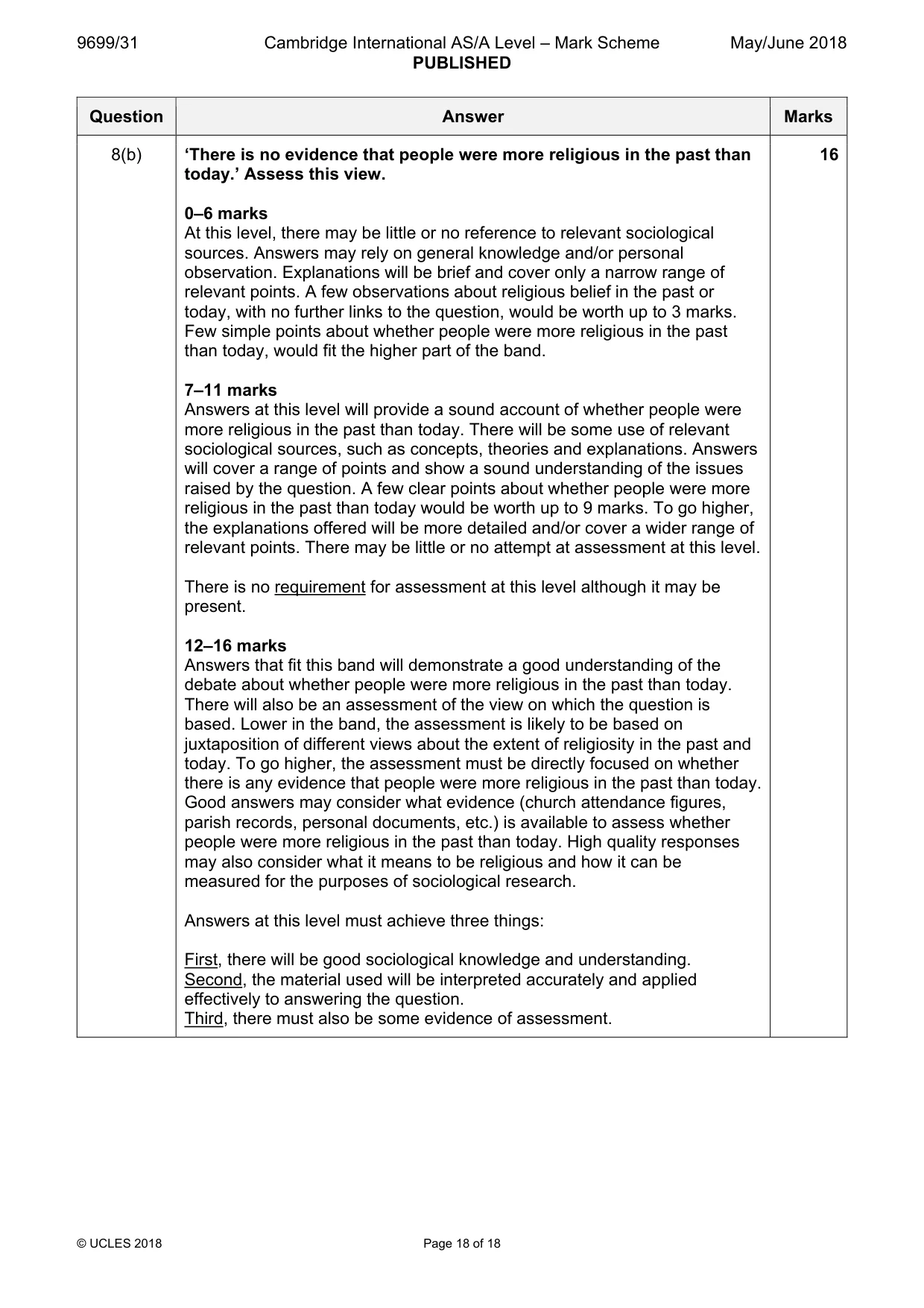
9699/31 Cambridge International AS/A Level – Mark Scheme PUBLISHED May/June 2018 © UCLES 2018 Page 18 of 18 Question Answer Marks 8(b) ‘There is no evidence that people were more religious in the past than today.’ Assess this view. 0–6 marks At this level, there may be little or no reference to relevant sociological sources. Answers may rely on general knowledge and/or personal observation. Explanations will be brief and cover only a narrow range of relevant points. A few observations about religious belief in the past or today, with no further links to the question, would be worth up to 3 marks. Few simple points about whether people were more religious in the past than today, would fit the higher part of the band. 7–11 marks Answers at this level will provide a sound account of whether people were more religious in the past than today. There will be some use of relevant sociological sources, such as concepts, theories and explanations. Answers will cover a range of points and show a sound understanding of the issues raised by the question. A few clear points about whether people were more religious in the past than today would be worth up to 9 marks. To go higher, the explanations offered will be more detailed and/or cover a wider range of relevant points. There may be little or no attempt at assessment at this level. There is no requirement for assessment at this level although it may be present. 12–16 marks Answers that fit this band will demonstrate a good understanding of the debate about whether people were more religious in the past than today. There will also be an assessment of the view on which the question is based. Lower in the band, the assessment is likely to be based on juxtaposition of different views about the extent of religiosity in the past and today. To go higher, the assessment must be directly focused on whether there is any evidence that people were more religious in the past than today. Good answers may consider what evidence (church attendance figures, parish records, personal documents, etc.) is available to assess whether people were more religious in the past than today. High quality responses may also consider what it means to be religious and how it can be measured for the purposes of sociological research. Answers at this level must achieve three things: First, there will be good sociological knowledge and understanding. Second, the material used will be interpreted accurately and applied effectively to answering the question. Third, there must also be some evidence of assessment. 16
What you needed in this session
Cambridge’s own grade thresholds for 2018 May/June, Paper 3 · Variant 1. A higher threshold means an easier paper — the bar moves with how the cohort did.