Cambridge A Level Sociology 9699 — 2017 Oct/Nov Paper 3 · Variant 1
9699/31/O/N/17 · 75 marks · ≈84 min
The question paper and its mark scheme, free to read here and free to download. This is Cambridge’s own paper, exactly as it was sat.
Question paper4 pages
Mark scheme17 pages
Answers below. Sit the paper first if you are practising.
Paper as text
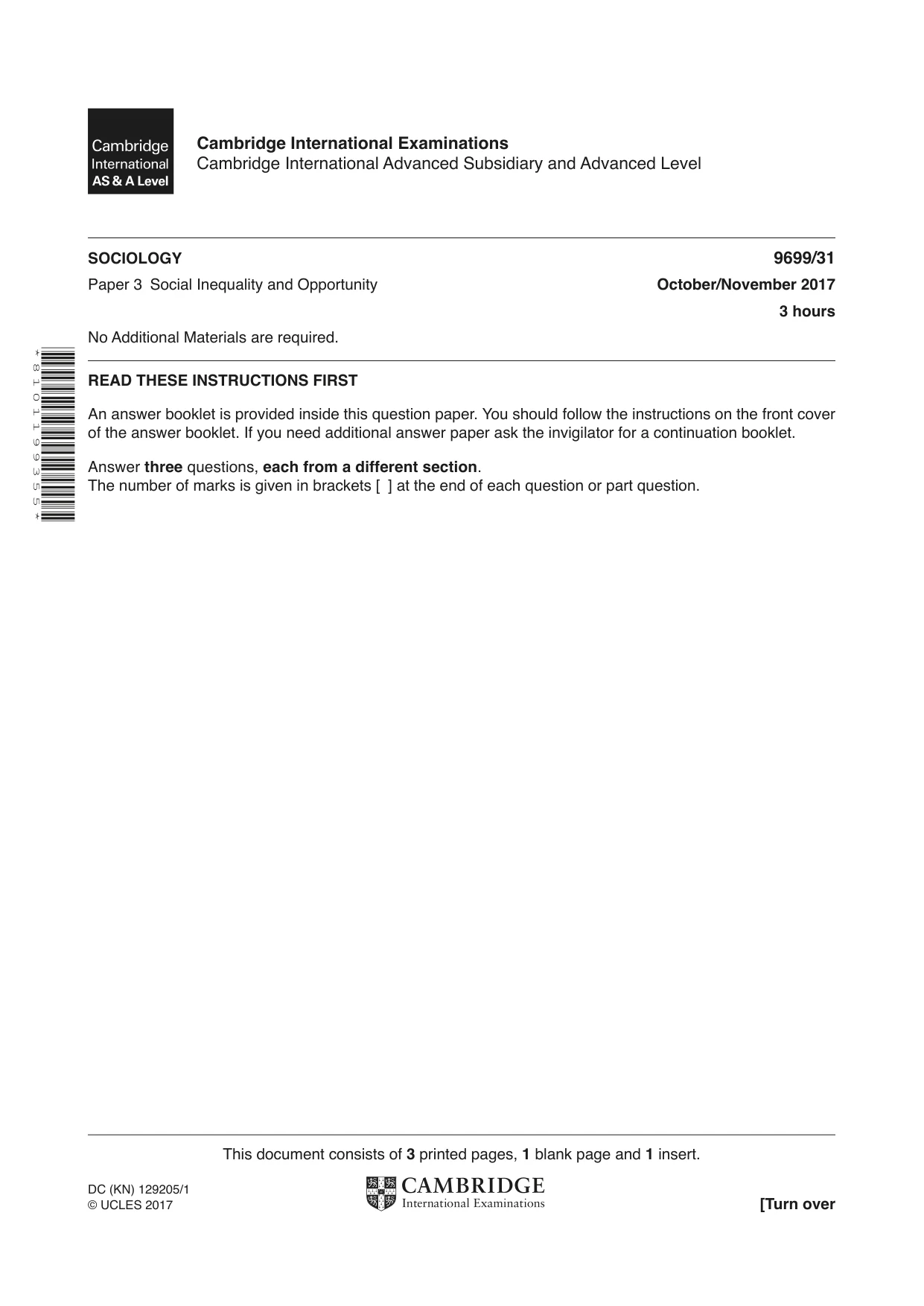
Question paper, page 1
This document consists of 3 printed pages, 1 blank page and 1 insert. DC (KN) 129205/1 © UCLES 2017 [Turn over Cambridge International Examinations Cambridge International Advanced Subsidiary and Advanced Level * 8 1 0 1 1 9 9 3 5 5 * SOCIOLOGY 9699/31 Paper 3 Social Inequality and Opportunity October/November 2017 3 hours No Additional Materials are required. READ THESE INSTRUCTIONS FIRST An answer booklet is provided inside this question paper. You should follow the instructions on the front cover of the answer booklet. If you need additional answer paper ask the invigilator for a continuation booklet. Answer three questions, each from a different section. The number of marks is given in brackets [ ] at the end of each question or part question.
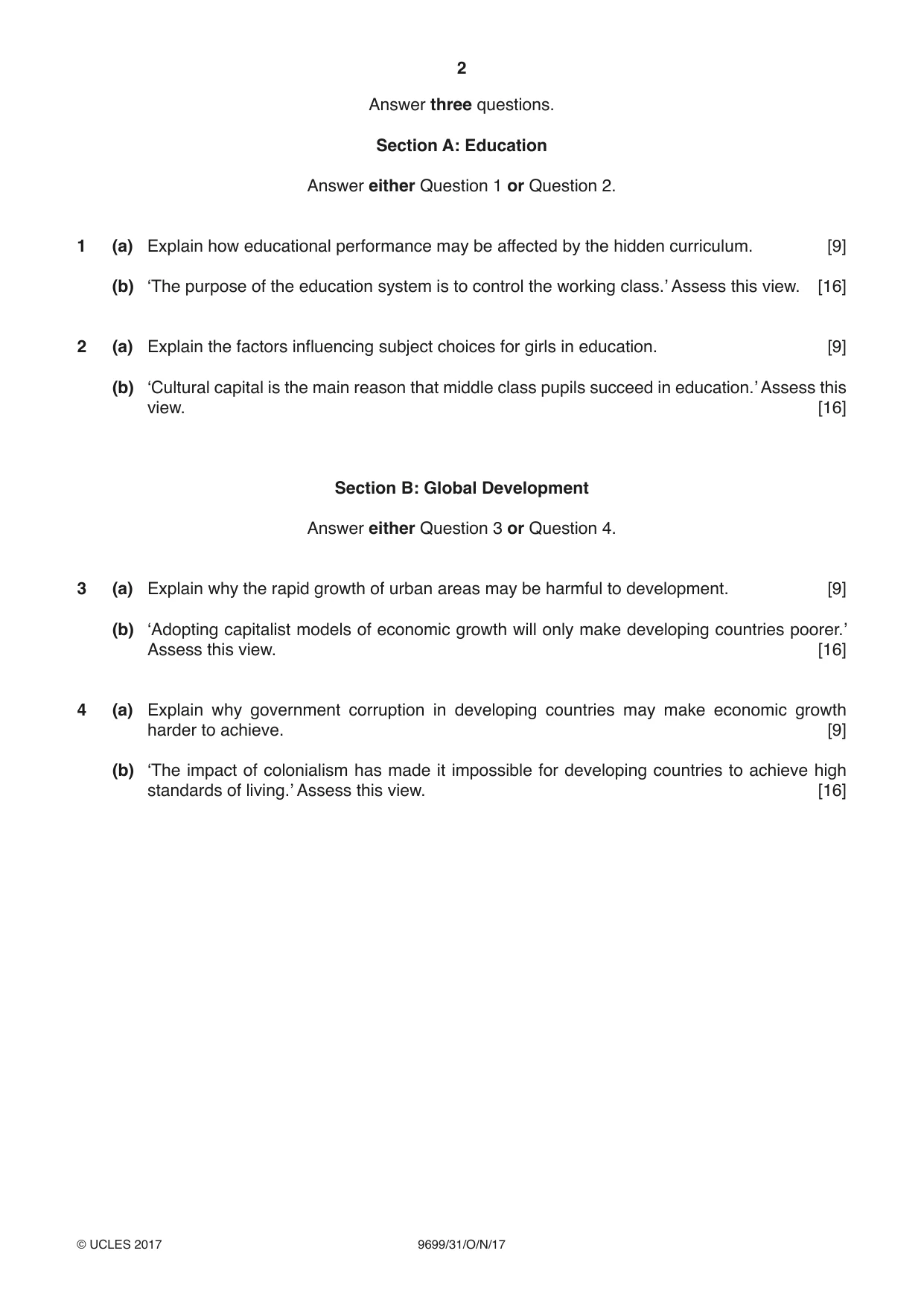
Question paper, page 2
2 9699/31/O/N/17 © UCLES 2017 Answer three questions. Section A: Education Answer either Question 1 or Question 2. 1 (a) Explain how educational performance may be affected by the hidden curriculum. [9] (b) ‘The purpose of the education system is to control the working class.’ Assess this view. [16] 2 (a) Explain the factors influencing subject choices for girls in education. [9] (b) ‘Cultural capital is the main reason that middle class pupils succeed in education.’ Assess this view. [16] Section B: Global Development Answer either Question 3 or Question 4. 3 (a) Explain why the rapid growth of urban areas may be harmful to development. [9] (b) ‘Adopting capitalist models of economic growth will only make developing countries poorer.’ Assess this view. [16] 4 (a) Explain why government corruption in developing countries may make economic growth harder to achieve. [9] (b) ‘The impact of colonialism has made it impossible for developing countries to achieve high standards of living.’ Assess this view. [16]
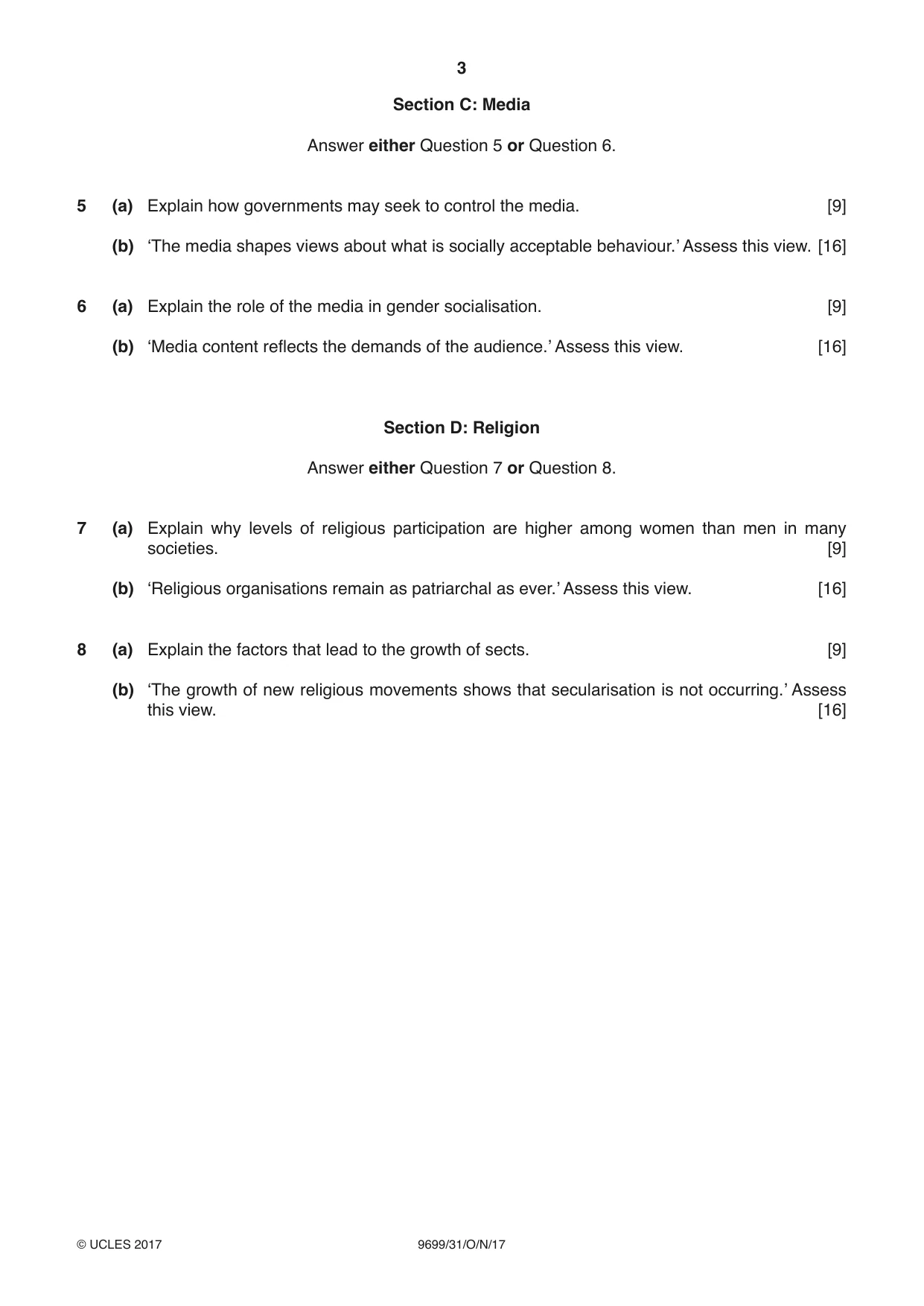
Question paper, page 3
3 9699/31/O/N/17 © UCLES 2017 Section C: Media Answer either Question 5 or Question 6. 5 (a) Explain how governments may seek to control the media. [9] (b) ‘The media shapes views about what is socially acceptable behaviour.’ Assess this view. [16] 6 (a) Explain the role of the media in gender socialisation. [9] (b) ‘Media content reflects the demands of the audience.’ Assess this view. [16] Section D: Religion Answer either Question 7 or Question 8. 7 (a) Explain why levels of religious participation are higher among women than men in many societies. [9] (b) ‘Religious organisations remain as patriarchal as ever.’ Assess this view. [16] 8 (a) Explain the factors that lead to the growth of sects. [9] (b) ‘The growth of new religious movements shows that secularisation is not occurring.’ Assess this view. [16]
Question paper, page 4
4 9699/31/O/N/17 © UCLES 2017 Permission to reproduce items where third-party owned material protected by copyright is included has been sought and cleared where possible. Every reasonable effort has been made by the publisher (UCLES) to trace copyright holders, but if any items requiring clearance have unwittingly been included, the publisher will be pleased to make amends at the earliest possible opportunity. To avoid the issue of disclosure of answer-related information to candidates, all copyright acknowledgements are reproduced online in the Cambridge International Examinations Copyright Acknowledgements Booklet. This is produced for each series of examinations and is freely available to download at www.cie.org.uk after the live examination series. Cambridge International Examinations is part of the Cambridge Assessment Group. Cambridge Assessment is the brand name of University of Cambridge Local Examinations Syndicate (UCLES), which is itself a department of the University of Cambridge. BLANK PAGE
Mark scheme, page 1
® IGCSE is a registered trademark. This document consists of 17 printed pages. © UCLES 2017 [Turn over Cambridge Assessment International Education Cambridge International Advanced Subsidiary and Advanced Level SOCIOLOGY 9699/31 Paper 3 October/November 2017 MARK SCHEME Maximum Mark: 75 Published This mark scheme is published as an aid to teachers and candidates, to indicate the requirements of the examination. It shows the basis on which Examiners were instructed to award marks. It does not indicate the details of the discussions that took place at an Examiners’ meeting before marking began, which would have considered the acceptability of alternative answers. Mark schemes should be read in conjunction with the question paper and the Principal Examiner Report for Teachers. Cambridge International will not enter into discussions about these mark schemes. Cambridge International is publishing the mark schemes for the October/November 2017 series for most Cambridge IGCSE®, Cambridge International A and AS Level components and some Cambridge O Level components.
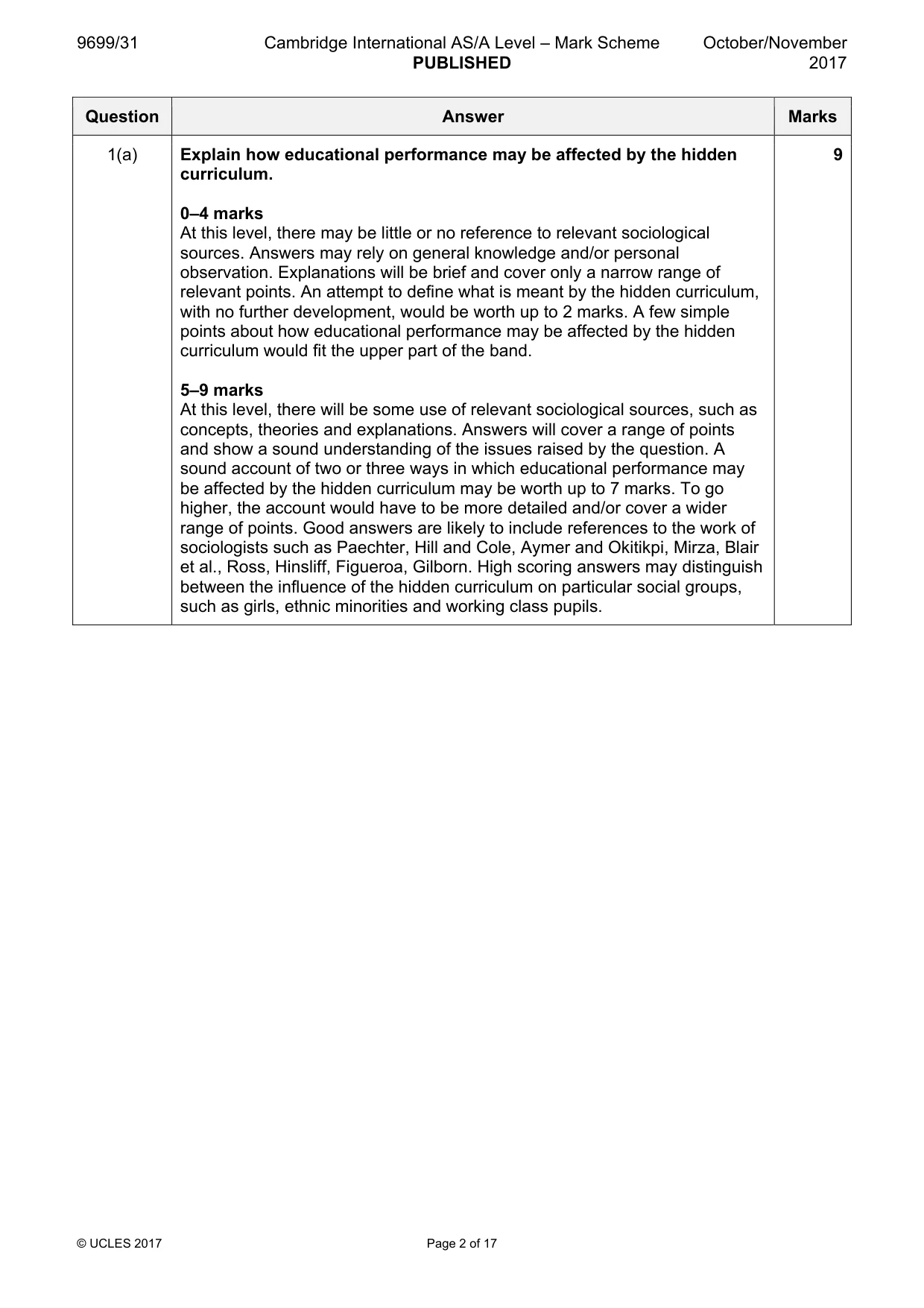
Mark scheme, page 2
9699/31 Cambridge International AS/A Level – Mark Scheme PUBLISHED October/November 2017 © UCLES 2017 Page 2 of 17 Question Answer Marks 1(a) Explain how educational performance may be affected by the hidden curriculum. 0–4 marks At this level, there may be little or no reference to relevant sociological sources. Answers may rely on general knowledge and/or personal observation. Explanations will be brief and cover only a narrow range of relevant points. An attempt to define what is meant by the hidden curriculum, with no further development, would be worth up to 2 marks. A few simple points about how educational performance may be affected by the hidden curriculum would fit the upper part of the band. 5–9 marks At this level, there will be some use of relevant sociological sources, such as concepts, theories and explanations. Answers will cover a range of points and show a sound understanding of the issues raised by the question. A sound account of two or three ways in which educational performance may be affected by the hidden curriculum may be worth up to 7 marks. To go higher, the account would have to be more detailed and/or cover a wider range of points. Good answers are likely to include references to the work of sociologists such as Paechter, Hill and Cole, Aymer and Okitikpi, Mirza, Blair et al., Ross, Hinsliff, Figueroa, Gilborn. High scoring answers may distinguish between the influence of the hidden curriculum on particular social groups, such as girls, ethnic minorities and working class pupils. 9
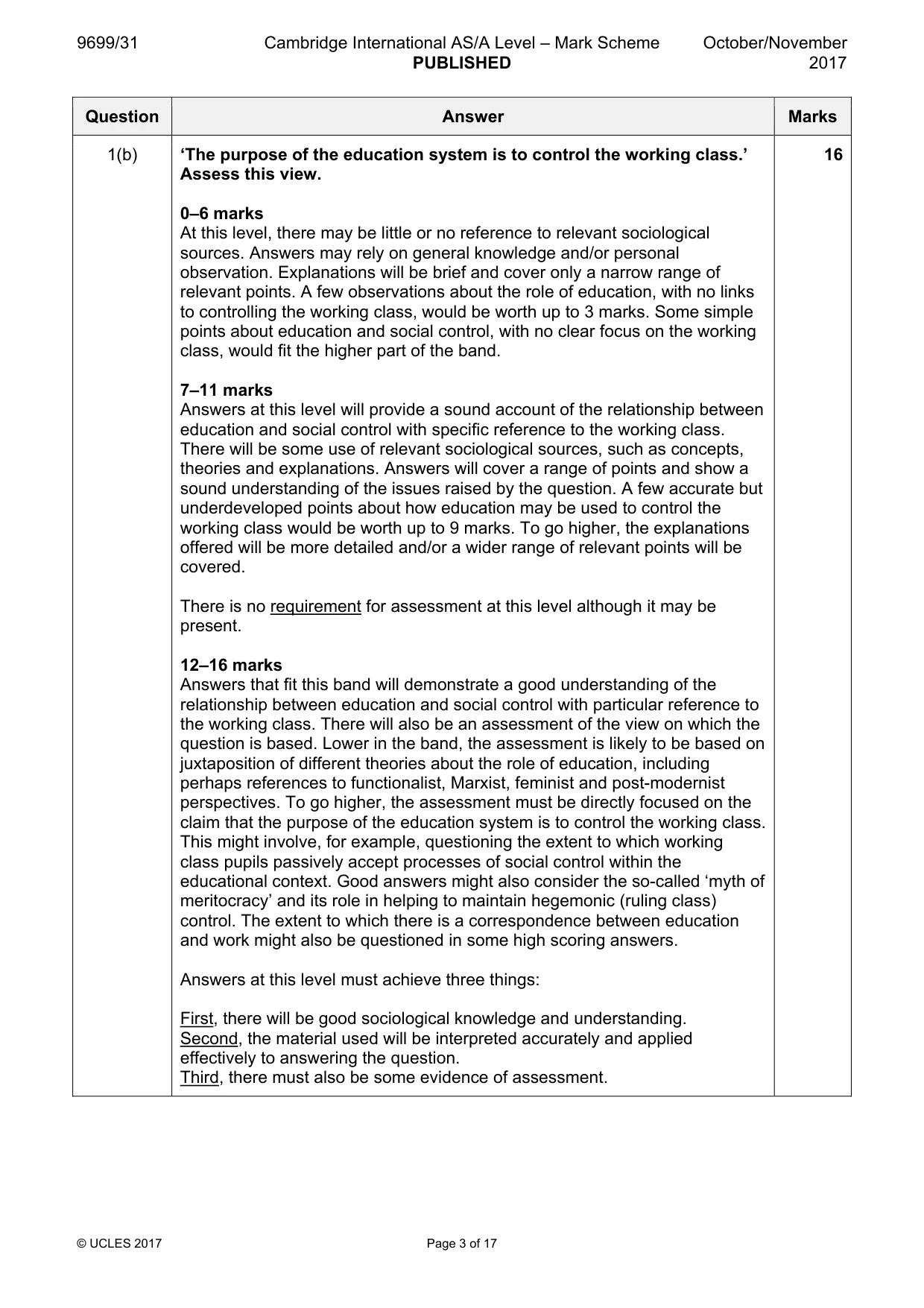
Mark scheme, page 3
9699/31 Cambridge International AS/A Level – Mark Scheme PUBLISHED October/November 2017 © UCLES 2017 Page 3 of 17 Question Answer Marks 1(b) ‘The purpose of the education system is to control the working class.’ Assess this view. 0–6 marks At this level, there may be little or no reference to relevant sociological sources. Answers may rely on general knowledge and/or personal observation. Explanations will be brief and cover only a narrow range of relevant points. A few observations about the role of education, with no links to controlling the working class, would be worth up to 3 marks. Some simple points about education and social control, with no clear focus on the working class, would fit the higher part of the band. 7–11 marks Answers at this level will provide a sound account of the relationship between education and social control with specific reference to the working class. There will be some use of relevant sociological sources, such as concepts, theories and explanations. Answers will cover a range of points and show a sound understanding of the issues raised by the question. A few accurate but underdeveloped points about how education may be used to control the working class would be worth up to 9 marks. To go higher, the explanations offered will be more detailed and/or a wider range of relevant points will be covered. There is no requirement for assessment at this level although it may be present. 12–16 marks Answers that fit this band will demonstrate a good understanding of the relationship between education and social control with particular reference to the working class. There will also be an assessment of the view on which the question is based. Lower in the band, the assessment is likely to be based on juxtaposition of different theories about the role of education, including perhaps references to functionalist, Marxist, feminist and post-modernist perspectives. To go higher, the assessment must be directly focused on the claim that the purpose of the education system is to control the working class. This might involve, for example, questioning the extent to which working class pupils passively accept processes of social control within the educational context. Good answers might also consider the so-called ‘myth of meritocracy’ and its role in helping to maintain hegemonic (ruling class) control. The extent to which there is a correspondence between education and work might also be questioned in some high scoring answers. Answers at this level must achieve three things: First, there will be good sociological knowledge and understanding. Second, the material used will be interpreted accurately and applied effectively to answering the question. Third, there must also be some evidence of assessment. 16
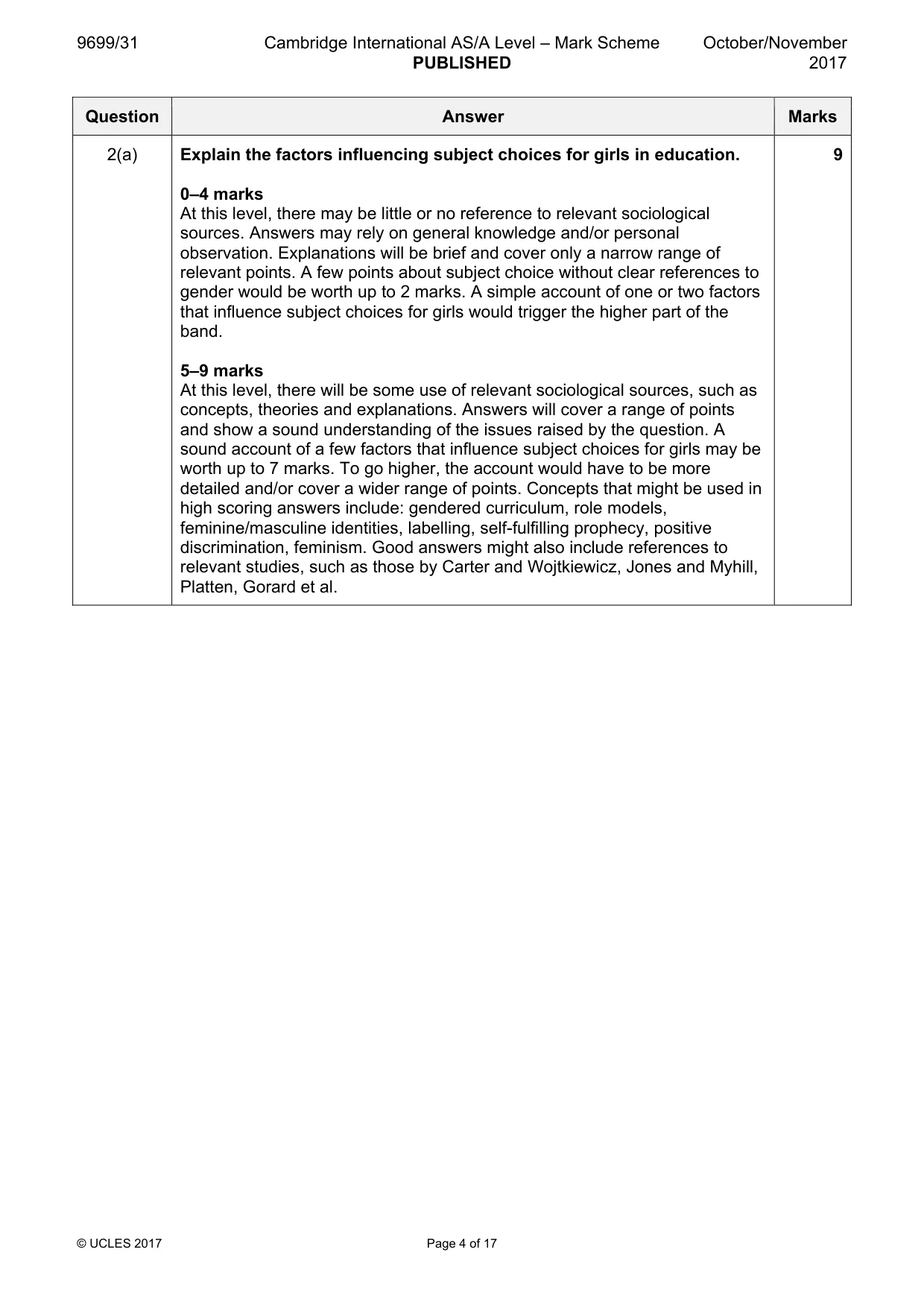
Mark scheme, page 4
9699/31 Cambridge International AS/A Level – Mark Scheme PUBLISHED October/November 2017 © UCLES 2017 Page 4 of 17 Question Answer Marks 2(a) Explain the factors influencing subject choices for girls in education. 0–4 marks At this level, there may be little or no reference to relevant sociological sources. Answers may rely on general knowledge and/or personal observation. Explanations will be brief and cover only a narrow range of relevant points. A few points about subject choice without clear references to gender would be worth up to 2 marks. A simple account of one or two factors that influence subject choices for girls would trigger the higher part of the band. 5–9 marks At this level, there will be some use of relevant sociological sources, such as concepts, theories and explanations. Answers will cover a range of points and show a sound understanding of the issues raised by the question. A sound account of a few factors that influence subject choices for girls may be worth up to 7 marks. To go higher, the account would have to be more detailed and/or cover a wider range of points. Concepts that might be used in high scoring answers include: gendered curriculum, role models, feminine/masculine identities, labelling, self-fulfilling prophecy, positive discrimination, feminism. Good answers might also include references to relevant studies, such as those by Carter and Wojtkiewicz, Jones and Myhill, Platten, Gorard et al. 9
Mark scheme, page 5
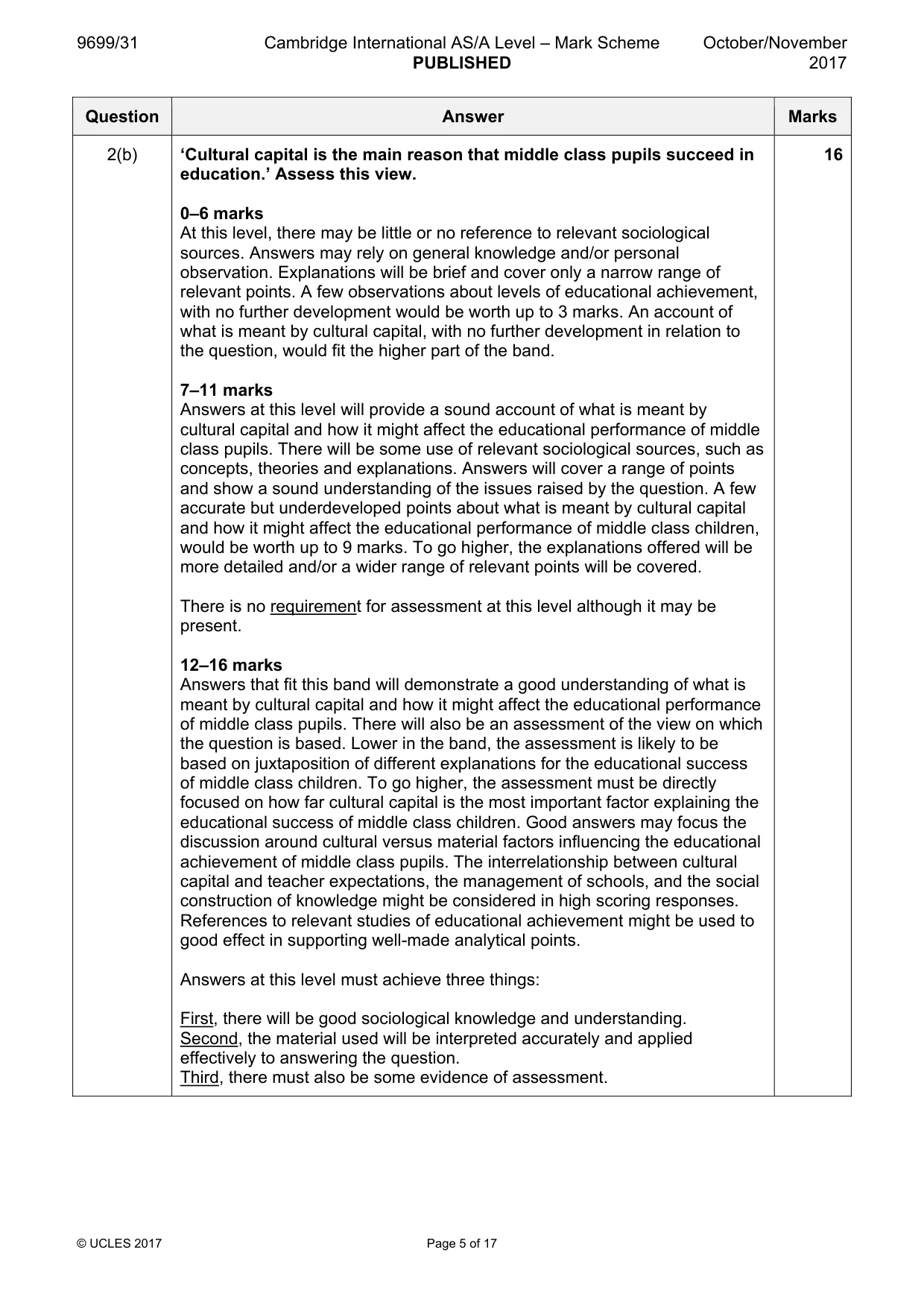
9699/31 Cambridge International AS/A Level – Mark Scheme PUBLISHED October/November 2017 © UCLES 2017 Page 5 of 17 Question Answer Marks 2(b) ‘Cultural capital is the main reason that middle class pupils succeed in education.’ Assess this view. 0–6 marks At this level, there may be little or no reference to relevant sociological sources. Answers may rely on general knowledge and/or personal observation. Explanations will be brief and cover only a narrow range of relevant points. A few observations about levels of educational achievement, with no further development would be worth up to 3 marks. An account of what is meant by cultural capital, with no further development in relation to the question, would fit the higher part of the band. 7–11 marks Answers at this level will provide a sound account of what is meant by cultural capital and how it might affect the educational performance of middle class pupils. There will be some use of relevant sociological sources, such as concepts, theories and explanations. Answers will cover a range of points and show a sound understanding of the issues raised by the question. A few accurate but underdeveloped points about what is meant by cultural capital and how it might affect the educational performance of middle class children, would be worth up to 9 marks. To go higher, the explanations offered will be more detailed and/or a wider range of relevant points will be covered. There is no requirement for assessment at this level although it may be present. 12–16 marks Answers that fit this band will demonstrate a good understanding of what is meant by cultural capital and how it might affect the educational performance of middle class pupils. There will also be an assessment of the view on which the question is based. Lower in the band, the assessment is likely to be based on juxtaposition of different explanations for the educational success of middle class children. To go higher, the assessment must be directly focused on how far cultural capital is the most important factor explaining the educational success of middle class children. Good answers may focus the discussion around cultural versus material factors influencing the educational achievement of middle class pupils. The interrelationship between cultural capital and teacher expectations, the management of schools, and the social construction of knowledge might be considered in high scoring responses. References to relevant studies of educational achievement might be used to good effect in supporting well-made analytical points. Answers at this level must achieve three things: First, there will be good sociological knowledge and understanding. Second, the material used will be interpreted accurately and applied effectively to answering the question. Third, there must also be some evidence of assessment. 16
Mark scheme, page 6
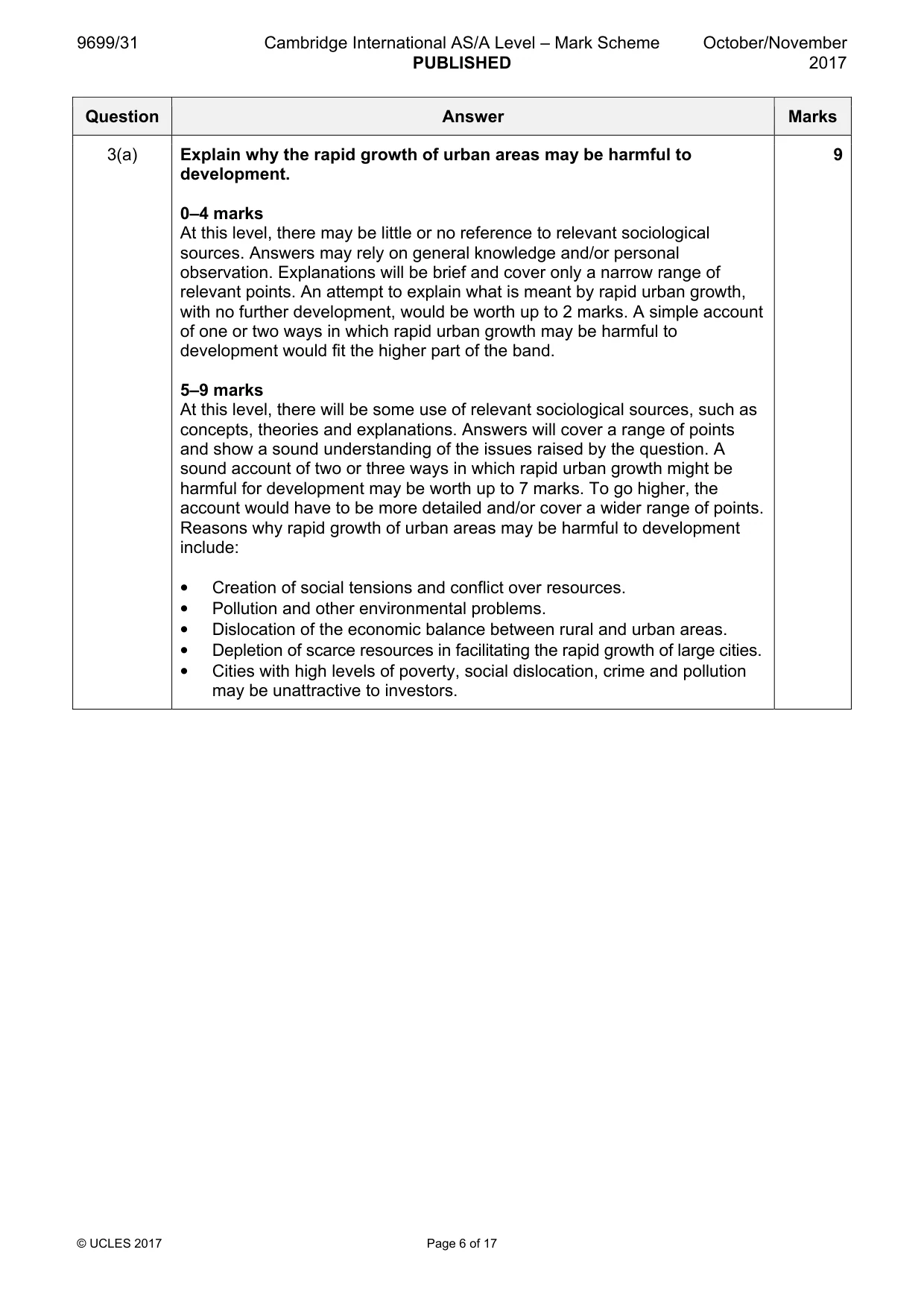
9699/31 Cambridge International AS/A Level – Mark Scheme PUBLISHED October/November 2017 © UCLES 2017 Page 6 of 17 Question Answer Marks 3(a) Explain why the rapid growth of urban areas may be harmful to development. 0–4 marks At this level, there may be little or no reference to relevant sociological sources. Answers may rely on general knowledge and/or personal observation. Explanations will be brief and cover only a narrow range of relevant points. An attempt to explain what is meant by rapid urban growth, with no further development, would be worth up to 2 marks. A simple account of one or two ways in which rapid urban growth may be harmful to development would fit the higher part of the band. 5–9 marks At this level, there will be some use of relevant sociological sources, such as concepts, theories and explanations. Answers will cover a range of points and show a sound understanding of the issues raised by the question. A sound account of two or three ways in which rapid urban growth might be harmful for development may be worth up to 7 marks. To go higher, the account would have to be more detailed and/or cover a wider range of points. Reasons why rapid growth of urban areas may be harmful to development include: • Creation of social tensions and conflict over resources. • Pollution and other environmental problems. • Dislocation of the economic balance between rural and urban areas. • Depletion of scarce resources in facilitating the rapid growth of large cities. • Cities with high levels of poverty, social dislocation, crime and pollution may be unattractive to investors. 9
Mark scheme, page 7
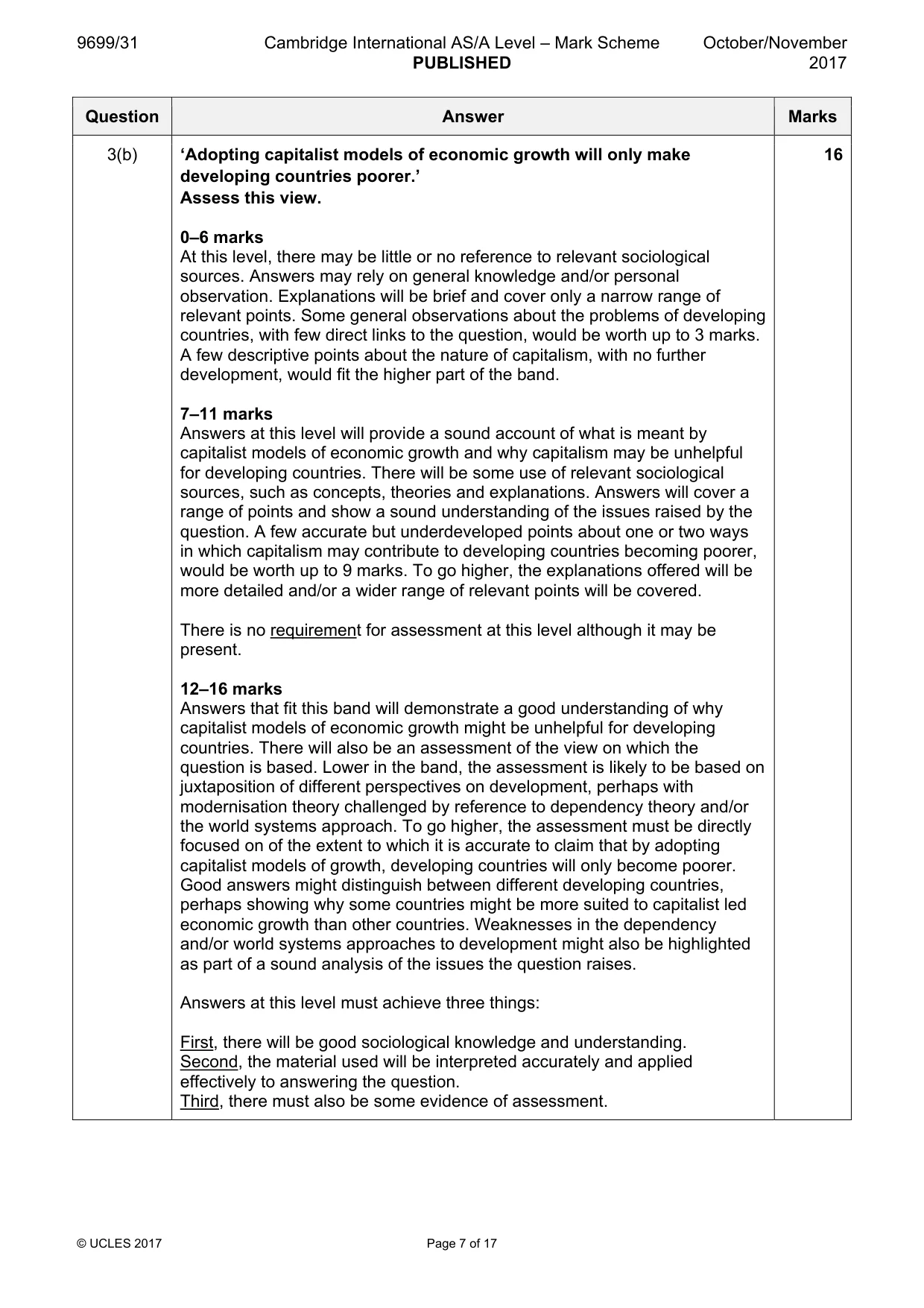
9699/31 Cambridge International AS/A Level – Mark Scheme PUBLISHED October/November 2017 © UCLES 2017 Page 7 of 17 Question Answer Marks 3(b) ‘Adopting capitalist models of economic growth will only make developing countries poorer.’ Assess this view. 0–6 marks At this level, there may be little or no reference to relevant sociological sources. Answers may rely on general knowledge and/or personal observation. Explanations will be brief and cover only a narrow range of relevant points. Some general observations about the problems of developing countries, with few direct links to the question, would be worth up to 3 marks. A few descriptive points about the nature of capitalism, with no further development, would fit the higher part of the band. 7–11 marks Answers at this level will provide a sound account of what is meant by capitalist models of economic growth and why capitalism may be unhelpful for developing countries. There will be some use of relevant sociological sources, such as concepts, theories and explanations. Answers will cover a range of points and show a sound understanding of the issues raised by the question. A few accurate but underdeveloped points about one or two ways in which capitalism may contribute to developing countries becoming poorer, would be worth up to 9 marks. To go higher, the explanations offered will be more detailed and/or a wider range of relevant points will be covered. There is no requirement for assessment at this level although it may be present. 12–16 marks Answers that fit this band will demonstrate a good understanding of why capitalist models of economic growth might be unhelpful for developing countries. There will also be an assessment of the view on which the question is based. Lower in the band, the assessment is likely to be based on juxtaposition of different perspectives on development, perhaps with modernisation theory challenged by reference to dependency theory and/or the world systems approach. To go higher, the assessment must be directly focused on of the extent to which it is accurate to claim that by adopting capitalist models of growth, developing countries will only become poorer. Good answers might distinguish between different developing countries, perhaps showing why some countries might be more suited to capitalist led economic growth than other countries. Weaknesses in the dependency and/or world systems approaches to development might also be highlighted as part of a sound analysis of the issues the question raises. Answers at this level must achieve three things: First, there will be good sociological knowledge and understanding. Second, the material used will be interpreted accurately and applied effectively to answering the question. Third, there must also be some evidence of assessment. 16
Mark scheme, page 8
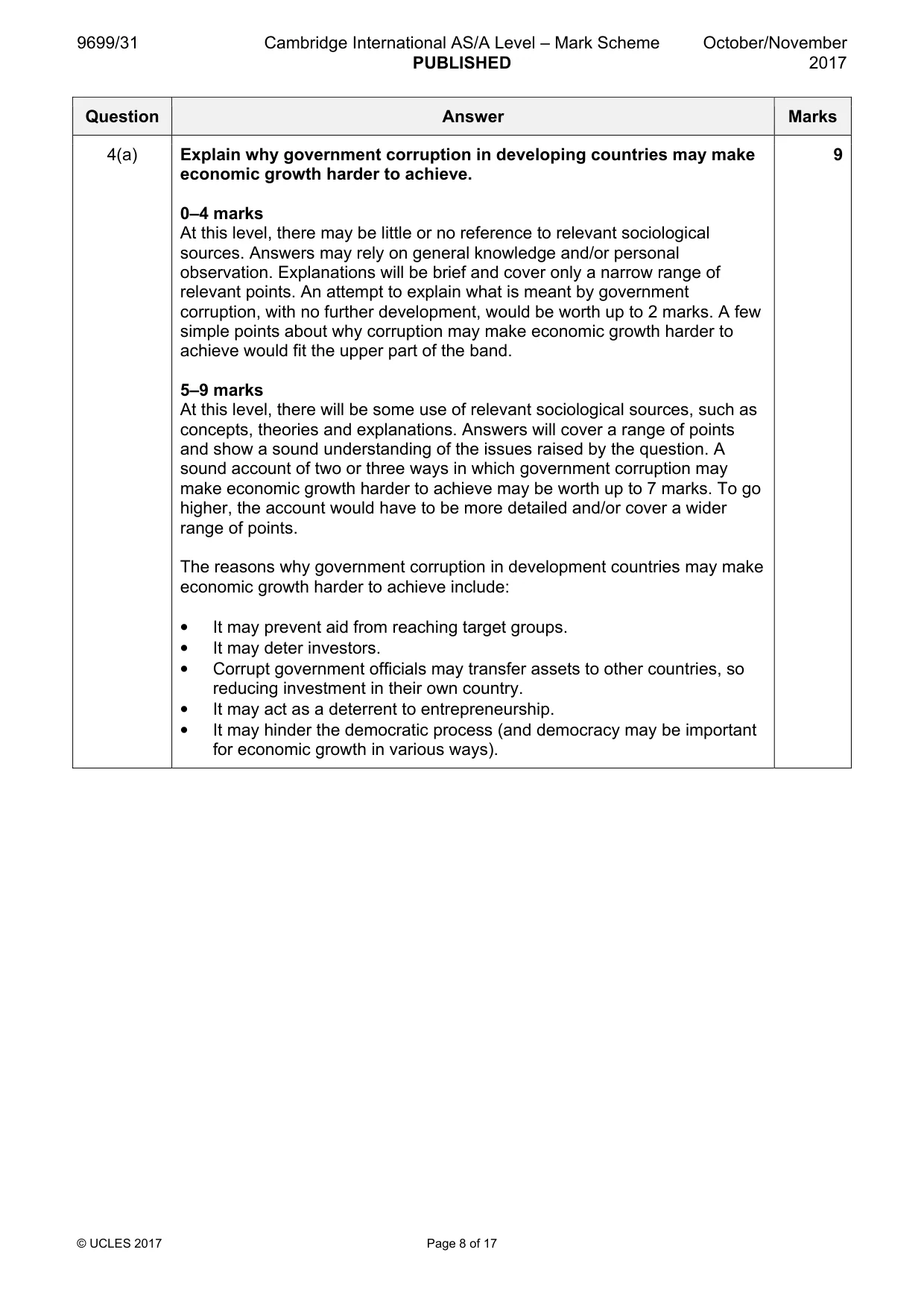
9699/31 Cambridge International AS/A Level – Mark Scheme PUBLISHED October/November 2017 © UCLES 2017 Page 8 of 17 Question Answer Marks 4(a) Explain why government corruption in developing countries may make economic growth harder to achieve. 0–4 marks At this level, there may be little or no reference to relevant sociological sources. Answers may rely on general knowledge and/or personal observation. Explanations will be brief and cover only a narrow range of relevant points. An attempt to explain what is meant by government corruption, with no further development, would be worth up to 2 marks. A few simple points about why corruption may make economic growth harder to achieve would fit the upper part of the band. 5–9 marks At this level, there will be some use of relevant sociological sources, such as concepts, theories and explanations. Answers will cover a range of points and show a sound understanding of the issues raised by the question. A sound account of two or three ways in which government corruption may make economic growth harder to achieve may be worth up to 7 marks. To go higher, the account would have to be more detailed and/or cover a wider range of points. The reasons why government corruption in development countries may make economic growth harder to achieve include: • It may prevent aid from reaching target groups. • It may deter investors. • Corrupt government officials may transfer assets to other countries, so reducing investment in their own country. • It may act as a deterrent to entrepreneurship. • It may hinder the democratic process (and democracy may be important for economic growth in various ways). 9
Mark scheme, page 9
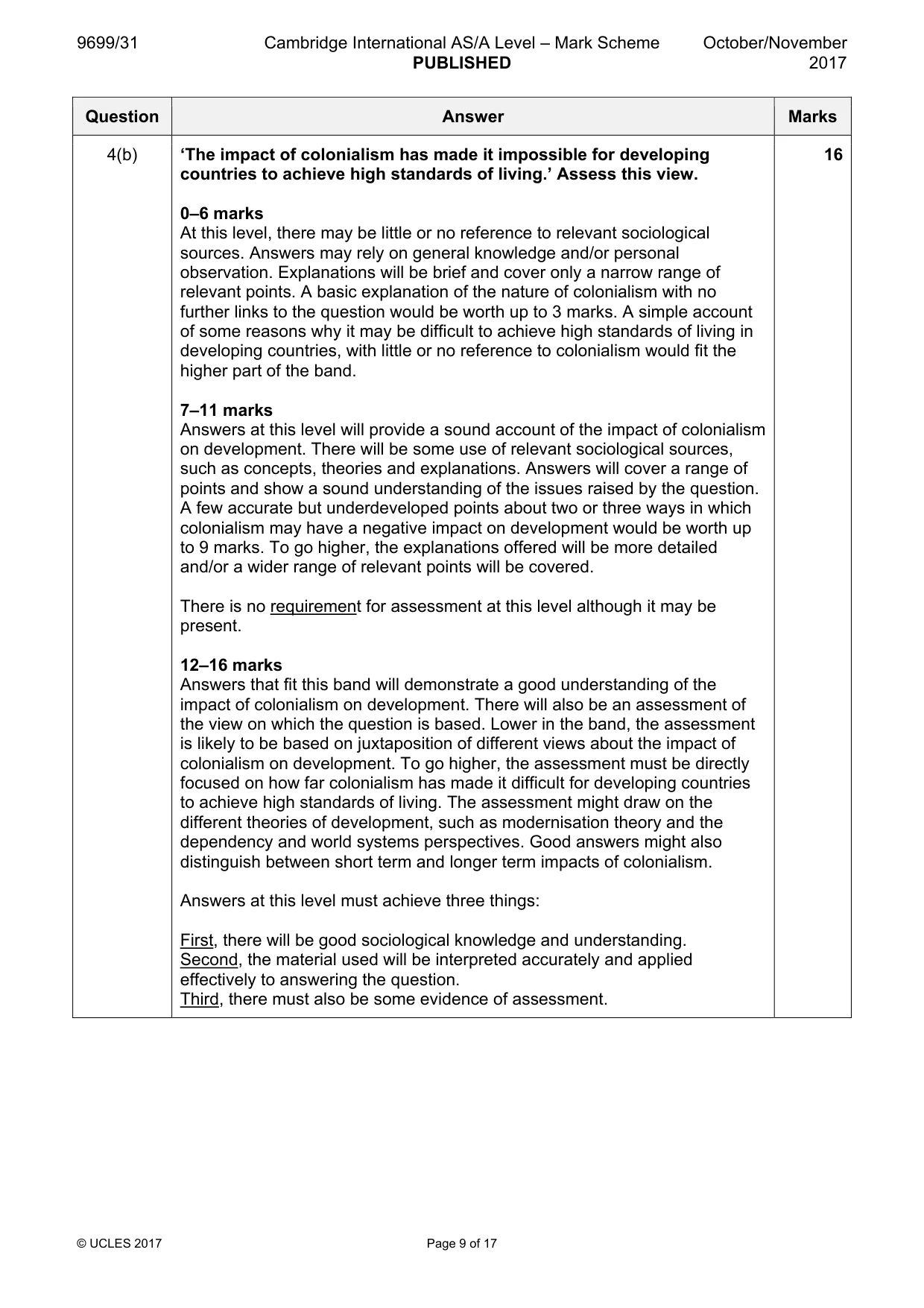
9699/31 Cambridge International AS/A Level – Mark Scheme PUBLISHED October/November 2017 © UCLES 2017 Page 9 of 17 Question Answer Marks 4(b) ‘The impact of colonialism has made it impossible for developing countries to achieve high standards of living.’ Assess this view. 0–6 marks At this level, there may be little or no reference to relevant sociological sources. Answers may rely on general knowledge and/or personal observation. Explanations will be brief and cover only a narrow range of relevant points. A basic explanation of the nature of colonialism with no further links to the question would be worth up to 3 marks. A simple account of some reasons why it may be difficult to achieve high standards of living in developing countries, with little or no reference to colonialism would fit the higher part of the band. 7–11 marks Answers at this level will provide a sound account of the impact of colonialism on development. There will be some use of relevant sociological sources, such as concepts, theories and explanations. Answers will cover a range of points and show a sound understanding of the issues raised by the question. A few accurate but underdeveloped points about two or three ways in which colonialism may have a negative impact on development would be worth up to 9 marks. To go higher, the explanations offered will be more detailed and/or a wider range of relevant points will be covered. There is no requirement for assessment at this level although it may be present. 12–16 marks Answers that fit this band will demonstrate a good understanding of the impact of colonialism on development. There will also be an assessment of the view on which the question is based. Lower in the band, the assessment is likely to be based on juxtaposition of different views about the impact of colonialism on development. To go higher, the assessment must be directly focused on how far colonialism has made it difficult for developing countries to achieve high standards of living. The assessment might draw on the different theories of development, such as modernisation theory and the dependency and world systems perspectives. Good answers might also distinguish between short term and longer term impacts of colonialism. Answers at this level must achieve three things: First, there will be good sociological knowledge and understanding. Second, the material used will be interpreted accurately and applied effectively to answering the question. Third, there must also be some evidence of assessment. 16
Mark scheme, page 10
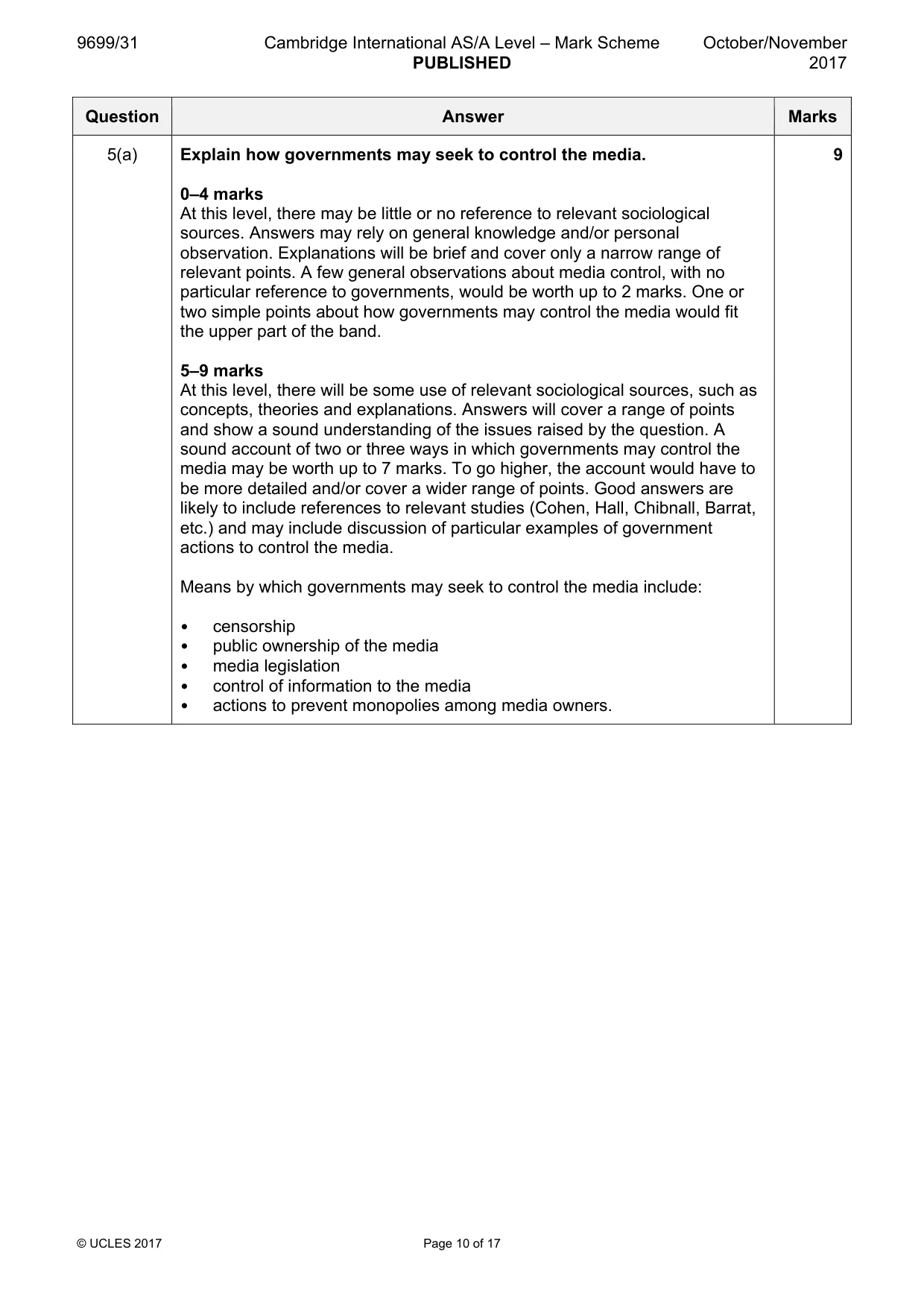
9699/31 Cambridge International AS/A Level – Mark Scheme PUBLISHED October/November 2017 © UCLES 2017 Page 10 of 17 Question Answer Marks 5(a) Explain how governments may seek to control the media. 0–4 marks At this level, there may be little or no reference to relevant sociological sources. Answers may rely on general knowledge and/or personal observation. Explanations will be brief and cover only a narrow range of relevant points. A few general observations about media control, with no particular reference to governments, would be worth up to 2 marks. One or two simple points about how governments may control the media would fit the upper part of the band. 5–9 marks At this level, there will be some use of relevant sociological sources, such as concepts, theories and explanations. Answers will cover a range of points and show a sound understanding of the issues raised by the question. A sound account of two or three ways in which governments may control the media may be worth up to 7 marks. To go higher, the account would have to be more detailed and/or cover a wider range of points. Good answers are likely to include references to relevant studies (Cohen, Hall, Chibnall, Barrat, etc.) and may include discussion of particular examples of government actions to control the media. Means by which governments may seek to control the media include: • censorship • public ownership of the media • media legislation • control of information to the media • actions to prevent monopolies among media owners. 9
Mark scheme, page 11
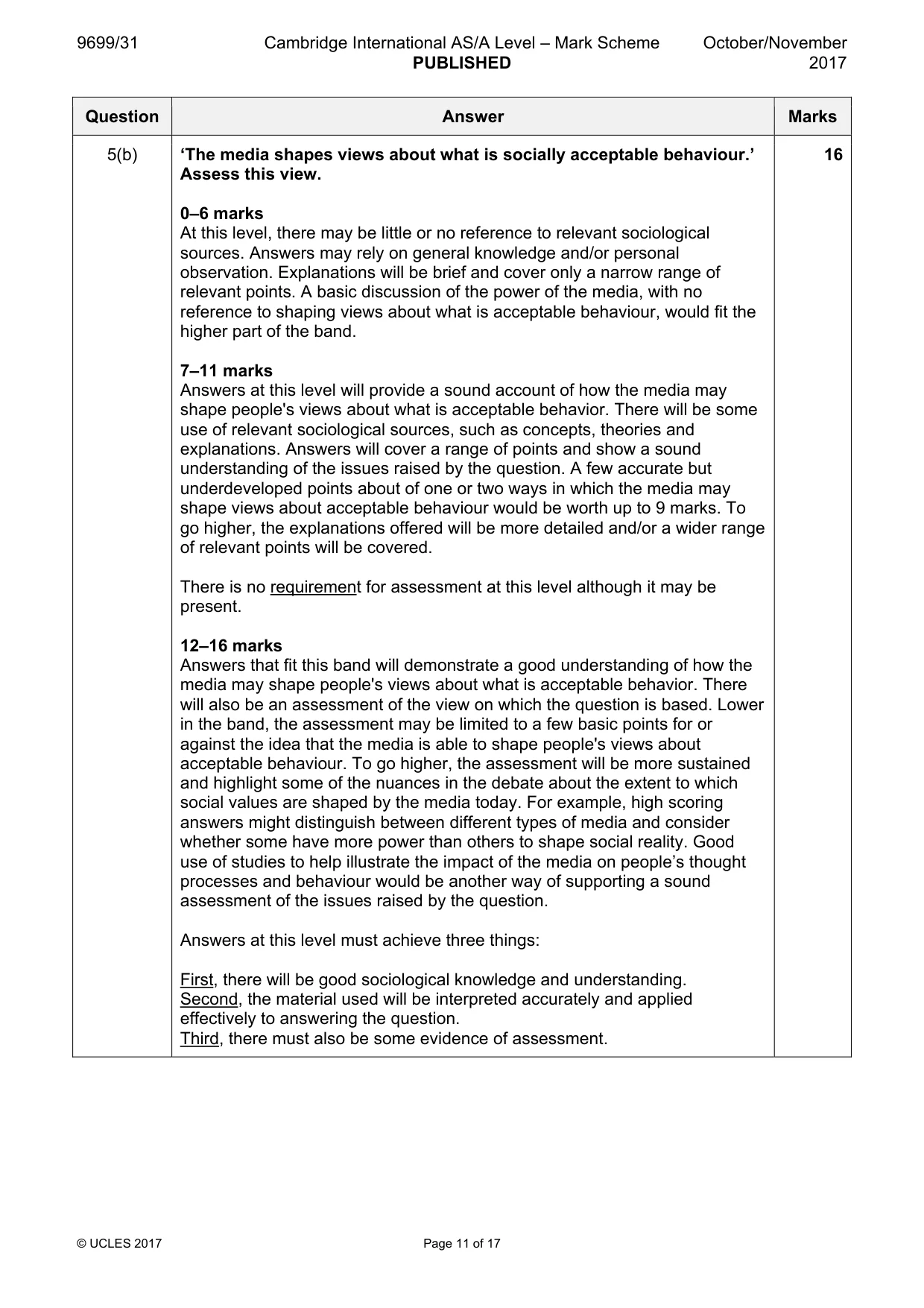
9699/31 Cambridge International AS/A Level – Mark Scheme PUBLISHED October/November 2017 © UCLES 2017 Page 11 of 17 Question Answer Marks 5(b) ‘The media shapes views about what is socially acceptable behaviour.’ Assess this view. 0–6 marks At this level, there may be little or no reference to relevant sociological sources. Answers may rely on general knowledge and/or personal observation. Explanations will be brief and cover only a narrow range of relevant points. A basic discussion of the power of the media, with no reference to shaping views about what is acceptable behaviour, would fit the higher part of the band. 7–11 marks Answers at this level will provide a sound account of how the media may shape people's views about what is acceptable behavior. There will be some use of relevant sociological sources, such as concepts, theories and explanations. Answers will cover a range of points and show a sound understanding of the issues raised by the question. A few accurate but underdeveloped points about of one or two ways in which the media may shape views about acceptable behaviour would be worth up to 9 marks. To go higher, the explanations offered will be more detailed and/or a wider range of relevant points will be covered. There is no requirement for assessment at this level although it may be present. 12–16 marks Answers that fit this band will demonstrate a good understanding of how the media may shape people's views about what is acceptable behavior. There will also be an assessment of the view on which the question is based. Lower in the band, the assessment may be limited to a few basic points for or against the idea that the media is able to shape people's views about acceptable behaviour. To go higher, the assessment will be more sustained and highlight some of the nuances in the debate about the extent to which social values are shaped by the media today. For example, high scoring answers might distinguish between different types of media and consider whether some have more power than others to shape social reality. Good use of studies to help illustrate the impact of the media on people’s thought processes and behaviour would be another way of supporting a sound assessment of the issues raised by the question. Answers at this level must achieve three things: First, there will be good sociological knowledge and understanding. Second, the material used will be interpreted accurately and applied effectively to answering the question. Third, there must also be some evidence of assessment. 16
Mark scheme, page 12
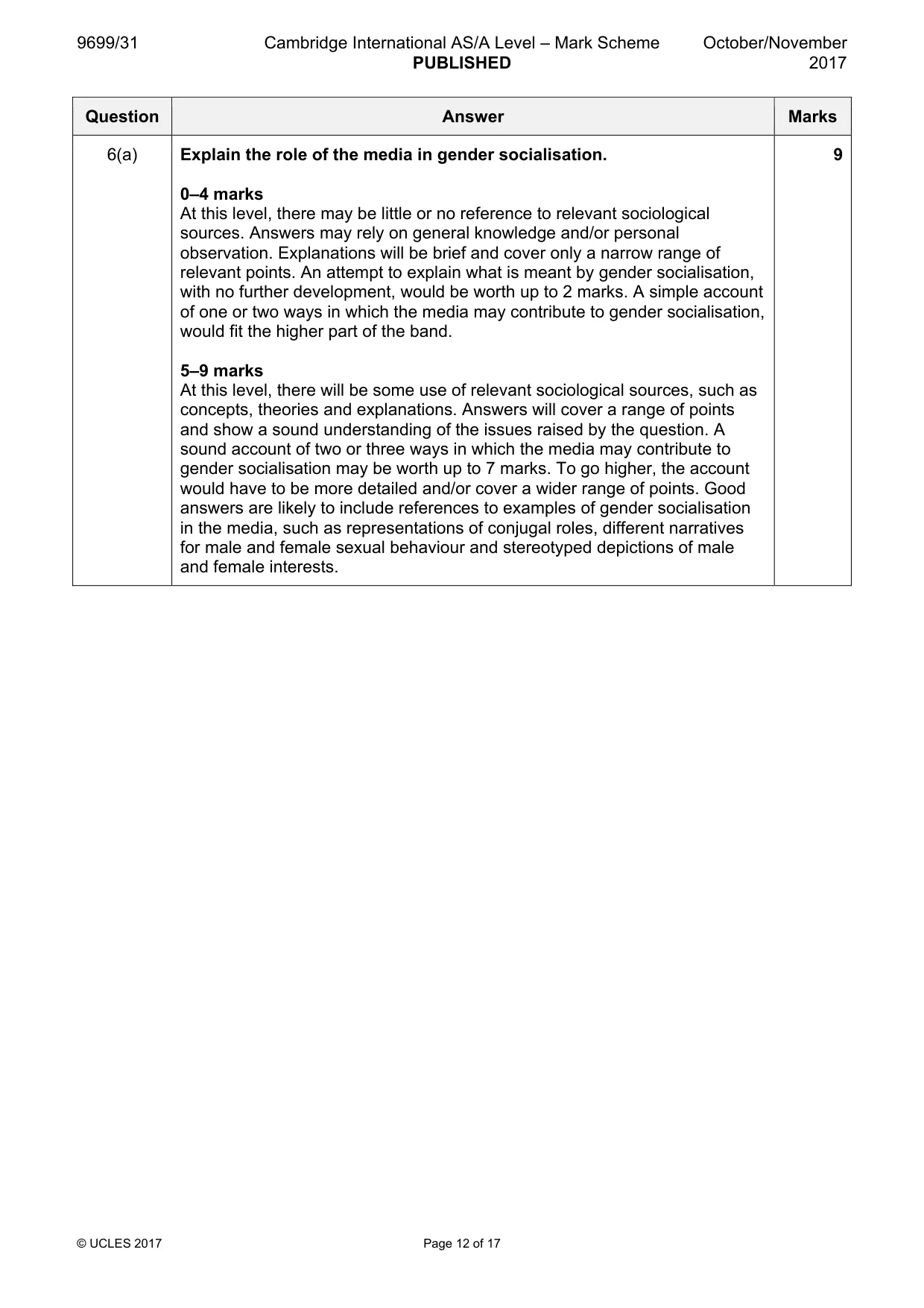
9699/31 Cambridge International AS/A Level – Mark Scheme PUBLISHED October/November 2017 © UCLES 2017 Page 12 of 17 Question Answer Marks 6(a) Explain the role of the media in gender socialisation. 0–4 marks At this level, there may be little or no reference to relevant sociological sources. Answers may rely on general knowledge and/or personal observation. Explanations will be brief and cover only a narrow range of relevant points. An attempt to explain what is meant by gender socialisation, with no further development, would be worth up to 2 marks. A simple account of one or two ways in which the media may contribute to gender socialisation, would fit the higher part of the band. 5–9 marks At this level, there will be some use of relevant sociological sources, such as concepts, theories and explanations. Answers will cover a range of points and show a sound understanding of the issues raised by the question. A sound account of two or three ways in which the media may contribute to gender socialisation may be worth up to 7 marks. To go higher, the account would have to be more detailed and/or cover a wider range of points. Good answers are likely to include references to examples of gender socialisation in the media, such as representations of conjugal roles, different narratives for male and female sexual behaviour and stereotyped depictions of male and female interests. 9
Mark scheme, page 13
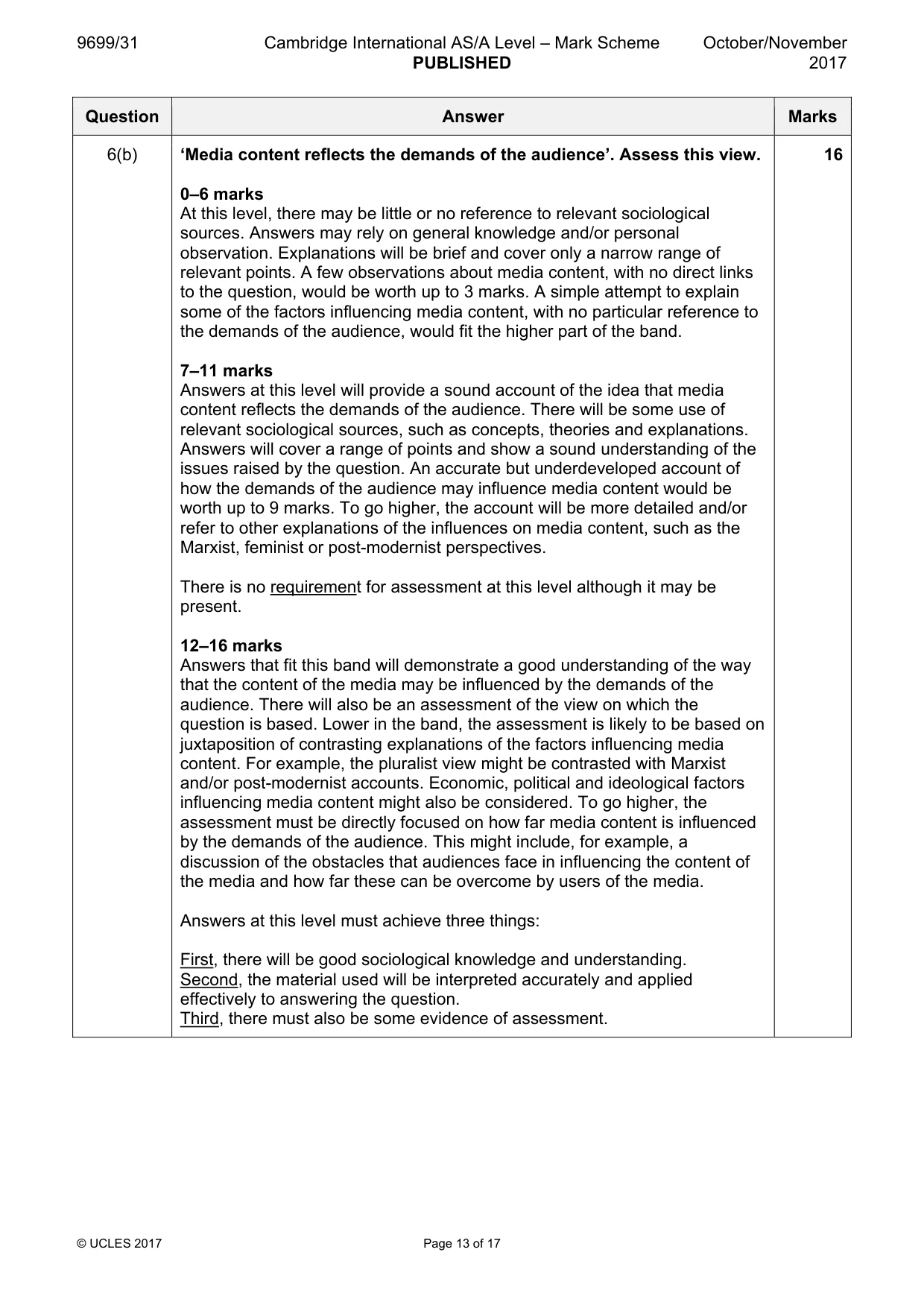
9699/31 Cambridge International AS/A Level – Mark Scheme PUBLISHED October/November 2017 © UCLES 2017 Page 13 of 17 Question Answer Marks 6(b) ‘Media content reflects the demands of the audience’. Assess this view. 0–6 marks At this level, there may be little or no reference to relevant sociological sources. Answers may rely on general knowledge and/or personal observation. Explanations will be brief and cover only a narrow range of relevant points. A few observations about media content, with no direct links to the question, would be worth up to 3 marks. A simple attempt to explain some of the factors influencing media content, with no particular reference to the demands of the audience, would fit the higher part of the band. 7–11 marks Answers at this level will provide a sound account of the idea that media content reflects the demands of the audience. There will be some use of relevant sociological sources, such as concepts, theories and explanations. Answers will cover a range of points and show a sound understanding of the issues raised by the question. An accurate but underdeveloped account of how the demands of the audience may influence media content would be worth up to 9 marks. To go higher, the account will be more detailed and/or refer to other explanations of the influences on media content, such as the Marxist, feminist or post-modernist perspectives. There is no requirement for assessment at this level although it may be present. 12–16 marks Answers that fit this band will demonstrate a good understanding of the way that the content of the media may be influenced by the demands of the audience. There will also be an assessment of the view on which the question is based. Lower in the band, the assessment is likely to be based on juxtaposition of contrasting explanations of the factors influencing media content. For example, the pluralist view might be contrasted with Marxist and/or post-modernist accounts. Economic, political and ideological factors influencing media content might also be considered. To go higher, the assessment must be directly focused on how far media content is influenced by the demands of the audience. This might include, for example, a discussion of the obstacles that audiences face in influencing the content of the media and how far these can be overcome by users of the media. Answers at this level must achieve three things: First, there will be good sociological knowledge and understanding. Second, the material used will be interpreted accurately and applied effectively to answering the question. Third, there must also be some evidence of assessment. 16
Mark scheme, page 14
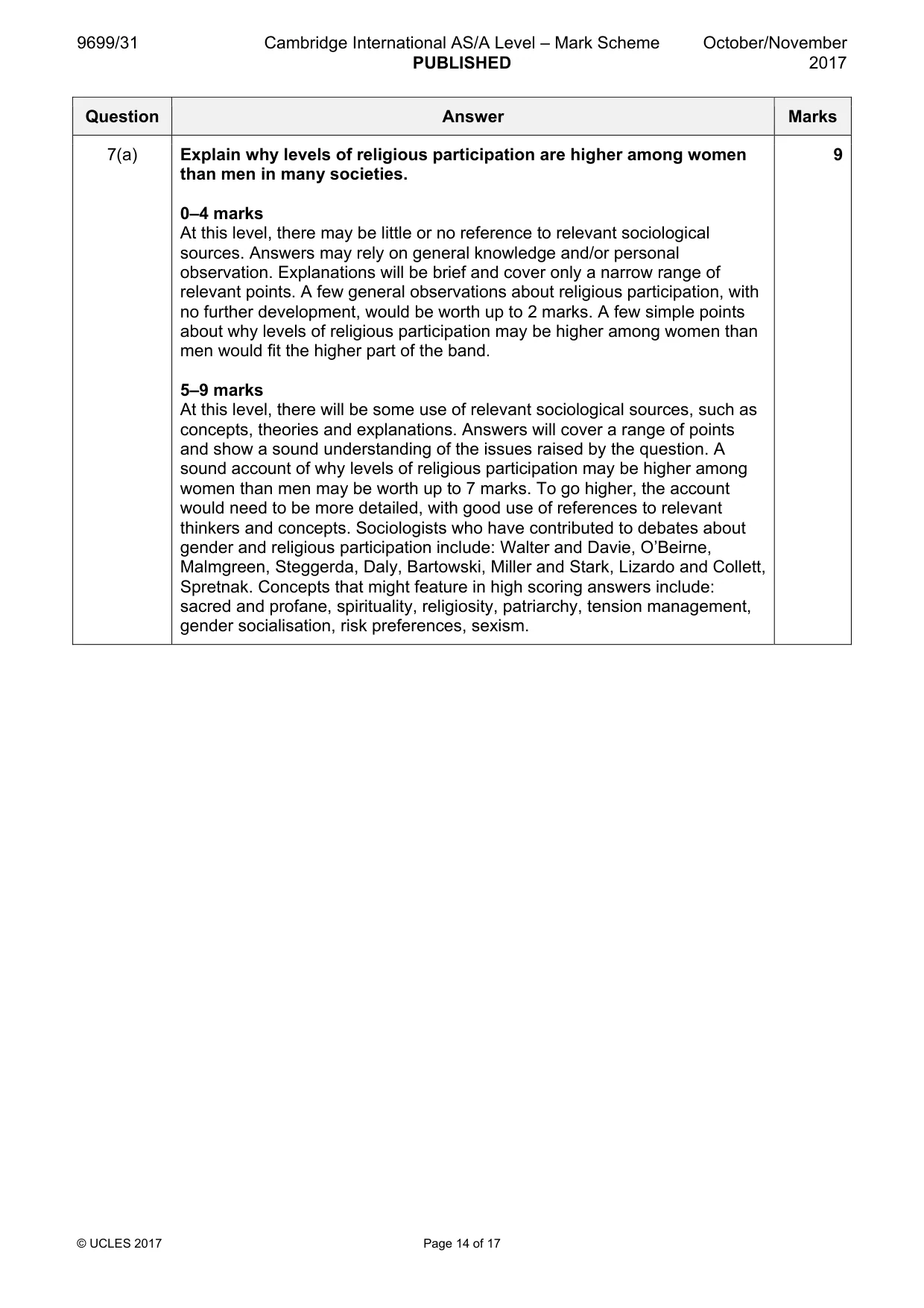
9699/31 Cambridge International AS/A Level – Mark Scheme PUBLISHED October/November 2017 © UCLES 2017 Page 14 of 17 Question Answer Marks 7(a) Explain why levels of religious participation are higher among women than men in many societies. 0–4 marks At this level, there may be little or no reference to relevant sociological sources. Answers may rely on general knowledge and/or personal observation. Explanations will be brief and cover only a narrow range of relevant points. A few general observations about religious participation, with no further development, would be worth up to 2 marks. A few simple points about why levels of religious participation may be higher among women than men would fit the higher part of the band. 5–9 marks At this level, there will be some use of relevant sociological sources, such as concepts, theories and explanations. Answers will cover a range of points and show a sound understanding of the issues raised by the question. A sound account of why levels of religious participation may be higher among women than men may be worth up to 7 marks. To go higher, the account would need to be more detailed, with good use of references to relevant thinkers and concepts. Sociologists who have contributed to debates about gender and religious participation include: Walter and Davie, O’Beirne, Malmgreen, Steggerda, Daly, Bartowski, Miller and Stark, Lizardo and Collett, Spretnak. Concepts that might feature in high scoring answers include: sacred and profane, spirituality, religiosity, patriarchy, tension management, gender socialisation, risk preferences, sexism. 9
Mark scheme, page 15
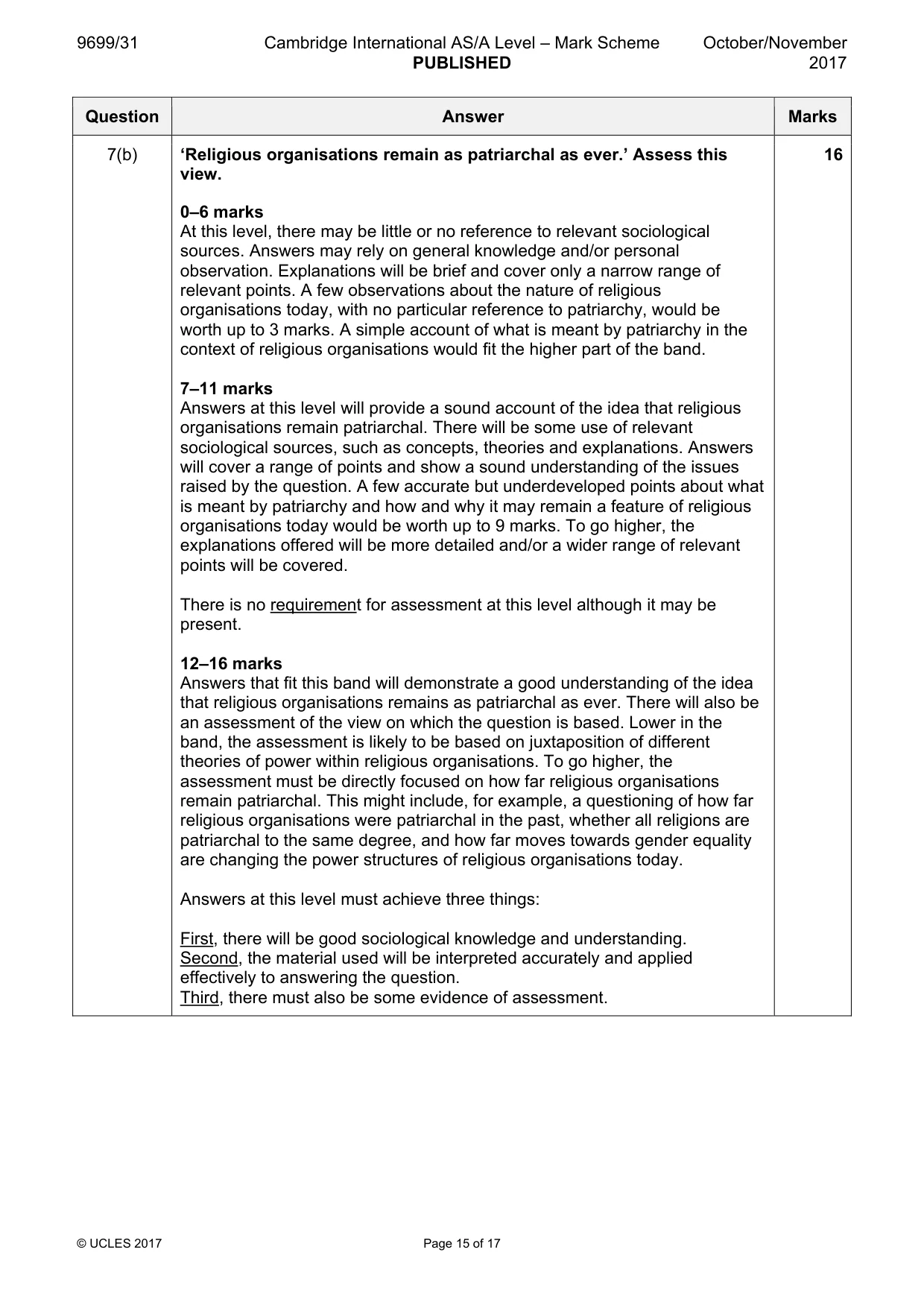
9699/31 Cambridge International AS/A Level – Mark Scheme PUBLISHED October/November 2017 © UCLES 2017 Page 15 of 17 Question Answer Marks 7(b) ‘Religious organisations remain as patriarchal as ever.’ Assess this view. 0–6 marks At this level, there may be little or no reference to relevant sociological sources. Answers may rely on general knowledge and/or personal observation. Explanations will be brief and cover only a narrow range of relevant points. A few observations about the nature of religious organisations today, with no particular reference to patriarchy, would be worth up to 3 marks. A simple account of what is meant by patriarchy in the context of religious organisations would fit the higher part of the band. 7–11 marks Answers at this level will provide a sound account of the idea that religious organisations remain patriarchal. There will be some use of relevant sociological sources, such as concepts, theories and explanations. Answers will cover a range of points and show a sound understanding of the issues raised by the question. A few accurate but underdeveloped points about what is meant by patriarchy and how and why it may remain a feature of religious organisations today would be worth up to 9 marks. To go higher, the explanations offered will be more detailed and/or a wider range of relevant points will be covered. There is no requirement for assessment at this level although it may be present. 12–16 marks Answers that fit this band will demonstrate a good understanding of the idea that religious organisations remains as patriarchal as ever. There will also be an assessment of the view on which the question is based. Lower in the band, the assessment is likely to be based on juxtaposition of different theories of power within religious organisations. To go higher, the assessment must be directly focused on how far religious organisations remain patriarchal. This might include, for example, a questioning of how far religious organisations were patriarchal in the past, whether all religions are patriarchal to the same degree, and how far moves towards gender equality are changing the power structures of religious organisations today. Answers at this level must achieve three things: First, there will be good sociological knowledge and understanding. Second, the material used will be interpreted accurately and applied effectively to answering the question. Third, there must also be some evidence of assessment. 16
Mark scheme, page 16
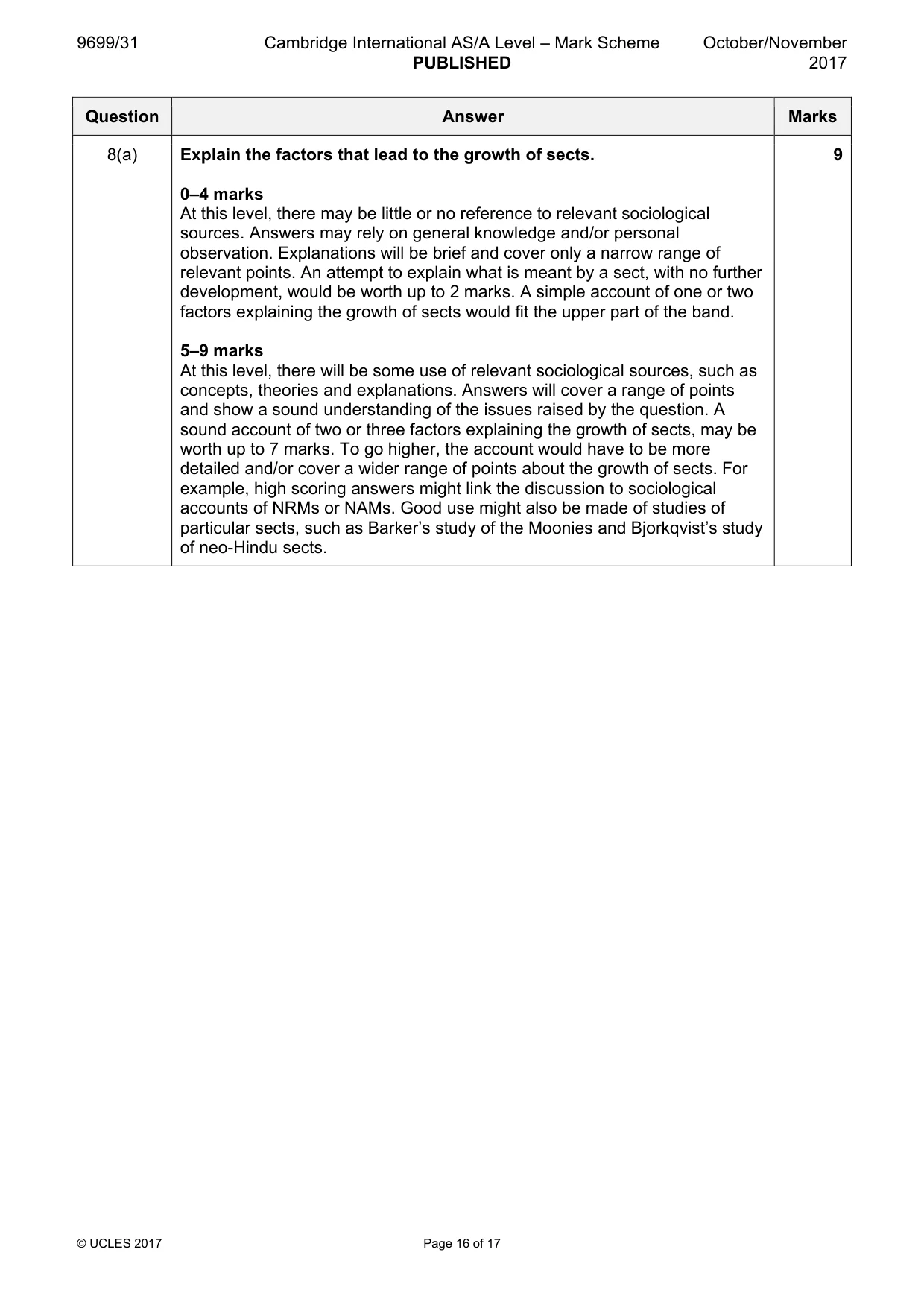
9699/31 Cambridge International AS/A Level – Mark Scheme PUBLISHED October/November 2017 © UCLES 2017 Page 16 of 17 Question Answer Marks 8(a) Explain the factors that lead to the growth of sects. 0–4 marks At this level, there may be little or no reference to relevant sociological sources. Answers may rely on general knowledge and/or personal observation. Explanations will be brief and cover only a narrow range of relevant points. An attempt to explain what is meant by a sect, with no further development, would be worth up to 2 marks. A simple account of one or two factors explaining the growth of sects would fit the upper part of the band. 5–9 marks At this level, there will be some use of relevant sociological sources, such as concepts, theories and explanations. Answers will cover a range of points and show a sound understanding of the issues raised by the question. A sound account of two or three factors explaining the growth of sects, may be worth up to 7 marks. To go higher, the account would have to be more detailed and/or cover a wider range of points about the growth of sects. For example, high scoring answers might link the discussion to sociological accounts of NRMs or NAMs. Good use might also be made of studies of particular sects, such as Barker’s study of the Moonies and Bjorkqvist’s study of neo-Hindu sects. 9
Mark scheme, page 17
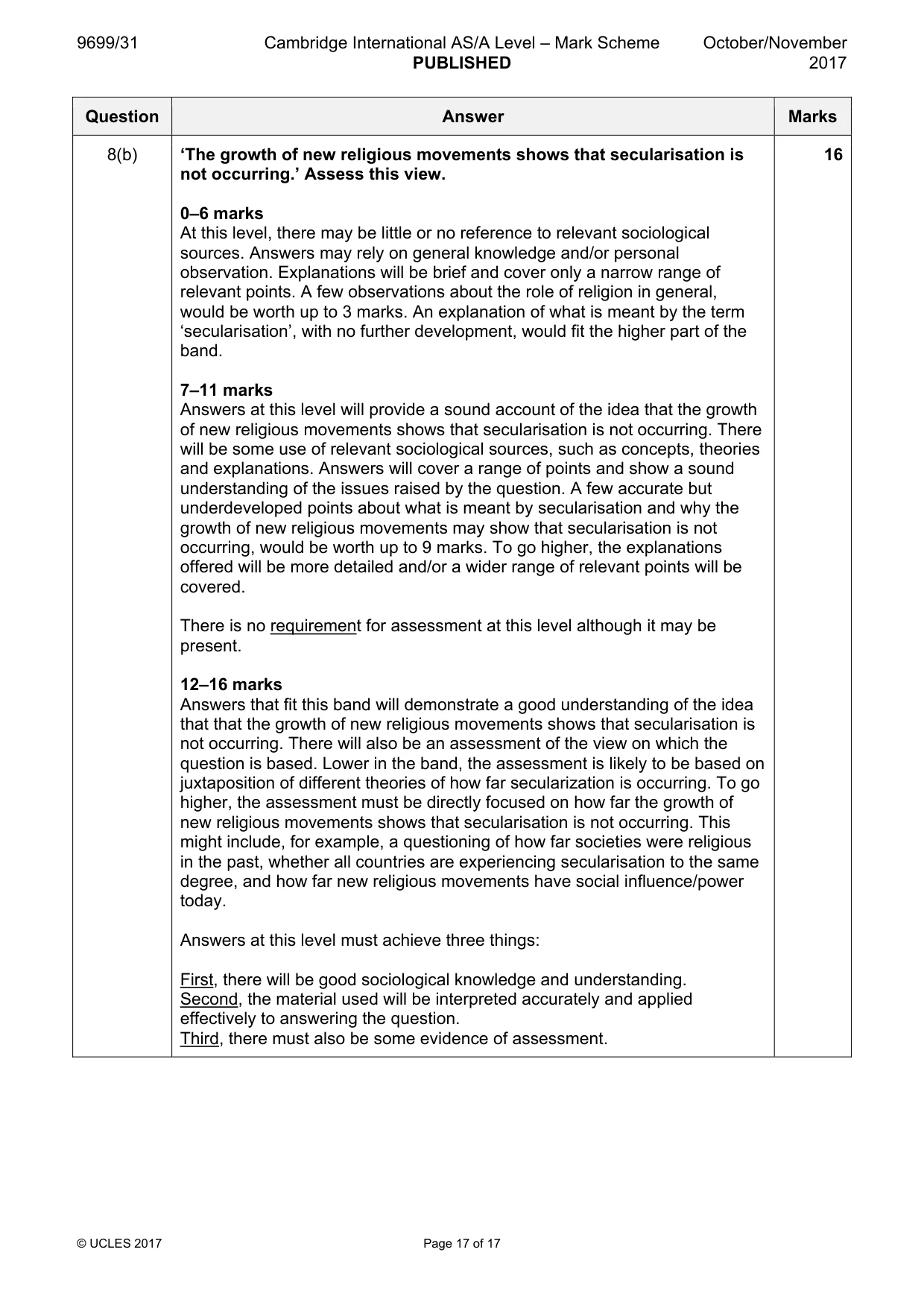
9699/31 Cambridge International AS/A Level – Mark Scheme PUBLISHED October/November 2017 © UCLES 2017 Page 17 of 17 Question Answer Marks 8(b) ‘The growth of new religious movements shows that secularisation is not occurring.’ Assess this view. 0–6 marks At this level, there may be little or no reference to relevant sociological sources. Answers may rely on general knowledge and/or personal observation. Explanations will be brief and cover only a narrow range of relevant points. A few observations about the role of religion in general, would be worth up to 3 marks. An explanation of what is meant by the term ‘secularisation’, with no further development, would fit the higher part of the band. 7–11 marks Answers at this level will provide a sound account of the idea that the growth of new religious movements shows that secularisation is not occurring. There will be some use of relevant sociological sources, such as concepts, theories and explanations. Answers will cover a range of points and show a sound understanding of the issues raised by the question. A few accurate but underdeveloped points about what is meant by secularisation and why the growth of new religious movements may show that secularisation is not occurring, would be worth up to 9 marks. To go higher, the explanations offered will be more detailed and/or a wider range of relevant points will be covered. There is no requirement for assessment at this level although it may be present. 12–16 marks Answers that fit this band will demonstrate a good understanding of the idea that that the growth of new religious movements shows that secularisation is not occurring. There will also be an assessment of the view on which the question is based. Lower in the band, the assessment is likely to be based on juxtaposition of different theories of how far secularization is occurring. To go higher, the assessment must be directly focused on how far the growth of new religious movements shows that secularisation is not occurring. This might include, for example, a questioning of how far societies were religious in the past, whether all countries are experiencing secularisation to the same degree, and how far new religious movements have social influence/power today. Answers at this level must achieve three things: First, there will be good sociological knowledge and understanding. Second, the material used will be interpreted accurately and applied effectively to answering the question. Third, there must also be some evidence of assessment. 16
What you needed in this session
Cambridge’s own grade thresholds for 2017 Oct/Nov, Paper 3 · Variant 1. A higher threshold means an easier paper — the bar moves with how the cohort did.