Cambridge A Level Sociology 9699 — 2017 May/June Paper 2 · Variant 3
9699/23/M/J/17 · 50 marks · ≈56 min
The question paper and its mark scheme, free to read here and free to download. This is Cambridge’s own paper, exactly as it was sat.
Question paper4 pages


Mark scheme11 pages
Answers below. Sit the paper first if you are practising.
Paper as text
Question paper, page 1
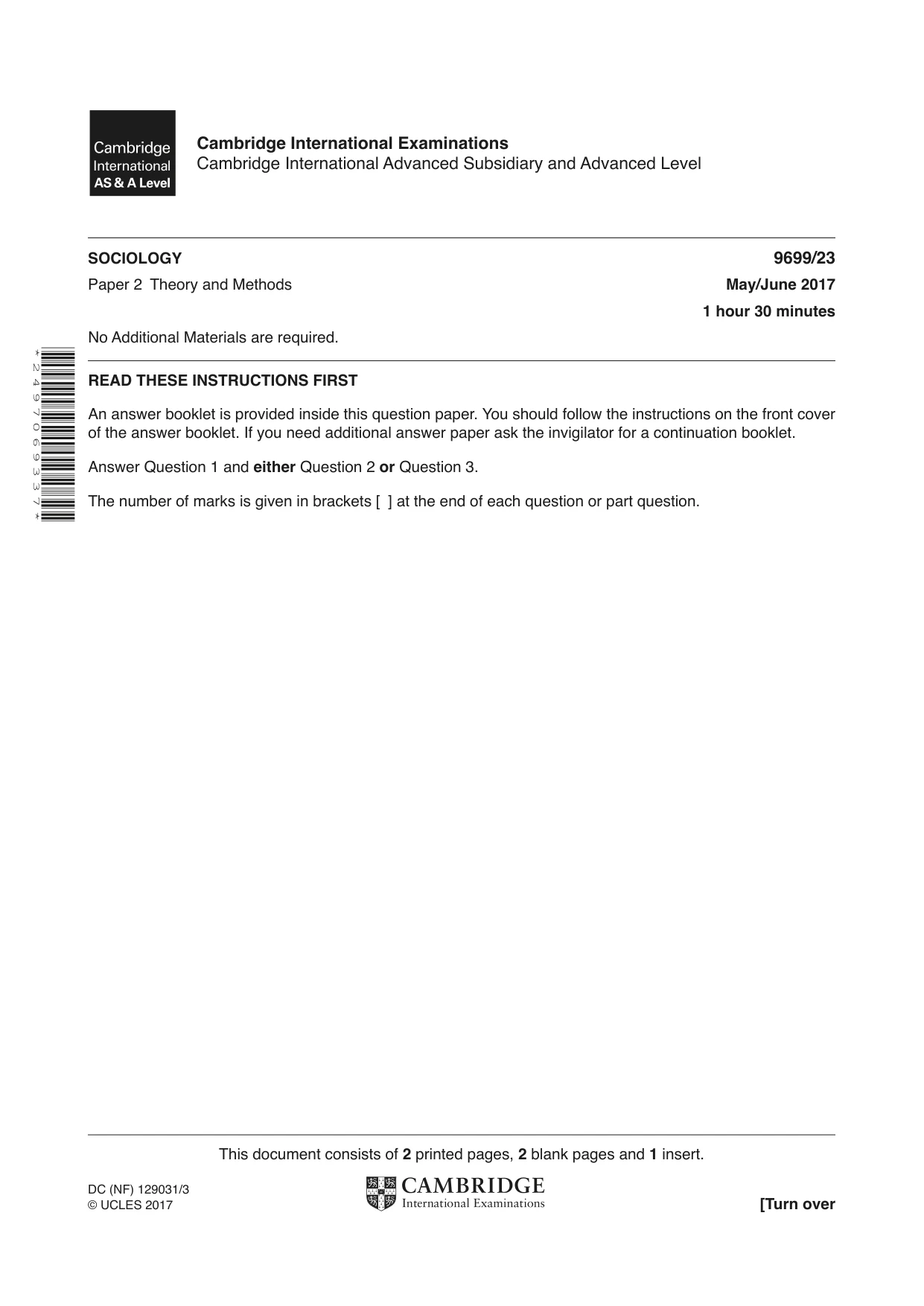
This document consists of 2 printed pages, 2 blank pages and 1 insert. DC (NF) 129031/3 © UCLES 2017 [Turn over Cambridge International Examinations Cambridge International Advanced Subsidiary and Advanced Level * 2 4 9 7 0 6 9 3 3 7 * SOCIOLOGY 9699/23 Paper 2 Theory and Methods May/June 2017 1 hour 30 minutes No Additional Materials are required. READ THESE INSTRUCTIONS FIRST An answer booklet is provided inside this question paper. You should follow the instructions on the front cover of the answer booklet. If you need additional answer paper ask the invigilator for a continuation booklet. Answer Question 1 and either Question 2 or Question 3. The number of marks is given in brackets [ ] at the end of each question or part question.
Question paper, page 2
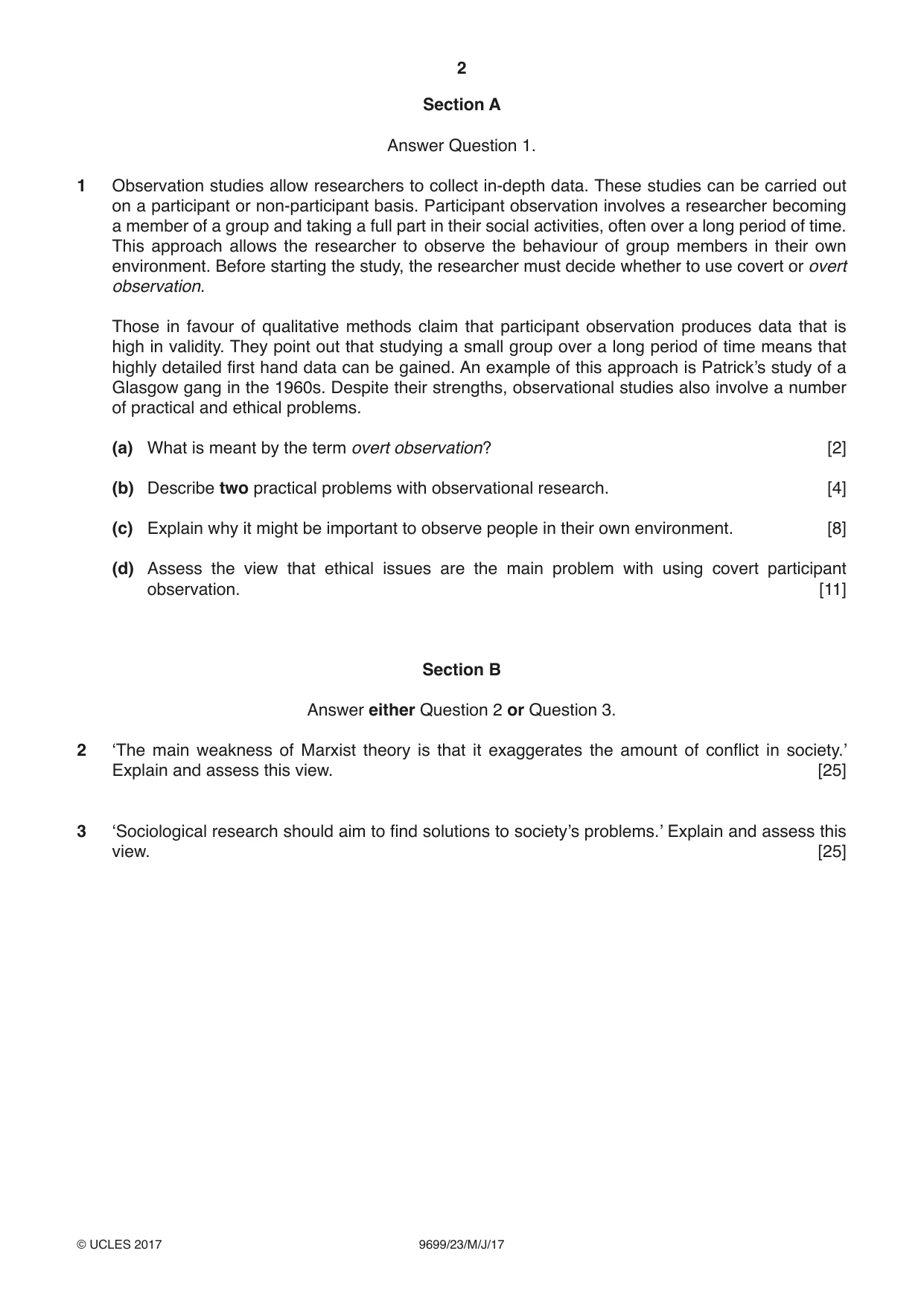
2 9699/23/M/J/17 © UCLES 2017 Section A Answer Question 1. 1 Observation studies allow researchers to collect in-depth data. These studies can be carried out on a participant or non-participant basis. Participant observation involves a researcher becoming a member of a group and taking a full part in their social activities, often over a long period of time. This approach allows the researcher to observe the behaviour of group members in their own environment. Before starting the study, the researcher must decide whether to use covert or overt observation. Those in favour of qualitative methods claim that participant observation produces data that is high in validity. They point out that studying a small group over a long period of time means that highly detailed first hand data can be gained. An example of this approach is Patrick’s study of a Glasgow gang in the 1960s. Despite their strengths, observational studies also involve a number of practical and ethical problems. (a) What is meant by the term overt observation? [2] (b) Describe two practical problems with observational research. [4] (c) Explain why it might be important to observe people in their own environment. [8] (d) Assess the view that ethical issues are the main problem with using covert participant observation. [11] Section B Answer either Question 2 or Question 3. 2 ‘The main weakness of Marxist theory is that it exaggerates the amount of conflict in society.’ Explain and assess this view. [25] 3 ‘Sociological research should aim to find solutions to society’s problems.’ Explain and assess this view. [25]
Question paper, page 3
3 9699/23/M/J/17 © UCLES 2017 BLANK PAGE
Question paper, page 4
4 9699/23/M/J/17 © UCLES 2017 BLANK PAGE Permission to reproduce items where third-party owned material protected by copyright is included has been sought and cleared where possible. Every reasonable effort has been made by the publisher (UCLES) to trace copyright holders, but if any items requiring clearance have unwittingly been included, the publisher will be pleased to make amends at the earliest possible opportunity. To avoid the issue of disclosure of answer-related information to candidates, all copyright acknowledgements are reproduced online in the Cambridge International Examinations Copyright Acknowledgements Booklet. This is produced for each series of examinations and is freely available to download at www.cie.org.uk after the live examination series. Cambridge International Examinations is part of the Cambridge Assessment Group. Cambridge Assessment is the brand name of University of Cambridge Local Examinations Syndicate (UCLES), which is itself a department of the University of Cambridge.
Mark scheme, page 1
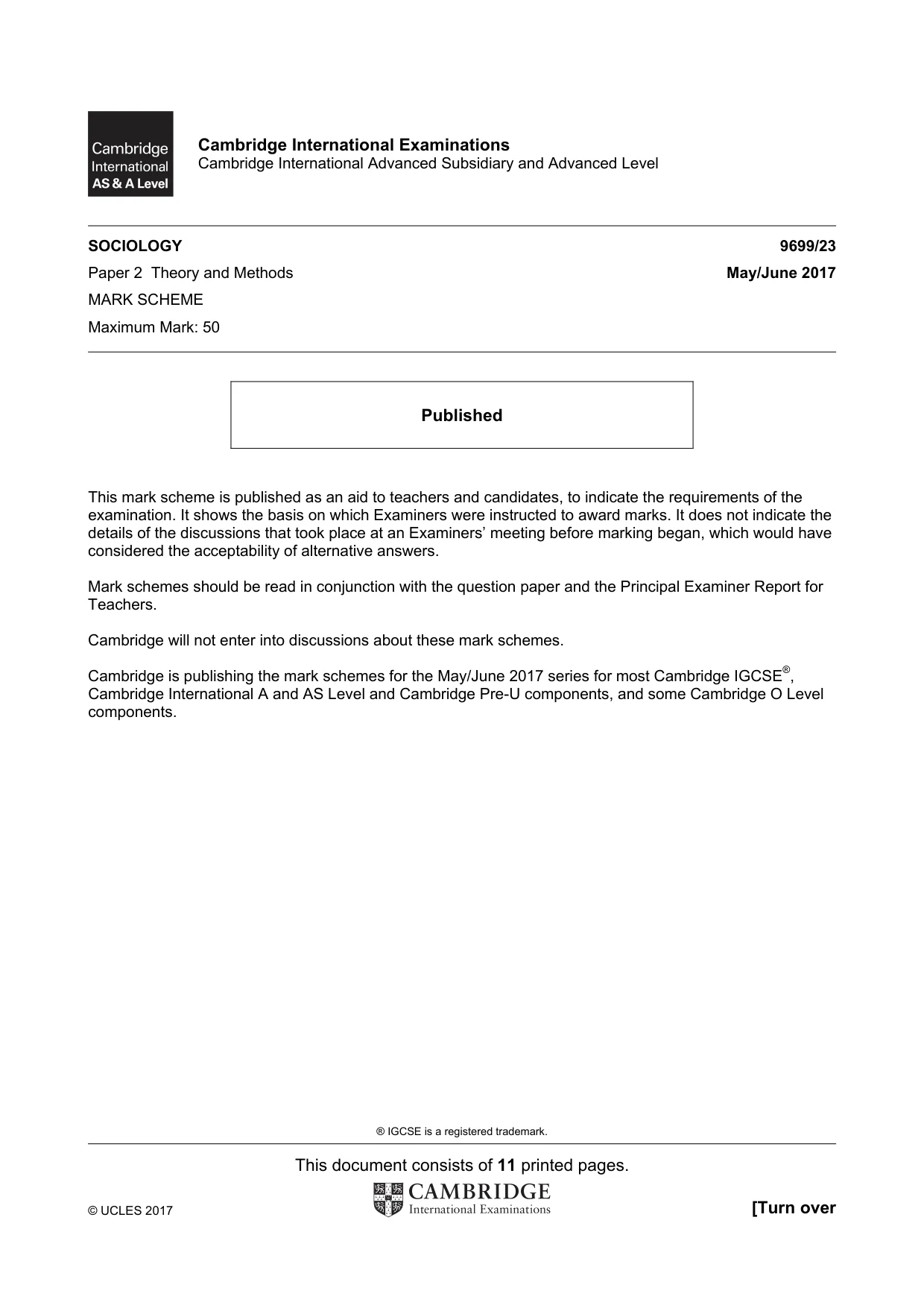
® IGCSE is a registered trademark. This document consists of 11 printed pages. © UCLES 2017 [Turn over Cambridge International Examinations Cambridge International Advanced Subsidiary and Advanced Level SOCIOLOGY 9699/23 Paper 2 Theory and Methods May/June 2017 MARK SCHEME Maximum Mark: 50 Published This mark scheme is published as an aid to teachers and candidates, to indicate the requirements of the examination. It shows the basis on which Examiners were instructed to award marks. It does not indicate the details of the discussions that took place at an Examiners’ meeting before marking began, which would have considered the acceptability of alternative answers. Mark schemes should be read in conjunction with the question paper and the Principal Examiner Report for Teachers. Cambridge will not enter into discussions about these mark schemes. Cambridge is publishing the mark schemes for the May/June 2017 series for most Cambridge IGCSE®, Cambridge International A and AS Level and Cambridge Pre-U components, and some Cambridge O Level components.
Mark scheme, page 2
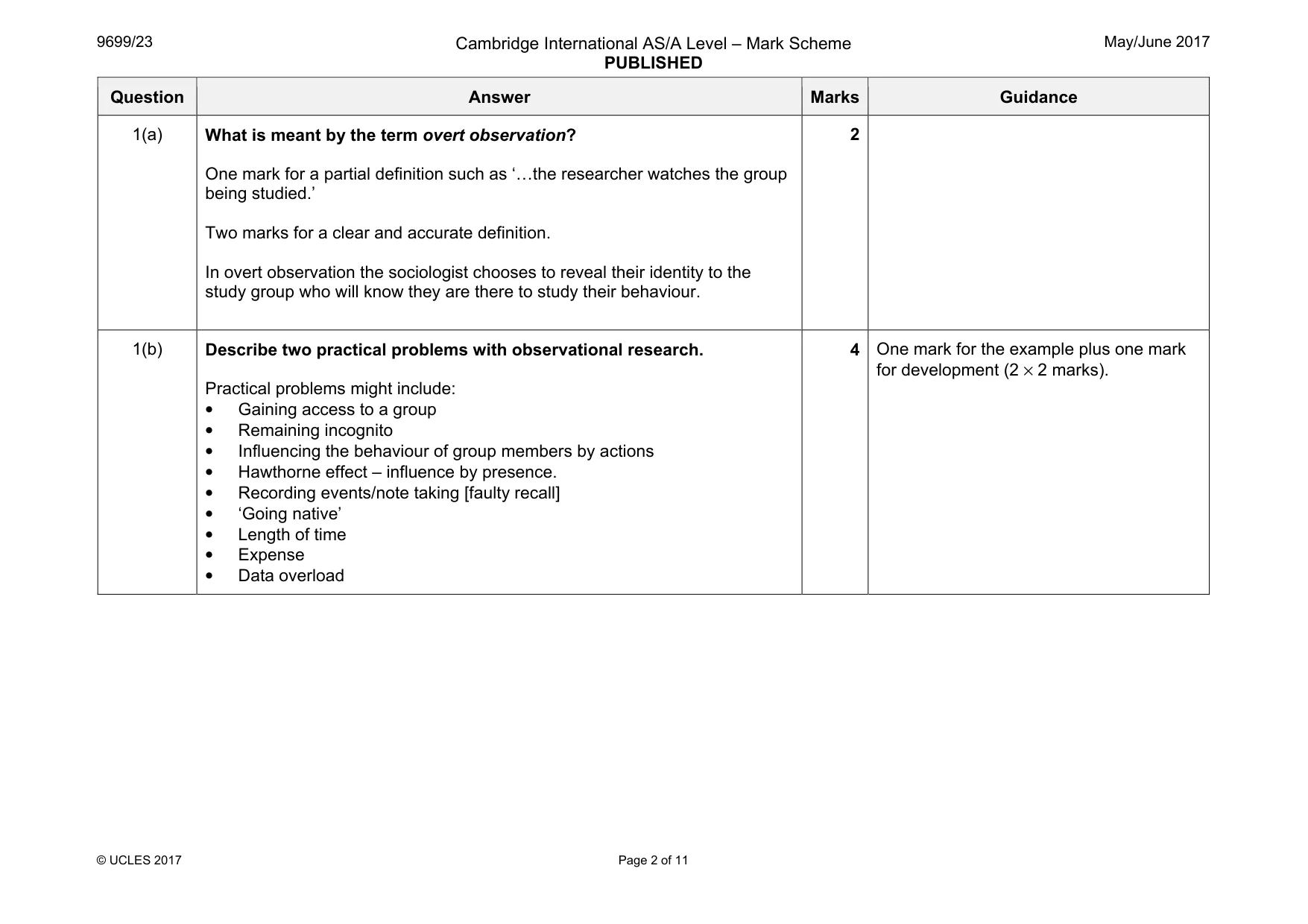
9699/23 Cambridge International AS/A Level – Mark Scheme PUBLISHED May/June 2017 © UCLES 2017 Page 2 of 11 Question Answer Marks Guidance 1(a) What is meant by the term overt observation? One mark for a partial definition such as ‘«the researcher watches the group being studied.’ Two marks for a clear and accurate definition. In overt observation the sociologist chooses to reveal their identity to the study group who will know they are there to study their behaviour. 2 1(b) Describe two practical problems with observational research. Practical problems might include: • Gaining access to a group • Remaining incognito • Influencing the behaviour of group members by actions • Hawthorne effect – influence by presence. • Recording events/note taking [faulty recall] • ‘Going native’ • Length of time • Expense • Data overload 4 One mark for the example plus one mark for development (2 × 2 marks).
Mark scheme, page 3
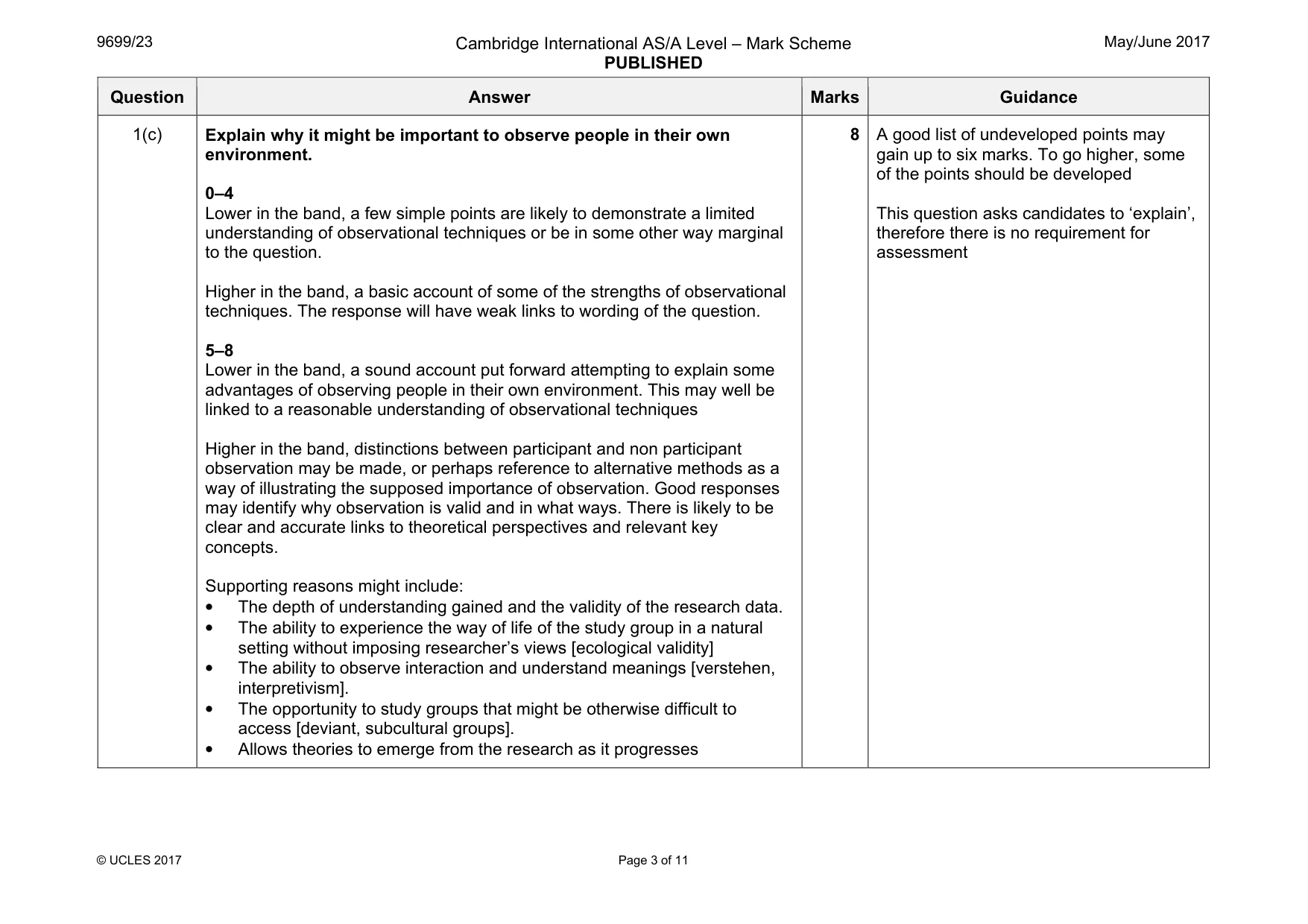
9699/23 Cambridge International AS/A Level – Mark Scheme PUBLISHED May/June 2017 © UCLES 2017 Page 3 of 11 Question Answer Marks Guidance 1(c) Explain why it might be important to observe people in their own environment. 0–4 Lower in the band, a few simple points are likely to demonstrate a limited understanding of observational techniques or be in some other way marginal to the question. Higher in the band, a basic account of some of the strengths of observational techniques. The response will have weak links to wording of the question. 5–8 Lower in the band, a sound account put forward attempting to explain some advantages of observing people in their own environment. This may well be linked to a reasonable understanding of observational techniques Higher in the band, distinctions between participant and non participant observation may be made, or perhaps reference to alternative methods as a way of illustrating the supposed importance of observation. Good responses may identify why observation is valid and in what ways. There is likely to be clear and accurate links to theoretical perspectives and relevant key concepts. Supporting reasons might include: • The depth of understanding gained and the validity of the research data. • The ability to experience the way of life of the study group in a natural setting without imposing researcher’s views [ecological validity] • The ability to observe interaction and understand meanings [verstehen, interpretivism]. • The opportunity to study groups that might be otherwise difficult to access [deviant, subcultural groups]. • Allows theories to emerge from the research as it progresses 8 A good list of undeveloped points may gain up to six marks. To go higher, some of the points should be developed This question asks candidates to ‘explain’, therefore there is no requirement for assessment
Mark scheme, page 4
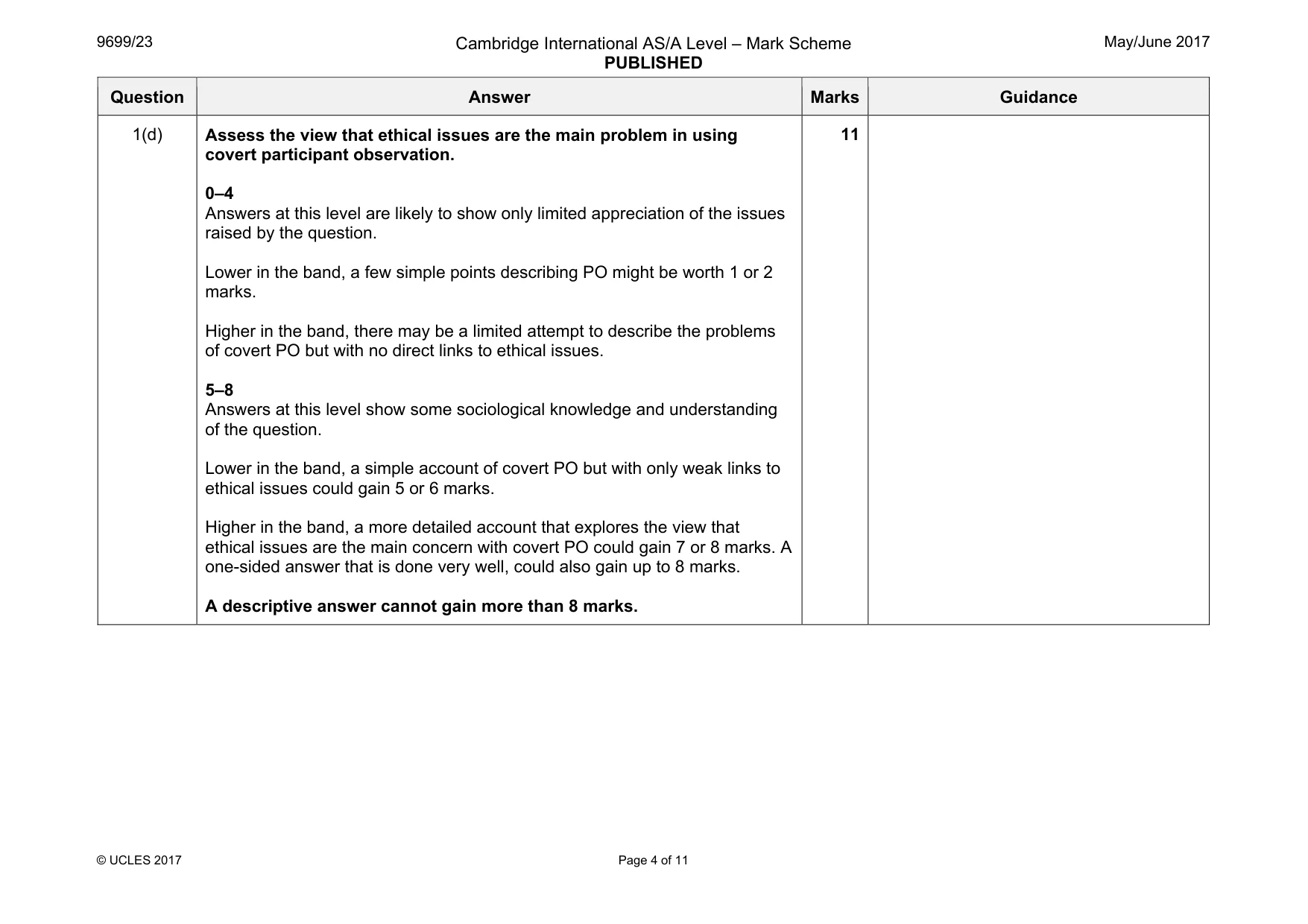
9699/23 Cambridge International AS/A Level – Mark Scheme PUBLISHED May/June 2017 © UCLES 2017 Page 4 of 11 Question Answer Marks Guidance 1(d) Assess the view that ethical issues are the main problem in using covert participant observation. 0–4 Answers at this level are likely to show only limited appreciation of the issues raised by the question. Lower in the band, a few simple points describing PO might be worth 1 or 2 marks. Higher in the band, there may be a limited attempt to describe the problems of covert PO but with no direct links to ethical issues. 5–8 Answers at this level show some sociological knowledge and understanding of the question. Lower in the band, a simple account of covert PO but with only weak links to ethical issues could gain 5 or 6 marks. Higher in the band, a more detailed account that explores the view that ethical issues are the main concern with covert PO could gain 7 or 8 marks. A one-sided answer that is done very well, could also gain up to 8 marks. A descriptive answer cannot gain more than 8 marks. 11
Mark scheme, page 5
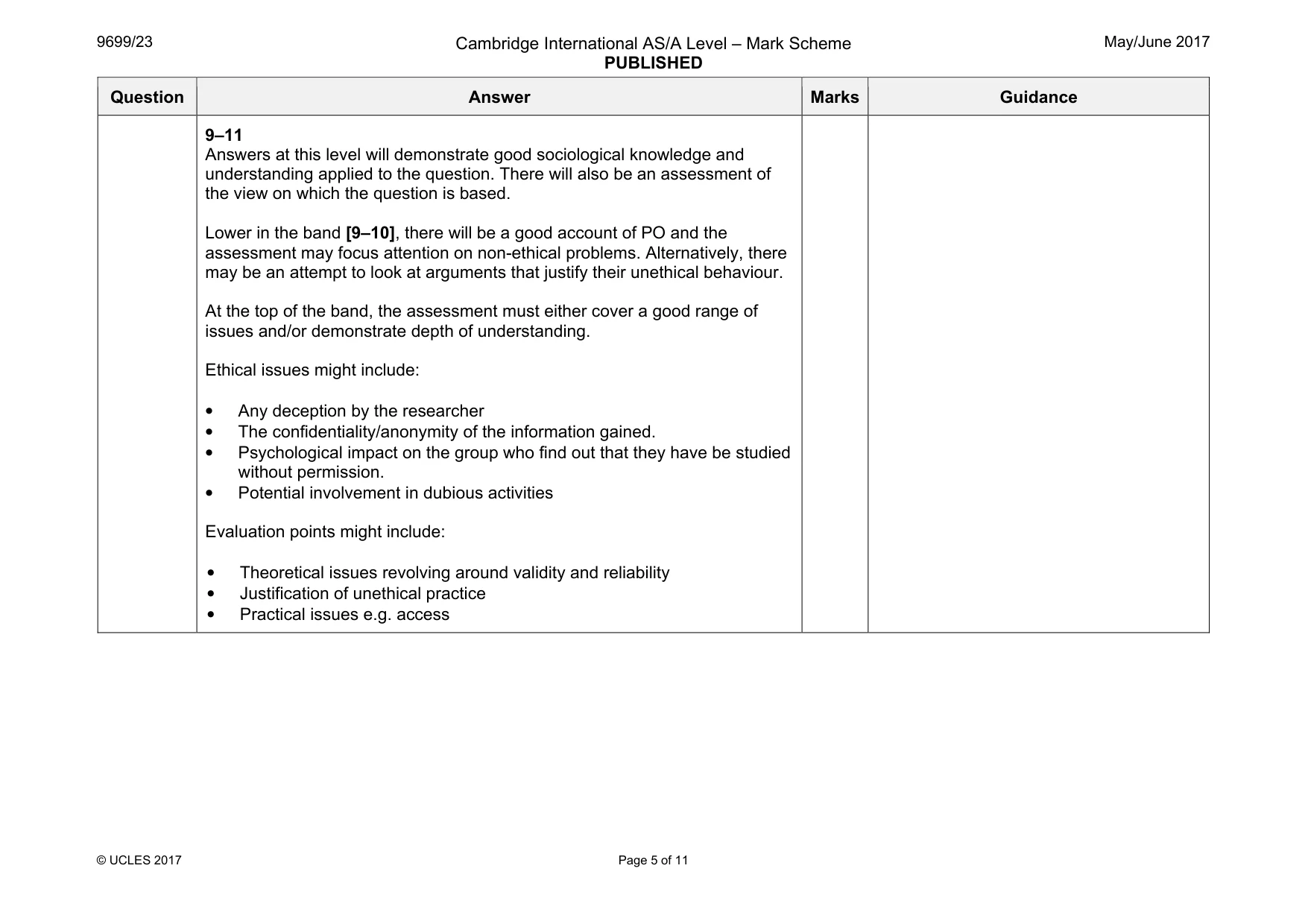
9699/23 Cambridge International AS/A Level – Mark Scheme PUBLISHED May/June 2017 © UCLES 2017 Page 5 of 11 Question Answer Marks Guidance 9–11 Answers at this level will demonstrate good sociological knowledge and understanding applied to the question. There will also be an assessment of the view on which the question is based. Lower in the band [9–10], there will be a good account of PO and the assessment may focus attention on non-ethical problems. Alternatively, there may be an attempt to look at arguments that justify their unethical behaviour. At the top of the band, the assessment must either cover a good range of issues and/or demonstrate depth of understanding. Ethical issues might include: • Any deception by the researcher • The confidentiality/anonymity of the information gained. • Psychological impact on the group who find out that they have be studied without permission. • Potential involvement in dubious activities Evaluation points might include: • Theoretical issues revolving around validity and reliability • Justification of unethical practice • Practical issues e.g. access
Mark scheme, page 6
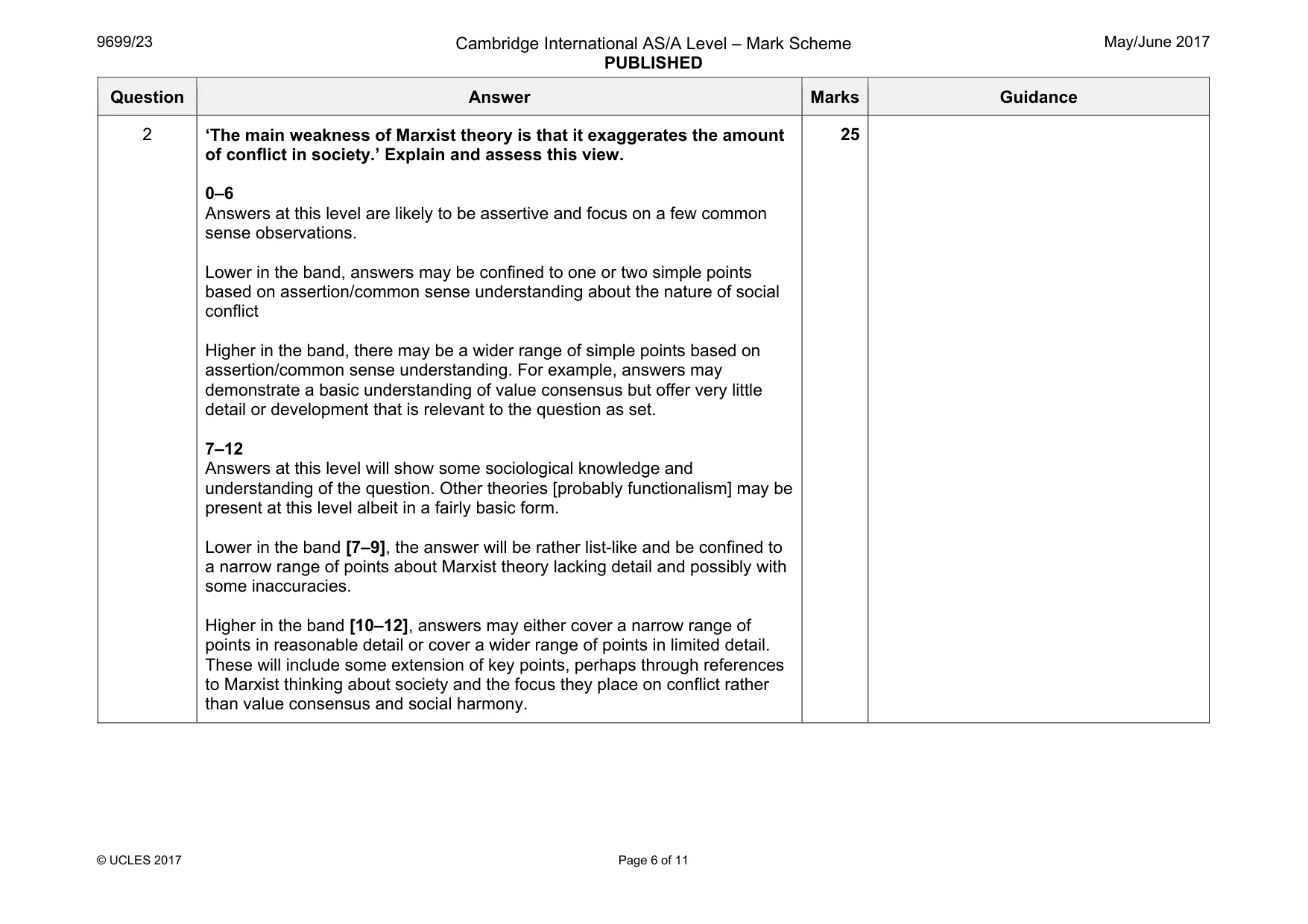
9699/23 Cambridge International AS/A Level – Mark Scheme PUBLISHED May/June 2017 © UCLES 2017 Page 6 of 11 Question Answer Marks Guidance 2 ‘The main weakness of Marxist theory is that it exaggerates the amount of conflict in society.’ Explain and assess this view. 0–6 Answers at this level are likely to be assertive and focus on a few common sense observations. Lower in the band, answers may be confined to one or two simple points based on assertion/common sense understanding about the nature of social conflict Higher in the band, there may be a wider range of simple points based on assertion/common sense understanding. For example, answers may demonstrate a basic understanding of value consensus but offer very little detail or development that is relevant to the question as set. 7–12 Answers at this level will show some sociological knowledge and understanding of the question. Other theories [probably functionalism] may be present at this level albeit in a fairly basic form. Lower in the band [7–9], the answer will be rather list-like and be confined to a narrow range of points about Marxist theory lacking detail and possibly with some inaccuracies. Higher in the band [10–12], answers may either cover a narrow range of points in reasonable detail or cover a wider range of points in limited detail. These will include some extension of key points, perhaps through references to Marxist thinking about society and the focus they place on conflict rather than value consensus and social harmony. 25
Mark scheme, page 7
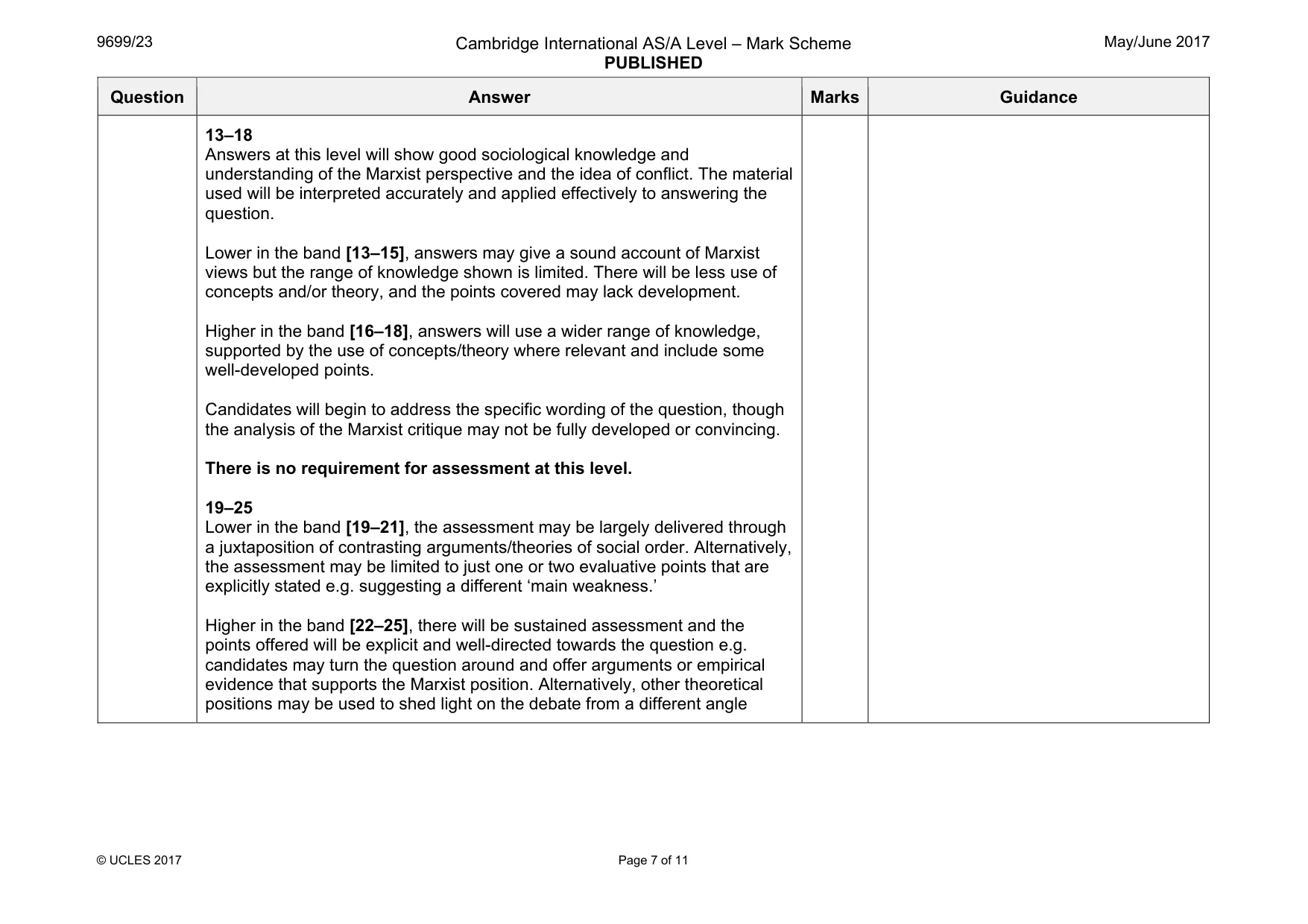
9699/23 Cambridge International AS/A Level – Mark Scheme PUBLISHED May/June 2017 © UCLES 2017 Page 7 of 11 Question Answer Marks Guidance 13–18 Answers at this level will show good sociological knowledge and understanding of the Marxist perspective and the idea of conflict. The material used will be interpreted accurately and applied effectively to answering the question. Lower in the band [13–15], answers may give a sound account of Marxist views but the range of knowledge shown is limited. There will be less use of concepts and/or theory, and the points covered may lack development. Higher in the band [16–18], answers will use a wider range of knowledge, supported by the use of concepts/theory where relevant and include some well-developed points. Candidates will begin to address the specific wording of the question, though the analysis of the Marxist critique may not be fully developed or convincing. There is no requirement for assessment at this level. 19–25 Lower in the band [19–21], the assessment may be largely delivered through a juxtaposition of contrasting arguments/theories of social order. Alternatively, the assessment may be limited to just one or two evaluative points that are explicitly stated e.g. suggesting a different ‘main weakness.’ Higher in the band [22–25], there will be sustained assessment and the points offered will be explicit and well-directed towards the question e.g. candidates may turn the question around and offer arguments or empirical evidence that supports the Marxist position. Alternatively, other theoretical positions may be used to shed light on the debate from a different angle
Mark scheme, page 8
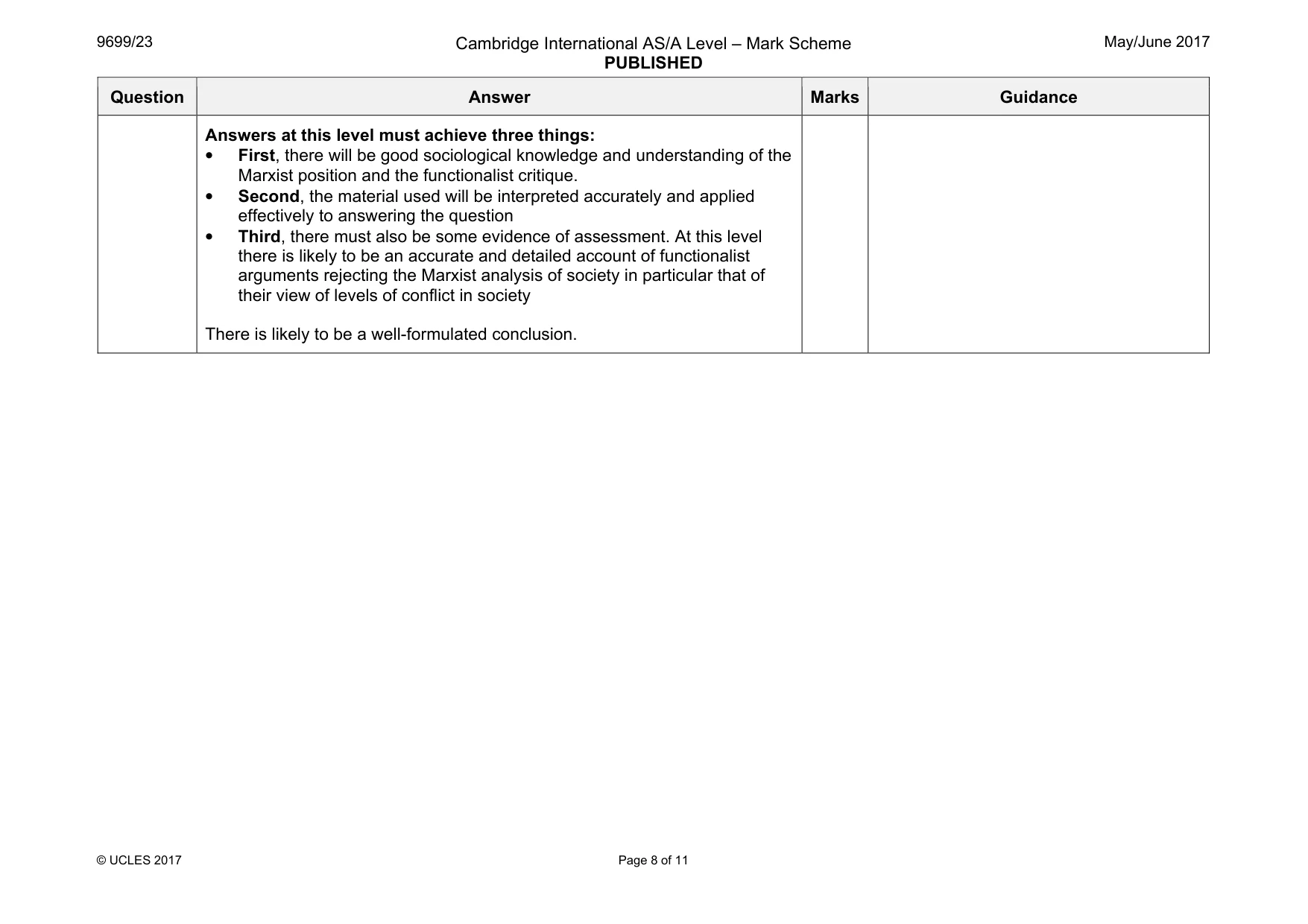
9699/23 Cambridge International AS/A Level – Mark Scheme PUBLISHED May/June 2017 © UCLES 2017 Page 8 of 11 Question Answer Marks Guidance Answers at this level must achieve three things: • First, there will be good sociological knowledge and understanding of the Marxist position and the functionalist critique. • Second, the material used will be interpreted accurately and applied effectively to answering the question • Third, there must also be some evidence of assessment. At this level there is likely to be an accurate and detailed account of functionalist arguments rejecting the Marxist analysis of society in particular that of their view of levels of conflict in society There is likely to be a well-formulated conclusion.
Mark scheme, page 9
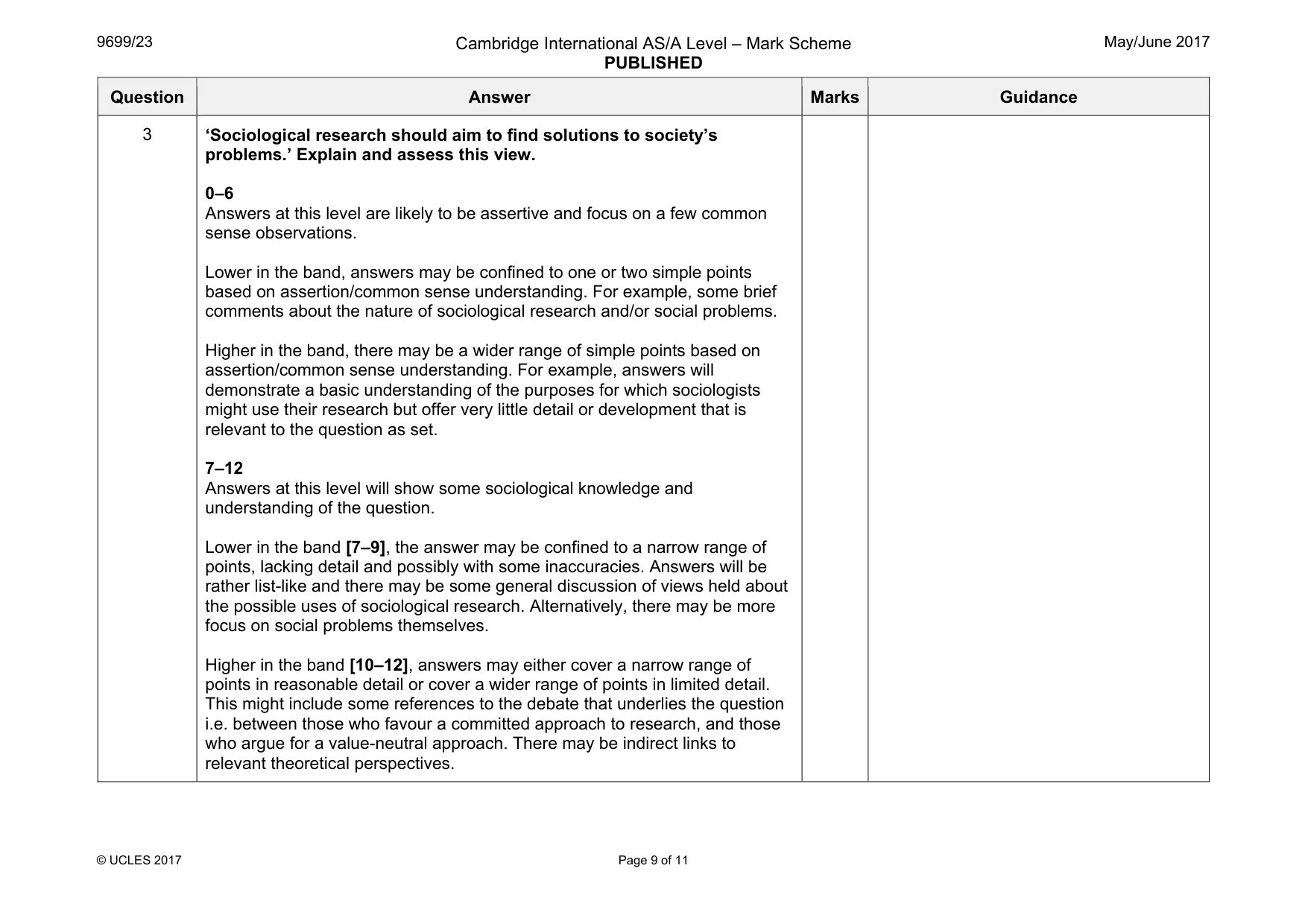
9699/23 Cambridge International AS/A Level – Mark Scheme PUBLISHED May/June 2017 © UCLES 2017 Page 9 of 11 Question Answer Marks Guidance 3 ‘Sociological research should aim to find solutions to society’s problems.’ Explain and assess this view. 0–6 Answers at this level are likely to be assertive and focus on a few common sense observations. Lower in the band, answers may be confined to one or two simple points based on assertion/common sense understanding. For example, some brief comments about the nature of sociological research and/or social problems. Higher in the band, there may be a wider range of simple points based on assertion/common sense understanding. For example, answers will demonstrate a basic understanding of the purposes for which sociologists might use their research but offer very little detail or development that is relevant to the question as set. 7–12 Answers at this level will show some sociological knowledge and understanding of the question. Lower in the band [7–9], the answer may be confined to a narrow range of points, lacking detail and possibly with some inaccuracies. Answers will be rather list-like and there may be some general discussion of views held about the possible uses of sociological research. Alternatively, there may be more focus on social problems themselves. Higher in the band [10–12], answers may either cover a narrow range of points in reasonable detail or cover a wider range of points in limited detail. This might include some references to the debate that underlies the question i.e. between those who favour a committed approach to research, and those who argue for a value-neutral approach. There may be indirect links to relevant theoretical perspectives.
Mark scheme, page 10
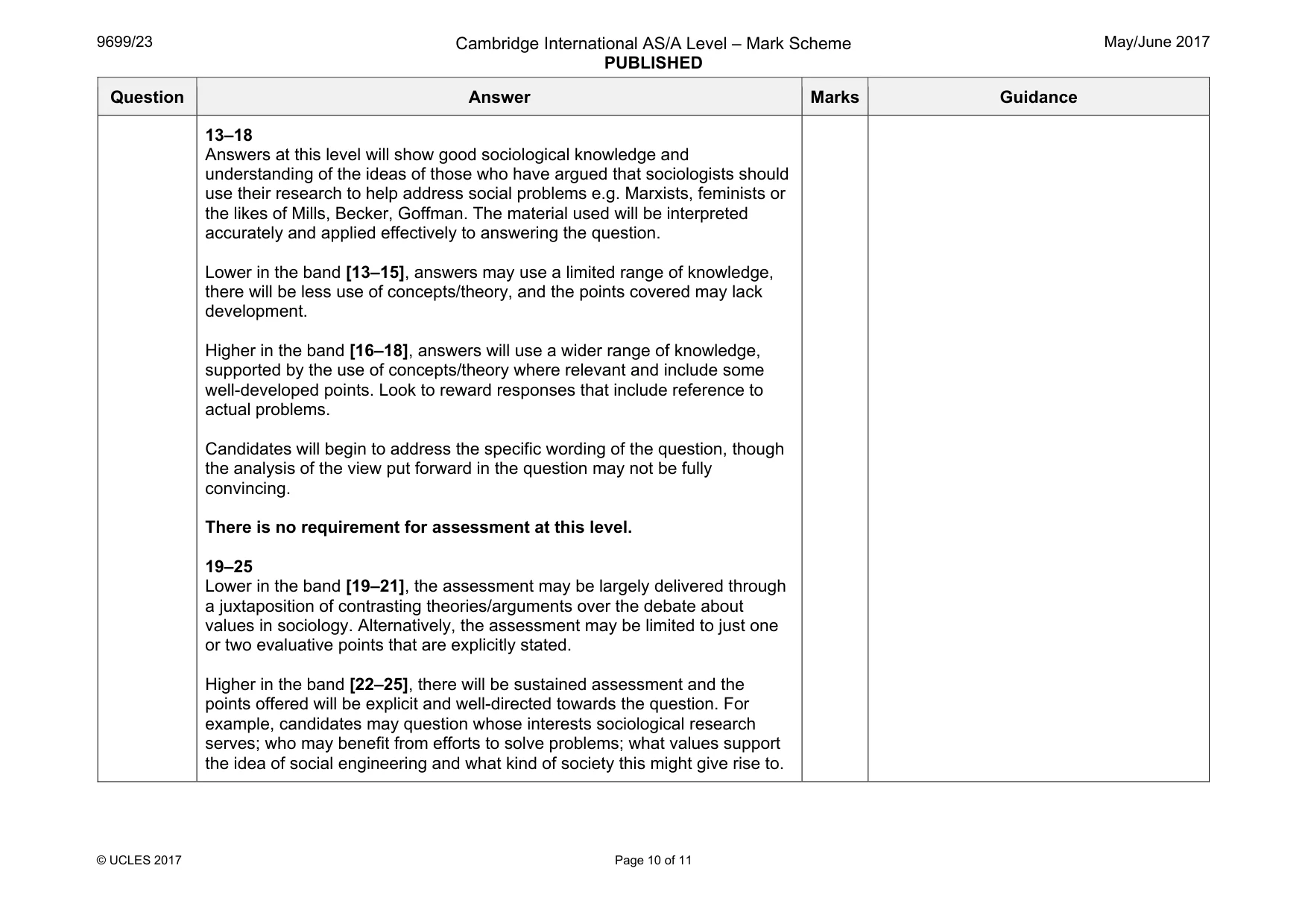
9699/23 Cambridge International AS/A Level – Mark Scheme PUBLISHED May/June 2017 © UCLES 2017 Page 10 of 11 Question Answer Marks Guidance 13–18 Answers at this level will show good sociological knowledge and understanding of the ideas of those who have argued that sociologists should use their research to help address social problems e.g. Marxists, feminists or the likes of Mills, Becker, Goffman. The material used will be interpreted accurately and applied effectively to answering the question. Lower in the band [13–15], answers may use a limited range of knowledge, there will be less use of concepts/theory, and the points covered may lack development. Higher in the band [16–18], answers will use a wider range of knowledge, supported by the use of concepts/theory where relevant and include some well-developed points. Look to reward responses that include reference to actual problems. Candidates will begin to address the specific wording of the question, though the analysis of the view put forward in the question may not be fully convincing. There is no requirement for assessment at this level. 19–25 Lower in the band [19–21], the assessment may be largely delivered through a juxtaposition of contrasting theories/arguments over the debate about values in sociology. Alternatively, the assessment may be limited to just one or two evaluative points that are explicitly stated. Higher in the band [22–25], there will be sustained assessment and the points offered will be explicit and well-directed towards the question. For example, candidates may question whose interests sociological research serves; who may benefit from efforts to solve problems; what values support the idea of social engineering and what kind of society this might give rise to.
Mark scheme, page 11
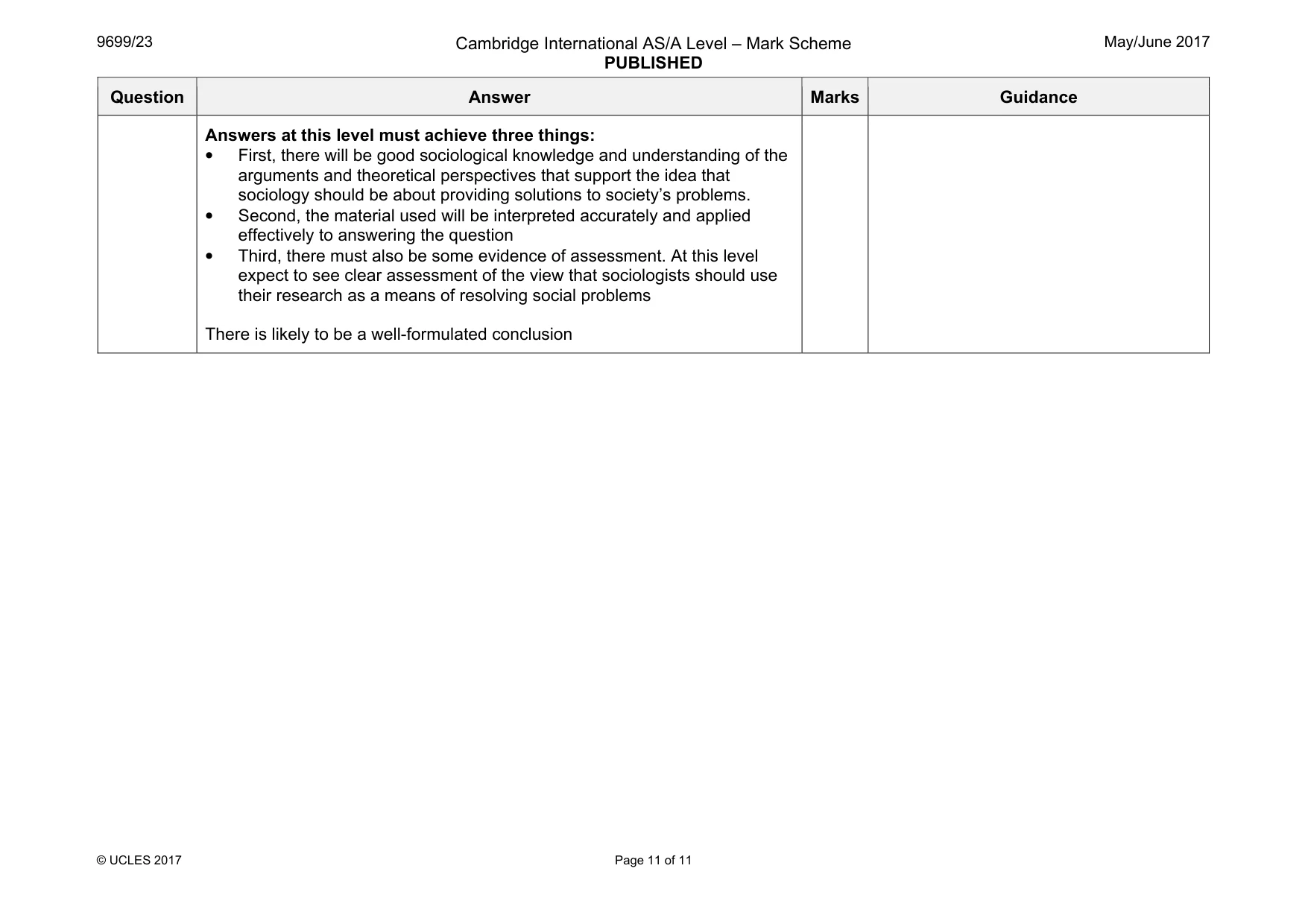
9699/23 Cambridge International AS/A Level – Mark Scheme PUBLISHED May/June 2017 © UCLES 2017 Page 11 of 11 Question Answer Marks Guidance Answers at this level must achieve three things: • First, there will be good sociological knowledge and understanding of the arguments and theoretical perspectives that support the idea that sociology should be about providing solutions to society’s problems. • Second, the material used will be interpreted accurately and applied effectively to answering the question • Third, there must also be some evidence of assessment. At this level expect to see clear assessment of the view that sociologists should use their research as a means of resolving social problems There is likely to be a well-formulated conclusion
What you needed in this session
Cambridge’s own grade thresholds for 2017 May/June, Paper 2 · Variant 3. A higher threshold means an easier paper — the bar moves with how the cohort did.