Cambridge A Level Sociology 9699 — 2016 May/June Paper 3 · Variant 3
9699/33/M/J/16 · 75 marks · ≈84 min
The question paper and its mark scheme, free to read here and free to download. This is Cambridge’s own paper, exactly as it was sat.
Question paper4 pages
Mark scheme9 pages
Answers below. Sit the paper first if you are practising.
Paper as text
Question paper, page 1
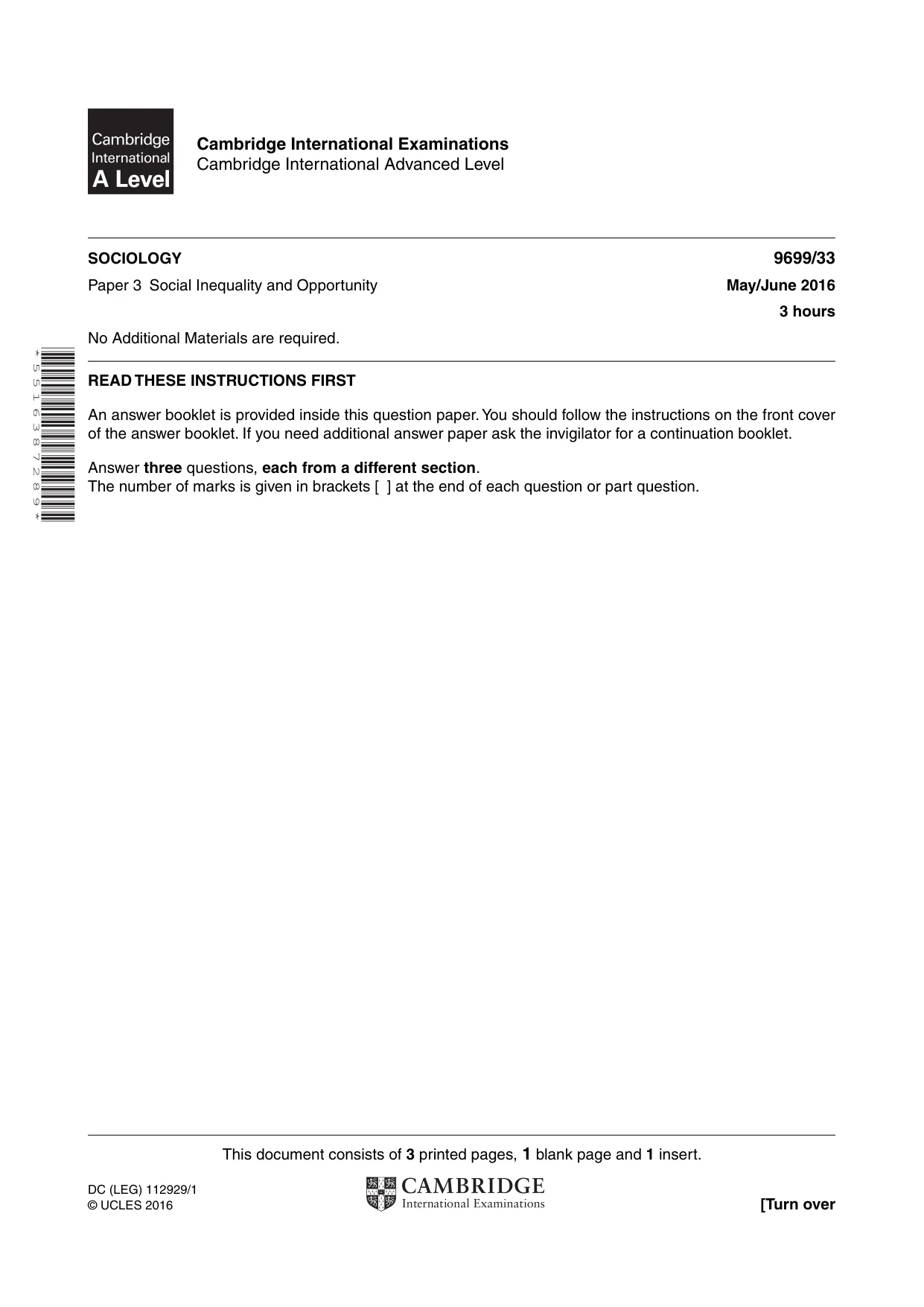
This document consists of 3 printed pages, 1 blank page and 1 insert. DC (LEG) 112929/1 © UCLES 2016 [Turn over Cambridge International Examinations Cambridge International Advanced Level * 5 5 1 6 3 8 7 2 8 9 * SOCIOLOGY 9699/33 Paper 3 Social Inequality and Opportunity May/June 2016 3 hours No Additional Materials are required. READ THESE INSTRUCTIONS FIRST An answer booklet is provided inside this question paper. You should follow the instructions on the front cover of the answer booklet. If you need additional answer paper ask the invigilator for a continuation booklet. Answer three questions, each from a different section. The number of marks is given in brackets [ ] at the end of each question or part question.
Question paper, page 2
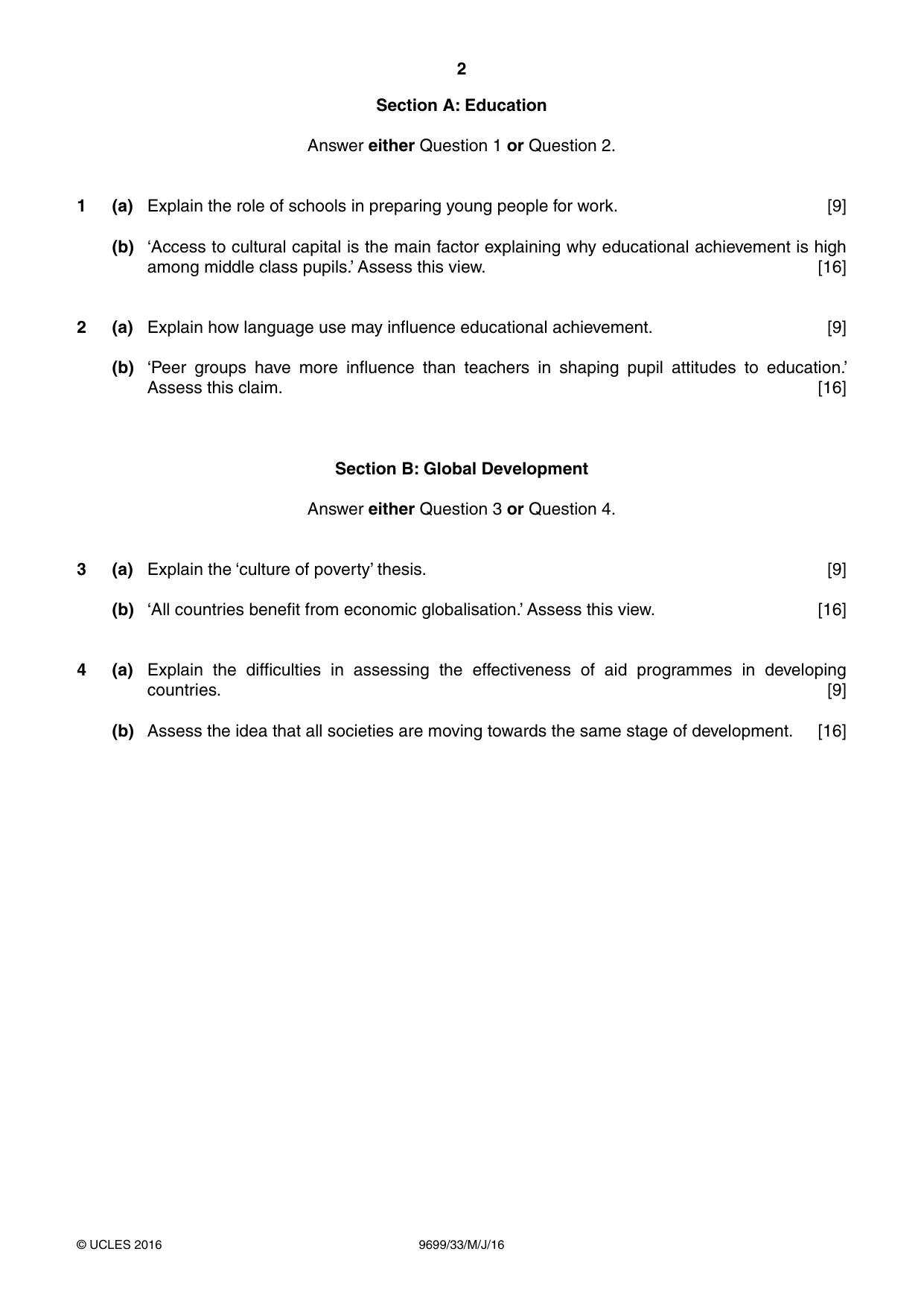
2 9699/33/M/J/16 © UCLES 2016 Section A: Education Answer either Question 1 or Question 2. 1 (a) Explain the role of schools in preparing young people for work. [9] (b) ‘Access to cultural capital is the main factor explaining why educational achievement is high among middle class pupils.’ Assess this view. [16] 2 (a) Explain how language use may influence educational achievement. [9] (b) ‘Peer groups have more influence than teachers in shaping pupil attitudes to education.’ Assess this claim. [16] Section B: Global Development Answer either Question 3 or Question 4. 3 (a) Explain the ‘culture of poverty’ thesis. [9] (b) ‘All countries benefit from economic globalisation.’ Assess this view. [16] 4 (a) Explain the difficulties in assessing the effectiveness of aid programmes in developing countries. [9] (b) Assess the idea that all societies are moving towards the same stage of development. [16]
Question paper, page 3
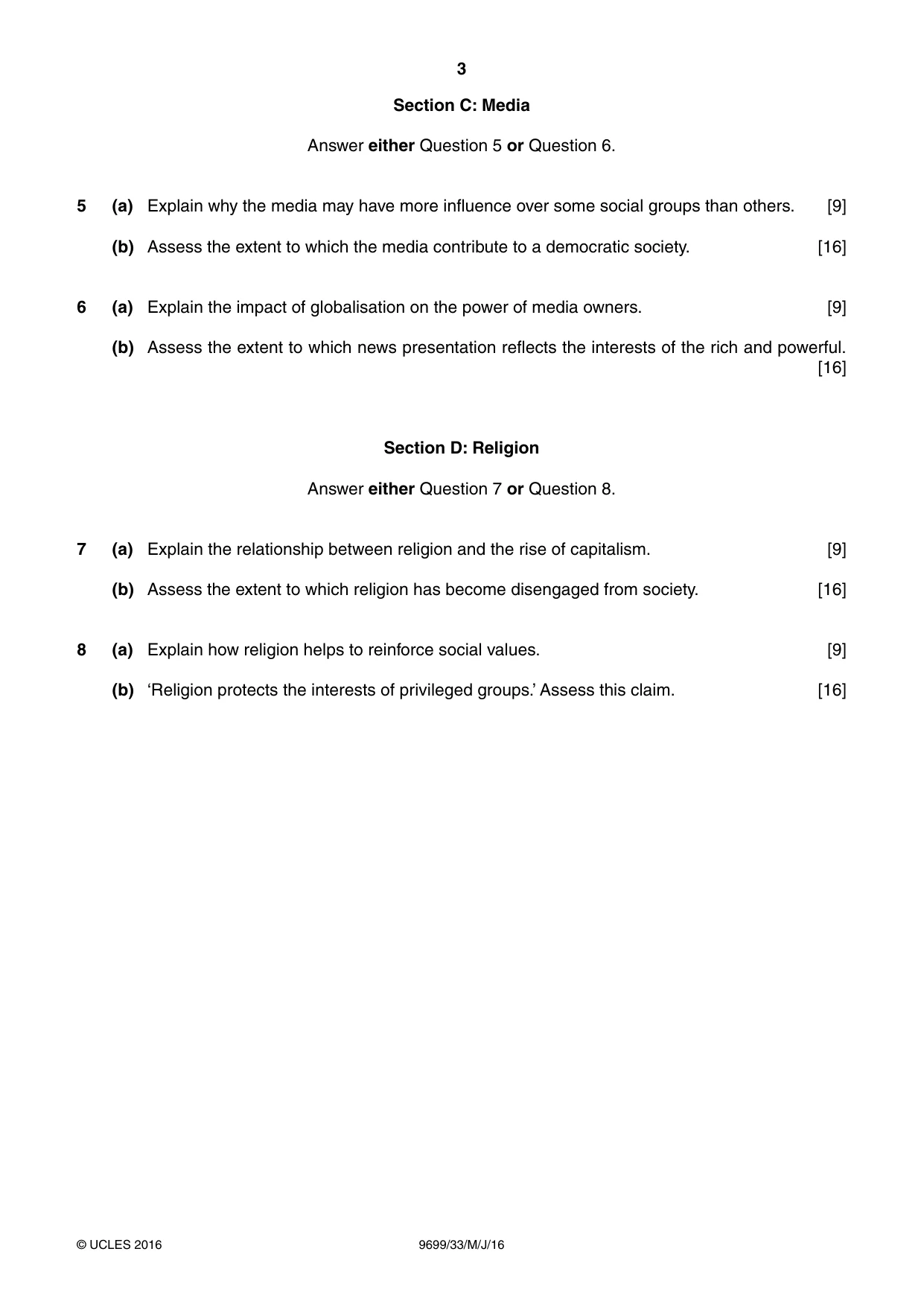
3 9699/33/M/J/16 © UCLES 2016 Section C: Media Answer either Question 5 or Question 6. 5 (a) Explain why the media may have more influence over some social groups than others. [9] (b) Assess the extent to which the media contribute to a democratic society. [16] 6 (a) Explain the impact of globalisation on the power of media owners. [9] (b) Assess the extent to which news presentation reflects the interests of the rich and powerful. [16] Section D: Religion Answer either Question 7 or Question 8. 7 (a) Explain the relationship between religion and the rise of capitalism. [9] (b) Assess the extent to which religion has become disengaged from society. [16] 8 (a) Explain how religion helps to reinforce social values. [9] (b) ‘Religion protects the interests of privileged groups.’ Assess this claim. [16]
Question paper, page 4
4 9699/33/M/J/16 © UCLES 2016 BLANK PAGE Permission to reproduce items where third-party owned material protected by copyright is included has been sought and cleared where possible. Every reasonable effort has been made by the publisher (UCLES) to trace copyright holders, but if any items requiring clearance have unwittingly been included, the publisher will be pleased to make amends at the earliest possible opportunity. To avoid the issue of disclosure of answer-related information to candidates, all copyright acknowledgements are reproduced online in the Cambridge International Examinations Copyright Acknowledgements Booklet. This is produced for each series of examinations and is freely available to download at www.cie.org.uk after the live examination series. Cambridge International Examinations is part of the Cambridge Assessment Group. Cambridge Assessment is the brand name of University of Cambridge Local Examinations Syndicate (UCLES), which is itself a department of the University of Cambridge.
Mark scheme, page 1
® IGCSE is the registered trademark of Cambridge International Examinations. This document consists of 9 printed pages. © UCLES 2016 [Turn over Cambridge International Examinations Cambridge International Advanced Subsidiary and Advanced Level SOCIOLOGY 9699/33 Paper 3 Social Inequality and Opportunity May/June 2016 MARK SCHEME Maximum Mark: 75 Published This mark scheme is published as an aid to teachers and candidates, to indicate the requirements of the examination. It shows the basis on which Examiners were instructed to award marks. It does not indicate the details of the discussions that took place at an Examiners’ meeting before marking began, which would have considered the acceptability of alternative answers. Mark schemes should be read in conjunction with the question paper and the Principal Examiner Report for Teachers. Cambridge will not enter into discussions about these mark schemes. Cambridge is publishing the mark schemes for the May/June 2016 series for most Cambridge IGCSE®, Cambridge International A and AS Level components and some Cambridge O Level components.
Mark scheme, page 2
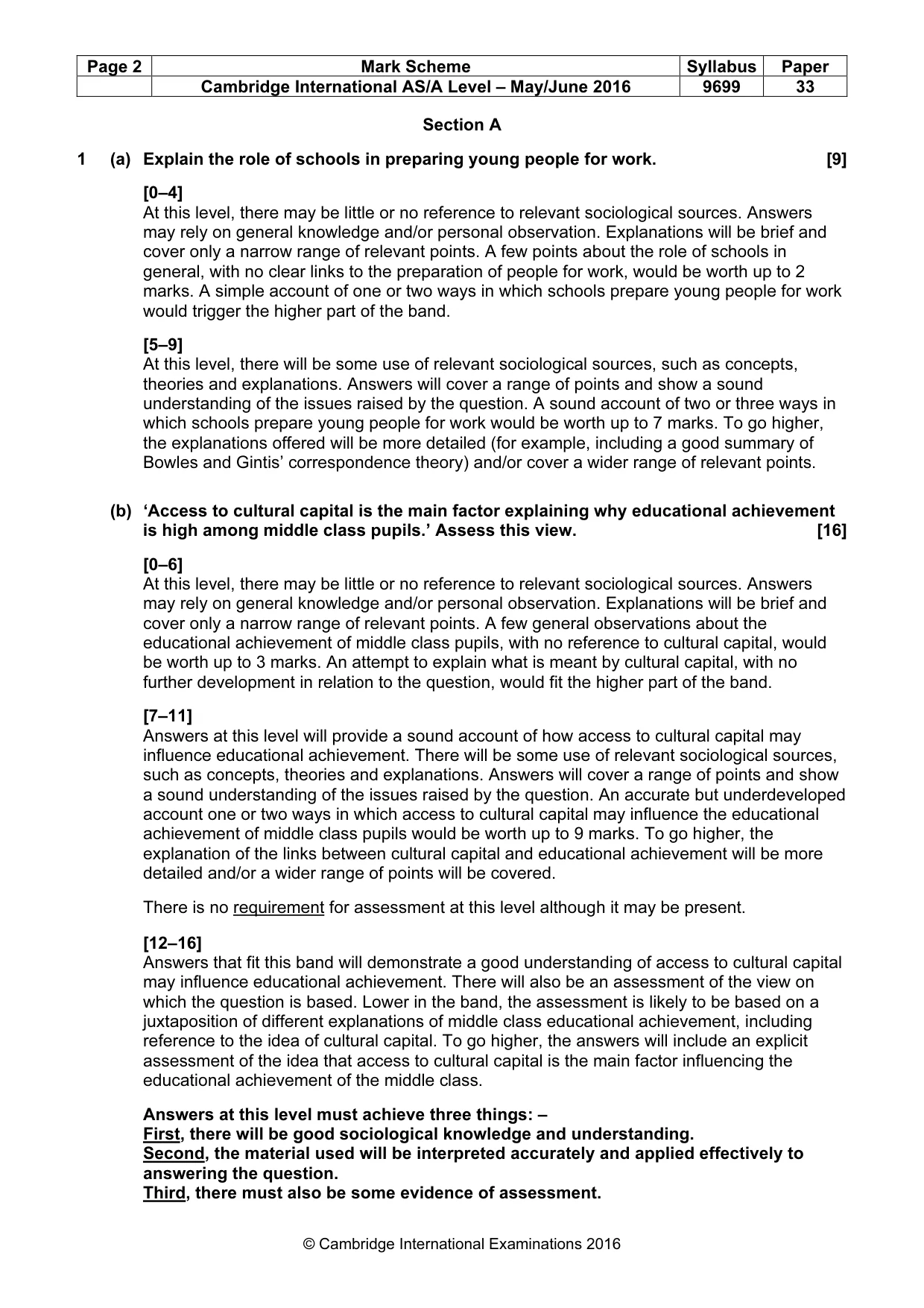
Page 2 Mark Scheme Syllabus Paper Cambridge International AS/A Level – May/June 2016 9699 33 © Cambridge International Examinations 2016 Section A 1 (a) Explain the role of schools in preparing young people for work. [9] [0–4] At this level, there may be little or no reference to relevant sociological sources. Answers may rely on general knowledge and/or personal observation. Explanations will be brief and cover only a narrow range of relevant points. A few points about the role of schools in general, with no clear links to the preparation of people for work, would be worth up to 2 marks. A simple account of one or two ways in which schools prepare young people for work would trigger the higher part of the band. [5–9] At this level, there will be some use of relevant sociological sources, such as concepts, theories and explanations. Answers will cover a range of points and show a sound understanding of the issues raised by the question. A sound account of two or three ways in which schools prepare young people for work would be worth up to 7 marks. To go higher, the explanations offered will be more detailed (for example, including a good summary of Bowles and Gintis’ correspondence theory) and/or cover a wider range of relevant points. (b) ‘Access to cultural capital is the main factor explaining why educational achievement is high among middle class pupils.’ Assess this view. [16] [0–6] At this level, there may be little or no reference to relevant sociological sources. Answers may rely on general knowledge and/or personal observation. Explanations will be brief and cover only a narrow range of relevant points. A few general observations about the educational achievement of middle class pupils, with no reference to cultural capital, would be worth up to 3 marks. An attempt to explain what is meant by cultural capital, with no further development in relation to the question, would fit the higher part of the band. [7–11] Answers at this level will provide a sound account of how access to cultural capital may influence educational achievement. There will be some use of relevant sociological sources, such as concepts, theories and explanations. Answers will cover a range of points and show a sound understanding of the issues raised by the question. An accurate but underdeveloped account one or two ways in which access to cultural capital may influence the educational achievement of middle class pupils would be worth up to 9 marks. To go higher, the explanation of the links between cultural capital and educational achievement will be more detailed and/or a wider range of points will be covered. There is no requirement for assessment at this level although it may be present. [12–16] Answers that fit this band will demonstrate a good understanding of access to cultural capital may influence educational achievement. There will also be an assessment of the view on which the question is based. Lower in the band, the assessment is likely to be based on a juxtaposition of different explanations of middle class educational achievement, including reference to the idea of cultural capital. To go higher, the answers will include an explicit assessment of the idea that access to cultural capital is the main factor influencing the educational achievement of the middle class. Answers at this level must achieve three things: – First, there will be good sociological knowledge and understanding. Second, the material used will be interpreted accurately and applied effectively to answering the question. Third, there must also be some evidence of assessment.
Mark scheme, page 3
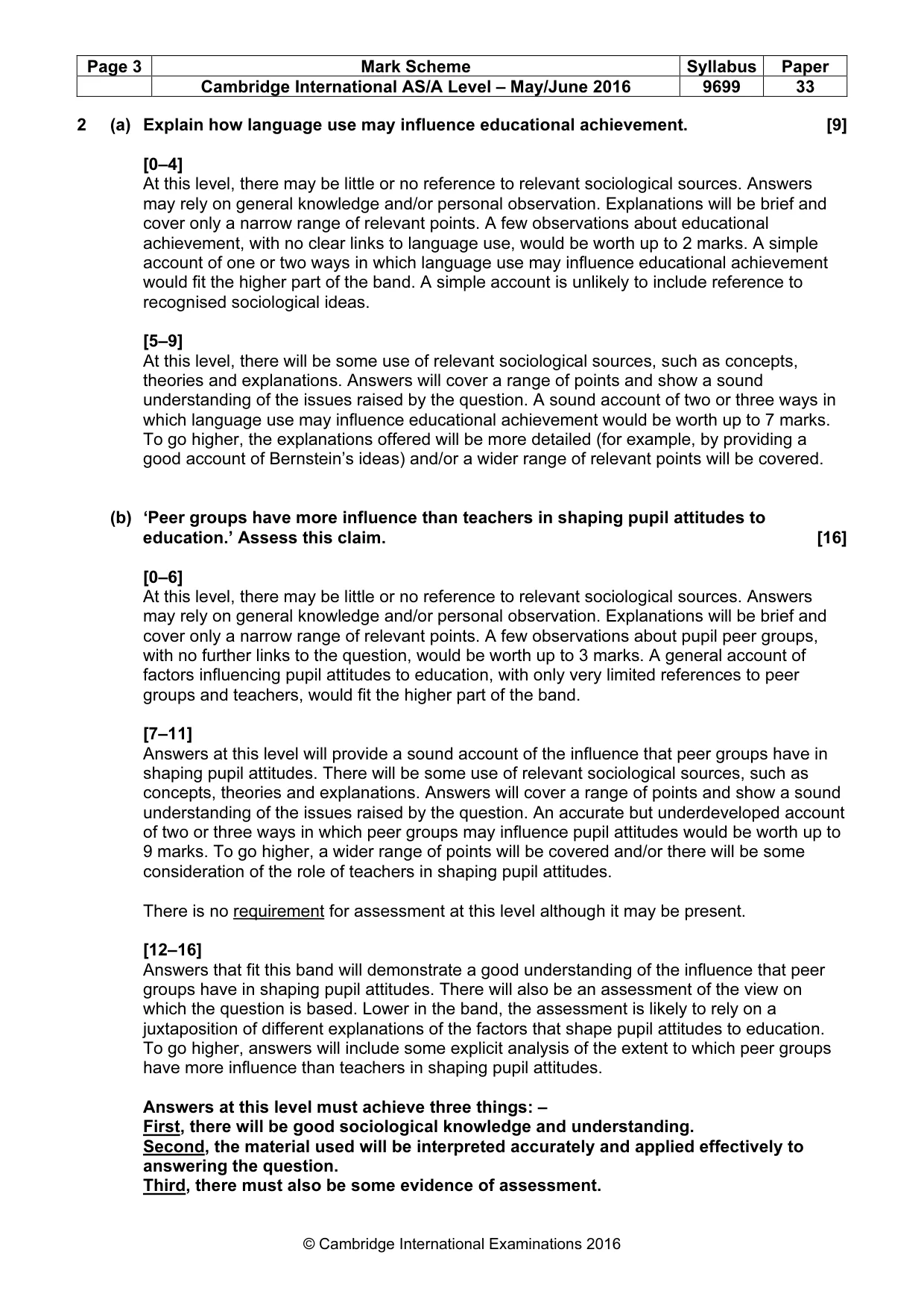
Page 3 Mark Scheme Syllabus Paper Cambridge International AS/A Level – May/June 2016 9699 33 © Cambridge International Examinations 2016 2 (a) Explain how language use may influence educational achievement. [9] [0–4] At this level, there may be little or no reference to relevant sociological sources. Answers may rely on general knowledge and/or personal observation. Explanations will be brief and cover only a narrow range of relevant points. A few observations about educational achievement, with no clear links to language use, would be worth up to 2 marks. A simple account of one or two ways in which language use may influence educational achievement would fit the higher part of the band. A simple account is unlikely to include reference to recognised sociological ideas. [5–9] At this level, there will be some use of relevant sociological sources, such as concepts, theories and explanations. Answers will cover a range of points and show a sound understanding of the issues raised by the question. A sound account of two or three ways in which language use may influence educational achievement would be worth up to 7 marks. To go higher, the explanations offered will be more detailed (for example, by providing a good account of Bernstein’s ideas) and/or a wider range of relevant points will be covered. (b) ‘Peer groups have more influence than teachers in shaping pupil attitudes to education.’ Assess this claim. [16] [0–6] At this level, there may be little or no reference to relevant sociological sources. Answers may rely on general knowledge and/or personal observation. Explanations will be brief and cover only a narrow range of relevant points. A few observations about pupil peer groups, with no further links to the question, would be worth up to 3 marks. A general account of factors influencing pupil attitudes to education, with only very limited references to peer groups and teachers, would fit the higher part of the band. [7–11] Answers at this level will provide a sound account of the influence that peer groups have in shaping pupil attitudes. There will be some use of relevant sociological sources, such as concepts, theories and explanations. Answers will cover a range of points and show a sound understanding of the issues raised by the question. An accurate but underdeveloped account of two or three ways in which peer groups may influence pupil attitudes would be worth up to 9 marks. To go higher, a wider range of points will be covered and/or there will be some consideration of the role of teachers in shaping pupil attitudes. There is no requirement for assessment at this level although it may be present. [12–16] Answers that fit this band will demonstrate a good understanding of the influence that peer groups have in shaping pupil attitudes. There will also be an assessment of the view on which the question is based. Lower in the band, the assessment is likely to rely on a juxtaposition of different explanations of the factors that shape pupil attitudes to education. To go higher, answers will include some explicit analysis of the extent to which peer groups have more influence than teachers in shaping pupil attitudes. Answers at this level must achieve three things: – First, there will be good sociological knowledge and understanding. Second, the material used will be interpreted accurately and applied effectively to answering the question. Third, there must also be some evidence of assessment.
Mark scheme, page 4
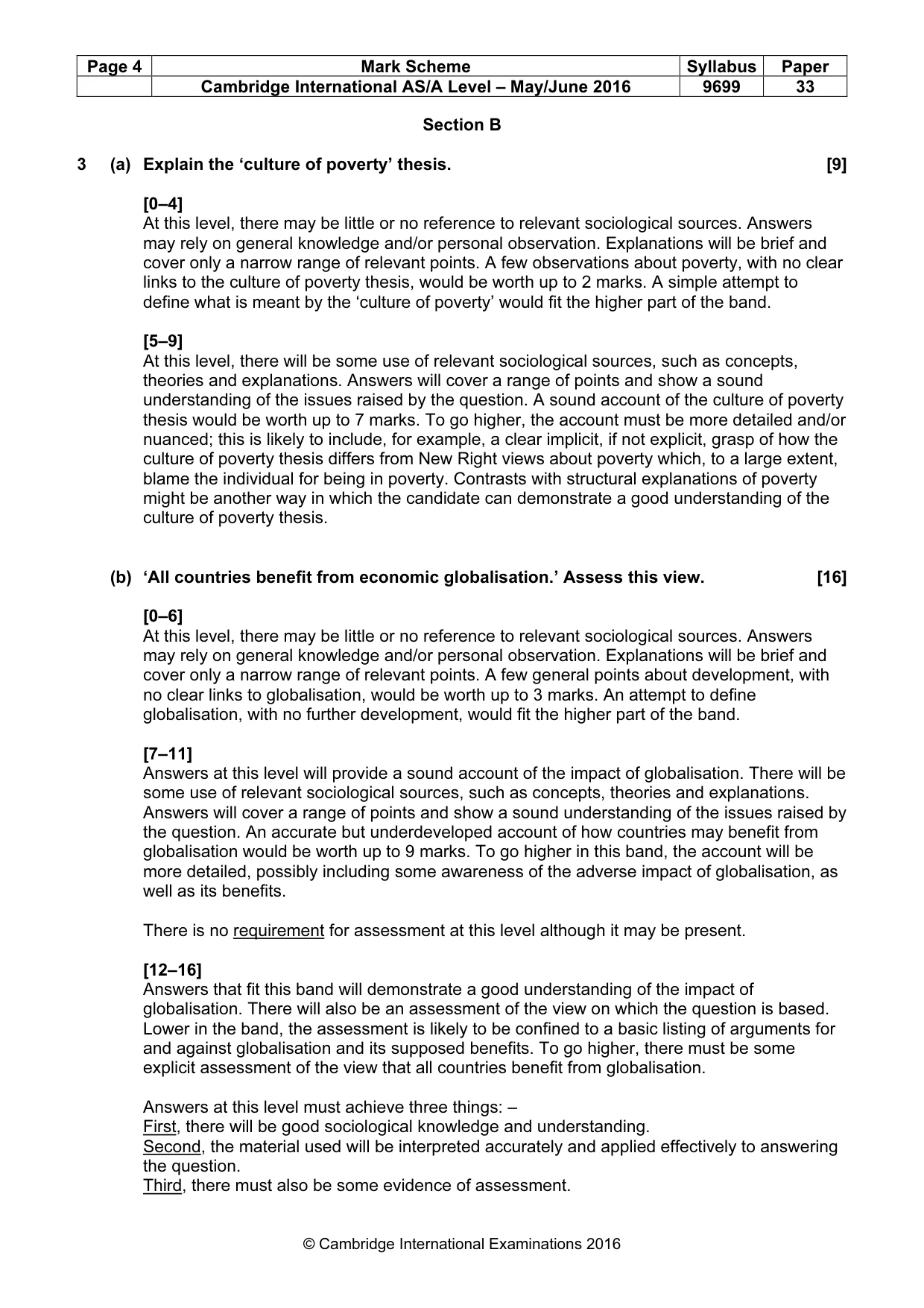
Page 4 Mark Scheme Syllabus Paper Cambridge International AS/A Level – May/June 2016 9699 33 © Cambridge International Examinations 2016 Section B 3 (a) Explain the ‘culture of poverty’ thesis. [9] [0–4] At this level, there may be little or no reference to relevant sociological sources. Answers may rely on general knowledge and/or personal observation. Explanations will be brief and cover only a narrow range of relevant points. A few observations about poverty, with no clear links to the culture of poverty thesis, would be worth up to 2 marks. A simple attempt to define what is meant by the ‘culture of poverty’ would fit the higher part of the band. [5–9] At this level, there will be some use of relevant sociological sources, such as concepts, theories and explanations. Answers will cover a range of points and show a sound understanding of the issues raised by the question. A sound account of the culture of poverty thesis would be worth up to 7 marks. To go higher, the account must be more detailed and/or nuanced; this is likely to include, for example, a clear implicit, if not explicit, grasp of how the culture of poverty thesis differs from New Right views about poverty which, to a large extent, blame the individual for being in poverty. Contrasts with structural explanations of poverty might be another way in which the candidate can demonstrate a good understanding of the culture of poverty thesis. (b) ‘All countries benefit from economic globalisation.’ Assess this view. [16] [0–6] At this level, there may be little or no reference to relevant sociological sources. Answers may rely on general knowledge and/or personal observation. Explanations will be brief and cover only a narrow range of relevant points. A few general points about development, with no clear links to globalisation, would be worth up to 3 marks. An attempt to define globalisation, with no further development, would fit the higher part of the band. [7–11] Answers at this level will provide a sound account of the impact of globalisation. There will be some use of relevant sociological sources, such as concepts, theories and explanations. Answers will cover a range of points and show a sound understanding of the issues raised by the question. An accurate but underdeveloped account of how countries may benefit from globalisation would be worth up to 9 marks. To go higher in this band, the account will be more detailed, possibly including some awareness of the adverse impact of globalisation, as well as its benefits. There is no requirement for assessment at this level although it may be present. [12–16] Answers that fit this band will demonstrate a good understanding of the impact of globalisation. There will also be an assessment of the view on which the question is based. Lower in the band, the assessment is likely to be confined to a basic listing of arguments for and against globalisation and its supposed benefits. To go higher, there must be some explicit assessment of the view that all countries benefit from globalisation. Answers at this level must achieve three things: – First, there will be good sociological knowledge and understanding. Second, the material used will be interpreted accurately and applied effectively to answering the question. Third, there must also be some evidence of assessment.
Mark scheme, page 5
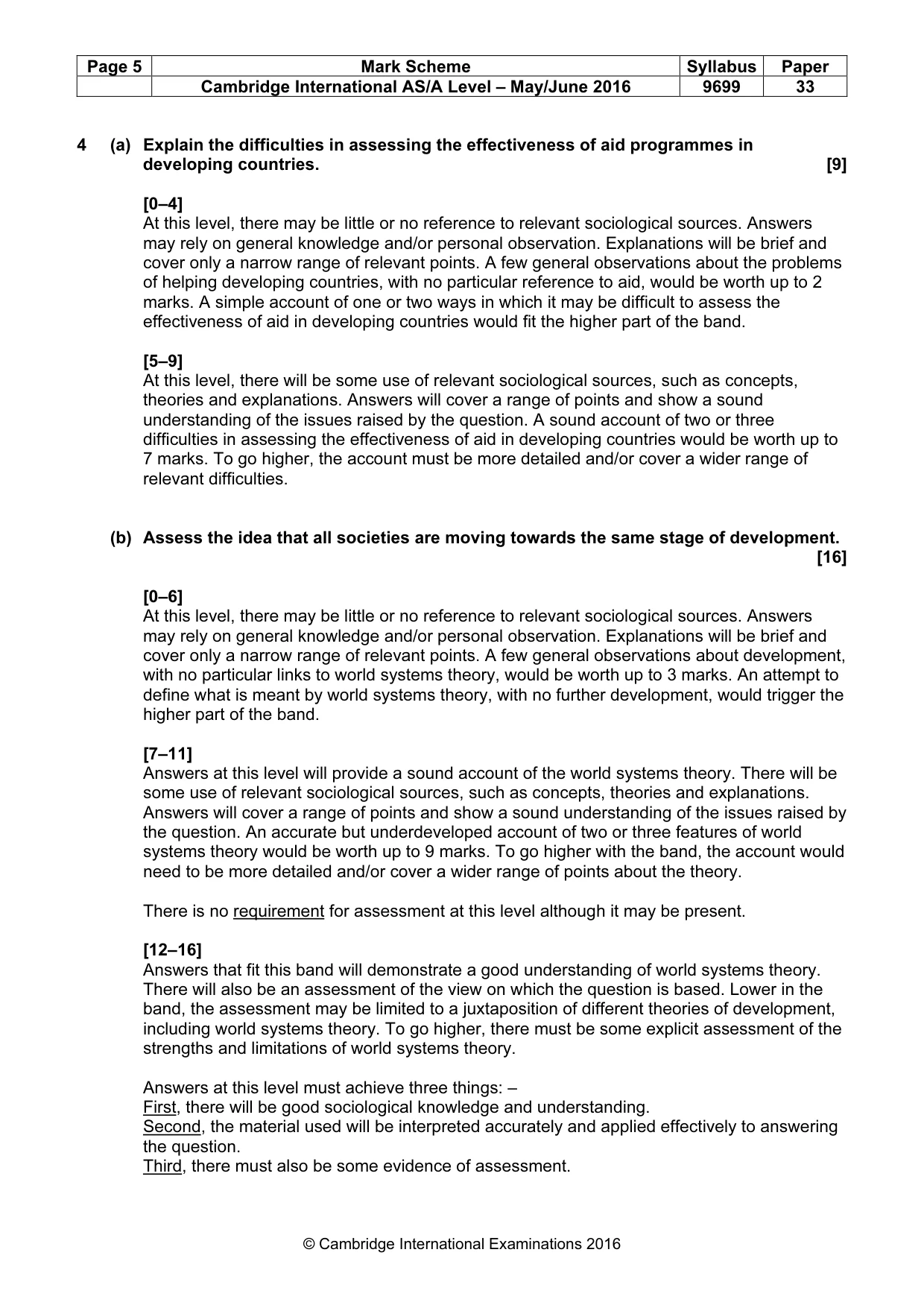
Page 5 Mark Scheme Syllabus Paper Cambridge International AS/A Level – May/June 2016 9699 33 © Cambridge International Examinations 2016 4 (a) Explain the difficulties in assessing the effectiveness of aid programmes in developing countries. [9] [0–4] At this level, there may be little or no reference to relevant sociological sources. Answers may rely on general knowledge and/or personal observation. Explanations will be brief and cover only a narrow range of relevant points. A few general observations about the problems of helping developing countries, with no particular reference to aid, would be worth up to 2 marks. A simple account of one or two ways in which it may be difficult to assess the effectiveness of aid in developing countries would fit the higher part of the band. [5–9] At this level, there will be some use of relevant sociological sources, such as concepts, theories and explanations. Answers will cover a range of points and show a sound understanding of the issues raised by the question. A sound account of two or three difficulties in assessing the effectiveness of aid in developing countries would be worth up to 7 marks. To go higher, the account must be more detailed and/or cover a wider range of relevant difficulties. (b) Assess the idea that all societies are moving towards the same stage of development. [16] [0–6] At this level, there may be little or no reference to relevant sociological sources. Answers may rely on general knowledge and/or personal observation. Explanations will be brief and cover only a narrow range of relevant points. A few general observations about development, with no particular links to world systems theory, would be worth up to 3 marks. An attempt to define what is meant by world systems theory, with no further development, would trigger the higher part of the band. [7–11] Answers at this level will provide a sound account of the world systems theory. There will be some use of relevant sociological sources, such as concepts, theories and explanations. Answers will cover a range of points and show a sound understanding of the issues raised by the question. An accurate but underdeveloped account of two or three features of world systems theory would be worth up to 9 marks. To go higher with the band, the account would need to be more detailed and/or cover a wider range of points about the theory. There is no requirement for assessment at this level although it may be present. [12–16] Answers that fit this band will demonstrate a good understanding of world systems theory. There will also be an assessment of the view on which the question is based. Lower in the band, the assessment may be limited to a juxtaposition of different theories of development, including world systems theory. To go higher, there must be some explicit assessment of the strengths and limitations of world systems theory. Answers at this level must achieve three things: – First, there will be good sociological knowledge and understanding. Second, the material used will be interpreted accurately and applied effectively to answering the question. Third, there must also be some evidence of assessment.
Mark scheme, page 6
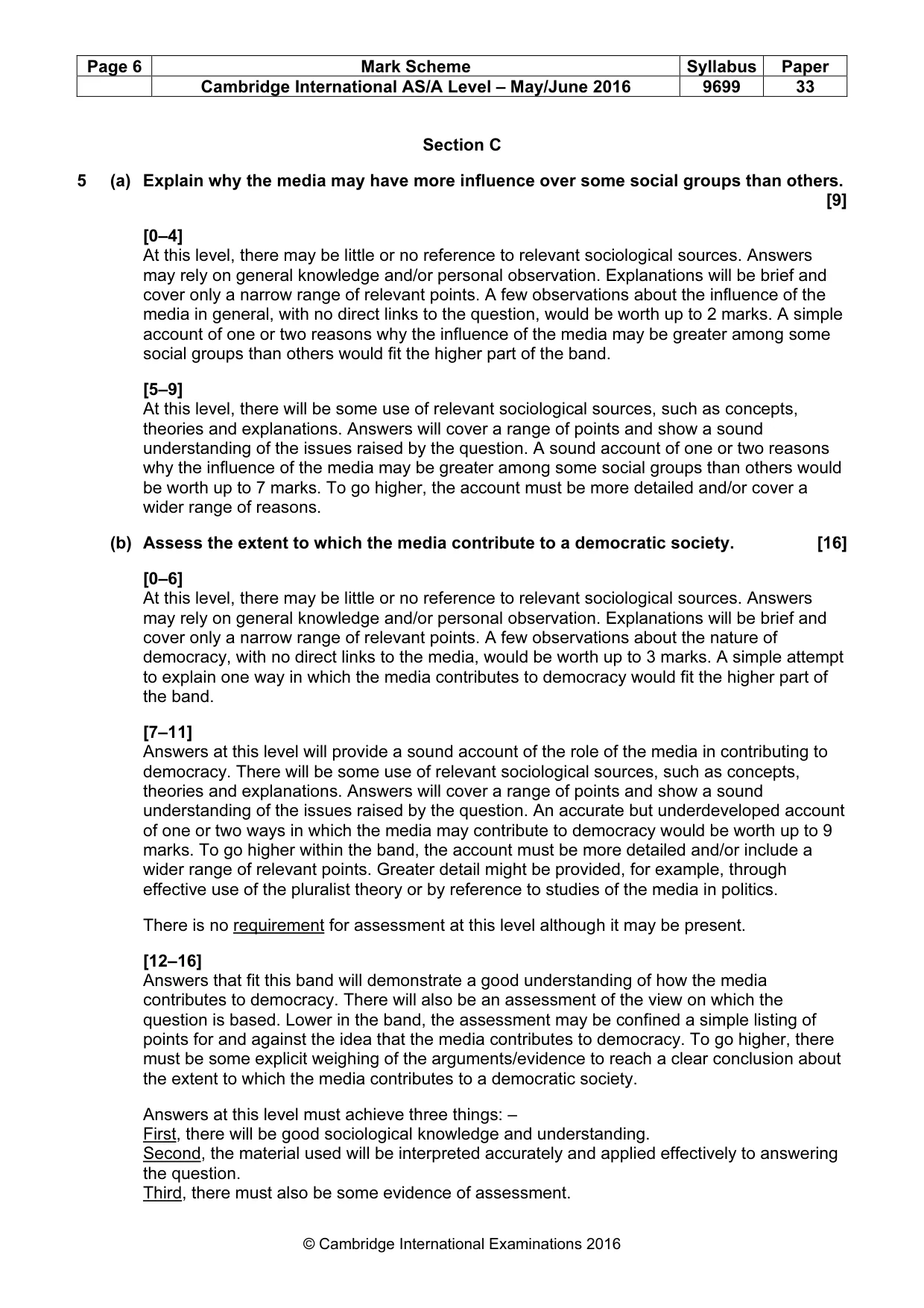
Page 6 Mark Scheme Syllabus Paper Cambridge International AS/A Level – May/June 2016 9699 33 © Cambridge International Examinations 2016 Section C 5 (a) Explain why the media may have more influence over some social groups than others. [9] [0–4] At this level, there may be little or no reference to relevant sociological sources. Answers may rely on general knowledge and/or personal observation. Explanations will be brief and cover only a narrow range of relevant points. A few observations about the influence of the media in general, with no direct links to the question, would be worth up to 2 marks. A simple account of one or two reasons why the influence of the media may be greater among some social groups than others would fit the higher part of the band. [5–9] At this level, there will be some use of relevant sociological sources, such as concepts, theories and explanations. Answers will cover a range of points and show a sound understanding of the issues raised by the question. A sound account of one or two reasons why the influence of the media may be greater among some social groups than others would be worth up to 7 marks. To go higher, the account must be more detailed and/or cover a wider range of reasons. (b) Assess the extent to which the media contribute to a democratic society. [16] [0–6] At this level, there may be little or no reference to relevant sociological sources. Answers may rely on general knowledge and/or personal observation. Explanations will be brief and cover only a narrow range of relevant points. A few observations about the nature of democracy, with no direct links to the media, would be worth up to 3 marks. A simple attempt to explain one way in which the media contributes to democracy would fit the higher part of the band. [7–11] Answers at this level will provide a sound account of the role of the media in contributing to democracy. There will be some use of relevant sociological sources, such as concepts, theories and explanations. Answers will cover a range of points and show a sound understanding of the issues raised by the question. An accurate but underdeveloped account of one or two ways in which the media may contribute to democracy would be worth up to 9 marks. To go higher within the band, the account must be more detailed and/or include a wider range of relevant points. Greater detail might be provided, for example, through effective use of the pluralist theory or by reference to studies of the media in politics. There is no requirement for assessment at this level although it may be present. [12–16] Answers that fit this band will demonstrate a good understanding of how the media contributes to democracy. There will also be an assessment of the view on which the question is based. Lower in the band, the assessment may be confined a simple listing of points for and against the idea that the media contributes to democracy. To go higher, there must be some explicit weighing of the arguments/evidence to reach a clear conclusion about the extent to which the media contributes to a democratic society. Answers at this level must achieve three things: – First, there will be good sociological knowledge and understanding. Second, the material used will be interpreted accurately and applied effectively to answering the question. Third, there must also be some evidence of assessment.
Mark scheme, page 7
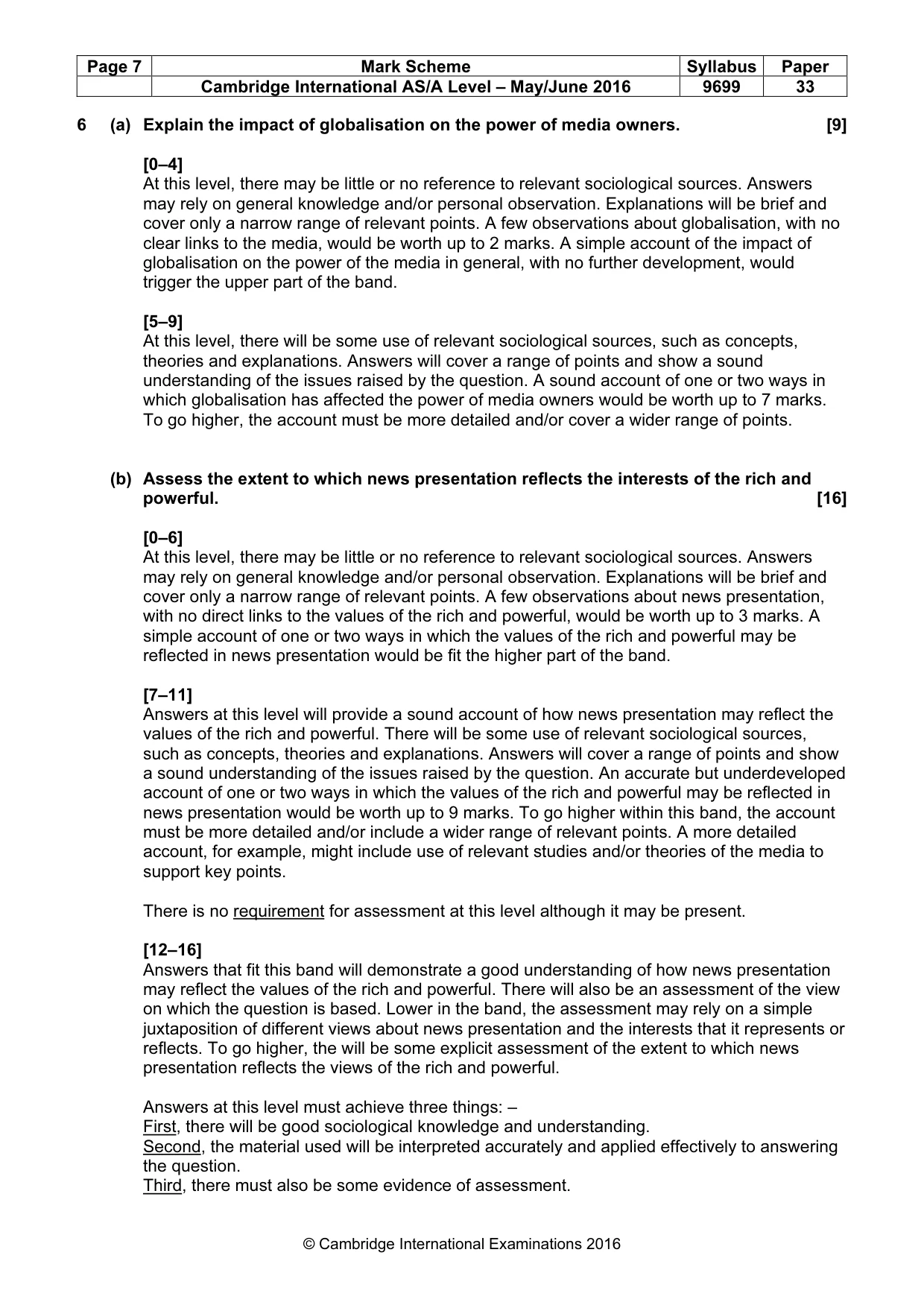
Page 7 Mark Scheme Syllabus Paper Cambridge International AS/A Level – May/June 2016 9699 33 © Cambridge International Examinations 2016 6 (a) Explain the impact of globalisation on the power of media owners. [9] [0–4] At this level, there may be little or no reference to relevant sociological sources. Answers may rely on general knowledge and/or personal observation. Explanations will be brief and cover only a narrow range of relevant points. A few observations about globalisation, with no clear links to the media, would be worth up to 2 marks. A simple account of the impact of globalisation on the power of the media in general, with no further development, would trigger the upper part of the band. [5–9] At this level, there will be some use of relevant sociological sources, such as concepts, theories and explanations. Answers will cover a range of points and show a sound understanding of the issues raised by the question. A sound account of one or two ways in which globalisation has affected the power of media owners would be worth up to 7 marks. To go higher, the account must be more detailed and/or cover a wider range of points. (b) Assess the extent to which news presentation reflects the interests of the rich and powerful. [16] [0–6] At this level, there may be little or no reference to relevant sociological sources. Answers may rely on general knowledge and/or personal observation. Explanations will be brief and cover only a narrow range of relevant points. A few observations about news presentation, with no direct links to the values of the rich and powerful, would be worth up to 3 marks. A simple account of one or two ways in which the values of the rich and powerful may be reflected in news presentation would be fit the higher part of the band. [7–11] Answers at this level will provide a sound account of how news presentation may reflect the values of the rich and powerful. There will be some use of relevant sociological sources, such as concepts, theories and explanations. Answers will cover a range of points and show a sound understanding of the issues raised by the question. An accurate but underdeveloped account of one or two ways in which the values of the rich and powerful may be reflected in news presentation would be worth up to 9 marks. To go higher within this band, the account must be more detailed and/or include a wider range of relevant points. A more detailed account, for example, might include use of relevant studies and/or theories of the media to support key points. There is no requirement for assessment at this level although it may be present. [12–16] Answers that fit this band will demonstrate a good understanding of how news presentation may reflect the values of the rich and powerful. There will also be an assessment of the view on which the question is based. Lower in the band, the assessment may rely on a simple juxtaposition of different views about news presentation and the interests that it represents or reflects. To go higher, the will be some explicit assessment of the extent to which news presentation reflects the views of the rich and powerful. Answers at this level must achieve three things: – First, there will be good sociological knowledge and understanding. Second, the material used will be interpreted accurately and applied effectively to answering the question. Third, there must also be some evidence of assessment.
Mark scheme, page 8
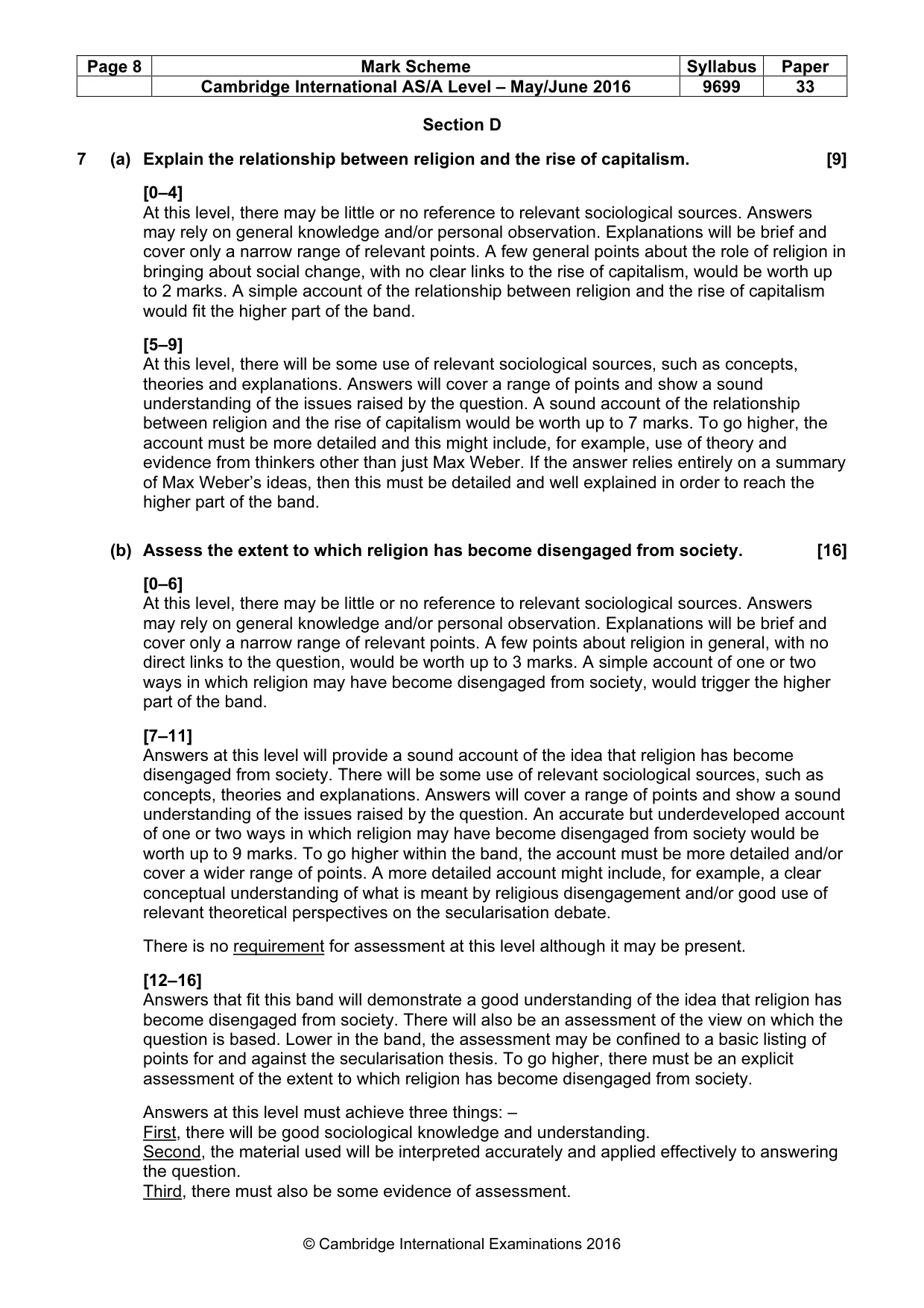
Page 8 Mark Scheme Syllabus Paper Cambridge International AS/A Level – May/June 2016 9699 33 © Cambridge International Examinations 2016 Section D 7 (a) Explain the relationship between religion and the rise of capitalism. [9] [0–4] At this level, there may be little or no reference to relevant sociological sources. Answers may rely on general knowledge and/or personal observation. Explanations will be brief and cover only a narrow range of relevant points. A few general points about the role of religion in bringing about social change, with no clear links to the rise of capitalism, would be worth up to 2 marks. A simple account of the relationship between religion and the rise of capitalism would fit the higher part of the band. [5–9] At this level, there will be some use of relevant sociological sources, such as concepts, theories and explanations. Answers will cover a range of points and show a sound understanding of the issues raised by the question. A sound account of the relationship between religion and the rise of capitalism would be worth up to 7 marks. To go higher, the account must be more detailed and this might include, for example, use of theory and evidence from thinkers other than just Max Weber. If the answer relies entirely on a summary of Max Weber’s ideas, then this must be detailed and well explained in order to reach the higher part of the band. (b) Assess the extent to which religion has become disengaged from society. [16] [0–6] At this level, there may be little or no reference to relevant sociological sources. Answers may rely on general knowledge and/or personal observation. Explanations will be brief and cover only a narrow range of relevant points. A few points about religion in general, with no direct links to the question, would be worth up to 3 marks. A simple account of one or two ways in which religion may have become disengaged from society, would trigger the higher part of the band. [7–11] Answers at this level will provide a sound account of the idea that religion has become disengaged from society. There will be some use of relevant sociological sources, such as concepts, theories and explanations. Answers will cover a range of points and show a sound understanding of the issues raised by the question. An accurate but underdeveloped account of one or two ways in which religion may have become disengaged from society would be worth up to 9 marks. To go higher within the band, the account must be more detailed and/or cover a wider range of points. A more detailed account might include, for example, a clear conceptual understanding of what is meant by religious disengagement and/or good use of relevant theoretical perspectives on the secularisation debate. There is no requirement for assessment at this level although it may be present. [12–16] Answers that fit this band will demonstrate a good understanding of the idea that religion has become disengaged from society. There will also be an assessment of the view on which the question is based. Lower in the band, the assessment may be confined to a basic listing of points for and against the secularisation thesis. To go higher, there must be an explicit assessment of the extent to which religion has become disengaged from society. Answers at this level must achieve three things: – First, there will be good sociological knowledge and understanding. Second, the material used will be interpreted accurately and applied effectively to answering the question. Third, there must also be some evidence of assessment.
Mark scheme, page 9
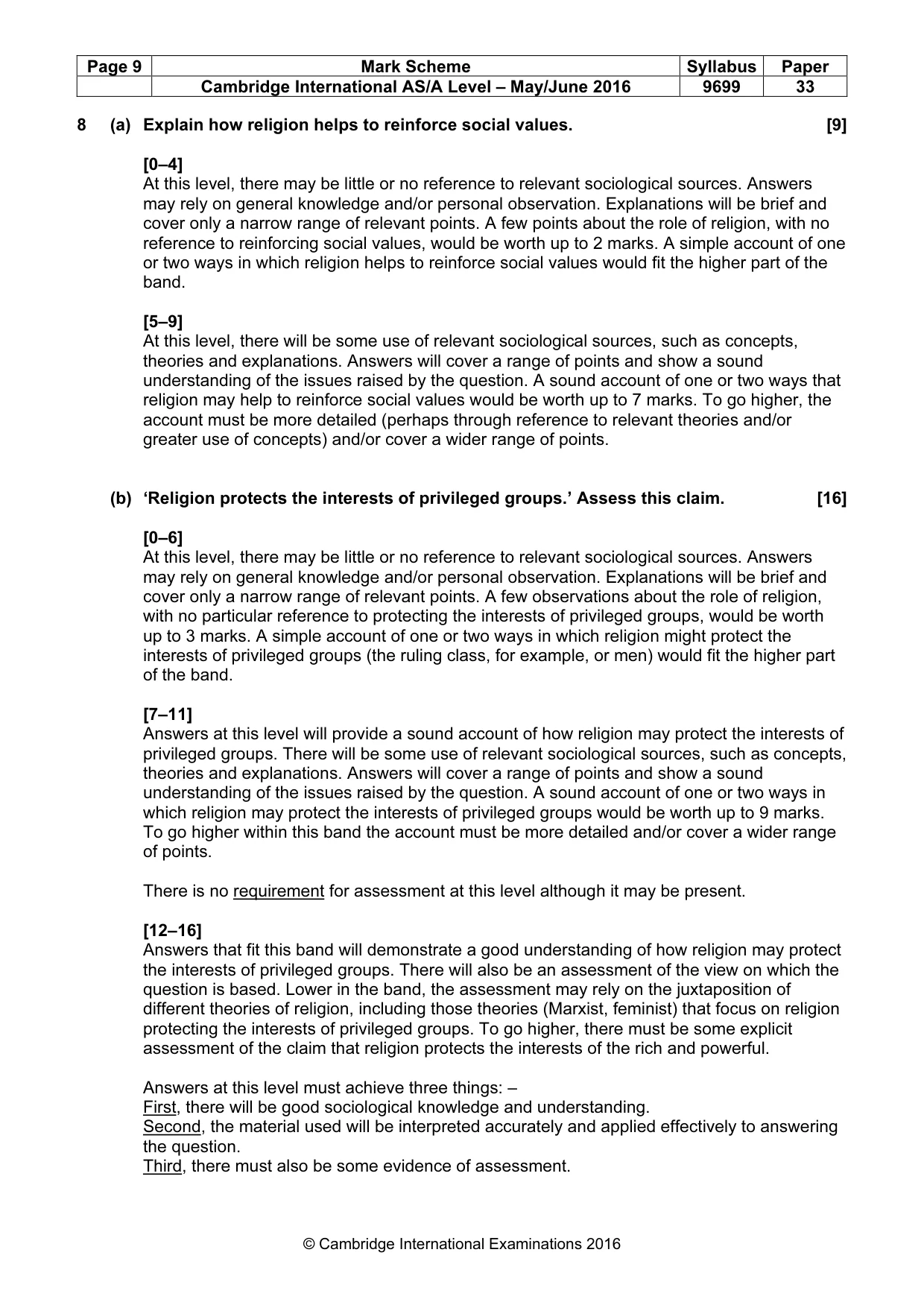
Page 9 Mark Scheme Syllabus Paper Cambridge International AS/A Level – May/June 2016 9699 33 © Cambridge International Examinations 2016 8 (a) Explain how religion helps to reinforce social values. [9] [0–4] At this level, there may be little or no reference to relevant sociological sources. Answers may rely on general knowledge and/or personal observation. Explanations will be brief and cover only a narrow range of relevant points. A few points about the role of religion, with no reference to reinforcing social values, would be worth up to 2 marks. A simple account of one or two ways in which religion helps to reinforce social values would fit the higher part of the band. [5–9] At this level, there will be some use of relevant sociological sources, such as concepts, theories and explanations. Answers will cover a range of points and show a sound understanding of the issues raised by the question. A sound account of one or two ways that religion may help to reinforce social values would be worth up to 7 marks. To go higher, the account must be more detailed (perhaps through reference to relevant theories and/or greater use of concepts) and/or cover a wider range of points. (b) ‘Religion protects the interests of privileged groups.’ Assess this claim. [16] [0–6] At this level, there may be little or no reference to relevant sociological sources. Answers may rely on general knowledge and/or personal observation. Explanations will be brief and cover only a narrow range of relevant points. A few observations about the role of religion, with no particular reference to protecting the interests of privileged groups, would be worth up to 3 marks. A simple account of one or two ways in which religion might protect the interests of privileged groups (the ruling class, for example, or men) would fit the higher part of the band. [7–11] Answers at this level will provide a sound account of how religion may protect the interests of privileged groups. There will be some use of relevant sociological sources, such as concepts, theories and explanations. Answers will cover a range of points and show a sound understanding of the issues raised by the question. A sound account of one or two ways in which religion may protect the interests of privileged groups would be worth up to 9 marks. To go higher within this band the account must be more detailed and/or cover a wider range of points. There is no requirement for assessment at this level although it may be present. [12–16] Answers that fit this band will demonstrate a good understanding of how religion may protect the interests of privileged groups. There will also be an assessment of the view on which the question is based. Lower in the band, the assessment may rely on the juxtaposition of different theories of religion, including those theories (Marxist, feminist) that focus on religion protecting the interests of privileged groups. To go higher, there must be some explicit assessment of the claim that religion protects the interests of the rich and powerful. Answers at this level must achieve three things: – First, there will be good sociological knowledge and understanding. Second, the material used will be interpreted accurately and applied effectively to answering the question. Third, there must also be some evidence of assessment.
What you needed in this session
Cambridge’s own grade thresholds for 2016 May/June, Paper 3 · Variant 3. A higher threshold means an easier paper — the bar moves with how the cohort did.