Cambridge A Level Sociology 9699 — 2013 May/June Paper 2 · Variant 1
9699/21/M/J/13 · 50 marks · ≈56 min
The question paper and its mark scheme, free to read here and free to download. This is Cambridge’s own paper, exactly as it was sat.
Question paper16 pages




Mark scheme7 pages
Answers below. Sit the paper first if you are practising.
Paper as text
Question paper, page 1
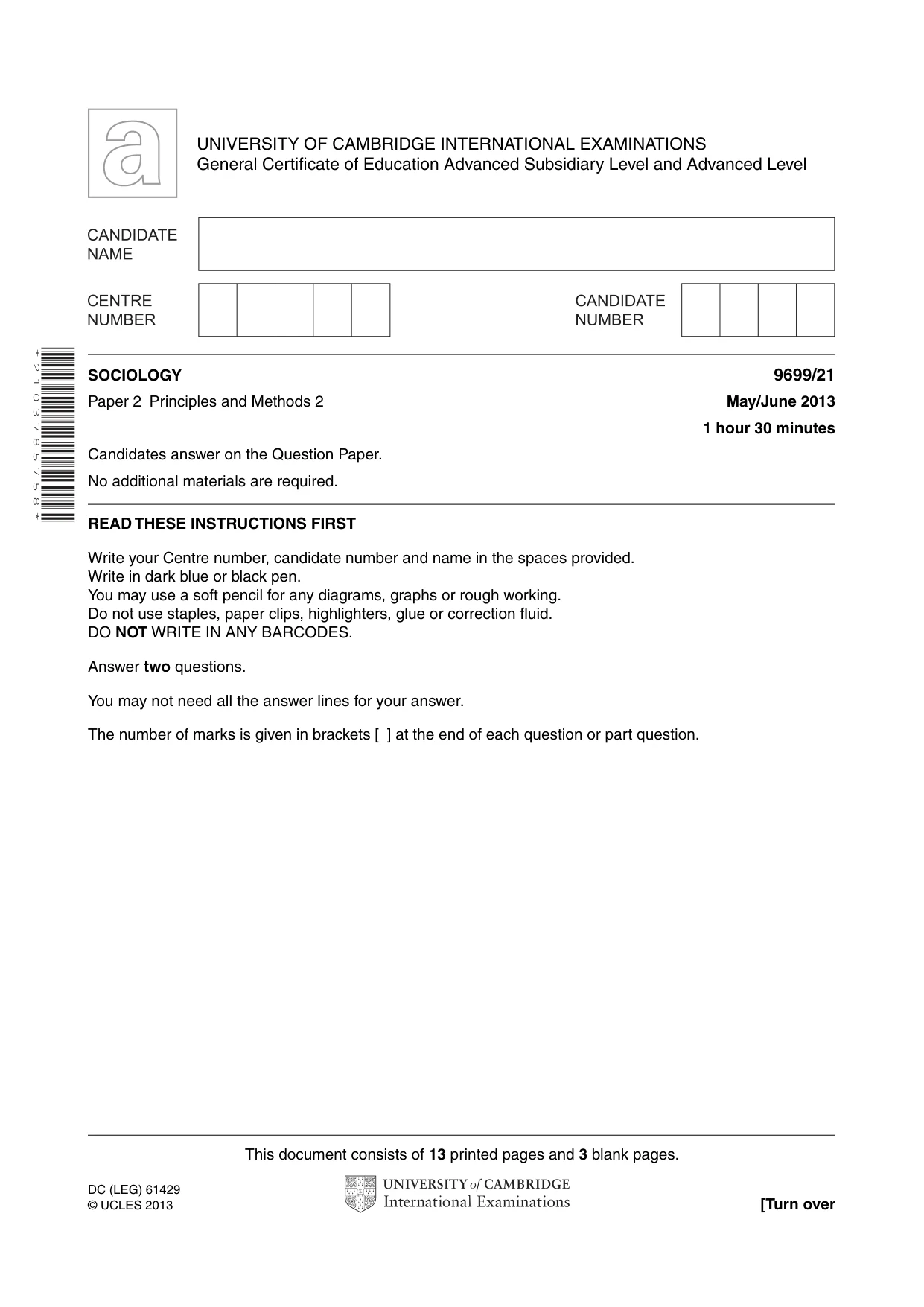
This document consists of 13 printed pages and 3 blank pages. DC (LEG) 61429 © UCLES 2013 [Turn over UNIVERSITY OF CAMBRIDGE INTERNATIONAL EXAMINATIONS General Certificate of Education Advanced Subsidiary Level and Advanced Level * 2 1 0 3 7 8 5 7 5 8 * SOCIOLOGY 9699/21 Paper 2 Principles and Methods 2 May/June 2013 1 hour 30 minutes Candidates answer on the Question Paper. No additional materials are required. READ THESE INSTRUCTIONS FIRST Write your Centre number, candidate number and name in the spaces provided. Write in dark blue or black pen. You may use a soft pencil for any diagrams, graphs or rough working. Do not use staples, paper clips, highlighters, glue or correction fluid. DO NOT WRITE IN ANY BARCODES. Answer two questions. You may not need all the answer lines for your answer. The number of marks is given in brackets [ ] at the end of each question or part question.
Question paper, page 2
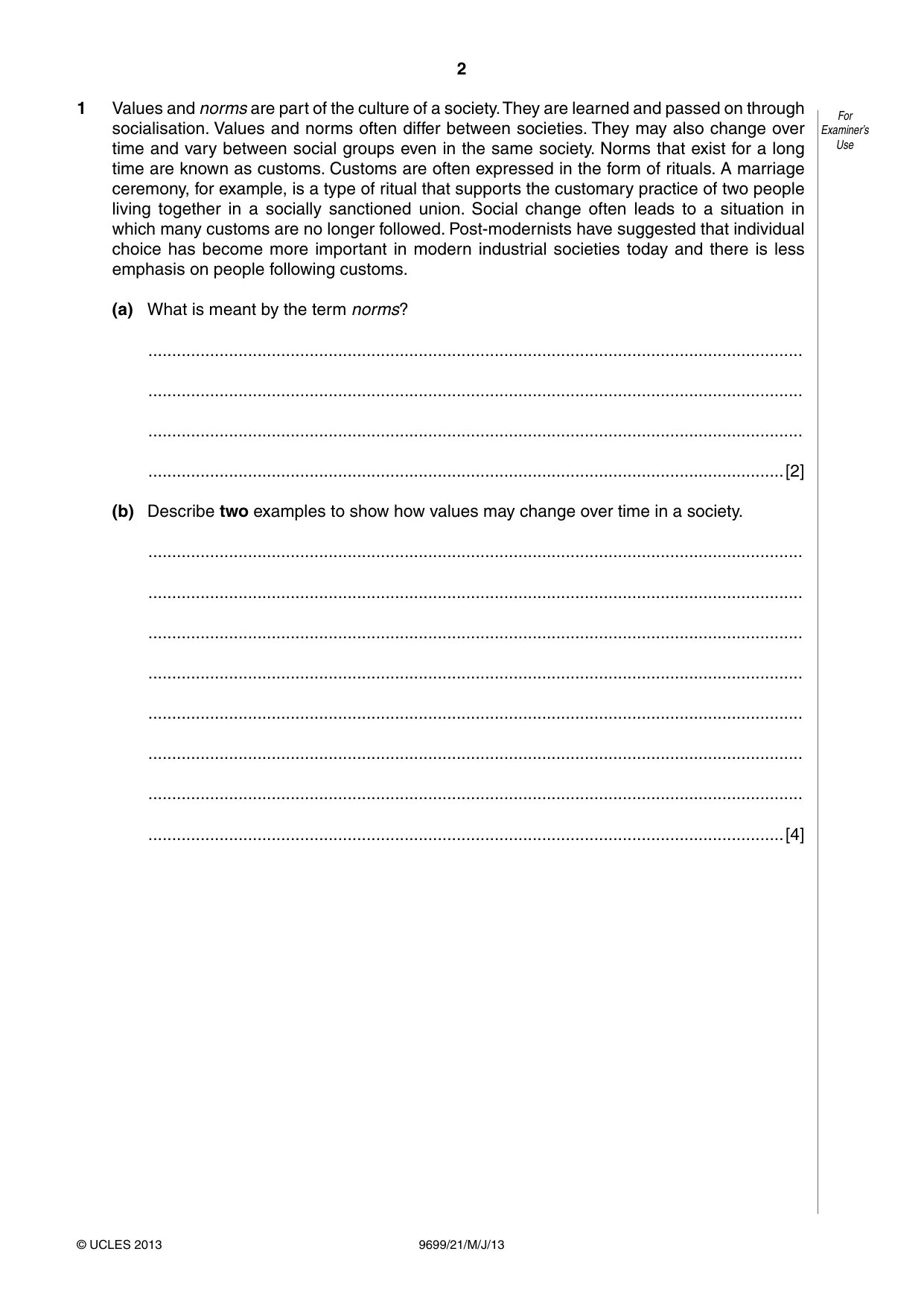
2 9699/21/M/J/13 © UCLES 2013 For Examiner’s Use 1 Values and norms are part of the culture of a society. They are learned and passed on through socialisation. Values and norms often differ between societies. They may also change over time and vary between social groups even in the same society. Norms that exist for a long time are known as customs. Customs are often expressed in the form of rituals. A marriage ceremony, for example, is a type of ritual that supports the customary practice of two people living together in a socially sanctioned union. Social change often leads to a situation in which many customs are no longer followed. Post-modernists have suggested that individual choice has become more important in modern industrial societies today and there is less emphasis on people following customs. (a) What is meant by the term norms? … … … …[2] (b) Describe two examples to show how values may change over time in a society. … … … … … … … …[4]
Question paper, page 3
3 9699/21/M/J/13 © UCLES 2013 [Turn over For Examiner’s Use (c) Explain why values may vary between social groups even in the same society. … … … … … … … … … … … … … … … … … … … … … … … … … … …[8]
Question paper, page 4
4 9699/21/M/J/13 © UCLES 2013 For Examiner’s Use (d) Assess the post-modernist view that there is less emphasis on people following customs in modern industrial societies today. … … … … … … … … … … … … … … … … … … … … … … … … … … …
Question paper, page 5
5 9699/21/M/J/13 © UCLES 2013 [Turn over For Examiner’s Use … … … … … … … … … … … … … … … … … … … … … … … … … … … …[11]
Question paper, page 6
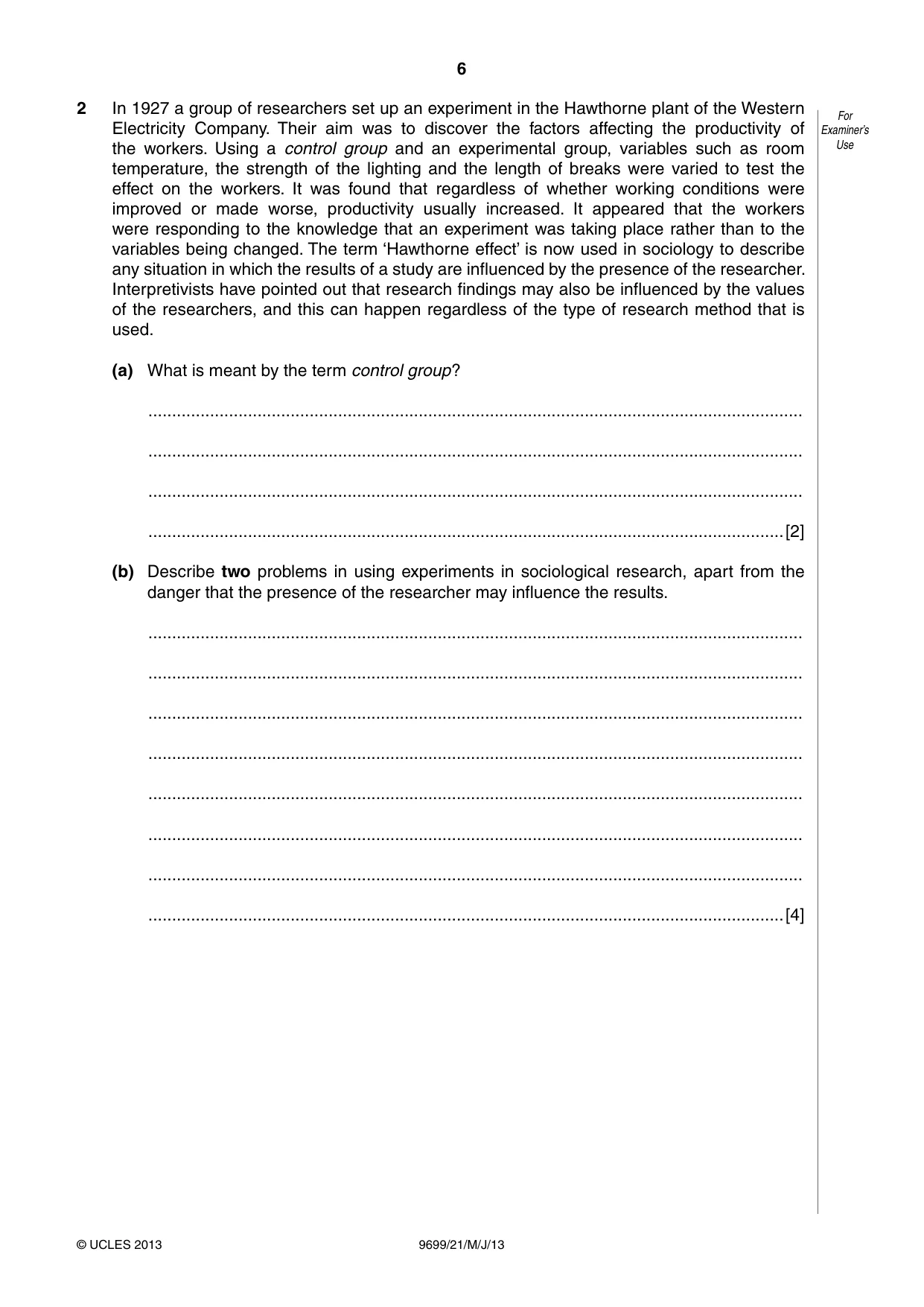
6 9699/21/M/J/13 © UCLES 2013 For Examiner’s Use 2 In 1927 a group of researchers set up an experiment in the Hawthorne plant of the Western Electricity Company. Their aim was to discover the factors affecting the productivity of the workers. Using a control group and an experimental group, variables such as room temperature, the strength of the lighting and the length of breaks were varied to test the effect on the workers. It was found that regardless of whether working conditions were improved or made worse, productivity usually increased. It appeared that the workers were responding to the knowledge that an experiment was taking place rather than to the variables being changed. The term ‘Hawthorne effect’ is now used in sociology to describe any situation in which the results of a study are influenced by the presence of the researcher. Interpretivists have pointed out that research findings may also be influenced by the values of the researchers, and this can happen regardless of the type of research method that is used. (a) What is meant by the term control group ? … … … …[2] (b) Describe two problems in using experiments in sociological research, apart from the danger that the presence of the researcher may influence the results. … … … … … … … …[4]
Question paper, page 7
7 9699/21/M/J/13 © UCLES 2013 [Turn over For Examiner’s Use (c) Explain why the presence of the researcher may influence the results of a sociological study. … … … … … … … … … … … … … … … … … … … … … … … … … … …[8]
Question paper, page 8
8 9699/21/M/J/13 © UCLES 2013 For Examiner’s Use (d) Assess the view that it is impossible to prevent research findings being influenced by the values of the researcher. … … … … … … … … … … … … … … … … … … … … … … … … … … …
Question paper, page 9
9 9699/21/M/J/13 © UCLES 2013 [Turn over For Examiner’s Use … … … … … … … … … … … … … … … … … … … … … … … … … … … …[11]
Question paper, page 10
10 9699/21/M/J/13 © UCLES 2013 For Examiner’s Use 3 Inequality in the distribution of income and wealth creates significant differences in life chances between people. Those who possess wealth will have control over their lives and will be able to participate fully in society. Those who live on low incomes and lack wealth are likely to be trapped in poverty. They will have little control over their lives and may be excluded from participating in many aspects of society. Although many believe that large differences in income and wealth have disappeared in modern industrial societies, research suggests that the opposite is the case, with the gap between the poor and the rich widening. High levels of poverty remain despite the existence of the welfare state and attempts by governments to redistribute wealth. (a) What is meant by the term wealth? …[2] (b) Describe two ways in which a person’s life chances may be affected by their income. … … … … … … … …[4]
Question paper, page 11
11 9699/21/M/J/13 © UCLES 2013 [Turn over For Examiner’s Use (c) Explain why being poor may exclude a person from participating fully in many aspects of society. … … … … … … … … … … … … … … … … … … … … … … … … … … …[8]
Question paper, page 12
12 9699/21/M/J/13 © UCLES 2013 For Examiner’s Use (d) Assess explanations for why high levels of poverty remain despite the existence of the welfare state in modern industrial societies. … … … … … … … … … … … … … … … … … … … … … … … … … … …
Question paper, page 13
13 9699/21/M/J/13 © UCLES 2013 For Examiner’s Use … … … … … … … … … … … … … … … … … … … … … … … … … … … …[11]
Question paper, page 14
14 9699/21/M/J/13 © UCLES 2013 BLANK PAGE
Question paper, page 15
15 9699/21/M/J/13 © UCLES 2013 BLANK PAGE
Question paper, page 16
16 9699/21/M/J/13 © UCLES 2013 Permission to reproduce items where third-party owned material protected by copyright is included has been sought and cleared where possible. Every reasonable effort has been made by the publisher (UCLES) to trace copyright holders, but if any items requiring clearance have unwittingly been included, the publisher will be pleased to make amends at the earliest possible opportunity. University of Cambridge International Examinations is part of the Cambridge Assessment Group. Cambridge Assessment is the brand name of University of Cambridge Local Examinations Syndicate (UCLES), which is itself a department of the University of Cambridge. BLANK PAGE
Mark scheme, page 1
CAMBRIDGE INTERNATIONAL EXAMINATIONS GCE Advanced Subsidiary Level and GCE Advanced Level MARK SCHEME for the May/June 2013 series 9699 SOCIOLOGY 9699/21 Paper 2 (Principles and Methods 2), maximum raw mark 50 This mark scheme is published as an aid to teachers and candidates, to indicate the requirements of the examination. It shows the basis on which Examiners were instructed to award marks. It does not indicate the details of the discussions that took place at an Examiners’ meeting before marking began, which would have considered the acceptability of alternative answers. Mark schemes should be read in conjunction with the question paper and the Principal Examiner Report for Teachers. Cambridge will not enter into discussions about these mark schemes. Cambridge is publishing the mark schemes for the May/June 2013 series for most IGCSE, GCE Advanced Level and Advanced Subsidiary Level components and some Ordinary Level components.
Mark scheme, page 2
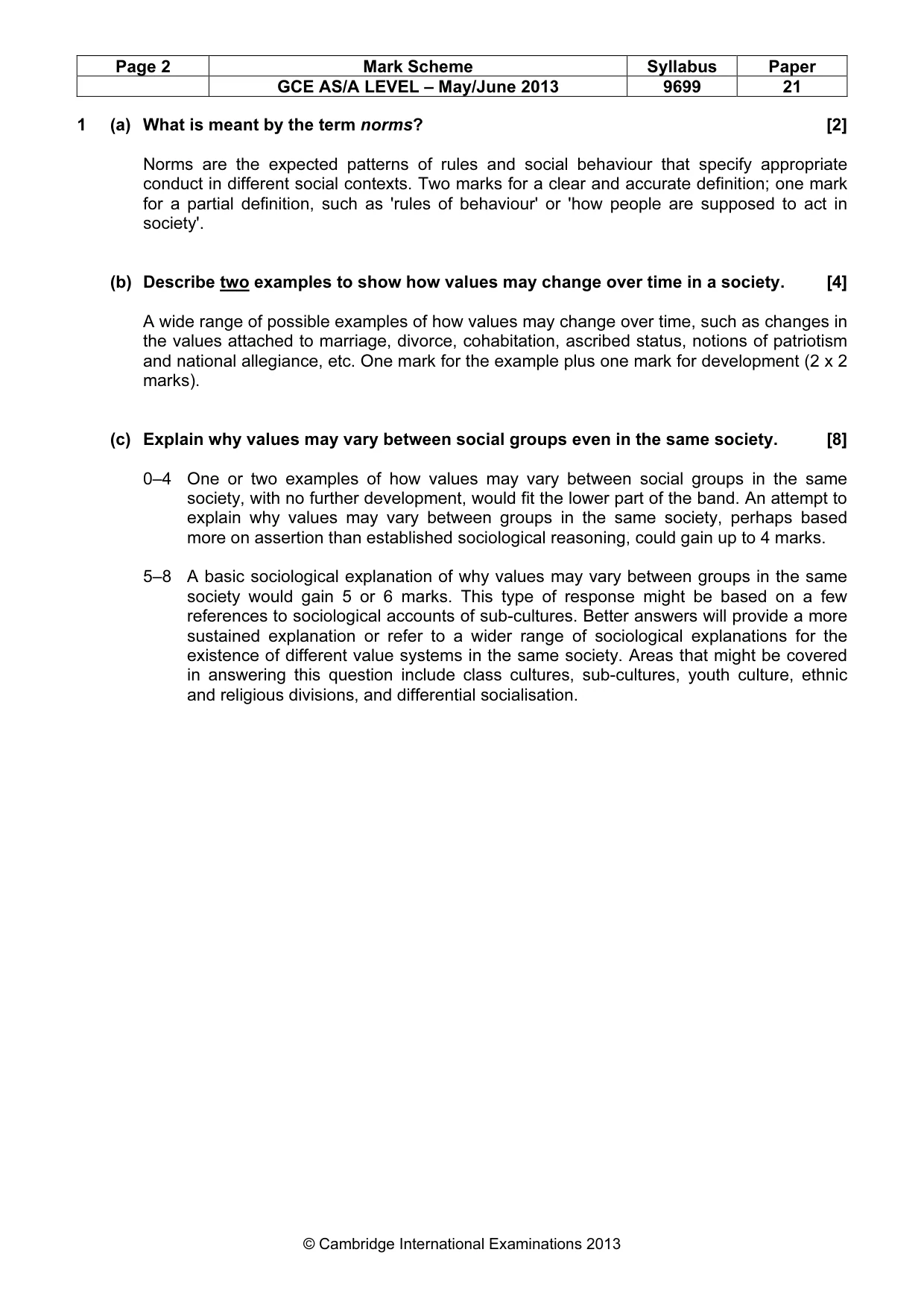
Page 2 Mark Scheme Syllabus Paper GCE AS/A LEVEL – May/June 2013 9699 21 © Cambridge International Examinations 2013 1 (a) What is meant by the term norms? [2] Norms are the expected patterns of rules and social behaviour that specify appropriate conduct in different social contexts. Two marks for a clear and accurate definition; one mark for a partial definition, such as 'rules of behaviour' or 'how people are supposed to act in society'. (b) Describe two examples to show how values may change over time in a society. [4] A wide range of possible examples of how values may change over time, such as changes in the values attached to marriage, divorce, cohabitation, ascribed status, notions of patriotism and national allegiance, etc. One mark for the example plus one mark for development (2 x 2 marks). (c) Explain why values may vary between social groups even in the same society. [8] 0–4 One or two examples of how values may vary between social groups in the same society, with no further development, would fit the lower part of the band. An attempt to explain why values may vary between groups in the same society, perhaps based more on assertion than established sociological reasoning, could gain up to 4 marks. 5–8 A basic sociological explanation of why values may vary between groups in the same society would gain 5 or 6 marks. This type of response might be based on a few references to sociological accounts of sub-cultures. Better answers will provide a more sustained explanation or refer to a wider range of sociological explanations for the existence of different value systems in the same society. Areas that might be covered in answering this question include class cultures, sub-cultures, youth culture, ethnic and religious divisions, and differential socialisation.
Mark scheme, page 3
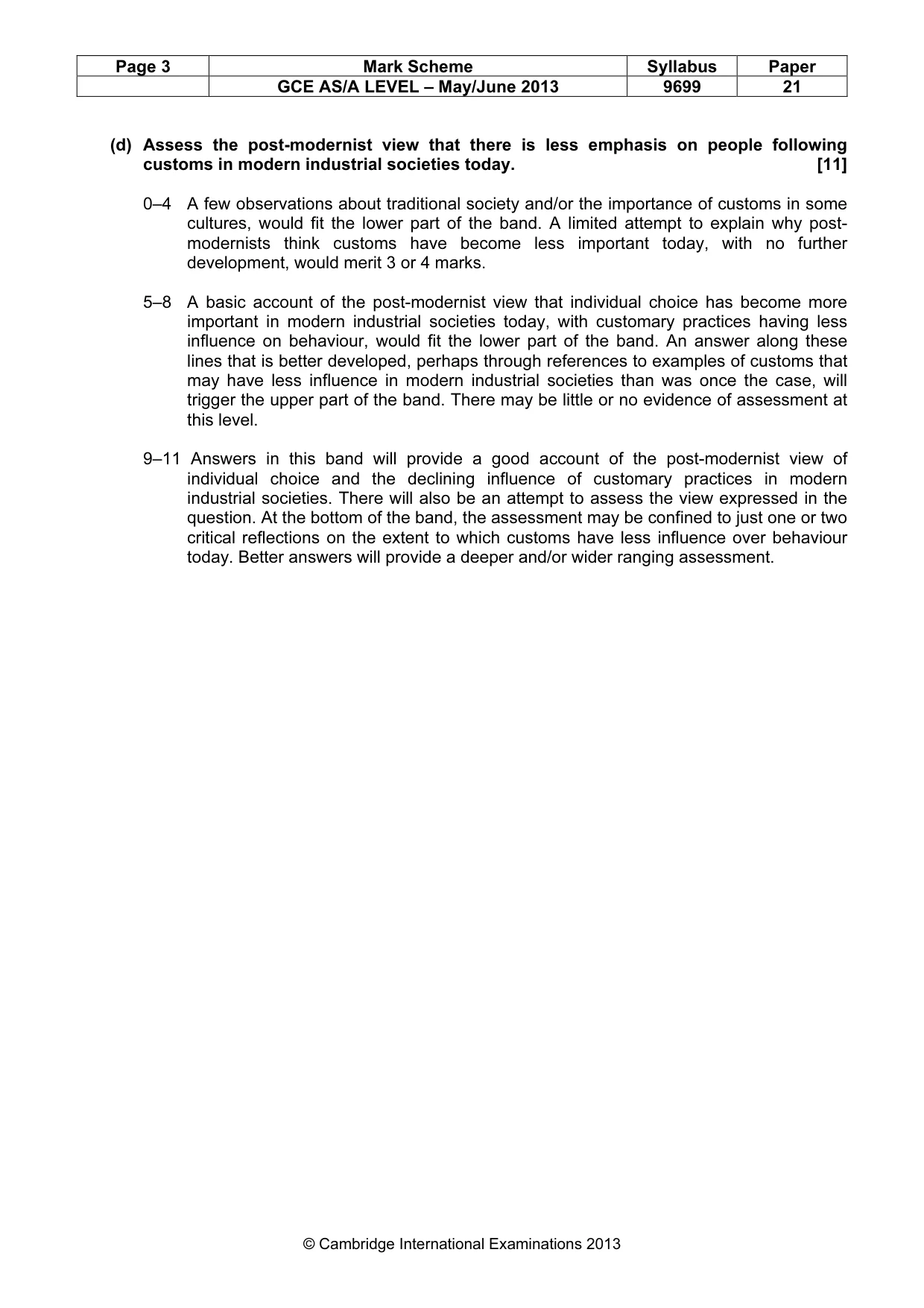
Page 3 Mark Scheme Syllabus Paper GCE AS/A LEVEL – May/June 2013 9699 21 © Cambridge International Examinations 2013 (d) Assess the post-modernist view that there is less emphasis on people following customs in modern industrial societies today. [11] 0–4 A few observations about traditional society and/or the importance of customs in some cultures, would fit the lower part of the band. A limited attempt to explain why post- modernists think customs have become less important today, with no further development, would merit 3 or 4 marks. 5–8 A basic account of the post-modernist view that individual choice has become more important in modern industrial societies today, with customary practices having less influence on behaviour, would fit the lower part of the band. An answer along these lines that is better developed, perhaps through references to examples of customs that may have less influence in modern industrial societies than was once the case, will trigger the upper part of the band. There may be little or no evidence of assessment at this level. 9–11 Answers in this band will provide a good account of the post-modernist view of individual choice and the declining influence of customary practices in modern industrial societies. There will also be an attempt to assess the view expressed in the question. At the bottom of the band, the assessment may be confined to just one or two critical reflections on the extent to which customs have less influence over behaviour today. Better answers will provide a deeper and/or wider ranging assessment.
Mark scheme, page 4
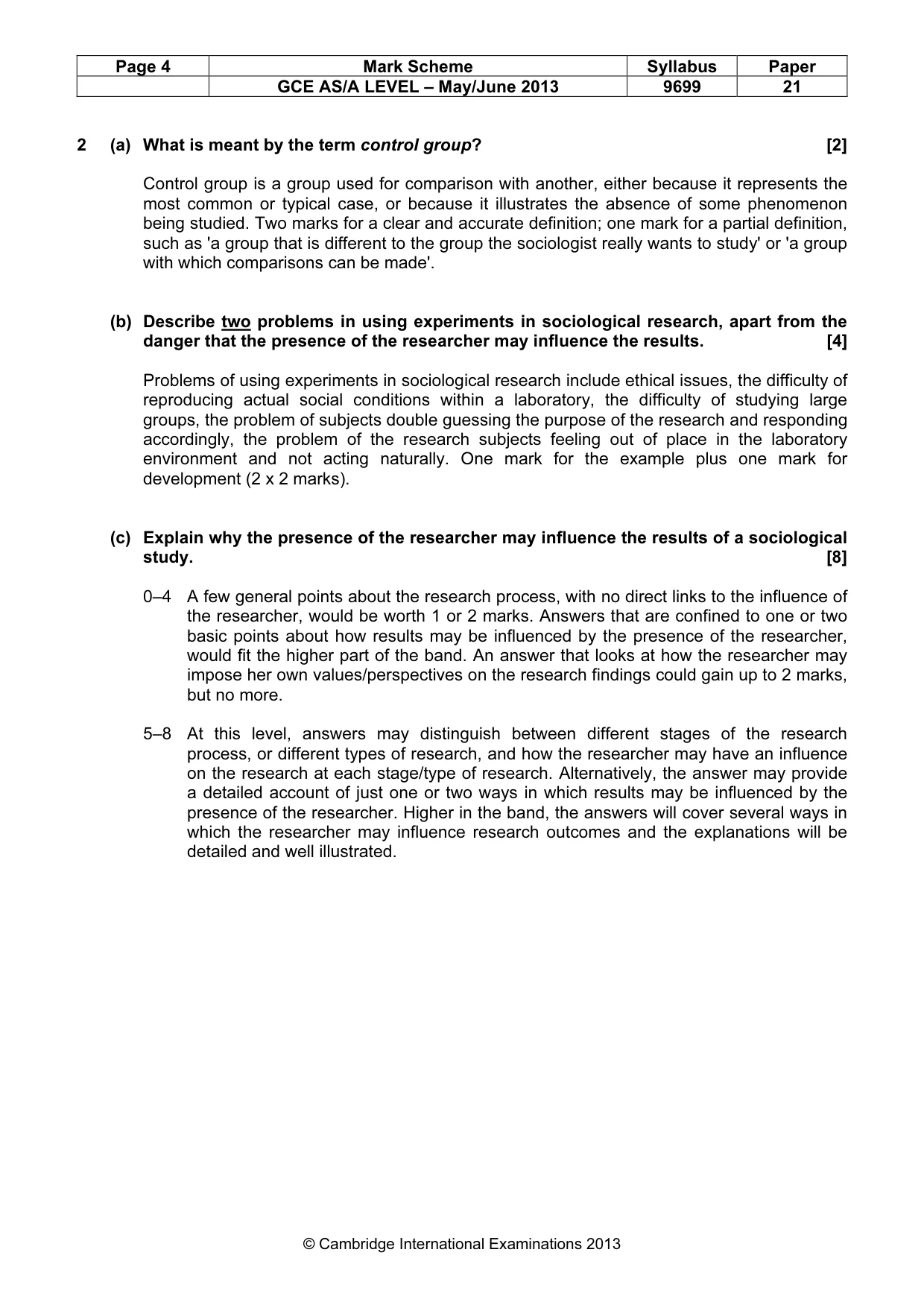
Page 4 Mark Scheme Syllabus Paper GCE AS/A LEVEL – May/June 2013 9699 21 © Cambridge International Examinations 2013 2 (a) What is meant by the term control group? [2] Control group is a group used for comparison with another, either because it represents the most common or typical case, or because it illustrates the absence of some phenomenon being studied. Two marks for a clear and accurate definition; one mark for a partial definition, such as 'a group that is different to the group the sociologist really wants to study' or 'a group with which comparisons can be made'. (b) Describe two problems in using experiments in sociological research, apart from the danger that the presence of the researcher may influence the results. [4] Problems of using experiments in sociological research include ethical issues, the difficulty of reproducing actual social conditions within a laboratory, the difficulty of studying large groups, the problem of subjects double guessing the purpose of the research and responding accordingly, the problem of the research subjects feeling out of place in the laboratory environment and not acting naturally. One mark for the example plus one mark for development (2 x 2 marks). (c) Explain why the presence of the researcher may influence the results of a sociological study. [8] 0–4 A few general points about the research process, with no direct links to the influence of the researcher, would be worth 1 or 2 marks. Answers that are confined to one or two basic points about how results may be influenced by the presence of the researcher, would fit the higher part of the band. An answer that looks at how the researcher may impose her own values/perspectives on the research findings could gain up to 2 marks, but no more. 5–8 At this level, answers may distinguish between different stages of the research process, or different types of research, and how the researcher may have an influence on the research at each stage/type of research. Alternatively, the answer may provide a detailed account of just one or two ways in which results may be influenced by the presence of the researcher. Higher in the band, the answers will cover several ways in which the researcher may influence research outcomes and the explanations will be detailed and well illustrated.
Mark scheme, page 5
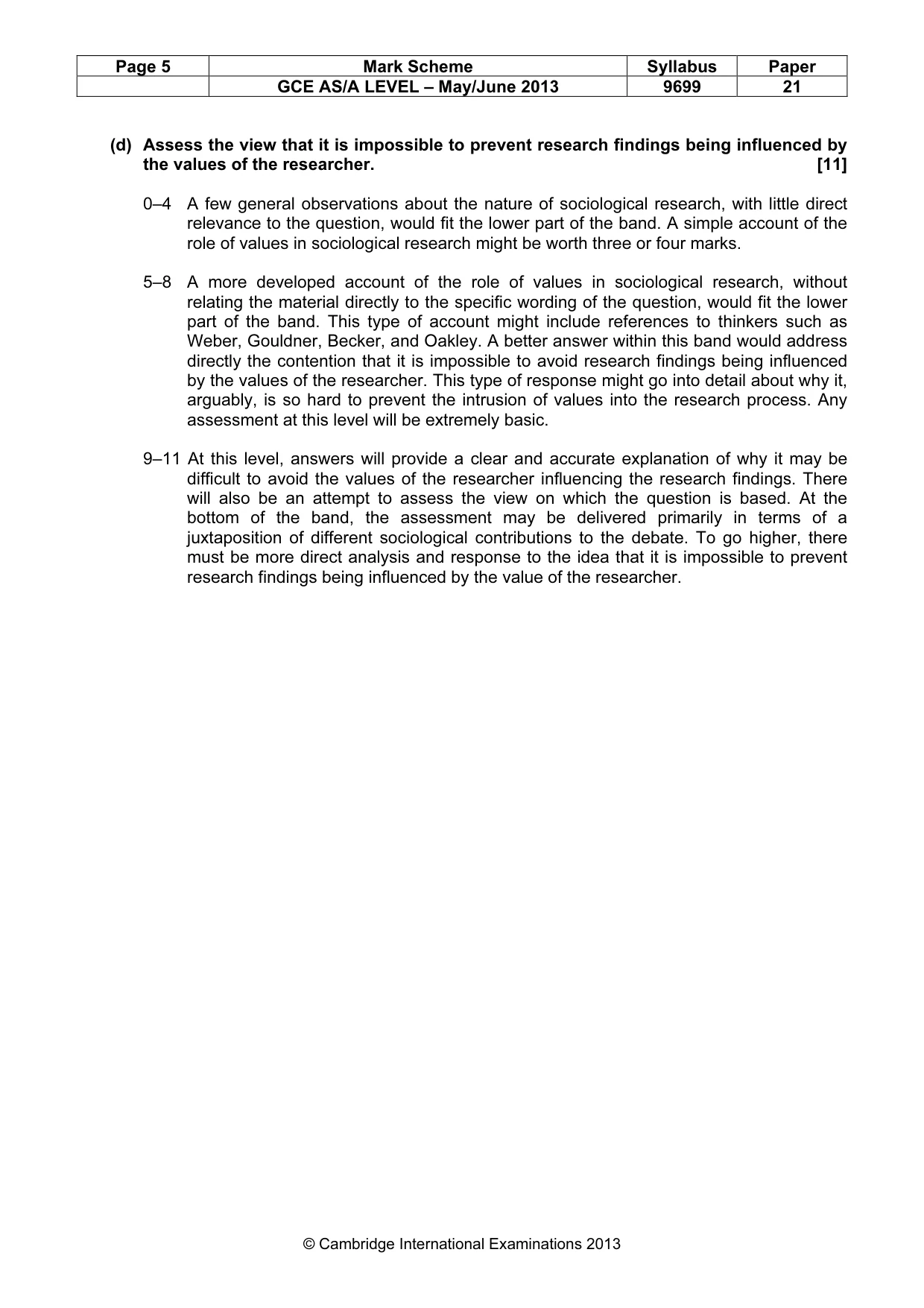
Page 5 Mark Scheme Syllabus Paper GCE AS/A LEVEL – May/June 2013 9699 21 © Cambridge International Examinations 2013 (d) Assess the view that it is impossible to prevent research findings being influenced by the values of the researcher. [11] 0–4 A few general observations about the nature of sociological research, with little direct relevance to the question, would fit the lower part of the band. A simple account of the role of values in sociological research might be worth three or four marks. 5–8 A more developed account of the role of values in sociological research, without relating the material directly to the specific wording of the question, would fit the lower part of the band. This type of account might include references to thinkers such as Weber, Gouldner, Becker, and Oakley. A better answer within this band would address directly the contention that it is impossible to avoid research findings being influenced by the values of the researcher. This type of response might go into detail about why it, arguably, is so hard to prevent the intrusion of values into the research process. Any assessment at this level will be extremely basic. 9–11 At this level, answers will provide a clear and accurate explanation of why it may be difficult to avoid the values of the researcher influencing the research findings. There will also be an attempt to assess the view on which the question is based. At the bottom of the band, the assessment may be delivered primarily in terms of a juxtaposition of different sociological contributions to the debate. To go higher, there must be more direct analysis and response to the idea that it is impossible to prevent research findings being influenced by the value of the researcher.
Mark scheme, page 6
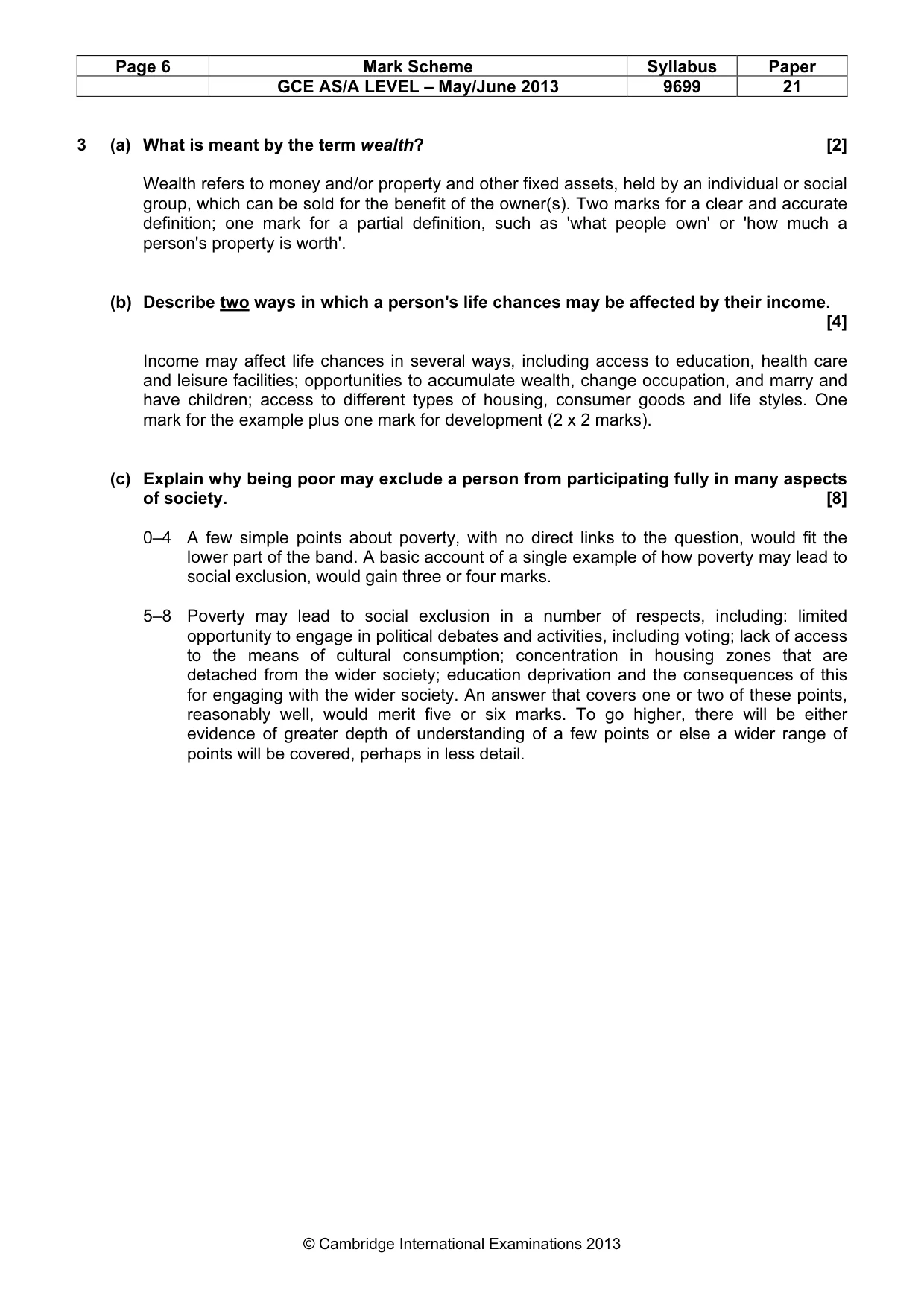
Page 6 Mark Scheme Syllabus Paper GCE AS/A LEVEL – May/June 2013 9699 21 © Cambridge International Examinations 2013 3 (a) What is meant by the term wealth? [2] Wealth refers to money and/or property and other fixed assets, held by an individual or social group, which can be sold for the benefit of the owner(s). Two marks for a clear and accurate definition; one mark for a partial definition, such as 'what people own' or 'how much a person's property is worth'. (b) Describe two ways in which a person's life chances may be affected by their income. [4] Income may affect life chances in several ways, including access to education, health care and leisure facilities; opportunities to accumulate wealth, change occupation, and marry and have children; access to different types of housing, consumer goods and life styles. One mark for the example plus one mark for development (2 x 2 marks). (c) Explain why being poor may exclude a person from participating fully in many aspects of society. [8] 0–4 A few simple points about poverty, with no direct links to the question, would fit the lower part of the band. A basic account of a single example of how poverty may lead to social exclusion, would gain three or four marks. 5–8 Poverty may lead to social exclusion in a number of respects, including: limited opportunity to engage in political debates and activities, including voting; lack of access to the means of cultural consumption; concentration in housing zones that are detached from the wider society; education deprivation and the consequences of this for engaging with the wider society. An answer that covers one or two of these points, reasonably well, would merit five or six marks. To go higher, there will be either evidence of greater depth of understanding of a few points or else a wider range of points will be covered, perhaps in less detail.
Mark scheme, page 7
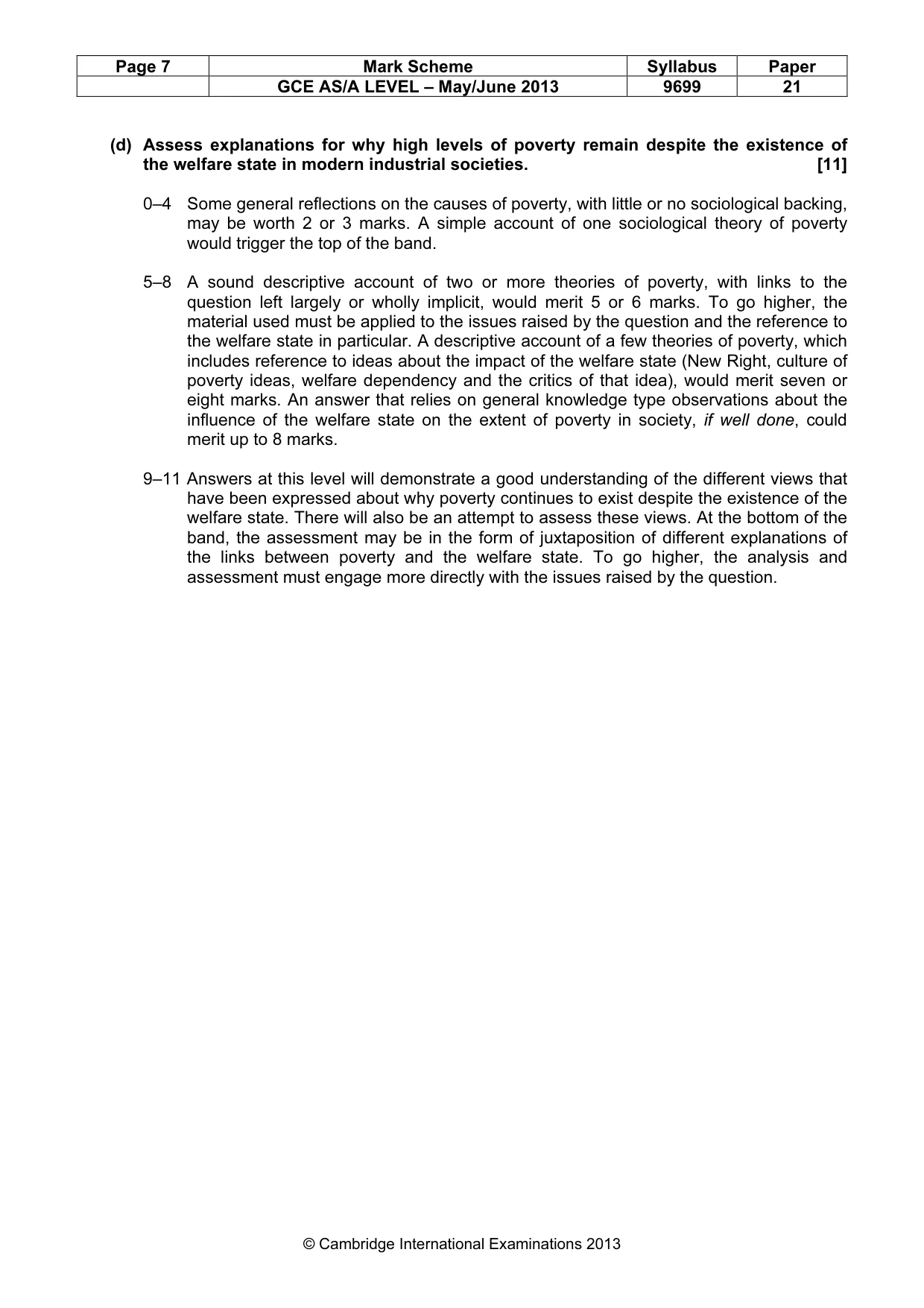
Page 7 Mark Scheme Syllabus Paper GCE AS/A LEVEL – May/June 2013 9699 21 © Cambridge International Examinations 2013 (d) Assess explanations for why high levels of poverty remain despite the existence of the welfare state in modern industrial societies. [11] 0–4 Some general reflections on the causes of poverty, with little or no sociological backing, may be worth 2 or 3 marks. A simple account of one sociological theory of poverty would trigger the top of the band. 5–8 A sound descriptive account of two or more theories of poverty, with links to the question left largely or wholly implicit, would merit 5 or 6 marks. To go higher, the material used must be applied to the issues raised by the question and the reference to the welfare state in particular. A descriptive account of a few theories of poverty, which includes reference to ideas about the impact of the welfare state (New Right, culture of poverty ideas, welfare dependency and the critics of that idea), would merit seven or eight marks. An answer that relies on general knowledge type observations about the influence of the welfare state on the extent of poverty in society, if well done, could merit up to 8 marks. 9–11 Answers at this level will demonstrate a good understanding of the different views that have been expressed about why poverty continues to exist despite the existence of the welfare state. There will also be an attempt to assess these views. At the bottom of the band, the assessment may be in the form of juxtaposition of different explanations of the links between poverty and the welfare state. To go higher, the analysis and assessment must engage more directly with the issues raised by the question.
What you needed in this session
Cambridge’s own grade thresholds for 2013 May/June, Paper 2 · Variant 1. A higher threshold means an easier paper — the bar moves with how the cohort did.