Cambridge A Level Sociology 9699 — 2012 Oct/Nov Paper 2 · Variant 1
9699/21/O/N/12 · 50 marks · ≈56 min
The question paper and its mark scheme, free to read here and free to download. This is Cambridge’s own paper, exactly as it was sat.
Question paper16 pages









Mark scheme6 pages
Answers below. Sit the paper first if you are practising.

Paper as text
Question paper, page 1
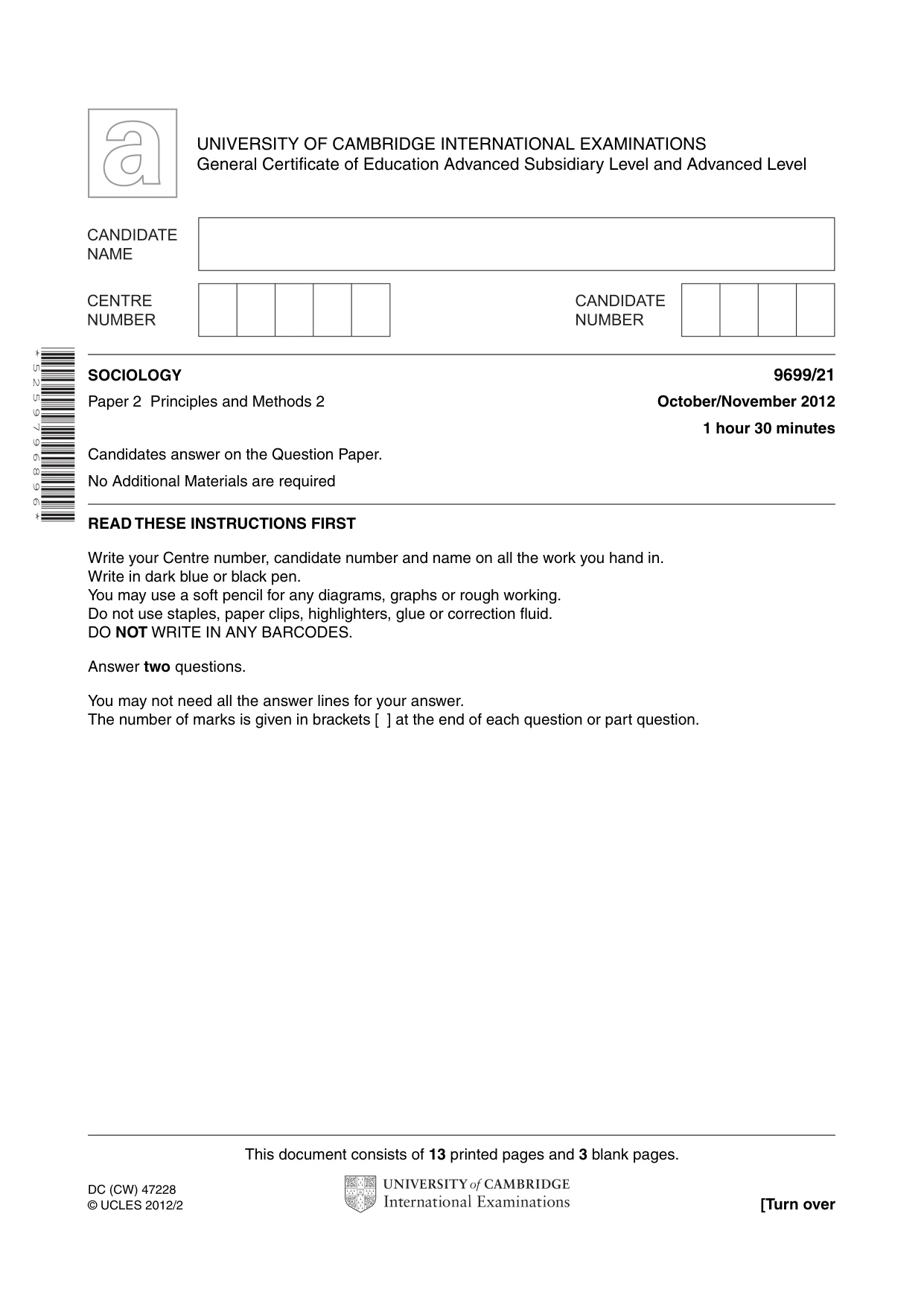
This document consists of 13 printed pages and 3 blank pages. DC (CW) 47228 © UCLES 2012/2 [Turn over UNIVERSITY OF CAMBRIDGE INTERNATIONAL EXAMINATIONS General Certificate of Education Advanced Subsidiary Level and Advanced Level * 5 2 5 9 7 9 6 8 9 6 * SOCIOLOGY 9699/21 Paper 2 Principles and Methods 2 October/November 2012 1 hour 30 minutes Candidates answer on the Question Paper. No Additional Materials are required READ THESE INSTRUCTIONS FIRST Write your Centre number, candidate number and name on all the work you hand in. Write in dark blue or black pen. You may use a soft pencil for any diagrams, graphs or rough working. Do not use staples, paper clips, highlighters, glue or correction fluid. DO NOT WRITE IN ANY BARCODES. Answer two questions. You may not need all the answer lines for your answer. The number of marks is given in brackets [ ] at the end of each question or part question.
Question paper, page 2
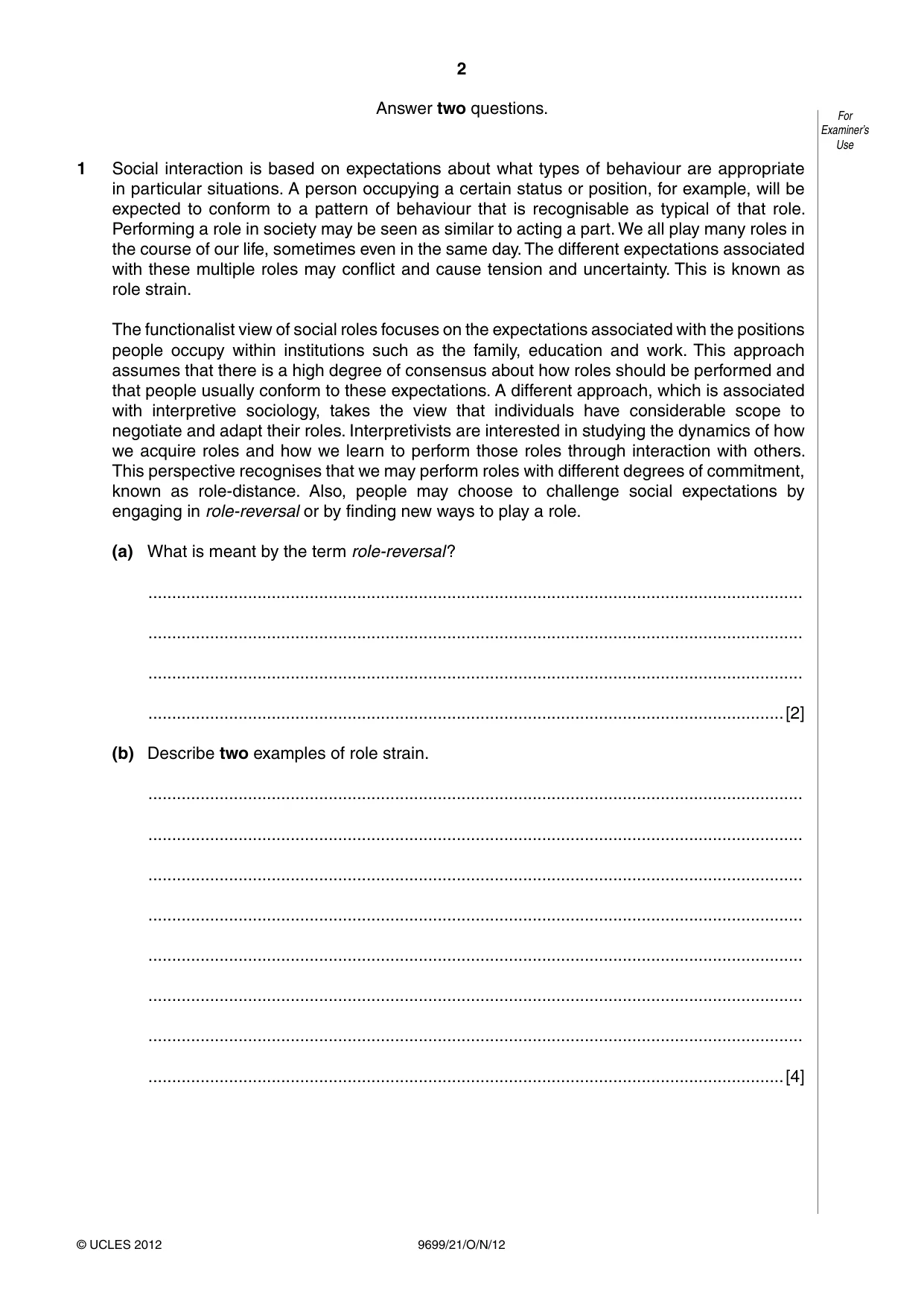
2 9699/21/O/N/12 © UCLES 2012 For Examiner’s Use Answer two questions. 1 Social interaction is based on expectations about what types of behaviour are appropriate in particular situations. A person occupying a certain status or position, for example, will be expected to conform to a pattern of behaviour that is recognisable as typical of that role. Performing a role in society may be seen as similar to acting a part. We all play many roles in the course of our life, sometimes even in the same day. The different expectations associated with these multiple roles may conflict and cause tension and uncertainty. This is known as role strain. The functionalist view of social roles focuses on the expectations associated with the positions people occupy within institutions such as the family, education and work. This approach assumes that there is a high degree of consensus about how roles should be performed and that people usually conform to these expectations. A different approach, which is associated with interpretive sociology, takes the view that individuals have considerable scope to negotiate and adapt their roles. Interpretivists are interested in studying the dynamics of how we acquire roles and how we learn to perform those roles through interaction with others. This perspective recognises that we may perform roles with different degrees of commitment, known as role-distance. Also, people may choose to challenge social expectations by engaging in role-reversal or by finding new ways to play a role. (a) What is meant by the term role-reversal ? … … … …[2] (b) Describe two examples of role strain. … … … … … … … …[4]
Question paper, page 3
3 9699/21/O/N/12 © UCLES 2012 [Turn over For Examiner’s Use (c) Explain why people usually conform to social expectations. … … … … … … … … … … … … … … … … … … … … … … … … … … …[8]
Question paper, page 4
4 9699/21/O/N/12 © UCLES 2012 For Examiner’s Use (d) Assess the strengths and limitations of the functionalist view of social roles. … … … … … … … … … … … … … … … … … … … … … … … … … … …
Question paper, page 5
5 9699/21/O/N/12 © UCLES 2012 [Turn over For Examiner’s Use … … … … … … … … … … … … … … … … … … … … … … … … … … … …[11]
Question paper, page 6
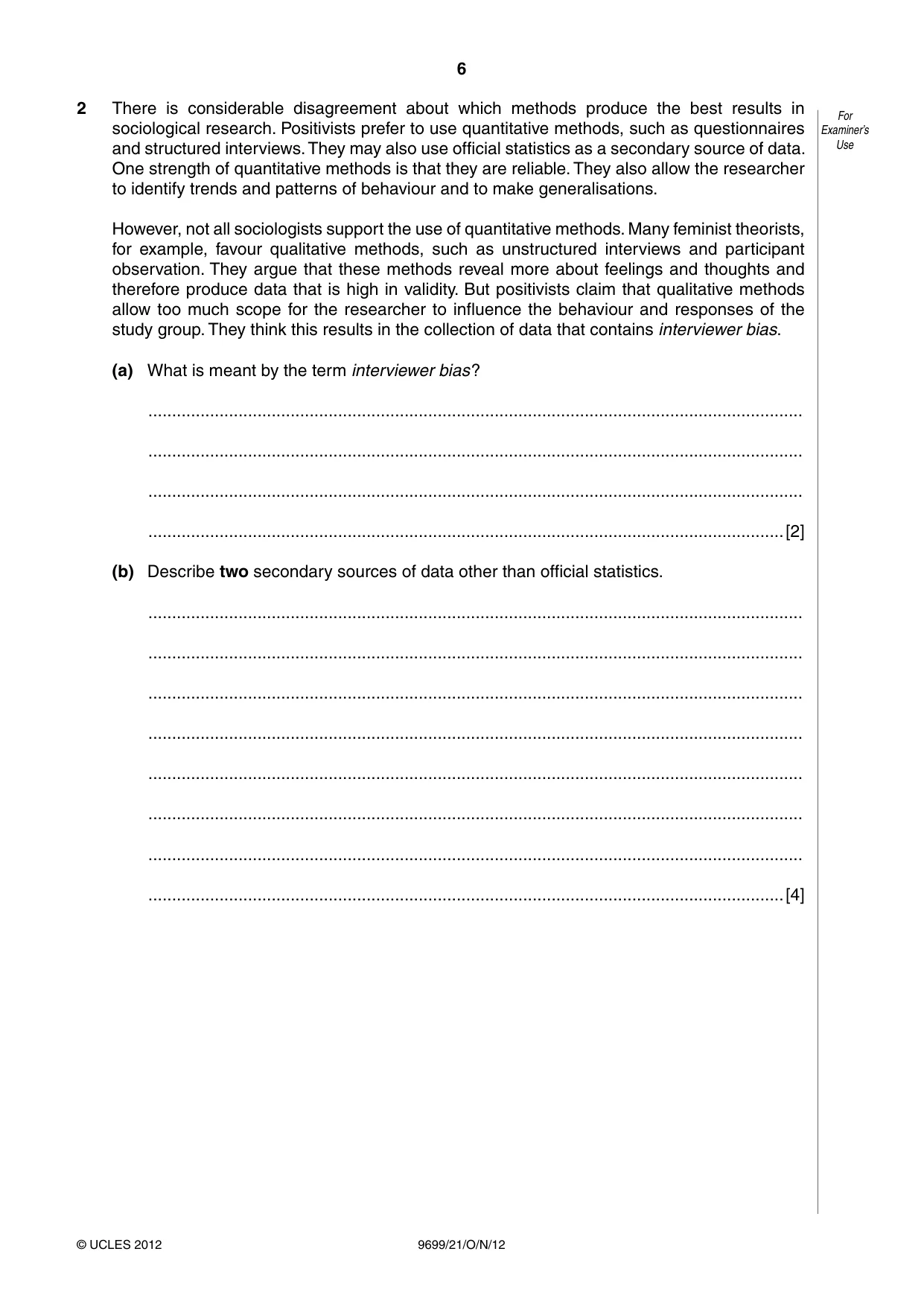
6 9699/21/O/N/12 © UCLES 2012 For Examiner’s Use 2 There is considerable disagreement about which methods produce the best results in sociological research. Positivists prefer to use quantitative methods, such as questionnaires and structured interviews. They may also use official statistics as a secondary source of data. One strength of quantitative methods is that they are reliable. They also allow the researcher to identify trends and patterns of behaviour and to make generalisations. However, not all sociologists support the use of quantitative methods. Many feminist theorists, for example, favour qualitative methods, such as unstructured interviews and participant observation. They argue that these methods reveal more about feelings and thoughts and therefore produce data that is high in validity. But positivists claim that qualitative methods allow too much scope for the researcher to influence the behaviour and responses of the study group. They think this results in the collection of data that contains interviewer bias. (a) What is meant by the term interviewer bias ? … … … …[2] (b) Describe two secondary sources of data other than official statistics. … … … … … … … …[4]
Question paper, page 7
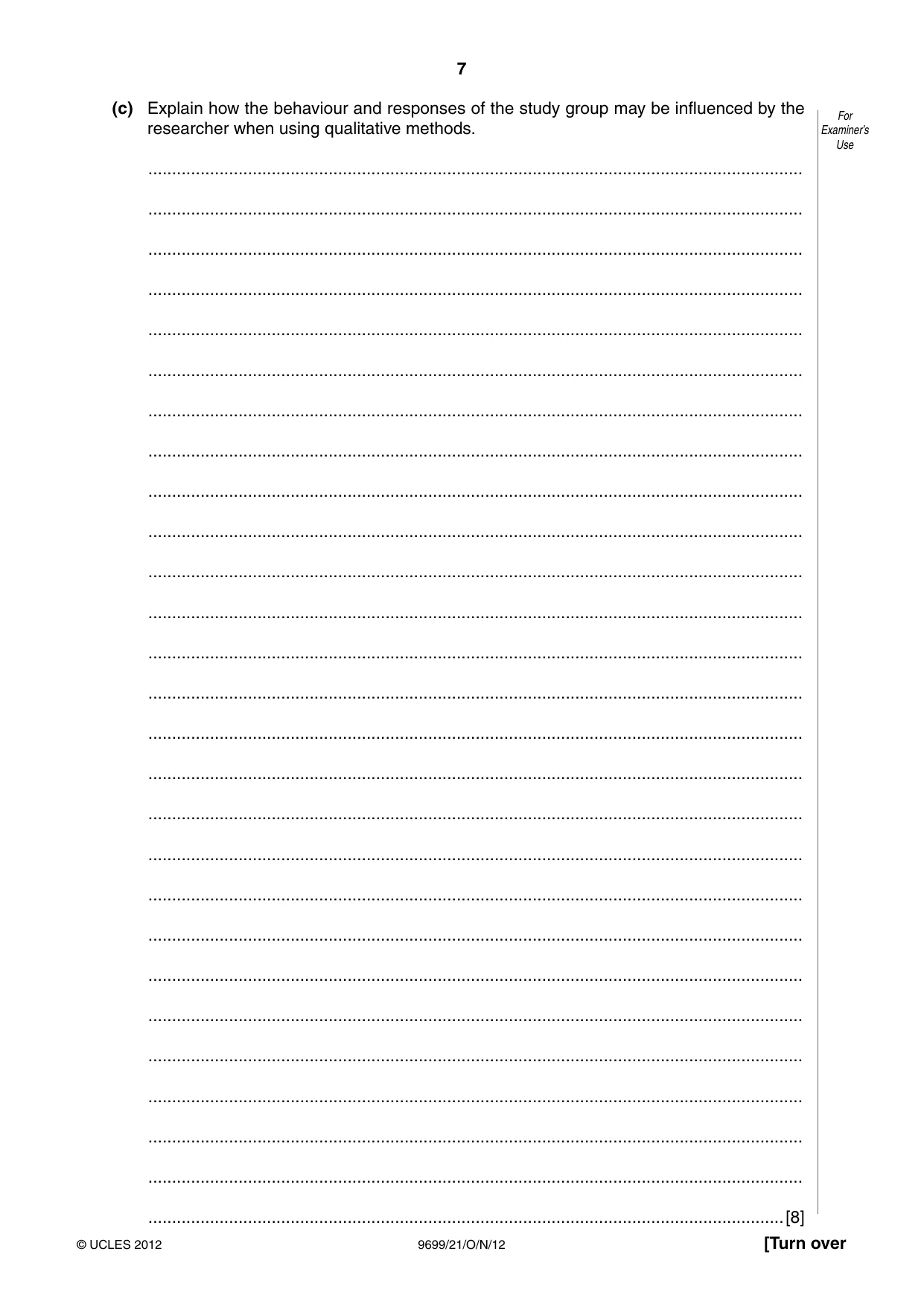
7 9699/21/O/N/12 © UCLES 2012 [Turn over For Examiner’s Use (c) Explain how the behaviour and responses of the study group may be influenced by the researcher when using qualitative methods. … … … … … … … … … … … … … … … … … … … … … … … … … … …[8]
Question paper, page 8
8 9699/21/O/N/12 © UCLES 2012 For Examiner’s Use (d) Assess the view that qualitative methods produce data that is high in validity. … … … … … … … … … … … … … … … … … … … … … … … … … … …
Question paper, page 9
9 9699/21/O/N/12 © UCLES 2012 [Turn over For Examiner’s Use … … … … … … … … … … … … … … … … … … … … … … … … … … … …[11]
Question paper, page 10
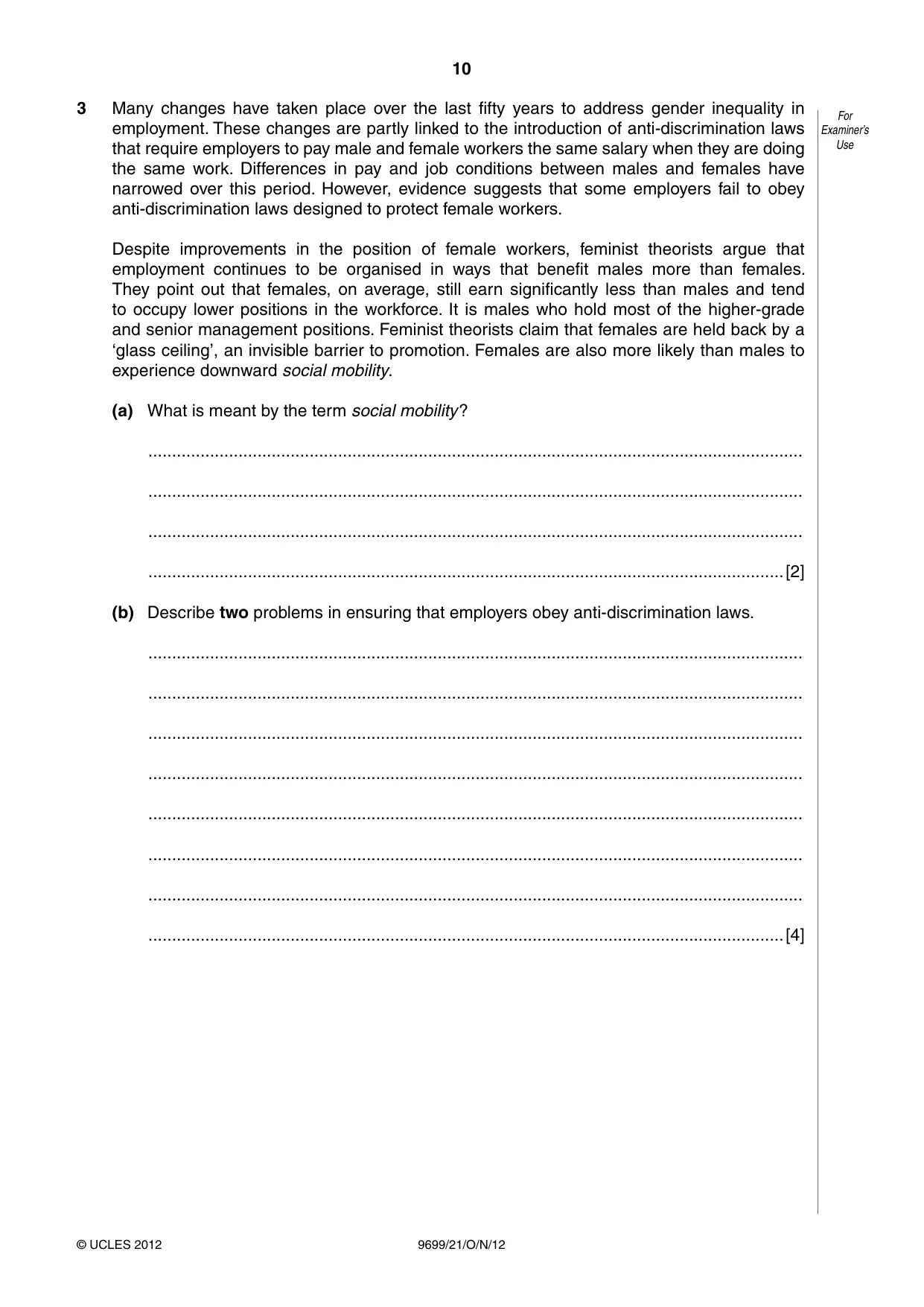
10 9699/21/O/N/12 © UCLES 2012 For Examiner’s Use 3 Many changes have taken place over the last fifty years to address gender inequality in employment. These changes are partly linked to the introduction of anti-discrimination laws that require employers to pay male and female workers the same salary when they are doing the same work. Differences in pay and job conditions between males and females have narrowed over this period. However, evidence suggests that some employers fail to obey anti-discrimination laws designed to protect female workers. Despite improvements in the position of female workers, feminist theorists argue that employment continues to be organised in ways that benefit males more than females. They point out that females, on average, still earn significantly less than males and tend to occupy lower positions in the workforce. It is males who hold most of the higher-grade and senior management positions. Feminist theorists claim that females are held back by a ‘glass ceiling’, an invisible barrier to promotion. Females are also more likely than males to experience downward social mobility. (a) What is meant by the term social mobility ? … … … …[2] (b) Describe two problems in ensuring that employers obey anti-discrimination laws. … … … … … … … …[4]
Question paper, page 11
11 9699/21/O/N/12 © UCLES 2012 [Turn over For Examiner’s Use (c) Explain why females are more likely than males to experience downward social mobility. … … … … … … … … … … … … … … … … … … … … … … … … … … …[8]
Question paper, page 12
12 9699/21/O/N/12 © UCLES 2012 For Examiner’s Use (d) Assess the view that feminist theorists exaggerate the role of males when explaining the causes of gender inequality in employment. … … … … … … … … … … … … … … … … … … … … … … … … … … …
Question paper, page 13
13 9699/21/O/N/12 © UCLES 2012 For Examiner’s Use … … … … … … … … … … … … … … … … … … … … … … … … … … … …[11]
Question paper, page 14
14 9699/21/O/N/12 © UCLES 2012 BLANK PAGE
Question paper, page 15
15 9699/21/O/N/12 © UCLES 2012 BLANK PAGE
Question paper, page 16
16 9699/21/O/N/12 © UCLES 2012 BLANK PAGE Permission to reproduce items where third-party owned material protected by copyright is included has been sought and cleared where possible. Every reasonable effort has been made by the publisher (UCLES) to trace copyright holders, but if any items requiring clearance have unwittingly been included, the publisher will be pleased to make amends at the earliest possible opportunity. University of Cambridge International Examinations is part of the Cambridge Assessment Group. Cambridge Assessment is the brand name of University of Cambridge Local Examinations Syndicate (UCLES), which is itself a department of the University of Cambridge.
Mark scheme, page 1
CAMBRIDGE INTERNATIONAL EXAMINATIONS GCE Advanced Subsidiary Level and GCE Advanced Level MARK SCHEME for the October/November 2012 series 9699 SOCIOLOGY 9699/21 Paper 2 (Data Response), maximum raw mark 50 This mark scheme is published as an aid to teachers and candidates, to indicate the requirements of the examination. It shows the basis on which Examiners were instructed to award marks. It does not indicate the details of the discussions that took place at an Examiners’ meeting before marking began, which would have considered the acceptability of alternative answers. Mark schemes should be read in conjunction with the question paper and the Principal Examiner Report for Teachers. Cambridge will not enter into discussions about these mark schemes. Cambridge is publishing the mark schemes for the October/November 2012 series for most IGCSE, GCE Advanced Level and Advanced Subsidiary Level components and some Ordinary Level components.
Mark scheme, page 2
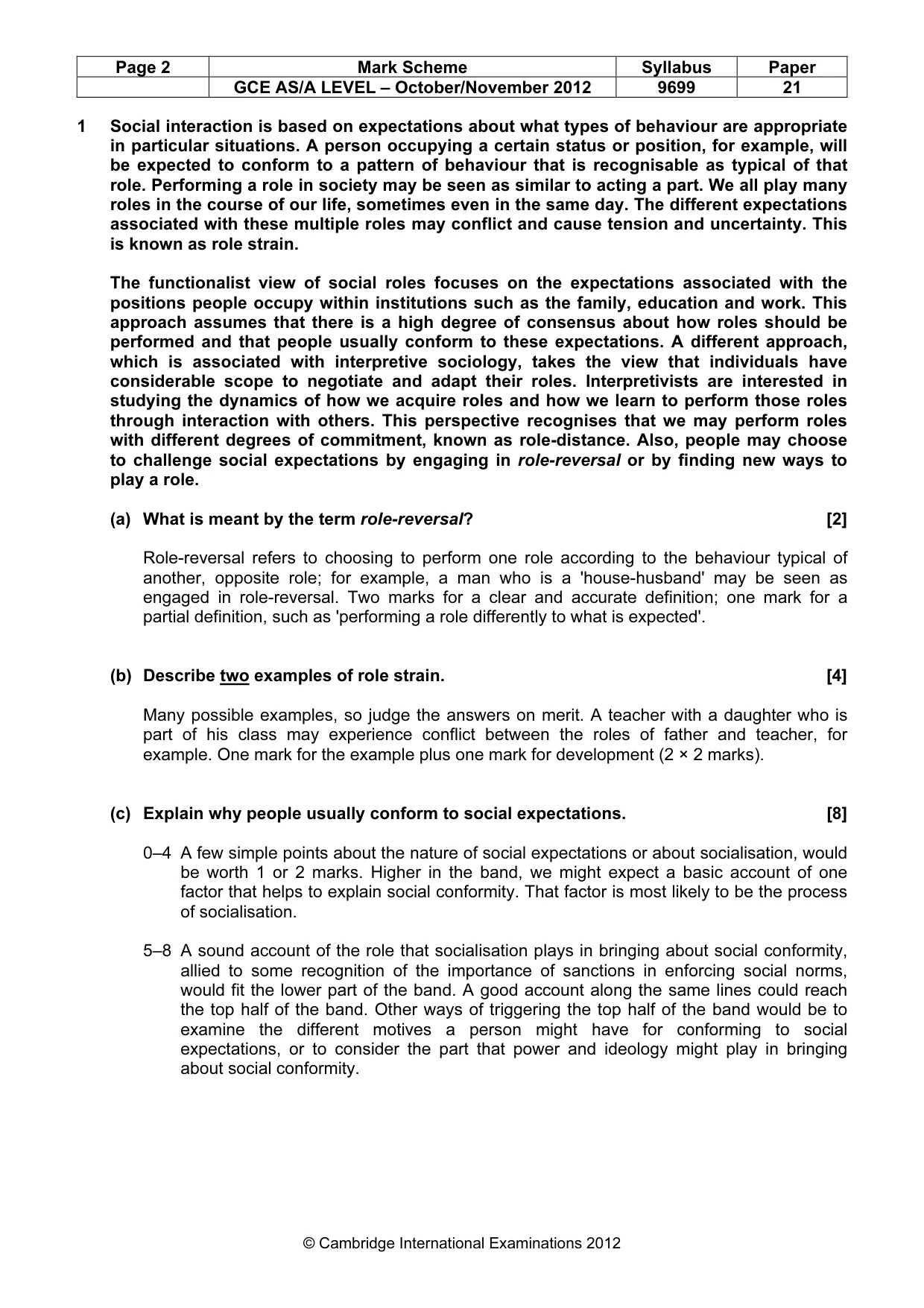
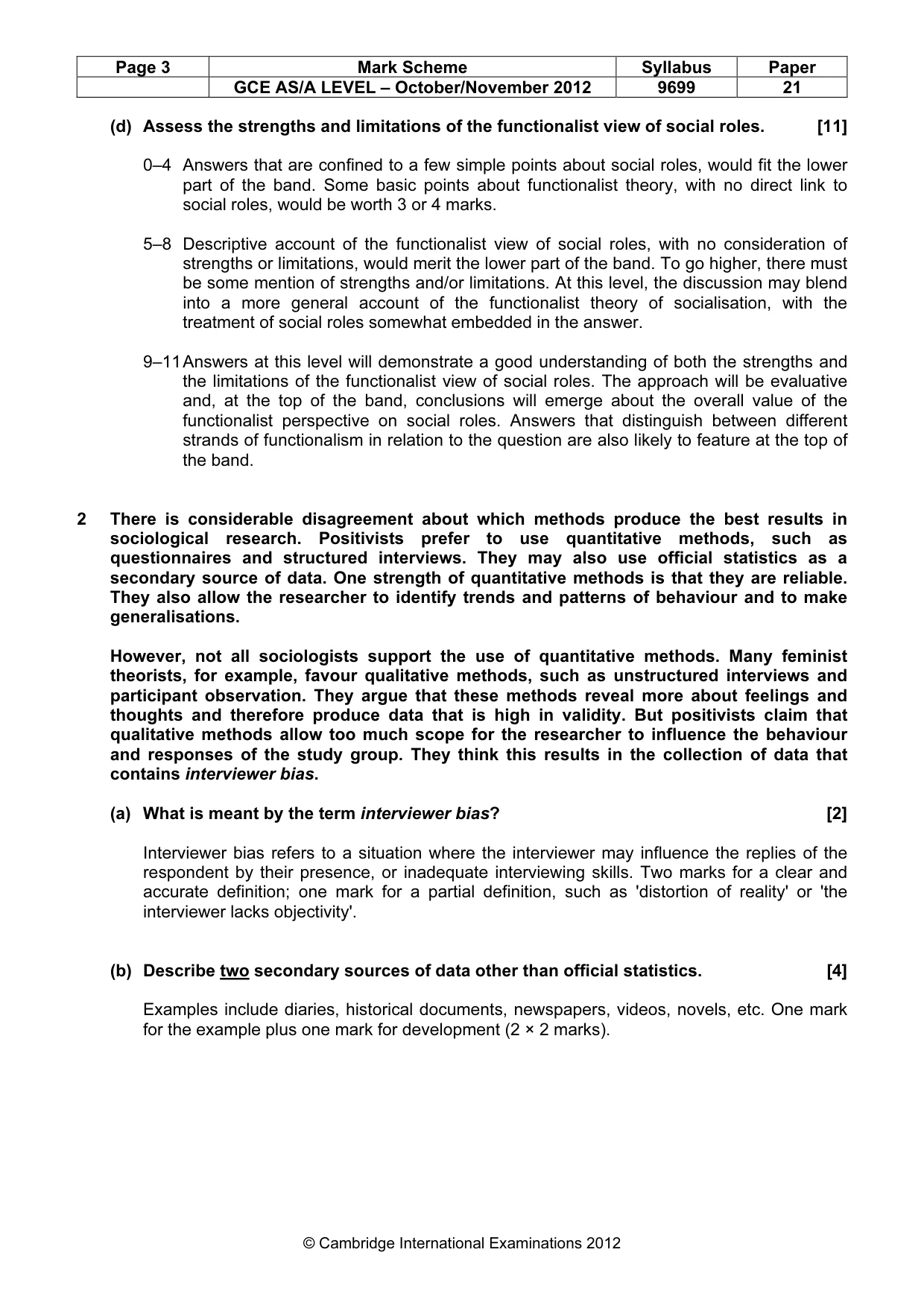
Page 2 Mark Scheme Syllabus Paper GCE AS/A LEVEL – October/November 2012 9699 21 © Cambridge International Examinations 2012 1 Social interaction is based on expectations about what types of behaviour are appropriate in particular situations. A person occupying a certain status or position, for example, will be expected to conform to a pattern of behaviour that is recognisable as typical of that role. Performing a role in society may be seen as similar to acting a part. We all play many roles in the course of our life, sometimes even in the same day. The different expectations associated with these multiple roles may conflict and cause tension and uncertainty. This is known as role strain. The functionalist view of social roles focuses on the expectations associated with the positions people occupy within institutions such as the family, education and work. This approach assumes that there is a high degree of consensus about how roles should be performed and that people usually conform to these expectations. A different approach, which is associated with interpretive sociology, takes the view that individuals have considerable scope to negotiate and adapt their roles. Interpretivists are interested in studying the dynamics of how we acquire roles and how we learn to perform those roles through interaction with others. This perspective recognises that we may perform roles with different degrees of commitment, known as role-distance. Also, people may choose to challenge social expectations by engaging in role-reversal or by finding new ways to play a role. (a) What is meant by the term role-reversal? [2] Role-reversal refers to choosing to perform one role according to the behaviour typical of another, opposite role; for example, a man who is a 'house-husband' may be seen as engaged in role-reversal. Two marks for a clear and accurate definition; one mark for a partial definition, such as 'performing a role differently to what is expected'. (b) Describe two examples of role strain. [4] Many possible examples, so judge the answers on merit. A teacher with a daughter who is part of his class may experience conflict between the roles of father and teacher, for example. One mark for the example plus one mark for development (2 × 2 marks). (c) Explain why people usually conform to social expectations. [8] 0–4 A few simple points about the nature of social expectations or about socialisation, would be worth 1 or 2 marks. Higher in the band, we might expect a basic account of one factor that helps to explain social conformity. That factor is most likely to be the process of socialisation. 5–8 A sound account of the role that socialisation plays in bringing about social conformity, allied to some recognition of the importance of sanctions in enforcing social norms, would fit the lower part of the band. A good account along the same lines could reach the top half of the band. Other ways of triggering the top half of the band would be to examine the different motives a person might have for conforming to social expectations, or to consider the part that power and ideology might play in bringing about social conformity.
Mark scheme, page 3
Page 3 Mark Scheme Syllabus Paper GCE AS/A LEVEL – October/November 2012 9699 21 © Cambridge International Examinations 2012 (d) Assess the strengths and limitations of the functionalist view of social roles. [11] 0–4 Answers that are confined to a few simple points about social roles, would fit the lower part of the band. Some basic points about functionalist theory, with no direct link to social roles, would be worth 3 or 4 marks. 5–8 Descriptive account of the functionalist view of social roles, with no consideration of strengths or limitations, would merit the lower part of the band. To go higher, there must be some mention of strengths and/or limitations. At this level, the discussion may blend into a more general account of the functionalist theory of socialisation, with the treatment of social roles somewhat embedded in the answer. 9–11 Answers at this level will demonstrate a good understanding of both the strengths and the limitations of the functionalist view of social roles. The approach will be evaluative and, at the top of the band, conclusions will emerge about the overall value of the functionalist perspective on social roles. Answers that distinguish between different strands of functionalism in relation to the question are also likely to feature at the top of the band. 2 There is considerable disagreement about which methods produce the best results in sociological research. Positivists prefer to use quantitative methods, such as questionnaires and structured interviews. They may also use official statistics as a secondary source of data. One strength of quantitative methods is that they are reliable. They also allow the researcher to identify trends and patterns of behaviour and to make generalisations. However, not all sociologists support the use of quantitative methods. Many feminist theorists, for example, favour qualitative methods, such as unstructured interviews and participant observation. They argue that these methods reveal more about feelings and thoughts and therefore produce data that is high in validity. But positivists claim that qualitative methods allow too much scope for the researcher to influence the behaviour and responses of the study group. They think this results in the collection of data that contains interviewer bias. (a) What is meant by the term interviewer bias? [2] Interviewer bias refers to a situation where the interviewer may influence the replies of the respondent by their presence, or inadequate interviewing skills. Two marks for a clear and accurate definition; one mark for a partial definition, such as 'distortion of reality' or 'the interviewer lacks objectivity'. (b) Describe two secondary sources of data other than official statistics. [4] Examples include diaries, historical documents, newspapers, videos, novels, etc. One mark for the example plus one mark for development (2 × 2 marks).
Mark scheme, page 4
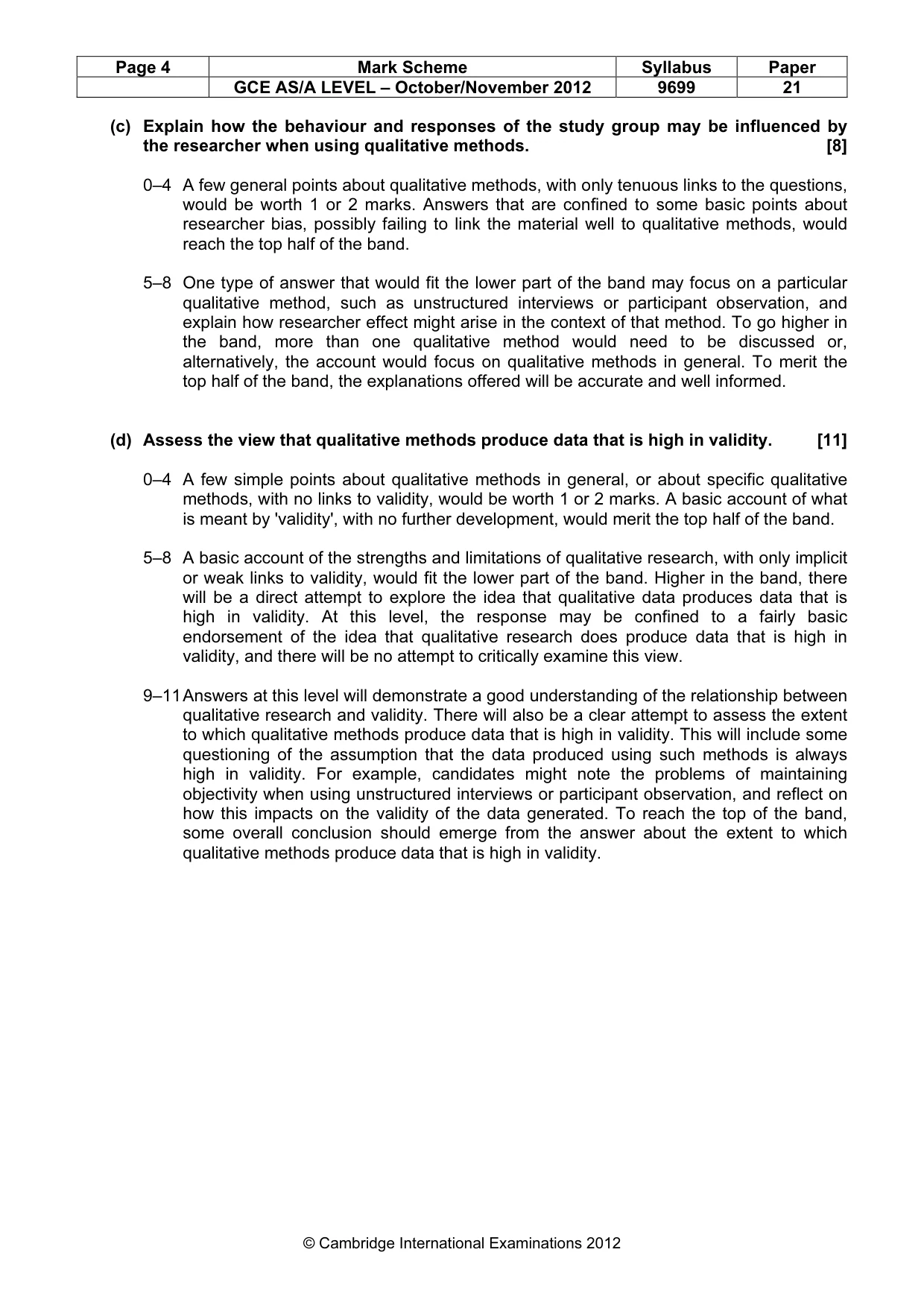
Page 4 Mark Scheme Syllabus Paper GCE AS/A LEVEL – October/November 2012 9699 21 © Cambridge International Examinations 2012 (c) Explain how the behaviour and responses of the study group may be influenced by the researcher when using qualitative methods. [8] 0–4 A few general points about qualitative methods, with only tenuous links to the questions, would be worth 1 or 2 marks. Answers that are confined to some basic points about researcher bias, possibly failing to link the material well to qualitative methods, would reach the top half of the band. 5–8 One type of answer that would fit the lower part of the band may focus on a particular qualitative method, such as unstructured interviews or participant observation, and explain how researcher effect might arise in the context of that method. To go higher in the band, more than one qualitative method would need to be discussed or, alternatively, the account would focus on qualitative methods in general. To merit the top half of the band, the explanations offered will be accurate and well informed. (d) Assess the view that qualitative methods produce data that is high in validity. [11] 0–4 A few simple points about qualitative methods in general, or about specific qualitative methods, with no links to validity, would be worth 1 or 2 marks. A basic account of what is meant by 'validity', with no further development, would merit the top half of the band. 5–8 A basic account of the strengths and limitations of qualitative research, with only implicit or weak links to validity, would fit the lower part of the band. Higher in the band, there will be a direct attempt to explore the idea that qualitative data produces data that is high in validity. At this level, the response may be confined to a fairly basic endorsement of the idea that qualitative research does produce data that is high in validity, and there will be no attempt to critically examine this view. 9–11 Answers at this level will demonstrate a good understanding of the relationship between qualitative research and validity. There will also be a clear attempt to assess the extent to which qualitative methods produce data that is high in validity. This will include some questioning of the assumption that the data produced using such methods is always high in validity. For example, candidates might note the problems of maintaining objectivity when using unstructured interviews or participant observation, and reflect on how this impacts on the validity of the data generated. To reach the top of the band, some overall conclusion should emerge from the answer about the extent to which qualitative methods produce data that is high in validity.
Mark scheme, page 5
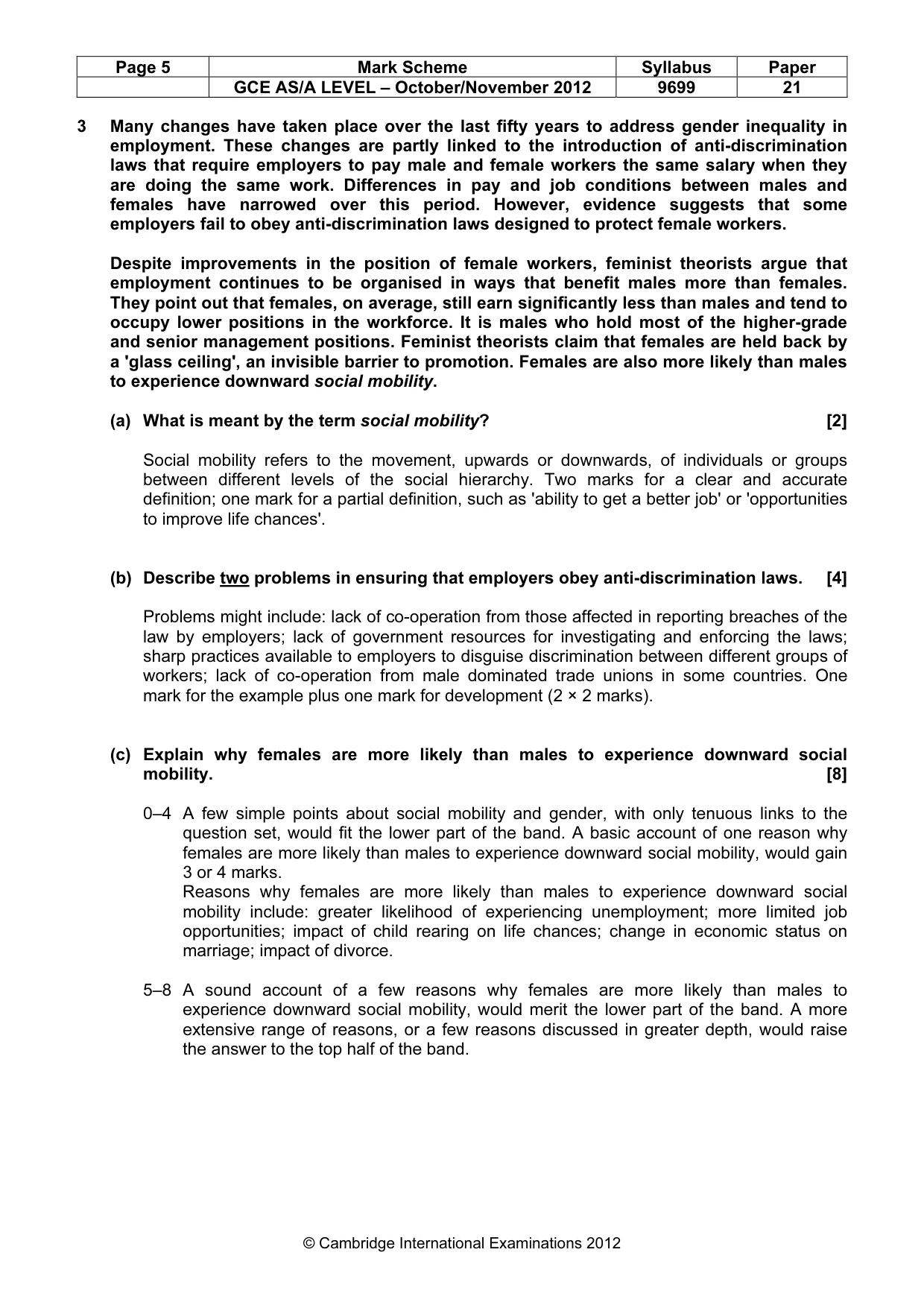
Page 5 Mark Scheme Syllabus Paper GCE AS/A LEVEL – October/November 2012 9699 21 © Cambridge International Examinations 2012 3 Many changes have taken place over the last fifty years to address gender inequality in employment. These changes are partly linked to the introduction of anti-discrimination laws that require employers to pay male and female workers the same salary when they are doing the same work. Differences in pay and job conditions between males and females have narrowed over this period. However, evidence suggests that some employers fail to obey anti-discrimination laws designed to protect female workers. Despite improvements in the position of female workers, feminist theorists argue that employment continues to be organised in ways that benefit males more than females. They point out that females, on average, still earn significantly less than males and tend to occupy lower positions in the workforce. It is males who hold most of the higher-grade and senior management positions. Feminist theorists claim that females are held back by a 'glass ceiling', an invisible barrier to promotion. Females are also more likely than males to experience downward social mobility. (a) What is meant by the term social mobility? [2] Social mobility refers to the movement, upwards or downwards, of individuals or groups between different levels of the social hierarchy. Two marks for a clear and accurate definition; one mark for a partial definition, such as 'ability to get a better job' or 'opportunities to improve life chances'. (b) Describe two problems in ensuring that employers obey anti-discrimination laws. [4] Problems might include: lack of co-operation from those affected in reporting breaches of the law by employers; lack of government resources for investigating and enforcing the laws; sharp practices available to employers to disguise discrimination between different groups of workers; lack of co-operation from male dominated trade unions in some countries. One mark for the example plus one mark for development (2 × 2 marks). (c) Explain why females are more likely than males to experience downward social mobility. [8] 0–4 A few simple points about social mobility and gender, with only tenuous links to the question set, would fit the lower part of the band. A basic account of one reason why females are more likely than males to experience downward social mobility, would gain 3 or 4 marks. Reasons why females are more likely than males to experience downward social mobility include: greater likelihood of experiencing unemployment; more limited job opportunities; impact of child rearing on life chances; change in economic status on marriage; impact of divorce. 5–8 A sound account of a few reasons why females are more likely than males to experience downward social mobility, would merit the lower part of the band. A more extensive range of reasons, or a few reasons discussed in greater depth, would raise the answer to the top half of the band.
Mark scheme, page 6
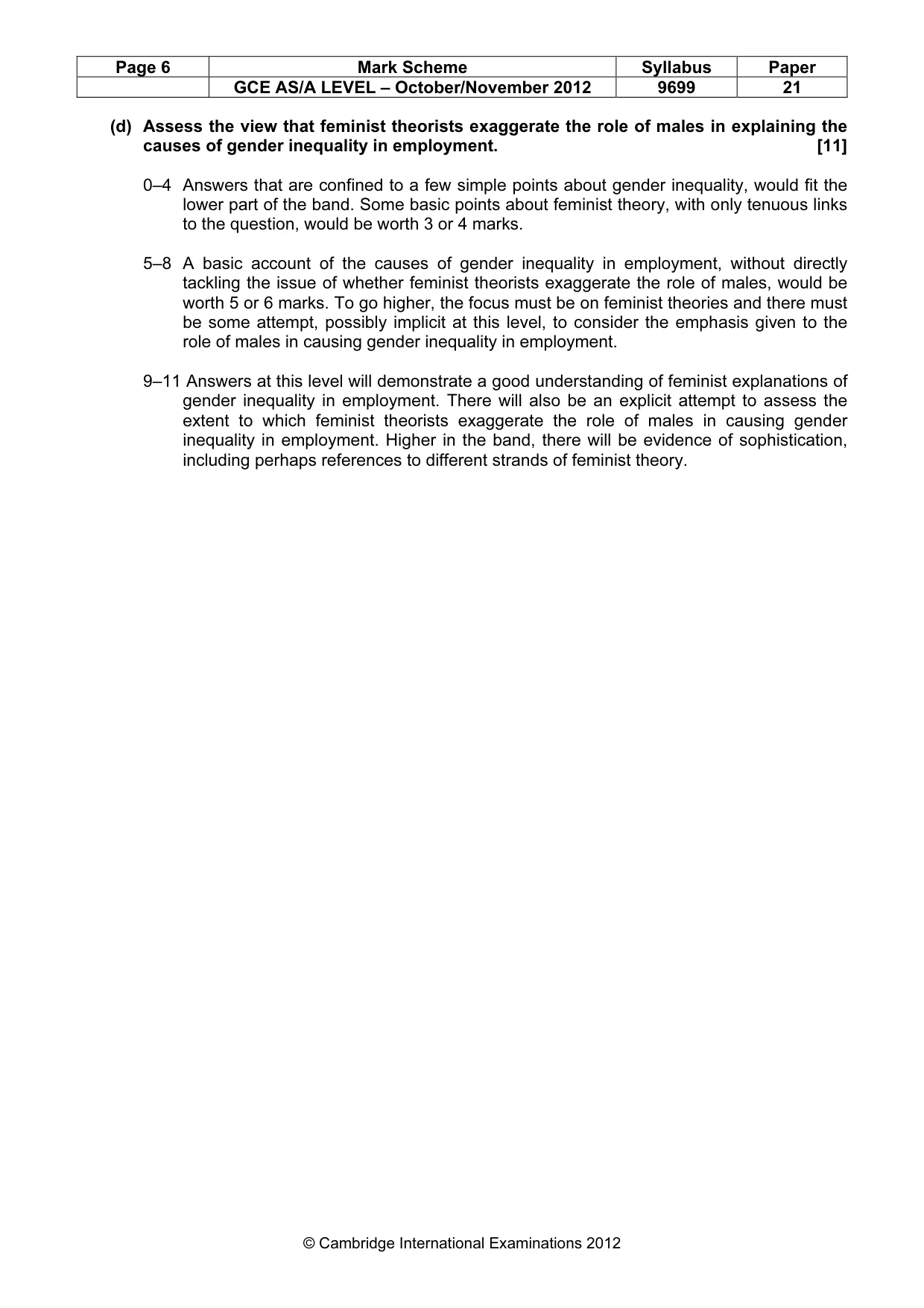
Page 6 Mark Scheme Syllabus Paper GCE AS/A LEVEL – October/November 2012 9699 21 © Cambridge International Examinations 2012 (d) Assess the view that feminist theorists exaggerate the role of males in explaining the causes of gender inequality in employment. [11] 0–4 Answers that are confined to a few simple points about gender inequality, would fit the lower part of the band. Some basic points about feminist theory, with only tenuous links to the question, would be worth 3 or 4 marks. 5–8 A basic account of the causes of gender inequality in employment, without directly tackling the issue of whether feminist theorists exaggerate the role of males, would be worth 5 or 6 marks. To go higher, the focus must be on feminist theories and there must be some attempt, possibly implicit at this level, to consider the emphasis given to the role of males in causing gender inequality in employment. 9–11 Answers at this level will demonstrate a good understanding of feminist explanations of gender inequality in employment. There will also be an explicit attempt to assess the extent to which feminist theorists exaggerate the role of males in causing gender inequality in employment. Higher in the band, there will be evidence of sophistication, including perhaps references to different strands of feminist theory.
What you needed in this session
Cambridge’s own grade thresholds for 2012 Oct/Nov, Paper 2 · Variant 1. A higher threshold means an easier paper — the bar moves with how the cohort did.