Cambridge A Level Sociology 9699 — 2012 May/June Paper 2 · Variant 3
9699/23/M/J/12 · 50 marks · ≈56 min
The question paper and its mark scheme, free to read here and free to download. This is Cambridge’s own paper, exactly as it was sat.
Question paper16 pages






Mark scheme7 pages
Answers below. Sit the paper first if you are practising.
Paper as text
Question paper, page 1
This document consists of 13 printed pages and 3 blank pages. DC (RW) 47227/1 © UCLES 2012 [Turn over UNIVERSITY OF CAMBRIDGE INTERNATIONAL EXAMINATIONS General Certificate of Education Advanced Subsidiary Level and Advanced Level * 6 7 7 1 6 7 6 0 1 7 * SOCIOLOGY 9699/23 Paper 2 Principles and Methods 2 May/June 2012 1 hour 30 minutes Candidates answer on the Question Paper. No additional materials are required. READ THESE INSTRUCTIONS FIRST Write your Centre number, candidate number and name on all the work you hand in. Write in dark blue or black pen. You may use a soft pencil for any diagrams, graphs or rough working. Do not use staples, paper clips, highlighters, glue or correction fluid. DO NOT WRITE IN ANY BARCODES. Answer two questions. You may not need all the answer lines for your answer. The number of marks is given in brackets [ ] at the end of each question or part question.
Question paper, page 2
2 9699/23/M/J/12 © UCLES 2012 For Examiner’s Use Answer two questions. 1 When a group of people establish a way of life in which there are shared norms and values their behaviour and morality is described as their culture. A culture will include language, dress, food, material goods, skills and knowledge. More importantly perhaps, it will also include beliefs and ideas about appropriate forms of behaviour. The national culture of a country may be described as the pattern of conduct and beliefs that is shared by most or all of the population. However, there may be differences between the behaviour and thought processes of groups within any single country based on such factors as class, gender, age and ethnicity. Some sociologists think that cultural differences between countries and groups in modern industrial societies are disappearing due to the impact of globalisation. The term community is sometimes used to describe all the people that share a similar culture, but it usually refers to a closer sense of identification between individuals in terms of co-operation and a sense of belonging. The idea of community is very important in understanding traditional rural societies where kinship ties and religion bind people together in a way of life that is slow to change and involves close relations with neighbours and family members. Industrialisation led to the breakdown of close-knit rural communities and their replacement by an urban way of life in which relations between people are more impersonal and there is greater individual freedom. (a) What is meant by the term globalisation? … … … …[2] (b) Describe two characteristics that are common to most national cultures. … … … … … … … …[4]
Question paper, page 3
3 9699/23/M/J/12 © UCLES 2012 [Turn over For Examiner’s Use (c) Explain why there may be greater individual freedom in societies based on an urban way of life. … … … … … … … … … … … … … … … … … … … … … … … … … … …[8]
Question paper, page 4
4 9699/23/M/J/12 © UCLES 2012 For Examiner’s Use (d) Assess the extent to which cultural differences are disappearing in modern industrial societies. … … … … … … … … … … … … … … … … … … … … … … … … … … …
Question paper, page 5
5 9699/23/M/J/12 © UCLES 2012 [Turn over For Examiner’s Use … … … … … … … … … … … … … … … … … … … … … … … … … … … …[11]
Question paper, page 6
6 9699/23/M/J/12 © UCLES 2012 For Examiner’s Use 2 Much sociological research involves asking people questions using either questionnaires or interviews. Sociologists may also conduct research by using observation techniques, which involve watching and listening to the group under study and recording what is observed over time. There are two types of observation: participant observation and non-participant observation. Both types of observation can be carried out covertly or overtly. In participant observation the researcher becomes part of the group that is to be studied. By taking part in the day-to-day activities of the group, the researcher can acquire a deeper understanding than would be possible using other research methods. However, it may be difficult to gain acceptance by the group to be studied. Participant observation may also give rise to ethical and legal problems. For these reasons, it may be preferable for the researcher to observe the group’s activities without taking part in them. This is known as non-participant observation. Objectivity may be easier to achieve with non-participant observation than with participant observation. (a) What is meant by the term objectivity in sociological research? … … … …[2] (b) Describe two reasons why the participant observer may find difficulty in gaining acceptance by the study group. … … … … … … … …[4]
Question paper, page 7
7 9699/23/M/J/12 © UCLES 2012 [Turn over For Examiner’s Use (c) Explain why objectivity may be easier to achieve with non-participant observation than with participant observation. … … … … … … … … … … … … … … … … … … … … … … … … … … …[8]
Question paper, page 8
8 9699/23/M/J/12 © UCLES 2012 For Examiner’s Use (d) Assess the view that ethical issues are the major limitation in using covert participant observation. … … … … … … … … … … … … … … … … … … … … … … … … … … …
Question paper, page 9
9 9699/23/M/J/12 © UCLES 2012 [Turn over For Examiner’s Use … … … … … … … … … … … … … … … … … … … … … … … … … … … …[11]
Question paper, page 10
10 9699/23/M/J/12 © UCLES 2012 For Examiner’s Use 3 Writing in the nineteenth century, Karl Marx claimed that the capitalist economic system gave rise to two main social classes, which he named the proletariat and the bourgeoisie. Marx recognised that other classes existed, but he believed that they would gradually be absorbed into the two main classes as capitalism developed. This led Marx to predict that there would be an increasing polarisation of society between the proletariat and the bourgeoisie. Critics of Marx argue that rather than becoming polarised, social classes have become more fragmented since the nineteenth century. By the time Max Weber was writing in the early twentieth century, a large middle class had emerged in capitalist societies. This led Weber to reject Marx’s two class model of society. Weber actually identified four social classes: manual workers, petty bourgeoisie, professionals and property owners. But he distanced himself from Marx’s economic determinism by arguing that there are many other divisions in society apart from those based on social class. Status divisions and power groupings are two other forms of social stratification that Weber emphasised. (a) What is meant by the term economic determinism? … … … …[2] (b) Describe two examples of status divisions. … … … … … … … …[4]
Question paper, page 11
11 9699/23/M/J/12 © UCLES 2012 [Turn over For Examiner’s Use (c) Explain the main divisions within the working class today. … … … … … … … … … … … … … … … … … … … … … … … … … … …[8]
Question paper, page 12
12 9699/23/M/J/12 © UCLES 2012 For Examiner’s Use (d) Assess how far the ownership of property continues to be the main source of power in modern industrial societies. … … … … … … … … … … … … … … … … … … … … … … … … … … …
Question paper, page 13
13 9699/23/M/J/12 © UCLES 2012 For Examiner’s Use … … … … … … … … … … … … … … … … … … … … … … … … … … … …[11]
Question paper, page 14
14 9699/23/M/J/12 © UCLES 2012 BLANK PAGE
Question paper, page 15
15 9699/23/M/J/12 © UCLES 2012 BLANK PAGE
Question paper, page 16
16 9699/23/M/J/12 © UCLES 2012 Permission to reproduce items where third-party owned material protected by copyright is included has been sought and cleared where possible. Every reasonable effort has been made by the publisher (UCLES) to trace copyright holders, but if any items requiring clearance have unwittingly been included, the publisher will be pleased to make amends at the earliest possible opportunity. University of Cambridge International Examinations is part of the Cambridge Assessment Group. Cambridge Assessment is the brand name of University of Cambridge Local Examinations Syndicate (UCLES), which is itself a department of the University of Cambridge. BLANK PAGE
Mark scheme, page 1
UNIVERSITY OF CAMBRIDGE INTERNATIONAL EXAMINATIONS GCE Advanced Subsidiary Level and GCE Advanced Level MARK SCHEME for the May/June 2012 question paper for the guidance of teachers 9699 SOCIOLOGY 9699/23 Paper 2 (Principles and Methods 2), maximum raw mark 50 This mark scheme is published as an aid to teachers and candidates, to indicate the requirements of the examination. It shows the basis on which Examiners were instructed to award marks. It does not indicate the details of the discussions that took place at an Examiners’ meeting before marking began, which would have considered the acceptability of alternative answers. Mark schemes must be read in conjunction with the question papers and the report on the examination. • Cambridge will not enter into discussions or correspondence in connection with these mark schemes. Cambridge is publishing the mark schemes for the May/June 2012 question papers for most IGCSE, GCE Advanced Level and Advanced Subsidiary Level syllabuses and some Ordinary Level syllabuses.
Mark scheme, page 2
Page 2 Mark Scheme: Teachers’ version Syllabus Paper GCE AS/A LEVEL – May/June 2012 9699 23 © University of Cambridge International Examinations 2012 1 When a group of people establish a way of life in which there are shared norms and values their behaviour and morality is described as their culture. A culture will include language, dress, food, material goods, skills and knowledge. More importantly perhaps, it will also include beliefs and ideas about appropriate forms of behaviour. The national culture of a country may be described as the pattern of conduct and beliefs that is shared by most or all of the population. However, there may be differences between the behaviour and thought processes of groups within any single country based on such factors as class, gender, age and ethnicity. Some sociologists think that cultural differences between countries and groups in modern industrial societies are disappearing due to the impact of globalisation. The term community is sometimes used to describe all the people that share a similar culture, but it usually refers to a closer sense of identification between individuals in terms of co-operation and a sense of belonging. The idea of community is very important in understanding traditional rural societies where kinship ties and religion bind people together in a way of life that is slow to change and involves close relations with neighbours and family members. Industrialisation led to the breakdown of close-knit rural communities and their replacement by an urban way of life in which relations between people are more impersonal and there is greater individual freedom. (a) What is meant by the term globalisation? [2] (b) Describe two characteristics that are common to most national cultures. [4] (c) Explain why there may be greater individual freedom in societies based on an urban way of life. [8] (d) Assess the extent to which cultural differences are disappearing in modern industrial societies. [11] 1 (a) Globalisation is a social process in which the constraints of geography on social and cultural arrangements recede and there is growing similarity in social and cultural life across the world. Two marks for a clear and accurate definition; one mark for a partial definition such as 'global events shape our lives today' or 'barriers between countries are disappearing'. (2) (b) Many possible examples, such as a national anthem, flag or other emblems of national identity, a particular cuisine, shared language(s) possibly, national festivals and celebrations. One mark for the example plus one mark for development (2 x 2 marks). (4) (c) 0–4 A few points about individual freedom or about urban life, with no attempt to address the specific wording of the question, might merit 1 or 2 marks. A simple explanation of why there may be greater freedom in societies based on the urban way of life, would trigger the top half of the band. (8)
Mark scheme, page 3
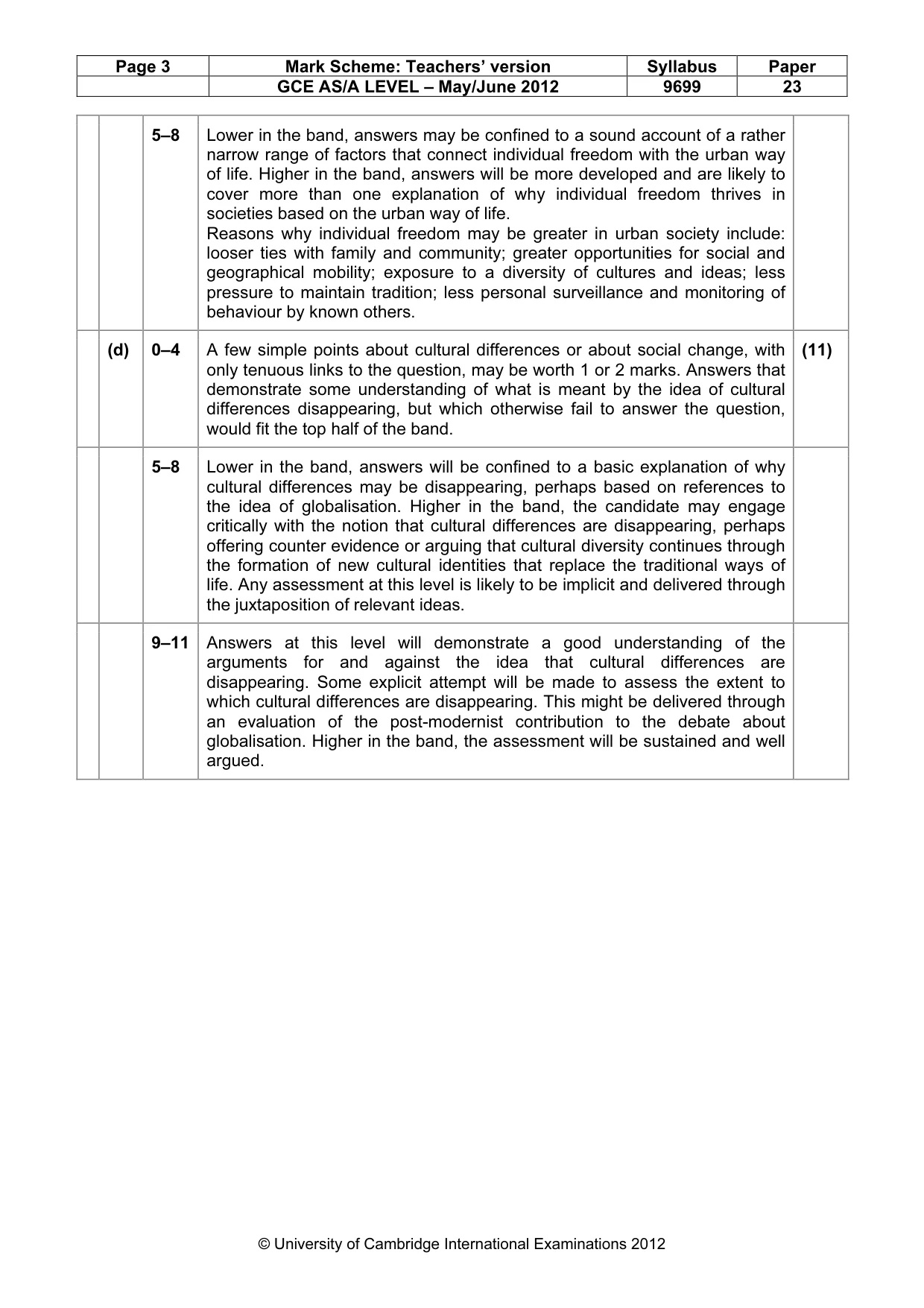
Page 3 Mark Scheme: Teachers’ version Syllabus Paper GCE AS/A LEVEL – May/June 2012 9699 23 © University of Cambridge International Examinations 2012 5–8 Lower in the band, answers may be confined to a sound account of a rather narrow range of factors that connect individual freedom with the urban way of life. Higher in the band, answers will be more developed and are likely to cover more than one explanation of why individual freedom thrives in societies based on the urban way of life. Reasons why individual freedom may be greater in urban society include: looser ties with family and community; greater opportunities for social and geographical mobility; exposure to a diversity of cultures and ideas; less pressure to maintain tradition; less personal surveillance and monitoring of behaviour by known others. (d) 0–4 A few simple points about cultural differences or about social change, with only tenuous links to the question, may be worth 1 or 2 marks. Answers that demonstrate some understanding of what is meant by the idea of cultural differences disappearing, but which otherwise fail to answer the question, would fit the top half of the band. (11) 5–8 Lower in the band, answers will be confined to a basic explanation of why cultural differences may be disappearing, perhaps based on references to the idea of globalisation. Higher in the band, the candidate may engage critically with the notion that cultural differences are disappearing, perhaps offering counter evidence or arguing that cultural diversity continues through the formation of new cultural identities that replace the traditional ways of life. Any assessment at this level is likely to be implicit and delivered through the juxtaposition of relevant ideas. 9–11 Answers at this level will demonstrate a good understanding of the arguments for and against the idea that cultural differences are disappearing. Some explicit attempt will be made to assess the extent to which cultural differences are disappearing. This might be delivered through an evaluation of the post-modernist contribution to the debate about globalisation. Higher in the band, the assessment will be sustained and well argued.
Mark scheme, page 4
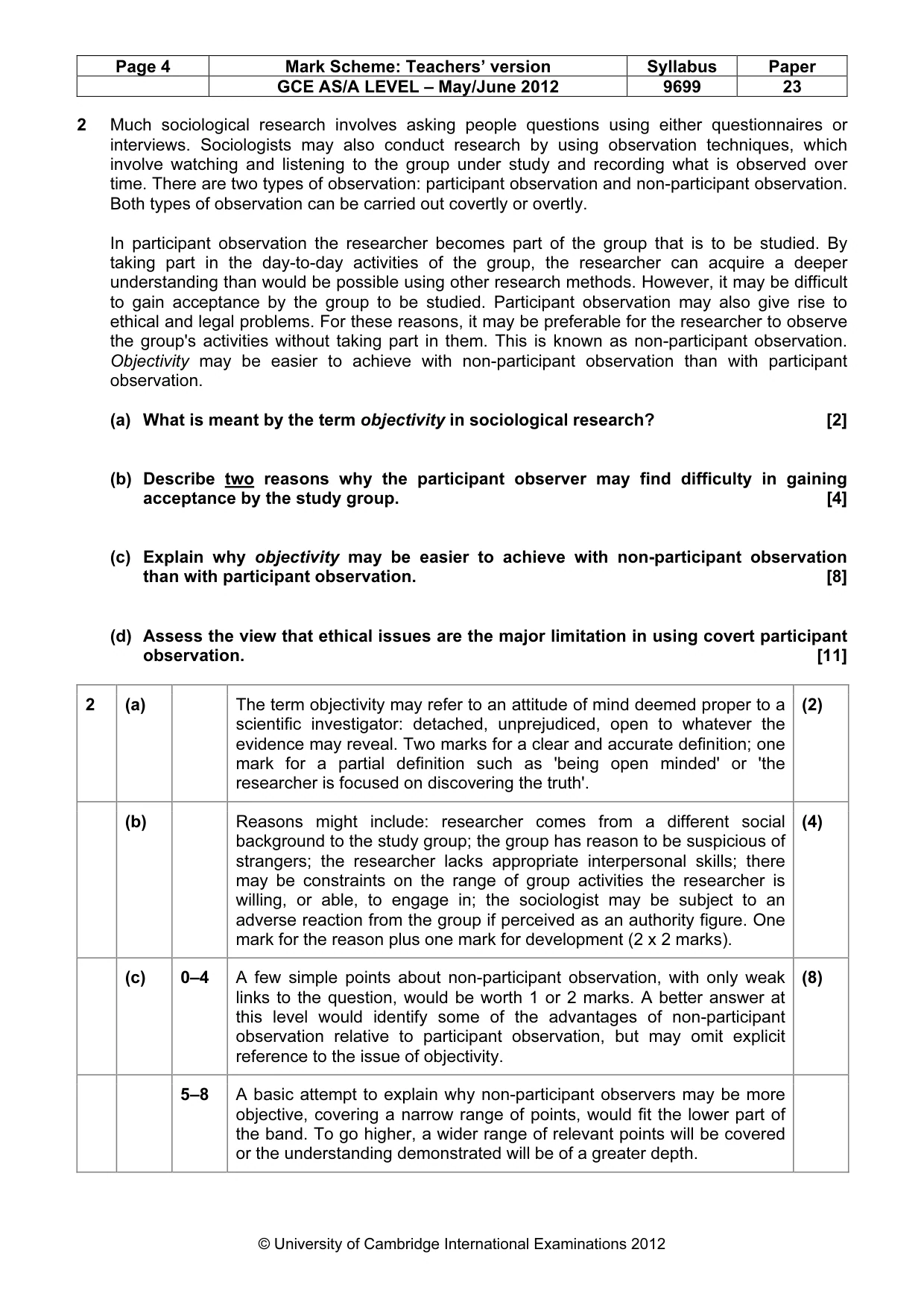
Page 4 Mark Scheme: Teachers’ version Syllabus Paper GCE AS/A LEVEL – May/June 2012 9699 23 © University of Cambridge International Examinations 2012 2 Much sociological research involves asking people questions using either questionnaires or interviews. Sociologists may also conduct research by using observation techniques, which involve watching and listening to the group under study and recording what is observed over time. There are two types of observation: participant observation and non-participant observation. Both types of observation can be carried out covertly or overtly. In participant observation the researcher becomes part of the group that is to be studied. By taking part in the day-to-day activities of the group, the researcher can acquire a deeper understanding than would be possible using other research methods. However, it may be difficult to gain acceptance by the group to be studied. Participant observation may also give rise to ethical and legal problems. For these reasons, it may be preferable for the researcher to observe the group's activities without taking part in them. This is known as non-participant observation. Objectivity may be easier to achieve with non-participant observation than with participant observation. (a) What is meant by the term objectivity in sociological research? [2] (b) Describe two reasons why the participant observer may find difficulty in gaining acceptance by the study group. [4] (c) Explain why objectivity may be easier to achieve with non-participant observation than with participant observation. [8] (d) Assess the view that ethical issues are the major limitation in using covert participant observation. [11] 2 (a) The term objectivity may refer to an attitude of mind deemed proper to a scientific investigator: detached, unprejudiced, open to whatever the evidence may reveal. Two marks for a clear and accurate definition; one mark for a partial definition such as 'being open minded' or 'the researcher is focused on discovering the truth'. (2) (b) Reasons might include: researcher comes from a different social background to the study group; the group has reason to be suspicious of strangers; the researcher lacks appropriate interpersonal skills; there may be constraints on the range of group activities the researcher is willing, or able, to engage in; the sociologist may be subject to an adverse reaction from the group if perceived as an authority figure. One mark for the reason plus one mark for development (2 x 2 marks). (4) (c) 0–4 A few simple points about non-participant observation, with only weak links to the question, would be worth 1 or 2 marks. A better answer at this level would identify some of the advantages of non-participant observation relative to participant observation, but may omit explicit reference to the issue of objectivity. (8) 5–8 A basic attempt to explain why non-participant observers may be more objective, covering a narrow range of points, would fit the lower part of the band. To go higher, a wider range of relevant points will be covered or the understanding demonstrated will be of a greater depth.
Mark scheme, page 5
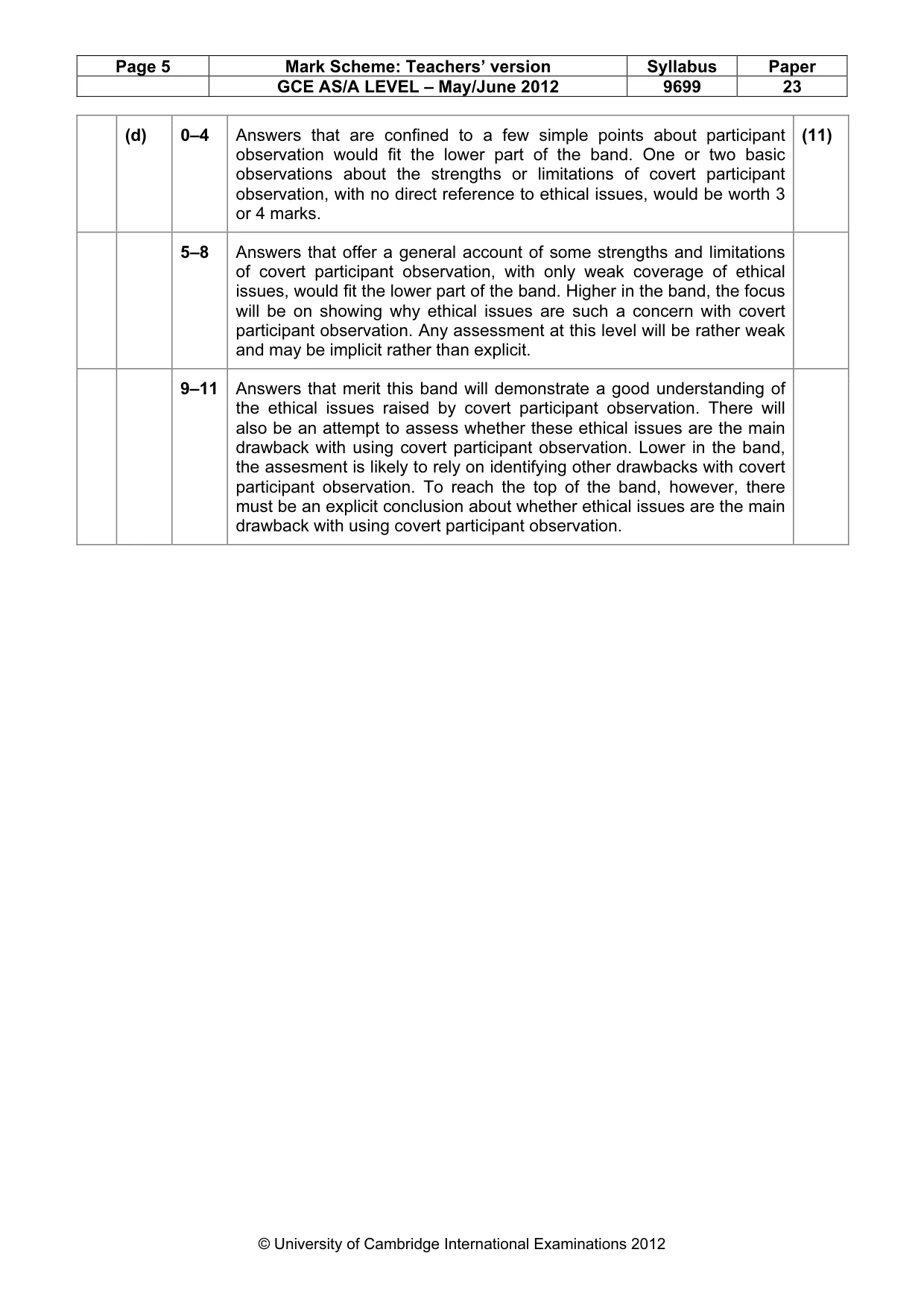
Page 5 Mark Scheme: Teachers’ version Syllabus Paper GCE AS/A LEVEL – May/June 2012 9699 23 © University of Cambridge International Examinations 2012 (d) 0–4 Answers that are confined to a few simple points about participant observation would fit the lower part of the band. One or two basic observations about the strengths or limitations of covert participant observation, with no direct reference to ethical issues, would be worth 3 or 4 marks. (11) 5–8 Answers that offer a general account of some strengths and limitations of covert participant observation, with only weak coverage of ethical issues, would fit the lower part of the band. Higher in the band, the focus will be on showing why ethical issues are such a concern with covert participant observation. Any assessment at this level will be rather weak and may be implicit rather than explicit. 9–11 Answers that merit this band will demonstrate a good understanding of the ethical issues raised by covert participant observation. There will also be an attempt to assess whether these ethical issues are the main drawback with using covert participant observation. Lower in the band, the assesment is likely to rely on identifying other drawbacks with covert participant observation. To reach the top of the band, however, there must be an explicit conclusion about whether ethical issues are the main drawback with using covert participant observation.
Mark scheme, page 6
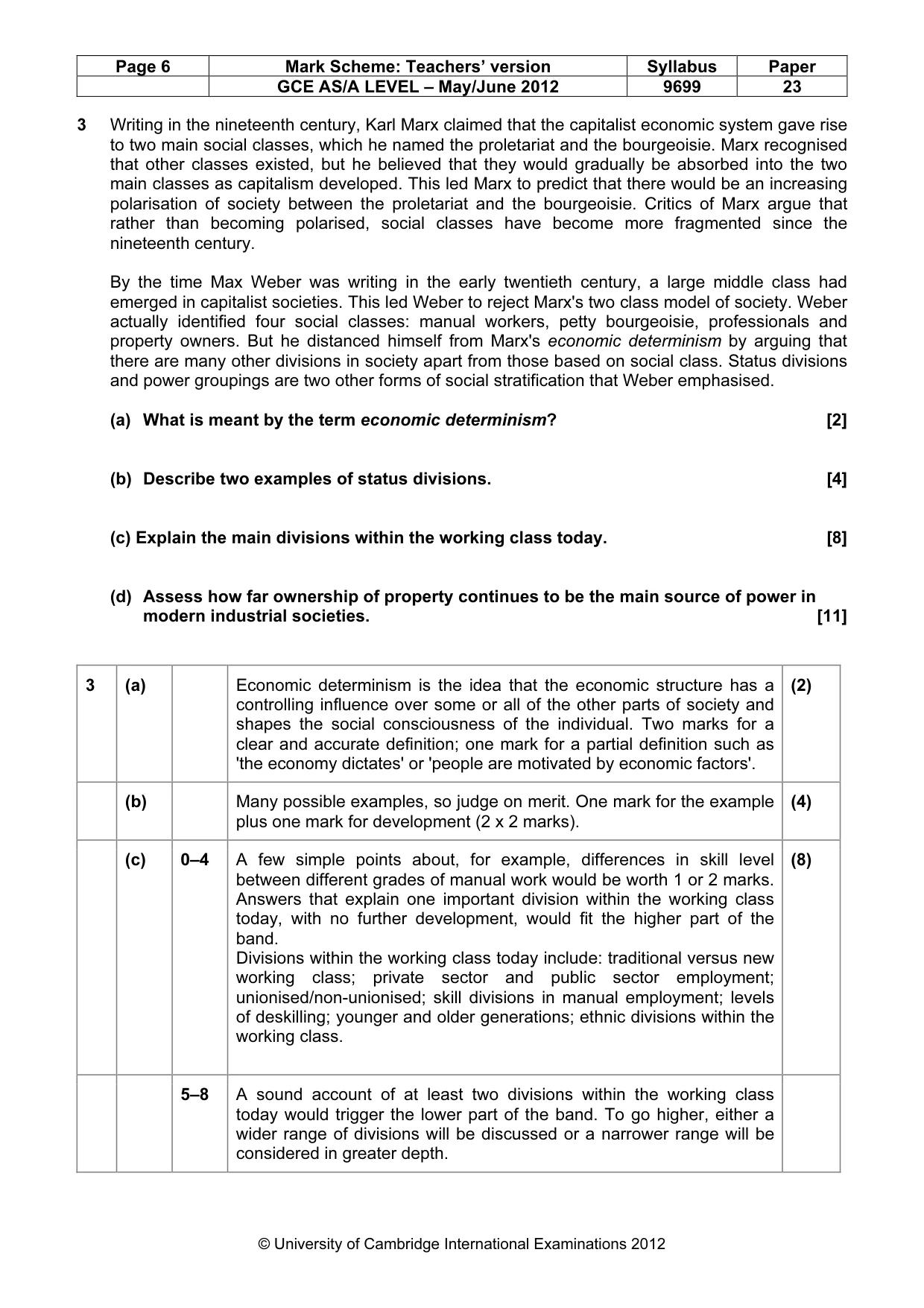
Page 6 Mark Scheme: Teachers’ version Syllabus Paper GCE AS/A LEVEL – May/June 2012 9699 23 © University of Cambridge International Examinations 2012 3 Writing in the nineteenth century, Karl Marx claimed that the capitalist economic system gave rise to two main social classes, which he named the proletariat and the bourgeoisie. Marx recognised that other classes existed, but he believed that they would gradually be absorbed into the two main classes as capitalism developed. This led Marx to predict that there would be an increasing polarisation of society between the proletariat and the bourgeoisie. Critics of Marx argue that rather than becoming polarised, social classes have become more fragmented since the nineteenth century. By the time Max Weber was writing in the early twentieth century, a large middle class had emerged in capitalist societies. This led Weber to reject Marx's two class model of society. Weber actually identified four social classes: manual workers, petty bourgeoisie, professionals and property owners. But he distanced himself from Marx's economic determinism by arguing that there are many other divisions in society apart from those based on social class. Status divisions and power groupings are two other forms of social stratification that Weber emphasised. (a) What is meant by the term economic determinism? [2] (b) Describe two examples of status divisions. [4] (c) Explain the main divisions within the working class today. [8] (d) Assess how far ownership of property continues to be the main source of power in modern industrial societies. [11] 3 (a) Economic determinism is the idea that the economic structure has a controlling influence over some or all of the other parts of society and shapes the social consciousness of the individual. Two marks for a clear and accurate definition; one mark for a partial definition such as 'the economy dictates' or 'people are motivated by economic factors'. (2) (b) Many possible examples, so judge on merit. One mark for the example plus one mark for development (2 x 2 marks). (4) (c) 0–4 A few simple points about, for example, differences in skill level between different grades of manual work would be worth 1 or 2 marks. Answers that explain one important division within the working class today, with no further development, would fit the higher part of the band. Divisions within the working class today include: traditional versus new working class; private sector and public sector employment; unionised/non-unionised; skill divisions in manual employment; levels of deskilling; younger and older generations; ethnic divisions within the working class. (8) 5–8 A sound account of at least two divisions within the working class today would trigger the lower part of the band. To go higher, either a wider range of divisions will be discussed or a narrower range will be considered in greater depth.
Mark scheme, page 7
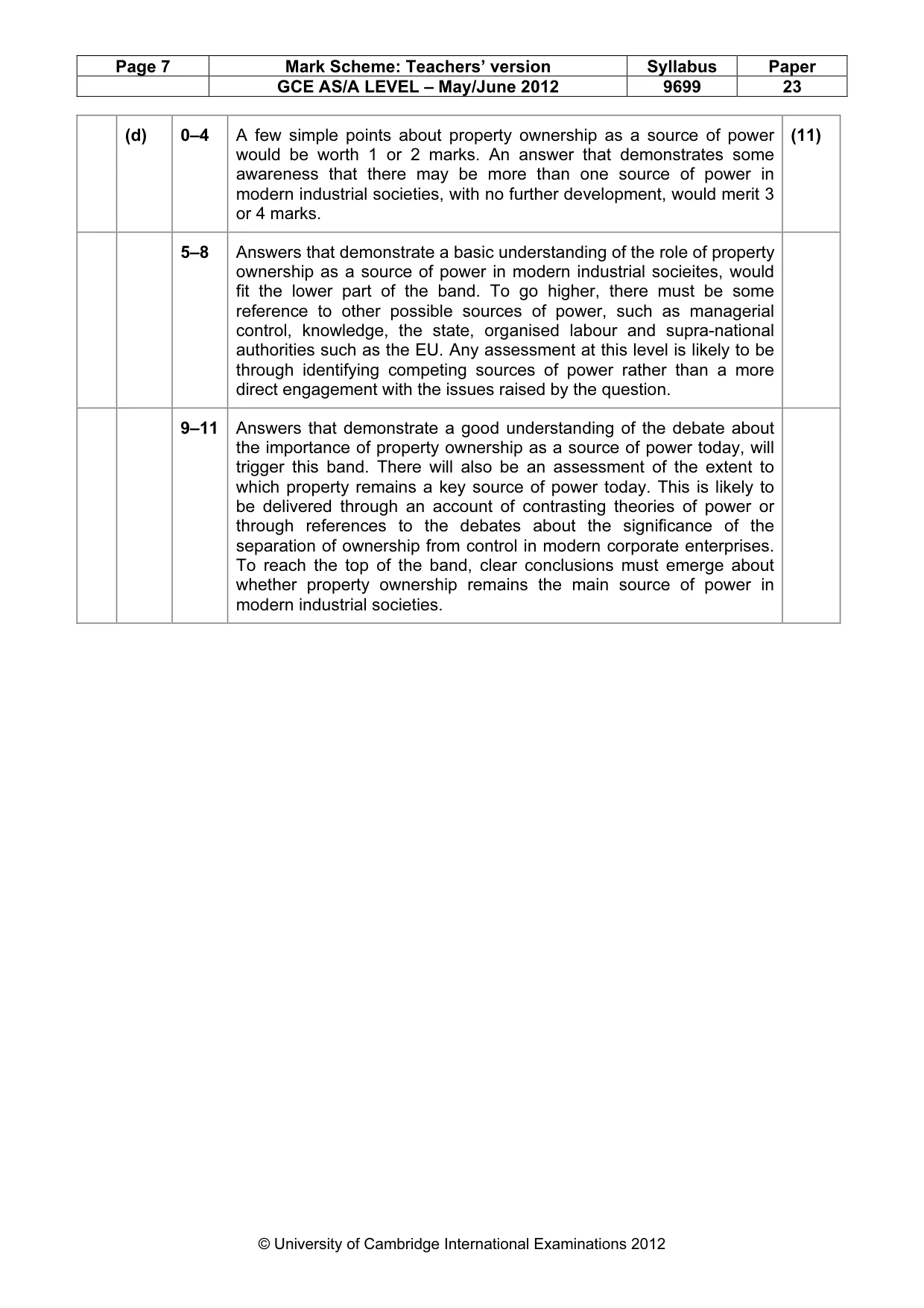
Page 7 Mark Scheme: Teachers’ version Syllabus Paper GCE AS/A LEVEL – May/June 2012 9699 23 © University of Cambridge International Examinations 2012 (d) 0–4 A few simple points about property ownership as a source of power would be worth 1 or 2 marks. An answer that demonstrates some awareness that there may be more than one source of power in modern industrial societies, with no further development, would merit 3 or 4 marks. (11) 5–8 Answers that demonstrate a basic understanding of the role of property ownership as a source of power in modern industrial socieites, would fit the lower part of the band. To go higher, there must be some reference to other possible sources of power, such as managerial control, knowledge, the state, organised labour and supra-national authorities such as the EU. Any assessment at this level is likely to be through identifying competing sources of power rather than a more direct engagement with the issues raised by the question. 9–11 Answers that demonstrate a good understanding of the debate about the importance of property ownership as a source of power today, will trigger this band. There will also be an assessment of the extent to which property remains a key source of power today. This is likely to be delivered through an account of contrasting theories of power or through references to the debates about the significance of the separation of ownership from control in modern corporate enterprises. To reach the top of the band, clear conclusions must emerge about whether property ownership remains the main source of power in modern industrial societies.
What you needed in this session
Cambridge’s own grade thresholds for 2012 May/June, Paper 2 · Variant 3. A higher threshold means an easier paper — the bar moves with how the cohort did.