Cambridge A Level Sociology 9699 — 2011 May/June Paper 3 · Variant 3
9699/33/M/J/11 · 75 marks · ≈84 min
The question paper and its mark scheme, free to read here and free to download. This is Cambridge’s own paper, exactly as it was sat.
Question paper4 pages
Mark scheme14 pages
Answers below. Sit the paper first if you are practising.
Paper as text
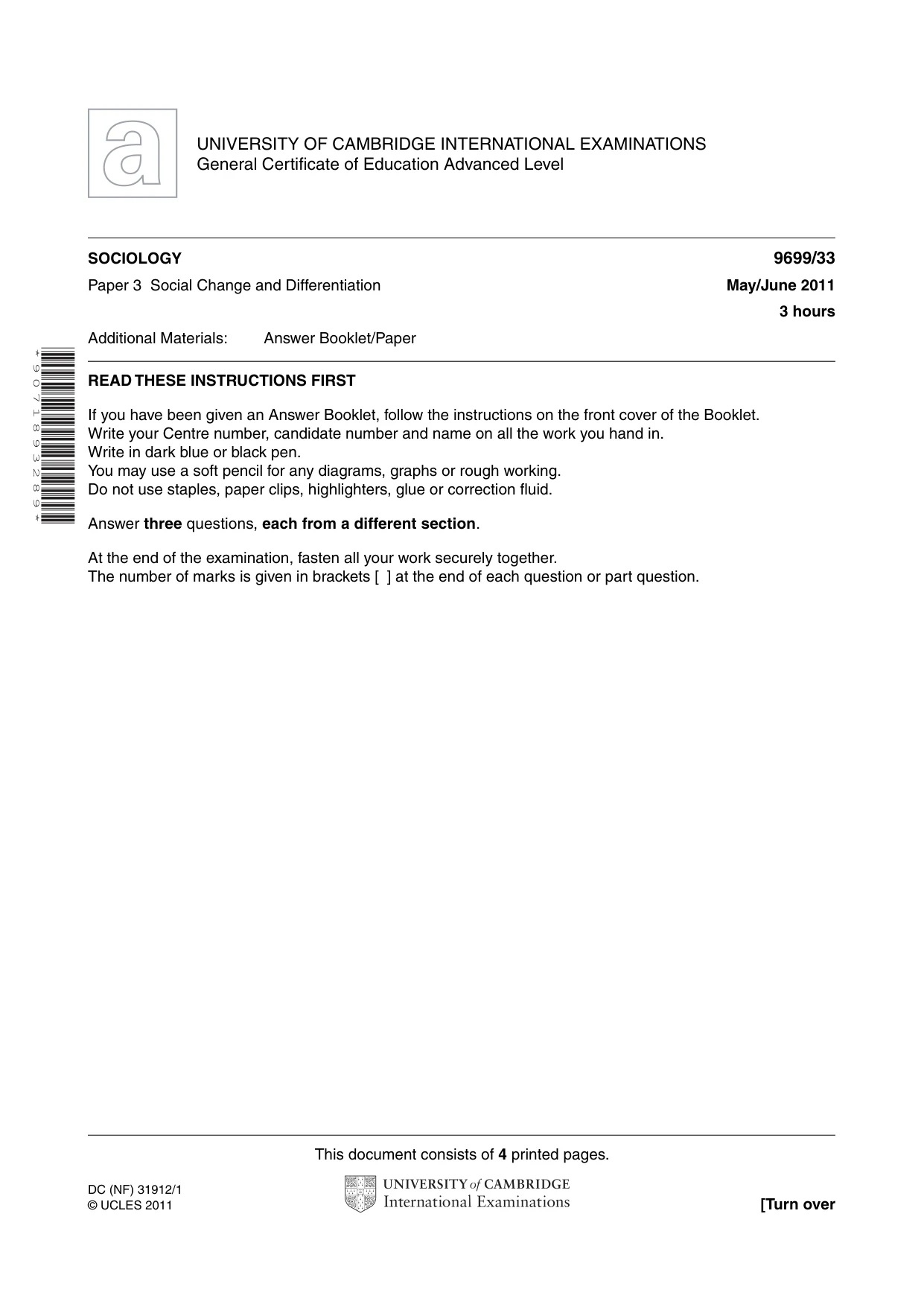
Question paper, page 1
This document consists of 4 printed pages. DC (NF) 31912/1 © UCLES 2011 [Turn over UNIVERSITY OF CAMBRIDGE INTERNATIONAL EXAMINATIONS General Certificate of Education Advanced Level * 9 0 7 1 8 9 3 2 8 9 * SOCIOLOGY 9699/33 Paper 3 Social Change and Differentiation May/June 2011 3 hours Additional Materials: Answer Booklet/Paper READ THESE INSTRUCTIONS FIRST If you have been given an Answer Booklet, follow the instructions on the front cover of the Booklet. Write your Centre number, candidate number and name on all the work you hand in. Write in dark blue or black pen. You may use a soft pencil for any diagrams, graphs or rough working. Do not use staples, paper clips, highlighters, glue or correction fluid. Answer three questions, each from a different section. At the end of the examination, fasten all your work securely together. The number of marks is given in brackets [ ] at the end of each question or part question.
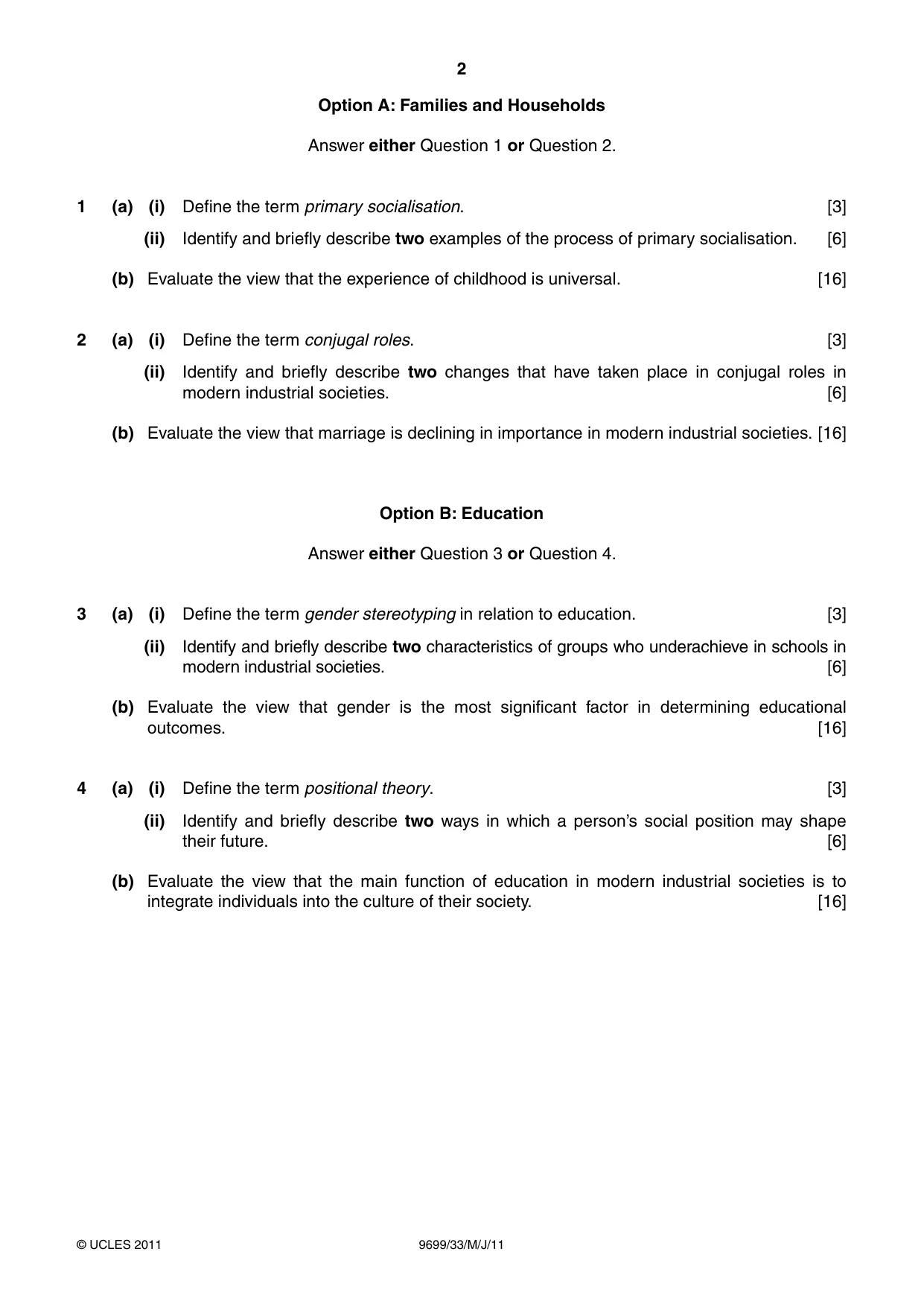
Question paper, page 2
2 9699/33/M/J/11 © UCLES 2011 Option A: Families and Households Answer either Question 1 or Question 2. 1 (a) (i) Define the term primary socialisation. [3] (ii) Identify and briefly describe two examples of the process of primary socialisation. [6] (b) Evaluate the view that the experience of childhood is universal. [16] 2 (a) (i) Define the term conjugal roles. [3] (ii) Identify and briefly describe two changes that have taken place in conjugal roles in modern industrial societies. [6] (b) Evaluate the view that marriage is declining in importance in modern industrial societies. [16] Option B: Education Answer either Question 3 or Question 4. 3 (a) (i) Define the term gender stereotyping in relation to education. [3] (ii) Identify and briefly describe two characteristics of groups who underachieve in schools in modern industrial societies. [6] (b) Evaluate the view that gender is the most significant factor in determining educational outcomes. [16] 4 (a) (i) Define the term positional theory. [3] (ii) Identify and briefly describe two ways in which a person’s social position may shape their future. [6] (b) Evaluate the view that the main function of education in modern industrial societies is to integrate individuals into the culture of their society. [16]
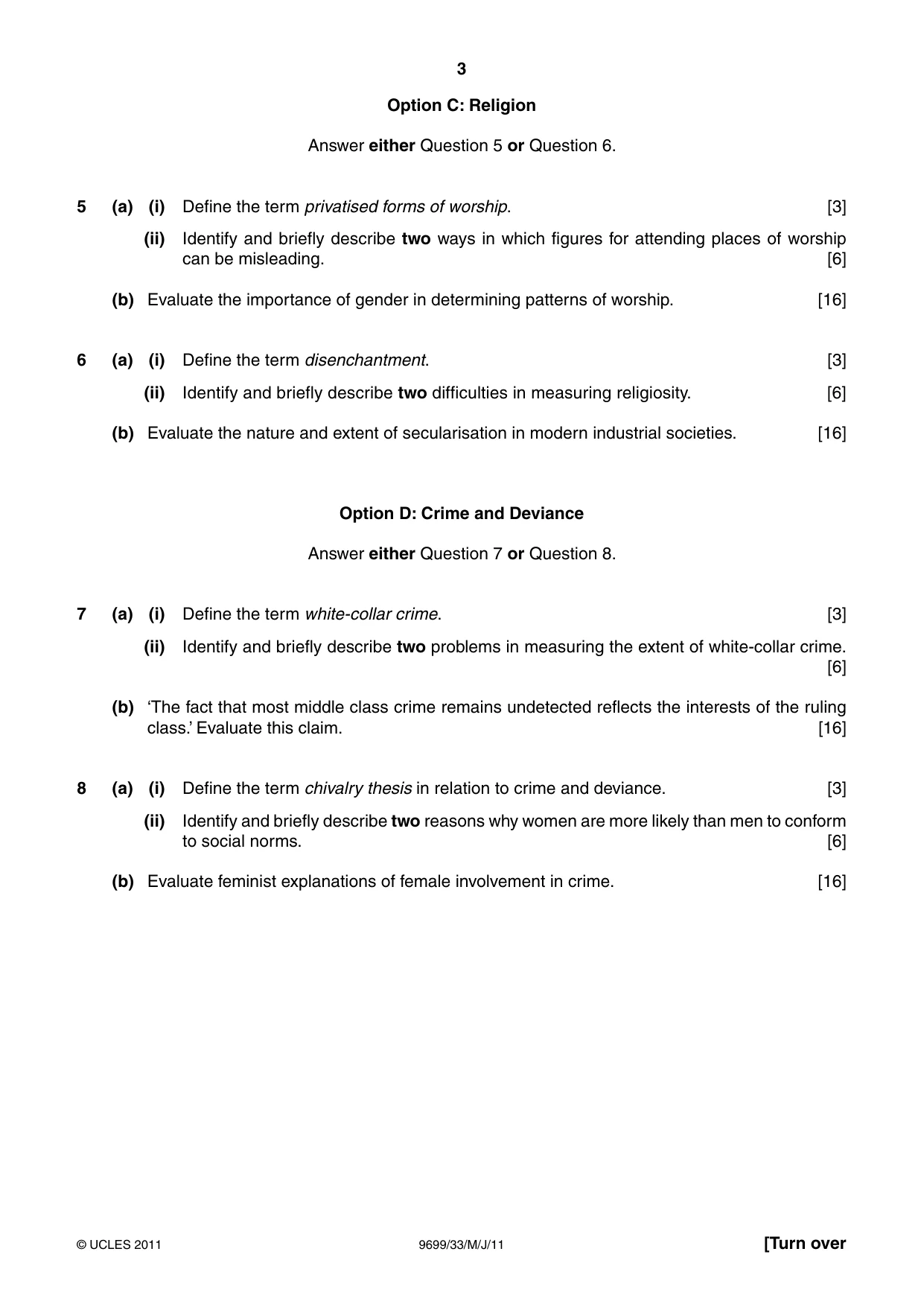
Question paper, page 3
3 9699/33/M/J/11 © UCLES 2011 [Turn over Option C: Religion Answer either Question 5 or Question 6. 5 (a) (i) Define the term privatised forms of worship. [3] (ii) Identify and briefly describe two ways in which figures for attending places of worship can be misleading. [6] (b) Evaluate the importance of gender in determining patterns of worship. [16] 6 (a) (i) Define the term disenchantment. [3] (ii) Identify and briefly describe two difficulties in measuring religiosity. [6] (b) Evaluate the nature and extent of secularisation in modern industrial societies. [16] Option D: Crime and Deviance Answer either Question 7 or Question 8. 7 (a) (i) Define the term white-collar crime. [3] (ii) Identify and briefly describe two problems in measuring the extent of white-collar crime. [6] (b) ‘The fact that most middle class crime remains undetected reflects the interests of the ruling class.’ Evaluate this claim. [16] 8 (a) (i) Define the term chivalry thesis in relation to crime and deviance. [3] (ii) Identify and briefly describe two reasons why women are more likely than men to conform to social norms. [6] (b) Evaluate feminist explanations of female involvement in crime. [16]
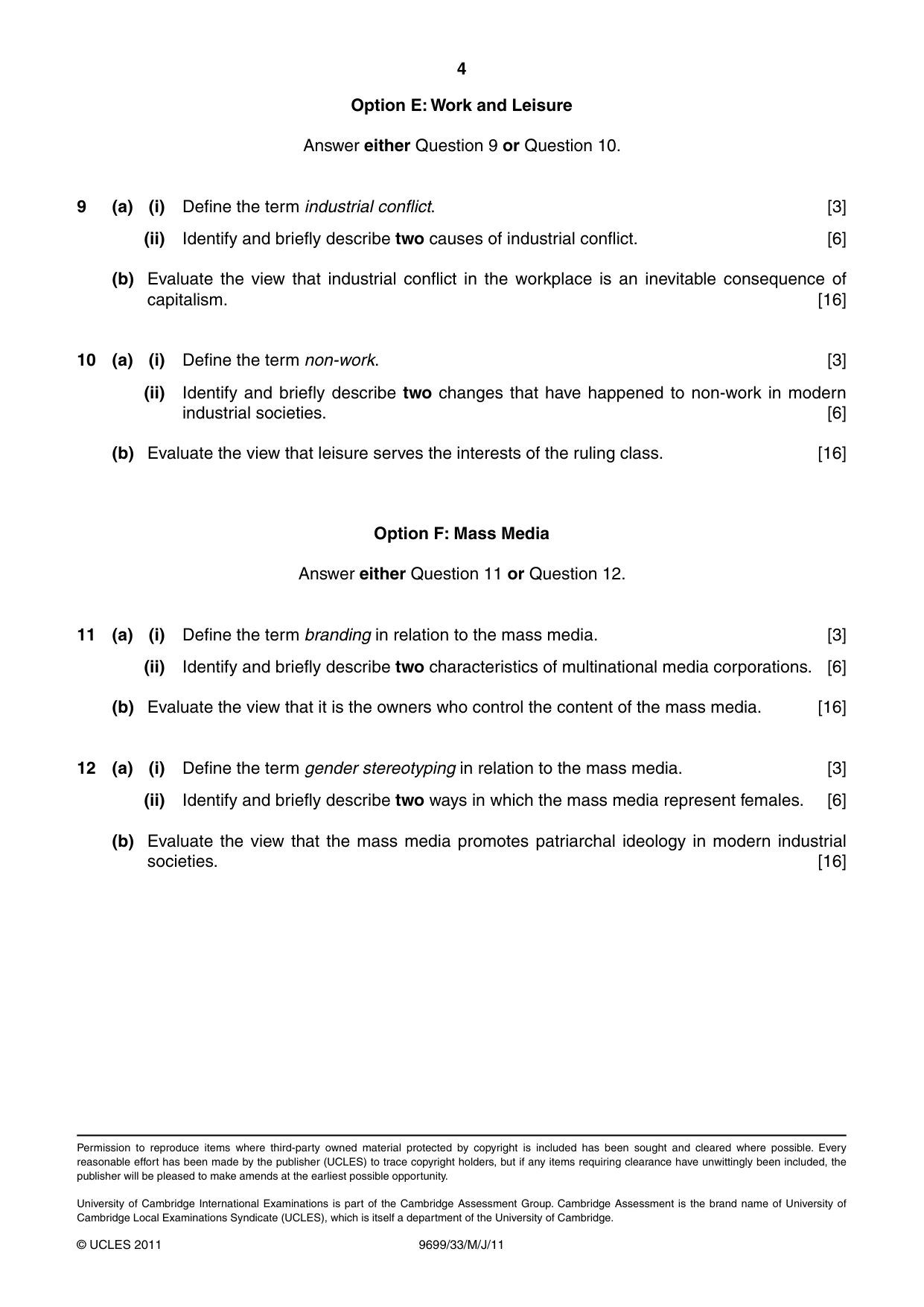
Question paper, page 4
4 9699/33/M/J/11 © UCLES 2011 Permission to reproduce items where third-party owned material protected by copyright is included has been sought and cleared where possible. Every reasonable effort has been made by the publisher (UCLES) to trace copyright holders, but if any items requiring clearance have unwittingly been included, the publisher will be pleased to make amends at the earliest possible opportunity. University of Cambridge International Examinations is part of the Cambridge Assessment Group. Cambridge Assessment is the brand name of University of Cambridge Local Examinations Syndicate (UCLES), which is itself a department of the University of Cambridge. Option E: Work and Leisure Answer either Question 9 or Question 10. 9 (a) (i) Define the term industrial conflict. [3] (ii) Identify and briefly describe two causes of industrial conflict. [6] (b) Evaluate the view that industrial conflict in the workplace is an inevitable consequence of capitalism. [16] 10 (a) (i) Define the term non-work. [3] (ii) Identify and briefly describe two changes that have happened to non-work in modern industrial societies. [6] (b) Evaluate the view that leisure serves the interests of the ruling class. [16] Option F: Mass Media Answer either Question 11 or Question 12. 11 (a) (i) Define the term branding in relation to the mass media. [3] (ii) Identify and briefly describe two characteristics of multinational media corporations. [6] (b) Evaluate the view that it is the owners who control the content of the mass media. [16] 12 (a) (i) Define the term gender stereotyping in relation to the mass media. [3] (ii) Identify and briefly describe two ways in which the mass media represent females. [6] (b) Evaluate the view that the mass media promotes patriarchal ideology in modern industrial societies. [16]
Mark scheme, page 1
UNIVERSITY OF CAMBRIDGE INTERNATIONAL EXAMINATIONS GCE Advanced Subsidiary Level and GCE Advanced Level MARK SCHEME for the May/June 2011 question paper for the guidance of teachers 9699 SOCIOLOGY 9699/33 Paper 3 (Essay), maximum raw mark 75 This mark scheme is published as an aid to teachers and candidates, to indicate the requirements of the examination. It shows the basis on which Examiners were instructed to award marks. It does not indicate the details of the discussions that took place at an Examiners’ meeting before marking began, which would have considered the acceptability of alternative answers. Mark schemes must be read in conjunction with the question papers and the report on the examination. • Cambridge will not enter into discussions or correspondence in connection with these mark schemes. Cambridge is publishing the mark schemes for the May/June 2011 question papers for most IGCSE, GCE Advanced Level and Advanced Subsidiary Level syllabuses and some Ordinary Level syllabuses.
Mark scheme, page 2
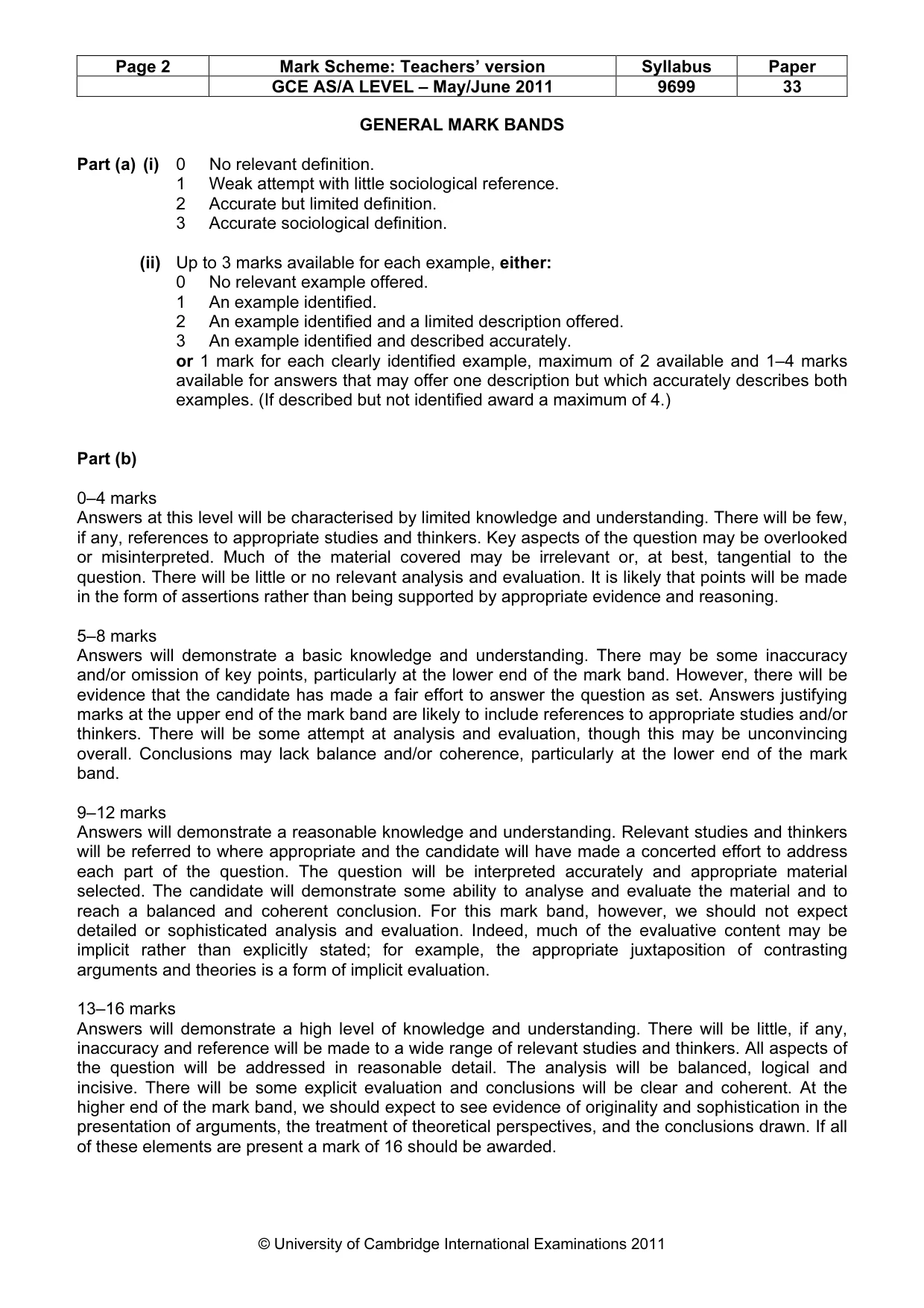
Page 2 Mark Scheme: Teachers’ version Syllabus Paper GCE AS/A LEVEL – May/June 2011 9699 33 © University of Cambridge International Examinations 2011 GENERAL MARK BANDS Part (a) (i) 0 No relevant definition. 1 Weak attempt with little sociological reference. 2 Accurate but limited definition. 3 Accurate sociological definition. (ii) Up to 3 marks available for each example, either: 0 No relevant example offered. 1 An example identified. 2 An example identified and a limited description offered. 3 An example identified and described accurately. or 1 mark for each clearly identified example, maximum of 2 available and 1–4 marks available for answers that may offer one description but which accurately describes both examples. (If described but not identified award a maximum of 4.) Part (b) 0–4 marks Answers at this level will be characterised by limited knowledge and understanding. There will be few, if any, references to appropriate studies and thinkers. Key aspects of the question may be overlooked or misinterpreted. Much of the material covered may be irrelevant or, at best, tangential to the question. There will be little or no relevant analysis and evaluation. It is likely that points will be made in the form of assertions rather than being supported by appropriate evidence and reasoning. 5–8 marks Answers will demonstrate a basic knowledge and understanding. There may be some inaccuracy and/or omission of key points, particularly at the lower end of the mark band. However, there will be evidence that the candidate has made a fair effort to answer the question as set. Answers justifying marks at the upper end of the mark band are likely to include references to appropriate studies and/or thinkers. There will be some attempt at analysis and evaluation, though this may be unconvincing overall. Conclusions may lack balance and/or coherence, particularly at the lower end of the mark band. 9–12 marks Answers will demonstrate a reasonable knowledge and understanding. Relevant studies and thinkers will be referred to where appropriate and the candidate will have made a concerted effort to address each part of the question. The question will be interpreted accurately and appropriate material selected. The candidate will demonstrate some ability to analyse and evaluate the material and to reach a balanced and coherent conclusion. For this mark band, however, we should not expect detailed or sophisticated analysis and evaluation. Indeed, much of the evaluative content may be implicit rather than explicitly stated; for example, the appropriate juxtaposition of contrasting arguments and theories is a form of implicit evaluation. 13–16 marks Answers will demonstrate a high level of knowledge and understanding. There will be little, if any, inaccuracy and reference will be made to a wide range of relevant studies and thinkers. All aspects of the question will be addressed in reasonable detail. The analysis will be balanced, logical and incisive. There will be some explicit evaluation and conclusions will be clear and coherent. At the higher end of the mark band, we should expect to see evidence of originality and sophistication in the presentation of arguments, the treatment of theoretical perspectives, and the conclusions drawn. If all of these elements are present a mark of 16 should be awarded.
Mark scheme, page 3
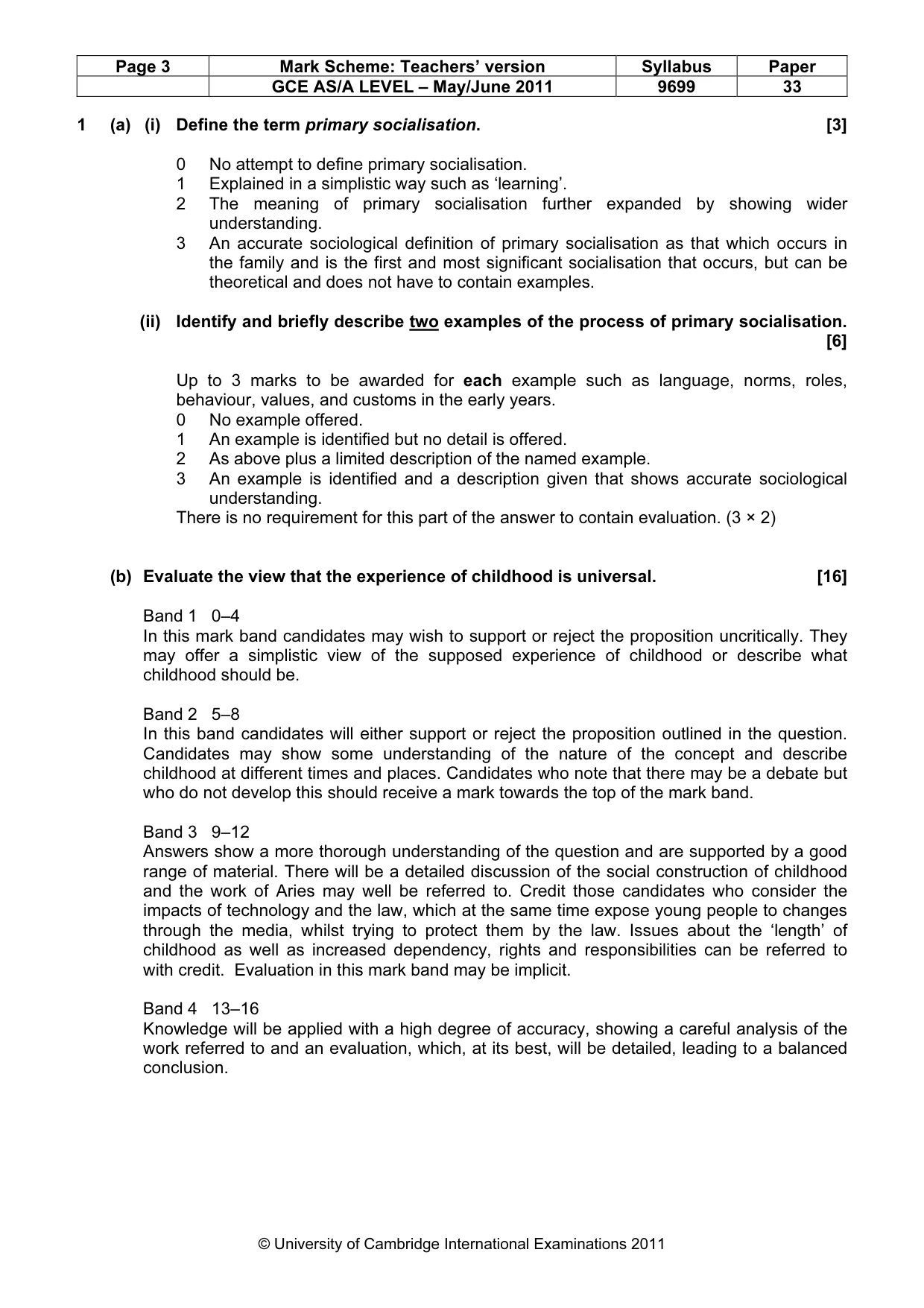
Page 3 Mark Scheme: Teachers’ version Syllabus Paper GCE AS/A LEVEL – May/June 2011 9699 33 © University of Cambridge International Examinations 2011 1 (a) (i) Define the term primary socialisation. [3] 0 No attempt to define primary socialisation. 1 Explained in a simplistic way such as ‘learning’. 2 The meaning of primary socialisation further expanded by showing wider understanding. 3 An accurate sociological definition of primary socialisation as that which occurs in the family and is the first and most significant socialisation that occurs, but can be theoretical and does not have to contain examples. (ii) Identify and briefly describe two examples of the process of primary socialisation. [6] Up to 3 marks to be awarded for each example such as language, norms, roles, behaviour, values, and customs in the early years. 0 No example offered. 1 An example is identified but no detail is offered. 2 As above plus a limited description of the named example. 3 An example is identified and a description given that shows accurate sociological understanding. There is no requirement for this part of the answer to contain evaluation. (3 × 2) (b) Evaluate the view that the experience of childhood is universal. [16] Band 1 0–4 In this mark band candidates may wish to support or reject the proposition uncritically. They may offer a simplistic view of the supposed experience of childhood or describe what childhood should be. Band 2 5–8 In this band candidates will either support or reject the proposition outlined in the question. Candidates may show some understanding of the nature of the concept and describe childhood at different times and places. Candidates who note that there may be a debate but who do not develop this should receive a mark towards the top of the mark band. Band 3 9–12 Answers show a more thorough understanding of the question and are supported by a good range of material. There will be a detailed discussion of the social construction of childhood and the work of Aries may well be referred to. Credit those candidates who consider the impacts of technology and the law, which at the same time expose young people to changes through the media, whilst trying to protect them by the law. Issues about the ‘length’ of childhood as well as increased dependency, rights and responsibilities can be referred to with credit. Evaluation in this mark band may be implicit. Band 4 13–16 Knowledge will be applied with a high degree of accuracy, showing a careful analysis of the work referred to and an evaluation, which, at its best, will be detailed, leading to a balanced conclusion.
Mark scheme, page 4
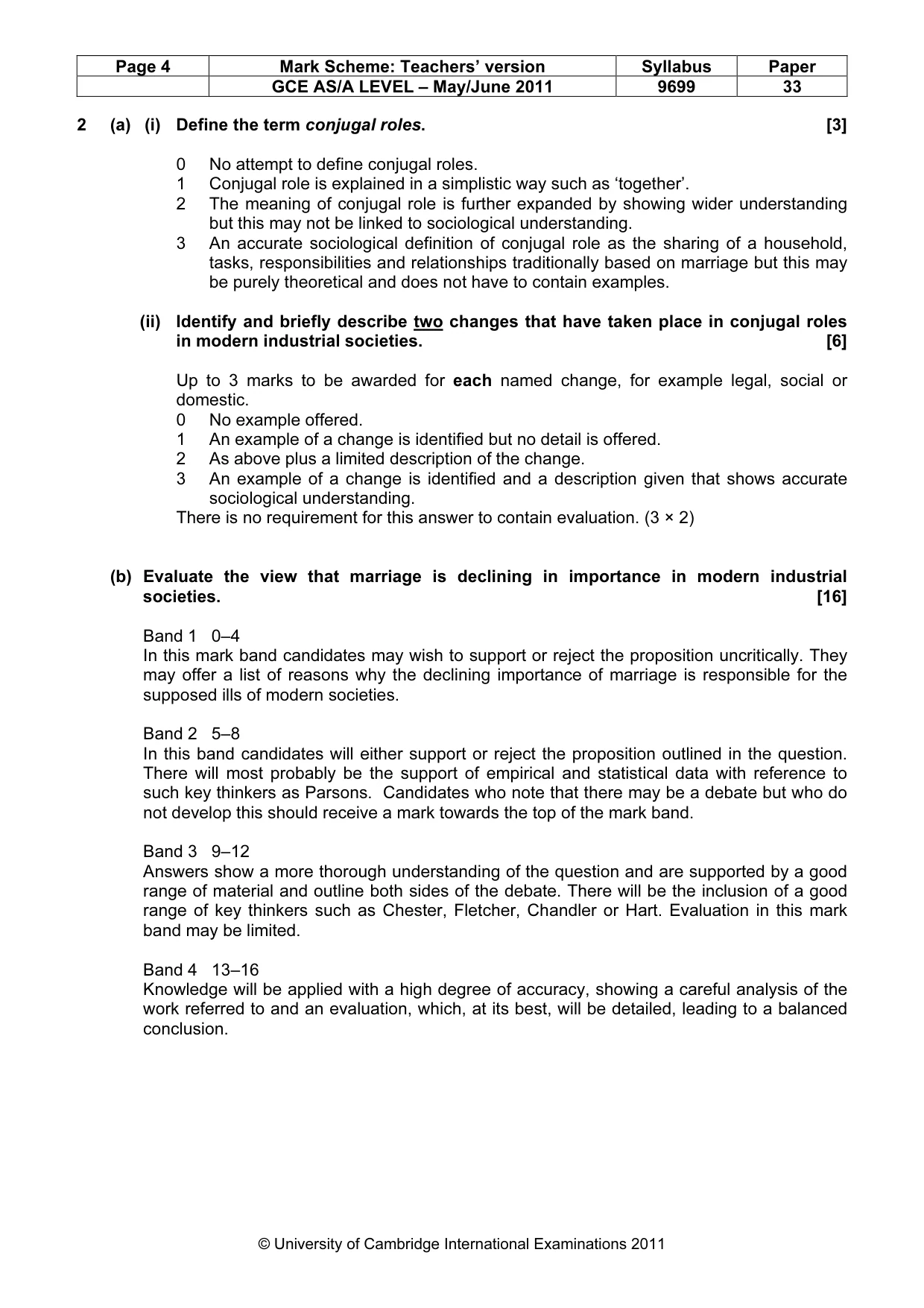
Page 4 Mark Scheme: Teachers’ version Syllabus Paper GCE AS/A LEVEL – May/June 2011 9699 33 © University of Cambridge International Examinations 2011 2 (a) (i) Define the term conjugal roles. [3] 0 No attempt to define conjugal roles. 1 Conjugal role is explained in a simplistic way such as ‘together’. 2 The meaning of conjugal role is further expanded by showing wider understanding but this may not be linked to sociological understanding. 3 An accurate sociological definition of conjugal role as the sharing of a household, tasks, responsibilities and relationships traditionally based on marriage but this may be purely theoretical and does not have to contain examples. (ii) Identify and briefly describe two changes that have taken place in conjugal roles in modern industrial societies. [6] Up to 3 marks to be awarded for each named change, for example legal, social or domestic. 0 No example offered. 1 An example of a change is identified but no detail is offered. 2 As above plus a limited description of the change. 3 An example of a change is identified and a description given that shows accurate sociological understanding. There is no requirement for this answer to contain evaluation. (3 × 2) (b) Evaluate the view that marriage is declining in importance in modern industrial societies. [16] Band 1 0–4 In this mark band candidates may wish to support or reject the proposition uncritically. They may offer a list of reasons why the declining importance of marriage is responsible for the supposed ills of modern societies. Band 2 5–8 In this band candidates will either support or reject the proposition outlined in the question. There will most probably be the support of empirical and statistical data with reference to such key thinkers as Parsons. Candidates who note that there may be a debate but who do not develop this should receive a mark towards the top of the mark band. Band 3 9–12 Answers show a more thorough understanding of the question and are supported by a good range of material and outline both sides of the debate. There will be the inclusion of a good range of key thinkers such as Chester, Fletcher, Chandler or Hart. Evaluation in this mark band may be limited. Band 4 13–16 Knowledge will be applied with a high degree of accuracy, showing a careful analysis of the work referred to and an evaluation, which, at its best, will be detailed, leading to a balanced conclusion.
Mark scheme, page 5
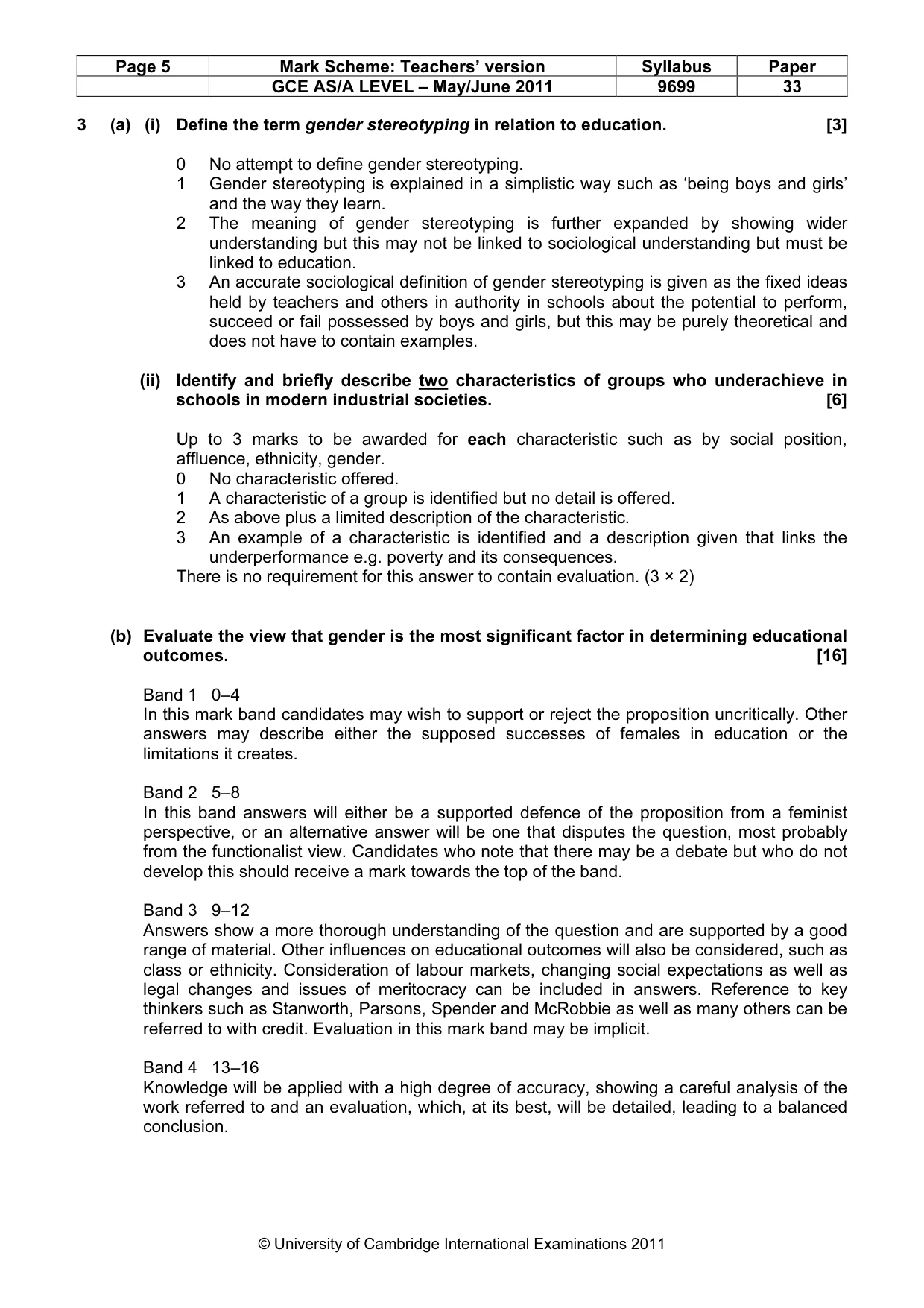
Page 5 Mark Scheme: Teachers’ version Syllabus Paper GCE AS/A LEVEL – May/June 2011 9699 33 © University of Cambridge International Examinations 2011 3 (a) (i) Define the term gender stereotyping in relation to education. [3] 0 No attempt to define gender stereotyping. 1 Gender stereotyping is explained in a simplistic way such as ‘being boys and girls’ and the way they learn. 2 The meaning of gender stereotyping is further expanded by showing wider understanding but this may not be linked to sociological understanding but must be linked to education. 3 An accurate sociological definition of gender stereotyping is given as the fixed ideas held by teachers and others in authority in schools about the potential to perform, succeed or fail possessed by boys and girls, but this may be purely theoretical and does not have to contain examples. (ii) Identify and briefly describe two characteristics of groups who underachieve in schools in modern industrial societies. [6] Up to 3 marks to be awarded for each characteristic such as by social position, affluence, ethnicity, gender. 0 No characteristic offered. 1 A characteristic of a group is identified but no detail is offered. 2 As above plus a limited description of the characteristic. 3 An example of a characteristic is identified and a description given that links the underperformance e.g. poverty and its consequences. There is no requirement for this answer to contain evaluation. (3 × 2) (b) Evaluate the view that gender is the most significant factor in determining educational outcomes. [16] Band 1 0–4 In this mark band candidates may wish to support or reject the proposition uncritically. Other answers may describe either the supposed successes of females in education or the limitations it creates. Band 2 5–8 In this band answers will either be a supported defence of the proposition from a feminist perspective, or an alternative answer will be one that disputes the question, most probably from the functionalist view. Candidates who note that there may be a debate but who do not develop this should receive a mark towards the top of the band. Band 3 9–12 Answers show a more thorough understanding of the question and are supported by a good range of material. Other influences on educational outcomes will also be considered, such as class or ethnicity. Consideration of labour markets, changing social expectations as well as legal changes and issues of meritocracy can be included in answers. Reference to key thinkers such as Stanworth, Parsons, Spender and McRobbie as well as many others can be referred to with credit. Evaluation in this mark band may be implicit. Band 4 13–16 Knowledge will be applied with a high degree of accuracy, showing a careful analysis of the work referred to and an evaluation, which, at its best, will be detailed, leading to a balanced conclusion.
Mark scheme, page 6
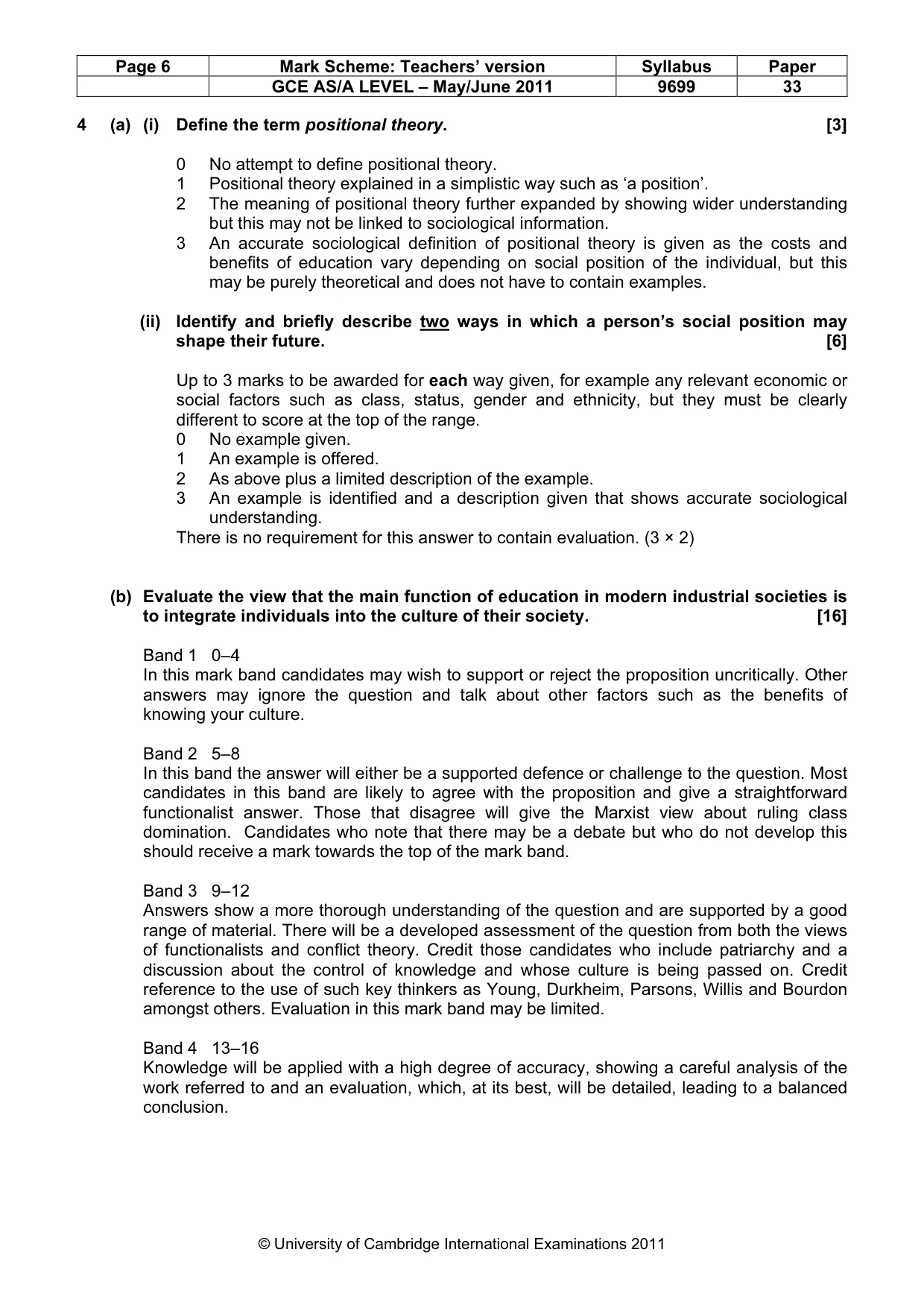
Page 6 Mark Scheme: Teachers’ version Syllabus Paper GCE AS/A LEVEL – May/June 2011 9699 33 © University of Cambridge International Examinations 2011 4 (a) (i) Define the term positional theory. [3] 0 No attempt to define positional theory. 1 Positional theory explained in a simplistic way such as ‘a position’. 2 The meaning of positional theory further expanded by showing wider understanding but this may not be linked to sociological information. 3 An accurate sociological definition of positional theory is given as the costs and benefits of education vary depending on social position of the individual, but this may be purely theoretical and does not have to contain examples. (ii) Identify and briefly describe two ways in which a person’s social position may shape their future. [6] Up to 3 marks to be awarded for each way given, for example any relevant economic or social factors such as class, status, gender and ethnicity, but they must be clearly different to score at the top of the range. 0 No example given. 1 An example is offered. 2 As above plus a limited description of the example. 3 An example is identified and a description given that shows accurate sociological understanding. There is no requirement for this answer to contain evaluation. (3 × 2) (b) Evaluate the view that the main function of education in modern industrial societies is to integrate individuals into the culture of their society. [16] Band 1 0–4 In this mark band candidates may wish to support or reject the proposition uncritically. Other answers may ignore the question and talk about other factors such as the benefits of knowing your culture. Band 2 5–8 In this band the answer will either be a supported defence or challenge to the question. Most candidates in this band are likely to agree with the proposition and give a straightforward functionalist answer. Those that disagree will give the Marxist view about ruling class domination. Candidates who note that there may be a debate but who do not develop this should receive a mark towards the top of the mark band. Band 3 9–12 Answers show a more thorough understanding of the question and are supported by a good range of material. There will be a developed assessment of the question from both the views of functionalists and conflict theory. Credit those candidates who include patriarchy and a discussion about the control of knowledge and whose culture is being passed on. Credit reference to the use of such key thinkers as Young, Durkheim, Parsons, Willis and Bourdon amongst others. Evaluation in this mark band may be limited. Band 4 13–16 Knowledge will be applied with a high degree of accuracy, showing a careful analysis of the work referred to and an evaluation, which, at its best, will be detailed, leading to a balanced conclusion.
Mark scheme, page 7
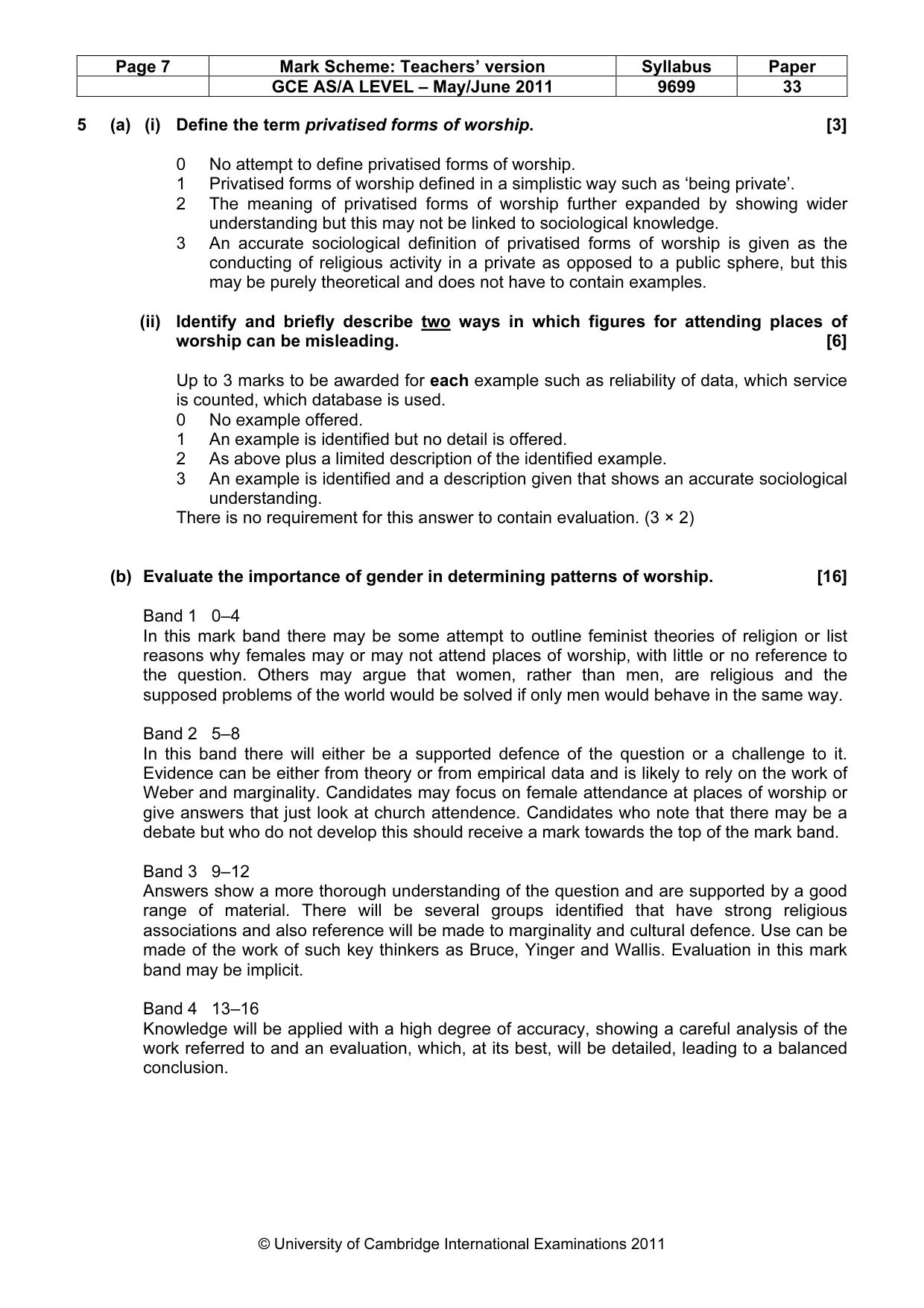
Page 7 Mark Scheme: Teachers’ version Syllabus Paper GCE AS/A LEVEL – May/June 2011 9699 33 © University of Cambridge International Examinations 2011 5 (a) (i) Define the term privatised forms of worship. [3] 0 No attempt to define privatised forms of worship. 1 Privatised forms of worship defined in a simplistic way such as ‘being private’. 2 The meaning of privatised forms of worship further expanded by showing wider understanding but this may not be linked to sociological knowledge. 3 An accurate sociological definition of privatised forms of worship is given as the conducting of religious activity in a private as opposed to a public sphere, but this may be purely theoretical and does not have to contain examples. (ii) Identify and briefly describe two ways in which figures for attending places of worship can be misleading. [6] Up to 3 marks to be awarded for each example such as reliability of data, which service is counted, which database is used. 0 No example offered. 1 An example is identified but no detail is offered. 2 As above plus a limited description of the identified example. 3 An example is identified and a description given that shows an accurate sociological understanding. There is no requirement for this answer to contain evaluation. (3 × 2) (b) Evaluate the importance of gender in determining patterns of worship. [16] Band 1 0–4 In this mark band there may be some attempt to outline feminist theories of religion or list reasons why females may or may not attend places of worship, with little or no reference to the question. Others may argue that women, rather than men, are religious and the supposed problems of the world would be solved if only men would behave in the same way. Band 2 5–8 In this band there will either be a supported defence of the question or a challenge to it. Evidence can be either from theory or from empirical data and is likely to rely on the work of Weber and marginality. Candidates may focus on female attendance at places of worship or give answers that just look at church attendence. Candidates who note that there may be a debate but who do not develop this should receive a mark towards the top of the mark band. Band 3 9–12 Answers show a more thorough understanding of the question and are supported by a good range of material. There will be several groups identified that have strong religious associations and also reference will be made to marginality and cultural defence. Use can be made of the work of such key thinkers as Bruce, Yinger and Wallis. Evaluation in this mark band may be implicit. Band 4 13–16 Knowledge will be applied with a high degree of accuracy, showing a careful analysis of the work referred to and an evaluation, which, at its best, will be detailed, leading to a balanced conclusion.
Mark scheme, page 8
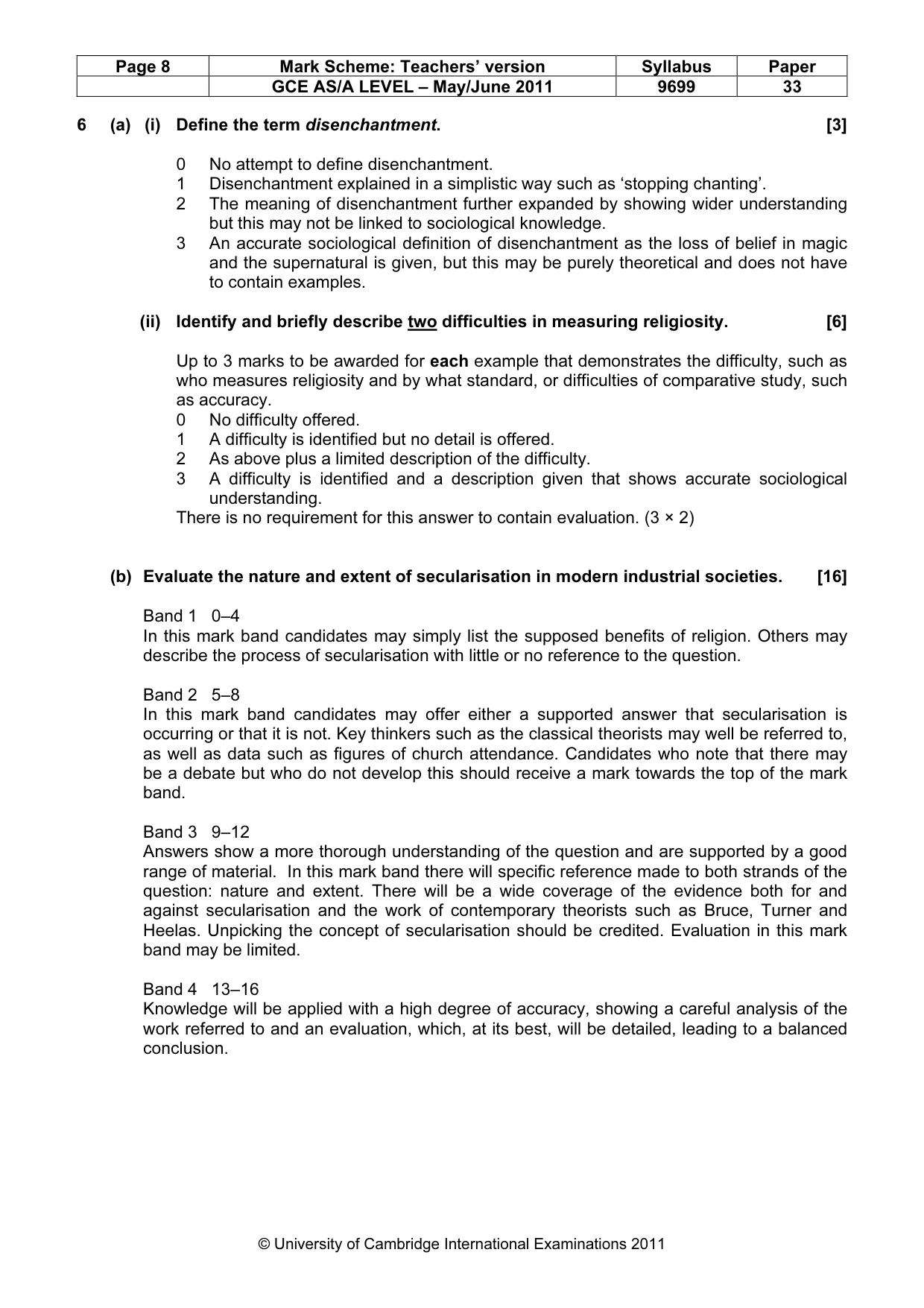
Page 8 Mark Scheme: Teachers’ version Syllabus Paper GCE AS/A LEVEL – May/June 2011 9699 33 © University of Cambridge International Examinations 2011 6 (a) (i) Define the term disenchantment. [3] 0 No attempt to define disenchantment. 1 Disenchantment explained in a simplistic way such as ‘stopping chanting’. 2 The meaning of disenchantment further expanded by showing wider understanding but this may not be linked to sociological knowledge. 3 An accurate sociological definition of disenchantment as the loss of belief in magic and the supernatural is given, but this may be purely theoretical and does not have to contain examples. (ii) Identify and briefly describe two difficulties in measuring religiosity. [6] Up to 3 marks to be awarded for each example that demonstrates the difficulty, such as who measures religiosity and by what standard, or difficulties of comparative study, such as accuracy. 0 No difficulty offered. 1 A difficulty is identified but no detail is offered. 2 As above plus a limited description of the difficulty. 3 A difficulty is identified and a description given that shows accurate sociological understanding. There is no requirement for this answer to contain evaluation. (3 × 2) (b) Evaluate the nature and extent of secularisation in modern industrial societies. [16] Band 1 0–4 In this mark band candidates may simply list the supposed benefits of religion. Others may describe the process of secularisation with little or no reference to the question. Band 2 5–8 In this mark band candidates may offer either a supported answer that secularisation is occurring or that it is not. Key thinkers such as the classical theorists may well be referred to, as well as data such as figures of church attendance. Candidates who note that there may be a debate but who do not develop this should receive a mark towards the top of the mark band. Band 3 9–12 Answers show a more thorough understanding of the question and are supported by a good range of material. In this mark band there will specific reference made to both strands of the question: nature and extent. There will be a wide coverage of the evidence both for and against secularisation and the work of contemporary theorists such as Bruce, Turner and Heelas. Unpicking the concept of secularisation should be credited. Evaluation in this mark band may be limited. Band 4 13–16 Knowledge will be applied with a high degree of accuracy, showing a careful analysis of the work referred to and an evaluation, which, at its best, will be detailed, leading to a balanced conclusion.
Mark scheme, page 9
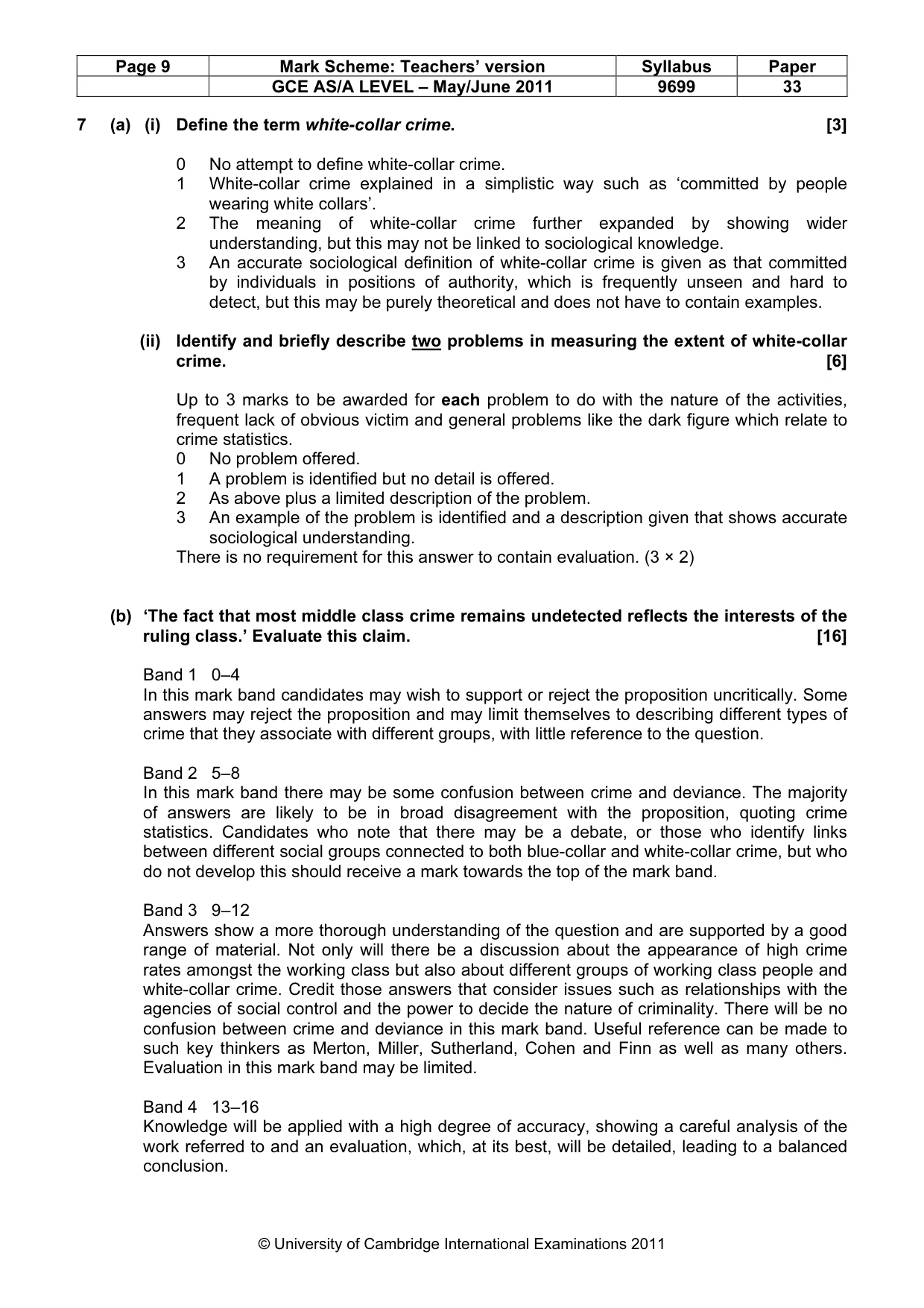
Page 9 Mark Scheme: Teachers’ version Syllabus Paper GCE AS/A LEVEL – May/June 2011 9699 33 © University of Cambridge International Examinations 2011 7 (a) (i) Define the term white-collar crime. [3] 0 No attempt to define white-collar crime. 1 White-collar crime explained in a simplistic way such as ‘committed by people wearing white collars’. 2 The meaning of white-collar crime further expanded by showing wider understanding, but this may not be linked to sociological knowledge. 3 An accurate sociological definition of white-collar crime is given as that committed by individuals in positions of authority, which is frequently unseen and hard to detect, but this may be purely theoretical and does not have to contain examples. (ii) Identify and briefly describe two problems in measuring the extent of white-collar crime. [6] Up to 3 marks to be awarded for each problem to do with the nature of the activities, frequent lack of obvious victim and general problems like the dark figure which relate to crime statistics. 0 No problem offered. 1 A problem is identified but no detail is offered. 2 As above plus a limited description of the problem. 3 An example of the problem is identified and a description given that shows accurate sociological understanding. There is no requirement for this answer to contain evaluation. (3 × 2) (b) ‘The fact that most middle class crime remains undetected reflects the interests of the ruling class.’ Evaluate this claim. [16] Band 1 0–4 In this mark band candidates may wish to support or reject the proposition uncritically. Some answers may reject the proposition and may limit themselves to describing different types of crime that they associate with different groups, with little reference to the question. Band 2 5–8 In this mark band there may be some confusion between crime and deviance. The majority of answers are likely to be in broad disagreement with the proposition, quoting crime statistics. Candidates who note that there may be a debate, or those who identify links between different social groups connected to both blue-collar and white-collar crime, but who do not develop this should receive a mark towards the top of the mark band. Band 3 9–12 Answers show a more thorough understanding of the question and are supported by a good range of material. Not only will there be a discussion about the appearance of high crime rates amongst the working class but also about different groups of working class people and white-collar crime. Credit those answers that consider issues such as relationships with the agencies of social control and the power to decide the nature of criminality. There will be no confusion between crime and deviance in this mark band. Useful reference can be made to such key thinkers as Merton, Miller, Sutherland, Cohen and Finn as well as many others. Evaluation in this mark band may be limited. Band 4 13–16 Knowledge will be applied with a high degree of accuracy, showing a careful analysis of the work referred to and an evaluation, which, at its best, will be detailed, leading to a balanced conclusion.
Mark scheme, page 10
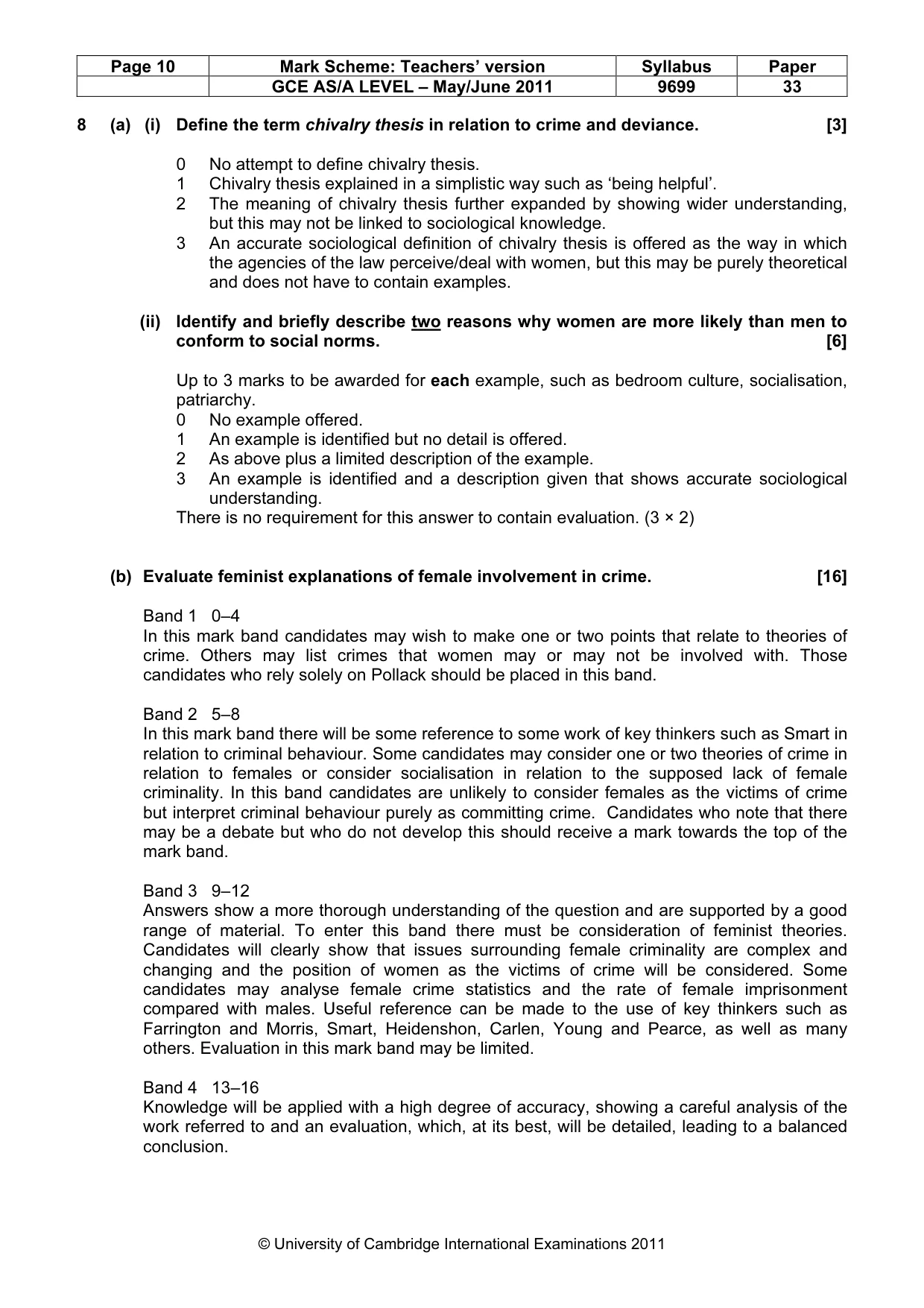
Page 10 Mark Scheme: Teachers’ version Syllabus Paper GCE AS/A LEVEL – May/June 2011 9699 33 © University of Cambridge International Examinations 2011 8 (a) (i) Define the term chivalry thesis in relation to crime and deviance. [3] 0 No attempt to define chivalry thesis. 1 Chivalry thesis explained in a simplistic way such as ‘being helpful’. 2 The meaning of chivalry thesis further expanded by showing wider understanding, but this may not be linked to sociological knowledge. 3 An accurate sociological definition of chivalry thesis is offered as the way in which the agencies of the law perceive/deal with women, but this may be purely theoretical and does not have to contain examples. (ii) Identify and briefly describe two reasons why women are more likely than men to conform to social norms. [6] Up to 3 marks to be awarded for each example, such as bedroom culture, socialisation, patriarchy. 0 No example offered. 1 An example is identified but no detail is offered. 2 As above plus a limited description of the example. 3 An example is identified and a description given that shows accurate sociological understanding. There is no requirement for this answer to contain evaluation. (3 × 2) (b) Evaluate feminist explanations of female involvement in crime. [16] Band 1 0–4 In this mark band candidates may wish to make one or two points that relate to theories of crime. Others may list crimes that women may or may not be involved with. Those candidates who rely solely on Pollack should be placed in this band. Band 2 5–8 In this mark band there will be some reference to some work of key thinkers such as Smart in relation to criminal behaviour. Some candidates may consider one or two theories of crime in relation to females or consider socialisation in relation to the supposed lack of female criminality. In this band candidates are unlikely to consider females as the victims of crime but interpret criminal behaviour purely as committing crime. Candidates who note that there may be a debate but who do not develop this should receive a mark towards the top of the mark band. Band 3 9–12 Answers show a more thorough understanding of the question and are supported by a good range of material. To enter this band there must be consideration of feminist theories. Candidates will clearly show that issues surrounding female criminality are complex and changing and the position of women as the victims of crime will be considered. Some candidates may analyse female crime statistics and the rate of female imprisonment compared with males. Useful reference can be made to the use of key thinkers such as Farrington and Morris, Smart, Heidenshon, Carlen, Young and Pearce, as well as many others. Evaluation in this mark band may be limited. Band 4 13–16 Knowledge will be applied with a high degree of accuracy, showing a careful analysis of the work referred to and an evaluation, which, at its best, will be detailed, leading to a balanced conclusion.
Mark scheme, page 11
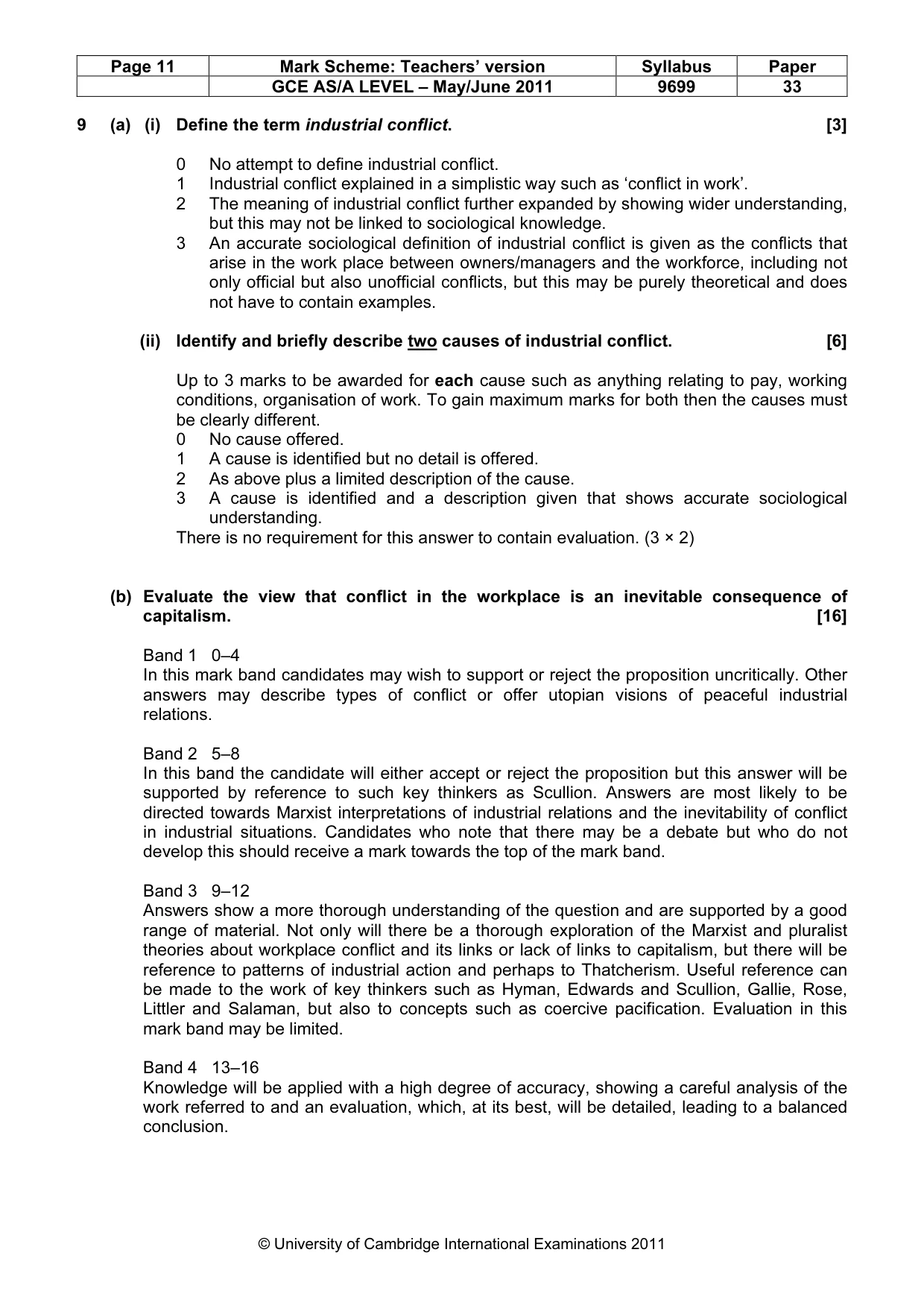
Page 11 Mark Scheme: Teachers’ version Syllabus Paper GCE AS/A LEVEL – May/June 2011 9699 33 © University of Cambridge International Examinations 2011 9 (a) (i) Define the term industrial conflict. [3] 0 No attempt to define industrial conflict. 1 Industrial conflict explained in a simplistic way such as ‘conflict in work’. 2 The meaning of industrial conflict further expanded by showing wider understanding, but this may not be linked to sociological knowledge. 3 An accurate sociological definition of industrial conflict is given as the conflicts that arise in the work place between owners/managers and the workforce, including not only official but also unofficial conflicts, but this may be purely theoretical and does not have to contain examples. (ii) Identify and briefly describe two causes of industrial conflict. [6] Up to 3 marks to be awarded for each cause such as anything relating to pay, working conditions, organisation of work. To gain maximum marks for both then the causes must be clearly different. 0 No cause offered. 1 A cause is identified but no detail is offered. 2 As above plus a limited description of the cause. 3 A cause is identified and a description given that shows accurate sociological understanding. There is no requirement for this answer to contain evaluation. (3 × 2) (b) Evaluate the view that conflict in the workplace is an inevitable consequence of capitalism. [16] Band 1 0–4 In this mark band candidates may wish to support or reject the proposition uncritically. Other answers may describe types of conflict or offer utopian visions of peaceful industrial relations. Band 2 5–8 In this band the candidate will either accept or reject the proposition but this answer will be supported by reference to such key thinkers as Scullion. Answers are most likely to be directed towards Marxist interpretations of industrial relations and the inevitability of conflict in industrial situations. Candidates who note that there may be a debate but who do not develop this should receive a mark towards the top of the mark band. Band 3 9–12 Answers show a more thorough understanding of the question and are supported by a good range of material. Not only will there be a thorough exploration of the Marxist and pluralist theories about workplace conflict and its links or lack of links to capitalism, but there will be reference to patterns of industrial action and perhaps to Thatcherism. Useful reference can be made to the work of key thinkers such as Hyman, Edwards and Scullion, Gallie, Rose, Littler and Salaman, but also to concepts such as coercive pacification. Evaluation in this mark band may be limited. Band 4 13–16 Knowledge will be applied with a high degree of accuracy, showing a careful analysis of the work referred to and an evaluation, which, at its best, will be detailed, leading to a balanced conclusion.
Mark scheme, page 12
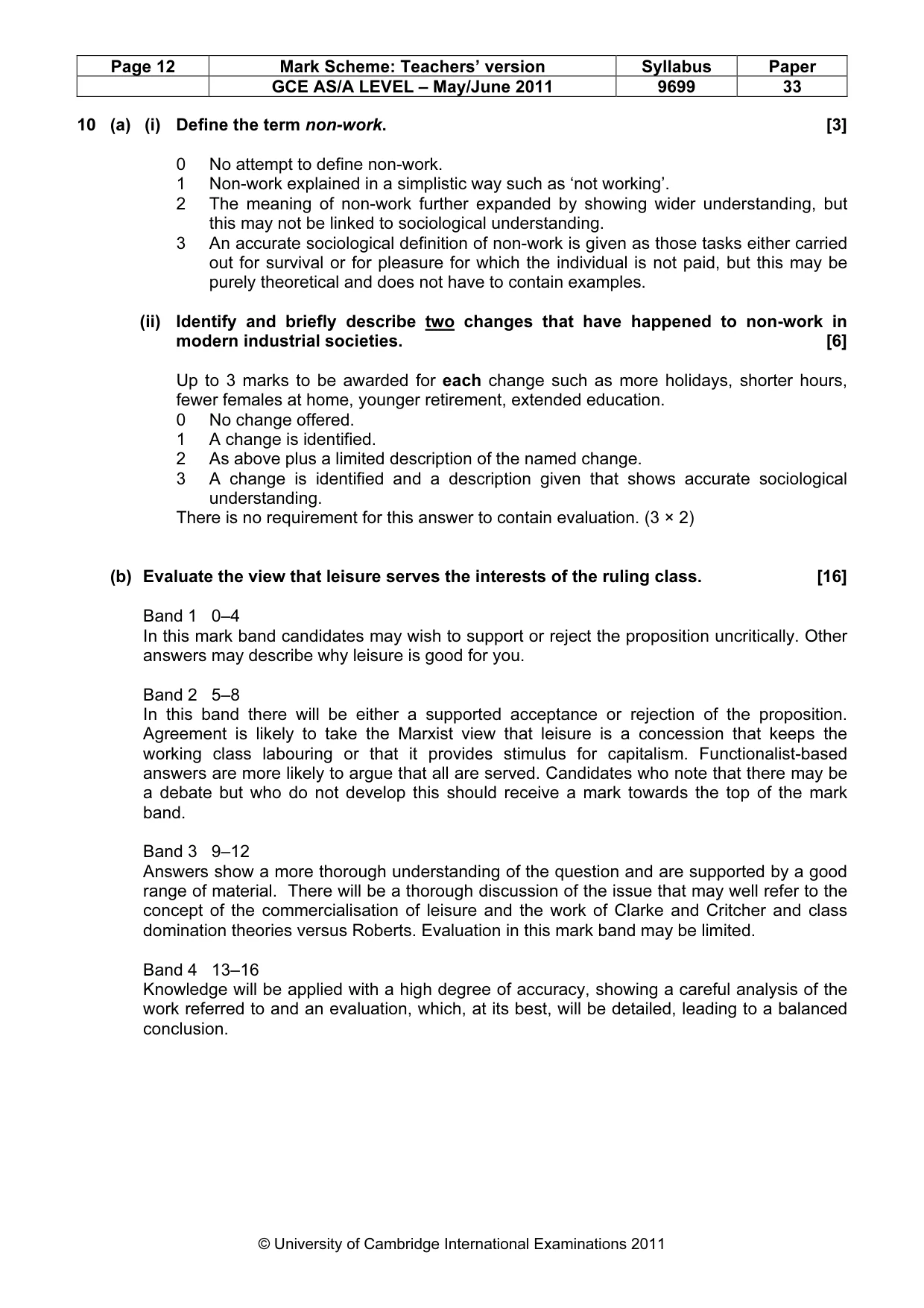
Page 12 Mark Scheme: Teachers’ version Syllabus Paper GCE AS/A LEVEL – May/June 2011 9699 33 © University of Cambridge International Examinations 2011 10 (a) (i) Define the term non-work. [3] 0 No attempt to define non-work. 1 Non-work explained in a simplistic way such as ‘not working’. 2 The meaning of non-work further expanded by showing wider understanding, but this may not be linked to sociological understanding. 3 An accurate sociological definition of non-work is given as those tasks either carried out for survival or for pleasure for which the individual is not paid, but this may be purely theoretical and does not have to contain examples. (ii) Identify and briefly describe two changes that have happened to non-work in modern industrial societies. [6] Up to 3 marks to be awarded for each change such as more holidays, shorter hours, fewer females at home, younger retirement, extended education. 0 No change offered. 1 A change is identified. 2 As above plus a limited description of the named change. 3 A change is identified and a description given that shows accurate sociological understanding. There is no requirement for this answer to contain evaluation. (3 × 2) (b) Evaluate the view that leisure serves the interests of the ruling class. [16] Band 1 0–4 In this mark band candidates may wish to support or reject the proposition uncritically. Other answers may describe why leisure is good for you. Band 2 5–8 In this band there will be either a supported acceptance or rejection of the proposition. Agreement is likely to take the Marxist view that leisure is a concession that keeps the working class labouring or that it provides stimulus for capitalism. Functionalist-based answers are more likely to argue that all are served. Candidates who note that there may be a debate but who do not develop this should receive a mark towards the top of the mark band. Band 3 9–12 Answers show a more thorough understanding of the question and are supported by a good range of material. There will be a thorough discussion of the issue that may well refer to the concept of the commercialisation of leisure and the work of Clarke and Critcher and class domination theories versus Roberts. Evaluation in this mark band may be limited. Band 4 13–16 Knowledge will be applied with a high degree of accuracy, showing a careful analysis of the work referred to and an evaluation, which, at its best, will be detailed, leading to a balanced conclusion.
Mark scheme, page 13
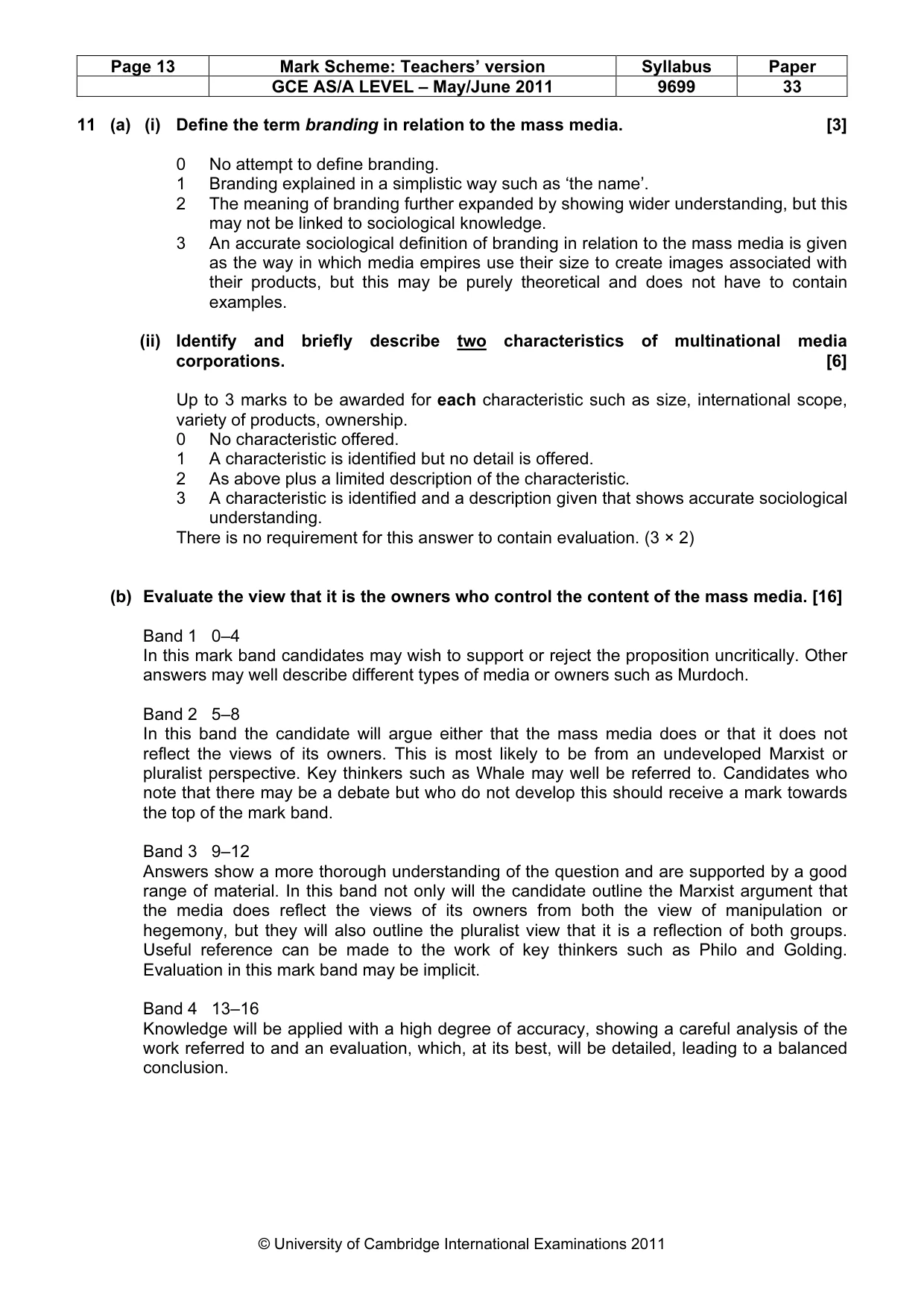
Page 13 Mark Scheme: Teachers’ version Syllabus Paper GCE AS/A LEVEL – May/June 2011 9699 33 © University of Cambridge International Examinations 2011 11 (a) (i) Define the term branding in relation to the mass media. [3] 0 No attempt to define branding. 1 Branding explained in a simplistic way such as ‘the name’. 2 The meaning of branding further expanded by showing wider understanding, but this may not be linked to sociological knowledge. 3 An accurate sociological definition of branding in relation to the mass media is given as the way in which media empires use their size to create images associated with their products, but this may be purely theoretical and does not have to contain examples. (ii) Identify and briefly describe two characteristics of multinational media corporations. [6] Up to 3 marks to be awarded for each characteristic such as size, international scope, variety of products, ownership. 0 No characteristic offered. 1 A characteristic is identified but no detail is offered. 2 As above plus a limited description of the characteristic. 3 A characteristic is identified and a description given that shows accurate sociological understanding. There is no requirement for this answer to contain evaluation. (3 × 2) (b) Evaluate the view that it is the owners who control the content of the mass media. [16] Band 1 0–4 In this mark band candidates may wish to support or reject the proposition uncritically. Other answers may well describe different types of media or owners such as Murdoch. Band 2 5–8 In this band the candidate will argue either that the mass media does or that it does not reflect the views of its owners. This is most likely to be from an undeveloped Marxist or pluralist perspective. Key thinkers such as Whale may well be referred to. Candidates who note that there may be a debate but who do not develop this should receive a mark towards the top of the mark band. Band 3 9–12 Answers show a more thorough understanding of the question and are supported by a good range of material. In this band not only will the candidate outline the Marxist argument that the media does reflect the views of its owners from both the view of manipulation or hegemony, but they will also outline the pluralist view that it is a reflection of both groups. Useful reference can be made to the work of key thinkers such as Philo and Golding. Evaluation in this mark band may be implicit. Band 4 13–16 Knowledge will be applied with a high degree of accuracy, showing a careful analysis of the work referred to and an evaluation, which, at its best, will be detailed, leading to a balanced conclusion.
Mark scheme, page 14
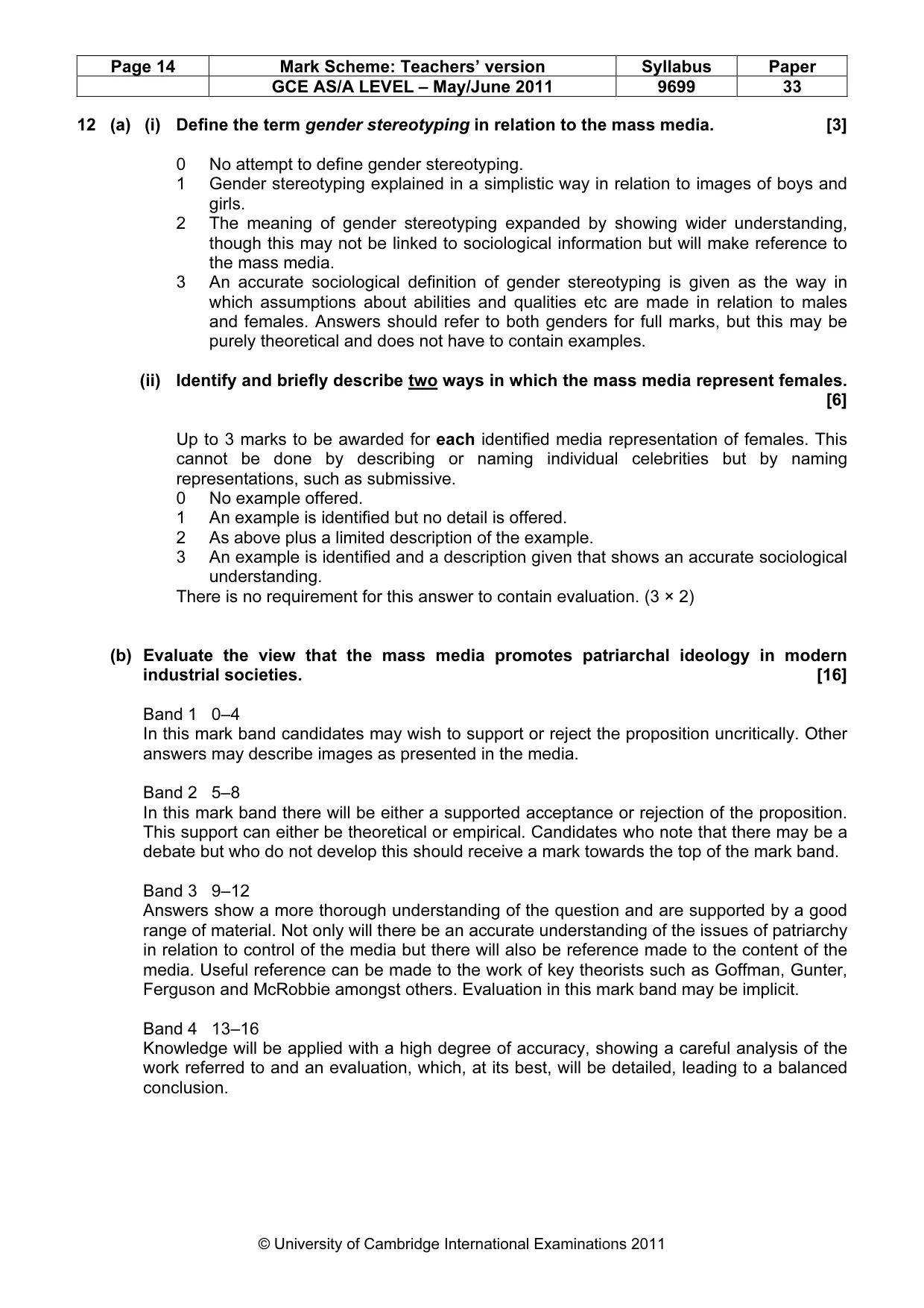
Page 14 Mark Scheme: Teachers’ version Syllabus Paper GCE AS/A LEVEL – May/June 2011 9699 33 © University of Cambridge International Examinations 2011 12 (a) (i) Define the term gender stereotyping in relation to the mass media. [3] 0 No attempt to define gender stereotyping. 1 Gender stereotyping explained in a simplistic way in relation to images of boys and girls. 2 The meaning of gender stereotyping expanded by showing wider understanding, though this may not be linked to sociological information but will make reference to the mass media. 3 An accurate sociological definition of gender stereotyping is given as the way in which assumptions about abilities and qualities etc are made in relation to males and females. Answers should refer to both genders for full marks, but this may be purely theoretical and does not have to contain examples. (ii) Identify and briefly describe two ways in which the mass media represent females. [6] Up to 3 marks to be awarded for each identified media representation of females. This cannot be done by describing or naming individual celebrities but by naming representations, such as submissive. 0 No example offered. 1 An example is identified but no detail is offered. 2 As above plus a limited description of the example. 3 An example is identified and a description given that shows an accurate sociological understanding. There is no requirement for this answer to contain evaluation. (3 × 2) (b) Evaluate the view that the mass media promotes patriarchal ideology in modern industrial societies. [16] Band 1 0–4 In this mark band candidates may wish to support or reject the proposition uncritically. Other answers may describe images as presented in the media. Band 2 5–8 In this mark band there will be either a supported acceptance or rejection of the proposition. This support can either be theoretical or empirical. Candidates who note that there may be a debate but who do not develop this should receive a mark towards the top of the mark band. Band 3 9–12 Answers show a more thorough understanding of the question and are supported by a good range of material. Not only will there be an accurate understanding of the issues of patriarchy in relation to control of the media but there will also be reference made to the content of the media. Useful reference can be made to the work of key theorists such as Goffman, Gunter, Ferguson and McRobbie amongst others. Evaluation in this mark band may be implicit. Band 4 13–16 Knowledge will be applied with a high degree of accuracy, showing a careful analysis of the work referred to and an evaluation, which, at its best, will be detailed, leading to a balanced conclusion.
What you needed in this session
Cambridge’s own grade thresholds for 2011 May/June, Paper 3 · Variant 3. A higher threshold means an easier paper — the bar moves with how the cohort did.