Cambridge A Level Sociology 9699 — 2010 Oct/Nov Paper 2 · Variant 1
9699/21/O/N/10 · 50 marks · ≈56 min
The question paper and its mark scheme, free to read here and free to download. This is Cambridge’s own paper, exactly as it was sat.
Question paper12 pages








Mark scheme7 pages
Answers below. Sit the paper first if you are practising.

Paper as text
Question paper, page 1
This document consists of 10 printed pages and 2 blank pages. DC (CW) 23028/3 © UCLES 2010 [Turn over UNIVERSITY OF CAMBRIDGE INTERNATIONAL EXAMINATIONS General Certificate of Education Advanced Subsidiary Level and Advanced Level SOCIOLOGY 9699/21 Paper 2 Principles and Methods 2 October/November 2010 1 hour 30 minutes Candidates answer on the Question Paper. No additional materials required. READ THESE INSTRUCTIONS FIRST DO NOT WRITE IN ANY BARCODES. Write your Centre number, candidate number and name on all the work you hand in. Write in dark blue or black pen. You may use a soft pencil for any diagrams, graphs or rough working. Do not use staples, paper clips, highlighters, glue or correction fluid. Answer two questions. The number of marks is given in brackets [ ] at the end of each question or part question. * 8 5 1 5 5 0 3 4 8 5 *
Question paper, page 2
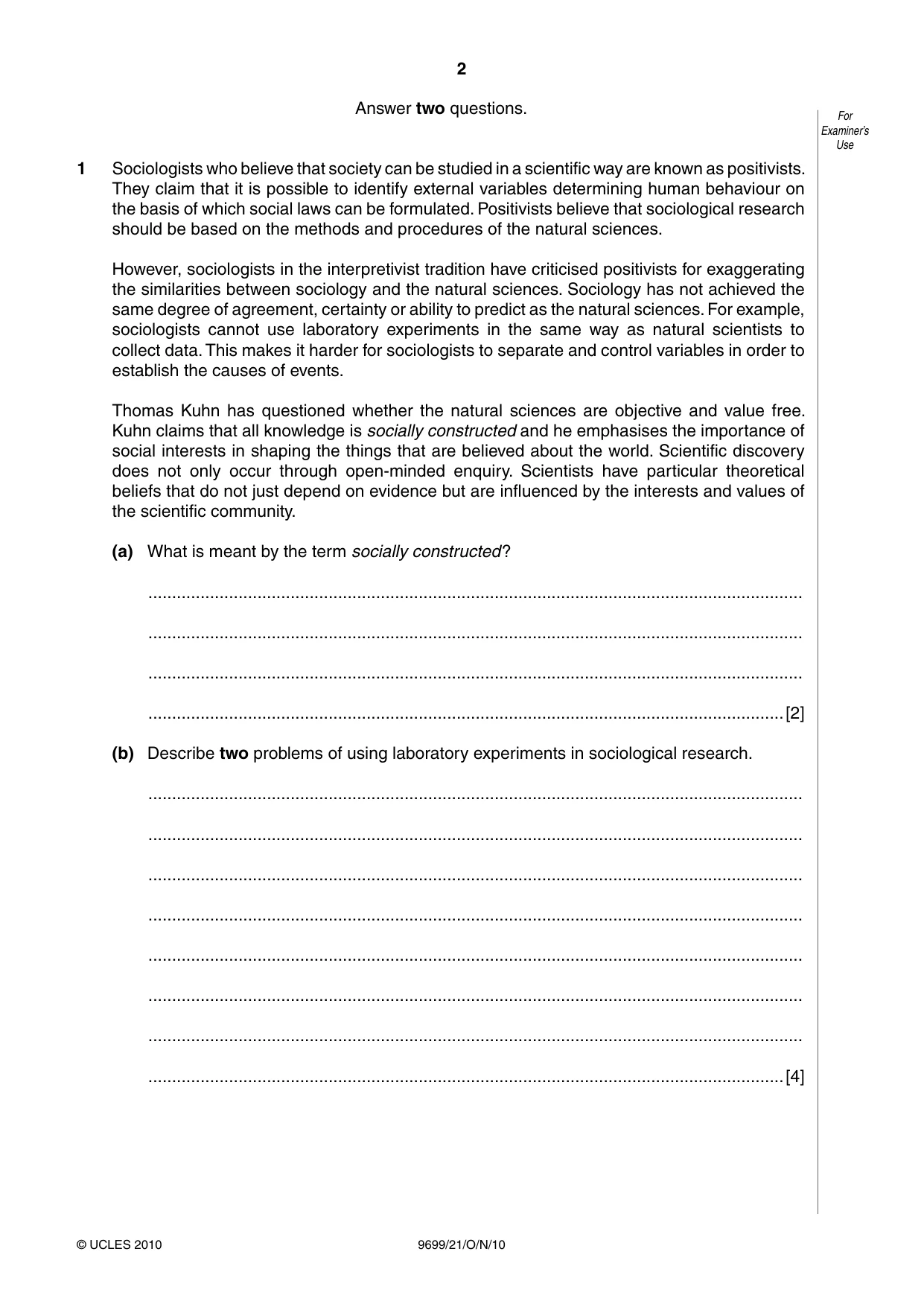
2 9699/21/O/N/10 © UCLES 2010 For Examiner’s Use Answer two questions. 1 Sociologists who believe that society can be studied in a scientific way are known as positivists. They claim that it is possible to identify external variables determining human behaviour on the basis of which social laws can be formulated. Positivists believe that sociological research should be based on the methods and procedures of the natural sciences. However, sociologists in the interpretivist tradition have criticised positivists for exaggerating the similarities between sociology and the natural sciences. Sociology has not achieved the same degree of agreement, certainty or ability to predict as the natural sciences. For example, sociologists cannot use laboratory experiments in the same way as natural scientists to collect data. This makes it harder for sociologists to separate and control variables in order to establish the causes of events. Thomas Kuhn has questioned whether the natural sciences are objective and value free. Kuhn claims that all knowledge is socially constructed and he emphasises the importance of social interests in shaping the things that are believed about the world. Scientific discovery does not only occur through open-minded enquiry. Scientists have particular theoretical beliefs that do not just depend on evidence but are influenced by the interests and values of the scientific community. (a) What is meant by the term socially constructed ? … … … …[2] (b) Describe two problems of using laboratory experiments in sociological research. … … … … … … … …[4]
Question paper, page 3
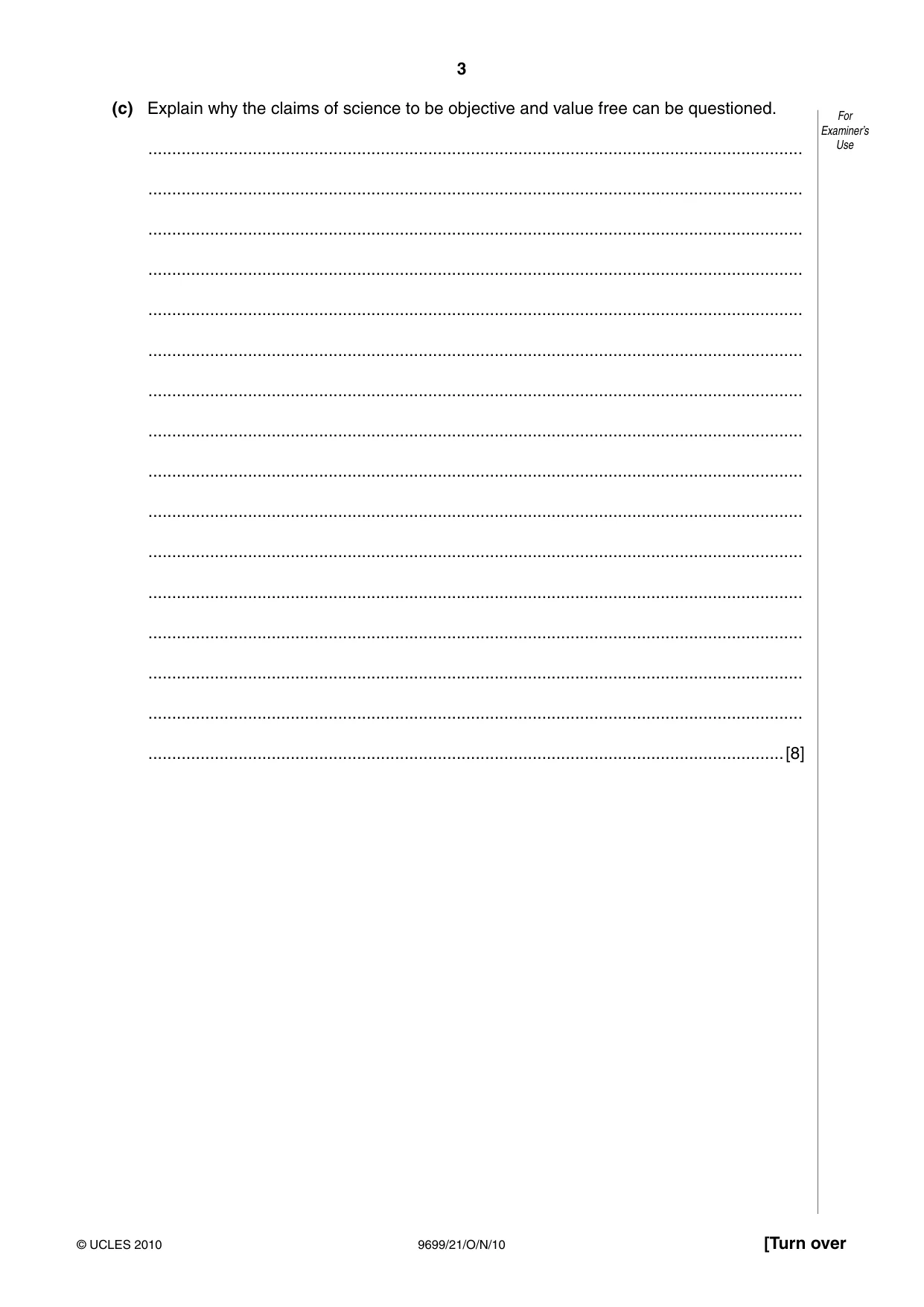
3 9699/21/O/N/10 © UCLES 2010 [Turn over For Examiner’s Use (c) Explain why the claims of science to be objective and value free can be questioned. … … … … … … … … … … … … … … … …[8]
Question paper, page 4
4 9699/21/O/N/10 © UCLES 2010 For Examiner’s Use (d) Assess the interpretivist critique of positivism. … … … … … … … … … … … … … … … … … … … … … …[11]
Question paper, page 5
5 9699/21/O/N/10 © UCLES 2010 [Turn over For Examiner’s Use 2 Participant observation is a widely used method of sociological research. It is particularly favoured by sociologists in the interpretivist tradition. In participant observation the researcher joins the study group in order to observe people in their natural surroundings and to learn to see and feel things as they do. Participant observation studies are usually carried out over a long time period. Gaining access to the group in order to begin the research can be a problem. Some researchers choose to reveal their identity to some or all of the people they are studying. This is known as overt participant observation. In covert participant observation the research is carried out secretly, with the researcher concealing their identity from the group. Supporters of participant observation argue that it enables the sociologist to achieve a detailed understanding of the subject under study and that the data it produces is high in validity. However, critics identify a number of limitations with participant observation, especially the many ethical problems that are associated with covert observation. (a) What is meant by the term validity ? … … … …[2] (b) Describe two difficulties for a sociologist in gaining access to a group they wish to study. … … … … … … … …[4]
Question paper, page 6
6 9699/21/O/N/10 © UCLES 2010 For Examiner’s Use (c) Explain why interpretivists favour the use of participant observation in sociological research. … … … … … … … … … … … … … … … …[8]
Question paper, page 7
7 9699/21/O/N/10 © UCLES 2010 [Turn over For Examiner’s Use (d) Assess the strengths and limitations of overt participant observation. … … … … … … … … … … … … … … … … … … … … … …[11]
Question paper, page 8
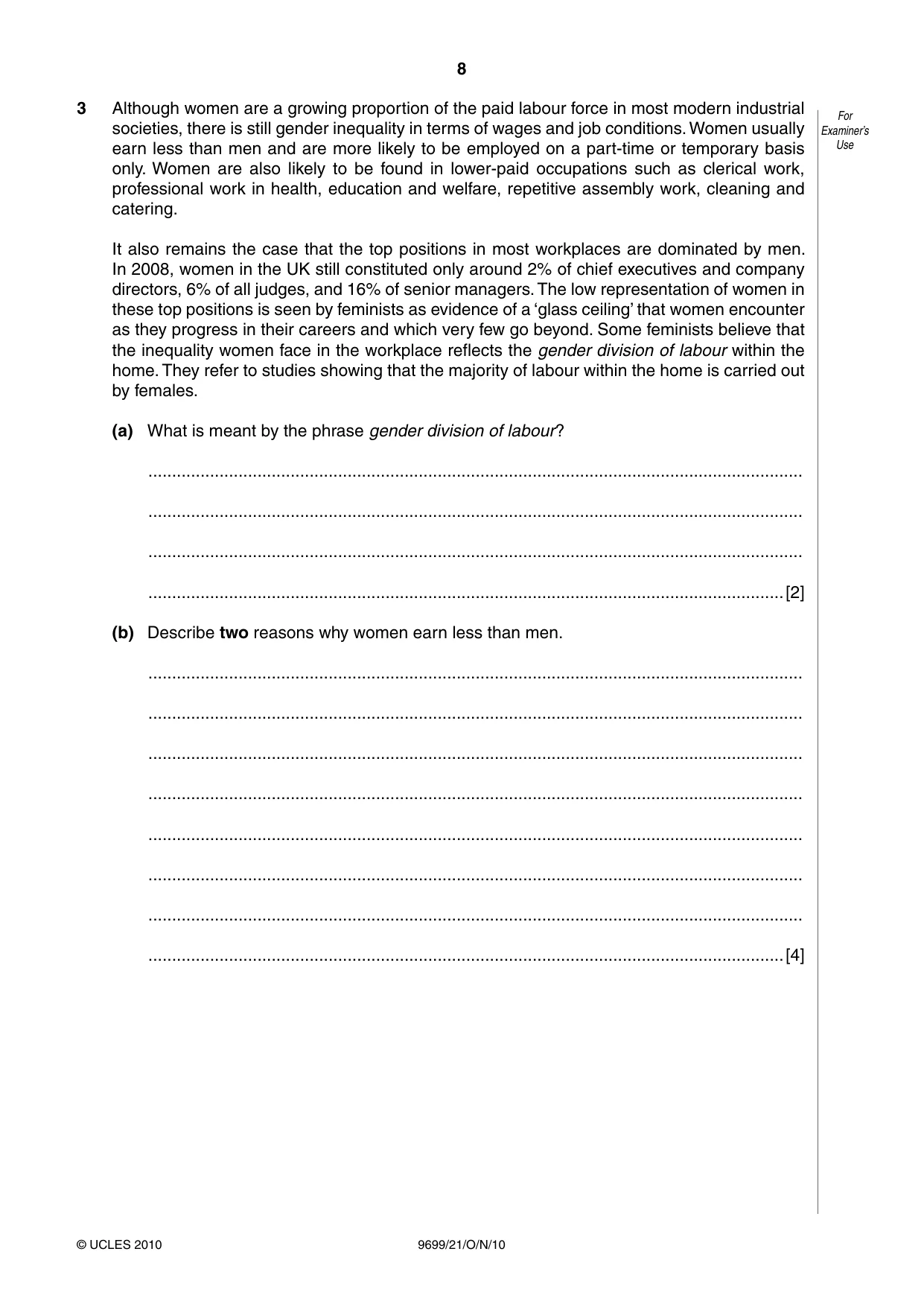
8 9699/21/O/N/10 © UCLES 2010 For Examiner’s Use 3 Although women are a growing proportion of the paid labour force in most modern industrial societies, there is still gender inequality in terms of wages and job conditions. Women usually earn less than men and are more likely to be employed on a part-time or temporary basis only. Women are also likely to be found in lower-paid occupations such as clerical work, professional work in health, education and welfare, repetitive assembly work, cleaning and catering. It also remains the case that the top positions in most workplaces are dominated by men. In 2008, women in the UK still constituted only around 2% of chief executives and company directors, 6% of all judges, and 16% of senior managers. The low representation of women in these top positions is seen by feminists as evidence of a ‘glass ceiling’ that women encounter as they progress in their careers and which very few go beyond. Some feminists believe that the inequality women face in the workplace reflects the gender division of labour within the home. They refer to studies showing that the majority of labour within the home is carried out by females. (a) What is meant by the phrase gender division of labour ? … … … …[2] (b) Describe two reasons why women earn less than men. … … … … … … … …[4]
Question paper, page 9
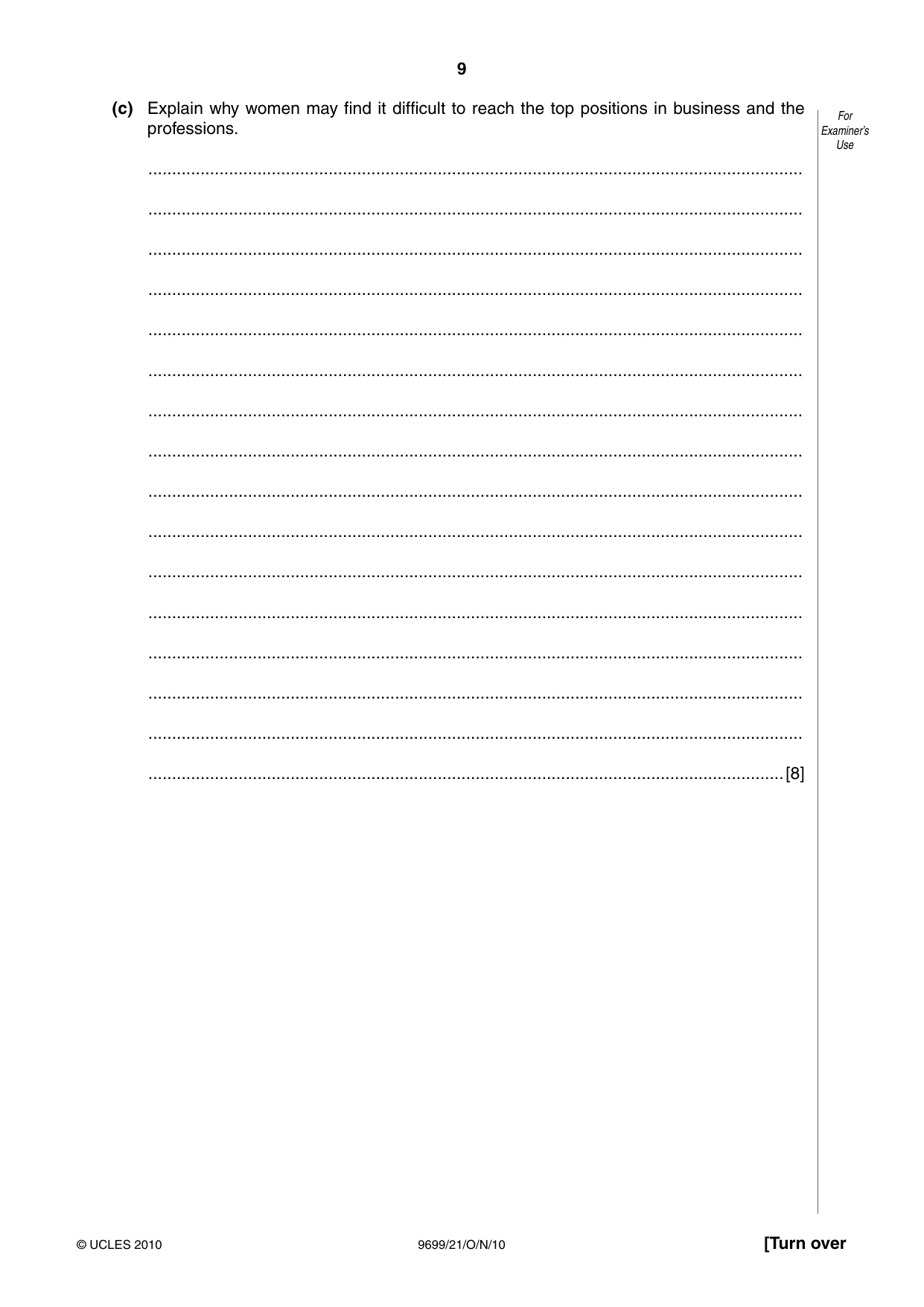
9 9699/21/O/N/10 © UCLES 2010 [Turn over For Examiner’s Use (c) Explain why women may find it difficult to reach the top positions in business and the professions. … … … … … … … … … … … … … … … …[8]
Question paper, page 10
10 9699/21/O/N/10 © UCLES 2010 For Examiner’s Use (d) Assess feminist explanations of gender inequality in the workplace. … … … … … … … … … … … … … … … … … … … … … …[11]
Question paper, page 11
11 9699/21/O/N/10 © UCLES 2010 BLANK PAGE
Question paper, page 12
12 9699/21/O/N/10 © UCLES 2010 BLANK PAGE Permission to reproduce items where third-party owned material protected by copyright is included has been sought and cleared where possible. Every reasonable effort has been made by the publisher (UCLES) to trace copyright holders, but if any items requiring clearance have unwittingly been included, the publisher will be pleased to make amends at the earliest possible opportunity. University of Cambridge International Examinations is part of the Cambridge Assessment Group. Cambridge Assessment is the brand name of University of Cambridge Local Examinations Syndicate (UCLES), which is itself a department of the University of Cambridge.
Mark scheme, page 1
UNIVERSITY OF CAMBRIDGE INTERNATIONAL EXAMINATIONS GCE Advanced Subsidiary Level and GCE Advanced Level MARK SCHEME for the October/November 2010 question paper for the guidance of teachers 9699 SOCIOLOGY 9699/21 Paper 2 (Data Response), maximum raw mark 50 This mark scheme is published as an aid to teachers and candidates, to indicate the requirements of the examination. It shows the basis on which Examiners were instructed to award marks. It does not indicate the details of the discussions that took place at an Examiners’ meeting before marking began, which would have considered the acceptability of alternative answers. Mark schemes must be read in conjunction with the question papers and the report on the examination. • CIE will not enter into discussions or correspondence in connection with these mark schemes. CIE is publishing the mark schemes for the October/November 2010 question papers for most IGCSE, GCE Advanced Level and Advanced Subsidiary Level syllabuses and some Ordinary Level syllabuses.
Mark scheme, page 2
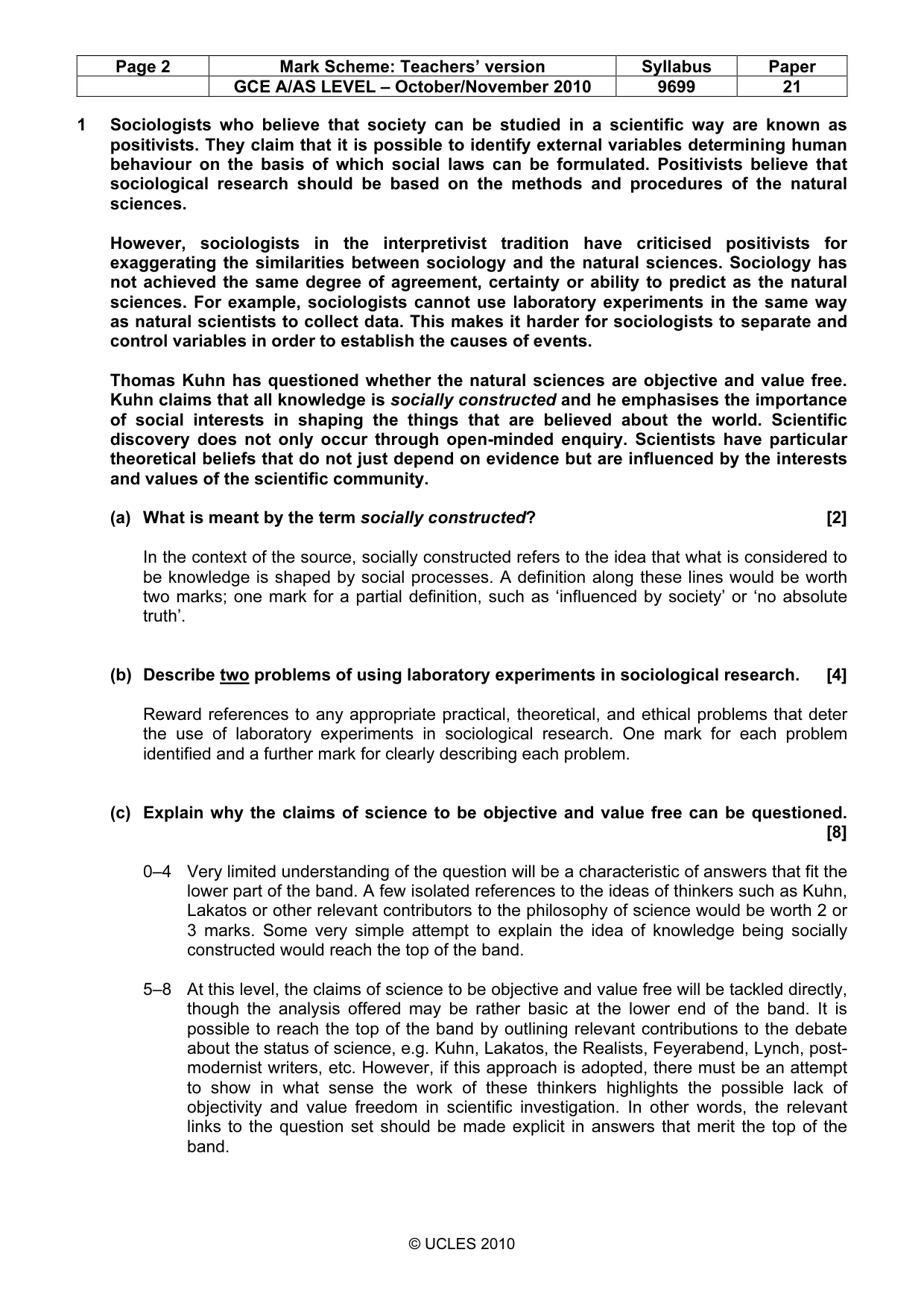
Page 2 Mark Scheme: Teachers’ version Syllabus Paper GCE A/AS LEVEL – October/November 2010 9699 21 © UCLES 2010 1 Sociologists who believe that society can be studied in a scientific way are known as positivists. They claim that it is possible to identify external variables determining human behaviour on the basis of which social laws can be formulated. Positivists believe that sociological research should be based on the methods and procedures of the natural sciences. However, sociologists in the interpretivist tradition have criticised positivists for exaggerating the similarities between sociology and the natural sciences. Sociology has not achieved the same degree of agreement, certainty or ability to predict as the natural sciences. For example, sociologists cannot use laboratory experiments in the same way as natural scientists to collect data. This makes it harder for sociologists to separate and control variables in order to establish the causes of events. Thomas Kuhn has questioned whether the natural sciences are objective and value free. Kuhn claims that all knowledge is socially constructed and he emphasises the importance of social interests in shaping the things that are believed about the world. Scientific discovery does not only occur through open-minded enquiry. Scientists have particular theoretical beliefs that do not just depend on evidence but are influenced by the interests and values of the scientific community. (a) What is meant by the term socially constructed? [2] In the context of the source, socially constructed refers to the idea that what is considered to be knowledge is shaped by social processes. A definition along these lines would be worth two marks; one mark for a partial definition, such as ‘influenced by society’ or ‘no absolute truth’. (b) Describe two problems of using laboratory experiments in sociological research. [4] Reward references to any appropriate practical, theoretical, and ethical problems that deter the use of laboratory experiments in sociological research. One mark for each problem identified and a further mark for clearly describing each problem. (c) Explain why the claims of science to be objective and value free can be questioned. [8] 0–4 Very limited understanding of the question will be a characteristic of answers that fit the lower part of the band. A few isolated references to the ideas of thinkers such as Kuhn, Lakatos or other relevant contributors to the philosophy of science would be worth 2 or 3 marks. Some very simple attempt to explain the idea of knowledge being socially constructed would reach the top of the band. 5–8 At this level, the claims of science to be objective and value free will be tackled directly, though the analysis offered may be rather basic at the lower end of the band. It is possible to reach the top of the band by outlining relevant contributions to the debate about the status of science, e.g. Kuhn, Lakatos, the Realists, Feyerabend, Lynch, post- modernist writers, etc. However, if this approach is adopted, there must be an attempt to show in what sense the work of these thinkers highlights the possible lack of objectivity and value freedom in scientific investigation. In other words, the relevant links to the question set should be made explicit in answers that merit the top of the band.
Mark scheme, page 3
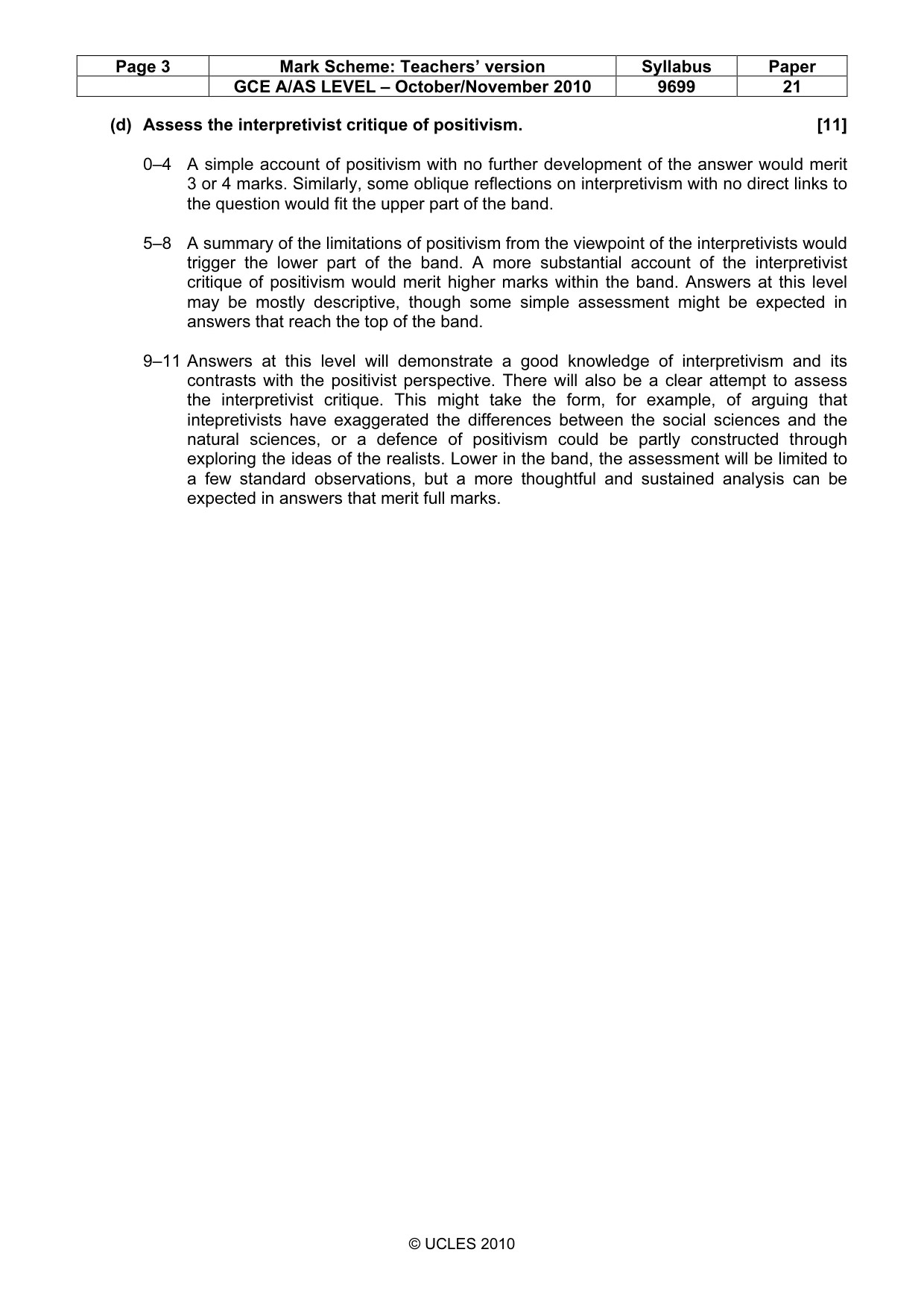
Page 3 Mark Scheme: Teachers’ version Syllabus Paper GCE A/AS LEVEL – October/November 2010 9699 21 © UCLES 2010 (d) Assess the interpretivist critique of positivism. [11] 0–4 A simple account of positivism with no further development of the answer would merit 3 or 4 marks. Similarly, some oblique reflections on interpretivism with no direct links to the question would fit the upper part of the band. 5–8 A summary of the limitations of positivism from the viewpoint of the interpretivists would trigger the lower part of the band. A more substantial account of the interpretivist critique of positivism would merit higher marks within the band. Answers at this level may be mostly descriptive, though some simple assessment might be expected in answers that reach the top of the band. 9–11 Answers at this level will demonstrate a good knowledge of interpretivism and its contrasts with the positivist perspective. There will also be a clear attempt to assess the interpretivist critique. This might take the form, for example, of arguing that intepretivists have exaggerated the differences between the social sciences and the natural sciences, or a defence of positivism could be partly constructed through exploring the ideas of the realists. Lower in the band, the assessment will be limited to a few standard observations, but a more thoughtful and sustained analysis can be expected in answers that merit full marks.
Mark scheme, page 4
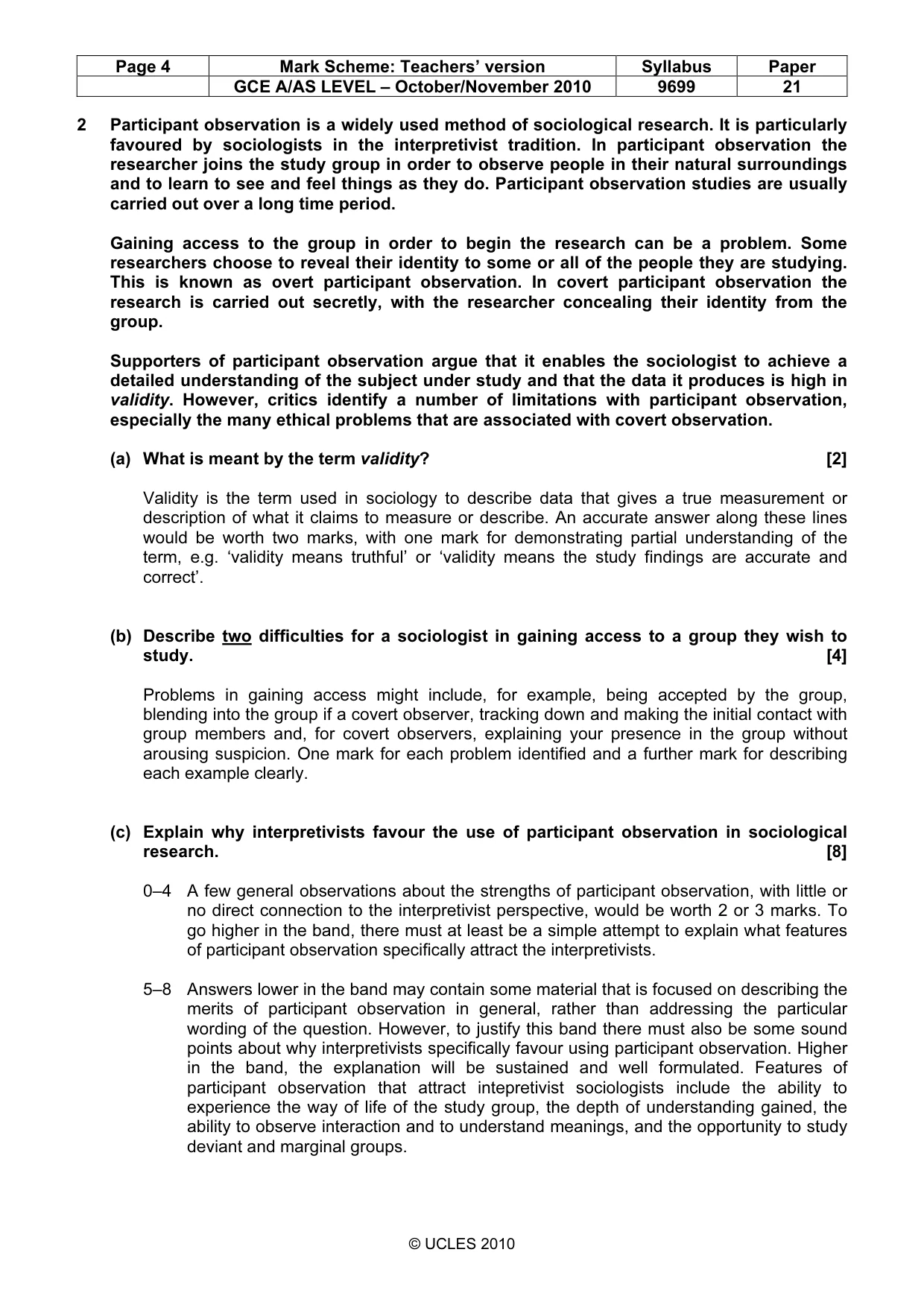
Page 4 Mark Scheme: Teachers’ version Syllabus Paper GCE A/AS LEVEL – October/November 2010 9699 21 © UCLES 2010 2 Participant observation is a widely used method of sociological research. It is particularly favoured by sociologists in the interpretivist tradition. In participant observation the researcher joins the study group in order to observe people in their natural surroundings and to learn to see and feel things as they do. Participant observation studies are usually carried out over a long time period. Gaining access to the group in order to begin the research can be a problem. Some researchers choose to reveal their identity to some or all of the people they are studying. This is known as overt participant observation. In covert participant observation the research is carried out secretly, with the researcher concealing their identity from the group. Supporters of participant observation argue that it enables the sociologist to achieve a detailed understanding of the subject under study and that the data it produces is high in validity. However, critics identify a number of limitations with participant observation, especially the many ethical problems that are associated with covert observation. (a) What is meant by the term validity? [2] Validity is the term used in sociology to describe data that gives a true measurement or description of what it claims to measure or describe. An accurate answer along these lines would be worth two marks, with one mark for demonstrating partial understanding of the term, e.g. ‘validity means truthful’ or ‘validity means the study findings are accurate and correct’. (b) Describe two difficulties for a sociologist in gaining access to a group they wish to study. [4] Problems in gaining access might include, for example, being accepted by the group, blending into the group if a covert observer, tracking down and making the initial contact with group members and, for covert observers, explaining your presence in the group without arousing suspicion. One mark for each problem identified and a further mark for describing each example clearly. (c) Explain why interpretivists favour the use of participant observation in sociological research. [8] 0–4 A few general observations about the strengths of participant observation, with little or no direct connection to the interpretivist perspective, would be worth 2 or 3 marks. To go higher in the band, there must at least be a simple attempt to explain what features of participant observation specifically attract the interpretivists. 5–8 Answers lower in the band may contain some material that is focused on describing the merits of participant observation in general, rather than addressing the particular wording of the question. However, to justify this band there must also be some sound points about why interpretivists specifically favour using participant observation. Higher in the band, the explanation will be sustained and well formulated. Features of participant observation that attract intepretivist sociologists include the ability to experience the way of life of the study group, the depth of understanding gained, the ability to observe interaction and to understand meanings, and the opportunity to study deviant and marginal groups.
Mark scheme, page 5
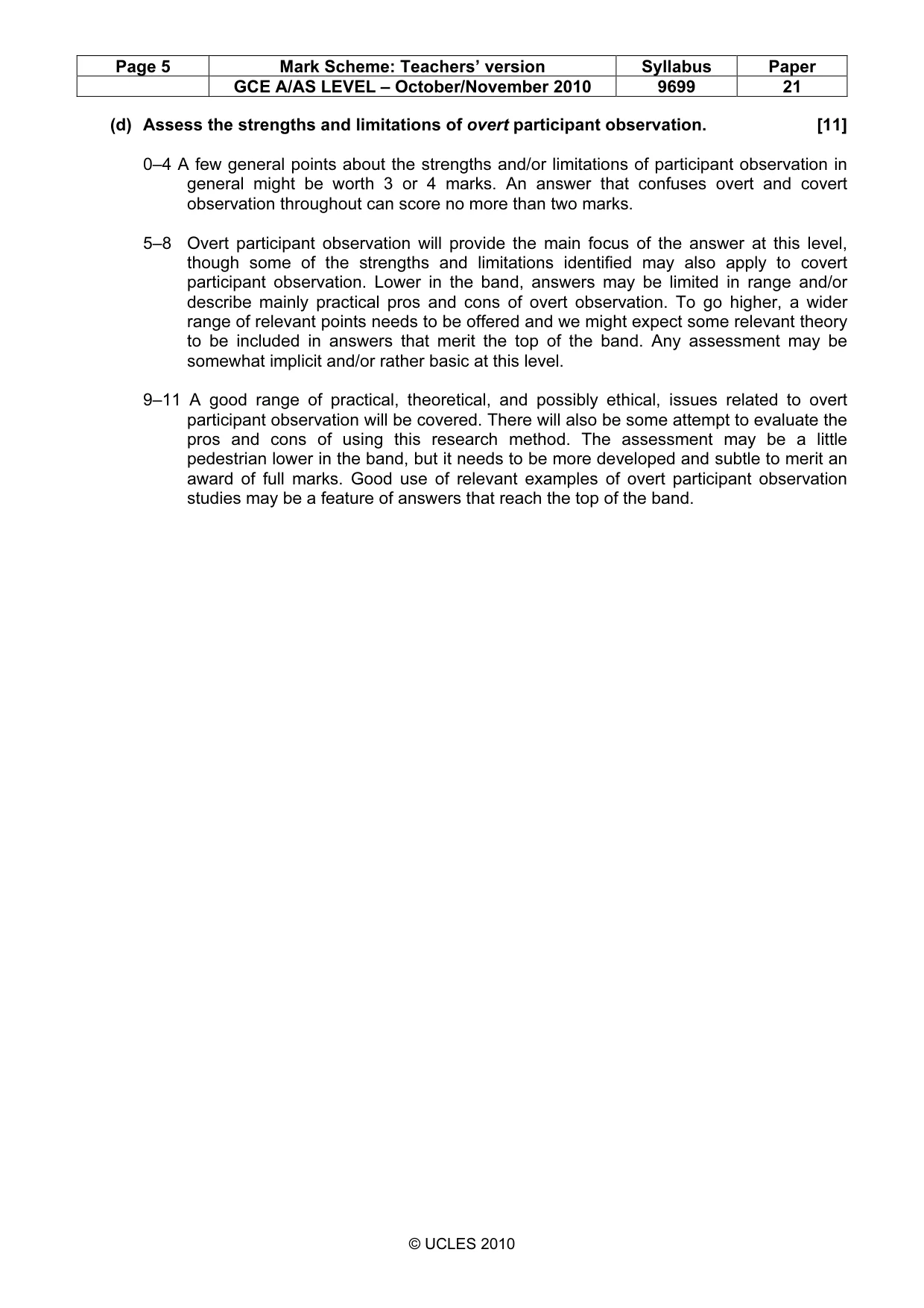
Page 5 Mark Scheme: Teachers’ version Syllabus Paper GCE A/AS LEVEL – October/November 2010 9699 21 © UCLES 2010 (d) Assess the strengths and limitations of overt participant observation. [11] 0–4 A few general points about the strengths and/or limitations of participant observation in general might be worth 3 or 4 marks. An answer that confuses overt and covert observation throughout can score no more than two marks. 5–8 Overt participant observation will provide the main focus of the answer at this level, though some of the strengths and limitations identified may also apply to covert participant observation. Lower in the band, answers may be limited in range and/or describe mainly practical pros and cons of overt observation. To go higher, a wider range of relevant points needs to be offered and we might expect some relevant theory to be included in answers that merit the top of the band. Any assessment may be somewhat implicit and/or rather basic at this level. 9–11 A good range of practical, theoretical, and possibly ethical, issues related to overt participant observation will be covered. There will also be some attempt to evaluate the pros and cons of using this research method. The assessment may be a little pedestrian lower in the band, but it needs to be more developed and subtle to merit an award of full marks. Good use of relevant examples of overt participant observation studies may be a feature of answers that reach the top of the band.
Mark scheme, page 6
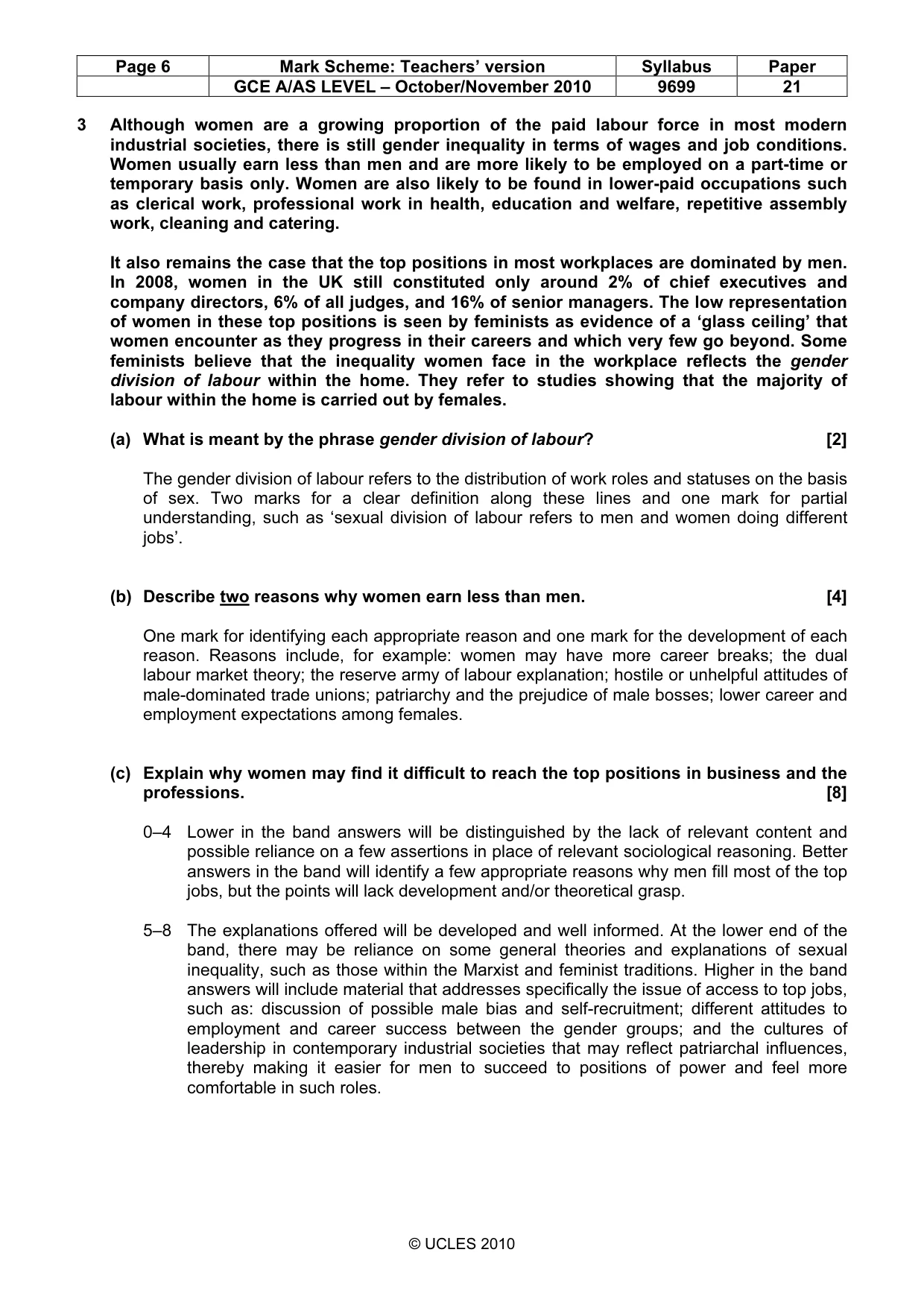
Page 6 Mark Scheme: Teachers’ version Syllabus Paper GCE A/AS LEVEL – October/November 2010 9699 21 © UCLES 2010 3 Although women are a growing proportion of the paid labour force in most modern industrial societies, there is still gender inequality in terms of wages and job conditions. Women usually earn less than men and are more likely to be employed on a part-time or temporary basis only. Women are also likely to be found in lower-paid occupations such as clerical work, professional work in health, education and welfare, repetitive assembly work, cleaning and catering. It also remains the case that the top positions in most workplaces are dominated by men. In 2008, women in the UK still constituted only around 2% of chief executives and company directors, 6% of all judges, and 16% of senior managers. The low representation of women in these top positions is seen by feminists as evidence of a ‘glass ceiling’ that women encounter as they progress in their careers and which very few go beyond. Some feminists believe that the inequality women face in the workplace reflects the gender division of labour within the home. They refer to studies showing that the majority of labour within the home is carried out by females. (a) What is meant by the phrase gender division of labour? [2] The gender division of labour refers to the distribution of work roles and statuses on the basis of sex. Two marks for a clear definition along these lines and one mark for partial understanding, such as ‘sexual division of labour refers to men and women doing different jobs’. (b) Describe two reasons why women earn less than men. [4] One mark for identifying each appropriate reason and one mark for the development of each reason. Reasons include, for example: women may have more career breaks; the dual labour market theory; the reserve army of labour explanation; hostile or unhelpful attitudes of male-dominated trade unions; patriarchy and the prejudice of male bosses; lower career and employment expectations among females. (c) Explain why women may find it difficult to reach the top positions in business and the professions. [8] 0–4 Lower in the band answers will be distinguished by the lack of relevant content and possible reliance on a few assertions in place of relevant sociological reasoning. Better answers in the band will identify a few appropriate reasons why men fill most of the top jobs, but the points will lack development and/or theoretical grasp. 5–8 The explanations offered will be developed and well informed. At the lower end of the band, there may be reliance on some general theories and explanations of sexual inequality, such as those within the Marxist and feminist traditions. Higher in the band answers will include material that addresses specifically the issue of access to top jobs, such as: discussion of possible male bias and self-recruitment; different attitudes to employment and career success between the gender groups; and the cultures of leadership in contemporary industrial societies that may reflect patriarchal influences, thereby making it easier for men to succeed to positions of power and feel more comfortable in such roles.
Mark scheme, page 7
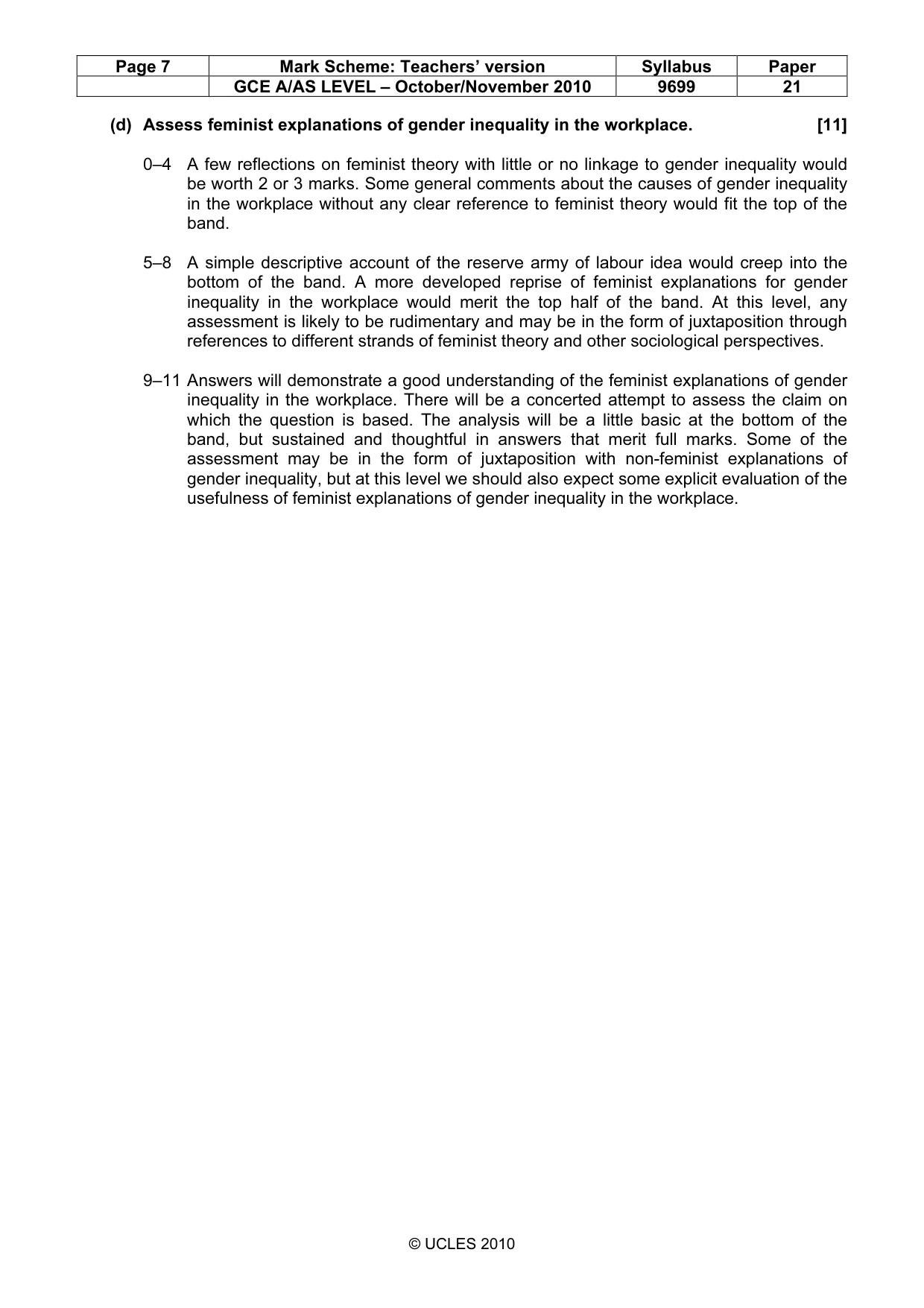
Page 7 Mark Scheme: Teachers’ version Syllabus Paper GCE A/AS LEVEL – October/November 2010 9699 21 © UCLES 2010 (d) Assess feminist explanations of gender inequality in the workplace. [11] 0–4 A few reflections on feminist theory with little or no linkage to gender inequality would be worth 2 or 3 marks. Some general comments about the causes of gender inequality in the workplace without any clear reference to feminist theory would fit the top of the band. 5–8 A simple descriptive account of the reserve army of labour idea would creep into the bottom of the band. A more developed reprise of feminist explanations for gender inequality in the workplace would merit the top half of the band. At this level, any assessment is likely to be rudimentary and may be in the form of juxtaposition through references to different strands of feminist theory and other sociological perspectives. 9–11 Answers will demonstrate a good understanding of the feminist explanations of gender inequality in the workplace. There will be a concerted attempt to assess the claim on which the question is based. The analysis will be a little basic at the bottom of the band, but sustained and thoughtful in answers that merit full marks. Some of the assessment may be in the form of juxtaposition with non-feminist explanations of gender inequality, but at this level we should also expect some explicit evaluation of the usefulness of feminist explanations of gender inequality in the workplace.
What you needed in this session
Cambridge’s own grade thresholds for 2010 Oct/Nov, Paper 2 · Variant 1. A higher threshold means an easier paper — the bar moves with how the cohort did.